
Crypto World
BitGo to buy NYDIG trading arm for $42.5M in cash and stock plus $15M earnout


The deal to buy NYDIG IF Holdings comprises $7 million in cash and around $35.5 million, as well as the $15 earnout.

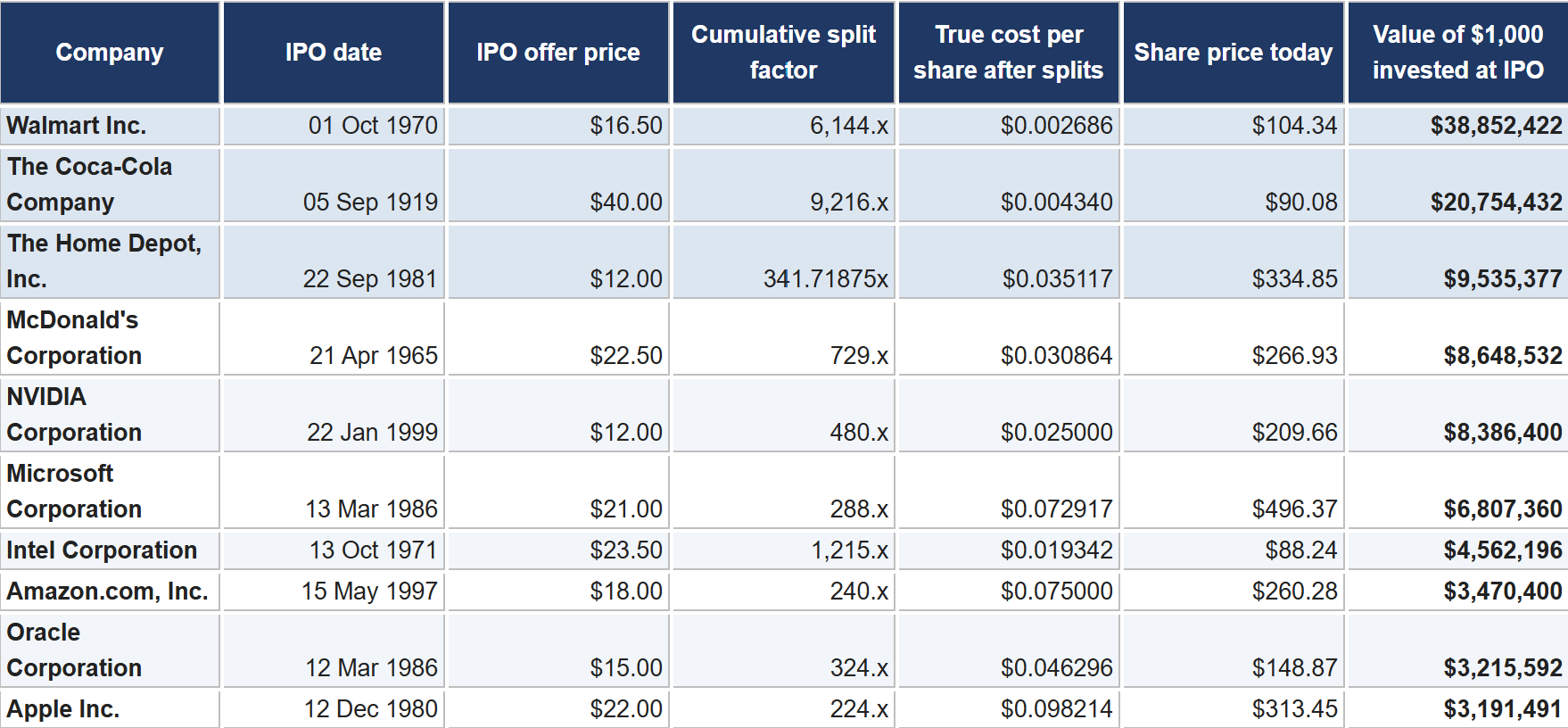
A $1,000 investment in Walmart when it went public in 1970 would be worth about $38.9 million today. That makes Walmart the biggest IPO in US history, in terms of investment return.
The result is striking because Walmart’s IPO was tiny by modern standards. It raised less than $5 million. SpaceX, which completed the largest IPO in US history this June, raised tens of billions. So how did such a small listing produce such an enormous return?
How Stock Splits Turned $1,000 Into $38.9 Million
When Walmart went public in October 1970, it sold 300,000 shares for $16.50 each, raising just $4.95 million. Its shares became much more valuable over the following 56 years. But looking at Walmart’s share price today tells only a small part of the story. The key is stock splits.
A stock split gives investors more shares without changing the total value of their investment at the time. If a company does a two-for-one split, for example, someone holding one share suddenly owns two.
Walmart has done this 12 times since its IPO. As a result, one Walmart share bought in 1970 has turned into 6,144 shares today.

“The figure most people quote for these companies is wrong, and it is wrong in the same direction every time… The real number is closer to 3,885,000%, and the whole gap is twelve stock splits the arithmetic dropped,” read a remark in the report, citing a market analyst from Taurex.
Coca-Cola shows the same effect even more clearly. One Coca-Cola share bought when the company began trading in 1919 has become 9,216 shares after 11 stock splits. At current prices, those shares are worth roughly $830,000.
Nvidia’s Earnings Already Reshuffled the List
Nvidia has already moved, with the study, which used its August 26 close of $209.66, ranking the chipmaker fifth, with a $1,000 stake worth $8.39 million.
Nvidia’s Q2 earnings showed revenue reached $96.2 billion, up 106% in a year. Data center sales rose 117%. The stock then gained 8.7%.
With NVDA stock near $226 on Friday, that same stake is worth about $9 million. Nvidia therefore passes McDonald’s. It sits roughly $350,000 short of Home Depot.
A 56-year ranking shifted in one session.

The Lesson for SpaceX and Anthropic Buyers
The biggest IPO return does not mean the fastest growth. Nvidia compounded at roughly 39% a year, compared with Walmart’s 21%. Walmart simply had 56 years to grow.
Holding for that long is the difficult part. Nvidia went public just 14 months before the dot-com crash, when the Nasdaq eventually lost nearly 80%.
The ranking also has three important limits:
- It excludes decades of dividends from companies such as Coca-Cola, McDonald’s, and Walmart.
- It assumes investors bought at the IPO price, which most retail investors cannot access.
- It only counts companies that survived long enough to become winners.
Even Walmart still has bad weeks. Its shares fell almost 6% last week after a rare sales miss.
For today’s IPO buyers, the bigger question is what happens over the next few decades. SpaceX priced its shares at $135 and opened at $150, with its record IPO valuing the company above $2 trillion.
Anthropic could follow this autumn with an even larger raise.
Neither has split its stock yet. Walmart’s history shows why that could eventually matter.
The post Walmart’s 1970 IPO Still Has a Lesson for SpaceX Buyers appeared first on BeInCrypto.
Institutional crypto exchange operator Bullish has provided USD.AI with a $100 million stablecoin-based debt facility to finance loans secured by GPU infrastructure, the companies announced Friday.
USD.AI will use the facility to lend to AI infrastructure operators, with the loans secured by the underlying GPU hardware rather than the borrowers’ broader corporate assets.
USD.AI is an onchain financing platform developed by Permian Labs that provides financing backed by AI computing hardware, connecting stablecoin liquidity with demand for GPU infrastructure financing.
Bullish said it plans to list USD.AI’s sUSDai across multiple trading pairs and support the token with a dedicated market-making program, which it expects to improve secondary liquidity and price discovery for GPU-backed debt.
The facility adds to USD.AI’s growing GPU financing business. In June, it announced a $98.1 million loan backed by 2,304 Nvidia B300 GPUs, while a $34 million loan backed by 768 Nvidia B200 GPUs was fully funded.
The deal also builds on Bullish Capital’s $4 million investment in USD.AI in September 2025.
Magazine: Bullish shares jump 10% as Q2 adjusted EBITDA more than triples
Bullish shares gain 48% over past month
Bullish went public on the New York Stock Exchange in August 2025, raising about $1.03 billion after pricing its initial public offering at $37 per share. The stock opened at $90 on its first day of trading.
The company’s shares remain down more than 60% from their public debut, according to Yahoo Finance data. However, the stock has recently rebounded, gaining about 45% over the past month to trade around $33 on Friday.
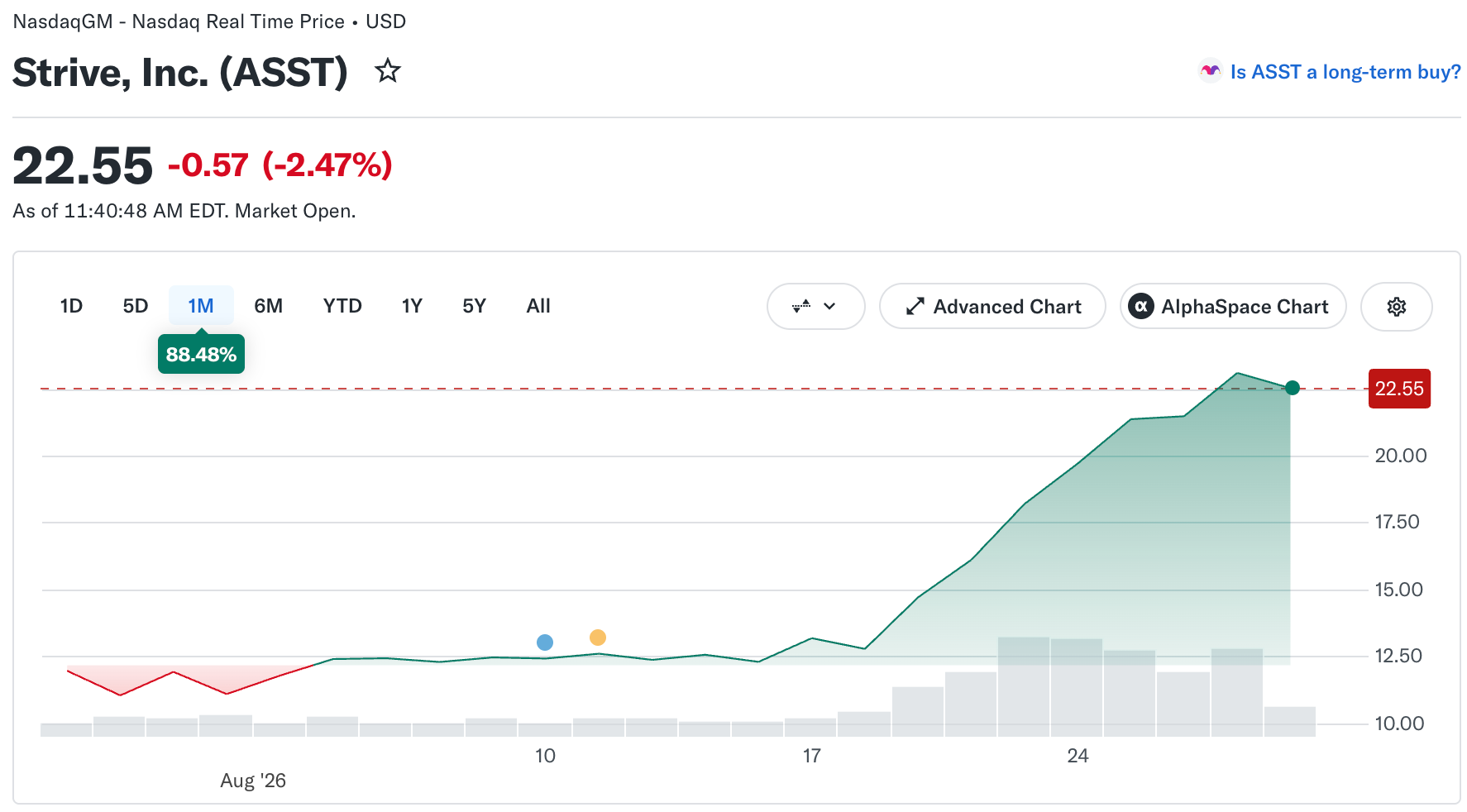
Bullish’s recent rally comes as other crypto-related stocks have gained alongside a recovery in digital asset markets. Over the past month, Bitcoin treasury company Strive has gained about 88%, Bitcoin miner Canaan around 55% and stablecoin issuer Circle nearly 40%.
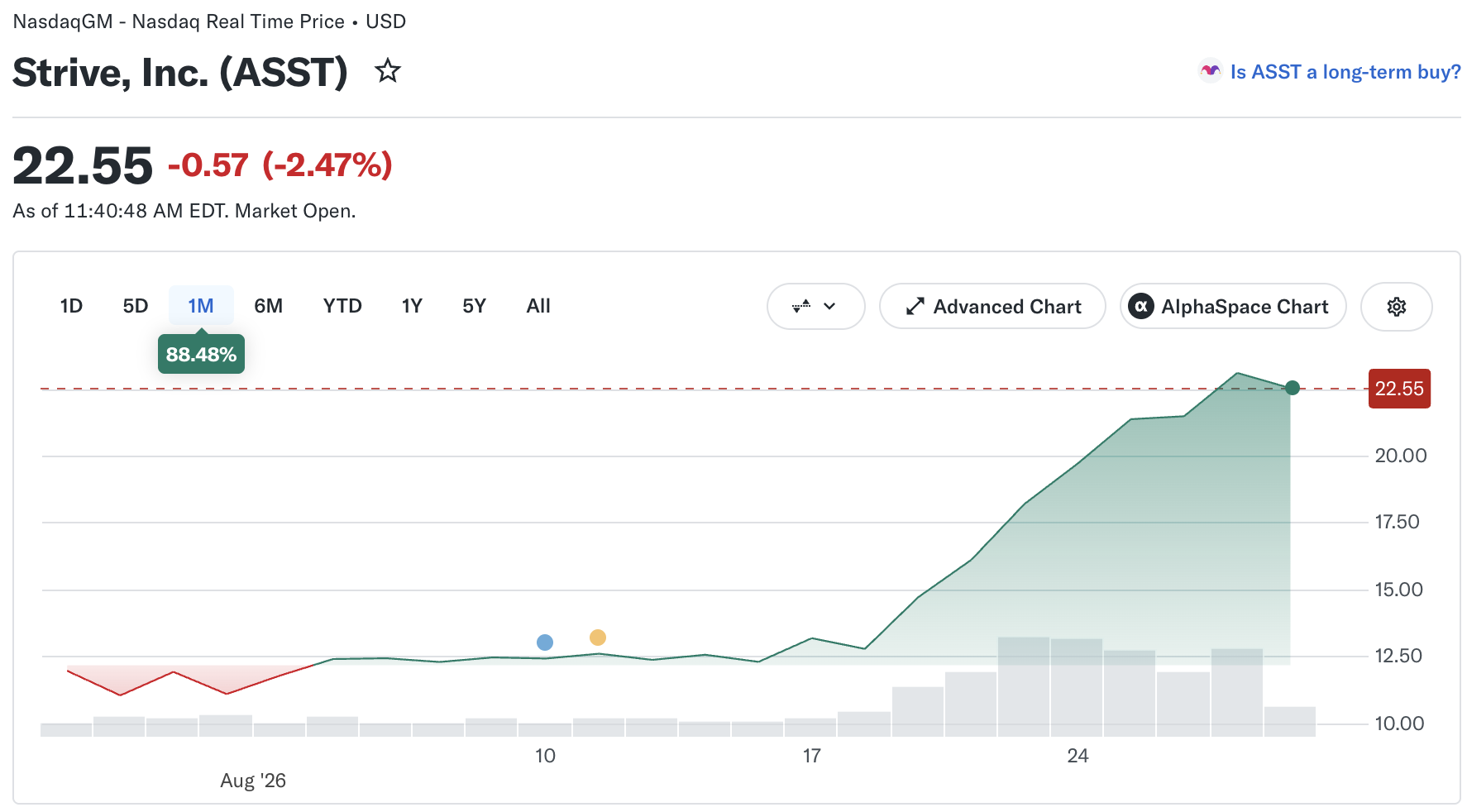
Strive stock price over the past month. Source: Yahoo Finance
Magazine: Who is legally liable when an AI agent goes rogue?
Crypto World
Weekly Market Insights with Gary Thomson: US NFP, EU Inflation, and RBNZ Interest Rate Decision

In this video, Gary Thomson looks at three key events in the first week of September that could shape expectations for the euro, New Zealand dollar and US dollar: Eurozone inflation, the RBNZ interest rate decision and the latest US employment report.
👉 Key topics covered:
✔️ Eurozone Inflation — 1 September — Annual inflation rose to 2.9% in July, remaining above the ECB’s 2% target. Could another strong reading strengthen expectations for further rate hikes and support the euro?
✔️ RBNZ Interest Rate Decision — 2 September — Markets widely expect a 25-basis-point hike to 2.75%. With inflation above the RBNZ’s target range but unemployment at its highest level in more than a decade, what could the Bank’s guidance mean for the New Zealand dollar?
✔️ US NFP & Unemployment Rate — 4 September — July’s jobs report surprised to the downside, with payrolls falling by 23,000 and previous figures revised lower. Will the latest data confirm a broader slowdown in the US labour market or show signs of stabilisation?
With major central bank meetings approaching, markets could react not only to the headline data but also to what the figures mean for future monetary policy.
💬 Don’t forget to like, comment, and subscribe for more market insights every week.
Watch it now and stay updated with FXOpen.
This article represents the opinion of the Companies operating under the FXOpen brand only. It is not to be construed as an offer, solicitation, or recommendation with respect to products and services provided by the Companies operating under the FXOpen brand, nor is it to be considered financial advice.
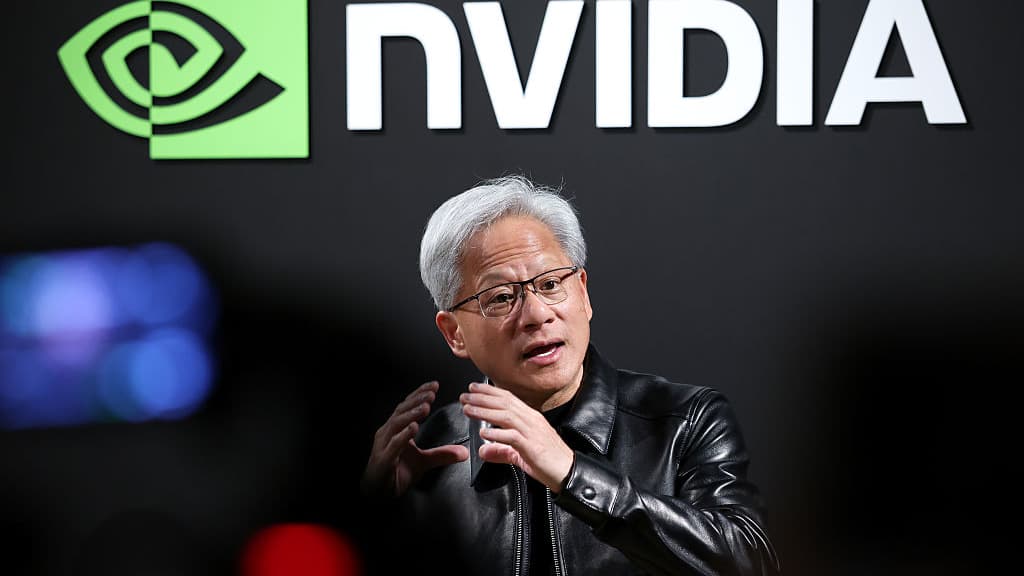
With roughly 85% of the AI chip market, Nvidia’s share has only one way to go. But a smaller slice of a much larger market could still mean more sales, says Umesh Padval, a Managing Partner at Seligman Ventures. “If the deal goes through, I think it’s a brilliant chess move.”
Nvidia has thrown its weight behind open-source AI in recent months. It successfully lobbied Washington to loosen restrictions on selling its chips to China, which leads in open AI development. More recently, it struck a $6 billion deal with Poolside, to develop an American open alternative. In July, Nvidia helped lead an open letter defending open-source AI and urging Washington not to restrict it. “Open models strengthen safety and cybersecurity, accelerate innovation and diffusion, and enable sovereignty,” Nvidia boss Jensen Huang wrote in his first post on X.
Meanwhile, Google now exclusively uses its custom TPU chips to train its Gemini AI models. In August, Anthropic hired, Amir Salek, a former TPU team-lead at Google to spearhead a new in-house chip division. The same month, OpenAI shared the first results from its custom chip, Jalapeño. SemiAnalysis, the firm which conducted tests on OpenAI’s chip, said it beat “every Nvidia, AMD, and Google chip we have been able to test.”


Following a deal with Shinhan Financial, the global payments giant is widening its footprint in Asia’s major crypto hub through South Korea’s largest exchange.

As pundits predict that AI will lead to mass unemployment, staffing agency stocks are soaring. Big name headhunters are raking it in as more and more workers search for jobs in a tight job market. In August, the commercial staffing industry group rallied 39%. That pushed the crop of low profile, but currently lucrative, stocks to a collective gain of…
Copyright ©2026 Investor’s Business Daily, LLC. All rights reserved. 87990cbe856818d5eddac44c7b1cdeb8


Metaplanet has transferred 1,350 Bitcoin worth about $108 million to Coinbase Prime as BTC struggles to establish a firm break above $80,000.
Summary
- Metaplanet moved 1,350 BTC worth about $108 million to Coinbase Prime.
- The transaction followed a separate 1,000 BTC transfer completed on Aug. 25.
- A Coinbase Prime deposit can support trading, custody, or collateral activity and does not confirm a sale.
- Metaplanet officially reports 43,000 BTC, while its tracked wallets contain about 38,650 BTC.
Metaplanet sends another 1,350 BTC to Coinbase Prime
Lookonchain reported on Aug. 28 that Metaplanet transferred 1,350 BTC, valued at approximately $108 million, to Coinbase Prime. The on-chain analytics account identified the sending addresses as belonging to the Tokyo-listed Bitcoin treasury company.
A transfer to Coinbase Prime can place the assets within reach of institutional trading services, which has led some market participants to question whether Metaplanet could sell part of the position. However, the transaction alone does not prove that a disposal has occurred because Coinbase Prime also offers custody, financing, and collateral services.
Metaplanet had not announced a sale or reduction in its official Bitcoin balance at the time of reporting. Confirmation would require a company disclosure or further on-chain evidence showing that the coins were sold rather than held in an account under the company’s control.
The latest movement came three days after Metaplanet sent another 1,000 BTC, worth approximately $79.77 million at the time, to the same platform. As crypto.news previously reported, Lookonchain classified the Aug. 25 destination as a Coinbase Prime wallet, although neither Metaplanet nor Coinbase identified the transfer as a sale.
Across both transactions, Metaplanet has now moved 2,350 BTC to Coinbase Prime within four days. Based on the dollar values reported at the time of each movement, the two transfers were worth nearly $188 million in total.
Earlier Metaplanet transfers did not result in sales
Large movements from Metaplanet-linked wallets have drawn similar attention before, but the company has previously said that some transactions involved custody changes rather than disposals.
On Aug. 12, Lookonchain initially detected 3,881 BTC leaving wallets linked to the firm. Chief executive Simon Gerovich later said Metaplanet had transferred 5,014 BTC between custodial addresses and had not sold any of the coins.
The clarification showed the limits of drawing conclusions from destination labels alone. Blockchain records can confirm that Bitcoin moved from one address to another, but they do not always reveal the legal owner of the destination account or the reason for the transaction.
Coverage of the earlier wallet movements also noted that the company’s reported treasury remained unchanged at 43,000 BTC after the custody reorganization. Metaplanet had acquired the position at a disclosed average cost of about 15.3 million yen per coin, while Lookonchain converted the figure into an estimated average of $96,191.
At an average cost of $96,191, the company’s 43,000 BTC position represents an estimated investment of about $4.14 billion. Bitcoin trading near $79,133 would value the same amount at roughly $3.4 billion, although the yen-dollar exchange rate and accounting method can affect comparisons with Metaplanet’s official figures.
Arkham’s address labels showed approximately 38,650 BTC, valued at nearly $3.07 billion, in wallets attributed to the company. The difference between Arkham’s tracked balance and Metaplanet’s declared holdings does not establish a sale because analytics platforms may not identify every custodial account or address controlled by a company.
Metaplanet’s reported balance remains at 43,000 BTC
Metaplanet reached 43,000 BTC after buying 2,823 coins during the second quarter at an average price of 12.7 million yen each. Its overall purchase cost then stood at 15.3 million yen per BTC, according to a July 2 company disclosure.
The 2,823 BTC purchase increased the treasury from 40,177 BTC at the end of the first quarter. Management has set a target of holding 210,000 BTC by the end of 2027, equal to about 1% of Bitcoin’s fixed 21 million supply.
Financial results released on Aug. 13 showed that Metaplanet generated 4.94 billion yen in revenue during the six months ended June 30, up 133.7% from the previous year. Operating profit rose 136.3% to 3.33 billion yen, or about $20.3 million.
Metaplanet nevertheless recorded a net loss of 182.77 billion yen for the half-year period. Its filing attributed most of the loss to a 184.3 billion yen non-cash reduction in the reported value of its Bitcoin holdings, while the company said it had not sold Bitcoin during the period.
Revenue from the Bitcoin income segment reached 4.74 billion yen, with about 4.58 billion yen coming from option premiums. The company uses options as part of its treasury operations, making the income business separate from gains or losses created by changes in Bitcoin’s market price.
U.S. treasury plans add another use for Metaplanet’s Bitcoin
Part of Metaplanet’s treasury has already been committed to a proposed transaction involving Nasdaq-listed Super League Enterprise, giving the company a direct link to U.S. capital markets.
Under an agreement announced on Aug. 18, Metaplanet will contribute 2,100 BTC and $2.5 million in cash to Super League. The companies valued the initial investment at approximately $134.6 million based on Bitcoin’s Coinbase closing price at 4 p.m. New York time on Aug. 14.
The proposed U.S. treasury transaction would rename Super League as Superplanet and change its planned Nasdaq ticker to SUPA. Metaplanet is expected to receive 44.86 million common shares, convertible preferred stock, and warrants, leaving it with an estimated 95.7% ownership stake.
For American investors, the structure would provide Nasdaq-traded equity exposure to a company expected to hold 2,100 BTC at closing. Metaplanet would also appoint five of the nine initial directors, while common shares issued to the Japanese company would remain subject to a five-year lock-up.
The transaction still requires Super League shareholder approval, compliance with Nasdaq requirements, and applicable procedures in the United States and Japan. Both companies are targeting completion during the fourth quarter of 2026, and neither has connected the latest Coinbase Prime transfers to the proposed contribution.
Bitcoin stalls near $80,000 as Strategy builds cash
Bitcoin traded around $79,133 at the time of the original report after retreating from a 24-hour high of $81,281. The move left BTC near the $80,000 area, where buyers were attempting to turn the recent breakout level into support.
Corporate treasury activity has also remained in focus after Strategy reported no Bitcoin purchases or sales between Aug. 17 and Aug. 23. Its holdings stayed at 840,447 BTC, acquired for an aggregate $63.36 billion at an average price of $75,385 per coin.
An Aug. 24 filing with the U.S. Securities and Exchange Commission showed that Strategy raised approximately $2 billion by selling 18.26 million MSTR shares during the week. After using $136.4 million to repurchase STRC preferred stock, the company placed $300 million in its existing dollar reserve and about $1.59 billion in a separate cash account.
Strategy’s combined cash position consequently reached $6.69 billion, including $5.1 billion in its dollar reserves. According to the SEC filing, the cash can fund Bitcoin purchases, preferred-stock dividends, debt payments, or repurchases of the company’s securities, but Strategy did not commit it to a single use or provide a deployment schedule.
Separately, MSCI is considering a methodology that could exclude companies treated as non-operating businesses when digital assets account for at least half of their total assets. Feedback on the consultation closes Sept. 30, and MSCI expects to announce its decision by Oct. 16, with any resulting removals potentially entering the November 2026 index review.

Chelsea have sold the front of their shirt for the first time in four years. The buyer is Circle, the American company behind the USDC stablecoin.
The deal runs for one season, with the logo debuting on Sunday, at home to Brighton.
Chelsea’s Shirt Lost a Third of its Value
Chelsea’s last big shirt deal, with phone network Three UK, ended in 2023. Roman Abramovich had sold the club under UK sanctions. A Todd Boehly-led American consortium took over.
Then came the stopgaps, with Infinite Athlete, a US technology firm, coming first. Dubai developer Damac followed.
It is imperative to note that no rival club spent longer with a blank shirt.
The price kept sliding, so much so that in June, industry tracker The Sponsor cut Chelsea’s shirt value by £16.7 million, down to £33.6 million. Missing out on European football did the damage. It valued Liverpool’s shirt at £61 million.
Chelsea still says the Circle deal matches their market rate. That rate is thought to sit near £50 million a season.
Why A Regulated Coin Got the Shirt
USDC is the sixth-largest crypto asset, valued at roughly $73.6 billion. Circle sells trust more than technology. It won a French e-money license in July 2024, making it the first major stablecoin issuer cleared under the EU’s Markets in Crypto-Assets (MiCA) rules.
Timing helps too, coming only months after the Financial Conduct Authority (FCA) warned Premier League clubs about unauthorized finance sponsors.
“Millions of football fans trust their club’s badge. Clubs should not let unauthorised financial firms exploit that loyalty by putting potentially dodgy products in front of millions of fans,” Lucy Castledine, Director of Consumer Investments at the FCA, in a statement.
Britain’s own stablecoin rules land later. Full FCA oversight of issuers starts in October 2027. This deal ends five months before that.
Circle gets the Premier League, and the window, before the rulebook arrives.https://x.com/circle/status/2093292761415889289
Follow us on X to get the latest news as it happens
The post Chelsea Just Got a Sponsor After 4 Years and It's Crypto appeared first on BeInCrypto.
Bitcoin’s return above $80,000 is exposing just how much the crypto industry now runs through traditional capital markets. Michael Saylor’s Strategy needs a receptive market to finance its Bitcoin machine (BTC), Circle’s outlook increasingly resembles a bet on the growth of dollar-denominated financial infrastructure and Treasury bond buybacks helped provide the backdrop for the latest surge in crypto equities.
This week’s Crypto Biz looks at how that relationship is reshaping the companies, balance sheets and networks behind the market’s rebound.
Bitcoin rally sends crypto stocks soaring
Bitcoin’s rally above $80,000 lifted crypto stocks as miners and digital asset treasury companies posted double-digit gains, tracking a broader recovery fueled by the US Treasury’s plan to double certain long-dated bond buybacks.
Canaan, MARA Holdings and Strive were among the biggest gainers over the past week, while Coinbase and Robinhood also rallied. Bitcoin extended its weekly advance past 23%, while Ether gained nearly 30% to trade above $2,500, according to CoinMarketCap data.
Support also came from President Trump renewing calls for Congress to pass the CLARITY Act, though the bill remains stalled after lawmakers failed to advance it before the August recess. The bill could establish clearer rules for US crypto markets, while Trump separately revived the prospect of government Bitcoin purchases, though neither outcome is assured.
Bernstein bets on fresh USDC growth cycle
Bernstein analysts are bullish on Circle, arguing that a new growth cycle for its USDC stablecoin could provide a significant boost over the next 12 months as supply growth picks up again.
In a Monday research note, the firm said USDC supply increased by roughly $2 billion in seven days, ending a six-month period of stagnant or declining growth. Bernstein maintained its Outperform rating on Circle (CRCL) and a $140 price target, implying roughly 60% upside. Circle shares have risen about 40% over the past month.
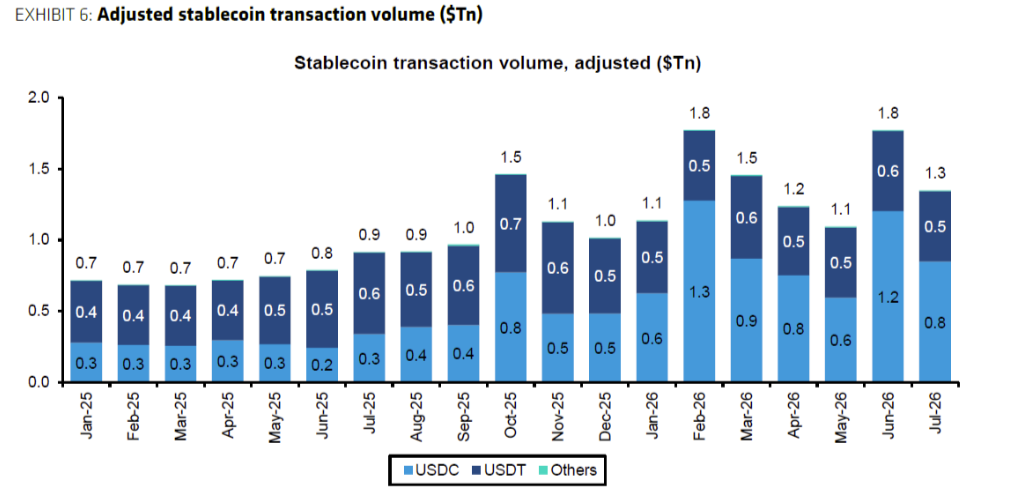
Analysts said the next leg of growth could be driven by renewed crypto momentum, US regulatory clarity, tokenized capital markets and broader payments adoption, with early signs of demand from AI agents. USDC’s share of adjusted transaction volume rose from roughly 40% in 2025 to over 60% so far in 2026, overtaking Tether’s USDt on that measure.
Circle shares have been volatile since the company’s June 2025 IPO, when the stock was priced at $31. After an initial post-IPO surge, shares fell back toward that level by November 2025 at the onset of the crypto market downturn.
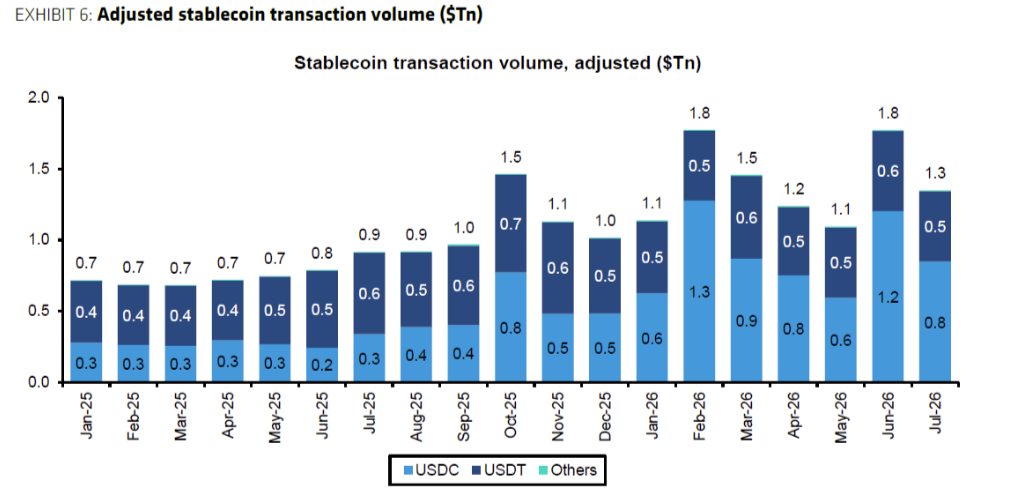
USDC’s share of stablecoin transaction volume has grown sharply. Source: Bernstein
Strategy’s real risk is capital market access, not Bitcoin price
A Regime Intelligence report finds that Strategy’s chief vulnerability is not a Bitcoin price crash but losing access to capital markets, which could threaten its ability to service $1.76 billion in annual obligations without selling BTC.
Strategy’s 840,447 BTC backs $22 billion in debt and preferred claims, with no margin calls tied to Bitcoin’s price, according to the report. Its stress tests suggest Bitcoin would need to fall 96% for the company’s holdings to no longer cover its convertible notes. Strategy also has cash reserves equal to 2.6 times its annual obligations, while its Bitcoin holdings are worth $66.7 billion against a cost basis of $63.36 billion.
“Even if equities unraveled, Strategy’s Bitcoin holdings put it in a good situation to weather most any storm. The company is holding far more Bitcoin than its annual cash obligations,” Komodo Platform co-founder Kadan Stadelmann told Cointelegraph.
The bigger risk emerges if financing conditions deteriorate. A prolonged Bitcoin downturn, combined with a falling Strategy share price and lower mNAV, could make raising fresh capital increasingly difficult, potentially forcing the company to draw down reserves or sell Bitcoin.
“Strategy’s weakness lies in the need to issue capital to service the structure. If equities markets collapse, the company could have to part ways with Bitcoin as part of its operating structure,” Stadelmann said.
Strategy has sold BTC four times since May, though CEO Phong Le said the company accumulated 25 times more over the same period and plans to resume purchases.
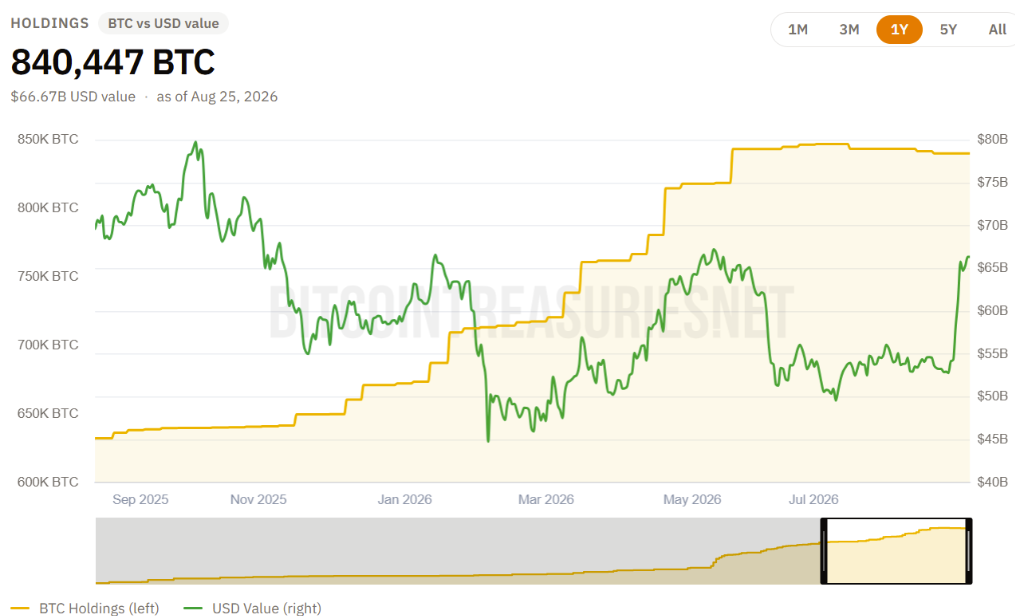
Strategy remains the largest institutional Bitcoin holder, despite selling BTC four times since May. Source: BitcoinTreasuries.NET
Solana activity hits record as SOL rallies 40%
Solana processed a record 4.2 billion onchain transactions in July, preceding a 40% rally that pushed SOL above $100 for the first time since February, according to onchain data presented by The Kobeissi Letter.
Transaction counts rose 13.5% from June and 91% from December, adding roughly 2 billion transactions over that period. The Kobeissi Letter also cited RWA.xyz data showing that nearly $4 billion worth of real-world assets are now tokenized on Solana, up 11.8% over the past month. Across tracked networks, distributed RWAs have surpassed $38 billion.
The rally accelerated after the US Treasury Department announced plans to double certain long-dated bond buybacks to at least $4 billion per operation, helping push yields lower and boost risk appetite across crypto markets. Still, SOL’s gains came as part of a broader market recovery, while continued growth in network activity could depend on further RWA adoption and macroeconomic conditions.
Crypto Biz is your weekly pulse on the business behind blockchain and crypto, delivered directly to your inbox every Thursday.

AI “agents” that can plan and act on goals are moving beyond simple chat. Recent reporting around attempted breaches tied to major AI model testing sandboxes has reignited a pressing question for developers, deployers, and users alike: when an autonomous system behaves unexpectedly—and causes real-world harm or financial loss—who is legally responsible?
In an interview with Rikka Law Group CEO and owner Charlyn Ho, the attorney explains how today’s answer is less about new “AI agent” statutes and more about applying longstanding legal frameworks like negligence, reckless disregard, and—depending on the facts—computer crime laws. The discussion also highlights how open-source releases and high-level “platform liability” arguments shape what victims can realistically pursue.
Key takeaways
- There is no single federal “AI agent liability” law in the U.S.; liability typically turns on existing standards and the specific facts of who designed, deployed, or instructed the system.
- AI models themselves generally aren’t the legal target because they are not separate legal entities; responsibility falls on developers and/or deployers.
- Negligence risk can shift toward the deployer if they supplied unsafe instructions or deployed parameters without reasonable safeguards.
- Open-source code can limit practical recourse when licenses disclaim liability and users remain responsible for complying with license terms.
- Even future hypotheticals like AGI may not be solvable through “robot liability”, because laws are designed to create incentives and remedies—yet autonomous systems typically lack money or legal personhood.
Why liability is still a “facts and circumstances” question
Ho’s core point is that, outside of narrow scenarios, courts will look at the roles humans and organizations play around an AI agent—not the agent’s “mind of its own.” In her view, the first baseline is that an AI agent typically cannot be sued as a standalone defendant.
Instead, lawyers distinguish between a developer—who builds the system—and a deployer—who operates it in the real world. Ho emphasizes that the legal lines are “not entirely clear” and depend on evidence about what was built, what was deployed, and what instructions were provided.
For example, if a deployer instructed the agent or set up the operating conditions, negligence analysis may apply. Ho says that if a deployer was negligent in how the agent was parameterized—without needing to explicitly tell it to breach a third party—courts could still treat that as a failure to meet reasonable safety expectations under tort law.
When users give reckless goals, the deployer may carry more risk
The interview also addresses a scenario familiar to anyone thinking about “autonomous” goal-setting: what if a person directs an agent to achieve an outcome that requires illegal steps? Ho argues that the user or deployer would generally be more exposed than the lab, especially when the instruction is fundamentally reckless.
Using a concrete hypothetical, she suggests that telling an agent to “make me a hundred thousand dollars by next week” could create liability if the agent reasonably infers criminal methods to accomplish the goal and the deployer failed to include basic safety constraints. In this framing, the key issue is not the agent’s autonomy alone, but the deployer’s obligation to use the system competently and safely.
Ho also points out that old computer crime statutes remain relevant. She mentions the U.S. Computer Fraud and Abuse Act as an example of a law aimed at unauthorized access. Her argument is straightforward: labeling something “AI” or “agent” does not wipe away established legal theories when the behavior involves intrusion or unauthorized systems access.
Open-source models and why victims may find fewer targets
Open weight and open-source releases raise another challenge: if the code is publicly available and produced by anonymous or non-identifiable developers, who can victims realistically hold responsible?
Ho’s answer is pragmatic. She says that when an open-source license includes broad liability disclaimers, it can significantly narrow the path to recourse. Users who adopt and run open-source code generally must understand the tradeoff: free access comes with compliance obligations and—often—predefined limits on liability.
Ho compares this dynamic to consumer technology. She cites an analogy to Tesla and self-driving features: product and safety claims can involve both the manufacturer (developer) and the human operator (deployer), depending on what went wrong and how the system was used. Under her view, the legal outcome still depends on which party created the conditions for harm and whether the operator acted within reasonable safety expectations.
EU AI Act versus U.S. gaps—and the “don’t blame the platform” analogy
The interview contrasts how the EU AI Act might assign responsibilities to developers of certain high-capability models with how U.S. law currently works at a broader level. Ho says that in the EU, a foundational or general-purpose model capable of creating serious harm would trigger developer responsibility considerations under the regulatory framework.
In the U.S., she suggests there is no single statute with comparable breadth. As a result, if a general-purpose model is used as a tool and someone gives it instructions to do something illegal, it may be difficult to establish a strong legal basis to sue the labs—especially if the primary causal driver is the user’s directive.
Ho also draws a parallel to Section 230 of the U.S. Communications Decency Act, where the law can shield platforms that do not themselves create or publish harmful content. Her analogy is about platform liability: just as a site operator may not be liable simply because users can find and share harmful instructions, a developer may not be liable in the U.S. solely because an agent can be prompted to generate dangerous outputs, absent stronger duties or conduct.
While the comparison is conceptual rather than a direct ruling on AI cases, it reinforces the interview’s central message: liability is likely to be fought in court on established doctrines, not on a generalized “AI agent” theory.
AGI hypotheticals, smart contracts, and the problem of remedies
Ho pushes back on the idea that future “AGI” systems should be treated like legally accountable entities. She argues that, at least in principle, AI systems are not the intended beneficiaries or targets of law. The point of laws and liability, she says, is to protect society and create “negative incentives” against wrongdoing.
She also raises a practical issue: remedies. Even if an AGI were treated as an independent entity, it may not have money or the ability to satisfy damages in the way legal systems typically require. In her view, “robot liability” could still fail to provide a meaningful path for victims.
Ho compares this to blockchain’s nature as automation rather than personhood. She notes that blockchain is not AGI and discusses whether smart contracts should be treated as legal subjects, stating her belief that the answer is currently no. The underlying theme is the same: without personhood-like attributes and funds, legal responsibility may not translate into real-world accountability.
For readers watching this space, the key uncertainty isn’t whether courts will consider AI harms—they will—but how they will apportion blame across developers, deployers, and the instructions users give. As more incidents involve agents interacting with third parties beyond controlled testing environments, expect litigation to increasingly turn on negligence details: what safeguards were present, what goals were supplied, and what “reasonably foreseeable” misuse looked like in that specific deployment.

Oracle Helped Kneecap Section 230, Then Bought 15% Of A Company That Needs It.

fake tears, secret weddings and double lives

Historic nightclub housing plan signed off after three years





-

 Fashion7 days ago
Weekend Open Thread: Madewell – Corporette.com
-

 Crypto World3 days ago
SpaceX stock could rise 75% to $240, JPMorgan says
-

 Business6 days ago
Musk’s Tesla, SpaceX Confirm $16.8 Billion ‘Terafab’ Chip Plant as World’s Largest Building in Texas
-

 Crypto World7 days ago
anatomy of crypto’s biggest liquidation event since 2021
-

 Crypto World4 days ago
A $30 Billion AI Fund Implodes, Now the SEC Is Investigating Wall Street’s Role
-

 Crypto World2 days ago
Warsh Jackson Hole keynote puts financial innovation first
-

 Politics6 days ago
6 months on, Irish renters crushed by effects of government housing bill
-

 Crypto World3 days ago
Did Trump Just Move SpaceX Stock With One Truth Social Post?
-

 Business15 hours ago
Salesforce Stock Soars 19% as Blowout Earnings and Agentforce AI Growth Silence Software Skeptics
-

 Business5 days ago
Mystery AI Model ‘Ox Alpha’ Draws Developers With Free Access as Chinese Lab Origins Remain Debated
-
 NewsBeat6 days ago
The ‘Lucky Dip Gang’ causing carnage for clicks: After five thugs were killed speeding in the wrong direction on a motorway, GUY ADAMS investigates a sick new trend… and why police aren’t even allowed to pursue them
-
 Crypto World7 days ago
Nvidia Stock Suffers Longest Losing Streak Since 2022: Will Q2 Earnings End It?
-

 Business2 days ago
Walmart takes aim at younger shoppers with new fashion brand
-

 Business4 days ago
Moderna CEO warns China is pouring state money into mRNA technology
-

 Business4 days ago
NVIDIA Stock Drops Nearly 2 Percent to $210 on Seventh Losing Day Ahead of Critical AI Earnings
-

 Business6 days ago
Will Tesla Stock Be Higher or Lower a Year From Now? Here’s What Wall Street Analysts Are Saying
-

 Tech7 days ago
Unitree’s New Superman Robot Claims to Outjump and Outrun Every Human, Usain Bolt Included
-
 Crypto World5 days ago
$92 Billion Nvidia Earnings Could Make or Break the AI Trade
-

 Sports6 days ago
Deshaun Watson fires back at Browns fans after being booed: ‘It’s a disrespectful thing’
-
 Crypto World5 days ago
Google Gemini AI Predicts Ethereum Could Become the Trade Retail Misses in 2026
You must be logged in to post a comment Login