

Crypto World
Bitmine Buys $52M ETH as Tom Lee Notes ETH Strength Not Yet Priced

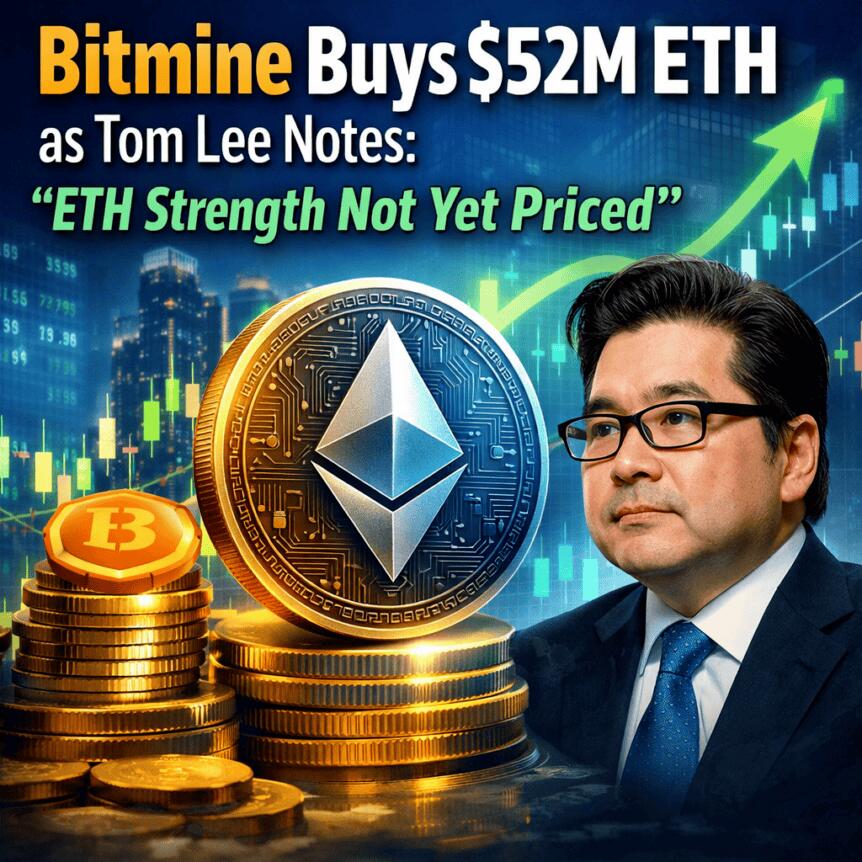
Bitmine Immersion Technologies has expanded its Ethereum holdings again, adding 26,497 ETH over the past week and lifting its total ETH reserves to about 5.42 million tokens. In a Monday statement, Bitmine chair Tom Lee reiterated that the move reflects a belief that Ethereum’s on-chain fundamentals are strengthening, even as crypto markets have faced choppier trading and broader sector volatility. The purchase adds to Bitmine’s reputation as the largest Ether treasury holder, a position reinforced by the company’s public disclosures and its ongoing accumulation strategy.
Bitmine now sits atop one of the most substantial crypto treasuries in existence, with estimates valuing its ETH stake at more than $10.5 billion at current prices. Earlier in the month, the firm slowed the pace of purchases after a stretch in which it scooped up more than 100,000 ETH per week for three consecutive weeks. The shift back to heavier buying signals the company’s continued confidence in Ethereum’s long-term appeal and its potential to weather near-term price softness.
According to Bitmine, the latest weekly addition brings its total ether holdings to roughly 5.42 million ETH, a level that underscores the company’s strategic thesis: that Ethereum stands to benefit from broader adoption, institutional interest, and the ongoing development of a sector-wide ecosystem around decentralized finance, tokenization, and scalable computing. The disclosure arrived via Bitmine’s X account, alongside the broader press materials that outlined the firm’s treasury targets and timeline.
Ether’s price action has chipped away at gains for the week. Data from CoinGecko show ETH down about 4.7% over the past seven days, trading in a wide band between roughly $1,963 and $2,126. In recent sessions, the token has hovered just under $2,000, illustrating the stubborn price rigidity that has characterized the market in recent months even as fundamentals push forward.
Lee spoke with CNBC on Monday to address the market backdrop, acknowledging that crypto sentiment has been softer as other technology sectors—particularly software—have shown resilience or even momentum. He framed the current lull as part of a familiar cycle, suggesting that the sector’s best days often follow a period that traders describe as crypto winter. The crypto market’s temperament, he implied, remains tied to the timing of macro catalysts and the pace of institutional adoption, rather than to short-term price swings alone.
Beyond price, Lee reiterated a conviction in the enduring usefulness of Bitcoin and Ethereum as foundational platforms for the next wave of digital money and commerce. He pointed to the parallel evolution of decentralized identity and verification as a natural complement to AI-enabled services and e-commerce, arguing that crypto’s core value proposition—trust-minimized verification and programmable money—will become increasingly central as digital interactions scale.
“As AI systems evolve, we’re talking about using commerce and operating websites, you need decentralized identity and verification, and that’s really what crypto does,” Lee said. “We know Wall Street wants to go toward tokenization; it’s a vast improvement in efficiency of how money actually moves, and that’s an innovation. The future isn’t changed.”
Bitmine’s public strategy has long centered on building a dedicated Ether treasury, a plan it outlined in July 2025. The target was to hold 5% of Ethereum’s circulating supply, a figure anchored to a ~120.6 million token base. With more than 5.4 million ETH already held, the firm has claimed roughly 90% of that goal—and it has signaled an expectation to complete the objective in 2026. The plan, if realized, would mark one of the most ambitious centralized treasury plays in crypto history and would position Bitmine as a persistent structural buyer in Ethereum’s market.
In context, Bitmine’s pace of acquisition has drawn attention to the potential role of corporate treasuries in crypto markets. While the weekly purchases in prior weeks signaled a robust, steady commitment, the subsequent slowdown reflected a balancing act as the market priced in uncertainty about macro conditions, regulatory developments, and sector-specific catalysts. The firm’s latest move, however, shows a renewed willingness to deploy capital in what it describes as a long-term, value-oriented strategy rather than a short-term trading bet.
From a market perspective, Ethereum’s fundamentals have continued to align with a narrative of digital identity, programmable money, and scalable, secure contracts. While price action remains a friction point for many active participants, the architecture of Ethereum—layered by upgrades, ecosystem maturation, and a growing array of decentralized applications—continues to attract attention from institutional and high-net-worth investors who view Ethereum as a long-duration asset with a compelling growth profile.
Key takeaways
- Bitmine’s ETH holdings rose by 26,497 ETH in the past week, taking its total to about 5.42 million ETH.
- The firm remains the largest Ether treasury holder, with an estimated value exceeding $10.5 billion at current prices.
- Ether’s price has weakened over the past week, down about 4.7%, trading in a range roughly between $1,963 and $2,126 per token.
- Tom Lee frames the current market as part of a broader crypto cycle, suggesting the “end of crypto winter” could be on the horizon as fundamentals strengthen.
- Bitmine’s long-term plan is to accumulate roughly 5% of Ethereum’s circulating supply (about 6.0 million ETH), with a target completion in 2026.
Bitmine’s ETH push deepens its treasury role
The latest purchase reinforces Bitmine’s strategy of building a robust Ether treasury as a core component of its business model. The 26,497 ETH addition adds to several weeks of aggressive accumulation that helped the company reach a multi-million-ETH position. The firm’s leadership has framed the stockpile as a bet on Ethereum’s continued network effects, including stronger on-chain activity, more robust DeFi liquidity, and an expanding ecosystem of smart-contract applications.
Industry observers have noted that such treasury commitments are relatively rare in scale, highlighting Bitmine’s willingness to deploy capital to a single-asset allocation that resembles corporate treasury behavior in traditional finance. The emphasis on a long-horizon strategy—rather than quick trades—suggests management’s belief in Ethereum’s role as a foundational layer of Web3 infrastructure and its potential to attract greater institutional participation as tokenization gains traction.
Bitmine’s leadership has repeatedly cited Ethereum’s ongoing upgrades, ecosystem growth, and the viability of smart contracts as the backbone for its conviction. The company publicly disclosed its Ethereum target and timelines, signaling that the treasury build is a deliberate, staged effort rather than a one-off accumulation. When viewed alongside other crypto institutions, Bitmine’s scale stands out, potentially influencing how peers think about treasury risk, liquidity, and strategic positioning in the coming years.
It’s worth noting that Bitmine began the year with a noticeably aggressive purchasing cadence, spurring conversations about the sustainability of such a pace. The company subsequently moderated its purchases, a move that some market participants interpreted as a cautious reassessment in light of evolving market conditions. The latest weekly addition, however, indicates a renewed commitment to enlarging the Ether treasury’s footprint in the near term.
Price backdrop and investor sentiment
ETH’s price action remains a key focal point for investors weighing the merits of such a treasury strategy. While Bitmine’s purchases demonstrate conviction in Ethereum’s longer-term trajectory, the near-term price dynamic continues to reflect a mix of macro uncertainty, regulatory risk, and shifting risk appetite across crypto assets. The price softness over the past week contrasts with the anticipated flow of capital from institutions and strategic buyers who view Ethereum as a core blockchain with scalable potential.
Lee’s remarks to CNBC emphasize a paradox often observed in crypto markets: while price moves can lag the underlying fundamentals, institutional and strategic interest can still intensify as the ecosystem matures. If Ethereum’s upgrade cycle, Layer-2 rollups, and the broader tokenization narrative begin to translate into tangible on-chain activity and liquidity, investor sentiment may begin to reprice risk more decisively. For now, the price remains a secondary indicator to the structural growth story Bitmine is betting on.
In parallel, industry watchers will want to monitor the progress of Bitmine’s 2026 target. Reaching 5% of circulating supply would require steady, sustained accumulation, and any deviation—whether due to liquidity constraints, tokenomics shifts, or regulatory headwinds—could influence how other corporate treasuries calibrate their own crypto exposure. The path from strategic buy-and-hold to realized influence in Ethereum’s market remains uncharted, but Bitmine’s evolving treasury could serve as a reference point for future large-scale corporate involvement in crypto.
Tokenization, identity, and the broader crypto thesis
Lee’s commentary underscored a broader narrative that crypto supporters have been advancing for years: that blockchain-based tokenization and decentralized identity are not only intrinsic to the technology’s value proposition, but are likely to accelerate as digital commerce expands and AI-powered systems proliferate. In practical terms, that means more efficient settlement, identity verification, and access control across financial services, supply chains, and digital services—areas where Ethereum and similar platforms could play a central role.
From a market structure perspective, the interaction between institutional tokenization ambitions and Ethereum’s on-chain capabilities could create a layered demand dynamic. If Wall Street and corporate treasuries continue to pursue tokenized assets, programmable money, and trust-minimized settlement, Ethereum’s ecosystem—the backbone for smart contracts—could see a more persistent bid, even in the absence of rapid price appreciation in the short term.
Bitmine’s strategy thus sits at a crossroads of technology, finance, and governance. It is a high-profile example of how large crypto treasuries operate, how they articulate their rationale to the market, and how they respond to shifting cycles of price and sentiment. While this week’s ETH purchases and the five-percent target are notable, the ultimate question remains: will the institutional appetite for Ethereum-scale holdings translate into sustained demand and price resilience as the ecosystem matures?
As the sector navigates regulatory developments and evolving market dynamics, readers should watch for three signals: the trajectory of Bitmine’s treasury target toward completion in 2026, any incremental data on Ethereum’s upgrade roadmap and Layer-2 adoption that could lift on-chain activity, and broader market reactions as institutional investors increasingly articulate long-term crypto exposure alongside traditional asset classes.
Source and official disclosures from Bitmine can be found in the company’s latest post on X and accompanying press materials, including the press release detailing ETH holdings and treasury status. For price reference, CoinGecko’s ETH data is used to outline recent movement, while Lee’s commentary is drawn from his CNBC interview and related remarks reported by industry outlets.
Readers should stay tuned to Bitmine’s ongoing disclosures and any regulatory developments that could affect large-scale crypto treasury strategies. The next couple of quarters will be telling as the firm pushes toward its 2026 milestone and as Ethereum-based use cases continue to mature in the real economy.
Note: This article reflects information disclosed by Bitmine and publicly available market data. All figures are subject to change with market pricing and corporate filings.


Kraken just became the official crypto exchange of the 2026 FIFA World Cup. Their marketing message? It’s clearly not for FIFA fans. It’s for people already in crypto. Here’s why that’s the biggest missed opportunity in sports marketing.
The Message That Reveals Everything
Kraken’s FIFA 2026 campaign just dropped. Here’s their pitch:
“Some watch every match; some only the ones that matter. Some are ride-or-die for one team, every win, every heartbreak, for life. Others just love the game, no matter who’s playing. Crypto’s no different. Some study every chart. Some go all-in on one coin and hold for years. Others just want a bit of everything. Kraken is built for all of them.”
Read that carefully.
Who is this message for?
Not FIFA fans discovering crypto. For people who already understand crypto talking about crypto using a soccer analogy.
That’s not a conversion pitch. That’s in-group messaging masquerading as a mainstream campaign.
What A Real Conversion Campaign Would Look Like
If Kraken was actually trying to convert FIFA fans, the billions of people watching the World Cup, the message would be completely different.
It would translate crypto concepts into soccer language:
Option 1 (Direct conversion): “You believe in your team. You invest emotion, time, loyalty. Investing in crypto is the same thing, belief, conviction, loyalty to an asset. Kraken makes that easy.”
Option 2 (Simple Value Prop): “Your national team wins, you celebrate. An investment wins, you profit. Kraken lets you profit from your convictions.”
Option 3 (Accessibility Angle): “Not everyone can afford to buy a team. Everyone can afford to invest in crypto. Kraken makes it accessible.”
What Kraken actually did: Used “hodlers” (a crypto insider term) in a campaign aimed at… FIFA fans?
No. Not FIFA fans. Crypto people who follow FIFA.
The Smoking Gun: “Hodlers”
The word “hodlers” is the tell.
A FIFA fan watching the World Cup has no idea what a “hodler” is. They’ve never heard the term. It means nothing to them.
But a crypto person? They know exactly what that means. It’s the crypto community’s inside joke about holding investments long-term.
Kraken used an insider term in a campaign supposedly designed to reach mainstream sports fans.
That’s not an accident. That’s evidence the campaign was never designed to convert new people.
It was designed to give existing crypto people a campaign they’d recognize and share with other crypto people.
That’s not marketing. That’s community building for people already bought in.
Why This Is A Massive Missed Opportunity
FIFA 2026 is the biggest sporting event in the world. It’s watched by over a billion people.
Kraken has access to all of them.
And what did Kraken do? They created a campaign that only resonates with people who already understand crypto.
Do you know how many potential new crypto users Kraken just failed to convert?
All of them.
Instead of saying “Crypto is like soccer-passion, belief, investment,” Kraken said “We understand your hodling journey, fellow hodlers.”
Those are not the same message. One converts. One reinforces.
The Pattern This Reveals
This isn’t just Kraken. This is crypto’s fundamental problem:
Crypto doesn’t know how to talk to people outside crypto.
Every major crypto campaign makes the same mistake:
- They use insider terminology (HODL, diamond hands, paper hands, rugpull, etc.)
- They assume people already understand the concept
- They communicate to crypto people using sports/culture metaphors
- They act surprised when mainstream adoption doesn’t happen
Kraken just demonstrated this at scale. With a billion-person audience. And a $X million sponsorship budget.
And they wasted it by talking to people who already get it.
What This Actually Reveals About Crypto’s Status
Here’s what Kraken’s campaign accidentally proves:
Crypto has stopped trying to convert mainstream audiences.
Why? Because it failed. The aggressive “mainstream adoption” campaigns of 2022 didn’t work. So now crypto is just trying to:
- Retain existing users
- Extract more value from them
- Use mainstream visibility to communicate insider concepts
That’s not expansion. That’s consolidation.
Kraken didn’t say “FIFA fans should discover crypto.” Kraken said “Crypto people, here’s a FIFA metaphor you’ll understand.”
The audience shifted. The opportunity shrunk. And nobody noticed because the sponsorship was so flashy.
How To Actually Use A FIFA Sponsorship
If I were Kraken, here’s what I’d do:
Phase 1: Convert Target FIFA fans with crypto-as-investment messaging. “Your team wins, you celebrate. Your investment wins, you profit. Here’s how.”
Phase 2: Educate Create FIFA-themed explainers. “How Bitcoin works (explained through FIFA analogies).” “What is a blockchain (using team formations as analogy).”
Phase 3: Onboard Make it stupidly easy for FIFA fans to buy crypto. Remove friction. Simple interface. Clear language.
Phase 4: Retain Once they’re in, communicate in crypto language. Now the insider terminology makes sense.
Instead, Kraken jumped straight to Phase 4 with a billion-person audience.
That’s not strategy. That’s leaving money on the table.
The Uncomfortable Truth
Crypto has accepted that mainstream adoption failed.
Instead of trying again with better messaging, crypto is now:
- Using mainstream visibility to communicate with existing users
- Creating insider-friendly campaigns that alienate newcomers
- Celebrating “official sponsorships” while failing to convert anyone
Kraken’s FIFA campaign is just the clearest example.
A billion-person audience. A chance to convert millions of new users. And the message was: “Fellow hodlers, here’s a crypto metaphor for soccer.”
That’s not a World Cup campaign. That’s a Reddit post dressed up as a major sponsorship.
What Comes Next
Crypto will claim the Kraken FIFA partnership is a victory.
Official sponsorships. Mainstream visibility. Biggest World Cup ever.
But the campaign itself—the actual message Kraken created—reveals the truth:
Crypto isn’t trying to convert new people anymore. Crypto is just trying to extract more value from people already in the ecosystem.
That’s not a sign of maturity. That’s a sign of surrender.
And a billion FIFA fans just learned… absolutely nothing about crypto, because Kraken was never trying to teach them.
The Real Lesson
If you want to reach a mainstream audience with a niche product, you have to translate it into their language.
Kraken had the opportunity. They had the budget. They had the audience.
They just didn’t have the vision to actually try.
Instead, they created a campaign for people who didn’t need converting.
That’s the most expensive way to reinforce what people already know.
What should Kraken’s FIFA campaign have said to actually convert fans? Drop your ideas, but make them actually appeal to someone who knows nothing about crypto.
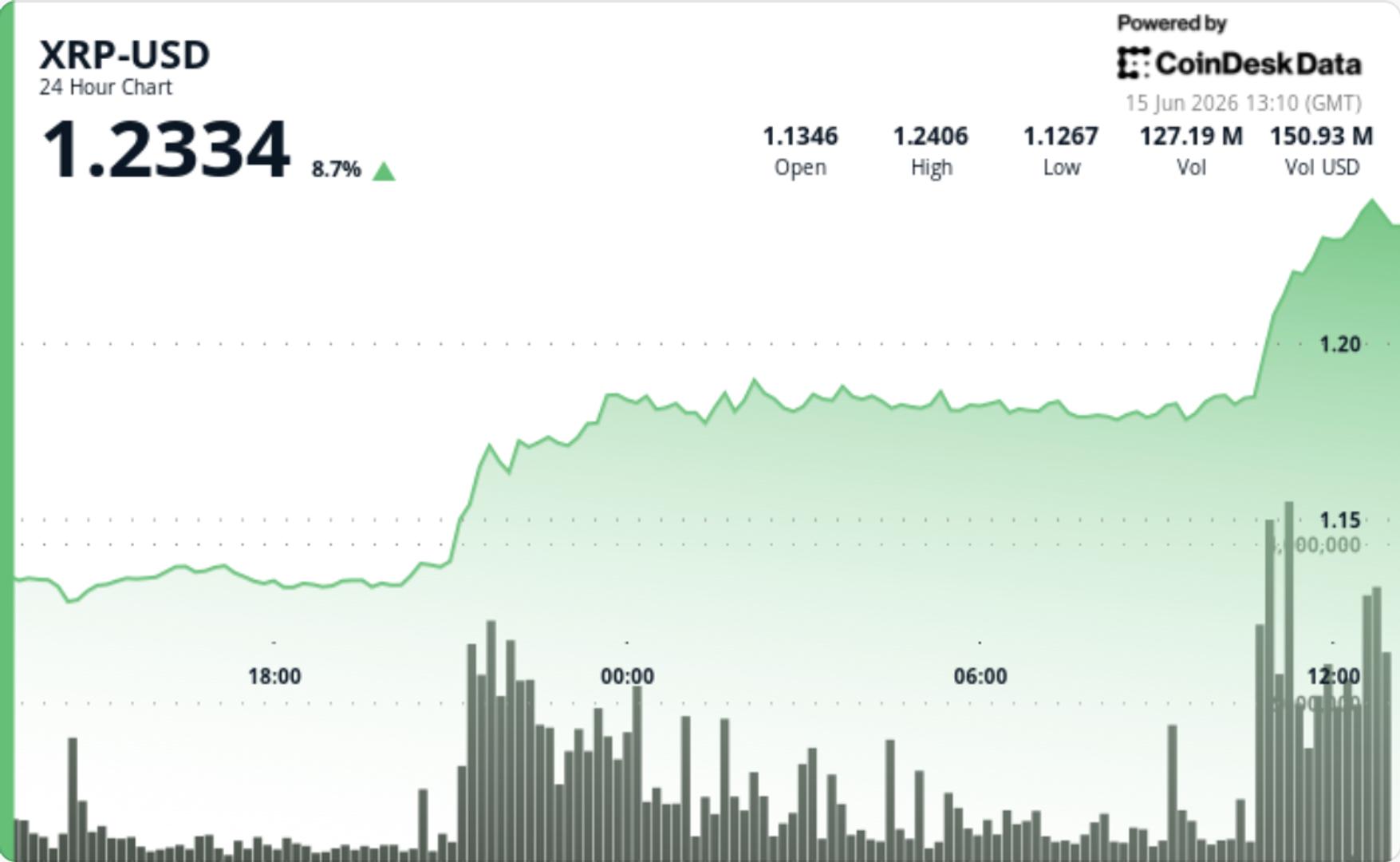
XRP spent the past two weeks trying to stop going down. Now it’s trying to go higher.
The token pushed through $1.14, then $1.18, and finally reclaimed $1.20 on the strongest volume since the early-June washout, forcing traders to reassess a market that had been priced for further weakness.
The move came as XRP-specific activity accelerated, with South Korea’s Upbit exchange accounting for a growing share of network flows and institutional demand continuing to build through ETF products.
News Background
• Ripple ecosystem activity picked up as traders focused on growing XRP demand across Asia, with Upbit accounting for 31% of XRP wallet-flow dominance by June 14, up from 13% a week earlier.
• XRP ETF products continued attracting capital, extending a run of inflows that has brought cumulative net investment to roughly $1.4 billion since launch.
• Several analysts pointed to bullish RSI divergences and completed correction structures following XRP’s rebound from the $1.05-$1.09 support zone.
Price Action Summary
• XRP climbed from $1.1425 to $1.2307 during the session, gaining roughly 8%.
• The breakout began during the June 14 21:00 UTC session, when volume surged to 107.6 million XRP and drove price through resistance near $1.14.
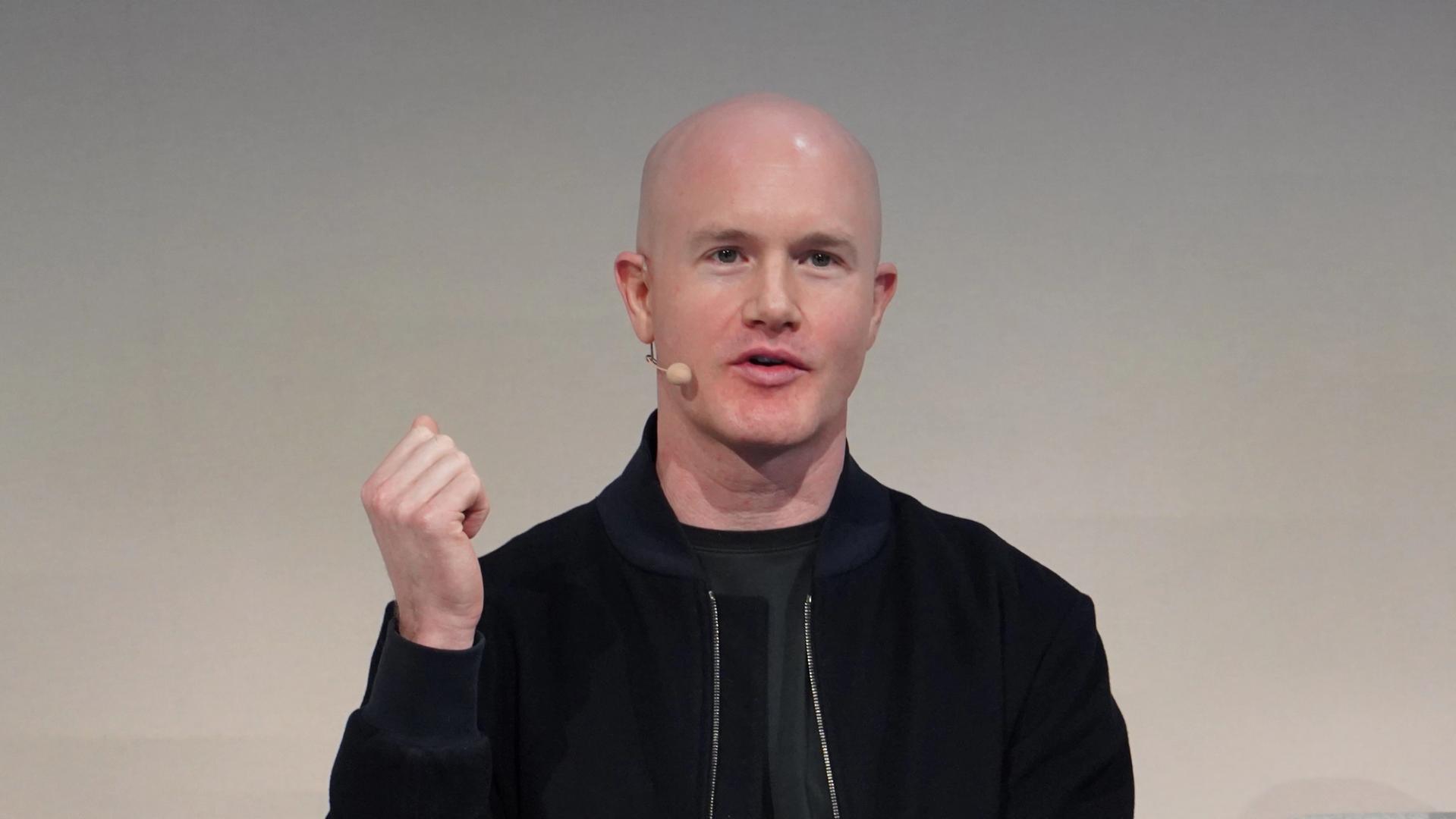
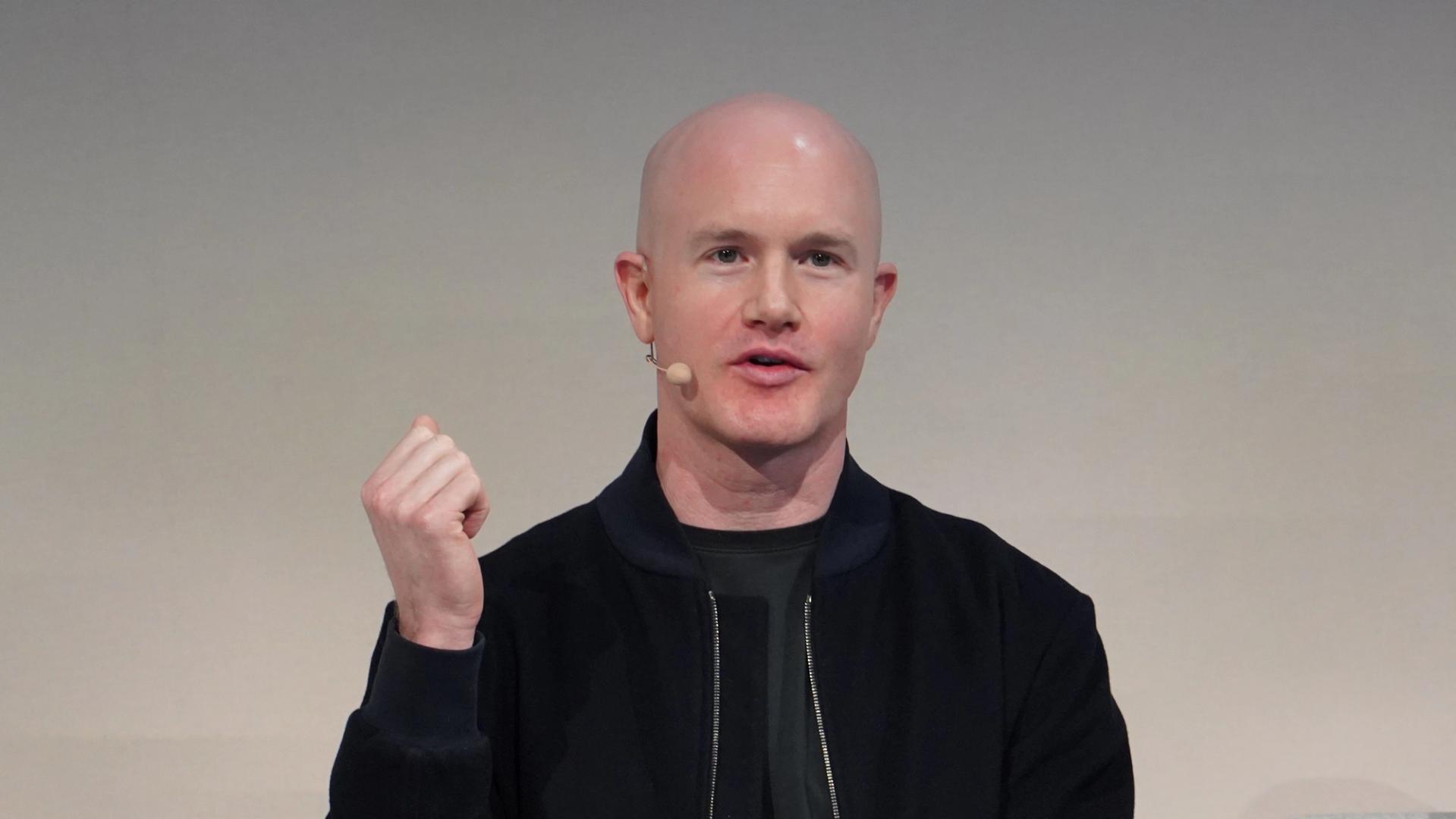
Coinbase (COIN) CEO Brian Armstrong believes bitcoin may have bottomed near $60,000.
“My instinct is we probably have bottomed at this point, maybe at the sixty K number, but nobody can say for sure,” Armstrong said in a video posted on X on Monday. He added that he remains long bitcoin and expects prices to be significantly higher by 2030.
“I think bitcoin is the new digital gold,” he said.
Bitcoin traded above $66,000 on Monday, up nearly 3% over 24 hours, after the US and Iran reached a deal to reopen the Strait of Hormuz. The token touched a low near $59,743 on June 5, its weakest level since October 2024, before recovering.
Armstrong pointed to bitcoin’s four-year halving cycle, which has historically alternated between bull and bear markets at roughly regular intervals, as a framework for reading the current drawdown. Bitcoin is now roughly 50% below its October 2025 all-time high near $126,000.
The Coinbase chief also said last week that the drop in bitcoin’s price was masking broader health in the crypto market. “Derivatives, stablecoins, prediction markets are all up,” he wrote on X on June 5. “It will take some time for this to sink in.”

World Liberty Financial’s USD1 stablecoin paid out $250,000 in fighter performance bonuses at UFC Freedom 250. The mixed martial arts and likely WLFI crypto event is held on the White House South Lawn starting on June 14, President Trump 80th birthday.
WLFI served as the presenting partner of the bonus pool, distributing USD1 across seven matches on the card. It is the most prominent consumer-facing deployment of the Trump stablecoin to date.
Land of the free. Home of the brave. — The White House (@WhiteHouse) June 15, 2026
 @UFC Freedom 250 has KICKED OFF! pic.twitter.com/6YKW9UTniC
The UFC activation did not happen in isolation; it arrived alongside a WLFI token surge of 3% on sponsorship news, a concurrent Binance rewards campaign allocating 178 million WLFI governance tokens to USD1 holders, and a separate $1 million CRO-denominated bonus pool from Crypto.com co-presenting the same event.
The total crypto-based fighter bonuses on the night approached $1.65 million.
Discover: The Best Crypto to Diversify Your Portfolio
Trump Crypto Venture: How the USD1 Bonus Pool Actually Worked
WLFI funded a $250,000 performance bonus pool denominated in USD1, distributed to fighters across seven bouts based on performance criteria standard to UFC fight-night bonus structures.
Payouts were made in USD1, a dollar-pegged stablecoin backed by cash and short-duration U.S. Treasuries custodied through BitGo. This means fighters received an asset functionally equivalent to dollars, just issued by a Trump family-affiliated DeFi venture.
Todd Phillips, crypto expert at the Klaros Group, framed the commercial logic: “Paying the fighters in the USD1 stablecoin would have the same economic function as writing them a check. Announcing to the world they are doing it in USD1 sounds like they are advertising to the world that USD1 is out there and that it is connected to the UFC and the White House.”
The White House as a Marketing Venue: The Conflict of Interest
Trump political brand has always been inseparable from his crypto and commercial brand, and voters who elected him understood that. A president who openly holds over $50 million in a crypto venture, uses the White House South Lawn to host a UFC card, and pays fighters in his family’s stablecoin is at least being transparent about the integration.
The White House maintains that Trump’s assets are managed through a trust run by his children. That is the administration’s position.
The Trump family reportedly receives approximately 75% of net proceeds from WLFI token sales, plus a share of yields generated on USD1 reserves. The venue for the UFC event is a taxpayer-owned property. The regulatory environment for stablecoins is being shaped in part by an administration with a direct financial interest in a stablecoin issuer.
— Coinpaper (@coinpapercom) May 9, 2026
 LATEST: A former New York Fed examiner says #Trump-linked crypto project World Liberty Financial may have issued an unregistered security.
The criticism centers on whether the $WLFI token qualifies as more than a simple governance token under recent SEC guidance. pic.twitter.com/8zuRHlrA7I
The SEC issued an investor bulletin specifically flagging USD1 as a privately issued stablecoin affiliated with the sitting president’s family.
The spectacle is effective. Trump understands that crypto runs on attention, and a White House UFC event is attention on an industrial scale. But retail participants holding USD1 in DeFi pools should understand they are operating inside a product whose issuer has already demonstrated willingness to push pool utilization to 93% for its own borrowing needs.
USD1 is in active litigation with Justin Sun over frozen holdings and is simultaneously pursuing a federal banking charter.
Discover: The Best Token Presales
The post Trump USD1 Crypto Stablecoin Debuts as Fighter Bonus Currency at White House UFC Event appeared first on Cryptonews.
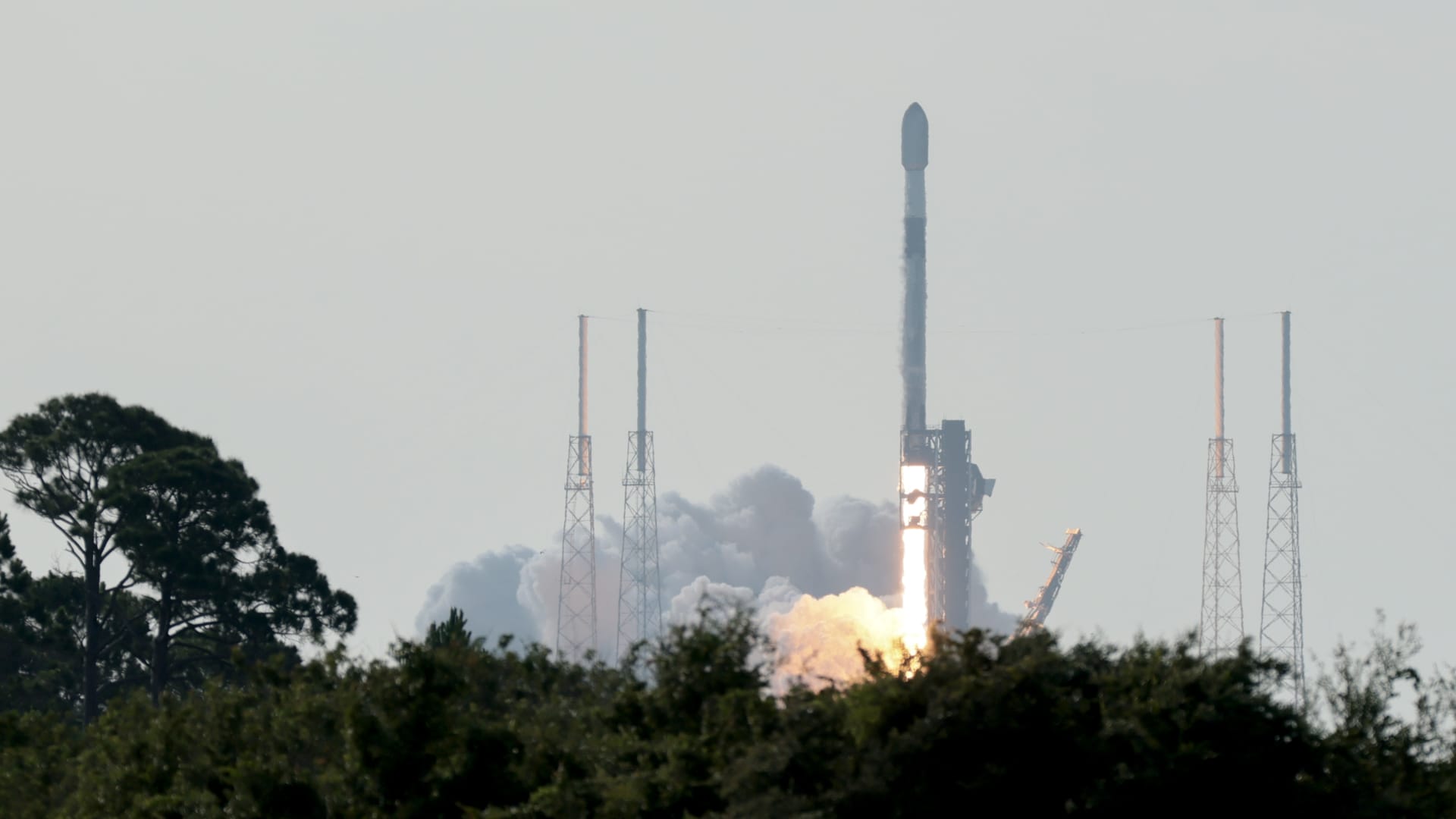
A Spacex Flacon 9 rocket lifts off from Space Launch Complex 40 on June 12, 2026 in Cape Canaveral Space Force Station, Florida.
Joe Raedle | Getty Images
SpaceX made its debut at the Nasdaq on Friday, climbing more than 19% on its first day of trading and rising above a $2 trillion market valuation. But while the arrival of the company to public markets is squared away, some of its other long-term plans are years in the future.
Elon Musk’s company in its initial public offering prospectus with the Securities and Exchange Commission repeatedly focused on the “Moon, Mars and beyond.” The company’s goal for Mars is so large that Musk won’t get a bonus of restricted shares unless SpaceX establishes a colony on the planet with more than 1 million inhabitants.
But when that will happen is years from now, traders on prediction market platform Kalshi think.
Traders see just an 18% chance that SpaceX launches a human mission to Mars by 2030. Since the event contract first launched in March 2024, traders have never seen more than one-in-four odds of the mission happening this decade.
The event contract will resolve to yes if SpaceX verifies a manned mission to Mars by Dec. 31, 2029.
Traders’ uncertainty mirrors SpaceX’s own plans. In its prospectus, SpaceX made clear it doesn’t have a vision for when a Mars mission may happen.
“Many of our initiatives… involve significant technical complexity, unproven technologies or technologies that do not exist, and such initiatives may not achieve commercial viability,” SpaceX said. “As a result, the timeline for certain of our initiatives involving unproven or new innovations … may be difficult or impossible to determine.”
But while an exact timeline may be unknown, the company’s focus on Mars is clear. The planet was mentioned 63 times in the prospectus itself, and once in a photo caption featured in the document.
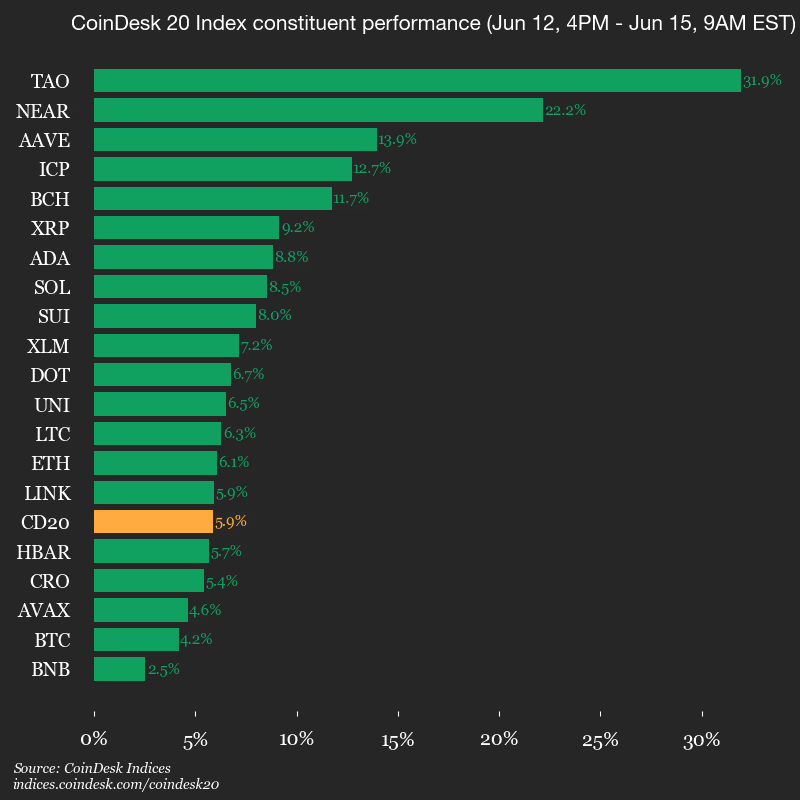
CoinDesk Indices presents its daily market update, highlighting the performance of leaders and laggards in the CoinDesk 20 Index.
The CoinDesk 20 is currently trading at 1812.32, up 5.9% (+100.88) since 4 p.m. ET on Friday.
All 20 assets are trading higher.

Leaders: TAO (+31.9%) and NEAR (+22.2%).
Laggards: BNB (+2.5%) and BTC (+4.2%).
The CoinDesk 20 is a broad-based index traded on multiple platforms in several regions globally.
BitMine Immersion Technologies said its Ethereum holdings reached 5,620,754 ETH as of June 14, bringing the company closer to its goal of owning 5% of the total ETH supply.
Summary
- BitMine now holds 5.62 million ETH, equal to 4.66% of total Ethereum supply today overall.
- The company says staked ETH stands at 4.72 million, supporting projected annual staking revenue.
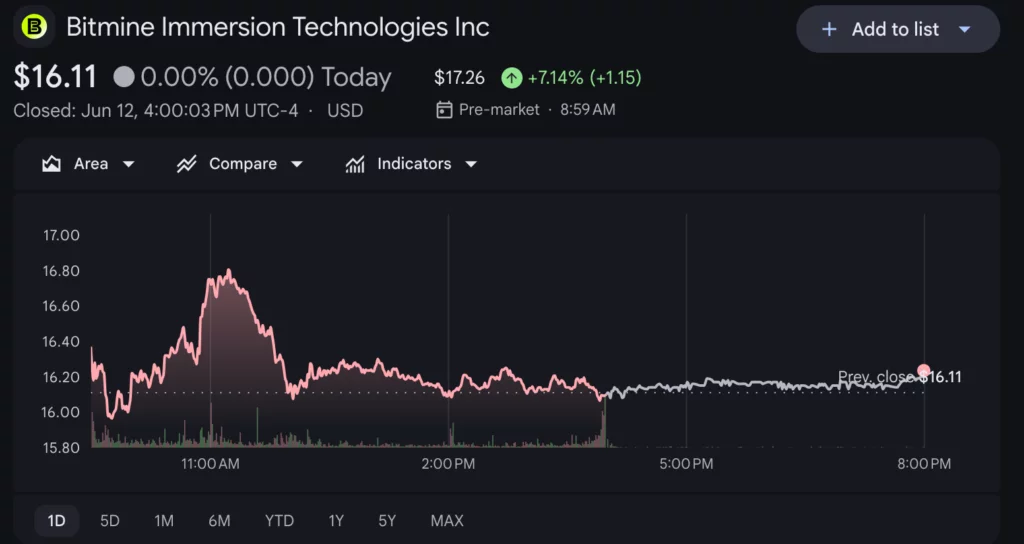
- BMNR traded near flat after the update, with shares at $16.11 in midday trading.
In a Monday announcement, the company said the position equals 4.66% of Ethereum’s 120.7 million token supply.
Meanwhile, the company also reported total crypto, cash, marketable securities and “moonshots” holdings of $10.4 billion. Its holdings include 204 BTC, $502 million in cash and marketable securities, a $180 million stake in Beast Industries and an $88 million stake in Eightco Holdings.
Staking operation backs preferred stock plan
BitMine said it has staked 4,718,677 ETH, worth about $8.1 billion at $1,718 per ETH. The company said this makes it the largest Ethereum treasury in the world and the second-largest crypto treasury behind Strategy.
“Over the past week, we acquired 76,881 ETH,” said chairman Thomas “Tom” Lee.
He said BitMine kept a higher buying pace because it believes the recent ETH pullback does not reflect stronger Ethereum fundamentals.
BitMine also closed the sale of 3,500,000 shares of 9.50% Series A Perpetual Preferred Stock on June 10. The company raised about $273.8 million in net proceeds after fees and expenses.
Lee said the preferred stock sale gives BitMine balance sheet diversification. He added that projected annual staking rewards of about $219 million provide recurring cash flow to support dividends on the preferred shares.
BMNR stock reaction stays muted
BitMine’s preferred shares are expected to start trading on the NYSE under the ticker BMNP on June 16. The company also declared a weekly cash dividend of $0.2639 per preferred share, expected to be paid on July 6 to holders of record on June 26.
BMNR stock showed little movement after the update. Google Finance data showed shares near $16.11, down about 0.03%, with a market capitalization of about $7.32 billion at the time checked.
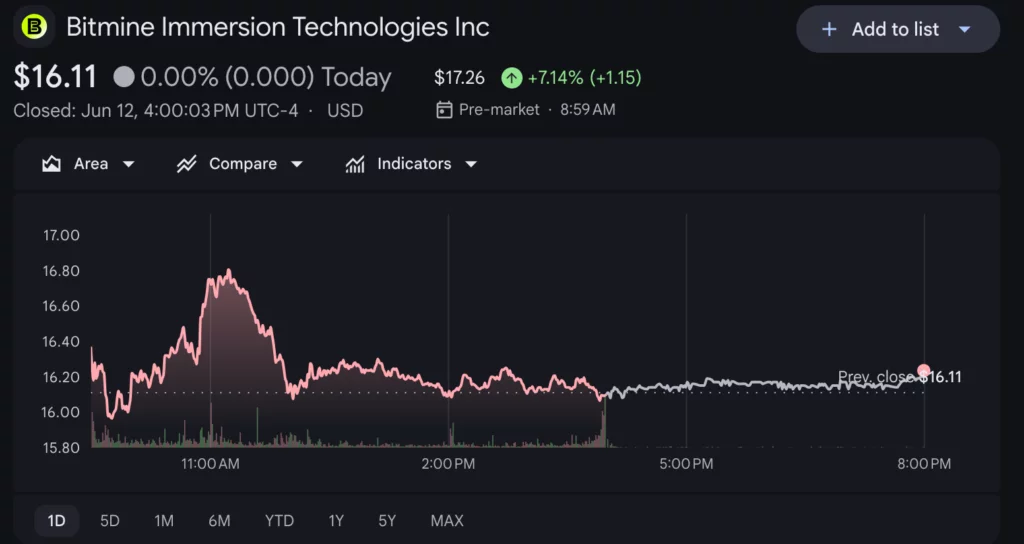
The muted reaction came after several weeks of heavy attention on BitMine’s Ethereum treasury model. The company said BMNR ranks among the most traded U.S. stocks, with average daily dollar volume of about $550 million over five days as of June 12.
Ethereum treasury race gains fresh attention
crypto.news recently reported that BitMine had raised its ETH holdings to 5.42 million tokens after buying 26,497 ETH. The report also noted that the firm had staked 4.72 million ETH and remained one of the largest public Ethereum treasury plays.
Moreover, as crypto.news reported, BitMine had moved closer to its 5% ETH target after further buying activity tied to large wallet transfers. That report also noted pressure on BMNR shares as ETH prices weakened and investors weighed the scale of the treasury bet.
The latest release shows BitMine has continued to add ETH while also building cash reserves and preferred stock financing. The next focus for investors will be whether the company can keep growing ETH per share while meeting weekly dividend obligations.

The Next Evolution of Decentralized Finance
Decentralized Finance (DeFi) was built on the promise of creating an open, permissionless financial system accessible to anyone with an internet connection. Yet despite billions of dollars flowing through decentralized exchanges, lending protocols, and on-chain financial products, one major obstacle remains: complexity.
For years, users have been expected to manage wallets, sign transactions, bridge assets, understand gas fees, navigate multiple blockchains, and interact with unfamiliar interfaces. While crypto-native users have adapted, mainstream adoption continues to face significant friction.
This challenge has sparked a new trend across the industry: abstraction. Increasingly, DeFi builders are racing to hide blockchain complexity behind seamless user experiences. The goal is simple yet transformative—allow users to benefit from decentralized finance without needing to understand the underlying infrastructure.
The future of DeFi may not be about adding more protocols. It may be about making those protocols invisible.
Why Abstraction Matters
The average internet user has little interest in learning blockchain mechanics.
Most people do not want to understand:
- Private key management
- Network switching
- Token approvals
- Transaction routing
- Liquidity fragmentation
- Layer-2 infrastructure
They simply want financial products that work.
Traditional fintech applications gained adoption because users never needed to understand payment rails, banking infrastructure, or settlement systems.
DeFi must reach a similar level of simplicity if it hopes to compete with mainstream financial services.
Abstraction is becoming the bridge between blockchain innovation and real-world usability.
Account Abstraction: The Foundation Layer
One of the most important developments driving this trend is account abstraction.
Traditional crypto wallets are often difficult for new users to manage. Losing a seed phrase can mean losing access to funds permanently.
Account abstraction introduces programmable wallet functionality that can dramatically improve user experience.
Features include:
- Social recovery
- Biometric authentication
- Multi-factor security
- Automated transaction execution
- Subscription payments
- Spending limits
Instead of behaving like rigid blockchain accounts, wallets become flexible financial operating systems.
This shift allows crypto applications to offer experiences that feel much closer to modern mobile banking.
The Rise of Intent-Based Finance
Another major innovation is the emergence of intent-based systems.
Historically, users have needed to specify exactly how transactions should be executed.
Intent-based finance flips this model.
Users simply express an objective.
For example:
- “Swap ETH for the highest amount of USDC.”
- “Earn the best stablecoin yield available.”
- “Transfer assets to another chain.”
Specialized networks, solvers, or agents then determine the optimal path to achieve the desired outcome.
This creates a user experience that resembles search engines or AI assistants rather than traditional financial software.
The complexity shifts from the user to the protocol layer.
Cross-Chain Abstraction Is Eliminating Blockchain Silos
One of the largest challenges in DeFi today is fragmentation.
Liquidity is distributed across numerous ecosystems, including:
- Ethereum
- Solana
- Base
- Arbitrum
- Optimism
- Avalanche
- BNB Chain
Historically, moving assets between these networks has required bridges, multiple wallets, and considerable technical knowledge.
Cross-chain abstraction aims to eliminate these obstacles.
Users increasingly interact with applications that automatically:
- Route transactions
- Bridge assets
- Manage liquidity
- Select execution venues
In the future, users may not even know which blockchain is processing their transaction.
The network becomes a backend service rather than a visible destination.
AI Agents Are Accelerating Abstraction
Artificial intelligence is emerging as a powerful force in the abstraction movement.
AI-powered agents can:
- Monitor markets
- Rebalance portfolios
- Execute trades
- Manage risk
- Optimize yield strategies
- Handle recurring financial tasks
Rather than manually interacting with multiple DeFi protocols, users can delegate objectives to autonomous systems.
Imagine saying:
“Allocate my capital across the safest opportunities earning more than 8% APY.”
An AI agent could evaluate markets, execute transactions, and continuously optimize positions.
As AI capabilities improve, financial management may become increasingly autonomous.
The Competitive Race Among DeFi Protocols
Protocols are recognizing that usability is becoming a competitive advantage.
Early DeFi focused primarily on:
- Liquidity
- Security
- Token incentives
The next phase is increasingly focused on:
- Simplicity
- Automation
- Accessibility
- User retention
Projects that successfully abstract complexity may gain significant market share by attracting non-technical users.
In many ways, DeFi is entering a new stage where user experience could become just as important as protocol design.
The winners may not be those with the most sophisticated technology, but those who make sophisticated technology disappear.
Risks of Increasing Abstraction
While abstraction improves usability, it also introduces new considerations.
Potential challenges include:
Reduced Transparency
Users may lose visibility into how transactions are executed.
Centralization Risks
Some abstraction layers may rely on intermediaries, solvers, or service providers.
Security Complexity
Additional automation can introduce new attack surfaces.
User Dependence
Overreliance on automated systems may reduce users’ understanding of financial risks.
The industry must balance convenience with transparency, security, and decentralization.
The Endgame: Invisible DeFi
The ultimate destination of abstraction is a world where blockchain technology becomes largely invisible.
Users may eventually interact through:
- Mobile applications
- AI assistants
- Embedded finance platforms
- Autonomous financial agents
Without needing to know:
- Which chain are they using
- Which bridge is involved
- Which protocol executes the trade
- How settlement occurs
They receive the benefits of an open, programmable financial infrastructure.
Just as internet users rarely think about TCP/IP, servers, or routing protocols, future DeFi users may never think about wallets, gas fees, or blockchain networks.
Conclusion
DeFi’s race toward abstraction represents one of the most important shifts in the industry’s evolution. While early decentralized finance proved that permissionless financial systems could exist, the next challenge is making them accessible to everyone.
Account abstraction, intent-based systems, cross-chain infrastructure, and AI-powered agents are collectively transforming how users interact with blockchain networks. The focus is moving from technical execution to user outcomes.
The future of DeFi may not be defined by more complexity, more chains, or more protocols. Instead, it may be defined by how effectively the industry can make those complexities disappear, creating a financial system that is both decentralized and effortless to use.
In that future, the most successful DeFi experience may be the one users never realize is DeFi at all.
REQUEST AN ARTICLE
Crypto World
Ethereum Price Prediction: ETH is Still Below Its 200 Week SMA, and Tom Lee Buying Spree Might End Soon
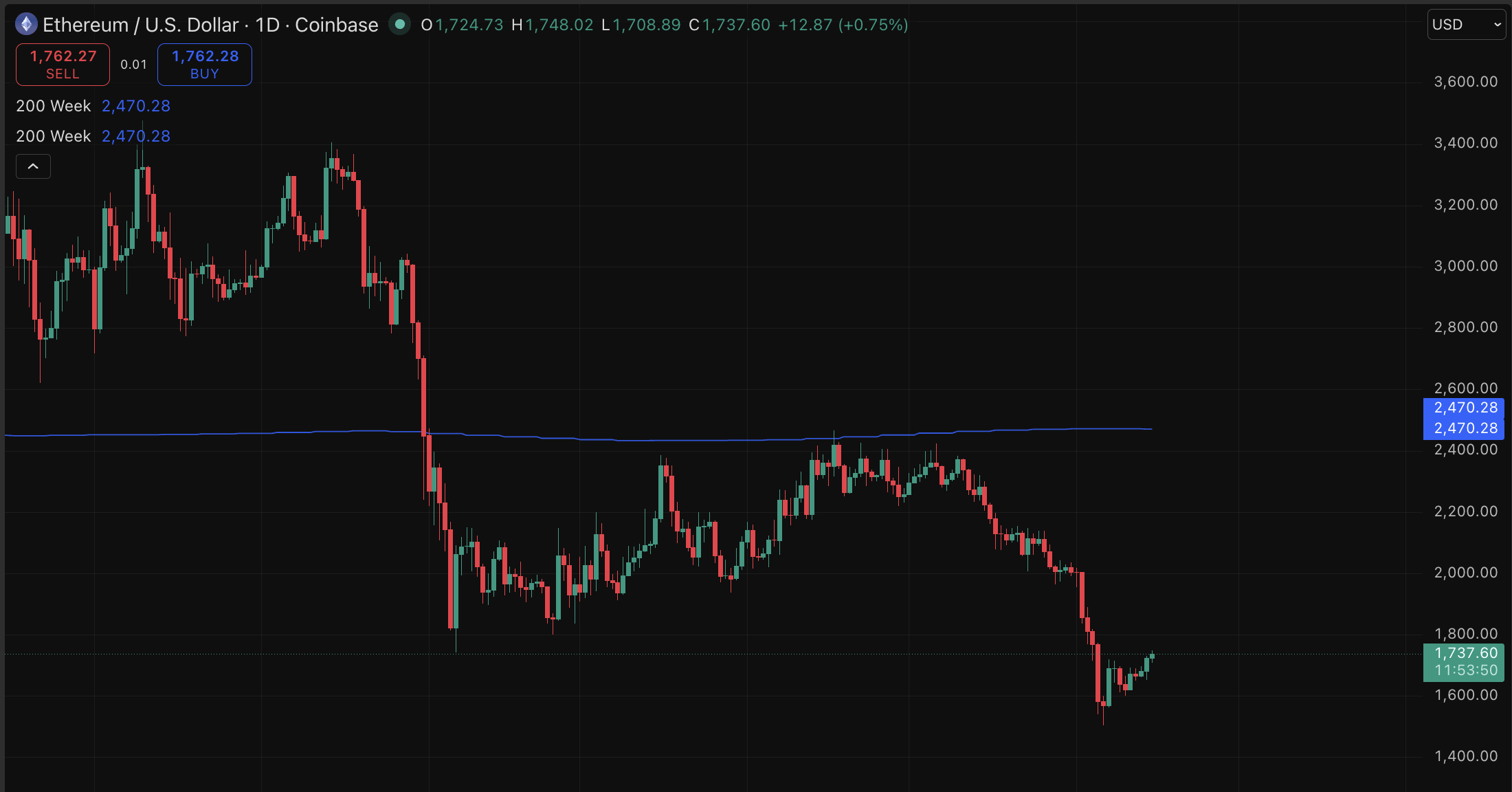
Ethereum price is trading above $1,700 after running for 5% today, and even our prediction model is calling for more leg higher. However, ETH remains pinned below its 200-week simple moving average, a level that historically separates accumulation floors from genuine bull market re-entries.
Tom Lee, after weeks of aggressive buying, is finally closing in on Bitmine 5% supply target. He is getting closer to his target, and Ethereum might lose its support defender.
Ethereum is doing well, but whether this bounce has legs or is simply just a dead-cat bounce is the question every ETH holder is asking.
Discover: The Best Crypto to Diversify Your Portfolio
Ethereum Price Prediction: Reclaim $1,800 Before Momentum Fades?
Spot ETH is closing to $1,800, price is recovering. Key levels are well-defined. Support clusters between $1,600 and $1,665, with the strongest floor sitting at $1,640.02. It’s anchoring its key support at $1,665.
Immediate resistance runs from $1,715 to $1,740. ETH has to close above $1,740 on meaningful volume to open a realistic path toward the $1,840 area that short-term forecasting models flag as a mid-June target.

The macro backdrop matters here, too. Institutional sentiment around the debasement trade has kept crypto broadly bid, but ETH specifically has been an underperformer relative to BTC this cycle. It’s a dynamic that doesn’t resolve on technicals alone.
Staking-related sell pressure has eased, which removes one headwind, but the 200-week SMA overhead remains a significant gravitational ceiling.
Discover: The Best Token Presales
LiquidChain Targets Early-Mover Positioning as Ethereum Tests Structural Resistance
ETH at $1,760 with a $200B market cap and a ceiling at its 200-week SMA is not the setup that generates 10x returns from here, not in the near term. Traders looking for asymmetric exposure during this consolidation window have been rotating toward earlier-stage infrastructure plays where price discovery hasn’t yet occurred.
LiquidChain ($LIQUID) is one project gaining traction in that context. It’s a Layer 3 infrastructure protocol built around a single execution environment that fuses Bitcoin, Ethereum, and Solana liquidity, a genuinely differentiated architecture at a time when cross-chain fragmentation remains one of DeFi’s most persistent friction points.
LiquidChain is always cooking something new.
This is what happens when a great idea meets innovation.pic.twitter.com/qYbth0impA
— LiquidChain (@getliquidchain) June 15, 2026

The project’s Unified Liquidity Layer and Deploy-Once Architecture mean developers write once and access all three ecosystems, which is the kind of structural utility that institutional-grade builders actually care about.
Presale figures as of writing: $0.0147 per $LIQUID, with $840K raised to date.
For traders who want exposure to the infrastructure layer while ETH consolidates overhead resistance, researching LiquidChain is worth the time.
The post Ethereum Price Prediction: ETH is Still Below Its 200 Week SMA, and Tom Lee Buying Spree Might End Soon appeared first on Cryptonews.


Strategy (MSTR) last week acquired 1,587 bitcoin for approximately $100 million, increasing its total holdings to 846,842 BTC, according to a Monday morning filing.
The latest purchase was made at an average price of $63,024 per bitcoin. The company disclosed it had also increased its USD Reserve by $100 million to $1.1 billion via the sale of common stock.
The purchase ran from June 8 to June 14, the same week Strategy raised $209 million by selling about 1.73 million MSTR shares through its at-the-market program.
The reserve is the money Strategy set aside in December 2025 to cover dividends on its preferred shares and interest on its debt. Building it up while continuing to buy bitcoin signals the company is funding both its accumulation and its obligations through equity issuance rather than touching its bitcoin or its cash cushion.
The buy lifts Strategy’s holdings to 846,842 BTC, worth about $56 billion at current prices and bought at an average of $75,656 per coin for a total of around $64 billion. The company remains the largest corporate holder of bitcoin, at roughly 4% of the supply that will ever exist.
Strategy disclosed on June 1 that it had sold 32 bitcoin to fund preferred dividends The company’s shares are up 5% pre market with bitcoin trading above $66,000.

Rihanna Kelver facing felony charges shows ‘stand your ground’ is not for trans people

Samsung’s upcoming foldables leak in a very interesting size comparison

Big Update on Cryptocurrency in India | Economic Impact Analysis by Ankit Avasthi Sir


-

 Business23 hours ago
No Jackpot Winner as $257 Million Prize Rolls Over to $269 Million Monday Draw
-

 Crypto World4 days ago
Oppenheimer backs SpaceX as $70 billion retail frenzy builds
-

 Crypto World4 days ago
Markets Rally as SpaceX IPO Looms Amid Iran Tensions and Inflation Surge
-

 Fashion3 days ago
Weekend Open Thread: Tuckernuck – Corporette.com
-

 Sports7 days ago
FIFA WC 2026 Group C: Morocco, Scotland challenge Brazil’s hunt for glory | FIFA World Cup 2022
-
 Crypto World14 hours ago
Zimbabwe Requires Crypto Businesses to Register Annually Under New FIU Regulations
-

 Entertainment6 days ago
The Ryan Gosling True Crime Thriller On Netflix That Gets Even Stranger, Stream It Now
-
 Sports6 days ago
Bangladesh beat Australia after 20 years in ODIs, register only their second win over six-time world champions | Cricket News
-

 Tech3 days ago
This Week In Security: Microsoft On Microsoft, Register Your Domains, Linux On ARM, And FreeBSD Joins The File Cache Club
-

 Tech3 days ago
NanoClaw integrates JFrog registries to secure AI agent downloads
-

 Crypto World2 days ago
Bitget enters Argentina’s regulated crypto market through PSAV registration
-

 Politics4 days ago
Politics Home | Healey Resignation Is “Colossal Failure Of Government”, Says Former Labour Defence Secretary
-
 Tech4 days ago
Dutton Ranch star claims they ‘didn’t see any disruption’ on set following Chad Feehan’s exit from Yellowstone spinoff fueled by Taylor Sheridan clash rumors
-

 Tech5 days ago
‘This is Seattle’s position on AI’: City Council votes unanimously to pause big new data centers
-

 NewsBeat4 days ago
El Nino has formed in the Pacific and could set records, forecasters say
-
 Entertainment4 days ago
Donnie Wahlberg & More Heat Up Las Vegas at Circa’s Barry’s Downtown Prime
-

 Sports4 days ago
First Time Since 1971: Australia Register Historic Low In ODI Cricket
-
 Tech4 days ago
Opendoor Ends India Operations, Fueling a Bigger Conversation About AI and Outsourcing
-

 Politics4 days ago
Belfast burns, while Met chief points finger at Iran and Russia
-

 NewsBeat3 days ago
FBI searches office of Ohio voter registration group
You must be logged in to post a comment Login