

Crypto World
Bitmine snaps up another $90M in ETH as Tom Lee nears 5% supply goal



Bitmine has purchased another 52,203 ETH worth about $90 million, bringing its holdings to 4.7% of Ethereum’s total supply.
Summary
- Bitmine purchased 52,203 ETH worth about $90 million, lifting its holdings to 4.7% of Ethereum’s supply.
- Tom Lee said the company remains close to its 5% ETH ownership target despite challenging market conditions.
- Staked ETH has increased projected annualized revenue to $223 million, with potential rewards reaching $268 million.
According to a company update released on Monday, Bitmine’s latest purchase increases its exposure to Ethereum despite continued weakness in the broader crypto market and repeated rejections at key price levels for the asset.
The company said its balance sheet now includes approximately $10.7 billion in crypto assets, cash, marketable securities, and strategic investments, including stakes in Eightco and Beast Industries. With the latest acquisition completed, Bitmine remains one of the largest corporate holders of Ethereum.
Commenting on the company’s outlook, Bitmine chairman Tom Lee said he expects tokenization and advances in artificial intelligence to drive future demand for blockchain networks and digital assets. Lee also reiterated his view that the crypto market remains in the early stages of what he previously described as a “crypto spring.”
Ethereum purchases continue as holdings approach target
Less than a year after launching its Ethereum treasury strategy, Bitmine has accumulated enough ETH to control 4.7% of the asset’s supply, according to the company. The latest purchase leaves the firm roughly 94% of the way toward its publicly stated goal of holding 5% of all Ethereum.
Recent fundraising efforts have helped finance that expansion. Earlier, crypto.news reported that Bitmine’s board approved a cash dividend of $0.1056 per share for holders of its 9.50% Series A Perpetual Preferred Stock, which trades on the New York Stock Exchange under the ticker BMNP.
The company said the dividend will be paid on July 10 to shareholders of record as of June 30.
Introduced in June to support the Ethereum treasury business, the preferred stock offering consisted of 3.5 million shares sold at $80 each on June 10. Bitmine reported net proceeds of approximately $273.8 million after fees and expenses.
At the time of the offering, Lee stated that the proceeds would be used to fund additional Ethereum purchases, while income generated from staking activities would help cover dividend payments.
Staking revenue rises despite unrealized losses
While Bitmine remains underwater on its overall Ethereum position, the company reported that staking has become a growing source of revenue.
According to Bitmine, 4,718,677 ETH valued at more than $8.2 billion at current prices has already been staked. Based on current yields, the company said annualized staking revenue has increased to approximately $223 million.
Providing additional projections, Lee stated that annualized staking rewards could rise to about $268 million once all of Bitmine’s Ethereum is fully staked through MAVAN and its staking partners. He attributed the estimate to a 2.73% seven-day BMNR yield.
The latest figures represent an increase from Lee’s earlier estimate of roughly $219 million in annualized staking rewards, which he discussed when the preferred stock offering was announced.
Bitmine’s accumulation strategy continues to place it among the largest corporate crypto holders. According to the company, only Michael Saylor’s Strategy currently holds a larger overall cryptocurrency treasury.
Strategy disclosed another Bitcoin purchase this week, adding 520 BTC to its reserves, although the acquisition was significantly smaller in dollar terms than Bitmine’s latest Ethereum buy.


Key Highlights
-
BoE finalizes regulatory framework for sterling stablecoins targeting 2027 deployment
-
£40 billion temporary ceiling imposed on systemically important tokens
-
Reserve composition permits 70% allocation to UK sovereign debt instruments
-
Individual user holding restrictions removed following industry consultation
-
Joint regulatory oversight model established between BoE and FCA
The Bank of England has published a comprehensive regulatory framework governing sterling-denominated stablecoins, positioning the United Kingdom for a supervised launch in 2027. The proposed guidelines establish stringent requirements for reserve management, redemption processes, and token issuance specifically targeting digital currencies deemed systemically significant. Notably, the framework abandons previously suggested individual holding thresholds in favor of aggregate issuance limitations.
Enhanced Flexibility for Interest-Generating Reserves
Under the updated Stablecoin Rules, token issuers may allocate up to 70% of backing reserves into short-dated UK government securities. This represents an increase from the earlier 60% threshold proposed during initial consultations, with the remainder required in central bank deposits. The adjustment provides operators with enhanced yield opportunities while maintaining sufficient liquidity for user withdrawals.
A minimum 30% allocation to central bank deposits remains mandatory for all systemically designated issuers. This requirement ensures immediate access to liquid capital necessary for processing redemption requests and maintaining market confidence. Regulators believe this dual-layer approach achieves an optimal balance between economic sustainability and consumer protection.
The modified framework emerged from extensive industry commentary received following the November 2025 consultation period. Market participants expressed concerns that overly restrictive reserve mandates would disadvantage UK-issued tokens compared to international competitors. Nevertheless, the Bank maintained direct reserve oversight given the potential systemic implications for payment infrastructure and broader financial stability.
Aggregate Issuance Ceiling Supersedes Individual Restrictions
Authorities have eliminated previously proposed holding limits of £20,000 for retail users and £10 million for institutional participants. The revised framework instead implements a £40 billion aggregate issuance threshold applicable to each systemically important token. This approach removes account-level restrictions while still controlling overall market exposure.
The issuance ceiling aims to prevent rapid capital flight from traditional banking deposits into stablecoin reserves. Substantial fund migrations could diminish bank liquidity and constrain lending capacity for consumers and enterprises. The temporary guardrail will persist until regulators determine that associated credit risks have adequately subsided.
The regulatory framework mandates periodic reassessment of the £40 billion threshold and its macroeconomic consequences. Officials intend to lift the restriction once systemic concerns regarding bank funding stability and credit provision are satisfactorily mitigated. Industry representatives continue advocating for more definitive timelines and differentiated risk assessments based on varying operational models.
Implementation Timeline Points to Late 2027 Rollout
The central bank has established September 22, 2026 as the deadline for public commentary on the draft Code of Practice. Finalization of the comprehensive regulatory framework is scheduled for completion before year-end 2026. Authorized systemically important stablecoins could commence operations under the new British regulatory regime throughout 2027.
Supervisory responsibilities will be distributed between the Bank of England and the Financial Conduct Authority across the stablecoin ecosystem. The Bank will assume oversight for systemically designated payment tokens, while the FCA will govern non-systemic variants and exchange-traded products. HM Treasury retains authority to designate which tokens warrant systemic classification.
The framework additionally establishes transition protocols for entities migrating from FCA jurisdiction into systemic supervision. Supplementary guidance documents will accompany the FCA’s finalized standards and implementation materials expected later this year. This comprehensive regulatory architecture represents a cornerstone of Britain’s strategic initiative to advance digital payment systems and tokenized financial infrastructure.


British asset manager Baillie Gifford has launched a tokenized fixed income fund, adding another entry into the list of products that use blockchain for access to conventional yield products. The fund operates on both Ethereum and Solana blockchains, while BNY is responsible for tokenizing and providing digital wallet services. The news was shared via CoinMarketCap’s X post, which included some initial information about the launch.
Tokenized Fund Structure Across Ethereum and Solana
The Baillie Gifford investment fund was designed to be used on both the Ethereum and Solana blockchains. Using two large blockchain networks with smart contracts and settlement of digital assets would allow the fund to interact with the two blockchain environments.
Ethereum is one of the most popular environments where decentralized apps work. Solana offers high transaction speeds and reduced fees. It allows the fund to operate across different technological platforms within the blockchain space.
BNY Role in Tokenization and Digital Infrastructure
BNY provides the tokenization protocol that transforms conventional financial assets into tokens through blockchain. The company also offers wallet services that will facilitate custody and processing of transactions. This places a regulated financial institution in the operational layer of the fund’s blockchain deployment.
This infrastructure enables the issuance and transfer of tokenized assets in a secure way. It also facilitates interoperability between the conventional finance system and blockchain.
Market Reaction and Social Media Disclosure
The launch received attention when CoinMarketCap posted an article on X. This article discussed Baillie Gifford’s entry into the realm of tokenized fixed income products and also mentioned Ethereum, Solana, and BNY.
The topic highlights the growth of tokenized real-world assets within prominent blockchain networks. This post added fuel to interest in tokenization models for fixed income instruments.
The official White House account teased a cryptic “Q posting,” then clarified the Q stood for quantum. The post turned a dry policy area into a viral moment and reignited debate over Bitcoin’s quantum risk.
The account told followers to “stay tuned,” previewing a quantum push from President Donald Trump’s administration. For crypto, the timing struck a long-running nerve about Bitcoin’s cryptography.
Why the Quantum Push Matters for Bitcoin
The teaser was deliberately cryptic.
“White House will be Q posting today… And by Q we mean Quantum. Stay tuned”
The official White House account posted the line on Monday, drawing attention and criticism before the quantum reveal.
Behind the meme, however, sits real policy. The tease previews an executive order expected this week, reported by Nextgov.
It would task the FBI and intelligence agencies with shielding quantum research from foreign spying.
The same order would direct the Energy and Defense departments to build a quantum computer. Reporting points to a second-order speeding post-quantum cryptography migration, plus a Commerce plan to expand investment in quantum firms.
The push extends Trump’s own record. He signed the National Quantum Initiative Act in 2018, though key parts lapsed in 2023.
That progress cuts both ways for Bitcoin. Stronger machines edge closer to Q-Day, when a quantum computer could break the cryptography securing wallets.
The math is moving. In 2019, Google researcher Craig Gidney estimated breaking RSA-2048 encryption would need about 20 million qubits. His May 2025 update cut that below 1 million.
A Global Risk Institute survey now puts even odds on a capable machine within 15 years. The fix is to adopt quantum-resistant cryptography, but coordinating it across the network takes years.
CZ Reignites the Satoshi Coin Debate
The teaser landed days after Binance founder Changpeng Zhao (CZ) floated freezing Satoshi’s dormant coins. He raised it with Galaxy Research’s Alex Thorn, calling it a community decision rather than a personal plan.
The stakes are concrete. By March 1, more than 34% of all Bitcoin had exposed a public key on-chain, according to BIP-361. That leaves those coins open to a future quantum attack.
The draft, from Jameson Lopp and five co-authors, would block sends to quantum-vulnerable Bitcoin addresses. It would void legacy signatures two years later.
Critics say any forced lock breaks Bitcoin’s rule that no one can seize another’s coins.
CZ has urged calm on quantum risk before, arguing the network can upgrade in time.
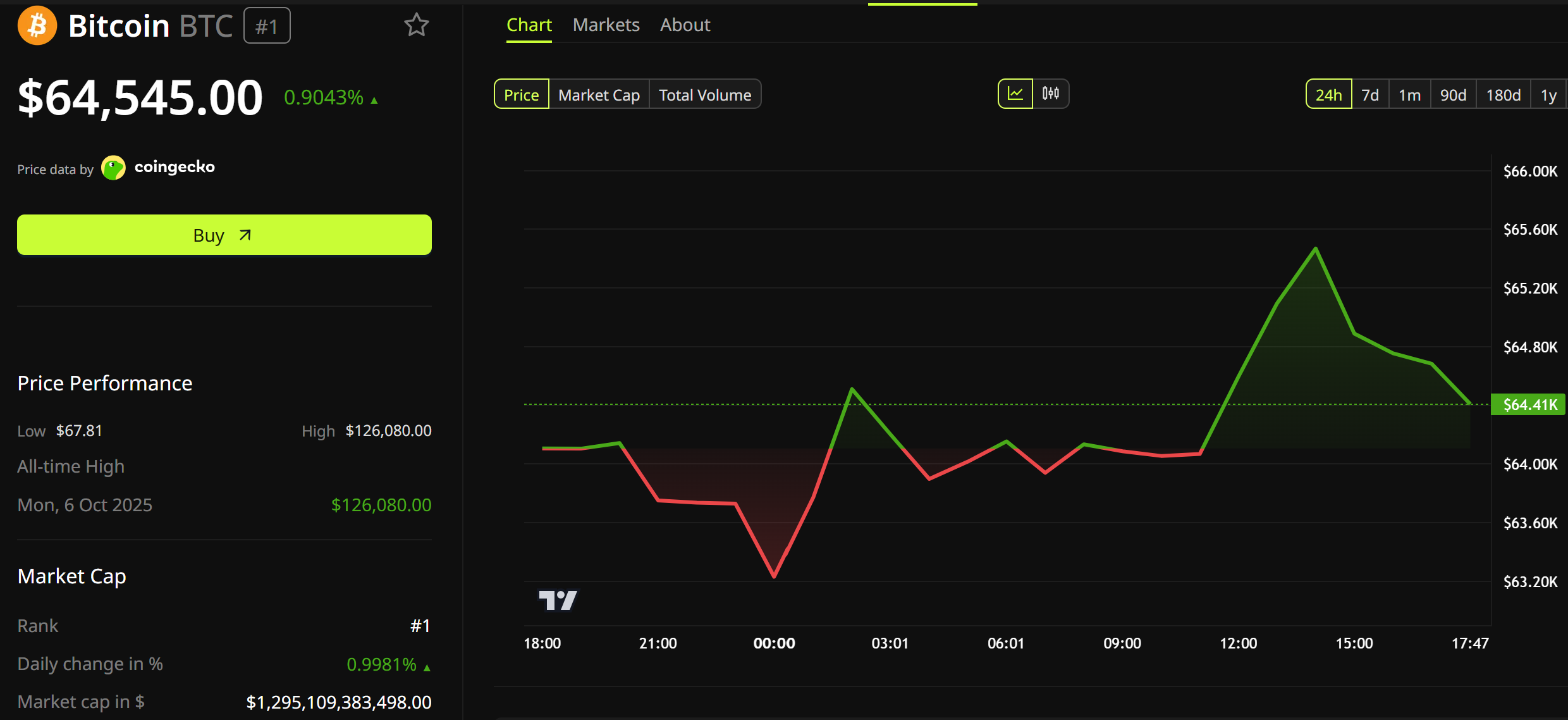
Satoshi Nakamoto’s estimated 1.1 million BTC, traced through the Patoshi pattern, is the highest-profile target. At Bitcoin’s market price near $64,545, that hoard is worth roughly $71 billion.

“Washington made two things clear. America intends to build the most capable quantum systems in the world, and it intends to defend the infrastructure and data those systems can break,” Matt Cimaglia, founder of Quantum Coast Capital, in remarks to Nextgov.
The White House has offered a meme and a promise. Whether the coming order turns Bitcoin’s quantum risk into crypto’s next defining narrative depends on what it mandates.
The post Trump’s White House Teases Quantum Push: Is Bitcoin’s Next Big Narrative Here? appeared first on BeInCrypto.
Ethereum has added a new independent research organization backed by Joe Lubin, Bitmine, and Sharplink, bringing together five former Ethereum Foundation researchers.
Summary
- Ethlabs launches with backing from Joe Lubin, Bitmine, Sharplink, and other Ethereum ecosystem contributors.
- Five former Ethereum Foundation researchers have joined the nonprofit to focus on core protocol research.
- The organization will study scaling, settlement, interoperability, and infrastructure for institutional adoption.
According to an announcement from Ethlabs, the newly launched nonprofit research group has secured support from Bitmine, Sharplink, Anchorage, Octant, SNZ, and other Ethereum ecosystem participants.
The organization did not disclose how much funding it has received.
Founded by former senior Ethereum Foundation researchers Ansgar Dietrichs, Barnabé Monnot, Caspar Schwarz Schilling, Josh Rudolf, and Julian Ma, Ethlabs has been created as an independent institution focused on technical research for the Ethereum network. The group said its work will cover areas including settlement speed, network capacity, native asset issuance, cross-chain interoperability and Ethereum’s monetary design.
The launch comes as Ethereum’s development ecosystem increasingly relies on independent organizations alongside the Ethereum Foundation.
Ethlabs said the structure gives researchers a dedicated home with long-term funding while allowing them to continue working on core protocol issues.
Ethlabs focuses on infrastructure needed by institutions
Among its founding members are researchers who have previously contributed to Ethereum’s work on scaling, finality, data availability, protocol economics, and virtual machine development.
In a statement accompanying the launch, executive director Ansgar Dietrichs said Ethlabs was established to advance Ethereum’s core technology and support infrastructure used by institutions, developers and autonomous AI systems.
“As longtime contributors to the core protocol, we are establishing an independent non-profit organization to advance Ethereum’s core technology and the shared standards and infrastructure builders depend on.”
The organization said its research priorities are tied to growing blockchain activity involving stablecoins, tokenized assets, investment products and AI-driven commerce. According to Ethlabs, improvements in these areas are needed as more financial activity moves onto public blockchain networks.
Commenting on the initiative, Ethereum co-founder Joe Lubin said Ethlabs would operate as another stewardship organization alongside the Ethereum Foundation and other independent groups working on Ethereum’s development.
Institutional supporters expand Ethereum commitments
Support from public companies arrives as some corporate backers continue increasing their exposure to Ethereum. As previously reported by crypto.news, Bitmine recently acquired another 52,203 ETH worth approximately $90 million, lifting its holdings to about 4.7% of Ethereum’s total supply.
Addressing the need for additional research investment, Bitmine Chairman Tom Lee said Ethereum could experience substantial adoption from institutions and AI agents, increasing demand for protocol research and technical expertise.
Sharplink CEO Joseph Chalom linked the funding decision to what he described as “the beginning of an institutional supercycle on Ethereum”. According to Chalom, supporting core protocol researchers represents a direct way for the company to contribute to the network’s long-term development.
Despite receiving funding from companies and ecosystem participants, Ethlabs said research decisions will remain independent. Contributions will be handled through an external grants administrator responsible for evaluating, screening, and distributing funds.
Under the structure outlined by Ethlabs, contributors will receive quarterly reporting and annual independent audits, but they will not have authority over research priorities, technical roadmaps, or organizational decisions.
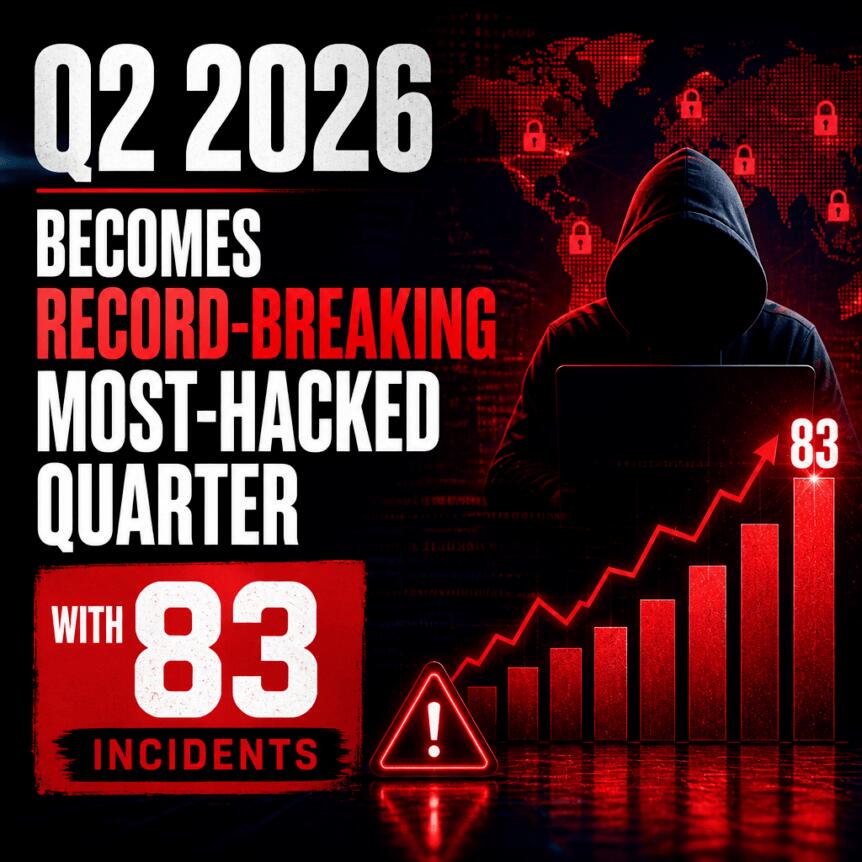
Cryptocurrency security continues to deteriorate into 2026’s second quarter, with incident counts already marking the period as the most-hacked quarter on record. Unfolded’s analysis—based on DefiLlama hack data—tracks 83 exploits targeting crypto protocols so far in Q2 2026.
Even with the spike in attacks, the quarter’s total losses of $755.3 million are still far below the record loss quarter of Q4 2020, when hacks totaled $3.56 billion. The contrast between rising exploit frequency and comparatively lower aggregate damage is becoming a defining feature of the current cycle.
Key takeaways
- Q2 2026 has logged 83 protocol exploits already, the highest incident count for any quarter in the dataset cited by Unfolded.
- Total stolen value so far stands at $755.3 million—materially lower than Q4 2020’s $3.56 billion, which remains the costliest quarter on record.
- Bridge attacks drove the quarter’s losses, with $351 million stolen via cross-chain bridges—led by the LayerZero OFT-related KelpDAO incident.
- Industry risk experts point to a mismatch between faster protocol redesign and the complexity of robust risk controls.
- Some security stakeholders argue attacker capabilities are improving amid a broader shift in the cyber landscape, while DeFi value appears to be smaller than in prior peaks.
More hacks, less value stolen than the 2020 high
The numbers underscore a persistent problem: crypto remains an attractive target, but the payoff per exploit may be changing. Unfolded’s incident-based tally shows the quarter is already number one by frequency, while the $755.3 million in stolen funds so far remains below the all-time high-water mark from Q4 2020.
At the top end of Q2’s damage, two single incidents dominate the current quarter’s storyline. KelpDAO’s $293 million hack and Drift Protocol’s $280 million exploit were the largest attacks reported so far, together accounting for a substantial portion of the quarter’s total losses.
Exploit activity appearing “more frequent” with lower total losses has also been attributed to the size of the available target pool. Dmytro Tarasiuk, product director at risk intelligence platform CORE3 and crypto security rating platform CER.live, suggested to Cointelegraph that total value locked (TVL) in DeFi appears to have fallen sharply—citing a drop from $164 billion before the Oct. 10 liquidation event to about $73 billion at the time of reporting. If less value is deployed, attackers can still run exploits, but the maximum extractable value may be constrained.
Tarasiuk also pointed to a structural vulnerability in how protocols are built. In his view, the industry’s most urgent weakness is that teams often re-engineer systems faster than they can properly align them with the underlying complexity of risk management. He described operational practices that can multiply exposure, including setups where a three-of-six multisig exists alongside key storage arrangements that concentrate risk—such as keeping multiple keys on the same device—creating additional attack surface beyond pure smart-contract logic.
Bridge exploits take the lead as the primary attack vector
Cross-chain bridges were the dominant technique in Q2 2026. According to the DefiLlama hack breakdown used in Unfolded’s analysis, $351 million in value was hacked through bridges during the quarter.
Within that category, the LayerZero OFT bridge exploit tied to the KelpDAO incident accounts for more than 38% of all value stolen in Q2. The same DefiLlama-based breakdown attributes 37% of losses to compromised admin attacks and fake token price manipulation, while private key compromises represented 5.66%.
This allocation is important for investors and protocol operators because it helps narrow where defenses must be strengthened first. If bridges remain the largest source of stolen value, then monitoring and hardening of cross-chain verification, administrative pathways, and token integrity mechanisms becomes a priority—not just after an exploit, but as part of ongoing control design.
The quarter also shows that bridge risk is not confined to a single ecosystem. Earlier coverage noted that Ethereum layer-2 network Taiko was the latest to experience a bridge-related incident, where hackers stole $1.7 million after compromising Taiko’s chain state verification mechanism.
Notable incidents highlight recurring weaknesses across ecosystems
Beyond bridges, the quarter included several high-profile thefts that point to the breadth of attack methods across DeFi. Cointelegraph reports that Humanity Protocol lost $36 million on June 8, while THORChain suffered an exploit of $10.7 million on May 15. The pattern suggests attackers are willing to probe different protocol architectures—from liquidity networks to cross-chain integrations—rather than concentrating exclusively on one style of vulnerability.
More examples from the same period also reinforce how adversaries can monetize weaknesses that extend beyond active code paths. Cointelegraph noted two exploits targeting Aztec Connect’s abandoned smart contracts, with $2.1 million stolen in one incident and $1.3 million stolen in another tied to decentralized exchange Raydium earlier in June. These cases matter because they indicate that “abandoned” or legacy components still have security implications, particularly when they remain discoverable or externally reachable.
Security debate turns to AI-enabled attacker advantage
As exploit frequency rises, the industry is continuing to debate whether recent advances in artificial intelligence have changed how attacks are conducted. Cointelegraph reports that Mitchell Amador, CEO of bug bounty platform Immunefi, told the outlet in a recent interview that the proliferation of new AI models shifted the cybersecurity playing field in favor of attackers.
Amador described this as a “vulnerability apocalypse,” linking the resurgence in exploits to the increased ability to identify and exploit weaknesses more efficiently. While that framing is not quantified in the figures cited here, it provides context for why Q2 2026’s incident count can rise even if total stolen value does not track proportionally with frequency.
For participants in crypto markets—whether traders managing exposure to risky venues, users choosing custody and on-chain interactions, or builders deciding where to spend engineering time—the takeaway is that risk is evolving on multiple fronts. DeFi’s shrinking TVL may reduce the size of the loot in aggregate, but attacker persistence and rapid exploitation cycles can still produce outsized disruption, especially where bridge infrastructure or operational controls are fragile.
Going forward, readers should watch whether bridge-related losses remain dominant in subsequent quarters, and whether any recovery in DeFi TVL leads to both higher incident counts and larger absolute losses—or if the current “more frequent, less total value” pattern persists as protocols adapt and security budgets shift.
Crypto World
Baillie Gifford Launches UK-Regulated Tokenized Bond Fund on Solana and Ethereum With BNY


Baillie Gifford, the Edinburgh-based investment firm, has launched a tokenized corporate bond fund natively on Solana and Ethereum, making it the first publicly available, fully native UK-regulated tokenized fund issued on public blockchains. The fund, called the Baillie Gifford Enhanced Yield Fund… Read the full story at The Defiant

TLDR
- Shares of Micron jumped 5.58% following announcement of comprehensive Anthropic collaboration.
- Partnership encompasses memory engineering, supply contracts, and enterprise Claude implementation.
- Agreement positions Micron to back Anthropic’s expanding data center needs.
- Joint research will focus on efficiency, performance metrics, and AI workload optimization.
- The memory chipmaker participated as strategic investor in Anthropic’s Series H financing.
Shares of Micron Technology climbed 5.58% to reach 1,197.26 following disclosure of an extensive strategic collaboration with Anthropic. The stock added 63.27 points as investors responded to the multifaceted agreement that reinforces Micron’s foothold in the rapidly growing AI infrastructure sector. The comprehensive deal encompasses collaborative product engineering, hardware supply arrangements, enterprise AI adoption, and Micron’s participation in Anthropic’s recent financing.
Partnership Focuses on Next-Generation AI Memory Solutions
The collaboration will see both organizations cooperate on engineering memory and storage architectures optimized for intensive artificial intelligence applications. Joint research efforts will analyze component performance across Anthropic’s computational environment. This work encompasses model training, inference operations, massive data handling, and distributed computing scenarios.
Micron will deliver high-bandwidth memory modules, DRAM technology, and advanced solid-state storage for Anthropic’s expanding computational demands. These solutions enable accelerated data throughput while minimizing energy consumption throughout expansive server farms. Consequently, the alliance directly aligns Anthropic’s infrastructure roadmap with Micron’s product innovation strategy.
Joint research will additionally explore how memory, storage, computing processors, and supporting infrastructure interact within AI systems. Such investigations may yield improvements in overall system efficiency, power consumption profiles, and inference cost economics. Simultaneously, Micron obtains valuable insights into the practical requirements of cutting-edge AI computing platforms.
Multi-Year Supply Deal Addresses Growing Infrastructure Needs
The partnership includes a supply arrangement providing Anthropic with Micron’s data center memory and storage portfolio. This agreement ensures Anthropic secures critical components necessary for its ambitious infrastructure buildout. The deal simultaneously establishes a sustained revenue stream for Micron connected to Anthropic’s long-term capacity expansion.
Memory component demand has surged as technology enterprises construct massive computing facilities dedicated to artificial intelligence applications. High-bandwidth memory has emerged as particularly critical since next-generation accelerators depend on rapid access to enormous data volumes. Memory manufacturers increasingly influence the architecture of modern AI computing infrastructure.
Micron participates across DRAM, NAND flash, high-bandwidth memory, and enterprise storage segments. The corporation delivers products serving data centers, smartphones, personal computers, automotive systems, and industrial applications. Nevertheless, AI infrastructure has emerged as a primary growth driver within its data center business unit.
Micron Implements Claude Throughout Global Operations
Micron has integrated Anthropic’s Claude AI assistant throughout its engineering divisions, manufacturing facilities, software development, and various business functions. The technology supports application development efforts and enables greater automation of internal workflows. The company applies these models to diverse technical and operational challenges across its worldwide operations.
This implementation extends the relationship beyond hardware collaboration and component procurement. Micron anticipates productivity gains while accelerating development cycles and manufacturing workflows. Moreover, the arrangement provides Anthropic with a significant enterprise client within the semiconductor sector.
Under the strategic framework, Micron participated in Anthropic’s Series H financing round. Specific investment amounts and financial details were not publicly disclosed. Regardless, this equity stake connects Micron’s strategic interests with Anthropic’s infrastructure scaling trajectory.
Stock Advances Before Quarterly Results Release
MU shares climbed consistently after the partnership disclosure and neared the 1,200 price level during trading. The equity advanced 63.27 points, marking a 5.58% gain from prior levels. This upward movement occurred just days ahead of Micron’s June 24 quarterly earnings report.
The market reaction highlighted the deal’s multiple dimensions spanning component demand, collaborative engineering, and enterprise software deployment. Micron has established a direct position in supplying and enhancing infrastructure powering Anthropic’s AI systems. The supply component may generate substantial data center revenues as Anthropic scales its computational capacity.
Micron manufactures memory and storage technologies marketed under its Micron and Crucial brand names. Product lines span DRAM, NAND flash, NOR memory, solid-state drives, and high-bandwidth memory offerings. The Anthropic collaboration now positions these products within one of the fastest-growing markets for advanced AI computing infrastructure.


Goldfinch Finance, the a16z- and Coinbase Ventures-backed DeFi lending protocol, is formally winding down after a governance proposal posted by its core developer confirmed the protocol cannot recover from widespread borrower defaults that have stranded depositors for nearly three years. Warbler… Read the full story at The Defiant
Three meme coins are looking at a unique setup in the last week of June 2026. Each shows a gap between on-chain positioning and price.
Smart money and the biggest wallets are making moves, but the charts don’t always confirm them.
Official Trump (TRUMP)
Official Trump (TRUMP) opens the week as one of the most volatile names to watch. The token jumped more than 5% in 24 hours, yet its setup pulls in two directions at once.
Want more token insights like this? Sign up for Editor Harsh Notariya’s Daily Crypto Newsletter here.
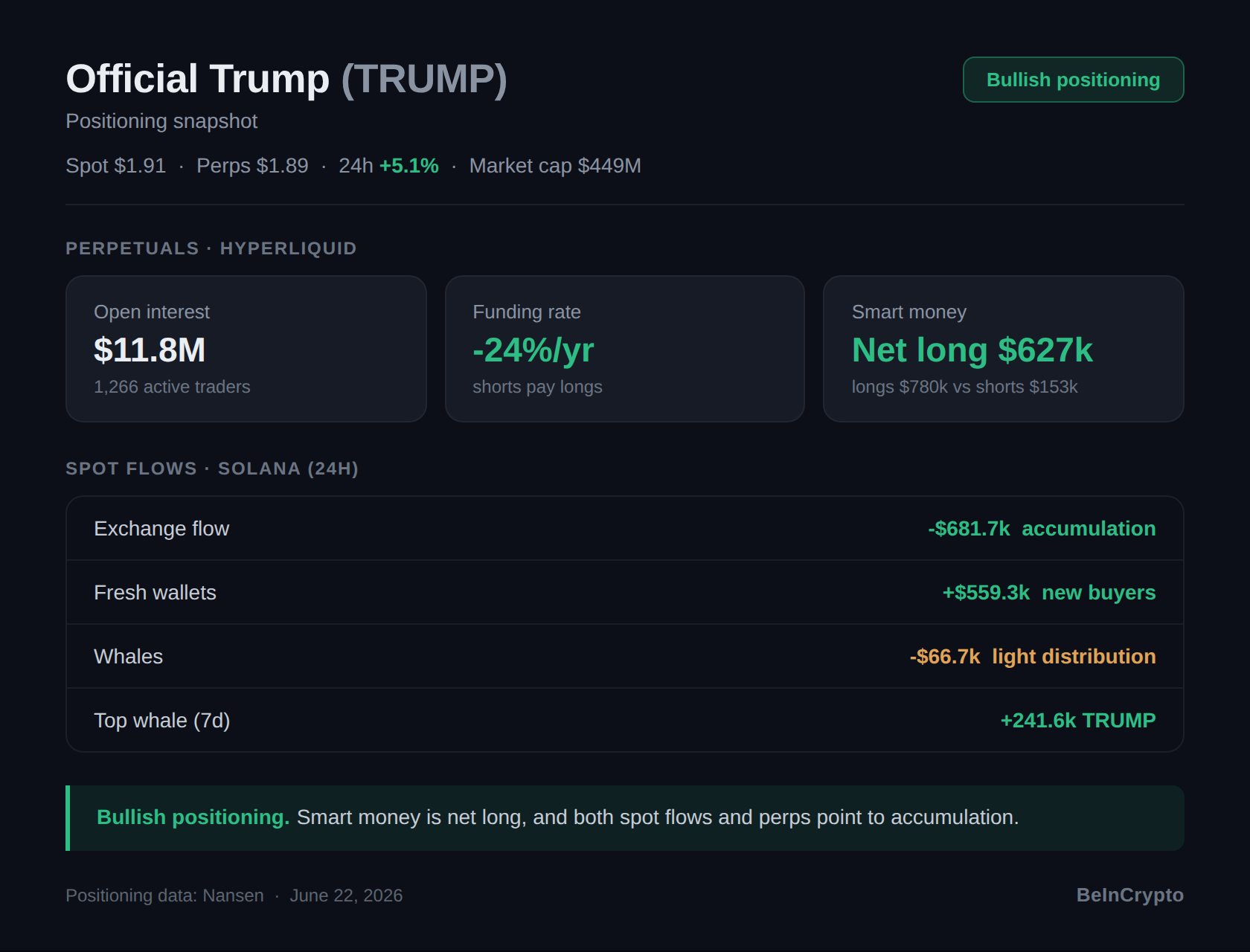
On-chain positioning leans bullish. Smart money holds a net long of $627,000 in Hyperliquid perps, a sign of an imminent price rise.
Spot exchanges saw $681,000 in outflows, a sign of accumulation. The funding rate, the recurring fee between long and short traders, sits at a negative near 24% annualized. That means shorts are paying longs.
Fresh wallet inflows of $559,000 point to new buyers stepping in. Since smart money is already long, the funding pays the bulls to keep holding, reinforcing the tilt.

The chart, however, tells a different story. TRUMP, the Solana-specific meme coin, has traded inside a falling channel since mid-March, a steadily lower price range.
It tried to break $2.20 on June 13 and failed. Volume spiked into that attempt, then faded, leaving no sustained buyers. The same burst-and-fade is repeating now. So the bullish positioning clashes with a bearish structure, a classic sentiment trap.

That tension is exactly why TRUMP is one of the top meme coins to watch this week. A reclaim of $2.20 would require a 16.46% surge and flip the trend.
Until then, smart money support may fuel short rebound legs inside the channel. A failure there opens the door to $1.48, especially if Trump-linked tensions with Iran flare again.
SPX6900 (SPX)
SPX6900 (SPX) makes the list because it still holds gains where most memes have bled. The token is up about 8% on the week, yet the biggest wallets are splitting in two directions. This split is what makes SPX an interesting meme coin to watch.
Since June 18, the two largest holder tiers have diverged. Wallets holding 1 million to 10 million SPX lifted their share from 33.98% to 34.69%.
The bigger 10 million to 100 million tier cut theirs from 28.56% to 27.79%. So the largest, sharpest money is trimming while smaller wallets add.

Nansen confirms the split. Smart money sits net short by $115,000 on perps. Positive funding backs them, with longs now paying shorts. That lines up with the bigger whales selling.
Fresh wallet inflows of $439,000 show smaller buyers taking the other side, which aligns with smaller whale optimism.

The chart explains the caution. SPX printed a double top at $0.49, a bearish pattern where the price fails twice at one ceiling. It was rejected there on May 11 and again on June 17. Smart money possibly shorted into that wall. A break of $0.26 would open a 45% slide.

So the levels decide it. The first hurdle is $0.38, then $0.40 and $0.44. A real bull turn needs a reclaim of $0.49. A drop under $0.35 exposes $0.31, then $0.26.
Degen (DEGEN)
Degen (DEGEN) earns a spot among the few memes still climbing. The token is up about 8% on the day and more than 25% on the week. That strength stands out while peers stall.
But the chart structure looks shaky beneath the gains. DEGEN has traded within a rising channel since May 30, a pattern in which the price climbs between two parallel trend lines.
It is pushing toward the upper line again. Volume, though, has fallen since June 4 to some of its lowest readings. So the rally may lack the legs to break higher.
Nansen agrees with that warning. DEGEN has no perpetual market, so there is no leveraged short to read here.
On spot, though, sellers outnumber buyers by a 24-hour ratio, and the largest holder dumped 185 million tokens this week. Smart money sits on the sidelines with no real bid. Exchange outflows of $251,000 and fresh wallets are the bullish counter, yet conviction is thin.

So the weak volume and the soft flow line up. Both say the climb lacks strong backing.

The key level is $0.0020. A clean break there exposes the upper trend line. Fading volume, though, may cap the move first. That leaves $0.0017 as the floor. A break below opens $0.0015, then $0.0014.
For now, a supposed sentimental price surge clashes with a bearish chart, making Degen one of the key meme coins to watch this week.
The post 3 Meme Coins to Watch in the Fourth Week of June 2026 appeared first on BeInCrypto.
Multiple XRP (XRP) indicators have hinted at a potential 25% relief rally in the coming weeks.
Key takeaways:
- XRP price looks poised to print a rare death cross with a rebound setup toward $1.40.
- XRP may also be forming a broader bottom, eyeing a larger rally toward $8 in the coming months.
XRP’s mean-reversion setup may send price toward $1.40
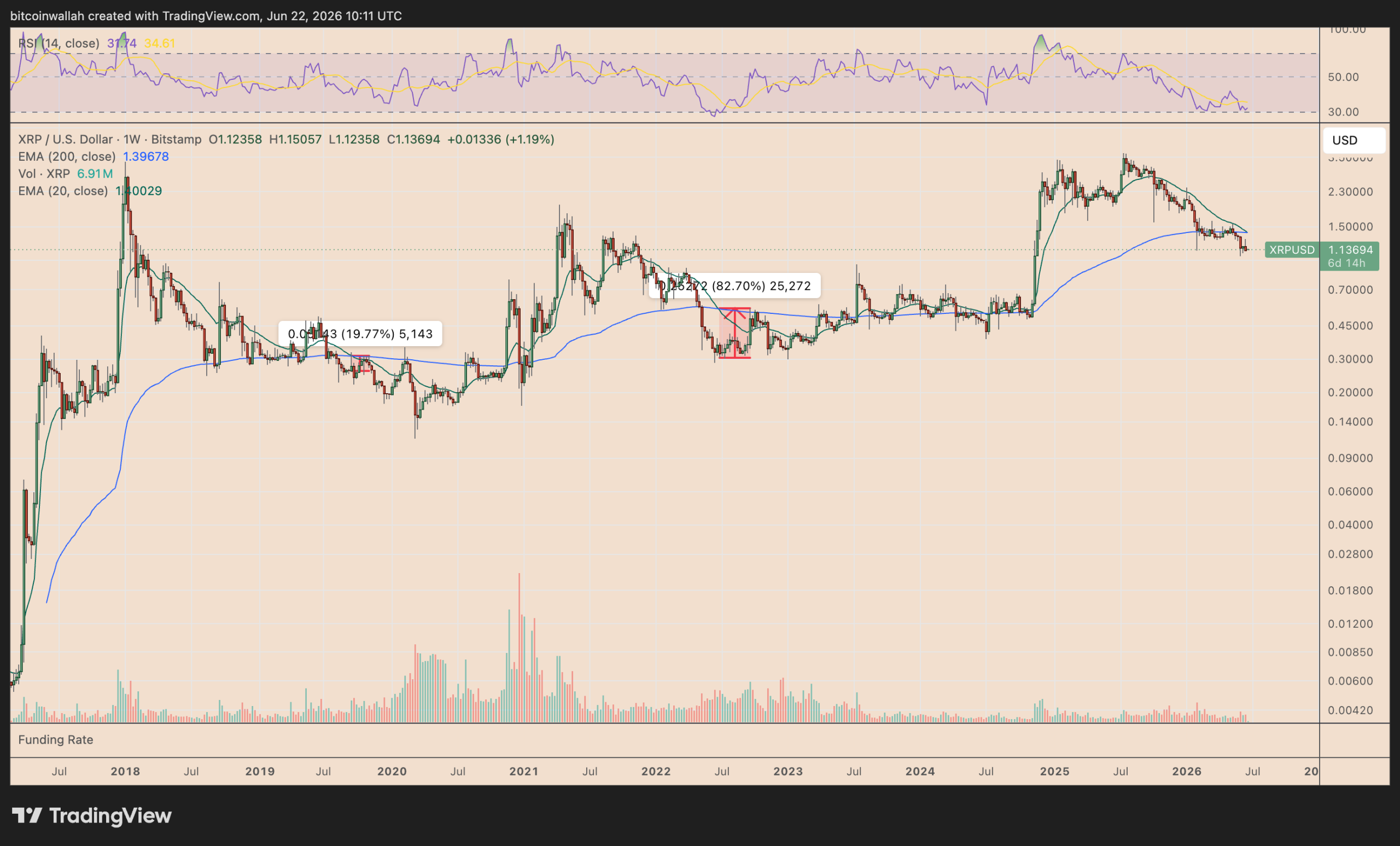
As of Monday, XRP’s 20-week exponential moving average (20-week EMA, green) near $1.40 was on the verge of crossing below its 200-week EMA (blue) near $1.39.
A confirmed weekly close below the longer-term average would mark a rare death cross between the two trend gauges.
XRP/USD weekly chart. Source: TradingView
In the past, XRP’s previous 20-week/200-week EMA crosses were followed by relief rebounds back toward the 200-week EMA. That includes a roughly 20% recovery in 2019 and a larger 82.7% rebound in 2022.
A similar mean-reversion move this time would put the $1.39–$1.40 area in focus, implying roughly 23%–25% upside by July from XRP’s current price near $1.13.
XRP’s weekly relative strength index, or RSI, was also hovering just above the oversold threshold of 30 on Monday.
The RSI measures whether an asset is becoming overheated or overly sold. Readings near 30 typically suggest that sellers may be running out of momentum, raising the odds of a short-term rebound even if the broader trend remains weak.
XRP shorts create $1.40 price magnet
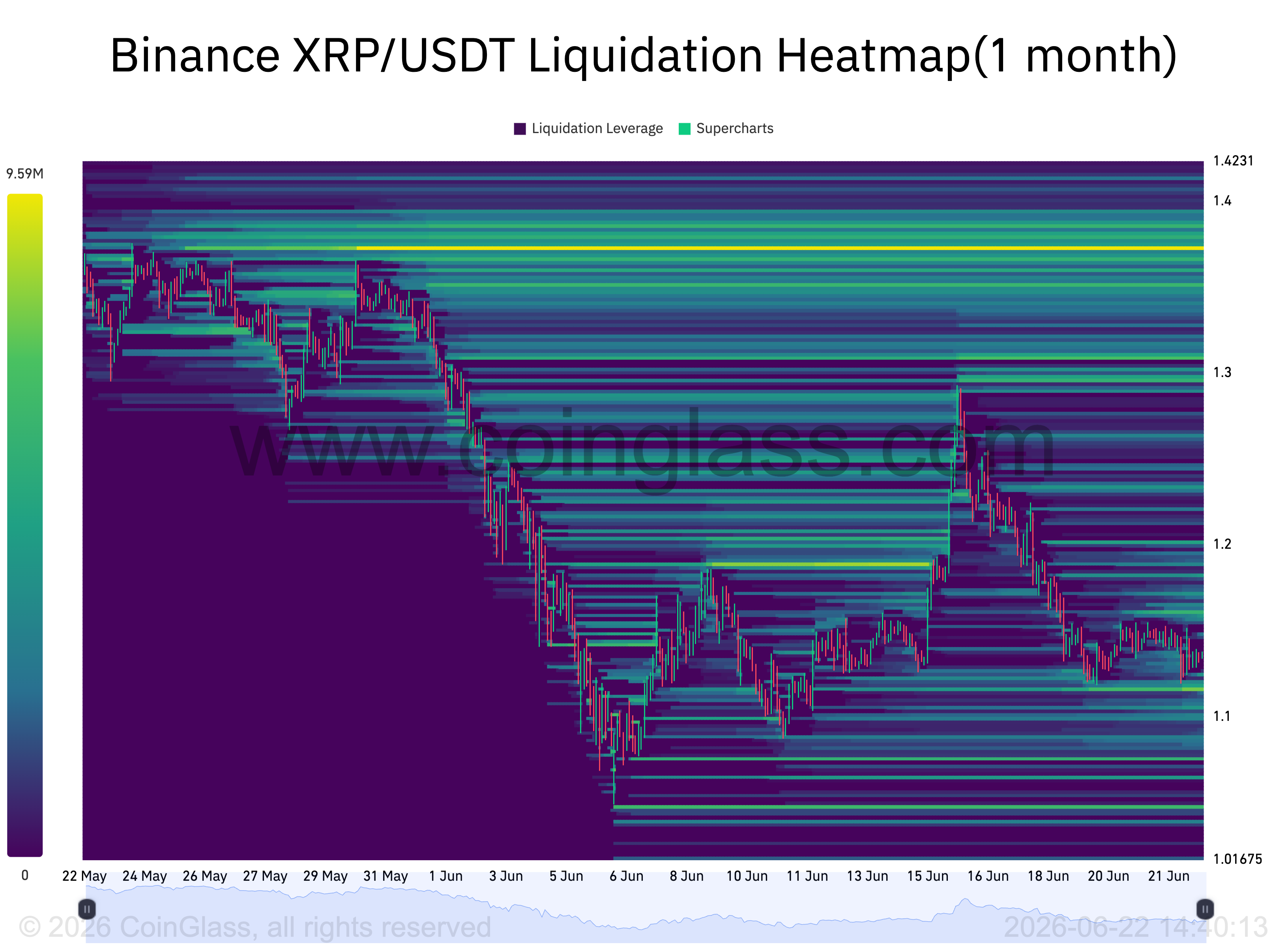
Binance XRP/USDT liquidation heatmap data further supports the relief-rally setup.
The chart shows a heavier concentration of short liquidation liquidity above the current price than long liquidation liquidity below it. The largest upside cluster, of around $236.5 million, appears around the $1.37–$1.40 zone, according to CoinGlass data.
XRP/USDT one-month liquidation heatmap. Source: CoinGlass
Liquidation heatmaps often highlight where prices may move to flush out crowded leveraged positions.
Short sellers positioned above the spot price could be forced to buy back their exposure if XRP starts rebounding from the current $1.13 price levels, adding fuel to a move toward the $1.39–$1.40 area.
XRP may rebound toward $8: Analyst
A separate long-term chart from analyst Cryptollica suggests that XRP’s next rebound could be part of a broader bottoming setup.
The chart shows XRP’s 10-day RSI hovering near the low-30s, close to the level that has historically appeared around major accumulation phases.
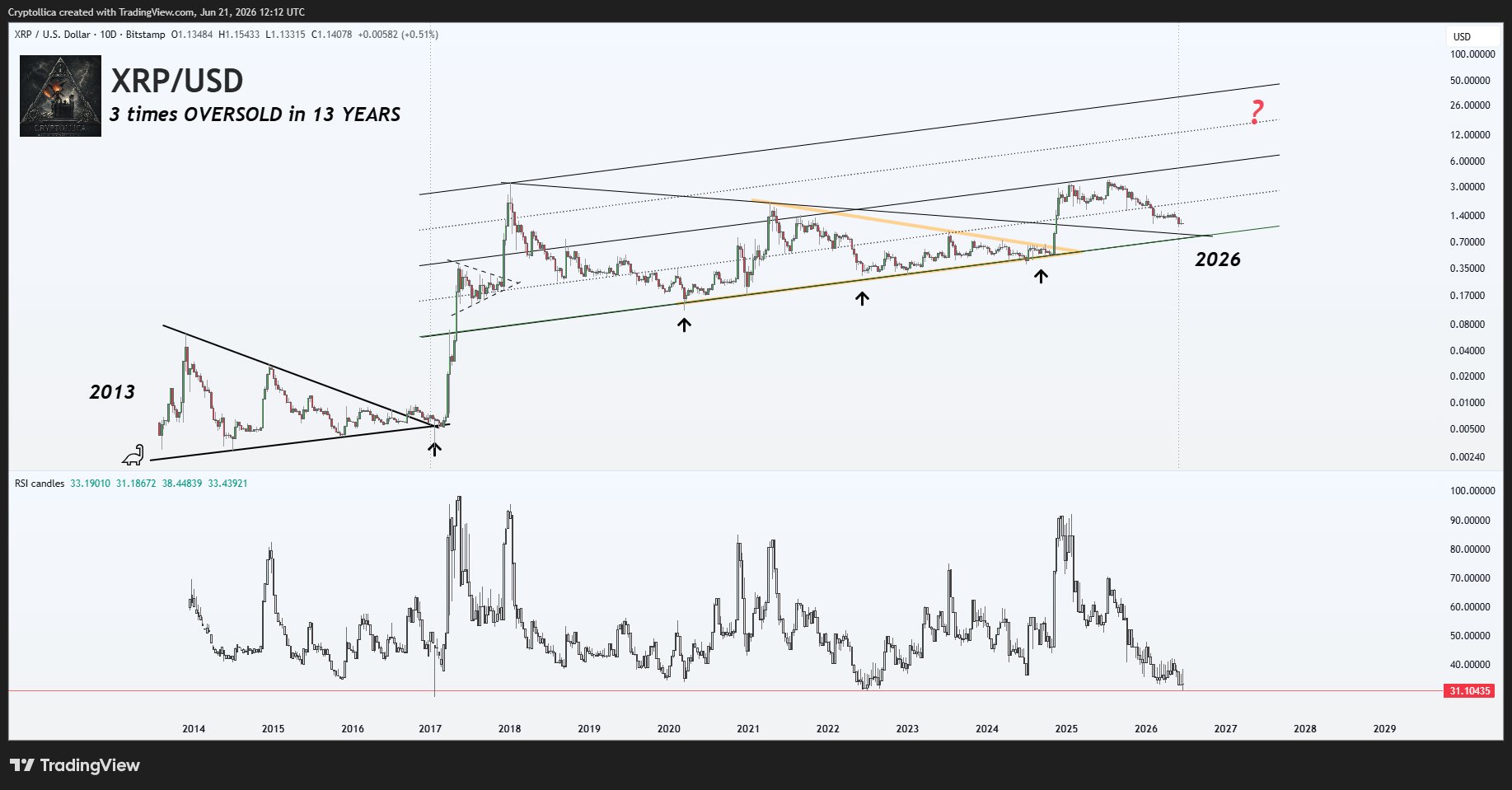
XRP/USD 10-day chart. Source: TradingView
“In 13 years, XRP has only been this washed out 3 times,” Cryptollica said in a Sunday post, adding:
“The first 2 times, the crowd laughed, ignored it, and only understood the setup after price had already left.”
Cryptollica’s chart also shows XRP trading above the lower boundary of a giant ascending channel, a long-term support line that has connected multiple macro lows since 2017.
Related: XRP whale wallet withdrawals top 720M as risk-adjusted return data points to opportunity
That trend line currently sits near $0.75, meaning XRP could still see one more downside sweep before a larger recovery begins. In previous cycles, tests of this support area preceded major upside expansions.
XRP could first retest the channel support before entering a broader bull-market phase, with the channel’s upper boundary putting a long-term target near $8 in focus if the pattern plays out again.

JOHN MURDOCH’S DRIVE TIME: We discover GEM Motoring Assist is urging people not to drive while tired and reveal Subaru has tasty offer for motorists

BGH: This Global Bond CEF Is Now A Decent Buy
UK Finalizes Stablecoin Framework Ahead of 2027 Regulatory Launch

No Jackpot Winner as $257 Million Prize Rolls Over to $269 Million Monday Draw

Blockchain.com files with SEC for U.S. IPO

Israel says it has killed new Hamas military leader in Gaza City airstrikes

BITCOIN ALERT!! | WHY BITCOIN DUMPING ? CRYPTO NEWS HINDI | BITCOIN PRICE UDPDATE | CRYPTO NEWS

MBA Finance ROI Proven | Placed as Fund Accountant at CITCO

XRP & DTCC (4,7 Billiarden) – Das EINZIGE Video das Du kennen musst!
-

 Fashion3 days ago
Weekend Open Thread: Miami – Corporette.com
-
 Tech6 days ago
The Adder At The Heart Of Intel’s 8087 FPU
-

 Entertainment2 days ago
Renter of Home in Anne Heche Crash Denies Settlement With Son
-

 Tech14 hours ago
Microsoft accidentally kills epic Outlook email threads
-

 Business2 days ago
Soccer-U.S. defends Iran World Cup travel restrictions, says discussions ongoing
-

 Politics4 days ago
BBC Reporter Discusses Cross Party Criticism Of Trumps Iran Deal
-
 Business3 days ago
Wall Street Week Ahead: Investors see Micron earnings as pulse check of AI rally momentum
-

 Tech4 days ago
AWS enters the context layer race with a graph that learns from agents, not manual curation
-

 Crypto World3 days ago
HIVE shares jump as $220M AI deal speeds Bitcoin mining pivot
-
 Crypto World3 days ago
Can Charles Hoskinson Really Rescue Cardano?
-

 Crypto World3 days ago
Jake Chervinsky accuses CME of protecting derivatives monopoly
-

 Tech7 hours ago
Nearly 7,000 fake Amazon domains registered ahead of Prime Day 2026, researchers warn
-

 Business2 days ago
MHP SE 2026 Q1 – Results – Earnings Call Presentation (OTCMKTS:MHPSY) 2026-06-20
-

 Sports4 days ago
FIFA World Cup 2026: Canada beat 9-men Qatar 6-0 to register first ever win | FIFA World Cup 2026
-

 Politics3 days ago
Andy Burnham and the meaning of Makerfield
-
 Tech2 days ago
Signal’s Meredith Whittaker says AI chatbots ‘are not your friends’ and calls Copilot agents a backdoor
-

 Crypto World5 days ago
Anthropic’s Dario Amodei Urged AI Unity at G7, Even as US Banned His Models
-

 Business4 days ago
Brexit cost 6% of UK economy, Bank of England company data suggests
-

 Tech5 days ago
Weeks Of In-The-Field Testing And A Verdict
-

 Entertainment3 days ago
Jose Alvarado Wants Taylor Swift at More Knicks Games
You must be logged in to post a comment Login