
Crypto World
Bitrue AI Review 2026: How Its Free AI Trading Copilot Works

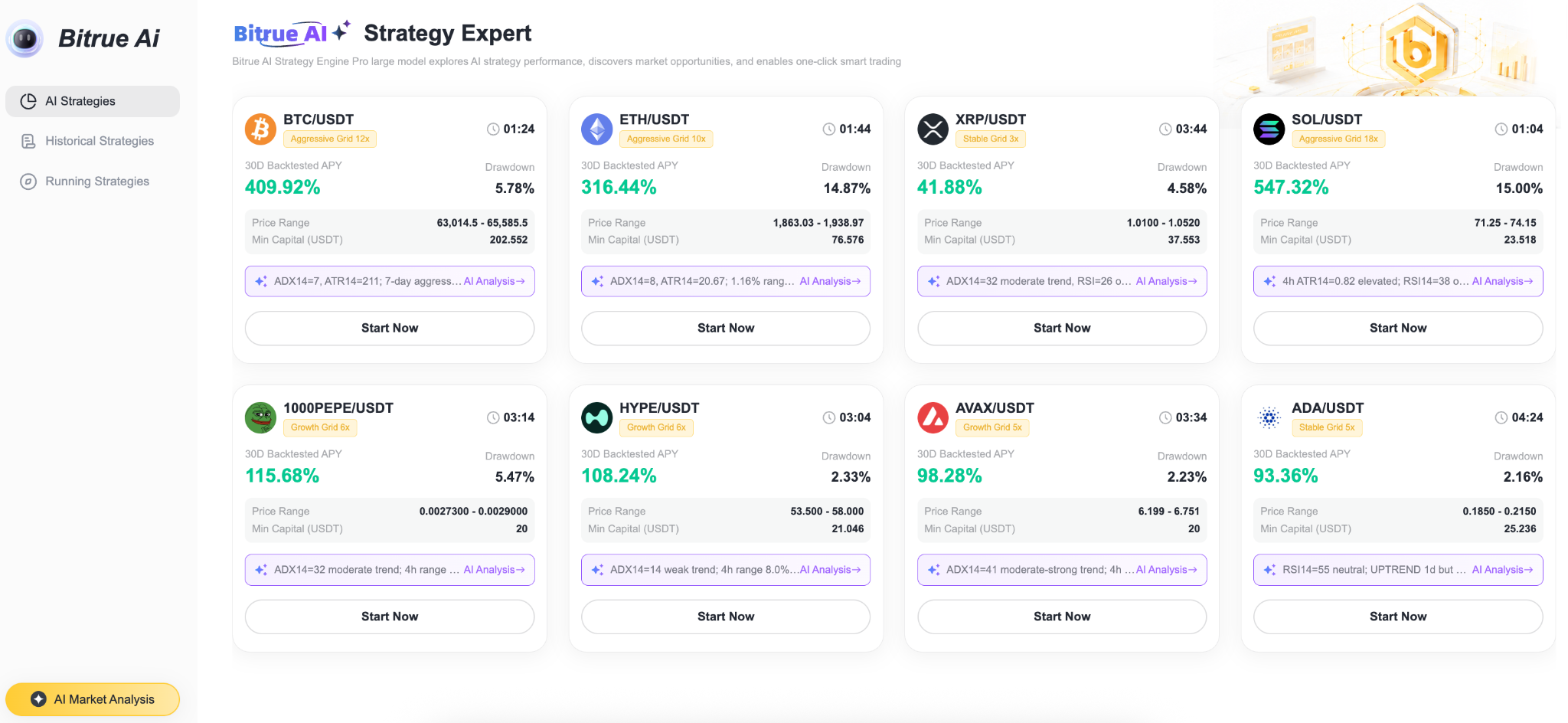
Crypto exchange Bitrue is approaching its 8th anniversary in 2026, and it’s launching a new interface designed to help traders make informed decisions using AI. But is it any good?
Bitrue AI is pitched as a beginner-friendly trading copilot. It scans live markets, proposes a strategy, sets entry and exit parameters and can manage a position through predefined take-profit and stop-loss levels.
Each recommendation includes Bitrue’s account of the market conditions, technical signals, risk classification, and reasoning used to construct it.
The product spans eight real-time strategies across three risk profiles: Aggressive, Growth and Stable. It also supports futures markets including BTC, ETH, SOL and XRP.
Bitrue says strategies refresh every few minutes as conditions change, rather than remaining static until a trader intervenes.
How Bitrue AI Works
The workflow begins with a market, risk preference, and time horizon. The system then generates a complete setup instead of asking the user to assemble one parameter by parameter.
Bitrue lists grid trading, DCA position scaling, RSI reversals, breakouts, double-top and double-bottom patterns, and multi-indicator strategies among its approaches.
Live technical data and large language models feed into proposed entries, exits and risk parameters, with indicators including RSI, Bollinger Bands, volatility and support and resistance levels.
Once a strategy is produced, the user sees the proposed trade alongside its rationale. Bitrue’s 24/7 market watch can then monitor the position and execute pre-set take-profit or stop-loss levels. Analysis, configuration, execution, and monitoring therefore sit inside one decision loop.

Explainable AI for XRP Traders
XRP is a test case because Bitrue has built much of its identity around the asset. For example, consider XRP is trading near $1.01 and a seven-day range extending to about $1.08.
Imagine a grid strategy calibrated around that $1.00-$1.08 band. Repeated movement inside the range can suit the strategy, with orders placed across successive price levels.
A sustained break above $1.08 changes the premise: grid spacing, profit targets, and potentially the strategy itself may warrant reassessment.
Bitrue AI is designed to revisit those assumptions as fresh data arrives. A strengthening trend could favour a breakout or momentum setup; deteriorating momentum could support a more conservative configuration.
The recommendation also shows the evidence the system says informed it, allowing the trader to inspect the assumptions behind the setup.
“An AI system that can’t explain its own trade recommendation isn’t really assisting anyone, it’s just automation with better marketing. With Explainable AI Strategies, someone who has never traded before can see exactly why a strategy was recommended, not just be told to trust it.” – Bitrue Research Institute.
Explainability exposes the assumptions behind a trade, but profitability still rests on whether those assumptions survive the market. A neat account of RSI, momentum and support can make a recommendation intelligible without making the future predictable.
An Overview of Bitrue AI
| Feature | Bitrue AI | Typical fixed/manual bot |
| Strategy generation | Generated from live analysis | Parameters configured by the user |
| Market response | Reassessed every few minutes | Often adjusted manually |
| Decision context | Conditions and rationale shown | Primarily parameters or signals |
| Explainability | Reasoning accompanies recommendations | Usually limited |
| Capital deployment | Parameters adapt with the setup | Allocation follows preset rules |
Who Bitrue AI Is Built For
- Beginners: Traders who want structured setups without building strategies manually.
- Busy traders: Users who cannot monitor crypto markets around the clock.
- Less disciplined traders: Those who want predefined risk levels and exit points before entering a trade.
- Intermediate traders: Users who may want a second opinion or an additional signal alongside their own analysis.
Bitrue AI Review
Bitrue AI makes automated reasoning legible before capital is committed, combining strategy generation, execution and monitoring with an explanation of each setup.
The unresolved issue is performance across changing market regimes. A well-explained strategy can still fail, particularly in leveraged crypto markets where volatility can invalidate a setup quickly.
Bitrue presents the tool as a copilot and advises users to review the reasoning, understand the risk and make the final trading decision themselves. The tool is currently free to use.
Verdict
Bitrue AI has a clearer use case than many crypto products carrying an AI label. Its main strength is the way it turns market data into a structured trade setup while showing users the reasoning and risk assumptions behind it.
That makes it most useful as a decision-support tool for newer or time-constrained traders rather than a replacement for trading judgment.
Its bigger test will be whether those strategies remain useful across different market conditions. Without longer-term performance data, the quality of the interface and explanations can be assessed more easily than the quality of the trading outcomes themselves.
For traders comfortable reviewing AI-generated setups rather than following them blindly, Bitrue AI offers a relatively accessible way to experiment with automated strategy generation. Futures trading still carries substantial risk, regardless of how clearly a recommendation is explained.
The post Bitrue AI Review 2026: How Its Free AI Trading Copilot Works appeared first on BeInCrypto.



Your day-ahead look for Aug. 31, 2026

XRP price is sitting in a corrective pocket after one of its stronger months of the year. That $2 target sounds ambitious given the current chart, but one metric buried in the fundamentals is giving bulls a reason to stay patient.
XRP remains up roughly 31% for August despite shedding about 5% over the past week, a pullback that follows a volatile range between $1.35 and $1.55 for most of the month. Meanwhile, RLUSD stablecoin volume on the XRP Ledger crossed $1 billion on August 30.
XRPL ACTIVITY SURGES — MjB38 | Crypto News (@MjB38) August 29, 2026

Receiving addresses briefly jumped to 926,000, while the transaction rate climbed 151%. Meanwhile, tokenized stocks, metals and Dubai real estate are expanding on the XRPL.
The RWA era is growing but we can’t yet say it caused the activity spike. $XRP
Not just the volume, active addresses have also surged more than 650%, climbing from 47,180 to 356,070 in just two weeks. The sharp rise in network participation came alongside XRP’s recent rally and suggests the move was supported by stronger blockchain activity. If this momentum continues and XRP can reclaim the $1.55 to $1.60 resistance zone, the token could open a path toward $1.70, $1.80 and eventually the psychologically important $2 level.
Bitcoin itself sat just under $78,000 Monday morning, flat on the day, while the market split hard. Risk appetite is uneven right now, and XRP’s next move likely hinges on whether it can decouple from that chop.
Discover: The Best Crypto to Diversify Your Portfolio
Can XRP Price Hit $2 This Week?
Short-term support clusters at $1.30–$1.36, with a daily pivot near $1.36 and deeper structural support around $1.28. Its immediate resistance is at $1.41–$1.45, a zone XRP needs to reclaim before any serious continuation talk. The pullback from the upper Bollinger Band near $1.40 reads more like cooling off than a breakdown as momentum eases.

- Bull case: a daily close above $1.45 opens the path toward $1.57, and from there the well-circulated $2.00 target becomes a live conversation rather than wishful thinking.
- Base case: consolidation between $1.30 and $1.45 while the market waits for a catalyst.
- Bear case: a breakdown below $1.30 tests the $1.00 structural floor, a level some analysts flag as the point where bears take real control.
Whale flows versus ETF demand remain worth watching closely here.
Trade XRP on Bybit and Get a Chance to Win Our $1,000 USDT Airdrop
Bitcoin Hyper Targets Early Mover Upside as XRP Tests Key Levels
Holding XRP through this chop takes conviction. The RLUSD volume story is real, but a move from $1.37 to $2 is “only” a 46% gain. Fine for a position, unremarkable for anyone chasing outsized returns at this stage of the cycle. That’s pushing more traders toward presale-stage infrastructure plays where the upside math looks different.
Bitcoin Hyper ($HYPER) is building the first Bitcoin Layer 2 with native SVM integration, smart contract execution faster than Solana itself, layered on Bitcoin’s base security.
The presale has raised $33 million at a current token price of just $0.0136855, with a high 35% APY staking already live for early participants.
Its Decentralized Canonical Bridge aims to solve BTC’s long-standing programmability gap without sacrificing trust assumptions.
Research Bitcoin Hyper before the presale window closes.
Discover: The Best Token Presales
The post XRP Price Targets $2 as One Key Metric Flashes Bullish Signal appeared first on Cryptonews.

A screen displays an image of Gemini co-founders Tyler Winklevoss and Cameron Winklevoss, and the Gemini logo, during the company’s IPO at the Nasdaq MarketSite, in New York City, U.S., Sept. 12, 2025.
Jeenah Moon | Reuters
Gemini Space Station scored a legal victory earlier in August after an arbitrator found the crypto exchange did not mislead users and was not at fault for the collapse of its Earn lending program.
The claim was filed in late 2024 by a user of the digital asset firm’s lending program Earn. However, there was insufficient evidence that Gemini had lied to its customers or neglected to do due diligence with Genesis Global Capital, its main lending partner, according to the ruling viewed by CNBC.
“To succeed in a claim for negligent infliction of emotional distress, a claimant must prove: (i) a breach of a duty owed to the claimant; (ii) emotional harm; (iii) a direct causal connection between the breach and the emotional harm; and (iv) circumstances providing some guarantee of genuineness of the harm,” the Aug. 12 ruling said. “In the instant case, Claimant offered no evidence of an actual or perceived threat to his physical safety.”
Launched in 2021, Earn allowed users to reap up to 7.4% annual yields on their cryptocurrencies by lending them out. Under the program, Gemini lent the assets to institutional borrowers, using Genesis as its intermediary.
However, Gemini halted withdrawals from its Earn program in November 2022, angering some of its more than 300,000 users. The move came shortly after Genesis paused new loan originations and redemptions due to a liquidity crunch it faced amid the crypto market downturn that year.
Following the Earn withdrawals freeze, several customers brought legal complaints against Gemini. The New York Attorney General also sued Gemini over its Earn program, settling with the company for $50 million in 2024.
In February 2024, Gemini announced that the company reached a “settlement in principle” with Genesis and other creditors in the Genesis Bankruptcy. Three months later, Earn users received $2.18 billion of their digital assets in kind, representing 97% of digital assets owed to Earn users and $1 billion more than when Genesis halted withdrawals in 2022.
As of earlier this month, there were still more than a dozen ongoing disputes aimed at Gemini brought by Earn customers.
— CNBC’s Talia Kaplan contributed reporting.
Bitcoin (BTC) heads into September still battling key resistance as markets flip hawkish on Federal Reserve policy.
Key points:
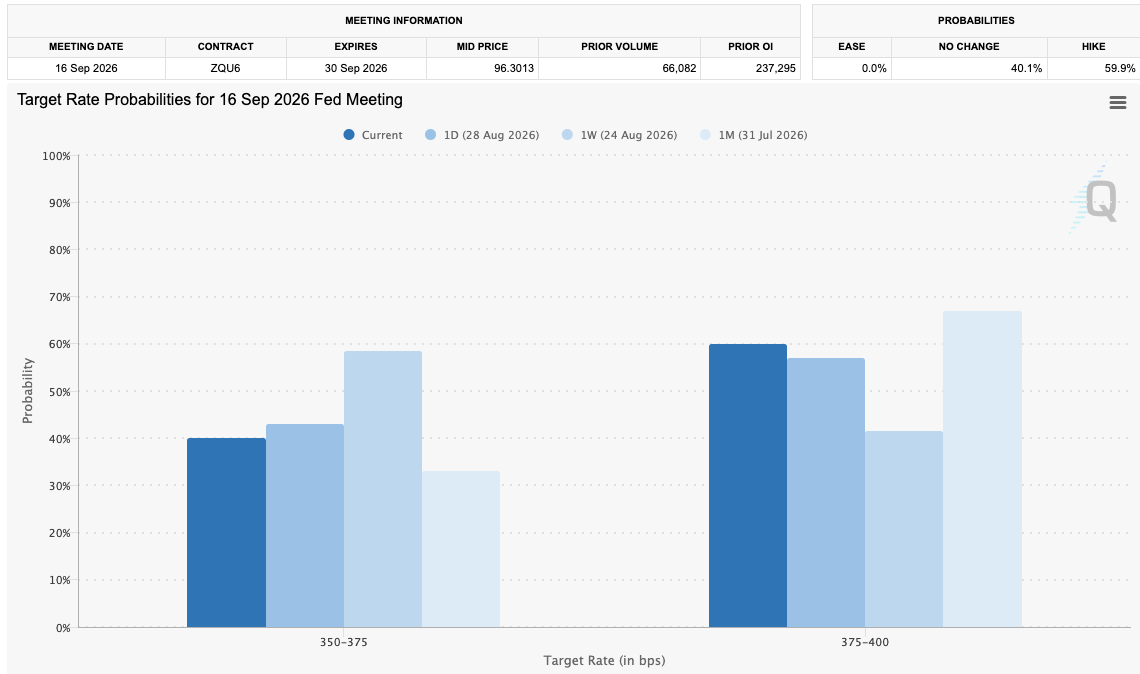
- Markets see a 60% chance of the Fed hiking interest rates in September, with jobs data due this week.
- Oil has experienced renewed volatility amid fresh US strikes on Iran and an unprecedented US-Venezuela oil-supply deal.
- Bitcoin remains under a crucial patch of resistance below $86,000 heading into the August monthly candle close.
September rate hike bets return after Jackson Hole
The coming week will bring the release of multiple US employment indexes, each likely to shape expectations for policy changes from the Federal Reserve.
The Fed is already in the spotlight after last week’s Jackson Hole economic symposium, which featured its first keynote speech from new chair Kevin Warsh. Warsh remained characteristically tight-lipped on policy cues, describing forward guidance — a fixture of Fed PR for decades — as having “overstayed its welcome.”
On inflation, Warsh described current data as too high, despite July’s lower-than-expected results for the Consumer Price Index (CPI) and Personal Consumption Expenditures (PCE) index.
“Each of these broad inflation measures have fallen significantly from their highs of a few years ago, but progress through the past couple of years has been more modest, and while this summer’s PCE and CPI readings were better than expected, they do not tell me that underlying trends have meaningfully improved,” he said.
Markets responded with increased expectations of interest-rate hikes, reverting to majority odds for a 0.25% hike at the Fed’s September meeting, per data from CME Group’s FedWatch Tool. At the time of writing, these odds stand at just below 60%, up from 41.4% last week.
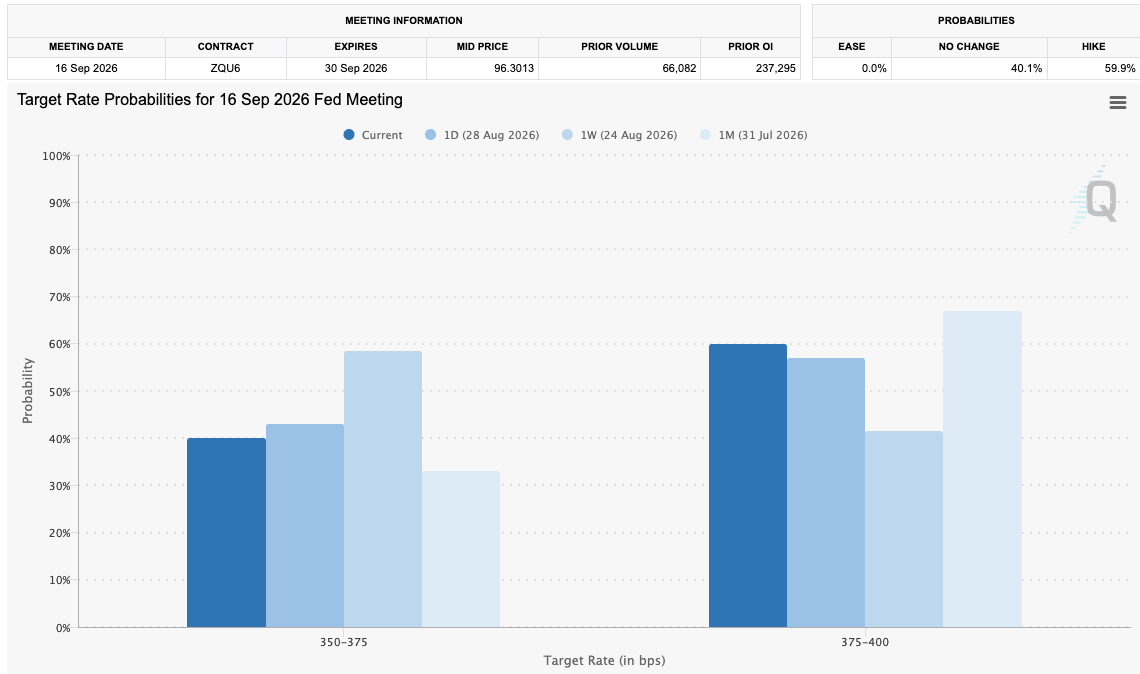
Fed target-rate probability comparison for September FOMC meeting (screenshot). Source: CME Group
Rates expectations could be tempered, however, by labor-market numbers. Friday will see August nonfarm payrolls data released. The economy is expected to have added 50,000 jobs last month, compared to a loss of 23,000 in June.
Private-sector employment numbers will precede nonfarm payrolls on Wednesday, followed by initial jobless claims on Thursday.
“All eyes are on the labor market,” trading resource The Kobeissi Letter summarized in commentary on X, noting that this would form the last slew of jobs data before the September rate decision.
Kobeissi flagged major downward revisions to employment numbers, with weak labor-market conditions forming a potential hurdle to Fed policy tightening. Citing data from the Bureau of Labor Statistics (BLS), it reported another 79,000 jobs removed in the 12 months through March this year.
“This follows last year’s record -911,000 revision and marks the 4th consecutive annual downward adjustment, matching the streak that ended in 2010 after the 2008 Financial Crisis,” it added, describing the labor market as being “weaker than initially reported for years.”
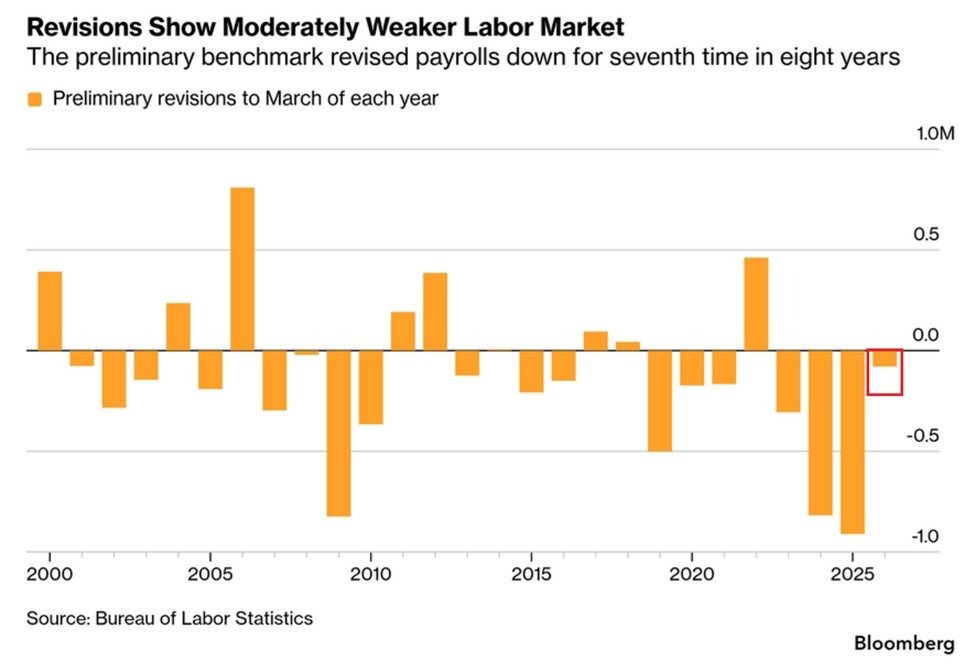
US employment data revisions. Source: The Kobeissi Letter on X.com
Oil spikes on US-Iran escalation
Oil markets are at the forefront of macro volatility as the week begins thanks to a combination of geopolitical catalysts.
Renewed US strikes on Iran sent Brent crude back above $90 per barrel on Monday, nearing its highest levels in a week. US WTI crude passed $85 per barrel, and was up 2.5% on the day at the time of writing.
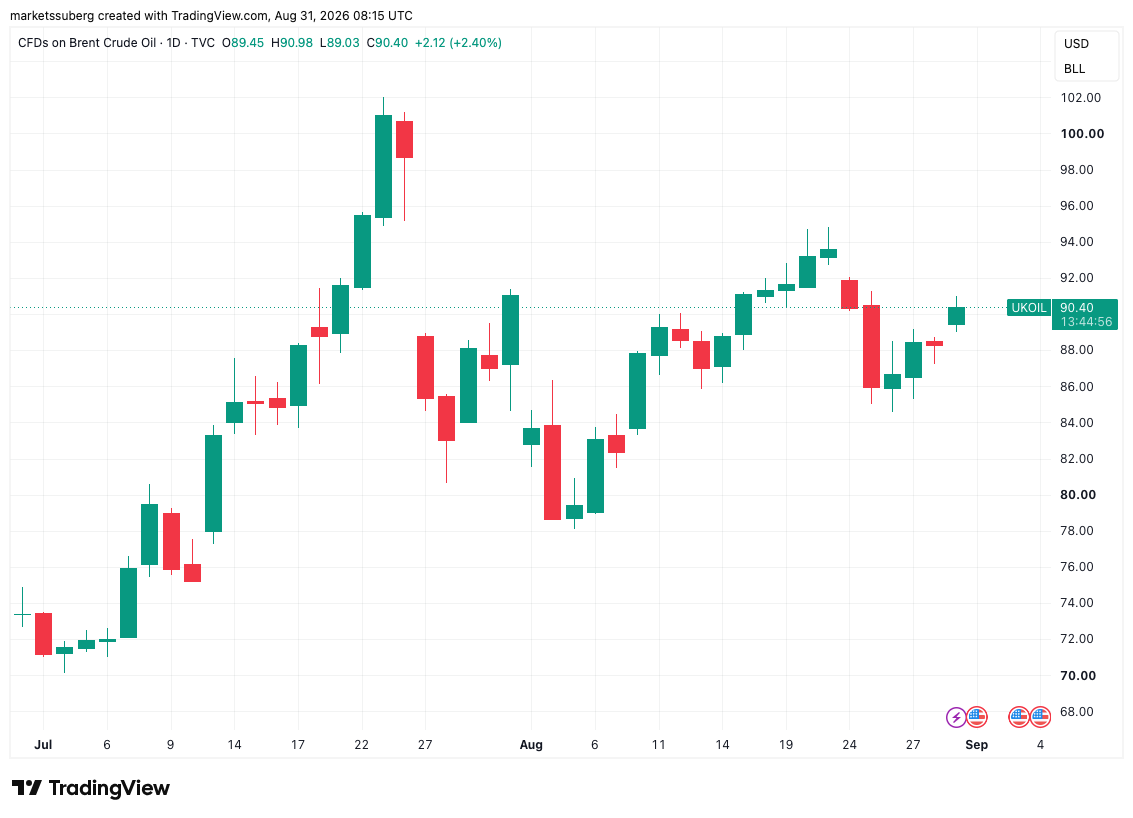
CFDs on Brent crude oil one-day chart. Source: Cointelegraph/TradingView
European stocks came under pressure as a result of the events, with Germany’s DAX down 0.7%. US president Donald Trump implied that Iran’s Kharg Island oil hub was once more a target. In a post on Truth Social, Trump uploaded an AI-generated video that appeared to show the bombing of oil infrastructure, describing the island as “being blown to smithereens.”
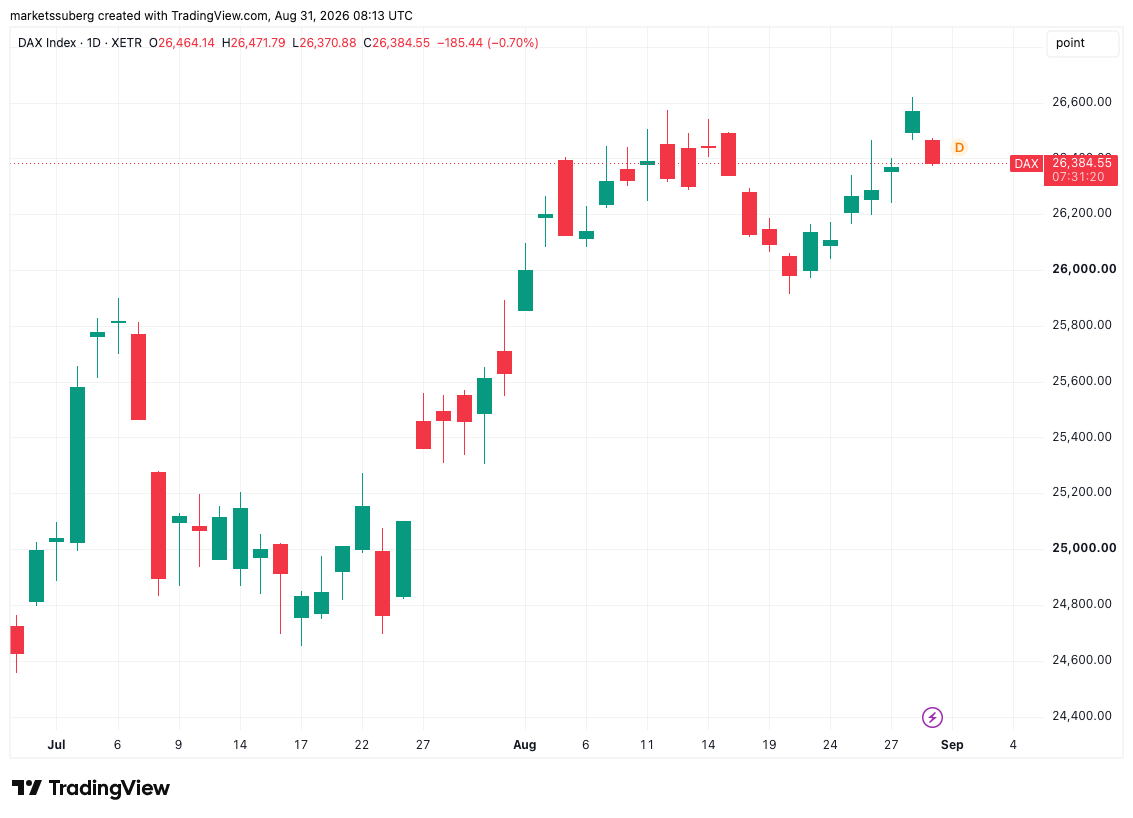
DAX one-day chart. Source: Cointelegraph/TradingView
The strikes followed news of a major energy deal granting the US significant control of Venezuela’s oil reserves. Numbers from Venezuela’s interim president Delcy Rodriguez quoted by CNBC and others referenced a daily oil-output target of 1.5 million barrels, with total reserves involved at 65 billion barrels, currently worth around $5.4 trillion.
In a Truth Social post, Trump described the takeover as the “biggest oil deal in history.”
Bitcoin battles multiple 50-week trend lines
Bitcoin saw late sell pressure into Sunday’s weekly close, with a brief trip below its 50-week exponential moving average (EMA) at $77,269, per data from TradingView.
Price defended the trend line, which we had previously flagged as important support, for a second consecutive week. In the wake of its recent rally, BTC had managed to reclaim the moving average with a weekly close for the first time since November 2025.
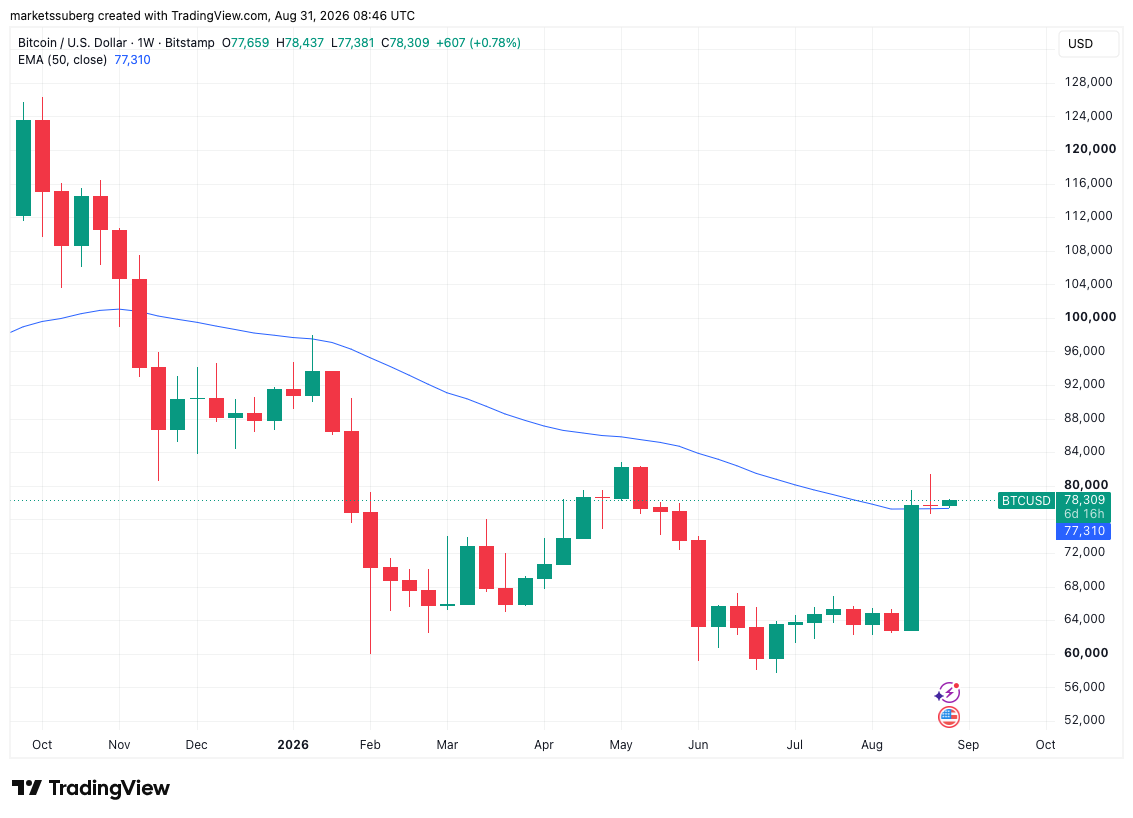
BTC/USD one-week chart with 50 EMA. Source: Cointelegraph/TradingView
In his latest market observations on X, Rafael Schultze-Kraft, cofounder of crypto analytics platform Glassnode, drew attention to the equivalent simple moving average (SMA) at $80,307. Here, BTC/USD still lacks a reclaim on the weekly time frame — something which has preceded additional price upside in the past, he showed.
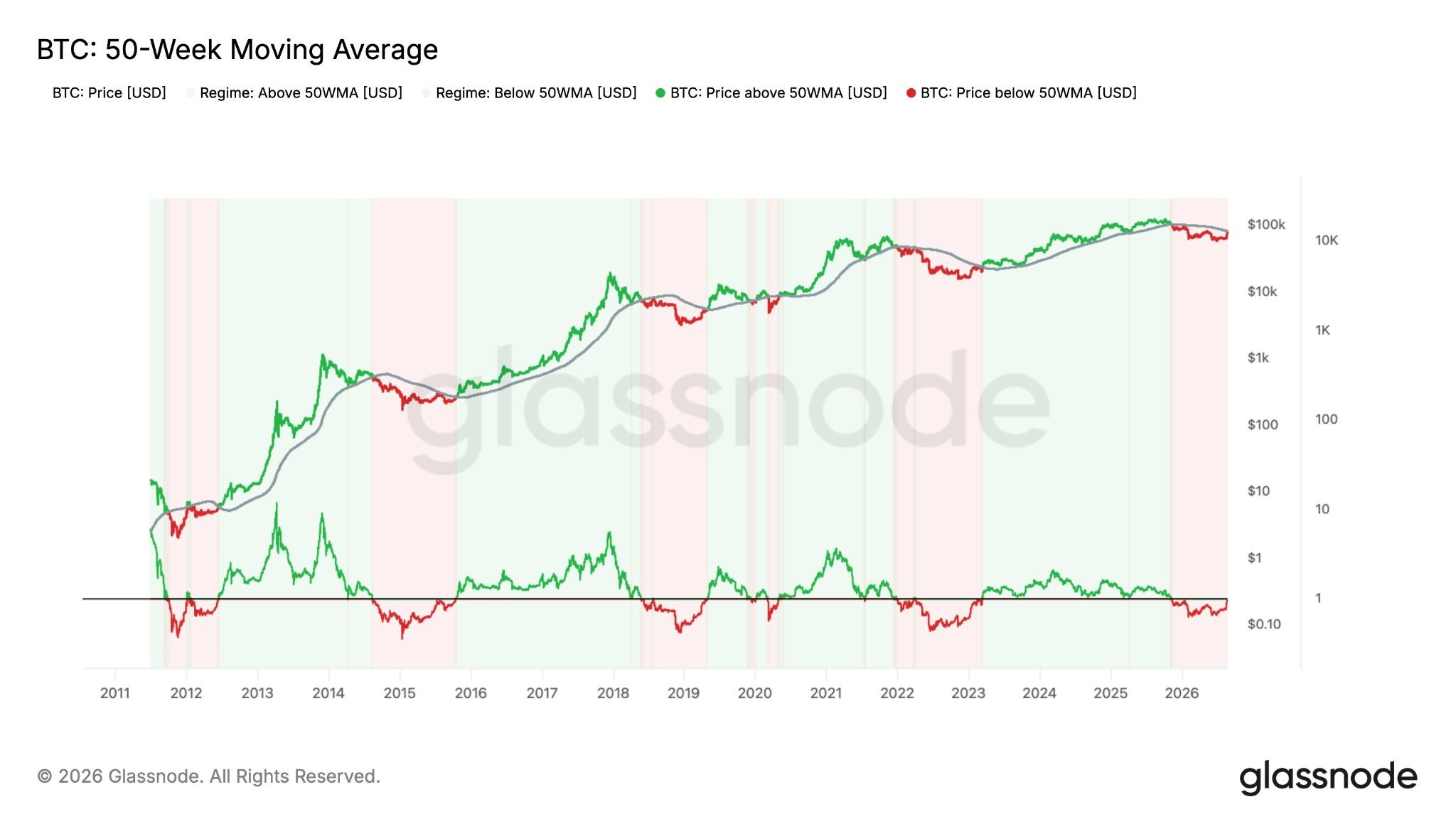
BTC/USD chart with periods above and below 50-week SMA. Source: Rafael Schultze-Kraft on X.com
Monthly close faces stiff resistance
Heading into the August monthly close, Bitcoin bulls face a key test as monthly gains for BTC/USD hover near 25%.
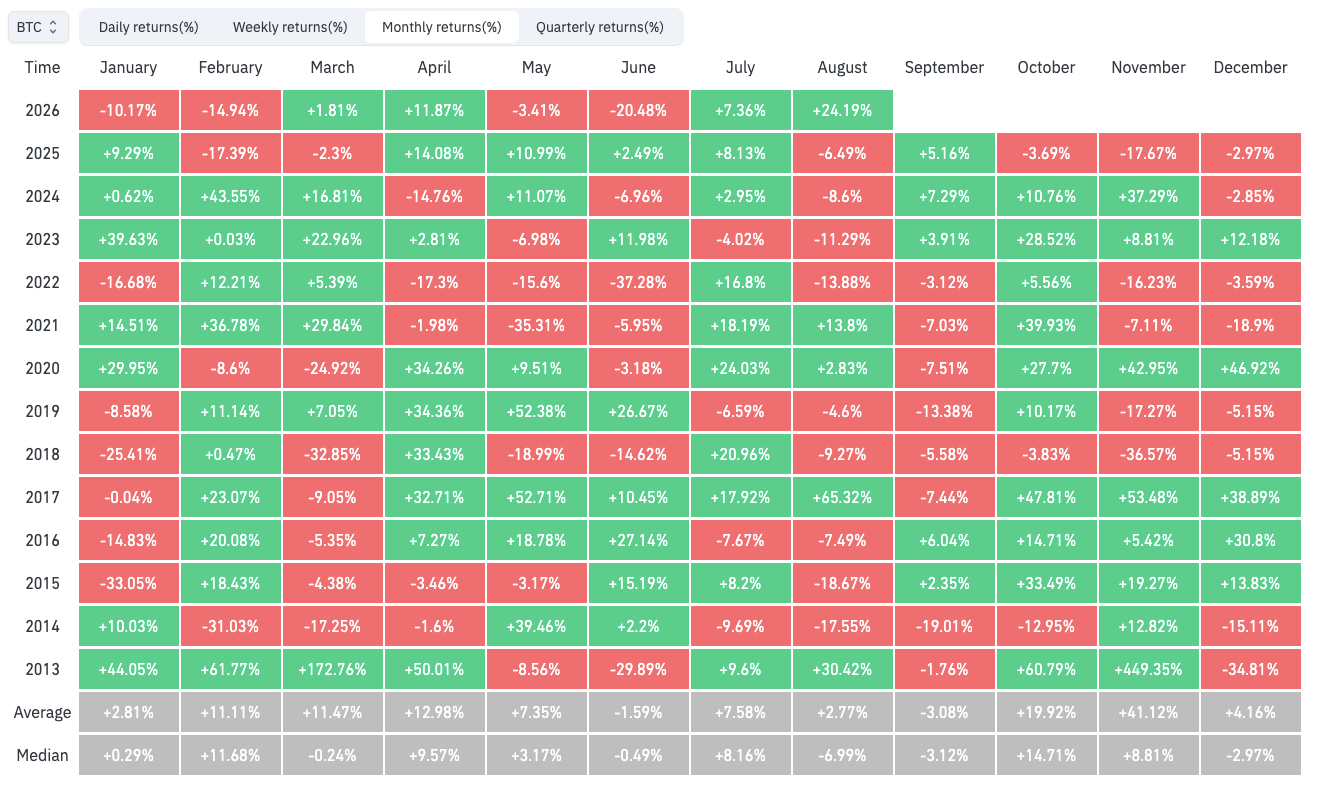
BTC/USD monthly returns (screenshot). Source: CoinGlass
Despite the biggest crypto short liquidation event ever recorded, buyers have so far failed to reclaim key resistance above $80,000, analysis warns.
“Bitcoin is still hovering beneath the Macro Downtrending resistance, having upside wicked briefly beyond it,” trader and analyst Rekt Capital summarized about the current status quo in his latest analysis on X.
“Still the pivotal resistance and by staying below it, Bitcoin continues its series of Macro Lower Highs.”
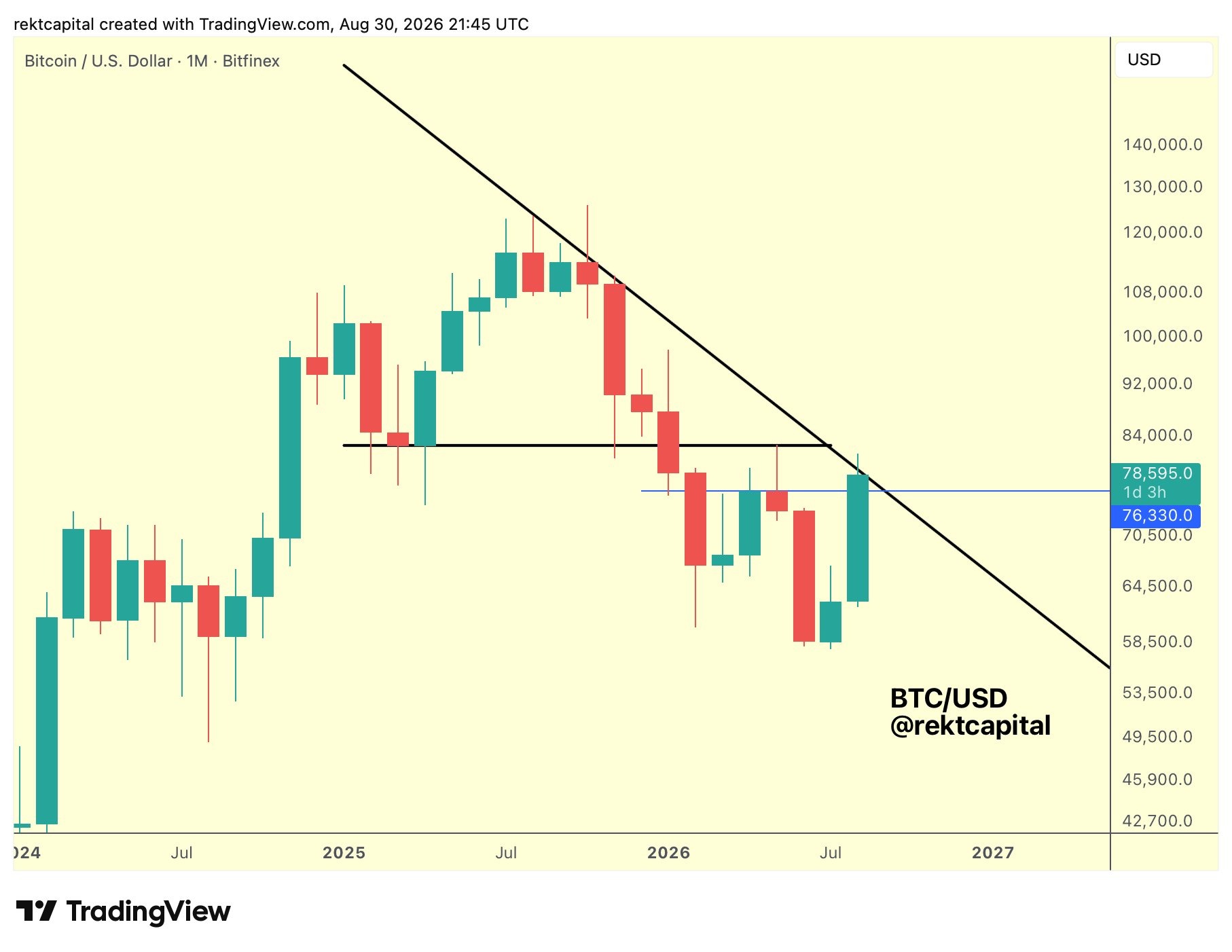
BTC/USD one-month chart. Source: Rekt Capital on X.com
Rekt Capital argued that a breakout above this resistance would have major implications for the four-year BTC price cycle, as it would mean that its latest bear market would be shorter than those before it.
Beyond the trend line, however, additional resistance has already formed thanks to thickening ask liquidity on exchange order books. As Cointelegraph reported, this extends to $86,000, thus requiring even more buy-side momentum to effect a lasting breakout.
“Every overhead structure we track now sits between $81K and $86K; that band is where the recovery’s demand meets its test,” Glassnode wrote in research last week.
Larger buyers seen as pivotal to BTC price upside
Glassnode calculated that 1.05 million BTC owned by long-term holders have a cost basis between $83,000 and $86,000. Long-term holders refer to wallets holding a given amount of BTC without selling for six months or more.
Related: Supply absorption ‘key question’ as Bitcoin fails to reclaim $80K: Analysis
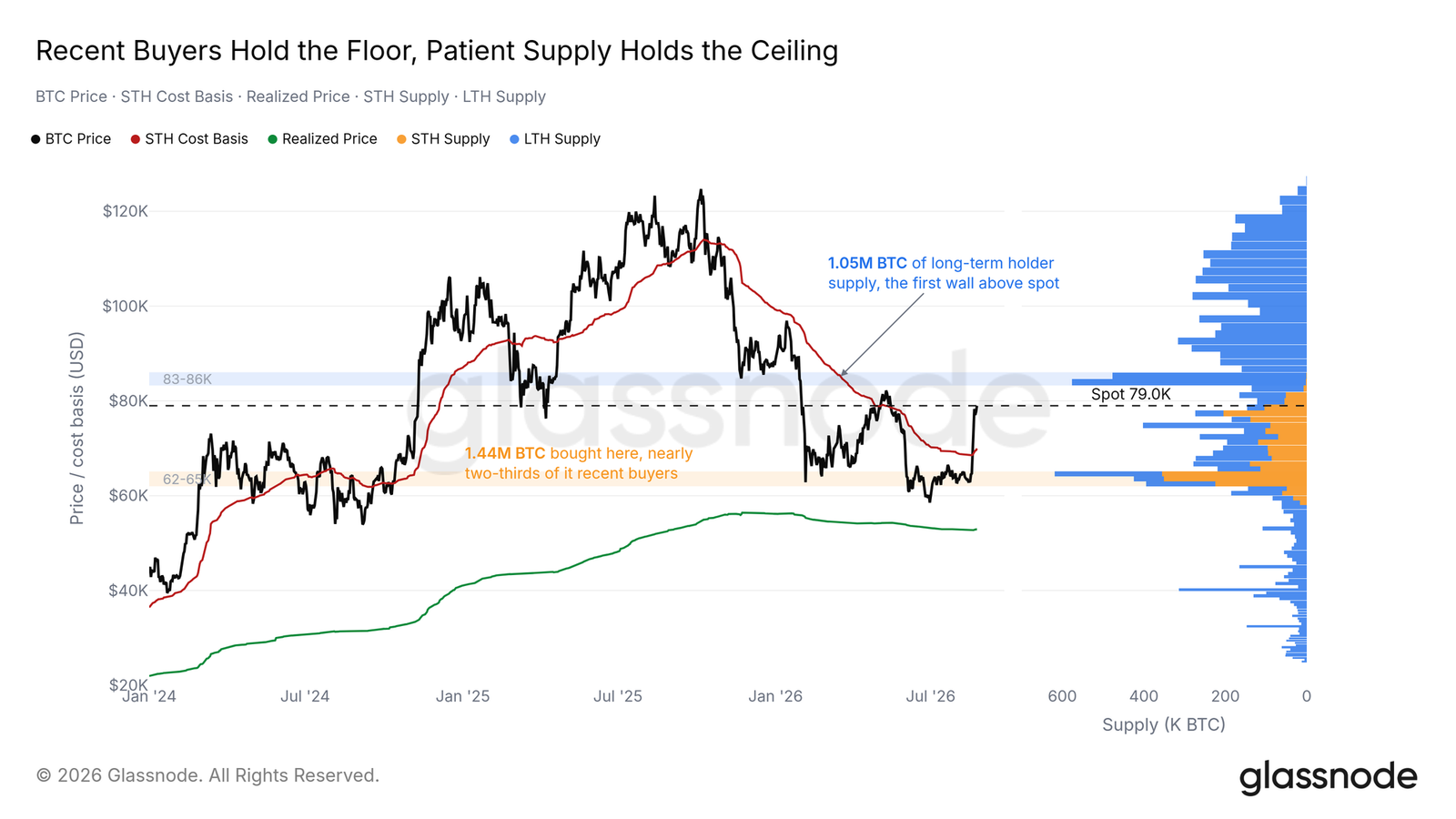
BTC supply distribution by wallet cohort. Source: Glassnode
In additional findings this week, onchain analytics platform CryptoQuant drew attention to the potential impact of large-volume investors going into September. These entities, its data showed, were behind buyer appetite this month, while smaller investors took profit or exited the market after their holdings returned to breakeven.
“From 1–30 August, wallets with 100+ BTC added about 60,000 BTC. Wallets with 1–100 BTC sold about 33,000. Wallets under 1 BTC sold about 14,000,” it wrote in a blog post on Monday.
“That split is the month. Large holders absorbed the breakout. Smaller holders used the rally as an exit.”
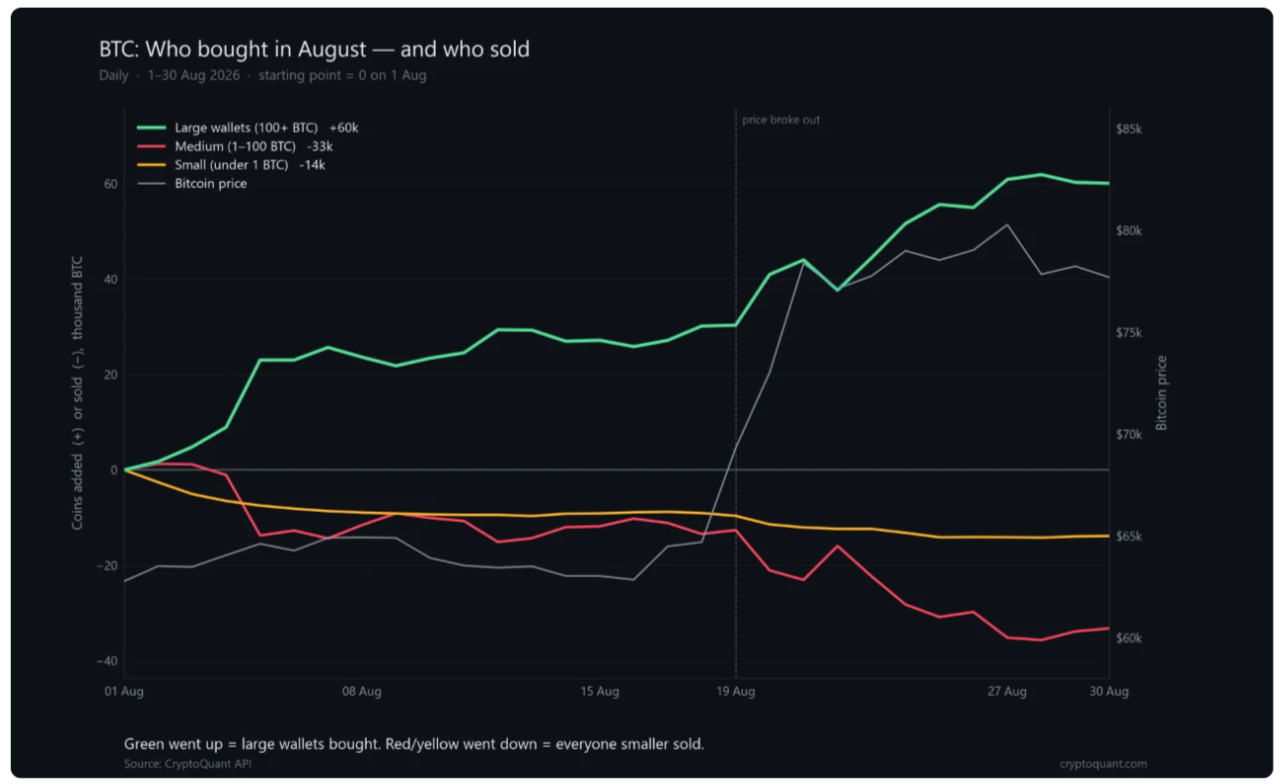
Bitcoin accumulation data by wallet cohort (screenshot). Source: CryptoQuant
CryptoQuant added that the view of large-investor accumulation would require reassessment should those entities start selling recently acquired supply below $80,000.


Polymarket has strengthened its trade surveillance and investigation systems ahead of the U.S. midterm elections, as the prediction market operator faces scrutiny over insider trading and American access to its international platform.
Summary
- Polymarket says its surveillance systems can identify anomalous trading as the U.S. midterm elections approach.
- The company uses blockchain analytics, machine learning and trade surveillance to detect potentially malicious activity.
- Polymarket says it has referred more than 100 cases to law enforcement, including suspected trades involving sensitive government information.
- The company says its controls block the vast majority of U.S. users from accessing its international platform under its 2022 CFTC settlement.
Reuters reported on Aug. 31 that Polymarket’s new global head of investigations and intelligence, Shana Bautista, said the company has systems capable of identifying unusual trading activity as election-related markets attract closer attention.
“I’m confident that I’m able to get the resources and the support I need,” Bautista told Reuters in her first interview since joining Polymarket in June. “I can tell you that we have the systems in place to be able to identify anomalous activity when the midterms do come.”
Polymarket prepares surveillance systems for U.S. midterms
Bautista, a former FBI investigator and Coinbase analyst, is overseeing Polymarket’s investigative work as U.S. lawmakers examine whether prediction markets could provide a venue for trading based on sensitive government or political information.
Congress has already moved toward restricting lawmakers from participating in such markets. Crypto.news previously reported that Rep. Bryan Steil was seeking to include a prediction market trading ban in a proposal that would restrict stock trading by members of Congress and their families.
Steil said lawmakers should not be trading contracts tied to elections or public policy. His proposal followed a unanimous Senate vote in April barring senators and their staff from trading on prediction markets such as Polymarket and Kalshi.
Questions over insider access have extended beyond lawmakers. A study published earlier this year examined how restrictions could affect the information produced by prediction market prices, arguing that enforcement should distinguish between traders who possess private information and participants who can influence the outcome of an event.
The research found that a blanket ban could reduce the information available in market prices, while recommending stronger penalties for participants capable of changing an outcome themselves. The findings came as Polymarket and Kalshi faced increased insider trading scrutiny from regulators and lawmakers.
Polymarket says its surveillance program uses several sources of information to detect potentially malicious activity. Bautista said the company combines machine learning, blockchain analytics, trade surveillance, open-source research and third-party services.
A new webpage will provide more public information about those controls and explain how the company works with law enforcement, according to a Polymarket spokesperson cited by Reuters.
“The market integrity program itself is not new, but what we’re putting on the record now is considerably more detail about how it operates,” Bautista said.
Blockchain activity gives Polymarket investigators a trading trail
Trades on Polymarket’s international platform settle on a blockchain, leaving transaction records publicly visible even when the people controlling individual wallets remain anonymous.
Critics have argued that pseudonymous wallet-based trading can create opportunities for misconduct. Bautista told Reuters that blockchain records can provide investigators with useful information about trading behavior and movements of funds between addresses.
Polymarket says it has referred more than 100 cases to law enforcement.
One involved a wallet linked to a U.S. soldier who prosecutors say used classified information to trade contracts concerning the capture of Venezuela’s Nicolás Maduro.
A federal judge in August paused the Commodity Futures Trading Commission’s civil case tied to the soldier while a related criminal proceeding continues. Prosecutors allege that about $409,881 was earned through 13 Venezuela-related Polymarket trades, according to the CFTC case proceedings.
The defendant has pleaded not guilty and challenged whether the prediction contracts involved in the case legally qualify as swaps.
Bautista said other referrals involved possible insider wagers concerning U.S. military actions in Iran. Reuters reported earlier in August that several trades linked to military developments had raised questions over whether some participants possessed information that was not publicly available.
Political concern has extended to federal employees with access to sensitive information. More than 40 Democratic lawmakers previously asked the CFTC and the U.S. Office of Government Ethics for guidance restricting federal employees from using nonpublic information to trade prediction contracts.
Their letter raised concerns involving political events, military developments and other contracts where government employees could have access to information before the public.
Polymarket says controls block most U.S. users
Keeping American users away from Polymarket’s international platform remains another enforcement issue for the company.
The CFTC reached a settlement with Polymarket in 2022 after finding that it had offered event-based binary options contracts without registering with the regulator. Polymarket agreed to pay a $1.4 million civil penalty and wind down markets that did not comply with U.S. law.
The settlement required the company to prevent U.S. customers from using its international operation.
Bautista told Reuters that she believes Polymarket’s current systems are sufficient to stop the vast majority of American users from accessing the international platform.
“It is difficult at scale to be able to consistently and always evade all of the guardrails we have,” Bautista said. “I do not see it being a really prevalent issue.”
Blockchain research has raised questions over how effectively those restrictions work.
On-chain research firm Allium estimated that U.S.-linked wallets traded about $571 million in political contracts on Polymarket over a one-year period despite the restrictions. The United States represented the largest national group identified in its analysis.
Allium cautioned that it could assign country labels to only a small share of political-market wallets and described its estimates as directional because blockchain activity cannot establish the identity or physical location of every trader.
The findings renewed attention on U.S. wallet activity on Polymarket’s international venue.
Federal scrutiny of the company has changed under President Donald Trump’s administration. Regulators dropped an investigation into whether Polymarket had breached its 2022 settlement, and CEO Shayne Coplan said at the time that the company had been cleared of wrongdoing.
Polymarket has taken a separate route to serve American customers through a regulated exchange.
The company returned to the U.S. market after acquiring a CFTC-registered exchange last year, creating an operation separate from the international blockchain platform that remains closed to U.S. users.
State lawsuits target prediction market sports contracts
While federal regulators oversee event contracts under commodities law, prediction market companies are fighting a separate series of disputes with state authorities over sports-related contracts.
Several states have argued that sports event contracts offered by prediction market platforms amount to gambling products that require state licenses.
Prediction market companies have disputed that position, maintaining that qualifying event contracts fall under federal commodities regulation and CFTC jurisdiction.
The conflict has produced lawsuits seeking to stop prediction market operators from offering sports contracts without state gambling licenses.
Polymarket’s regulated U.S. operation and its international platform remain separate. The international service uses blockchain-based settlement and wallet trading, while the U.S. exchange operates within the CFTC regulatory framework.
Bautista told Reuters that Polymarket intends to provide more public detail about its surveillance program as the midterm elections approach, including how the company uses blockchain analytics, machine learning and trade monitoring to identify suspicious activity and refer cases to law enforcement.
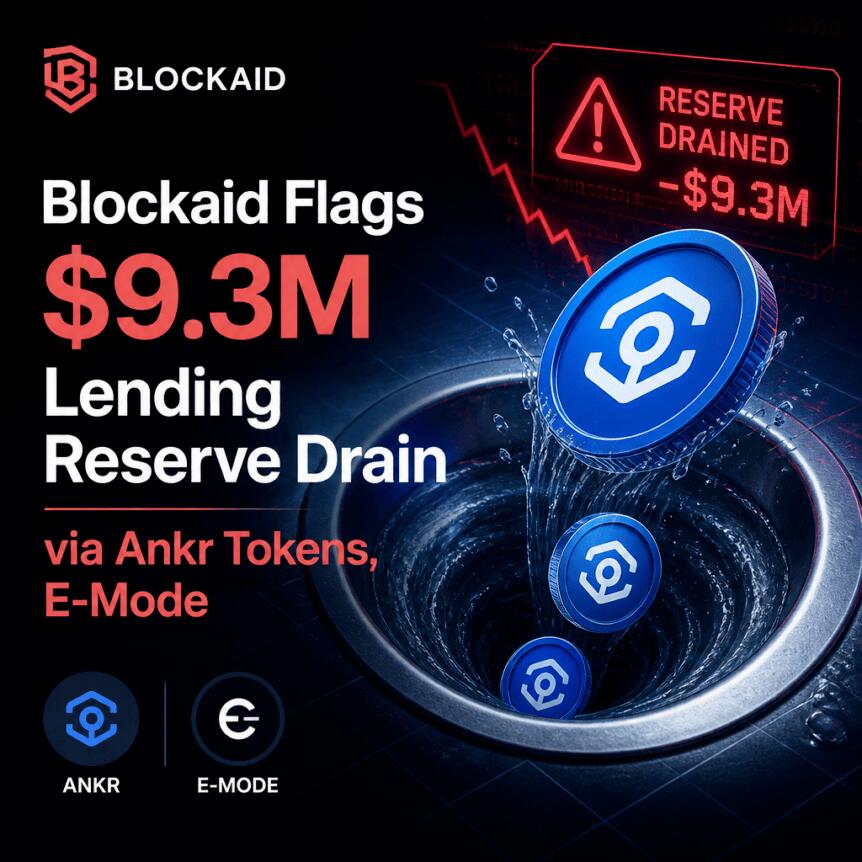
Flow-based DeFi lending protocol More Markets suffered a reserve drainage of about $9.3 million in digital assets, according to security firm Blockaid. Blockaid said the attacker extracted roughly 15.5 million Wrapped Flow (WFLOW) tokens from the protocol’s mFlowWFLOW lending reserve on the Flow EVM network.
The incident, outlined in a Monday post on X by Blockaid (see Blockaid’s report), highlights how lending platforms that support liquid staking tokens can be vulnerable when borrowing mechanics are combined with liquidity and efficiency-mode features.
Key takeaways
- $9.3 million worth of WFLOW was reportedly drained from More Markets’ mFlowWFLOW lending reserve on Flow EVM.
- Blockaid attributes the attack to the use of ankrFLOW (Ankr Staked FLOW) and Aave V3 E-mode overborrowing conditions.
- The exploitation contributed to total crypto hack losses of $139.7 million in August 2026, per DefiLlama.
- While August thefts remain the third-largest month of 2026 so far, they are far below $254 million stolen in July, according to DefiLlama data.
- More Markets has not publicly confirmed the incident or disclosed potential user losses as of publication.
How Blockaid says the Flow EVM exploit worked
In its analysis, Blockaid linked the theft to the borrowing and collateral logic used inside the protocol. The security firm said the attacker used Ankr Staked FLOW (ankrFLOW), a liquid staking token, together with E-mode—a feature associated with Aave V3.
E-mode (short for efficiency mode) is designed to increase borrowing power for certain asset pairs when their prices are expected to move together. Blockaid’s explanation focuses on the relationship between a liquid staking token and its underlying asset: if the tokenized staking position (ankrFLOW) behaves closely to the underlying FLOW, then the protocol may assign more favorable risk parameters under E-mode.
According to Blockaid, the attacker leveraged those assumptions to overborrow from the mFlowWFLOW reserve and drain liquidity. Blockaid’s public figures point to 15.5 million WFLOW tokens being pulled from the reserve and valued at about $9.3 million in the incident.
What the reserve drainage means for DeFi risk management
Incidents like this tend to raise a difficult question for DeFi lenders: how to balance the capital efficiency benefits of supporting liquid staking derivatives against the edge cases that can emerge when borrowing rules are pushed to their limits.
E-mode is meant to reflect a correlation between assets, but the way correlation is enforced on-chain can be exploited if attackers can find a path where collateral valuation, liquidity availability, or borrowed asset dynamics allow them to extract value faster than the system can correct risk exposure. In this case, Blockaid specifically cited E-mode plus the use of a liquid staking token to achieve an outcome that resulted in reserve depletion.
For users, the immediate practical takeaway is less about the specific tokens involved and more about the mechanics. When a lending market supports efficiency-mode pairings between liquid staking tokens and their underlying assets, traders and depositors should watch for whether the platform can demonstrate robust controls under volatile or abnormal borrowing conditions.
Hack totals for August remain elevated—yet down from July
The Flow EVM theft adds to the broader picture of crypto security losses in 2026. Blockaid’s report comes as overall monthly totals have remained high.
DefiLlama data shows that losses from cryptocurrency hacks reached $139.7 million in August, making it the third-largest month by value stolen so far in 2026. Even so, August’s total represents a substantial drop from $254 million stolen during July, according to the same DefiLlama dataset on hacks (see DefiLlama’s hacks dashboard).
That comparison matters for risk perceptions. A decline from one peak month does not imply fewer vulnerabilities overall—it may instead reflect differences in the types of exploits that surfaced, the speed of mitigation once attacks begin, or the particular concentration of high-value DeFi targets in each month.
Other network disruption: Cronos pauses after Tectonic exploit
Blockaid’s account of the More Markets drainage arrives amid other DeFi-related security actions. On Sunday, Cronos halted its network after a reported $75 million exploit targeting the DeFi lending protocol Tectonic, according to earlier coverage from Cointelegraph (see that report).
Taken together, the two incidents underscore how quickly lending infrastructures can draw attention from attackers and how governance and incident response—whether pausing a chain or adjusting protocol controls—can become a determining factor in whether additional losses are contained.
Unanswered questions for More Markets users
As of the time of publication, More Markets had not publicly confirmed the incident or disclosed whether any user losses occurred. Cointelegraph attempted to obtain additional details by contacting Blockaid, but received no response by publication. The outlet also was unable to reach More Markets for comment.
Readers should watch for a formal More Markets statement, any post-mortem describing which reserve controls were bypassed, and whether the platform (and related integrations) plans to adjust E-mode or liquid staking collateral parameters to reduce the chance of a repeat.
Bitcoin began the new business week with a dip below $77,000 as geopolitical tensions in the Middle East escalated amid new attacks, but has since managed to shrug off the losses.
The same cannot be said about most larger-cap alts. ETH is still struggling at $2,500, while BNB is below $700. XRP has seemingly lost the $1.40 support. XMR is among the few exceptions.
BTC Rebounds
After gaining $15,000 in 48 hours, bitcoin was due for a correction last weekend and dropped below $75,500. However, the bulls quickly resumed control of the market and initiated a couple of major legs up as the previous business week progressed, driving the asset to $81,000 and $81,500, respectively.
This meant that BTC had reached its highest price tag in over three months. However, its attempt on Thursday was met with a sharp rejection, perhaps due to the hawkish stance taken by Fed Chair Kevin Warsh during the Friday speech at Jackson Hole, and bitcoin slumped to under $77,000.
It managed to rebound over the weekend and even climbed past $79,000. However, then came the new attacks in the Middle East, and the cryptocurrency dipped to just under $77,000 on Monday morning.
It has reacted swiftly by recovering nearly two grand ahead of another major macro week. As a result, it trades close to $79,000 once again, with its market cap jumping back to $1.580 trillion, while its dominance over the alts has rocketed to over 58.5% on CG.

XMR Pumps
Monero’s XMR is today’s top performer, having surged by almost 10% to well over $520. UNI and MNT follow suit, with increases of 6-7%. In contrast, most other large-cap alts remain in the red.
ETH is still just under $2,500, BNB has failed to reclaim $690, while XRP, despite the major ETF inflows from last week, is well below $1.40. SOL, TRX, HYPE, and DOGE are down by up to 2.5%, while RAIN has plummeted by 8.6% to $0.016. PUMP is the other big loser today, slumping by 9% to $0.0044.
The cumulative market cap of all crypto assets has recovered over $50 billion since this morning’s low and is up to $2.7 trillion on CG.

The post BTC Recovers Swiftly and Eyes $79K Again, XMR Surges Above $500: Market Watch appeared first on CryptoPotato.

Traditional economists typically begin with the presumption that private, competitive markets are efficient and the desirable way to provide ordinary goods like groceries. Government should stick to where it is needed, these economists believe, like providing defense and environmental regulation.
But over the past 50 years, this presumption has been totally undermined, as we’ve come to understand better the many ways in which markets “fail,” especially in the presence of imperfect information. Even in the simple area of groceries, market incentives direct consumers to more profitable but less nutritious foods, contributing, for instance, to the childhood diabetes crisis. Public grocery stores, whose objective is to provide better, more affordable goods for all citizens—rather than just maximizing profits—hold out the promise of a healthier population and a more productive labor force.
The argument for private markets begins with unrealistic assumptions about perfect markets, with perfect competition and perfect information. Even seemingly competitive markets like grocery stores are better described by monopolistic competition than perfect competition. In a series of papers, I showed that the market equilibrium in such markets was not, in general, efficient. This is true even if profit margins of grocery stores are thin. Indeed, part of the problem is that to maintain even these thin margins, grocery stores often have to engage in exploitative activities that encourage the consumption of high-margin and often less-nutritious foods at the expense of lower-margin foods that would be better for everyone’s health.
Crypto World
Solana ETFs Hit 9 Straight Days of Inflows While the Chart Cools Off: Is $100 About to Break?

In the latest Solana News, Institutional money keeps arriving even as the chart cools off, and that mismatch is defining the setup right now.
SOL is trading around $101.59 after shedding roughly 3% the previous session, putting the $100 psychological support level under direct scrutiny.
The token is holding that line while SOL-focused ETFs booked $153.87 million in inflows last week, extending their streak to 9 consecutive days of net buying.
That demand signal contrasts sharply with a daily chart where momentum indicators are easing. Institutional flows keep arriving even as the RSI retreats from overbought territory. Whether that combination resolves into bullish consolidation or a further decline depends on how the price behaves around nearby support and resistance levels in the next few sessions.

Solana News: Institutional Demand Meets Supply-side Changes
The $153.87 million weekly inflow figure lands alongside a governance shift on the network itself. Solana validators voted to double the disinflation rate to 30% and establish a new governance framework, a move aimed at better structuring disinflation and supporting long-term growth.
A separate proposal to introduce usage-based fees, which could have pushed daily SOL burns to almost 9,000 tokens, failed to pass.

The governance outcome leaves the disinflation measure in place without the proposed usage-based fee mechanism.
Supplementary reporting said US spot Solana ETFs recorded $60.91 million in daily inflows on August 27, describing it as their best daily inflow result of the year to date. The same report said August inflows had surpassed $134 million before the month closed.
Make Your Prediction Count With $25 For Free on Kalshi
Solana News: Why ETF inflows do not settle the $100 question
Strong ETF inflows typically project confidence in long-term growth and can fuel demand from large-wallet and retail investors as risk appetite improves. That is the constructive read on the nine-day streak, reflecting sustained capital flows into SOL-focused ETF products.
What it does not do is override the technical picture sitting directly beneath the price. The daily RSI has eased to 67 from overbought levels, suggesting buying pressure is cooling even as ETF inflows remain positive.
The MACD is edging lower toward its signal line, reinforcing that the pace of upside is slowing rather than accelerating.
Inflows are a supportive context for a price level, not a mechanism that guarantees it will hold. The weekly ETF figure alone does not determine whether SOL can maintain support near $100 following the previous session’s decline.
The $98.02 support and $116.88 barrier
SOL remains above its 50-day EMA at $85.05, its 100-day EMA at $82.77, and its 200-day EMA at $89.71. With all three averages below the market, the broader technical structure remains constructive despite easing short-term momentum.
Immediate downside support sits at the February 1 low of $98.02. A break below that level shifts attention to the 200-day EMA at $89.71, then to the 50-day EMA at $85.05.
On the upside, the next notable hurdle is $116.88, the December 18 low. The level represents a significant structural barrier to an extended rally.
If SOL holds the $98.02 low and stays above $100, the existing EMA structure remains intact, and $116.88 becomes the level to watch for a possible extension of the move higher. That scenario keeps the institutional-demand narrative in focus alongside the technical setup.
A break below $98.02 shifts attention toward the 200-day and 50-day EMAs as the next support levels and would indicate that ETF inflows have not offset broader selling pressure. A sustained move through $116.88 would clear the named structural barrier, while the cooling RSI and MACD keep attention on whether buying pressure can strengthen again.
The interaction between ETF flows, governance developments, and the technical levels around $100 will remain central to SOL’s near-term setup.
The Best Traders Around Use It: AI Copy Trading Bots From CryptoHopper
Solana Has the Demand. LiquidChain Is Building Where That Liquidity Can Travel Next.
Nine straight days of ETF inflows show that fresh capital is still willing to enter Solana even as price tests support. The bigger opportunity may be what happens when that capital starts moving beyond a single ecosystem.
LiquidChain is building for exactly that.
Bitcoin, Ethereum, and Solana still operate as separate liquidity environments. Moving between them means bridges, duplicated deployments, added fees, and fragmented execution. LiquidChain is building a single execution layer designed to connect all 3, allowing one deployment to reach multiple ecosystems without rebuilding the same application chain by chain.
That means LiquidChain does not need Solana to lose for its thesis to work. The more activity grows across major chains, the more valuable seamless execution between them becomes.
The presale is currently priced at $0.01454 with just over $920,000 raised, leaving the project at a stage where relatively modest inflows can still materially change its valuation.
Gain Special Access to Layer 3 Trading Here
The post Solana ETFs Hit 9 Straight Days of Inflows While the Chart Cools Off: Is $100 About to Break? appeared first on Cryptonews.

XRP is changing hands around $1.37 as the token grinds through a second week of consolidation after August’s rally and news faded. The bulls haven’t lost the plot entirely, but the chart is asking a question few want to answer yet: Is this a pause or the start of something worse? What happens at the next support test could set the tone for September.
The last 48 hours have been dominated by a post-rally pullback narrative. One market report noted XRP remains up 31% for August despite shedding 8% in a single week, pressured by heavy Binance sell-side volume and hawkish Jackson Hole commentary.
The general crypto sentiment remains choppy heading into September, with macro headlines doing as much damage as any XRP-specific news. That backdrop matters for where the price goes next.
Discover: The Best Crypto to Diversify Your Portfolio
Can XRP Price Hit $1.5 This Week Amid Bearish Jackson Hole News?
XRP trades at $1.37, off 2% intraday, sitting just above the critical $1.35 support shelf that’s held for over a week. Volume has thinned since the late-August run, a sign that conviction is missing on both sides. Momentum indicators lean neutral-to-bearish, with the token still down nearly 7% on the weekly timeframe despite the monthly gain holding.
The best case would need XRP to reclaim $1.40–$1.43, opening a path toward $1.47–$1.50, especially if ETF flow data keeps surprising to the upside. Most likely scenario is a continued chop between $1.35 and $1.40 while the market digests macro signals.
What the bulls don’t want is a clean break below $1.35, which would expose $1.30–$1.32, with $1.26 as the next line of defense. None of these outcomes is locked in; the setup is watch-and-wait, not commit-and-hope.
Trade XRP on Bybit and Get a Chance to Win Our $1,000 USDT Airdrop
Maxi Doge Targets Early Mover Upside as XRP Tests Key Levels
Holding XRP through this chop hasn’t been fun, and the reward for patience so far has been sideways price action, not a breakout. At the current market cap, even a strong reclaim of $1.43 only nets double-digit percentage moves, respectable, but not the kind of asymmetric setup that changes a portfolio. That’s the gap early-stage plays are built to fill.
Enter Maxi Doge ($MAXI), a meme token built around a 240-lb canine mascot channeling 1000x-leverage trading energy and gym-bro humor into a community-driven presale.
Current price sits at $0.0002836, with $4.8 million raised so far and a huge 65% APY staking live for early holders. Standout features include holder-only trading competitions with leaderboard rewards and a Maxi Fund treasury earmarked for liquidity and partnerships.
Research Maxi Doge before the raise closes further.
Discover: The Best Token Presales
The post XRP News: Price Faces Crucial Support Test After August Rally Loses Steam appeared first on Cryptonews.

HDFC Bank shares after Jagdishan: What lies ahead for the country’s largest private lender?

Here's 1 metric on U.S. debt that makes bitcoin's bull case look stronger than ever

The 8 Most Fun Superhero Movies of All Time, Ranked





-

 Crypto World5 days ago
SpaceX stock could rise 75% to $240, JPMorgan says
-

 Fashion3 days ago
Weekend Open Thread: Maeve – Corporette.com
-

 Crypto World3 days ago
Bitcoin’s 22% rally now needs real demand to outlast Treasury liquidity boost
-

 Crypto World5 days ago
Warsh Jackson Hole keynote puts financial innovation first
-

 Crypto World6 days ago
A $30 Billion AI Fund Implodes, Now the SEC Is Investigating Wall Street’s Role
-

 Business3 days ago
Salesforce Stock Soars 19% as Blowout Earnings and Agentforce AI Growth Silence Software Skeptics
-

 Crypto World5 days ago
Did Trump Just Move SpaceX Stock With One Truth Social Post?
-

 Crypto World4 days ago
Elon Musk Grok Bot Promise: We Will Make You Whole if AI Loses Your Money
-

 Business3 days ago
Apple Confirms September 9 Keynote and Reveals Its Full Pre-Order Schedule
-

 Business5 days ago
Walmart takes aim at younger shoppers with new fashion brand
-
 NewsBeat5 days ago
Lindsay Clancy jury braces for closing arguments as judge tells court: ‘You’ve heard all the evidence’ – Live updates
-

 Crypto World2 days ago
Bitcoin price tests $82K resistance as Brandt stays long
-

 Business2 days ago
Onto Innovation Stock: AI’s Next Bottleneck Is Yield (NYSE:ONTO)
-

 Business5 days ago
Thailand’s Eastern Economic Corridor Capital City (EECiti): Key Developments and Investment Opportunities
-

 Crypto World4 days ago
NVIDIA revenue hits $96.2B as AI demand doubles
-

 Business7 days ago
Moderna CEO warns China is pouring state money into mRNA technology
-

 Business7 days ago
NVIDIA Stock Drops Nearly 2 Percent to $210 on Seventh Losing Day Ahead of Critical AI Earnings
-

 Business3 days ago
iPhone 18 Pro Pre-Orders Could Shift to Saturday as Apple Reportedly Avoids September 11 Anniversary
-

 NewsBeat5 days ago
Trump’s trade truce with China faces test with Iran effort
-
 Crypto World5 days ago
Nvidia Q2 Earnings Reveal $96.2 Billion Beat, So Why Is NVDA Falling?
You must be logged in to post a comment Login