BlackRock and Coinbase plan to take an 18% share of staking rewards from BlackRock’s proposed Ethereum staking exchange-traded fund, according to an updated regulatory filing.
Summary
BlackRock and Coinbase will take 18% of ETH ETF staking rewards.
Between 70% and 95% of the fund’s Ethereum would be staked, with Coinbase serving as custodian and execution agent.
Supporters see institutional yield access as positive, while critics warn about fees and centralization risks.
The firms disclosed the fee structure in an amended S-1 filing with the U.S. Securities and Exchange Commission on Feb. 17. According to the filing, investors will receive 82% of gross staking rewards, with the fund sponsor and its execution partner receiving 18%.
A sponsor fee that ranges from 0.12% to 0.25% of the investment value will be paid by shareholders each year in addition to the staking fee.
Advertisement
How the staking model will work
Under the proposed structure, most of the fund’s Ethereum (ETH) holdings will be used for staking. The filing says between 70% and 95% of assets may be staked under normal conditions, with the rest kept available for liquidity and redemptions.
Coinbase will act as the prime execution agent and custodian through its institutional services unit. The company may also pass part of its share to third-party validators and infrastructure providers involved in the staking process.
BlackRock has already seeded the trust with $100,000, equal to 4,000 shares priced at $25 each. The firm is also building its Ethereum position ahead of a potential launch.
Advertisement
Based on early 2026 network data, Ethereum staking yields have averaged close to 3% annually. After the 18% cut and other fees, the effective return for investors is expected to be lower, depending on market conditions and network participation.
Market reaction and centralization concerns
The fund is a yield-generating variant of BlackRock’s current Ethereum spot ETF, which has garnered significant institutional interest since its inception. After the success of its Bitcoin (BTC) and Ethereum products, the company has established itself as a significant player in digital asset ETFs over the last two years.
Nasdaq has already applied to list the staked, indicating growing support for regulated crypto yield products in traditional markets.
Some analysts say the structure could appeal to investors seeking exposure to blockchain rewards without managing wallets or validators. Others have questioned whether an 18% share of staking income is too high, especially as competition in the ETF space increases.
Advertisement
Concerns have also been raised about the concentration of influence. In the same week as BlackRock’s filing, Vitalik Buterin warned that growing Wall Street involvement in Ethereum could increase centralization risks over time.
Supporters argue that institutional products help bring liquidity and legitimacy to the market. Critics say they may shift too much control toward large financial firms.
Pi Network’s native token is the top performer on a weekly scale, followed by STABLE and MORPHO.
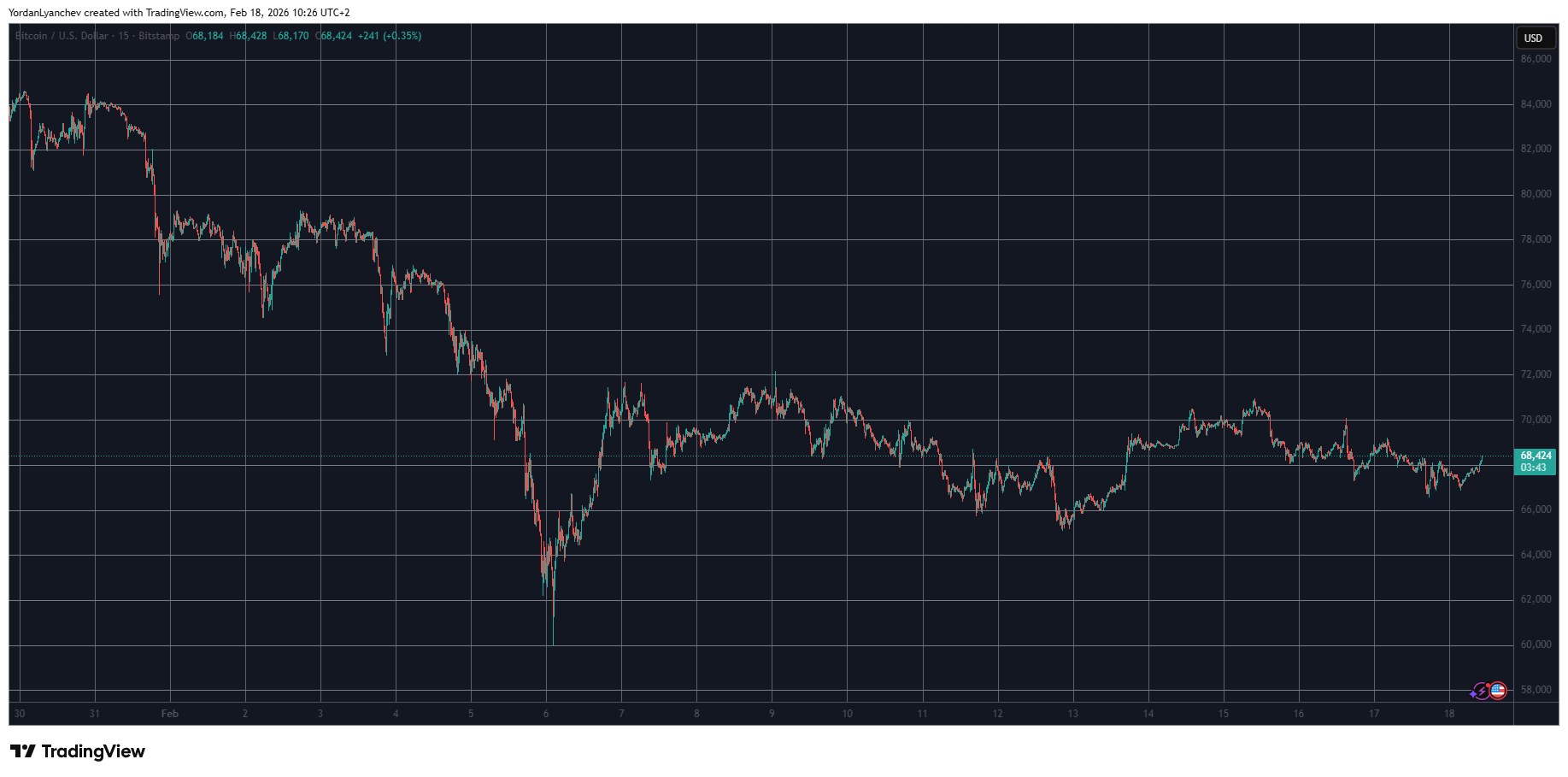
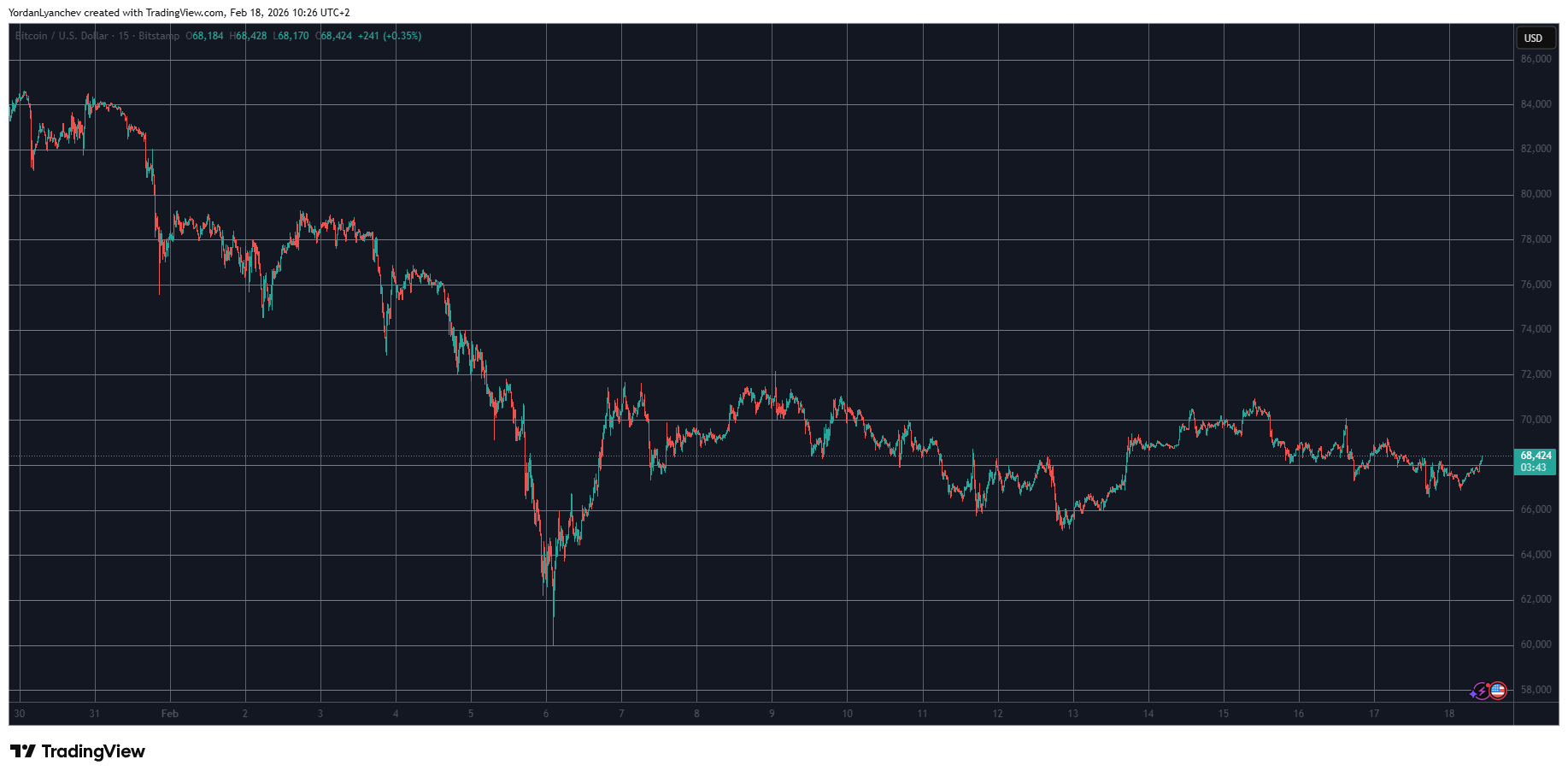
Bitcoin’s rather underwhelming price movements around $68,000 continue as the asset slipped below that level on a couple of occasions in the past 24 hours.
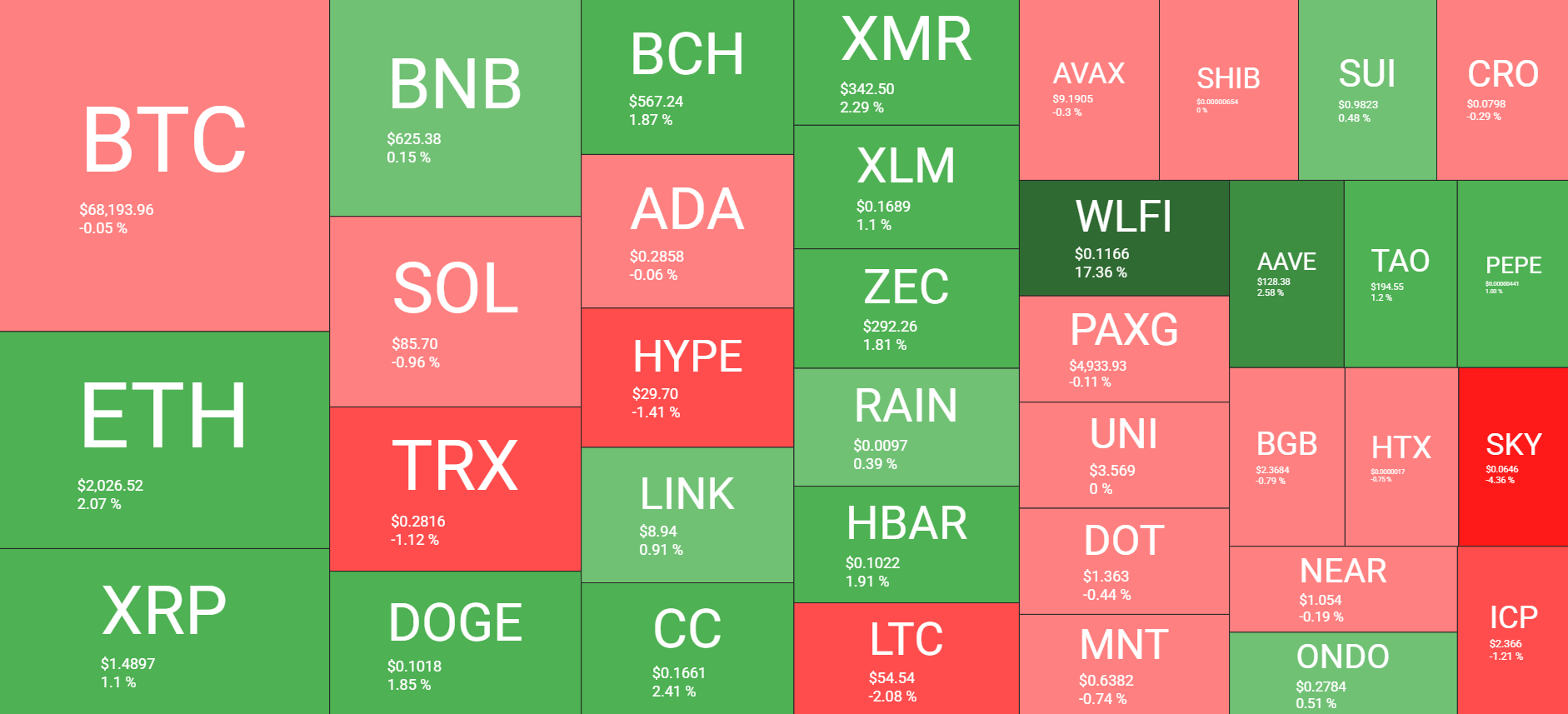
WLFI has soared the most from the larger-cap alts in the past 24 hours, while significantly more modest gains from ETH have pushed the asset to just over $2,000.
Advertisement
BTC Fragile at $68K
The first trading week of the current month resulted in a massive calamity for bitcoin, as the asset plunged to $60,000 for the first time since October 2024. This crash represented a $30,000 decline in the span of just over a week.
The bulls finally intervened at this point and helped BTC recover $12,000 in just a day. However, it faced immediate selling pressure at $72,000 and spent the following several days trading between that upper boundary and the lower one at $68,000.
It lost the support a week ago, but quickly reclaimed it and rocketed to over $70,000 during the weekend. However, that was another fakeout and returned to under $70,000 a day later. It slipped below $67,000 yesterday after the latest rejection, but now stands above $68,000, which is essentially the same level as this time yesterday.
Its market cap has remained calm at $1.365 trillion on CG, while its dominance over the alts is down to 56.2%.
Advertisement
BTCUSD Feb 18. Source: TradingView
PI’s Weekly Surge
Ethereum is up by 2% in the past day and now sits above $2,000 once more. XRP has neared $1.50 after a minor increase. BNB, DOGE, BCH, and CC are also slightly in the green, while TRX and HYPE are with minor losses. WLFI has stolen the show in the past 24 hours, surging by over 17% to over $0.115.
On a weekly scale, though, Pi Network’s PI token shines. The asset is up by over 40% within this timeframe, as it dumped to a new all-time low of $0.1312 at the time. It now sits close to $0.19 after another 6% daily increase.
The total crypto market cap has added over $25 billion in a day and is up to $2.430 trillion on CG.
Cryptocurrency Market Overview Feb 18. Source: QuantifyCrypto
SPECIAL OFFER (Exclusive)
SECRET PARTNERSHIP BONUS for CryptoPotato readers: Use this link to register and unlock $1,500 in exclusive BingX Exchange rewards (limited time offer).
Disclaimer: Information found on CryptoPotato is those of writers quoted. It does not represent the opinions of CryptoPotato on whether to buy, sell, or hold any investments. You are advised to conduct your own research before making any investment decisions. Use provided information at your own risk. See Disclaimer for more information.
WLFI rallied 20% as traders positioned ahead of the World Liberty Forum and large on-chain withdrawals drew attention.
Summary
World Liberty Financial price surged 20% and approached the top of its weekly range.
Trading volume more than doubled while derivatives positioning declined.
Price must clear the $0.12–$0.14 zone to shift short-term structure bullish.
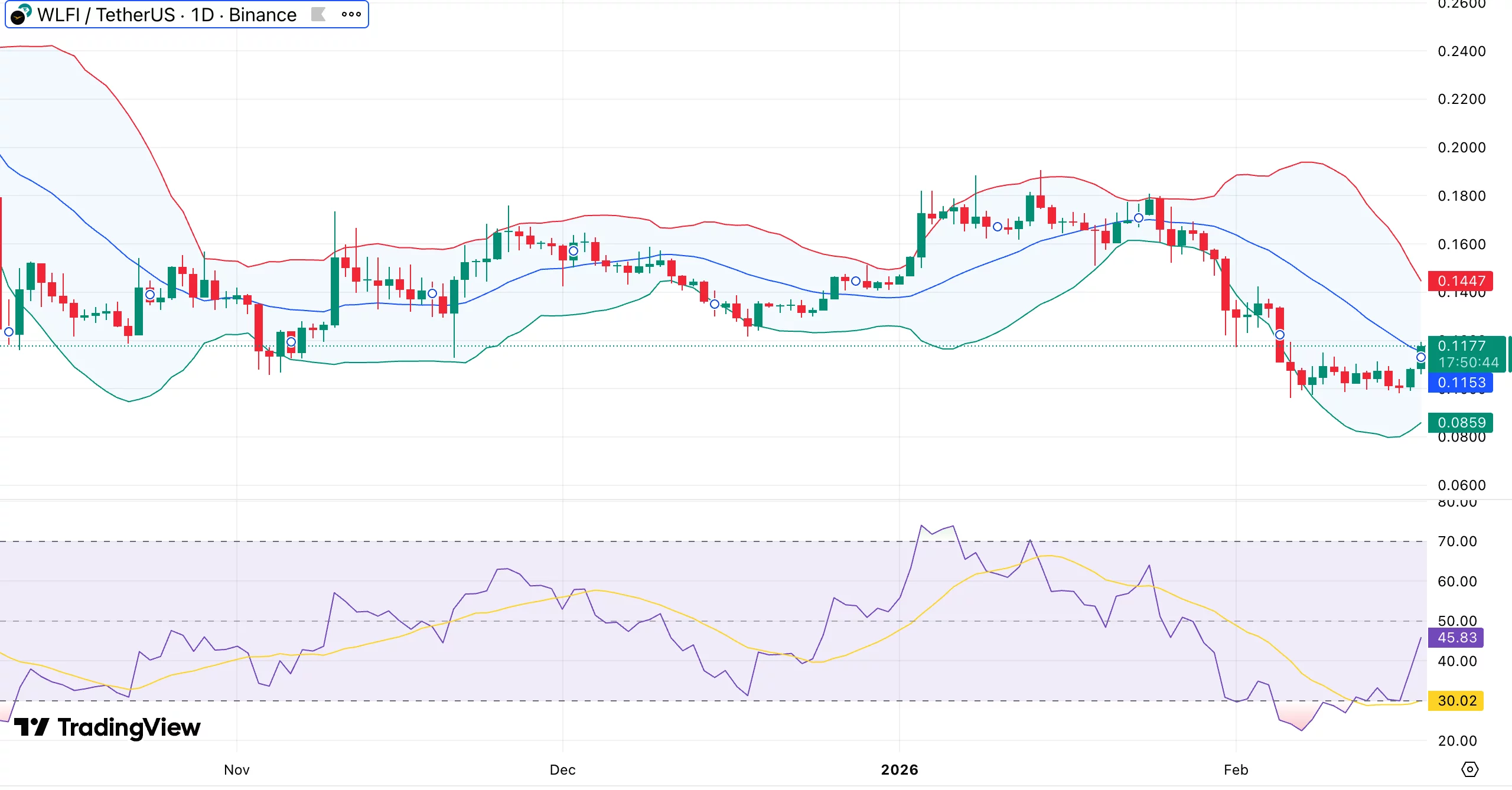
World Liberty Financial (WLFI) was trading at $0.1178 at the time of writing, up about 20% in the past day. The token is currently close to the peak of its seven-day range, which spans from $0.09947 to $0.1183.
Even with the rally, WLFI is still down 27% over the past 30 days and sits roughly 64% below its September 2025 all-time high of $0.3313. The larger trend has been negative, but short-term momentum has picked up.
Advertisement
Spot trading activity surged. Over the past 24 hours, volume reached $224 million, marking a 118% increase from the previous day. Buyers stepped in aggressively during the move higher.
In contrast, derivatives positioning softened. CoinGlass data shows futures volume slipped 0.49% to $11 million, while open interest fell 4.83% to $1.20 million. When price rises as open interest drops, the move is often driven by spot demand or short covering rather than heavy new leverage.
Forum hype and large withdrawals draw attention
Much of the excitement appears tied to the World Liberty Forum, an invitation-only event that will be hosted at Mar-a-Lago on Feb. 18.
According to reports, the event has reached capacity with around 400 attendees. Executives of prominent financial firms like Coinbase CEO Brian Armstrong, NYSE President Lynn Martin, Nasdaq CEO Adena Friedman, and Goldman Sachs CEO David Solomon are among the high-profile attendees.
Advertisement
The forum will focus on digital assets, regulation, and integration between traditional finance and crypto. The project’s political connections have increased visibility, which has fueled speculation ahead of potential announcements.
On-chain data added to the narrative. On Feb. 18, analytics platform Onchain Lens reported that 313.31 million WLFI, worth about $33.76 million, was withdrawn from Binance within 11 hours.
Exchange outflows of that size are often interpreted as tokens moving into longer-term storage, though the intent behind transfers is not always clear.
Advertisement
The recent announcement of an upcoming World Swap forex and remittance platform has also attracted interest. The product targets cross-border payments, a sector with significant global demand.
World Liberty Financial price technical analysis
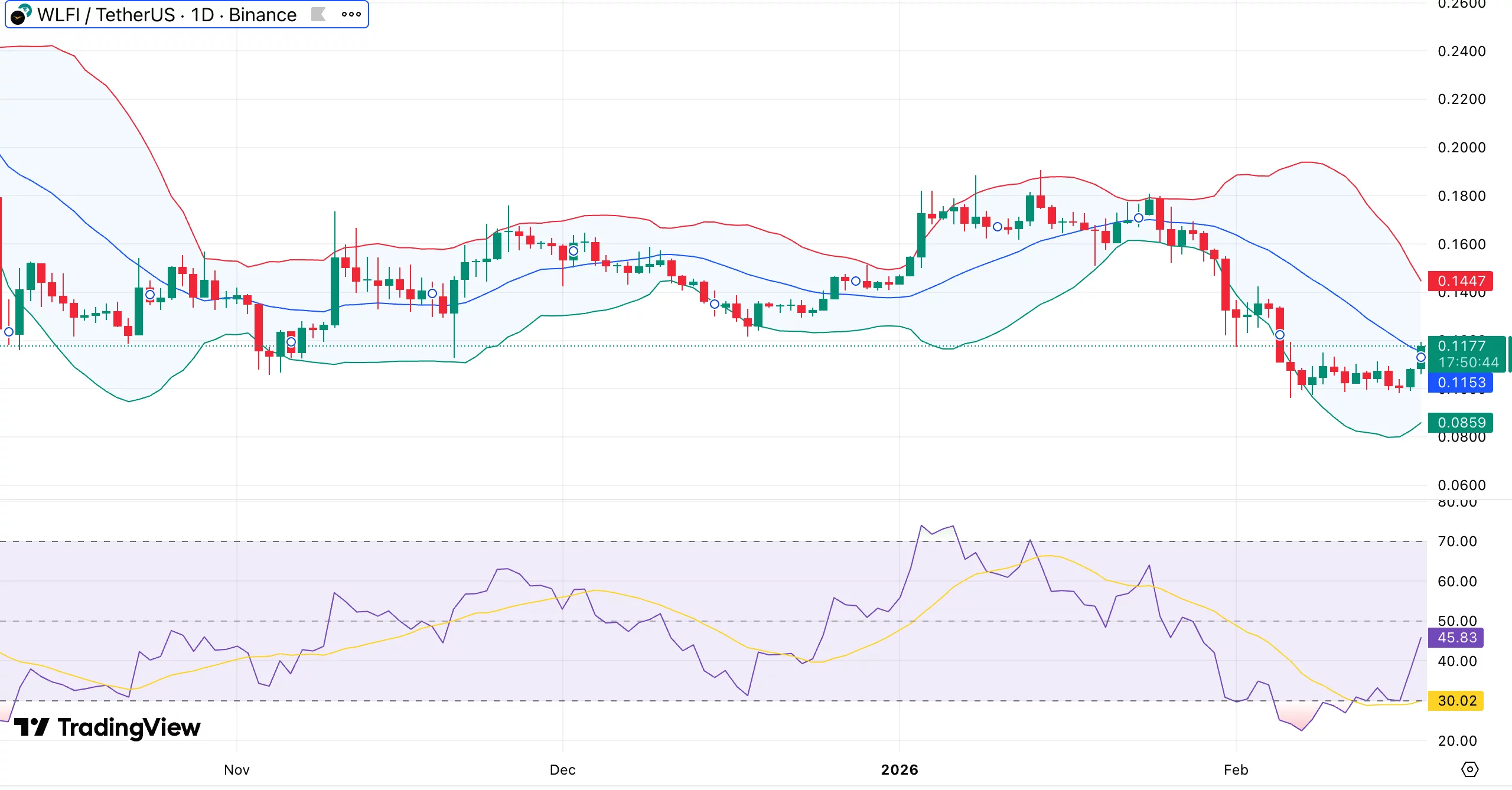
On the daily chart, WLFI has been in a short-term downtrend since early February. The price is trading below the 20-day moving average, and lower highs and lows are evident.
The downward slope of the moving average indicates that there has been consistent selling pressure in recent weeks.
WLFI daily chart. Credit: crypto.news
The Bollinger Bands widened during the most recent decline. Price touched the lower band near $0.086, then bounced sharply. That reaction pushed the relative strength index from below 30 to around 45–46. Momentum has improved, but RSI has not crossed above 50, so buyers have not fully taken control.
The current zone around $0.117–$0.12 acts as immediate resistance. A daily close above $0.12 would be the first technical improvement. If that level breaks with strength, price could test $0.14–$0.15, where the upper Bollinger Band and prior structure align.
Advertisement
Support sits near $0.10–$0.11, with stronger backing at $0.085–$0.090. A drop below $0.085 would expose the token to a move under $0.08.
Billionaire venture capitalist and co-founder of PayPal and Palantir Technologies, Peter Thiel’s Founders Fund, has fully divested from ETHZilla, a digital asset treasury firm that holds Ethereum (ETH).
The development comes as digital asset treasury firms face mounting pressure amid the broader crypto market downturn.
Sponsored
Sponsored
Advertisement
Peter Thiel Cuts Ties With ETHZilla During Crypto Market Slump
The digital asset treasury wave gained momentum last year, with several companies adopting Strategy’s (formerly MicroStrategy) 2020 Bitcoin (BTC) playbook. Firms began accumulating cryptocurrencies as reserve assets, attracting heightened investor attention as prices climbed and equity valuations expanded.
BeInCrypto reported in August 2025 that through entities such as The Founders Fund, Thiel controlled a 7.5% stake in ETHZilla. However, the latest SEC filing shows that entities managed by Thiel reported zero ownership in the company by the end of 2025, indicating a complete exit.
“This matters because Thiel is considered smart institutional capital, and a full exit from an ETH treasury firm could signal shifting sentiment, risk reduction, or a strategic rotation away from Ethereum exposure,” Crypto Town Hall posted.
The move comes against the backdrop of a broader market downturn. In October, crypto markets suffered a sharp downturn, often referred to as the “10/10” or “Black Friday” crash. The subsequent months extended the decline.
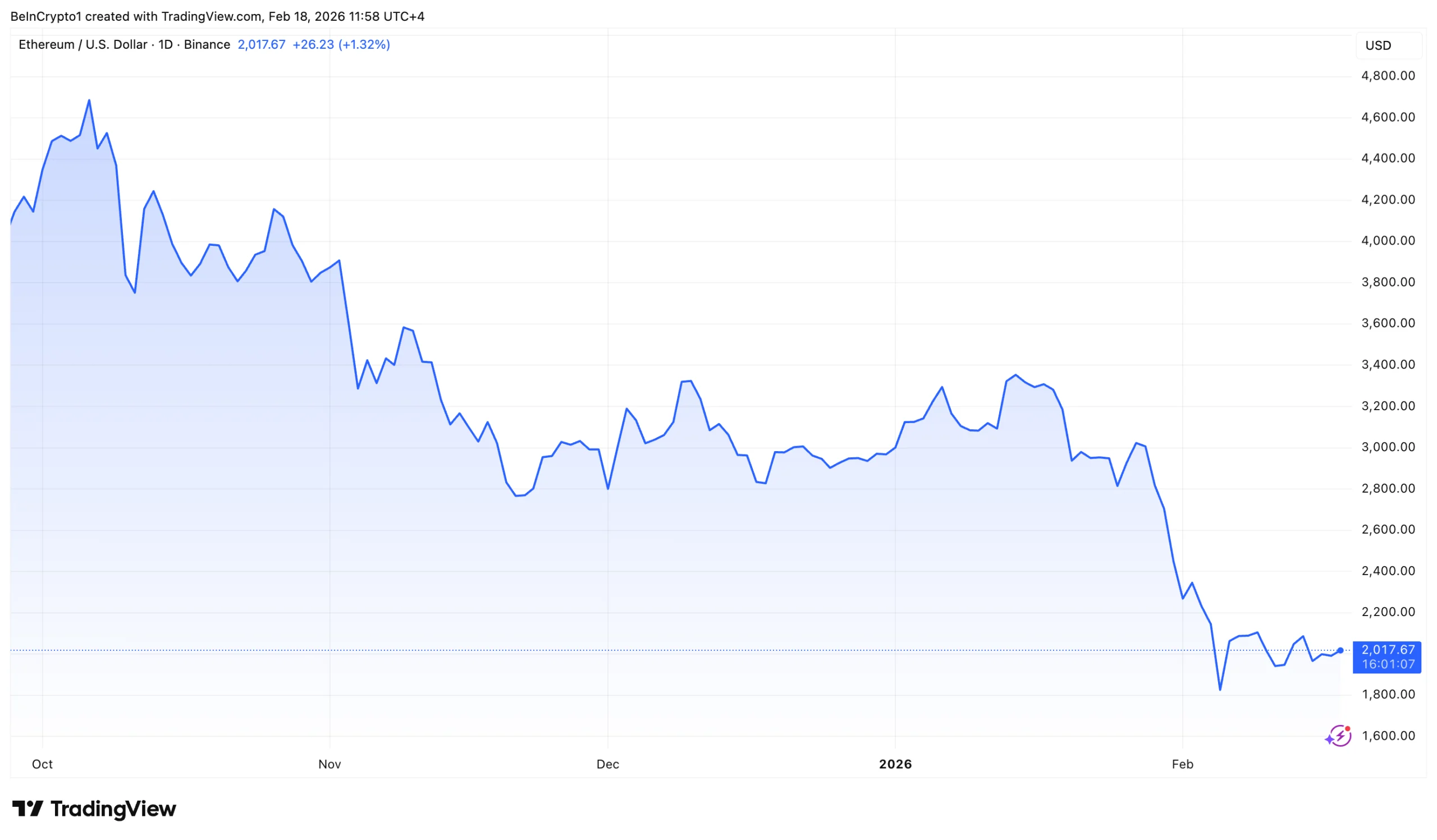
According to CryptoRank data, Ethereum fell 28.4% in Q4 2025, marking its first negative fourth quarter since 2022. Although 2026 began with a brief recovery, the rebound quickly reversed.
Advertisement
Sponsored
Sponsored
ETH closed January 2026 down 17.7%, and so far in February, its price has declined another 18.1%. At press time, it traded at $2,017.
Ethereum (ETH) Price Performance. Source: TradingView
Treasury Strategy Under Strain as Ethereum Decline Hits Corporate Holders
The sustained price weakness has directly impacted digital asset treasury firms, reducing the value of their crypto holdings and pressuring stock prices. For example, BitMine is currently sitting on unrealized losses exceeding $7 billion. Furthermore, its share price is down 25.7% year-to-date.
ETHZilla, which previously operated as 180 Life Sciences before pivoting toward an Ethereum treasury strategy and rebranding, has faced similar headwinds. At its peak, the company held more than 100,000 ETH.
Advertisement
As market conditions deteriorated in October, the company moved quickly to trim its exposure. Toward the end of that month, ETHZilla offloaded roughly $40 million in Ether, directing the proceeds toward share buybacks.
A second round of sales followed in December, totaling about $74.5 million. The funds were allocated to repay senior secured convertible debt. CoinGecko data shows the company now holds 69,802 ETH, a substantial reduction from its previous peak position.
The company has since outlined yet another strategic shift. According to Bloomberg, ETHZilla’s wholly owned subsidiary, called ETHZilla Aerospace, is seeking to provide tokenized exposure to equity in leased jet engines.
Bitcoin-focused public company Nakamoto Inc., led by chairman and CEO David Bailey, has signed definitive agreements to acquire BTC Inc. and UTXO Management GP, LLC in an all-stock transaction valued at approximately $107.3 million.
Summary
Nakamoto Inc., led by David Bailey, will acquire BTC Inc. and UTXO Management GP, LLC in a $107.3 million all-stock deal.
The transaction consolidates Bitcoin media, events, and asset management businesses under one publicly listed entity.
Nakamoto aims to build a vertically integrated Bitcoin platform spanning publishing, conferences, advisory, and investment strategy.
The deal brings together companies closely tied to Bailey, who co-founded BTC Inc. and later helped launch UTXO Management, under a single publicly listed Bitcoin-focused entity.
Under the terms of the deal, Nakamoto will issue common shares to the sellers at a pre-negotiated price of $1.12 per share. The transaction is expected to close in the first quarter of 2026, subject to customary conditions.
Advertisement
The acquisition brings together media, events, and asset management businesses under a single public holding company. BTC Inc. is best known for publishing Bitcoin Magazine and organizing The Bitcoin Conference, one of the largest Bitcoin-focused gatherings globally. UTXO Management advises Bitcoin-centric investment vehicles and focuses on capital allocation across public and private markets.
Nakamoto said the combination is designed to create a vertically integrated Bitcoin platform with diversified revenue streams.
David Bailey’s expanding Bitcoin platform
The deal further consolidates businesses tied to David Bailey, Nakamoto’s chairman and CEO. Bailey co-founded BTC Inc. in 2013 and later helped launch UTXO Management.
Advertisement
“Bringing BTC Inc and UTXO into Nakamoto has been a part of our vision since day one,” said David Bailey. “We intend to operate a portfolio of companies across media, asset management, and advisory services that can scale with Bitcoin’s long-term growth.
Over the past decade, he has been an active voice in the Bitcoin (BTC) industry and has served on the board of the Bitcoin Policy Institute.
Nakamoto has positioned itself as a Bitcoin-native public vehicle focused on media, advisory services, and treasury strategy. The company’s leadership has signaled interest in further expansion as institutional adoption of Bitcoin grows.
If completed, the transaction would mark a notable consolidation in the Bitcoin sector, combining publishing, large-scale events, and capital management operations within a single listed entity.
As of Feb. 18, XRP (XRP) is trading around $1.48, with 24‑hour moves roughly flat to slightly positive (about +0.1% to +0.7% depending on venue).
Data shows XRP at $1.48 with a 24‑hour change of +0.11%, a circulating supply near 60.92 billion tokens and a market cap close to $89.96 billion. CoinMarketCap and other trackers broadly confirm a 24‑hour volume in the $2.2–$2.4 billion range and total XRP supply of roughly 100 billion.
Advertisement
For context, Bitcoin trades near $67,900, down about 0.8–0.9% on the day, on more than $33 billion in 24‑hour volume. Ethereum changes hands around $1,998–$2,000, up about 0.5% over the last 24 hours, with spot volume near $2.7 billion.
Velocity on XRPL: capital actually moving
Stablecoin value is accruing to the XRP Ledger, and relatively fast. Roughly $425 million in stablecoins now sit on XRPL, up 6.6% over the 30 days ending Feb. 12, with Ripple’s RLUSD accounting for about 83% of that pool. In monetary terms, that base is the ledger’s “money stock.”
#XRP News: Is #Ripple Payments Quietly Becoming the New SWIFT? Top Crypto Executive Jake Boyle Explains.
Ripple Payments is emerging as a faster alternative to legacy bank rails like SWIFT.
Caleb & Brown’s CCO Jake Boyle says the firm now processes hundreds of USD withdrawals… pic.twitter.com/7QEf1Q5oNG
The more important signal for price, however, is velocity. According to one analyst, “Stablecoin transfers rising can often be an even more informative piece of information than stablecoin supply rising, because it hints that people are actually moving money rather than just parking it.” Over the last 30 days, XRPL processed around $1.2 billion in stablecoin transfer volume, a 57.5% jump that the author calls “a huge surge in volume, to say the least.”
In macro terms, you have a growing stock ($425 million in stablecoins) turning over faster ($1.2 billion in transfers), meaning each unit of capital is circulating multiple times a month. That rising throughput supports fee burn, forces participants to hold XRP as reserve collateral, and tends to anchor speculative rallies in actual payment activity rather than pure narrative.
Implications for XRP price path
The XRP Ledger (XRPL) is getting used for what it was built to do. In other words, velocity is laying the rails before price tries to break out. Higher payments flow can attract more businesses and developers to build on the ledger, and they’ll need to buy and hold some XRP to do so, while more activity means more XRP is being used to pay transaction fees.
Advertisement
Still, does this mean you should drop $2,000 into XRP today? For traders used to beta‑chasing, the message is blunt: watch the velocity and on‑chain cash flow first; the sustainable leg higher in XRP likely comes only once that fundamental usage persists through the current drawdown.
Bitcoin price is stabilizing after a sharp correction, but on-chain data suggests the real story may lie beneath the surface.
Summary
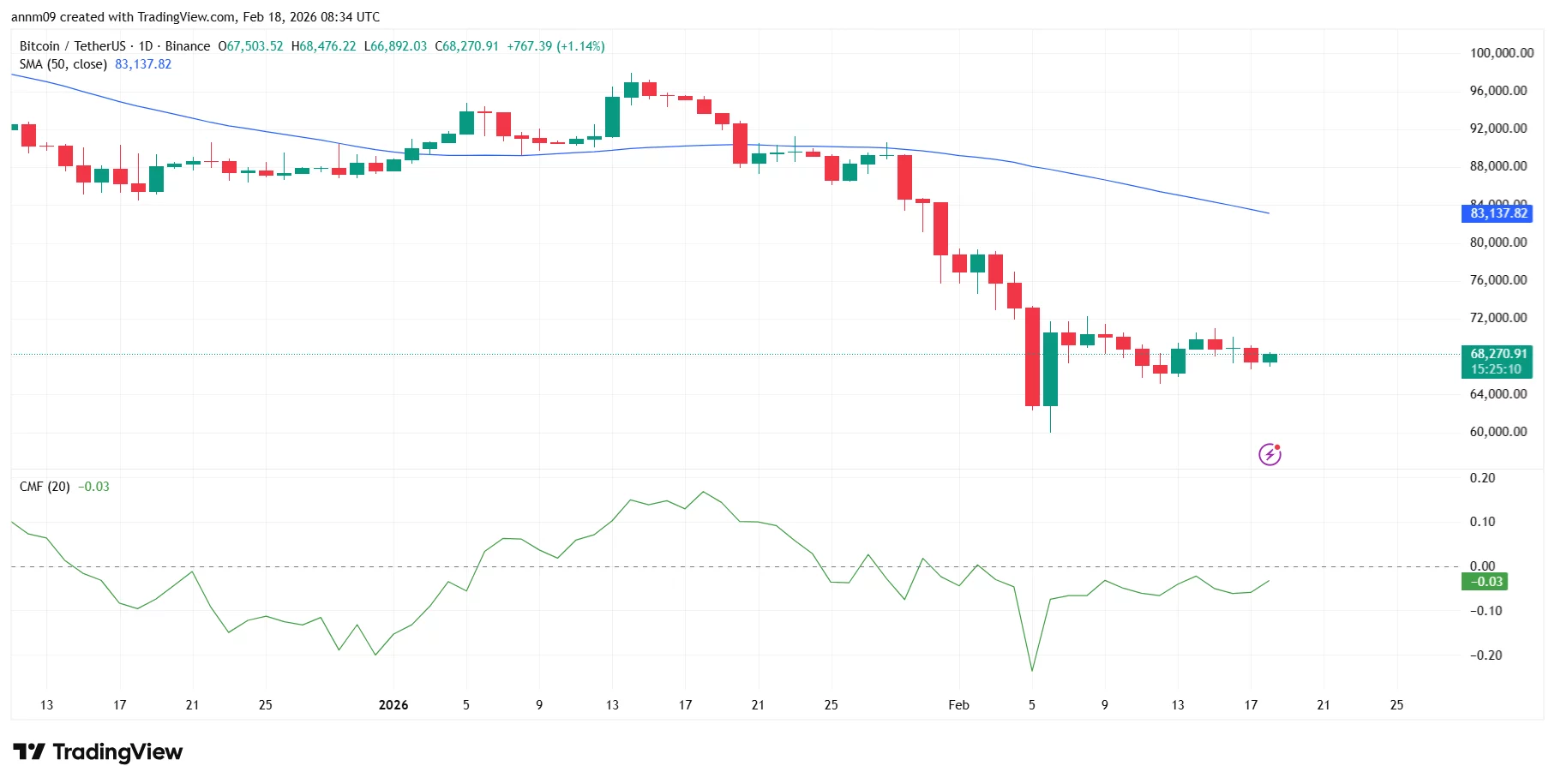
Bitcoin consolidates near $68,000 after falling from the mid-$90,000s to $60,000, with the 50-day SMA around $83,000 acting as key resistance.
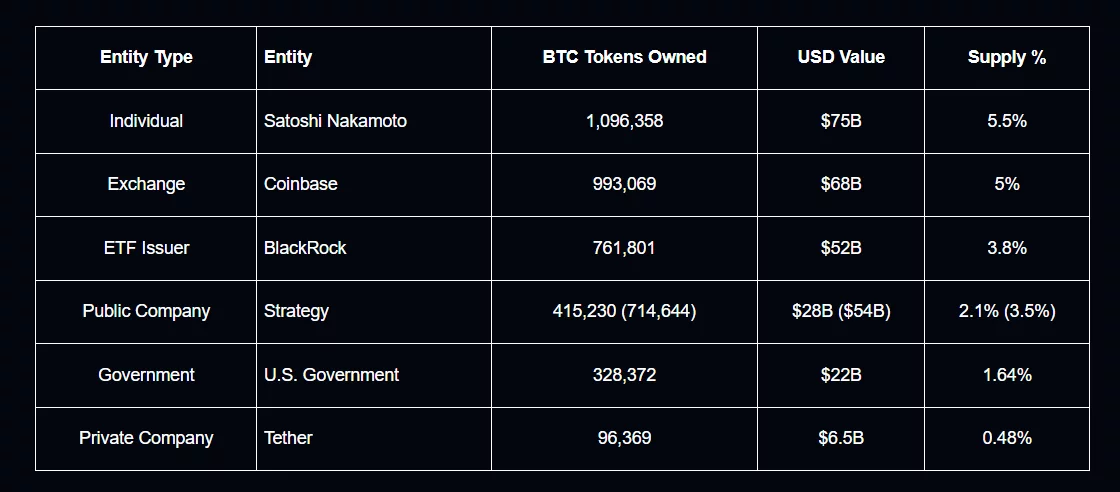
Arkham data shows heavy supply concentration, with Satoshi, major exchanges, BlackRock’s ETF, Strategy, and the U.S. government controlling a significant share of total BTC.
Whale inactivity and potential exchange outflows could tighten supply, meaning renewed institutional demand may trigger a sharper upside move.
As Bitcoin (BTC) consolidates near the $68,000 level, Arkham Intelligence’s latest ownership data reveals who controls a large share of supply and that concentration could shape the next breakout or breakdown.
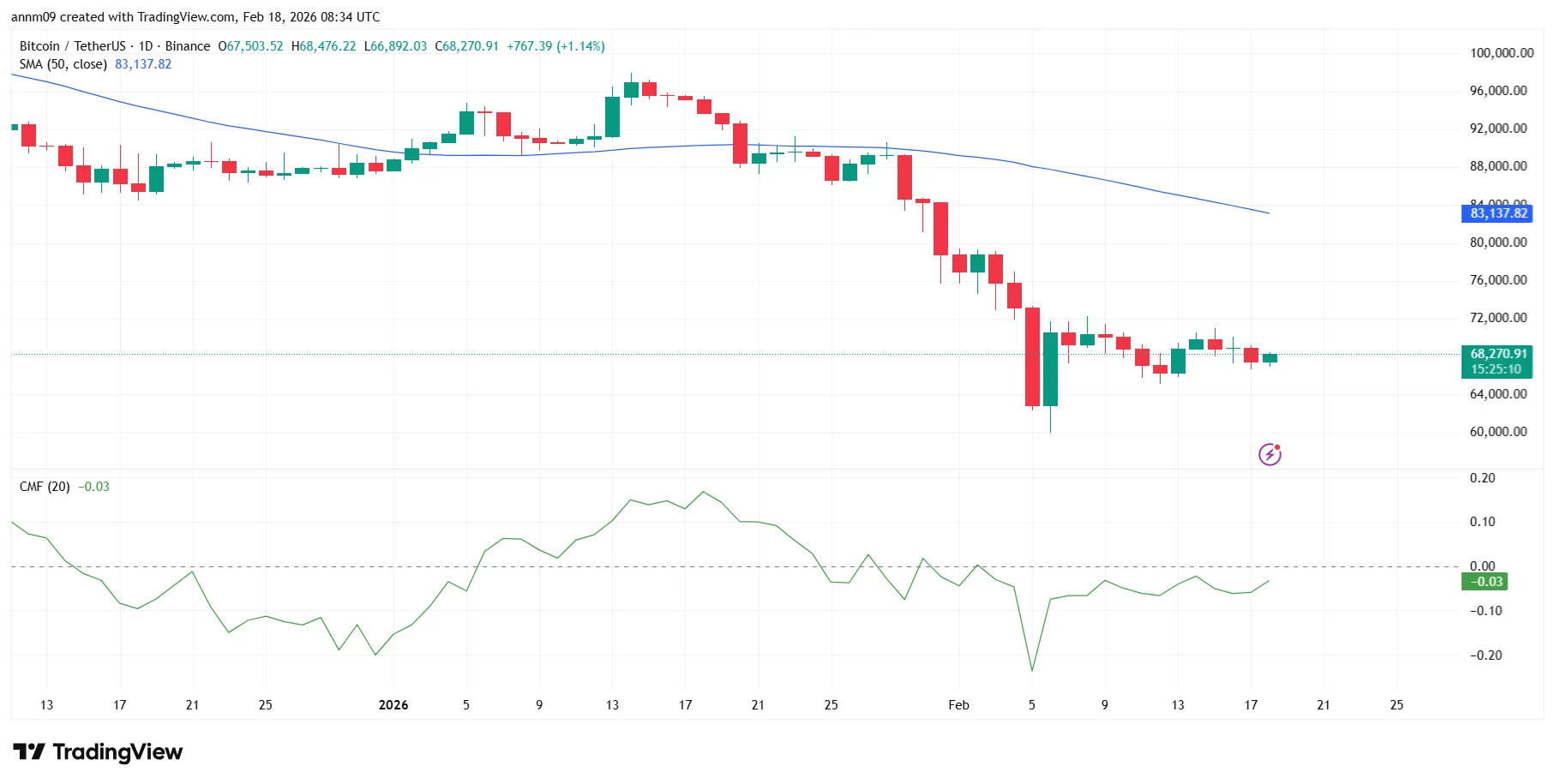
Bitcoin price recently fell from the mid-$90,000 region earlier this year to a local low near $60,000 before rebounding. At press time, price action shows consolidation below the 50-day simple moving average, which sits around $83,000. That level now acts as dynamic resistance.
The daily chart shows heavy selling through late January and early February. A sharp capitulation candle drove price toward $60,000, followed by a reflex bounce.
However, the Chaikin Money Flow indicator remains slightly negative at around -0.03. This suggests capital inflows are still weak. Momentum has improved, but conviction is not yet strong.
While short-term momentum remains fragile, ownership structure tells a longer-term story.
Advertisement
Bitcoin whale concentration and supply control
Arkham’s 2026 data shows Bitcoin ownership remains highly concentrated. Satoshi Nakamoto’s wallets still hold roughly 1.096 million BTC, representing over 5% of total supply.
Bitcoin’s largest holders | Source: Arkham
Coinbase controls close to 1 million BTC, while Binance holds more than 600,000 BTC. BlackRock’s spot ETF alone holds over 760,000 BTC. Strategy, formerly MicroStrategy, controls more than 400,000 BTC. The U.S. government also holds over 300,000 BTC.
This concentration matters. Large holders reduce effective circulating supply when coins remain dormant. Satoshi’s coins have never moved. Corporate and ETF holdings also tend to be long-term allocations rather than short-term trading inventory. That structurally tightens supply during periods of demand expansion.
However, exchange balances are a different story. When large exchanges hold significant BTC reserves, liquidity remains accessible. If exchange-held Bitcoin begins declining while ETFs continue accumulating, the float could tighten quickly. In that scenario, even modest demand could trigger an outsized upside move.
What it means for Bitcoin price’s next move
Technically, Bitcoin must reclaim the 50-day SMA near $83,000 to confirm a bullish reversal. A break above that level could open a move back toward $90,000. Failure to hold $65,000 may expose $60,000 again.
Advertisement
Structurally, whale dominance suggests long-term supply remains constrained. If institutional demand returns while major holders stay inactive, price pressure could build quickly.
The next decisive move will likely depend on whether capital inflows return and whether the biggest holders continue to sit tight.
Editor’s note: In a milestone year for the company, eToro’s public results reflect a strategic pivot to a global, AI-enabled investing platform with a growing multi-asset offering. The press release below provides the official quarterly and full-year numbers, while this editorial note highlights the broader implications for users, investors, and the evolving financial landscape. As eToro expands access to markets, introduces AI-powered tools, and moves toward on-chain capabilities, readers can gauge how the platform aims to empower a new generation of investors across regions and asset classes.
Key points
Full-year 2025: Net Contribution up 10% to $868 million; GAAP Net Income up 12% to $216 million; Non-GAAP Adjusted Net Income up 10% to $251 million; Adjusted EBITDA up 4% to $317 million; Adjusted Diluted EPS of $2.64.
Q4 2025: Net Contribution down 10% to $227 million; GAAP Net Income up 16% to $69 million; Non-GAAP Adjusted Net Income up 6% to $70 million; Adjusted EBITDA down 19% to $87 million; Funded Accounts rose to 3.81 million; AUA grew to $18.5 billion; cash and equivalents at $1.3 billion.
January 2026 KPIs show continued activity across capital markets, crypto, and money transfers, signaling ongoing platform utilization and growth momentum.
Strategic focus areas include AI adoption, 24/7 access for select assets, and app ecosystem expansion ahead of the eToro App Store launch.
Why this matters
eToro’s results underscore a transition to a multi-asset, digital-first investing platform that leverages AI and on-chain capabilities to broaden access, personalization, and cross-border reach. With a stronger balance sheet, diversified revenue streams, and ongoing product innovation, eToro is positioned to capture long-term growth opportunities while expanding services for retail and professional users worldwide.
What to watch next
Rollout of 24/7 access to select assets with plans to expand across asset classes.
Launch of several apps ahead of the eToro App Store, enabling investor builders to publish and share tools.
Ongoing share repurchase activity and potential accelerated programs as part of capital allocation strategy.
Disclosure: The content below is a press release provided by the company/PR representative. It is published for informational purposes.
eToro Reports Fourth Quarter and Full Year 2025 Results
UAE, Abu Dhabi, February 17, 2026 – eToro Group Ltd. ( NASDAQ: ETOR ), the trading and investing platform, today announced financial results for the fourth quarter and full year 2025 which ended December 31, 2025.
Yoni Assia, CEO of eToro
“This was a milestone year for eToro,” said Yoni Assia, CEO of eToro. “We became a publicly traded company and significantly advanced the build-out of our global financial super-app. In 2025, we accelerated product innovation and AI adoption, expanded access to global markets, broadened and localized our offering, and strengthened eToro’s footprint around the world. We are operating at a pivotal moment for financial services. Artificial intelligence and progress towards on-chain market infrastructure are reshaping how people invest and interact with markets and eToro is uniquely positioned to capture this opportunity. Through our public APIs and suite of AI-powered tools, users and partners can build, share, and scale strategies and tools, as part of a growing ecosystem. We are launching a number of apps ahead of the roll out of the eToro App Store, bringing enhanced capabilities to our retail audience. In parallel, we are positioning eToro for a financial system that is increasingly moving on-chain. With our long-standing leadership in crypto and tokenization, we are well placed to help shape this transition. This quarter, we are introducing 24/7 access to select popular assets with plans to expand around-the-clock access across asset classes. Our focus remains on empowering users through a simple, transparent, and digital-first investing experience, while positioning eToro to serve the next generation of investors at every stage of their journey. We are uniquely positioned as both a natively crypto company and a global equities trading platform. We look forward to capturing the many long-term growth opportunities ahead for the benefit of our users, shareholders, and partners.”
Meron Shani, CFO of eToro, said: “Our fourth quarter results reflect the strength and resilience of our mult-asset business model. We delivered compelling financial performance through a combination of diversified revenue streams, healthy funded accounts growth, and disciplined financial management. Furthermore, we are off to a strong start to 2026 with our January capital markets KPIs demonstrating the ability of our platform to adapt and perform across all different market conditions, including the recent spike in commodities trading. With our strong balance sheet and a clear execution roadmap, we believe that we are well positioned to deliver accelerated growth in 2026.”
Full year 2025 Financial Highlights1
Net Contribution increased by 10% year over year to $868 million, compared to $788 million in 2024.
Net Income (GAAP) increased 12% year over year to $216 million, compared to $192 million in 2024.
Adjusted Net Income (Non-GAAP) increased 10% to $251 million, compared to $228 million in 2024.
Adjusted EBITDA (Non-GAAP) increased by 4% year over year to $317 million, compared to $304 million in 2024
Adjusted Diluted EPS (Non-GAAP) was $2.64, compared to $2.67 in 2024.
Fourth Quarter 2025 Financial Highlights2
Net Contribution decreased by 10% year over year to $227 million, compared to $253 million in the fourth quarter of 2024.
Net Income (GAAP) increased 16% year over year to $69 million, compared to $59 million in the fourth quarter of 2024.
Adjusted Net Income (Non-GAAP) increased 6% year over year to $70 million, compared to $67 million in the fourth quarter of 2024.
Adjusted EBITDA (Non-GAAP) decreased by 19% year over year to $87 million, compared to $108 million in the fourth quarter of 2024
Adjusted Diluted EPS (Non-GAAP) was $0.71, compared to $0.79 in the fourth quarter of 2024.
Funded Accounts increased 9% year over year to 3.81 million compared to 3.48 million in the fourth quarter of 2024.
Assets Under Administration (AUA) grew by 11% year over year to $18.5 billion, compared to $16.6 billion in the fourth quarter of 2024.
Cash, Cash Equivalents and Short-Term Investments were $1.3 billion as of December 31, 2025.
January KPI metrics3
eToro also reported the below selected monthly business metrics for January 2026:
Advertisement
Assets under Administration (AUA) were $18.4 billion, up 2% year-over-year.
Funded accounts were 3.85 million, up 9% year-over-year.
Capital Markets/ECC Activity
Total number of trades for January was 74 million, up 55% year-over-year;
Invested amount per trade for January was $252, up 8% year-over-year;
Crypto Activity
Total number of trades for January was 4 million, down 50% year-over-year;
Invested amount per trade for January was $182, down 34% year-over-year;
Interest Earning Assets for January was $7.7 billion, up 17% year-over-year.
Total Money Transfers for January was $1.8 billion, up 68% year-over-year.
Business Highlights
eToro is demonstrating strong progress across its four product pillars driven by continued product innovation, localization, and strategic partnerships.
Trading: eToro expanded access to global markets while advancing toward always-on trading. With the addition of equities listed on the Abu Dhabi Securities Exchange, Hong Kong Stock Exchange, and across the Nordics, eToro now offers access to equities from 25 stock exchanges. The Company grew its crypto offering to more than 150 cryptoassets, including an expanded range of more than 100 cryptoassets for US users. eToro also broadened derivatives access, expanding its futures offering across Europe and launching futures and options in the UK. It has also begun the roll out of stock margin trading, where eligible users can access leveraged exposure to U.S. equities. In 2025, eToro expanded 24/5 trading to all S&P 500 and NASDAQ 100 stocks, and in Q1, the Company is introducing 24/7 access to a select number of popular assets with plans to expand this across asset classes.
Investing: eToro strengthened its investing proposition by expanding access to intelligent, long-term investment solutions. The Company launched Tori, its AI Analyst, and through its public APIs and suite of AI-powered tools, users and partners can build, share, and scale strategies and tools, creating a growing ecosystem. This quarter, eToro is introducing a number of apps ahead of the launch of the eToro App Store, where ‘investor builders’ and partners can publish and share their apps with millions of eToro users globally. eToro continued to expand its range of Smart Portfolios including launching portfolios with Franklin Templeton, WisdomTree, ARK Invest and Amundi. The launch of Alpha Portfolios provides retail investors with access to quantitative, data driven strategies leveraging eToro’s data for the benefit of our customers. Having pioneered social investing, users can follow, copy, and engage with over 5,000 members of eToro’s Pro Investor Program, with Copy Trading now also launched in the US. During 2025, eToro introduced securities lending in the UK, Europe and the UAE, as well as expanding its staking program to help users access passive yield generating opportunities. eToro launched the eToro Club Subscription providing access to premium investing tools, financial perks and dedicated support.
Wealth Management: eToro continued to scale its long-term savings solutions in 2025. The Company partnered with Generali to provide French users with access to long-term, tax advantaged retirement (PER) and life insurance products. eToro also expanded its ISA offering in the UK with the addition of a self-directed stocks and shares ISA and a cash ISA. The AuA in eToro’s UK ISA products grew by 7x from Q4 2024 to Q4 2025. Assets under administration in our Australian savings products grew 44% between 2023 and 2025, supported by strong momentum following the launch of our superannuation offering.
Neo-Banking: During 2025, eToro accelerated the localization of its money management experience. The expansion of local bank accounts to more countries and the continued roll out of the debit card across Europe resulted in eToro Money’s transaction volume increasing 6.5x year-over-year. eToro Money ended the year with 1.87 million accounts. eToro Money, including eToro’s crypto wallet, is now fully integrated into the eToro app and provides seamless crypto transfers including 1% stock-back rewards on eligible crypto transfers.
Partnerships: eToro announced a multi-year partnership with BWT Alpine Formula 1 extending the business’ global brand presence and engagement with a fast-growing, international audience. eToro also entered into a partnership with Gemini Space Station Inc to support the migration of their customers from the UK, Europe and Australia onto the eToro platform, reinforcing its position as a leading, global, multi-asset broker.
Share Repurchase Program eToro today announced that its Board of Directors has approved a $100 million increase to its existing share repurchase program. The program previously authorized $150 million, of which $100 million has already been used, leaving $50 million remaining. Following the increase, total remaining authorization is $150 million. Such repurchases may be made through a variety of methods, including through open market transactions (including through Rule 10b5-1 plans), privately negotiated transactions, block trades and by way of an accelerated share repurchase program. Additionally, subject to market and other conditions, the Company intends to enter into an Accelerated Share Repurchase (“ASR”) agreement to repurchase approximately $50 million of its common shares under the new authorization. This authorization reflects the Company’s confidence in its long-term strategy and growth prospects, financial strength, and commitment to deliver shareholder value. eToro believes that its current share price does not fully reflect the Company’s fundamental value, and that repurchasing shares represents a prudent allocation of capital. The program also provides additional flexibility to support potential future strategic initiatives, including mergers and acquisitions, where eToro shares could serve as an effective transaction currency. The actual timing, number, manner and value of any shares repurchased will depend on several factors, including the market price of our shares, general market and economic conditions, our liquidity requirements, applicable legal requirements and other business considerations. The authorization does not expire.
About eToro
eToro is the trading and investing platform that empowers you to invest, share and learn. We were founded in 2007 with the vision of a world where everyone can trade and invest in a simple and transparent way. Today we have 40 million registered users from 75 countries. We believe there is power in shared knowledge and that we can become more successful by investing together. So we’ve created a collaborative investment community designed to provide you with the tools you need to grow your knowledge and wealth. On eToro, you can hold a range of traditional and innovative assets and choose how you invest: trade directly, invest in a portfolio, or copy other investors. You can visit our media center here for our latest news.
Risk & affiliate notice: Crypto assets are volatile and capital is at risk. This article may contain affiliate links. Read full disclosure
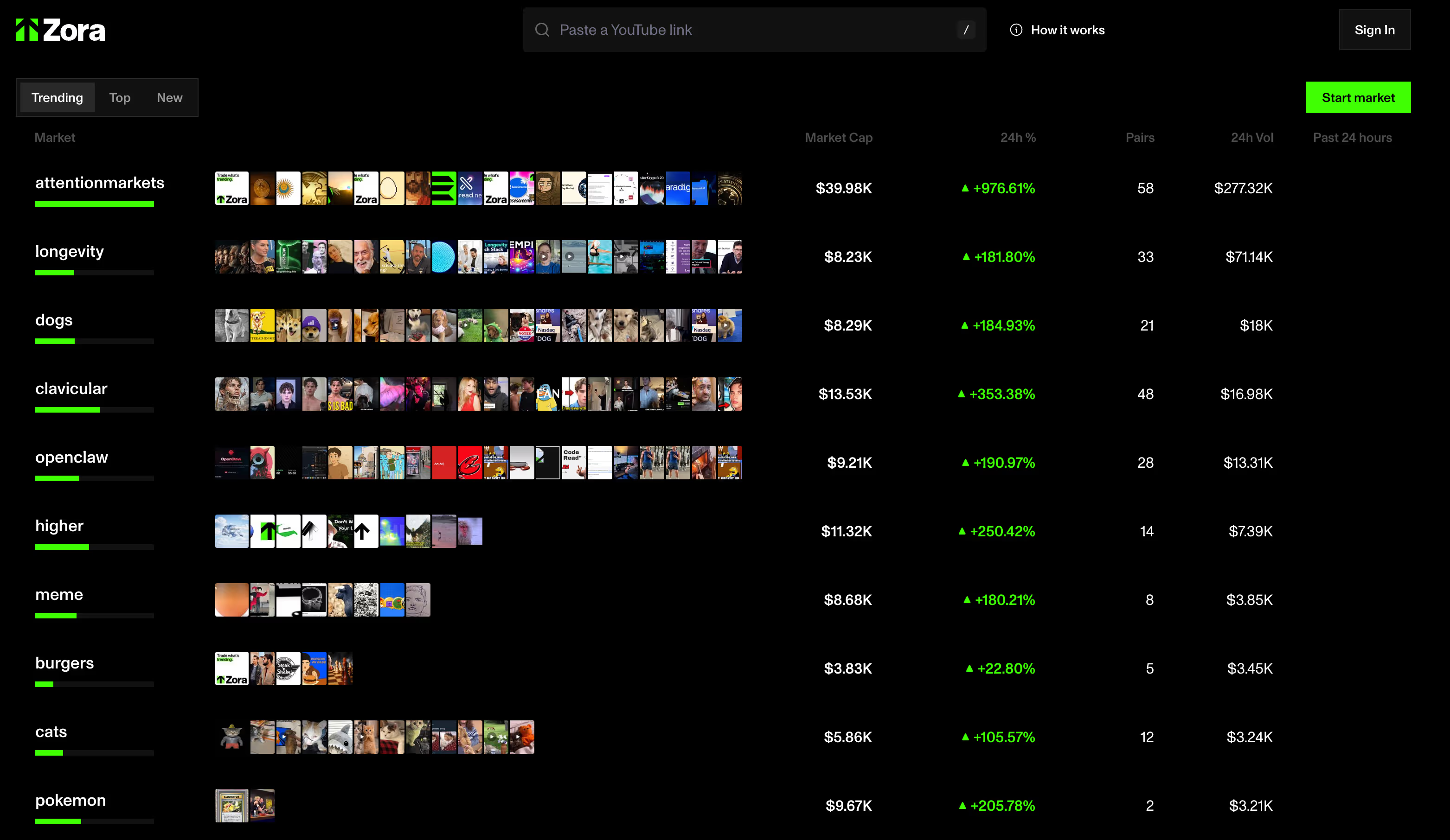
On-chain social platform and decentralized protocol Zora is making a decisive shift beyond its non-fungible tokens (NFT) and creator roots with the launch of “attention markets” on Solana, a product that allows users to trade tokens tied to internet trends, memes and cultural moments.
The feature, unveiled Feb. 17, lets anyone create a new market for 1 SOL. Once live, users can buy and sell positions on whether a topic will gain or lose traction across social media.
Instead of wagering on elections or macro data, traders speculate on buzz itself — such as hashtags, viral narratives, even broad themes like “AI girlfriend” or “bitcoin.”
The design leans heavily into Solana’s strengths. Fast block times and low transaction costs make it easier to support rapid price updates and frequent trading, which are essential for markets built around fleeting online momentum.
Advertisement
Initial activity was limited, however. The primary “attentionmarkets” token briefly touched roughly $70,000 in market capitalization, with around $200,000 in trading volume. Most other trend markets struggled to attract meaningful liquidity, with few crossing the $10,000 mark in their first day.
Percentage swings were sharp, though largely driven by thin order books rather than sustained demand.
Zora was among the breakout applications on Coinbase’s Layer 2 Base network in the past few years. It launched its ZORA token there in April, and helped roll out Creator Coins tied to Base profiles in July, a push that briefly helped Base overtake Solana in daily token creation.
Creator coins are tokens tied to an individual creator’s online profile, brand or community. Think of them as tradable “shares” in a person’s internet presence.
On platforms like Zora and Base, a creator coin could be automatically generated from a user’s profile. Fans could buy the coin to signal support, gain social clout, or speculate that the creator’s popularity would grow. As more people bought in, the price could rise, and interest faded, it could fall.
Advertisement
As such, some in the Base community saw the new “attention markets” product as a pivot away from that momentum.
Jacek Trociński, the developer behind Base memecoin Degen, called it “really disappointing” to see Zora move to Solana. Veil Cash builder Apex777.eth was harsher, accusing Zora of “extracting” value from Base before switching networks.
Meanwhile, Base creator Jesse Pollak said Zora’s creator tools remain “fully operational” on the network.
As speculation moves beyond price charts and into cultural data, platforms like Zora are testing whether attention itself can become memetic and deeply tied to the internet’s real-time financial pulse.
The legal clash between Kalshi and Nevada regulators intensified this week as the state’s gaming authority pressed forward with enforcement actions after a federal appeals court refused to halt the state’s conduct. The Ninth Circuit Court of Appeals on Tuesday denied Kalshi’s bid to block the Nevada Gaming Control Board from pursuing a civil case over Kalshi’s sports event contracts, effectively clearing the path for the regulator to proceed in state court. In short order, the Nevada Gaming Control Board filed a civil enforcement action, arguing Kalshi offers unlicensed wagering in violation of Nevada gaming law. Kalshi countered by seeking to move the dispute to federal court, echoing its long-held position that its activities fall under exclusive federal jurisdiction via the Commodity Futures Trading Commission (CFTC). The evolving dispute highlights a broader, unsettled regulatory landscape for prediction markets in the United States.
Key takeaways
The Ninth Circuit refused Kalshi’s request to pause Nevada’s enforcement efforts, allowing a state-court civil action to proceed against Kalshi over sports-related markets.
Following the ruling, the Nevada Gaming Control Board immediately filed a civil enforcement action in state court, asserting Kalshi operates unlicensed wagering on sporting outcomes in violation of state law.
Kalshi maintains it operates under exclusive federal jurisdiction and has argued that federal law supersedes state-level actions in this area, leveraging the CFTC’s authority over commodity derivatives.
The case mirrors similar tensions in other states and among other prediction-market operators, underscoring a broader regulatory crackdown on unlicensed gaming-like activity in the prediction space.
The regulatory narrative is being shaped in part by federal involvement, with the CFTC signaling its stance on jurisdiction over prediction-market activity and related contracts.
Sentiment: Bearish
Market context: The dispute sits at the intersection of state gaming regulation and federal commodity rules, a space that remains legally unsettled as regulators and platform operators test boundaries around prediction markets and their licensing needs. The CFTC has emphasized its jurisdiction over commodity derivatives traded on designated contract markets, while states push for traditional licensing regimes where wagering is involved.
Why it matters
For Kalshi, the Nevada case is a test of its central premise—that prediction-market activity should fall under federal oversight rather than state gaming statutes. If the state court ultimately concludes that Kalshi’s sports event contracts require licensing under Nevada law, Kalshi may face injunctions, penalties, or the need to halt certain markets within the state. The immediate practical effect would be to constrain Kalshi’s ability to offer sports-related contracts to Nevada residents, reinforcing the idea that licensing requirements can operate at the state level even when a company argues federal preemption.
For other prediction-market operators, the unfolding legal framework signals heightened regulatory risk. The ongoing tension between state enforcement actions and federal jurisdiction could prompt platforms to seek clearer licensing pathways or, in some cases, to trim or relocate markets to jurisdictions with more predictable rules. The broader regulatory climate also matters for investors and developers evaluating the growth potential of prediction-market ecosystems, including partnerships and product designs that align with licensing realities rather than contending with uncertain legal status.
Advertisement
From the federal perspective, the CFTC’s posture—evidenced by statements and amicus actions in related cases—suggests a willingness to defend a permissive view of what constitutes a derivative market under federal law. That approach has implications for how products are structured, how they are offered to users, and how regulators coordinate across state and federal lines. The involvement of the CFTC in similar matters, including its stance in parallel suits against other states, indicates that the federal framework may ultimately steer product development and regulatory compliance norms in the prediction-market space.
The case is also emblematic of a wider policy conversation about the boundary between what constitutes gaming under state law and what falls under the umbrella of commodity derivatives regulated by the federal government. As technology enables more sophisticated event-based contracts and as states consider licensing to govern consumer protections, a clearer, nationwide standard remains elusive. The legal arguments that Kalshi has advanced—namely, that its markets are governed by federal commodity laws rather than state wagering statutes—will likely continue to echo through courtroom corridors as other jurisdictions weigh similar actions.
The regulator’s position is reinforced by the state’s explicit assertion that Kalshi’s offerings amount to wagering on sports outcomes and therefore qualify for licensing under Nevada law. The regulatory calculus hinges on whether these contracts are sufficiently akin to traditional gaming or whether they can still be framed as commodity derivatives that fall under federal oversight. The Ninth Circuit’s decision not to pause the state’s enforcement action confirms that the state court system will be the next arena where these questions are tested, at least in the near term.
As this legal saga unfolds, observers will watch for how Kalshi frames its next strategic move—whether to intensify its federal-venue approach, pursue further appeals, or seek negotiated licensing accommodations that could permit continued operation in Nevada and beyond. The regulatory momentum in other states, along with potential federal actions, will shape the tempo and direction of future actions by prediction-market platforms and the regulators overseeing them.
Advertisement
For reference, Kalshi’s dispute has roots in earlier regulatory correspondence, including a cease-and-desist order that spurred Kalshi to sue Nevada in March of the previous year and a federal court ruling in April that temporarily blocked Nevada from taking action during the litigation. The state’s subsequent civil enforcement action underscores a shift from courts determining temporary relief to real-world enforcement remedies that could affect ongoing offerings. The legal arguments—centered on licensing requirements, intent to operate in a regulated gaming environment, and the scope of federal jurisdiction—will likely shape how prediction markets navigate compliance moving forward.
The broader industry context includes a notable cross-pollination of interests between traditional gaming regulators and digital-asset-adjacent markets. With players like Crypto.com pursuing similar matters against Nevada regulators, and with political and legal attention on the legality and design of prediction markets, the industry stands at a crossroads where licensing frameworks, consumer protections, and innovative financial instruments intersect. As these threads converge, the coming months are likely to produce more clarity—and more controversy—about where prediction markets fit within the U.S. regulatory tapestry.
Source references tied to the ongoing dispute include Nevada Gaming Control Board filings and docket activity, as well as court documents detailing Kalshi’s attempts to move the case to federal court. For a snapshot of the state-level actions, the regulator’s official filings and statements provide direct attestations of the legal theory the state is pursuing against Kalshi.
What to watch next
The state court civil enforcement action against Kalshi in Nevada: timeline for hearings and potential rulings.
Any subsequent filings or rulings from the Ninth Circuit or federal courts on Kalshi’s venue arguments and potential appeals.
Further amicus briefs or regulatory filings from the CFTC or other federal agencies regarding jurisdiction over prediction-market activities.
Developments in parallel cases, such as Crypto.com’s challenges to Nevada regulators and any related state actions against other prediction-market operators.
Sources & verification
Nevada Gaming Control Board press release and complaint PDF alleging Kalshi’s unlicensed wagering (kalshi-complaint.pdf).
Nevada Gaming Control Board press release on civil enforcement action against Kalshi (ngcb-files-civil-enforcement-action-against-kalshi.pdf).
CourtListener docket for State of Nevada ex rel. Nevada Gaming Control Board v. Kalshi LLC (docket entry showing the federal motion and related filings).
Kalshi’s federal court venue motion referenced in court records (CourtListener docket).
CFTC amicus brief discussion in related Crypto.com case in Nevada (Cointelegraph coverage referencing the CFTC stance).
Kalshi and Nevada clash over sports contracts
The dispute between Kalshi LLC and the State of Nevada over Kalshi’s sports-event contracts has moved from a regulatory order into a courtroom duel over jurisdiction and licensing. After Kalshi’s bid to halt Nevada’s enforcement was rejected by the Ninth Circuit, the regulator proceeded with a civil action in state court, arguing that Kalshi’s offerings amount to unlicensed wagering under Nevada law. Kalshi contends that its activities are subject to exclusive federal jurisdiction, a claim it has pressed since the outset of the case and one it has framed around the CFTC’s authority over commodity derivatives.
In a sequence of filings and rulings, the parties have mapped a jurisdictional battleground that is likely to influence the trajectory of prediction-market operators beyond Nevada. Kalshi’s argument rests on the premise that prediction-market contracts function as commodity derivatives and therefore belong under the federal oversight of the CFTC. Nevada’s counterpoint emphasizes licensing requirements within the state’s gaming framework, asserting that even if a contract resembles a derivative in structure, it still implicates wagering and gaming activities that require state licensing. The Ninth Circuit’s decision to deny a stay removes a preliminary hurdle for the state to pursue civil remedies, allowing the underlying enforcement to proceed while the broader jurisdictional questions continue to percolate in appellate and district court settings.
Advertisement
Public filings and press materials from the Nevada regulator outline the legal theory at stake: Kalshi’s markets are active in the state, but Kalshi has not secured the necessary licenses to operate those markets within Nevada’s borders. The regulator has pointed to the state’s existing framework for gaming and wagering to argue that Kalshi must obtain licenses for its sports contracts. Kalshi, meanwhile, has sought to position the matter within the federal regime that governs designated contract markets and other CFTC-regulated activities, arguing that state enforcement risks duplicative and conflicting obligations for a market participant operating across multiple jurisdictions.
As regulators, courts, and market participants monitor this case, the central questions will revolve around licensing, consumer protections, and the proper allocation of regulatory authority between state gaming authorities and federal commodity regulators. Should Kalshi prevail on the federal-venue theory in the long run, it could pave the way for broader operation of prediction-market platforms without state-level licensing, provided federal law offers a clear path. Conversely, a ruling affirming Nevada’s licensing demands could constrain Kalshi’s services in the state and prompt similar actions in other jurisdictions, thereby shaping the practical viability of prediction markets as a class of financial products in the United States.
For now, the Nevada case stands as a pivotal, high-stakes test of how prediction markets fit into a complex mosaic of gaming and commodities regulation. The coming months are likely to reveal how the regulatory regime coalesces—or fractures—around questions of licensing, jurisdiction, and the boundary between gaming normalities and financial-derivative constructs in the evolving landscape of digital markets.
Risk & affiliate notice: Crypto assets are volatile and capital is at risk. This article may contain affiliate links. Read full disclosure
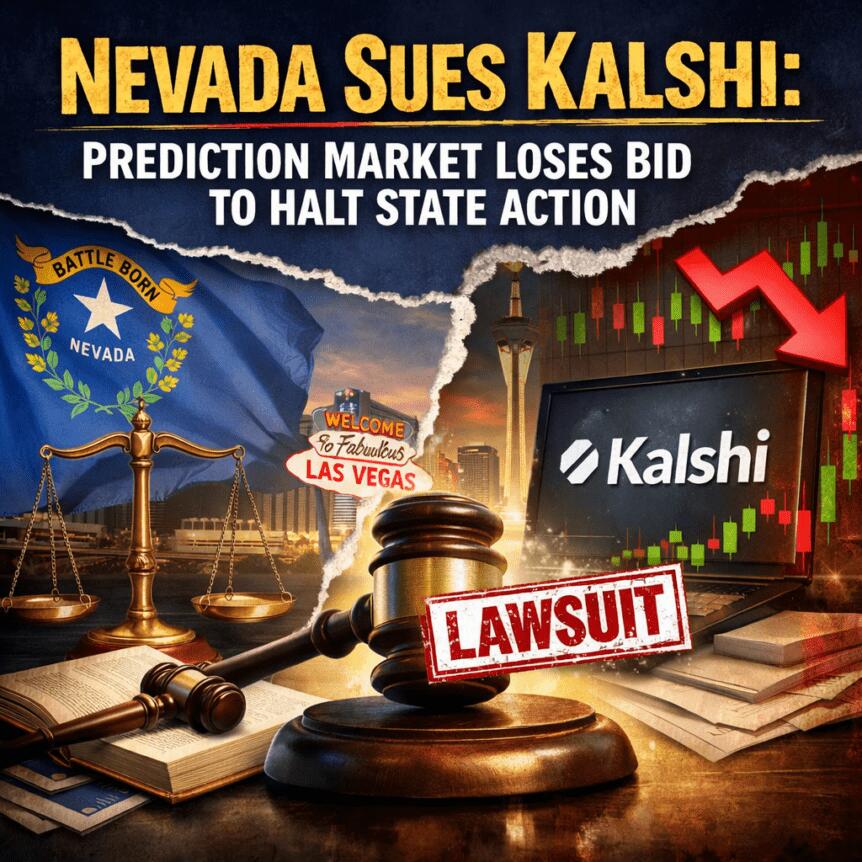
The Nevada Gaming Control Board has filed a civil enforcement action against KalshiEX LLC, accusing the federally regulated prediction market of offering unlicensed wagering in the state.
Summary
The Nevada Gaming Control Board has filed a civil enforcement action against Kalshi, alleging its sports-linked event contracts amount to unlicensed gambling under state law.
Kalshi is seeking to move the case to federal court, arguing it operates under the exclusive jurisdiction of the U.S. Commodity Futures Trading Commission.
The lawsuit adds to a growing national battle between state gaming regulators and federally regulated prediction markets, with multiple states taking similar action.
Nevada moves to block Kalshi’s event trading
In a complaint filed in Carson City District Court, regulators argue that Kalshi’s sports-linked “event contracts” amount to gambling under Nevada law. The state is seeking declaratory relief and an injunction to stop the company from operating in Nevada without a gaming license.
According to the complaint, making “event contracts” available to Nevada residents without approval from the Nevada Gaming Commission violates multiple provisions of the state’s gaming code.
Advertisement
“The Board continues to vigorously fulfill its obligation to safeguard Nevada residents and gaming patrons,” said NGCB Chairman Mike Dreitzer.
Kalshi quickly moved to shift the case to federal court, reiterating its long-standing position that it falls under the exclusive jurisdiction of the Commodity Futures Trading Commission and not state gaming regulators.
State law vs. Federal oversight
Kalshi maintains that its contracts are financial derivatives regulated by the U.S. CFTC, not traditional bets. The company operates as a CFTC-designated exchange and says federal law preempts state gaming rules.
Advertisement
Nevada disagrees. Regulators argue that contracts tied to sports outcomes mirror sportsbook wagers and fall squarely under state jurisdiction.
The Board says allowing unlicensed operators would undermine Nevada’s tightly controlled gaming framework.
The lawsuits come amid a growing national legal battle over whether prediction markets such as Kalshi fall under state gambling laws or are exclusively governed by federal regulators. States including Maryland, New Jersey, Ohio and Tennessee have also challenged prediction markets, issuing cease-and-desist orders or filing lawsuits to block unlicensed sports event contracts.
Advertisement
Meanwhile, the CFTC has pushed back, defending its authority over event contracts. In earlier disputes, Kalshi secured temporary relief in court, though those wins have been limited and closely watched.
At issue is who controls the fast-growing prediction market sector — federal derivatives regulators or state gaming boards.
The outcome could reshape how Americans trade on elections, sports and economic events. It may also determine whether prediction markets operate nationwide under a single federal regime, or face a patchwork of state gambling laws.
















 Sports6 days ago
 Video2 days ago
 Tech3 days ago
 Video5 days ago

 Sports1 day ago
 Crypto World24 hours ago
 Business9 hours ago
 Video1 day ago
 Crypto World4 days ago
 Video6 days ago

 Business6 days ago
 Business2 hours ago
 Crypto World6 days ago

 Crypto World5 days ago
 NewsBeat4 days ago
 Crypto World4 days ago