
Crypto World
BlackRock Debuts Two Canada ETFs; One Adds 3% Bitcoin Exposure

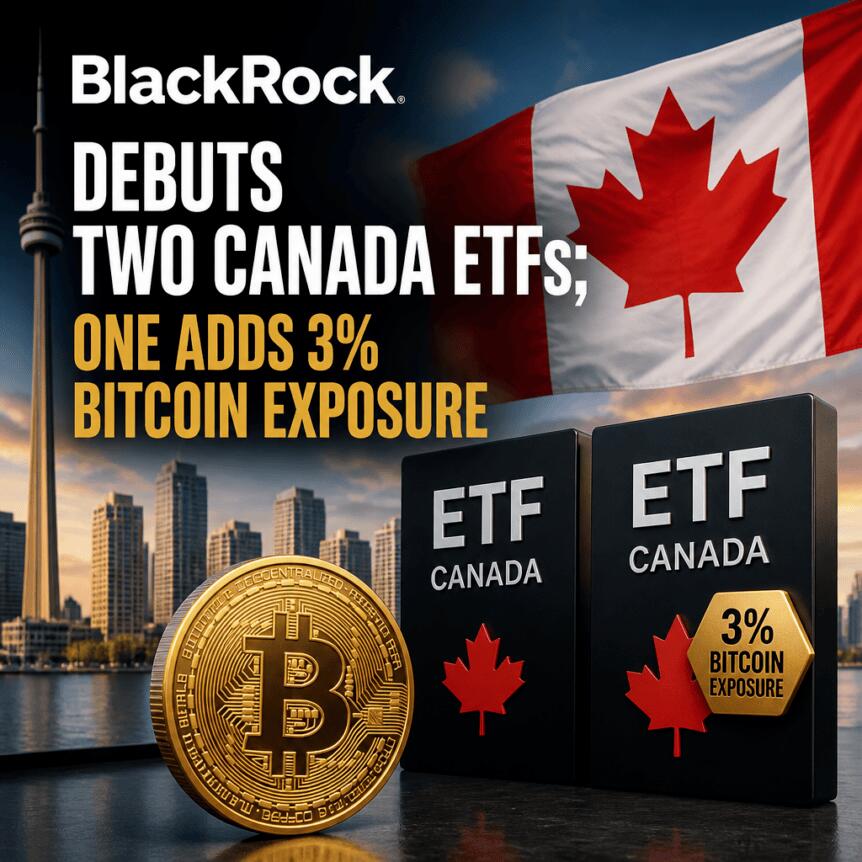
BlackRock is expanding its Canada-listed ETF lineup with two new iShares products that begin trading on the Toronto Stock Exchange (TSX) this week. The most notable addition blends traditional equities with a small, fixed allocation to Bitcoin exposure.
Both funds are managed by BlackRock Asset Management Canada under the RBC iShares alliance. They are designed for investors seeking diversified market exposure—either broadly outside North America, or a balanced mix that includes a Bitcoin sleeve.
Key takeaways
- BlackRock Canada launched two TSX-listed iShares ETFs: IBQT (equities plus a 3% Bitcoin allocation) and XINT (international equity exposure).
- IBQT’s structure targets a diversified equity core: 97% in equities via iShares ETFs, alongside 3% Bitcoin exposure via BlackRock’s Canadian iShares Bitcoin ETF (IBIT).
- XINT provides broad non-North America coverage: it tracks the MSCI ACWI ex North America IMI Index, spanning more than 5,000 companies across over 40 markets.
- BlackRock positions iShares as the platform: both funds rely primarily on other iShares ETFs rather than direct stock holdings.
- BlackRock’s US Bitcoin ETF scale remains a reference point: CoinMarketCap data shows its US-listed iShares Bitcoin Trust (IBIT) holds about $47.9 billion in assets under management.
What BlackRock launched on the TSX
On Monday, BlackRock Canada introduced two ETFs on the Toronto Stock Exchange: the iShares Equity + Bitcoin ETF Portfolio (IBQT) and the iShares Core MSCI All-International Equity Index ETF (XINT).
While both funds sit under the iShares brand and share a common management setup, they differ sharply in how they aim to deliver exposure. IBQT adds a defined Bitcoin component to an otherwise equity-focused portfolio, while XINT is a more traditional, index-tracking international equity fund.
IBQT: a “core equities + 3% Bitcoin” portfolio
The iShares Equity + Bitcoin ETF Portfolio (IBQT) is designed around a straightforward allocation framework. The fund allocates 97% of its portfolio to a mix of equities across Canada, the United States, international markets, and emerging markets. The remaining 3% is allocated to Bitcoin exposure through BlackRock’s Canadian iShares Bitcoin ETF (IBIT), which trades on Cboe Canada.
According to the launch details, IBQT does not seek to hold individual stocks directly. Instead, it primarily invests in other iShares ETFs to achieve both its diversified equity exposure and its Bitcoin sleeve.
This design choice matters for investors thinking about implementation. A fund-of-funds approach can make it easier to access multiple exposures within a single product, rather than requiring investors to combine separate equity and Bitcoin funds themselves—though investors will still want to review the underlying holdings and the total costs across the layered structure.
XINT: broad international equities outside North America
The second product, iShares Core MSCI All-International Equity Index ETF (XINT), is more conventional in its index approach. The ETF tracks the MSCI ACWI ex North America IMI Index.
Based on the provided index description, XINT offers exposure to more than 5,000 companies spread across over 40 developed and emerging markets, covering regions outside both Canada and the United States.
For investors who already hold North American equities and want a non-overlapping allocation, XINT’s benchmark selection is intended to fill that gap. By tracking a widely diversified index outside North America, it also reduces the need to make region-by-region allocation decisions, at least at the index construction level.
Why this matters for Canadian ETF investors
BlackRock’s move reflects a broader shift in how crypto exposure is being packaged for mainstream portfolios—often in small, rules-based allocations rather than all-in constructions. IBQT’s fixed 3% Bitcoin allocation is a concrete example of that approach: it aims to keep the portfolio heavily equity-oriented while adding a measured amount of BTC-linked exposure.
At the same time, BlackRock is keeping the rest of the implementation familiar. Both funds are described as relying primarily on iShares ETFs, which signals that BlackRock is leveraging its existing ETF ecosystem to deliver new outcomes—rather than creating a wholly separate investment framework for crypto-linked products in Canada.
BlackRock said its iShares business managed approximately $6.2 trillion in assets across more than 1,700 ETFs as of June 30. That scale can be relevant for Canadian investors because it suggests ongoing operational capacity and product development across the iShares range, including the integration of new crypto components into established ETF formats.
Bitcoin ETF momentum remains a key backdrop
The launch of IBQT also lands against ongoing momentum in BlackRock’s US Bitcoin ETF business. The US-listed iShares Bitcoin Trust (IBIT) is described as the largest US spot Bitcoin ETF by assets under management, with about $47.9 billion in AUM, according to CoinMarketCap.
While IBQT is a Canada-focused product and XINT is an equities-only index fund, BlackRock’s shared branding and ETF infrastructure underscore a key reality: the firm’s crypto products are increasingly becoming part of a broader ETF platform strategy, rather than operating as isolated experiments.
Going forward, investors should watch how IBQT’s trading and flows develop on the TSX, including whether the “small fixed Bitcoin sleeve” format draws demand from advisors and retail investors seeking easier portfolio integration. It will also be important to track how regulators and market participants continue to treat crypto-linked exchange-traded products in Canada, since that environment will shape how quickly similar portfolio-style offerings spread.



Australia’s financial intelligence agency has suspended Cryptolink’s crypto ATM operations for three months after finding failures in transaction reporting and raising ongoing concerns over the company’s handling of high-risk activity.
Summary
- Cryptolink’s 96 Bitcoin ATMs have been suspended for three months over compliance concerns.
- AUSTRAC cited failures involving threshold transaction reports and an unanswered information request.
- Cryptolink previously paid a A$56,340 penalty after alleged reporting and risk assessment failures.
- Australia has tightened crypto ATM controls after authorities linked the machines to scams and money laundering risks.
According to the Australian Transaction Reports and Analysis Centre, Cryptolink’s registration as a virtual asset service provider was suspended from Aug. 9, preventing the company from operating its 96 Bitcoin ATMs during the three-month period.
AUSTRAC CEO Brendan Thomas said the regulator remained concerned about Cryptolink’s ability to manage high-risk transactions through its crypto ATMs. The latest action follows an enforceable undertaking imposed on the operator in October 2025 over separate compliance failures identified by the agency’s Cryptocurrency Taskforce.
Cryptolink operates machines that allow customers to exchange cash for Bitcoin, with most of its 96 Australian ATMs located in major cities including Sydney, Melbourne and Brisbane.
Cryptolink crypto ATMs suspended over reporting failures
In outlining the reasons for the suspension, AUSTRAC said Cryptolink had failed to meet basic reporting requirements, particularly its obligations involving threshold transaction reports.
The company also failed to respond to an information request from the regulator, according to AUSTRAC.
“As part of our continued focus on digital currency as a money laundering risk, AUSTRAC has ongoing concerns about the company’s ability to manage high-risk transactions through its CATMs,” Thomas said.
Cryptolink had already been subject to regulatory action before the suspension. In October 2025, the company entered into an enforceable undertaking with AUSTRAC after the agency’s Cryptocurrency Taskforce identified alleged breaches involving late transaction reporting and shortcomings in its risk assessments.
AUSTRAC also issued Cryptolink an infringement notice worth A$56,340 as part of the earlier enforcement action. The company subsequently paid the penalty.
The three-month registration suspension now prevents Cryptolink from providing the registered virtual asset services covered by the order, effectively taking its Australian Bitcoin ATM network offline for the duration of the suspension.
Australia has tightened controls on crypto ATMs
Cryptolink’s suspension comes after more than a year of regulatory scrutiny of Australia’s crypto ATM sector, which has expanded rapidly while attracting attention from financial crime authorities.
Australia has the largest crypto ATM market in the Asia-Pacific region. Speaking at the National Press Club in Canberra in October 2025, Home Affairs Minister Tony Burke said the number of machines had increased from 23 six years earlier to about 2,000.
Burke said Australia had become the world’s third-largest crypto ATM market at the time, while authorities had linked some activity involving the machines to scams, fraud, money laundering, illicit drug transactions and other criminal activity.
Citing AUSTRAC data, Burke said 85% of funds passing through crypto ATMs among the highest-volume users were associated with scams or money mules.
AUSTRAC had started increasing its scrutiny of operators months earlier. In March 2025, the agency warned crypto ATM providers about compliance with Australia’s anti-money laundering rules before conducting targeted investigations into the sector.
By June, the regulator had introduced a A$5,000 cash transaction limit for crypto ATM deposits and withdrawals. Operators were also required to conduct stronger customer due diligence and place scam warnings at their machines.
At the time, Thomas said the conditions were intended to protect consumers from scams while reducing the ability of criminals to exploit crypto ATM businesses.
Crypto ATM scams have caused millions in losses
Authorities have also documented cases in which scammers directed victims to crypto ATMs to transfer money.
Tasmania Police reported in July 2025 that 15 victims had lost an estimated A$2.5 million through scams involving crypto ATMs. The average victim was 65 years old and lost about A$165,000, while one person lost A$750,000.
Detective Sergeant Turner said some victims suffered consequences that affected retirement plans and forced them to sell assets before relying on social support payments.
Police identified romance scams, investment fraud, impersonation of government authorities and technology support scams among the methods used against the victims. In such cases, fraudsters persuaded or pressured victims to deposit cash at crypto ATMs and send the resulting digital assets to wallets controlled by the scammers.
The transfers created an additional problem for victims because cryptocurrency transactions sent to a scammer-controlled wallet generally cannot be reversed through the mechanisms available for some traditional financial transfers.
Australia’s response stopped short of the approach adopted across the Tasman Sea. New Zealand announced a ban on crypto ATMs in June 2025 as part of measures intended to prevent criminals from converting illicit cash into digital assets.
Australian authorities instead moved toward tighter limits, customer checks and regulatory supervision of operators.
AUSTRAC has expanded crypto transfer requirements
Regulatory requirements for Australian crypto businesses have continued to develop outside the ATM sector as well.
From July 1, 2026, Australia’s crypto travel rule introduced additional data requirements for virtual asset transfers handled by regulated businesses. AUSTRAC’s framework covers services including crypto-to-fiat and crypto-to-crypto exchange, virtual asset transfers, custody and certain services connected with token offerings.
Under the regulator’s guidance, businesses handling covered transfers must collect, verify and transmit specified information about the parties involved in a transaction.
For transfers involving self-hosted wallets, AUSTRAC requires the sending institution to determine whether the receiving wallet is custodial or self-hosted. While information does not have to be passed to another institution when no other regulated intermediary exists, the business must still collect and verify payer information and obtain relevant payee and tracing information.
The requirements apply alongside Australia’s existing financial intelligence reporting system. AUSTRAC previously said it received more than 2 million threshold transaction reports and more than 450,000 suspicious matter reports during the preceding reporting period.
Cryptolink’s reporting practices had already drawn regulatory attention months before the latest suspension, with the October 2025 enforceable undertaking requiring the company to address deficiencies identified by AUSTRAC’s Cryptocurrency Taskforce.
The company paid the associated A$56,340 infringement notice, while its latest three-month VASP registration suspension took effect on Aug. 9.
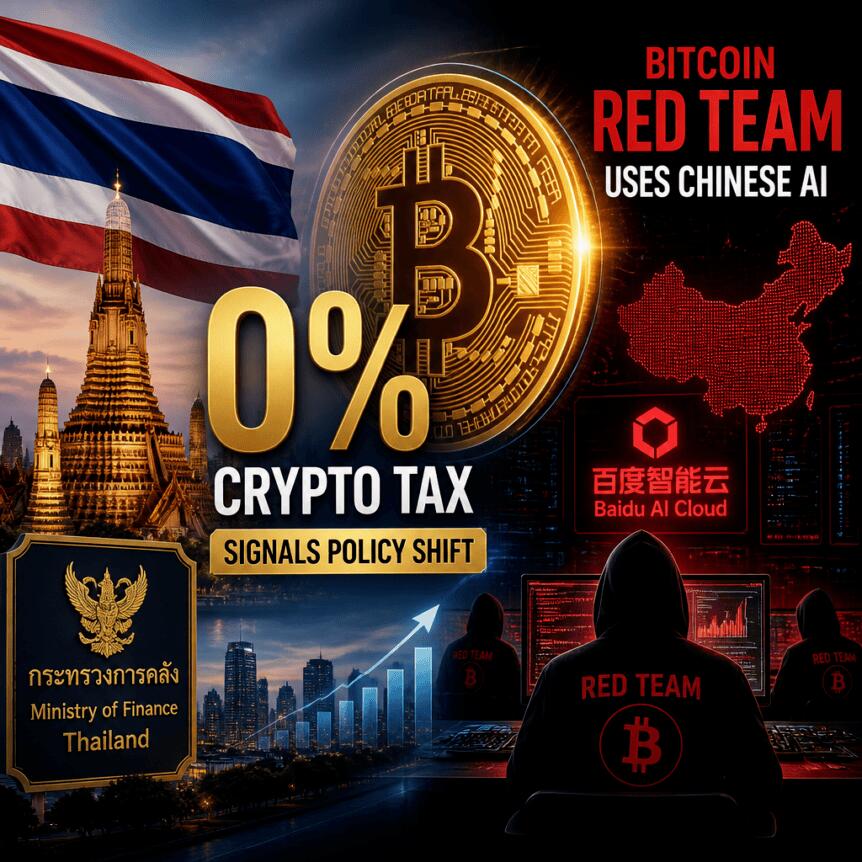
Thailand is rolling out a targeted tax break for crypto investors: beginning January 1, 2025, capital gains tax on profits from crypto trades conducted through platforms licensed by the country’s Securities and Exchange Commission will be exempt for five years, through December 31, 2029.
The move is designed to strengthen Thailand’s position as a regional digital-asset hub, while drawing a clear line between regulated onshore platforms and trading activity that occurs outside licensing—where investors would remain subject to standard personal income tax rates of up to 38%.
Key takeaways
- Thailand will exempt qualifying crypto capital gains for trades executed via SEC-licensed platforms from Jan. 1, 2025 to Dec. 31, 2029.
- Unlicensed or overseas exchange activity is still taxed under standard personal tax rates up to 38%.
- The policy is intended to make Thai-regulated access more attractive for investors, aligning crypto treatment with that of traditional securities.
- Across Asia, regulators and courts are simultaneously pushing for stronger controls—ranging from anti-scam withdrawal safeguards to travel-rule style data sharing.
Thailand’s five-year capital gains exemption for regulated exchanges
Under the new framework, crypto investors in Thailand will not pay capital gains tax on sales made through platforms licensed by the Thai Securities and Exchange Commission. The exemption runs for five years, covering January 1, 2025 through December 31, 2029.
While the tax incentive is specifically tied to using licensed venues, the exemption also signals a broader regulatory posture: Thailand is effectively attempting to mirror capital gains treatment applied to traditional securities. That linkage matters because it changes how investors model after-tax returns when comparing Thai-regulated offerings with offshore alternatives.
However, the relief is not universal. Traders who use exchanges that are unlicensed in Thailand, or that operate overseas without meeting the local licensing requirements, are expected to continue facing the country’s regular personal tax rates, reported as as high as 38%.
Thailand’s approach also follows earlier steps. In early 2024, the country reportedly waived 7% value-added tax on crypto gains—suggesting a pattern of phased adjustments aimed at improving the competitiveness of licensed crypto activity.
Asia’s policy push: scams, travel rules, and enforceability
Thailand’s tax move lands in a wider regulatory environment across Asia where authorities are focusing not only on market structure, but also on operational safeguards and information-sharing.
In Japan, for example, the Financial Services Agency has asked exchanges to adopt withdrawal delays and additional controls to combat scams. The regulator and Japan’s National Police Agency also highlighted patterns where fraudulent proceeds are transferred to exchange accounts. The requested measures include restricting withdrawals for a set period after customers deposit fiat or purchase digital assets, requiring users to pre-register withdrawal addresses, and enforcing a waiting period before newly added addresses can be used.
Taiwan is moving in a similar compliance direction. The Financial Supervisory Commission is set to require crypto platforms to transmit customer information for domestic platform-to-platform transfers starting in October. The rules apply irrespective of transfer value, with extra data requirements for transfers above 30,000 New Taiwan dollars (about $930). For high-value transfers, additional details such as a sender’s date of birth and residential address (for individuals) or corporate identification and registered address are expected. Receiving platforms would also need to verify beneficiary information provided by the sending institution against their own records. Taiwan also plans to extend the framework to transfers between domestic and overseas VASPs by the end of 2027.
Enforcement and asset tracing: Bybit’s North Korea case
Regulatory safeguards are running alongside legal efforts to trace and recover stolen funds. In a US court case involving exchange Bybit, a federal judge reportedly supported Bybit’s bid to trace assets connected to the widely reported $1.5 billion North Korea-linked hack from February 2025.
According to newly revealed court records, Bybit filed the lawsuit under seal on June 18 against North Korea, its Reconnaissance General Bureau, the Lazarus Group, and 20 unidentified defendants. The court granted expedited discovery on June 19, giving Bybit a route to identify alleged intermediaries and pursue a portion of funds that remain traceable.
Bybit reportedly told the court that 90.2% of the stolen assets had become untraceable after moving through mixers, cross-chain bridges, and over-the-counter dealers. The remaining 9.8% was said to be traced to identifiable wallets, including 5.3% of the total—about $75.5 million—that had been frozen or recovered. Bybit is seeking return of the stolen assets and approximately $1.5 billion in damages.
For market participants, the practical significance is straightforward: even when large portions of theft are obfuscated, courts and discovery processes can still uncover pockets of traceability—often tied to wallet-level movements and intermediary behavior—creating leverage for claims that go beyond a single judgment against a sanctioned state actor.
What builders and investors should watch next
Thailand’s capital gains exemption is likely to intensify the incentive to trade through SEC-licensed channels, while continuing to discourage the “regulatory arbitrage” route of using unlicensed or offshore exchanges. Investors should watch how Thailand defines eligibility in practice and whether licensed platforms promote the change in ways that meaningfully shift user behavior.

Harry Chun Tak Yeh, founder of Quantum Fintech Group and a longtime figure in the Fantom ecosystem, died after a reported fall from the Jade Park residential tower in Asunción, Paraguay, with authorities still investigating how it happened.
Summary
- Paraguayan authorities are investigating Harry Yeh’s death after a fall from Jade Park’s 30th floor.
- Police found the 30th floor apartment linked to Yeh open and disturbed during their investigation.
- Authorities have not determined whether the fall was accidental, suicide related, or involved another person.
- Yeh founded Quantum Fintech Group and became closely associated with Fantom ecosystem project Tomb Finance.
- Yeh’s website claimed his funds and partners managed over $2 billion, without independent verification publicly.
Police were called to the building at about 4:30 a.m. on Aug. 7 and preliminarily identified the victim as Yeh.
The investigation remains open. Paraguayan police and prosecutors have not publicly classified the death as an accident, suicide or an act involving another person. The latest local reporting reviewed on Aug. 10 said forensic work and an autopsy were being used to establish the cause and circumstances.
Harry Yeh death probe centers on two apartments
Prosecutor María del Carmen Palazón joined Criminalistics and Homicide officers in examining an apartment on the 30th floor where Harry Yeh was believed to have stayed. Investigators found its doors open and the interior heavily disturbed, with nobody inside, according to a local report.

Police also examined another apartment on the 27th floor. Homicide chief Abel Cantero said evidence collected from both properties was transferred to the Public Prosecutor’s Office. Local reports said Yeh’s body was found without clothing, but authorities have not publicly explained whether that detail has any relevance to the cause of death.
Police have not established how the fall occurred
Asunción police director Francisco Ávalos said investigators were still at an early stage and could not determine how Yeh fell. Authorities were considering multiple possibilities rather than treating any single explanation as established. Prosecutors also sought authorization to search the apartment more thoroughly as they attempted to reconstruct Yeh’s movements before his death.
No official finding cited in the latest Paraguayan reporting has accused another person of involvement. Likewise, reports describing the apartment as disturbed do not by themselves establish robbery, assault or a crypto related crime. The body was transferred to Paraguay’s Judicial Morgue for an autopsy and forensic examination.
Yeh became closely tied to Fantom through Tomb Finance
Harry Yeh founded and managed Quantum Fintech Group, an investment business focused on cryptocurrency, blockchain and digital assets. His own profile says he also founded and seeded LIF3 and L3 Reserve and had been active across crypto investment and trading.
His connection to Fantom was particularly visible through Tomb Finance. A 2021 Fantom Foundation post said Tomb operated under Yeh’s oversight after he assumed direction of the project. His website separately describes an investment ecosystem focused primarily on Fantom based projects.
That ecosystem later changed substantially as Fantom evolved into Sonic. As previously reported inthe Fantom to Sonic transition, the FTM to S migration began in early 2025 at a 1:1 ratio. More recently,Sonic’s leadership restructuring saw several longtime figures step away from its board in June 2026.
$2 billion investment figure remains self reported
Harry Yeh’s biography says funds and assets managed by him, Quantum Fintech Group and partners “exceeded $2B USD.” An older profile reported that Yeh and his team said their network managed more than $2.4 billion. Neither source provides independently audited documentation supporting those figures, so they should be treated as claims rather than verified assets under management.
The next confirmed development is expected to come from Paraguay’s forensic and prosecutorial process. As of Aug. 10, the latest authoritative local reporting still described the autopsy and evidence review as pending and did not establish what caused Yeh to fall. Any claim that the death resulted from murder, suicide, robbery or a crypto related attack therefore remains unconfirmed.
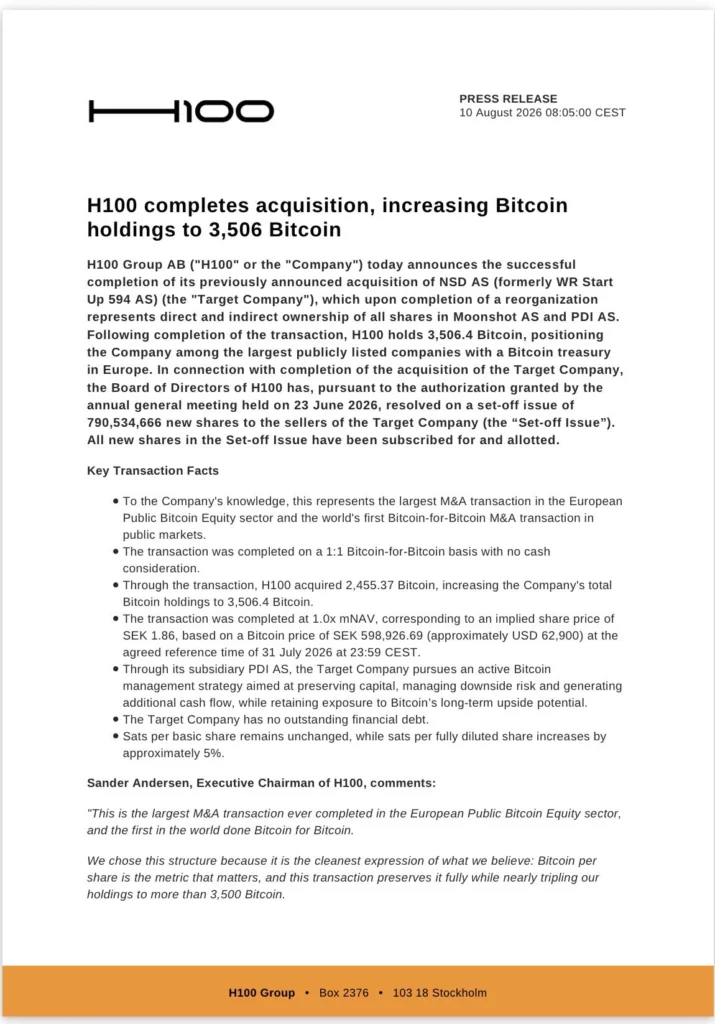
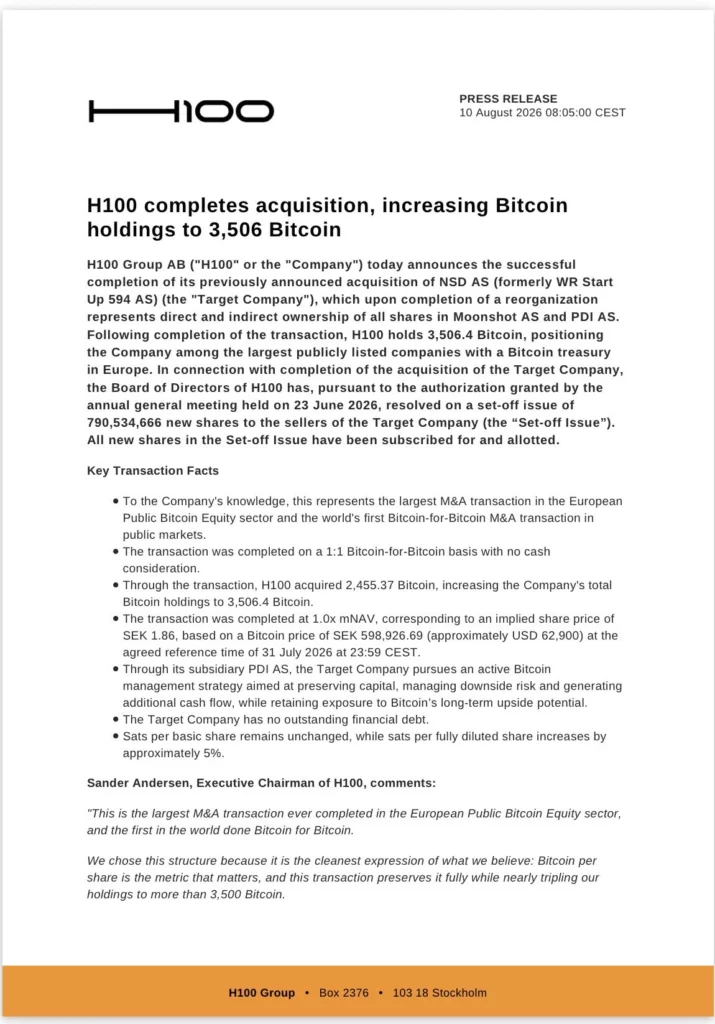
H100 Group completed its previously announced acquisition of NSD AS on Aug. 10, adding 2,455.37 Bitcoin and lifting its total treasury to 3,506.4 BTC.
Summary
- H100 acquired 2,455.37 Bitcoin through NSD, raising its total treasury holdings to 3,506.4 Bitcoin overall.
- The transaction used no cash, with H100 issuing 790.5 million shares to NSD’s sellers instead.
- H100 priced consideration shares at SEK 1.86, using Bitcoin’s July 31 reference price for valuation.
- The new share issue creates approximately 70% dilution, while basic Bitcoin per share remains unchanged.
- H100 says fully diluted sats per share increased roughly 5%, while NSD carried no debt.
The Stockholm listed company paid no cash for the transaction, instead issuing shares to the sellers under a Bitcoin for Bitcoin valuation structure, according to its official release.
The acquired Bitcoin was valued using a July 31 reference price of SEK 598,926.69, or about $62,900 per BTC. At Bitcoin’s current price near $65,158, H100’s enlarged treasury is worth roughly $228.5 million.
H100 nearly triples its Bitcoin holdings
The transaction follows a binding share purchase agreement signed on April 23 after the group first outlined the deal in March. NSD, formerly WR Start Up 594 AS, was reorganized so that it directly and indirectly owns Moonshot AS and PDI AS. H100 said the acquired company has no outstanding financial debt.
As crypto.news reported in the planned Norwegian acquisition, the original proposal was expected to raise H100’s treasury from about 1,051 BTC to roughly 3,501 BTC. The completed transaction ultimately added 2,455.37 BTC, taking the total slightly higher to 3,506.4 BTC.
Importantly, the roughly $62,900 figure was an agreed valuation reference, not the price of an open market Bitcoin purchase. The group used the Coinbase BTC/SEK spot rate at 23:59 CEST on July 31 to determine the consideration share price. The release does not provide a new official average purchase price for the combined treasury, so describing all 2,455.37 BTC as Bitcoin bought at $62,900 would be imprecise.
The group called the transaction the largest M&A deal in Europe’s public Bitcoin equity sector and “the first in the world done Bitcoin for Bitcoin.” Those descriptions are company claims and have not been independently established across every public market transaction.
In addition, H100 issued 790,534,666 new shares to the sellers at SEK 1.86 each. The consideration totaled about SEK 1.47 billion and was settled through seller promissory notes offset against the newly issued shares. As a result, the group made no cash payment to complete the acquisition.
The new shares create about 70% dilution based on the company’s share count when the deal closed. Even so, H100 said sats per basic share remained unchanged because the consideration was based on each side’s relative Bitcoin contribution. Fully diluted sats per share increased about 5%, from 288 to 303, according to company disclosures.
Deal adds Moonshot and PDI capabilities
The acquisition also brings Moonshot and PDI into H100’s corporate structure. The group said PDI follows an active Bitcoin management strategy focused on capital preservation, downside risk management and additional cash flow while retaining Bitcoin exposure. Those objectives describe the company’s strategy rather than guaranteed financial outcomes.
Executive Chairman Sander Andersen said the combination adds technology and market capabilities that complement H100’s existing operations. Principal seller Geir Harald Hansen also entered a 12 month lockup covering the consideration shares he received, subject to specified exceptions.
What happens next for H100
The newly issued shares are expected to begin trading on NGM Nordic SME as soon as practicable. The group completed the transaction using authority approved by shareholders at the June 23 annual general meeting, which allowed its board to issue consideration shares to the sellers under the April purchase agreement.
The deal represents a rapid expansion from the group’s first Bitcoin purchase in May 2025, when it acquired just 4.39 BTC. As previously reported in coverage of its first treasury purchase, the company subsequently raised capital and accelerated its Bitcoin accumulation strategy.
Moreover, the group also broadened its investor access through its Frankfurt market expansion in July 2025. After nearly tripling its Bitcoin holdings in the latest transaction, the immediate corporate milestone is the admission of the 790.5 million new shares to NGM Nordic SME.
Ripple minted 10 million Ripple USD on the XRP Ledger on Aug. 10, adding another large issuance transaction to its regulated stablecoin network.
Summary
- Ripple minted 10 million RLUSD on XRPL, according to the transaction recorded by XRPScan Monday.
- RWA.xyz shows RLUSD market capitalization near $1.53 billion, below Ripple’s reported $1.7 billion June level.
- Santiment data shared by Ali Martinez showed whales accumulated more than 380 million XRP weekly.
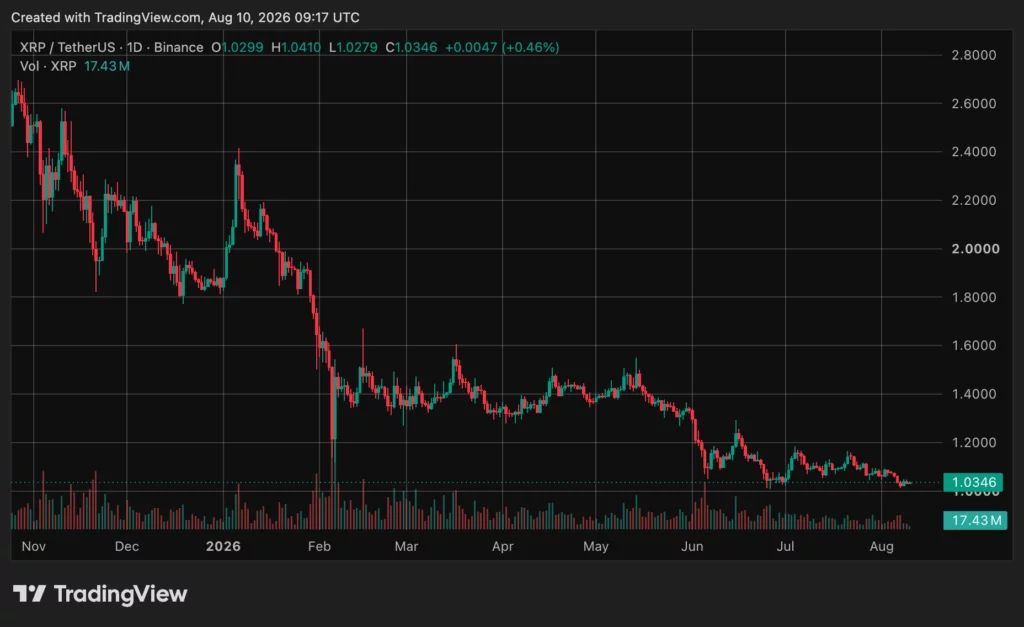
- XRP traded near $1.03 Monday, remaining close to the psychologically important $1 level despite accumulation.
- New York regulators list RLUSD among stablecoins approved for issuance by regulated virtual currency entities.
The onchain transaction was recorded by XRPScan and tracked publicly shortly after execution.
The mint arrived as separate Santiment data shared by analyst Ali Martinez showed large XRP holders adding more than 380 million tokens during the previous week. The two developments occurred around the same period, but there is no evidence that the RLUSD issuance caused the whale accumulation or that the whales were responding to Ripple’s mint.
RLUSD mint does not automatically mean $10M entered markets
Ripple’s 10 million RLUSD transaction increases the amount of stablecoins issued on XRPL, but the transaction alone does not establish that $10 million immediately entered circulation, was deployed into XRP, or represented fresh market buying. Ripple’s institutional platform allows approved customers to mint, redeem and manage RLUSD, meaning issuance can form part of treasury and settlement operations.
That distinction matters because describing the transaction as a $10 million “capital injection” into XRP would go beyond what the blockchain record proves. Ripple has not publicly identified a customer behind this specific issuance or disclosed its intended use. As crypto.news reported in recent platform launch coverage, Ripple Mint was introduced in July to give institutional customers direct tools for repeated RLUSD issuance, redemption and cross network management.
RLUSD’s wider supply remains below levels recorded earlier this summer. RWA.xyz data showed a market capitalization of about $1.53 billion on Aug. 10. Ripple had said in June that the stablecoin had reached $1.7 billion, while crypto.news later reported a retreat toward $1.52 billion after a series of token burns.
In earlier supply contraction coverage, RLUSD had fallen roughly 20% from a late May peak near $1.9 billion after Ripple removed tokens from circulation. Monday’s mint therefore comes against a backdrop of active issuance and redemption rather than uninterrupted supply growth.
XRP whales reportedly accumulated 380M tokens
Separately, Martinez shared Santiment data showing that a large holder cohort accumulated more than 380 million XRP over seven days. The increase came while XRP repeatedly traded close to the $1 psychological level. The reported accumulation lifted attention toward whether larger holders were rebuilding positions after months of weak price performance.
However, describing those wallets as actively “defending” $1 remains an interpretation rather than an onchain fact. The data show a change in balances attributed to large holders; they do not establish the holders’ motivation or prove coordinated support for a particular price. Martinez described the activity as an “encouraging sign of conviction,” but that remains his assessment.
The latest increase is considerably larger than the 70 million XRP accumulated by whales during one July week. As crypto.news reported in previous large holder coverage, those purchases coincided with declining XRP balances on Binance and a rebound above $1.11 at the time.
XRP price has yet to confirm a breakout
Despite the reported whale buying, XRP had not produced a strong immediate breakout by Aug. 10. Current market data placed the token around $1.03, down roughly 0.4% over 24 hours and 2.8% over seven days. Its intraday range was approximately $1.03 to $1.05.
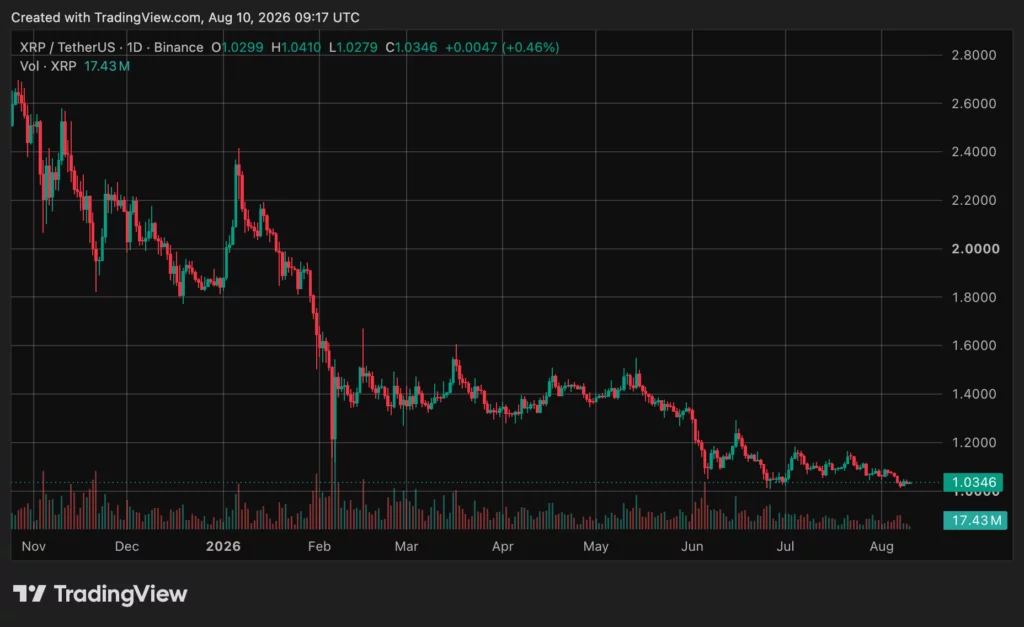
That performance means the whale accumulation and RLUSD mint should not be presented as confirmed bullish catalysts for XRP. Ripple and XRP are connected through the XRP Ledger ecosystem, but RLUSD issuance does not mechanically require equivalent XRP purchases. The stablecoin can be minted and transferred independently while using XRPL infrastructure.
The latest activity also comes as Ripple continues expanding RLUSD’s institutional role. The company says the stablecoin is fully backed by segregated cash and cash equivalent reserves and redeemable one for one for U.S. dollars. New York’s Department of Financial Services continues to list RLUSD among stablecoins approved for issuance by regulated virtual currency entities.
What happens next for RLUSD and XRP
The next point to watch is whether the newly issued RLUSD moves from treasury accounts into wider circulation and whether aggregate supply rises materially from its current level. Ripple has not announced a schedule for future minting, and individual issuance transactions can be followed by transfers, redemptions or burns depending on institutional demand.
For XRP, the more immediate test remains the $1 area and whether the reported whale accumulation translates into sustained spot demand. The token remained below levels seen during July even as institutional infrastructure around Ripple continued expanding. In related market analysis, the disconnect between Ripple’s business expansion and XRP’s weaker price performance has persisted throughout 2026.
The confirmed developments are therefore narrower than some bullish interpretations suggest: Ripple minted 10 million RLUSD on XRPL, RLUSD remains a roughly $1.5 billion stablecoin, and Santiment data shared by Martinez show a sharp rise in holdings among large XRP wallets. Whether those trends ultimately translate into stronger XRP prices remains unproven.
Disclosure: This article does not represent investment advice. The content and materials featured on this page are for educational purposes only.
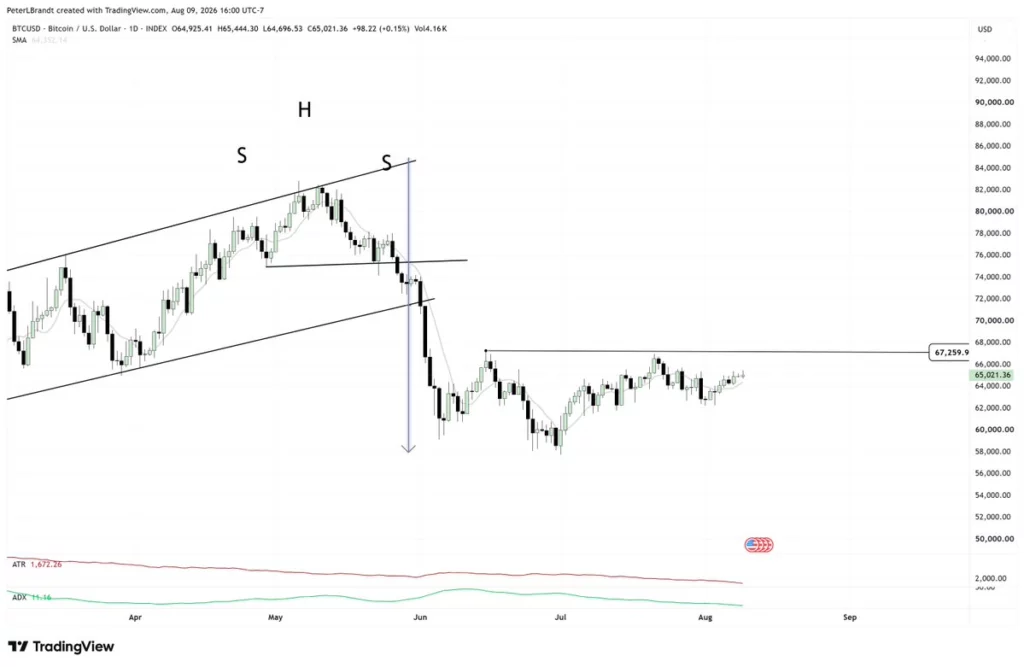
Bitcoin hovered near $65,000 on Aug. 10 as veteran trader Peter Brandt leaned toward another decline, pointing to a large head and shoulders structure that broke down earlier this summer.
Summary
- Bitcoin trades near $65,000 while Peter Brandt says he would currently bet on another decline.
- Brandt’s head and shoulders chart points toward $58,000 if Bitcoin fails to reclaim resistance soon.
- Bitcoin’s daily chart shows ADX near 11.16, signaling weak trend strength during current consolidation conditions.
- U.S. spot Bitcoin ETFs recorded more than $850 million in net inflows across five sessions.
- Lookonchain tracked one whale selling 7,513 BTC worth roughly $486.9 million during three recent weeks.
Brandt said he had not entered a trade, but wrote that “if I were to bet it would be for a decline.”
The cautious view comes as the crypto tries to stabilize above its 54 day moving average while U.S. spot Bitcoin ETFs attract more than $850 million in weekly inflows. That leaves the market caught between improving institutional demand and a technical structure that has not yet cleared resistance around $67,260.
Bitcoin indicators show a weak trend below $67,260
On the supplied BTC/USD daily chart, BTC was trading near $65,021 and remained slightly above its 54 day simple moving average near $64,352. Holding above that average points to stabilization following the June selloff, but price is still below the marked $67,260 resistance area.
The lower indicators reinforce the lack of a strong directional move. Average True Range stood near 1,672, showing that daily price ranges remain relatively wide, while the Average Directional Index was only about 11.16. An ADX reading this low indicates weak trend strength, which fits Bitcoin’s sideways movement after its drop toward the $58,000 to $60,000 area.
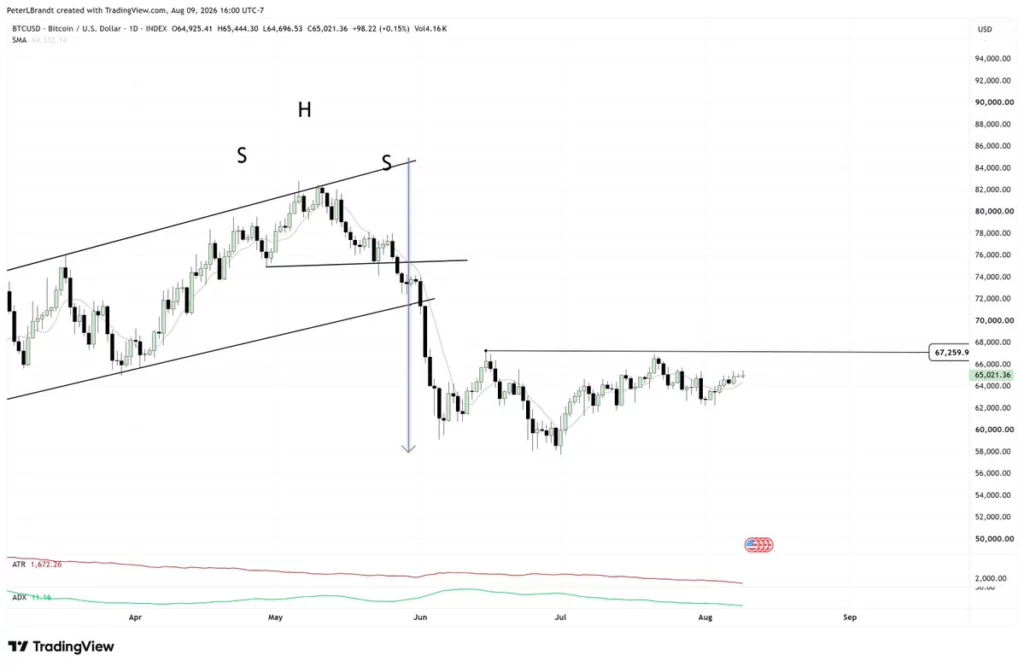
Brandt’s chart shows a head and shoulders structure built between April and June. The neckline around $75,000 has already broken, and his drawn path points toward roughly $58,000. That is a technical scenario rather than a confirmed destination. A sustained move above $67,260 would weaken the immediate bearish setup shown on his chart.
Brandt leans bearish as one large whale keeps selling
Brandt made the uncertainty clear in his Aug. 10 post. “I am not in the bet yet, but if I were to bet it would be for a decline,” he wrote. His wording matters because he is expressing a directional preference rather than announcing an active short position or guaranteeing another selloff.
Selling by at least one large holder adds another source of supply. Lookonchain reported that a whale sold another 1,019 BTC, worth about $66.4 million, and had disposed of 7,513 BTC worth roughly $486.9 million over three weeks. The activity is notable, but one tracked whale should not be treated as proof that Bitcoin whales as a group are selling.
That pressure also lines up with recent onchain analysis showing Bitcoin below the short term holder realized price. CryptoQuant analyst Axel Adler Jr. placed that cost basis at $67,523 on Aug. 8, close to Brandt’s resistance area. As crypto.news reported in recent holder selling analysis, a move toward that level could bring some underwater holders closer to breakeven.
U.S. Bitcoin ETF demand offers a bullish counterweight
ETF demand has moved in the opposite direction. Farside Investors recorded daily net inflows of $170.1 million, $211.5 million, $244.4 million, $137.6 million and $101.7 million from Aug. 3 through Aug. 7. Those figures total about $865.3 million across five sessions.
As crypto.news reported in today’s U.S. CPI preview, Bitcoin nevertheless remained around $65,000 despite the stronger fund demand.
A separate claim circulating Monday connected the stronger ETF flows with the Coldcard wallet breach. Coinkite has confirmed a seed generation weakness affecting several Coldcard firmware versions and warned affected customers to create new seeds and move their BTC.
However, there is currently no verified evidence that the Coldcard incident caused investors to shift directly into Bitcoin ETFs. The timing alone does not establish that relationship. Inrelated Coldcard security coverage, Galaxy Research had confirmed 1,596 BTC stolen across three attack waves, while a suspected fourth wave could bring losses to roughly 2,055 BTC. The higher figure remains unconfirmed.
Bitcoin now faces U.S. CPI and the $67K barrier
The next scheduled macro test arrives Wednesday, Aug. 12. The Bureau of Labor Statistics will release July U.S. consumer price data at 8:30 a.m. ET. Friday’s employment release showed nonfarm payrolls falling by 23,000 in July, while May and June were revised down by a combined 103,000 jobs.
Bitcoin’s short term map is therefore relatively clear. A sustained break above $67,260, followed by the short term holder cost basis around $67,523, would challenge the bearish setup and improve the recovery structure. Failure around that zone would keep the recent consolidation intact and leave the $60,000 region exposed to another test.
Brandt’s roughly $58,000 path should remain attributed as his technical scenario, not a market forecast. For now, ADX near 11 shows little trend strength, ETF inflows remain supportive, and tracked large holder selling is still present. Wednesday’s inflation report could provide the next catalyst for a break from BTC’s current range.
Disclosure: This article does not represent investment advice. The content and materials featured on this page are for educational purposes only.
THAILAND
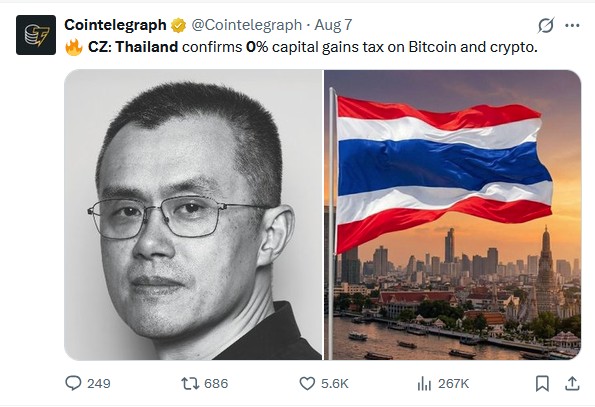
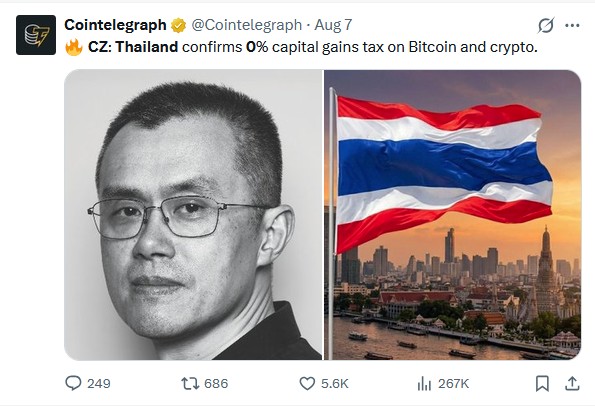
Thailand introduces 0% capital gains tax on crypto
For the next few years crypto investors in Thailand won’t have to pay any capital gains taxes on sales made via platforms licensed by Thailand’s Securities and Exchange Commission. The exemption is for five years and covers the period of January 1 2025, through to December 31 2029.
The scheme aims to boost Thailand’s attractiveness as a regional crypto hub, and it’s already home to a growing community of crypto digital nomads
However trades on unlicensed or overseas exchanges will still face standard personal tax rates as high as 38%. The exemption aligns the tax treatment of crypto with capital gains from traditional securities in the country.
Thailand previously waved 7% value added tax on crypto gains in early 2024.
CHINA
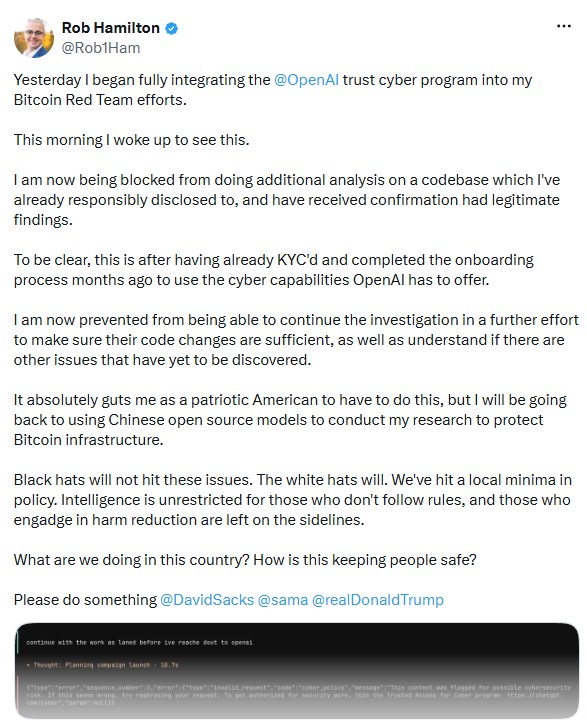
Bitcoin Red Team founder turns to Chinese AI
Bitcoin Red Team founder Rob Hamilton has been forced to rely on open-source Chinese AI models after finding himself restricted from analyzing codebases by OpenAI, highlighting a growing concern that the most capable AI tools aren’t being made available to defenders.
“It absolutely guts me as a patriotic American to have to do this, but I will be going back to using Chinese open source models to conduct my research to protect Bitcoin infrastructure,” he said.
“Black hats will not hit these issues. The white hats will. We’ve hit a local minima in policy,” said Hamilton. “Intelligence is unrestricted for those who don’t follow rules, and those who engage in harm reduction are left on the sidelines.”
The Bitcoin Policy Institute and an alliance of blockchain firms subsequently issued a call to “frontier AI labs to establish a clear, trusted pathway for qualified open-source and digital asset defenders to access their strongest capabilities.”
Source: Rob Hamilton
CHINA NEWS IN BRIEF
— A man in Shenzen was convicted of attempted extortion after he stole confidential R&D data from his company and then posed as an overseas hacker to demand a ransom paid in Bitcoin.
ASIA PACIFIC
APAC region sees big jump in onchain transactions year-on-year
A new report from Hashed Open Research and SCBX found that on-chain transaction volume across the Asia-Pacific region grew by 68% year-on-year, from $1.4 trillion to $2.36 trillion. It was the fastest growth of any region globally, driven mainly by countries in South East Asia.
The report found that consumers in the region had skipped straight from cash, over cards and bank transactions, and went directly to mobile payments. Digital payments now account for 60% of all payments in the region.
CLARITY Act delay gives Asian financial hubs an opening: First Digital CEO
The US Senate’s delay of a vote on crypto market structure legislation to mid-September could give Hong Kong and Singapore more time to strengthen their positions as digital asset hubs, according to First Digital founder and CEO Vincent Chok.
Chok, whose company issues the FDUSD stablecoin, said the delay could give jurisdictions with clearer regulatory frameworks an advantage in attracting capital and talent as US uncertainty weighs on institutional adoption.
“For Asia, this delay gives regional financial hubs like Hong Kong and Singapore additional time to demonstrate that clear regulation can coexist with innovation.”
NORTH KOREA
US court backs Bybit’s bid to trace funds from $1.5B North Korea hack
A US federal judge backed crypto exchange Bybit’s effort to trace assets stolen in the infamous $1.5 billion North Korea-linked hack in February 2025.
According to newly revealed records, Bybit filed the lawsuit under seal on June 18 against North Korea, its Reconnaissance General Bureau, the Lazarus Group and 20 unidentified defendants. The court granted Bybit’s request for expedited discovery on June 19.
The discovery authority gives Bybit a practical route to identify alleged intermediaries and pursue a small portion of stolen assets that remains traceable, rather than relying solely on a judgment against North Korea.

Unfortunately, Bybit told the court that 90.2% of the stolen assets had become untraceable after passing through mixers, cross-chain bridges and over-the-counter dealers. The remaining 9.8% had been traced to identifiable wallets, including 5.3% of the total, about $75.5 million, that had been frozen or recovered.
Bybit is seeking the return of the stolen assets and approximately $1.5 billion in damages.
SOUTH KOREA NEWS IN BRIEF
— Dunamu, which operates Upbit, has been selected by the National Police Agency to custody seized crypto assets for the next year after it obtained the highest technical evaluation score of 94.14 points.
JAPAN
Japan FSA asks crypto exchanges to impose withdrawal delays to fight scams
Japan’s financial regulator has asked crypto exchanges to introduce withdrawal delays and other safeguards as authorities respond to increasingly sophisticated scams involving digital assets.
The Financial Services Agency (FSA) said it had jointly requested the measures with the National Police Agency amid growing losses among crypto exchange users and cases where funds obtained through fraudulent schemes are being transferred to exchange accounts.
The request calls on exchanges to restrict crypto withdrawals for a specified period after customers deposit fiat currency or purchase digital assets. Platforms were also asked to require users to pre-register crypto withdrawal addresses and impose a waiting period before newly added addresses can be used.
JAPAN NEWS IN BRIEF
— Tokyo Stock Exchange plans to introduce a re‑examination regime for companies that undergo a major business pivot. The TSE didn’t name digital asset treasuries but logic suggests they may well fall within the scope of the new rules.
TAIWAN
Taiwan plans Travel Rule for domestic crypto transfers from October
Taiwan’s Financial Supervisory Commission will require crypto platforms to transmit customer information on all domestic platform-to-platform transfers starting in October.
The rules would apply regardless of value, but transfers exceeding 30,000 New Taiwan dollars (about $930) would trigger additional data requirements, including an individual sender’s date of birth and residential address, or a corporate sender’s official identification number and registered address.
Receiving VASPs would also be required to compare beneficiary information supplied by the originating platform with their own records.
The FSC plans to extend the framework to transfers between domestic and overseas VASPs by the end of 2027.
SINGAPORE
Bitdeer increased Bitcoin mining output by nearly fivefold in Q2
Singapore headquartered Bitcoin miner Bitdeer mined 2,694 Bitcoin during the second quarter of 2026, up nearly fivefold from 565 BTC a year earlier.
The miner closed the quarter with 150 BTC held on its balance sheet, down 90% from 1,502 BTC a year earlier, according to the company’s Q2 report published Monday.
Bitdeer liquidated its entire 943 BTC treasury in February, citing liquidity decisions rather than a shift away from its core Bitcoin mining business.
SINGAPORE NEWS IN BRIEF
—UBS is sharpening its focus on wealthy Singapore residents. Over the past 25 years the number of Singapore residents who have between $5 million to $10 million compounded at an annual growth rate of 8 percent. In total there are 27,000 residents with between $5 million and $100 million.
HONG KONG
Binance sues RedotPay over alleged $473 million user losses: Report
Binance-affiliated companies have sued the founders of Hong Kong-based cryptocurrency payments company RedotPay, alleging it diverted more than 470,000 users from Binance Card in breach of their commercial agreement.
The plaintiffs seek nearly $473 million in damages, alleging the conduct contributed to RedotPay’s valuation as the company considers a potential initial public offering.
RedotPay said it is defending the proceedings and rejected what it described as “unfounded allegations” against the company and its co-founders. “RedotPay is strenuously defending the proceedings,” a RedotPay spokesperson told Cointelegraph, adding that it will respond through the appropriate legal process.
HONG KONG NEWS IN BRIEF
— Hong Kong police have arrested a 67-year-old woman accused of posing as a prospective tenant to scam property owners out of $510,000. She offered to pay rent in advance, then gave them a mobile phone with a genuine crypto app on it. However, the app had malware giving control over the wallet to the scammers, allowing them to steal funds once it had been funded.
VIETNAM NEWS IN BRIEF
— The Vietnam RWA Summit heard about how the country is developing groundwork for tokenizing RWAs from the securities regulator and Vietnam Blockchain Association.
— Vietnam’s central bank governor presented a draft law to the National Assembly to make crypto asset services reporting entities under the country’s anti money laundering regulations. It also highlights suspicious transaction indicators specifically tailored to crypto asset activities.
Cointelegraph publishes long-form journalism, analysis and narrative reporting produced by Cointelegraph’s in-house editorial team with subject-matter expertise. All articles are edited and reviewed by Cointelegraph editors in line with our editorial standards. Some articles contain affiliate links, from which Cointelegraph may earn a commission. These relationships do not influence which products we review or our editorial conclusions. Content published in here does not constitute financial, legal or investment advice. Readers should conduct their own research and consult qualified professionals where appropriate. Cointelegraph maintains full editorial independence.
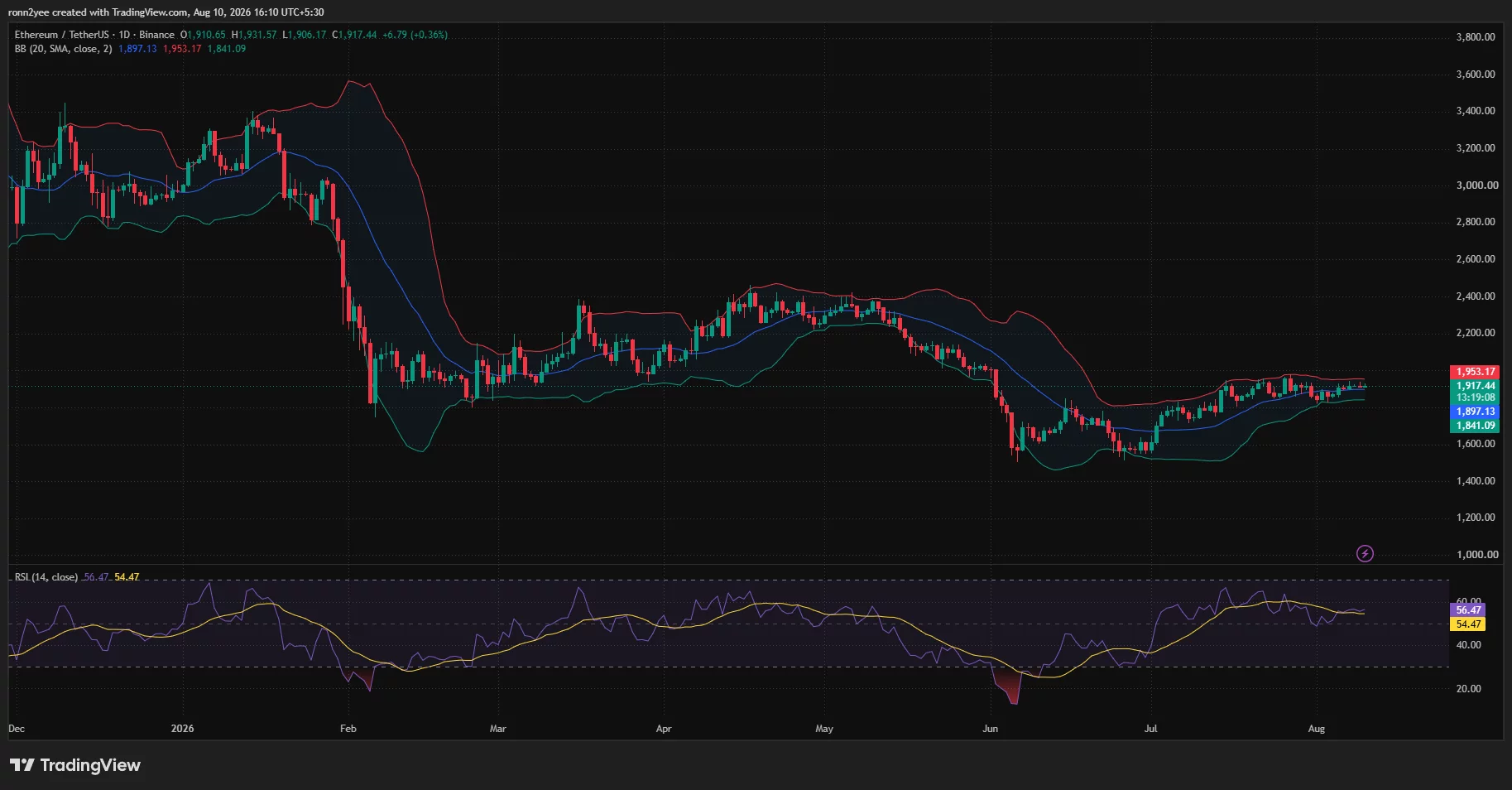
Ethereum price consolidated near $1,917 on Aug. 10 as buyers defended the $1,900 area, but weakening short-term momentum and dense liquidity near $1,950 kept ETH inside a narrow range.
Summary
- Ethereum price traded near $1,917, holding above the daily Bollinger Band midpoint at $1,897.
- The 4-hour chart places immediate support between $1,894 and $1,900.
- Liquidation data shows large leverage clusters near $1,950 and $1,895.
- A break above $1,953 could reopen the path toward the psychological $2,000 level.
Ethereum price holds above $1,900
According to data from crypto.news, Ethereum (ETH) price was trading at approximately $1,917 at the time of writing, after moving between $1,906 and $1,931 during the latest daily session.
ETH has consolidated above $1,900 since recovering from lows near $1,800 earlier in August. The move followed renewed spot demand, short liquidations and a broader risk-asset rally after weak U.S. employment data reduced expectations for another near-term Federal Reserve rate hike.
U.S. nonfarm payrolls fell by 23,000 in July, missing forecasts for an increase of around 80,000. May and June payroll figures were also revised lower by a combined 103,000.
The softer report pushed Treasury yields lower and helped the S&P 500 close at a record on Aug. 7. Ethereum benefited from the same change in risk appetite, although the weekend advance has since lost momentum.
Washington also provided a secondary sentiment boost. Senate Majority Leader John Thune filed a motion that prepares the Digital Asset Market Clarity Act for a procedural vote after the August recess. However, the filing did not represent final passage, and lawmakers still need to resolve disputes involving government ethics, stablecoin rewards and enforcement provisions.
ETH momentum weakens below $1,950
The daily chart shows Ethereum trading in the upper half of its Bollinger Bands. The middle band stands at $1,897, while the upper and lower boundaries sit at $1,953 and $1,841, respectively.
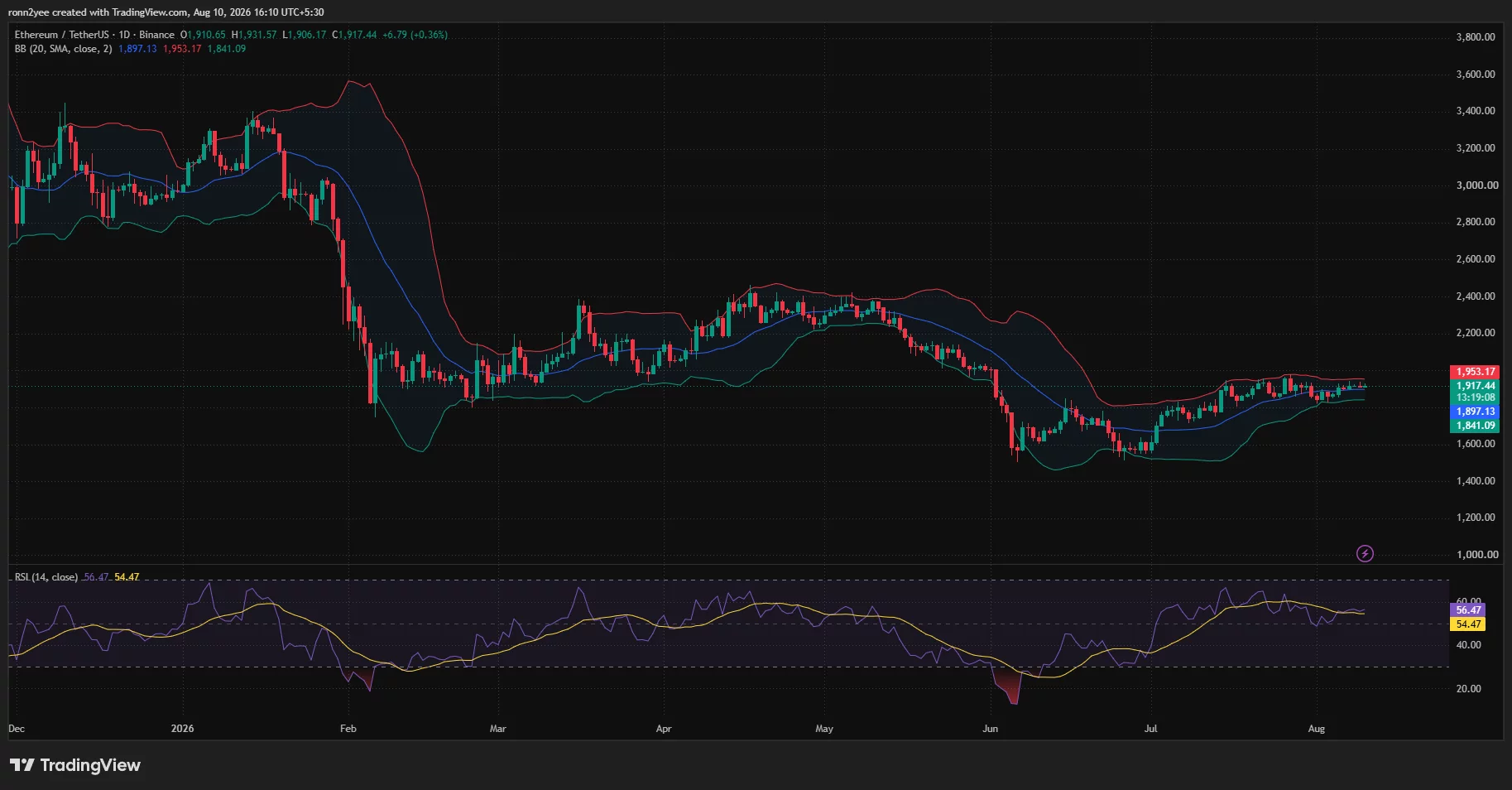
Holding above the $1,897 midpoint keeps the short-term structure tilted toward buyers. The upper band near $1,953 now forms the main technical barrier before $2,000.
The daily relative strength index stands at 56.47, slightly above its signal average of 54.47. This indicates moderate bullish momentum without placing ETH in overbought territory. However, the indicator has flattened after its latest rise, matching the sideways price action.
Shorter-term indicators show more caution. On the 4-hour chart, ETH is sitting almost directly on its 20-period simple moving average at $1,917.78. The 50- and 100-period averages are clustered at $1,894.24 and $1,894.80, creating a concentrated support area below the current price.
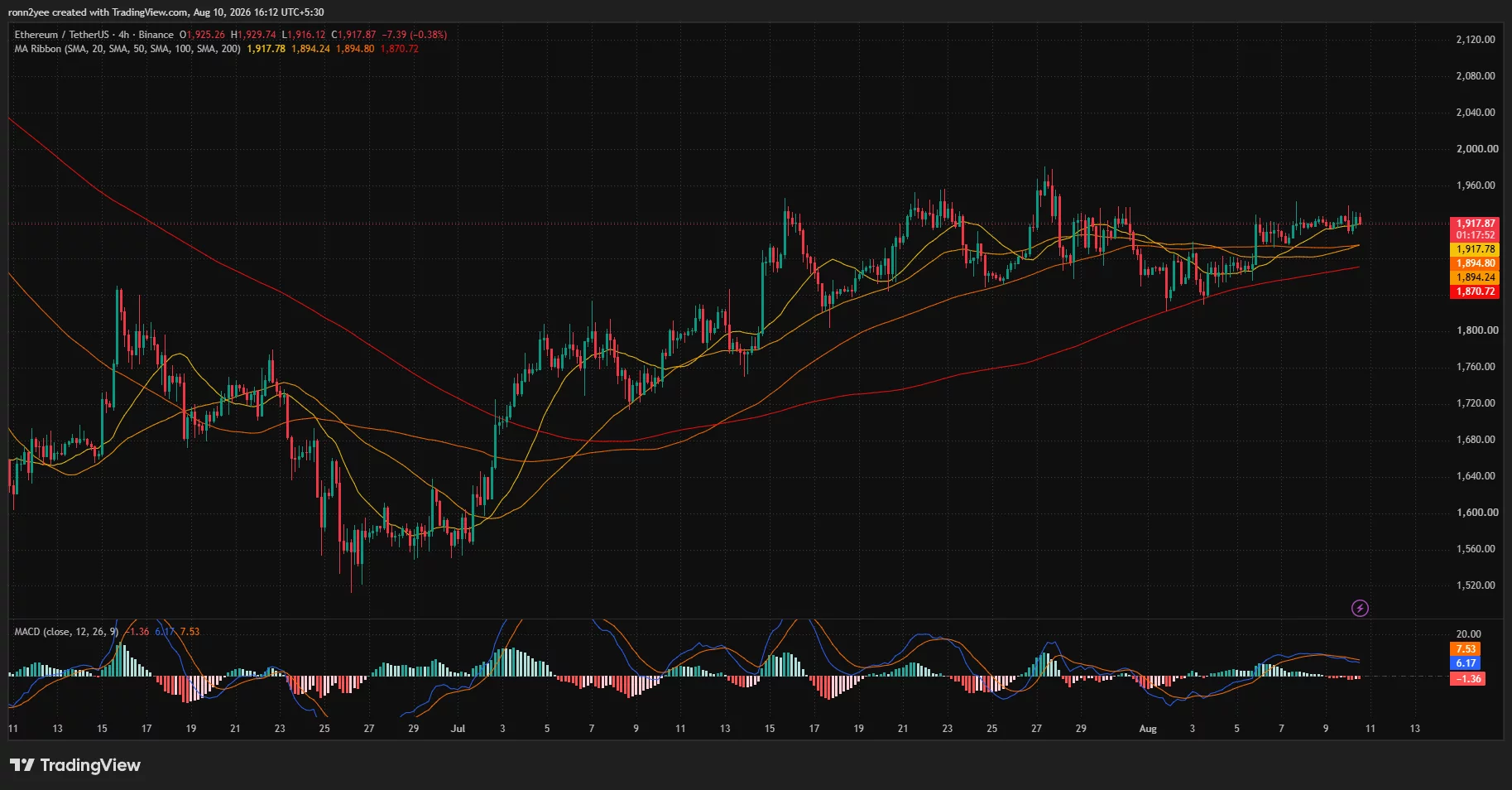
The 200-period average is lower at $1,870.72. ETH remains above all four averages, preserving the broader recovery structure despite the latest consolidation.
The 4-hour moving average convergence divergence indicator has weakened. Its MACD line stands at 6.17, below the signal line at 7.53, while the histogram has turned slightly negative at minus 1.36. That crossover suggests buyers are losing momentum, but it has not yet produced a confirmed trend reversal.
Liquidation clusters frame the next Ethereum move
CoinGlass’ 3-day liquidation heatmap shows ETH trading between two major leverage concentrations.
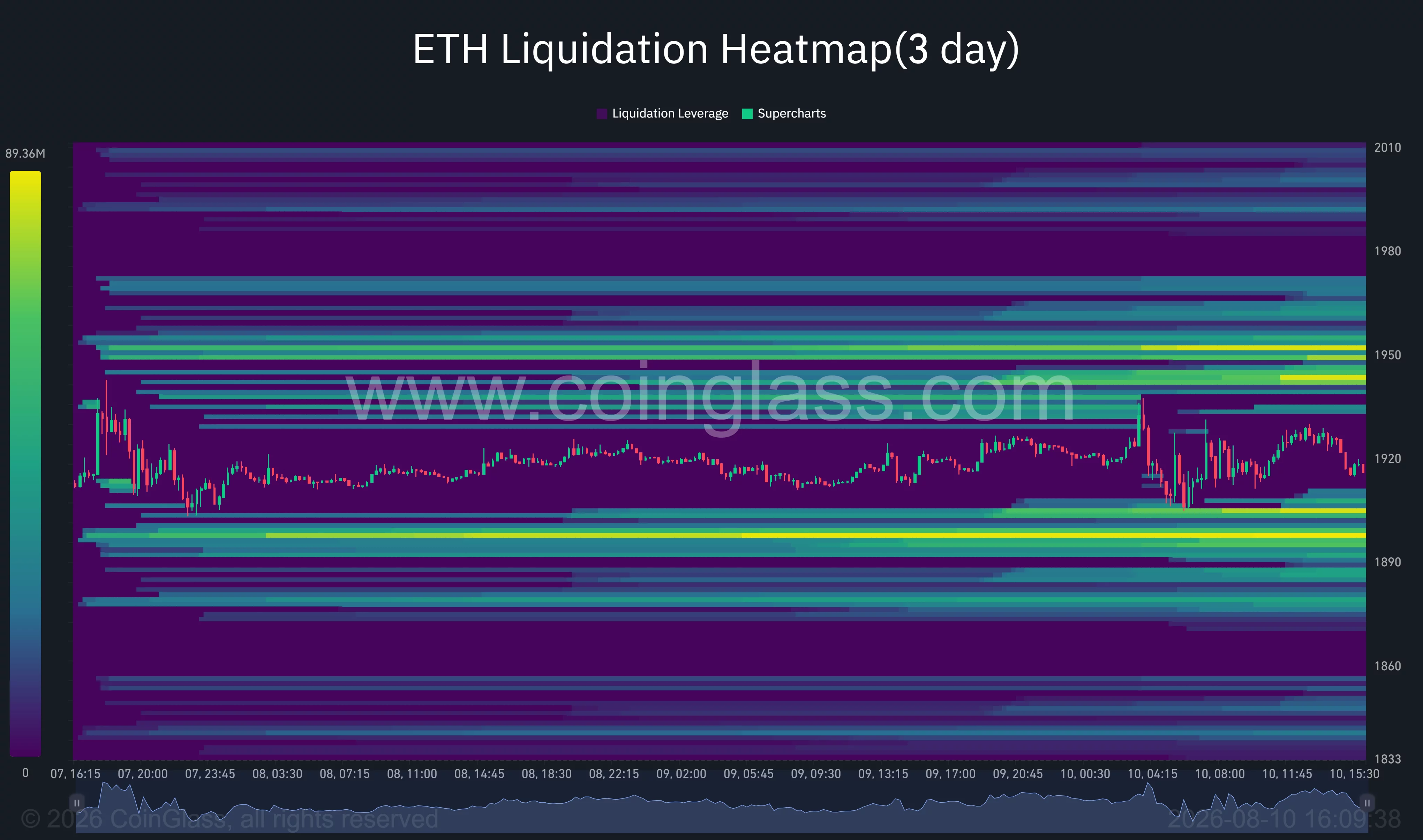
The nearest upside cluster extends from approximately $1,942 to $1,953. Liquidity is particularly dense around $1,950, making that area a possible price magnet if ETH clears its recent intraday highs near $1,930.
A move through $1,953 would also break the daily upper Bollinger Band. Bulls could then target $1,965, a resistance level identified during the previous recovery, followed by $2,000.
Crypto.news previously reported that ETH needed to defend $1,900, clear leverage around $1,925 and break $1,965 to strengthen the case for a move toward $2,000. Price has met the first two conditions temporarily, but the final breakout remains unconfirmed.
On the downside, the strongest nearby liquidation band sits around $1,895–$1,902. That cluster overlaps with the 4-hour 50- and 100-period moving averages and the daily Bollinger midpoint.
A sweep of this area could trigger leveraged long liquidations before buyers attempt another recovery. If $1,890 fails, ETH may retreat toward its 4-hour 200-period average at $1,871. The daily lower Bollinger Band at $1,841 provides the next major support.
Analysts split on the $2,000 breakout
Analyst Ted Pillows said Ethereum was “holding strongly above the $1,900 level” and identified $2,000 as the next upside target. His chart places intermediate resistance near $1,965, followed by $2,030 and $2,100 if momentum accelerates.
The bearish scenario begins if ETH loses the $1,900–$1,850 support region. Pillows’ chart points to deeper downside levels near $1,700 and $1,500 if the recovery structure breaks.
Fellow analyst Gerla offered a more cautious long-term view. Gerla said ETH was testing a descending resistance line for the third time after the previous two encounters produced sharp rejections.
“Rejection first → accumulation → breakout → $10K+,” Gerla wrote.
The projection is a speculative long-term scenario rather than a verified target. The analyst’s chart also identifies the $1,400–$1,600 region as a possible demand zone if ETH suffers another broad correction.
For the immediate outlook, the range is tighter. A confirmed close above $1,953 would favor a test of $1,965 and $2,000. Losing $1,894 would instead expose $1,871 and $1,841, placing the current recovery at risk.
Disclosure: This article does not represent investment advice. The content and materials featured on this page are for educational purposes only.


Revolut has secured a full banking licence in France, creating its second banking entity in the European Union as the fintech prepares to move more than 30 million Western European customers onto a Paris-based operation.
Summary
- Revolut has secured a French banking licence, creating its second full banking entity in the EU.
- The French unit will initially serve France before expanding to Germany, Ireland, Italy, Portugal and Spain.
- The licence allows Revolut to add lending, mortgages and regulated savings products in France.
- Revolut has invested more than €1 billion in France and plans to open its Western Europe headquarters in Paris in 2027.
- The approval follows Revolut’s recent banking and crypto regulatory expansion across the UK, U.S., Australia and UAE.
The European Central Bank’s Governing Council approved the licence following a joint review with France’s Autorité de Contrôle Prudentiel et de Résolution, according to Revolut, allowing Revolut Bank S.A. to operate alongside the company’s existing Lithuanian banking entity.
The French operation will initially serve customers in France before Revolut progressively moves Germany, Ireland, Italy, Portugal and Spain onto the new entity. Lithuania will continue serving customers across the remaining European Economic Area markets.
Revolut founder and CEO Nik Storonsky said the licence gives the company a base from which to serve more than 30 million customers across Western Europe. He described France as an important financial hub for the company’s next stage of banking expansion.
Revolut banking licence opens access to lending in France
Until now, Revolut served its French customers through its Lithuanian banking operation, which allowed the company to provide services across the European Economic Area.
Under the French licence, Revolut can build out locally regulated banking products including loans, mortgages and regulated savings accounts. Products similar to France’s Livret A savings accounts could also become part of its local offering.
The change comes after several years of customer growth in what has become Revolut’s largest Western European market. The company had more than seven million customers in France by early 2026, an increase of about 2.5 million from 2025, and has set a target of reaching 10 million customers by 2027.
Revolut has also committed more than €1 billion to its French operations and hired over 600 employees in the region. A new Western European headquarters is scheduled to open in Paris in 2027 as the company transfers more of its regional operations to the French entity.
Béatrice Cossa-Dumurgier, Revolut’s CEO for Western Europe, said the company will begin with French customers before moving into other Western European markets. Product localisation for retail and business customers will form part of the rollout, she added.
The licence follows a lengthy regulatory process. In October 2025, Cossa-Dumurgier told Euronews that Revolut was not rushing the application because it could already serve customers in France through Lithuania. By April, she said the company expected a decision during 2026.
Frédéric Oudéa, the former Société Générale CEO who now chairs Revolut Western Europe’s board, said the approval followed work on the company’s governance, regulatory and compliance standards and engagement with French and European regulators.
ECB conditions could limit the initial product rollout
While the licence creates room for Revolut to add lending and savings products, regulatory conditions could determine how quickly some services become available.
Bloomberg reported in July that the French banking operation was expected to face restrictions similar to measures previously placed on Revolut’s Lithuanian entity. The report, citing people familiar with the matter, said some of the conditions imposed by the ECB on the Lithuanian business last year were likely to apply to the French unit as well.
Revolut has not disclosed the conditions attached to the French approval.
Any restrictions on new products could affect the timing of services such as mortgages and regulated savings accounts. The company has historically generated a large share of its earnings from payments, fees, wealth products and crypto trading rather than conventional lending.
Its 2025 results showed how that business has developed before the French banking expansion. Revolut reported $6 billion in group revenue, up 46% from $4 billion a year earlier, while profit before tax increased 57% to $2.3 billion.
Net profit reached $1.7 billion, and the company reported a 38% pre-tax profit margin. Revolut ended the year with 68.3 million retail customers after adding 16 million during 2025, while customer balances reached $67.5 billion and transaction volume climbed 65% to $1.7 trillion.
Wealth revenue, which includes investment and crypto-related activity, increased 31% to $876 million during the year.
Banking approvals extend beyond the European Union
The French licence adds to several regulatory approvals Revolut has secured or pursued during 2026.
In March, the company received its full U.K. banking licence after spending about three years working through the regulatory process. The approval expanded Revolut’s ability to provide deposits, credit and lending products in its home market.
Around the same period, Revolut applied to the Office of the Comptroller of the Currency for a U.S. national bank charter after abandoning an earlier plan to acquire an American lender.
Reuters reported in June, citing Revolut U.S. CEO Cetin Duransoy, that the company plans to launch a U.S. bank in 2027 if it receives regulatory approval. The proposed operation would be based in Stamford, Connecticut, with an additional office in New York.
Under the plan described to Reuters, Revolut would offer FDIC-insured checking accounts alongside high-yield investment accounts, multi-currency deposits, stock trading, crypto trading and stablecoin services. Rather than operating physical branches, the company plans to give customers access through existing ATM networks.
Revolut had about one million U.S. customers when Reuters reported on the plans, many of whom had previously used its services while travelling or living outside the country.
The fintech also received a full Australian banking licence in July, extending its regulated banking operations into the Asia-Pacific region.
Crypto licences remain part of Revolut’s regulatory expansion
Alongside its banking licences, Revolut has continued seeking separate regulatory approvals for its digital asset business.
Dubai’s Virtual Assets Regulatory Authority granted the company in-principle approval in July to move toward offering regulated virtual asset services in the United Arab Emirates. Final authorization would allow eligible customers to buy, sell and hold cryptocurrencies through Revolut’s main app and Revolut X, its dedicated crypto trading platform.
The proposed UAE licence covers virtual asset broker-dealer, exchange, management and investment services. Revolut had previously received approval from the Central Bank of the UAE for its payments business.
Within Europe, the company secured a Markets in Crypto-Assets licence in Cyprus in October 2025, providing a regulatory route for crypto services across eligible EU jurisdictions.
Revolut has also changed parts of its digital asset offering as MiCA requirements have taken effect. In July, it said notified customers in eligible European markets would have until Aug. 31 to sell or transfer Tether’s USDT before the stablecoin was removed from their supported accounts.
Tether has not received authorization under MiCA, while CEO Paolo Ardoino has publicly criticized parts of the framework governing stablecoin reserves.
Revolut’s valuation has climbed to $115 billion
The regulatory approvals have come during another increase in Revolut’s private-market valuation.
A secondary share sale reported by The Wall Street Journal in July priced Revolut stock at $2,017 per share, valuing the company at $115 billion. Existing employees and shareholders were able to sell shares through the transaction, meaning the deal did not provide fresh capital to Revolut.
The valuation was about 53% above the $75 billion level established through a 2025 share sale and more than twice its $45 billion valuation in 2024.
Revolut has said it now serves more than 75 million customers worldwide and operates across 40 markets. Storonsky has previously said the company does not plan to pursue an initial public offering before 2028.
The company is also preparing its physical operations for the new European structure. France will become the first market transferred to Revolut Bank S.A., with Germany, Ireland, Italy, Portugal and Spain scheduled to follow, while the Lithuanian entity will continue covering the rest of the EEA under supervision from the ECB and Lithuania’s national authorities.
Disclosure: This content is provided by a third party. Neither crypto.news nor the author of this article endorses any product mentioned on this page. Users should conduct their own research before taking any action related to the company.
It was still dark and quiet at 5:30 am in the morning on Sunday August 2nd , 2026 when CBS New’s truck arrived with John Elliott the award winning meteorologist and his team to broadcast live for three hours the upcoming week’s weather forecast from the National Lighthouse Museum on Staten Island (NLM). The forecast would be somewhat similar to the severe environmental crises NY experienced in mid-2023, featuring hazardous Canadian wildfire smoke turning skies orange, followed closely by catastrophic, record-shattering torrential rain and flash floods in July 2023 that prompted a federal disaster declaration.
Summary
- New York imposed a one year moratorium on permits for new hyperscale data centers while the state studies their impact on the power grid and environment.
- Space based data centers are being explored as an alternative that could use continuous solar power and avoid terrestrial land and water demands.
- PowerBank launched the DeStarlink Genesis 1 satellite in December 2025 as the first step toward Orbit AI’s planned Orbital Cloud network.
- Meta has agreed with Overview Energy to secure up to 1 GW of space based solar power capacity for its AI data centers.
- New York’s SUNNY Act would allow window solar panels for commercial and residential buildings, including terrestrial data centers.
For three hours talented John Elliott hosted a live television feature for CBS News from the NLM, where he interviewed the museum’s Executive Director, Linda Dianto, Chairman of the Board Captain Joseph Ahlstrom, curator Stevie Peters, intern Daniel Wills, Treasurer Eleanor Dugan, Esq and artist of Ocean Lovers – Angel Fish Flag CCL Selva Ozelli, Esq, CPA.
Mr. Elliott skillfully weaved into his weather forecast impacted by Canadian wildfire smoke which caused hazardous flash flood conditions in New York, with the rich maritime history of the site, which originally served as the U.S. Lighthouse Service General Depot from 1864 to 1939—effectively the central hub where all American lighthouses were designed and supplied. Satellite-based systems like GPS largely replaced physical lighthouses as the primary tool for marine navigation, giving rise to NLM’s ongoing mission to preserve the technical and social history of American light stations.
His segment showcased various museum artifacts, including a 1920s French foghorn, a newly donated gas-powered weather signal buoy, Fresnel lights and the museum’s famous “Wall of Lights” which features over 160 miniature lighthouse models.
He spotlighted the Statue of Liberty Art Show currently being hosted at the museum to celebrate the country’s upcoming milestones, highlighting the Statue of Liberty’s history as an operational lighthouse featuring art work by esteemed artists Hunt Slonem and Selva Ozelli and a historic Statue of Liberty photo of when she first arrived in New York.
Mr. Elliott noted structural updates surrounding the NLM property, including a promenade under construction to repair damage originally caused by Hurricane Sandy and ongoing damage by torrential floods some which were helped along by the Canadian wildfire smoke which significantly impacted New York in 2023 and 2026, bringing widespread haze and dangerous air pollution, followed by torrential rain and flash floods to the state.
Moratorium on Hyperscale Data Centers in NY
Intense smoke and hazardous air quality choked New York City and the surrounding Northeast region throughout July 2026 originating from massive, uncontrolled wildfires burning in Canada, in tandem with the apocalyptic wildfires in Europe which began escalating sharply in early July 2026, heavily impacting France, Spain, Portugal, Italy, Scottish Highlands and Greece forcing over 330,000 evacuations. The widespread haze and dangerous air pollution was followed by torrential rain and flash floods to the state as accurately forecasted by Mr. Elliot throughout July and August.
Some good news arrived on July 14th, 2026 when Governor Kathy Hochul signed an executive order New York State Governor Official Website halting state agencies from issuing discretionary permits to new hyperscale data centers (drawing 50 megawatts or more of power) for up to one year to study their environmental and grid impacts.
Hyperscale data centers require massive resource inputs, typically drawing 100 megawatts (MW) or more of electrical power and consuming 1 million to 5 million gallons of water per day for cooling and operations. The United States is the leader in data center hosting, commanding over 40% of the world’s facilities [over 5,000 facilities as of 2026], driven by a head start by US tech giants such as such as Amazon Web Services (AWS), Microsoft Azure, Oracle and Google Cloud, which made high-volume investment in AI.
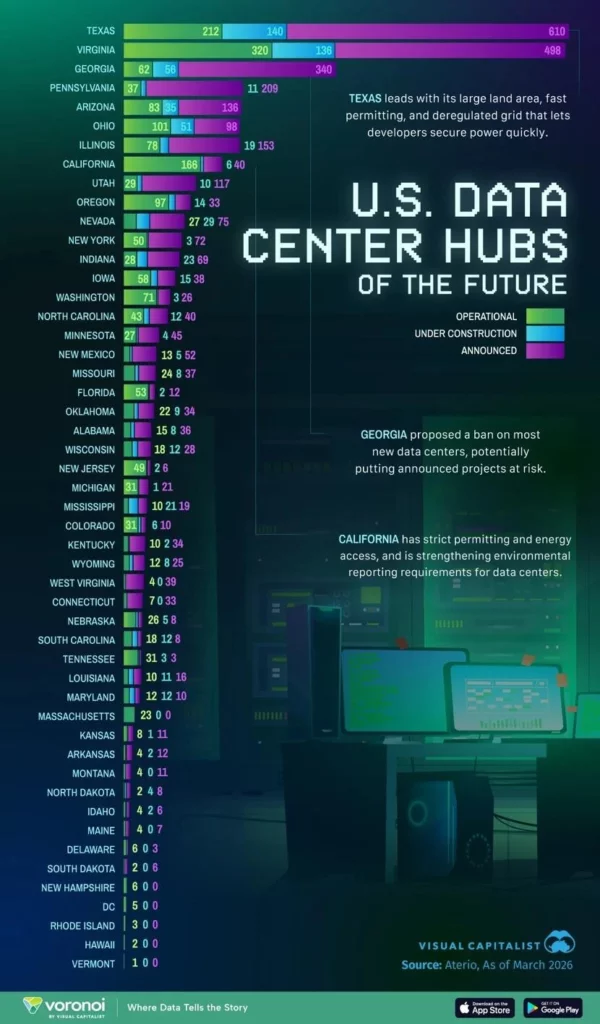
Recent reports and state data show that New York ranks 12th in the U.S. building data center hubs with roughly 50 massive data centers currently operating, 3 under construction and over 72 additional hyperscale projects actively stalled or proposed in NYS’s power queue. The pause targets massive energy and water demands, aiming to protect NY’s power grid.
Ranked: The U.S. States Building the Most Data Centers
Data Center Moratoriums National Conference of State Legislatures
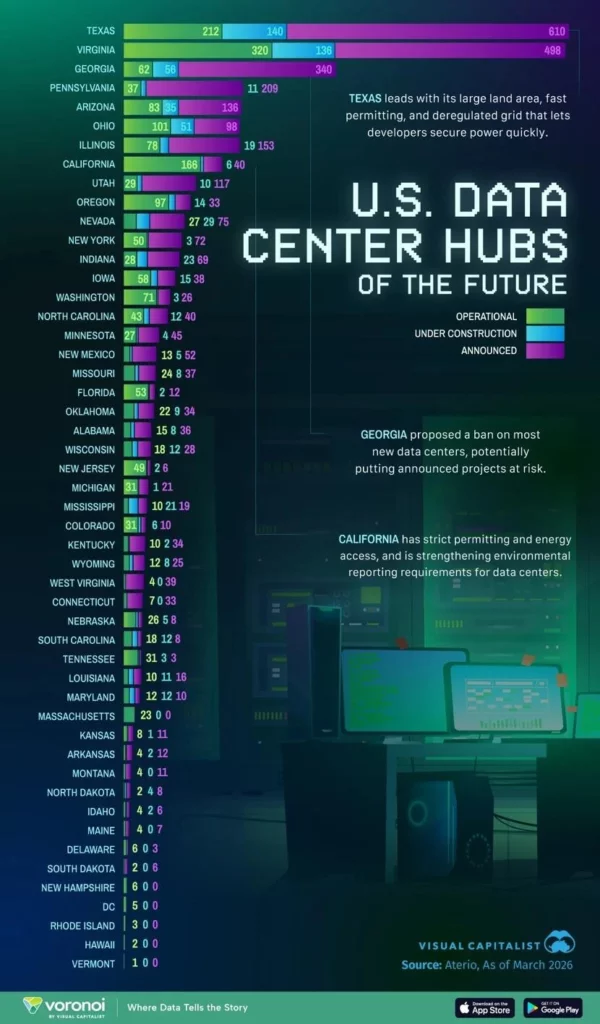
New York is the first and the only U.S. state to enact a full, statewide moratorium on large data center construction as NY is one of three states that enacted a constitutional green amendment to its state constitution to ensure environmental rights environment as a basic civil liberty —like clean air, pure water, and a stable climate. These rights can require government officials like Governor Kathy Hochul to prioritize environmental protections in energy policy, with courts playing an important role in enforcing environmental rights. As they are recognized and protected at a fundamental level, setting a legal foundation for environmental protection, often allowing citizens to sue for environmental harm and hold the government accountable for preserving natural resources. While no other state in the U.S. has implemented a statewide ban, dozens of state legislatures and municipalities across the country have introduced or passed temporary bans and restrictions.
Are Space Solarized Orbital Data Centers (ODC) the Future?
Space solarized orbital data centers (ODC) present a trade-off to terrestrial data centers as they eliminate land and water use by using solar power and space vacuum cooling, but they risk severe upper-atmosphere pollution from space junk, rocket launches and satellite re-entries. Elon Musk the founder and CEO of Space X has positioned ODCs as a key component of SpaceX’s future. Musk explained that energy and water constraints on Earth are becoming the primary limiters for artificial intelligence compute scaling, making space-based data centers a “logical extension, especially with reduction in launch cost and advances in solar efficiency”. By placing data centers in orbit, these facilities aim to harness continuous solar energy and the natural cooling of space to create a more sustainable AI computing infrastructure to convert massive amounts of electrical power into intelligence, measured in tokens. Musk has predicted that within two to three years, the lowest-cost way to generate AI compute will be in space, bypassing terrestrial environmental impacts. Already last year on December 10, 2025 PowerBank Corporation (Canada) launched the inaugural DeStarlink Genesis-1 satellite, marking Orbit AI’s (Singapore) first step toward building its space solarized Orbital Cloud network — an architecture where AI compute, connectivity, and blockchain (Ethereum) – verified processing occur directly in low-Earth satellites.
Terrestrial Solar Power Harvesting (Space-to-Earth Energy)
The surging power demands of AI workloads have put immense strain on the domestic energy grid, forcing US technology companies to seek unconventional energy sources. Meta’s data center footprint consumed over 18,000 gigawatt-hours in 2024 alone.
Instead of putting servers in space, this approach keeps the data centers on the ground but uses satellites in geosynchronous orbit (GEO) capture sunlight without the hindrance of weather, clouds, or nighttime, then transmit this energy to terrestrial receivers located directly at or near data center sites. This GEO positioning yields up to \(5 \times\) the energy of standard ground-based solar farms, bypassing terrestrial power grid constraints, eliminating interconnection bottlenecks, and providing instantaneous, 24/7 clean energy to highly demanding data center hubs.
Amazon Web Services (AWS) indicated that it remains focused on terrestrial data center expansion and has entered a partnership with Orbital Materials to focus on terrestrial data center infrastructure. The collaboration utilizes artificial intelligence to design and test new synthetic materials aimed at making traditional data centers more sustainable through targeted carbon removal and optimized cooling systems.
Meanwhile, with a first-of-its-kind commercial agreement, Space-based solar power (SBSP) in GEO is transitioning from theory as explained by Dr. Paul Jaffe to commercial implementation. Meta announced an agreement with startup Overview Energy to secure up to 1 gigawatt (GW) of space-based solar power capacity for its AI data centers. By beaming continuous energy via near-infrared lasers from geosynchronous orbit, the technology bypasses grid constraints by illuminating terrestrial solar farms at night to provide round-the-clock generation.
As “space solar can be beamed to receivers placed anywhere there is space for them and the receivers can be connected directly to large users, or to a local microgrid or the Grid for further distribution” explained Sanjay Vijendran Co-founder & CTO of TerraSpark.
With the Hyperscale Data Center Moratorium in Place for a Year Will New York Remain the Financial Center of the World?
Supporting AI inference and blockchain tokenization of the financial markets requires massive terrestrial data center power. New York’s statewide moratorium on new hyperscale data centers will temporarily hinder large-scale infrastructure deployment.
However, the SUNNY Act (Solar Up Now New York Act) is currently on Governor Kathy Hochul’s desk awaiting for her signature to legalize window solar panels for commercial and residential buildings including terrestrial data centers. The state legislature passed the bill, and NYC officials are urging her to sign it so that New York can “remain the financial center of the world by embracing change but also demanding that change uplift our people,” Hochul said at a press conference announcing the order.
To celebrate this good news for our future, join us at the NLM’s Gala on August 7, 2026 where Light Meets Liberty! I have been announced as a speaker at the UN Blockchain Conference on September 16, 2026 held in Times Square, NY.
About the Author:
Selva Ozelli Esq, CPA, is an international digital asset legal expert and author of Sustainably Investing in Digital Assets Globally and an award winning artist. Her writings are translated into 45 languages and republished in over 200 global publications. She is recognized as an expert media/TV commentator on global AI, digital asset regulation, tax, and technology matters.
Disclosure: This content is provided by a third party. Neither crypto.news nor the author of this article endorses any product mentioned on this page. Users should conduct their own research before taking any action related to the company.

Legit Social Casinos and the User Experience Standard

Australia suspends Cryptolink’s 96 Bitcoin ATMs for three months

Martha Stewart Debuts ‘Rose Gold’ Hair, Ditches Blonde Color


-

 Fashion3 days ago
Weekend Open Thread: Mattifying Sunscreen
-

 Fashion4 days ago
Frugal Friday’s Workwear Report: Cap-Sleeve Pointelle Crewneck Sweater
-

 Sports5 days ago
Jordan Coyle & Cordiamo take Laya Arena Stakes at RDS
-

 News Videos3 days ago
Can Astrology Help Find Gold and Silver Trends? A Financial Astrology Guide
-
 Business5 days ago
US stocks: Dow closes at record on Mideast optimism; SpaceX, AMD drag Nasdaq
-

 Politics5 days ago
Reform UK And Greens Sink To Lowest Favourability Ratings To Date
-

 Tech6 days ago
OpenAI, Anthropic AI agents targeted real people and systems in cyber tests
-

 Business6 days ago
Nvidia Stock Climbs 2.5% as Chip Sector Rally Builds Ahead of AMD Earnings, Nvidia’s Own Report Looms
-

 Crypto World6 days ago
Polymarket targets $20 billion valuation as competition heats up in prediction market sector
-

 Business5 days ago
Supply chain issues impact Ingredion
-
 Crypto World7 days ago
CLARITY Act Senate Vote Locked In, But 60-Vote Hurdle Looms Large
-

 Tech3 days ago
Rinn Pharma & Biopharma to join NordicPharmaTrain network
-
 Crypto World6 days ago
Dow and S&P 500 Hit Records on AI Earnings: When Will the Bubble Burst?
-

 Business2 days ago
How to Start a Cleaning Business: A Step-by-Step Guide
-

 Business2 days ago
Datadog: Best Of Breed For Multiple Reasons
-

 Business2 days ago
BDC Weekly Review: Private BDC Q2 Numbers Are Strong
-
 Crypto World6 days ago
Dollar Index Trapped at 100 as Hawkish Fed Meets Official Selling
-

 Business6 days ago
McDonald’s (MCD) Q2 2026 earnings
-
Crypto World7 days ago
Trump Administration Plans Ban on New Chinese AI Data Center Components: Report
-

 Fashion6 days ago
The Bright Side of Black and White
You must be logged in to post a comment Login