

Crypto World
Block kicks off Cash App’s phased stablecoin roll out to its nearly 60 million users



Block’s Cash App has quietly begun rolling out its highly anticipated stablecoin payment feature, a source familiar with the matter told CoinDesk Wednesday. According to this individual, the feature is now active for 25% of Cash App’s nearly 60 million users, with plans to scale to 100% by the end of the week.
Block did not immediately respond to a CoinDesk request for comment.
The launch marks an unprecedented ideological shift for Block’s leadership and changes how the platform handles digital fiat currency.
The source familiar with the matter said that integrating alternative blockchain rails indicates Block CEO Jack Dorsey, a historically staunch bitcoin maximalist, has changed his mind and now sees tangible value in these non-BTC networks.
As of this week, the total market value of stablecoins has reached a record $322 billion, surpassing the foreign exchange reserves of 95 countries, including developed economies like the United Kingdom and Canada.
The integration of a stablecoin payment method was first announced on the Cash App website late last year, saying it would be available in 2026.
Dorsey explained his shift in stance in March. The bitcoin purist announced his firm was reluctantly giving into stablecoins. “I don’t like that we’re going to support stablecoins but our customers want to use them,” he said. “I don’t think it’s wise to go from one gatekeeper to another.”
For years, Dorsey framed Block’s crypto strategy around Bitcoin alone, backing mining hardware development and integrating the asset into products such as Cash App.
The newly-released integration treats stablecoins strictly as a payment method rather than investment infrastructure, according to a statement on the Cash App website.
Users can deposit Circle’s USDC stablecoins from external accounts to fund their fiat Cash App balance or withdraw funds as stablecoins to external accounts, utilizing the blockchain entirely as a modern transaction rail.
According to official product documentation, the feature supports USDC across four networks, including Solana, Ethereum, Polygon, and Arbitrum. Because these blockchain transactions are entirely irreversible, any funds sent to incorrect addresses or unsupported networks will be permanently lost.
To use the feature, which is currently unavailable in New York and on sponsored accounts, identity-verified users face strict caps: a $2,000 daily ($5,000 weekly) sending limit and a $10,000 weekly receiving limit.


Quick Summary
- Total net revenue for 2025 reached $4.5B at Robinhood, representing a 52% annual increase
- First quarter 2026 brought $1.07B in revenue (up 15%), while Gold membership reached 4.3 million users
- Wall Street’s consensus 12-month target averages approximately $112, marginally exceeding today’s ~$108 trading level
- Projections for 2031 suggest a baseline target near $148, with optimistic scenarios approaching ~$293
- Probability-weighted analysis indicates a 2031 price around $156, representing potential gains of ~44% from present values
Robinhood (HOOD) stock currently hovers around the $108 mark, prompting investors to question its trajectory over the coming half-decade.
The trading platform delivered $4.5 billion in consolidated net revenue throughout 2025, marking a substantial 52% year-over-year expansion. Profitability metrics showed strength as well, with net income totaling $1.9 billion while adjusted EBITDA surged 76% to reach $2.5 billion.
Momentum carried into the first quarter of 2026. Robinhood generated $1.07 billion in quarterly revenue, reflecting 15% growth compared to the same period a year earlier. Earnings per share on a diluted basis landed at $0.38, representing a 3% improvement. The premium Gold subscription service expanded its user base by 36%, hitting an all-time high of 4.3 million subscribers.
Operational metrics from May painted an even stronger picture. The platform’s funded customer count climbed to 27.7 million, while aggregate platform assets swelled to $377 billion—a 48% year-over-year jump. During Q1 alone, net deposits totaled $17.7 billion.
The company has evolved significantly beyond its original retail equity trading roots. Today, Robinhood encompasses options trading, cryptocurrency transactions, retirement planning tools, banking services, credit card offerings, prediction market participation, and access to private market opportunities.
Exploring Three Distinct Price Scenarios
Three potential pathways illustrate where HOOD shares might trade by 2031.
Under a bearish scenario, annual revenue reaches approximately $6.5 billion, but compressed margins and subdued trading activity constrain profitability. Applying a 22x price-to-earnings ratio yields a potential stock price around $35.
The baseline projection estimates annual revenue of roughly $10 billion by 2031. Assuming net profit margins stabilize around 35% and earnings per share hit $3.90, a 38x valuation multiple suggests a price target near $148.
An optimistic scenario envisions Robinhood successfully constructing a comprehensive financial ecosystem. Should revenue climb to $14 billion with EPS reaching $6.50, a 45x earnings multiple would support a stock price approaching $293.
Balancing these scenarios through probability weighting produces a 2031 target price around $156—translating to approximately 44% appreciation from current levels, or roughly 7.5% compound annual growth.
Wall Street’s Current Perspective
Analyst sentiment toward Robinhood remains constructive, though enthusiasm appears measured.
MarketBeat data reveals HOOD holds 18 Buy recommendations, 5 Hold ratings, and no Sell opinions. The overall consensus stands at Moderate Buy. However, the mean 12-month price objective sits around $112—only marginally higher than current trading levels.
This modest near-term target despite positive ratings suggests analysts recognize the long-term opportunity while acknowledging limited immediate upside following the stock’s recent appreciation.
Several headwinds warrant consideration. Current valuation multiples appear elevated. Transaction-based revenue streams face cyclical pressures. Cryptocurrency markets exhibit high volatility. The regulatory environment remains uncertain. Established financial institutions pose formidable competitive challenges.
Conversely, Robinhood possesses meaningful competitive strengths—including a substantial, demographically young customer base, expanding subscription-driven revenue from Gold memberships, growing assets under administration, and continuous product portfolio diversification.
Realistic modeling places the 2031 price range between $150 and $160. Achieving the $293 bull case target would require Robinhood to successfully transform into a comprehensive financial super app serving next-generation consumers.



Blockstream CEO Adam Back said concerns over Strategy’s small Bitcoin sale are overblown, framing the move as normal treasury management rather than a warning sign for the company’s Bitcoin plan.
Summary
- Adam Back said Strategy’s small Bitcoin sale showed balance sheet flexibility, not bearish treasury change.
- Strategy sold 32 BTC for about $2.5 million to fund preferred stock dividend payments due.
- Crypto.news later reported Strategy bought 1,550 BTC, keeping its accumulation story active for now again.
Speaking in a Bloomberg interview shared on YouTube, Back addressed questions about Strategy selling 32 BTC to help pay preferred stock dividends. He said the sale showed the firm could meet obligations while keeping Bitcoin at the center of its balance sheet.
Back frames sale as balance sheet use
Back argued that the market should not treat the 32 BTC sale as a bearish signal. In his view, Strategy used a small part of its Bitcoin position to support investor payments and reduce pressure on the capital structure.
He also said the move showed how Bitcoin can function inside a corporate treasury. Rather than showing weak conviction, it showed that a company can hold Bitcoin, raise capital against it and use a limited amount when cash needs arise.
Back’s argument also places the sale inside a larger shift in corporate Bitcoin finance, where companies use BTC alongside preferred shares, debt, common equity, and market tools today.
Strategy’s first sale drew attention
As previously reported by crypto.news, Strategy disclosed on June 1 that it sold 32 Bitcoin between May 26 and May 31 at an average price of $77,135. The sale raised about $2.5 million.
The filing said proceeds were expected to fund distributions on the company’s preferred stock. The sale represented about 0.0038% of Strategy’s Bitcoin holdings at the time, but it drew attention because Michael Saylor had long promoted a “never sell” message around Bitcoin.
Crypto.news later reported that Saylor separated personal investor advice from corporate treasury actions. “I said to YOU never sell your bitcoin,” Saylor said at BTC Prague.
Preferred dividends remain in focus
The debate centers on Strategy’s preferred stock model. Preferred shares can give investors yield, but they also create recurring cash needs that the company must meet through cash reserves, equity issuance or limited Bitcoin sales.
Strategy’s STRC preferred stock has faced pressure after falling below its $100 par value. As crypto.news reported, Saylor defended the company’s Bitcoin-backed strategy and said its Bitcoin and cash reserves still exceeded outstanding debt by about $48 billion.
Some critics argue that dividend obligations could become harder to manage if market conditions weaken. Supporters say the 32 BTC sale showed Strategy has several funding tools and does not need to abandon its long-term accumulation plan.
Strategy remains a net accumulator
The sale did not stop Strategy from buying more Bitcoin. Crypto.news reported that the company later bought 1,550 BTC for $101.3 million, lifting its holdings to 845,256 BTC after the sale disclosure.
That purchase was nearly 50 times larger than the 32 BTC sale. It helped support Back’s view that the transaction was not a broad retreat from Bitcoin.
Saylor has also argued that Bitcoin does not need staking or protocol-based yield. In a separate post covered by crypto.news, he framed Bitcoin as the base layer for credit, money, yield and equity products.
For now, the issue is not whether Strategy still wants Bitcoin. The question is how it funds preferred dividends while keeping investor trust and managing balance sheet risk.

TLDR
- STRC, Strategy’s preferred stock instrument, plunged to an all-time intraday low of $83 on June 18, trading approximately 17% beneath its $100 par value — marking the worst performance since launching in July 2025.
- The company’s $1.5 billion convertible bond repurchase depleted Strategy’s cash reserves, slashing projected dividend coverage from an intended 24-month buffer down to approximately 6 months.
- With bitcoin declining from highs above $80,000 in May to approximately $62,500, Strategy’s BTC portfolio now carries an unrealized deficit of roughly $11.14 billion.
- CEO Michael Saylor maintained the company’s financial strength, noting that combined BTC and USD reserves surpass total debt obligations by approximately $48 billion.
- While skeptics like Peter Schiff have questioned the legality of Strategy’s approach, advocates contend STRC’s framework remains viable provided Bitcoin experiences long-term appreciation.
On June 18, Strategy’s STRC preferred shares collapsed to an unprecedented intraday bottom of $83, ultimately settling at $88.59 — approximately 17% under the $100 par value benchmark. Since its July 2025 introduction, the instrument was engineered to maintain trading levels at or close to par while delivering an 11.5% annualized return.
This sharp decline wasn’t an abrupt event. Rather, it emerged from a sequence of corporate actions and bitcoin’s persistent price deterioration spanning several weeks.
Heading into its monthly ex-dividend date on May 14, STRC maintained its $100 level while bitcoin commanded prices exceeding $80,000. Superficially, the situation appeared stable. However, BTC had already retreated significantly from its October 2024 peak of $126,000.
That identical day, competitor Strive Asset Management unveiled SATA, its own preferred instrument featuring daily distributions at a 13% yield — immediately creating competitive pressure for Strategy.
Convertible Note Repurchase Drains Cash Cushion
The following day, May 15, Strategy disclosed plans to repurchase $1.5 billion worth of its 2029 convertible bonds at an 8% discount. The company financed a portion of this transaction by tapping into cash reserves initially designated for dividend distributions and debt service obligations.
This crucial information wasn’t immediately transparent. When details surfaced on May 26, the reserve balance had contracted to $871 million — dramatically reducing STRC dividend coverage from the advertised 24-month projection to merely 6 months.
STRC slipped to $99.33 that session. Bitcoin was changing hands around $77,000.
Despite this, Strategy persisted with bitcoin accumulation. On May 18, the firm acquired 24,869 BTC while prices descended toward $76,000.
June 1 delivered another unexpected development. Strategy disposed of 32 BTC — representing its first bitcoin divestment since 2022. Though minuscule at just 0.0038% of total holdings, the transaction alarmed market participants. MSTR shares declined 5.9% that day. Bitcoin tumbled to lows near $70,500. STRC settled at $98.07.
Accelerating Bitcoin Weakness Compounds Challenges
By June 5, bitcoin had penetrated below $60,000 for the first time since October 2024. STRC touched lows of $90 before recovering to close at $93.40.
Strategy shareholders authorized a transition to semi-monthly STRC dividend distributions on June 8, an adjustment intended to minimize volatility surrounding ex-dividend periods. The company simultaneously disclosed its dollar reserve had rebounded to $1 billion following the purchase of 1,550 BTC.
On June 15, Strategy added another 1,587 BTC to its portfolio. Reserve balances reached $1.1 billion.
Then June 18 arrived. STRC plummeted to $83 during trading hours before finishing at $88.59 as bitcoin declined 2.4% to $62,880. Strive CEO Matt Coles, whose SATA instrument also suffered losses, attributed the downturn to forced liquidations from leveraged positions rather than fundamental credit deterioration.
Strategy currently maintains 846,842 BTC, accumulated at an average acquisition cost of $75,656 per unit. With bitcoin hovering around $62,500, the corporation faces an unrealized portfolio loss approaching $11.14 billion.
MSTR common equity trades near $112, representing roughly an 80% decline from its November 2024 record high.
Michael Saylor countered critics this week, declaring via X that combined BTC and USD reserves now surpass the company’s total debt burden by approximately $48 billion. He drew comparisons to 2022, when debt temporarily exceeded reserves by $300 million while BTC traded near $20,000.
Peter Schiff has advocated for shareholder litigation and suggested Saylor potentially breached SEC promotional regulations while marketing STRC. Conversely, Bitcoin proponent Samson Mow characterized STRC as a “brilliant instrument,” maintaining there are no inherent structural deficiencies unless one assumes bitcoin won’t appreciate over extended timeframes.

Key Takeaways
- Q1 2026 marked Coinbase’s second consecutive quarterly loss, posting $1.43 billion in revenue against a $394 million net deficit.
- Strategic diversification includes stablecoins, derivatives trading, payment solutions, and prediction market platforms.
- The newly launched prediction markets division achieved more than $100 million in annualized revenue within months.
- Deribit acquisition strengthens Coinbase’s competitive stance in cryptocurrency derivatives trading.
- Wall Street consensus targets approximately $250 for 12 months, with 2031 base-case projections between $300–$400.
Since going public through a direct listing in 2021, Coinbase (COIN) stock has experienced significant volatility — climbing to impressive peaks before retreating sharply. While near-term movements capture headlines, the more compelling analysis focuses on where this cryptocurrency platform could stand by 2031.
Current analyst consensus places COIN at approximately $250, derived from 33 Wall Street analysts monitored by MarketBeat. The overall rating stands at Hold, comprising 18 Buy recommendations, 12 Hold positions, and 3 Sell ratings.
Recent performance has been challenging. The stock has retreated from previous highs, and first-quarter 2026 earnings reflected this pressure. The company reported roughly $1.43 billion in revenue while recording a $394 million net loss — marking back-to-back quarters in the red. Declining cryptocurrency trading volumes directly impacted transaction-based income.
This represents the immediate reality. The extended-term narrative, however, tells a different story.
Coinbase has systematically constructed a diversified portfolio of services extending beyond its primary exchange operations. The company now operates across stablecoins, derivatives markets, institutional infrastructure, payment processing, and Base — its proprietary Ethereum Layer 2 blockchain solution.
The Deribit purchase represents a strategic milestone. As among the world’s leading platforms for cryptocurrency options and futures, Deribit’s integration significantly enhances Coinbase’s capabilities in derivatives — a rapidly expanding market segment.
Rapid Growth in Prediction Markets
One recent initiative has generated particular interest: Coinbase’s entrance into prediction markets. Company leadership revealed the segment surpassed $100 million in annualized revenue shortly after deployment. This rapid scaling demonstrates the viability of new product categories.
This development illustrates Coinbase‘s capacity to execute swiftly when identifying market opportunities, with several initiatives already delivering meaningful returns.
Constructing a 2031 Valuation Framework
Valuing Coinbase through current earnings metrics presents challenges — cryptocurrency markets operate cyclically, and the company remains in transformation mode. A more practical approach examines potential revenue generation five years forward.
In a base-case projection — assuming continued institutional cryptocurrency adoption, expanding stablecoin utilization, and growing derivatives activity — Coinbase could achieve approximately $12 billion in annual revenue by 2031. Applying roughly $9 in earnings per share with a 32x earnings multiple suggests a stock price approaching $300.
This represents the moderate scenario. A pessimistic outlook, where adoption stagnates and fee compression intensifies, could drive shares toward $20–$50. Conversely, an optimistic scenario featuring mainstream digital asset integration and Base establishing itself as a major blockchain network could propel valuations beyond $800.
Rosenblatt recently confirmed its Buy rating with a $240 target. Multiple analysts continue positioning COIN as a long-term investment thesis on cryptocurrency adoption.
Probability-weighted modeling currently suggests a base estimate near $370 by 2031, according to current analytical frameworks.


SEC Commissioner Hester Peirce, widely known in the digital asset industry as “Crypto Mom,” said she will leave the agency in November and join Regent University School of Law as an associate professor.
Summary
- Peirce said she will leave the SEC in November and join Regent Law as professor.
- Her exit comes as the SEC weighs crypto rules, tokenization and a narrow innovation exemption.
- The SEC will have only Paul Atkins and Mark Uyeda as active commissioners after departure.
Peirce confirmed the plan during an appearance on The Rollup podcast, saying she will be “moving to the beach” after nearly three decades in Washington, D.C. As previously reported by crypto.news, Regent announced in May that she will teach securities regulation, financial markets, digital assets and public policy.
Peirce confirms move to Regent Law
Peirce has served as an SEC commissioner since January 2018. The Senate confirmed her for a second term in 2020, and that term expired on June 5, 2025.
SEC rules allow commissioners to remain for up to 18 months after a term expires if no successor has been confirmed, according to the SEC commissioners page. Peirce could have stayed until December 2026, but her November move means she will leave slightly earlier.
On the podcast, Peirce said she looks forward to working with students. “I’m going to be teaching law school. So, I’m excited about working with the next generation,” she said.
Crypto task force faces transition
Peirce has led the SEC’s Crypto Task Force since January 2025. The task force seeks to draw clearer lines around digital assets, token status, disclosure rules, registration paths and enforcement priorities. It also gives market participants a channel to send written input and request meetings during the current rule review.
Her departure will leave the commission with Chairman Paul Atkins and Commissioner Mark Uyeda as the two active sitting members, unless new nominees are confirmed before then. The SEC is designed to have five commissioners, with no more than three from the same political party.
Peirce’s final priorities include helping shape a crypto framework, changing rules so more companies can go public earlier and removing the trade-through rule. These items remain part of a wider market-structure debate at the agency.
Innovation exemption remains pending
The SEC’s possible “innovation exemption” for digital assets has drawn strong attention from crypto firms and tokenization platforms. Peirce used the podcast appearance to lower expectations around what the proposal may include.
“First, the innovation exemption has not yet been released. So that’s one myth that should be dispelled,” Peirce said. She also said synthetic securities were not part of what officials had in mind.
Her comments followed reports that the SEC could give firms limited room to test blockchain-based products while broader rules remain under review. Peirce said the exemption should not be treated as a blanket approval for every tokenized product.
Exit comes during crypto policy reset
Peirce gained the “Crypto Mom” nickname after years of criticizing enforcement-led crypto oversight and calling for clearer rules. Her public dissents made her one of the industry’s most followed SEC officials.
The agency has shifted under Atkins toward new crypto policy work, including tokenization, custody and market access. The question now is whether that work continues at the same pace after Peirce leaves.
For crypto firms, the timing matters because several rulemaking paths remain open. Peirce’s exit does not stop the SEC’s crypto agenda, but it removes one of its most visible advocates inside the commission.


A Japanese corporate pension fund serving about 1,200 small and medium-sized businesses plans to allocate roughly 1% of its assets to cryptocurrency during fiscal 2026.
According to Nikkei, the Nationwide Business Corporate Pension Fund, based in Okayama, will invest in a passive fund managed by a major hedge fund that holds multiple crypto assets. The pension fund reportedly manages about 21.3 billion yen in assets, or about $130 million.
Japanese crypto news site CoinPost reported that the fund is adding crypto as part of an effort to diversify its exposure. The fund reportedly allocates 80% of its assets to yen, 15% to US dollars and 5% to other currencies.
The move suggests crypto is beginning to gain acceptance among Japan’s more conservative institutional investors as the country prepares to integrate digital assets more closely with traditional finance.
Japan brings crypto closer to traditional finance
The planned pension allocation comes as Japanese lawmakers and financial institutions prepare for digital assets to play a larger role in the country’s traditional financial system.
On June 11, Japan’s House of Representatives passed legislation that would bring crypto assets under the Financial Instruments and Exchange Act, subjecting them to rules more closely aligned with those governing conventional financial products.
The legislation is expected to proceed to the House of Councilors and could create a path for crypto exchange-traded funds and a shift to a 20% flat tax on digital-asset gains.
Related: Polymarket seeks Japan entry despite gambling law hurdles: Report
Japanese financial groups are also developing new ways for retail and institutional investors to access crypto. SBI Shinsei Bank has begun testing a deposit-linked rewards program offering vouchers redeemable for Bitcoin, Ether or XRP, ahead of a planned permanent launch this autumn.
On June 12, Metaplanet, Japan’s largest publicly listed Bitcoin holder, also agreed to acquire Siiibo Securities for 2.1 billion yen. The company said the acquisition would support the development and distribution of Bitcoin-linked yield products through a newly formed securities arm.
Magazine: China’s 107 Bitcoin memory thief, Bithumb CEO booked: Asia Express
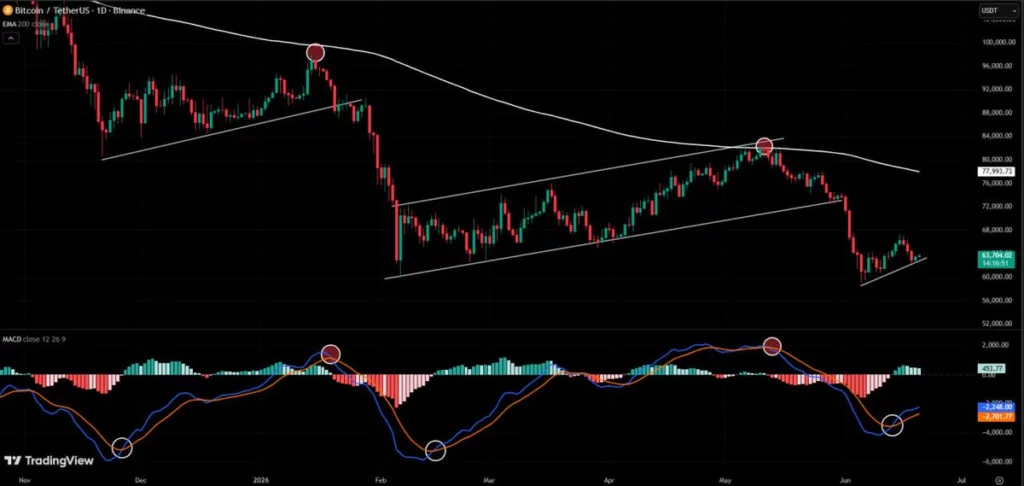
Bitcoin traded near $64,000 on Sunday after recovering part of Friday’s sell-off, but the rebound has not yet changed the wider range.
Summary
- Bitcoin traded near $64,008, up 0.87% daily, while staying almost flat on the week overall.
- Galaxy Research said Bitcoin ETFs posted a record $6.35B outflow across the latest 30-day window.
- Analysts are watching $62K support and $67K resistance as macro risks steer near-term Bitcoin direction.
According to crypto.news market data, Bitcoin traded around $64,008, up 0.87% over 24 hours.
The page showed a 24-hour range between $63,188 and $64,462, with daily volume above $16.6 billion. Bitcoin’s seven-day move stayed slightly negative, showing that the weekend bounce only repaired part of the damage.
The move kept traders focused on the $62,000 support area. A clear break below that zone could weaken short-term sentiment, while a move above $67,000 would give bulls a stronger relief setup.
Bitcoin holds range after Friday’s drop
Bitcoin fell below $63,000 on Friday as risk appetite weakened across crypto markets. It later bounced from the weekly 200-period moving average area and the 0.618 Fibonacci retracement, according to crypto trader Daan Crypto Trades.
Daan said the $62,000 area remains the level bulls “must hold” into the weekly close. In his view, a move below that level would look bearish in the short term, while a break above the local high near $67,000 could open a move toward $73,000.
Ether, Solana and Tron also firmed over the weekend, while HYPE remained one of the stronger weekly performers despite a daily pullback. Dogecoin stayed weaker than most large tokens on a seven-day basis.
The broader market move looked more like stabilization than a strong trend change. Bitcoin still needs a higher close above nearby resistance to show that buyers control the next leg.
Hormuz threat keeps macro risk alive
Bitcoin’s weekend move came as traders watched planned U.S.-Iran ceasefire talks in Switzerland. The talks follow last week’s memorandum of understanding, which gave both sides a 60-day window to work toward a longer deal.
The market backdrop remains unsettled because Iran again ordered the closure of the Strait of Hormuz. The waterway is one of the world’s key oil routes. A real closure could lift oil prices and pressure risk assets, including Bitcoin.
crypto.news previously reported that lower oil from a reopened Hormuz can ease inflation pressure and help liquidity expectations. The reverse also matters. Higher oil could revive inflation worries and keep the Federal Reserve cautious, which would limit support for crypto.
That keeps Bitcoin tied to events outside crypto markets. A durable ceasefire would reduce one source of risk, while a renewed oil shock could bring back defensive trading across digital assets.
Bitcoin ETF outflows weigh on demand
ETF flows remain another key issue for Bitcoin price analysis. Galaxy Research said U.S. spot Bitcoin ETFs recorded $6.35 billion in net outflows over the latest 30-day window, the largest such outflow in its tracked data.
The same data showed six straight weeks of outflows. Cumulative net flows reportedly fell to $53.4 billion from a $63 billion peak in October 2025. That suggests institutional demand has cooled while price tries to hold support.
ETF outflows do not always force an immediate price break. Still, they remove a source of steady demand that helped Bitcoin during earlier parts of the cycle. When fund flows weaken at the same time as macro risk rises, buyers often wait for clearer levels before adding exposure.
The pressure also matters because Bitcoin has traded below several earlier cycle reference levels. If funds keep losing capital, spot buyers may need to absorb more supply before price can reclaim the $67,000 area.
Analysts split on momentum signals
Some technical traders see early signs of relief. Crypto analyst BATMAN said Bitcoin printed a daily MACD momentum flip from deeply negative territory. He argued that similar signals in this cycle appeared near local bottoms before relief rallies.
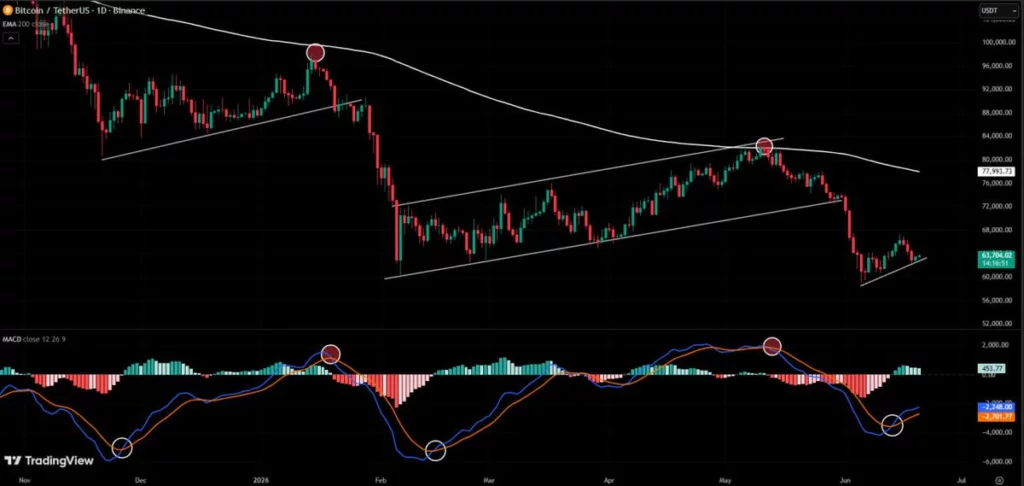
Rekt Capital gave a more cautious historical view. He said that if June ends red, July has often moved in the opposite direction. He also noted that a weak June close could confirm a loss of the 50-month EMA as support, turning any July bounce into a retest rather than a confirmed recovery.
For now, Bitcoin remains caught between support near $62,000 and resistance near $67,000. A close below $62,000 would put the $60,000 to $59,000 zone back in focus. A move above $67,000 could shift attention toward $73,000, especially if oil risk eases and ETF outflows slow.
The near-term setup therefore stays balanced. Bitcoin has stabilized, but traders still need stronger volume, better fund flows and calmer geopolitical news before calling the rebound durable over the near term.
Disclosure: This article does not represent investment advice. The content and materials featured on this page are for educational purposes only.


An attacker drained roughly $7.5 million from the JaredFromSubway MEV bot, one of Ethereum’s most active sandwich-attack systems, after tricking it into approving token spending it never should have granted.
Security firm Blockaid, which flagged the incident, said the bot was not hit by a smart-contract bug, a phishing attack, or a private-key leak. Instead, the attacker turned the bot’s own profit-seeking logic against it.
How the MEV Bot was Tricked
The JaredFromSubway MEV bot runs an automated strategy that scans Ethereum’s mempool for profitable trades. The practice is known as maximal extractable value.
The bot front-runs and back-runs other trades to capture the price difference, a tactic called a sandwich attack.
It became infamous in April 2023. In one day, it burned over $1 million in gas, nearly 8% of all Ethereum gas spending.
The attacker spent weeks deploying 66 counterfeit token contracts. The fakes imitated Wrapped Ether (WETH), USD Coin (USDC), and Tether (USDT).
To the bot, these contracts looked like the routes it was built to chase. It took the bait and approved spending to attacker-controlled helper contracts. One approval alone handed over more than 92 WETH.
A final contract then used those open allowances to sweep real funds from the bot.
A Reverse-MEV Trap
The trap turned the bot’s speed and aggression into a weakness. Hunting MEV bots is not new. In 2023, a rogue validator drained about $25 million from MEV sandwich bots.
“attacker-controlled contracts tricking an automated MEV execution system into granting token approvals, later used to drain funds,” Blockaid indicated.
Sandwich attacks like these have long drawn criticism for acting as an invisible tax on everyday traders.
The bot’s operator put the loss closer to $15 million. They also offered a $1 million bounty for the return of the funds. Blockaid and PeckShield valued the on-chain drain at about $7.5 million in WETH, USDC, and USDT.
The operator recovering anything may now depend on the attacker accepting that offer.
The post Ethereum’s Most Notorious MEV Bot Loses $7.5 Million in On-Chain Honeypot Trap appeared first on BeInCrypto.


On-chain tracker Lookonchain said three wallets made $24.25 million in profits from World Cup betting on Polymarket, raising fresh questions about large traders in crypto prediction markets.
Summary
- Lookonchain linked three winning wallets to one Binance deposit address after posting $24.25M in profits.
- The wallets allegedly won several World Cup bets, then stopped trading and withdrew remaining funds.
- The case adds fresh pressure on prediction markets already facing scrutiny over insider-style information advantages.
The tracker described the activity as tied to a “suspected insider,” but the claim remains based on wallet links and public trading data. Polymarket and Binance had not publicly confirmed the finding at the time of review.
Lookonchain points to three winning Polymarket wallets
According to Lookonchain, the wallets named mintblade, GRIMDRIP and endlessFate together made more than $24 million from World Cup markets. Mintblade reportedly made $9.24 million after winning five out of five bets.
GRIMDRIP allegedly made $7.6 million after winning two out of two bets, while endlessFate made $7.41 million after winning six out of nine bets. Lookonchain said all three wallets later sent funds to Binance through the same deposit address, 0xB08B…317D.
The tracker said the common deposit path suggested the same person may control the wallets. It also said the wallets stopped trading and withdrew all remaining funds after the profits.
Large World Cup wagers drew attention
Lookonchain had already flagged several large World Cup wagers before the latest post. On June 17, it said one trader made $9.24 million in one day after winning four bets, including a large position on Iran not beating New Zealand.
The account also tracked endlessFate placing $7.46 million on Colombia to beat Uzbekistan. If the position won, the bettor stood to make $2.71 million, while a loss would erase the full stake.
Other posts showed more large positions across World Cup markets. A wallet called weatherman12 put $1.81 million on Argentina not winning and Algeria covering a spread. Another wallet, LEEEROYJENKINS, reportedly made $5.2 million from Türkiye not winning against Australia and from an Australia spread bet.
Prediction markets face scrutiny
The case comes as prediction markets draw more attention from regulators, sports fans and crypto traders. As previously reported by crypto.news, Congress has moved to ban lawmakers from trading on prediction markets such as Polymarket and Kalshi, citing insider-trading risks.
crypto.news also reported in February that unusual Polymarket betting tied to a ZachXBT insider-trading probe raised questions about whether some traders had access to better information. That report noted that policing non-public information remains difficult when outside users trade through pseudonymous wallets.
Polymarket relies on public markets where users trade outcome contracts tied to real-world events. Supporters say these markets can reflect fast-moving public expectations, while critics argue they can reward private information when outcomes depend on facts known to only a few people.
World Cup betting expands across crypto
The World Cup has become a major test for sports prediction markets in 2026. crypto.news earlier reported that Myriad launched a $100,000 World Cup contest with more than 75 match markets, while Polymarket and Kalshi were already listing live World Cup markets.
LBank also promoted a World Cup prediction event tied to Spain and Saudi Arabia, showing that exchanges and trading platforms are using football to attract users. These campaigns bring more attention to sports markets, but they also put trade monitoring and fair access under closer review.
For now, Lookonchain’s findings do not prove misconduct. They do show how wallet tracking can reveal trading patterns, shared cash-out routes and unusually strong win rates in public crypto markets.

Key Takeaways
- The MEV bot Jaredfromsubway.eth suffered a loss exceeding $7.5 million over the weekend
- A malicious actor created 66 fraudulent token contracts across multiple weeks to deceive the automated system
- The bot was exploited into granting permissions to attacker-controlled contracts for fund transfers
- Blockchain security company Blockaid described the incident as a “counter-MEV honeypot attack”
- Portions of the pilfered assets have been transferred to Tornado Cash
A prominent crypto automation tool has fallen prey to its own methodology. The MEV bot operating under the address Jaredfromsubway.eth, which generated substantial profits by front-running other market participants, lost over $7.5 million this past Saturday.
Blockchain security company Blockaid verified the exploit.
The Mechanics Behind the Exploit
The perpetrator executed a patient, methodical approach spanning multiple weeks. They created 66 counterfeit token contracts mimicking legitimate assets including Wrapped ETH, USDC, and USDT. These fraudulent tokens were matched with deceptive liquidity pools engineered to appear as lucrative trading opportunities.
The automated system performed precisely as programmed. It identified what appeared to be a profitable arbitrage scenario and granted specific contracts authorization to access its treasury.
This authorization was the vulnerability the attacker exploited. Within a single blockchain transaction, all 66 malicious backdoors activated simultaneously, draining the bot’s entire holdings across ETH, USDC, and USDT.
“The irony is that through its own operational processes, it handed the attacker access to millions sitting in the bot’s wallet,” explained Blockaid’s Chief Technology Officer Raz Niv.
Blockaid emphasized this wasn’t a conventional security breach. “This differs from typical phishing schemes and traditional smart-contract exploits,” the company stated. The attack specifically targeted the automated reasoning mechanisms fundamental to MEV bot operations.
Understanding Jaredfromsubway.eth
MEV (Maximal Extractable Value) bots scan pending blockchain transactions and reorder their execution sequence for financial gain. This practice is often described as an “invisible fee” imposed on everyday users.
Sandwich attacks represent a widespread tactic. These bots detect incoming trades, insert their own transactions immediately before and after the target trade, and capture profits from the resulting price fluctuations.
From November 2024 through October 2025, Jaredfromsubway.eth executed approximately 70% of all sandwich attacks on the Ethereum network. Research from Cointelegraph indicates these attacks drain roughly $60 million annually from traders, with monthly attack volumes ranging from 60,000 to 90,000 during peak periods.
Last May, Ethereum creator Vitalik Buterin became a target of this identical bot during a modest DigitalBits token swap. While his monetary loss was negligible, the incident demonstrated that no transaction value is beneath targeting.
Onchain tracking reveals that portions of the stolen cryptocurrency have been routed through Tornado Cash, a privacy-focused mixing protocol.
Community sentiment regarding the incident has been divided. Crypto investor David Gokhshtein commented: “This isn’t something to celebrate; nobody should be cheering… but if this bot has ever sandwiched your trades… I suspect you’re not mourning this development.”
This exploit represents among the most substantial individual losses documented for any MEV bot to date.

How Will Tokenization Affect XRP?

Man United transfer news LIVE: Mateus Fernandes twist, new Ederson update, Sandro Tonali stance

More Retirees Are Choosing Continuing Care Communities. How to Pick One.


-

 Business7 days ago
No Jackpot Winner as $257 Million Prize Rolls Over to $269 Million Monday Draw
-

 Fashion2 days ago
Weekend Open Thread: Miami – Corporette.com
-
Crypto World6 days ago
Zimbabwe Requires Crypto Businesses to Register Annually Under New FIU Regulations
-
 Business1 day ago
Wall Street Week Ahead: Investors see Micron earnings as pulse check of AI rally momentum
-
 Entertainment7 days ago
Matt Damon’s Viral Sci-Fi Thriller Has Taken Over HBO Max
-

 Tech7 days ago
As AI companies race to go public, who else is along for the ride?
-

 Business7 days ago
Anthropic staff to meet White House officials next week, Axios reports
-

 Crypto World1 day ago
HIVE shares jump as $220M AI deal speeds Bitcoin mining pivot
-
 Crypto World7 days ago
Bitcoin could crash to $48,000, if this historical pattern is triggered
-
 NewsBeat7 days ago
what doctors are seeing in ebike crashes
-
 NewsBeat7 days ago
Warning of disruption as Cardiff Crossrail works to start
-
 NewsBeat7 days ago
Tributes to former deputy head teacher at Cambridge school among death and funeral notices
-
 Entertainment7 days ago
Kate Middleton Glare Goes Viral After Kids Booed At Royal Event
-

 Politics7 days ago
“Israel’s” ban on ICRC visits ruled illegal, but Knesset moves to stop them permanently
-

 News Videos7 days ago
Financial Accounting | Last Day Revision Strategy and Booster | CMA Inter – June 2026
-

 Crypto World7 days ago
XRP ETFs Outperform As Bitcoin And Ethereum Funds Extend Outflow Trend
-

 Tech6 days ago
Over 400 Arch Linux packages compromised to push rootkit, infostealer
-

 Business7 days ago
Invesco Quality Income Fund Q1 2026 Commentary
-

 NewsBeat7 days ago
Singer Oliver Tree dies aged 32 in helicopter crash in Brazil
-
 Crypto World7 days ago
Market Preview: SpaceX (SPCX) IPO Record, Federal Reserve Meeting, and Iran Nuclear Agreement
You must be logged in to post a comment Login