
Crypto World
bonding curves, Pump.fun, and the math behind rug pulls



Most meme coin guides explain culture and community. This one explains plumbing: the bonding curve formula that sets the price, the graduation threshold that moves a token to a real exchange, and the arithmetic that shows why the vast majority of buyers lose money before a single meme goes viral.
Summary
- A bonding curve is a smart contract that mints tokens on demand and prices each successive unit higher than the last, removing the need for a traditional order book or market maker.
- Pump.fun, the largest meme coin launchpad, allocates 800 million of each token’s one billion supply to its bonding curve and graduates the token to a decentralized exchange once the curve accumulates roughly 85 SOL.
- Fewer than two percent of all tokens launched on Pump.fun ever reach graduation, meaning the bonding curve itself is where the overwhelming majority of trading activity and losses occur.
- A rug pull on a bonding curve platform does not require removing liquidity in the traditional sense; it requires only that insiders accumulate tokens cheaply at the bottom of the curve and sell into the buying pressure of later arrivals.
- The math of any convex bonding curve guarantees that late buyers pay exponentially more per token than early buyers, creating a structural transfer of value from latecomers to early participants regardless of the creator’s intentions.
The popular narrative frames meme coins as jokes that accidentally made money. The reality is more mechanical than that. Every meme coin that trades on a launchpad like Pump.fun follows an identical mathematical structure, and that structure determines who profits and who loses before a single holder posts a rocket emoji. Understanding the bonding curve, the graduation process, and the wallet concentration patterns that precede most collapses is not optional for anyone putting capital into this market.
What a bonding curve actually does
A bonding curve is a pricing function embedded in a smart contract. When a buyer sends SOL to the contract, the contract mints new tokens and sends them to the buyer at a price determined by how many tokens have already been sold. When a seller sends tokens back, the contract burns them and returns SOL at the current curve price.
The simplest version of the formula is:
Price = k * (supply sold)^n
In this equation, k is a scaling constant and n determines the steepness of the curve. When n equals 1, the price rises linearly with each token sold. When n is greater than 1, the price rises exponentially, meaning the gap between what early buyers paid and what late buyers pay widens dramatically as more tokens enter circulation.
The critical property is that the contract itself holds the reserve. There is no counterparty. The SOL that buyers send in sits inside the contract and is available for sellers to withdraw when they sell back. This creates automatic liquidity at every price point on the curve, which is why bonding curve tokens can trade immediately after creation without anyone needing to seed a liquidity pool.
The tradeoff is that this liquidity is thin by design. Because the price is a function of cumulative supply, even a moderately sized sell order pushes the price significantly lower. The contract guarantees you can sell, but it does not guarantee the price at which you sell will resemble the price at which you bought.
How Pump.fun structures a token launch
Pump.fun, which launched on Solana in January 2024, standardized the meme coin creation process into a single transaction. A creator pays a small fee, names the token, uploads an image, and the platform deploys a bonding curve contract with fixed parameters.
Every Pump.fun token has the same structure:
Total supply: 1 billion tokens. No exceptions.
Bonding curve allocation: 800 million tokens go into the curve. These are the tokens available for purchase during the pre-graduation phase.
Graduation reserve: 200 million tokens are held back. These tokens, along with the SOL accumulated in the curve, form the initial liquidity pool when the token graduates.
Graduation threshold: The bonding curve completes when it accumulates approximately 85 SOL from purchases. At that point, the token “graduates” and migrates to PumpSwap, the platform’s own automated market maker. Before March 2025, graduation sent tokens to Raydium, a third-party decentralized exchange.
Fee: Pump.fun charges a one percent fee on every trade that occurs on the bonding curve. This fee alone generated hundreds of millions of dollars in revenue during the platform’s first year of operation.
The standardization is the key innovation. Because every token uses identical contract parameters, buyers do not need to audit the smart contract for hidden functions. The risk surface shifts entirely from the contract code to the market dynamics and wallet distribution.
The graduation bottleneck
The graduation threshold is where theory meets reality. Reaching 85 SOL of cumulative purchases sounds modest, but the graduation rate tells a different story.
Across the millions of tokens launched on Pump.fun since January 2024, fewer than two percent have ever reached graduation. The remaining 98 percent die on the bonding curve, meaning they never accumulate enough buying pressure to migrate to a real trading venue.
For the tokens that do graduate, the transition creates a structural shift. On the bonding curve, the contract itself provides liquidity. After graduation, liquidity depends on the pool seeded by the 200 million reserved tokens and the accumulated SOL. If the pool is small relative to the holders who want to sell, slippage on exit can be severe.
The graduation event often triggers the first wave of selling. Early buyers who entered at the bottom of the curve now hold tokens that have appreciated by orders of magnitude. Many of them sell into the post-graduation liquidity, which pushes the price down and traps later buyers who entered near the top of the curve expecting graduation to be a catalyst for further appreciation.
The arithmetic of who wins and who loses
The bonding curve’s convex shape creates a mathematical certainty: the average buyer loses money.
Consider a simplified example. Suppose a token’s bonding curve prices the first 100 million tokens at 0.000001 SOL each and the last 100 million tokens at 0.0001 SOL each, a 100x increase. The first buyer spends 0.1 SOL and receives 100 million tokens. The last buyer spends 10 SOL and receives 100 million tokens.
Both buyers hold the same number of tokens, but the last buyer paid 100 times more. If the price settles anywhere below the last buyer’s entry, the last buyer is underwater. The first buyer can sell at any price above 0.000001 SOL and turn a profit.
Scale this across thousands of buyers, and the pattern becomes clear: the bonding curve redistributes value from late buyers to early buyers. This is not a bug. It is the intended function of the mechanism. The curve incentivizes early participation by rewarding those who take risk when the token has no community, no narrative, and no trading volume.
The problem is that the people who benefit most from this structure are often the creators themselves and their associates, who can buy at the absolute bottom of the curve in the same block that the token is deployed.
Now extend the arithmetic to the total SOL deposited into the curve. If the curve accumulates 85 SOL before graduation, that 85 SOL is the total capital base supporting all token holders. But the token’s implied market capitalization at the graduation price is much higher than 85 SOL, because the market cap is calculated by multiplying the last traded price by the total supply. The difference between the implied market cap and the actual SOL in the contract is the gap that makes exits painful. There is not enough SOL in the system for every holder to sell at the last traded price. Someone must sell at a loss for anyone else to sell at a profit. The bonding curve does not create wealth. It redistributes the SOL that buyers deposited, minus the platform’s one percent fee on every trade.
How rug pulls work on bonding curve platforms
A traditional rug pull involves a creator removing liquidity from a decentralized exchange pool, leaving holders with tokens that cannot be sold. Bonding curve platforms change this dynamic.
On Pump.fun, the bonding curve contract is standardized and the creator cannot modify it after deployment. There is no liquidity to remove during the curve phase because the contract itself is the liquidity. This leads many buyers to assume they are safe from rug pulls on bonding curve platforms. They are not.
The modern meme coin rug pull has three common forms:
Insider accumulation. The creator or a coordinated group buys a large percentage of the available supply at the bottom of the curve using multiple wallets. Because early curve prices are near zero, acquiring 20 to 30 percent of the supply costs very little SOL. The insiders then promote the token on social media, driving external buyers onto the curve. As the price rises, the insiders sell their holdings back into the curve or on the post-graduation DEX, extracting the SOL that later buyers deposited.
Bundled launches. A creator deploys the token and purchases a large allocation in the same transaction or the same block, ensuring no one else can buy before them. On-chain analysis tools can detect bundled transactions, but most retail buyers do not check before buying.
Post-graduation dump. After a token graduates, the creator’s reserved allocation or accumulated holdings are sold into the DEX liquidity pool. Because post-graduation pools are typically small, concentrated selling can drain the pool and crash the price in seconds. The token remains technically tradable, but at a fraction of its graduation price.
None of these require the creator to insert malicious code into the contract. The standardized contract is functioning exactly as designed. The extraction happens through market dynamics, not technical exploits.
On-chain signals that precede most collapses
The advantage of bonding curve platforms is that every transaction is public. The disadvantage is that most buyers never look at the data.
Several on-chain patterns consistently appear before meme coin collapses:
Wallet concentration. If the top 10 wallets (excluding the bonding curve contract) hold more than 30 percent of the circulating supply, the token is structurally fragile. A coordinated sell from those wallets will overwhelm available liquidity.
Creator wallet activity. Check whether the deployer wallet or wallets funded by the same source have already begun selling. Blockchain explorers and dedicated meme coin analytics tools show wallet funding trees, which reveal when multiple “independent” buyers are actually controlled by the same entity.
Velocity of new holders. A sudden spike in new holders driven by a single social media post or influencer promotion, followed by a plateau, suggests the buying pressure is temporary. Sustainable price action on bonding curve tokens typically shows a steady accumulation of holders, not a single burst.
Time between deployment and significant volume. Tokens that see large buy volume in the first minutes after deployment often have coordinated insider buying. Organic discovery of a new token rarely happens within the first block.
Social media timing. Compare when the first large purchases appeared on-chain with when the first promotional posts appeared on social media. If the wallet accumulation predates the promotion by hours or days, the promotion is likely a distribution event, not a discovery event.
What this does not cover
This guide explains the mechanics of bonding curves, launchpad economics, and the market dynamics that produce losses. It does not cover:
- Tax treatment of meme coin profits and losses, which varies by jurisdiction and is evolving rapidly.
- The social and cultural dynamics that determine which meme coins attract attention. Virality is real and valuable, but it is not a mechanical process that can be analyzed the same way as a bonding curve.
- Cross-chain meme coin platforms on Ethereum, Base, or other networks. The core bonding curve mechanics are similar, but fee structures, graduation thresholds, and DEX integrations differ.
- Celebrity and influencer token launches, which follow the same bonding curve mechanics but carry additional reputational and legal considerations that are outside the scope of this guide.
Practical checks before buying any meme coin
Before sending SOL to a bonding curve, run these checks:
Check the holder distribution. Use a Solana block explorer or a meme coin analytics dashboard to see how many wallets hold what percentage of the supply. If the distribution is heavily concentrated, the risk of a coordinated dump is high.
Check for bundled transactions. Look at the token’s first few transactions. If the creator’s wallet or wallets funded from the same source bought a large portion of the supply in the deployment block, the launch was not organic.
Check the creator’s history. Most launchpad platforms track the creator wallet’s previous deployments. If the wallet has launched dozens of tokens that all collapsed shortly after, the pattern speaks for itself.
Check the curve position. Understand where on the bonding curve the current price sits. If the curve is 70 percent filled, you are paying prices much higher than early buyers. The remaining upside before graduation may not justify the risk relative to what you would lose if the curve reverses.
Set a loss limit before buying. Bonding curve tokens can lose 80 percent of their value in minutes. Decide before purchasing how much you are willing to lose, and sell if the token hits that level. The curve guarantees you can sell; it does not guarantee you will want to.
Understand your position on the curve. The percentage of the bonding curve that has been filled tells you where you sit in the queue of buyers. If you are buying when the curve is 90 percent full, nearly all of the upside between the initial price and the graduation price has already been captured by earlier buyers. Your potential gain is limited to whatever premium the market assigns after graduation, minus the slippage you will face when selling into post-graduation liquidity.
What to watch
Regulatory attention to launchpad platforms. The SEC and international regulators have not yet taken formal action against bonding curve launchpads, but the volume of trading and the frequency of losses make regulatory scrutiny increasingly likely.
Platform fee changes. Pump.fun’s one percent trading fee is a significant revenue source. Changes to this fee, or the introduction of new fee structures on competing platforms, would alter the economics of token creation and trading.
Graduation destination changes. The shift from Raydium to PumpSwap in March 2025 changed where post-graduation liquidity lives. Further changes to graduation mechanics or liquidity seeding would affect the risk profile of tokens that reach the threshold.
Anti-bundling tools. Several analytics platforms now flag bundled launches automatically. As these tools improve and become more widely used, the effectiveness of insider accumulation strategies may decrease, though new evasion methods will likely follow.
Cross-chain competition. Bonding curve launchpads on Base, Ethereum, and other chains are gaining volume. Fragmentation of meme coin trading across chains affects liquidity depth and graduation dynamics on every platform.
What is a bonding curve in meme coin trading?
A bonding curve is a mathematical formula embedded in a smart contract that sets the price of a token based on how many tokens have been sold. As more tokens are purchased, the price rises along the curve. As tokens are sold back, the price falls. The contract itself holds the reserve currency (typically SOL) and provides automatic liquidity at every point on the curve.
How does Pump.fun work?
Pump.fun is a meme coin launchpad on Solana where anyone can create a token by paying a small fee. The platform deploys a standardized bonding curve contract with a fixed supply of one billion tokens, 800 million of which go into the curve. When purchases accumulate roughly 85 SOL, the token graduates to PumpSwap, a decentralized exchange, where it begins trading with traditional pool-based liquidity.
What does it mean when a meme coin graduates?
Graduation is the moment when a bonding curve token accumulates enough buying volume to migrate from the launchpad’s internal trading mechanism to a decentralized exchange. On Pump.fun, this happens at approximately 85 SOL. After graduation, the token trades in a standard liquidity pool, which changes the liquidity dynamics and price behavior.
Why do most meme coins fail?
Fewer than two percent of tokens launched on Pump.fun reach graduation. Most tokens fail because they never attract enough buying interest to fill the bonding curve. Without sustained demand, the price stalls or declines as early buyers sell, and the token becomes effectively abandoned while still technically tradable at near-zero prices.
Can you get rug pulled on Pump.fun?
Yes. While Pump.fun uses standardized contracts that prevent the creator from modifying the code or removing liquidity from the bonding curve, rug pulls still occur through market manipulation. Insiders buy large allocations at the bottom of the curve, promote the token to attract external buyers, and then sell their holdings into the rising price, extracting the capital that later buyers deposited.
How can you spot a meme coin rug pull before it happens?
Check the holder distribution for concentration in a few wallets, look for bundled transactions in the deployment block, review the creator wallet’s history of previous launches, and examine whether early buying activity appears coordinated. None of these signals guarantee a rug pull is imminent, but their presence significantly increases the probability.
What is the difference between a bonding curve and a liquidity pool?
A bonding curve uses a mathematical formula to mint and burn tokens, with the contract itself acting as the sole counterparty. A liquidity pool pairs two tokens in a smart contract, and the price is determined by the ratio of tokens in the pool. Bonding curves provide liquidity from the moment of creation without external providers, while liquidity pools require someone to deposit both tokens before trading can begin.
Is buying early on a bonding curve a guaranteed way to profit?
No. Buying early means you pay a lower price per token, but the token must attract enough subsequent buyers to push the price above your entry before you can profit. Since over 98 percent of bonding curve tokens never reach graduation, the most common outcome for early buyers is that the token attracts minimal interest and their investment approaches zero. Early entry improves the odds relative to late entry, but the base rate of failure is extremely high.
This article is for informational purposes only and does not constitute financial, investment, or legal advice. Meme coin trading carries extreme risk, including the potential for total loss of capital. Always conduct your own research before making any investment decision. Information current as of August 4, 2026.


A former FBI supervisory agent stole roughly $1 million in cryptocurrency and consulted ChatGPT on how to use the funds and relocate to Europe.
Federal investigators charged Patrick Steven Yaroch with interstate transportation of stolen goods and receipt of stolen goods after he allegedly confessed to stealing cryptocurrency from wallets linked to FBI investigations between late 2024 and early 2025.
Former FBI Agent In Custody
Yaroch allegedly stole the cryptocurrency from wallets described in court documents as “adversarial cryptocurrency accounts.” The former agent was arrested on Friday after confessing to the theft.
According to an affidavit filed on August 1, Yaroch discovered private keys that allowed him to access and transfer funds from the wallets to himself. The transfers were completed through a dozen transfers between late 2024 and early 2025.
Prosecutors stated that Yaroch contacted an employee of the United States Department of Justice and requested a meeting to discuss personal matters. However, during the meeting, held at FBI headquarters, he broke down and admitted to accessing the FBI’s systems to obtain the cryptocurrency.
“During the afternoon of July 28, 2026, Yaroch contacted DOJ Employee 1 via Signal and requested to meet to discuss personal matters. Upon meeting DOJ Employee 1 at FBI headquarters, Yaroch immediately started to break down as he told his story.”
Yaroch allegedly told the DOJ employee he had made “some very poor decisions related to cryptocurrency wallets.” He added that he was frustrated because he was “unable to do more to stop people connected to an adversarial nation from using cryptocurrency.” However, prosecutors have alleged he transferred the assets for his personal benefit outside authorized seizure or forfeiture processes, and mixed the cryptocurrency with his personal funds. Yaroch’s crypto holdings eventually totaled nearly $1 million, and investigators searching his home seized a Trezor hardware wallet and handwritten seed phrases.
They also discovered $188,570 in a Kraken account, including $166,000 in USD, $18,000 in USDC, and small holdings of Bitcoin and other cryptocurrencies. Yaroch had also transferred $1.02 million into a Suilend account on July 23.
ChatGPT Conversations
Investigators stated that Yaroch turned to ChatGPT to figure out how to use the funds, including questions about how he could invest a million dollars and maximize profits and returns. He also asked the AI about leaving the US and settling in a European country.
Investigators also discovered queries regarding visa requirements and an email draft about job opportunities in Greece. They also discovered details of a planned trip to Portugal, related power-of-attorney documents, and evidence of unreported foreign travel.
When presented with the details, Yaroch said he wasn’t planning to funnel money to Portugal, and that his family had planned a trip to the country to meet friends. The complaint states, “FBI WF Agents mentioned to Yaroch that they located the power of attorney forms for Portugal. Yaroch stated he was not planning to funnel money into Portugal. Yaroch told FBI WF Agents that his family had a trip planned to Portugal in September 2026 to meet friends. Yaroch realized he might not be able to attend the trip but stated he hoped his wife and child would still go on the trip.”
Crypto Under Scrutiny
The incident comes at a time when crypto is under intense scrutiny after a wave of security incidents. Coldcard was hit by a major exploit after a 2021 firmware bug bypassed its hardware wallet’s random number generator, allowing hackers to remotely drain $89 million in Bitcoin.
Ostium’s off-chain infrastructure was also compromised after an attacker manipulated BTC-USD price reports, draining 23.75 million in USDC from its liquidity vault.
However, Yaroch’s case is one of alleged insider theft by a supervisory special agent working at the FBI headquarters’ Counterintelligence and Espionage Division.
Disclaimer: This article is provided for informational purposes only. It is not offered or intended to be used as legal, tax, investment, financial, or other advice.

The 40-year-old director became the first person to have her first three solo feature films—Lady Bird, Little Women, and Barbie—each nominated for “Best Picture” at the Academy Awards. The key to a Gerwig film, she says, has to do with her decision to take on ambitious projects, a topic which she expounded on before discussing the possibility of a Barbie sequel.
“Sometimes, because I write and direct, I write things that I genuinely sit back and think, ‘I have no idea how I’m actually going to accomplish that.’ And that’s actually the most exciting feeling. Because then you can gather people— gather your designers, your heads of departments—and everybody kind of figures out something that’s never been done before. And that’s thrilling.”
Gerwig said that when she works on a film she has to find an “undertow.” For Barbie, the undertow was the intergenerational struggle behind the doll. “I remember going to Toys R Us and looking at the Barbies, and I loved their hair. And I loved everything about them. And my mom was not sure about it. And I thought that’s the story,” Gerwig says. A sequel to the film would be dependent on her finding a similar element.
Gerwig remains tight-lipped about how that dynamic will manifest in her forthcoming adaptation of the Chronicles of Narnia—“that’s just for me,” she jokingly says—but does share that it would be an honor to work with the Barbie cast and crew again.
For now, she says she’s choosing to focus on the other joys in life, monumentally her family, but also more trivial matters.
When asked what she wants her future self to remember about this moment in her life, Gerwig said, “I hope that the thing I remember is how amazing and fun it is,” before adding, “and how—and this sounds totally superficial but you know, when you go to these events and you put on clothes and part of me is like, ‘I don’t know’—I looked great.”
“That’s sort of a hard thing to feel all the time, and I think when I’m 80, I’ll be like, ‘Look at you! You’re 40! You look wonderful.’”
TIME Women of the Year was sponsored by P&G, Rolex, Ray Ban-Meta, Donna Karan New York, FIJI Water, Campari, and Mattel.
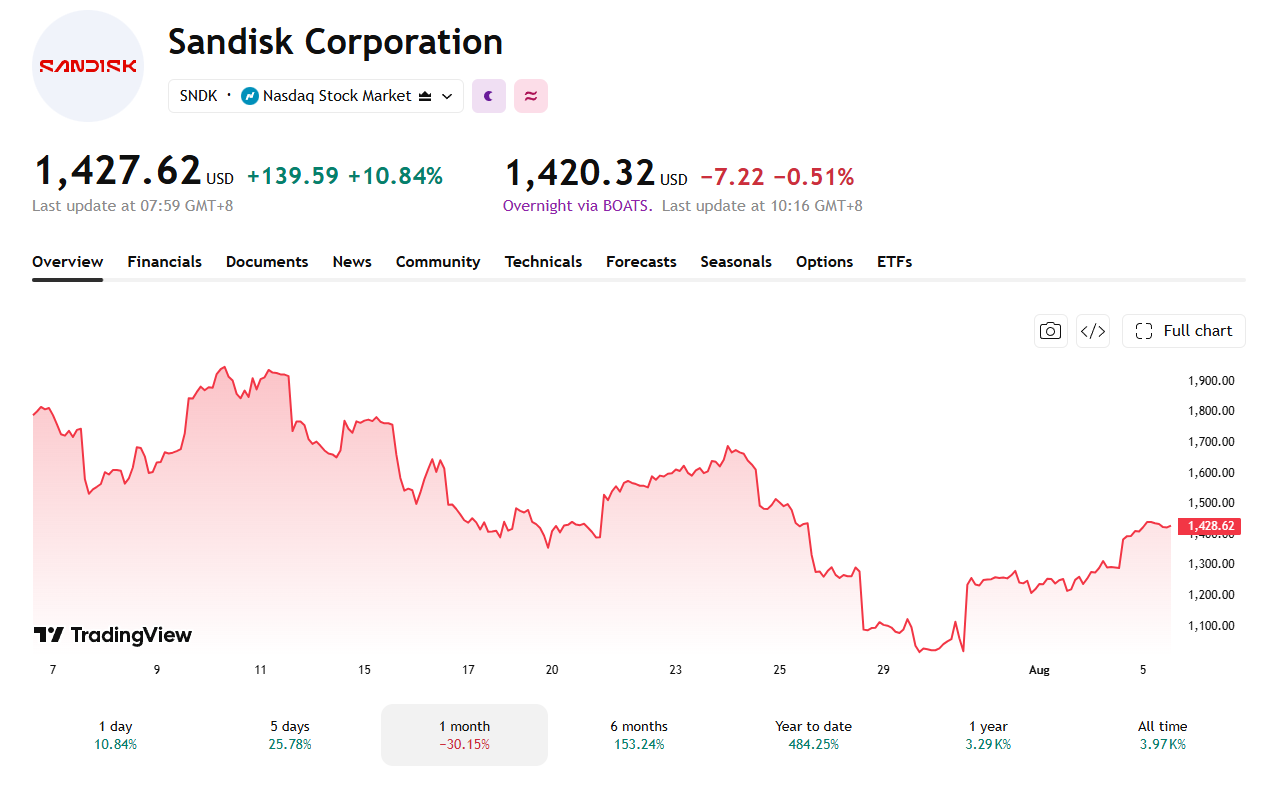
Whale Rock Capital Management’s flagship hedge fund fell 21.7% in July. The drop cut its 2026 gains roughly in half as artificial intelligence and semiconductor stocks sold off.
Whale Rock’s year-to-date return dropped to 35.1% through July. That’s down from 72.5% at the end of June, a person familiar with the matter told Bloomberg. Alex Sacerdote runs the Boston-based, $19 billion firm.
A Rough Month for AI Stockpickers
Whale Rock’s long-only fund fell 18.8% in July but still holds a 36.8% gain for the year. The firm marks its 20th anniversary in 2026. It rode a chipmaker rally through the first half of the year, but conditions reversed sharply in July.
Regulatory filings show Whale Rock added to its stakes in SanDisk and Bloom Energy during the first quarter. Both names tumbled in July alongside CoreWeave. All three fell victim to a broader memory sector selloff that hit chip and AI infrastructure stocks hardest.

The damage spread beyond semiconductors. Mega-cap names like Google and Meta also saw minor declines in July. Meanwhile, investors grew wary of continued AI spending. That concern echoes a broader warning that the market now trades as one AI bet.
Not the AI Industry’s Only Casualty
Whale Rock wasn’t alone in taking a hit. Leopold Aschenbrenner’s Situational Awareness fund posted a 67% loss last month. That marked the sharpest hedge fund drawdown of July, following a forced unwind of its stock book.
The reversal fits a pattern playing out across Wall Street’s AI trade this summer. Some strategists compare it to the dot-com era. Others, however, see the pullback as a buying opportunity, not the start of a longer bust.
Whale Rock’s August performance may hinge on the current earnings season. Investor sentiment toward AI infrastructure spending will likely decide whether the fund stabilizes or extends July’s losses.
The post Whale Rock’s AI Bet Turns Volatile: July Losses Erase Half of 2026 Gains appeared first on BeInCrypto.


Institutional investors accounted for a record 72% of spot trading volume on Wintermute’s over-the-counter desk in the first half of 2026, up from 59% a year earlier. The shift marks the clearest sign yet that Wall Street, not retail traders, now sets the pace of crypto markets.
Wintermute’s OTC flow report ties the change to a prolonged bear market that pushed retail traders toward equities instead. That absence gave institutional flow more weight in shaping prices.
Wall Street’s Growing Crypto Footprint
Hedge funds, digital asset treasuries (DATs), asset managers, and family offices drove that 72% share. Wintermute called it the highest level on record.
The figure compares with 61% in the second half of 2025 and 59% in the first half of that year.
“At three quarters of volume, institutional flow defines market structure.”
Wintermute linked that dominance directly to falling volatility. Bitcoin’s (BTC) realized volatility has roughly halved across market cycles, sliding from about 70% to 45%.
Institutions increasingly sit through price swings instead of chasing them, and that patience helps explain the drop.
This concentration builds on a trend BeInCrypto has tracked before. Institutional crypto bets have narrowed toward Bitcoin, Ethereum and a handful of select DeFi names, rather than spreading across the long tail of smaller tokens.
Institutions Move Faster Than Retail in Crypto
Institutions and retail traders both pile into a token once its volume and price surge. However, the difference lies in how long each side stays.
Institutional activity typically fades within a day of a rally. Retail traders remain active for about three days.
Retail now makes up a smaller share of the market overall. That mismatch means altcoin momentum can fade faster than it did in past cycles.
Derivatives and Tokenization Pick Up the Slack
Institutional activity did not stop at spot trading. Altcoin options volume on Wintermute’s OTC desk grew roughly 3.4 times over the past year. The rise ran from the second half of 2025 into the first half of 2026.
The trend started as a yield trade in major tokens like Bitcoin and Ethereum (ETH). It has since moved down the curve into altcoins.
Yield-seeking flow tends to dampen price swings rather than amplify them. Wintermute said that effect, long visible in Bitcoin and Ethereum, is now reaching altcoins too.
Meanwhile, tokenized real-world assets (RWA) are crypto tokens that represent ownership of off-chain assets like bonds or real estate. That sector grew nearly 50% to $31 billion in the first half of 2026.
That fits a broader trend. Tokenized assets have emerged as one of the market’s few growth pockets even as trading volumes elsewhere softened.
What It Means for Altcoin Season
Wintermute frames the shift simply. The market increasingly reflects its dominant participant. It is patient, selective in tokens, and inclined toward derivatives rather than spot trades.
Retail traders still spread their activity across a much wider set of assets than institutions do. If institutional flow keeps setting the market’s direction, the next rally may reward fewer winners than past cycles did.
The post Institutions Now Drive 72% of Crypto’s OTC Flow, Wintermute Data Shows appeared first on BeInCrypto.
Bitcoin treasury company Strategy sold another tranche of Bitcoin (BTC) last week, according to an 8-K filing with the United States Securities and Exchange Commission (SEC).
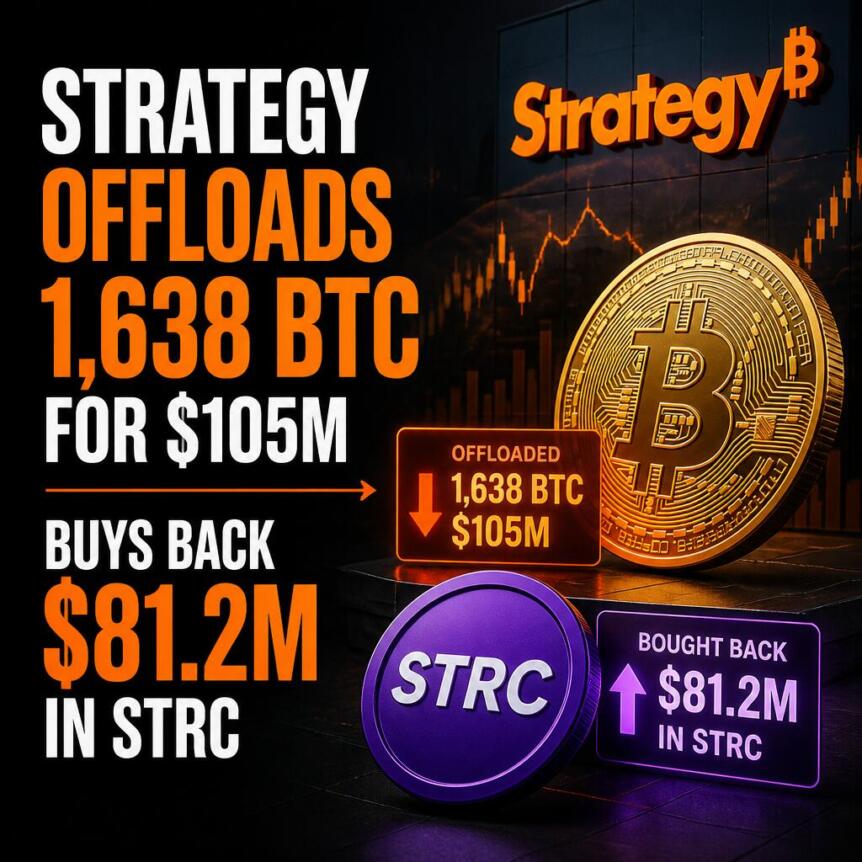
Strategy sold 1,638 BTC for $104.7 million, using the proceeds to fund dividend obligations and repurchase STRC stock. The sale reduces the company’s total holdings to 842,138 BTC.
Strategy Selling Bitcoin Again
Strategy sold the Bitcoin (BTC) at an average sale price of $63,957, significantly lower than the average acquisition cost of $75,419. The company now holds 842,138 BTC, worth $52.6 billion at current prices. Strategy used the proceeds from the sale toward preferred stock dividend obligations and repurchased $52.3 million worth of Variable Rate Series A Perpetual Stretch Preferred Stock (STRC).
Monday’s 8-K filing also revealed that Strategy sold 3,011,361 MSTR shares, raising $290.6 million from the sale. The company used the proceeds to increase its USD reserve to $4 billion and repurchase $28.9 million of STRC. The remaining $11.7 million was redirected toward its cash balance. The company has $22.7 billion worth of MSTR shares available for issuance and sale as of August 2, 2026.
Strategy’s Bitcoin stash carries almost $11 billion in paper losses
Another Cryptic Saylor Post
Saylor took to X on Sunday, posting a Strategy Bitcoin tracker chart with the caption “Bitcoin Drive engaged.” Saylor’s weekend posts have typically hinted at an imminent BTC buy, but they’ve gotten cryptic in recent weeks as Strategy shifts priorities.
The company’s Digital Credit Capital Framework restricts its USD reserve to preferred stock dividends and interest payments. It also authorized a $1 billion repurchase program and adopted a flexible STRC dividend policy. Strategy also approved a $1 billion common stock buyback program, expanding its Bitcoin monetization program to allow the sale of up to $5 billion in BTC to fund its reserve, interest payments, securities repurchase, and dividends.
What Does Strategy Selling Bitcoin Mean For The Market?
Michael Saylor once claimed in February 2024 that he had “no plans to sell any Bitcoin,” calling Strategy’s Bitcoin push “accumulation without an exit.” A lot has changed since that bold claim, with Strategy now selling part of its Bitcoin holdings as STRC, its high-yielding preferred stock takes precedence.
While the sale represents a minuscule fraction of Strategy’s Bitcoin holdings, it is significant because the company built its identity around its Bitcoin reserve and is now selling to fund a USD reserve.
According to data from Bitcoin Treasuries, Strategy currently holds 842,138 BTC, purchased for $63.51 billion, at an average cost basis of $75,419. Bitcoin is currently trading around the $64,000 mark, putting Strategy’s position roughly $10 billion in the red. The latest Bitcoin sale left the company with a realized loss of around $20 million.
STRC Taking Precedence
Strategy used $52.3 million out of the $104.73 million raised from its Bitcoin sale, along with a portion of the funds raised by selling its common stock, to purchase $81.2 million in STRC stock. Its USD reserve now holds $4 billion, which will be utilized to meet dividend obligations on STRC. STRC has a 12% annual payout, representing a significant outflow.
Strategy’s USD reserve helps cover its dividend obligations without forced selling of BTC at unfavorable price levels. Repurchasing STRC also helps reduce future dividend obligations while BTC trades at lower levels. While this is rational, it flies in the face of Saylor’s “never sell” claim.
Unsurprisingly, Saylor has come under heavy criticism for Strategy’s recent selling spree. The Strategy co-founder took to X to defend his decision, stating,
“When I say “Never Sell Your Bitcoin,” I speak as one saver to another. I have never sold mine. Not one satoshi. Strategy is a public company, not my wallet. Since 2020, it has disclosed it may buy or sell $BTC to manage capital. Our shared conviction in Bitcoin remains unchanged.”
However, the argument faced intense backlash, with Peter Schiff responding,
“You knew the impression you were creating, and you never bothered to clarify it. So either that was a deliberate attempt to deceive, or you actually meant that Strategy would never sell.”
Schiff called STRC an albatross around MSTR’s neck, forcing continued BTC sales and common stock dilution.
“In the past week, @saylor sold 1,638 Bitcoin & more than 3 million $MSTR shares to raise cash and buy back $STRC. This reduced Bitcoin YTD Yield to 3.5%, 74% below its May peak. STRC is now an albatross around MSTR’s neck, ensuring continued Bitcoin sales & common-stock dilution.”
Disclaimer: This article is provided for informational purposes only. It is not offered or intended to be used as legal, tax, investment, financial, or other advice.
Democratic senators Elizabeth Warren and Richard Blumenthal have asked the SEC to investigate whether the TRUMP meme coin facilitated fraud or improper enrichment after its value collapsed 98% from its peak.
Summary
- Warren and Blumenthal urged the SEC to investigate possible fraud involving the TRUMP token.
- Nearly 989,000 wallets lost a combined $3.81 billion, according to Nansen data.
- TRUMP trades near $1.47, down about 98% from its all-time high above $73.
- The request adds pressure to the CLARITY Act’s unresolved ethics negotiations.
Senators ask SEC to investigate TRUMP coin
Warren and Blumenthal sent a letter to SEC Chair Paul Atkins asking the agency to determine whether the president-linked token involved illegal fraudulent activity or allowed insiders to obtain improper gains.
“We are concerned that President Trump’s memecoin scheme may constitute an illegal scam,” the lawmakers wrote, according to CNN reporting cited by multiple outlets.
The senators reportedly asked the SEC to examine whether the project operated as a “soft rug pull.” The term describes a situation in which insiders or developers gradually withdraw support or extract value instead of abandoning a project in one sudden move.
Their letter does not establish that fraud occurred. The SEC would need to determine whether federal securities laws apply to the token and whether its promotion, distribution, or trading involved any legal violations.
TRUMP coin investors lost $3.81 billion
The lawmakers cited the scale of investor losses surrounding the Solana-based token, which launched shortly before Trump returned to the White House in January 2025.
Data from blockchain analytics firm Nansen showed that 988,905 of the 1.48 million wallets that purchased TRUMP were carrying losses by the end of June. Their combined losses reached approximately $3.81 billion.
Trump reported earning about $636 million from the meme coin, while his wider crypto-related income exceeded $1.4 billion in 2025, according to financial disclosures reported by US media. Those figures have intensified questions about whether a sitting president should benefit from digital assets while shaping federal crypto policy.
TRUMP traded near $1.47 on Aug. 4, with a market capitalization of approximately $366 million and daily volume near $159 million, according to CoinMarketCap. Its price has fallen roughly 98% from an all-time high of $73.43, although the token was slightly higher over the previous 24 hours.
CLARITY Act ethics dispute remains unresolved
The SEC request comes as senators remain divided over an ethics provision in the CLARITY Act, a broader bill intended to establish US rules for digital asset markets.
As crypto.news reported on Aug. 4, the White House had not responded to a bipartisan counterproposal from Republican Sen. Thom Tillis and Democratic Sen. Ruben Gallego. The compromise would allow state attorneys general to sue the Department of Justice if it failed to enforce restrictions on crypto activity involving federal officials.
Democrats opposed an earlier version that left enforcement solely with the DOJ. Warren has argued that passing the bill without stronger safeguards could expand conflicts of interest tied to Trump’s crypto businesses.
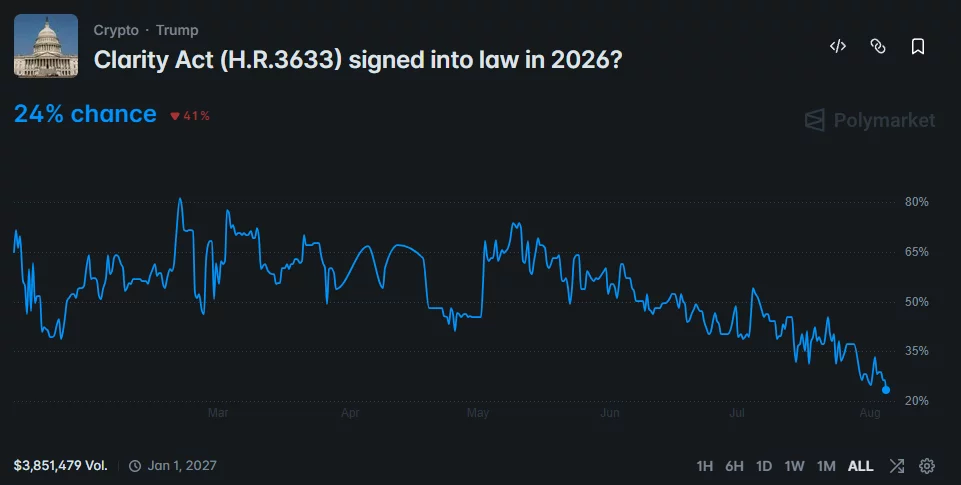
The delay pushed Polymarket’s estimated chance of the legislation becoming law in 2026 to an all-time low of 24%. The measure must still pass the Senate and resolve any differences with the House before reaching Trump’s desk.
Senate faces wider fight over developer protections
The ethics dispute is not the only issue slowing the CLARITY Act. The Blockchain Association sent an eight-page letter to Senate leaders on Aug. 3 disputing claims from the National Sheriffs’ Association that the latest draft creates broad exemptions from anti-money laundering rules.
The trade group argued that Section 10604 protects developers who create neutral software without controlling customer assets or transactions. It said intermediaries that exercise control would remain subject to the Bank Secrecy Act, sanctions and anti-money laundering requirements. The Blockchain Association’s response also rejected the view that earning revenue alone makes a developer a financial institution.
The Senate ended Monday without taking action on the bill, leaving it without a publicly announced vote as lawmakers approach the August recess. Warren and Blumenthal’s request could now place the TRUMP coin and presidential crypto conflicts more firmly at the center of those negotiations.


SpaceX shares rebounded ahead of the company’s first quarterly report since its June IPO, as investors looked beyond an expected $1.9 billion loss toward its AI infrastructure plans and Starlink growth.
Summary
- SpaceX is expected to report $6.8 billion in quarterly revenue and a $1.9 billion loss.
- Bernstein maintained its Outperform rating and $239 price target before the results.
- SPCX remains more than 50% below its $225.64 high despite its latest rebound.
- Investors are watching Starship reuse, Starlink growth, and AI computing demand for signs of long-term value.
SpaceX earnings put AI strategy in focus
SpaceX is scheduled to publish its second-quarter results after the U.S. market closes on Tuesday, marking its first earnings report as a public company.
Analysts expect the company to post revenue of about $6.8 billion and a net loss near $1.9 billion. Starlink growth is expected to offset some of the losses from SpaceX’s launch and artificial intelligence operations, according to estimates cited by CBS News.
The headline financial figures may receive less attention than management’s outlook for AI infrastructure. SpaceX has been developing plans to deploy space-based data centers, which would use satellite networks to provide computing capacity.
The company’s AI strategy also includes terrestrial infrastructure agreements. Anthropic agreed to pay SpaceX $1.25 billion per month through May 2029 for computing capacity, although the arrangement was expected to generate lower payments during its initial ramp-up period, Axios reported.
Investors will want details about when these contracts will contribute materially to revenue and whether they can offset the high spending required to expand computing capacity.
Bernstein keeps $239 target despite SpaceX stock slide
Bernstein SocGen Group maintained an Outperform rating and a $239 price target on SpaceX ahead of the report. That target implies substantial upside from the stock’s recent trading range.
The firm identified rapid Starship reuse as the most important factor supporting SpaceX’s long-term valuation. A reusable Starship system could lower the cost of deploying the satellites needed for orbital data centers and expand the company’s launch capacity.
Bernstein also identified semiconductor supply, regulatory approvals, and continued demand for computing power as major risks. These issues could determine how quickly SpaceX can develop its planned satellite-based AI network.
Competition from China, Starlink’s international broadband expansion, and the company’s direct-to-device mobile business remain other considerations. However, Bernstein said those areas are secondary to SpaceX’s ability to execute its AI infrastructure strategy.
The company’s first public earnings call could provide investors with clearer timelines for Starship development, satellite deployments, and capital spending.
SPCX stock targets $124 after its rebound
As reported by crypto.news, SPCX stock traded around $119.71 after gaining 4.6%, extending its recovery from a recent low near $105. The rebound came after the shares lost more than half their value from a 52-week high of $225.64.
Holding above $119.34 could allow the stock to challenge $124.15. A move through that level would place $130.67 in focus, followed by higher resistance at $138.63 and $146.58.
Failure to remain above $119.34 could expose the stock to another decline toward $114 and $110. The main downside level remains near $104.91, close to the floor established during the latest sell-off.
Despite the rebound, the broader trend remains weak. SPCX has fallen from above $172 in early July and remains below its June IPO price of $135.
Starlink and Starship could decide what comes next
Starlink remains SpaceX’s strongest operating business and the only segment consistently producing profits. Its broadband subscriber growth will be important because that cash flow helps fund Starship development and the company’s capital-intensive AI expansion.
Wall Street will also examine management’s spending plans. Building computing infrastructure, manufacturing satellites, and testing Starship require substantial capital before they can generate sustainable returns.
For U.S. investors, the report will provide the first detailed test of whether SpaceX’s public valuation can be supported by its operating results. Strong Starlink growth and clearer AI revenue guidance could support the recovery, while higher spending or delays to Starship reuse could renew pressure on SPCX shares.
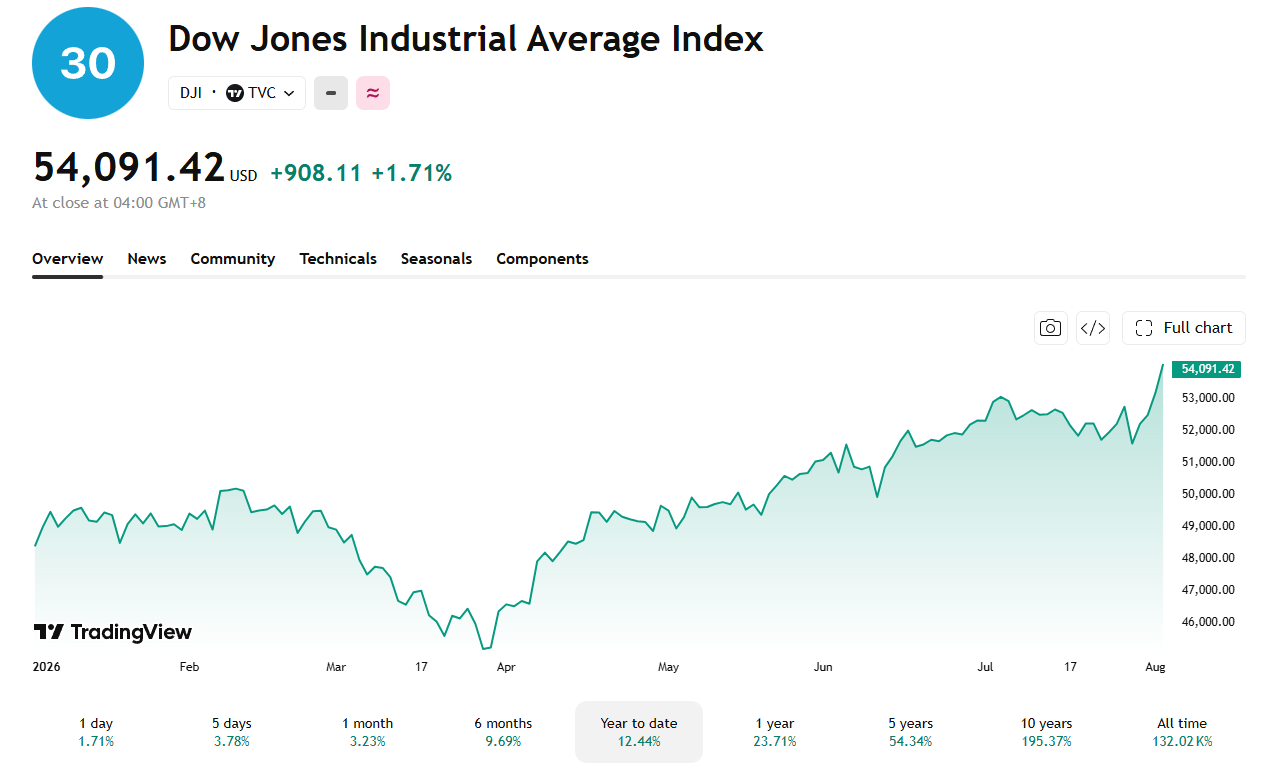
Upbeat earnings from Caterpillar and Palantir Technologies (PLTR) drove the Dow Jones Industrial Average and S&P 500 to record closes on Tuesday, easing concerns over artificial intelligence (AI) spending.
The Dow gained 907 points, or 1.71%, to close at 54,091.42. The S&P 500 rose 1.79% to 7,736.52. The Nasdaq Composite jumped 2.59% to a record 26,584.99.
AI Earnings Beat the Street
Caterpillar raised its annual revenue growth forecast as AI data center construction drove demand for its power-generation equipment. Its stock jumped 5.6%, the single biggest boost to the Dow.
Palantir’s blowout earnings drove an even bigger move. Shares climbed 29.5% after the company raised its own annual revenue forecast, marking its best single-day gain since February 2024.

Optimism extended well beyond those two stocks. Of the 304 S&P 500 companies that had reported second-quarter results, 85.2% beat estimates, versus a long-term average of 67.5%, according to Reuters.
Investors view semiconductor stocks as AI beneficiaries, and those shares rose for a fourth straight session. The Philadelphia Semiconductor Index climbed 6.6% and extended its rebound after tumbling 20.6% in July.

The Rally Went Global
Technology shares and a wave of corporate earnings updates pushed the pan-European STOXX 600 to a record close, up 0.73% to 656.86. MSCI’s All Country World Index gained 1.30% and hit an intraday record too.
Oil added fuel to the rally. Brent crude fell 5.3% to $79.36 a barrel on hopes for a diplomatic resolution to the Iran war that could reopen the Strait of Hormuz to more shipping. The drop pushed September rate-hike odds down to 56.9% from 67.2% and sent two-year Treasury yields to a two-week low.
Not Everyone Is Convinced
Not every voice on Wall Street shared the enthusiasm. Jack Ablin, chief investment strategist at Cresset Capital Management, raised that note of caution even as records piled up.
“I don’t sense one ounce of skepticism among investors, from oil to interest rates to equities. The earnings reports were certainly supportive, and that’s great news, but I’m not sure a handful of earnings reports justifies new records in the S&P.”
Oliver Pursche, senior vice president at Wealthspire Advisors, saw it differently, pointing to “stronger earnings and stronger expectations” behind the mood.
That split showed up again hours later. SpaceX’s debut earnings beat Wall Street on revenue, up 92% year over year, yet shares fell roughly 8% in after-hours trading once results landed.
Ablin’s caution points to a real question. Does a rally built on a handful of earnings beats justify fresh records, or is the market pricing in AI demand that has yet to prove durable?
Tuesday’s numbers don’t settle it, and the rest of earnings season should offer more evidence.
The post Dow and S&P 500 Hit Records on AI Earnings: When Will the Bubble Burst? appeared first on BeInCrypto.
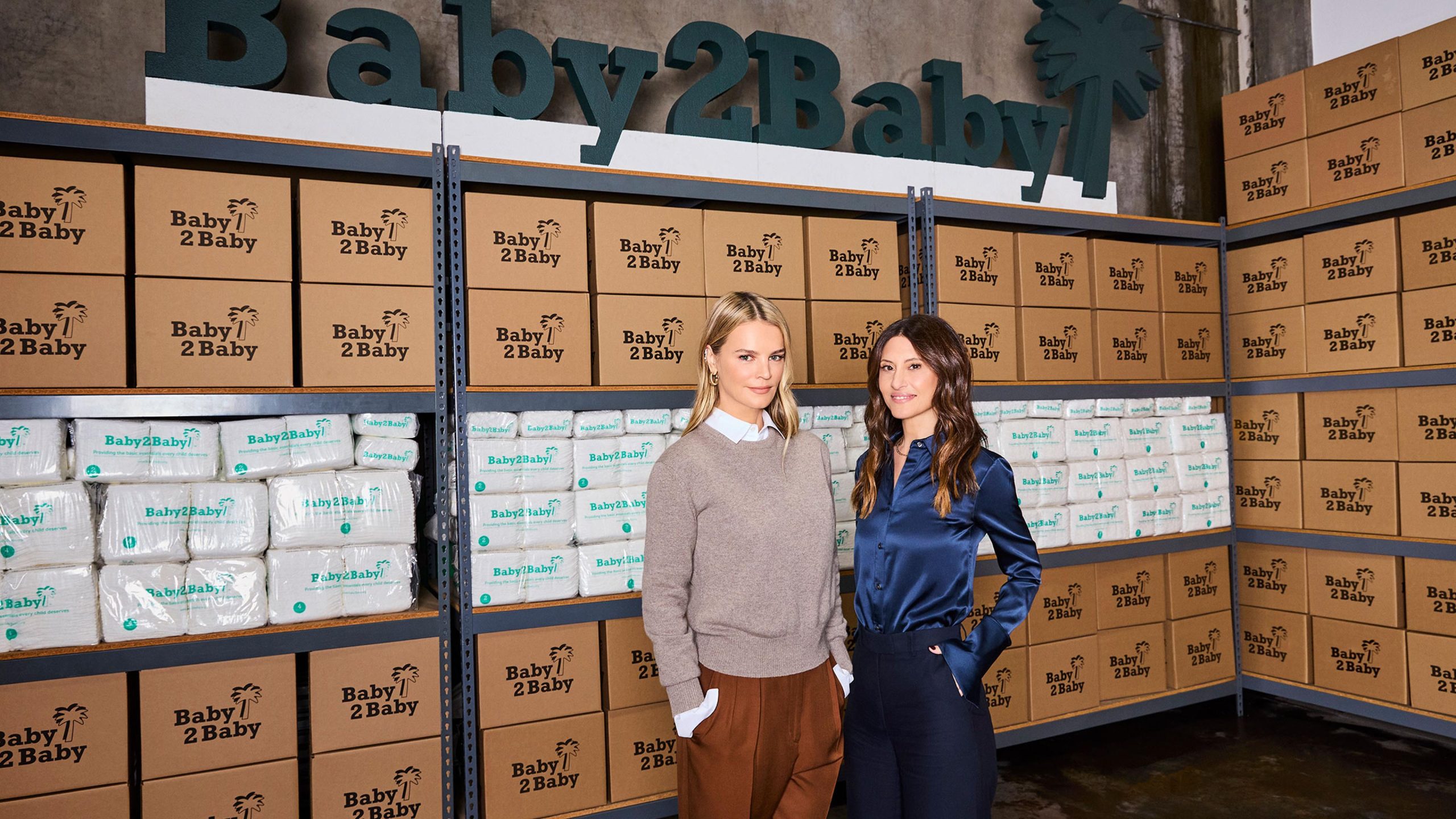
Kelly Sawyer Patricof and Norah Weinstein are a dynamic duo who have made a significant impact on the lives of families who are struggling. Their dedication and tireless efforts to provide essential items for children through their work with Baby2Baby have helped so many families across the country—their passion for giving back is truly inspiring. Kelly and Norah’s leadership and vision have transformed Baby2Baby into a beacon of hope, providing items such as diapers, clothing, and other necessities to ensure that children have what they need to thrive.
Through their collaborative efforts, Kelly and Norah have shown that when people come together with a shared goal of helping others, incredible things can happen. Their compassion, generosity, and dedication to making a difference serve as a powerful reminder of the impact one can have
when driven by a desire to be of service. Thank you, Kelly Sawyer Patricof and Norah Weinstein, for your unwavering commitment to creating a brighter future for families in need.


BNY is adding Galaxy’s staking infrastructure to its digital asset custody platform, giving eligible institutional clients access to custody and staking through one servicing model.
Summary
- Galaxy will provide institutional staking through BNY’s Digital Asset Custody platform.
- The service remains subject to regulatory review and will be limited to eligible clients.
- BNY is also developing onchain transfer agency and tokenized Treasury infrastructure.
- BNY’s Belgian subsidiary recently received MiCA authorization for crypto custody and transfers.
BNY adds staking to institutional crypto custody
Galaxy said it has entered a strategic collaboration with BNY to integrate staking into the bank’s Digital Asset Custody platform. The arrangement will combine asset safekeeping and staking within a single institutional workflow.
Eligible clients will be able to use staking alongside BNY services such as fund accounting, tax reporting, payments and client reporting, where applicable. Galaxy will supply the staking infrastructure and act as a design partner for BNY’s broader digital asset platform.
The companies said the model could simplify institutional participation in proof-of-stake networks by reducing the need to coordinate between separate custody and staking providers. Client assets would remain within BNY’s institutional custody framework while accessing Galaxy’s staking capabilities.
However, the companies did not disclose which proof-of-stake assets the platform will support or when the service will become available. The launch remains subject to regulatory review.
“As digital assets continue to evolve, clients want more than safekeeping alone — they want a broader set of capabilities delivered through an institutional-grade model,” BNY Chief Product and Innovation Officer Carolyn Weinberg said.
Why the Galaxy partnership matters for US institutions
The collaboration expands the services available through a major U.S. custodian as banks compete to support institutional demand for digital assets. BNY reported $62.6 trillion in assets under custody or administration as of June 30.
Institutional staking can generate protocol rewards by committing eligible crypto assets to proof-of-stake networks. Yet the activity also introduces operational, technical and regulatory considerations that differ from conventional asset custody.
Combining both services could give asset managers and other institutions a more familiar route into staking. BNY would provide the custody and reporting framework, while Galaxy would handle the underlying staking infrastructure.
For U.S. institutions, the regulatory-review condition remains important. The companies have not said which regulators must approve the service or whether access will vary by client type or jurisdiction.
“The future of financial markets will be built on open, programmable rails, and the institutions that move first will define the era that follows,” Galaxy Global Co-Head of Digital Assets Steve Kurz said.
BNY expands onchain fund infrastructure
The staking agreement follows BNY’s move in late July to bring investment fund ownership records onchain through a blockchain-enabled transfer agency platform.
The platform will allow fund transactions and official shareholder records to be maintained on a shared digital ledger. BNY will continue operating its traditional transfer agency services alongside the blockchain-based system.
Rather than only tokenizing investment products, the bank is applying blockchain technology to the record-keeping systems that support fund administration. The model is intended to create a shared source of ownership information for institutions involved in processing and servicing funds.
BNY has also completed after-hours U.S. Treasury transactions with stablecoin issuers. The bank reportedly plans to introduce tokenized U.S. Treasuries before the end of 2026 and conduct pilot transactions on a private blockchain during the year.
MiCA approval supports BNY’s European crypto push
BNY is also expanding its regulated digital asset operations in Europe. ESMA added BNY SA/NV, the bank’s Belgian subsidiary, to its interim Markets in Crypto-Assets register in July.
The National Bank of Belgium authorized the subsidiary to provide crypto-asset custody and transfer services. Its addition came as ESMA’s register reached 309 authorized providers following 15 new entries.
The approval gives BNY a regulated route to offer specified crypto services under the European Union’s MiCA framework. Combined with the Galaxy agreement and its onchain fund platform, the authorization shows BNY is building separate but connected infrastructure across custody, staking, tokenized assets and fund administration.
The next step will depend on regulatory clearance for the staking service and details about supported assets, client eligibility and launch timing.

Empire State Realty: Prime NYC Real Estate At Attractive Discount (NYSE:ESRT)

Ex-Fbi Agent’s Ai-Assisted Retirement Plan Lands Him In Federal Custody

Ricky Alvarez at the Heart of Ariana Grande’s Public Hiatus


-

 Business6 days ago
Why Trees Belong on the Risk Register
-

 Fashion4 days ago
Weekend Open Thread: Wit & Wisdom
-

 Politics4 days ago
Meta enters AI-training agreement with far-right ‘propaganda rag’ Newsmax
-

 Politics7 days ago
Reform UK betrays West Mids residents by running from party pledges
-

 Crypto World3 days ago
MicroStrategy Post-Earnings CLARITY Act Push Could Add New Catalyst for Its Stock
-

 Politics2 days ago
Zack Polanski: an incitement to murder Nigel Farage?
-

 Business7 days ago
Major shareholder moves on Canyon
-

 Crypto World4 days ago
XRP Ledger v3.3.0 brings five institutional features
-

 News Videos6 days ago
Bitcoin Enters the 3rd Stage of the Bear Market
-

 Politics5 days ago
Luke Littler’s dominance sparks GOAT debate
-

 Sports5 days ago
Seema Kaliramna Wins Discus Throw Bronze, Takes India’s CWG Medals Tally To 17
-

 Crypto World4 days ago
New York sues Kalshi over prediction market gambling
-

 Crypto World3 days ago
Crypto PAC spending tops $2M in Michigan House race
-

 Business5 days ago
Trump Announces Hamas Disarmament Agreement as Iran Strikes Kuwait Air Base and US Attacks Pause Overnight
-

 Tech7 days ago
Gemini can now summarize the messiest comment threads in Google Docs
-

 Tech3 days ago
ESET tracks rise in malicious AI skills and adaptable malware
-

 Business2 days ago
DTCR: Deleveraging And A Hedge Fund Collapse Point To A Possible AI Bottom
-

 NewsBeat6 days ago
Four people die trying to cross Channel in small boats
-

 Tech5 days ago
Gemini Spark can now use Chrome logins and saved passwords to run errands on your behalf
-

 Tech5 days ago
Building A Reproduction PlayStation Motherboard
You must be logged in to post a comment Login