
Crypto World
Brazil Bans 27 Prediction Platforms, Including Kalshi and Polymarket


Brazilian authorities have moved to shut down 27 prediction market platforms, including Kalshi and Polymarket.
The decision, announced Friday, follows a directive from the Ministry of Finance and enforcement by the National Telecommunications Agency (Anatel), according to state-owned news outlet Agência Brasil. Authorities claimed that such services fall outside Brazil’s current legal framework and therefore operate illegally.
“We have been monitoring the evolution of this sector in Brazil, which suffered a period of anarchy because there were no rules, no oversight, from 2018 to 2022,” Finance Ministry executive secretary Dario Durigan reportedly said during a press conference at the Palácio do Planalto.
The crackdown follows Resolution 5.298 issued by Brazil’s National Monetary Council (CMN) on Friday, which takes effect in early May and sharply limits what prediction market platforms can offer. Under the new rules, contracts tied to sports, politics, entertainment, or social events are banned, as authorities consider them closer to gambling than financial investments.
Only contracts linked to economic indicators, such as inflation, interest rates, exchange rates, or commodity prices, will remain allowed and fall under financial market oversight.
Related: Kalshi bans 3 US politicians for betting on their own election races
Brazil flags prediction platforms as debt risk
Durigan claimed that prediction markets could deepen household debt and expose users to financial harm. “At a time when we are working to reduce debt levels among families, small businesses, and students, we must also prevent new forms of harmful indebtedness,” he said.
The blocked platforms include a mix of international and Brazil-focused services, with major names including Kalshi, Polymarket, PredictIt, Robinhood (via its forecasting feature) and Fanatics Markets.
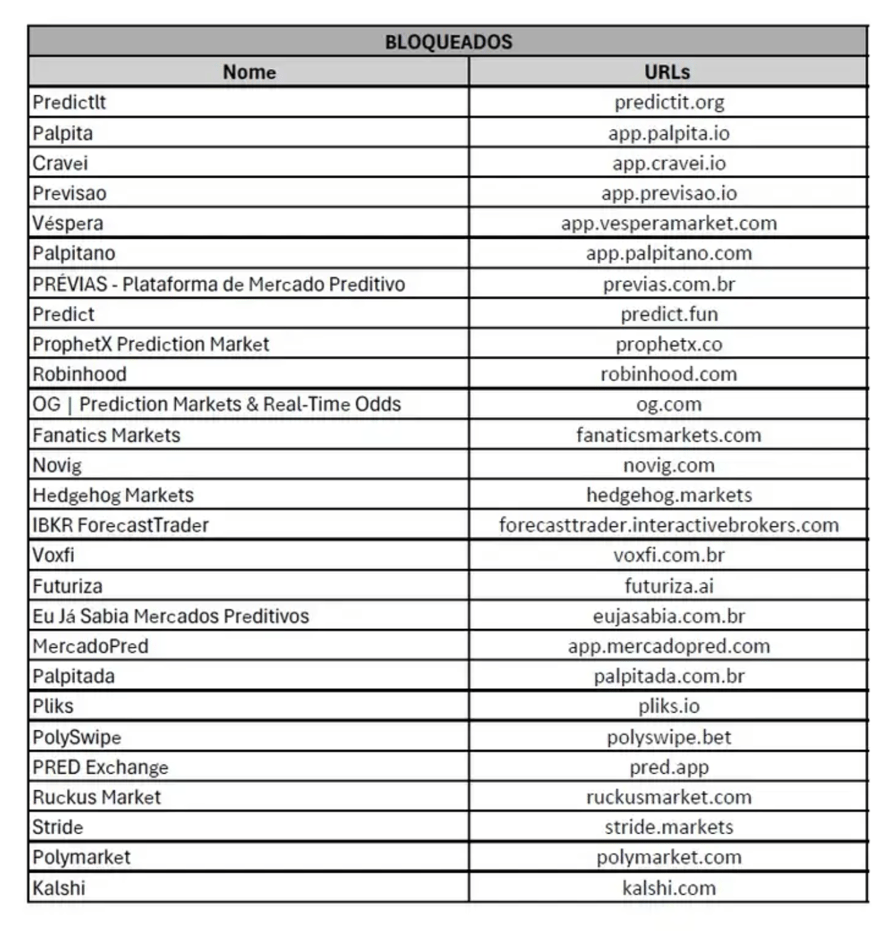
Banned prediction markets in Brazil. Source: Agência Brasil
Other affected platforms include ProphetX, Hedgehog Markets, Novig, Polyswipe, PRED Exchange and Stride, alongside several Brazil-focused services such as Palpita, Cravei, Previsao, and MercadoPred.
Related: Prediction market battle gets closer to Supreme Court
More countries ban prediction markets
A growing number of jurisdictions have moved to ban prediction markets, often folding them into gambling or financial regulations. Several European nations, including France, Belgium and the Netherlands, have blocked or penalized platforms operating without authorization.
In the United States, the situation is more fragmented, with an ongoing tug-of-war between federal regulators and individual states over prediction markets.
Magazine: How to fix suspected insider trading on Polymarket and Kalshi


TLDR:
- Purrlend lost $1.5M across HyperEVM and MegaETH in a suspected coordinated dual-network exploit.
- HyperEVM bore the larger loss at $1.2M, while MegaETH accounted for roughly $324,000 in stolen funds.
- Stolen assets included USDC, USDT0, USDH, wstHYPE, kHYPE, WHYPE, UETH, WETH, and USDm tokens.
- April 2026 is on pace to rank among the worst months for crypto theft, with over $600M lost in 18 days.
Purrlend, a decentralized lending and borrowing protocol built on HyperEVM, suffered a suspected exploit on April 25, 2026.
The attack hit two separate networks simultaneously, HyperEVM and MegaETH. Combined losses reached approximately $1.5 million.
The incident was first flagged by Kirby Ong, founder of HypurrCollective. Purrlend has since paused all protocol operations while its team investigates the breach.
Attack Drains Funds Across Two Blockchain Networks
The exploit targeted Purrlend on both HyperEVM and MegaETH in a coordinated dual-network attack. HyperEVM suffered the larger share of losses, with roughly $1.2 million drained from the protocol. MegaETH accounted for the remaining $324,549 in stolen funds.
Kirby Ong, founder of HypurrCollective, was the first to raise the alarm on social media. He posted a detailed breakdown of stolen assets across both chains. His post read: “Purrlend appears to be exploited on both MegaETH and HyperEVM.”
The stolen assets on HyperEVM included nearly $450,000 in USDC and $214,000 in USDT0. The attacker also took close to $195,000 in USDH, along with wstHYPE, kHYPE, WHYPE, and UETH tokens. On MegaETH, the attacker withdrew $163,000 in USDT0, WETH, and USDm.
Purrlend confirmed the incident shortly after through an official post. The team stated: “We have detected irregular activity on the protocol and are actively investigating.” The protocol remains paused as the investigation continues.
April Emerges as One of the Worst Months for Crypto Theft in 2025
The Purrlend exploit adds to a growing list of attacks recorded in April. More than $600 million has been stolen from crypto protocols in just 18 days this month. That figure places April on pace to surpass even the most damaging months in recent DeFi history.
The bulk of April’s losses trace back to attacks on KelpDAO and Drift Protocol. Together, those two incidents account for an estimated $577 million in losses. Both attacks have drawn sharp attention to the state of security across DeFi platforms.
By comparison, the largest single breach this year remains the $1.4 billion Bybit hack from February 2025. April’s total, however, is approaching that threshold at a rapid pace. That trend has put protocol security practices under growing scrutiny.
For Purrlend, the road to recovery will depend heavily on the findings of its ongoing investigation. The protocol has not yet disclosed the specific attack vector used by the exploiter. Until then, users have been urged to proceed with caution across all connected platforms.

Crypto World
Binance Users Are Looking Beyond Trading To Income; Varntix Is Where Some Capital Is Moving

Investors are starting to question whether traditional crypto earning methods are truly reliable. Platforms like Binance make it easy to earn through staking and advanced yield products, but returns often depend on market conditions. This means income can fluctuate without warning.
That shift is driving capital toward alternatives like Varntix. In a market where timing often fails, Varntix is positioning itself as the solution for traders who want certainty, control, and returns they can actually plan around. Instead of relying on market movement, smart investors can receive fixed and predictable returns that are agreed from the start.
Binance Offers Easy Income but Lacks Guaranteed Returns
Binance is one of the largest crypto exchanges by trading volume, and a popular choice for trading. One way traders earn on the platform is through staking. This allows users to lock up their tokens and receive rewards for supporting blockchain networks.
While this provides an easy way to earn, the returns are not guaranteed. Earnings can also vary depending on network activity and overall market trends.
In addition, the crypto exchange offers Advanced Earn products designed to deliver higher potential returns. While these products can offer attractive APRs, they rely heavily on market conditions and require a higher tolerance for risk.
Even so, Binance is easy to access and its diverse product offerings make it appealing to many investors.
However, investors’ earnings depend on the market. This means returns are not fixed and can change over time. With this in mind, many are seeking platforms with returns that do not rely on broader market performance.
Varntix Provides Clear Returns as Crypto Earnings Remain Unpredictable
Crypto earnings have become increasingly unpredictable. Strategies like staking and borrowing often depend on market performance leaving returns difficult to plan. Because of this, more traders are shifting toward structured income models that offer clarity.
Varntix is one of the platforms leading this shift. It operates as a digital savings platform for crypto, giving users access to fixed and flexible income plans with clearly defined returns.
Fixed plans offer higher, guaranteed returns over a set period. Depending on the duration and allocation, returns can reach up to around 24% APY. For instance, a $10,000 allocation at a 20% APY could yield about $6,000 over three years. The return is known upfront, removing the need to guess market direction.
On the other hand, flexible plans are designed for access. Users can withdraw their funds at any time while still earning. In real terms, a $10,000 allocation at 6% APY would earn roughly $600. All while allowing investors access to the capital.
Additionally, returns are paid in stablecoins like USDC, helping protect value. It also avoids the impact of market volatility during the earnings period.

Varntix Gains Ground as Investors Move Away From Market-Driven Yields
When yields are unpredictable, it’s hard to plan for crypto income. A user might stake with the expectation of steady returns but is disappointed by market conditions.
Binance offers ways to earn passively, but the returns are not fixed. They depend on what is happening in the market, so profits can change at anytime. Because of this, some investors are moving their capital to Varntix to get more stable and predictable returns.
The main difference is in how both platforms work. Market-based platforms like Binance are flexible and easy to use, but they are also more volatile.
Meanwhile, Varntix focuses on reducing the impact of market changes. Users can know their expected returns, how long their funds will be locked, and when they will receive payouts from the beginning.
Take a closer look at Varntix if you want your crypto to work harder.
FAQs
1. Why are Binance users looking for other income options?
Many users are exploring alternatives because earnings on Binance depend on market conditions. Returns from staking and yield products can change at any time, making income hard to predict.
2. Why are structured income models gaining popularity in crypto?
Structured income models offer clearer, more stable returns that investors can plan around.
3. How does Varntix reduce risk compared to market-based platforms?
Varntix provides predefined returns and pays out in stablecoins like USDC, helping reduce exposure to price swings and making earnings more consistent.
Disclaimer: This is a Press Release provided by a third party who is responsible for the content. Please conduct your own research before taking any action based on the content.
TLDR:
- Uniswap liquidity pools mirror Wall Street market making, letting anyone earn fees on every trade executed.
- Popular DeFi pairs have generated annualized yields between 15% and 100%, driven purely by trading volume and fees.
- Impermanent loss remains the primary risk, but high-volume pair selection and concentrated liquidity help manage exposure.
- Real-time pool analytics from DeFiLlama and Revert Finance give retail investors the same data institutional allocators access.
Liquidity pools on decentralized exchanges have opened market-making to everyday investors. For decades, firms like Citadel Securities and Jane Street dominated this space, earning billions by sitting between buyers and sellers.
Now, through platforms like Uniswap, anyone with a crypto wallet can provide liquidity and collect trading fees. The barrier to entry has collapsed, and the mechanics remain the same.
How Market Making Works in DeFi
Market making has long been the quiet engine behind Wall Street’s most profitable firms. Citadel Securities processed roughly 28% of all U.S. equities volume in 2024.
Jane Street generated over $20 billion in revenue in 2023, surpassing Goldman Sachs’s entire trading division. These firms earn by quoting buy and sell prices simultaneously and collecting the spread on every trade.
Uniswap brought this model on-chain in 2018. Instead of proprietary algorithms, it uses liquidity pools funded by ordinary users.
Traders swap tokens directly against these pools. The liquidity providers behind those pools earn a percentage fee on every transaction completed.
Fee tiers on Uniswap typically range from 0.05% to 1%, depending on pair volatility. Fees distribute proportionally to everyone who contributed to the pool. A provider holding 10% of a pool earns 10% of all fees that pool generates.
The protocol operates around the clock, every day of the year. No license, institutional affiliation, or minimum deposit is required. Tools like DeFiLlama and Revert Finance provide real-time pool data to any user, free of charge.
Yields, Risks, and What Providers Should Know
During high-volume periods, popular Uniswap pairs have generated annualized yields exceeding 100% for liquidity providers.
Even in quieter conditions, well-chosen pairs routinely produce 15–40% annually. These returns come from fee income, not speculation or token price appreciation.
The primary risk unique to this strategy is impermanent loss. When one token’s price shifts significantly against the other, the pool rebalances automatically. This can leave providers holding a ratio worth less than simply holding both tokens separately.
Providers can manage this risk by choosing pairs where they are comfortable holding both assets long-term. Uniswap v3’s concentrated liquidity feature also helps, allowing users to target specific price ranges and improve fee efficiency. High-volume pairs relative to pool size further offset impermanent loss exposure.
Smart contract risk also exists, though Uniswap’s contracts rank among the most tested in crypto history. Smaller altcoin pairs carry additional token-specific risks that providers should assess carefully before committing capital.
The formula for earnings is straightforward: volume multiplied by fee rate, multiplied by pool share, equals income.
A 10% share of a pool generating $10 million in daily volume at 0.3% produces roughly $3,000 per day. The protocol applies the same math regardless of deposit size.
Kooc Media, a specialist PR distribution agency for the crypto, fintech, technology and iGaming industries, has announced a dedicated suite of PR solutions for DeFi protocols, NFT platforms and Web3 projects. The service provides guaranteed media placements across established blockchain, finance and technology publications, giving decentralised finance, digital collectible and Web3 infrastructure projects the visibility they need to attract users, investors and developer communities.
The DeFi, NFT and Web3 sectors have grown into major segments of the broader crypto industry, but each faces distinct challenges when it comes to media coverage and public awareness. DeFi protocols compete in an increasingly crowded market of lending platforms, decentralised exchanges and yield aggregators. NFT platforms fight for attention in a space that has moved well beyond profile pictures into gaming, music, real estate and identity. Web3 projects building the infrastructure layer of the decentralised internet often struggle to communicate their value to anyone outside a narrow developer audience.
What these sectors share is a desperate need for media coverage that reaches beyond their existing communities. And what they have in common is that traditional PR has consistently failed to deliver it.
“DeFi, NFT and Web3 projects are building some of the most important technology in the crypto space,” said Michelle De Gouveia, spokesperson for Kooc Media. “But the gap between what these projects are building and how many people know about them is enormous. Closing that gap is what our PR service does.”
Three Sectors, One Visibility Problem
Despite their technical differences, DeFi protocols, NFT platforms and Web3 projects all face the same fundamental marketing challenge. The standard channels that technology companies use to reach new audiences are largely closed to them.
Google restricts advertising for many categories of crypto products. Meta applies similar limitations. App store policies create barriers for decentralised applications. Traditional tech media covers crypto sporadically and often sceptically. Mainstream business media covers it only when prices spike or crash.
Meanwhile, the audiences these projects need to reach — crypto-native users, institutional investors, developers and mainstream adopters — each consume media through different channels and respond to different messages. A DeFi protocol trying to attract liquidity providers needs to be visible on different publications than an NFT marketplace trying to attract digital artists, even though both operate within the broader crypto ecosystem.
This fragmented media landscape makes specialist PR essential. A generic approach that treats all crypto projects the same will miss the specific audiences that DeFi, NFT and Web3 projects need to reach. Kooc Media’s crypto PR services are structured to address the specific visibility challenges that each of these sectors faces.
Guaranteed Placements on Publications That Matter
Kooc Media’s PR model is built on a simple principle: clients should pay for results, not for effort. The agency owns and operates several established online news brands including Blockonomi, CoinCentral, MoneyCheck, Parameter, Beanstalk and Computing. These in-house publications have been publishing daily content for years, with strong domain authority, organic search traffic and engaged readerships across the crypto, finance and technology sectors.
When a DeFi protocol, NFT platform or Web3 project books a campaign, the specific publications that will carry the article are confirmed before the campaign begins. There is no pitching to external journalists. No waiting for editorial approval. No risk of paying a retainer and receiving nothing in return. The article is written, reviewed and published — typically the same day.
This guaranteed model solves the most persistent frustration in crypto PR. Traditional agencies charge monthly retainers and promise to pitch stories to journalists on the client’s behalf. Whether any coverage actually materialises depends on factors outside anyone’s control. Projects can spend months paying an agency and end up with nothing published. With Kooc Media, the published article is the deliverable.
For projects that need reach beyond crypto-native audiences, Kooc Media distributes press releases through major financial and business newswire networks. Depending on the package, articles can appear on mainstream outlets such as Business Insider, Bloomberg, Benzinga, MarketWatch, USA Today and Dow Jones feeds. A DeFi protocol seeking institutional liquidity, an NFT platform courting mainstream brands or a Web3 project pitching enterprise clients can all benefit from coverage that appears alongside traditional financial and business news.
Every campaign includes transparent reporting with live links to each published article.
Tailored Approaches for DeFi, NFT and Web3
While the underlying PR infrastructure is the same across all campaigns, Kooc Media tailors its approach based on the specific sector and goals of each client.
DeFi PR campaigns focus on the metrics and mechanisms that matter to the decentralised finance audience. Coverage for a lending protocol highlights interest rates, collateral options, security audit results and total value locked. Coverage for a decentralised exchange emphasises trading volume, liquidity depth, supported chains and fee structures. Coverage for a yield aggregator explains the strategies, risks and historical performance. The content speaks directly to the DeFi user who evaluates platforms based on data rather than branding.
NFT PR campaigns address a fundamentally different audience. NFT buyers, collectors, artists and gamers respond to different messages than DeFi liquidity providers. Coverage for an NFT marketplace might focus on creator tools, royalty structures, community features and notable collections. Coverage for an NFT gaming platform might highlight gameplay mechanics, earning potential, asset interoperability and partnerships with established gaming studios. The content meets the NFT audience where their interests actually lie.
Web3 PR campaigns tackle the unique challenge of explaining infrastructure-level technology to audiences that may not immediately understand why it matters. Coverage for a decentralised storage network needs to explain the practical benefits in terms that make sense to potential users and enterprise clients, not just developers. Coverage for an identity protocol needs to connect abstract concepts like self-sovereign identity to real-world use cases that readers can relate to. Kooc Media’s editorial team has experience translating complex Web3 concepts into accessible content without sacrificing technical accuracy.
“A DeFi lending protocol and an NFT art marketplace have almost nothing in common except that they both use blockchain,” said De Gouveia. “Treating them the same in a PR campaign would be a waste of money. We build each campaign around the specific project, its specific audience and the specific publications where that audience spends time.”
Content That Technical Audiences Respect
The audiences for DeFi, NFT and Web3 content are among the most technically literate in any industry. DeFi users understand smart contract architecture, liquidity pool mechanics and yield calculation models. NFT enthusiasts understand token standards, metadata storage and on-chain versus off-chain dynamics. Web3 developers evaluate projects based on documentation quality, consensus mechanisms, throughput specifications and composability.
Writing for these audiences requires genuine technical understanding. A press release about a DeFi protocol that misuses basic terminology will be dismissed immediately. An article about an NFT platform that confuses ERC-721 with ERC-1155 will damage rather than build credibility. Content about a Web3 infrastructure project that cannot explain its consensus mechanism accurately will be taken apart by the developer community within hours of publication.

Kooc Media’s managed PR creation service handles all content production in-house. The editorial team includes writers who cover DeFi protocols, NFT platforms and Web3 infrastructure as their primary beat. They understand the technology at a level that allows them to write with precision and credibility. They know the difference between an optimistic rollup and a zk-rollup. They understand how automated market makers calculate pricing. They can explain decentralised identity without resorting to empty buzzwords.
Projects provide their technical documentation, key announcements and target messaging. Kooc Media returns finished articles that the project’s own developers would be comfortable sharing. For teams that are focused on building and do not have dedicated marketing staff, this service eliminates the content bottleneck that prevents most DeFi, NFT and Web3 projects from maintaining any consistent media presence.
Search Visibility Across a Fragmented Market
DeFi, NFT and Web3 projects compete for search traffic across thousands of relevant keywords. DeFi protocols target terms like decentralised lending, yield farming, DEX trading and liquidity mining. NFT platforms target terms like NFT marketplace, digital collectibles, NFT gaming and create NFTs. Web3 projects target terms like decentralised storage, blockchain identity, Web3 infrastructure and decentralised applications.
Each article placed on one of Kooc Media’s high-authority publications creates an indexed page that can rank for these terms and their many long-tail variations. A single article provides modest search value. A sustained campaign that places articles across multiple trusted domains month after month builds a search presence that compounds over time.
After several months of consistent coverage, a DeFi protocol has articles ranking across Blockonomi, CoinCentral, MoneyCheck and potentially mainstream outlets like Benzinga and Business Insider. An NFT platform has coverage spanning crypto-native and mainstream publications that appears whenever collectors search for new marketplaces. A Web3 project has technical coverage that reaches developers through search engines rather than relying solely on developer relations and conference appearances.
This compounding search visibility is one of the most valuable long-term outcomes of consistent PR. The coverage published today continues driving discovery for years. Each new article reinforces the project’s authority for its target keywords. Over time, the cumulative effect creates an organic traffic channel that operates independently of any paid marketing spend.
About Kooc Media
Kooc Media was founded in 2017 as a specialist PR distribution agency for the crypto, fintech, technology and iGaming industries. The company operates its own network of in-house news websites and a large partner distribution network, delivering guaranteed media coverage across high-authority publications. Services include press release writing, sponsored articles, newswire distribution, homepage placements and full campaign reporting. Kooc Media serves clients across the crypto, fintech and gambling sectors.
Kooc Media’s Crypto PR packages are available now through the company’s website at https://kooc.co.uk.
Crypto World
Mike Tyson, Tether CEO, Cathie Wood are among speakers at Trump’s ‘most exclusive’ crypto conference

A group of cryptocurrency executives, investors and public figures is set to speak Saturday at a private event hosted by U.S. President Donald Trump at his Mar-a-Lago club in Palm Beach, Florida.
The event, billed as “the most exclusive conference in the world,” started with Bill Zanker, co-founder of TRUMP memecoin and was followed by legendary boxer Mike Tyson, according to the speaker lineup seen by CoinDesk.
Other high-profile speakers include stablecoin issuer Tether’s CEO Paolo Ardoino, who is expected to address the link between financial inclusion and the U.S. dollar’s global role. Ark Invest founder Cathie Wood and crypto infrastructure provider Alchemy’s CEO Nikil Viswanathan will also speak at the conference, and each will focus on the overlap between artificial intelligence and crypto, a topic that has drawn increasing attention as both sectors expand.

Anchorage Digital CEO Nathan McCauley is scheduled to join a panel on the state of crypto and equities markets, while investor Anthony Pompliano of ProCap Financial is also set to appear on stage.

The lineup also includes traditional finance investors such as Tim Draper and Grant Cardone, as well as author Tony Robbins.
The event is touted as a major cryptocurrency and finance gathering tied to Trump’s broader push to support the digital asset industry since returning to the White House in January 2025. The conference website lists Trump as the keynote speaker and says attendance is limited to the top 297 holders of the $TRUMP token, a meme coin launched in his name.
This will mark the second time such an event has been hosted by the President. That previous dinner prompted Democratic lawmakers to lodge protests and raise concerns about Trump profiting off of his own crypto token while simultaneously championing legislation to support the industry and appointing regulators to oversee crypto.
Since taking over the Oval Office, Trump has backed several crypto-related projects, including the $TRUMP and $MELANIA meme coins, which are tied closely to the public profiles of the president and first lady rather than any underlying utility. Transaction fees generated from trading the coins have produced millions of dollars in revenue for entities linked to Trump and his family.
Nevertheless, since launching around Trump’s second inauguration, the $TRUMP token has fallen about 97% from its peak. The $MELANIA coin has dropped even further, down roughly 99% after a rapid rise and decline.
Read more: It could cost you up to $6 million to grab lunch with Donald Trump

The Commodity Futures Trading Commission (CFTC) has filed a lawsuit in the Southern District of New York to block New York state authorities from applying its gambling statutes to federally regulated prediction market platforms. The action highlights a widening clash over regulatory jurisdiction between federal financial regulators and state gambling authorities, with high-stakes implications for platforms, banks, and investors that rely on event-contract products.
According to the complaint, the CFTC contends that federal law grants it exclusive authority over prediction markets, and it seeks a declaratory judgment and a permanent injunction to restrain New York’s enforcement actions. CFTC Chair Michael Selig framed the filing as part of a broader effort to defend the agency’s jurisdiction over federally registered exchanges amid an “onslaught” of state lawsuits aimed at limiting access to event contracts and undermining the CFTC’s oversight. In parallel, New York has already pursued enforcement actions against major crypto-asset venues, including Coinbase and Gemini, alleging their offerings violated state gambling rules, and had previously moved against Kalshi by ordering changes to portions of its sports-related contracts.
In another development, a broad coalition of states has weighed in on the Kalshi matter at the appellate level. On Friday, 37 states and Washington, D.C., filed an amicus brief supporting Massachusetts in its case against Kalshi, urging the state’s highest court to reject Kalshi’s argument that federal law permits a nationwide sports-betting product without adhering to state regulatory regimes. Kalshi argues its betting products qualify as “swaps” regulated by a federal financial statute enacted in 2010, while the states contend that the federal framework was not intended to centralize or override state gambling authority. The amicus brief underscores a major fault line in U.S. policy: whether federal financial regulation can or should preempt traditional state consumer protections in gambling and related markets.
Related coverage note: Kalshi, Polymarket among 27 prediction platforms banned in Brazil. This context illustrates how global regulators are intensifying scrutiny of prediction-market activity across jurisdictions.
Key takeaways
- The CFTC asserts exclusive federal authority over prediction markets and seeks judicially binding clarification to prevent state enforcement actions from applying gambling laws to these platforms.
- New York state actions have expanded beyond Kalshi to target major platforms such as Coinbase and Gemini, signaling a broader strategy to curb unlicensed offerings by crypto venues under state gambling rules.
- A coordinated multi-state effort, with 37 states and Washington, D.C., argues against a federal preemption that would broadly legalize nationwide sports betting without state oversight, highlighting a persistent policy fracture between federal and state regulators.
- State regulators are increasingly aggressive, issuing cease-and-desist notices and pursuing litigation to enforce traditional gambling licensing, age restrictions, fraud prevention, and consumer-protection measures on prediction-market products.
- The legal and regulatory dynamics raise practical concerns for platform operators, financial institutions, and investors, including licensing obligations, cross-border compliance, and the risk of conflicting standards between federal and state authorities.
Federal authority and the preemption question
The central issue in the CFTC’s litigation is whether federal law provides exclusive jurisdiction over prediction-market activity, thereby limiting or preempting state gambling laws. The complaint argues that prediction markets—where participants trade on the outcomes of real-world events—fall squarely within the CFTC’s remit as futures and derivatives markets. As such, the agency seeks a declaratory judgment that New York’s approach conflicts with federal authority and a permanent injunction to halt enforcement actions that could chill access to federally regulated platforms.
By contrast, Kalshi and its backers invoke a 2010 financial statute, contending that its betting products are swaps regulated by federal authorities and, therefore, should be shielded from state gambling regulation. The states dispute that interpretation, arguing that the statute was not intended to authorize nationwide sports betting or to nullify well-established state licensing and consumer-protection regimes. This disagreement underscores a foundational question about the reach of federal financial regulation versus state sovereignty in areas historically governed at the state level, such as gaming and gambling.
The argument has practical resonance for exchanges that operate across state lines and for banks and payment providers that support their activities. If federal law is deemed to preempt state gambling rules, compliant pathways for offering prediction-market products could shift toward a uniform federal standard. If not, operators may face a mosaic of state requirements, complicating product design, KYC/AML controls, licensing, and ongoing compliance programs. The outcome could also influence how other crypto-native products with structured payoff features are regulated in the United States.
State enforcement intensifies crackdown on prediction markets
The dispute in New York fits within a broader pattern of state actions targeting prediction markets. States across the country have increasingly viewed these products through a gambling-regulation lens, issuing cease-and-desist orders, bringing enforcement actions, and seeking to compel operators to integrate traditional licensing, responsible-gaming controls, and age-verification measures. Jurisdictions such as Arizona, Connecticut, and Illinois have been active in pursuing enforcement against prediction platforms, while Nevada recently extended a prohibition on Kalshi’s event-based contracts, siding with regulators who contend the activities constitute unlicensed gambling.
These state actions reflect concerns that predictive markets—despite their claimed hedging or informational utility—can pose consumer-protection risks, enable fraud, or facilitate unlicensed gambling without robust age checks, advertising restrictions, advertising disclosures, or capital requirements. The convergence of gaming and financial-regulatory concerns has intensified scrutiny of platforms that straddle finance, technology, and entertainment, raising the bar for compliance programs across the board. In this context, the emerging regulatory framework is less about product innovation and more about gatekeeping—who may offer such products, under what standards, and with what oversight by regulators at the federal and state levels.
In parallel, Brazil’s regulatory action against a broader set of prediction platforms serves as a cautionary signal for participants planning cross-border operations. The Brazilian context, though jurisdictionally distinct, illustrates the global patchwork of policy responses to prediction markets and the potential spillovers into U.S. activity, particularly for platforms seeking multi-jurisdictional licenses and market access.
Regulatory and market implications for incumbents and policy direction
For market participants, the core implication is heightened regulatory risk and an expanded compliance footprint. Exchanges and brokers that list prediction-market products must navigate a spectrum of requirements, including licensing regimes, consumer-protection standards, age-verification protocols, and strict anti-fraud controls. The interplay between federal and state authorities could yield a future in which a single platform operates under a federally preemptive regime in some contexts while remaining subject to state rules in others, depending on product design, client base, and where services are marketed and accessed.
The stakes extend to financial institutions and payment rails that service prediction-market platforms. Banks and custody providers must assess legal risk, programmatic controls, and Know-Your-Customer (KYC) and anti-money-laundering (AML) obligations under evolving regulatory guidance. Depending on the trajectory of the cases, there could be a renewed emphasis on licensing clarity, standardized disclosure practices, and formalized oversight structures that reduce ambiguity for counterparties and investors.
Policy context matters as well. The ongoing dispute sits at the intersection of federal financial regulation and state gaming oversight, a dynamic that has prompted calls for greater harmonization or, at minimum, clearer delineation of jurisdiction. In international terms, the U.S. framework could influence discussions around analogous regimes in other jurisdictions, including the European Union’s Markets in Crypto-Assets (MiCA) framework, which contemplates different mechanisms for regulating crypto markets at the supranational level. For operators with cross-border ambitions, aligning with a coherent, predictable regulatory posture becomes essential for risk management and capital planning.
As the litigation unfolds, analysts and compliance teams will be watching for developments on several fronts: whether the federal court grants a broad interpretation of exclusive CFTC jurisdiction; whether state courts or legislatures seek to preserve traditional gambling controls or push for regulatory convergence with federal standards; and how these legal questions translate into licensing timelines, product design changes, and enforcement priorities across jurisdictions.
Closing perspective
The unfolding disagreement between federal authority and state gambling regulation over prediction markets underscores a fundamental shift in how authorities may oversee emerging financial-technology products. For institutions, the path forward will require meticulous mapping of regulatory requirements, robust cross-jurisdictional compliance programs, and careful attention to evolving case law as courts define the boundaries of federal preemption and state sovereignty.
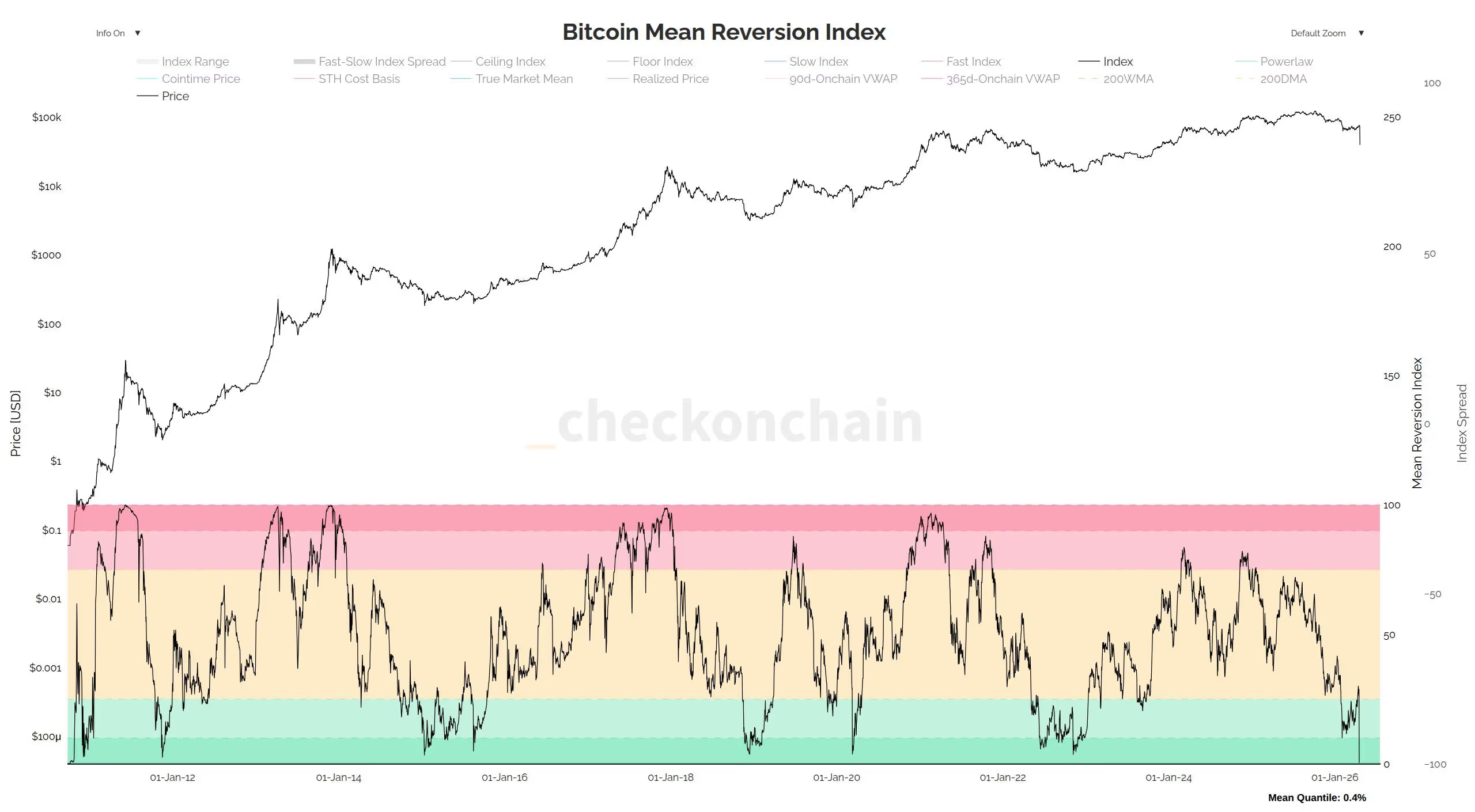
Bitcoin’s recent gains — it’s added almost 15% this month — aren’t enough to convince some industry observers that the largest cryptocurrency has escaped the bear market it entered in October. It is, after all, still 40% below its record.
There may be deeper drops to come, with some, unidentified, forecasters, predicting a drop to as low as $40,000, a 70% drop from its all-time high. The figure comes from bitcoin analyst James Check, who says such a move is unlikely. While not impossible, he said in a post on X, it would be statistically extraordinary.
“Just to make a point, for the bears who want to see $40k.
You may well end up right. However, consider that on a mean reversion basis, averaging relative to nine anchors (a mix of technical, onchain, trend, fast, slow etc), it is a Q 0.4 event.
Lower than $2 Bitcoin in 2011.”
After climbing over $126,000 in October, bitcoin slid more than 50% to around $60,000 in February before stabilizing. It was trading Friday near $78,000.
Talking to the bears, Check said their predictions warrant closer scrutiny.
Check points to the Bitcoin Mean Reversion Index, a composite model that averages multiple key valuation metrics, including the 200-week moving average, realized price, power law trend and a number of volume-weighted average price measures. The index ranks bitcoin’s price on a historical percentile basis.
When modeled at $40,000, bitcoin registers as a “0.4 event,” meaning it would fall in the 0.4th percentile of all daily closes.
“That’s below any meaningful deviation across all major anchors,” Check said.
For context, Check says that would be equivalent to bitcoin trading below $2 in 2011 on a relative basis. By contrast, today’s price sits around the 31.5th percentile, historically weak but within normal correction ranges.
“There’s no zero probability in markets,” Check added, “but this would be a near-unprecedented outcome.”

TLDR:
- Aave and partners submitted a governance proposal asking Arbitrum DAO to release 30,765.67 frozen ETH.
- The April 18 rsETH exploit created a backing shortfall of approximately 76,127 rsETH across the protocol.
- Released ETH would go to a 2-of-3 Gnosis Safe controlled by Aave Labs, KelpDAO, and Certora signers.
- The full governance process spans roughly 49 days before any ETH release can be formally executed.
Aave service providers, alongside KelpDAO, LayerZero, EtherFi, and Compound, have submitted a governance proposal to the Arbitrum DAO.
The proposal requests the release of 30,765.67 ETH frozen by the Arbitrum Security Council. The funds, frozen following the April 18 rsETH exploit, would go toward a coordinated cross-protocol recovery effort.
The goal is to restore rsETH’s backing and reduce losses for affected users across DeFi.
Arbitrum Governance Asked to Unlock Frozen ETH
The Arbitrum Security Council froze the ETH on April 21, 2026, moving it to a designated address after identifying the exploiter’s holdings.
A subsequent governance vote is required before any release can happen. The proposal was submitted on April 25, 2026, and is now open for community review and feedback.
Aave posted on X, stating that the proposal aims to direct the recovered funds into DeFi United, a coordinated recovery effort.
The post noted that releasing the ETH “would meaningfully advance the path to resolution as others confirm their commitments.” The Arbitrum community is invited to share feedback on the forum.
The LlamaRisk April 20 incident report confirmed the scale of the problem. The KelpDAO rsETH Unichain-to-Ethereum bridge released 116,500 rsETH on Ethereum without a corresponding burn on the source side.
At the time of the report, only 40,373 rsETH remained as confirmed backing for 152,577 rsETH in remote-chain claims, leaving a shortfall of approximately 76,127 rsETH.
The 30,765.67 ETH currently frozen on Arbitrum represents a material portion of what is needed to close that gap. Returning those funds to the recovery effort would directly reduce the backing shortfall and improve conditions for rsETH holders across multiple protocols.
Coordinated Recovery Effort Targets Full Collateralization
If the proposal passes, the ETH will be sent to a 2-of-3 Gnosis Safe at a designated recovery address. Signers from Aave Labs, KelpDAO, and Certora will control the multisig. The funds are intended solely for remediating losses from the exploit.
Within Aave’s Ethereum Core and Arbitrum markets, the exploiter supplied 89,567 rsETH and borrowed 82,650 WETH plus 821 wstETH against those positions. Aave’s smart contracts were not compromised, as the incident originated outside the protocol entirely.
The proposal timeline spans approximately 49 days in total. This includes a one-week forum discussion period, a Snapshot temperature check, a 14-day onchain vote, and various waiting and finalization periods across both L2 and L1.
No new treasury allocation is requested from Arbitrum DAO, as the ETH is already frozen and awaiting a governance decision on its destination.
A partial recovery would still reduce the shortfall proportionally, improving outcomes for affected users even if full collateralization is not immediately achieved.

The Commodity Futures Trading Commission (CFTC) has filed a lawsuit against New York to stop the state from applying its gambling laws to federally regulated prediction market platforms, escalating a growing clash over who has authority to oversee these products.
In a complaint lodged in the US District Court for the Southern District of New York, the CFTC argued that federal law gives it exclusive authority over these markets, asking the court for a declaratory judgment and a permanent injunction against New York’s enforcement actions.
“CFTC-registered exchanges have faced an onslaught of state lawsuits seeking to limit Americans’ access to event contracts and undermine the CFTC’s sole regulatory jurisdiction over prediction markets,” CFTC Chair Michael Selig said.
Earlier this week, New York filed suits against Coinbase and Gemini, claiming their offerings violated state gambling rules. The state had also previously targeted Kalshi, ordering it to halt parts of its sports-related contracts.
Related: Kalshi, Polymarket among 27 prediction platforms banned in Brazil
States say federal law doesn’t legalize sports betting
On Friday, a coalition of 37 states and Washington, D.C. filed an amicus brief supporting Massachusetts in its case against Kalshi, urging Massachusetts’ highest court to reject Kalshi’s argument that federal law allows it to offer sports betting nationwide without following state rules.
Kalshi argues its betting products are “swaps” regulated by a federal agency under a 2010 financial law. The states say that law was never meant to legalize or control sports betting and does not clearly override state authority, which has historically governed gambling.

37 states back Massachusetts in amicus brief. Source: New York Gov
The states also argue that removing state oversight would weaken protections. State laws currently handle licensing, age limits, fraud prevention, and gambling addiction, which are areas not covered by federal financial regulation.
Related: US appeals court upholds preventing New Jersey enforcement against Kalshi
States ramp up crackdown on prediction markets
State officials have taken a more aggressive stance against prediction markets in recent months, issuing cease-and-desist letters and pursuing legal action against firms offering prediction contracts.
States like Arizona, Connecticut and Illinois are seeking to enforce gambling laws against prediction platforms. Earlier this month, a Nevada judge extended a ban preventing Kalshi from offering event-based contracts in the state, siding with regulators who argue the products amount to unlicensed gambling.
Magazine: How to fix suspected insider trading on Polymarket and Kalshi

US spot Bitcoin ETFs continued to attract fresh capital, extending a nine-day inflow run through April 24 as investors piled into core crypto exposure through regulated vehicles. SoSoValue’s tracking shows about $2.12 billion of net inflows over the April 14–24 window, with the strongest single-day performance on April 17, when inflows reached $663.91 million. Other notable sessions included April 14’s $411.50 million and April 22’s $335.82 million.
The momentum wasn’t universal across all funds. Friday’s activity was comparatively modest, with net inflows of $14.45 million. Among the individual managers, BlackRock’s IBIT led the session with $22.88 million in inflows, while Fidelity’s FBTC recorded outflows of $1.69 million. Bitwise’s BITB and ARK 21Shares’ ARKB also posted outflows of $8.85 million and $9.02 million, respectively, with other products largely flat. The overall streak marks the first nine-day run for spot BTC ETFs since a similar burst in October, when inflows surged on consecutive days, including $1.21 billion on Oct. 6 and $875.6 million on Oct. 7.
Bitcoin’s market backdrop has helped sustain the flow. BTC was trading around $77,516.55, up roughly 10.7% over the past month, according to CoinMarketCap. The confluence of rising prices and regulated access appears to be reinforcing investor conviction that these products offer a stable exposure channel for crypto exposure within traditional portfolios.
Key takeaways
- Spot BTC ETFs posted roughly $2.12 billion in net inflows over April 14–24, marking a nine-day streak driven by broad-based institutional demand.
- Single-day highs included $663.91 million on April 17, with other strong days on April 14 ($411.50 million) and April 22 ($335.82 million).
- Not all funds participated equally; some concentrates like BlackRock’s IBIT led the day, while Fidelity’s FBTC and others faced outflows or flat flows.
- Overall, 2026 cumulative net inflows through spot BTC ETFs reached about $58.23 billion, signaling persistent demand despite a price backdrop below recent peaks.
- Ether ETFs mirrored BTC momentum with a nine-day inflow streak, though the run paused on April 23 with a net outflow of $75.94 million.
Bitcoin ETF investors stay the course amid volatility
The sustained inflows into spot BTC ETFs—despite Bitcoin trading well below its October highs—underscore a shift toward longer-term positioning among institutional investors. In a social post, ETF analyst Nate Geraci characterized the pattern as evidence of “diamond hands” behavior, where buyers maintain exposure through drawdowns rather than reacting to near-term volatility. SoSoValue data corroborate a broader theme: ETF participants are treating these products as core allocations rather than tactical bets, reinforcing a structural layer of demand that can help stabilize flows during pullbacks.
The takeaway for traders and builders is that regulatory-compliant access channels continue to resonate with the market’s risk tolerance. The steady flow suggests participants view spot BTC ETFs as a credible, long-horizon mechanism to gain exposure to Bitcoin without directly holding the asset, which can matter for liquidity, price discovery, and risk budgeting in diversified portfolios.
Ethereum exposure climbs in step, then eases
US spot Ether ETFs mirrored the BTC momentum, recording nine consecutive days of net inflows from April 14 through April 22. The strongest session occurred on April 17, when Ether ETFs attracted $127.49 million. Other notable days included April 22 with $96.44 million and April 20 with $67.77 million. The streak ended on April 23, when funds logged net outflows of $75.94 million, marking a reversal after a robust run.
The broader ETH narrative continues to draw attention to Ethereum’s ecosystem exposure alongside BTC. While the BTC rally anchors the narrative, Ether-based products offer market participants a way to diversify crypto risk and participate in the broader smart-contract platform theme with regulated vehicles. The data indicate a protective appetite for ETH exposure during the streak, followed by a pullback that may reflect shifting demand or tactical rebalancing across funds.
Where this leaves investors and markets next
Overall, the period pushed cumulative 2026 inflows into the BTC ETF space to a sizable sum—roughly $58.23 billion, according to SoSoValue—highlighting a durable appetite for regulated crypto access. The juxtaposition of rising inflows against a still-substantial price gap from the all-time highs may indicate that investors view these products as stabilizing anchors for long-term crypto exposure, rather than merely chasing immediate price moves.
As for Ether, the nine-day inflow streak followed by a pause raises questions about the durability of ETH-related demand in the near term. Market participants will be watching for fresh data in early May to see whether inflows resume and how price dynamics for ETH influence further fund flows, particularly as Ethereum-related fundamentals and network activity continue to evolve.
Looking ahead, the key watchpoints will include how policymakers and regulators respond to evolving ETF structures, how primary-market flows interact with secondary-market liquidity, and whether next-month data reinforce the current pattern of steady, institutionally oriented capital entering spot crypto ETFs. For readers, the signal remains clear: regulated products are increasingly central to how major investors gain and manage crypto exposure, even as volatility persists.
Cointelegraph remains committed to transparent reporting and will continue tracking ETF inflows, price action, and regulatory developments to help readers gauge the evolving dynamics of crypto-market access.

AI, fungi, and the future of enterprise tech: Industry vet Bill Hilf on his debut novel, ‘The Disruption’

The Most Racist Woman On Financial Audit

Eight-year-old suffers cuts and bruises in Hartlepool hit-and-run

Manchester United reach agreement with Casemiro over contract clause amid transfer speculation

US brings back mandatory military draft registration

Steven Gerrard disagrees with Gary Neville over ‘shock’ Chelsea and Arsenal claim | Football


-

 Business6 days ago
Powerball Result April 18, 2026: No Jackpot Winner in Powerball Draw: $75 Million Rolls Over
-

 Politics6 days ago
Zack Polanski demands ‘council homes not luxury flats for foreign investors’
-

 Fashion22 hours ago
Weekend Open Thread – Corporette.com
-
Entertainment6 days ago
NBA Analyst Charles Barkley Chimes in on Ice Spice McDonald’s Fiasco
-

 Tech7 days ago
Auto Enthusiast Scores Running Tesla Model 3 for Two Grand and Turns It Into Bare-Bones Go-Kart
-

 Politics5 days ago
Gary Stevenson delivers timely reminder to register to vote as deadline TODAY
-

 Politics3 days ago
Making troops accountable for war crimes threatens US alliance, ex-SAS colonel warns
-

 Business3 days ago
Rolls-Royce Voted UK’s Most Iconic Trade Mark as IPO Register Hits 150
-

 Politics3 days ago
Disabled people challenge government SEND proposals over segregation concerns
-
Crypto World5 days ago
Bank of Hawai’i (BOH) Q1 2026: Net Income Drops to $57.4M as Net Interest Margin Expands
-

 Politics3 days ago
Zack Polanski responds to home secretary’s taser threat
-
Politics3 days ago
Wings Over Scotland | How To Get Away With Crimes
-

 Politics3 days ago
Starmer handler McSweeney to be dragged from shadows by Foreign Affairs Committee
-
Crypto World7 days ago
Kelp DAO rsETH Bridge Hack Drains $292M as DeFi Losses Top $600M in Two Weeks
-

 Politics3 days ago
‘Iran is still a nuclear threat’
-

 Crypto World4 days ago
New York sues Coinbase, Gemini over prediction market offerings
-
 Crypto World4 days ago
Five Value Stocks with Recovery Potential in 2026: PayPal (PYPL), Nike (NKE), and More
-

 Business3 days ago
The Job Benefits Most Men Don’t Know to Negotiate
-

 Crypto World1 day ago
Michael Saylor says BTC winter is over. Market analyst disagrees, says bitcoin was in a pullback
-

 Politics6 days ago
Reform investigating candidate who ‘hates’ the NHS
You must be logged in to post a comment Login