
Crypto World
Brazil central bank orders daily crypto exchange asset proof by 2027



Brazil’s central bank will force licensed crypto exchanges to prove asset sufficiency daily from Jan. 1, 2027.
Summary
- Brazil’s central bank will require daily asset sufficiency reports from licensed crypto exchanges starting Jan. 1, 2027
- New rules mandate full segregation of client and platform assets, plus on‑balance‑sheet recognition of crypto under a dedicated accounting manual
- The announcement comes as major assets like BTC and ETH trade lower amid broader risk‑off sentiment in crypto markets
Brazil’s central bank has introduced a new regulatory framework that will require all licensed cryptocurrency trading platforms in the country to submit daily reports proving they hold sufficient assets to cover operational and security risks, starting Jan. 1, 2027. The measures, published via market communications on March 3, target exchanges’ resilience against hacking, operational failures, and misuse of client funds by aligning crypto intermediaries with commercial banking standards on capital, data protection, and confidentiality. The rules also expand oversight of cross‑border flows and aim to tighten controls on how crypto assets are recorded on balance sheets, signaling a more stringent, bank‑style prudential regime for Brazil’s growing digital asset sector.
Under the new framework, exchanges operating in Brazil will need to deliver daily attestations demonstrating they have adequate fiat and crypto reserves to withstand cyberattacks, liquidity shocks, and other material risks associated with running a trading venue. Supervisors are expected to use these reports to monitor whether platforms maintain asset sufficiency in line with internal risk models and regulatory expectations, reducing the likelihood that a sudden shortfall in funds will cascade into customer losses. The move reflects lessons learned from high‑profile failures of offshore exchanges, where lack of transparency around reserves and intra‑group flows contributed to insolvencies and prolonged withdrawals.
A core pillar of the regime is the strict segregation of customer and platform assets. Exchanges must fully separate their own fiat and cryptocurrency accounts from those belonging to clients, preventing the commingling of operational capital with custodied funds. This requirement is designed to make it harder for platforms to rehypothecate or use customer balances for proprietary trading or unsecured lending, while giving regulators a clearer view of which assets are legally attributable to users in the event of resolution or bankruptcy. In practice, this pushes Brazilian exchanges closer to a custodial model, in which they act as fiduciaries for client holdings rather than counterparties taking balance‑sheet risk.
Regulators are also mandating that crypto assets be recognized on exchanges’ balance sheets under a specialized accounting manual tailored to digital instruments. Instead of treating crypto solely as off‑balance‑sheet custodial items, platforms will have to follow standardized guidance on classification, valuation, and impairment, making financial statements more comparable across the sector. This step aligns Brazil with an emerging global trend, where supervisors in jurisdictions influenced by frameworks like MiCA are pushing for consistent accounting treatment of tokens held or intermediated by regulated entities. By clarifying how assets and liabilities are booked, authorities hope to reduce information asymmetries between exchanges, investors, and auditors.
Beyond balance‑sheet transparency, the new rules extend to data protection and confidentiality obligations that mirror those imposed on commercial banks. Exchanges will be required to implement robust controls around customer data, transaction records, and internal communications, limiting the risk of leaks or unauthorized access. This is particularly relevant in a market where on‑chain and off‑chain identifiers can be combined to build detailed profiles of user behavior, creating potential targets for cybercrime and surveillance. Treating crypto platforms more like banks in this respect underscores the central bank’s view that large exchanges play systemically important roles in Brazil’s retail investment and payments landscape.
In addition to domestic prudential rules, Brazilian authorities will impose tighter restrictions and audits on cross‑border transfers involving crypto assets. Exchanges facilitating international flows will face enhanced scrutiny of the origin and destination of funds, as well as the on‑chain pathways used to move value between wallets and jurisdictions. Supervisors intend to leverage blockchain analytics and reporting obligations to improve the traceability of transactions, making it more difficult for actors to use crypto for money laundering, tax evasion, or financing criminal networks.
This focus on traceability echoes steps taken in other jurisdictions, where regulators have pushed intermediaries to adopt travel‑rule style data sharing and transaction monitoring standards. In Brazil’s case, the central bank is likely to coordinate with tax authorities, financial intelligence units, and international partners to harmonize reporting formats and risk indicators. Exchanges will need to build or integrate compliance systems capable of flagging suspicious cross‑border flows in near real time, while maintaining sufficient documentation to satisfy audits.
The policy shift comes as global regulators intensify their attention on crypto intermediaries rather than solely targeting individual users or protocol‑level activity. Recent measures in countries such as Turkey and Japan have focused on taxation and anti‑money‑laundering controls for both centralized platforms and related service providers, reflecting concern that unregulated gateways can undermine existing capital flow and sanctions regimes. Brazil’s approach, anchored in its central bank, positions the country among those seeking to fold crypto markets into the perimeter of traditional financial supervision instead of relying purely on securities‑style oversight.
For exchanges, the daily reporting requirement and asset segregation rules will likely increase operational costs, particularly for smaller platforms that lack sophisticated risk management and compliance teams. They may need to hire additional staff, upgrade custody solutions, and integrate third‑party tools for reserve verification and transaction monitoring. Larger venues with existing institutional infrastructure, including those already serving global clients or partnering with firms like Coinbase or Visa, may find it easier to absorb these changes and use compliance as a competitive differentiator. Over time, the regulatory burden could accelerate consolidation in Brazil’s exchange market as less capitalized players exit or merge.
Market participants will be watching how the new framework interacts with broader trends in crypto prices and liquidity. At the time of the announcement, BTC and ETH were trading lower amid a wider drawdown across major tokens, with selling pressure reflecting both macro risk‑off conditions and positioning after recent rallies. While the rules do not target any specific asset like SOL, the signal that a large emerging‑market economy is imposing bank‑grade standards on exchanges could affect perceptions of regulatory risk and premium in local markets. Some institutional investors may view the clarity as a positive step toward de‑risking on‑ramp exposure, while retail traders could initially focus on potential costs or friction.
On‑chain data and exchange volume metrics in the coming months will provide clues about how Brazilian users respond to the new regime. If domestic platforms see sustained or rising spot and derivatives activity despite tighter controls, it may indicate that users value the added protections and are willing to trade under stricter oversight. Conversely, a notable shift toward offshore venues or direct peer‑to‑peer markets would suggest that some traders prefer less regulated channels, even at the cost of legal certainty. For regulators, the challenge will be calibrating enforcement and implementation timelines to avoid sudden disruptions while still closing gaps that have historically allowed misuse of crypto rails.
The Brazilian central bank’s push to require daily proof of asset sufficiency, strict client fund segregation, and enhanced cross‑border audits underscores a broader policy objective: integrating crypto asset intermediaries into the core of the country’s financial system without granting them a regulatory free pass. By aligning exchanges with commercial banking standards on reporting, data protection, and accounting, authorities hope to reduce systemic risk while preserving the innovative aspects of digital asset markets. How effectively exchanges adapt to this new environment will shape both the structure of Brazil’s crypto industry and its role in the global digital finance ecosystem over the next several years.



Crypto asset manager 21shares sees actively managed exchange-traded products as the next phase of crypto investing, as the market matures beyond simple price-tracking funds.
Duncan Moir, president of 21shares, told Cointelegraph in an exclusive interview that because crypto is a nascent and growing asset class, it is particularly well suited to active management.
He said the company combines bottom-up research on individual assets with quantitative and discretionary top-down strategies to manage risk and position portfolios, adding that 21shares has been expanding its portfolio management and trading teams to support more sophisticated products.
We’ve had to hire and build out the team with people who have different trading and portfolio management expertise, but now we have a solid team and we think we’ll be able to deliver strong actively managed products.
Active ETFs worldwide held nearly $1.8 trillion in assets at the end of 2025, according to data compiled by Morningstar and Goldman Sachs Asset Management.
Moir added that integration with FalconX, which acquired 21shares in October, is expected to accelerate product development, particularly as the company expands into more complex offerings.
Demand for crypto ETPs and ETFs varies by region, Moir told Cointelegraph. He said:
The interest is still concentrated in the larger coins in the US. In Europe, institutional clients are more interested in newer assets and the application layer beyond the layer-1s.
He attributed the divergence to a more mature investor base in Europe, where institutions that already hold Bitcoin (BTC) and Ether (ETH) are increasingly looking to expand their crypto allocations.
Against that backdrop, 21shares recently launched an exchange-traded product in Europe linked to Strategy’s preferred stock (STRC), offering exposure to a high-yield instrument linked to the company’s Bitcoin-focused capital strategy.
Moir said the product has seen strong early demand across multiple regions, reflecting investor appetite for yield-generating assets that are easier to access through traditional brokerage platforms.
Related: Crypto ETF inflows slow to $230M as Fed caution dents momentum: CoinShares
Crypto ETPs evolve beyond passive exposure
As the crypto ETP and ETF market matures, issuers are moving beyond simple price tracking, with more complex structures emerging across the US and Europe.
One area gaining traction is staking, a process that allows investors to earn yield by locking up crypto assets to help secure blockchain networks. In October, Grayscale introduced staking across its ETPs, making its Ether funds the first US-listed spot crypto ETFs to offer staking rewards while extending the feature to its Solana trust pending ETP approval.
In March, asset manager BlackRock launched a Nasdaq-listed Ethereum product that incorporates staking, combining spot Ether exposure with yield generation. The fund recorded $15.5 million in trading volume on its first day.
As new exchange-traded products come to market, Moir said 21shares evaluates potential launches based on three factors: internal research, client demand and broader market trends, with its research team identifying early opportunities and institutional feedback helping gauge interest.
“The third is where we see trends going in the future,” he said, adding that this can result in either niche, single-asset products or broader thematic offerings depending on conviction.
Moir pointed to the company’s Bitcoin-and-gold ETP as an example of that approach in practice. While recently cross-listed in London, the product has been live for four years and, he said, has delivered some of the strongest risk-adjusted returns among European ETPs.
From a portfolio perspective, the combination “just makes total sense,” he added, citing its diversification benefits across Bitcoin and gold.
Magazine: Banks want to run Vietnam’s crypto exchanges, Boyaa’s $70M BTC plan: Asia Express


Tether hires a Big Four firm for the first full financial audit of $184b USDT reserves, aiming to reset stablecoin transparency and institutional trust.
Summary
- Tether has formally engaged a Big Four accounting firm to conduct its first full independent financial statement audit, the company announced March 24.
- With over $184 billion in USDT market capitalization and more than 550 million users globally, the audit is expected to be the largest inaugural audit in financial markets history.
- CEO Paolo Ardoino and CFO Simon McWilliams say the milestone signals a new benchmark for transparency and institutional accountability in the digital asset industry.
Tether, the issuer of the world’s largest stablecoin by market capitalization, announced on March 24 that it has entered a formal engagement with a Big Four accounting firm to complete its first-ever full independent financial statement audit — a move company leadership describes as the biggest inaugural audit in the history of financial markets.
The announcement marks a turning point for Tether, which has long faced scrutiny over its reserve transparency. USDT currently circulates at a market cap exceeding $184 billion, underpinning a global user base of more than 550 million people. Despite publishing quarterly attestations through BDO Italy in recent years, critics and institutional investors have consistently demanded a more rigorous, comprehensive audit — one that only the Big Four tier of accounting firms can credibly deliver.
Tether’s Decade of Scrutiny
Questions about whether each USDT token is truly backed 1:1 by dollar-denominated reserves have followed Tether since the stablecoin’s launch in 2014. The collapse of multiple major exchanges and lending platforms between 2022 and 2024 heightened calls for deeper accountability. Attestations, while standard practice across the stablecoin sector, fall well short of the full scope and independence of a financial statement audit. Tether’s own press release acknowledged this gap directly, noting that “while others in the industry have settled for the minimum viable level of transparency, Tether is building the architecture against which the next generation of global financial standards will be measured.”
Tether’s path to this engagement was deliberate. The appointment of Simon McWilliams as Chief Financial Officer in early 2025 was specifically intended to build the internal financial architecture required to meet Big Four standards. According to McWilliams, the selection process was competitive. “The Big Four firm was selected through a competitive process because the organisation is already operating at Big Four audit standard; the audit will be delivered,” he said in the company’s official statement.
CEO Paolo Ardoino framed the decision in terms of accountability to Tether’s global user base. “Trust is built when institutions are willing to open themselves fully to scrutiny,” Ardoino said. “This audit represents years of work to strengthen our systems so that Tether can meet the highest standards applied in global finance. For the hundreds of millions of people and businesses who rely on USD₮ every day, this audit is not just a compliance exercise; it is about accountability, resilience, and confidence in the infrastructure they depend on.”
As part of the audit onboarding, which concluded several weeks ago, the engaged firm conducted a comprehensive assessment of Tether’s systems, internal controls, and financial reporting. Multiple Big Four firms reportedly expressed interest in the engagement — a signal, Tether argues, of the audit’s significance to the broader industry.
Tether also noted it will be moving listed securities over the coming days as part of the reserve optimization process. The ongoing expansion of Tether’s broader portfolio — which includes over 140 investments and a USDT float sitting near $185 billion — means the audit will cover a uniquely complex mix of digital assets, traditional reserves, and tokenized liabilities. The company holds, among other things, 140 tons of gold in a Swiss vault worth approximately $23 billion, and has co-led a $7.5 million financing round in Utexo to build native USDT settlement on the Bitcoin and Lightning networks.
The identity of the specific Big Four firm has not been disclosed. Tether said the full audit will provide “complete visibility into the strength and positioning” of its reserves — and, if completed as described, would represent a watershed moment not just for USDT, but for institutional confidence in the stablecoin sector writ large.
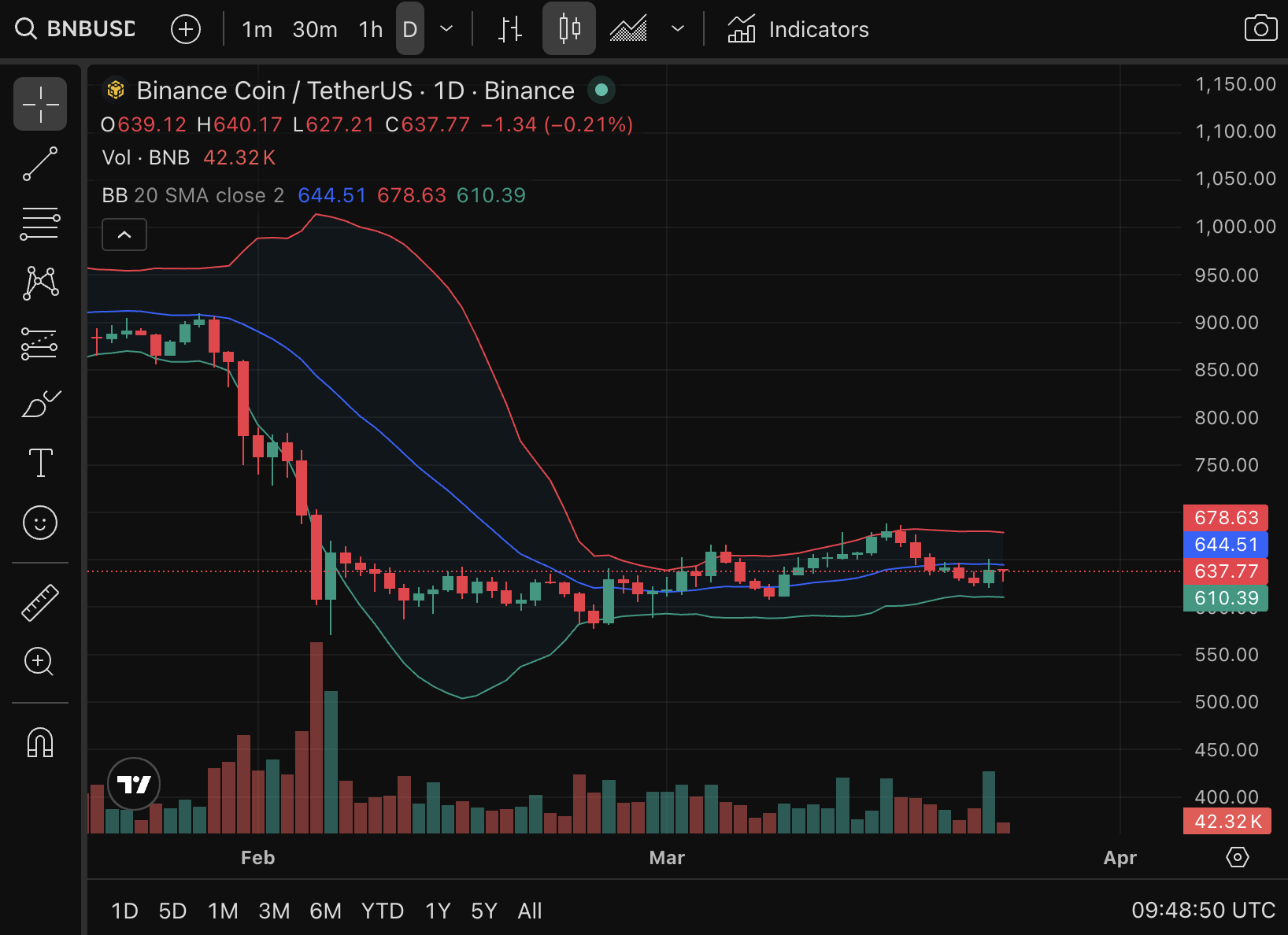
BNB price is trading at $634, posting more than 2% gain over the last 24 hours as prediction and momentum shift back to the buy side. The asset has recovered from its previous close, supported by trading volume of $1.6 billion.
This surge in participation suggests institutional rotation is active as the token has stabilized since last year. The market is asking one question: Is this a dead-cat bounce or the start of a run to the $728 monthly target?
The technical posture remains cautiously optimistic. While the crypto market displays volatility, BNB’s ability to hold above $620 indicates structural strength. We are now watching the immediate ceiling at $650. A clean break here validates the bullish thesis, while a rejection could see a retest of the $590 support bound.
Can Binance Coin Maintain Momentum Above $635? Here’s Our BNB Price Prediction
Current price action places BNB USD in a neutral-to-bullish zone. The Relative Strength Index (RSI) reads 50 on the daily, a level that leaves ample room for upside without triggering overbought alarms.
The immediate battleground is the 50-day moving average at $645, with BNB currently trading just below this pivot point. If bulls can reclaim this level on closing volume, the path opens toward the upper Bollinger Band at $678. Breaking this resistance is essential to unlocking the monthly forecast of $730, which represents a 13% potential upside. Conversely, failure here could see the price slip back toward the $590 lower band support.

Historical data reinforces the importance of the $648 resistance level. In previous cycles, volume confirmation above this price point has often preceded double-digit percentage rallies. We should monitor the volume metric; sustaining this liquidity is vital for breaking the psychological sell walls established earlier this quarter.
Discover: The best crypto to diversify your portfolio with
LiquidChain Targets Early Mover Upside as BNB Stabilizes
While BNB offers established stability with a forecasted 13% monthly upside, capital often rotates into infrastructure plays offering higher beta returns during recovery phases. The logic is simple: while large-cap assets like BNB battle heavy resistance at $650, emerging protocols solving fragmentation issues can capture aggressive speculation before price discovery matures.
This dynamic is drawing attention to LiquidChain ($LIQUID), a Layer 3 infrastructure project currently in its presale phase. Unlike standard Layer 2s, LiquidChain fuses Bitcoin, Ethereum, and Solana liquidity into a unified execution environment. The project has raised more than $600K to date, pricing its native token at $0.0143 with more than 1700% APY rewards.
The project’s premise addresses the liquidity fracture slowing down DeFi adoption. By acting as a Cross-Chain Liquidity Layer, it attempts to merge the security of BTC with the speed of SOL and the ecosystem of ETH.
Those interested in the protocol’s approach to verifiable settlement can research the LiquidChain presale here.
Disclaimer: Cryptocurrencies are high-risk assets. This article is for informational purposes and does not constitute financial advice. Invest only what you can afford to lose.
The post BNB Price Prediction: Monthly Target Challenges Resistance appeared first on Cryptonews.
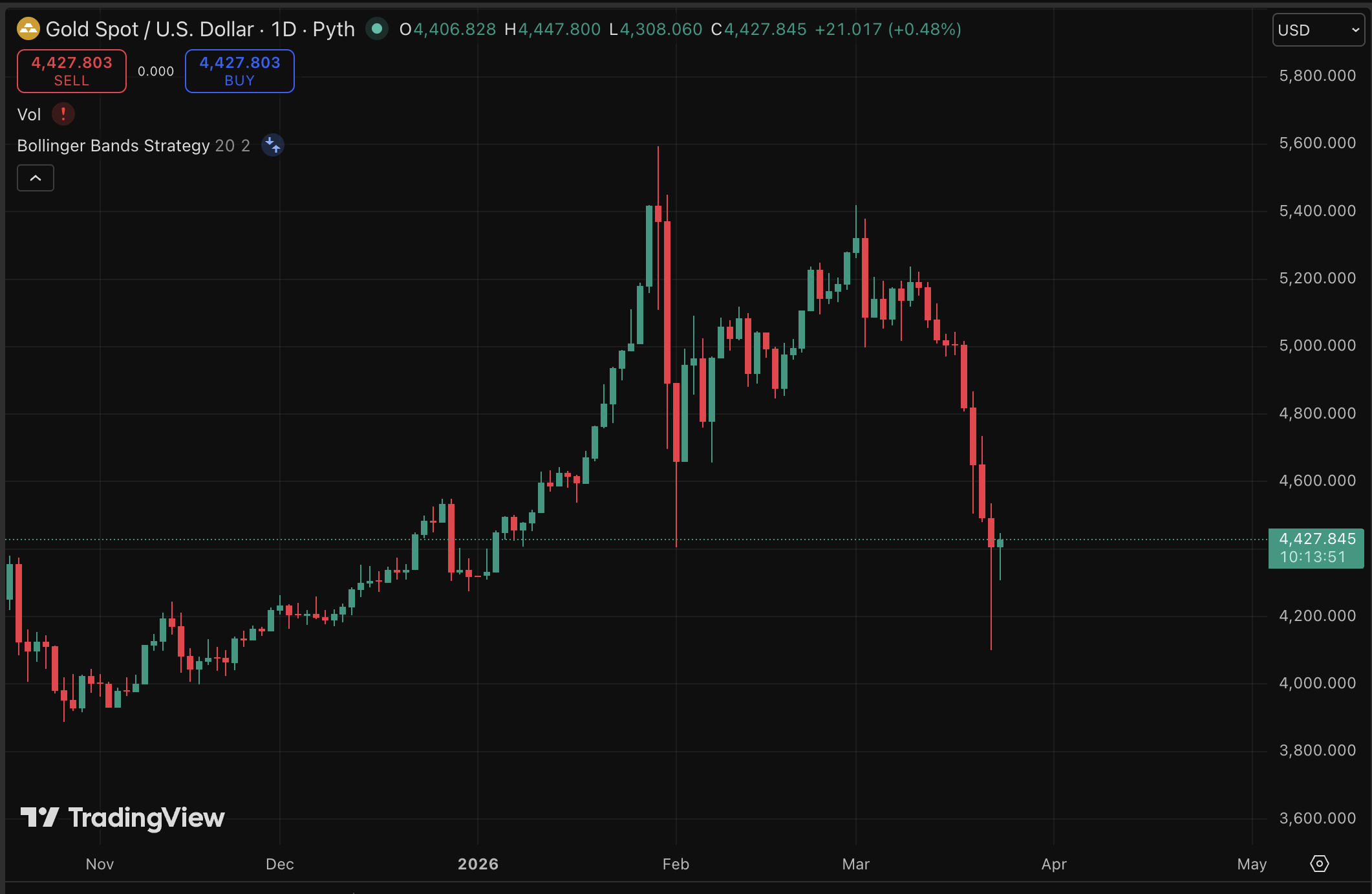
Safe-haven assets are defying historical correlations and analysis this week, with the gold price plummeting nearly 20% from its ATH while Bitcoin shows surprising relative strength in a risk-off environment.
As geopolitical tensions escalate, Bitcoin has retraced to trade at just at $71,000, it is significantly outperforming the precious metal, which has moved in lockstep.
This decoupling, usually, Gold rises during war scares, has left traditional investors scrambling. The market is digesting rapid-fire catalysts ahead of today’s G7 meeting. While legacy hedges bleed, on-chain data highlights specific pockets of immense speculation; AI-meme token SIREN surged 76.6% in 24 hours to $1.62. This volatility suggests capital isn’t leaving the ecosystem; it is rotating aggressively.
Discover: The best pre-launch token sales
Gold Price Analysis: A Signal To a Broader Liquidity Crunch?
The 20% drawdown in Gold prices from its ATH signals a liquidity crisis rather than a failed safe-haven narrative; investors are selling what they can, not just what they want to. Bitcoin’s dominance remains high at 58.6%, yet it faces immediate resistance at prior support levels.
Analysis of the gold price crash suggests that if XAU fails to reclaim its weekly support, the correlation with risk assets could deepen, dragging crypto lower in the short term.

Conversely, crypto-specific dynamics are painting a mixed picture. Santiment data predicts a potential “re-accumulation phase,” betting on a breakout triggered by upcoming regulatory clarity around the “Clarity Act.”
Technically, Bitcoin needs to reclaim the $72,000 zone to stabilize the altcoin bleed. If it fails, the 4.5% divergence between BTC and Gold may close rapidly. However, macro factors affecting silver and gold indicate that the traditional finance sector is currently under more stress than the digital asset market.
Discover: The best pre-launch token sales
LiquidChain Consolidates Cross-Chain Liquidity as Macros Widen
As traditional hedges like Gold falter and L1s struggle with fragmentation, smart money is increasingly targeting infrastructure plays that abstract complexity.
The thesis is simple: regardless of whether Bitcoin or Solana leads the next leg up, the rails connecting them will capture value. This narrative is driving early inflows into LiquidChain ($LIQUID), a Layer 3 infrastructure project designed to unify liquidity across Bitcoin, Ethereum, and Solana.
Unlike standard bridges that wrap tokens with high contagion risk, LiquidChain utilizes a “Deploy-Once Architecture.” This allows developers to write code once and access users and liquidity on all three major chains simultaneously using a Unified Liquidity Layer. The protocol promises verifiable settlement and single-step execution, addressing the exact fragmentation issues making current markets inefficient.
The presale data reflects this demand for infrastructure consolidation. LiquidChain has already raised more than $600K from early investors. The current entry price sits at $0.0143 with more than 1700% APY in staking rewards.
Disclaimer: Crypto is a high-risk asset class. This article is provided for informational purposes and does not constitute investment advice. You could lose all of your capital.
The post Gold Price Analysis: Crypto Decoulpling From Safe-Haven appeared first on Cryptonews.


Summary
- Research firm Bernstein says Bitcoin has likely found a cycle bottom and is reiterated its $150,000 year-end price target, describing the current drawdown as the “weakest bear case” in the asset’s history.
- BTC is trading around $70,668, roughly 40% below its all-time high, but Bernstein argues the correction reflects a temporary confidence crisis rather than any structural breakdown.
- Strategy (formerly MicroStrategy) — which holds approximately 3.6% of Bitcoin’s total supply, worth around $53.5 billion — has continued buying at recent lows, raising $7.3 billion in 2026 alone to expand its holdings.
Research and brokerage firm Bernstein, which manages approximately $867 billion in assets, declared on March 24 that Bitcoin’s (BTC) price bottom is likely in and maintained its end-of-2026 price target of $150,000 — implying more than a 100% gain from current levels — as the firm’s analysts argued the ongoing selloff is categorically different from every bear market Bitcoin has previously endured.
Lead analyst Gautam Chhugani described the current pullback as “the weakest Bitcoin bear case in its history,” pointing to what the firm sees as a temporary crisis of investor confidence rather than any deterioration in Bitcoin’s underlying fundamentals. With BTC trading around $70,668 at time of writing — down roughly 40% from its peak — Bernstein’s conviction remains intact.
A Different Kind of Drawdown
The framing is a deliberate break from how past bear markets have been characterized. Previous Bitcoin cycles saw far more violent collapses: the 2013 peak near $1,150 was followed by an 84% drawdown, the 2017 high of $20,000 preceded a 77% decline, and the 2021 peak near $69,000 gave way to a roughly 70% correction. By comparison, the current drawdown of around 40% looks restrained — and Bernstein argues it is, structurally speaking, far less dangerous.
The key differentiators, according to the firm, are the maturation of institutional flows and a more favorable policy environment. Spot Bitcoin ETF adoption continues to expand, corporate treasury participation is accelerating, and the U.S. political backdrop has shifted in a direction broadly viewed as supportive of digital assets. None of the systemic failures that defined 2022 — collapsed exchanges, insolvent lenders, contagion — are present in the current cycle.
Strategy and On-Chain Signals
Strategy’s continued accumulation at depressed prices is cited as a key supporting data point. The company now holds approximately 3.6% of Bitcoin’s total circulating supply, valued at around $53.5 billion, and has raised $7.3 billion in 2026 specifically to expand its Bitcoin treasury. Bernstein views Strategy as a high-beta vehicle with a structurally resilient balance sheet, noting that only an extreme scenario — BTC falling to $8,000 and remaining there for five years — would require any balance sheet restructuring.
On-chain data adds further context. Analyst Ali Charts pointed to Bitcoin approaching the 0.8 MVRV ratio band, a level situated between $56,000 and $60,000 that has historically served as a launchpad for major rallies: +963% in 2017, +261% in 2018, +1,126% in 2020, and +660% following the FTX collapse in 2022. CryptoQuant analyst Crypto Dan echoed the sentiment, arguing that reduced participation and fading retail interest are “textbook bear market” indicators — but historically, accumulation phases rather than exit points. “A bear market is not a time to give up. It is the time to prepare for the next bull cycle,” he wrote on X.
Where Analysts Diverge
Not everyone shares Bernstein’s confidence. VanEck CEO Jan VanEck told CNBC in early March that while a bottom may be forming, 2026 represents Bitcoin’s typical fourth-year bear cycle, consistent with historical halving patterns. Some traders argue that failure to reclaim and hold above $70,000 could open the door to a deeper leg lower, potentially retesting the $60,000 level that has emerged as the most closely watched structural support.
Bernstein’s $150,000 target, first established when Bitcoin was trading at significantly higher levels, aligns with a broader cluster of institutional 2026 price forecasts that include $150,000 from BSTR President Katherine Dowling and $180,000 from Ripple CEO Brad Garlinghouse. Longer term, Bernstein maintains a target of $1 million by 2033.


The issuer of the largest stablecoin by market cap has been under scrutiny for years for not conducting a full financial audit
Tether announced on Tuesday that it has engaged a Big Four accounting firm to conduct what the firm says is its “first full independent financial statement audit.” The issuer of USDT, the largest stablecoin by market cap with over $184 billion, did not name which specific firm would conduct the audit, and described it as potentially the largest inaugural audit in financial markets history.
The company, which reports a global user base of more than 550 million, said the engagement follows a competitive onboarding process during which multiple audit firms assessed Tether’s systems, internal controls, and financial reporting.
The move comes after years of criticism over Tether’s transparency practices. Rather than full audits, Tether has historically provided quarterly attestations from BDO Italia — a more limited form of financial review. In 2021, the Commodity Futures Trading Commission (CFTC) issued a $41 million fine over misleading claims that USDT was fully backed by U.S. dollars.
No timeline for completion of the audit was disclosed in today’s announcement.
As The Defiant reported in 2023, then-CTO Paolo Ardoino — now CEO — attributed the lack of a full audit in part to difficulties with auditing firms themselves.
More recently, both the EU’s MiCA framework for digital asset regulation and the U.S. stablecoin-focused GENIUS Act have included provisions calling for full reserve backing and transparent audits of stablecoin issuers, as The Defiant reported previously. In November, S&P Global downgraded USDT’s dollar-peg stability score to its lowest mark, citing growing exposure to higher-risk assets.
Tether credited the appointment of CFO Simon McWilliams in early 2025 as key to preparing the company’s internal architecture for a full audit, per today’s announcement. McWilliams said the firm was “selected through a competitive process because the organisation is already operating at Big Four audit standard.”
The announcement comes alongside Tether’s broader push into the U.S. market. Last August, the company hired Bo Hines, former executive director of the White House Crypto Council, as a strategic advisor overseeing its U.S. expansion. More recently, Tether invested $200 million in commerce platform Whop, building on the launch of its regulated U.S. stablecoin USAT, which it first unveiled in September.
This article was written with the assistance of AI workflows. All our stories are curated, edited and fact-checked by a human.
Key takeaways:
-
Investors dumped gold and bonds for cash as war-driven oil spikes and inflation forced a defensive market stance.
-
Rising yields and a 20% rate hike chance signal a tight outlook, leaving Bitcoin vulnerable amid soaring US debt.
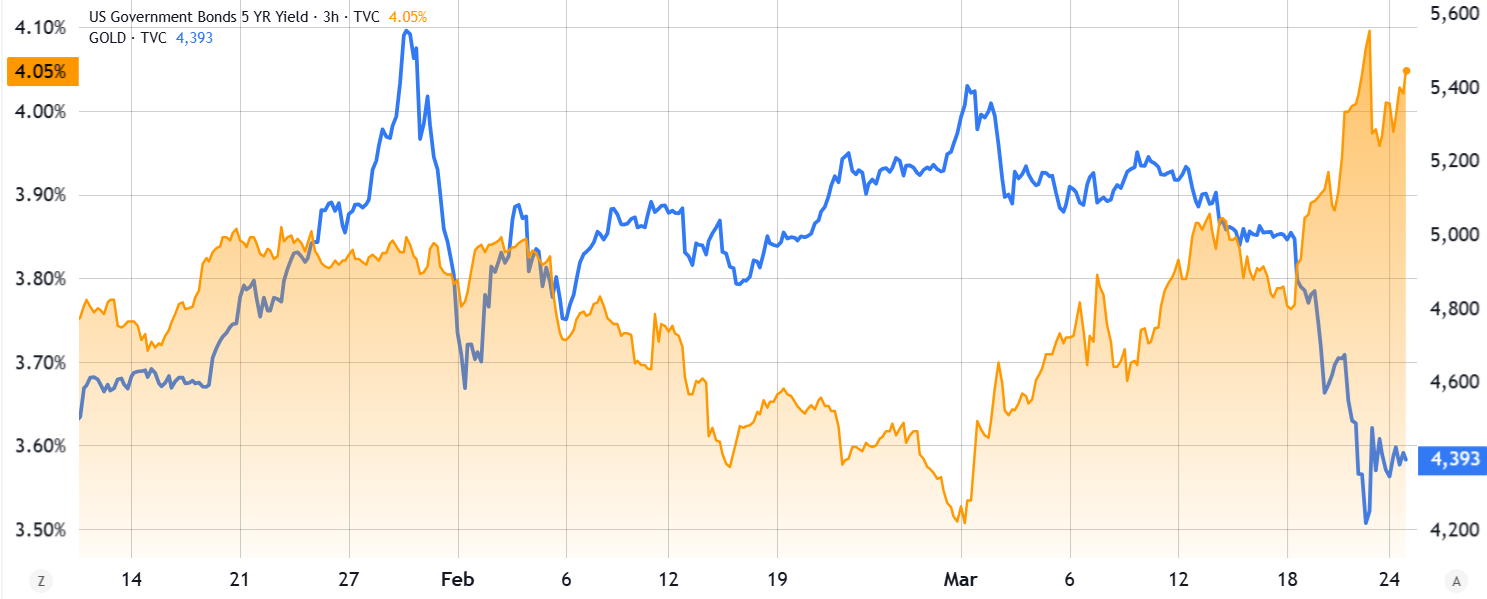
Bitcoin (BTC) retested the $67,500 support level on Monday, a move that coincided with gold prices suffering their sharpest correction in over 50 years. Fears of a prolonged war in Iran and the inflationary impact of oil prices holding above $85 pushed investors to cut risk.

US Treasuries also faced a sell-off during this period, suggesting that traders aggressively built cash positions. Yields on the US 5-year Treasury jumped to 4.10%, marking a nine-month high as traders demanded better returns. With the S&P 500 hitting its lowest point in over six months on Monday, evidence suggested a broad rush to liquidity.
Cash is king amid economic uncertainty, while Bitcoin risks further downside
Investors appeared to be raising cash either to cover recent losses or to brace for further price drops across risk markets.

The ongoing war in Iran pushed oil prices past $90, creating inflationary pressure. The Wall Street Journal reported that the US planned to deploy roughly 3,000 troops to the Middle East to counter Iran’s influence over the Strait of Hormuz. Part of the decline in gold prices was likely linked to fading expectations for US monetary policy easing in the near term.

Bond market futures showed that the implied probability of the Federal Open Market Committee (FOMC) hiking interest rates by July surged to 20.5%, up from 0% just one week prior. Investors anticipated a cooling job market as high interest rates continued to reduce corporate expansion incentives.
Tech stocks fall, inflation hurts consumers
US legislators debated an additional $200 billion in funding to support the war in Iran, according to The Washington Post. Kevin Hassett, director of the US National Economic Council, stated that $12 billion had already been spent. Lawmakers did not authorize the war, and Congress showed growing unease with the military strategy, according to AP.
Meanwhile, the US national debt soared past $39 trillion, which further pushed consumers toward a cost-of-living crisis. Fear of excessive speculative investment in the artificial intelligence sector emerged after Reuters reported that ChatGPT maker OpenAI offered private-equity firms a guaranteed minimum return of 17.5% while the company remained largely unprofitable.

Some of the world’s largest tech companies faced losses of 10% or more over the past six weeks, including Google (GOOG US), Meta (META US), and IBM (IBM US). Thus, regardless of the sharp correction in gold prices, traders increasingly feared recession risks or a surge in inflation above the 4% fixed income returns.
Related: Bitcoin holders shift from panic to cash-buffer discipline as volatility deepens
The combination of declining stock prices and persistent inflationary pressure explained why investors aggressively sought the safety of cash positions.
Regardless of favorable Bitcoin onchain metrics, broader macroeconomic conditions remained unfavorable for sustainable bullish momentum. The decline in gold prices while investors offloaded US Treasuries served as a sign of risk aversion. The odds of a $66,000 retest remain a serious threat, at least until inflation and war expenses hold US monetary policy tight for a longer period.
This article does not contain investment advice or recommendations. Every investment and trading move involves risk, and readers should conduct their own research when making a decision. While we strive to provide accurate and timely information, Cointelegraph does not guarantee the accuracy, completeness, or reliability of any information in this article. This article may contain forward-looking statements that are subject to risks and uncertainties. Cointelegraph will not be liable for any loss or damage arising from your reliance on this information.
Circle stock fell 19% after the latest Senate draft of the Clarity Act included restrictions on stablecoin yield.
Crypto markets dipped slightly on Tuesday as geopolitical uncertainty persisted and investors considered the implications of the U.S. Senate’s revised draft of the crypto market structure bill, or Clarity Act.
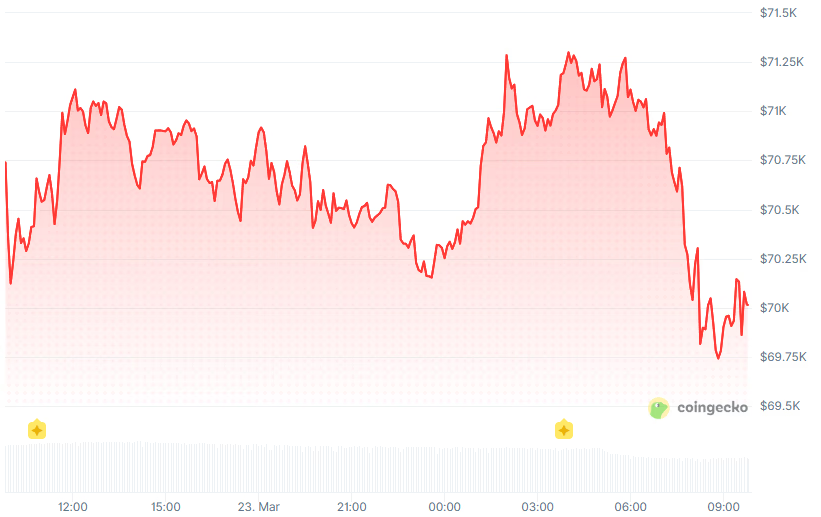
Bitcoin (BTC) is trading at around $70,000, down less than 1% over the past 24 hours. ETH and SOL fell 0.6% to $2,135 and $90, respectively. Meanwhile, Ripple (XRP) slipped 3%.

Total crypto market capitalization is down 0.2% to $2.48 trillion, according to Coingecko.
Bitcoin surged above $71,000 on Monday after President Donald Trump announced a five-day postponement of planned strikes on Iran’s power infrastructure, citing what he called productive talks with Tehran. However, Iran’s Fars news agency denied that any talks had taken place.
Clarity Act Draft Rattles Stablecoin Stocks
Circle stock plunged 19%, and Coinbase dropped 8% after details emerged from the latest draft of the Clarity Act, which would restrict stablecoin yield offerings. The revised language, crafted by Senators Angela Alsobrooks and Thom Tillis, would ban yield payments for simply holding a stablecoin while permitting narrowly defined activity-based rewards tied to transactions or platform usage.

Crypto industry insiders got their first look at the revised text during a closed-door review on Capitol Hill on Monday, according to Coindesk.
Big Movers
Nearly all of the Top 100 digital assets posted minor losses over the last 24 hours.
Today’s top gainers are Bittensor (TAO) and World Liberty Financial (WLFI), which surged 10%.
Monero (XMR) and Polkadot (DOT) are the biggest losers, down 5% and 4%, respectively.
Around 79,000 leveraged traders were liquidated for $153 million in the past 24 hours, according to CoinGlass. Bitcoin accounted for $46 million, while ETH made up $33 million.
Bitcoin exchange-traded funds (ETFs) recorded inflows of $163.5 million on Tuesday, snapping a three-day losing streak, according to SoSoValue.
The Crypto Fear & Greed Index sits at 11, indicating ‘Extreme Fear’, and has spent the bulk of March below 20, a prolonged stretch of pessimism not seen since the depths of the 2022 bear market.

Active, actively managed crypto exchange-traded products are emerging as the next frontier for institutional exposure, as the market moves beyond passive price-tracking funds. 21shares, a leading issuer in the space, argues that the asset class’s nascency makes it particularly amenable to portfolio-level management.
In an exclusive conversation, Duncan Moir, president of 21shares, outlined a strategy that blends bottom-up research on individual assets with quantitative and discretionary top-down risk controls to steer portfolios. The firm has been expanding its portfolio-management and trading ranks to support more sophisticated products, he said, reflecting a broader shift in the crypto ETP space toward active strategies.
We’ve had to hire and build out the team with people who have different trading and portfolio management expertise, but now we have a solid team and we think we’ll be able to deliver strong actively managed products.
Industry data underscore the trend: active exchange-traded products worldwide held nearly $1.8 trillion in assets by the end of 2025, according to data compiled by Morningstar and Goldman Sachs Asset Management.
Moir also pointed to the strategic role of FalconX, which acquired 21shares in October, as a force-multiplier for product development, particularly as the firm pursues more complex offerings.
Regional demand for crypto ETPs and ETFs remains uneven. In the United States, investor interest remains skewed toward the largest-cap crypto assets, while in Europe institutions are showing appetite for newer assets and the application layer beyond base-layer tokens. This divergence reflects a mature European investor base already holding BTC and ETH and looking to broaden crypto allocations with yield-oriented or theme-driven products.
In this environment, 21shares has rolled out Europe-listed ETP linked to Strategy’s preferred stock (STRC), offering exposure to a Bitcoin-focused capital strategy with a high-yield profile. The product has attracted strong early interest across regions as investors seek straightforward exposure to yield via traditional brokers.
Crypto ETPs evolve beyond passive exposure
As the crypto ETP and ETF market matures, issuers are moving beyond simple price tracking, with more complex structures emerging across the US and Europe.
One area gaining traction is staking, a process that allows investors to earn yield by locking up crypto assets to help secure blockchain networks. In October, Grayscale introduced staking across its ETPs, making its Ether funds among the first US-listed spot crypto ETFs to offer staking rewards while extending the feature to its Solana trust pending ETP approval.
In March, asset manager BlackRock launched a Nasdaq-listed Ethereum product that incorporates staking, combining spot Ether exposure with yield generation. The fund recorded $15.5 million in trading volume on its first day.
As new exchange-traded products come to market, Moir said 21shares evaluates potential launches based on three factors: internal research, client demand, and broader market trends, with its research team identifying early opportunities and institutional feedback helping gauge interest. This triad helps determine whether a niche, single-asset product or a broader thematic offering best fits conviction and demand.
Among examples of the approach in practice is 21shares’ Bitcoin-and-gold ETP. Cross-listed in London and live for several years, Moir notes that the product has delivered some of the strongest risk-adjusted returns among European ETPs, illustrating the appeal of balanced exposure across flagship crypto and traditional stores of value.
From a portfolio perspective, the combination “just makes total sense,” he added, citing diversification benefits across Bitcoin and gold.
What’s next for crypto ETPs and investors
The evolving landscape suggests investors can expect more nuanced structures, including yields and staking rewards embedded in traditional brokerage-accessible formats. The FalconX deal accelerates product development by providing deeper execution capabilities and liquidity to support a broader range of strategies. As institutions in Europe deepen their crypto allocations and U.S. issuers explore tiered yield and application-layer exposures, the market will likely see a steady cadence of launches that blend traditional finance rails with crypto’s distinct yields and risk profiles.
Looking ahead, the conversation centers on how regulators will shape access to staking-based products, how quickly large-cap and next-generation assets receive broad market validation, and how issuers balance risk controls with the demand for yield-driven strategies. For investors, the key watchpoints are whether new products deliver clear, repeatable performance across cycles, and how cross-border listings and collaborations—such as 21shares’ integration with FalconX—affect liquidity, pricing, and transparency in the evolving crypto ETP ecosystem.
Readers should watch regulatory clarity in major markets and the pace of institutional adoption as 21shares and peers press forward with more sophisticated, yield-focused offerings that aim to turn crypto exposure into scalable, traditionally accessible investment strategies.

Key Takeaways
- Micron shares declined approximately 15% across four consecutive trading sessions following exceptional Q2 fiscal 2026 results
- Quarterly revenue reached $23.86 billion, representing nearly a 200% surge from the prior year’s $8.05 billion
- According to CEO Sanjay Mehrotra, current production capacity meets only 50% to 66% of major customer demand
- Competitor SK Hynix announced plans for an $8 billion EUV equipment investment and potential $10 billion U.S. stock listing — intensifying competitive dynamics
- Leading Wall Street firms including Bank of America, Morgan Stanley, and JPMorgan elevated their price projections following the earnings announcement
Micron delivered exceptional quarterly results last week. Wall Street’s reaction? A double-digit decline.
Following the release of Q2 fiscal 2026 earnings on Wednesday, Micron shares have experienced consecutive daily losses spanning four trading sessions. The negative price action has left many observers perplexed, particularly considering the impressive financial metrics.
Quarterly revenue totaled $23.86 billion — representing approximately a threefold increase from the $8.05 billion Micron generated during the comparable quarter last year. Management also projected gross margin percentages hovering around 80% for the upcoming quarter.
Despite the recent downturn, Micron shares have surged more than 300% over the trailing twelve months. The memory chip manufacturer stands as the sole technology company among America’s top 10 market leaders posting year-to-date gains, while Oracle and Microsoft have both retreated over 20%.
Citi’s semiconductor analyst Atif Malik attributed the selloff primarily to investor profit-taking. “Higher FY27 capex and peak gross margin concerns (81% > Nvidia’s 75%) likely induced some profit taking after a strong stock run into the print,” he noted.
Production Capacity Lags Behind Customer Requirements
CEO Sanjay Mehrotra spoke openly about current supply constraints during an interview with CNBC’s Squawk on the Street on Thursday.
“Memory today is very tight supply and supply cannot be brought up that easily,” he explained. Major clients are presently obtaining only “50% to two-thirds of their requirements.”
This supply squeeze stems directly from artificial intelligence demand. Micron, SK Hynix, and Samsung collectively dominate the high-bandwidth memory segment that powers AI processors from manufacturers such as Nvidia and AMD.
The explosion in AI infrastructure investments has elevated memory pricing while keeping availability constrained. Mehrotra indicated the company’s robust financial performance directly mirrors these market dynamics.
Major financial institutions including Bank of America, Morgan Stanley, and JPMorgan raised their valuation targets for Micron following the quarterly disclosure, suggesting analysts remain optimistic about longer-term prospects despite near-term share price weakness.
South Korean Rival Escalates Competition
Compounding investor concerns this week, SK Hynix unveiled two significant strategic initiatives that unsettled Micron shareholders.
The Seoul-based chipmaker submitted regulatory documentation on Tuesday revealing intentions to acquire approximately $8 billion worth of extreme ultraviolet (EUV) lithography systems from ASML through the end of 2027 — representing a substantial commitment to advanced manufacturing capabilities.
Simultaneously, Korea Economic Daily published reports indicating SK Hynix is evaluating a potential U.S. stock exchange listing that could generate up to $10 billion in capital. U.S. investors presently face restricted access to SK Hynix equity, with most exposure limited to over-the-counter trading or exchange-traded funds such as the iShares MSCI South Korea ETF.
A domestic U.S. listing could fundamentally alter investment flows within the memory semiconductor sector. SK Hynix currently commands a forward price-to-earnings multiple of approximately 4.8 times, compared to Micron’s 5.3 times valuation, based on FactSet data.
During Tuesday’s midday trading session, Micron shares declined an additional 2.4%, prolonging the post-earnings retreat to four consecutive sessions.


Victor Wembanyama, surging Spurs face depleted Grizzlies

Epic Games layoffs impact 82 workers at Seattle-area office as part of broader cuts

Daily Market Coverage Mar. 24, 2026 9AM-11AM (ET) | Yahoo Finance


-
 Crypto World4 days ago
NIO (NIO) Stock Plunges 6.5% as Shelf Registration Sparks Dilution Worries
-

 Fashion4 days ago
Weekend Open Thread: Adidas – Corporette.com
-

 Politics4 days ago
Jenni Murray, Long-Serving Woman’s Hour Presenter, Dies Aged 75
-

 Crypto World3 days ago
Best Crypto to Buy Now: Strategy Just Spent $1.57 Billion on Bitcoin During Fear While Early Investors Quietly Enter Pepeto for 150x Potential
-

 News Videos6 days ago
RBA board divided on rate cut, unusually buoyant share market | Finance Report | ABC NEWS
-

 Crypto World3 days ago
Bitcoin Price News: Bhutan Sells $72 Million in BTC Under Fiscal Pressure, but the Smart Money Entering Pepeto Sees What the Market Does Not
-

 Politics7 days ago
The House | The new register to protect children from their abusers shows Parliament at its best
-

 Tech5 days ago
inKONBINI Lets You Spend Summer Days Behind the Register
-

 Crypto World6 days ago
Canada’s FINTRAC revokes registrations of 23 crypto MSBs in AML crackdown
-

 Sports2 days ago
Remo Stars and Kano Pillars Strengthen Survival Hopes in NPFL
-
 NewsBeat6 days ago
Residents in North Lanarkshire reminded to register to vote in Scottish Parliament Election
-

 News Videos6 days ago
PARLIAMENT OF MALAWI – PAC MEETING WITH REGISTRAR OF FINANCIAL ON AMARYLLIS HOTEL – INQUIRY LIVE
-

 Politics5 days ago
Gender equality discussions at UN face pushbacks and US resistance
-

 Business2 days ago
No Winner in March 21 Drawing as Prize Rolls to $133 Million for Next
-

 Business6 days ago
Who Was Alex Pretti? 5 Key Facts About the ICU Nurse Killed by Federal Agents in Minneapolis
-

 Sports2 days ago
Gary Kirsten Accuses Pakistan Cricket Board Of ‘Interference’, Mohsin Naqvi Responds
-

 Tech2 days ago
Give Your Phone a Huge (and Free) Upgrade by Switching to Another Keyboard
-

 Sports4 days ago
2026 Kentucky Derby horses, odds, futures, preview, date: Expert who nailed 12 Derby-Oaks Doubles enters picks
-

 Tech7 days ago
Subnautica 2 might finally be entering early access in May
-
Sports6 days ago
Vikings Free Agency Enters Phase 2 with Key Questions
You must be logged in to post a comment Login