
Crypto World
Brazil Weighs 24-Hour Crypto Transfer Hold to Curb Fraud


Brazil’s central bank has approved new rules that require virtual asset service providers (VASPs) to temporarily freeze certain crypto transfers before sending funds to foreign platforms or self-custody wallets. The precautionary hold is designed to give firms time to review suspected fraud and suspected illicit behavior.
According to a note published by the Banco Central do Brasil (BCB) on Friday, the requirement takes effect on Jan. 1, 2027 and will apply to transfers where the amount received by a customer exceeds $10,000, either as a single transaction or based on the customer’s total activity in a day. In addition to that threshold, VASPs must also place holds on other transfers flagged for enhanced scrutiny under their risk-management systems.
Key takeaways
- Brazil’s BCB will require VASPs to implement precautionary holds of up to 24 hours on certain outbound virtual asset transfers.
- The initial trigger is $10,000 in value received, measured per transaction or aggregated across daily customer activity.
- Holds also cover transfers marked for review under a provider’s existing risk-management policies.
- VASPs must inform customers about holds and maintain records of fraud incidents and remediation steps.
- Japan’s earlier anti-scam measures exist, but they are non-binding—a key difference from Brazil’s approach.
How the 24-hour hold will work
Under the BCB’s framework, VASPs must apply precautionary holds to certain transfers once the underlying conditions are met. The central bank’s statement specifies that the rules cover funds received above $10,000, either in a single transaction or through the accumulation of transactions over the course of a day.
The BCB also requires providers to place holds on additional transfers that need further evaluation under their own risk policies. In other words, the $10,000 threshold is not the only gate: the central bank expects VASPs to treat certain flagged activity more cautiously, even if the threshold is not the only factor.
Providers will be allowed to complete their assessment and release a transfer before the 24-hour window ends, as long as they follow parameters set out by the BCB. That gives firms flexibility in cases where they can quickly clear the transfer after review.
Operational duties for VASPs
The BCB’s note makes clear that the hold mechanism comes with compliance obligations. VASPs must:
- Notify customers when a transfer is subject to a hold.
- Keep records of fraud incidents, attempted fraud, and the corrective actions taken in response.
These requirements matter for users and firms alike because they effectively formalize what providers must do when suspicious cross-border activity is detected. For traders and businesses relying on fast settlement, the policy introduces a potential delay on outbound transfers routed to foreign venues or self-custody addresses when the relevant conditions apply.
Why this is being tightened now
The central bank’s move reflects a broader shift among regulators as they confront scams that leverage the speed and global reach of digital assets. Crypto transfers can settle quickly across borders, which can help legitimate users—but it also creates opportunities for criminals to move funds before counterparties can intervene.
Brazil’s rules are part of a larger international pattern where regulators seek to slow down or add friction at key stages of the transfer process, particularly when money is leaving regulated custody environments for higher-risk destinations such as self-custody wallets.
That context is especially important for investors and service providers: while blockchain activity is transparent, reversing losses is often difficult. Measures like precautionary holds aim to reduce the chance that funds are sent to the wrong addresses in the first place.
Comparisons: Japan’s withdrawal delays and Europe’s scam warnings
Brazil’s action follows similar anti-scam developments elsewhere. In Japan, the Financial Services Agency and the National Police Agency asked crypto exchanges to restrict withdrawals after customers deposit fiat or buy digital assets. As reported earlier by Cointelegraph, Japanese authorities urged exchanges to implement controls such as requiring customers to preregister withdrawal addresses and applying a waiting period before newly added addresses can be used.
Other safeguards discussed in Japan include customer-specific withdrawal limits, stronger monitoring, phishing-resistant multifactor authentication, and checks intended to confirm that a bank remitter’s name matches the crypto account holder.
However, the Japanese measures are not binding. Exchanges can decide how to implement protections based on their own operations and exposure to misuse, which stands in contrast to Brazil’s regulatory timing and threshold-based structure.
In Europe, regulators have also highlighted risks tied to impersonation and fraud. Earlier coverage from Cointelegraph noted warnings about criminals impersonating watchdogs and crypto firms, including instances involving fake websites and the misuse of identity and logos in falsified documents. While those reports focus more on deception surrounding licensed providers, they point to the same underlying issue: scammers adapt quickly to user demand, especially when people are looking for regulated access points.
What to watch next
With Brazil’s hold rules scheduled to begin on Jan. 1, 2027, VASPs will likely adjust transfer flows, customer communications, and fraud-review processes well before the effective date. Users sending large transfers to foreign services or self-custody wallets should watch how providers interpret the $10,000 trigger and what criteria they use to classify additional transfers as “requiring further scrutiny.”


Bitcoin’s contentious BIP-110 upgrade track is showing tangible friction in the form of a widening chain split. According to the BIP-110 monitor, the enforcing (BIP-110 validating) branch has stalled at block 961,633 after producing only two blocks, while the non-enforcing branch has advanced to block 961,721—pushing the gap to 88 blocks.
As the disagreement persists through the period where difficulty adjustments cannot yet fully catch up, the episode is again highlighting how “mandatory signaling” mechanics can turn a soft-proposal into an operational contest between node policies and mining output.
Key takeaways
- The enforcing BIP-110 branch halted at block 961,633, while the non-enforcing chain reached 961,721, widening divergence to 88 blocks.
- BIP-110 nodes reject blocks that do not signal via version bit 4, while ordinary Bitcoin nodes accept both signaling and non-signaling blocks—enabling two simultaneous histories.
- Mandatory signaling began at block 961,632, following a signaling rate of only 2.53% (51 out of 2,016 blocks) in the prior window.
- Ocean records attribute the enforcing branch’s first two blocks to a pseudonymous mining group named Roughnecks using Ocean’s DATUM mining protocol.
- Mandatory signaling is scheduled to continue through block 963,647, and enforcing nodes must mine through the remainder of the 2,016-block adjustment period before difficulty can respond.
A split driven by node policy and signaling
The divergence started right as BIP-110 moved into mandatory signaling. The BIP-110 monitor reported the latest state as of 10:19 am UTC, showing the enforcing branch’s last block at 961,633—about 12 hours after the branch produced its two-block output.
In the window immediately before mandatory signaling, only 51 of the previous 2,016 blocks signaled support for BIP-110. The 2.53% figure matters because it reflects how limited the share of blocks was that complied with the signaling requirement before the stricter rule took effect.
Under the BIP-110 mechanism, nodes enforcing the proposal reject blocks that do not signal the required version bit (version bit 4). By contrast, standard Bitcoin nodes do not apply the same rejection rule and therefore accept both signaling and non-signaling blocks. That asymmetry is what allows two competing chains to progress independently when miners do not consistently produce blocks meeting the enforcing criteria.
What changed at block 961,632
Earlier coverage from Cointelegraph noted that BIP-110 crossed key thresholds as “spam wars” around transaction-level policy heated up. Building on that context, the current episode is now anchored to a precise transition: BIP-110 entered mandatory signaling at block 961,632 on Saturday.
The proposal’s terms, including the way mandatory signaling is enforced, run through block 963,647, according to the BIP-110 documentation. This implies that miners and enforcing nodes remain in a regime where the enforcing branch can only be strengthened if sufficiently more blocks comply with the signaling requirement.
Importantly for traders and operators tracking chain health, progress is not instantaneous. The enforcing branch must continue mining through the remainder of the 2,016-block difficulty adjustment period before difficulty can adjust, making it harder for a smaller enforcing cohort to “catch up” quickly without a material increase in hashpower.
Mining attribution points to a small cohort
Ocean’s records on the relevant block history provide additional detail on who produced the early enforcing blocks. Ocean data associated the enforcing branch’s first two blocks with a pseudonymous mining group called Roughnecks.
Those blocks were reportedly mined using Ocean’s Decentralized Alternative Templates for Universal Mining (DATUM) mining protocol, as reflected in Ocean’s block information for the cited enforcing-branch block. The fact that only a limited number of enforcing-compliant blocks appeared before the stalling suggests—without proving intent—that the set of miners producing compliant blocks has been comparatively small.
That matters operationally: if compliance is concentrated among a niche subgroup rather than broadly distributed across the mining ecosystem, the enforcing branch can lag for long stretches—exactly what the current 88-block gap illustrates.
Why critics argue the rules risk unintended consequences
The BIP-110 controversy has long centered on whether forcing consensus-level behavior around signaling and block acceptance is worth the potential benefits. Prominent Bitcoin figures have criticized the change as potentially undermining neutrality and creating avoidable risks.
Strategy executive chairman Michael Saylor told Cointelegraph that while he supports the proposal’s objectives, he argued its approach threatened Bitcoin’s “neutral rules” and consensus. Separately, Blockstream CEO Adam Back warned, also via Cointelegraph coverage, that a consensus-level change could damage Bitcoin’s credibility and potentially make certain unspent transaction outputs unspendable.
While today’s split is not a verdict on the broader debate, it does underscore how quickly policy-based enforcement can translate into practical chain divergence when signaling support is thin and hashpower distribution doesn’t align with the enforcing conditions.
For readers watching this closely, the question is less whether the debate exists—critics and supporters are both on the record—but how sustained the operational divergence becomes once mandatory signaling remains in place through block 963,647.
What to monitor next
Until the enforcing branch reaches a point where difficulty can adjust—or until miners meaningfully increase the share of compliant signaling—watch for whether the enforcing chain resumes producing blocks at a higher rate and whether the block gap continues to widen or begins to narrow before block 963,647.
The spot exchange-traded funds tracking the sixth-largest cryptocurrency by market cap have recorded their fourth consecutive week in the green. However, there are certain warning signs that cannot be ignored.
Meanwhile, the native token’s price dipped toward a key support that has managed to hold… for now. Analysts weighed in on the asset’s potential ahead and what might come next.
XRP ETFs Still in the Green, but…
During May and June, months in which the spot Bitcoin and Ethereum ETFs bled out heavily, often in the billions of dollars, the spot XRP counterparties managed to defy the overall slump. As we consistently reported, they recorded an impressive streak of nine consecutive weeks in the green, and even the one that was in the red and stopped it back in early May saw a very modest net outflow of $35,210.
July began on the wrong foot, as the first full week saw over $7 million in net withdrawals. However, the bulls returned in the following three weeks, pouring in $6.78 million, $8.15 million, and $14.86 million, respectively. Thus, the month ended with net inflows of $27.29 million.
While on the surface it appears as a major win, a deeper look shows the first warning sign: this was the second-weakest month in terms of net inflows since January this year. The beginning of August is also in the green, but there’s another warning shot – the actual inflows are a very modest $1 million. At the same time, both the BTC and ETH ETFs attracted over $1 billion combined.
Two out of the five trading days saw no reportable numbers ($0.00), while investors pulled out $3.58 million on Wednesday. The net inflows of $1.15 million on Monday and $3.45 million on Thursday managed to barely offset the losses.
XRP Dipped to Key Support
The weak ETF data failed to help XRP during the week in terms of price action, and the asset felt the negative consequences of the delayed CLARITY Act voting in the US Senate. As reported on Friday, the token fell to $1.02, coming just inches away from dipping below the key $1.00 support.
Nevertheless, analysts remain bullish on its future price performance. Some expect its ‘strongest price reversal’ if it manages to hold that support and reclaim the $1.05 level soon. Others outlined some massive targets for the next bull run of up to $50, which sound a bit far-fetched at the moment, admittedly.
The post Ripple (XRP) ETFs Record Another Green Week but Fresh Concerns Surface appeared first on CryptoPotato.
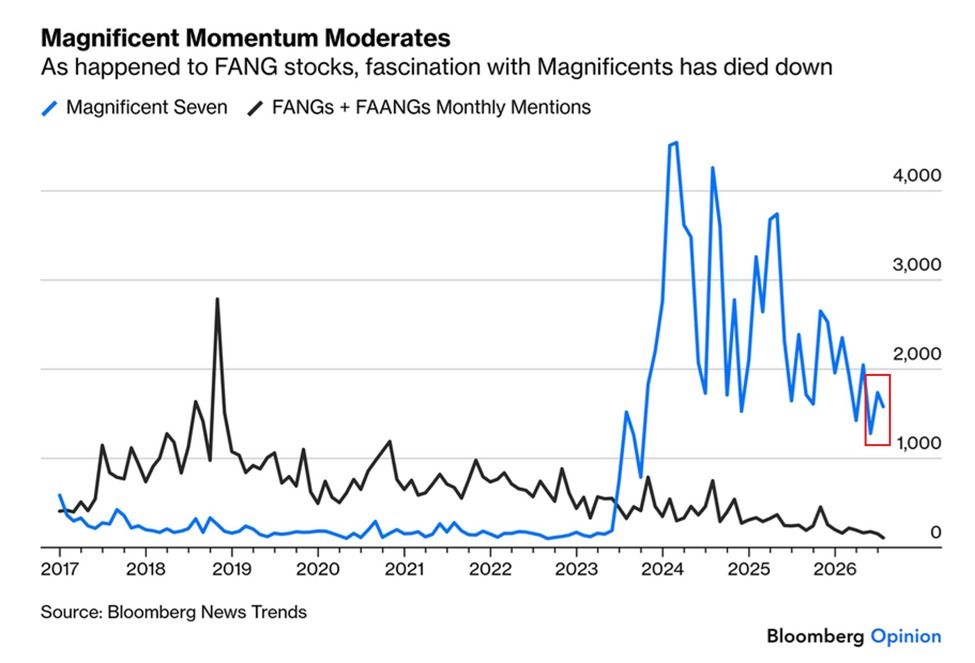
Monthly mentions of the Magnificent Seven (Mag 7) in Bloomberg Terminal news stories have fallen roughly 70% from their Q1 2024 peak.
This points to a notable shift in investor attention away from the megacap technology group.
Magnificent 7 Mentions Fall to Lowest Level Since Late 2023
The Kobeissi Letter highlighted the decline in a post on X. The mentions have fallen to roughly 1,400, bringing the figure to its lowest level since the fourth quarter of 2023.
The decline marks a sharp reversal from early 2024, when the group became one of the dominant themes in financial markets. Monthly mentions peaked at roughly 4,300 in Q1 2024, meaning the current level represents a decline of about two-thirds from that high.
The Kobeissi Letter compared the trend with earlier Wall Street groupings, including FANG and FAANG. Mentions of those terms peaked at nearly 2,800 in the fourth quarter of 2018, then plunged by about 82% to roughly 500 by early 2020.
The “Magnificent 7” label emerged in 2023 to describe Apple, Microsoft, Nvidia, Amazon, Alphabet, Meta, and Tesla.

Follow us on X to get the latest news as it happens
Mag 7 Loses Ground as AI Trade Broadens
The decline in Mag 7 mentions comes as the group loses some market dominance in 2026. Investors are increasingly favoring companies tied directly to heavy AI infrastructure spending.
The shift is also visible in the relationships between the seven stocks. Amazon, Nvidia, Meta, Apple, Microsoft, Tesla, and Alphabet are no longer moving in tandem as closely as they once did.
This signals a growing divergence in how investors are valuing the companies. Their average three-month pairwise correlation has fallen to 0.27, from 0.78 in mid-2025.
The changing dynamics have prompted some Wall Street strategists to question whether the Mag 7 remains the best way to capture the broader AI theme.
Citigroup strategists have argued that the popular Magnificent Seven label is no longer relevant for assessing how to position for the US AI trade.
Subscribe to our YouTube channel to watch leaders and journalists provide expert insights
The post The US Magnificent 7 Stocks are Losing Wall Street Interest appeared first on BeInCrypto.
Crypto World
Crypto is going through a massive dot-com style shakeout as over 100 projects fold in 2026


“There were way too many general-purpose layer twos, which frankly don’t make sense as a product, because there’s no reason to have many, many versions of the same thing,” Ben Fisch, CEO of Espresso Systems, told CoinDesk. “We’re in a consolidation phase for general-purpose layer twos, not layer twos broadly.”
Industry leaders argue the shakeout reflects a broader shift across crypto rather than a problem unique to Ethereum scaling networks.
“Consolidation is happening across all of crypto right now, not just layer two, from DeFi protocols to DEXs and infrastructure providers. It’s a sign that the industry is maturing. The networks continuing through this period are the ones people actually use and depend on,” Marek Olszewski, co-founder of the Celo layer-2, told CoinDesk.
“For every crypto project that you hear about shutting down, there are perhaps another 10 silently doing the same,” Nick Puckrin, founder of Coin Bureau, wrote in a post on X. “Creative destruction for the next cycle perhaps.”
Orkun Mahir Kılıç, co-founder and CEO of Chainway Labs, which is building the Bitcoin layer-2 Citrea, said the wave of closures reflects a maturing market where capital is harder to raise and investors are becoming more selective.
“Different businesses have different reasons and different underlying problems for shutting down. The pattern we’re seeing emerge isn’t really an inherent problem within the L2 ecosystem. The market and the tech are maturing, investment is a lot slower and more cautious now, and only projects with sound business models and a clear problem statement will survive,” Mahir Kılıç told CoinDesk.


Trump Media & Technology Group is pulling back from one of its biggest crypto expansion plans less than a year after announcing it.
Summary
- Trump Media, Crypto.com and Yorkville terminated the proposed $6.42 billion CRO treasury combination on Friday.
- Truth Social will market Crypto.com prediction products instead of directly integrating prediction markets into platform.
- The canceled treasury expected $1 billion in CRO plus a $5 billion Yorkville equity line.
- Trump Media is prioritizing its pending TAE merger, which it hopes to close during 2026.
- Separate ETF servicing plans involving Crypto.com were also canceled, while Yorkville’s existing funds remain unchanged.
On Aug. 7, Trump Media, Crypto.com and Yorkville Acquisition Corp. Mutually terminated their proposed business combination to establish Trump Media Group CRO Strategy, a company designed around a multibillion dollar Cronos treasury. The companies cited “prevailing market conditions” and changing business and stakeholder priorities.
The decision comes as Trump Media shifts attention toward its media operations and pending merger with TAE Technologies. The all stock TAE transaction was valued at more than $6 billion when announced in December 2025. Meanwhile, Trump Media is also scaling back plans to build prediction markets directly into Truth Social.
Trump Media abandons the $6.42B CRO treasury plan
The CRO treasury project dated to August 2025, when Trump Media, Crypto.com and Yorkville announced plans for a publicly traded company centered on accumulating and managing Cronos tokens.
According to the original SEC filing, the structure included $1 billion worth of CRO, $200 million in cash and $220 million from mandatory exercise warrants. It also included a $5 billion equity line of credit, bringing the planned funding package to $6.42 billion.
The $6.42 billion figure did not represent CRO that had already been purchased. Rather, it described the financing available to the proposed treasury company. As crypto.news reported when the transaction was announced, the deal initially triggered a sharp rally in CRO as investors reacted to the planned institutional treasury.
Crypto.com, Trump Media and Yorkville have now said all initial discussions and development efforts connected to that business combination will formally end. Their Aug. 7 announcement did not provide a termination payment or indicate that any party would face a breakup fee.
However, Trump Media’s existing CRO exposure should not be confused with the canceled treasury vehicle. Under a separate strategic partnership announced in August 2025, Trump Media agreed to buy approximately $105 million of CRO for its own balance sheet, while Crypto.com agreed to acquire $50 million of Trump Media shares.
Trump Media subsequently acquired hundreds of millions of CRO through that arrangement. The latest cancellation announcement specifically addresses the proposed CRO Strategy business combination and does not say those existing balance sheet holdings are being unwound.
Truth Social scales back its prediction market strategy
Trump Media is also changing its approach to prediction markets. The company and Crypto.com previously planned to embed a product called Truth Predict directly into Truth Social, giving users access to event contracts tied to areas such as politics, economics and sports.
Truth Predict was announced in October 2025 through a partnership with Crypto.com’s derivatives business. The original plan would have allowed users to interact with prediction contracts from inside Truth Social.
That direct integration is no longer moving ahead. Instead, Trump Media intends to pursue a marketing arrangement promoting Crypto.com’s prediction market products to Truth Social users.
The shift reduces the amount of infrastructure Trump Media would need to operate itself while preserving a commercial relationship with Crypto.com. The companies have not disclosed financial terms for the revised marketing arrangement.
Trump Media and Crypto.com are also abandoning a separate arrangement under which Crypto.com would have serviced certain planned Yorkville America exchange traded funds. However, the companies said Yorkville America’s existing Truth Social branded funds and plans for other ETF products remain unchanged.
TAE merger becomes a bigger strategic priority
Trump Media’s pullback from the CRO treasury comes as the company concentrates on its planned combination with fusion energy company TAE Technologies.
The companies announced the TAE transaction in December 2025 as an all stock merger valued at more than $6 billion. They said shareholders of Trump Media and TAE would each own approximately 50% of the combined company on a fully diluted basis after closing.
Trump Media’s changing strategy follows substantial exposure to digital assets during the past year. The company recorded a $405.9 million first quarter net loss as declining Bitcoin and CRO prices contributed to large unrealized markdowns. Trump Media reported holding 9,542 BTC and approximately 756 million CRO at the end of March.
Those holdings mean the termination of the dedicated CRO treasury company does not amount to Trump Media abandoning crypto altogether. The company retains digital asset exposure, and its existing Crypto.com relationship extends beyond the canceled SPAC structure.
What happens next for Trump Media
The TAE merger now represents one of the company’s clearest pending corporate milestones. Closing remains subject to regulatory approvals, shareholder processes and other customary conditions, meaning the transaction is not guaranteed to close on its proposed timetable.
Trump Media is also considering other changes to its structure. In related coverage, the company disclosed earlier in 2026 that it was exploring a possible spin off of Truth Social and related businesses before completion of the TAE transaction. The companies cautioned at the time that discussions were ongoing and there was no assurance a separate transaction would be completed.
For Crypto.com, the Aug. 7 decision removes the proposed $6.42 billion CRO treasury vehicle and the limited ETF servicing arrangement, while replacing the direct Truth Predict integration with a narrower marketing relationship.
The change leaves Trump Media with a simpler near term strategy but does not fully sever its crypto ties. Existing CRO holdings, digital asset products and parts of its Crypto.com partnership remain separate from the deals the companies have now terminated.


Bybit’s effort to recover assets from the $1.5 billion February 2025 hack has moved deeper into the U.S. court system, with a federal judge granting expedited discovery and later part of the exchange’s request for a preliminary injunction.
Summary
- Bybit secured expedited discovery allowing requests for identities, balances and transaction histories from U.S.-linked platforms.
- Court records show temporary restraints began June 19, with a partial preliminary injunction July 30.
- Bybit reports $48.4 million recovered and $30.5 million frozen across 28-plus exchanges and custodians worldwide.
- Bybit said 90.2% of stolen assets were untraceable when its June complaint was initially filed.
- The FBI officially attributes the February 2025 theft to North Korean cyber actors called TraderTraitor.
Bybit filed the case on June 18 in the U.S. District Court for the District of Columbia against North Korea, its Reconnaissance General Bureau, the Lazarus Group and 20 unidentified defendants.
The exchange’s latest update, published Aug. 7, says about $48.4 million of stolen assets has been recovered, while more than $30.5 million remains frozen across more than 28 exchanges and custodians. That puts roughly $78.9 million in the recovered or frozen category, although the frozen portion has not yet been returned to Bybit.
U.S. court gives Bybit faster access to records
Court records show Judge John D. Bates granted expedited discovery on June 19, one day after Bybit filed its complaint under seal. The measure allows the exchange to seek account identities, balances and transaction histories from platforms with U.S. operations that may hold information tied to the stolen funds. The court also issued a temporary restraining order that day to stop certain traceable assets from being moved.
The restraining order was renewed on July 16. On July 30, Bates granted Bybit’s request for a preliminary injunction in part, preserving identified assets while the case continues. Bybit said the court found that “Bybit has demonstrated a likelihood of success on the merits.” That is an interim legal finding, not a final ruling that all allegations in the complaint have been proved.
Most stolen assets are now harder to trace
Bybit said in its June filing that 90.2% of the stolen assets had become untraceable after moving through mixers, cross-chain bridges and over-the-counter dealers. Only 9.8% remained connected to identifiable wallets at that point, while about 5.3% of the original theft, roughly $75.5 million, had been frozen or recovered.
Those figures do not establish that the remaining assets are permanently unrecoverable. “Untraceable” describes Bybit’s stated ability to follow the transaction trail at the time of filing. The new discovery authority could provide offchain records, including customer identities and account histories, that blockchain analysis alone cannot supply. Meanwhile, Bybit’s newer Aug. 7 figures separate $48.4 million already recovered from more than $30.5 million still frozen.
The decline in traceability has been steep. CEO Ben Zhou said in March 2025 that 88.87% of the stolen funds could still be traced, while 7.59% had gone dark and 3.54% had been frozen. The June 2026 filing shows how much more difficult following the assets became as laundering continued.
FBI attribution and Safe findings support the case
The theft occurred on Feb. 21, 2025. Five days later, the FBI formally attributed the attack to North Korea and said it tracks the activity as “TraderTraitor.” The agency said the attackers converted some stolen assets into Bitcoin and other cryptocurrencies and dispersed them across thousands of addresses on multiple blockchains.
The FBI also urged exchanges, bridges, blockchain analytics firms, DeFi services and other virtual asset providers to block transactions linked to addresses it identified in the laundering operation. Bybit says its civil proceeding remains separate from ongoing U.S. criminal investigations and that it continues sharing blockchain intelligence with the agency.
The attack was also traced to compromised infrastructure connected to Safe Wallet. As previously reported, forensic investigators found that a compromised Safe developer machine enabled the attackers to propose a disguised malicious transaction. Safe later said its review found no vulnerability in its smart contracts or source code and that it rebuilt infrastructure and rotated credentials after the breach.
Bybit launched a bounty program shortly after the hack to encourage investigators and platforms to help identify and freeze stolen funds. The federal lawsuit adds discovery and injunction tools to that earlier recovery strategy, giving the exchange another route to identify intermediaries connected to assets within reach of U.S. legal process.
Bybit must turn asset freezes into recoveries
The complaint seeks return of the stolen assets, about $1.5 billion in compensatory damages, punitive damages and treble damages under the U.S. Racketeer Influenced and Corrupt Organizations Act, according to the unsealed court records. Those requests remain claims for relief. The court has not entered a final judgment awarding those damages against North Korea, the Lazarus Group or the unidentified defendants.
The next stage centers on discovery and enforcement. Bybit can seek records from relevant service providers while the preliminary injunction restricts movement of certain identified assets. Further recovery will depend on whether the exchange can connect wallets to identifiable account holders or intermediaries and reach assets held by entities subject to enforceable court orders.
Bybit also credited international cooperation for earlier progress, citing German authorities’ action against eXch and the German-Swiss disruption of Cryptomixer.io, services the exchange said were used to move illicit proceeds. Those actions are separate from the Washington case but form part of a broader effort to close laundering routes used after the theft.
For now, the U.S. court orders give Bybit a stronger legal route to pursue assets that remain within reach, but they do not guarantee additional recovery. The next material developments will include responses to discovery requests, attempts to identify the John Doe defendants, possible additional asset restraint orders and later rulings on the exchange’s claims. Bybit said it intends to seek further judicial relief as the litigation proceeds.

Bitcoin’s BIP-110-enforcing branch has stalled after mining just two blocks, widening the separation from the non-enforcing chain to 88 blocks. The latest update from a BIP-110 monitoring dashboard shows the mandatory-signaling version of the network making extremely slow progress as it awaits further blocks to complete the current difficulty-adjustment window.
According to the BIP-110 monitor (updated at 10:19 am UTC), the enforcing branch was last seen at block 961,633 after a long gap since its previous block. In the meantime, the non-enforcing chain advanced to block 961,721, underscoring how thin the enforcement-side hashpower currently is.
Key takeaways
- The enforcing branch produced only two blocks before stalling, while the non-enforcing chain continued forward, increasing the block-gap to 88.
- The divergence began after BIP-110 entered mandatory signaling at block 961,632, during which only 2.53% of blocks in the preceding window signaled support.
- Mandatory signaling is scheduled to continue through block 963,647, but difficulty adjustment won’t fully help until the enforcing side mines through the remainder of the 2,016-block adjustment period.
- Mining activity on the enforcing branch’s early blocks was attributed, via Ocean records, to a pseudonymous group using Ocean’s DATUM mining protocol.
Where the chains split
The split traces back to the moment BIP-110 moved into mandatory signaling mode. Earlier on Saturday, BIP-110 entered mandatory signaling at block 961,632. During the preceding 2,016-block adjustment window, only 51 blocks—about 2.53%—signaled support.
This matters because, under the BIP-110 rules, enforcing nodes reject blocks that do not signal via version bit 4, while standard Bitcoin nodes continue to accept both signaling and non-signaling blocks. The result is that the enforcing branch can lag if insufficient miners actively produce signaling blocks during the mandatory phase.
Under the proposal documented in the BIPs repository for BIP-110, mandatory signaling continues through block 963,647. Enforcing nodes must mine through the rest of the 2,016-block adjustment period before difficulty can adjust on their branch—an environment where even a temporary shortage of supporting hashpower can create long delays.
Stalled progress and the role of adjustment windows
Even when enforcement rules are live, the network’s practical pace can remain constrained by the mechanics of Bitcoin’s difficulty targeting. The BIP-110-enforcing side can’t benefit from a difficulty change until it has advanced far enough within the current adjustment period.
Ocean’s records cited in the BIP-110 monitor coverage indicate that a pseudonymous mining group—Roughnecks—produced the first two enforcing-branch blocks using Ocean’s Decentralized Alternative Templates for Universal Mining (DATUM) mining protocol. Those two blocks appear to be the basis for the enforcing-side head seen at block 961,633, after which progress slowed materially.
With the non-enforcing chain reaching block 961,721, the distance between the two heads has grown quickly once the enforcing branch stopped producing frequent blocks. For miners and observers, this is a concrete reminder that “mandatory signaling” does not automatically translate into immediate, sustained block production on the enforcing side—especially if the number of miners willing to follow version bit 4 during the mandatory phase is limited.
What BIP-110 requires—and why critics warn
BIP-110’s stated mechanism is straightforward: enforce nodes require blocks to signal through a specified version bit, while ordinary Bitcoin nodes tolerate both signaling and non-signaling blocks. That design is intended to curb unwanted data patterns described in the broader debate around spam and template behavior.
Still, the approach has drawn notable resistance from influential figures in the Bitcoin ecosystem. Cointelegraph previously reported that Strategy executive chairman Michael Saylor supports the general objectives but argued the proposal’s method threatens Bitcoin’s “neutral rules” and consensus integrity. Separately, Blockstream CEO Adam Back has warned that the consensus-level change could damage Bitcoin’s credibility and may make certain unspent transaction outputs unspendable, according to earlier Cointelegraph coverage.
The stalled enforcing branch provides a live illustration of how contentious or under-resourced changes can become when they rely on adoption by a critical mass of miners. If enforcement is accepted by fewer miners than required to keep block production competitive, the chain running enforcement rules can fall behind—even if the rules themselves are technically activated.
What to watch next
For now, readers tracking BIP-110 should focus on whether additional miners begin signaling in larger numbers as the mandatory window continues through block 963,647, and whether the enforcing branch’s block production improves before the next difficulty adjustment opportunity. If the hashpower supporting version bit 4 remains limited, the enforcing chain may continue to lag—turning a theoretical protocol enforcement into a practical question of miner participation.


Galaxy Research Vice President Lucas Tcheyan said on Aug. 7 that Ethereum and Solana are confronting a similar policy question: how much token issuance is needed to pay for network security, and when does that security budget become more costly than useful? The debate is moving through proposal processes on both networks, but neither blockchain has approved an inflation change.
Summary
- Ethereum’s tapered issuance proposal is now EIP-8363, after editors reassigned its initially reported proposal number.
- EIP-8363 would burn rising validator rewards and remove issuance incentives near a 50% staking ratio.
- Solana’s SIMD-0550 would double annual disinflation to 30%, cutting projected emissions by 18.9 million SOL.
- Solana governance requires two-thirds support from decisive stake after proposals complete an eleven-epoch voting process.
- Galaxy says both networks are reassessing security budgets, with no final inflation changes approved yet.
One important update concerns Ethereum’s proposal number. Galaxy initially referred to the Tapered Issuance Burn proposal as EIP-8361. Ethereum’s EIP editors later assigned it EIP-8363 because EIP-8361 had already been allocated elsewhere. The EIP-8363 pull request remained open as of Aug. 9, and an editor requested changes on Aug. 6.
Ethereum proposal would taper rewards as more ETH is staked
EIP-8363 would burn a growing share of consensus layer validator rewards as Ethereum’s staking ratio rises. The burn fraction would reach 100% around a 50% staking ratio, removing new issuance as an incentive for additional staking beyond that level. The authors propose an 18 month transition because applying the full mechanism immediately would sharply reduce validator returns.
Galaxy estimated that, with roughly one third of ETH staked, consensus layer yield would fall from about 2.6% to 1.2% under the full design. MEV and priority fees would remain outside the proposed burn. Those figures describe a modeled outcome, not an approved change to Ethereum’s monetary policy.
The Aug. 6 All Core Developers Consensus agenda listed Tapered Issuance Burn among proposals being considered for Hegotá. The agenda explicitly said the meeting was not a decision to include or schedule those proposals. No network vote or activation date has been set.
Meanwhile, SharpLink CEO Joseph Chalom opposed the issuance change, arguing lower staking returns could make ETH less attractive to institutions and raise financing costs in DeFi. Those outcomes remain forecasts. As crypto.news previously reported, supporters instead argue Ethereum may be paying more issuance than necessary as staked ETH rises.
Solana proposals target emissions and transaction burns
Solana is considering two separate changes. SIMD-0550 would double annual disinflation from 15% to 30% while keeping the terminal inflation floor at 1.5%. The technical proposal was merged into Solana’s improvement document repository on July 23 with Review status, but that does not activate the change.
SGP-0002 asks validators and delegators whether Solana should pursue the faster schedule. Its authors estimate the change would bring the terminal rate forward from about 5.7 years to 2.8 years and produce roughly 18.9 million fewer SOL in emissions over six years. The “18.9 million SOL” reduction is a projection, not a guaranteed change in supply.
SGP-0003 addresses fees. It backs SIMD-0553, which would add an inclusion fee and a resource based fee tied to transaction resource use, with the resource component burned in full. Galaxy cited estimates that daily burns could rise from roughly 650 SOL to between 7,500 and 9,000 SOL under recent network conditions.
However, the burn estimate is already being refined. On Aug. 9, SIMD-0553 author cavemanloverboy said he had been told earlier estimates were “misleading” and published optimistic and pessimistic bounds using the previous month’s traffic. He also noted that contract optimization and other behavioral changes could reduce future burns, meaning the eventual level cannot be treated as fixed.
Solana governance still stands between proposals and activation
Galaxy said SGP-0002 and SGP-0003 each secured support from at least 15% of active stake, enough to advance under Solana’s new onchain governance process. Under the official governance rules, reaching that threshold starts an 11 epoch sequence: seven epochs for discussion, one for a stake snapshot and three for voting.
A proposal passes only if For votes represent at least 66.67% of decisive stake, meaning For plus Against votes. Abstentions are excluded, and there is no separate quorum requirement. Even a successful SGP is a directional mandate rather than automatic code activation; the associated SIMD still needs development and feature gate deployment.
The process follows Solana’s earlier difficulty in changing inflation. SIMD-0228 failed in March 2025 despite 61.39% support because it did not reach the required two thirds approval level. More recently, Solana introduced its SGP framework to separate stake weighted policy signals from technical SIMD review.
What happens next for Ethereum and Solana inflation
Ethereum developers will continue reviewing EIP-8363 and deciding whether it should progress toward Hegotá. The proposal remains an open pull request, and the Aug. 6 developer meeting treated it only as a candidate for further consideration. Any adoption would require more review, agreement on upgrade inclusion and client implementation.
Solana’s path is tied to its governance clock. SGP-0002 and SGP-0003 must complete discussion, stake snapshot and voting stages before either direction is accepted. Technical activation would follow separately. For now, the proposals alter expectations about future ETH and SOL supply rather than either network’s current issuance rules.
Galaxy’s broader view is that both communities are reassessing the price they pay for security as their networks mature. The firm argues lower issuance may improve scarcity at the margin, but demand for blockspace and applications remains the stronger long term driver of token value. With no final decision, any repricing of future supply remains dependent on proposals still under debate.
Three crypto companies, Bitdeer (BTDR), Forward Industries (FWDI), and Bit Digital (BTBT), report quarterly earnings this week, each coming off a quarter deep in the red.
The three prints span exposure to major tokens, including Bitcoin (BTC), Solana (SOL), and Ethereum (ETH). All three assets fell last quarter, likely driving heavy paper losses. Now the earnings will show how deep the damage ran.
1. Bitdeer (BTDR)
Bitdeer opens the week on Monday. It will report its second-quarter 2026 results before the US market opens on Monday, August 10, at around 7:00 a.m. ET
In the first quarter, Bitdeer reported a $159.5 million net loss, pressured by weaker cryptocurrency prices. Revenue, however, rose to $188.9 million, while adjusted EBITDA remained positive at $14.4 million.
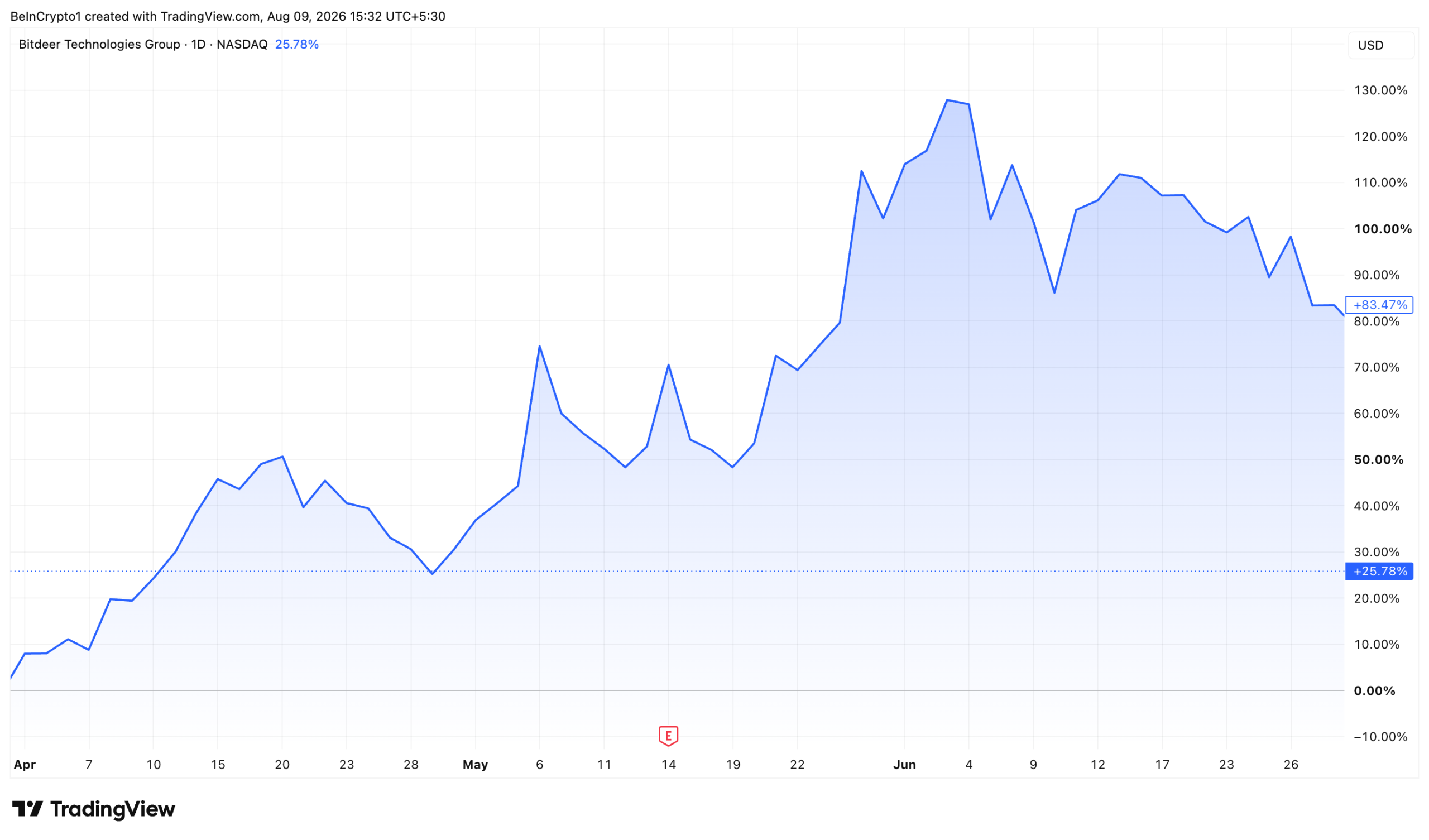
The second-quarter results come amid a strong period for Bitdeer shares. BTDR gained roughly 83% during Q2, significantly outperforming Bitcoin, which fell 14.08% over the same period.

The company’s mining output also surged. June production reached 990 BTC, up 388% year-over-year. Moreover, Bitdeer has continued to expand its AI infrastructure push.
In June, its subsidiary signed a colocation lease for its Tydal AI data center in Norway. It also broke ground on an Alberta facility.
Follow us on X to get the latest news as it happens
2. Forward Industries (FWDI)
Forward Industries will report its fiscal third-quarter results on Wednesday. In fiscal Q2, the company posted a $283.1 million net loss, largely due to Solana-related write-downs. Revenue more than quadrupled year-over-year to $13.0 million.
Forward previously disclosed that it acquired more than 500,000 SOL during fiscal Q3 at an average price of about $79 per token, lifting its Solana treasury to 7.55 million SOL. The purchases helped fuel a rally in the company’s stock.
Despite that boost, Forward was the only decliner among the three stocks during the quarter, falling about 5% between April and June. The decline was smaller than Solana’s roughly 11.4% drop.

3. Bit Digital (BTBT)
Bit Digital closes the week on Thursday before the open. The Ethereum treasury firm reported a net loss of $146.7 million last quarter as Ethereum’s price downturn cut deep. A $121.1 million hit on digital assets drove most of the damage.
Revenue fell 13.6% to $27.9 million, and the firm held about 155,444 ETH. The stock still recovered. Bit Digital rose about 37% in the second quarter, diverging from ETH’s 25.3% dip.

Together, the three reports test one question. Each firm holds tokens that fell last quarter, and the earnings will show how deeply those drawdowns cut into results.
Subscribe to our YouTube channel to watch leaders and journalists provide expert insights
The post 3 Crypto Earnings to Watch This Week After Q1 Losses appeared first on BeInCrypto.

Brazil’s central bank is introducing a new anti-fraud rule for cryptocurrency transfers, requiring regulated virtual asset service providers (VASPs) to temporarily “hold” certain outbound payments. The measure is designed to slow down potentially fraudulent flows that take advantage of cross-border speed and the complexities of self-custody transfers.
According to a statement from the Banco Central do Brasil (BCB), the rules will apply to funds received above $10,000—either in a single transaction or based on a customer’s total transactions over a day—when those funds are sent to foreign platforms or to customers’ self-custody wallets. The precautionary hold can last up to 24 hours, and providers will also need to hold other transfers that require additional review under their risk-management systems.
Key takeaways
- Brazil’s central bank (BCB) will require up to 24-hour precautionary holds on certain VASP transfers tied to fraud prevention.
- The rule targets transfers involving funds received above $10,000, measured by single transactions or daily aggregates.
- Holds must also cover other transfers flagged for extra scrutiny under a provider’s existing risk policies.
- The requirement takes effect Jan. 1, 2027, with VASPs required to disclose holds to customers and keep detailed records.
24-hour holds for high-value cross-border and self-custody transfers
The BCB says the framework applies when VASPs receive funds over the $10,000 threshold and then transfer them to either overseas providers or wallets held directly by customers. The central bank’s approach is effectively threshold-based: it covers not only one-off large transactions but also cases where multiple smaller moves add up to more than $10,000 in a day for the same customer.
Beyond the headline threshold, the rules also extend to “other transfers requiring further scrutiny” according to each provider’s risk-management policies. That language matters because it gives regulators flexibility to capture additional suspicious patterns even when transfers fall below the $10,000 number, as long as the provider’s compliance framework would normally treat them as higher risk.
When VASPs can release transfers early
A key operational detail is that the hold is not necessarily an automatic full 24-hour delay in every case. The BCB’s statement indicates that a VASP can complete its assessment and release a transfer before the 24 hours expire, as long as it follows parameters set out by the central bank.
Separately, VASPs will be expected to notify customers that a hold has been applied and to document relevant compliance activity. The BCB also requires providers to keep records related to fraud incidents, attempted fraud, and the corrective actions they take. For traders and users, the practical implication is that transfers to foreign platforms or self-custody wallets may become more variable in settlement timing—especially around higher-value or risk-flagged transactions—even if a provider ultimately clears the transfer quickly.
Brazil’s shift reflects a broader anti-scam push
Brazil’s central bank move comes as regulators globally respond to crypto scams that are enabled by fast settlement and the borderless nature of digital assets. The BCB’s approach mirrors a growing trend: slowing down or gating withdrawals and outbound transfers long enough to detect fraud patterns.
Earlier this year, Japan’s Financial Services Agency and National Police Agency asked crypto exchanges to restrict withdrawals in certain circumstances after users deposit fiat currency or buy digital assets. The Japanese authorities outlined expectations that exchanges require customers to pre-register withdrawal addresses, impose a waiting period for newly added addresses, and adopt additional measures such as customer-specific withdrawal limits and stronger monitoring. They also pointed to security practices including phishing-resistant multifactor authentication and checks to ensure the name of a bank remitter matches the account holder of the crypto transaction.
However, the Japan steps are not binding, and exchanges retain flexibility over how they implement restrictions based on their operations and exposure to misuse. Brazil’s plan, by contrast, is framed as an explicit central-bank requirement with a clear effective date and compliance obligations.
What to watch as the rules approach 2027
With the BCB rules scheduled to begin on Jan. 1, 2027, VASPs operating in Brazil will need to ensure their transfer monitoring systems can reliably identify the threshold conditions—particularly the “single transaction or daily total” logic tied to inbound funds above $10,000. They also need workflows for customer notification and for maintaining compliance records on fraud-related events and responses.
For users, the biggest day-to-day impact is likely to be around transfer timing and the need for clarity from providers when outbound moves are paused for review. For investors and market participants, these kinds of rules can affect how quickly capital moves through on-ramps, custody, and exchanges—potentially changing risk pricing, liquidity expectations, and the practical usability of cross-border or self-custody transfers during periods of heightened scam activity.
The next question for Brazil’s crypto market is how strongly providers will apply holds under the broader “risk-management” portion of the framework, and whether central bank guidance will specify further operational parameters that determine when transfers can be released early. Those details will likely shape how disruptive compliance becomes in practice—and how effectively it deters fraud without unduly burdening legitimate users.

How To Achieve Financial Freedom? By Sandeep Maheshwari | Hindi

Arsenal vs Borussia Dortmund and Liverpool vs Monaco – pre-season friendlies LIVE: Boos ring around the Emirates as the champions fall behind within the first seven minutes

Letterboxd Goes Down? Users Face Sunday Ongoing Sign-In Problems

Renter of Home in Anne Heche Crash Denies Settlement With Son

No Jackpot Winner as $257 Million Prize Rolls Over to $269 Million Monday Draw

Weekend Open Thread: Staud – Corporette.com
How To Achieve Financial Freedom? By Sandeep Maheshwari | Hindi

CA Foundation Business Economics: Money Market | Chanakya 3.0 | One Shot | Love Kaushik Sir

Which Stock Market Sectors Should Investors Watch? | Financial Astrology | Prashant Kapoor LIVE
-

 Politics7 days ago
Zack Polanski: an incitement to murder Nigel Farage?
-

 Fashion2 days ago
Frugal Friday’s Workwear Report: Cap-Sleeve Pointelle Crewneck Sweater
-

 Fashion2 days ago
Weekend Open Thread: Mattifying Sunscreen
-

 Business6 days ago
DTCR: Deleveraging And A Hedge Fund Collapse Point To A Possible AI Bottom
-

 Crypto World7 days ago
XRP Ledger urges node upgrade after manifest flood
-

 Sports3 days ago
Jordan Coyle & Cordiamo take Laya Arena Stakes at RDS
-

 News Videos1 day ago
Can Astrology Help Find Gold and Silver Trends? A Financial Astrology Guide
-
 Crypto World6 days ago
US Tech Stocks See Largest 5-Week Inflow in History: Can Nasdaq Break Its Downtrend?
-
 Business4 days ago
US stocks: Dow closes at record on Mideast optimism; SpaceX, AMD drag Nasdaq
-

 Politics3 days ago
Reform UK And Greens Sink To Lowest Favourability Ratings To Date
-

 Business5 days ago
Nvidia Stock Climbs 2.5% as Chip Sector Rally Builds Ahead of AMD Earnings, Nvidia’s Own Report Looms
-

 Tech7 days ago
OpenAI teases Astra, its next major AI model, after it solves 10 long-standing math problems
-

 Crypto World5 days ago
Polymarket targets $20 billion valuation as competition heats up in prediction market sector
-

 Tech4 days ago
OpenAI, Anthropic AI agents targeted real people and systems in cyber tests
-

 Business4 days ago
Supply chain issues impact Ingredion
-

 News Videos6 days ago
#crypto #cryptocurrency #cryptonews #cuet2026 #ceuta
-

 Business6 days ago
Myspace owners announce plans to relaunch the once-popular platform
-

 News Videos6 days ago
Crypto.com Partners with UFC for UFC 331 Event
-
 Crypto World5 days ago
CLARITY Act Senate Vote Locked In, But 60-Vote Hurdle Looms Large
-

 News Videos6 days ago
Huge SPINS!! (for me) #slots #casino #gambling #money #jackpot
You must be logged in to post a comment Login