
Connect with us

NewsBeat

Shaun Murphy smashes Ronnie O’Sullivan snooker record in stunning China Open win

Published

on

Shaun Murphy smashes Ronnie O'Sullivan snooker record in stunning China Open win
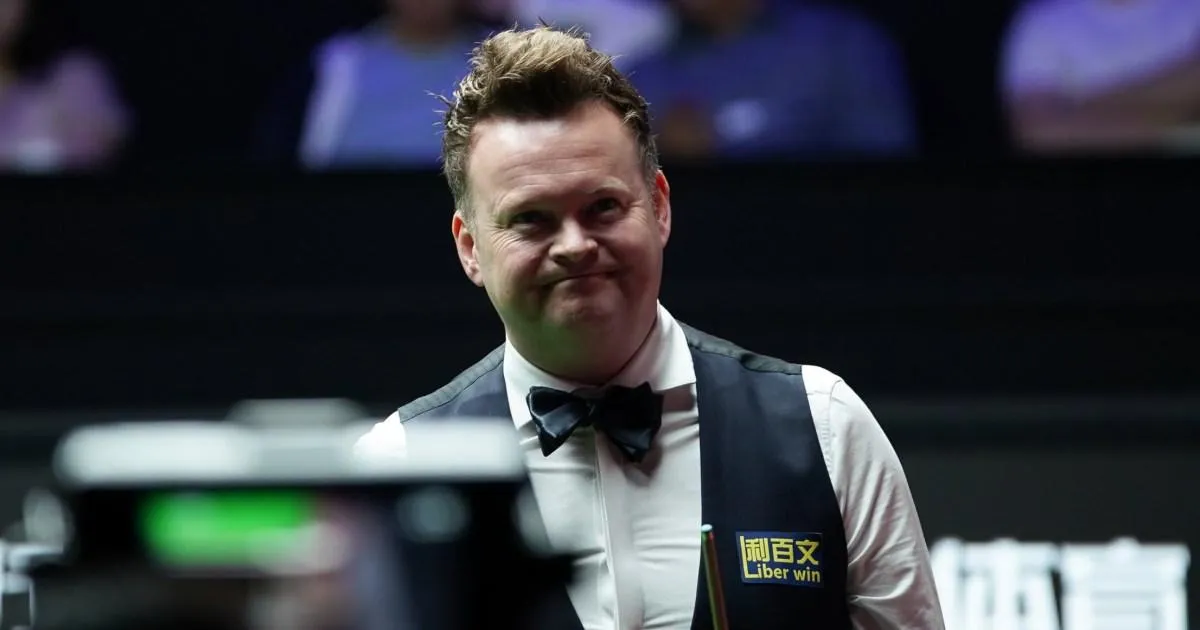
Shaun Murphy has secured a piece of snooker history (Picture: Getty Images)

Shaun Murphy has broken Ronnie O’Sullivan’s long-standing record for most points scored without reply in a snooker match.

The Magician took on Matt Selt in the last 32 of the China Open in Taiyuan on Sunday and was in spectacular form.

This year’s World Championship runner-up made breaks of 61, 132, 103, 139 and 113 to surge into a 5-0 lead without Selt scoring a point.

He opened the scoring in the sixth frame, but could not wrap things up in one visit and Selt scored his first points of the match.

Advertisement

That saw Murphy’s run of unanswered scoring end at 607 points, smashing the previous record held by the Rocket.

Ask Metro


Use AI to go deeper into the stories you care about – powered by Metro and trusted publications.

Advertisement

Are you snooker loopy?

You’re in the right place. I’m Phil Haigh, and I cover the game we all love for Metro.

In my newsletter, The Table, I analyse the biggest talking points, pull back the curtain on the sport and crown the biggest winners and losers every week.

Sign up here.

Phil has been reporting on snooker for over a decade
Advertisement

O’Sullivan scored 556 points without reply against Ricky Walden at the Masters in 2014, a record which has stood for over 12 years.

Murphy secured the sixth and final frame of the match to beat Selt 6-0, just as O’Sullivan hammered Walden 6-0 at Alexandra Palace in 2014.

More to follow…

Advertisement

Source link

Advertisement
Continue Reading
Click to comment

You must be logged in to post a comment Login

Leave a Reply

NewsBeat

Will companies ever be run by an AI CEO?

Published

on

Will companies ever be run by an AI CEO?

OpenAI’s CEO Sam Altman has speculated about how long it will take for artificial intelligence to replace senior leadership teams in organisations. “Shame on me,” Altman told the Conversations with Tyler podcast in November 2025, “if OpenAI is not the first big company run by an AI CEO.”

Altman is not the only one thinking about corporate robot leaders. Mark Zuckerberg has revealed he is training an AI agent to partly automate his job as the boss of Meta.

The promise of an AI CEO, powered by machine learning and neural networks, is that it can streamline decision-making and improve management operations. This vision is not new: in 2017, Jack Ma, CEO of Chinese e-commerce company Alibaba, was already predicting the rise of android business leaders.

Since then, several companies have installed a humanoid AI bot as their chief executive, including Chinese videogame company NetDragon Websoft and Polish drinks company Dictador. While these examples are probably publicity stunts dressed up as corporate strategy, the theory is that AI can do anything a human leader can do – only better and cheaper.

Advertisement

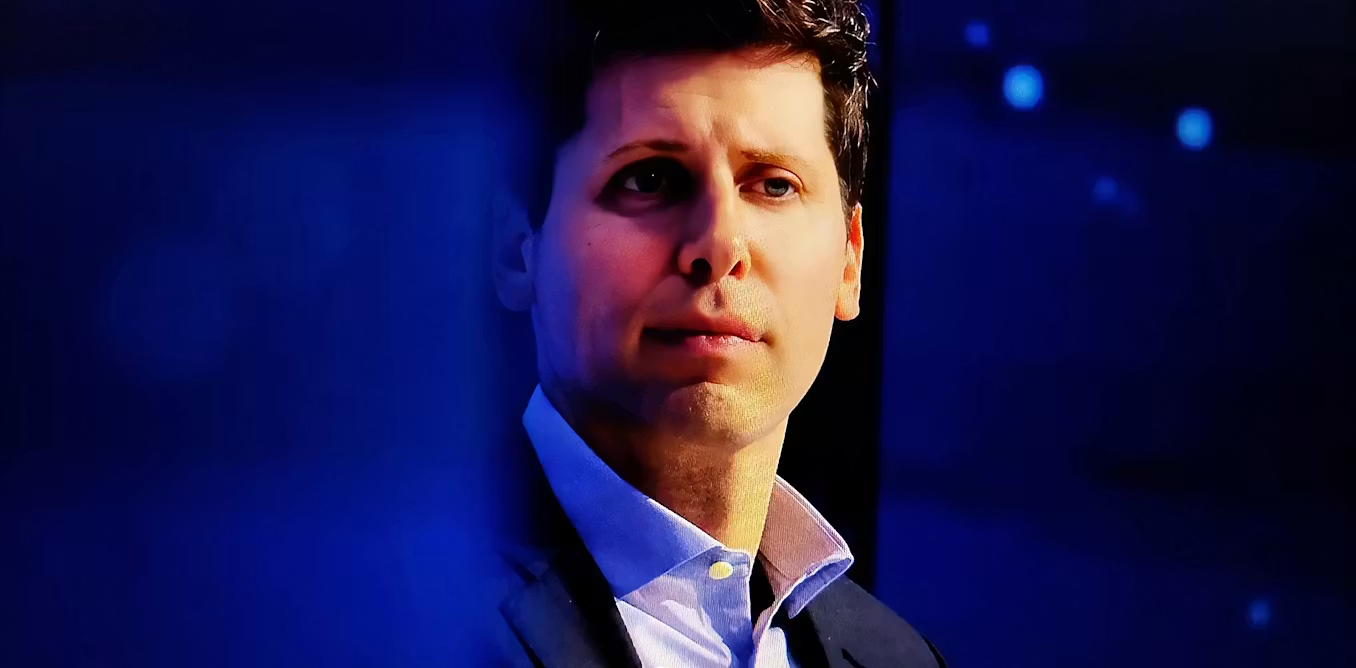
Sam Altman in conversation at the Progress Conference last year.

For Altman, though, there is a problem: not with AI – you can already run a company by algorithmic processes – but with humans. Workers might not be ready to accept an AI CEO that has the power to hire and fire at will, for example.

For this reason, Altman said he could see himself remaining the public face of OpenAI – a charismatic leader of an organisation that is otherwise largely automated.

Human face, AI brain

Altman’s vision aligns with what we call the “reversal of the Mechanical Turk”, a phenomenon that involves hiding AI behind a human face.

Advertisement

The original Mechanical Turk was a chess-playing machine designed and constructed by the engineer and inventor Wolfgang von Kempelen. Unveiled in 1770 at the Austrian imperial court to impress Empress Maria Theresa, it displayed an Ottoman-dressed figure seated behind a chessboard on top of a large cabinet. The doll appeared to play chess, usually beating its human opponents.

For nearly a century, the Mechanical Turk toured Europe and the US, defeating such eminent figures as Napoleon and Benjamin Franklin. Finally, Edgar Allan Poe’s family doctor acquired it and confirmed what had long been suspected: the machine was an illusion, operated by a human chess player hidden inside the cabinet.

The future of leadership in Altman’s vision is the exact opposite of the Mechanical Turk: a company that appears human (with Altman as its friendly face) but is actually machinic.

In Altman’s view, AI can do all the things a human CEO is supposed to do – including formulating a corporate vision, communicating organisational values and making strategic decisions. But the public will see only the human in the loop, not the algorithms behind the scenes.

Advertisement

Leadership in the age of AI

Could an AI CEO really do the job better than its human counterpart? If the role of CEO is to maximise efficiency and pursue market growth at all costs, then the answer might be “yes”. After all, AI is built to produce high-probability outputs based on patterns in data.

But most people expect more from leaders than algorithmic optimisation – a means-ends logic without heart or soul. The importance still placed on popular concepts like authenticity, responsiblity and value-driven leadership indicate that what we want from corporate leaders is something intrinsically human.

Just as we know that computers are infinitely better at number crunching than humans, we also know that computers are incapable of key leadership qualities like empathy or ethical judgment. A large language model (LLM)-based chatbot is unable to exert true leadership, just as a dishwasher is unable to fall in love.

Yet an AI CEO might be able to imitate the qualities we expect from good leaders. It’s plausible, for example, that an AI CEO could convince us that it cares about its employees or that it feels strongly about the company’s mission, in the same way that any chatbot tells us things we want to hear.

Advertisement

But none of this would be true. An AI CEO can only ever be a bundle of predictive algorithms geared towards operational effectiveness.

Against the anthropomorphisation of AI

The idea of an AI CEO is an extreme form of the anthropomorphisation of LLM-based systems. We already use terms such as artificial intelligence, reasoning models and hallucinations when talking about non-sentient machines. The word “leadership” applied in this context is no different.

The anthropomorphism of AI creates the illusion that chatbots operate “just like a human leader”. At the start of this year, the US AI company Anthropic published an 84-page constitution in which the company set out its “vision for Claude’s character”, including the personality traits for its AI chatbot.

These traits included intellectual curiosity, warmth and care, and a deep commitment to honesty and ethics – all qualities that we normally associate with good leadership.

Advertisement

It is important to call out such chimeras. Doing so can avoid amplifying the illusion of the Mechanical Turk reversed: a belief that an AI CEO could really take the place of a living, breathing corporate leader, supplanting their most quintessential human qualities.


AI has long been discussed as a threat to jobs and livelihoods. But what’s the reality? In this series, we explore the impact it is already having on different occupations – and how people really feel about their AI assistants.

Source link

Advertisement
Continue Reading

NewsBeat

Clarkson’s Farm’s Harriet Cowan dons bodysuit as she swaps farm for festival

Published

on

Wales Online

Clarkson’s Farm star Harriet Cowan has been busy since her stint on the Prime Video show, but recently took time out from work to enjoy Y Not Festival with her pals

Clarkson’s Farm star Harriet Cowan has showcased a strikingly different persona after glamming up for a music festival alongside her friends. The 25-year-old rose to fame following her appearance on Jeremy Clarkson’s Prime Video series in its fourth series, temporarily replacing farmhand Kaleb Cooper while he undertook his solo tour, The World According to Kaleb.

Advertisement

Harriet, a TikTok content creator and healthcare worker at the time, rapidly adapted to her responsibilities and established herself as a popular member of the programme. Upon securing the role, however, she confessed she’d never actually watched the series before, which is recorded at former Top Gear presenter Clarkson’s estate at Diddly Squat Farm in Chipping Norton in the Cotswolds.

Despite this, she eagerly immersed herself in the duties, tackling tasks in the cattle barn, the stables, and across the farmland. Accompanied by several pals, Harriet recently attended Y Not Festival, which ran from July 30 to August 2 in Pikehall in the Peak District, drawing approximately 33,000 attendees.

In a video she shared on TikTok, she donned a white form-fitting bodysuit, paired with burgundy cowgirl boots and a coordinating leather jacket. The ensemble was a stark contrast to the clothing viewers typically see her wearing alongside Jeremy Clarkson and fellow cast members on screen.

“Festival weekend,” she wrote in the caption as she twirled for her 844,000 followers. Harriet also turned to Instagram to post a collection of photographs from the festival.

Advertisement
Content cannot be displayed without consent

The opening image captured her revelling with friends as darkness fell over the main stage. “Did someone say festival season?” she wrote.

Harriet was also snapped enjoying a few drinks, and sharing her delight at discovering another festival attendee wearing one of Clarkson’s Hawkstone Brewery t-shirts. She struck further poses before the festival’s helter-skelter and mingled amongst the crowds of revellers.

“Damn, I watched that more than I should have…,” one admirer confessed in the comments. A second gushed: “Wow, you look good in that outfit girl.”

A third contributed: “Farm is treating you well!” While a fourth TikTok user declared: “Wow! Simply wow!”

Advertisement

Following her appearance on Clarkson’s Farm, it has emerged Harriet has formed her own private company called Farmfluence, with the organisation registered on July 1, 2025. Based on latest company documentation, the business operations are described as “motion picture, video and television programme post-production activities” with Harriet acting as the sole director/shareholder.

Alongside her growing prominence and recent agency partnership, Harriet has revealed her tie-up with Country Moos, a sock manufacturer specialising in bovine designs, which she will be championing through her social media channels.

This year’s Y Not Festival delivered an exceptional programme, with The Libertines, The Streets, Two Door Cinema Club, and Reytons securing the top billing. The remarkable roster also featured Kaiser Chiefs, The Vaccines, Happy Mondays, Sophie Ellis-Bextor, The Royston Club, Scouting For Girls, Ash, Reverend And The Makers, Keo, and Freddie Halkon.

Get daily breaking news updates on your phone by joining our WhatsApp community here. We occasionally treat members to special offers, promotions and ads from us and our partners. See our Privacy Notice.

Advertisement

Source link

Continue Reading

NewsBeat

Why are deaf audiences still treated as an afterthought in theatre and cinema?

Published

on

Why are deaf audiences still treated as an afterthought in theatre and cinema?

In this article, deaf is used as an umbrella term to include Deaf, deaf, hard of hearing, hearing-impaired, deafened and people with hearing loss.

Theatre and cinemas are increasingly lauding their commitment to access and diversity; yet deaf people are still excluded from most performances and films.

Many theatre performances are not captioned or British Sign Language (BSL) interpreted and if they are, theatres typically offer one captioned and one interpreted show in a run, regardless of the number of performances.

Most films are distributed with caption tracks, but cinemas, on average, caption only 1% of all showings. This is despite statistics showing that in the UK, one in seven people – approximately 14% of the population – are deaf or have hearing loss.

Advertisement

This is not meaningful inclusion; it is managed exclusion and amounts to what is termed “deafwashing”.


This article is part of our State of the Arts series. These articles tackle the challenges of the arts and heritage industry – and celebrate the wins, too.


As a deaf/deafened researcher, a lifelong theatregoer and amateur performer, I have spent years watching accessibility being treated as a specialist add-on rather than an integral part of arts and culture. Theatre was once one of the places where I felt most connected to the wider world. Now, however, access barriers have made participation almost impossible, transforming what should be a positive social experience into a demoralising logistical challenge.

Advertisement

The issue matters for reasons that extend beyond the arts. Worse mental health among deaf people is well documented, with higher rates of conditions such as depression and anxiety, and a higher prevalence of social isolation and loneliness.

Prevalence of mental health problems in deaf children has been found to be twice to four times as high as their typically hearing peers. Social exclusion – defined as exclusion from economic, social, political and cultural life – is considered a key driver of these disparities.

A profound connection

Going to the theatre, cinema or a live performance is not simply entertainment. It is a way of connecting with others, participating in shared conversations and feeling part of a community.

Advertisement

Restricting access for deaf audiences is often justified through claims that accessibility features are distracting, aesthetically intrusive or unwanted by general audiences. Such assumptions persist despite a lack of evidence to support them.

Some cinemas have begun offering captioning glasses, which is a welcome improvement on a complete lack of access. However, these solutions still risk stigmatising deaf audiences, and some may feel uncomfortable wearing them and being visibly singled out.

In fact, many hearing people also find captions helpful or even necessary, including neurodivergent people, those with developmental conditions, older adults and non-native speakers. More broadly, captions can support understanding of complex or fast-paced dialogue. Given the widespread demand for captions, it is unsurprising that global platforms such as YouTube and TikTok have made them standard. Why, then, do theatres and cinemas continue to treat accessibility as an optional extra?

This exclusion stems from a long history of institutional exclusion. Accessibility is frequently viewed through the lens of accommodation rather than inclusion: accommodation asks how institutions can make occasional adjustments for a minority group, positioning inclusion as a burdensome add-on.

Advertisement

Inclusion, by contrast, asks how environments can be designed so that a wider range of people can participate from the outset. This is embodied in the concept of universal design; designing with built-in access for everyone rather than additional special features for disabled people.

A recent production of Under Milk Wood at Theatr Clwyd in Wales ably demonstrates how theatre can successfully incorporate deaf inclusion. Created by Craidd, a collaboration of Welsh theatre companies, the performance integrated captions, BSL interpretation and audio description into the artistic fabric of the show.

The captions moved and performed alongside the action, almost becoming supporting actors, while the BSL interpretation bounced between the cast, fully immersed in the performance. Far from being an unwelcome distraction, this enhanced the performance for all audiences providing additional textual, visual and emotional interpretations alongside traditional spoken words and acting. This is supported by research showing that visually rich and emotionally attuned captioning augments comprehension and emotional engagement.

Advertisement

Sara Beer, director for change at Craidd, notes: “Lots of people liked the captions – even those without hearing loss – because they helped them make sense of what was happening. It’s another way of telling the story, and lots of people like it even if they don’t need it as an access requirement.”

The question, then, is not whether accessibility in the arts is possible, we know it is.

“It’s about deciding at the start what access will work best for the production, not adding it on afterwards,” says Beer. “It has a cost implication, but if you budget for it at the start in the way that you budget for everything it just becomes what you do.”

It is time inclusivity becomes the norm rather than the exception. For deaf audiences, inclusion means more than being welcomed in principle; it means being able to attend performances with the same spontaneity and freedom as everyone else.

Advertisement

We need more deaf creatives in positions of genuine creative influence, and to move beyond measures that superficially support access, but merely contribute to ableist norms being perpetuated. Access should be part of universal design not an afterthought.

Source link

Advertisement
Continue Reading

NewsBeat

Five lost Glasgow restaurants around in the 70’s that no longer exist – do you remember them?

Published

on

Daily Record

The city has lost many beloved eateries over the years

It’s fair to say we are spoiled for choices these days when it comes to food in and around Glasgow City Centre, with countless restaurants and eateries offering almost every type of cuisine imaginable.

Advertisement

Due to an endless revolving door of new food spots, the restaurant industry is now a lot more competitive and a lot of places fail to withstand the test of time.

This is of course with the exception of a select few iconic Glasgow venues that are still standing today including Café Gandolfi, Sloans, La Lanterna and Cafe D’Jaconelli.

However, there are many beloved restaurants that we have lost along the way.

Taking it back to simpler times, here are some Glasgow favourites from the 1970’s that closed their doors for the final time much to locals’ dismay.

Advertisement

Do you remember any of them?

Dino’s

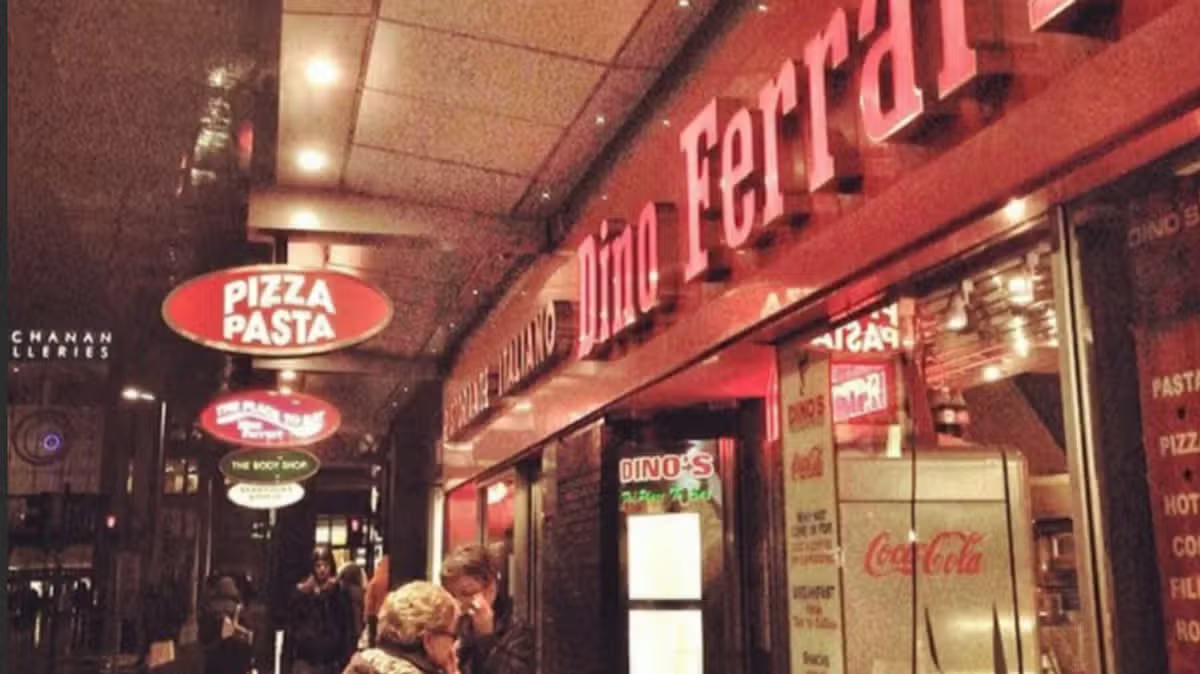
Dino Ferrari’s on Sauchiehall Street was once a Glasgow institution.

Founded in 1966 on Buchanan Street, the Italian eatery relocated to Sauchiehall Street in the 1970’s.

Advertisement

It offered many Scots their first taste of the continental culinary delights that are pizza and pasta.

Dino’s announced their heartbreaking closure in 2014 after almost 50 years in business when owner Alfredo Crolla retired.

Speaking fondly of Dino’s on a nostalgic Reddit thread about defunct restaurants in Glasgow, one Scot wrote: “Nothing has ever replaced the Dino’s £3.80 10’ pizza. What a class place that was.”

Danish Food Centre

The beloved Danish Food Centre once stood on St Vincent Street after it opened in the city in 1969.

Advertisement

The restaurant was a chain and its Glasgow location came as the third of its kind in the UK after the first stores were built in London and Manchester.

Famed for its smoked mackerel and it’s ‘Smorgasbord’ buffet, the food joint introduced Glaswegians to a wide range of Danish grub.

Speaking of the ‘missed’ Glasgow eateries on a Reddit thread, one Scot wrote: “Going way back to the early 70’s, the Danish Food Centre.”

Advertisement

Rogano

Rogano was first opened back in the 1930’s and was a popular joint in the 70’s and 80’s for those who remember.

The historic seafood restaurant was located just off Royal Exchange Square in Glasgow City Centre.

Loved by locals, it was also popular with celebrities including Elizabeth Taylor, Mick Jagger and Kylie Minogue.

Advertisement

The famed art deco fish joint sadly closed during the pandemic over a legal dispute about flooding damage sustained during lockdown.

In a Reddit thread about closed down Glasgow restaurants, one Scot described it as: “One of a kind.”

Buck Rogers

One of Glasgow’s most famously themed eateries was Queen Street’s Buck Rogers Burger Station which was inspired by the NBC TV series that ran from 1979 to 1981.

Opened by the city’s Lord Provost in November 1982, the iconic Burger Station was designed to whisk its patrons directly into the 25th century.

Food and drinks were even served by the show’s robot Twiki and the entire eatery was decorated in futuristic furnishings.

The sci-fi themed eatery was later transformed into one of the city’s best-known nightclubs, Archaos.

Wimpy

There were several Wimpy restaurants across Glasgow in the 1960’s including at The Sauchiehall Centre, Ingram Street and Union Street.

Advertisement

The classic UK burger chain was a hit in the city, selling American-style fast food that was served at your table with proper plates and cutlery.

Famed for their burgers and milkshakes, one Scot fondly remembers another dish of theirs.

In a Reddit thread about defunct Glasgow restaurants, they wrote: “Wimpy’s Sauchiehall Street. They made damn good fish n’ chips.”

Advertisement

The burger chain’s outlets gradually disappeared in the 1990’s. However, you can still find Wimpy restaurants in a limited number of places around the UK

Source link

Continue Reading

NewsBeat

Arsenal vs Borussia Dortmund and Liverpool vs Monaco – pre-season friendlies LIVE: Boos ring around the Emirates as the champions fall behind within the first seven minutes

Published

on

Arsenal vs Borussia Dortmund and Liverpool vs Monaco - pre-season friendlies LIVE: Boos ring around the Emirates as the champions fall behind within the first seven minutes

Advertisement

Follow Daily Mail Sport’s live coverage for the latest updates as Arsenal take on Borussia Dortmund at the Emirates and Andoni Iraola makes his Anfield bow as his Liverpool team host Monaco. 

Advertisement

Source link

Advertisement
Continue Reading

NewsBeat

Talented young performers wanted for production of The Addams Family in Belfast

Published

on

Belfast Live

The show will be staged at The Waterfront Hall Studio

If your child loves to sing, dance and act and shines on the stage then this upcoming production might be the perfect opportunity for them this Autumn.

Advertisement

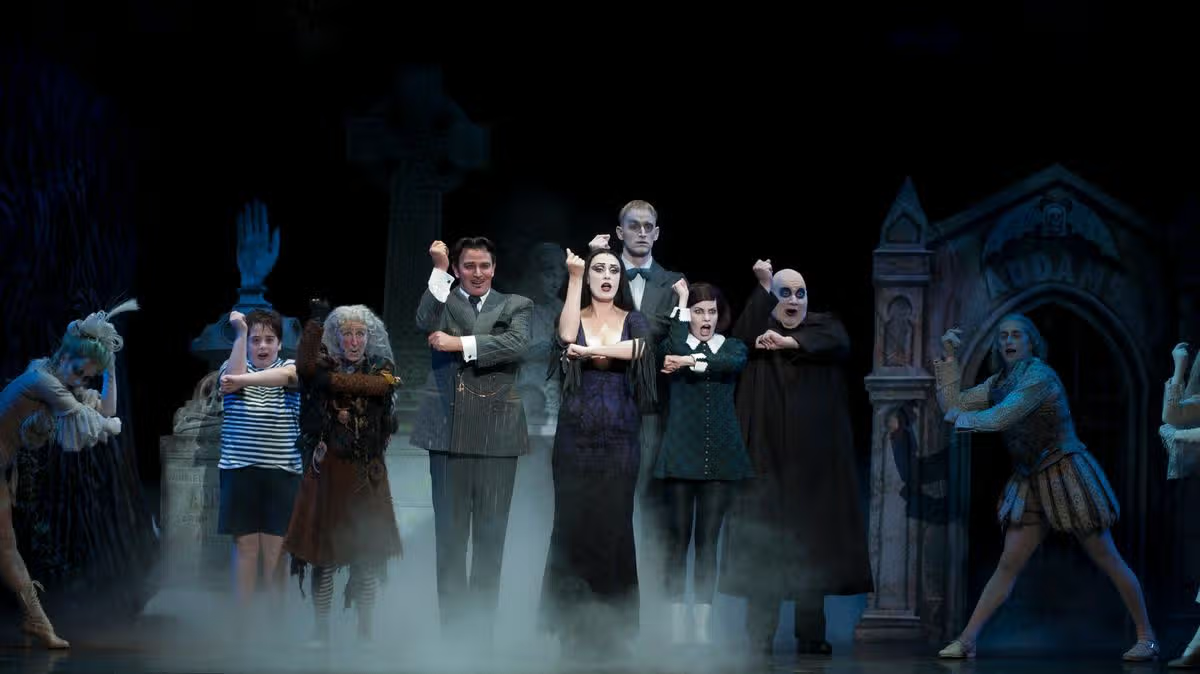
Young performers are currently wanted for an upcoming family-friendly production of The Addams Family in Belfast.

Just Stage It (JSI) Academy are on the search for talented performers aged 7-18 for their next show which will be staged in The Waterfront Studio this Halloween.

The Young@Part version of The Addams Family is a 60-minute edition of the Broadway musical for youth theatres and schools.

A spokesperson for JSI said: “Whether you’re an experienced performer or stepping onto the stage for the very first time, JSI welcomes enthusiastic young people who love to sing, dance and act.

Advertisement

“No previous stage experience is required – just passion, commitment and a willingness to have fun.

“The cast will train with an outstanding professional creative team comprising Adam Gillian, Johanna Johnston, Matt Evans, and Jonny Brown.

“Together, they bring a wealth of experience in professional musical theatre, providing young performers with expert training in acting, singing and dance before performing

“Auditions will take place on 22nd and 23rd August, with successful applicants joining the cast for rehearsals leading to performances on 31st October and 1st November 2026 at the Waterfront Studio Theatre, Belfast.

Advertisement

“The Addams Family Young@Part® is a spooky, hilarious and heartwarming musical based on the beloved characters created by Charles Addams.

“Packed with unforgettable songs, quirky characters and plenty of laughs, this promises to be one of JSI’s biggest productions to date.”

To register for auditions, email info@juststageit.net or click here

For all the latest news, visit the Belfast Live homepage here and sign up to our What’s On newsletter.

Source link

Advertisement
Continue Reading

NewsBeat

Man explains scheme to retire at 45 after tearing up ‘pointless’ pension plans

Published

on

Daily Mirror

Sean decided his pension plan was not helping him at all and came up with a different solution

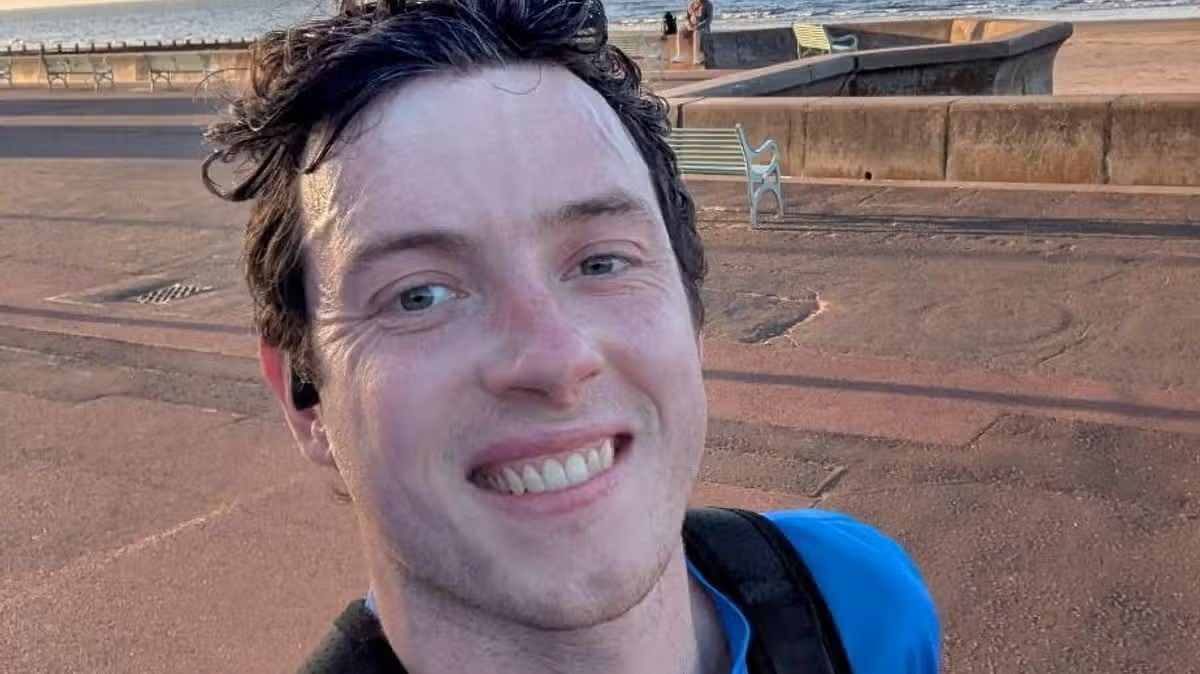
A man has revealed how he tore up his pension plans after launching a bold bid to retire at 45 on £30,000 a year. Sean Leith is an actuarial consultant working in pensions – so knows a thing or two about the issue. He says he is well on his way to saving £700,000 over the next 15 years.

Advertisement

Sean, 30, is channelling as much of his £3,400 monthly wage as possible into a stocks and shares ISA, focusing on specific ETFs (exchange traded funds). Sean, from Edinburgh, made the decision to cut back his pension contributions and instead pour more money into his ISA – all in a bid to retire early and make the most of life away from the office.

Since 2021, he has put £29,500 into his ISA, a figure that has more than doubled to £67,000 following what Sean described as some “lucky” investments into individual companies. He now aims to ramp up his contributions to between £800 and £1,000 a month.

He hopes this strategy will allow him to retire by 45, or 50 at the very latest, with roughly £700,000 to his name. Sean said: “The plan is to retire at 45, 50 at the latest. Hopefully, the ISA will have enough saved in it.

“I think I will need just around £700,000 in today’s money. That should allow me to have £30,000 a year.”

Sean overhauled his pension plan in July 2026 after realising the tax relief he was receiving no longer matched his retirement ambitions. He currently has £83,000 tucked away in an employer pension scheme. He said: “I used to pay loads into my pension to get tax relief. Then I realised if I want to retire by 45, it was pointless.

“At the peak, I was paying 25% of my salary into my pension, a total of £1,450 monthly with my employer’s contribution.

“I reduced my pension contributions down to 5% as that’s the most my employer will match. That means I can put more money into my ISA.”

Of course, money in ETFs can go down as well as up – so there are no guarantees and people should seek proper financial advice before making significant changes such as this. Yet when he does retire, Sean is hoping to spend time on golf courses and padel courts – if he has other retired friends to play with. Sean said: “The plan is to travel a lot and do lots of sports. It will be nice to do what I want and not have to work.

Advertisement

“My only worry is none of my friends are really doing this. Who will I do that stuff with?”

Sean hopes to leave his job at 45, in 2041, though he may need to hold on until 50 if his investment returns and contributions fall short of the 10% he’s targeting.

He admitted: “The 45 age is ambitious to live the life I want. I could retire much earlier with much less money.

Advertisement

“My current salary is around £62,000. I’m at around £67,000 in my ISA, but I’m definitely going to need to up my contributions.

“I’m aiming to put £500 a month in the ISA, but it’s more variable. To retire at 45, I need to be at £800 to £1,000 a month.”

Sean, who runs the Instagram account @seansmoney2396, began taking his financial future more seriously after being signed off work for six months during lockdown.. He said: “In lockdown, I started really struggling with anxiety. I’d been working in finance for five years but I was spending everything each month.

“I got signed off work for six months, but after three months I was on the statutory minimum. I had no savings so paying bills was impossible.

Advertisement

“I said to myself, this is ridiculous. I was earning £35,000, I shouldn’t be in a situation where I’m off work for two weeks and can’t pay my bills.”

Sean began by putting aside £100 a month, and when he returned to work he was able to save increasingly larger amounts. He said: “When I got back to work I kept doing stuff to get to do extra money.

“It was in a savings account, but I did my research and I realised I could do more with it.” If he successfully manages it, Sean will have accumulated around £700,000 in his ISA within 15 years – allowing him to pack in his job and live comfortably nearly 22 years before he reaches state pension age.

Sean remains sceptical about the state pension, saying: “In terms of the state pension, I don’t care about the age I can access that.

Advertisement

“I don’t think I’ll get it either, as it will be gone or means-tested. If I’m the guy with £700,000 in my ISA at 45, I’ll be ineligible anyway. “.

SEAN’S MONTHLY OUTGOINGS

  • Mortgage – £1150
  • Council tax – £140
  • Gas and electricity – £100
  • WiFi – £35
  • Phone bill – £10

Source link

Continue Reading

NewsBeat

Trump’s peace plan for Gaza is REJECTED by Israel as Netanyahu refuses to withdraw until Hamas is disarmed

Published

on

US  President Donald Trump points his finger towards Israeli Prime Minister Benjamin Netanyahu during a press conference in December of 2025

Advertisement

Prime Minister Benjamin Netanyahu announced Sunday his nation is rejecting a peace plan proposed by President Donald Trump‘s Board of Peace.

‘I want to clarify this: Israel rejects the 15-point document. I have heard people saying, ‘You didn’t say that.’ So here I am saying it again, Netanyahu told a meeting of his Cabinet.

‘The IDF will not carry out any withdrawal until Hamas is disarmed,’ the Israeli PM added. 

Last month, Trump championed a breakthrough in his peace plan for Gaza but it appeared to hit a major roadblock Sunday after  Netanyahu flatly rejected a key part of the proposed deal, insisting Hamas must surrender every weapon before Israeli troops leave the territory.

Advertisement

Trump had celebrated what he described as a breakthrough in negotiations last month, saying Hamas had agreed to lay down its arms. But the Board of Peace’s roadmap calls for Israel to gradually withdraw its forces from Gaza as Hamas disarms – a sequence Netanyahu made clear he will not accept.

‘When I say Hamas must be disarmed, I mean heavy weapons, lighter weapons, all weapons. We are talking about genuine disarmament, not a fictitious one,’ Netanyahu declared Sunday, insisting Israeli troops will remain in Gaza until the terror group is completely stripped of its arsenal.

Hamas has taken the opposite position. The group said last month it would only disarm after Israel fully withdraws from Gaza and ends military operations, adding that surrendering its heavy weapons would come later and only if a Palestinian state is established.

Netanyahu also doubled down on his long-standing opposition to Palestinian statehood, declaring: ‘As long as I am Prime Minister, there will be no Palestinian State.’ His comments come as he faces a fierce political fight ahead of October elections, with the wars in Gaza and Iran expected to dominate the campaign.

Advertisement

US  President Donald Trump points his finger towards Israeli Prime Minister Benjamin Netanyahu during a press conference in December of 2025

Senior Hamas official Basim Naeem blasted Netanyahu’s remarks, urging US officials and international mediators to ‘exert pressure’ on the Israeli leader to follow the agreed roadmap and ‘prevent him from obstructing the process for domestic political and electoral considerations.’

Naeem said Hamas remained committed to the Board of Peace’s proposal, describing it as an act of ‘national responsibility’ that serves the ‘interests of the Palestinian people.’

Advertisement

Netanyahu acknowledged negotiations with Washington remain ongoing despite the impasse.

‘We are currently discussing this issue with the Americans,’ he said. ‘They have ideas; some of them are acceptable to us and some are not, and we know how to stand firm on these matters.’

This is a breaking news story and will be updated. 

Advertisement

Advertisement

Source link

Continue Reading

NewsBeat

Bear Grylls fans floored after learning who his famous sister is

Published

on

Daily Mirror

Bear Grylls fans wouldn’t have expected the survival expert to be related to this reality star

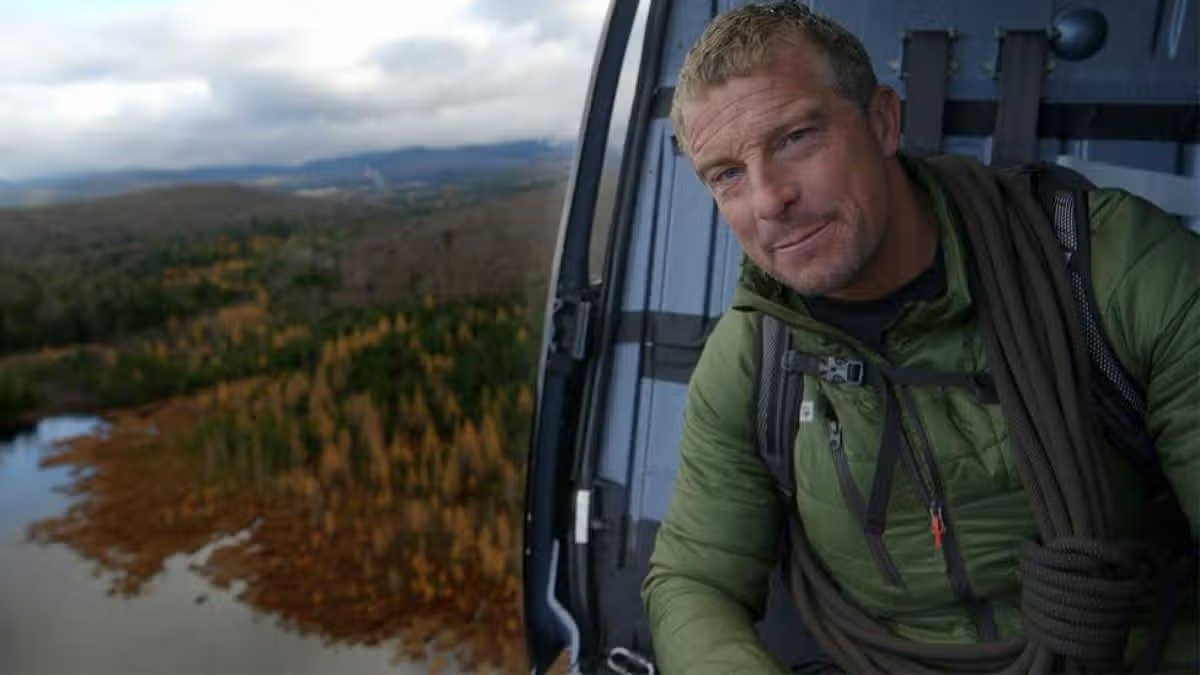
Bear Grylls is far from the only famous face in his family but with his sister going down a very different career path.

The Chosen in the Wild with Bear Grylls has dropped on Prime Video today, Sunday August 9, where he leads the cast of historical drama The Chosen through rugged landscapes to explore their real-life spiritual journeys.

Advertisement

All six episodes are ready to stream now and as fans delve into the docu-series, many viewers are growing curious about Grylls’ personal life, including his family.

But what fans may not realise is that his older sister has become a regular on our screens every Friday night as she is Gogglebox star Lara Fawcett.

Bear clearly isn’t the only one with an adventurous side in the family though as Lara is an open-water cold swimmer.

The 60-year-old has previously represented Team GB in the International Ice Swimming World Championships in the French Alps.

But since competing in the extreme sport, she joined the cast of Channel 4’s Gogglebox, appearing alongside her mother-in-law Sara on her sofa.

It was also thanks to Lara, who now works in PR, that the survival expert got his famous nickname.

He previously shared with The Times: “I was christened Edward. My sister gave me the name Bear when I was a week old and it has stuck.”

Advertisement

Bear and Lara’s father was also well known but in a very different field as he was British Conservative politician Sir Williams Grylls.

He served as an MP for both Chertsey and North West Surrey from 1970 to 1997 and sadly died in 2001 at the age of 66.

Grylls has been married to author, philanthropist and speaker Shara Grylls since 2000 and they have three sons together.

Advertisement

She has written two relationship books that focus on advice and insights about maintaining a strong partnership.

The Chosen in the Wild with Bear Grylls is available to watch on Prime Video.

Source link

Advertisement
Continue Reading

NewsBeat

Forget golf or boozy lunches, top firms are now wooing new clients over a game of padel

Published

on

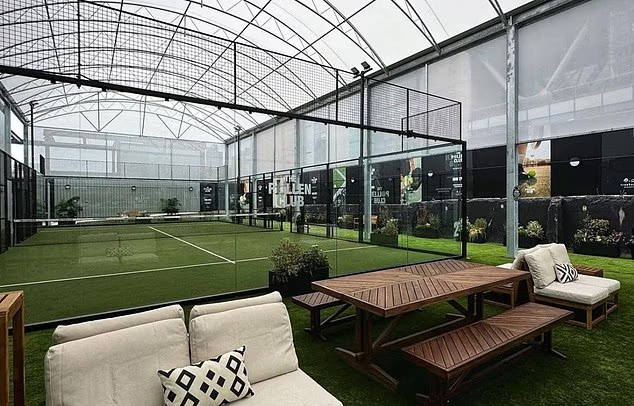
Padel, a tennis-squash hybrid played with rackets, has become a favourite for networking and team-building among lawyers, venture capitalists and management consultants (Pictured: Pollen Club padel clubhouse in Deansgate, Manchester)

Forget golf clubs and boozy lunches – top firms across Britain are now wooing new clients over a game of padel.

Padel, a tennis-squash hybrid played with rackets, has become a favourite for networking and team-building among lawyers, venture capitalists and management consultants in recent years – with courts increasingly springing up close to offices and along commuters’ routes home

Unlike suburban golf courses, padel courts are popping up in some of London‘s smartest neighbourhoods, including Battersea, Canary Wharf, Shoreditch and Vauxhall.

The trend is also spreading beyond the capital.

Advertisement

In central Manchester, players can head to Pollen Club, a padel clubhouse in Deansgate complete with a terrace and coffee shop, while in Birmingham, Powerleague boasts a state-of-the-art padel court alongside private parking and a cafeteria.

But the sport does not come cheap. Court hire typically costs between £30 and £50 an hour, rising to as much as £100 at London clubs such as Padium in Canary Wharf, at the heart of London’s financial district.

Former lawyer Lauren van der Westhuizen, 34, is the founder of House of Racquet, a padel club based in King’s Cross in London. 

She has hosted 150 corporate and brand events centred around the sport in just three months, with employees from Goldman Sachs, Jane Street, Checkout, Google and Meta taking part in networking and team-building days.  

Advertisement

Padel, a tennis-squash hybrid played with rackets, has become a favourite for networking and team-building among lawyers, venture capitalists and management consultants (Pictured: Pollen Club padel clubhouse in Deansgate, Manchester)

In Birmingham , Powerleague boasts a state-of-the-art padel court alongside private parking and a cafeteria (pictured)

In Birmingham , Powerleague boasts a state-of-the-art padel court alongside private parking and a cafeteria (pictured)

Ms van der Westhuizen said the sport offers a refreshing alternative to deals being sealed over a game of golf. 

Advertisement

She told The Times, ‘When I worked in law, I’d go in on a Friday and be like: ‘Why is the office empty except for the female associates?’ 

‘Oh, because they’ve got partners and senior associate golf day. Padel is gender-balanced.’ 

Amy Hall, founder of Solihull-based women’s padel merchandise brand Serve, said the sport takes the ‘awkwardness’ out of traditional networking. 

Jenny Afia, a partner and solicitor advocate at Schillings who organises padel games for people working in media and media law, agreed, saying: ‘People connect far more naturally when they’re doing something together than when they’re standing in a room exchanging business cards.’ 

Advertisement

Padel is a racquet sport that follows the same scoring system as lawn tennis, but is played on courts roughly a third of the size.

Usually played in doubles, the game uses solid, stringless racquets and enclosed courts where, as in squash, players can use the walls to keep the ball in play.

The balls are slightly smaller than tennis balls and serves are made underarm. Among the sport’s celebrity fans are David Beckham, Serena Williams and even French President Emmanuel Macron.

Padel is replacing traditional networking locations, including golf courses (Pictured: Pollen Club padel clubhouse in Deansgate, Manchester)

Padel is replacing traditional networking locations, including golf courses (Pictured: Pollen Club padel clubhouse in Deansgate, Manchester)

Advertisement

Its meteoric rise is all the more remarkable given that padel was only invented in 1969, when a husband and wife created the game while on holiday as a way to stave off boredom.

But not everyone is a fan of padel – a sport said to have more than one million players in Britain and a rapidly growing following, according to the Lawn Tennis Association.

Rob Mindell, a managing director at consulting firm Alvarez & Marsal, said a game of padel can involve ’90 minutes’ of little to no conversation, unlike a business lunch, where there is ample opportunity to get to know the other person directly. 

And on TikTok, users have also been quick to point out the sport’s shortcomings.

Advertisement

One commenter on a video about the sport also branded it ‘a commercial rip off’, while another simply agreed: ‘Utter rip off.’

Others took aim at its price tag and image. One wrote: ‘Padel is definitely elitist,’ while another dismissed it as ‘very performative’.

There have also been growing concerns that community spaces are being lost to make way for padel courts. 

Aiwa Saito is a regular at Barking Skatepark in London, which is set to be replaced by padel courts.

Advertisement

Ms Saito said she now feels there are few safe indoor spaces in the capital where she can take her children skating.

‘Outdoor skateparks aren’t safe for children, particularly teenage girls,’ she told The Guardian.

‘Parents already tell their girls: ‘You have to be really careful when you go skateboarding, which park you go to. It’s not safe.’ 

‘And to take that away, with no alternative, is unacceptable.’

Advertisement

Source link

Continue Reading

Trending

Copyright © 2025