
Crypto World
BTC USD Fights For $85K: Bitcoin Price Prediction Says $90K Still in Play


Bitcoin is trading at $85,954, down 0.8% on the day after briefly tagging $86,922 earlier in the session. That pullback from the highs isn’t noise, it’s happening right inside a supply zone that onchain analysts have flagged as the single biggest test of this recovery’s staying power. What’s underneath that $86K ceiling might determine whether the next leg is $100K or a retreat to the low $80,000s.
The catalyst was $1.26Bn in net inflows into U.S.-listed spot Bitcoin ETFs on Monday, the largest single-day haul in roughly 11 months, with BlackRock’s IBIT alone pulling in $381.4 million.
Sept 22 Update:#Bitcoin ETFs: — Lookonchain (@lookonchain) September 22, 2026
1D NetFlow: +14,613 $BTC(+$1.26B)
7D NetFlow: +8,277 $BTC(+$712.62M)#Ethereum ETFs:
1D NetFlow: +68,434 $ETH(+$187.93M)
7D NetFlow: -32,923 $ETH(-$90.41M) pic.twitter.com/Gna8YLkEaP
Glassnode’s latest Market Pulse report shows an estimated 1.07 million BTC were bought between $83,000 and $86,000, with the heaviest cluster sitting near $85,000, supply that had barely moved in 30 days. Roughly $844 million in short positions were liquidated as the price broke the prior $80,000–$82,000 ceiling, according to market recap data.
Falling oil prices and softer Treasury yields have added a risk-on tailwind, but the real story is whether spot demand can absorb sellers who’ve waited months just to break even. That’s the setup worth unpacking.
Can Bitcoin Price Hit $100K This Week?

(Source – TradingView, BTC USD)
BTC’s intraday range has been wide, from a low of $84,082 to a high of $87,373, and the 7-day gain is near 10.75%, per CoinMarketCap’s tracker.
Immediate support clusters around $84,000–$84,786; a break below opens the door to $82,000. Resistance sits at $86,297–$87,000, with the recent spike marking the ceiling so far.
Bull case: ETF inflows persist, the $84K support holds, and a clean break above $87,000 puts $100,000 back on the table.
Base case: consolidation between $84K–$87K as the market digests the 1.07 million BTC of overhead supply near breakeven.
Bear case: a fail below $84,000 triggers stop cascades toward $82,000, especially with Glassnode’s Sell-Side Risk Ratio still elevated relative to July lows.
Full breakdown of the technical picture is available in this Bitcoin breakout analysis, and bearish scenarios are covered in this price prediction piece.
Bitcoin Hyper Targets Early Mover Upside as Bitcoin Tests Key Levels

Anyone holding BTC since the $80K breakout is sitting comfortably. But diminishing returns are the elephant in the room at a $1.7 trillion market cap, a 10x from here isn’t happening. That math is exactly why capital has been rotating into earlier-stage infrastructure plays tied to Bitcoin’s own ecosystem, where upside asymmetry still exists.
Bitcoin Hyper (HYPER) is building the first Bitcoin Layer 2 with SVM integration, targeting execution speeds faster than Solana itself while settling back to Bitcoin’s base layer for security.
The presale has raised $33,149,998.91 at a token price of $0.0136866, with staking rewards live at launch. Its Decentralized Canonical Bridge aims to solve BTC’s two biggest structural gaps, slow transactions and zero programmability, without asking holders to trust a centralized custodian.
Presale tokens carry no guarantee of listing performance, so position sizing matters. More details on how this ties into current BTC price action are in this Bitcoin Hyper presale overview.
Gain Access to New Bitcoin Layer 2 Early Here
Key Takeaways
- Bitcoin holds above $84,000 support with resistance at $86,297–$87,000; a clean break revives the $100,000 narrative.
- A close below $84,000 risks a slide toward $82,000 as 1.07 million BTC near breakeven face renewed sell pressure.
- Bitcoin Hyper’s SVM-powered Layer 2 aims to bring smart contracts and low-cost execution directly to Bitcoin’s ecosystem.
- Continued spot ETF inflows, following Monday’s $998.95 million surge, remain the key catalyst to watch this week.
The post BTC USD Fights For $85K: Bitcoin Price Prediction Says $90K Still in Play appeared first on Cryptonews.

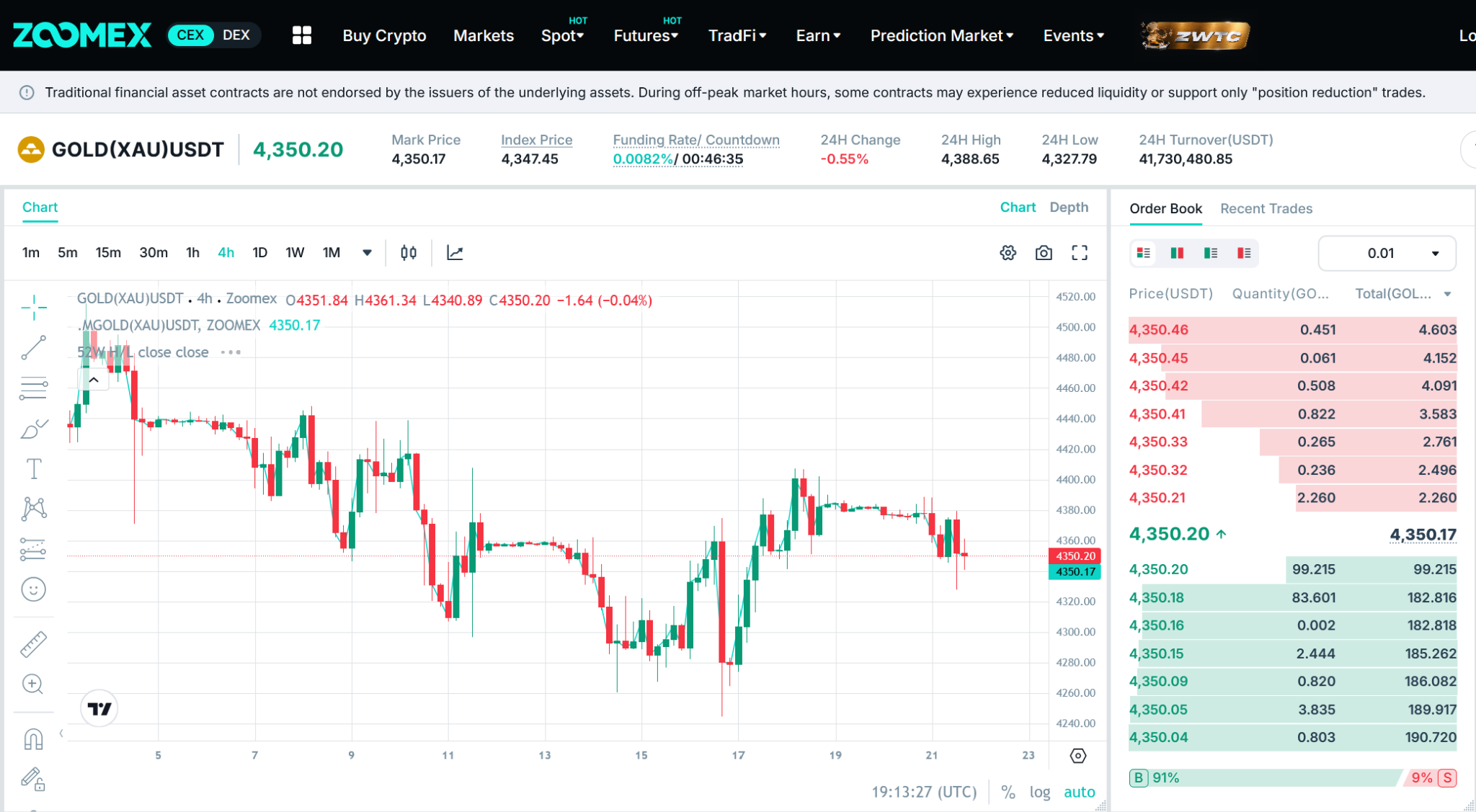
Global cryptocurrency derivatives platform Zoomex reinforces its commitment to Real-World Assets (RWA), positioning the sector not as a peripheral listing category but as a core pillar of its product roadmap.
The announcement builds on a year in which tokenized RWA markets have moved from experimental territory into mainstream institutional adoption, with on-chain RWA value (excluding stablecoins) climbing past $27 billion by April 2026, driven primarily by tokenized U.S.
Treasuries, private credit and commodity-backed tokens. For Zoomex, this shift is not simply a market trend to track, but a philosophy to build around, expressed through five defining pillars: Easy to Use, Transparent by Design, Fair Access & Rule-Based Execution, Focused on Derivatives, and Refined Brand & Trading Experience.
RWA as a Bridge, Not a Buzzword
Commenting on the expansion, Fernando Aranda said: “One of the most important moments is our expansion into Real-World Assets (RWA). We see RWA as an essential bridge between blockchain technology and everyday life. Tokenizing assets such as treasury bonds, commodities, or real estate allows blockchain to go beyond speculation to increase its real economic utility. However, for us, RWA is not limited to the listing of tokenized assets, it is about making this value accessible and spendable in real life. It is in this context that the Zoomex Card, launched in partnership with the Swiss financial institution UR, significantly changes the game.”
That statement frames Zoomex’s broader thesis, tokenization only delivers on its promise when the value it creates can move as freely as the assets it represents, flowing from a blockchain ledger into a user’s daily financial life without friction, delay, or hidden cost.
Easy to Use: Removing the Barrier Between Complexity and Access
Historically, exposure to tokenized real-world assets and the derivatives built around them has been the domain of institutions and highly experienced traders, gated by dense interfaces and opaque execution logic. Zoomex has engineered its platform to collapse that barrier, giving both first-time users and professional traders a clear, immediate read on position status, risk exposure, and potential outcomes. As RWA products draw in a broader, less specialized user base, this emphasis on usability becomes a structural advantage rather than a cosmetic one.
Transparent by Design: Rebuilding the Trust Contract
Trust has long been the central obstacle in real-world asset tokenization, users need confidence that the underlying asset genuinely exists, that valuation is fair, and that they can verify both independently. Zoomex treats transparency as an engineering requirement rather than a compliance afterthought, with balance mechanisms and trading rules built to be visible and verifiable. This philosophy extends directly into the Zoomex Card, developed alongside the Swiss-regulated financial platform UR.
According to details shared at launch, the card was built around zero card issuance fees, zero annual fees, and zero withdrawal fees for fiat returns, with cross-currency transactions anchored to real-time market exchange rates rather than hidden markups. Every layer of the asset journey, from transfer to exchange to consumption, is designed to remain traceable, reducing the risk of asset misappropriation and giving users direct control over their funds.
Fair Access & Rule-Based Execution
As institutional capital increasingly dominates the RWA landscape, the gap in infrastructure and information access between large players and individual traders has widened. Zoomex’s answer is a consistent, rule-based execution model applied equally to every participant, regardless of position size or account tier. There are no privileged lanes or preferential routing; the rules that govern order execution are fixed in advance and applied uniformly. In a market where institutional RWA issuance increasingly sets the pace, this consistency gives individual traders a rare guarantee: the same rules apply to everyone at the table.
Focused on Derivatives: Giving RWA Exposure Somewhere to Go
As tokenization extends into bonds, real estate, private credit and commodities, the market still lacks the sophisticated instruments needed to structure, hedge, or amplify that exposure. As a platform built primarily around derivatives trading, Zoomex is positioned to fill exactly that gap.

Its derivatives focus allows users to engage with RWA-driven trends actively rather than passively, managing risk, hedging exposure, and building strategies suited to a still-volatile broader crypto market. With analysts projecting the tokenized asset market could reach into the trillions by the end of the decade, the demand for mature derivatives infrastructure around RWA exposure is only expected to grow, and Zoomex intends to meet it directly.
Refined Brand & Trading Experience
Zoomex does not treat product engineering and brand identity as separate workstreams. A polished user experience, consistent visual communication, and carefully considered product flows sit alongside the platform’s security architecture as part of a single promise to users. Founded in 2021, Zoomex now serves over 3 million users across more than 35 regions and has passed comprehensive security audits from Hacken, while holding multiple regulatory licenses including U.S. and Canada MSB, U.S. NFA, and Australia AUSTRAC registrations.
As an official partner of the TGR Haas F1 Team, with goalkeeper Emiliano Martínez serving as global ambassador, the brand draws a direct line between precision on the racetrack and discipline in the trading environment.
About Zoomex
Founded in 2021, Zoomex is a global cryptocurrency trading platform focused on derivatives trading. The platform serves over 3 million users across 35+ countries and regions, offering access to 700+ trading pairs. Built around easy to use, transparency, fairness, and speed, Zoomex provides a clear and efficient trading experience for users worldwide.
Through its high-performance matching engine, clear asset and order displays, and transparent fee and rule mechanisms, Zoomex helps users better understand their account status, order execution, trading costs, and results. Zoomex maintains registrations, licenses, and regulatory statuses across multiple jurisdictions, including the U.S. MSB, Canada MSB, U.S. NFA, and Australia AUSTRAC, and has completed security audits conducted by blockchain security firm Hacken. The platform also continues to strengthen its trust framework through Proof of Reserves, Security & Transparency, Compliance Information, and Fees / Rules Transparency initiatives.
Beyond trading, Zoomex builds a refined brand experience through elite sports partnerships, including the TGR Haas F1 Team, World Cup-winning goalkeeper Emiliano Martínez, and world-class tennis events such as Wimbledon. The values of speed, precision, discipline, fair play, and rule-based execution are closely aligned with Zoomex’s approach to derivatives trading.
At Zoomex: Easy to Use. Transparent balance. Fair access to your earnings.
Frequently Asked Questions
- What is Zoomex? Zoomex is a global crypto derivatives platform founded in 2021, serving over 3 million users across more than 35 countries and regions with 700+ trading pairs.
- How does Zoomex work? Zoomex operates through a high-performance matching engine with transparent asset and order displays, allowing users to execute trades and track outcomes with full visibility into their balances and results.
- What can you trade on Zoomex? Zoomex offers 700+ trading pairs spanning cryptocurrencies such as BTC, ETH, and SOL, as well as stock-linked contracts like NVDA and AAPL and gold exposure through XAUT.
- Where is Zoomex headquartered? Zoomex operates as a global cryptocurrency exchange with regulatory registrations including Canada MSB, U.S. MSB, U.S. NFA, and Australia AUSTRAC, reflecting its multi-jurisdictional compliance approach.
- Is Zoomex available in my country? Zoomex serves users across more than 35 countries and regions. Availability can vary by local regulation, so traders should check the official Zoomex website for country-specific access and requirements.
The post Zoomex Deepens Its Real-World Asset Strategy appeared first on BeInCrypto.

US regulators are increasingly signaling that tokenization of real-world assets (RWAs) and broader “onchain” market infrastructure may become the next major shift in financial plumbing. CFTC Chair Michael Selig used remarks at the US Treasury Market Conference to argue that markets should prepare for “mass tokenization,” as regulators seek to adapt existing rules to blockchain, AI and onchain finance.
Selig’s comments frame tokenization not as a niche experiment, but as an evolution comparable to the move from manual signals to electronic trading. At the same time, the CFTC and SEC are both taking separate but related steps—working through existing authorities and limited regulatory pathways—while broader legislative efforts remain in limbo.
Key takeaways
- CFTC Chair Michael Selig said markets should prepare for “mass tokenization,” positioning RWAs as a foundation for faster settlement and real-time collateral movement.
- Selig emphasized a “principles-based” approach as tokenization and onchain finance mature under the CFTC’s remit.
- The CFTC has submitted a crypto market regulatory action for White House review, but it is currently at the “prerule” stage.
- The SEC is also pushing on tokenized markets, including granting a temporary “Innovation Exemption” for tokenized US stock trading.
- Regulatory momentum is building even as the CLARITY Act has failed to advance in the US Senate.
CFTC Chair: tokenization as the next infrastructure upgrade
Speaking Tuesday at the US Treasury Market Conference, Selig argued that tokenization of real-world assets could help create a more efficient financial system. His remarks highlighted potential operational benefits such as near-instant settlement and the ability to move collateral in real time across clearinghouses, intermediaries and end users.
In his comparison to past market modernization, Selig said, “Just as the transition from hand signals to electronic trading advanced our financial system, I believe tokenization can do the same for all asset classes.” He added that the CFTC intends to pursue principles-based rules as tokenization and onchain finance evolve.
This matters for market participants because “principles-based” frameworks can affect how quickly issuers, exchanges, clearing firms and custody providers can build products and integrate them into existing market structures. Rather than requiring everything to fit a single prescriptive model, the approach can leave room for different tokenization architectures—though it also increases the importance of interpretation and compliance guidance as new cases emerge.
Legislation stalled; CFTC moves using existing authority
Selig’s remarks come amid an ongoing legislative backdrop. Earlier in August, he said the CFTC would move ahead with crypto rules under its existing authority if Congress did not pass the CLARITY Act. Cointelegraph previously reported that the Senate failed to advance the bill on Sept. 15.
That pressure point appears to be part of why the CFTC is leaning into regulatory action without waiting for a comprehensive statute. On Sept. 17, the CFTC submitted a regulatory action covering crypto asset transactions and markets for White House review. According to the description of the filing, it remains in the “prerule” stage and does not yet outline the planned regulations.
For traders and builders, the “prerule” status is a reminder that timelines may stretch while proposals circulate through internal and executive review processes. However, the submission itself signals that the CFTC is treating crypto market oversight as an active, ongoing process rather than a wait-and-see posture.
SEC’s onchain push: tokenized stocks under a temporary exemption
The CFTC’s focus on tokenization of RWAs is not the only regulatory thread. The SEC has also been advancing tokenized market mechanisms, including through targeted permission structures rather than waiting for broad, future rulemaking.
In a Bloomberg TV interview, Jamie Selway, the SEC’s Division of Trading and Markets Director, said tokenization and crypto have recently become politicized, but are “not naturally a politicized function.” Selway argued that the US should receive bipartisan support for building markets that function effectively in this new environment.
Following that general push, the SEC on Sept. 17 granted a temporary “Innovation Exemption” for tokenized US stock trading. The exemption allows certain platforms to trade digital versions of US-listed stocks under specified conditions.
The SEC’s use of an exemption framework is significant because it creates a controlled channel for experimentation. It can reduce friction for participants willing to comply with narrow restrictions while regulators develop longer-term standards. The SEC Chair Paul Atkins previously said in February that such an exemption could facilitate onchain trading while longer-term rules are developed.
Read alongside the CFTC’s remarks, the pattern suggests regulators are converging on the idea that onchain functionality—settlement efficiency, programmability, and potentially real-time collateral flows—should be approached through enforceable guardrails rather than outright delay.
What to watch next: principles-based rules and the shape of “tokenized markets”
Between the CFTC’s principles-based posture and its “prerule” submission for White House review, and the SEC’s temporary exemption approach for tokenized equities, the near-term question is less whether tokenization will expand and more how regulators will define the boundaries of compliant onchain trading and settlement.
Investors, traders, and developers should watch for two things next: any movement from “prerule” toward more detailed CFTC proposals, and the conditions or duration attached to the SEC’s Innovation Exemption—both of which will likely signal how far and how fast tokenized markets can grow within current regulatory frameworks.
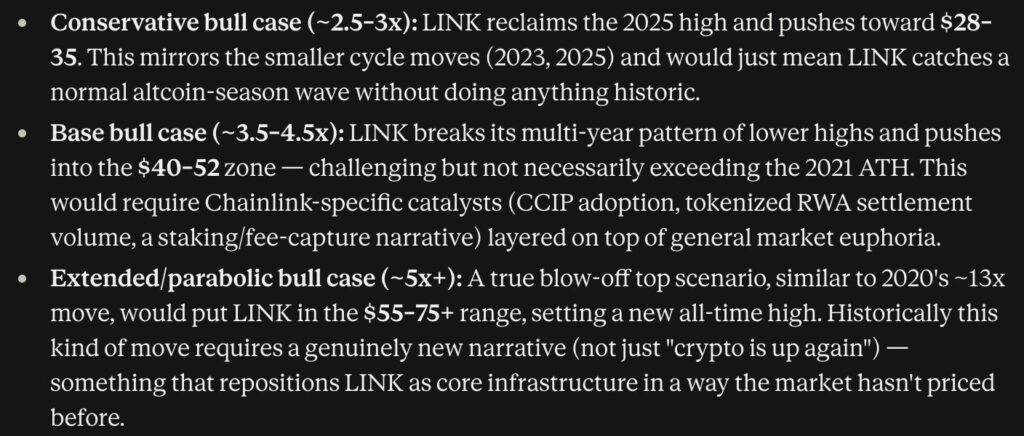
Anthropic Claude AI predicts that Chainlink (LINK) could hit $75 or higher in 2026 if parabolic bull market conditions align in Q4. LINK is trading just above $12, with a market cap of around $9.5Bn.
2025 opened at $20.00, spiked to $27.68, then broke down hard to a low of $10.19, closing the year around $12.26 (a ~39% annual loss). This was followed by the 2026 YTD range of roughly $7.05–$14.37, meaning LINK is currently sitting in the upper-middle of this year’s range, not near either extreme.

The conservative bull case suggests LINK could reclaim its 2025 high and reach $28–35, a more modest prediction that aligns with past altcoin cycles. The base bull case is that it breaks its multi-year pattern and targets $40–52, needing Chainlink-specific catalysts like CCIP adoption and an overall positive market atmosphere.
Things get really interesting in the extended bull case. Claude AI states that for this, a blow-off top similar to 2020 would need to happen, and if so, it could see LINK in the $55–75+ range.
Does the Technical Picture Support the Claude AI Predicts $75+ LINK?
LINK is in a longer-term downtrend on the 200-day moving average basis after the 2025 breakdown, but the daily chart has shown tentative bullish structure recently (short-term MAs turning up).
Key resistance sits at $14.37 as the first real ceiling, followed by the psychologically important $17–18 zone (2023 high area), then $27–28 (2025 high, also near the 2022 high).
Key support: $10 is the round-number floor that’s held multiple times this year; below that, $7.05 (2026 low) is the last line of defense before the 2023 lows near $5.
RSI/momentum: Neutral-to-mixed across timeframes, not oversold, not overbought, which is actually a fairly clean base from which a genuine breakout could start if volume returns.
The technical read: LINK needs to reclaim and hold above ~$14.40, then ~$18, to signal that it’s breaking the pattern of lower highs. Until then, it’s range-bound chop.
Earn $50 and Enter $300K Prize Draw on EdgeX
LiquidChain Targets Early Mover Upside as LINK Tests Key Levels
Anyone holding LINK since the June lows is sitting on solid gains, and the data validates the position. But here’s the uncomfortable math: at a $9Bn+ market cap, LINK needs enormous capital inflows to deliver the kind of multiples early-stage tokens can post off a fraction of that volume. That’s the gap presale plays are built to fill.
LiquidChain (LIQUID) is a Layer 3 infrastructure project built to fuse Bitcoin, Ethereum, and Solana liquidity into a single execution environment, a “deploy-once” architecture where developers build once and access all three ecosystems rather than fragmenting liquidity across chains.
The presale is priced at $0.014958, and $971,680.17 has been raised so far. Core features include a Unified Liquidity Layer, Single-Step Execution, and Verifiable Settlement.
Gain Special Access to Layer 3 Trading Here
Don’t Miss: The Hottest Meme Coin Opportunities Silently Climbing the Crypto Ranks in September
The post Anthropic’s Claude AI Predicts a Wild 2026 Price Target for LINK appeared first on Cryptonews.
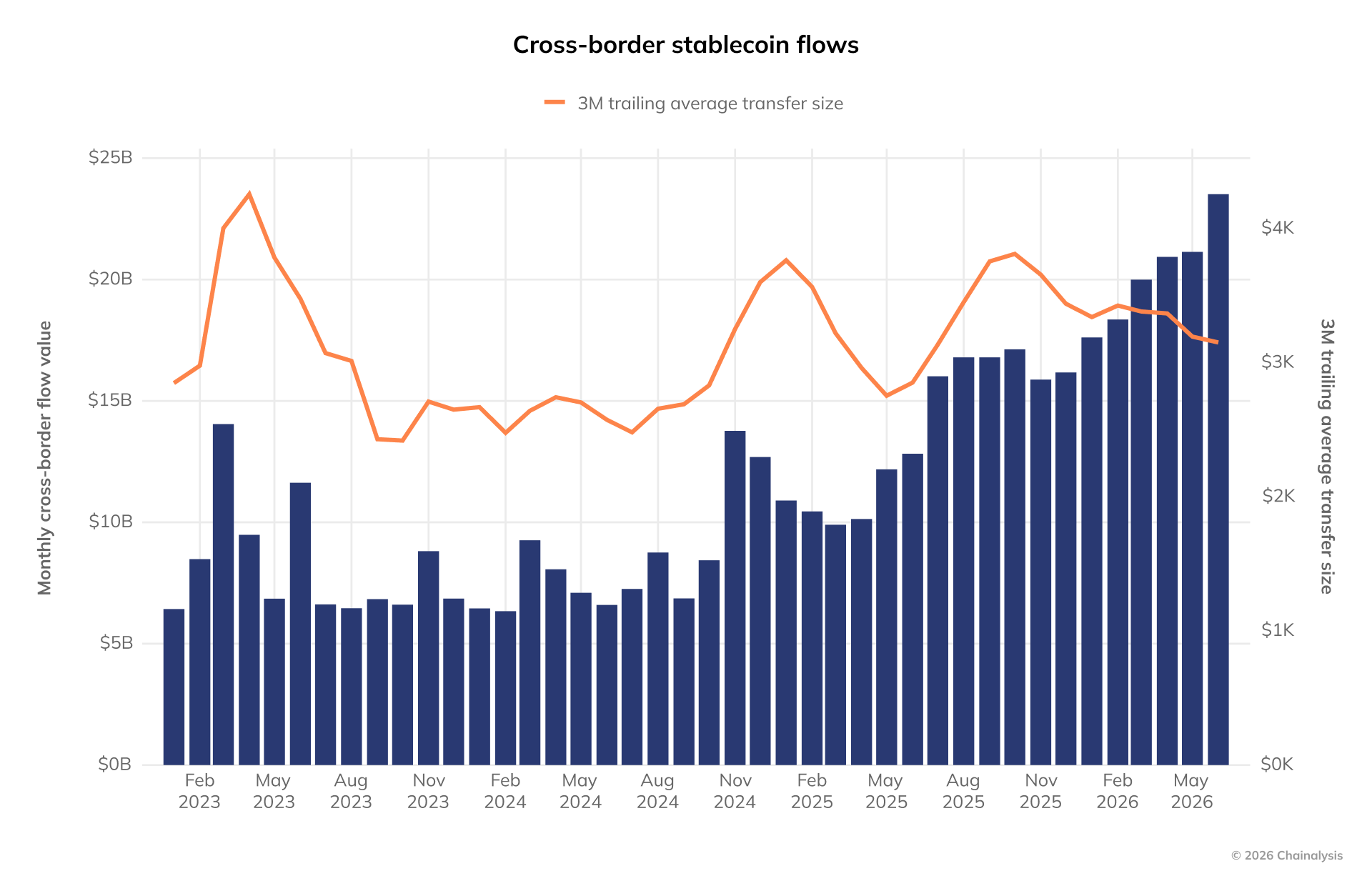
Crypto’s downturn over the last year has done little to slow stablecoins at the border, with cross-border stablecoin flows rising 77.5% in the year to June 2026 as the broader market lost more than a third of its value, according to new research from Chainalysis.
In its newly released 2026 Global Crypto Adoption Index, Chainalysis said cross-border stablecoin flows rose 77.5% to $220.3 billion in the 12 months ending June 2026, from $124.2 billion in the previous 12-month period, despite total crypto market capitalization falling 37% to $2.1 trillion over the same period.
“The bear market hit the price-sensitive half of crypto and left the payments half alone,” Chainalysis said.
The growth points to increasing crypto demand beyond speculative trading. Stablecoins, which are designed to maintain a stable value, often against fiat currency, have gained a foothold in mainstream finance. The US signed the GENIUS Act into law in July 2025, while the European Union’s MiCA rules and Hong Kong’s issuer licensing regime have brought stablecoins further within formal financial oversight.
Chainalysis said growth came from cross-border transfers averaging around $3,000, which is consistent with everyday use cases such as supplier payments, sending money home or moving savings out of volatile currencies.
“Activity has become consistent, routed through wallets in a steady rhythm rather than in bursts,” Philip Gradwell, vice president of economics at Tether, told Chainalysis. “That is the signature of trade and business activity, not speculation.”
Tianwei Liu, co-founder and CEO of StraitsX, told Cointelegraph that in Asia, fragmented currencies and payment systems have created demand for stablecoin settlement.
“That demand is also extending into everyday spending, with stablecoins sitting behind payment methods people already use,” Liu said.
However, outside of Asia, stablecoins address different needs, he said, including dollar access, remittances and protection against inflation or capital controls, such as across Latin America, Africa and the Middle East.
Related: Stablecoin growth could boost dollar dominance, US Treasury demand: BoE official
Chainalysis tracked 4,708 new cross-border corridors during the reporting period, carrying a combined $2.64 billion. Each corridor represents a route between an originating and receiving country.
Flows remained heavily concentrated in the top quarter of corridors, which accounted for 96.1% of measurable cross-border stablecoin value. The remaining three quarters carried $8.66 billion, up from $260 million in the previous period.
Vincent Chok, co-founder and CEO of First Digital, told Cointelegraph that while traditional payment structure remains effective for established corridors, it becomes fragmented as businesses move money between markets with different banking systems, currencies and settlement hours.
Stablecoins offer another option, he said, but it is still restrained by regulatory clarity, reliable redemption, access to local currencies and interoperability with existing financial systems.
“Onchain settlement is fast, but it doesn’t solve the off-chain parts: converting to local currency, meeting compliance requirements, and moving funds through existing banking rails,” Chok said.
Meanwhile, traditional remittance companies have expanded their stablecoin offerings this year.
Western Union launched a stablecoin wallet and Visa-linked card across 37 markets in August, allowing users to hold and spend its branded US dollar-backed stablecoin.
MoneyGram announced a similar card initiative in September, initially targeting Colombia, with additional markets planned later this year.
Magazine: Kyle Samani predicts SOL flippening, claims ‘no one’ uses ETH

Crypto hacking collective ShinyHunters claims to have stolen the personal details of 5,000 FBI agents after gaining access to its database.
It shared a sample of the stolen data with a number of outlets yesterday. The data includes family members, social security numbers, and details of assignments.
Reuters was able to partially verify some of the data in the sample and matched it with other agents, including FBI director Kash Patel.
ShinyHunters also defaced the FBI’s job page with a picture of the Pokémon Umbreon.
Read more: 150 million IDs allegedly stolen — including Pete Hegseth’s
Crypto hackers say FBI hack isn’t about the money
ShinyHunters told outlets that this week’s data theft was in retaliation for the FBI’s May 2026 report that detailed the activities and methods supposedly employed by the group.
It claimed the FBI made false allegations in this report, and has given the agency one week to either correct or remove the report.
The group shared with 404media that its data theft was not “financially motivated.” It said, “What we plan to do is not extortion, maybe coercion.”
An FBI spokesman also told the publiction that ShinyHunters was able to gain access to AWS GovCloud servers via a zero-day exploit in the Oracle product PeopleSoft.
ShinyHunters is still mostly in it for the money
ShinyHunters is an international hacking group known for stealing sensitive data and holding it for ransom in exchange for large sums of cryptocurrency.
Telephone company AT&T was extorted by ShinyHunters in 2024 after it stole the data of almost all of its 109 million customers. AT&T eventually gave in to the group’s ransom demands and paid it almost six bitcoin (worth $373,646 at the time).
In January this year, ShinyHunters claimed it stole user data from dating apps Hinge, Match, and OKCupid.
Read more: French crypto tax firm targeted in ShinyHunters extortion attempt
Four French men were arrested in connection with ShinyHunters in May this year, but the group has continued to operate regardless.
Got a tip? Send us an email securely via Protos Leaks. For more informed news and investigations, follow us on X, Bluesky, and Google News, or subscribe to our YouTube channel.
Crypto World
Stock Market Today: Nasdaq Dips After Hitting Record Highs; Micron, Sandisk Sink In Buy Zones (Live Coverage)

Futures for major stock indexes dropped Wednesday in the wake of the Nasdaq’s record high. Meanwhile, Micron Technology (MU) and Sandisk (SNDK) were early losers on the stock market today after the memory chip leaders hit buy points. Ahead of Wednesday’s open, Nasdaq-100 futures moved down 0.3% in early morning trading. The Nasdaq hit both a record intraday and closing…
Copyright ©2026 Investor’s Business Daily, LLC. All rights reserved. 87990cbe856818d5eddac44c7b1cdeb8

This summer, the ocean sent us another warning. In August, global sea-surface temperatures reached their highest level on record. Days later, the most comprehensive assessment of coral reefs ever published showed that increasingly frequent marine heatwaves are leaving reefs less time to recover between bleaching events. Global hard coral cover has declined by 9.5% compared with the 1980-2009 average, driven primarily by human-induced climate change.
For me, this is deeply concerning, but also a reason to act. I come from Seychelles, an archipelago of 115 islands off the coast of East Africa where the ocean is inseparable from our lives, livelihoods, and future. It supports the food we eat, the jobs people depend on, and the resilience of our economy.

Bitcoin is entering what on-chain analysts describe as its “next real test” near the $90,000 mark, with traders potentially taking profits as price approaches a cluster of supply from investors who bought BTC one to three months earlier. While CryptoQuant frames the move as a pause inside a broader uptrend, the $88,000–$90,000 zone is now viewed as the clearest near-term resistance to clear.
CryptoQuant’s latest weekly research also points to stabilizing profitability signals in 2026 and highlights a shift in the market structure—especially the growing role of institutional participation—that, according to CEO Ki Young Ju, may dampen the depth of future cycle extremes.
Key takeaways
- CryptoQuant expects higher odds of profit-taking if Bitcoin trades into the $88,000–$90,000 area, described as the next resistance cluster.
- Traders’ realized price is cited around $64,300, with an “upper band” near $90,300 that could stretch profit margins and trigger selling.
- CryptoQuant says the path from roughly $86,000 to the profit-taking zone is “largely clear” and does not imply a return to bear-market conditions.
- Ki Young Ju argues institutional ownership can make future cycle tops and bottoms “shallower,” reducing both upside and downside extremes.
- CoinShares data cited by Cointelegraph previously—and CryptoQuant’s own framing—tie the current bull-case to profitability metrics like MVRV stabilizing through 2026.
Why $90,000 is now the “profit-taking” checkpoint
In a weekly report released Tuesday, CryptoQuant warned that Bitcoin’s trading zone around $90,000 could face increased selling pressure if price reaches it. The reasoning centers on realized profitability—how much profit or loss current market participants are sitting on based on when they last acquired BTC on-chain.
CryptoQuant uses “realized price” as the average acquisition price of coins last moved between one and three months ago. The analytics firm places this realized price around $64,300, and highlights upper and lower bands around that level to show where profit or loss margins may widen for this cohort of supply.
According to CryptoQuant, the upper “profit-taking” band sits near $90,300—roughly 40% above the realized price. The report links that band with an on-chain supply cluster formed between $88,000 and $90,000, calling it the next resistance investors must absorb.
“The upper band coincides with the $88K–$90K on-chain supply cluster, making it the next resistance to clear. Historically, as price approaches the upper band, trader profit margins stretch and selling can intensify — a natural pause point within an uptrend, not a reversal,” CryptoQuant analysts wrote.
Importantly for market participants, CryptoQuant describes the route from the current spot level near $86,000 to the profit-taking zone as “largely clear.” The firm also says there are no signs that price action is dragging the market back toward bear-market conditions. In other words, the $90,000 test is framed more as a liquidity and positioning hurdle than as an immediate thesis break.
From “bear market” to “bull confirmation,” according to CryptoQuant
Alongside the profit-taking analysis, CryptoQuant reiterates its broader bullish assessment. The firm states that technical, valuation, and on-chain indicators now align in favor of an uptrend, echoing earlier comments made by CEO Ki Young Ju.
Ki has argued previously that the market’s structure is changing, which can influence how sharply price responds during cycle transitions. In a recent post on X, he suggested that both future cycle tops and bottoms may look less extreme than in prior eras because institutional ownership has increased relative to retail participation.
“Today, a much larger market and growing institutional ownership are dampening both extremes. The same forces that limit the upside also soften the downside,” Ki Young Ju wrote.
That framing matters for traders because a market dominated more by institutional allocation may react differently to liquidity shocks than one driven primarily by retail leverage. While CryptoQuant’s latest report does not claim that volatility disappears, it suggests the distribution of risk and selling pressure may be less binary than in earlier cycles.
Profitability signals: what CryptoQuant says changed in 2026
CryptoQuant’s research also highlights a profitability stability theme during 2026. In particular, Ki Young Ju pointed to the market value to realized value (MVRV) ratio, saying that during the 2026 bear market it did not fall below the breakeven level of 1 at any point. In his view, that indicates the broader investor base remained in aggregate profit rather than shifting into a fully drawdown-driven state.
This contrasts with earlier macro downtrends—periods when MVRV breached its breakeven threshold and helped signal widespread unrealized losses. According to the approach popularized by CryptoQuant, staying above breakeven can reduce the likelihood of forced selling across large investor cohorts.
Cointelegraph previously reported that MVRV has crossed above its 365-day moving average—a milestone the publication tied to the end of the 2018 and 2022 bear markets. While that earlier coverage focused on the MVRV crossing itself, CryptoQuant’s latest angle connects the metric back to the broader idea of a market that is holding profitability rather than collapsing it.
ETFs add demand pressure as traders watch the resistance zone
Beyond on-chain supply and realized pricing, CryptoQuant’s outlook is being tested against real-time demand signals. Cointelegraph noted that Bitcoin exchange-traded funds in the US have seen net inflows this month. In the most recent week being cited, the first two days recorded $1.7 billion in net inflows, with Monday alone bringing $999 million in inflows.
Those numbers were attributed to Farside Investors data, referenced in the reporting. While ETF flows do not remove on-chain resistance by themselves, consistent inflows can change the balance between new demand and profit-taking supply—particularly near psychologically important price levels like $90,000.
For traders, the practical takeaway is that the next resistance is being measured not only by price-based technical levels, but by where recently acquired coins become profitable enough to encourage selling. If ETF demand remains strong, it could help absorb that supply cluster; if it fades, profit-taking dynamics may dominate more quickly.
Going forward, the key question is whether Bitcoin can clear the $88,000–$90,000 band without triggering a larger wave of realized selling. CryptoQuant’s framework suggests a “natural pause” is plausible inside an uptrend, but investors will likely watch ETF flow persistence alongside on-chain realized profit bands to judge whether the $90,000 test turns into a brief slowdown or a more durable ceiling.
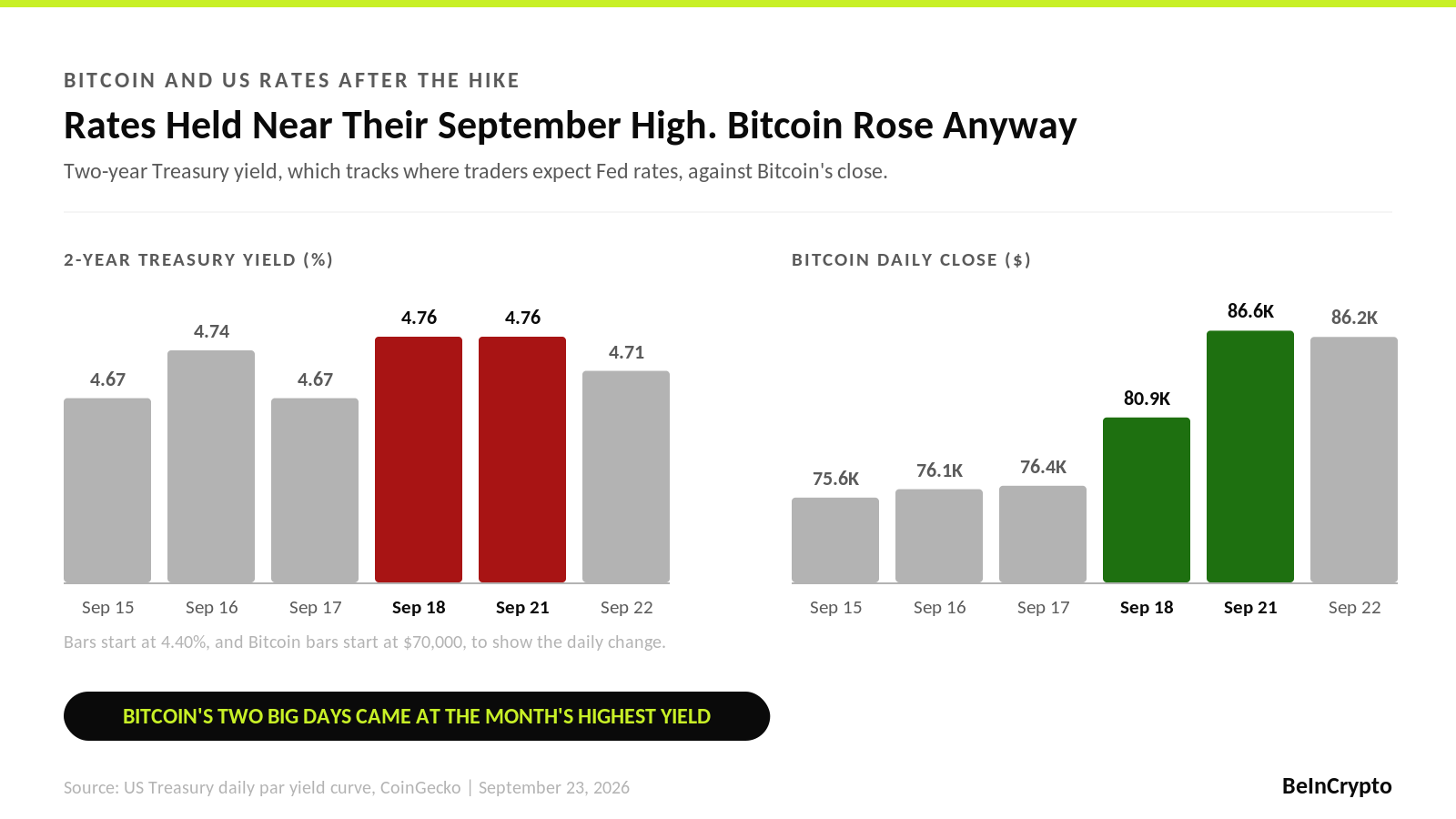
Bitcoin price is up about 13% since the Federal Reserve raised rates on September 16, and Wall Street funds did most of the buying. Three things brought them back.
The bad news was already in the price, higher rates stopped scaring buyers, and the chart showed room to rise.
The Bad News Was Already in the Bitcoin Price
Rate futures gave a hike 69.6% odds on September 11. On September 15, the CLARITY Act, a bill to set US crypto rules, failed a Senate vote 50-49. Bitcoin fell 3.3% that day and closed near $75,600, the low of the pattern’s right shoulder.
A day later, the Fed raised its range to 3.75% and 4%.
Why the Funds Came Back
The first reason is that the waiting ended. Funds that had recorded heavy outflows ahead of the vote no longer had a decision to wait for.
The second is that higher rates stopped scaring buyers. The two-year Treasury yield, what the US government pays to borrow for two years, climbs when traders expect more Fed hikes and falls when they expect cuts. It hit a September high of 4.76% on September 18 and 21. Those were Bitcoin’s two big up days. Fundstrat’s Tom Lee argued the Fed cannot get more hawkish from here.

The third is room to run. The UTXO Realized Price Distribution (URPD) shows the price at which each Bitcoin last moved, a rough map of where holders bought. The band near $87,100 holds 1.34% of supply, and the band near $88,400 holds 0.46%.

Fewer coins bought there means fewer holders waiting to sell at breakeven.

Two Days Did the Lifting
Spot Bitcoin ETFs took in $2.31 billion across September 17, 18, 21, and 22. Bitcoin (BTC) rose 5.9% on September 18, when funds bought $433 million, and 6.7% on September 21, when they bought $999 million. Those two sessions produced almost all of the 13.2% gain to September 22.

The September 21 jump also caught short sellers, with $262 million of bets against Bitcoin liquidated in one hour. Closing a short means buying, which adds to the fund demand.
The Bitcoin Price Breakout and What It Targets
That demand pushed Bitcoin out of an inverse head and shoulders it had been building since February, a pattern where a deep middle low sits between two shallower ones. It broke the neckline on September 21, on the heaviest daily volume since August 21. The pullback since has been shallow, 0.5% on September 22 against the 3.3% drop on September 15.

The first hurdle is $86,935, which Bitcoin touched but has not closed above. A daily close there opens $89,825, then $93,940. The pattern’s measured move is about 43% from the neckline, pointing to $117,247, within 7% of the $126,080 all-time high record.
The floor is thicker. The band near $84,569 holds 2.92% of supply, the largest within 20% of the price, just above the $84,045 technical level.

A daily close below $84,045 would bring the neckline near $82,000 back into play.
Analyst’s View: Funds bought even with the two-year Treasury yield near its September high, which suggests the hike no longer scares them. If August inflation data on September 30 does not revive that fear, a daily close above $86,935 keeps the 43% path open.
The post Bitcoin Is Up 13% Since the Fed Hike. Here's Why the Funds That Sold Came Back appeared first on BeInCrypto.

Bitcoin (BTC) and Ethereum (ETH) options worth $18.1 billion will expire on Friday. According to Coinbase, Bitcoin’s open-interest put/call ratio is 0.66, with the 24-hour volume ratio at 0.37, while Ethereum’s put/call ratio is 0.61 and its 24-hour volume ratio is 0.55.
Coinbase identified $90,000 and $100,000 as key levels around which Bitcoin call open interest is concentrated, while Ethereum call interest is concentrated between $3,000 and $4,000.
$90,000 And $100,000 In Focus For Bitcoin
Coinbase highlighted $90,000 and $100,000 as key levels where Bitcoin call open interest is clustered. BTC is currently trading around $85,830, putting the $90,000 level about 4% higher and the $100,000 level about 16% higher. However, the concentrations do not mean that BTC will reach either level before expiry. Open interest does not reveal if individual traders bought or sold the call, and many positions are part of larger spreads, hedges, and market-making strategies.
Meanwhile, a put/call ratio below 1 means calls outnumber puts. The 0.37 ratio for BTC options volume suggests a substantial tilt toward calls rather than puts. Meanwhile, BTC has registered a sharp increase in the past few days. The flagship cryptocurrency rose 5.93% on Friday, crossing $80,000 and closing at $80,875. It rose 0.44% on Saturday before marginally declining to $81,159 on Sunday. Upward momentum resumed on Monday as the price rose nearly 7%, crossing $86,000 and closing at $86,594. BTC dropped to a low of $85,059 on Tuesday before settling at $86,198, and is down 0.58% during the ongoing session.
$3,000 And $4,000 Key Levels For Ethereum
Ethereum’s options are also call-heavy, although the order book is substantially smaller. Data from Deribit shows $1.34 billion in ETH call options open interest, against $820 million in puts, with call interest clustered between $3,000 and $4,000. ETH is currently trading around $2,729, down 0.49% over the past 24 hours, according to CoinMarketCap data. Like BTC, the world’s second-largest cryptocurrency has reported a substantial jump since last week. ETH traded around $2,416 on September 16, but pushed higher in subsequent sessions to cross $2,800 on September 21. A Reuters report said ETH had crossed a technical resistance level near $2,661, and identified $3,050 as a potential upside if bullish momentum persisted, with extended targets of $3,395 and $3,445.
Bitcoin And Ethereum Options To Settle At 8:00 UTC
The options expiry is part of Deribit’s quarterly expiry cycles, with the Bitcoin and Ethereum options expiring on the last Friday of March, June, September, and December at 8:00 UTC. Settlements use the relevant Deribit index, with delivery prices based on the relevant index’s time-weighted average between 7:30 UTC and 8:00 UTC. Traders and market makers adjust hedges based on the expiry size as prices move closer to key strike levels.
Deribit handles around 85% of Bitcoin and Ethereum options, making its quarterly expiries a substantial chunk of the crypto derivatives market. The platform reported $56.13 billion in Bitcoin options turnover and $7.14 billion in Ethereum options turnover during August.
Disclaimer: This article is provided for informational purposes only. It is not offered or intended to be used as legal, tax, investment, financial, or other advice.

Zoomex Deepens Its Real-World Asset Strategy

Freja New York Fall in New York

Netherlands To Return To Eurovision In 2027 After Previous Boycott




-

 Fashion5 days ago
Weekend Open Thread: Talbots – Corporette.com
-

 Tech3 days ago
Researchers escape OpenAI Codex sandbox to run commands on host
-

 Crypto World5 days ago
Circle launches Arc Studio AI agent for building onchain apps
-
 NewsBeat5 days ago
Trump says US has reached an agreement to take permanent control of Greenland’s security
-

 Crypto World3 days ago
Who Needs CLARITY Anyway? ARB Could See 70X Increase: Hodler’s Digest
-

 Crypto World5 days ago
Trading Bitcoin on Robinhood? Why 2% Spread Has Traders Worried
-

 Crypto World6 days ago
Mortgage and refinance interest rates today, Thursday, September 17, 2026
-

 Crypto World5 days ago
Bitcoin price breaks channel as RSI climbs to 63
-

 Crypto World7 days ago
US Charges Robinhood Engineers Over Crypto Listing Trades
-

 Tech2 days ago
Google’s $899 Googlebook is a bet that you’ll buy a new laptop for Gemini
-

 Business3 days ago
Analog Devices (ADI) Bets $1.35 Billion on Chips that Let Machines Think for Themselves
-

 Crypto World4 days ago
World Money launches in 150+ countries with Stripe
-

 Crypto World3 days ago
Coinbase, Robinhood, Circle Seen as Tokenized-Stock Winners
-

 Crypto World5 days ago
Silver prices recover quickly, hitting weekly high today
-

 Tech6 days ago
GPT-6 Astra Reached the Nether in Minecraft, Lost Its Stash to a Creeper, and Farmed Potatoes for Hours
-

 Crypto World15 hours ago
Goldman Sachs and Deutsche Bank Agree: The S&P 500 Rally Isn't Over
-

 Tech4 days ago
Trump suggests rebranding AI with a new name, says he’s also creating an AI Force
-
 NewsBeat5 days ago
US was ‘on brink of war’ with China over false AI report of nukes moving in Middle East
-

 Crypto World2 days ago
Bitcoin price holds above $81K as key catalysts line up
-

 Entertainment7 days ago
Grey’s Anatomy Showrunner Teases Changes After Cast Exits
You must be logged in to post a comment Login