
Crypto World
BTCPay Server supporters back 10% bounty to recover stolen Bitcoin



BTCPay Server supporters have backed a recovery bounty equal to 10% of funds retrieved from a recent Lightning wallet exploit, with the reward capped at 3 BTC if all stolen assets are recovered.
Summary
- BTCPay Server supporters have backed a 10% recovery bounty, capped at 3 BTC if all stolen funds are recovered.
- The exploit exposed LND admin macaroon credentials, allowing attackers to access connected Lightning wallets.
- BTCPay fixed the vulnerability in version 2.4.2, while its onchain wallets were not affected.
- The BTCPay Server Foundation is donating 0.21 BTC each to Craig Raw and the Bitcoin Red Team fund for discovering and reporting the flaw.
- BTCPay said AI may have helped uncover the vulnerability and is preparing a detailed postmortem.
The BTCPay Server project said on Monday that the bounty is part of its response to a critical security flaw that exposed LND administrator credentials on vulnerable installations, days after users were told to immediately upgrade to version 2.4.2.
The open-source Bitcoin payment processor has not disclosed how much cryptocurrency was stolen or how many servers were compromised. However, several affected users, including Foundation and Citadel21, have reported that funds held in their Lightning nodes were drained.
BTCPay said the vulnerability affected all releases before version 2.4.2, including release candidate versions of 2.4.2. The flaw allowed an attacker to obtain LND admin macaroon credentials from exposed BTCPay instances and then access wallets connected to the affected Lightning nodes.
A macaroon works as an authentication credential for a Lightning node, with an administrator macaroon providing extensive permissions over the associated wallet. Access to those credentials can therefore allow an unauthorized party to control funds held through the affected LND setup.
BTCPay Server exploit was fixed in version 2.4.2
Following the discovery, BTCPay released the final version of 2.4.2 with a fix for the vulnerability and urged operators running older versions to update their servers.
The project said the security issue was specific to LND credentials and did not expose users running other Lightning implementations through the same attack route. Operators who do not use Lightning were also not affected by the LND credential issue, although BTCPay recommended that all users install the latest release.
BTCPay’s onchain wallets were not compromised through the vulnerability, including onchain hot wallets maintained by users of the software, according to the project.
The distinction limits the known attack path to connected LND wallets rather than the full range of Bitcoin funds that can be managed through a BTCPay installation.
Although BTCPay has yet to release figures for the losses, reports from individual users have confirmed that the exploit resulted in stolen funds. The project is preparing a full postmortem that is expected to provide more information about the vulnerability and the response.
BTCPay has also started introducing stronger code-scanning and review procedures with assistance from several external organizations.
The response follows a difficult year for crypto security. In April,crypto.news reported that CertiK had recorded more than $600 million in crypto losses during 2026 at the time, while the security firm warned that AI-assisted attacks and weaknesses in infrastructure were becoming important risks for projects.
Researchers receive 0.42 BTC for finding the flaw
Alongside the recovery bounty, the BTCPay Server Foundation is paying rewards to the researchers who identified the vulnerability before it was publicly disclosed.
The foundation is donating 0.21 BTC each to Sparrow Wallet developer Craig Raw and the Bitcoin Red Team fund. Raw discovered the security issue and privately reported it to BTCPay, allowing developers to prepare a fix before details of the flaw became public.
Raw later said he had also been affected by the exploit.
Bitcoin Red Team operates as a volunteer security research group whose members include Rob Hamilton, Calle and Evan Kaloudis. The group works on finding and reporting vulnerabilities affecting Bitcoin-related software.
BTCPay’s decision to fund both researchers comes alongside the separate recovery bounty backed by project supporters. Under the proposed terms, 10% of successfully recovered funds can be paid as a bounty, while a complete recovery would carry a maximum reward of 3 BTC.
Recovery incentives have also surfaced after other crypto exploits this year. In July, crypto.news examined efforts to recover roughly 16 million ADA taken from 374 Cardano wallets in a late-June exploit. EMURGO outlined a process to return affected assets while an independent forensic team conducted a separate investigation into the incident.
AI may have helped uncover the BTCPay Server exploit
As part of its initial assessment, BTCPay raised the possibility that artificial intelligence tools could have played a role in finding the vulnerable code.
The project said improving AI models have reduced the time and cost required to inspect large software repositories for weaknesses, changing the capabilities available to both attackers and security researchers.
Bitcoin software presents an attractive target because exploitable weaknesses can provide direct access to assets, BTCPay said, adding that other areas of the software industry could eventually face similar problems as AI-based code analysis becomes more capable.
Concerns over AI-assisted attacks had already surfaced elsewhere in the crypto sector. CertiK reported in June that crypto hacks and exploits caused $68.3 million in losses during May, down nearly 90% from roughly $650 million in April, but the firm also recorded an increase in AI-assisted malware targeting code repositories and coding tools, as previously covered by crypto.news.
A July analysis of AI security also examined how increasingly capable models can identify and exploit software vulnerabilities, with the technology arriving during a year already dominated by large crypto security incidents.
The BTCPay incident differs from attacks based primarily on social engineering or compromised signing devices because the entry point was a software vulnerability that exposed sensitive LND authentication credentials.
Coldcard exploit raised similar AI concerns
The BTCPay attack has followed another major Bitcoin security incident involving Coldcard hardware wallets, where the suspected use of AI to inspect older code was also raised after funds were stolen.
At least $116 million in losses have been confirmed from the Coldcard exploit so far. Coinkite, the company behind Coldcard, said it considered it likely that someone had used AI to examine older publicly available firmware and identify the weakness.
The two incidents have put code review under increased attention at a time when attackers have already moved beyond conventional smart contract vulnerabilities.
In April, crypto.news reported on more than $17 billion lost across 518 documented crypto hacks and exploits over the previous decade, citing DefiLlama data. The report found that private key leaks, credential theft, phishing and attacks against wallets and infrastructure had become major sources of losses alongside flaws in smart contracts.
Chainalysis has separately estimated that attackers stole $36.7 million from unverified, closed-source smart contracts during the first six months of 2026 by decompiling contract bytecode. The blockchain analytics firm assessed that AI was very likely involved in this activity.
For BTCPay users, the immediate remediation remains the official 2.4.2 release. The project has said it will publish a more detailed postmortem on the exploit while its new code-scanning and review procedures are being developed with external organizations.



Australia’s financial crime watchdog suspended crypto ATM operator Cryptolink Pty Ltd for three months, forcing the firm to shut down 96 machines across the country.
The Australian Transaction Reports and Analysis Centre, known as AUSTRAC, said the suspension took effect Aug. 9. Cryptolink cannot provide virtual asset services while the order remains in place.
Crypto ATMs allow customers to use cash to buy cryptocurrency, serving as a bridge between fiat currency and crypto. AUSTRAC said it remains concerned about Cryptolink’s ability to manage transactions that carry a higher risk of money laundering or terrorism financing.
The regulator said Cryptolink initially met the terms of an enforceable undertaking imposed in October 2025. The company later failed to submit required threshold transaction reports and did not respond to an AUSTRAC information request.
AUSTRAC CEO Brendan Thomas said those failures made the business “too high risk to continue operating at present.”
The earlier undertaking followed an investigation by AUSTRAC’s Cryptocurrency Taskforce into alleged breaches of anti-money laundering and counter-terrorism financing rules. The regulator cited late transaction reports and weaknesses in Cryptolink’s risk assessments.
AUSTRAC also issued Cryptolink a fine of 56,340 Australian dollars ($36,600), which the company paid.
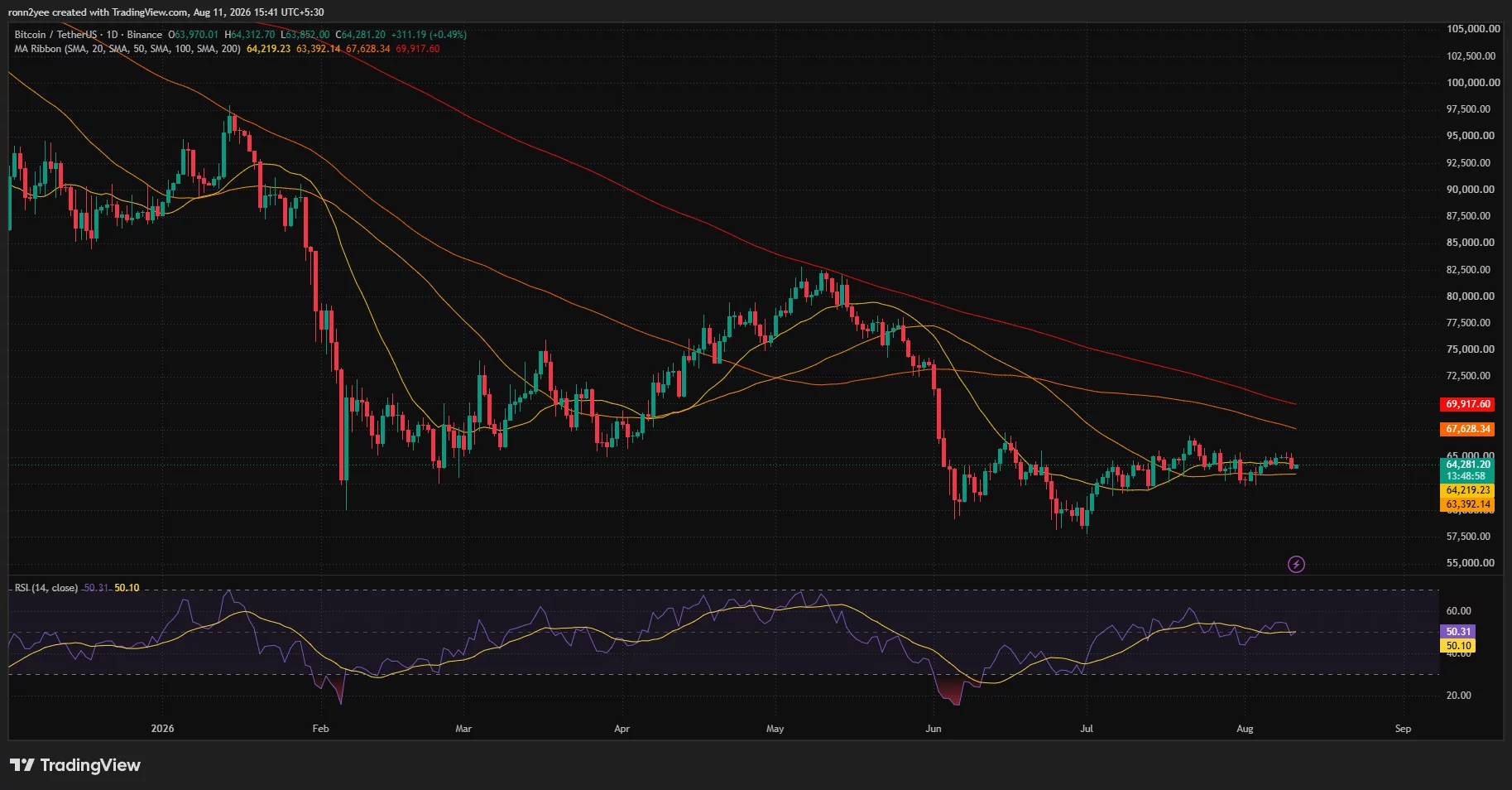
Bitcoin price fell below $64,000 on Aug. 11 as rising oil prices and uncertainty before the U.S. inflation report weakened risk appetite, leaving traders focused on whether the $63,900 support level can prevent a deeper correction.
Summary
- Bitcoin price fell about 2% to $63,780 before recovering above $64,000 during the session.
- The $63,900–$64,000 region is the main short-term pivot ahead of the July CPI report.
- Daily RSI remains neutral at 50.31, while BTC trades below its 100-day and 200-day moving averages.
- Liquidation clusters near $63,700 and $65,600 could attract price during the next volatility spike.
Bitcoin price drops below $64,000
According to data from crypto.news, Bitcoin (BTC) price traded as low as $63,852 on Binance before recovering to approximately $64,281 at the time the daily chart was captured. The intraday rebound reduced the loss, but BTC remained below the $65,000 level that buyers had attempted to establish as support over the previous four days.
The decline followed another deterioration in U.S.-Iran negotiations over reopening the Strait of Hormuz. Brent crude rose above $89 a barrel as reduced hopes for an agreement renewed concerns about energy supplies and inflation.
Higher oil prices can complicate the Federal Reserve’s inflation outlook by raising transportation and production costs. That pressure reduced demand for risk assets as U.S. traders prepared for the July Consumer Price Index report.
Broader crypto markets also weakened during the move. Ether and XRP fell more than 2%, while Bitcoin lost the $64,000 level after failing to hold above $65,000.
SoSoValue data shows that institutional demand offered limited support. U.S. spot Bitcoin exchange-traded funds recorded $144.6 million in net outflows on Aug. 10, ending five consecutive sessions of positive flows. The reversal reduced one source of spot demand as macroeconomic uncertainty increased.
Daily chart shows Bitcoin trapped in consolidation
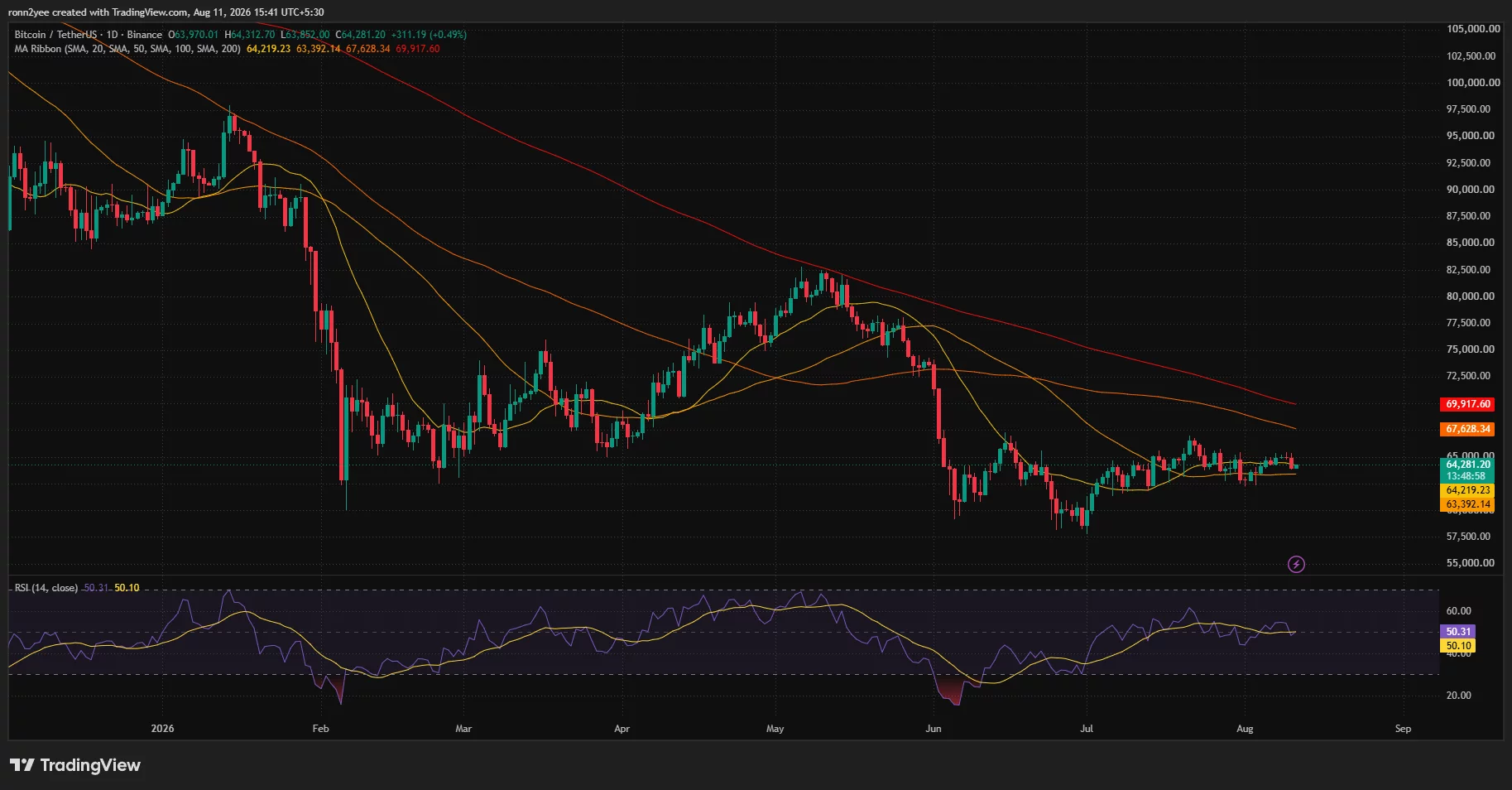
The daily chart shows that Bitcoin’s price remains locked inside the broad range formed after the June decline. BTC has repeatedly found buyers near $60,000–$63,000, but attempts to establish a sustained recovery above $65,000 have failed.
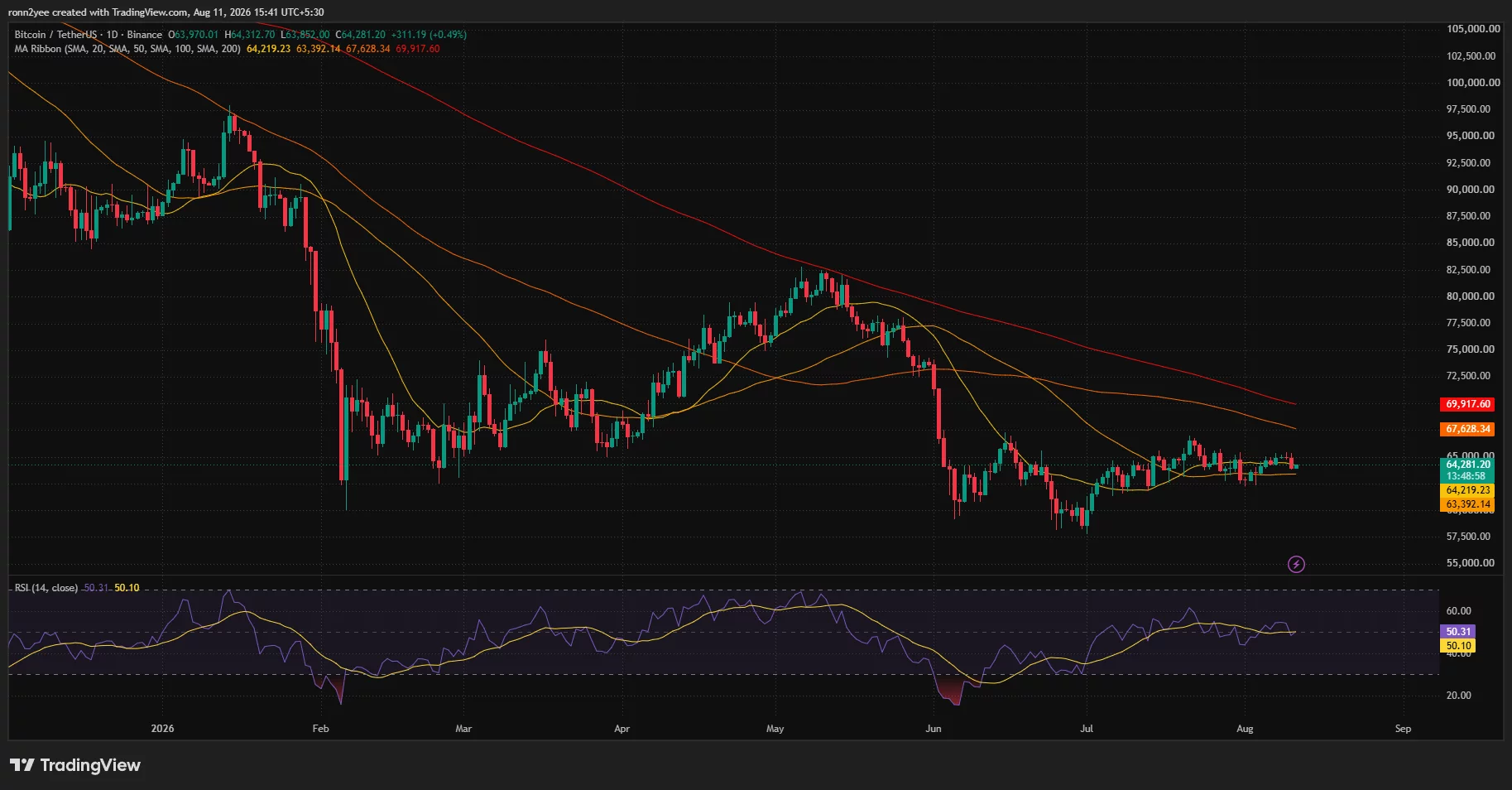
The asset was trading slightly above its 20-day simple moving average at $64,219 and its 50-day SMA at $63,392. Holding both averages would keep the short-term recovery structure intact despite the latest sell-off.
However, the wider trend remains under pressure. Bitcoin continues to trade below the 100-day SMA at $67,628 and the 200-day SMA at $69,918. Those averages are also sloping downward, creating a large resistance area between approximately $67,600 and $70,000.
The daily relative strength index stood at 50.31, almost level with its signal line at 50.10. The reading shows that neither buyers nor sellers have decisive momentum. It also supports the view that Bitcoin remains in consolidation instead of entering a confirmed directional trend.
A daily close below the 50-day SMA at $63,392 would weaken the recovery and expose $62,000, followed by the June-July demand zone between $57,500 and $60,000. Conversely, a close above $65,500 would give buyers another opportunity to challenge the 100-day SMA.
$63,900 is the key Bitcoin support
The 4-hour chart places immediate support between $63,900 and $64,000. Bitcoin briefly moved that region below during the sell-off before recovering, indicating that buyers were still active around the weekly midpoint.
Trader Lennaert Snyder described $63,900 as an important level because it represents the 50% mark of the previous weekly candle. He said holding or losing that price could determine momentum for the remainder of the week.
Under the bullish scenario, continued support near $63,900 could produce another move toward the previous weekly high around $65,500. That level rejected Bitcoin during its latest advance and remains the first major barrier above the current range.
A bearish break would become more convincing if BTC loses $63,900 and falls below the recent $63,200 low. Such a move could send BTC price toward $62,000 and allow sellers to target the lower part of the wider consolidation range.
The 4-hour Supertrend has turned bearish, placing resistance at $65,210. Bitcoin also slipped below the indicator’s former support near $64,344 during the decline. Bulls must reclaim both levels before the short-term trend can return to a stronger position.
Bull-bear power stood at negative 612, confirming that sellers had regained short-term control. However, the negative reading was smaller than the extreme levels recorded during earlier June sell-offs, suggesting that bearish momentum had not yet reached capitulation conditions.
Trader Daan Crypto Trades similarly identified $64,000 as the main pivot. He noted that BTC had closed slightly below the 4-hour 200-period moving averages but had started to stabilize, with several large-cap altcoins still showing relative strength.
Liquidation heatmap points to $63,700 and $65,600
The one-week CoinGlass liquidation heatmap shows large concentrations of leveraged positions on both sides of Bitcoin’s current price.
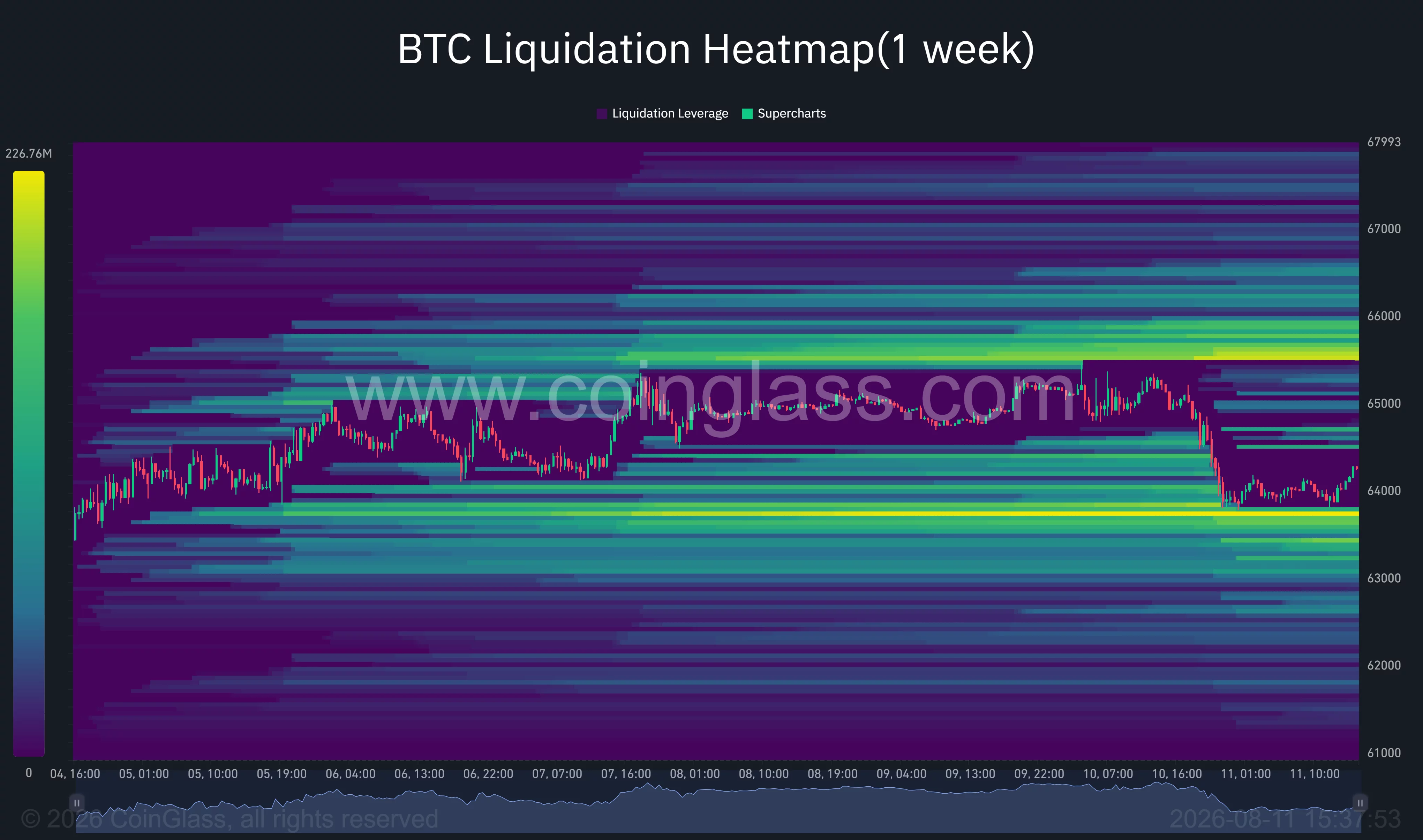
The closest downside liquidity cluster sits around $63,600–$63,800. Bitcoin tested this region during the latest decline but did not produce a sustained breakdown. A second pocket is visible between $63,200 and $63,400.
If $63,700 fails, forced selling could accelerate the move toward the lower cluster. However, the concentration of liquidity can also attract buyers looking to enter after leveraged long positions have been cleared.
The largest nearby upside band sits around $65,500–$65,700. A rebound through $65,000 could therefore trigger short liquidations and help BTC revisit the weekly high. Additional liquidity appears near $66,200 and $67,000, but those levels would require a confirmed breakout from the current range.
This positioning leaves Bitcoin vulnerable to a sharp move in either direction. Price is trading between the closest major liquidation pools, while the upcoming inflation release provides a clear catalyst for volatility.
U.S. CPI could decide Bitcoin’s next move
The U.S. Bureau of Labor Statistics will publish July CPI data on Aug. 12 at 8:30 a.m. Eastern Time. The report could influence expectations for the Federal Reserve’s September policy decision, particularly after rising oil prices renewed inflation concerns.
A cooler reading could ease pressure on Treasury yields and help Bitcoin recover $65,000. Breaking $65,500 would expose the $65,600 liquidation cluster, followed by the 100-day SMA near $67,628.
A hotter reading would strengthen the case for restrictive monetary policy and could pressure speculative assets. Under that outcome, a confirmed loss of $63,900 would shift attention toward $63,200, $62,000, and eventually the $60,000 psychological support.
Regulatory uncertainty also remains in the background. The CLARITY Act’s procedural vote was delayed until Sept. 15, removing a near-term policy catalyst that some U.S. investors had expected before the Senate recess.
For now, Bitcoin remains range-bound rather than decisively bearish. The $63,900–$64,000 zone separates a possible recovery toward $65,500 from a deeper move toward $62,000. The CPI release will likely determine which liquidity pool the market tests first.
Disclosure: This article does not represent investment advice. The content and materials featured on this page are for educational purposes only.
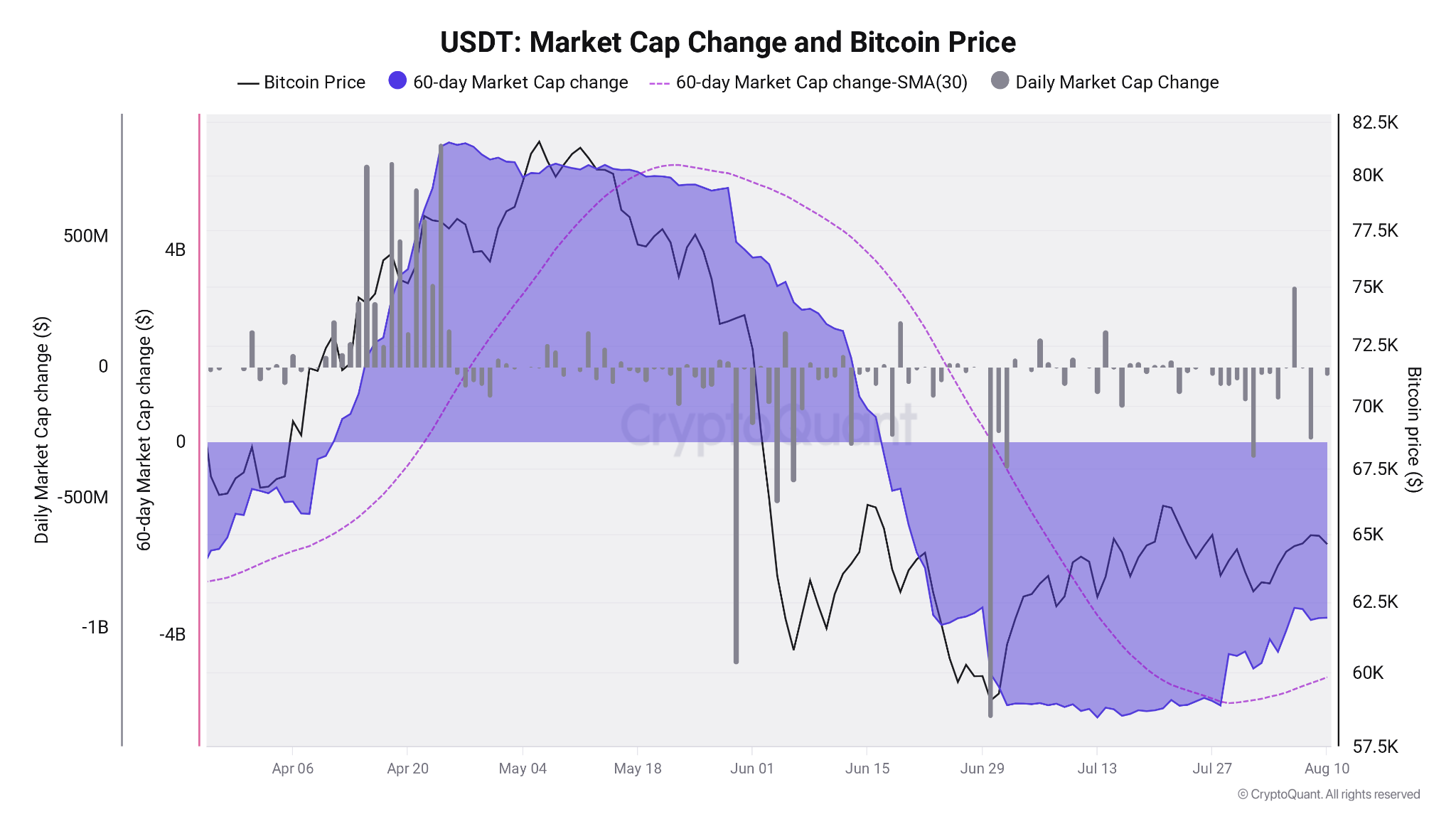
Biggest stablecoin Tether (USDT) has shed $4 billion in market cap in just two months, but history suggests that the downturn is nearly over.
Key points:
- Tether’s 60-day rolling market-cap contraction stays near $4 billion in one of its heaviest drawdowns.
- Analysis suggests that the worst of bear-market selling pressure could be over as a result.
- Comparison to 2022 bear-market highlights an ongoing RSI divergence.
USDT drawdown puts “acceleration” of Bitcoin selling in doubt
Onchain analytics platform CryptoQuant in a blog post last week flagged market cap “undergoing one of its sharpest contractions on record.”
“The deterioration has also accelerated at the margin: nearly $870 million of USDT supply disappeared over the latest 11-day period, showing that the contraction is not merely a legacy effect from earlier redemptions,” analysts wrote.
CryptoQuant data puts the 30-day simple moving average (SMA) of 60-day USDT market-cap change at minus $4.88 billion as of Aug. 10.
USDT 60-day market-cap change vs. BTC/USD. Source: CryptoQuant
The extent of the drawdown echoes crypto bear markets and rivals the largest ever seen. Its severity has implications for Bitcoin and the broader market recovery. Stablecoins provide a key source of liquidity, and when this evaporates, less capital or “dry powder” is available for deployment, showing a lack of interest among investors in stepping in at a given price.
“The caution is that correlation between USDT flows and BTC price doesn’t settle causality. Both likely respond to the same risk-off conditions, with redemptions accelerating alongside spot selling rather than strictly ahead of it,” CryptoQuant analysts said. They added:
“Periods of sustained USDT expansion have generally coincided with stronger Bitcoin price regimes, while prolonged contractions have accompanied weaker demand, deeper corrections, and deteriorating market conditions.”
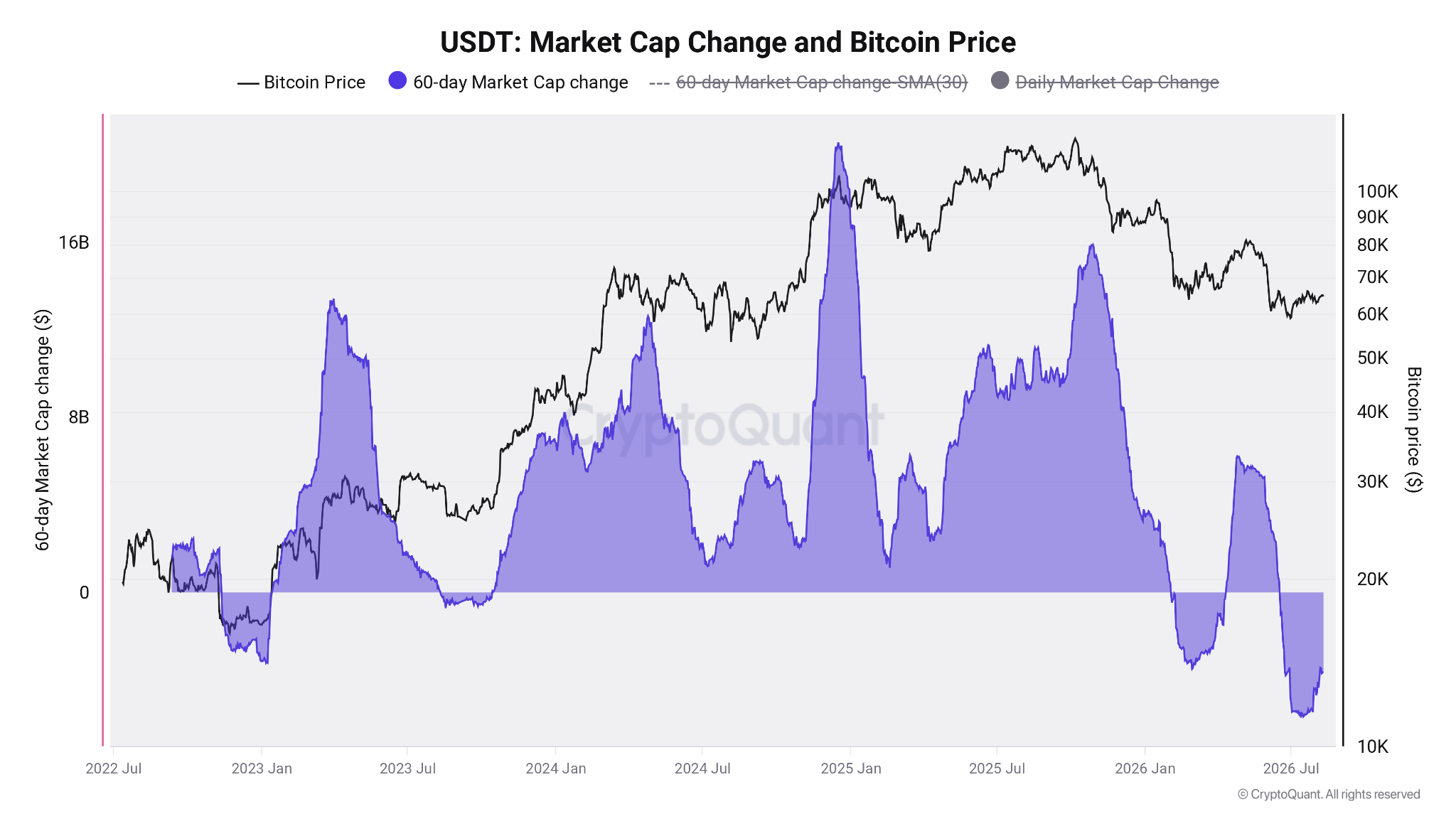
Expanded USDT 60-day market-cap change vs. BTC/USD. Source: CryptoQuant
The steepest 60-day contraction period for USDT market cap completed on July 13, when it reached minus $5.72 billion.
Zooming out, CryptoQuant notes that the most pronounced contraction phases have historically occurred in the final phases of macro market downturns.
“Historically, the market’s deepest USDT contraction phases have also marked points where selling pressure was closer to exhaustion than to further acceleration,” it added.
Weekly RSI divergence echoes 2022 reversal
The findings add to the mounting body of evidence that suggests the current bear market is in its final stages.
Related: Binance Bitcoin volume ratio hits record as futures outweigh spot eight times over
As Cointelegraph continues to report, consensus among market participants increasingly favors a new Bitcoin macro bottom forming before the end of 2026. Both comparisons to previous bear markets and onchain indicators, however, see the downturn continuing in the short term.
Independent analyst William Clemente’s Aug. 8 BTC outlook echoed the prognosis while describing the Bitcoin network as “fundamentally healthy.”
“I think Bitcoin is ‘cheap’ although we could have a leg lower at some point throughout the year,” he summarized.
Two days later, he highlighted an unfolding bullish divergence between BTC/USD and the relative strength index (RSI) on weekly time frames — a classic leading indicator for a market reversal which accompanied the end of the 2022 bear market.
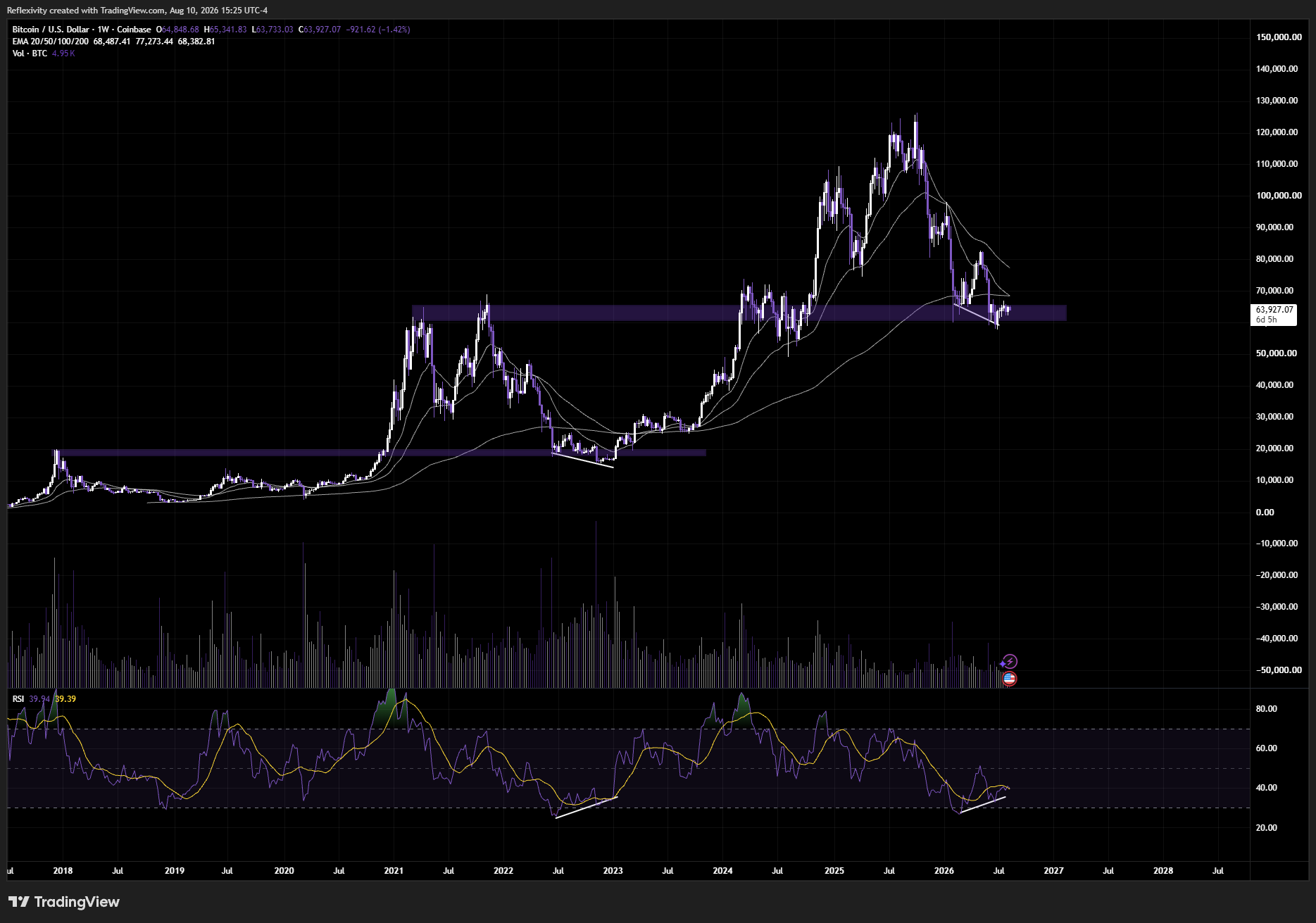
BTC/USD one-week chart with RSI divergences marked. Source: William Clemente on X.com
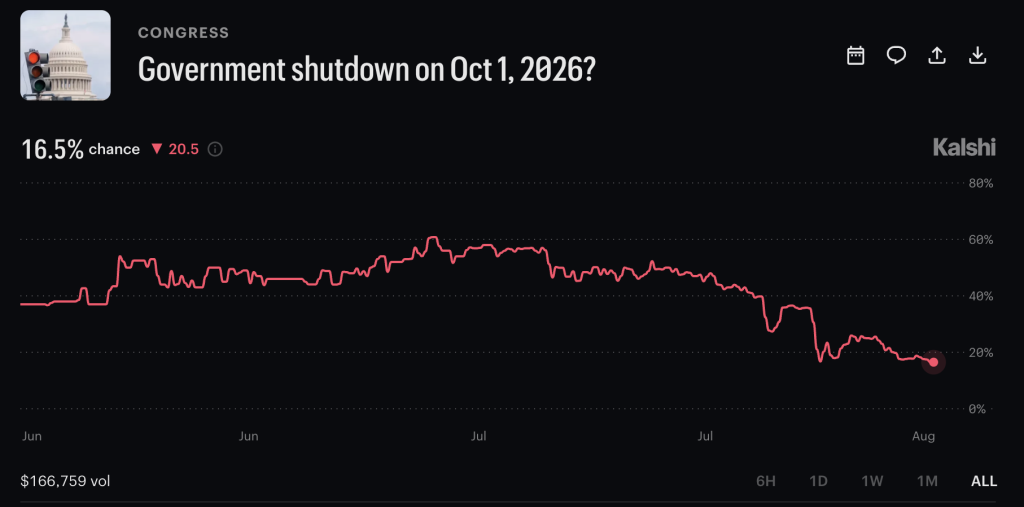
The Senate passed a short-term funding measure by a 90-6 vote, reducing the immediate odds of a US government shutdown and removing one macro overhang for risk assets heading into the fall. Bitcoin is just about managing to hold onto $64,000, with Government shutdown odds increasing.
The bill funds federal agencies at current levels through December 11, but it still needs House approval and Trump’s signature before the threat is actually removed.
That distinction matters more than the headline vote count. A Senate funding bill passing by a wide bipartisan margin is a signal of intent, not a resolved outcome, and for Bitcoin, which has spent the past year trading as a rate-and-liquidity proxy as much as a risk-on tech asset, the gap between “Senate passed it” and “it’s law” is exactly where volatility tends to live.
Discover: Everyone’s Got a Take. Join Kalshi and Get a Free $25 to Actually Trade Yours
Government Shutdown Odds and Why the House Vote Still Matters
The House has already passed its own version of a continuing resolution that funds the government only through December 4, a week earlier than the Senate’s December 11 target.
Reconciling those two bills is not a formality; the chambers will need to work out the actual funding date and any policy riders attached to it before either version reaches the president’s desk.
Senate leadership moved unusually early, nearly two months ahead of the typical eleventh-hour scramble, in part to avoid repeating a shutdown during election season.
That urgency followed a stretch of shutdown fights that have already tested market patience once this year, and traders are unlikely to fully exhale until the House sends something Trump can sign.
Discover: Your Market Calls Are Worth Something. Start With Free $25 on Kalshi
Government Shutdown Odds On Polymarket: What Reduced Shutdown Risk Actually Does for Crypto Markets
A government shutdown does two things that matter directly to crypto markets: it delays official economic data releases- CPI, jobs reports, GDP revisions- that traders use to price Fed policy, and it stalls regulatory and legislative work at agencies like the SEC and CFTC, along with congressional efforts on market-structure legislation.
Both are Bitcoin-relevant. Delayed data widens the uncertainty band around rate expectations, and stalled legislative work pushes back timelines on the kind of regulatory clarity crypto markets have been pricing in for months.
Removing near-term shutdown odds doesn’t create a bullish catalyst on its own; it removes a tail risk. That’s a meaningful but narrow distinction: Bitcoin isn’t rallying because Washington avoided a crisis; it’s simply not pricing in one additional source of macro noise for the next several weeks.
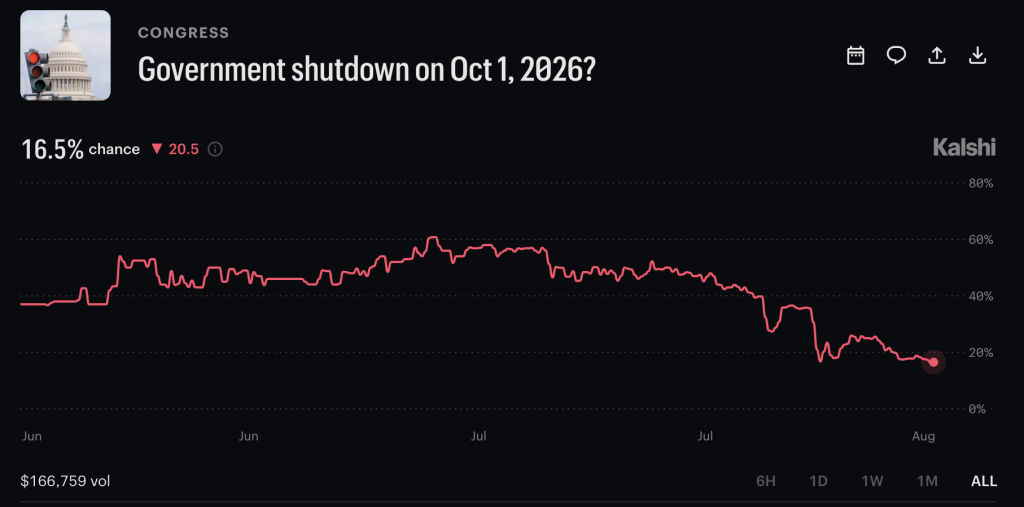
Traders watching how BTC reacts to shifting liquidity conditions should keep an eye on current key price levels for signs of whether that removed risk is actually translating into positioning.
The bigger question is whether reduced political noise changes anything about the Fed’s data dependency. If shutdown risk had escalated, delayed CPI and payrolls prints would have forced the market to trade rate expectations on stale information, a dynamic already explored in the context of upcoming CPI-driven price scenarios for BTC/USD.
With that scenario pushed back, at least temporarily, the macro calendar reasserts itself as the dominant driver over the next stretch.
The December 11 Deadline Is the Real Test
Nothing about this vote eliminates shutdown risk; it deferred it. December 11 is now the operative date, and if the House and Senate can’t reconcile their competing bills before then, the same volatility setup returns with less runway and higher stakes given year-end liquidity conditions.
This isn’t the first time this year that legislative friction has bled into crypto positioning. The pattern of Senate-level delays complicating market-structure timelines showed up recently with the CLARITY Act’s own stalled progress, another example of Capitol Hill gridlock functioning as an indirect but real headwind for digital-asset regulatory certainty.
Three scenarios are worth tracking into December. If the House adopts the Senate’s December 11 timeline cleanly, expect the shutdown discount to stay compressed and crypto markets to trade primarily on rate expectations and spot flows rather than political risk.
If negotiations drag and reconciliation slips toward the deadline itself, expect the same pre-deadline jitteriness that hit risk assets earlier this year to resurface, with Bitcoin likely to trade defensively alongside equities. And if the two chambers can’t agree at all, the shutdown clock resets entirely, pushing regulatory work, economic data, and the broader risk-on setup crypto traders have been counting on right back into limbo.
Don’t Miss Out on Our $1,000 USDT Airdrop on ByBit
The post Bitcoin Gets a Brief Reprieve as Shutdown Risk Moves to December appeared first on Cryptonews.
Crypto World
The New Race for Cross-Chain Liquidity: Why the Future of DeFi May Depend on Moving Capital Seamlessly

For years, blockchain ecosystems competed largely on one question: Which network can attract the most users, developers, and capital?
Ethereum built a massive DeFi economy. Solana became known for high-speed transactions and low fees. Layer-2 networks expanded Ethereum’s capacity, while newer chains introduced alternative approaches to scalability, interoperability, and application development.
But the competitive landscape is changing.
The next major battle may not be about which blockchain has the most liquidity locked inside its ecosystem. Instead, it may be about which networks, protocols, and infrastructure providers can move liquidity between ecosystems most efficiently, securely, and intelligently.
This is creating a new race for cross-chain liquidity.
As the number of blockchains continues to grow, liquidity becomes increasingly fragmented. Assets that once existed primarily within a single ecosystem can now move across multiple chains, creating new opportunities—but also new technical and security challenges.
The winners of the next phase of DeFi may therefore be the platforms that can make blockchain fragmentation feel invisible to users.
What Is Cross-Chain Liquidity?
Cross-chain liquidity refers to the ability to move, access, or utilize capital across different blockchain networks.
Imagine a user holding USDC on one blockchain who wants to participate in a lending protocol on another network. Without interoperability infrastructure, the user may need to:
- Move assets through a bridge.
- Convert the asset into another token.
- Pay multiple transaction fees.
- Wait for confirmations.
- Navigate different wallets or applications.
- Accept additional smart-contract and bridge risks.
Cross-chain infrastructure attempts to simplify this process.
Instead of treating every blockchain as an isolated financial island, interoperability protocols aim to connect liquidity across ecosystems.
The goal is simple:
Liquidity should be able to follow opportunity.
If lending yields are better on one chain, trading volume is higher on another, or a new application launches somewhere else, capital should ideally be able to move there efficiently.
That concept could become one of the most important foundations of mature DeFi.
Why Liquidity Fragmentation Is Becoming a Bigger Problem
The blockchain industry has evolved from a relatively small number of major networks into a highly fragmented environment.
There are Layer-1 blockchains, Ethereum Layer-2s, appchains, rollups, sidechains, modular networks, and specialized execution environments.
This creates an interesting paradox.
More blockchains create more opportunities.
But:
More blockchains can also create more fragmented liquidity.
A trader may find the best liquidity for one asset on Ethereum, the lowest transaction costs on another network, and the most attractive DeFi opportunity somewhere else.
Capital becomes scattered.
This fragmentation can produce several problems:
- Lower liquidity on individual applications
- Higher slippage
- More complicated user experiences
- Increased transaction costs
- Liquidity trapped inside isolated ecosystems
- Greater reliance on bridges and interoperability infrastructure
- More difficult capital management for DeFi users
For decentralized finance to become a truly interconnected financial system, liquidity cannot remain permanently trapped within individual chains.
The Evolution of Cross-Chain Infrastructure
Cross-chain technology has gone through several generations.
Early blockchain bridges largely focused on one objective:
Move an asset from Chain A to Chain B.
The process often involved locking an asset on one network and creating a corresponding representation on another.
For example:
Native Asset → Lock → Wrapped Asset → Destination Chain
Although this approach enabled interoperability, it also introduced additional points of failure.
The industry has since experimented with more sophisticated architectures.
Modern interoperability systems can involve:
- Cross-chain messaging
- Liquidity networks
- Intent-based systems
- Shared security models
- Decentralized verification
- Relayers
- Validators
- Proof-based verification
- Native asset transfers
- Cross-chain swaps
The broader trend is moving from simple token bridging toward programmable interoperability.
That distinction matters.
The future isn’t necessarily about simply moving tokens.
It is about allowing applications on different blockchains to communicate, coordinate, and execute financial actions across networks.
Cross-Chain Messaging Could Be More Important Than Bridging
One of the most important developments in interoperability is the shift from asset movement toward cross-chain messaging.
A bridge answers:
“How do I move this asset?”
Cross-chain messaging asks:
“How can this application communicate with another blockchain?”
That difference opens up much larger possibilities.
For example, a decentralized application could potentially:
- Trigger transactions on another chain
- Verify information from another blockchain
- Coordinate liquidity between ecosystems
- Manage cross-chain positions
- Execute governance instructions
- Automate treasury strategies
- Synchronize application states
This creates the possibility of cross-chain applications rather than simply cross-chain assets.
In such an environment, blockchains become less like isolated networks and more like interconnected components of a larger financial infrastructure.
The Rise of Intent-Based Liquidity
Another important development is the growing interest in intent-based systems.
Traditional DeFi often requires users to specify every step of a transaction.
For example:
Swap Token A → Bridge → Change network → Swap Token B → Approve transaction.
An intent-based system can instead allow the user to express the desired outcome:
“I want 1,000 USDC on this chain.”
The infrastructure can then determine how to execute the transaction.
Different liquidity providers, solvers, market makers, and routing systems can compete to fulfill that intent.
This introduces a new model for liquidity:
Users specify the destination. Infrastructure determines the route.
If this model scales successfully, cross-chain complexity could increasingly disappear behind the interface.
Users may not even need to know which blockchain is handling the transaction.
Liquidity Is Becoming Programmable
Traditional liquidity is relatively passive.
A pool contains assets, and users interact with that liquidity.
Cross-chain liquidity introduces something more dynamic.
Liquidity can potentially be:
- Routed
- Rebalanced
- Aggregated
- Optimized
- Automated
- Allocated according to demand
- Directed toward higher-value opportunities
This means liquidity itself is becoming increasingly programmable.
Imagine a system monitoring dozens of blockchains simultaneously.
If a particular market suddenly experiences high demand, the system could identify available liquidity elsewhere and route capital toward that opportunity.
The resulting architecture begins to resemble a global liquidity layer rather than a collection of isolated decentralized exchanges.
Why Stablecoins Are Central to the Cross-Chain Race
Stablecoins may become one of the most important assets in cross-chain liquidity.
Unlike highly volatile tokens, stablecoins are primarily used as:
- Trading pairs
- Settlement assets
- DeFi collateral
- Payment instruments
- Treasury assets
- Cross-border transfer mechanisms
This makes them natural candidates for interoperability.
A trader may hold stablecoins on one network but want to use them on another.
A DeFi protocol may accept stablecoins from multiple ecosystems.
A payment application may need to settle transactions across different chains.
As stablecoin usage expands, the ability to move stablecoin liquidity efficiently could become a major competitive advantage for blockchain ecosystems.
The race may therefore increasingly revolve around a simple question:
Which infrastructure can make stablecoin liquidity available wherever users need it?
The Security Problem: Liquidity Creates a Bigger Target
Cross-chain liquidity creates enormous opportunities, but it also creates enormous security risks.
Bridges have historically been among the most attractive targets for attackers because they often control significant amounts of assets or coordinate complicated cross-chain verification mechanisms.
The challenge comes from the fact that a cross-chain system must answer a difficult question:
How can one blockchain securely trust information originating from another blockchain?
If that verification process fails, the consequences can be severe.
Potential vulnerabilities include:
- Smart-contract exploits
- Validator compromise
- Private-key failures
- Malicious relayers
- Incorrect message verification
- Oracle manipulation
- Economic attacks
- Liquidity-provider exploits
- Governance attacks
- Replay attacks
- Poorly designed token representations
This means cross-chain liquidity cannot simply be optimized for speed and capital efficiency.
It must also be optimized for security and trust minimization.
The Liquidity Trilemma
Cross-chain infrastructure faces a difficult balancing act.
Users want:
1. Security
Funds should remain protected.
2. Capital Efficiency
Liquidity should not sit idle unnecessarily.
3. Speed
Transactions should settle quickly.
But improving one dimension can sometimes create trade-offs elsewhere.
For example, highly secure verification mechanisms may introduce additional latency.
Extremely fast systems may rely on additional assumptions.
Capital-efficient systems may require complex liquidity management.
The next generation of interoperability protocols will therefore compete not simply on the number of supported chains, but on how effectively they balance these three objectives.
The Battle for Liquidity Providers
Cross-chain infrastructure also creates a new competitive environment for liquidity providers.
Liquidity providers are the capital behind many decentralized markets.
They can earn fees by supplying assets to:
- Automated market makers
- Cross-chain pools
- Lending markets
- Liquidity networks
- Settlement systems
- Intent-based trading systems
But cross-chain liquidity introduces additional considerations.
A liquidity provider must evaluate:
- Yield
- Trading volume
- Impermanent loss
- Bridge risk
- Smart-contract risk
- Chain-specific risk
- Liquidity utilization
- Withdrawal conditions
- Token volatility
Higher yields may compensate for higher risk—but not always.
This means sophisticated liquidity providers will increasingly evaluate risk-adjusted returns, rather than simply chasing the highest advertised APY.
Cross-Chain DEX Aggregation
Decentralized exchanges are another major battleground.
Instead of searching for liquidity on a single chain, cross-chain aggregators can potentially search across multiple liquidity sources.
Consider a user wanting to exchange Asset A for Asset B.
The optimal route might involve:
Chain A → Liquidity Pool → Cross-Chain Network → Chain B → DEX
The user may not need to manually execute each step.
Routing infrastructure can compare:
- Liquidity depth
- Price impact
- Fees
- Gas costs
- Execution speed
- Available routes
- Bridge costs
The result is potentially better execution for users and more efficient utilization of fragmented liquidity.
Why Developers Care About Cross-Chain Liquidity
Cross-chain liquidity isn’t only a user problem.
It is also a developer problem.
A new DeFi application launching on a smaller blockchain may have excellent technology but insufficient liquidity.
Without enough capital, users experience:
- High slippage
- Low borrowing capacity
- Poor trading execution
- Limited market depth
Cross-chain infrastructure can potentially help applications access liquidity beyond their native ecosystem.
This creates a powerful network effect.
More liquidity attracts users.
More users create more volume.
More volume attracts liquidity providers.
More liquidity attracts more developers.
This cycle can accelerate ecosystem growth.
Cross-Chain Liquidity Could Change Blockchain Competition
For years, blockchain ecosystems competed by trying to retain users inside their own environments.
But interoperability creates a different competitive model.
Instead of asking:
“How do we keep liquidity inside our chain?”
Networks may increasingly ask:
“How do we become an attractive destination within a larger liquidity network?”
This is a significant philosophical shift.
A blockchain does not necessarily need to own all liquidity.
It may simply need to become the best place for liquidity to operate.
For example, a chain could specialize in:
- Derivatives
- Gaming
- Stablecoin payments
- Institutional settlement
- Real-world assets
- Lending
- Trading
- AI applications
Cross-chain infrastructure can then connect that specialized economy to the rest of Web3.
The Institutional Opportunity
Cross-chain liquidity could also become increasingly important as institutional capital enters blockchain markets.
If institutions eventually interact with multiple blockchain ecosystems, they will need infrastructure capable of managing liquidity across networks without requiring manual processes for every chain.
This could create demand for sophisticated cross-chain treasury and liquidity-management systems.
Instead of managing isolated wallets across dozens of networks, institutions could potentially use unified infrastructure to monitor and allocate capital across multiple blockchain environments.
Real-World Assets Add Another Layer
The growth of tokenized real-world assets could make interoperability even more important.
Tokenized:
- Treasury products
- Bonds
- Funds
- Credit instruments
- Commodities
- Real estate
- Other financial assets
may eventually exist across different blockchain environments.
If these assets become fragmented across networks, interoperability becomes essential.
Imagine a tokenized financial asset issued on one blockchain while investors use another network for trading, collateralization, or settlement.
Without efficient interoperability, the market becomes fragmented.
With strong interoperability, these assets could potentially participate in a broader digital financial ecosystem.
The Future May Be Chain-Agnostic
One of the most interesting possibilities is that users eventually stop caring which blockchain they are using.
Today, crypto users often think about:
- Which chain?
- Which wallet?
- Which bridge?
- Which DEX?
- Which gas token?
- Which network fee?
For mainstream adoption, that complexity may need to disappear.
The ideal experience could look more like traditional internet applications.
Users simply choose what they want to accomplish.
The infrastructure handles:
Chain selection → Liquidity discovery → Routing → Execution → Settlement
Behind the scenes, multiple blockchains may be involved.
But from the user’s perspective, there is simply one application.
That is the promise of chain abstraction.
Chain Abstraction: The Next Step
Chain abstraction aims to hide blockchain-specific complexity from users and applications.
Instead of forcing users to understand individual networks, applications can provide a unified experience.
This could involve:
- Unified balances
- Automated gas management
- Cross-chain transactions
- Smart routing
- Intent-based execution
- Unified liquidity
- Account abstraction
- Cross-chain messaging
If successful, chain abstraction could transform how people interact with Web3.
Users would no longer think:
“I need to bridge my assets to another chain.”
They would simply think:
“I want to trade, borrow, pay, invest, or transfer.”
The underlying infrastructure would handle the complexity.
What Will Determine the Winners?
The race for cross-chain liquidity will likely not be won by the project supporting the largest number of chains alone.
Several factors will matter.
Security
A cross-chain system managing billions in liquidity must have robust security assumptions.
Capital Efficiency
Idle liquidity is expensive.
The best systems will find ways to maximize the productive use of capital.
Execution Quality
Users care about the final result: price, fees, speed, and reliability.
Liquidity Depth
Deep liquidity reduces slippage and improves execution.
Developer Experience
Infrastructure needs to be easy for applications to integrate.
Composability
Cross-chain systems should allow applications to interact with other protocols rather than operating as isolated services.
Decentralization
Users and institutions may increasingly demand systems that reduce dependence on centralized intermediaries.
Scalability
As more chains and applications connect, interoperability infrastructure must handle increasing transaction and messaging volumes.
The New Competitive Moat: Liquidity Connectivity
In traditional finance, liquidity is a competitive advantage.
The same principle applies to DeFi.
But in a multi-chain environment, simply possessing liquidity may not be enough.
The more important advantage may be liquidity connectivity.
A protocol with access to multiple liquidity sources can potentially offer:
- Better execution
- More trading pairs
- Greater capital efficiency
- More opportunities
- Lower slippage
- Better user experiences
This creates a new kind of network effect.
The more chains connected to a liquidity network, the more valuable that network can become.
And the more users and applications use it, the more attractive it becomes to liquidity providers.
The emerging cross-chain economy could create a powerful flywheel:
More Chains Connected
↓
More Liquidity Available
↓
Better Execution
↓
More Users
↓
More Transaction Volume
↓
More Fees and Opportunities
↓
More Liquidity Providers
↓
Even Deeper Liquidity
This flywheel could become one of the defining economic mechanisms of the next generation of DeFi infrastructure.
What Could Go Wrong?
Despite the enormous potential, cross-chain liquidity is not guaranteed to become a seamless global system.
Several challenges remain.
Fragmented Standards
Different chains may use different architectures, messaging systems, and security models.
Security Failures
One major exploit could undermine confidence in an interoperability network.
Liquidity Fragmentation
Ironically, adding more interoperability systems could create even more fragmentation.
Economic Attacks
Protocols must defend against attackers exploiting incentives rather than traditional software vulnerabilities.
Regulatory Uncertainty
Cross-border digital asset movement may attract increasing regulatory attention.
Complexity
Even if infrastructure becomes sophisticated, poor user interfaces could keep cross-chain applications difficult to use.
The industry therefore needs to solve not only the technical problem of interoperability, but also the economic, security, governance, and user-experience problems surrounding it.
The Bigger Picture
The race for cross-chain liquidity is ultimately about something bigger than bridges.
It is about whether blockchain networks remain isolated economies or evolve into an interconnected financial system.
If interoperability succeeds, liquidity could become increasingly mobile.
Capital could move toward the applications, markets, and opportunities offering the best combination of risk and return.
Developers could build applications without worrying that their users are trapped on a single chain.
Liquidity providers could access markets across multiple ecosystems.
Institutions could manage blockchain-based assets through unified infrastructure.
And users could interact with Web3 without needing to understand every technical layer underneath the application.
Conclusion: Liquidity Wants to Move
Blockchain ecosystems are no longer competing in isolation.
Ethereum, Layer-2 networks, Solana, and other chains are increasingly becoming pieces of a much larger digital economy.
The next stage of DeFi may therefore be defined not by how much liquidity a chain can attract, but by how efficiently that liquidity can connect to the rest of the ecosystem.
The winners of this race will likely be the networks and infrastructure providers that can combine:
Security + Liquidity + Speed + Capital Efficiency + Interoperability + User Simplicity.
Cross-chain liquidity could ultimately transform blockchain from a collection of separate financial networks into a connected global liquidity layer.
And when that happens, the most valuable blockchain may not be the one that keeps liquidity trapped inside its walls.
It may be the one that makes liquidity flow everywhere.
REQUEST AN ARTICLE

“This is a really important time for Taiwan,” she says. “Are we going to go toward war or toward peace across the Strait? This is really why I decided to take the party chair.”
Standing 5 ft. 10 in., Cheng is an arresting presence with a reputation for chest-thumping speeches. Sure enough, during our interview, her answers betray a bombastic staccato honed on the stump. Behind the scenes, however, she is amiable and slightly introverted.
“I actually am a very, very quiet person,” she says. “I don’t like to see people, and I don’t like to talk to people. I like to keep to myself.”
It’s a surprising revelation given Cheng’s political journey under the spotlight, which in many ways reflects the complicated social dynamics of Taiwan, where political fault lines have historically been drawn between native islanders and mainland arrivals following the Civil War.
Cheng grew up in the southern city of Tainan, the daughter of a Taiwanese mother and a KMT soldier father from China’s southwestern Yunnan province, who fled to Taiwan in 1953 via Southeast Asia’s arcane Golden Triangle. “My father really hated politics, hated war, and hated the army,” Cheng says. “He hated the KMT. My father thought all politicians are assholes!”

[PRESS RELEASE – Curacao, Curacao, August 11th, 2026]
BetFury, a leading crypto casino, closed its Fury World Cup ’26 on July 27. The campaign turned the 2026 FIFA World Cup into a platform-wide event with a $600,000 prize pool spread across five parallel promotions. The final numbers show what an event scaled to the world’s biggest football tournament can deliver for a platform and its community.
Growth Across Every Core Metric
Measured against the 43 days before the event, every core participation metric rose. Active users climbed 66.06%. Total bets grew 16.93% and deposits increased 7.53%. The scale of the user gain against a far smaller deposit increase points to broad participation rather than concentrated spending. Regarding the World Cup, the final match between Argentina and Spain was the most popular in terms of users, bets and a total wager.
A Build-Up that Started Before Kick-Off
Before the main phase of the Fury World Cup ’26, users could add the event to their calendar and get No Risk Bet rewards. The Fury World Cup ’26 Giveaway brought 30 random users $100 each in Free Bets. Along with other additional activities, they fueled interest in the upcoming group stage and playoff matches.
Rewards across the main promotions
In each of the three sports Battles (First Kick, Final Whistle, and Midfield), 150 winners split $40,000 in BFG tokens and Free Bets. The Sport Missions Journey covered 115 Missions. The Mundial Prediction Event ran free to enter, awarding 2 to 12 points per correct match-winner call, based on the World Cup phase. The top 100 users shared a $20,000 prize pool. The Golden Ticket Raffle closed the campaign, handing $100,000 to random holders of lucky lottery tickets.
Why Does the Event at this Scale Matter?
The scale produced returns on three fronts. For players, all the promotions and the $600,000 pool turned six weeks of soccer into daily competition and free rewards. For the business, the rise in active users and revenue converted a global cultural moment into measurable platform performance. For the wider industry, the campaign offers an example of how a crypto sportsbook can connect predictions, missions, competitions, and rewards around a major sporting event instead of limiting its activity to advertising around the tournament.
“A tournament that comes around once every four years deserved more than a standard promotion, so we built an event on the same scale,” said the CEO of BetFury. “What matters most is how many of our users took part, and a 74.66% jump in GGR shows that engagement translated into real commercial return. That is the foundation we will keep building future events around.”
Therefore, Fury World Cup ’26 has ended, but its effect on BetFury holds: a larger active base, stronger platform metrics, and a proven blueprint for the next large-scale campaign.
About BetFury
BetFury is a leading crypto casino with 3.5M registered players and $11.5B wagered, founded in 2019. The platform offers over 13,000 games, 24 Original games with RTP up to 99.28%, and 80+ sports for betting with odds higher than the market average. Beyond gaming, BetFury provides a full suite of crypto tools: Crypto Staking with up to 60% APR, Futures, Crypto Swap, etc. Moreover, it has a BFG Staking for accumulating more native tokens or collecting payouts in BFG or USDT. BetFury continuously evolves based on user feedback and is committed to responsible gambling practices. Learn more at betfury.com.
The post BetFury Closes Fury World Cup ’26 With $600,000 Awarded and 66% User Growth appeared first on CryptoPotato.


Only 281 of 1,343 crypto service providers operating across the European Economic Area have secured MiCA authorization after the EU’s final transition period expired on July 1, leaving more than 1,000 firms without approval under the bloc’s licensing regime.
Summary
- Only 281 of 1,343 EEA crypto service providers secured MiCA authorization by July 1.
- High or Severe risk ratings applied to 12% of unauthorized firms, compared with 2% of authorized providers.
- Unauthorized firms sent $5 billion directly to sanctioned counterparties, about three times the $1.7 billion recorded among authorized firms.
- Germany authorized 55 firms, while Poland issued no authorizations despite its previous register exceeding 1,800 entries.
According to blockchain intelligence firm TRM Labs, 1,062 firms in its dataset had not obtained authorization under the Markets in Crypto-Assets Regulation by the deadline and must now leave the market, restructure their operations or transfer customers to an authorized provider.
The gap extends beyond licensing. TRM found that 12% of firms without authorization carry a High or Severe risk rating, compared with 2% of authorized providers, while every firm assigned a Severe rating belonged to the unauthorized group.
Most providers in both groups have little direct contact with illicit funds. However, TRM identified a small number of unauthorized firms sending between 1% and 12% of their volume directly to illicit addresses. No authorized provider recorded direct illicit exposure above 1%.
MiCA authorization has left more than 1,000 firms outside the regime
Before MiCA, crypto companies operated under separate registration or licensing systems maintained by individual European countries, creating major differences in the requirements firms faced depending on where they registered.
TRM identified 383 operating firms under Lithuania’s previous registration system and 241 in Poland. Poland’s official register contained more than 1,800 entries, although the blockchain intelligence firm said most showed no observable crypto activity.
At the other end, Slovenia had three identified providers and Belgium had two. TRM cautioned that its figures track firms it could identify as actually providing crypto services rather than every entry on national registers, meaning countries without public registers may be undercounted.
MiCA replaced the national systems with a common authorization framework. Companies legally operating before Dec. 30, 2024, could continue under Article 143(3) while seeking authorization during the transition period, with July 1 serving as the final EU-wide cutoff.
As crypto.news explained shortly before the deadline, individual member states were allowed to set shorter transition periods, but none could extend the grandfathering system beyond July 1. Firms without the required authorization after their applicable deadline could no longer legally provide covered crypto services in the EU.
Licensing numbers had already shown how much the market could contract. In May, the ESMA register contained 204 authorized CASPs, including 51 approved during the first five months of 2026. Germany accounted for 55 at the time, followed by the Netherlands with 25 and France with 17.
A separate June report found that more than 3,000 crypto firms had been registered across Europe before MiCA, while only 194 had secured authorization by May. Hogan Lovells estimated at the time that roughly 75% of firms registered under the previous systems could lose their status as national transition periods expired.
Germany and smaller EU states have taken more firms through MiCA
Authorization has been uneven across individual European jurisdictions, according to TRM’s July 1 dataset.
Germany authorized 55 firms, while France and the Netherlands each authorized 29. Malta approved 20 and Cyprus 19, compared with nine home authorizations issued by Italy despite 145 firms operating there.
Malta, Cyprus, Ireland and Luxembourg together accounted for 63 of 272 home authorizations identified by TRM, even though only 101 operating firms came from their previous registers.
Lithuania produced a very different conversion rate. Eight firms obtained authorization from a previous register containing more than 400 providers, while Poland issued none despite its old register exceeding 1,800 entries. Greece and Portugal also issued no home authorizations in TRM’s dataset.
The figures also show how MiCA’s passporting system can separate where a provider operates from which regulator supervises it. Germany’s BaFin authorized 55 of the 57 licensed providers operating in the country, while Italy hosted 37 licensed firms but issued nine home authorizations. Spain hosted 34 and authorized 12.
Under MiCA, a CASP approved in one member state can use passporting rights to provide covered services elsewhere in the bloc. For example, B2C2 secured Luxembourg authorization in May, allowing the liquidity provider to offer regulated over-the-counter spot crypto trading across all 27 EU member states and three additional EEA markets.
The same system has allowed firms including Coinbase, Bitpanda and Kraken to operate from different regulatory bases while serving customers across multiple European markets.
By July 3, ESMA’s interim register had expanded to 300 authorized crypto-asset service providers after 57 additional firms were added around the July 1 deadline, including Standard Chartered and FalconX.
Unauthorized firms carry higher risk ratings and sanctions exposure
Looking beyond license numbers, TRM found a clear difference in the risk profiles of the two groups.
About 12% of unauthorized firms received a High or Severe rating, six times the 2% recorded among authorized providers. Severe ratings were found exclusively among firms that failed to obtain authorization.
Direct exposure to illicit or high-risk counterparties was much closer when measured across each group as a whole. Unauthorized providers recorded 0.09% of outgoing volume directly involving such counterparties, compared with 0.07% among licensed firms.
High-risk exchanges and gambling services accounted for the largest exposures. Unauthorized firms sent $19 billion to high-risk exchanges and $15.3 billion to gambling services, while authorized providers recorded $14.2 billion and $13.4 billion, respectively.
Sanctions exposure produced a larger difference. TRM calculated that unauthorized firms sent $5 billion directly to sanctioned counterparties, roughly three times the $1.7 billion recorded among authorized firms.
Risk within the unauthorized group was heavily concentrated. Half of the firms showed no measurable direct illicit exposure, while a limited number sent between 1% and 12% of their volume directly to illicit addresses. TRM calculated that direct illicit exposure among the offboarding firms was about four times higher because of those outliers.
The unauthorized cohort also included HTX, which TRM described as a designated exchange, and Huione Pay, which has been named under U.S. special measures. Entities affected by EU measures restricting dealings connected to Russia were also among firms that held national registrations but did not obtain MiCA authorization.
The composition of the two groups differed as well. Exchanges accounted for 42% of unauthorized providers compared with 29% of authorized firms, while payment companies represented 16% and 9%, respectively.
Financial and investment service providers were more common among authorized CASPs, making up 25% and 21% of the group, compared with 9% and 7% among unauthorized firms. TRM’s High-Risk Exchange category appeared only among providers that did not obtain authorization.
Customer transfers are creating a new supervisory test
With more than 1,000 firms outside the authorization regime, the EU’s Anti-Money Laundering Authority has focused on what happens when their customers and assets move elsewhere.
AMLA said the end of the transition period would cause unauthorized virtual asset service providers to leave the market, customer relationships to be transferred or terminated, and crypto activity to become concentrated among fewer authorized CASPs.
During wind-downs, compressed exit schedules can place pressure on anti-money laundering controls and make it harder to track where customers and funds move, according to the authority. Receiving CASPs can simultaneously face changes in their customer risk profiles and additional demands on transaction monitoring systems.
AMLA has therefore asked supervisors to prioritize oversight of exit plans and customer transfers while coordinating with regulators in other jurisdictions when customers move across borders.
TRM identified 30 unauthorized providers with High or Severe risk ratings, giving receiving firms and supervisors a group that can be screened before customer migrations take place.
The firm also cautioned against treating all customers leaving unauthorized providers as equally risky. Most firms that failed to secure authorization still carried Low risk ratings and recorded negligible direct illicit exposure.
For receiving CASPs, TRM said entity-level screening can distinguish customers arriving from a Low-rated payment provider with little illicit exposure from those leaving a Severe-rated entity where a measurable share of transaction volume has moved directly to illicit addresses.
Regulators have also started examining authorized providers after completing much of the initial licensing work. In July, ESMA launched a review of a sample of MiCA-authorized crypto custodians, examining areas including custody controls, private-key management, incident response and risks tied to third-party providers.
TRM separately examined whether regulators issuing more licenses were also supervising firms with higher illicit exposure. Across 23 jurisdictions where licensed providers carried measurable transaction volume, it found no identified correlation between the number of authorizations issued and the illicit exposure of firms supervised there.
For financial institutions assessing counterparties, TRM said the number of CASP licenses granted by a firm’s home jurisdiction therefore provides little information about the individual provider’s risk. Its analysis instead found the differences at entity level, including individual risk ratings and direct exposure to illicit, sanctioned and other high-risk counterparties.

Payments firm Decta says it is adding Circle’s USDC to the back-end of its international treasury operations, using OpenPayd to convert fiat into the stablecoin for internal settlement across markets. The move highlights a growing pattern in crypto: stablecoins are increasingly used as infrastructure for liquidity and operational transfers, rather than as a branded payment option for customers.
Decta told Cointelegraph that the company will route its own funds through OpenPayd’s regulated infrastructure, where they are converted into USDC via OpenPayd’s over-the-counter capabilities. OpenPayd then supports international operational settlements that Decta would otherwise complete through conventional banking processes.
Key takeaways
- Decta will use USDC for internal treasury settlement across markets, positioning the stablecoin as a back-end liquidity tool rather than a customer payment feature.
- The conversion and settlement is handled through OpenPayd’s regulated infrastructure and OTC capabilities.
- Decta frames the change as an operational efficiency upgrade versus bank transfer frictions like cut-off times and multi-day value dates.
- Stablecoins continue to deepen their role inside traditional payments and financial infrastructure stacks.
How Decta plans to use USDC
In remarks shared with Cointelegraph, OpenPayd’s chief commercial officer, Lux Thiagarajah, described the integration as “a proprietary treasury use case rather than a customer-facing payments flow.” In other words, the stablecoin is intended for Decta’s own internal movements of value across entities and markets—not for consumer or merchant payments.
Thiagarajah explained that Decta transfers its funds into OpenPayd’s regulated infrastructure, where they are converted into USDC. OpenPayd’s role is to facilitate this conversion through its OTC capabilities, then use the resulting digital settlement instrument to support international operational settlements.
For investors and builders watching crypto adoption, the practical implication is straightforward: stablecoins are being absorbed into workflows where speed and execution certainty matter most. Even when customer-facing adoption lags, stablecoin rails can still become embedded in day-to-day operations for regulated financial intermediaries.
Treasury operations and the limits of banking rails
Decta UK CEO Scott Dawson said the company regularly moves funds between banking relationships to fund operations and settle internal obligations across regulated entities and jurisdictions. Traditionally, these transfers rely on standard banking rails, which can impose operational constraints such as cut-off times, weekends, and multi-day value dates.
Dawson argued that using OpenPayd’s regulated infrastructure changes the timing dynamics. According to his statement to Cointelegraph, Decta converts fiat into a digital settlement instrument through OpenPayd, then “moves it across markets near-instantly.”
This matters because treasury departments generally value predictability and execution efficiency. While banking transfers can be reliable, their scheduling constraints can complicate cash planning and working-capital management—particularly for firms operating across multiple countries and regulated entities.
Dawson also pointed out that Decta transfers its own funds for settlements rather than altering the structure of its customer payment products. That distinction suggests the company is aiming for improved operational settlement performance without expanding the stablecoin exposure embedded in its customer-facing services.
Decta and OpenPayd: where the integration fits
Founded in 2015 in London, Decta describes itself as a payments platform providing payment processing, acquiring, card issuing, banking, and other financial infrastructure to businesses. The company says it operates across 32 countries and serves hundreds of companies, according to its announcement.
On the infrastructure side, OpenPayd—founded in 2018 in London—positions itself as a bridge between fiat and digital assets. Cointelegraph previously reported that OpenPayd secured authorization under the European Union’s Markets in Crypto-Assets Regulation (MiCA) in June, enabling it to offer crypto services across the European Economic Area, including fiat-to-stablecoin on- and off-ramps. Its listed clients include Kraken, eToro, OKX, and B2C2, as described in that earlier coverage.
Cointelegraph also noted in past reporting that Decta had explored stablecoin issuance. In August 2024, Decta Limited and France-based Next Generation said they were looking at a potential euro-pegged stablecoin that Decta could issue under MiCA, subject to regulatory approval.
Taken together, the new USDC settlement plan fits a broader trajectory for regulated payment businesses: stablecoins can be treated as settlement instruments in specific operational layers, while issuance ambitions or customer-facing products may follow separate regulatory and market readiness paths.
What to watch next
As Decta rolls USDC into its international treasury workflow, market observers should look for whether the arrangement remains strictly proprietary (back-end settlements) or gradually expands into other operational flows. The key unresolved question is how widely similar regulated payment firms will follow—especially given the ongoing need to balance faster settlement with compliance expectations across jurisdictions.
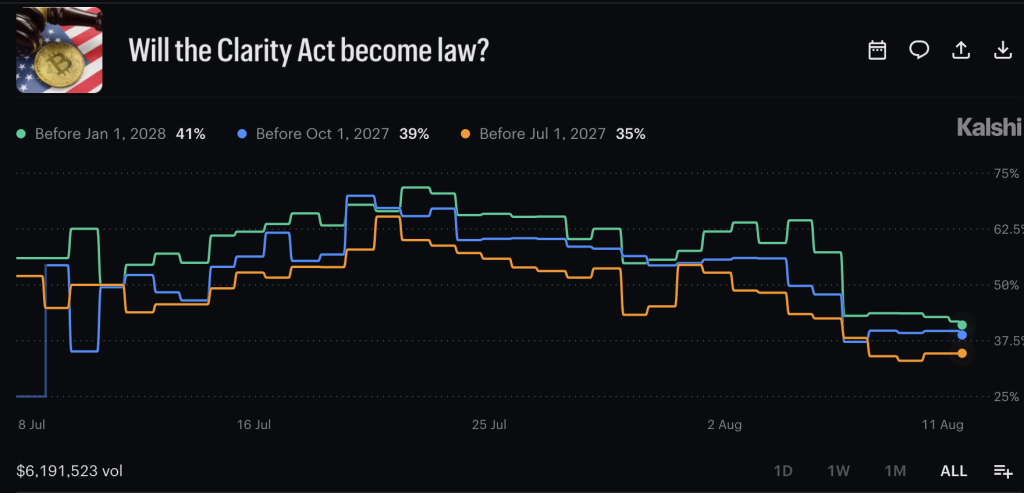
The CLARITY Act bill cleared the Senate Banking Committee by a comfortable 15-9 bipartisan margin, but now carries a 75% chance of dying before it ever reaches a final vote.
That’s the assessment TD Cowen Washington Research Group analyst Jaret Seiberg delivered in an August 10 policy note, and it reframes the CLARITY Act from a near-certain legislative win into a genuine coin-flip proposition heading into September.
This latest twist in the CLARITY Act drama comes as Kalshi bettors have been placing money on the bill being passed by July 1, 2027, with that market increasing 2% overnight, currently sitting at 35%.
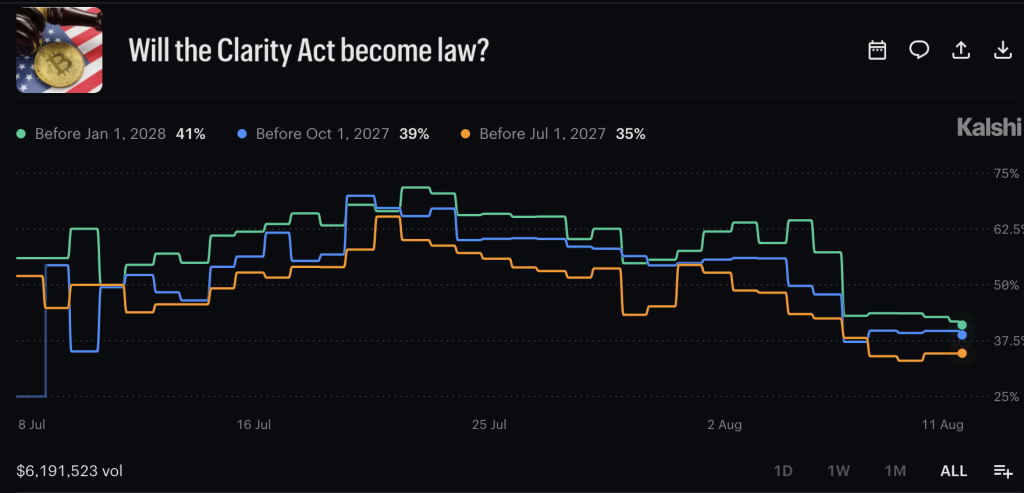
Where the CLARITY Act Bill Actually Stands
The Digital Asset Market Clarity Act (H.R. 3633) aims to separate federal oversight of digital assets between the SEC and CFTC, designating digital commodities to the CFTC and investment-contract assets to the SEC.
Senator Cynthia Lummis (R-WY) released updated text on July 22 and emphasized the urgency of passing the legislation, calling it “the last real chance…to get this right.”
Senate Agriculture Committee Chairman John Boozman (R-AR) noted the bill provides a clear regulatory framework for digital commodities.
Banking Committee Chairman Tim Scott (R-SC) highlighted its role in protecting retail investors and preventing illicit finance. Despite previous momentum, including a 15-9 committee vote, progress has stalled in the Senate.
BREAKING: — Bull Theory (@BullTheoryio) August 11, 2026
 SEC is set to begin its first major crypto rulemaking process this week as the Senate has failed to pass the Clarity Act before the August recess.
The SEC will meet on August 14 to propose “Regulation Crypto.”
The proposal could create a legal path for certain… pic.twitter.com/Z0R4fIdYPp
Why TD Cowen Puts the Odds Against Enactment
Seiberg’s estimate of a 75% failure rate, mentioned by Bitcoin.com News, came after Senate Majority Leader John Thune filed for cloture on Aug. 8. While an initial cloture vote is scheduled for 2:15 p.m. ET on Sept. 15, this does not guarantee a completed legislative process. Three potential failure scenarios include:
- The motion clears the 60-vote threshold, but Democrats block further cloture due to unresolved amendments.
- The scheduled vote does not happen because Republicans avoid contentious issues.
- The vote passes, but no amendments or subsequent motions occur, leaving the bill stalled.
With Republicans holding 53 seats, at least seven Democrats or independents must support the motion for it to pass. Disputes over stablecoin yield, anti-money-laundering provisions, and regulatory authority remain unresolved.
The 25% Path Isn’t Dead, Just Narrow
TD Cowen’s enactment case isn’t zero, and the firm’s language matters here: the bill is not dead, but the path forward is harder. The most plausible route to passage has the initial cloture motion clearing 60 votes.
Then Democrats getting a floor vote on their preferred ethics compromise, that amendment failing on a simple majority, and crypto-friendly Democrats then back final passage, having registered their objection on record.
A less likely branch involves the White House cutting its own ethics deal with Democrats to unlock enough votes outright. There’s also a lame-duck scenario, but it only exists if Republicans hold both chambers past the midterms, which pushes any resolution well beyond this fall’s trading calendar.
For traders pricing in a near-term regulatory catalyst, that’s the detail that matters most: even the optimistic case doesn’t deliver crypto regulation clarity on a September timeline.
Market Implications of a Stalled Senate Vote for the CLARITY Act
Assets most tied to the SEC/CFTC market-structure outcome have already priced in the delay. XRP, which stands to benefit directly from a codified digital-commodity classification under CFTC oversight, has seen ETF inflows soften alongside the postponed timeline.
This is a dynamic covered in detail, tied to weaker XRP ETF inflows amid CLARITY Act uncertainty. The pattern repeated after each procedural setback, including the immediate price reaction documented when the Senate vote was previously postponed.
That reaction function is instructive for Sept. 15. A clean cloture pass with visible follow-through, amendment votes, and a real path to final passage would be read as a genuine de-risking event for market-structure-sensitive tokens.
A cloture vote that either doesn’t happen or produces no subsequent action would confirm the bill’s drift toward TD Cowen’s base case, and assets that had priced in regulatory tailwinds would likely give back those gains.
The post CLARITY Act Vote Faces Procedural Fight, Not Final Passage appeared first on Cryptonews.

M25 closed as industrial estate fire rages next to motorway amid fears of ‘explosion’

UEFA, CONCACAF and AFC accuse Gianni Infantino of ‘fundamental breach of trust’

Bernie Sanders tells OpenAI, Anthropic, and Meta to pause AI development or face Senate action


-

 Fashion4 days ago
Weekend Open Thread: Mattifying Sunscreen
-

 Fashion4 days ago
Frugal Friday’s Workwear Report: Cap-Sleeve Pointelle Crewneck Sweater
-

 Sports5 days ago
Jordan Coyle & Cordiamo take Laya Arena Stakes at RDS
-

 News Videos3 days ago
Can Astrology Help Find Gold and Silver Trends? A Financial Astrology Guide
-
 Business6 days ago
US stocks: Dow closes at record on Mideast optimism; SpaceX, AMD drag Nasdaq
-

 Politics5 days ago
Reform UK And Greens Sink To Lowest Favourability Ratings To Date
-

 Business7 days ago
Nvidia Stock Climbs 2.5% as Chip Sector Rally Builds Ahead of AMD Earnings, Nvidia’s Own Report Looms
-

 Tech6 days ago
OpenAI, Anthropic AI agents targeted real people and systems in cyber tests
-

 Crypto World7 days ago
Polymarket targets $20 billion valuation as competition heats up in prediction market sector
-

 Business6 days ago
Supply chain issues impact Ingredion
-

 Tech4 days ago
Rinn Pharma & Biopharma to join NordicPharmaTrain network
-

 Business2 days ago
How to Start a Cleaning Business: A Step-by-Step Guide
-
 Crypto World6 days ago
Dow and S&P 500 Hit Records on AI Earnings: When Will the Bubble Burst?
-

 Business2 days ago
Datadog: Best Of Breed For Multiple Reasons
-

 Business2 days ago
BDC Weekly Review: Private BDC Q2 Numbers Are Strong
-
 Crypto World7 days ago
Dollar Index Trapped at 100 as Hawkish Fed Meets Official Selling
-

 Business6 days ago
McDonald’s (MCD) Q2 2026 earnings
-

 Fashion6 days ago
The Bright Side of Black and White
-

 Fashion6 days ago
Suit of the Week: Me + Em
-

 Business6 days ago
Apple UK encryption challenge filed against Home Office
You must be logged in to post a comment Login