
Crypto World
Bybit Funds Malaysia’s Dual-Licensed Hata Crypto Platform

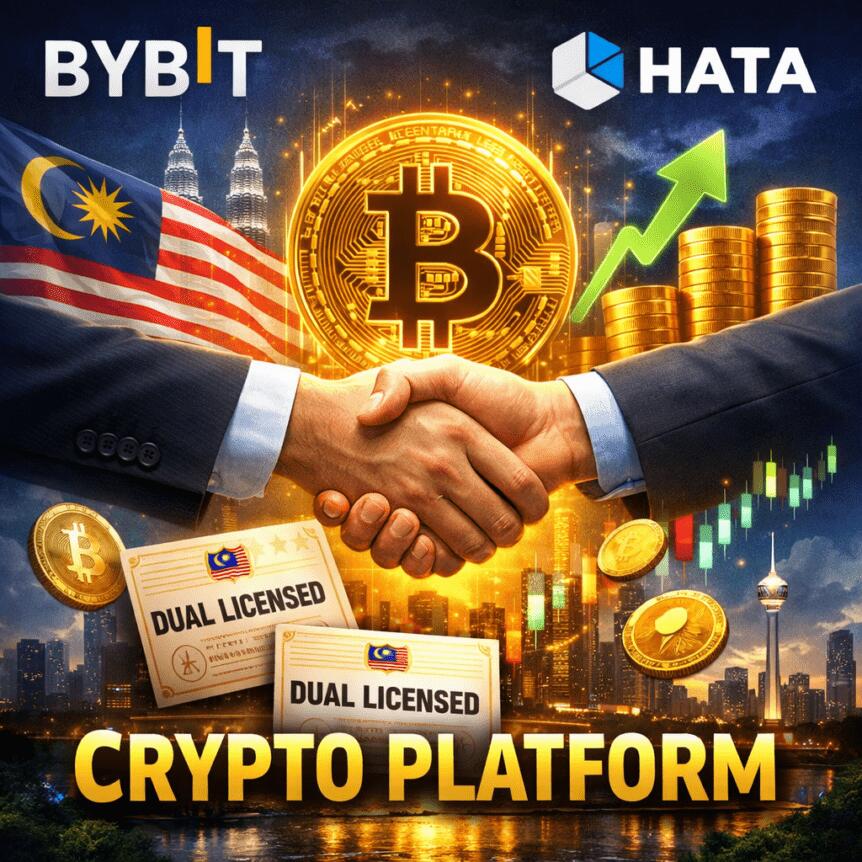
Bybit has led an $8 million Series A for Hata, a dual-licensed digital asset exchange operating in Malaysia, marking a notable push into Southeast Asia’s evolving crypto regulatory landscape. The round, which followed Bybit’s earlier $4.2 million seed investment, is aimed at boosting liquidity, expanding the user base, and developing additional digital asset products as Hata scales in the country.
Hata operates under licenses from Malaysia’s Securities Commission and the Labuan Financial Services Authority, enabling it to offer trading and custody services for digital assets within the Southeast Asian nation. Since launching in 2023, the platform reports more than 209,000 registered users and processed 1.04 billion Malaysian ringgits (about $225 million) in transaction volume in 2025, underscoring growing demand for compliant onshore crypto access.
Ben Zhou, Bybit’s co-founder and CEO, described Malaysia as strategically important, noting its digitally engaged population and long-term potential for asset adoption across Southeast Asia. Bybit itself sits among the world’s largest crypto exchanges by trading volume, with CoinMarketCap ranking it as the fifth-largest platform globally.
Beyond Southeast Asia, Bybit has deepened its commitment to the Middle East. In March, the firm named Derek Dai as the new country manager for the MENA region to spearhead expansion and partnerships, despite ongoing regional tensions. The executive said the Middle East is emerging as a key crypto market, with Bybit targeting expanded access to local currencies, including the UAE dirham, and closer collaboration with banks and payment providers in the coming months.
Related reading: Rwanda swats Bybit’s P2P platform offering franc-to-crypto trading
Key takeaways
- Bybit-led $8 million Series A fuels Hata’s growth in Malaysia, with prior seed funding of $4.2 million contributing to its onshore expansion agenda.
- Hata operates under dual licensing from Malaysia’s Securities Commission and the Labuan Financial Services Authority, enabling trading and custody of digital assets in-country.
- Malaysia’s regulatory push includes a Digital Asset Innovation Hub sandbox and a broader three-year roadmap from Bank Negara Malaysia to explore asset tokenization and cross-border settlement.
- Bybit’s regional strategy extends beyond Malaysia into the Middle East, with a dedicated MENA leadership and plans to broaden local currency access and banking partnerships.
Malaysia’s regulatory sandbox as a testing ground for digital assets
The fundraising comes amid a broader regulatory push in Malaysia to create a structured framework for digital assets. In June, Malaysia unveiled the Digital Asset Innovation Hub as a regulatory sandbox, allowing fintechs and digital asset firms to pilot use cases such as programmable payments, ringgit-backed stablecoins, and supply chain financing under central bank oversight. The aim is to test and refine practical applications of tokenized finance within a controlled environment before wider market rollout.
That same month saw notable industry activity, with a Crown Prince-owned telecom company launching a ringgit-backed stablecoin called RMJDT on the Zetrix blockchain within the sandbox framework. These developments illustrate Malaysia’s intent to balance innovation with consumer protection and regulatory clarity as the sector matures.
Bank Negara Malaysia (BNM) has signaled a longitudinal, three-year plan to explore asset tokenization, including pilots for tokenized deposits, stablecoins, and cross-border settlement via its Digital Asset Innovation Hub. The central bank has formed an industry working group co-led with the Securities Commission Malaysia to coordinate use cases and address regulatory and legal considerations as the market evolves.
What Bybit’s regional push means for investors and users
Bybit’s investment in Hata aligns with a wider pattern of exchanges pursuing onshore hubs that offer regulated access to digital assets while expanding liquidity and product depth. For investors, the Malaysia-focused funding round signals confidence in a credible regulatory pathway that could attract more institutional liquidity and user adoption as the market scales. For users, the move could translate into more competitive trading options, improved custody solutions, and a broader suite of asset offerings under compliant standards.
The Middle East leg of Bybit’s expansion strategy further broadens the firm’s geographic footprint at a time when regional crypto markets are intensifying activity despite ongoing geopolitical headwinds. With Dai at the helm in MENA, Bybit aims to broaden UAE dirham access and foster partnerships with banks and payment providers, potentially unlocking smoother onramps for retail and institutional participants alike.
Analysts familiar with the space note that the regulatory sandbox in Malaysia could become a proving ground for cross-border tokenization concepts, while Bybit’s regional expansion could accelerate the adoption cycle in the MENA region. If these efforts translate into measurable liquidity improvements and broader product offerings, they could set a precedent for other exchanges looking to operate vertically integrated, licenced platforms in emerging markets.
What to watch next
In the near term, observers should monitor how Hata leverages the fresh funding to enhance liquidity and user growth, and whether subsequent regulatory milestones in Malaysia unlock additional onshore listings and product pilots. In the Middle East, the pace of collaborations with banks and payment providers will be a key indicator of Bybit’s ability to convert strategic commitments into practical access for users and merchants. Finally, Malaysia’s regulatory sandbox activity—alongside the central bank’s tokenization roadmap—will shape the broader environment for digital assets and could influence how exchanges approach onshore operations in the region.



While quantum computing remains a largely theoretical threat to blockchain for now, some projects are already preparing for that eventuality.
Fintech company Ripple has released a detailed four-phase roadmap to make the XRP Ledger, a decentralized, layer-1 blockchain, quantum-resistant, aiming to reach full readiness by 2028. XRP, the world’s fourth-largest digital asset by market capitalization, is the native token of the XRP Ledger. Ripple’s solutions use XRP Ledger, XRP, and other digital assets. Ripple is also one of many developers building on and contributing to the XRP Ledger (XRPL).
Ripple’s announcement comes weeks after Google warned that a quantum computer could potentially attack Bitcoin, the world’s largest blockchain, with less computational power than previously estimated—prompting some analysts to suggest 2029 as the Q-day, the so-called deadline to build defenses against such a machine. Bitcoin developers are also already working on measures to mitigate the risk.
Let’s first understand the threat to XRPL and then discuss the four-phase plan.
Quantum risks to XRPL
A quantum computer has three implications for the XRP Ledger, and these apply equally to most other blockchains.
First, every time an XRPL account signs a transaction, its public key becomes visible on the blockchain. It’s like writing your mailing addresses on the outside of an envelope, allowing anyone to see where it came from, but they still can’t see what’s written inside without the private key.
However, a quantum computer can reverse-engineer the private key from the exposed public key, draining your coin holdings.
Second, accounts that have held coins for long periods of time are the highest risk. The longer the public key sits on-chain, the more time a future quantum attacker has to target it.
Lastly, the team added that building quantum-resistant systems is not just a technical challenge but an operational one, as it’s tied to every XRP holder and every application built on the XRP Ledger.
Collectively, these things warrant a structured response.
The four-phase plan
Phase 1, called Q-Day readiness, is an emergency measure designed to protect exposed public keys and long-held accounts if quantum computers arrive faster than expected.
In that case, Ripple will implement what it calls a hard shift: Classical public-key signatures will no longer be accepted by the network, requiring all funds to migrate to quantum-safe accounts.
This phase also looks into enabling safe recovery for all account owners via zero-knowledge proofs, a way of mathematically proving you own a key without revealing the key itself. This would allow holders to migrate funds even in a compromised scenario, ensuring no one is locked out.
Phase 2 is already underway and is targeted for completion in the first half of 2026. It involves Ripple’s applied cryptography team conducting a full assessment of quantum vulnerability across the XRPL network and testing defenses suggested by the National Institute of Standards and Technology, the U.S. government’s global standards body for cybersecurity.
But those defenses aren’t without cost. For instance, post-quantum cryptography uses larger keys and signatures, which can strain the ledger. So the team is also working through the tradeoffs and what system changes might be needed.
To accelerate this phase, Ripple has teamed up with quantum security research firm Project Eleven for validator-level testing, developer networking benchmarking and early custody wallet prototypes.
Phase 3, targeted for completion in the second half of 2026, involves controlled integration of post quantum measures. In this phase, Ripple will begin integrating quantum-resistant signatures alongside existing ones on its developer test network. It will allow developers to test and build against the new cryptography without disrupting the live network and existing users.
This phase, therefore, directly addresses the third implication that migration, though a giant operational effort, must not break what already works.
At the same time, the work goes beyond just replacing today’s signing methods. The team is rethinking the broader cryptography underpinning XRPL and exploring quantum-resistant approaches to privacy and secure data processing, which are important for compliant tokenization and features such as confidential transfers.
“This phase is where experimentation meets system design. We’re not just asking “what works cryptographically?” We’re asking “what works for XRPL at scale?,” the team said.
Phase 4 marks the full transition from experiment to full deployment, targeting completion by 2028. “We’ll design, build and propose a new amendment to the XRPL ecosystem for native post-quantum cryptography and begin transitioning the network to PQC-based signatures at scale,” Ripple’s team said.
The four phases mean the migration path could be seamless and significantly less painful, which could be a material advantage as the clock ticks down to Q-day.
Crypto World
Dutch Blockchain Week 2026 Strengthens Position as Europe’s Leading B2B Blockchain Event Week
Dutch Blockchain Week 2026 is rapidly evolving into one of Europe’s most business-driven blockchain event weeks. Taking place from June 22–28, 2026, the event will bring together the international digital asset ecosystem in Amsterdam for a full week of conferences, networking and high-level industry collaboration.
At the core of the week is the Dutch Blockchain Week Summit, hosted on June 24–25 at the Johan Cruijff ArenA, where more than a thousand professionals per day are expected to attend.
Strong Early Momentum With Leading Partners Onboard
Within just a few months of active conversations, Dutch Blockchain Week 2026 has secured a strong and diverse group of partners, highlighting the growing relevance of the event within the European digital asset landscape.
Confirmed partners include:
● Bitvavo as Main Partner
● bunq as Diamond Partner (joining for the first time)
● Visa, Kraken, OKX, Bybit EU and ZeroHash as Platinum Partners ● Mastercard, Worldpay, Talos, Deloitte, Coinmerce, Fireblocks and others as Gold Partners
In addition, a growing group of ecosystem and media partners is contributing to the expansion of the event’s international reach.
From Community to Business: A Clear B2B Focus
Dutch Blockchain Week has grown from a community-driven initiative into a fully B2B-focused event week, designed to connect:
● Exchanges
● Banks and payment providers
● Asset managers and funds
● Infrastructure providers
● Legal and compliance firms
● Regulators and policymakers
The event reflects the broader shift within the industry, where institutional adoption continues to accelerate and traditional finance increasingly converges with digital assets.
Amsterdam as a Gateway to the European Market
The Netherlands continues to play a leading role in Europe’s digital asset landscape, particularly with regard to MiCA licensing and regulatory developments.
This position is driving increasing interest from international companies looking to establish or expand their presence in Europe, making Dutch Blockchain Week a strategic entry point into the European market.
A Full Week of Events Across the City
Dutch Blockchain Week 2026 will feature more than 40 side events across Amsterdam, organized by partners from the Netherlands and abroad.
These include:
● Private dinners and roundtables
● Community and developer meetups
● Investor-focused gatherings
● Exclusive networking events
A key highlight is the VIP Night, an invite-only event ahead of the summit where speakers, partners and selected attendees connect in a more intimate setting.
Focused on Meaningful Connections
Rather than focusing solely on visibility, Dutch Blockchain Week is built around creating real business opportunities. Through curated networking, a dedicated networking app and facilitated introductions, the event enables participants to connect with the right people.
Looking Ahead to June 2026
With strong early traction, a growing international partner base and a clear positioning as a business-focused platform, Dutch Blockchain Week 2026 is set to become its most impactful edition to date.
For one week, Amsterdam will once again serve as the meeting point for the European Web3 and digital asset ecosystem.
Tickets are available via: https://dutchblockchainweek.com/tickets/
About Dutch Blockchain Week
Dutch Blockchain Week is the largest Web3 and digital assets event in the Netherlands and one of the fastest-growing blockchain event weeks in Europe. Since its launch, DBW has brought together thousands of professionals, dozens of side events and leading companies from across blockchain, fintech and digital assets.
The post Dutch Blockchain Week 2026 Strengthens Position as Europe’s Leading B2B Blockchain Event Week appeared first on BeInCrypto.
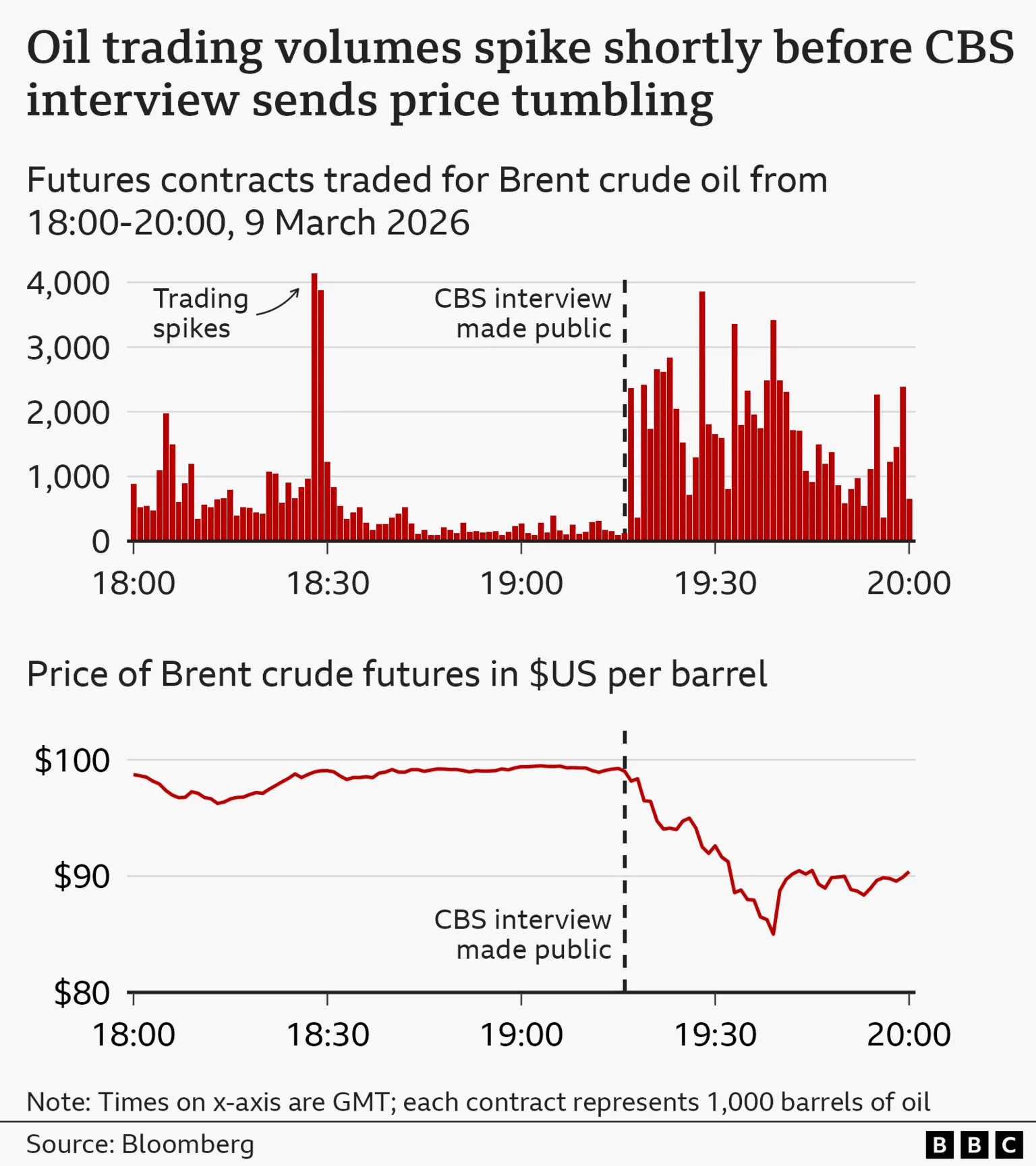
A BBC investigation has identified a consistent pattern of spikes in trading activity across several financial markets in the hours or minutes before US President Donald Trump’s most significant market-moving statements during his second term.
Some analysts argue the activity carries the telltale signs of illegal insider trading. Meanwhile, others contend the situation is less clear-cut, suggesting certain traders have simply grown more skilled at predicting the president’s interventions.
Is Someone Trading on Trump’s Next Move Before the World Hears It?
The report presented five notable examples. On March 9, 2026, a large volume of bets on falling oil prices was reportedly placed 47 minutes before a CBS reporter’s post about Trump’s interview on X.
During the interview with CBS, Trump signaled that the US-Israel war with Iran was “very complete, pretty much.” Oil prices subsequently dropped around 25%.
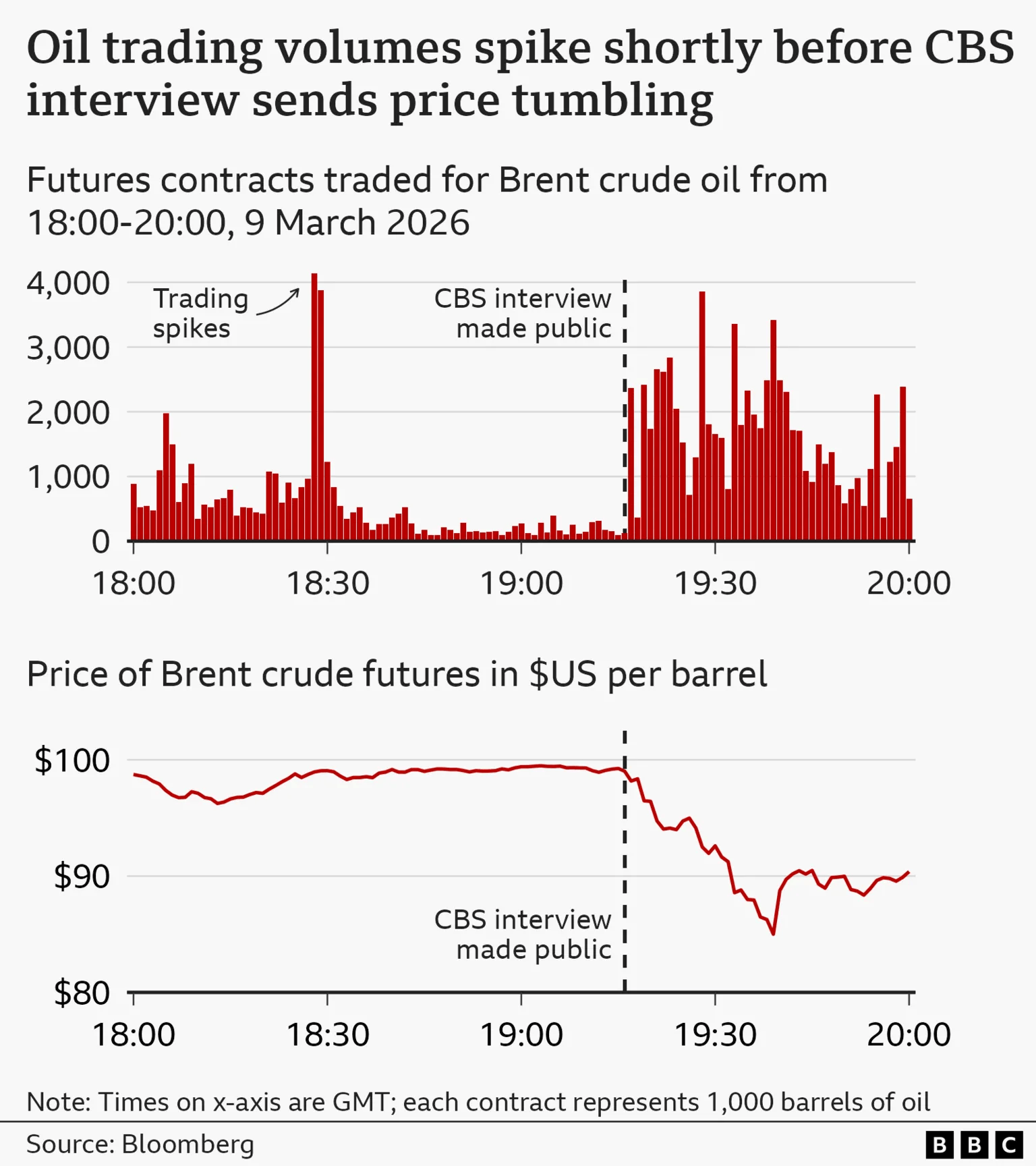
On March 23, 2026, traders placed “unusually high number bets” on US oil prices 14 minutes before Trump’s Truth Social post about a resolution with Iran. One oil analyst told the BBC the activity appeared abnormal.
Ahead of Trump’s 90-day “Liberation Day” tariff pause on April 9, 2025, over $2 million was wagered on the S&P 500 rising despite seven consecutive days of losses.
“Again, a pattern of unusual trading preceded these events with an unusually high number of bets ahead of the announcement on one fund that tracks the S&P 500. The number of contracts traded jumped to over 10,000 per minute just after 18:00 BST. Earlier in the day, the number had been in the hundreds,” the report read.
Follow us on X to get the latest news as it happens
The BBC also flagged that a Polymarket account called “Burdensome-Mix,” which turned $32,500 in wagers into $436,000. The account placed bets on Venezuelan President Nicolás Maduro leaving office just days before US special forces seized him on January 3, 2026.
The report added that shortly after, the account changed its username and has not placed any wagers since.
Finally, the BBC, citing data from blockchain analytics firm Bubblemaps, noted that six Polymarket accounts were created in February 2026. All wagered on a US strike against Iran by February 28. The accounts collectively earned roughly $1.2 million after the attack.
“Five of those six users have placed no more bets since, but one of the account’s recent activity shows it has subsequently made $163,000 by correctly betting on a US-Iran ceasefire by 7 April, which was announced by Washington and Tehran on that day,” the outlet added.
BeInCrypto has reached out to the White House, the Securities and Exchange Commission (SEC), and the Commodity Futures Trading Commission (CFTC) for comment.
Subscribe to our YouTube channel to watch leaders and journalists provide expert insights
The post Is It Luck, Skill, or a Leak? BBC Probes Trades Before Trump’s Announcements appeared first on BeInCrypto.


New York state assemblymember and congressional candidate Alex Bores has proposed an AI dividend program aimed at addressing possible job losses linked to artificial intelligence.
Summary
- Alex Bores proposed an AI dividend to support Americans if automation causes broad job displacement nationwide.
- The plan would use AI taxes, equity stakes, and reform to fund direct payments.
- The proposal also supports worker training, education, and oversight as AI adoption expands further.
He presented the plan as a way to prepare US workers and households for changes that may come as AI adoption spreads across industries.
In a post on X, Bores said the proposal would create direct payments for Americans if AI leads to major labor displacement. He said the goal is to prepare for what he called ”potential large-scale displacement of human labor by artificial intelligence.”
According to Bores, the proposed AI dividend would draw funding from several sources. These include taxes on AI use, equity stakes in major AI companies, and tax reforms tied to the treatment of labor and capital.
Bores said the plan is designed to respond if AI lifts productivity while concentrating more wealth in fewer hands. The proposal states, ”if AI dramatically increases productivity and concentrates wealth, the American people have a stake in those gains.” It also describes the dividend as ”not a punishment for innovation” but ”an insurance policy.”
Meanwhile, the plan goes beyond direct payments. It also calls for investments in workforce transition, education, training, and oversight systems tied to AI safety. That structure suggests the proposal is meant to address both income support and longer-term labor market adjustments.
Bores is promoting the policy as part of his campaign for Congress. That means the proposal’s path forward may depend in part on the outcome of his race and whether he can build broader political support for the idea.
Debate over AI job losses remains unsettled
The proposal comes as concerns about AI-led layoffs continue to grow. A recent Goldman Sachs report said AI adoption contributed to the loss of about 16,000 jobs per month over the past year, adding to worries that automation may reduce hiring in some sectors.
At the same time, other research points to a more mixed picture. Morgan Stanley said in an April 14 report that AI’s effect on the labor market has been ”modest so far.”
The firm said evidence of broad job losses remains limited and noted that past technological shifts often created new jobs over time, even when they replaced others in the short term.
Major US technology firms such as Amazon, Meta, Intel, and Microsoft have already cut thousands of jobs or reportedly planned cuts tied to AI-driven efficiency.
That backdrop has given more attention to proposals such as the AI dividend as policymakers weigh how to respond to the next stage of automation.


A chunk of the Kelp DAO haul is no longer going anywhere.
Arbitrum’s Security Council froze 30,766 ETH worth roughly $71 million on Monday night, moving funds linked to Saturday’s $292 million rsETH exploit into an intermediary wallet that can only be accessed through further Arbitrum governance action.
rsETH is a liquid restaking token issued by KelpDAO and represents a user’s position in restaked ether (ETH).
The Arbitrum Security Council has taken emergency action to freeze the 30,766 ETH being held in the address on Arbitrum One that is connected to the KelpDAO exploit. The Security Council acted with input from law enforcement as to the exploiter’s identity, and, at all times,…
— Arbitrum (@arbitrum) April 21, 2026
The council said it acted on input from law enforcement regarding the exploiter’s identity and executed the freeze “without impacting any Arbitrum users or applications.”
The transfer completed at 11:26 p.m. ET on April 20, according to Arbitrum’s statement on X. The stolen funds are no longer controllable by the address that originally held them.
The move recovers about a quarter of the total amount drained from Kelp’s LayerZero-powered bridge on Saturday, when attackers pulled 116,500 rsETH by exploiting compromised verifier infrastructure. LayerZero attributed the attack with preliminary confidence to North Korea’s Lazarus Group.
Arbitrum is a layer-2 blockchain, meaning a network built on top of Ethereum that processes transactions more cheaply and settles them back to the main chain. Its Security Council is a group of elected signers with emergency powers to take protective action in exactly this kind of scenario, though governance-level interventions on user funds remain rare and controversial because they introduce a degree of discretionary control over an otherwise permissionless network.
The freeze leaves Kelp with a partial recovery option on top of whatever else law enforcement and chain-tracing firms can claw back.
It also escalates the ongoing dispute between Kelp and LayerZero over who bears responsibility for the exploit, since any broader socialization of remaining losses now has a $71 million offset to work with before legal coordination, insurance, or treasury contributions come into play.
Kelp has said it is coordinating with ecosystem partners on a recovery fund and weighing next steps on unpausing, loss socialization, and legal coordination with affected counterparties. LayerZero has not publicly commented on the Arbitrum freeze.
Whether more stolen funds can be frozen depends on where else the attacker moved rsETH or its derivatives before consolidation, and whether other chains with similar emergency powers choose to act on their portions of the flow.
Coinbase-backed AI payments protocol x402 has launched Agentic.market, a new platform built to help AI agents find and use compatible online services.
Summary
- Coinbase-backed x402 launched Agentic.market, helping AI agents find, access, and pay for compatible online services more easily.
- The platform offers human browsing tools and agent-facing integrations, removing API key barriers for service discovery.
- Support from Google, Microsoft, AWS, Visa, and Stripe expands momentum around x402-based AI payment infrastructure.
The launch adds a discovery layer to the protocol by offering a single place where users and AI agents can search for tools that support x402-based payments.
Coinbase product lead Nick Prince said the platform aims to “give humans and their agents access to thousands of services, with zero API keys required.” He described Agentic.market as a storefront where users can discover, compare, and use services that work with x402.
Prince said the platform addresses a gap in the AI agent market. He said many users have depended on scattered information and informal recommendations to find services that AI agents can access. Agentic.market is designed to solve that issue by organizing those services in one place.
The marketplace includes services and websites that AI agents can use, such as CoinGecko, Google Flights, and X. Prince also said the platform includes a web interface for people and a programming layer that lets AI agents search, filter, and connect to services on their own during operation.
Additionally, the x402 protocol launched in May 2025 and allows AI agents to make internet payments using stablecoins. It takes its name from the rarely used HTTP status code “402 Payment Required.” Coinbase and its partners present the protocol as infrastructure for AI-driven online commerce.
Prince said the platform gives an AI agent “skills,” or code that explains how to use a service. He added that agents also get a wallet, which allows them to “buy services and also sell services.” This setup is meant to let agents complete more tasks without requiring direct human control for each action.
Support grows across tech and payments firms
Earlier this month, Google, Microsoft, and Amazon Web Services backed the launch of the x402 Foundation, which will govern the protocol. American Express, Mastercard, Visa, Cloudflare, Shopify, Stripe, Circle, Base, Polygon Labs, the Solana Foundation, Thirdweb, and KakaoPay also expressed support for the initiative.
“There will be more AI agents transacting online than humans very soon,” noted Coinbase CEO Brian Armstrong.
Circle CEO Jeremy Allaire made a similar forecast in January, saying “literally billions of AI agents” could transact on blockchains within three to five years. The launch of Agentic.market places x402 more directly within that growing AI payments push.
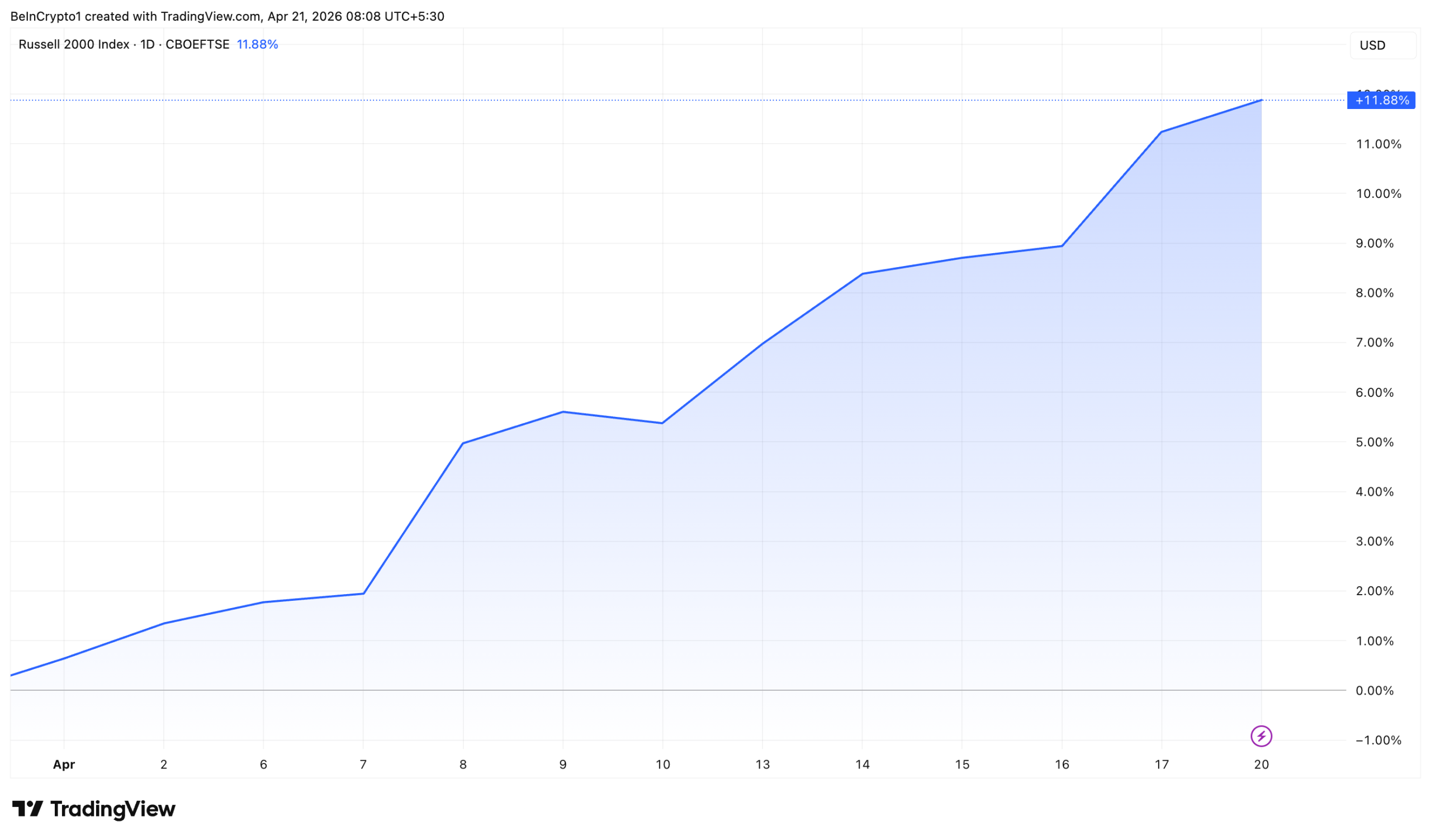
The Russell 2000 just hit a new all-time high, sparking optimism for an altcoin season. However, this time, its historical correlation with altcoins has turned negative for the first time since July 2016.
The shift breaks a pattern that has guided altcoin season traders. It arrives as the macro setup turns bullish, but altcoin charts remain unconfirmed.
Russell 2000 Breakout Revives Altseason Narrative Amid Liquidity Surge
The Russell 2000 index tracks approximately 2,000 small-cap US companies, a segment generally associated with higher risk within traditional financial markets.
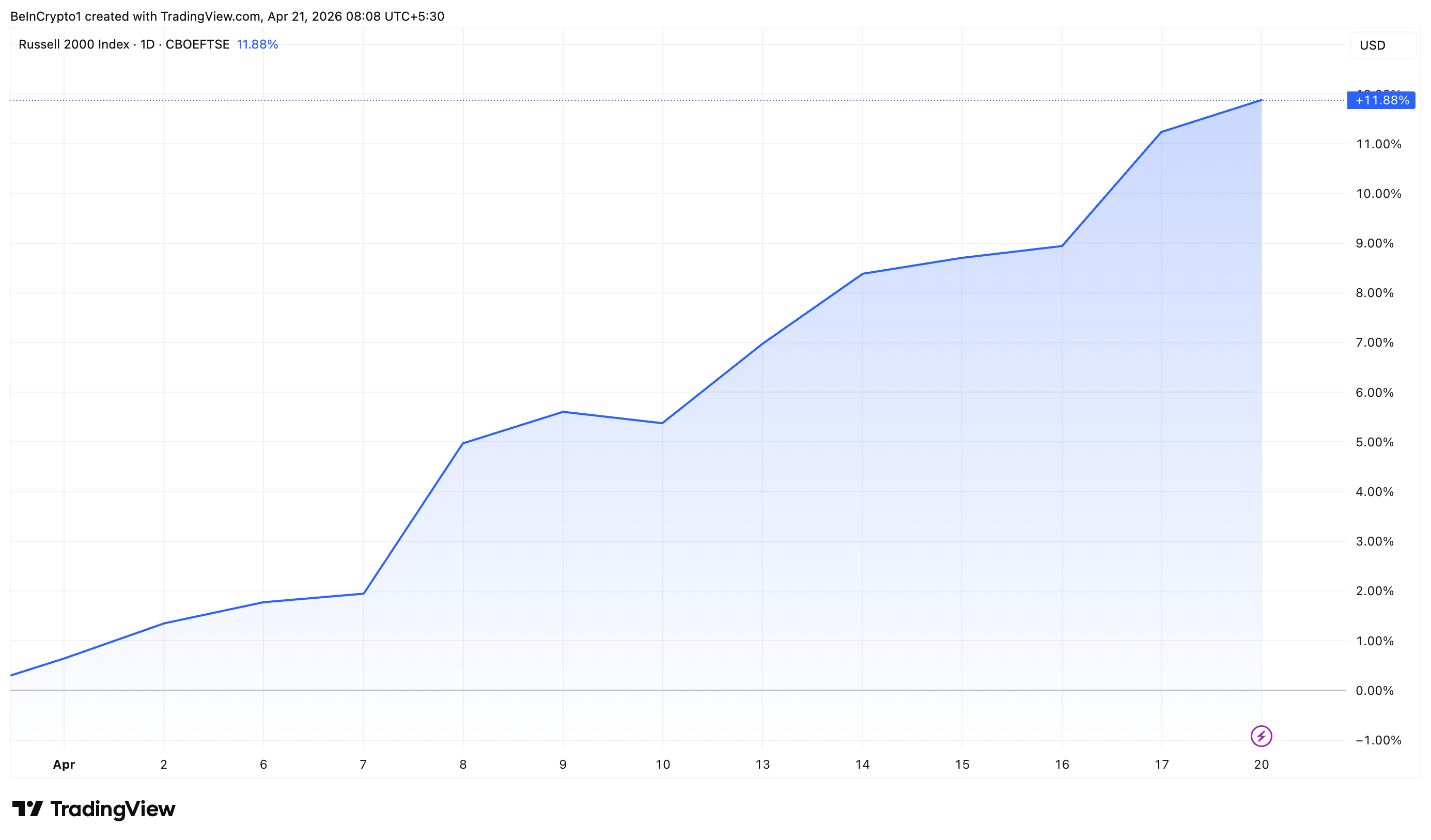
Outperformance in the index typically reflects a shift in market sentiment toward risk-on behavior, as investors allocate capital to higher-beta assets in pursuit of stronger returns. In April, the small-cap benchmark surged 11.8%, reaching a fresh all-time high on Monday.
“When small caps outperform on a red day for big tech the market is not scared. It is repositioning. Investors are rotating into the companies that benefit most from a domestic recovery. Lower oil. Lower rates. Peace deal,” analyst Bull Theory posted.
According to the analyst, past Russell 2000 breakouts have consistently preceded rallies in the altcoin market. Ash Crypto echoed the bullish view.
Follow us on X to get the latest news as it happens
Meanwhile, Federal Reserve balance sheet activity reinforces the bullish setup.
“One of the key drivers behind previous Alt Seasons is the Fed balance sheet… and it’s exploding for the first time in years. Three liquidity injections coming this week. • $5.058B Fed bill purchase (and repeated $5B–$7.5B ops scheduled) • $90B released via TGA • $15B Treasury debt buyback (largest on record) • $40B+ in total Fed purchases this week QT is over. Balance sheet is turning up. Risk is being re-enabled,” analyst Mark added.
He argued that the altseason was delayed rather than cancelled, citing the Fed’s balance sheet expansion.
The Correlation That Traders Rely On Has Broken
Nonetheless, the relationship supporting the altcoin rally thesis has shifted sharply. Analyst Tony Severino noted the correlation coefficient between the Russell 2000 and altcoins has turned negative and is strengthening to the downside.
“At the moment, the correlation between these two assets is negative for the first time since July 2016. The indicator can curl back up from here, but at the moment it is pointed sharply down,” he said.
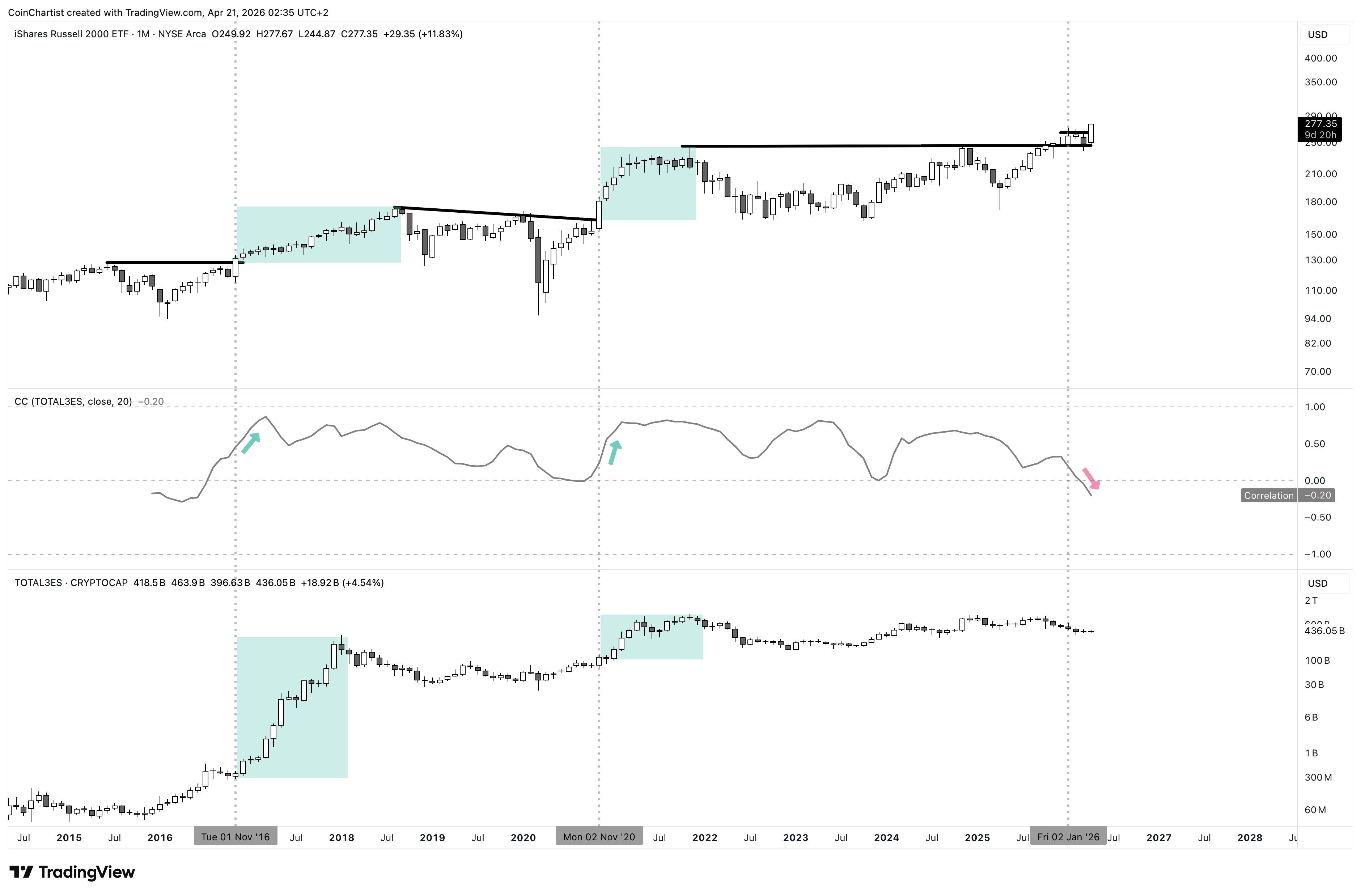
Severino emphasized that historical correlations offer limited predictive value in a changing macro environment. As a result, relying on past breakout patterns may be ineffective when a previously positive relationship has reversed into negative territory.
At the same time, analyst Zach Humphries sees similar weakness on altcoin market cap charts, describing current price action as a bearish retest.
Whether the negative correlation reverses or signals a structural change in altcoin capital formation will determine whether the delayed altseason thesis survives into mid-2026.
Subscribe to our YouTube channel to watch leaders and journalists provide expert insights
The post Russell 2000 Hits New Record High: Why This Signal May Mean Less for Altcoins in 2026 appeared first on BeInCrypto.


Bitcoin traded at $75,733 on Tuesday morning, up 1.5% over 24 hours, as Iran signaled it will send a team to Pakistan talks and Brent crude slipped ahead of the Wednesday ceasefire deadline.

Coinbase-backed x402 has unveiled Agentic.market, a dedicated marketplace aimed at increasing the usefulness of AI agents by aggregating thousands of apps and services that agents can access without any API keys. The rollout positions the platform as a central hub for agents to discover, evaluate, and deploy capabilities across a standardized payments layer.
Coinbase product lead Nick Prince described Agentic.market in a video posted on X as a storefront for discovering, comparing, and using x402 services. The marketplace is designed to give both humans and their AI agents access to a wide range of tools—from data feeds to consumer apps—without the friction of managing API credentials.
A storefront for discovering, comparing, and using x402 services. Thousands of services. Zero API keys. Powered by x402.
Prince added that the market offers a web interface for humans to browse and assess services, alongside a programming layer that lets AI agents autonomously search, filter, and integrate new capabilities at runtime without human intervention. Each AI agent is equipped with “skills”—the code that defines how to use a service—and a wallet that enables it to buy and sell services within the marketplace.
The launch comes as the x402 protocol, introduced by Coinbase in May 2025, enables AI agents to conduct internet payments using stablecoins and has begun to gain broad industry support. The broader ecosystem envisions a growing flow of autonomous commerce as more companies recognize the potential for AI-powered agents to operate across digital services and platforms.
Key takeaways
- Agentic.market consolidates thousands of x402-enabled services into a single storefront, removing API-key frictions for AI agents and human users.
- The marketplace features a dual interface: a consumer-friendly web frontend and a programming layer that empowers agents to autonomously extend their capabilities at runtime.
- Backing and governance for the x402 framework have grown beyond Coinbase, with major tech and financial players signaling support and participation.
- x402’s core proposition—AI agents transacting with stablecoins—aims to accelerate the shift toward an “agent economy” where autonomous services perform on-chain payments at scale.
- Industry attention is rising as hundreds of thousands of AI agents reportedly transact in hundreds of millions of dollars in volume, signaling real-world usage beyond experimental deployments.
Backing, governance, and the broader ecosystem
The x402 initiative has drawn notable interest from major technology and payments players. In a broader push to formalize an AI-agent payments fabric, Google, Microsoft, and Amazon Web Services backed the creation of the x402 Foundation to govern the protocol. Alongside this governance push, a broad coalition of firms signaled initial intent and support, including American Express, Mastercard, Visa, Cloudflare, Shopify, Stripe, Circle, Base, Polygon Labs, the Solana Foundation, Thirdweb, and KakaoPay. The combined support underscores a growing belief within the industry that AI-driven commerce will rely on interoperable, on-chain payments and standardized agent capabilities.
Coinbase CEO Brian Armstrong has framed the development as an inflection point for online transactions, noting that “there will be more AI agents transacting online than humans very soon.” The sentiment echoes earlier comments from Circle CEO Jeremy Allaire about billions of AI agents potentially transacting on blockchains within a few years.
The market’s governance and ecosystem-building efforts were highlighted in coverage of big-tech backing for the x402 protocol. Prior reporting noted that major firms were aligning around the idea of standardized, agent-enabled payments and a framework to manage governance and interoperability across services.
Why the Agentic market matters for builders and users
Agentic.market could materially lower the cost of integrating AI agents with external services. By providing a centralized catalog and a runtime-capable programming layer, developers can more readily enable agents to perform tasks that require real-time data, booking, or account actions without developers building bespoke connectors for each service. For investors, the marketplace also represents a signal that the agent economy is moving from concept to execution, with concrete storefronts and programmable workflows delivering measurable transaction volume.
For users and enterprises, the marketplace promises increased transparency and comparability: agents can be evaluated against a catalog of services, with standardized interfaces and a shared payments layer. This could accelerate adoption by reducing technical debt and giving buyers and sellers clearer paths to interoperability and monetization.
That said, the shift toward autonomous, on-chain payment flows will invite scrutiny over security, governance, and the reliability of agents operating without a human in the loop. The coming months will reveal how the ecosystem manages trust, fraud prevention, and service quality across thousands of partners in a single platform.
What to watch next
Key questions for the coming period include how rapidly enterprises formalize usage of x402-enabled services, whether Agentic.market expands its catalog to include more partners such as data providers or e-commerce tools, and how regulators respond to broader autonomous-payment activity on-chain. The size and pace of actual transaction volume via AI agents will be a telling gauge of the market’s momentum beyond pilot deployments.
As developers and investors assess the trajectory, the continued alignment between large tech platforms, payment rails, and AI-service providers will be crucial to turning the agent-economy thesis into sustained, scalable adoption.
Watch for further updates on how the Agentic.market catalog evolves, how AI agents demonstrate governance-compatible behavior at scale, and which new services become first-class citizens in the x402 ecosystem.


OpenGradient’s AI‑focused OPG token will launch via an exclusive Binance Wallet and PancakeSwap TGE on April 21, with access gated by Binance Alpha points.
Summary
- Binance Wallet and PancakeSwap will co‑host an exclusive Token Generation Event for OpenGradient (OPG) on April 21, 2026, from 9:00–11:00 UTC.
- Eligible users must spend Binance Alpha points to subscribe, with OPG trading scheduled to open at 11:00 UTC on the same day.
- OpenGradient, a “verifiable AI” computation layer, has raised $9.5 million and set a 1 billion OPG token supply, with 4% allocated to an airdrop and 6% to liquidity and launch.
Binance Wallet will jointly launch the exclusive Token Generation Event for OpenGradient with PancakeSwap on April 21, 2026, positioning the AI‑focused blockchain project as the next test case for Binance’s Alpha points launch model. In an announcement on Binance Square, the team said the event, billed as the “46th exclusive TGE,” will run from 9:00 to 11:00 UTC, with token claims and trading set to open at 11:00 UTC.
According to Binance Wallet, “eligible participants are required to use Binance Alpha points to join,” making OPG’s launch effectively a loyalty‑driven sale rather than a traditional public ICO. OpenGradient has already deployed its OPG token contract on BNB Smart Chain, with one Binance post noting that “99% [of the supply is] listed on Binance Alpha” ahead of the April 21 issuance.
OpenGradient describes itself as a decentralized “computational layer for verifiable AI,” built as a dedicated co‑processor network that provides model inference via GPU and trusted execution environment (TEE) nodes for applications, blockchains and agents. The project says each inference is accompanied by “cryptographic verification proofs for each inference,” allowing external parties to independently verify models, inputs and outputs in a bid to solve the black‑box problem in AI.
In a recent funding announcement, OpenGradient disclosed that it has raised a total of $9.5 million from investors including a16z crypto, Coinbase Ventures, SV Angel and Foresight Ventures. A separate tokenomics post on Binance Square states that OPG will have a fixed supply of 1 billion tokens, distributed across ecosystem (40%), foundation (15%), core contributors (15%), investors and advisers (10%), staking rewards (10%), liquidity and token launch (6%) and airdrop (4%).
The team says 10% of the ecosystem allocation will unlock at TGE, with the remaining 30% linearly released over 60 months, while foundation tokens see 33.33% unlocked at TGE and the rest vesting over 48 months. Core contributors and investor tranches carry a 12‑month cliff followed by 36 months of linear unlocking, and both the 6% liquidity/token‑launch slice and 4% airdrop are “fully unlocked at TGE.”
OpenGradient has also opened an OPG airdrop registration portal that remains live until April 20, with claims beginning on April 21 alongside the Binance Wallet and PancakeSwap event. In a Binance Square post, the team said its network “currently serves over 2 million users, processing over 2 million verifiable inferences and generating more than 500,000 proofs,” framing the TGE as a way to decentralize ownership around an already active AI infrastructure layer.

Deadly domestic violence cases stir calls for more care resources for Black communities

Canva backer, Google Maps founder invest in Perth data play Sovereign Green Compute

Ripple wants the XRP Ledger to be quantum-proof by 2028. Here is its plan

Manchester United reach agreement with Casemiro over contract clause amid transfer speculation

Steven Gerrard disagrees with Gary Neville over ‘shock’ Chelsea and Arsenal claim | Football

US brings back mandatory military draft registration


-

 NewsBeat7 days ago
Trump and Pope Leo: Behind their disagreement over Iran war
-

 News Videos6 days ago
Secure crypto trading starts with an FIU-registered
-

 Fashion4 days ago
Weekend Open Thread: Theodora Dress
-

 Sports4 days ago
NWFL Suspends Two Players Over Post-Match Clash in Ado-Ekiti
-

 Business2 days ago
Powerball Result April 18, 2026: No Jackpot Winner in Powerball Draw: $75 Million Rolls Over
-

 Politics3 days ago
Palestine barred from entering Canada for FIFA Congress
-

 Crypto World3 days ago
Russia Pushes Bill to Criminalize Unregistered Crypto Services
-

 Politics10 hours ago
Gary Stevenson delivers timely reminder to register to vote as deadline TODAY
-
 Business4 days ago
Creo Medical agree sale of its manufacturing operation
-

 Politics2 days ago
Zack Polanski demands ‘council homes not luxury flats for foreign investors’
-

 Tech2 days ago
Auto Enthusiast Scores Running Tesla Model 3 for Two Grand and Turns It Into Bare-Bones Go-Kart
-

 Tech5 days ago
‘Avatar: Aang, The Last Airbender’ Leaked Online. Some Fans Say Paramount Deserves the Fallout
-

 Crypto World3 days ago
Russia Introduces Bill To Criminalize Unregistered Crypto Services
-

 Tech6 days ago
Microsoft adds Windows protections for malicious Remote Desktop files
-

 Crypto World6 days ago
X Launches New Cashtag Feature for Stocks and Crypto: X
-

 Sports7 days ago
Younger Than Sachin Tendulkar: Vaibhav Sooryavanshi Set To Make Historic India Debut
-

 Entertainment6 days ago
Prince Carter Brings Fans Front Row and Backstage at Boys 4 Life Tour
-
 Entertainment6 days ago
Dave Portnoy Slams Dianna Russini: ‘Makes Zero Sense’
-

 Sports5 days ago
British climbers complete new route in Swiss Alps
-

 Crypto World6 days ago
Global recession inevitable if Strait of Hormuz stays shut
You must be logged in to post a comment Login