
Crypto World
OpenGradient’s AI token to debut in Binance Wallet and PancakeSwap TGE



OpenGradient’s AI‑focused OPG token will launch via an exclusive Binance Wallet and PancakeSwap TGE on April 21, with access gated by Binance Alpha points.
Summary
- Binance Wallet and PancakeSwap will co‑host an exclusive Token Generation Event for OpenGradient (OPG) on April 21, 2026, from 9:00–11:00 UTC.
- Eligible users must spend Binance Alpha points to subscribe, with OPG trading scheduled to open at 11:00 UTC on the same day.
- OpenGradient, a “verifiable AI” computation layer, has raised $9.5 million and set a 1 billion OPG token supply, with 4% allocated to an airdrop and 6% to liquidity and launch.
Binance Wallet will jointly launch the exclusive Token Generation Event for OpenGradient with PancakeSwap on April 21, 2026, positioning the AI‑focused blockchain project as the next test case for Binance’s Alpha points launch model. In an announcement on Binance Square, the team said the event, billed as the “46th exclusive TGE,” will run from 9:00 to 11:00 UTC, with token claims and trading set to open at 11:00 UTC.
According to Binance Wallet, “eligible participants are required to use Binance Alpha points to join,” making OPG’s launch effectively a loyalty‑driven sale rather than a traditional public ICO. OpenGradient has already deployed its OPG token contract on BNB Smart Chain, with one Binance post noting that “99% [of the supply is] listed on Binance Alpha” ahead of the April 21 issuance.
OpenGradient describes itself as a decentralized “computational layer for verifiable AI,” built as a dedicated co‑processor network that provides model inference via GPU and trusted execution environment (TEE) nodes for applications, blockchains and agents. The project says each inference is accompanied by “cryptographic verification proofs for each inference,” allowing external parties to independently verify models, inputs and outputs in a bid to solve the black‑box problem in AI.
In a recent funding announcement, OpenGradient disclosed that it has raised a total of $9.5 million from investors including a16z crypto, Coinbase Ventures, SV Angel and Foresight Ventures. A separate tokenomics post on Binance Square states that OPG will have a fixed supply of 1 billion tokens, distributed across ecosystem (40%), foundation (15%), core contributors (15%), investors and advisers (10%), staking rewards (10%), liquidity and token launch (6%) and airdrop (4%).
The team says 10% of the ecosystem allocation will unlock at TGE, with the remaining 30% linearly released over 60 months, while foundation tokens see 33.33% unlocked at TGE and the rest vesting over 48 months. Core contributors and investor tranches carry a 12‑month cliff followed by 36 months of linear unlocking, and both the 6% liquidity/token‑launch slice and 4% airdrop are “fully unlocked at TGE.”
OpenGradient has also opened an OPG airdrop registration portal that remains live until April 20, with claims beginning on April 21 alongside the Binance Wallet and PancakeSwap event. In a Binance Square post, the team said its network “currently serves over 2 million users, processing over 2 million verifiable inferences and generating more than 500,000 proofs,” framing the TGE as a way to decentralize ownership around an already active AI infrastructure layer.



Coin Center has stepped up its defence of crypto developers, arguing that publishing software code should be treated as protected speech under the U.S. Constitution.
Summary
- Coin Center says publishing crypto software code should be treated as protected speech under the U.S. Constitution.
- The report draws a clear line between writing code and actions like handling user funds or executing transactions on behalf of users.
According to a report released Monday by Coin Center, Executive Director Peter Van Valkenburgh and Director of Research Lizandro Pieper said writing and sharing crypto code is no different from publishing a book or a recipe, placing it squarely within First Amendment protections.
Their paper arrives at a time when developers are facing growing legal pressure over how their tools are used, including high-profile criminal cases tied to privacy software and decentralized applications.
Coin Center’s report sets out to draw a clear line between protected speech and actions that regulators can oversee, arguing that not all developer activity should be treated the same.
“Lower court confusion over the distinction between conduct and speech naturally found in software publishing has fueled the development of what might be called a functional code theory of diminished First Amendment protection,” the authors wrote.
Courts have at times taken the view that software behaves like conduct because it can produce real-world outcomes. Coin Center pushed back on that idea.
“Some courts have suggested that because software can be executed to produce real-world effects, it resembles conduct rather than speech.”
“We argue that such activities are pure speech and that the Supreme Court’s existing jurisprudence insists on this interpretation even if some lower courts have gone astray.”
The group said a developer moves into regulatable territory only when taking direct control over user funds, executing transactions on behalf of users, or making decisions for them. Publishing and maintaining code alone, it argued, should not trigger licensing or compliance obligations.
“They are speakers and inventors, not agents, custodians, or fiduciaries. Extending pre-registration or licensing requirements to this speech activity drops the historical logic of financial oversight and imposes a classic prior restraint on activities that are primarily speech and expression—which is almost always unconstitutional.”
Legal pressure builds around crypto developers
Coin Center pointed to recent prosecutions as a sign that courts and regulators are still grappling with how to apply existing law to decentralized technology.
Roman Storm, a developer linked to the Tornado Cash protocol, was convicted last year on charges tied to operating an unlicensed money-transmitting business. His legal team has since sought dismissal, citing Supreme Court precedent, including Cox Communications Inc. v. Sony Music Entertainment, to argue he lacked intent to participate in criminal activity.
Developers behind Samourai Wallet, a privacy-focused Bitcoin wallet, were also convicted on similar charges and received prison sentences ranging from four to five years.
Those cases have raised concerns across the industry that writing open-source code could expose developers to liability based on how third parties use it.
First Amendment framework takes center stage
Coin Center grounded its argument in long-standing legal precedent, including the 1985 Supreme Court decision in Lowe v. SEC, which held that publishing information without managing client assets or acting on their behalf falls under protected speech rather than regulated financial activity.
Traditional financial rules were built around intermediaries that hold or move funds for users. Crypto systems often remove those roles, allowing peer-to-peer transfers and self-custody without centralized control.
Van Valkenburgh and Pieper argued that applying intermediary-style regulation to developers for “administrative convenience” risks stretching the law beyond its intended scope.
“Crypto software does not necessitate the invention of new legal doctrines or novel carveouts. It requires the faithful application of settled First Amendment principles to a new technological context.”
“In the age of computers, where software is the primary means for expressing ideas and organizing economic life, those principles matter more, not less. Writing and publishing code is speech. And in a free society, speech cannot be licensed into silence.”
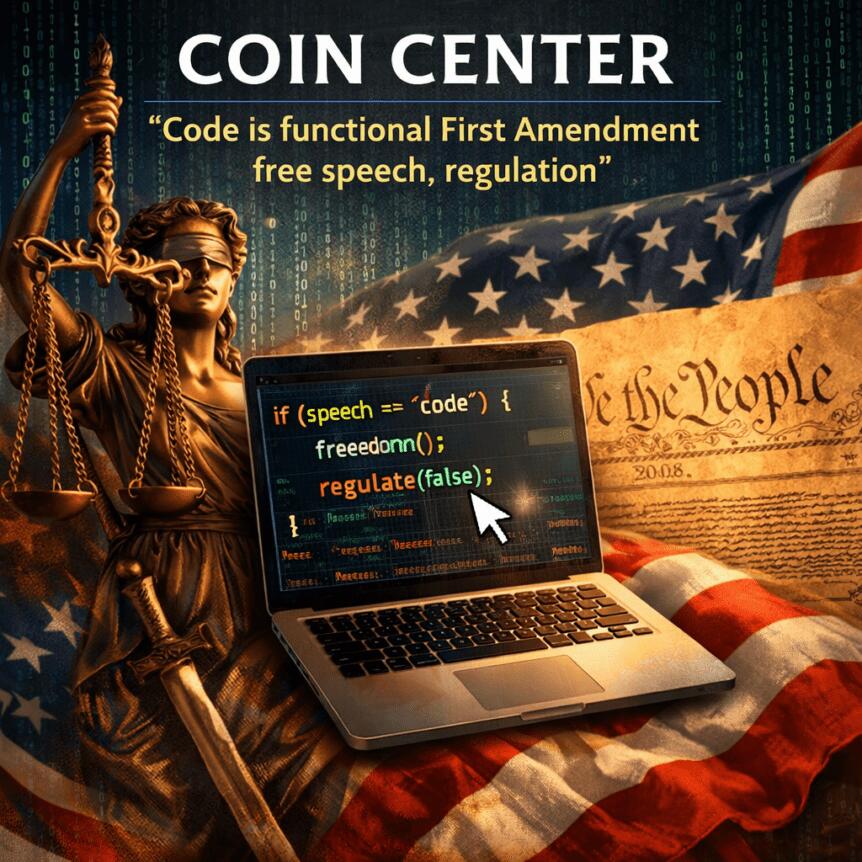
In a policy briefing published this week, the crypto policy group Coin Center argues that software code used to design, publish, and maintain crypto systems constitutes protected speech under the First Amendment, and should not be readily conscripted into regulatory oversight as if it were a traditional financial intermediary. The authors—Executive Director Peter Van Valkenburgh and Director of Research Lizandro Pieper—frame code publication as an act of expression, akin to publishing a book or a culinary recipe, rather than as the actions of a financial services provider.
According to Coin Center, extending pre-registration or licensing requirements to speech activity would undermine constitutional protections and distort the historical rationale for financial oversight. They emphasize that developers are speakers and inventors, not fiduciaries or middlemen, and that treating code as regulated conduct risks a prior restraint that is almost always unconstitutional. The briefing seeks to provide a framework for courts and regulators to distinguish between protected software publication and a developer’s professional conduct in the ecosystem.
They also note that there have been high-profile convictions of crypto developers based on how software is used, including cases tied to Tornado Cash, which underscore the legal tensions around liability for code and its uses. The discussion situates these prosecutions within a broader quest to separate speech from regulated activity in a rapidly evolving technology space.
Key takeaways
- Publication and maintenance of crypto software is argued to be First Amendment–protected speech, not inherently a regulated financial service.
- Regulatory oversight should target conduct only when developers actively control user assets, execute transactions for users, or make decisions on users’ behalf.
- There is ongoing doctrinal tension among courts regarding whether software constitutes speech or conduct; a clear framework is needed to preserve free-speech protections in software publication.
- Precedents such as Lowe v. SEC are cited to support the notion that publishers who do not hold assets or act on behalf of clients may be shielded from regulation as speech, highlighting risks of overreach in enforcement against developers.
- Policy implications span enforcement tactics, licensing regimes, cross-border divergences, and the balance between innovation and consumer protection in crypto markets.
Legal framing: software as speech and the conduct boundary
The authors contend that the First Amendment shields those who publish and maintain code, framing software as a medium of expression rather than a support service that facilitates financial transactions. They argue that treating software publication as regulated conduct would undermine a long-standing constitutional logic that protects speech, regardless of the potential real-world effects of the code when used by others. The briefing emphasizes that the “speakers and inventors” behind crypto software are distinct from intermediaries who custody assets or execute user-directed actions, and that extending licensing requirements to routine publication would amount to an unwarranted prior restraint on speech.
Central to the paper is a call to resist a “functional code theory” that some courts have used to blur the line between speech and conduct. By referencing established jurisprudence, the authors seek to remind courts that the mere execution of code—particularly when published with no asset custody or user-directed action—should not automatically be treated as regulated activity. The framework aims to clarify when regulatory oversight is appropriate and when constitutional protections apply, thereby reducing legal ambiguity for developers and their ecosystems.
Enforcement considerations for developers and institutions
From a regulatory perspective, the briefing highlights a practical concern: if regulators compel pre-registration or licensing for all software publications, the gatekeeping effect could chill innovation and hamper developer collaboration. For institutions such as exchanges, banks, and other market participants, the delineation between speech and conduct has direct compliance implications. The authors argue that the correct approach is to focus on concrete, user-facing conduct—such as asset custody, automated asset transfers, or decisions made or controlled by developers on behalf of users—rather than on the act of writing, publishing, and maintaining software itself.
The discussion also touches on enforcement realities in the United States, where some prosecutions have leveraged traditional money-services or money-transmitter statutes to address crypto software usage. In this context, the paper argues that liability should hinge on connections to asset custody and transactional control, not on the mere availability of code. This distinction matters for developers seeking to avoid mischaracterization as financial intermediaries and for compliance teams that must assess risk without stifling legitimate software innovation.
Coin Center points to the broader regulatory environment as a backdrop for these arguments. The push for tailored frameworks that reflect constitutional protections, rather than broad, asset-centric licensing, has implications for how agencies coordinate cross-border oversight and how industry participants structure KYC and AML programs. The aim is to preserve the ability to publish and steward open-source software while maintaining accountable pathways for consumer and market protection where appropriate.
Case landscape and precedent shaping risk
The briefing places its analysis within a real-world backdrop of recent prosecutions that have involved developers whose work enabled or facilitated certain financial activities. Notably, high-profile cases connected to Tornado Cash have spurred ongoing legal debates about intent, liability, and the role of developers in the use of their code. In related developments, authorities have pursued cases against individuals associated with other privacy-focused or non-custodial projects on charges related to unregistered money transmission and related offenses. In several instances, defendants and their counsel have argued that their actions constituted speech or publication rather than regulated service provision, invoking established constitutional principles in defense of their work.
In this context, the Coin Center briefing draws an explicit line: while developers should not be immunized from accountability for illegal activity they knowingly facilitate, liability should not be expanded to cover publication of software itself. The 1985 Lowe v. SEC decision is cited as a benchmark, in which the Supreme Court suggested that a publisher who does not hold assets on behalf of a client and does not act in the client’s stead is protected by free speech. The implication for current enforcement is clear: doctrines that would treat code publication as professional or administrative conduct warrant careful scrutiny to avoid overreach into speech protection.
The broader policy takeaway is that software developers cannot reasonably be treated as scapegoats for illicit activity, nor should their work be criminalized for outcomes driven by user behavior. The briefing argues that the legal framework should reflect the reality that crypto software often operates as an expression of ideas and as a tool for decentralized coordination, rather than as a regulated service in itself. This stance has meaningful implications for licensing debates, regulatory oversight, and the development of compliance programs across the industry.
Regulatory precedent and notable cases shaping risk
Looking ahead, observers should watch how courts apply the conduct-vs-speech distinction in crypto-related litigation, particularly where developers publish code that enables asset transfers or transaction scripting. The current discourse emphasizes that the constitutional protections surrounding speech should guide how regulators approach code publication, while ensuring that enforcement targets genuine custodial or transactional intermediaries. The evolving case law and regulatory discourse will influence policy design across jurisdictions, including any interactions with comprehensive regulatory regimes like MiCA in the European Union and analogous frameworks in the United States and beyond.
As enforcement and policy evolve, the central question remains: how can regulators protect consumers and markets without diminishing the freedoms that underpin open, collaborative software development? The Coin Center analysis suggests that a principled application of First Amendment doctrine—grounded in the distinction between speech and conduct—offers a path to reconcile innovation with public-interest safeguards.
What to watch next: ongoing court decisions, forthcoming regulatory guidance, and cross-border policy developments that define the permissible contours of crypto software publication versus regulated financial activity. The balance struck in these debates will shape both the legal risk environment for developers and the compliance posture of institutions engaging with decentralized technologies.
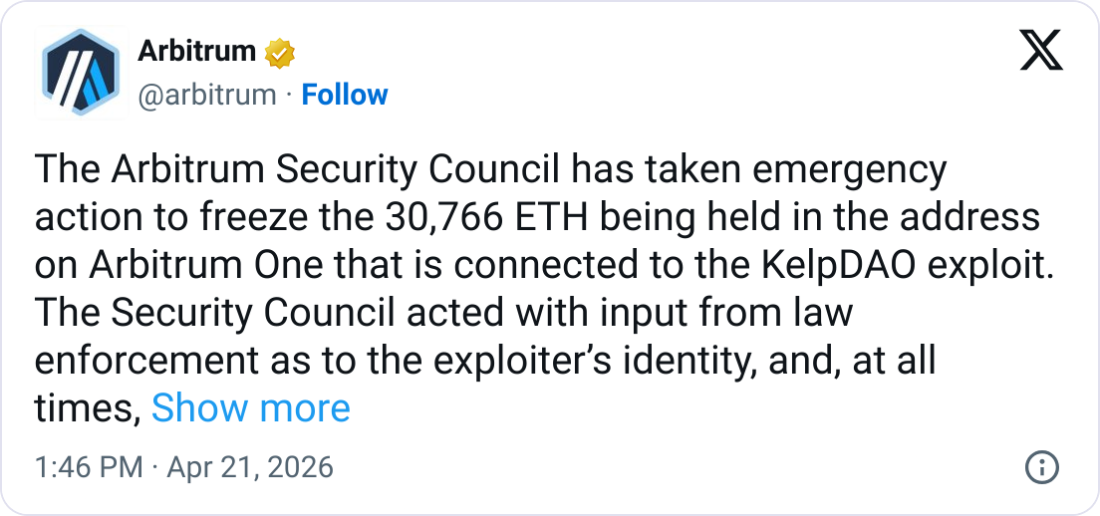
Ethereum layer-2 blockchain Arbitrum on Monday froze more than 30,000 Ether worth about $71.2 million held in a wallet connected to the recent exploit of the Kelp protocol.
Arbitrum said on Monday that its security council, a 12-member body elected by the Arbitrum community, took “emergency action” to freeze 30,766 Ether (ETH) that was held in a wallet connected to the Kelp exploit.
It added that the ETH had been moved to “an intermediary frozen wallet” and was “no longer accessible to the address that originally held the funds, and can only be moved by further action by Arbitrum governance.”
Kelp, a liquid restaking protocol, was hacked for at least $293 million on Saturday through its LayerZero-powered bridge, with LayerZero accusing North Korea of carrying out the attack.

The exploit has caused millions of dollars’ worth of “bad debt” in the highly interconnected crypto lending market, as the attackers used stolen Kelp tokens to borrow cryptocurrencies on the lending platform Aave.
A blockchain freezing crypto is a divisive measure in the crypto sector, with opponents of freezes arguing that such action is antithetical to the purpose of the technology, while supporters argue it enhances security and maintains a network’s integrity.
Multiple users on X criticized Arbitrum over the freeze and questioned its decentralization in light of funds being frozen by decree of a council.
Related: Hackers impersonated eth.limo team to hijack its domain: Post-mortem
Griff Green, a member of the Arbitrum Security Council, posted to X that the group “did not make this decision lightly, there were countless hours of debates, technical, practical, ethical and political.”
Green added that nine members of the 12-member council voted to freeze the funds, but did not share further details.
Arbitrum said its council acted with input from law enforcement and “weighed its commitment to the security and integrity of the Arbitrum community without impacting any Arbitrum users or applications.”
Magazine: South Korea gets rich from crypto… North Korea gets weapons
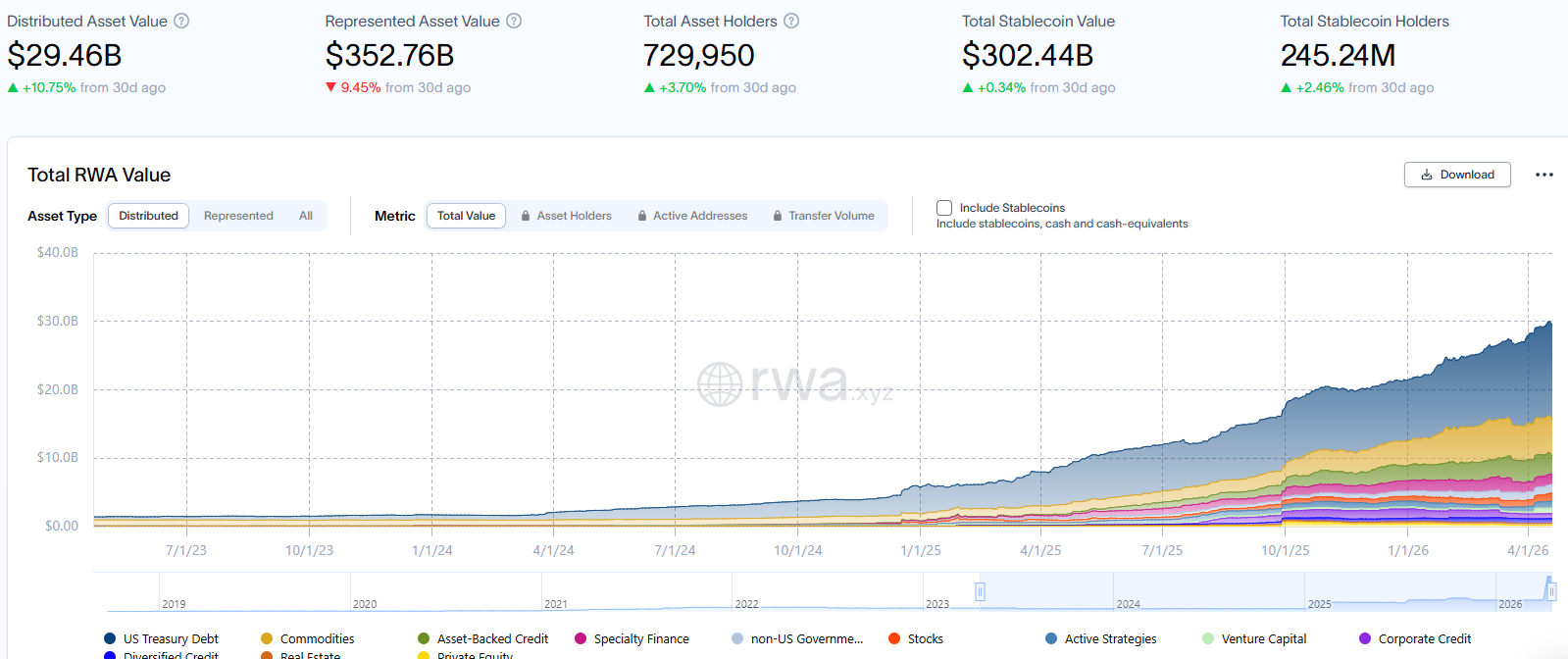
The value of tokenized real-world assets on public blockchains is estimated at more than $29 billion, up more than 10% in the last 30 days.
OCBC, one of Singapore’s largest banking and financial services corporations, has launched a tokenized physical gold fund, with the underlying token, GOLDX, issued on both Ethereum and Solana.
The launch was made together with its asset management arm, Lion Global Investors and digital asset exchange DigiFT. The token is aimed at institutional investors, hedge funds and asset managers and can be bought and sold using both stablecoins and fiat currencies. After subscription, the token is delivered directly to investors’ blockchain wallets, OCBC said on Monday.
Kenneth Lai, head of global markets at OCBC, said the move is part of a new corporate strategy and a milestone in the corporation’s blockchain-focused approach.
“We believe digital assets will play an increasingly important role in financial services and our focus is on bridging traditional finance with the emerging world of decentralized finance,” he said.
The value of tokenized real-world assets on public blockchains has been on the rise in 2026, and is sitting at over $29 billion, up over 10% in the last 30 days, according to data from rwa.xyz.

GOLDX token tied to a physical gold fund
OCBC’s GOLDX token offers on-chain exposure to the LionGlobal Singapore Physical Gold Fund, which launched in December and had about $525 million (669 million Singapore dollars) in assets under management as of April 16, according to OCBC.
Related: Singapore Gulf Bank adds stablecoin mint and redeem for 24/7 settlement
The goal of the tokenized fund is to attract Web3 ecosystem participants and high-net-worth individuals who operate in blockchain and cryptocurrency ecosystems, according to OCBC.
OCBC has used blockchain technology before, starting with its first tokenized equity-linked note for accredited investors in 2023. Its total assets were estimated at about $526 billion as of December 2025.
Crypto World
Is SUI Network Positioned for the Next Bull Cycle? CME Futures, Spot ETFs, and 219% Dev Growth Suggest It

TLDR:
- SUI Network holds $583M in TVL and processes over $100 billion in monthly stablecoin volume on-chain.
- Monthly active developers grew 219% year-over-year, with more than 500 active projects in the ecosystem.
- USDsui, backed by Stripe, reached $36 million in supply within one month of its public launch.
- SUI is one of fewer than 10 altcoins with a live U.S. spot ETF, with CME futures launching in May.
SUI Network continues to attract market attention as on-chain data shows consistent, measurable activity. The Layer-1 blockchain holds total value locked of approximately $583 million, with daily DEX volume at $60 million.
Monthly active developers grew 219% year-over-year to roughly 1,400. With over 500 active projects and close to 300,000 daily active users, the ecosystem reflects data-backed growth. These numbers have drawn attention from both retail and institutional market participants.
On-Chain Metrics Point to a Maturing Blockchain
The network’s stablecoin supply stands at $519 million, with USDC making up about 72% of that figure. Monthly stablecoin volume exceeds $100 billion, and the chain crossed $1 trillion in cumulative stablecoin transfers by March.
These figures reflect genuine network usage, not just speculative activity. That distinction matters when evaluating whether a Layer-1 blockchain has real traction.
The MystenLabs/sui GitHub repository holds over 7,600 stars and more than 11,700 forks. Active projects across the ecosystem have surpassed 500, showing expansion well beyond early-stage development.
As analyst @Kaffchad noted on X, bear market conditions have helped separate genuine progress from noise. The network kept shipping and funding projects through the broader market cooldown.
Daily active users range from 150,000 to 300,000, showing demand that extends beyond speculative trading cycles. That consistency becomes a key comparison point against earlier-generation blockchains.
Moreover, MystenLabs has maintained active incubation efforts throughout the market downturn. Few Layer-1 networks carry the financial capacity to support builders at that level.
Developer growth of 219% year-over-year stands out across the broader L1 landscape. Each new project added to the ecosystem creates additional utility and pulls in more users over time.
This compounding effect has been building steadily through 2024 and into 2025. It represents the kind of structural growth that price momentum alone cannot manufacture.
Institutional Products and a Payments Roadmap Drive Broader Adoption
SUI launched USDsui, a Stripe-backed stablecoin that reached $36 million in supply within its first month. Treasury bond yields tied to this product flow back into buybacks and DeFi incentives.
Gasless stablecoin transfers are also planned for the 2026 roadmap. These moves place the chain in direct competition with Solana and Tron in the payments space.
Canary’s SUIS launched on NASDAQ and Grayscale’s GSUI listed on NYSE Arca in February. That makes SUI one of fewer than 10 altcoins with a live U.S. spot ETF.
Bitwise and 21Shares have additional ETF applications pending regulatory approval. T. Rowe Price also included the asset in a multi-asset crypto ETF filing in March.
CME Group is set to launch SUI futures in May, widening institutional market access further. @Kaffchad noted that the chain’s $15 billion market cap run came without the controversies tied to Solana’s rise.
No FTX or Alameda equivalent was connected to its early growth. That cleaner track record carries weight when institutional buyers assess counterparty risk.
Solana and Tron built payment dominance through low fees and fast transaction speeds. SUI brings comparable performance on more modern technical infrastructure.
With live institutional products and an active payments roadmap in motion, the network is building operational infrastructure that matches its on-chain data. Execution over the coming quarters will determine whether this trajectory holds.



While quantum computing remains a largely theoretical threat to blockchain for now, some projects are already preparing for that eventuality.
Fintech company Ripple has released a detailed four-phase roadmap to make the XRP Ledger, a decentralized, layer-1 blockchain, quantum-resistant, aiming to reach full readiness by 2028. XRP, the world’s fourth-largest digital asset by market capitalization, is the native token of the XRP Ledger. Ripple’s solutions use XRP Ledger, XRP, and other digital assets. Ripple is also one of many developers building on and contributing to the XRP Ledger (XRPL).
Ripple’s announcement comes weeks after Google warned that a quantum computer could potentially attack Bitcoin, the world’s largest blockchain, with less computational power than previously estimated—prompting some analysts to suggest 2029 as the Q-day, the so-called deadline to build defenses against such a machine. Bitcoin developers are also already working on measures to mitigate the risk.
Let’s first understand the threat to XRPL and then discuss the four-phase plan.
Quantum risks to XRPL
A quantum computer has three implications for the XRP Ledger, and these apply equally to most other blockchains.
First, every time an XRPL account signs a transaction, its public key becomes visible on the blockchain. It’s like writing your mailing addresses on the outside of an envelope, allowing anyone to see where it came from, but they still can’t see what’s written inside without the private key.
However, a quantum computer can reverse-engineer the private key from the exposed public key, draining your coin holdings.
Second, accounts that have held coins for long periods of time are the highest risk. The longer the public key sits on-chain, the more time a future quantum attacker has to target it.
Lastly, the team added that building quantum-resistant systems is not just a technical challenge but an operational one, as it’s tied to every XRP holder and every application built on the XRP Ledger.
Collectively, these things warrant a structured response.
The four-phase plan
Phase 1, called Q-Day readiness, is an emergency measure designed to protect exposed public keys and long-held accounts if quantum computers arrive faster than expected.
In that case, Ripple will implement what it calls a hard shift: Classical public-key signatures will no longer be accepted by the network, requiring all funds to migrate to quantum-safe accounts.
This phase also looks into enabling safe recovery for all account owners via zero-knowledge proofs, a way of mathematically proving you own a key without revealing the key itself. This would allow holders to migrate funds even in a compromised scenario, ensuring no one is locked out.
Phase 2 is already underway and is targeted for completion in the first half of 2026. It involves Ripple’s applied cryptography team conducting a full assessment of quantum vulnerability across the XRPL network and testing defenses suggested by the National Institute of Standards and Technology, the U.S. government’s global standards body for cybersecurity.
But those defenses aren’t without cost. For instance, post-quantum cryptography uses larger keys and signatures, which can strain the ledger. So the team is also working through the tradeoffs and what system changes might be needed.
To accelerate this phase, Ripple has teamed up with quantum security research firm Project Eleven for validator-level testing, developer networking benchmarking and early custody wallet prototypes.
Phase 3, targeted for completion in the second half of 2026, involves controlled integration of post quantum measures. In this phase, Ripple will begin integrating quantum-resistant signatures alongside existing ones on its developer test network. It will allow developers to test and build against the new cryptography without disrupting the live network and existing users.
This phase, therefore, directly addresses the third implication that migration, though a giant operational effort, must not break what already works.
At the same time, the work goes beyond just replacing today’s signing methods. The team is rethinking the broader cryptography underpinning XRPL and exploring quantum-resistant approaches to privacy and secure data processing, which are important for compliant tokenization and features such as confidential transfers.
“This phase is where experimentation meets system design. We’re not just asking “what works cryptographically?” We’re asking “what works for XRPL at scale?,” the team said.
Phase 4 marks the full transition from experiment to full deployment, targeting completion by 2028. “We’ll design, build and propose a new amendment to the XRPL ecosystem for native post-quantum cryptography and begin transitioning the network to PQC-based signatures at scale,” Ripple’s team said.
The four phases mean the migration path could be seamless and significantly less painful, which could be a material advantage as the clock ticks down to Q-day.
Crypto World
Dutch Blockchain Week 2026 Strengthens Position as Europe’s Leading B2B Blockchain Event Week
Dutch Blockchain Week 2026 is rapidly evolving into one of Europe’s most business-driven blockchain event weeks. Taking place from June 22–28, 2026, the event will bring together the international digital asset ecosystem in Amsterdam for a full week of conferences, networking and high-level industry collaboration.
At the core of the week is the Dutch Blockchain Week Summit, hosted on June 24–25 at the Johan Cruijff ArenA, where more than a thousand professionals per day are expected to attend.
Strong Early Momentum With Leading Partners Onboard
Within just a few months of active conversations, Dutch Blockchain Week 2026 has secured a strong and diverse group of partners, highlighting the growing relevance of the event within the European digital asset landscape.
Confirmed partners include:
● Bitvavo as Main Partner
● bunq as Diamond Partner (joining for the first time)
● Visa, Kraken, OKX, Bybit EU and ZeroHash as Platinum Partners ● Mastercard, Worldpay, Talos, Deloitte, Coinmerce, Fireblocks and others as Gold Partners
In addition, a growing group of ecosystem and media partners is contributing to the expansion of the event’s international reach.
From Community to Business: A Clear B2B Focus
Dutch Blockchain Week has grown from a community-driven initiative into a fully B2B-focused event week, designed to connect:
● Exchanges
● Banks and payment providers
● Asset managers and funds
● Infrastructure providers
● Legal and compliance firms
● Regulators and policymakers
The event reflects the broader shift within the industry, where institutional adoption continues to accelerate and traditional finance increasingly converges with digital assets.
Amsterdam as a Gateway to the European Market
The Netherlands continues to play a leading role in Europe’s digital asset landscape, particularly with regard to MiCA licensing and regulatory developments.
This position is driving increasing interest from international companies looking to establish or expand their presence in Europe, making Dutch Blockchain Week a strategic entry point into the European market.
A Full Week of Events Across the City
Dutch Blockchain Week 2026 will feature more than 40 side events across Amsterdam, organized by partners from the Netherlands and abroad.
These include:
● Private dinners and roundtables
● Community and developer meetups
● Investor-focused gatherings
● Exclusive networking events
A key highlight is the VIP Night, an invite-only event ahead of the summit where speakers, partners and selected attendees connect in a more intimate setting.
Focused on Meaningful Connections
Rather than focusing solely on visibility, Dutch Blockchain Week is built around creating real business opportunities. Through curated networking, a dedicated networking app and facilitated introductions, the event enables participants to connect with the right people.
Looking Ahead to June 2026
With strong early traction, a growing international partner base and a clear positioning as a business-focused platform, Dutch Blockchain Week 2026 is set to become its most impactful edition to date.
For one week, Amsterdam will once again serve as the meeting point for the European Web3 and digital asset ecosystem.
Tickets are available via: https://dutchblockchainweek.com/tickets/
About Dutch Blockchain Week
Dutch Blockchain Week is the largest Web3 and digital assets event in the Netherlands and one of the fastest-growing blockchain event weeks in Europe. Since its launch, DBW has brought together thousands of professionals, dozens of side events and leading companies from across blockchain, fintech and digital assets.
The post Dutch Blockchain Week 2026 Strengthens Position as Europe’s Leading B2B Blockchain Event Week appeared first on BeInCrypto.
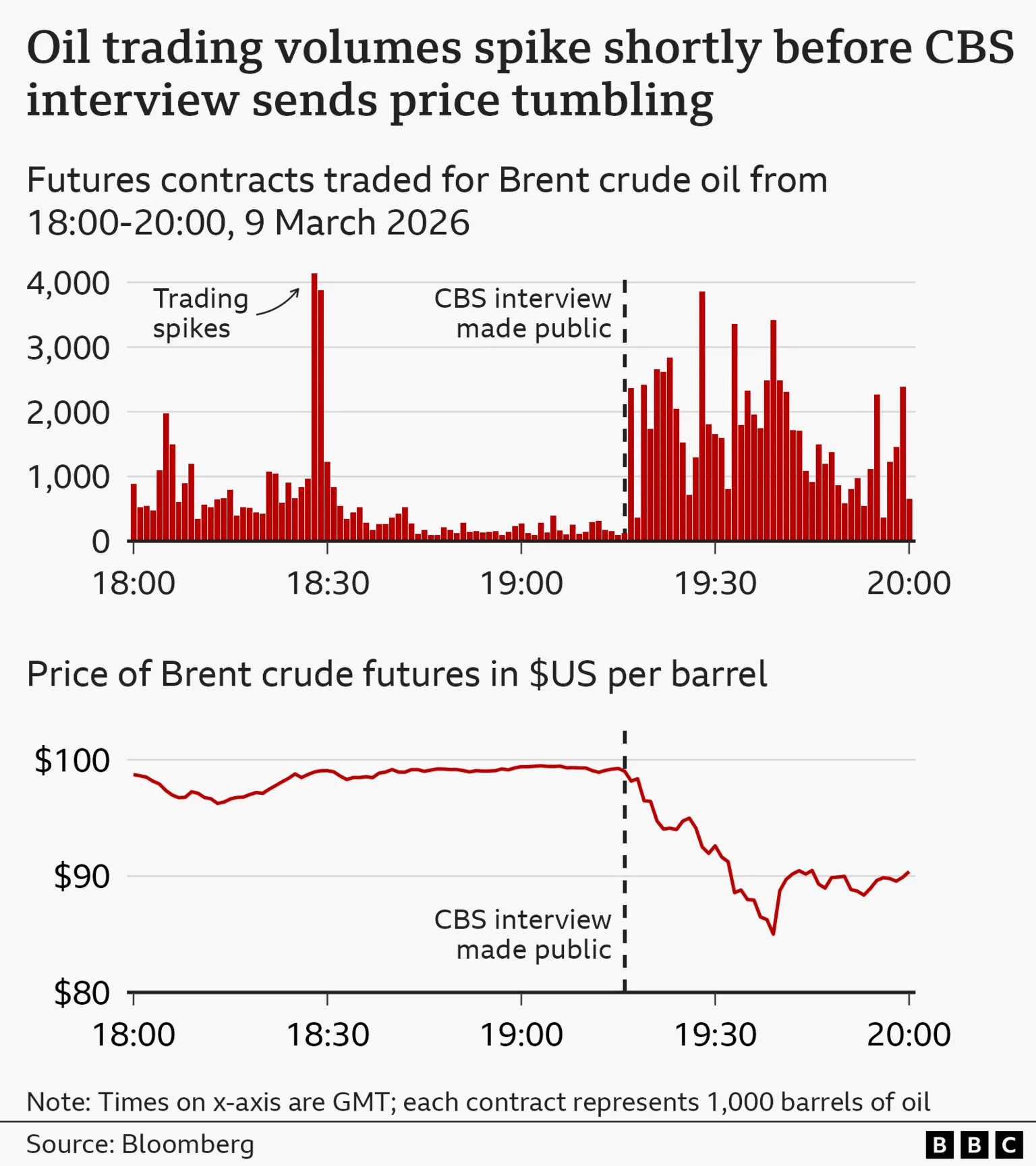
A BBC investigation has identified a consistent pattern of spikes in trading activity across several financial markets in the hours or minutes before US President Donald Trump’s most significant market-moving statements during his second term.
Some analysts argue the activity carries the telltale signs of illegal insider trading. Meanwhile, others contend the situation is less clear-cut, suggesting certain traders have simply grown more skilled at predicting the president’s interventions.
Is Someone Trading on Trump’s Next Move Before the World Hears It?
The report presented five notable examples. On March 9, 2026, a large volume of bets on falling oil prices was reportedly placed 47 minutes before a CBS reporter’s post about Trump’s interview on X.
During the interview with CBS, Trump signaled that the US-Israel war with Iran was “very complete, pretty much.” Oil prices subsequently dropped around 25%.
On March 23, 2026, traders placed “unusually high number bets” on US oil prices 14 minutes before Trump’s Truth Social post about a resolution with Iran. One oil analyst told the BBC the activity appeared abnormal.
Ahead of Trump’s 90-day “Liberation Day” tariff pause on April 9, 2025, over $2 million was wagered on the S&P 500 rising despite seven consecutive days of losses.
“Again, a pattern of unusual trading preceded these events with an unusually high number of bets ahead of the announcement on one fund that tracks the S&P 500. The number of contracts traded jumped to over 10,000 per minute just after 18:00 BST. Earlier in the day, the number had been in the hundreds,” the report read.
Follow us on X to get the latest news as it happens
The BBC also flagged that a Polymarket account called “Burdensome-Mix,” which turned $32,500 in wagers into $436,000. The account placed bets on Venezuelan President Nicolás Maduro leaving office just days before US special forces seized him on January 3, 2026.
The report added that shortly after, the account changed its username and has not placed any wagers since.
Finally, the BBC, citing data from blockchain analytics firm Bubblemaps, noted that six Polymarket accounts were created in February 2026. All wagered on a US strike against Iran by February 28. The accounts collectively earned roughly $1.2 million after the attack.
“Five of those six users have placed no more bets since, but one of the account’s recent activity shows it has subsequently made $163,000 by correctly betting on a US-Iran ceasefire by 7 April, which was announced by Washington and Tehran on that day,” the outlet added.
BeInCrypto has reached out to the White House, the Securities and Exchange Commission (SEC), and the Commodity Futures Trading Commission (CFTC) for comment.
Subscribe to our YouTube channel to watch leaders and journalists provide expert insights
The post Is It Luck, Skill, or a Leak? BBC Probes Trades Before Trump’s Announcements appeared first on BeInCrypto.


New York state assemblymember and congressional candidate Alex Bores has proposed an AI dividend program aimed at addressing possible job losses linked to artificial intelligence.
Summary
- Alex Bores proposed an AI dividend to support Americans if automation causes broad job displacement nationwide.
- The plan would use AI taxes, equity stakes, and reform to fund direct payments.
- The proposal also supports worker training, education, and oversight as AI adoption expands further.
He presented the plan as a way to prepare US workers and households for changes that may come as AI adoption spreads across industries.
In a post on X, Bores said the proposal would create direct payments for Americans if AI leads to major labor displacement. He said the goal is to prepare for what he called ”potential large-scale displacement of human labor by artificial intelligence.”
According to Bores, the proposed AI dividend would draw funding from several sources. These include taxes on AI use, equity stakes in major AI companies, and tax reforms tied to the treatment of labor and capital.
Bores said the plan is designed to respond if AI lifts productivity while concentrating more wealth in fewer hands. The proposal states, ”if AI dramatically increases productivity and concentrates wealth, the American people have a stake in those gains.” It also describes the dividend as ”not a punishment for innovation” but ”an insurance policy.”
Meanwhile, the plan goes beyond direct payments. It also calls for investments in workforce transition, education, training, and oversight systems tied to AI safety. That structure suggests the proposal is meant to address both income support and longer-term labor market adjustments.
Bores is promoting the policy as part of his campaign for Congress. That means the proposal’s path forward may depend in part on the outcome of his race and whether he can build broader political support for the idea.
Debate over AI job losses remains unsettled
The proposal comes as concerns about AI-led layoffs continue to grow. A recent Goldman Sachs report said AI adoption contributed to the loss of about 16,000 jobs per month over the past year, adding to worries that automation may reduce hiring in some sectors.
At the same time, other research points to a more mixed picture. Morgan Stanley said in an April 14 report that AI’s effect on the labor market has been ”modest so far.”
The firm said evidence of broad job losses remains limited and noted that past technological shifts often created new jobs over time, even when they replaced others in the short term.
Major US technology firms such as Amazon, Meta, Intel, and Microsoft have already cut thousands of jobs or reportedly planned cuts tied to AI-driven efficiency.
That backdrop has given more attention to proposals such as the AI dividend as policymakers weigh how to respond to the next stage of automation.


A chunk of the Kelp DAO haul is no longer going anywhere.
Arbitrum’s Security Council froze 30,766 ETH worth roughly $71 million on Monday night, moving funds linked to Saturday’s $292 million rsETH exploit into an intermediary wallet that can only be accessed through further Arbitrum governance action.
rsETH is a liquid restaking token issued by KelpDAO and represents a user’s position in restaked ether (ETH).
The Arbitrum Security Council has taken emergency action to freeze the 30,766 ETH being held in the address on Arbitrum One that is connected to the KelpDAO exploit. The Security Council acted with input from law enforcement as to the exploiter’s identity, and, at all times,…
— Arbitrum (@arbitrum) April 21, 2026
The council said it acted on input from law enforcement regarding the exploiter’s identity and executed the freeze “without impacting any Arbitrum users or applications.”
The transfer completed at 11:26 p.m. ET on April 20, according to Arbitrum’s statement on X. The stolen funds are no longer controllable by the address that originally held them.
The move recovers about a quarter of the total amount drained from Kelp’s LayerZero-powered bridge on Saturday, when attackers pulled 116,500 rsETH by exploiting compromised verifier infrastructure. LayerZero attributed the attack with preliminary confidence to North Korea’s Lazarus Group.
Arbitrum is a layer-2 blockchain, meaning a network built on top of Ethereum that processes transactions more cheaply and settles them back to the main chain. Its Security Council is a group of elected signers with emergency powers to take protective action in exactly this kind of scenario, though governance-level interventions on user funds remain rare and controversial because they introduce a degree of discretionary control over an otherwise permissionless network.
The freeze leaves Kelp with a partial recovery option on top of whatever else law enforcement and chain-tracing firms can claw back.
It also escalates the ongoing dispute between Kelp and LayerZero over who bears responsibility for the exploit, since any broader socialization of remaining losses now has a $71 million offset to work with before legal coordination, insurance, or treasury contributions come into play.
Kelp has said it is coordinating with ecosystem partners on a recovery fund and weighing next steps on unpausing, loss socialization, and legal coordination with affected counterparties. LayerZero has not publicly commented on the Arbitrum freeze.
Whether more stolen funds can be frozen depends on where else the attacker moved rsETH or its derivatives before consolidation, and whether other chains with similar emergency powers choose to act on their portions of the flow.
Taylor Frankie Paul Responds to Fan’s Healing Advice

Kerry Group expands Cork facility as lactose-free demand grows

Netflix’s harrowing new cult thriller Unchosen is your next must-watch binge

Manchester United reach agreement with Casemiro over contract clause amid transfer speculation

Steven Gerrard disagrees with Gary Neville over ‘shock’ Chelsea and Arsenal claim | Football

US brings back mandatory military draft registration


-

 NewsBeat7 days ago
Trump and Pope Leo: Behind their disagreement over Iran war
-

 News Videos6 days ago
Secure crypto trading starts with an FIU-registered
-

 Fashion4 days ago
Weekend Open Thread: Theodora Dress
-

 Sports4 days ago
NWFL Suspends Two Players Over Post-Match Clash in Ado-Ekiti
-

 Business2 days ago
Powerball Result April 18, 2026: No Jackpot Winner in Powerball Draw: $75 Million Rolls Over
-

 Politics3 days ago
Palestine barred from entering Canada for FIFA Congress
-

 Crypto World3 days ago
Russia Pushes Bill to Criminalize Unregistered Crypto Services
-

 Politics10 hours ago
Gary Stevenson delivers timely reminder to register to vote as deadline TODAY
-
 Business4 days ago
Creo Medical agree sale of its manufacturing operation
-

 Politics2 days ago
Zack Polanski demands ‘council homes not luxury flats for foreign investors’
-

 Tech2 days ago
Auto Enthusiast Scores Running Tesla Model 3 for Two Grand and Turns It Into Bare-Bones Go-Kart
-

 Tech5 days ago
‘Avatar: Aang, The Last Airbender’ Leaked Online. Some Fans Say Paramount Deserves the Fallout
-

 Crypto World3 days ago
Russia Introduces Bill To Criminalize Unregistered Crypto Services
-

 Tech6 days ago
Microsoft adds Windows protections for malicious Remote Desktop files
-

 Crypto World6 days ago
X Launches New Cashtag Feature for Stocks and Crypto: X
-
 Entertainment6 days ago
Dave Portnoy Slams Dianna Russini: ‘Makes Zero Sense’
-

 Sports7 days ago
Younger Than Sachin Tendulkar: Vaibhav Sooryavanshi Set To Make Historic India Debut
-

 Entertainment6 days ago
Prince Carter Brings Fans Front Row and Backstage at Boys 4 Life Tour
-

 Sports5 days ago
British climbers complete new route in Swiss Alps
-

 Crypto World6 days ago
Global recession inevitable if Strait of Hormuz stays shut
You must be logged in to post a comment Login