
Crypto World
Can Zcash Really Follow Bitcoin? This Model Puts ZEC to the Test

ZEC’s most recent surge, which got it close to $1,300, has managed to revive considerable comparisons between it and Bitcoin – in particular because both of them have a maximum supply of 21 million coins.
However, prominent analyst filbfilb argues that matching circulating supply alone says very little about valuation. He has developed a series of models that attempt to better quantify how much of Bitcoin’s network value Zcash has actually managed to earn.
The analyst compared ZEC with Bitcoin using metrics such as transaction activity, transferred value, circulating supply, as well as potential future convergence between both networks.

Current Activity Suggests Bullish Biases May Be Overblown
Zcash currently has slightly less than 17 million coins in circulation, which approximately matches an earlier stage in Bitcoin’s issuance history.
But instead of simply applying Bitcoin’s valuation at that particular point to ZEC, filbfilb adjusted it based on relative network usage.
At the equivalent issuance stage, Zcash’s TX activity amounts to roughly 3.71% of Bitcoin’s. When that percentage is applied to Bitcoin’s historical market capitalization, the result produces an implied ZEC price of approximately $254.
A second model compares both networks today. At the moment, Zcash processes roughly 1.01% of Bitcoin’s transaction count, which, when applied to BTC’s current market cap, results in an implied value near $944 per ZEC.
As you can notice, both of these numbers sit below the recent high that ZEC made.
ZEC’s Privacy Changes the Calculation
Filb notes an obvious weakness when applying the transaction count model: a $10 transfer and a $10 million transfer each count as a single transaction. The model, therefore, also considers the dollar value transferred across each network.
Zcash complicates that calculation. That’s because shielded transactions hide transfer amounts. He assumes that 58% of transactions are shielded and that the average shielded transaction carries the same dollar value as an observable one.
Under those assumed conditions, Zcash reaches approximately 12.34% of Bitcoin’s equivalent-stage transfer value, compared with only 3.71% using the previous model.
Blending those two measurements equally results in an estimated network progress of about 8.03%.
Convergence is Important
This is where the numbers become substantially larger.
If Bitcoin’s current network valuation is treated as a potential long-term destination, the transaction-only model results in a price of roughly $3,457 per ZEC under a hypothetical 100% Bitcoin value-capture scenario.
Once he blends the transaction and privacy-adjusted transfer model, it reaches roughly $7,480, while 25% and 50% capture assumptions assume $1,870 and $3,740, respectively.
It’s also important to note that these are but scenarios. They are not price targets or probabilities. He has also highlighted certain limitations, including differences between architectures, as well as the inability to measure shielded transfer values.
The takeaway is that ZEC, at current highs, already appears relatively expensive when compared to what its network has achieved today. Whether that valuation ultimately changes depends on whether the cryptocurrency can continue closing the gap with Bitcoin.
The post Can Zcash Really Follow Bitcoin? This Model Puts ZEC to the Test appeared first on CryptoPotato.

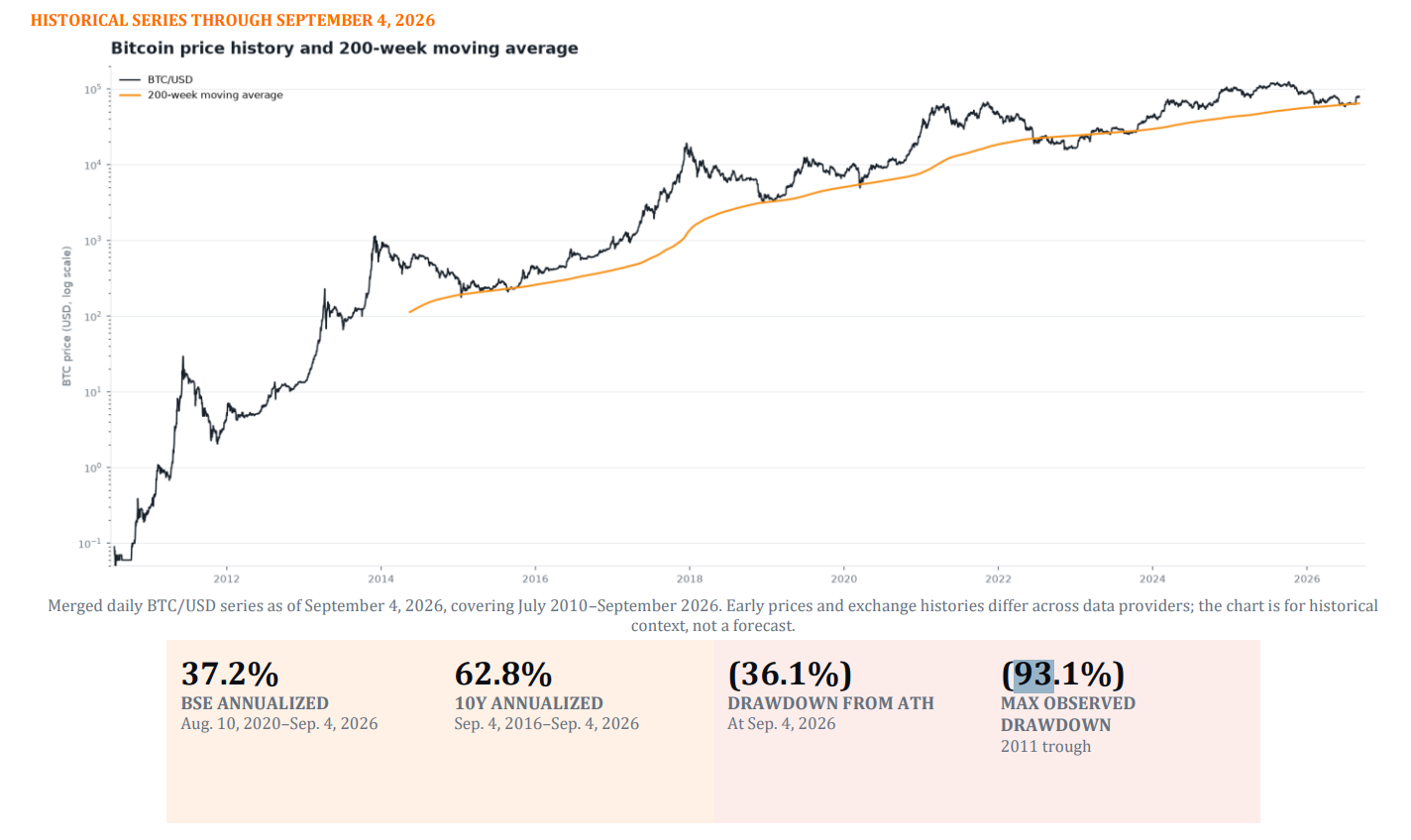
MicroStrategy, now Strategy, has published a Bitcoin guide that warns buyers that the asset has already crashed 93.1% once.
Executive Chairman Michael Saylor shared it over the weekend. The document devotes more space to losses, custody failures, and position sizing than to upside.
What the MicroStrategy Bitcoin Guide Warns About
That 93.1% drop, which occurred at the 2011 low, is the deepest in Bitcoin’s trading history. The guide adds a worst one-year return of minus 83.6%. Its point is not about direction. It is about survival.
Being right about Bitcoin over 10 years does not protect anyone over 10 months.

“An investor can be correct that Bitcoin appreciates and still lose money through leverage, option decay, an unfavorable capital structure, corporate risks, counterparty failure, excessive fees or forced liquidation,” the company says.
Saylor Has Already Lived a Crash Like This
The warning carries weight because Saylor watched one wreck his own company. On March 20, 2000, MicroStrategy restated three years of revenue. The stock fell 62% in a single day from a peak of $333.

The SEC then charged him with fraud. He paid $8.28 million in disgorgement and a $350,000 penalty, without admitting wrongdoing.
Why the Warning Lands Awkwardly Now
Strategy is not a neutral narrator. Filings show 845,050 BTC held on September 7, at an average cost of $75,412.
Bitcoin’s current market price is near $77,106. That leaves the company barely 2% above water, and 38.8% below its October 2025 record.
Recent buys are already losing money. BeInCrypto reported that Strategy resumed its Bitcoin buying on August 31, paying an average of $80,318 for 4,603 BTC. However, the resumption lasted only one week.
Meanwhile, the MicroStrategy Bitcoin guide doubles as a product menu. Its table of investor options lists the common stock and the preferred stock of a BTC treasury company. Strategy sells both.
It does disclose the conflict. Strategy states plainly that it profits from higher Bitcoin prices. Therefore, even as Michael Saylor is telling investors to size for a 93% fall, his own company is sized for the opposite.
The post MicroStrategy's Bitcoin Guide Issues a 93% Crash Warning to Investors appeared first on BeInCrypto.
AMC Entertainment CEO Adam Aron has challenged Robinhood’s claimed 1:1 stock token backing by asking whether shares supporting the products could be lent to short sellers.
Summary
- AMC CEO Adam Aron has questioned whether Robinhood lends shares supporting stock tokens to short-sellers.
- Robinhood describes each stock token as debt backed one-for-one by the corresponding underlying equity share.
- Stock token holders receive economic exposure and dividend adjustments but lack shareholder voting rights entirely.
- Robinhood Assets Jersey Limited issues the products, which remain unavailable to people in the U.S.
- Robinhood had not publicly answered Aron’s collateral-lending question when this report was prepared for publication.
Aron’s Sept. 12 statement directed a series of questions to Robinhood CEO Vlad Tenev and Chief Legal Officer Dan Gallagher. The post followed their public defense of the company’s stock token business during the previous week.
Among the questions, Aron asked whether a token could still be described as backed one-for-one if Robinhood lent its corresponding share to a short seller. He framed the scenario as hypothetical and did not present evidence that Robinhood currently lends shares assigned to its stock token reserves.
Robinhood had not posted a public response addressing the collateral-lending question as of Sept. 13. Its published product documents describe the tokens as backed by underlying securities but do not make token holders registered owners of those shares.
AMC CEO questions Robinhood’s 1:1 backing claim
In his latest post, Aron called the stock token model “abhorrent” and argued that it conflicts with the purpose of public share ownership. He questioned whether customers could misunderstand the rights attached to the products when Robinhood promotes them using the names and prices of listed companies.
“If those tokens are theoretically backed 1:1 by real shares, but hypothetically some of those underlying real shares are in turn lent out to short sellers, are the tokens really backed 1:1 in fact?” Aron wrote.
The question concerns the assets Robinhood holds against its token liabilities. Robinhood’s stock token documentation says Robinhood Assets Jersey Limited issues tokenized debt securities that provide economic exposure to an underlying security.
Robinhood says each public-company stock token is backed by a corresponding share. Its documents do not say that the token itself represents legal ownership of the underlying equity. A token holder instead holds a claim against the Jersey issuer. Aron did not cite Robinhood records, custody statements or onchain evidence showing that the corresponding shares had been lent. His post asked Robinhood to disclose how the backing operates if securities lending occurs.
Robinhood stock tokens do not carry shareholder rights
Under Robinhood’s structure, the investor receives exposure to movements in the referenced stock’s price. The product can account for distributions such as dividends, but the holder does not appear on the public company’s shareholder register.
Token owners lack voting rights attached to the referenced shares. Robinhood’s Key Information Document characterizes the product as a derivative and identifies Robinhood Assets Jersey Limited as its manufacturer.
The document warns that investors depend on the issuer’s ability to meet its obligations. Ownership of a token therefore differs from direct ownership of AMC common stock, even when the token’s value tracks an AMC share.
Robinhood introduced stock tokens for European customers as part of an international expansion announced in 2025. The company later connected the product line with Robinhood Chain, its blockchain network for tokenized assets.
The products are not offered to U.S. persons. Robinhood’s expansion announcement says the stock tokens are issued through Robinhood Assets Jersey Limited and provide exposure to U.S.-listed securities. Aron questioned why Robinhood’s U.S. website promotes the concept when domestic customers cannot purchase the products. He described the Jersey structure as an offshore operation designed to function outside U.S. securities laws. Robinhood has not accepted that description.
Tenev says companies cannot veto referenced tokens
Tenev defended the stock token model during a Sept. 9 CNBC “Squawk Box” interview. He argued that issuers control the rights and duties attached to shares they issue but do not control every separate financial product referencing their stock.
“Issuers should have control and do have control over the rights and obligations of the stock that they issue, but that doesn’t mean they control everything about it,” Tenev said.
Tenev stated that issuer consent “depends on what exactly you’re doing.” He maintained that Robinhood’s products “should not automatically require issuer consent,” although no cited court or U.S. regulatory decision has settled that position for Robinhood’s structure. Aron previously said AMC did not authorize, endorse or participate in the creation of its referenced token. In a prior statement, he called on Robinhood to stop offering the product and said AMC would consult securities lawyers about possible legal and regulatory action.
Gallagher rejected the demand publicly. “We know a little something about the U.S. securities laws and will not ‘DECIST,’” he wrote on X, reproducing a misspelling in Aron’s earlier post. Gallagher invited AMC to send its lawyers.
No public lawsuit filed by AMC over Robinhood’s stock tokens had been identified by Sept. 13. The U.S. Securities and Exchange Commission had not announced an enforcement action involving the AMC-linked product.
Share lending and voting remain open questions
Robinhood’s public material explains how token prices follow referenced securities, but its available summaries provide limited detail about the custody and possible lending of each backing share. Aron’s latest post asks the company to state whether reserve shares are kept unencumbered or can enter securities-lending transactions.
A securities loan transfers shares temporarily to a borrower under a separate agreement. Aron’s hypothetical question does not establish that Robinhood uses this arrangement for stock token collateral. A direct answer would require information from Robinhood or its custodian concerning the treatment of reserve shares.
The company has not published a token-by-token reserve register showing where each corresponding share is held. Its stock token documentation identifies the issuer and product mechanics but does not give token holders direct voting control over the referenced equity.
Robinhood therefore controls, directly or through its custody structure, any voting power connected to the underlying shares. Tenev has not announced how votes attached to stock token collateral are exercised. European regulators have raised separate concerns about products that track shares without transferring legal ownership. The European Securities and Markets Authority has warned that tokenized instruments may create investor confusion when buyers do not receive the governance rights attached to conventional shares, Reuters reported.
OpenAI raised a comparable ownership distinction in 2025 after Robinhood promoted a token tied to the private company. OpenAI said the instrument was not its equity and had not received the company’s endorsement, according to Reuters.
Robinhood maintains that its tokens can give eligible international customers economic exposure to U.S. securities. The company is developing Robinhood Chain to support tokenized assets, while crypto.news reported that its architecture creates a revenue stream for Arbitrum through chain-related fees.
As of Sept. 13, Robinhood continued to describe its public-company tokens as one-for-one backed. Neither Tenev nor Gallagher had publicly answered Aron’s specific question about whether shares assigned to that backing may be lent to short sellers.


We all know at least one or two adults who like to have things done for them: someone to run their errands, drive them to the doctor, pick up their medications and groceries. My mother was like this. I was what is referred to as the parentified child, taking care of her since I was a young girl until she died seven years ago. I was so put off by my mother’s complete reliance on other people that I went in the opposite direction; I became a psychologist who strongly prefers to do everything for herself.
I learned over time that the problem with excessive self-reliance or stoicism is that it isn’t always, or even often, effective. As a psychologist, I had to learn and teach myself, as well as my patients, the importance of asking for help when one needs it. As I tell my patients (and as I learned to tell myself), we do ourselves a disservice by not asking for and accepting help when we need it.
No one can go through life alone. Humans are social beings, and we are designed to be interconnected with one another. Being able to effectively ask for and receive help also makes us stronger and more independent over time.
There are many reasons why people don’t like to ask for help. One is we think we should be able to do everything for ourselves. We feel like if we ask others for help that we will look weak or needy. We might fear rejection or are concerned with imposing on others. We may be concerned that asking someone for help gives people some kind of power or leverage over us. We may even believe that receiving help from others means we owe someone something back.
Believe me, I get it. I have some of those same cognitive distortions in my thinking as well. I need to give myself grace and compassion for having such thoughts, and then push through them.
The next step is figuring out what help we could benefit from, and knowing how, when, and who to ask for help. Doing this helps set us up for success.
Humans aren’t perfect. We aren’t supposed to have all the answers, capabilities, or capacities. I encourage the people I work with to take an inventory of the needs that they have. We have to understand that, as emotionally healthy adults, we need to meet many of our own needs ourselves. Some of our needs we can ask other people for help with, and some of our needs will go unmet.
Once we figure out the needs we have, we can spot which ones might benefit from support and assistance. Let’s say we don’t want to go to the end-of-summer company picnic alone and would prefer a plus-one to come with us. There’s nothing wrong—and, dare I say, everything right—with asking another person to accompany us. But we need to be strategic.
First, pick a supportive person to ask. (This isn’t a task for your least-social friend.) Then, ask politely. When we ask for help, we might want to consider what our body language, posture, tone of voice, and choice of words say about us and our request. For example, if we stand in front of someone with our arms crossed over our chests, this often signals defensiveness or a lack of openness. If we slump or shrug, avoid eye contact, or point a finger, this also doesn’t invite people in. Similarly, making demands, threats, or insults—or insisting someone help us—can also be off-putting, and decrease our chances of getting support.
I really like a treatment called Seeking Safety. Though originally designed for trauma survivors who have co-occurring PTSD and substance abuse, these are behavioral, cognitive, and people skills that have wider applicability. For example, in regards to asking for help, the method suggests that people consider starting small, practicing on safe people with simple requests. It may seem obvious, but your odds of getting a ride to a job interview or doctor’s appointment are higher than if you ask someone for money to pay this month’s rent or the next car payment.
Of course, there are other great treatments and resources for learning related social skills. For example, the psychologist Donald Meichanbaum has written extensively on the skills needed for interpersonal effectiveness, behavioral rehearsal, and problem-solving.
When we ask for help, we also must be prepared for someone to say no. If they do, we must learn not to take it personally. Most of the time, their reasons for refusal are not about us. It could be about their own time management, finances, or resources.
I reached out to Adam Brown, a psychologist and professor at the New School for Social Research who has conducted research on factors that contribute to mental-health risks and resilience. “Strong social connections and support are among the most important protective factors when people face stress, adversity, and difficult life circumstances,” he said. “Asking for help is not a sign of weakness. It is a form of adaptive coping that strengthens relationships, reduces isolation, and creates opportunities to gain new perspectives, learn from others, and grow.”
I agree, and I need that reminder sometimes when my old imprint comes back to me, and I think that I need to have all the answers and take care of everyone but me.
I’m human. I deserve support, connection, and help, just like everyone else. And so do you.
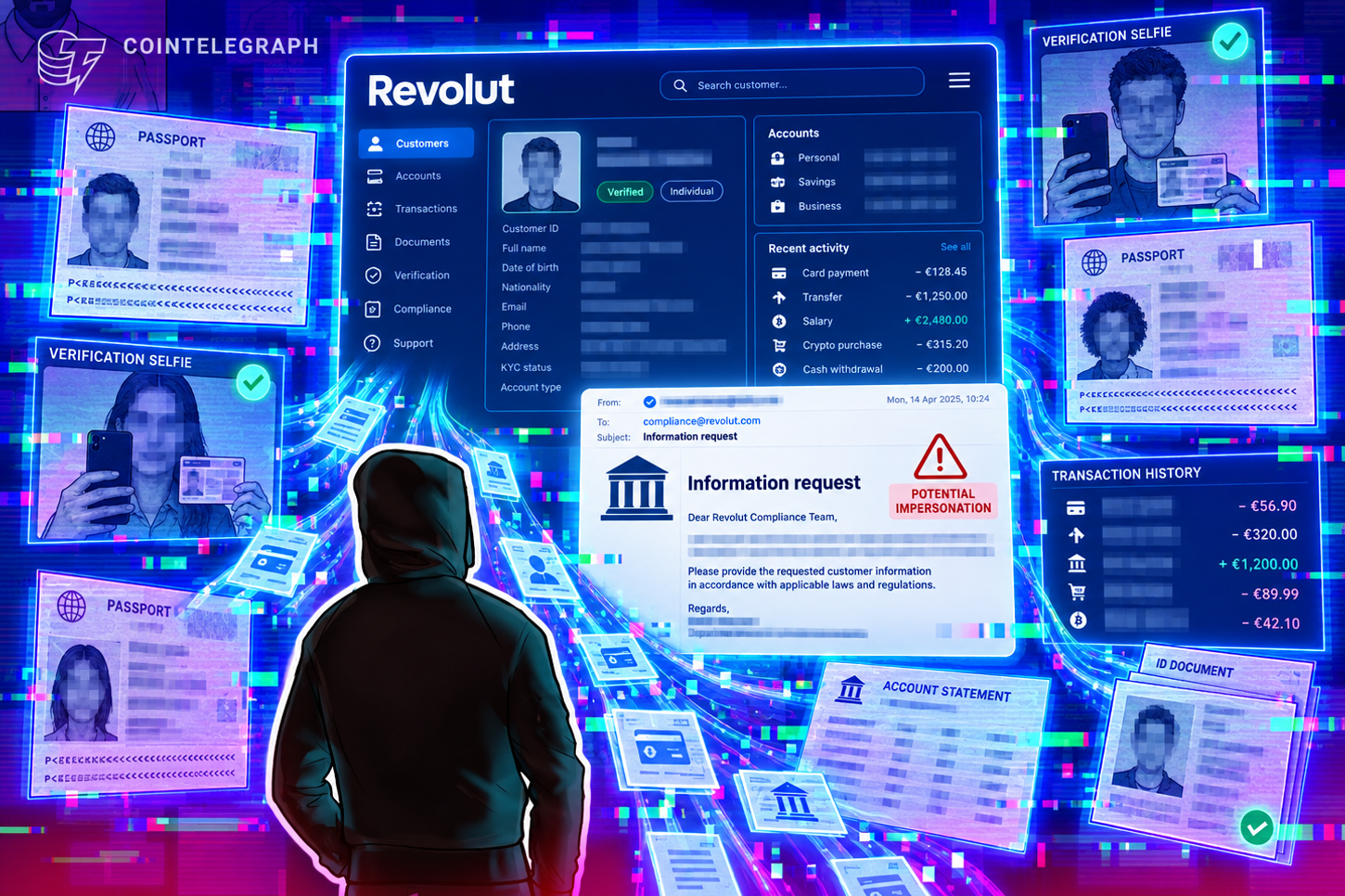
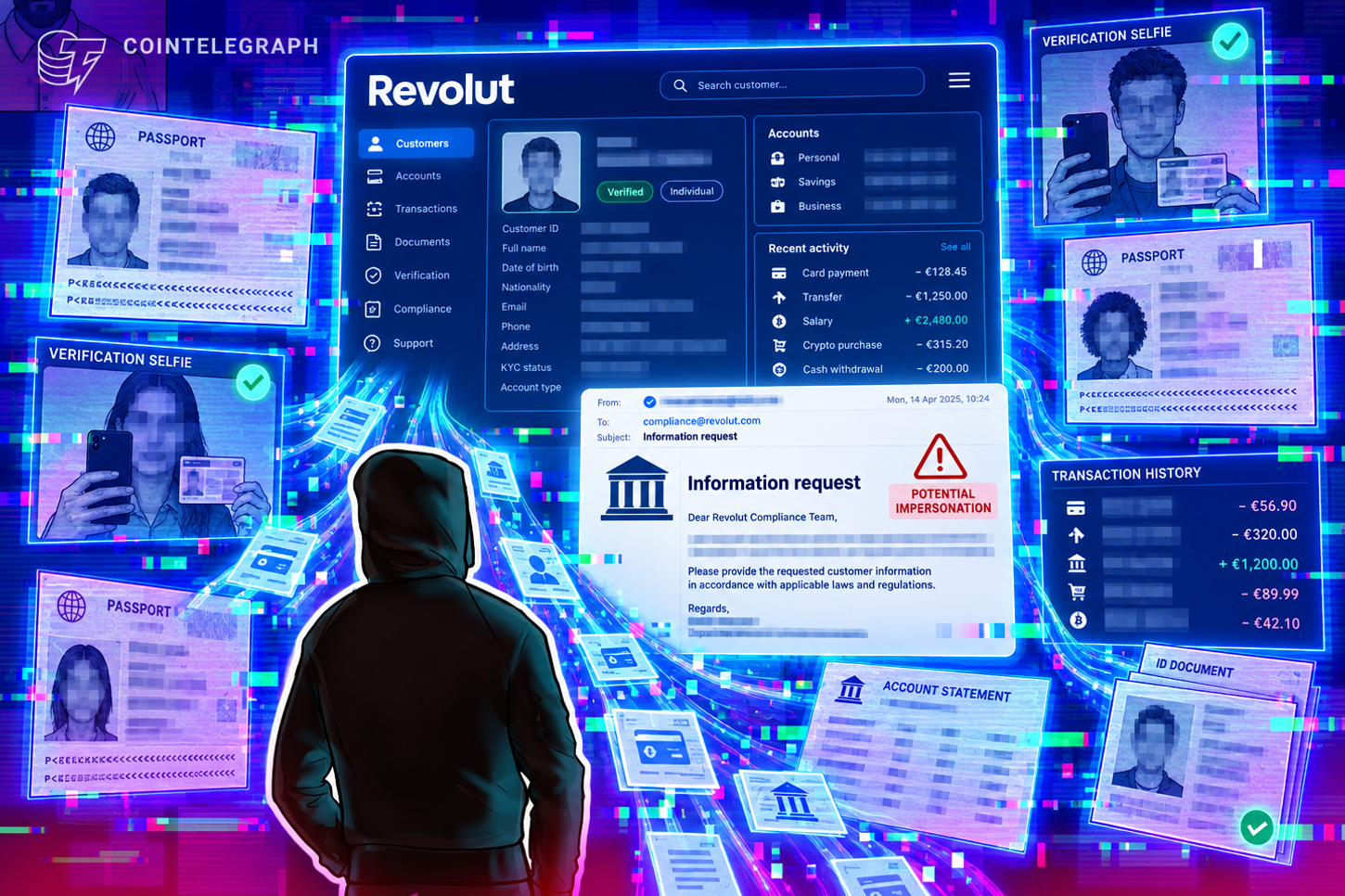
Passports, selfies and financial transaction histories of some customers were revealed to a fraudster using a government agency domain.


Base tokenized stocks have recorded a new daily decentralized exchange trading high of $100 million, with Aerodrome controlling more than three-quarters of the category’s monthly volume.
Summary
- Base tokenized stocks reached $100 million in daily DEX volume, setting a new network record.
- Token Terminal reported $730.9 million in Base tokenized-stock trading volume over the preceding thirty days.
- Aerodrome generated $557.1 million of volume, representing 76% of the measured monthly market on Base.
- Uniswap v4 ranked second after processing $139.3 million of Base tokenized-stock trades during period measured.
- Coinbase launched four products before adding six tokenized stocks referencing public and private companies later.
Token Terminal reported on Sept. 12 that tokenized-stock DEX volume on Base reached $730.9 million during the preceding 30 days. Aerodrome processed $557.1 million, representing 76% of the total, while Uniswap v4 handled $139.3 million.
The two exchanges generated $696.4 million collectively, accounting for more than 95% of the recorded volume. Based on the reported figures, the remaining Base venues processed approximately $34.5 million.
Base founder Jesse Pollak shared the record and noted that the category had grown from zero to $100 million in daily volume. Coinbase introduced its first Base-native stock tokens on Aug. 24, less than three weeks before Token Terminal published the latest data.
Aerodrome captured most Base tokenized stock trading
Aerodrome’s $557.1 million total was approximately four times the volume handled by Uniswap v4. The figures measure the value of completed swaps, not the value of stocks held in custody or revenue received by either decentralized exchange.
Every trade contributes to volume, meaning the same token can be counted repeatedly as it changes hands. Token Terminal did not publish a breakdown showing the number of participating wallets, average transaction size or volume generated by each stock token.
Aerodrome uses liquidity pools to execute trades on Base. Users and professional market makers deposit paired assets into the pools, allowing traders to exchange tokens without sending orders through a centralized exchange.
Uniswap v4 offers a separate source of liquidity. The protocol’s programmable hooks let pool developers customize fees, liquidity management and access conditions. Uniswap v4’s $139.3 million represented close to 19% of the reported monthly market.
Neither dataset established how much trading occurred during regular U.S. equity-market hours. The tokens can trade outside the operating hours of Nasdaq and the New York Stock Exchange, creating periods when their onchain prices move without an active primary-market price for the referenced shares.
Base tokenized stocks grew from four to ten products
Coinbase launched the initial tokenized-stock group on Aug. 24 for eligible investors outside the U.S. The first products referenced Apple, Nvidia, Alphabet and Meta through the AAPLc, NVDAc, GOOGLc and METAc tickers.
Coinbase later introduced tokens connected to Amazon, Microsoft, Strategy, SanDisk, Tesla and SpaceX. Base announced the six-product expansion in September. SpaceX is privately held and does not have shares listed on a public exchange. Its inclusion means the Base product group covers both listed equities and a private-company asset. Separate issuance, transfer and valuation rules may apply to a private-share token.
The products use the B20 standard developed for Base. B20 is compatible with the network’s smart-contract applications and can support identity checks, compliance controls and restrictions established by an issuer.
Coinbase describes its tokenization infrastructure as a system for issuing, trading and managing assets with compliance functions. Its dedicated platform connects token issuance with Base and Coinbase’s other trading and custody products.
Availability remains subject to location and eligibility rules. The initial launch targeted customers outside the U.S., although the tokens reference shares in U.S. companies and trade on a blockchain developed by Coinbase.
Underlying shares back the public stock tokens
Coinbase says its listed-equity tokens are backed one-for-one by underlying shares held through Alpaca, a U.S. brokerage infrastructure provider. The product structure is designed to connect every issued token with a corresponding share in custody.
As crypto.news previously reported, the initial four products gave holders beneficial ownership connected to underlying shares. They were not described as synthetic contracts supported only by a general collateral pool.
One-for-one backing does not mean a token is legally identical to a conventional share held directly in a brokerage account. The governing agreements determine voting rights, dividend treatment, redemption procedures and claims against the issuer or custodian.
Custody arrangements create their own operational considerations. Token holders rely on the issuer and broker to maintain accurate records, hold sufficient shares and process corporate actions affecting the underlying securities.
Traditional corporate actions can include dividends, stock splits, mergers and tender offers. Each product’s terms determine how those events reach token holders and whether any payment is distributed in cash, stablecoins or additional tokens.
The legal position of a holder may depend on whether the blockchain record represents direct registered ownership, beneficial ownership through an intermediary or a separate contractual claim. Investors must review the documentation for each product before treating a stock token as equivalent to a conventional share.
SEC guidance separates different token structures
The Securities and Exchange Commission addressed the legal structure of tokenized securities in a January statement. The agency said securities may be tokenized by their original issuers or by unaffiliated third parties. An issuer-sponsored token can place ownership records directly on distributed-ledger technology. A third-party structure may provide beneficial ownership, a security entitlement or only economic exposure linked to another asset.
The SEC said tokenization does not remove an instrument from federal securities law. Legal treatment depends on the rights represented by the token and the relationships among the investor, issuer, broker, custodian and underlying company.
Federal banking agencies have expressed a similar distinction when discussing tokenized assets. The Federal Reserve’s guidance separates tokens representing ownership in an underlying security from instruments that merely reference another asset.
Neither statement specifically approved Coinbase’s Base products. The guidance provides a framework for determining whether a token represents the share itself, an indirect ownership interest or a debt-style claim against a third party.
Base stock tokens were initially offered outside the U.S., but their connection to U.S. securities gives the project a direct American market angle. Alpaca’s role as broker and custodian introduces another link to U.S. financial rules.
Monthly volume will depend on continued liquidity
Token Terminal’s $730.9 million figure uses a rolling 30-day period. The total will change as daily trading activity enters and leaves the measurement window.
Aerodrome’s 76% share could move if liquidity providers transfer assets to Uniswap v4 or another Base exchange. New token listings may create separate pools and distribute activity across more venues.
The current data does not show whether the $100 million daily record resulted from sustained participation or a short burst of trading. Wallet counts, trade sizes and daily volume following the record would provide more information about the source of the activity.
Crypto.news reported that Robinhood Chain reached $945 million in daily DEX volume in August, with tokenized assets contributing to activity on that network. Robinhood’s products use a different legal and issuance structure from the beneficial-ownership model described for Coinbase’s Base stock tokens. Token Terminal had not announced a revised Base record or a new 30-day figure after its Sept. 12 post at the time of publication.
For the ninth consecutive week, the exchange-traded funds tracking the popular cross-border token were in the green, attracting nearly $19 million, similar to the previous week.
The cumulative total net inflows hit another all-time high, but the underlying asset continues to struggle with its breakout attempts as its mid-August rally came to a halt.
Another ATH
During the last full week of August, the spot XRP ETFs marked their best performance since early December 2025, attracting $110.49 million. This followed another impressive week, in which the net inflows neared $40 million.
The inflows slowed down at the start of September but remained well in the green. Although there was still a single day in the red for the first time in a month, the funds gained $18.96 million during the week that ended on September 4. The next one, which was just four business days long, saw similar inflows of $18.98 million.
The numbers on Tuesday were quite modest, with just $1.55 million. However, Wednesday brought $12.29 million, followed by another $5.14 million on Thursday. Interestingly, Friday was a no-action day, according to data from SoSoValue, with net flows of $0.00. This was rather unexpected given the massive market turbulence that day, but more on that later.
Ultimately, the XRP ETFs reached another all-time high of $1.7 billion. Bitwise’s XRP fund, which recently surpassed $500 million in assets, has extended its cumulative net inflow lead – $608 million compared with $490 million for Canary Capital’s XRPC.

XRP Still Struggles
The underlying asset exploded during the market breakout between August 19 and 22, skyrocketing by 70% in less than 72 hours. It jumped from $1.00 to $1.70, where it was rejected and driven south hard, despite the positive ETF flows.
It tried to take down the crucial $1.40 resistance in the past week, only to be halted again. On Friday, it went through a wild two-hour ride after the release of the CPI numbers. It went from $1.36 to $1.32 before it soared to almost $1.45. However, it was stopped once again, and now struggles below $1.40.
Crypto analysts are now split on its short-term potential. Ali Martinez, for instance, warned that whales have started to secure profits, while the network activity has dumped hard, which could lead to another leg down. In contrast, Celal Kucuker outlined a pattern that previously led to a 600% surge and suggested that it could run it back.
The post XRP ETFs Smash Another All-Time High as Inflow Streak Hits 9 Weeks appeared first on CryptoPotato.


Uniswap has processed more than $70 billion in trading volume over the past month, exceeding the combined volume attributed to the next three decentralized exchanges in its cited ranking.
Summary
- Uniswap processed more than $70B in decentralized exchange volume during the latest monthly period measured.
- The protocol said its volume exceeded the combined total of the next three DEXs ranked.
- DeFiLlama data attributes roughly $32B to Uniswap v3 and nearly $38B to v4 activity recently.
- Uniswap operates across multiple blockchains, allowing traders to swap assets through automated liquidity pools directly.
- UNI traded near $6.21 after falling roughly 2% during the latest market session tracked globally.
Uniswap said on Sept. 13 that the comparison came from DeFiLlama Research, describing the result as evidence that a large portion of decentralized spot trading continues to pass through its protocol.
The claim covers activity across multiple versions of Uniswap and the blockchains where its smart contracts operate. It does not represent revenue earned by Uniswap Labs or the market value of the UNI governance token.
Current DeFiLlama data supports a monthly total above $70 billion when the tracked volumes for Uniswap v2, v3 and v4 are combined. Since the figures update continuously, exact totals can change as older trading days leave the 30-day measurement period and new activity enters it.
Uniswap v4 and v3 account for most of the volume
DeFiLlama’s Uniswap v4 page showed close to $38 billion in trading volume over the preceding 30 days when accessed on Sept. 13. The analytics platform attributed roughly $32 billion to Uniswap v3 during a similar period.
Uniswap v2 contributed more than $1.2 billion, placing the combined figure for the three versions above the $70 billion level cited by the protocol. Smaller deployments or differences in update timing can produce slight variations between the version-level sum and Uniswap’s published figure.
Volume represents the dollar value of swaps processed by the protocol. It does not show how much profit traders made, how much liquidity providers retained or how much revenue reached UNI holders. Each trade can generate fees for liquidity providers, while selected pools direct part of their fees to the protocol under governance-approved settings.
Uniswap v3 remains active because it lets liquidity providers concentrate capital within chosen price ranges. Version 4 uses a shared contract architecture and programmable hooks, which developers can use to add customized pool functions.
Recent v4 growth has moved the newer version ahead of v3 in the current monthly snapshot. The data does not establish that every trader has migrated to v4 because the two versions continue to serve different pools, assets and integrations.
Uniswap volume spans dozens of blockchain networks
Uniswap’s total covers deployments across Ethereum and numerous scaling networks. DeFiLlama lists v3 contracts on more than 40 chains, with Ethereum representing the largest portion of the version’s locked liquidity.
Activity from Base, Arbitrum, BNB Chain, Polygon, OP Mainnet and Robinhood Chain contributes to the combined protocol figures. Each deployment processes swaps through its own pools, while analytics providers group the results under the Uniswap protocol.
Robinhood Chain has recently become one source of Uniswap activity. As crypto.news reported, the network reached approximately $945 million in daily DEX volume on Aug. 25, with Uniswap serving as its main public automated market maker.
DeFiLlama’s Sept. 13 snapshot showed Robinhood Chain processing roughly $1.35 billion in total DEX volume over 24 hours and $12.19 billion during seven days. Uniswap accounted for approximately $262 million of the chain’s daily volume and close to $4 billion of its seven-day total at the time of measurement.
Uniswap Labs launched v2, v3, v4 and UniswapX on Robinhood Chain in July. The integration placed the protocol in the Uniswap web application, wallet and API from the network’s first day of public operation.
On Ethereum, DeFiLlama recorded approximately $681 million in total DEX trading over the latest 24-hour period and $8.5 billion over seven days. Uniswap competes there with Curve, PancakeSwap, SushiSwap and other automated exchanges.
The rival comparison remains a moving snapshot
Uniswap said its monthly volume exceeded the next three DEXs combined, but the protocol did not identify the three competitors in its post. Rankings can differ depending on whether an analytics provider groups protocol versions, counts spot swaps only or combines activity across supported chains.
DeFiLlama defines DEX volume as the value of spot token swaps processed by a protocol. Perpetual futures trading is presented separately, preventing derivatives-focused venues from being mixed directly with spot exchanges in the same metric.
Competition within the DEX sector has changed over time. Raydium surpassed Uniswap in one monthly comparison during January 2025, while PancakeSwap held a higher 30-day total during parts of that year. The latest data cited by Uniswap places the protocol back at the top of the selected spot DEX ranking.
An earlier monthly record offers another comparison. Crypto.news reported in November 2024 that Uniswap reached $38 billion across Ethereum scaling networks. The latest figure is more than 80% above that total, though the two measurements cover different dates and may not include an identical set of chains and protocol versions.
Uniswap’s current competitor comparison should therefore be read as a trailing-period snapshot. It can be verified only against the methodology, protocol groupings and timestamp used for the underlying ranking.
Protocol fees connect volume with UNI supply
Uniswap governance approved a fee mechanism that directs part of the trading charges from selected pools to the protocol. The settings do not cover every pool or every dollar of reported volume, so monthly trading volume cannot be multiplied by one fee rate to calculate protocol revenue.
In July, Governance Proposal 100 expanded the mechanism to v4 pools across seven networks. Crypto.news reported that the changeaised Uniswap’s measured daily protocol revenue from approximately $114,000 to $325,000 at the time.
Captured fees are routed through TokenJar contracts and can fund UNI purchases and token burns under the governance system. Liquidity providers continue to receive the portion assigned to them under each pool’s settings.
Uniswap Labs has kept expanding the products connected to the protocol’s liquidity. A June agreement brought $150 million in Spark stablecoin liquidity to v4, with plans to move the assets into a programmable DualPool hook developed with Uniswap Labs.
Spark’s design places idle stablecoins in yield-bearing vaults between trades and moves the required capital into a v4 pool when a swap occurs. Uniswap said USDS would serve as the first quote asset, with support planned for USDT and PYUSD liquidity.
UNI traded near $6.21 during the latest market session, down roughly 2% from the previous close. The token moved between approximately $6.17 and $6.55 during the day, with no verified evidence connecting the price decline to Uniswap’s monthly volume announcement.


The CLARITY Act has reached a Sept. 15 Senate cloture vote that will determine whether senators begin formal floor debate on the U.S. crypto market-structure bill.
Summary
- The Senate has scheduled a September 15 cloture vote on proceeding to the CLARITY Act.
- Sixty votes are generally required for cloture, making Democratic support necessary if Republicans remain united.
- The procedural vote would open debate but would not approve the legislation or final text.
- White House adviser Patrick Witt has warned that failure could close Congress’s current legislative window.
- Banking, ethics and anti-money-laundering provisions remain contested before senators can negotiate a final bipartisan measure.
Reuters reported on Sept. 9 that cryptocurrency companies and banking groups had intensified their lobbying before the procedural vote. The two industries disagree over stablecoin rewards, bank deposits, anti-money-laundering controls and the division of regulatory authority.
Patrick Witt, executive director of the White House Digital Asset Advisory Council, has urged senators from both parties to support the motion to proceed. He warned that a failed vote could close the available legislative window and leave the United States without a federal crypto market framework.
Treasury Secretary Scott Bessent has made a similar case for congressional action. In April, Bessent said the absence of clear rules was pushing digital-asset development toward jurisdictions including Singapore and Abu Dhabi,Reuters reported.
CLARITY Act vote opens debate, not final passage
The Sept. 15 action is expected to be a cloture vote on the motion to proceed to H.R. 3633. It is not a final vote on whether the CLARITY Act becomes law. Senate cloture generally requires 60 votes, giving the minority party leverage when the majority lacks that number on its own.
Senate Majority Leader John Thune filed the cloture motion before the August recess, according to published accounts of the Senate schedule. If senators invoke cloture, the chamber can move toward debate on the bill, consider amendments and negotiate changes before voting on passage.
Failure to reach 60 votes would block the Senate from taking up the measure through the scheduled process. Republican leaders could reconsider the vote or pursue another procedural route, but limited floor time before the 2026 midterm elections would make another attempt difficult.
The House approved its version of the CLARITY Act by a 294-134 vote in July 2025. The Senate Banking Committee advanced its version in May 2026 by a 15-9 vote, with Republicans joined by Democratic Sens. Ruben Gallego of Arizona and Angela Alsobrooks of Maryland, Reuters reported. Neither senator committed at that stage to supporting the eventual floor bill.
Democratic votes remain the immediate test
Politico reported that no Democratic senator had publicly committed to supporting the Sept. 15 motion as of its latest assessment. Supporters have said they need at least six Democratic votes, although the exact number depends on attendance and whether every expected Republican supports cloture.
Earlier vote estimates were less favorable. Reuters reported in August that the bill required support from at least eight Democrats if every voting Republican backed it. Changes in attendance, Republican positions or the working text can alter the number of opposition-party votes needed to reach 60.
Forbes reported that the latest negotiating draft incorporated 114 amendments or proposals requested by Democrats. Incorporating proposals into a draft does not establish that their sponsors support the entire bill. Senators can seek revisions while reserving their position on cloture or final passage.
The committee vote showed that some Democrats were prepared to continue negotiations. Gallego and Alsobrooks joined Republicans in advancing the measure from committee, but both said discussions remained fluid. No committee vote guarantees support for a later floor version containing different language.
President Donald Trump supports the legislation, while Witt and Bessent have pressed lawmakers to treat the vote as part of the administration’s digital-asset policy. Their warning that Congress may lose its present opportunity is a political forecast, not a procedural rule preventing lawmakers from introducing another bill.
Stablecoin and enforcement provisions remain disputed
The CLARITY Act seeks to define when a crypto asset falls under securities law and when it qualifies for treatment as a digital commodity. Its framework would give the Commodity Futures Trading Commission authority over covered spot-market activity while preserving Securities and Exchange Commission powers over securities and investment contracts.
Registration requirements would apply to certain exchanges, brokers and dealers serving the digital-asset market. The legislation contains disclosure, custody and customer-protection provisions, although senators continue to negotiate their scope and the treatment of decentralized finance.
Democratic critics have sought stronger anti-money-laundering requirements and more enforcement power for state authorities, according to Reuters. Ethics restrictions involving elected officials and their families have remained another area of negotiation.
Banks have focused on provisions affecting stablecoin rewards. Banking groups argue that interest-like payments on stablecoin balances could pull deposits away from insured banks and reduce funds available for lending. Crypto companies contend that restrictions written too widely could prevent lawful customer rewards and limit competition.
However, the Independent Community Bankers of America has lobbied senators over the deposit issue. Crypto organizations, including Stand With Crypto and the Blockchain Association, have organized events, opinion pieces and direct outreach supporting passage.
Political spending has raised the stakes surrounding the negotiations. Crypto groups have committed more than $190 million to political efforts, Reuters reported, as the industry seeks federal rules governing token classification and trading platforms.
In related coverage, crypto.news examined why the procedural vote may not settle the future of U.S. crypto rules, citing Coinbase CEO Brian Armstrong’s expectation that agencies and lawmakers would keep working if the bill failed.
Senate approval would send the bill back to the House
Invoking cloture would permit the Senate to proceed to debate, but senators would still need to resolve the bill’s disputed provisions and vote on passage. Amendments adopted on the floor could produce a text different from the House-approved measure.
If the Senate passes an amended bill, the House must approve the Senate language or the chambers must reconcile their versions. Both chambers must pass identical text before sending legislation to the president.
A failed cloture vote would leave the SEC and CFTC working under their existing legal authority. Witt has said the agencies could pursue rulemaking if Congress does not act, though administrative rules cannot independently rewrite the statutory division of authority established by Congress.
The SEC and CFTC would need to use their separate notice-and-comment procedures for any new regulations. Agency rules can face court challenges over statutory authority, procedure and compliance costs. Senators are scheduled to return from recess before the Sept. 15 vote. The first recorded result will establish whether the bill has the 60 votes needed to begin consideration; it will not resolve its final language, secure House agreement or enact the CLARITY Act.
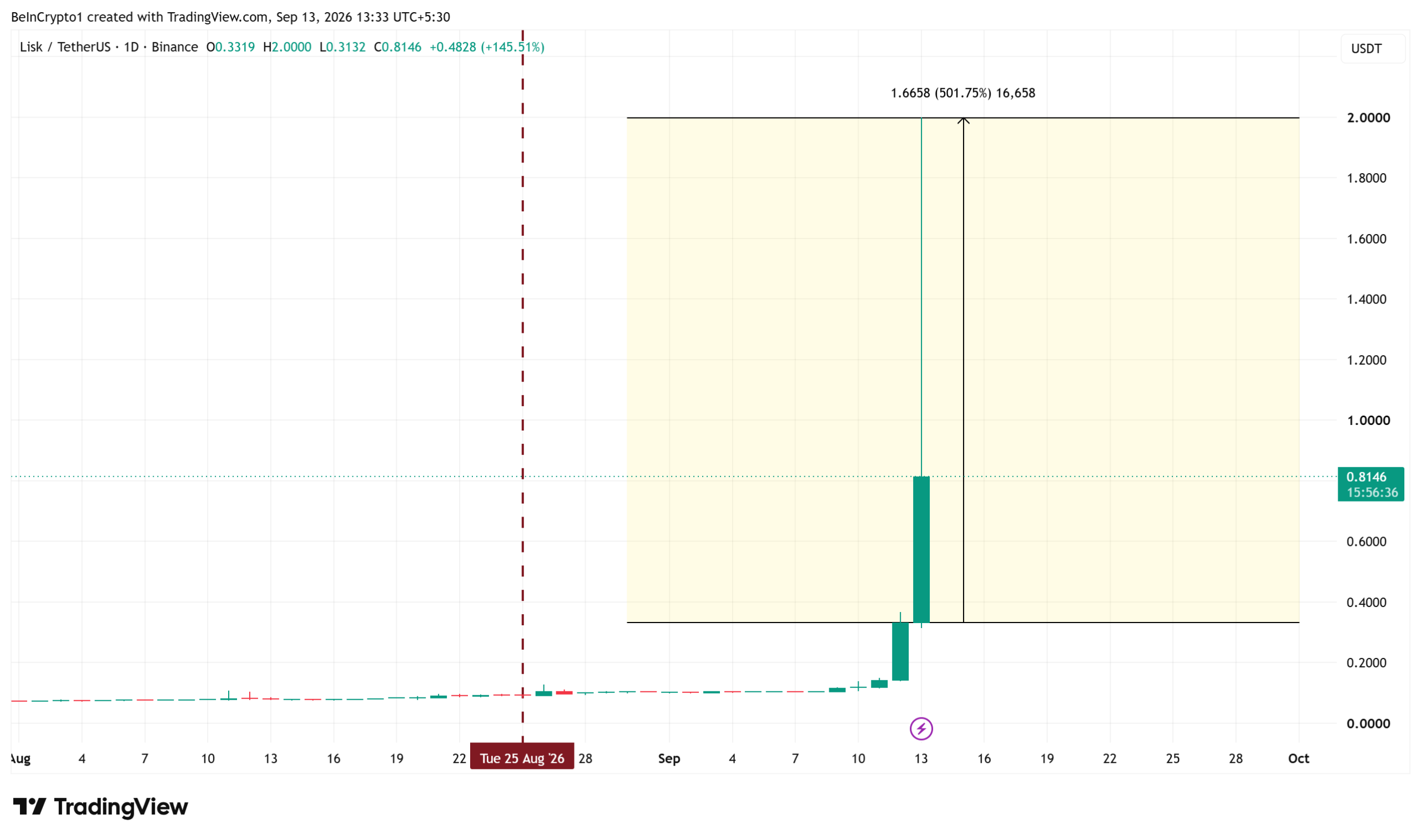
Lisk (LSK) climbed above $2 on Sunday, a gain of more than 900% from its August floor. On Sunday alone, it soared by over 500% before surrendering most of that within hours and now trades near $0.80.
The round trip made LSK the single largest liquidation event in crypto over 24 hours. Traders positioned on both sides of the move were forced out.

Short Sellers Paid for the LSK Price Spike
Coinglass recorded $41.13 million in LSK liquidations across the day. Shorts accounted for $33.68 million of that total, against $7.44 million in longs.
That four-to-one split points to forced buying rather than fresh demand. Short sellers betting on a decline had to repurchase the token as it rose. Each repurchase lifted the price further.
Open interest, meaning the value of outstanding futures positions, reached roughly $42 million against $501 million in daily futures turnover. Spot order books were far thinner. LSK’s current price and volume show it holding near $0.81, still up more than 300% on the day.

BeInCrypto flagged the conditions in July, when Binance added LSK to its Monitoring Tag, a delisting risk warning label applied to unusually volatile listings.
The Burn Traders Bought Has Not Been Approved
Most of the positioning traces back to August 25, when Lisk said it would shut down its blockchain on October 31 and rebuild as a stablecoin payments service for company finance teams.
That plan carries a proposal to destroy 100 million LSK held in the treasury, cutting maximum supply by a quarter. Token holders have not yet voted on it.
LSK continues as a loyalty token on Ethereum and Base. Anyone still holding on the old chain must bridge out before the deadline.
The token remains more than 97% below its 2018 peak, and whether Sunday’s bid survives the vote is the question the next three weeks will answer.
The post Forgotten Crypto Token LSK Jumps 500% Before Crashing: What Happened? appeared first on BeInCrypto.


Thailand’s Securities and Exchange Commission has proposed limiting inbound and outbound stablecoin transfers involving external wallets to five million baht, or roughly $151,000, per customer, operator and day.
Summary
- Thailand’s SEC proposes daily stablecoin transfer caps of five million baht per customer and operator.
- Deposits and withdrawals would be restricted to accounts or wallets verified as belonging to customers.
- Transfers between compliant Thai-regulated operators would remain exempt from the proposed five-million-baht daily transfer ceiling.
- Businesses, authorized institutions and qualifying market makers would receive exemptions under the regulator’s proposed framework.
- Public comments remain open through September 25, with requirements proposed to start sixty days later.
The regulator’s consultation, published on Sept. 11, would require stablecoins deposited with or withdrawn from licensed digital asset businesses to move between accounts verified as belonging to the same customer. Public comments remain open through Sept. 25.
Inbound and outbound transfers would each carry the five-million-baht ceiling. The dollar equivalent uses an indicative exchange rate and can change with the Thai baht.
The proposed rules are not yet in force. Thailand’s SEC said it opened the consultation to address money laundering, cybercrime and attempts to bypass controls governing international money transfers.
Thailand SEC would block third-party wallet transfers
Licensed digital asset operators could accept stablecoin deposits only from an account or wallet belonging to their customer. Withdrawals would need to go to another account or wallet verified under the same customer’s name.
Sending stablecoins from another person’s wallet into a customer’s exchange account would therefore be prohibited. A customer could not withdraw stablecoins from a regulated operator directly to another person’s wallet.
The restriction covers transfers involving foreign digital asset operators and private wallets. Thai businesses would need procedures for verifying ownership before processing the transaction. Ownership checks would operate alongside Travel Rule requirements. Operators would need to classify customers, screen account information and check whether a wallet is linked to mule accounts, watchlists or transactions presenting an elevated illegal-finance risk.
Blockchain analytics or comparable monitoring tools would be required to trace digital asset movements and identify links to high-risk wallets. The consultation does not name specific analytics providers or prescribe one technical platform.
In related coverage, crypto.news reported that Thailand proposed five-year recordkeeping and wallet checks under an expanded Travel Rule framework. The stablecoin consultation focuses more narrowly on ownership, transfer values and regulated operator responsibilities.
The five-million-baht cap has several exemptions
For transfers involving a private wallet or foreign operator, a customer’s stablecoin deposits and withdrawals could not exceed five million baht per day at each licensed business. At current exchange rates, the limit equals close to $151,000.
The permitted value would need to remain consistent with the customer’s income and financial position. Operators could therefore apply a lower practical threshold when a transfer does not match information collected during customer checks.
Transfers between accounts held at Thai-regulated digital asset operators would not face the five-million-baht ceiling when both businesses comply with the Travel Rule. Customer information would move through the regulated system, giving each operator a record of the parties involved.
Several customer groups would receive separate exemptions. Businesses transferring stablecoins through accounts held in their own names would not face the same ceiling when the activity serves their stated commercial purpose. Institutions supervised by the Bank of Thailand could qualify when the central bank authorizes stablecoin use for a particular business arrangement. Approval would be assessed case by case.
Market makers supplying liquidity to stablecoin-baht pairs would receive an exemption when transfers are required for liquidity management. The proposal does not create a general waiver for every market-making transaction, leaving regulated operators responsible for confirming that activity fits the stated function.
Off-platform trades would face price disclosure rules
Thailand’s SEC paired the stablecoin transfer controls with proposed standards for off-platform transactions handled by digital asset brokers and dealers. Such trades would need a minimum value of three million baht, equal to roughly $91,000 at the current exchange rate.
Businesses providing the service would need to publish digital asset trading prices on their websites or platforms. The disclosure requirement is designed to let customers verify the prices used for transactions completed outside regular order books.
Digital asset brokers could not arrange direct off-platform transactions between two customers. They could act as agents that match customers through an exchange, according to the consultation.
The proposal draws a distinction between brokers, which arrange transactions for clients, and dealers, which trade as principals. Each category would remain subject to controls intended to prevent off-platform services from being used for cybercrime or money laundering.
No transaction-volume estimates were supplied for Thailand’s existing off-platform market. The regulator did not publish data showing how many current transactions would fall below the proposed three-million-baht minimum.
Market makers and liquidity providers face more checks
Licensed exchanges would need to publish the names of their market makers and identify the digital assets for which each firm supplies liquidity. Screening would cover the source of assets and the actual purpose of market-making transactions.
Exchange operators would have to monitor and periodically review market-maker conduct. The regulator said the controls are intended to improve transparency and prevent liquidity arrangements from becoming channels for illegal fund movements.
For digital asset brokers, the proposal would prohibit liquidity providers from serving stablecoin-baht trading activity. Other liquidity providers would face location, regulatory and anti-money-laundering requirements.
A qualifying provider could not operate from a jurisdiction that fails to implement Financial Action Task Force recommendations. The provider would need oversight from an appropriate business or anti-money-laundering regulator, while the broker would need reasonable grounds to believe customer assets can be safeguarded.
Brokers would have to disclose their liquidity providers and any conflicts of interest to clients. Reviews would cover asset origins, transaction purposes and provider behavior.
Source exchanges used by brokers would face comparable standards. They would need regulatory supervision and ongoing screening based on controls applied to liquidity providers.
Consultation closes on September 25
Stakeholders can submit comments through theThai SEC website, Thailand’s central legal consultation portal or the email addresses listed in the notice. The deadline is Sept. 25. Following consultation, the SEC can revise, postpone or abandon parts of the proposal before issuing final requirements. The notice does not provide a date for approving the final text.
Stablecoin rules covering transfers, market makers, liquidity providers, source exchanges and off-platform transactions are proposed to take effect 60 days after the resulting notification becomes effective.
Separate provisions would strengthen the SEC’s response when digital asset operators fail to collect or disclose required information. The regulator could order a business to correct the breach within a stated period and, if noncompliance continues, direct it to perform or stop specified activities.

Money-lisa blackpink |mirrored dance tutorial |slow mode _ 0.75x speed #lisa#blackpink#money #shorts

Bat causes chaos on Glasgow train as passengers duck to avoid creature
French AI boom exposes Europe’s funding gap as startups turn to U.S.

Memory prices are slowing because buyers ran out of money

Micron Stock Climbs Above $1,031 as AI Memory Crunch and a $50 Billion Outlook Fuel the Rally

AMD Stock Climbs After Management Lifts 2027 Data Center Outlook Toward $70 Billion in AI Sales


-
Tech5 days ago
Memory prices are slowing because buyers ran out of money
-
 Business3 days ago
Micron Stock Climbs Above $1,031 as AI Memory Crunch and a $50 Billion Outlook Fuel the Rally
-
 Business3 days ago
AMD Stock Climbs After Management Lifts 2027 Data Center Outlook Toward $70 Billion in AI Sales
-
 Crypto World4 days ago
Bitcoin price risks $76K drop as $78K support weakens
-

 Crypto World5 days ago
Robinhood Stock: How To Take Advantage With Reduced Risk
-
 Crypto World4 days ago
Ethereum price stalls below $2,500 as ADX drops to 11
-

 Fashion2 days ago
Weekend Open Thread – Corporette.com
-

 Crypto World2 days ago
XAG/USD: Silver’s Short-Term Rally Meets Its Moment of Truth
-

 NewsBeat5 days ago
England up in reading, maths and science rankings as Scotland and Wales dip
-
 Crypto World3 days ago
2 Chip Stocks Broke Out This Week. Neither Was Nvidia
-

 Crypto World2 days ago
OKX launches 10x OpenAI, Anthropic X-Perps in Europe
-

 Crypto World2 days ago
Diesel Tops $6 a Gallon for the First Time as 28 States Set Records
-
 Crypto World5 days ago
Intel Stock Jumps 9% on Chip Price Hike Report, US Stake Gains $36 Billion
-

 Tech3 days ago
Battery life is the only iPhone 18 Pro and iPhone Duo upgrade I care about. Apple didn’t disappoint
-

 NewsBeat4 days ago
What went right this week: an ‘historic’ fall in violent crime, plus more
-
 Crypto World3 days ago
Bitcoin price risks $70K if $78K neckline breaks
-

 Business2 days ago
10 Most-Streamed Songs On Spotify In 2026 So Far, Led By Ella Langley’s Dominant Run On The Charts This Year
-
 Crypto World4 days ago
Bitcoin price holds near $79K as cycle drawdowns narrow
-

 Tech3 days ago
Apple Watch Ultra 4 vs Watch Ultra 3: Should you really spend another $799?
-
Crypto World2 days ago
Ethereum Price Analysis: Consolidation at $2.5K Tests Momentum as On-Chain Activity Surges
You must be logged in to post a comment Login