
Crypto World
Canada crypto ownership jumps to 25% in 2026



Crypto ownership in Canada has more than doubled since 2023, even as regulators warn that many investors still misunderstand platform protections and industry rules.
Summary
- 25% of Canadians owned crypto in 2026, up from 10% in 2023.
- The Ontario Securities Commission survey found 59% of respondents were aware of crypto assets.
- Only about half of crypto owners checked whether their trading platform was registered.
- Canada is also considering bans on crypto ATMs and digital asset political donations.
Canada crypto ownership more than doubles
Canada’s cryptocurrency ownership rate rose to 25% in 2026 from 10% in 2023, according to new research from the Ontario Securities Commission.
The OSC surveyed 2,360 Canadian adults between December 2025 and January 2026. Its findings showed that 59% of respondents were aware of crypto assets, while one in four reported owning them.
The increase represents a 15-percentage-point gain in ownership over roughly three years. It also suggests that digital assets are reaching a broader section of the Canadian population despite persistent concerns about fraud, volatility and consumer protection.
“Crypto markets continue to evolve, and Canadians are participating in them more than ever before,” said Naizam Kanji, executive vice president of strategic regulation at the OSC.
“By identifying emerging trends and behaviors with our research, we can look around corners, anticipate potential opportunities and risks, and ensure our regulatory approach supports investor protection while fostering fair and efficient markets.”
The research arrives as major crypto companies seek a larger role in Canada’s financial market. As previously reported by crypto.news, Coinbase is preparing to expand its “Everything Exchange” strategy into the country.
The plan would move Coinbase beyond cryptocurrency trading by combining tokenized stocks, traditional financial products and blockchain-based services in one application for Canadian users.
Investors remain confused about crypto protections
Growing ownership has been accompanied by greater awareness of risk, but the OSC found that knowledge of existing protections remained limited.
About 50% of crypto owners reported checking whether a platform was registered before opening an account or completing a transaction. That leaves a large portion of investors using services without first confirming their regulatory status.
Respondents also showed misunderstandings about how crypto platforms are regulated, whether digital assets carry insurance protections, and which transactions can be reversed or recovered.
Those gaps matter because crypto holdings typically do not receive the same protections as deposits kept at regulated banks. Blockchain transactions may also be difficult or impossible to reverse after funds are sent to a fraudulent address.
For US investors, the Canadian findings reflect a familiar regulatory concern. American agencies and state authorities have also focused on platform registration, fraud disclosures and the differences between crypto accounts and insured bank deposits.
However, the two countries continue to develop their digital asset rules separately. A product offered to Canadian customers may not be available under the same terms in the United States.
Canada targets crypto ATMs and political donations
Higher adoption comes as Ottawa considers tougher restrictions on some uses of digital assets.
Canada’s federal government outlined plans in its Spring Economic Update 2026 to prohibit crypto ATMs nationwide. Officials described the machines as a frequent tool for scammers seeking to collect money from victims or process illicit cash.
Investigations cited by the government identified crypto ATMs as a channel through which fraud victims are instructed to transfer funds. Unlike conventional bank transfers, payments sent through these machines can be difficult to recover once completed.
A separate bill introduced in March would restrict cryptocurrency donations to political groups. The proposal is part of a wider effort to tighten election-financing rules and limit foreign interference risks before the next federal election.
If approved, the measures would create a sharper divide in Canada’s approach to crypto. Authorities would continue allowing regulated ownership and financial products while restricting channels viewed as vulnerable to fraud, hidden funding or illicit activity.
Regulation faces a rapid adoption test
Canada’s rising ownership rate places more pressure on regulators to balance market access with investor protection.
Coinbase’s proposed expansion could give local customers access to a broader selection of crypto and traditional financial products. At the same time, the planned ATM ban and political donation restrictions show that federal officials remain cautious about use cases that can obscure the source or destination of funds.
The OSC survey indicates that adoption is moving faster than investor understanding. Registration checks, insurance assumptions and transaction recovery remain central risks as more Canadians enter the market.
Future policy will therefore need to address both sides of the trend: growing demand for digital assets and the consumer-protection gaps that become more consequential as ownership rises.



In a post on X, CEO Brian Armstrong pointed to the company’s expanding businesses beyond spot trading, including stablecoins, Base and prediction markets, noting that Coinbase reached a record 10.3% share of global crypto trading volume during the quarter.
CFO Alesia Haas struck a more measured tone, saying crypto market conditions were challenging as industry spot trading volumes fell more than 20% and the total crypto market capitalization declined by double digits. She said those conditions contributed to a 14% quarter-over-quarter decline in Coinbase’s total revenue.
Several Wall Street firms lowered estimates ahead of earnings and trimmed EBITDA forecasts as lower crypto prices weighed on institutional trading, blockchain rewards and retail activity.
Investors remained focused on Coinbase’s efforts to reduce its dependence on transaction fees.
Subscription and services revenue, which includes USDC interest income, staking, custody, Coinbase One memberships and institutional services, has become a key measure of whether the company can generate more stable revenue through crypto market cycles.
Analysts also watched for updates on newer businesses, including derivatives, prediction markets and Base, Coinbase’s Ethereum layer-2 network.
The company will host a call with investors at 5pm E.T.


Crypto exchange Coinbase reported mixed second-quarter results on Thursday, missing Wall Street expectations on profitability as weaker trading activity weighed on results despite the company capturing a record share of the crypto market.
In the second quarter, Coinbase generated roughly $1.2 billion in net revenue, broadly in line with expectations but down 19% from a year earlier. The company reported a GAAP net loss of $359 million, significantly wider than analysts’ expectations for a roughly $122 million loss. Transaction revenue, subscription and services revenue, and adjusted EBITDA also fell short of consensus estimates.
Despite the losses, the exchange posted an all-time-high 10.3% share of global crypto trading volume, up from 9.1% in the first quarter, even as industry-wide trading activity weakened.
Transaction revenue totaled $599 million, below analyst expectations of $636 million, while subscription and services revenue came in at $555 million, missing the $590 million consensus estimate.
Coinbase attributed the decline in transaction revenue to weaker consumer and institutional trading activity amid a 25% quarter-over-quarter drop in total crypto spot trading volume, lower market volatility and weaker crypto prices.
The results come as Coinbase continues to position itself as an “Everything Exchange,” broadening its business beyond spot cryptocurrency trading into derivatives, prediction markets, tokenized assets and payments.
Coinbase shares fell more than 5% in after-hours trading.
Magazine: CLARITY hopes fade, BitMEX shuts as lawsuit looms: Hodler’s Digest, July 26


The Bitcoin treasury company said it has built a $3.75 billion cash reserve to support preferred stock payouts following the launch of its BTC monetization program.
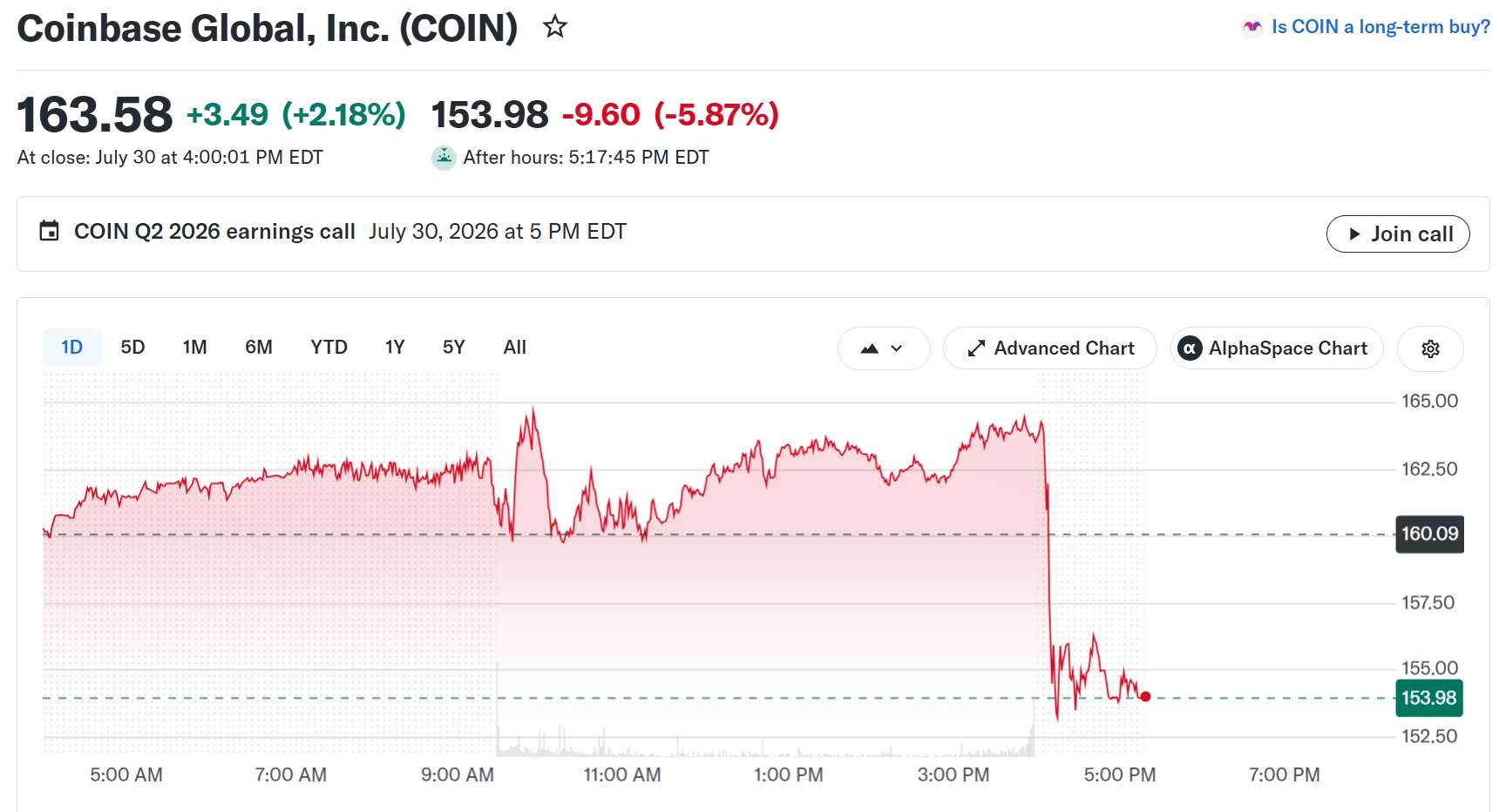
Coinbase posted a $359.5 million net loss on second quarter revenue of $1.22 billion, below Wall Street’s $1.29 billion consensus. COIN shares fell 5.44% after hours to $154.68.
The selloff erased a 2.18% regular session gain that had left the stock at $163.58. Investors looked past a record trading market share and fixed on the shrinking top line.

Coinbase Revenue Miss Extends a Losing Streak
This was the third straight quarter in the red. Losses have narrowed each time.
Coinbase lost $666.7 million in the fourth quarter of 2025 and $394.1 million in the first. Diluted loss per share came in at $1.36, while transaction revenue reached $599.2 million.
Adjusted EBITDA stayed positive at $207.8 million, a 14th consecutive quarter above zero. That figure fell from $303.3 million three months earlier.
Restructuring costs added $52.4 million. The line had read zero for 10 straight quarters before Coinbase began cutting 700 jobs earlier this year. Citi had already cut its price target by 41% days before the report.
Record Market Share Lands in a Shrinking Market
Crypto trading volume market share climbed to 10.3% from 9.1% in the first quarter, a third consecutive record. Derivatives share also hit an all-time high for the third quarter running.
Meanwhile, the wider crypto derivatives market contracted by double digits over the same stretch.
Prediction markets did the heaviest lifting. Contracts and revenue both more than doubled, growing 106% quarter over quarter. The business crossed $100 million in annualized revenue.
Those gains landed against a weak backdrop. Bitcoin spot trading volumes fell toward multi-year lows in July. Rival Robinhood saw crypto revenue drop 38% year over year.
Stablecoins Now Carry More of the Load
Subscription and services revenue reached $555.1 million, or 48% of net revenue. That share stood at 29% in the fourth quarter of 2024.
Coinbase said 88% of net revenue came from sources other than Bitcoin spot trading. Average USDC held in Coinbase products hit a record $20 billion. That is more than 30% of the dollar-pegged stablecoin in circulation at quarter end.
Stablecoin transaction volume on Base, the company’s own layer-2 network, rose sevenfold year over year.
“Coinbase is no longer a bet just on the price of Bitcoin. All of financial services are getting updated by crypto, whether that’s trading or payments or lending, and Coinbase is the best-positioned company in the world to power this,” Brian Armstrong, Coinbase co-founder and chief executive, in the earnings release.
Follow us on X to get the latest news as it happens
What Comes Next
Coinbase reduced and narrowed its 2026 adjusted expense guidance. The company now implies GAAP technology, administrative and marketing costs of $4.34 billion to $4.6 billion this year.
“Despite market headwinds, our fundamentals remain strong as we consolidate trading share and continue to build through the cycle,” Alesia Haas, Coinbase chief financial officer, in the same release.
One question now hangs over the second half. Can a bigger slice of a smaller market lift revenue once trading volumes recover?
The post Coinbase Q2 Earnings Miss Drags COIN Lower as Losses Hit 3rd Quarter appeared first on BeInCrypto.

Coinbase reported mixed results for the second quarter, showing profitability pressure as overall crypto trading activity softened—despite the exchange winning a record slice of global market volume. The company’s performance underscored a key tension for large exchanges this year: when user activity and volatility decline, even strong market share gains may not be enough to offset revenue headwinds.
For the quarter, Coinbase generated about $1.2 billion in net revenue, broadly in line with expectations but down 19% from the prior year. The exchange posted a GAAP net loss of $359 million, widening significantly versus analysts’ expectations for a loss around $122 million.
Key takeaways
- Coinbase’s net revenue for Q2 was roughly $1.2 billion, down 19% year over year, as trading-related revenue weakened.
- The company reported a GAAP net loss of $359 million, materially worse than expected.
- Transaction revenue fell short of consensus, while subscription and services revenue also missed estimates.
- Despite weaker industry activity, Coinbase reached a record 10.3% share of global crypto spot trading volume, up from 9.1% in Q1.
Revenue softness and a wider-than-expected loss
Coinbase’s top-line picture was restrained. Transaction revenue totaled $599 million, below analyst expectations of $636 million. Subscription and services revenue came in at $555 million, missing the $590 million consensus estimate.
The gap between performance and expectations showed up most clearly in the bottom line. Coinbase’s GAAP net loss of $359 million was substantially larger than forecasts for a roughly $122 million loss, reflecting the squeeze across revenue categories tied to market participation and trading conditions.
Why trading revenue declined
The exchange pointed to weaker engagement across both consumer and institutional trading. According to Coinbase, transaction revenue fell as total crypto spot trading volume dropped 25% quarter over quarter, with lower market volatility and weaker crypto prices contributing to the decline.
That explanation matters for investors because it highlights what likely drove the quarter: not a loss of competitive position, but a reduction in the underlying trading “fuel” that generates fee income. Even when an exchange captures a larger share of a smaller market, the absolute level of activity can still weigh on results.
Market share at a record level, even as volumes weakened
While revenue suffered, Coinbase’s routing and distribution strength appeared resilient. The company reported an all-time high 10.3% share of global crypto trading volume, up from 9.1% in the first quarter.
This is an important counterpoint to the earnings misses. In prior periods, exchange earnings have often been highly sensitive to both share and total market activity. Here, Coinbase demonstrated share gains even as industry-wide trading activity softened, suggesting competitive momentum. The open question for traders and analysts is whether market share growth can continue translating into better financial outcomes when price movement and volatility are weak.
Strategic push beyond spot trading
Coinbase also framed the results within its broader push to expand beyond spot trading. The company continues to position itself as an “Everything Exchange,” extending into areas including derivatives, prediction markets, tokenized assets, and payments.
That diversification angle is particularly relevant in quarters like this one, where spot activity declines can pressure transaction fees. Investors will likely watch whether non-spot products can help stabilize revenue during periods when spot volumes and volatility fall, or whether the business remains too dependent on traditional trading patterns.
Coinbase shares fell more than 5% in after-hours trading after closing up 2.2% during regular trading.
Going forward, readers should focus on whether Coinbase’s record market-share gains persist and, more importantly, whether its expansion into derivatives and other digital-asset services can deliver stronger revenue resilience when spot trading volume and volatility remain under pressure.


The Senate released 616 pages merging two committee drafts into one bill. Here is what the combined text actually does, section by section.
Summary
- Senate Republicans released updated CLARITY Act text on July 22, 2026, merging the Banking and Agriculture committee drafts into a single 616-page bill with more than 70 pages of new language, including a government ethics title negotiated with the White House.
- The bill divides digital assets into three statutory categories: digital commodities overseen by the CFTC, investment contract assets under the SEC, and permitted payment stablecoins governed by the GENIUS Act, with a maturity certification process that lets tokens graduate from securities treatment as their networks decentralize.
- An ETP grandfather clause permanently classifies tokens that anchored a qualifying exchange-traded product before January 1, 2026, as non-securities, immediately covering Bitcoin, Ether, XRP, SOL, and DOGE without requiring any issuer action.
- The Blockchain Regulatory Certainty Act, carried intact from the House version, shields non-custodial software developers from money-transmitter obligations and Bank Secrecy Act requirements, while a separate DeFi exclusion exempts validators and open-source publishers from registration.
- No cloture motion was filed before the August 8 recess. The Senate moved to a nominations package and a Russia sanctions bill instead, shelving the CLARITY Act for the summer and compressing the remaining legislative calendar into a September session that carries less political momentum. Polymarket odds on 2026 passage have fallen from a February peak above 80 percent to roughly 30 percent as of July 29.
What the merge produced
The merged text is not a revision of either committee draft. It is a new document that stitches the Senate Banking Committee’s market-structure framework, passed 15-9 on May 14, to the Senate Agriculture Committee’s commodity-market provisions, then layers on titles that neither committee produced alone: a government ethics title, a law enforcement tools title, and 25 sections addressing sanctions and anti-money-laundering gaps.
The result is 616 pages across roughly a dozen titles. Senator Cynthia Lummis released the text alongside a section-by-section summary. The bill number remains H.R. 3633, the same vehicle that passed the House 294-134 in July 2025.
For readers who want the full statutory architecture mapped section by section, we published that guide when the House text shipped. What follows here covers only what the Senate merge added, changed, or settled.
The three-bucket classification
The core mechanism of the CLARITY Act is a statutory taxonomy that sorts every digital asset into one of three categories, each with a defined regulator.
Digital commodities are tokens whose underlying blockchain has reached functional maturity or sufficient decentralization. Once classified, these assets fall under CFTC jurisdiction. The CFTC gains exclusive authority over their spot markets, a power it currently lacks under the Commodity Exchange Act, which limits its spot-market role to anti-fraud and anti-manipulation enforcement. Centralized exchanges, brokers, and dealers trading digital commodities must register with the CFTC and comply with custody, trading, reporting, and consumer-protection standards.
Investment contract assets are tokens sold as part of an investment contract that have not yet graduated to commodity status. These remain under SEC jurisdiction and are subject to disclosure, registration, and investor-protection requirements consistent with existing securities law.
Permitted payment stablecoins are carved out entirely and governed by the GENIUS Act, which Congress passed in July 2025. The CLARITY Act does not duplicate that framework; it defers to it.
The taxonomy matters because it replaces the enforcement-by-litigation approach of the Gensler era with a statutory line. A token’s classification is no longer a question that gets answered in a federal courtroom years after launch. It is a question that gets answered by the text of the statute, the maturity certification process, or the grandfather clause.
The merged text also introduces a provisional registration regime for digital commodity exchanges and brokers. Firms can register with the CFTC and continue operating while final rules are written, avoiding the years-long limbo that characterized the previous regulatory environment. This is a meaningful change from the pre-CLARITY status quo, where an exchange could not know whether its tokens were securities or commodities until a court told it, often through an enforcement action. Under provisional registration, the exchange registers under a defined framework, lists tokens that have been certified or are in the certification pipeline, and operates under CFTC oversight from day one.
The maturity certification path
The bill creates a defined process for a token to move from securities treatment to commodity treatment. An issuer can notify the SEC that its digital asset is, or will become within four years, “functionally mature” or “sufficiently decentralized.” The SEC then evaluates the claim against statutory criteria: the network no longer depends on a centralized group to function, the token has real utility within its ecosystem, and ongoing management by the original development team is no longer the primary driver of the asset’s value.
Once certified, the asset is no longer classified as a security. The issuer’s filing obligations lighten, and the CFTC assumes oversight. Digital commodity exchanges may list only tokens whose blockchains have been certified as mature or whose issuers comply with ongoing reporting while the certification is pending.
This is the on-ramp that the industry has described as the bill’s central innovation. It is also the provision most dependent on rulemaking that has not begun. As our analysis of what Monday morning actually looks like if CLARITY passes details, the certification process exists in statute but cannot operate until the SEC writes the rules, and the base rate for timely agency rulemaking in this space is poor.
The ETP grandfather clause
Not every token needs to walk the certification path. Section 10101 of the merged text permanently classifies any token that was the principal asset of a qualifying exchange-traded product listed on a national securities exchange before January 1, 2026, as a non-security. The classification operates by force of statute the day the bill takes effect. It cannot be reversed through SEC rulemaking.
The practical effect is immediate and large. Bitcoin, Ether, XRP, SOL, and DOGE all anchored qualifying ETPs before the cutoff. They are grandfathered as digital commodities without any issuer action, any certification filing, or any waiting period. For these five assets, the classification war ends on signature day.
The grandfather clause is permanent. It does not sunset. It does not require renewal. And because it operates by statute rather than by agency interpretation, it survives changes in SEC leadership and rulemaking priorities. This is the single provision in the bill that delivers its effects without depending on a federal agency to do anything.
Regulation Crypto: the fundraising exemption
The merged text carries forward the Regulation Crypto framework from the House version. This is a bespoke exemption from full SEC registration for ancillary assets, tokens sold in connection with an investment contract that have not yet reached maturity.
An originator can raise the greater of $50 million per calendar year for four years, or 10 percent of the total dollar value of outstanding ancillary assets, subject to a $200 million aggregate cap. The exemption comes with tailored disclosure requirements rather than full securities registration. It is designed to let early-stage projects fund development without the cost and complexity of a registered offering while still providing investors with material information.
The key constraint is the cap structure. A project that raises $50 million a year exhausts its four-year allowance at $200 million. A project whose outstanding ancillary assets are worth $3 billion can raise $300 million per year but still cannot exceed the $200 million aggregate limit. The math channels early-stage capital into projects that are building, not projects that are already large enough to register.
The DeFi developer shield
Section 604 of the merged text incorporates the Blockchain Regulatory Certainty Act (BRCA), unchanged from the House version. The BRCA codifies that non-custodial software developers are not money transmitters under federal law and carry no Bank Secrecy Act obligations. It draws a bright line between custodial and non-custodial activities, making it clear which side of that line coders and validators stand on.
A separate DeFi exclusion exempts activities like validating transactions and publishing open-source code from SEC registration requirements. Running nodes, validating transactions, and maintaining protocol software are carved out from the bill’s compliance requirements entirely. Anti-fraud and anti-manipulation enforcement still applies; the shield covers registration, not conduct.
The DeFi Education Fund, reviewing the merged text, confirmed that the BRCA is unchanged, developer protections under the Exchange Act (Section 10601) and the Commodity Exchange Act (Section 20209) are intact, and the self-custody provision (Section 10605, the Keep Your Coins Act) is preserved. Protections under the Exchange Act reflect a compromise, with some protections for DeFi trading protocols, messaging systems, and self-custody hardware and software subject to future rulemaking. Protections under the CEA remain identical to the House-passed version.
This is the provision that the Fraternal Order of Police initially opposed and then reversed its position on. After reviewing the clarifying language in the merged text, the organization confirmed on July 24 that it is satisfied the provision does not limit law enforcement’s ability to address unlawful conduct involving digital assets.
The ethics provision
The merged text adds an entirely new government ethics title, developed in negotiations with the White House. Section 13152 prohibits covered federal officials and their spouses from issuing or sponsoring a digital asset in exchange for consideration during public service. “Covered federal officials” includes the president, vice president, members of Congress, and senior executive branch appointees.
The design choices are deliberate. The ban covers issuing new assets, not holding or profiting from existing ones. A safe harbor protects officials who place earlier crypto interests in qualified blind trusts or divest them. Penalties reach $250,000 per day of violation. And enforcement belongs solely to the Attorney General of the United States, with state attorneys general and private plaintiffs expressly barred from bringing actions.
The provision sunsets on January 20, 2029, the next presidential inauguration day.
These design choices are why the ethics provision is the center of the bill’s political fight. Seven Senate Democrats who had been negotiating the bill, including Senators Booker, Murphy, Van Hollen, and Merkley, issued a joint statement rejecting the released version the same day. Their objections center on two points: DOJ-only enforcement places the mechanism under a department whose nominee is the president’s former personal lawyer, and the 2029 sunset means the restriction expires with the current administration rather than enduring as a permanent standard.
The two Democrats whose committee votes carried the bill through the Banking Committee, Senators Alsobrooks and Gallego, also oppose the released version, for the same reasons.
Law enforcement and illicit finance
The merged text is substantially heavier on law enforcement provisions than either committee draft. Title II, Protecting Against Illicit Finance, and Title III, Responsible Innovation in Decentralized Finance, extend Bank Secrecy Act obligations to digital asset intermediaries and create rulemakings that give regulators new tools to address illicit finance through the existing AML framework.
Title IX, Law Enforcement Tools, is entirely new. It contains provisions developed in response to concerns from federal law enforcement that the original bill did not give prosecutors adequate authority. At first assessment, the title provides law enforcement with operational tools and funding without imposing registration requirements on non-custodial developers, threading a needle that earlier drafts left unresolved.
In total, the merged text contains 25 sections addressing sanctions, anti-money-laundering, and law enforcement, a significant expansion from the House version. This expansion reflects a political reality: multiple Senate votes, including some within the Democratic caucus, were conditioned on the bill doing more to address the use of digital assets in illicit finance, ransomware, and sanctions evasion.
Federal preemption
The merged text preempts state laws regulating the offer or sale of digital assets for federally registered firms, except for general antifraud statutes. This creates a uniform regulatory environment at the federal level, replacing the current patchwork of state-by-state requirements.
The preemption is significant for compliance costs. Under the current regime, a digital asset firm operating in all 50 states may need to comply with dozens of different regulatory frameworks. Under the CLARITY Act, federal registration replaces state-level licensing for activities covered by the bill. States retain their antifraud authority, and the preemption does not affect state tax law or criminal statutes.
For a broader view of where this fits within the full map of US crypto regulation in 2026, the preemption provision is the mechanism that converts the federal framework from a layer on top of existing state rules into a replacement for them, at least for firms that register.
What is not in the merged text
The merged text does not address several areas that remain open:
Stablecoin yield. Banking trade associations have publicly stated that the updated text puts at risk the local lending that drives economic activity, reflecting an ongoing dispute over whether rewards paid in connection with holding payment stablecoins constitute yield. The GENIUS Act governs stablecoins, but the interaction between the two statutes on this point is unresolved.
Specific rulemaking deadlines with enforcement teeth. The bill instructs the SEC and CFTC to write rules but does not impose the kind of penalties for missed deadlines that would force agency action. The GENIUS Act’s agencies missed their own statutory rulemaking deadline this month, one year after passage, and the CLARITY Act hands a larger workload to a CFTC operating with a single confirmed commissioner.
NFT classification. The taxonomy addresses fungible digital assets but does not create a specific category or exemption for non-fungible tokens. Their treatment will depend on how the SEC and CFTC apply the existing categories through rulemaking and enforcement.
Custody standards for qualified custodians. The merged text prohibits federal regulators from requiring financial institutions to carry customer digital assets as liabilities on their own balance sheets or hold additional capital against custodied assets, except as necessary to address operational risk. But it does not define affirmative custody standards for qualified custodians beyond this prohibition. The details of how banks, trust companies, and registered custodians must segregate, insure, and report on digital asset holdings will be determined through rulemaking.
Cross-border coordination. The bill is a domestic statute. It does not address how the CFTC and SEC will coordinate with foreign regulators on cross-listed digital assets, how conflicts between the CLARITY Act’s classification framework and foreign regulatory regimes will be resolved, or how enforcement jurisdiction will be allocated when a token classified as a commodity in the United States is treated as a security abroad.
The vote math and the shelving
The bill needs 60 votes to clear the Senate under cloture rules. Republicans hold 53 seats. Every Republican vote is assumed, which means seven Democrats must cross over. Two Democrats, Senators Gallego and Alsobrooks, voted for the bill in committee but have since opposed the merged text over the ethics provision. Their opposition does not reduce the required crossover count, because their committee votes were not floor commitments, but it signals the difficulty of the remaining math.
As our coverage of the 60-vote gap the bill faces on the Senate floor detailed, the cloture sequence itself consumes days: filing, an intervening day, the vote, then up to 30 hours of post-cloture debate. A contested bill typically needs the sequence twice, once on the motion to proceed and once on the bill itself. The calendar arithmetic proved as binding as the vote arithmetic.
No cloture motion was filed. Senate Majority Leader Thune acknowledged on July 23 that the chamber lacked time to complete debate, amendments, and a cloture vote before the August 8 recess. The floor went to a nominations package and a Russia sanctions bill instead. The CLARITY Act has sat on the Senate Legislative Calendar as Calendar No. 423 since June 1, without a scheduled vote.
The shelving does not kill the bill. The 119th Congress runs until January 2027, and the merged text remains on the calendar. But the political window narrows sharply after recess as midterm positioning absorbs Senate floor time. A September session carries less momentum, fewer available floor days, and the same unresolved ethics deadlock. Polymarket odds on the bill becoming law in 2026 are worth reading as an arc instead of a number: a February peak above 80 percent, a record low near 24 percent in mid-July, a rebound to 43 percent on July 21 after reports that the White House had agreed to the ethics provision, and roughly 30 percent as of July 29.
What to watch
September floor time. With no cloture motion filed before the August 8 recess, the next opportunity is the September session. Whether Thune allocates floor time to the CLARITY Act or prioritizes the reconciliation package will determine whether the bill gets a vote in 2026.
Democratic crossover count. Seven crossover votes beyond Gallego and Alsobrooks are needed for 60. The ethics provision remains the binding constraint on every undecided Democrat, and the recess has not produced any new commitments.
Ethics provision amendments. Floor amendments extending the sunset past 2029 or adding state AG enforcement authority would change the vote math significantly.
CFTC confirmation. The CFTC is operating with a single confirmed commissioner. Until additional commissioners are confirmed, the agency’s capacity to write the rules the bill requires is structurally limited.
SEC rulemaking timeline. The maturity certification process, the Regulation Crypto disclosure requirements, and portions of the DeFi protections all depend on SEC rulemaking that has not started.
Frequently asked questions
What is the CLARITY Act merged text?
It is a 616-page bill released by Senate Republicans on July 22, 2026, combining the Senate Banking Committee’s market-structure framework with the Senate Agriculture Committee’s commodity-market provisions, plus new titles on government ethics and law enforcement. The bill number is H.R. 3633.
How does the bill classify digital assets?
The bill creates three statutory categories: digital commodities (CFTC jurisdiction), investment contract assets (SEC jurisdiction), and permitted payment stablecoins (governed by the GENIUS Act). A maturity certification process lets tokens graduate from securities to commodity treatment as their networks decentralize.
Which tokens are grandfathered as non-securities?
Any token that was the principal asset of a qualifying exchange-traded product listed on a national securities exchange before January 1, 2026. In practice, this covers Bitcoin, Ether, XRP, SOL, and DOGE. The classification is permanent and operates by force of statute.
What does Regulation Crypto allow?
It lets token issuers raise the greater of $50 million per year for four years, or 10 percent of outstanding ancillary assets, up to a $200 million aggregate cap, with tailored disclosures instead of full SEC registration.
Does the bill protect DeFi developers?
Yes. The Blockchain Regulatory Certainty Act (Section 604) shields non-custodial software developers from money-transmitter and Bank Secrecy Act obligations. A separate exclusion exempts validators and open-source publishers from registration. Anti-fraud enforcement still applies.
What does the ethics provision do?
It bans the president, vice president, members of Congress, and senior officials from issuing or sponsoring digital assets while in office. Penalties reach $250,000 per day. Enforcement belongs solely to the Attorney General. The provision sunsets on January 20, 2029.
Why did Democrats reject the merged text?
Seven negotiating Democrats opposed the bill because enforcement of the ethics provision is limited to the DOJ, headed by the president’s former personal lawyer, and the provision sunsets with the current administration instead of setting a permanent standard.
Has the CLARITY Act become law?
No. The bill passed the House 294-134 in July 2025 and cleared the Senate Banking Committee 15-9 in May 2026, but no cloture motion was filed before the August 8 recess. The bill remains on the Senate calendar, and the next opportunity is the September session. The 119th Congress runs until January 2027. This is educational analysis, not investment advice.
Disclaimer: This article is for informational purposes only and does not constitute legal, financial, or investment advice. Regulatory outcomes are uncertain, and the legislative text discussed may change through floor amendments or conference negotiation. Readers should consult qualified professionals before making decisions based on pending legislation. Information is accurate as of July 30, 2026.


The 2026 FIFA World Cup drove $20 billion in blockchain-based prediction market volume and $24 million in digital collectible trades, with more than 400,000 wallets participating in blockchain-based betting, according to a report from blockchain analytics firm Chainalysis.
The $20 billion figure includes trading before and during the tournament, with bettors placing roughly $5.7 billion in wagers over the five-week World Cup itself. World Cup-related markets accounted for about 63% of all prediction market activity during that period, the report said.
According to Chainalysis, users from every continent except Antarctica participated in World Cup prediction markets, with the United States and China generating the highest attributable trading volumes, followed by Canada, Thailand and the United Kingdom.
Despite the scale of betting activity, illicit participation remained limited. Chainalysis said fewer than 1% of wallets participating in World Cup prediction markets had ties to illicit actors, though it identified roughly $5.4 million in flows originating from sanctioned entities and other illicit sources.
The report also highlighted growing adoption of blockchain-based digital collectibles. Fans traded about $24 million worth of FIFA Collect NFTs during the tournament, while more than 100,000 match tickets were distributed through the platform. Wallets linked to sanctioned entities accounted for less than 0.01% of FIFA Collect users, which Chainalysis attributed in part to the platform’s identity verification requirements.
Chainalysis said the findings suggest blockchain will play a growing role in major global events and underscored the importance of compliance measures as platforms attract broader participation.


Strategy reported an $8.33 billion second-quarter operating loss after Bitcoin’s 27% decline this year drove a sharp reduction in the value of its digital asset portfolio.
Summary
- Strategy recorded an $8.32 billion unrealized digital asset loss during the second quarter.
- Its 843,775 BTC were worth $54.77 billion, below their $63.69 billion acquisition cost.
- The company posted an $8.22 billion net loss, equal to $24.45 per diluted share.
- A $3.75 billion dollar reserve provides 2.1 years of preferred dividend coverage under Strategy’s policy.
Strategy’s Bitcoin decline drives $8.33B loss
Bitcoin traded near $64,700 following Strategy’s earnings announcement, down from approximately $88,400 at the end of 2025. That decline left the company’s holdings valued below their aggregate purchase cost.
Strategy recorded an $8.32 billion unrealized loss on digital assets during the quarter, contributing to an operating loss of $8.33 billion. The results reversed the $14.05 billion unrealized gain recorded in the same quarter a year earlier.
The company reported a net loss of $8.22 billion, or $24.45 per diluted common share. Strategy posted net income of $10.02 billion, or $32.60 per share, during the comparable period last year.
Strategy shares were mostly unchanged in after-hours trading following the earnings release, suggesting investors had largely expected Bitcoin’s decline to weigh on the results.
Bitcoin holdings fall below Strategy’s acquisition cost
Strategy held 843,775 BTC as of July 26, an increase of 25% since the start of the year. The position had an original cost of $63.69 billion, including fees and expenses, and a market value of $54.77 billion.
Its average purchase price stood at approximately $75,476 per Bitcoin. With BTC trading near $64,700 after the report, the company’s position was about $10,776 underwater per coin based on its average acquisition cost.
The gap placed the total portfolio roughly $8.92 billion below its original cost. However, the reported quarterly loss was largely unrealized, meaning it reflected changes in Bitcoin’s market value rather than losses from selling the full position.
As crypto.news reported earlier, Strategy made no Bitcoin purchases between July 20 and July 26. Its total holdings remained unchanged at 843,775 BTC during that period.
The company has nevertheless sold approximately $218.4 million in Bitcoin this year to help fund preferred stock dividends. Those sales remain small relative to its overall digital asset reserve but show that Strategy is using part of the portfolio to meet financing obligations.
Strategy raises cash while reducing convertible debt
Strategy’s core software business generated quarterly revenue of $122.4 million, up 6.9% from $114.5 million a year earlier. Gross profit reached $81.6 million, representing a margin of 66.6%.
The company raised $17.06 billion through its capital markets programs during the year and reported a Bitcoin yield of 4.5%. That internal metric measures the change in Bitcoin held per assumed diluted share and does not represent a conventional investment yield.
Strategy also cut its convertible debt by 18% to $6.71 billion after repurchasing $1.5 billion of notes at a discount. The move reduced part of the company’s debt burden as lower Bitcoin prices placed pressure on its balance sheet.
Its U.S. dollar reserve rose by $525 million to $3.75 billion. Strategy said the reserve provides 2.1 years of coverage for preferred stock dividends under its current policy, although the calculation does not guarantee payments under every market condition.
Separate $1 billion repurchase programs have also been established for Strategy’s common shares and digital credit securities. The programs give the company the option to buy back securities but do not require it to use the full authorized amounts.
What the results mean for US investors
Strategy remains one of the largest publicly traded corporate Bitcoin holders, giving U.S. investors indirect exposure to BTC through its securities. Its shares can respond to Bitcoin prices as well as debt costs, equity issuance, preferred dividends and changes in the company’s capital structure.
The second-quarter loss shows how Bitcoin volatility can produce large swings in reported earnings. Strategy moved from a $14.05 billion unrealized digital asset gain a year earlier to an $8.32 billion unrealized loss this quarter.
Its increased cash reserve and lower convertible debt provide additional financial flexibility, but Bitcoin remains below the company’s average purchase price. Further declines could deepen unrealized losses, while a recovery above $75,476 would move the portfolio back above its aggregate acquisition cost.


Strategy (MSTR), the world’s largest corporate bitcoin holder, reported Thursday an $8.2 billion second-quarter net loss after the cryptocurrency’s price decline erased billions of dollars from the value of its digital asset holdings.
The quarterly loss was driven almost entirely by an $8.32 billion unrealized markdown on its bitcoin holdings under fair-value accounting.
The company held 843,775 bitcoin as of July 26, up 25% from the start of the year. At current prices, the stash is worth roughly $54.8 billion, compared with an acquisition cost of $63.7 billion.
The report came after a period of growing investor scrutiny on the firm over whether it can sustain an increasingly complex capital structure built around multiple classes of preferred stock, common equity and convertible debt.
The company raised $17.06 billion through at-the-market stock offerings this year, repurchased $1.5 billion of convertible notes at an 8% discount and expanded its U.S. dollar reserve to $3.75 billion, enough to cover more than two years of preferred dividend payments and interest expenses.
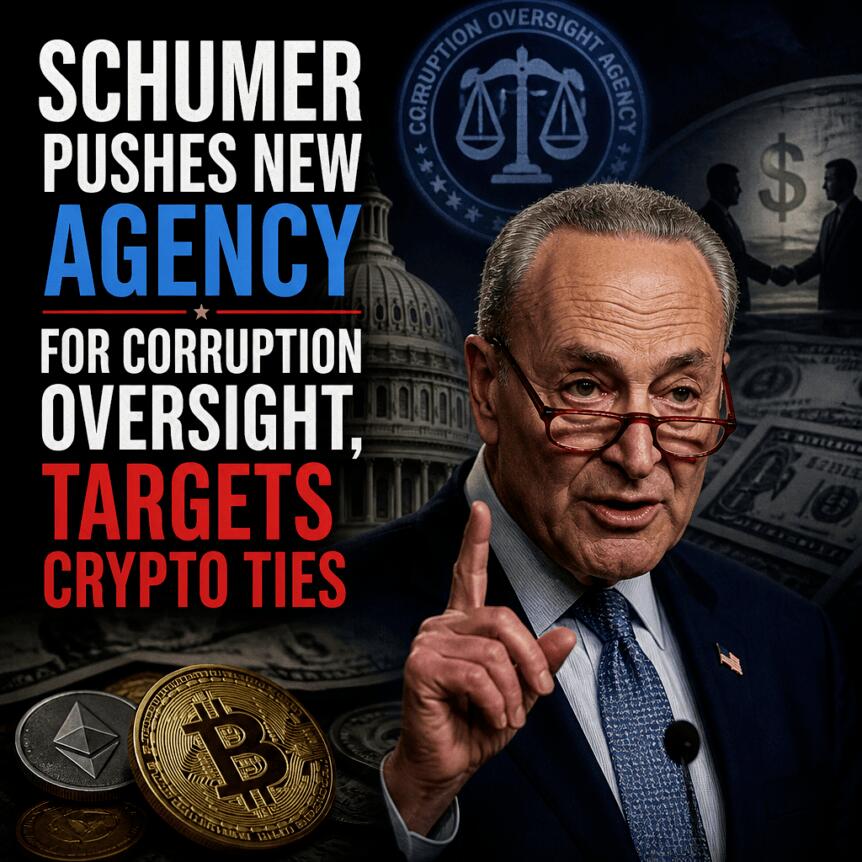
Senate Minority Leader Chuck Schumer has introduced new federal legislation aimed at creating an “Anti-Corruption Bureau” with the power to investigate, enforce, and prevent executive-branch corruption. The proposal also folds into a wider political fight over cryptocurrency ethics and market-structure reform, as Schumer’s remarks directly referenced President Donald Trump’s financial ties to crypto.
According to Schumer’s office, the bill—called the Anti-Corruption Bureau Creation Act—would establish a new agency designed to replace what he described as a fragmented system of oversight bodies. Schumer and cosponsors presented the effort as a targeted response to conflicts of interest they say stem from public office and lucrative crypto-related investments.
Key takeaways
- Schumer introduced the Anti-Corruption Bureau Creation Act, proposing a dedicated US agency to investigate, enforce, and prevent executive-branch corruption.
- The bill’s rationale ties to alleged Trump-linked financial gains, including references to crypto exposure mentioned in Schumer’s Thursday notice.
- Schumer’s proposal would consolidate multiple ethics and oversight functions, grouping entities including the Federal Election Commission and other government ethics offices “under one roof.”
- Supporters position the bureau as a “real teeth” enforcement mechanism, while passage could still face hurdles in the House and Senate—and a potential veto by Trump.
- The timing overlaps with ongoing uncertainty around the Senate’s handling of the Digital Asset Market Clarity (CLARITY) Act, a major market-structure effort backed by many in the industry.
A new enforcement-focused anti-corruption bureau
In a Thursday press notice, Schumer said he introduced the Anti-Corruption Bureau Creation Act. He described the agency as one with enforcement authority, designed to “investigate, enforce, and prevent executive branch corruption.” The legislation also sets out “Congress’ findings” that Schumer claims include disclosures about Trump’s earnings from investments and additional crypto exposure connected to foreign governments through a family fund, as referenced in Schumer’s notice.
Schumer framed the proposal as an institutional fix. In remarks shared through a Public Citizen forum about the bill, he characterized the bureau as having “real teeth” and argued it would help harmonize enforcement across institutions that currently operate with overlapping or inconsistent authority.
The bill’s structure, as described in connection with the forum, calls for a bipartisan group of seven members to be confirmed by the Senate. It also includes mechanisms intended to allow private citizens and state authorities to seek recovery of funds they allege were stolen through corruption, according to descriptions tied to the proposal.
How crypto ethics enters the political equation
For Democrats weighing support for comprehensive crypto market structure legislation, President Trump’s business ties have become a central flashpoint. Many lawmakers, despite White House agreement to certain ethics provisions in the Digital Asset Market Clarity (CLARITY) Act, have argued that the offered safeguards do not fully address potential conflicts of interest.
Earlier coverage from Cointelegraph noted that debates around the CLARITY Act have kept ethics provisions at the center of discussions, with lawmakers saying the measures fall short. Schumer’s new anti-corruption bill adds a separate enforcement pathway to that same broader argument: that oversight should be strengthened to prevent public office from translating into private financial benefit, including in crypto-related business interests.
Consolidating enforcement and ethics offices
A notable feature of the anti-corruption proposal is its intent to gather multiple oversight functions under one organizational umbrella. As described in the coverage, the legislation would place the US Federal Election Commission, the Office of Government Ethics, and the Office of Special Counsel “under one roof” within the new bureau.
Supporters argue the consolidation would reduce the gaps they believe exist across current watchdog systems. Schumer’s messaging emphasized replacing “a broken patchwork of watchdogs” with a single agency capable of acting “anywhere, anytime corruption strikes.” Critics of the current system—particularly those focused on ethics enforcement—often point to jurisdictional complexity and uneven prioritization across agencies; this bill attempts to address that by reorganizing responsibilities rather than relying solely on incremental reforms.
Cointelegraph reported that it reached out to the White House for comment but did not receive an immediate response regarding the proposal.
Cosponsors, vote math, and what happens next
The bill was introduced by Schumer and has cosponsors including Senators Andy Kim, Alex Padilla, and Jeff Merkley. Passage would require Republican support in the House and Senate, where the party holds a slim majority.
Even if it advances before 2028, the president would have veto power. If Trump vetoed the legislation, Congress would need a two-thirds majority in both chambers to override it, according to the rules typically governing federal veto overrides.
The timing is also important because the Senate is approaching a break. As described in the coverage, the Senate had just over a week left before lawmakers planned to leave for a month-long state work period. That looming calendar could affect the speed at which both ethics-related and market-structure measures move in the upper chamber.
CLARITY Act uncertainty persists alongside the anti-corruption push
While Schumer’s anti-corruption proposal targets executive-branch conduct, it arrives in the midst of unresolved negotiations around the CLARITY Act, which many see as a key step toward a clearer US framework for digital assets.
As of Thursday, the Senate had not scheduled a vote on the CLARITY Act, despite pushes from Republican lawmakers and industry stakeholders. Cointelegraph previously highlighted that ethics provisions remain a sticking point for some Democrats, and this week’s status underscores how procedural timing may be just as decisive as policy design.
According to remarks attributed in the coverage to former SEC official John Reed Stark, after a public forum hosted by Senators Richard Blumenthal and Chris Van Hollen, it was unclear whether lawmakers would move the CLARITY Act during the available window. The same report cited statements from Coinbase CEO Brian Armstrong referring to the bill nearing a critical stage, alongside continued advocacy from Senator Cynthia Lummis for a vote.
The political sequence matters for market participants: if crypto market structure legislation is delayed by calendar constraints, lawmakers may re-focus on broader political disputes about ethics and enforcement, potentially reshaping what “safe enough” looks like for legislators and regulators. Conversely, if the CLARITY Act advances, it could clarify the legislative pathway for industry—while leaving ethics and anti-corruption reforms to run in parallel.
For now, investors and builders should watch two developments closely: whether the Senate schedules and votes on the CLARITY Act before its break, and whether Schumer’s anti-corruption bureau proposal gains traction early enough to overcome House and Senate vote hurdles and any eventual veto risk.

Haiti starts to register voters in violent capital and beyond in push for general elections

FCC bans certain foreign-made robot vacuums under new security rules

Coinbase (COIN) sinks 5% after missing Q2 revenue estimates


-

 Fashion6 days ago
Weekend Open Thread: Brooks Brothers
-
 Sports4 days ago
Commonwealth Games boxing: Jadumani Singh seals dominant 5-0 win over Pakistan’s Sumama Rehman to enter quarter-finals | Commonwealth Games News
-

 Business1 day ago
Why Trees Belong on the Risk Register
-

 Tech4 days ago
Intel is reversing course and bringing hyper-threading back to its server chips
-

 Crypto World5 days ago
Ripple bought a bank in pieces. The $4 billion audit
-

 Politics3 days ago
Luke Littler dismantles Gerwyn Price to retain title in Blackpool
-
 Entertainment6 days ago
A New Post-Apocalyptic Gundam Anime Series Blasts Into SDCC
-

 Politics3 days ago
The Part of the Electric Transition Nobody Wants to Discuss
-

 News Videos4 days ago
BITCOIN JUST ENTERED THIS CRITICAL ZONE…
-

 Fashion7 days ago
16 Dresses for the High Summer Event
-

 Sports7 days ago
2026 3M Open leaderboard: Scottie Scheffler finds putter in Round 1, sits three back
-

 Business2 days ago
Major shareholder moves on Canyon
-

 Crypto World5 days ago
XRP Ledger adds $2.6B as RWA inflows rank second
-

 Politics4 days ago
Spain sweeps the board at 2026 World Cup with individual awards
-

 News Videos10 hours ago
Bitcoin Enters the 3rd Stage of the Bear Market
-
 Entertainment2 days ago
‘Stargate’ Creator’s New Sci-Fi Series Returns for Season 3 Tomorrow
-

 Tech6 days ago
Anthropic launches Claude Opus 5, a cheaper AI model for coding, agents and enterprise workflows
-

 Crypto World2 days ago
Kraken Enables Retail Access to Jersey Mike’s IPO via Tokenized Shares
-

 Entertainment5 days ago
Sara Gilson Killed By Husband After Viral “Pedophile” TikTok Video
-

 News Videos2 days ago
Claude: Build Financial Dashboards in Minutes (2026)
You must be logged in to post a comment Login