

Crypto World
CASHCAT’s $226M question as NOXA launchpad goes dark



For five consecutive days, a launchpad that did not exist a month ago collected more protocol fees than Pump.fun. On its best day, NOXA took in $2.33 million while the Solana incumbent, the platform that has minted eleven million tokens and defined an entire market cycle, managed $575,500.
Summary
- NOXA briefly out-earned Pump.fun and became Robinhood Chain’s dominant launchpad before its website went offline.
- CASHCAT’s $226 million market capitalization depends less on token mechanics than on attention, discovery, and launchpad infrastructure.
- The outage did not stop CASHCAT from trading, but it threatened the interface that drives creator fees, discovery, and momentum.
- Locked liquidity protects against one kind of rug, but it does not protect a memecoin from losing attention.
- The real test is whether NOXA’s interface, fee claims, and market share recover before competitors absorb its launchpad flow.
NOXA had launched more than 60,000 tokens, captured roughly 75% of all deployments on Robinhood Chain, and pulled 267,642 unique wallets onto a network that went live on July 1. Its flagship asset, a cat themed memecoin named CASHCAT, had run to a market capitalization of $226 million.Then the website went down. It stayed down for two days.Not the chain. Not the pools. Not the tokens. The front end, the thing that made all of it legible, the interface where creators claimed fees and buyers found what was trending and the entire machinery of manufactured urgency lived. It returned an error, and it kept returning an error while the market it had built continued trading without it.
The official explanation is a Cloudflare problem. The team’s account remains active, telling users a new site is in testing and that creator fees will be claimable through the interface once it goes live. Nothing in the public record contradicts that account. Nothing in the public record confirms it either, and in a market where the base rate for launchpad tokens dying is somewhere around 98%, two days of silence from the infrastructure holding a nine figure ecosystem is not a neutral event. It is a live experiment in what a memecoin is actually worth when the machine that made it stops answering.That experiment has a number attached, and the number is $226 million.
What CASHCAT is, and why it exists
Cash Cat was the original name Robinhood’s founders considered for the company, a detail preserved in a decade old tweet from chief executive Vladimir Tenev and in an early mascot the brokerage used before it became a mainstream financial institution. When Robinhood launched its own layer 2 network on July 1, the mascot was sitting there, unclaimed, perfectly formed as a memecoin premise: the discarded name of a company now worth tens of billions, revived on that company’s own chain.
Somebody launched it on NOXA. It worked spectacularly. CASHCAT rose more than 5,530% over seven days and more than 1,400% in a single twenty four hour stretch, hitting an all time high near $0.1418 while bitcoin fell roughly 2% over the same window, which is the clearest possible evidence that nothing macro was driving it. Onchain analysts surfaced the trades that make these markets self sustaining: one wallet turned $838 into $1.05 million over twenty days, another converted $86 into $1.6 million. Tenev himself posted about the chain’s ability to host both memecoins and real world assets, and attention did the rest.
There were no exchange listings. There was no protocol upgrade, no partnership, no treasury, no roadmap, and no team in any conventional sense. There was a joke about a company’s abandoned name, deployed on that company’s chain, at the exact moment the chain became interesting. That is the entire fundamental basis of a $226 million asset, and stating it plainly is not a criticism. It is a description of the category, one that governs the whole meme coins sector and has for years. Attention was the product, and the product sold.
The launchpad that ate Robinhood Chain
NOXA’s rise is the more revealing half of the story, because it exposes how much of a memecoin ecosystem is infrastructure rather than tokens.NOXA Fun is a hybrid launchpad. Where Pump.fun runs a custom bonding curve and migrates liquidity to an open exchange at graduation, NOXA deploys an ERC-20 and adds single sided liquidity to a Uniswap V3 pool in one transaction, making the token tradable on a public exchange from its first block. The liquidity position is locked permanently in a locker contract that never moves and cannot be pulled, which removes the classic liquidity drain rug and eliminates the migration window that has historically been the riskiest moment in a bonding curve launch. On its own terms the design is more conservative than the model it competes with, and understanding why requires knowing how liquidity pools and automated market makers actually work.
The platform layered on protections as it scaled: anti-vampire measures, anti-bundling detection, multi wallet controls, iterating fast enough that observers noted it week by week. Its native token, deployed on a different chain entirely and pending migration, carried a fully diluted valuation of $11 to $12 million after the team burned about 40% of supply, against $11 million in cumulative fees across four days. Pump.fun’s fully diluted valuation, for comparison, sits near $1.5 billion.
That gap is the valuation paradox the market has been arguing about all week. A platform earning at the rate of the category leader, valued at under 1% of it. There are three readings and they cannot all be right. The bullish one says the market has not repriced yet and NOXA is the most obvious mispricing on any chain. The structural one says fee run rates from a chain in its second week are not a business, they are a spike, and pricing a spike at Pump.fun multiples would be insane. The dark one says the discount is the market’s estimate of how likely the whole thing disappears.
Two days of downtime moved that argument out of theory.It is worth noting how quickly the market found the argument in the first place. Traders were circulating the fee-to-valuation gap within days of NOXA’s rise, framing it as an obvious mispricing against Pump.fun. That enthusiasm is itself information: a discount this visible on an asset this liquid is rarely a gift. Markets price launchpad tokens cheaply for the same reason they price mining stocks cheaply during a boom, because everyone can see that the current rate of extraction has nothing to do with the durable rate.
The mechanics of a two week fee explosion
The scale of what NOXA collected deserves unpacking, because the number is doing something other than what it appears to do.Launchpads earn on activity. A creation fee when a token deploys, a share of trading fees on every swap through the pool, and in NOXA’s structure, fees flowing from Uniswap V3 positions at the 1% tier that the platform’s tokens use. None of that revenue depends on any token succeeding. It depends only on churn, and churn is exactly what a brand new chain with a retail audience and 19,000 daily deployments produces in abundance. Across four days the platform booked roughly $11 million against a token valued at $12 million, which reads as an obvious arbitrage until you ask the question underneath: is that four day rate a business or a weather event?
The comparison to Pump.fun cuts both ways here. Pump.fun’s $1.5 billion valuation rests on two years of proven durability across multiple attention cycles, a graduated exchange of its own, a completed billion dollar token sale, and a fee base that survived the collapse of the memecoin mania that created it. NOXA has a fortnight, on a chain with a fortnight, in the single most favorable conditions any launchpad will ever see: a novel network, a mainstream brand halo, no competitors holding entrenched positions, and a flagship token running 5,000% in a week. Annualizing that is not analysis. It is extrapolation from a peak.
Which is why the outage is such an efficient test. If the fee run rate was a business, it survives two days offline and resumes. If it was a weather event, the two days are the whole event, and the rate never returns because the conditions that produced it were never repeatable. The market gets its answer within a week, and it gets it cheaply, which almost never happens in this asset class.
What the outage actually threatens
Here is the part that matters for CASHCAT holders, and it is more subtle than it first appears.The tokens are fine. That is not a reassurance; it is a technical fact with sharp edges. CASHCAT is an ERC-20 on Robinhood Chain, trading against a Uniswap V3 pool whose liquidity is locked in a contract that operates whether or not anyone can load a website. Uniswap does not need NOXA. The chain does not need NOXA. Any wallet can interact with the pool directly, and any aggregator can route to it without the launchpad’s involvement or permission. In the strict sense, a launchpad outage cannot touch the assets it launched, and anyone claiming CASHCAT holders are trapped has confused the interface with the market.
What the outage threatens is everything around the token. Creator fees accrue through the platform, and the team’s own statement acknowledges that claiming them requires the interface, meaning revenue owed to thousands of token deployers currently sits behind a domain that does not resolve. Discovery collapses without the front end: new tokens launch elsewhere, existing tokens lose the trending feeds and progress bars that manufacture the urgency these markets run on. And the flywheel reverses. Onchain data already showed new memecoin creation on Robinhood Chain climbing past 19,500 in a day while competing launchpads including flap.sh, trensh.today, and bankr absorbed share that NOXA could not defend from behind an error page.
So the honest framing of the risk is not that CASHCAT stops trading. It is that CASHCAT stops mattering. A memecoin’s value is the attention flowing through it, the attention is manufactured by an interface, and the interface has been offline for the two most valuable days a two week old ecosystem will ever have.
Is this a rug?
The question is being asked openly, and it deserves a rigorous answer rather than a vibe.Take the case for calm first. The team is publicly communicating during the outage, which is close to disqualifying as rug behavior: the defining feature of an exit is silence, deleted accounts, and vanished channels, not status updates about a staging environment. Liquidity is locked by design and cannot be withdrawn, so the single most common rug mechanism is architecturally unavailable here. The platform burned 40% of its own token supply days before going dark, an odd move for anyone planning to sell the rest. Cloudflare outages are real, routine, and have taken down far larger properties than a two week old launchpad. And the underlying economics are absurd for an exit: a platform earning millions in fees per day has vastly more to gain from staying online than from disappearing with whatever sits in a fee contract.
Now the case for concern. Two days is a long outage for an infrastructure problem that the operator attributes to a third party content delivery network, and it is exactly as long as it takes for competitors to take a market. Creator fees being unclaimable during the outage means real money is unreachable for real users, whatever the cause, and the promise to make them claimable “once the new site goes live” converts a technical failure into a trust exposure with no deadline attached. The platform’s own token lives on a different chain pending migration, which is an added moving part at precisely the wrong moment. And the category’s history is unkind: the industry’s canonical rug taxonomy distinguishes hard rugs, where developers vanish, from soft rugs, where involvement gradually decays while the thing quietly dies, and soft rugs look exactly like an infrastructure problem that never quite resolves.
The evidence, weighed honestly, favors the boring explanation. A team executing an exit does not typically burn its own supply, lock its liquidity permanently, post status updates, and abandon a business printing seven figures a day. But the market is not pricing the probability of a rug. It is pricing the probability of irrelevance, which is a different and much higher number, and two days offline in a launchpad war is how irrelevance starts.
There is also a category error worth naming, because it is corrupting the discourse around this. A rug is an act by an identifiable party who takes something they controlled and should not have taken. A collapse is a market outcome in which nobody did anything wrong and the money disappears regardless. Memecoin markets produce collapses at overwhelming rates without any fraud involved, which means most tokens that go to zero were never rugged, they were simply correct valuations of nothing arriving on schedule. Applying the word rug to a launchpad outage flattens that distinction and, more practically, sets holders up to look for the wrong evidence. They watch for a villain when the thing actually killing their position is indifference.
What would settle it is specific and observable. Watch whether the new interface ships and creator fees actually become claimable. Watch whether NOXA’s fee share recovers or whether flap.sh and its peers keep the ground. Watch the team’s wallets. Watch whether Robinhood Chain’s daily token creation stays near Solana’s or reverts once the novelty burns off. None of those require trusting anyone’s statement.
What the numbers actually say about the ecosystem
Look past the fees at the composition of the activity, and a less flattering picture emerges.More than 60,000 tokens launched through NOXA. Of those, the platform’s own interface displays a handful with meaningful market capitalizations, headed by CASHCAT, with the rest of the visible field clustering in the hundreds of thousands or low millions and the long tail invisible entirely. Peak single day volume of $252.9 million across the platform, with a single project accounting for $224 million of a comparable day, means the flagship was not one asset among many. It was the market, and everything else was noise around it.
That concentration is the ecosystem’s actual risk profile. A launchpad whose fee base is one token’s trading is not a platform, it is a single asset’s plumbing, and its revenue lives or dies with the attention on that one asset. The 640,000 unique holder addresses and 267,000 wallets NOXA brought onto Robinhood Chain are impressive as a distribution achievement and mostly irrelevant as a durability signal, because holders of a token that ran 5,000% in a week are not users, they are a queue.
None of this is unique to NOXA. It describes Pump.fun’s first year, Four.Meme’s ascendancy, LetsBonk’s arrival, and every launchpad that has ever briefly topped a fee chart. What is unique here is the timing: a platform reached that concentration and then lost its interface, in the same fortnight, on a chain that had no proven alternative for anyone to fall back to. The stress test arrived before the structure was finished.
The dependency nobody priced
Strip the specifics away and the CASHCAT situation exposes a structural feature of this entire market that the fair launch ideology obscures.
The pitch for permissionless launchpads is that they remove intermediaries. No gatekeepers, no vetting, no company standing between a creator and a market. Bonding curves and locked liquidity mean the platform cannot rug you, which the industry has treated as the end of the argument about platform risk.
It is not. The platform cannot take your tokens, and it does not have to. It can simply stop generating the attention that gives them value, and the tokens will die exactly as thoroughly as if it had drained the pool. Locked liquidity protects the mechanism and does nothing for the market. A permanently locked Uniswap position holding a token nobody is looking at is a monument, not an asset. The lock guarantees you can always sell. It guarantees nothing about whether anyone will be there to buy, and those are the only two facts that matter, in that order.
This is the same lesson that keeps arriving in different costumes. When a DAO’s treasury drained through a governance process working exactly as designed, the failure was not in the code, a dynamic crypto.news traced in detail in its account of how BonkDAO lost $20 million in a single vote. When BNB Chain’s Four.Meme briefly flipped Pump.fun on daily revenue, the lesson was that launchpad dominance is a function of where attention currently lives and nothing more durable than that. Infrastructure risk in crypto is rarely custodial. It is attentional, and no audit measures it.
CASHCAT holders own an asset with permanently locked liquidity on a chain backed by a publicly traded brokerage, launched through a platform with better rug protections than the category leader, and every one of those facts is true and none of them answers the only question that determines their outcome, which is whether anyone is still looking in a month.
Robinhood’s problem, arriving on schedule
There is a second party to this that has said nothing, and its position gets more uncomfortable by the day.Robinhood Chain launched as infrastructure for onchain finance and real world asset tokenization. What it got in its first fortnight was a memecoin casino, more than $3 billion in decentralized exchange volume, honeypot tokens proliferating fast enough that cross chain provider Relay Protocol began publicly blocking them, and a scam token that used the hijacked accounts of SpaceX and Starlink to rob buyers on its rails, an episode that arrived within weeks of SpaceX joining the Nasdaq-100 with its trade already running on crypto rails. NOXA, the largest single application on the chain, states plainly in its own interface that it is an independent project not affiliated with Robinhood Markets.
That disclaimer is doing an enormous amount of work. It is legally accurate and commercially irrelevant. A retail brokerage’s brand is on the chain, retail users are the audience, and the flagship asset of the ecosystem is literally named after the company’s original name and modeled on its own former mascot. Robinhood did not build CASHCAT, did not endorse it, and under the architecture it chose, cannot remove it. It will nonetheless own every consequence in the public reading, and its silence through both the SCATMAN affair and the NOXA outage suggests a company that has not decided what it wants to say, or has decided that saying anything invites the responsibility it structured the chain to avoid.
The permissionless design that made the chain’s launch explosive is the same design that makes the next fortnight unmanageable. That is not a contradiction anyone has solved, on any chain, including the ones without a brokerage’s name on them.
Where this lands
Three outcomes are live, and the market is currently paying for the middle one.NOXA returns, ships the new interface, unlocks creator fees, and reclaims its share. The outage becomes a footnote, the valuation paradox resolves upward, and CASHCAT trades on whatever attention Robinhood Chain retains once its novelty is priced. This is the likeliest single outcome and the least interesting.
NOXA returns and the market has moved. The fees flowed to flap.sh and the rest during the blackout, the trending feeds rebuilt themselves elsewhere, and NOXA is a large historical fee number attached to a platform nobody defaults to anymore. CASHCAT survives as an artifact of a moment, drifting on whatever residual community persists. This is the outcome that history most often delivers, because attention is the least loyal asset in this market and switching costs between launchpads are effectively zero. A creator chooses a platform in seconds and abandons it just as fast.
NOXA does not return in a form anyone trusts. The creator fees stay unclaimed, the explanation stays thin, and a two week old chain learns that its dominant application was a single point of failure with a status page. CASHCAT’s locked liquidity keeps a market technically alive at a price that reflects nobody caring.
The tokens survive all three scenarios. That is precisely the point that the fair launch pitch never quite says out loud: survival of the contract and survival of the value are unrelated propositions, and the second one depends entirely on infrastructure that owes its users nothing and can go dark for two days without breaking a single promise it ever made.The $226 million question is not whether CASHCAT can still be traded. It is whether $226 million was ever a fact about the token, or a fact about the launchpad, briefly measured through it.
Disclaimer: This article is for informational purposes only and does not constitute investment advice. Figures on protocol fees, token counts, market capitalizations, and wallet activity derive from third party sources including DefiLlama, Dune, Lookonchain, and platform interfaces, not from audited disclosures. No rug pull has been confirmed and the platform attributes its outage to a third party service failure. Details reflect information current as of July 14, 2026, and are subject to change. Always do your own research.

Just a few short years ago, the crypto hype was strong. VCs were eager to pour money into solutions for scalability, data availability, and any number of buzzwords.
Since then, the advent of powerful AI models and prolonged bear markets have taken the wind out of crypto’s sails and many chains which promised the future are now as good as forgotten.
One keen-eyed X user, crypto marketer Stacy Muur, noted the staggering $500 million invested across six blockchain projects which, together, have produced a total of just $360 in blockchain fees in the past 24 hours.
Read more: AscendEx shutdown: Uncertainty over withdrawals as hot wallets lack funds
The claim caught Protos’ eye, so we took a look at the six companies to see where it all went wrong.
Berachain
Berachain is a blockchain born as a spinoff of the 2021-era Bong Bears NFT collection. It claims to be the first proof-of-liquidity based chain, and aims to be a “growth engine for onchain businesses.”
The project raised a total of $142 million across two rounds in 2023 and 2024.
However, according to its most recent EoY statement, the project has struggled amidst issues with sentiment, shrinking crypto-native TAM and “increased skepticism around the value of infrastructure as a whole.”
Since launching in early 2025, its BERA token is down 98%.
Berachain was among the networks caught up in November’s devastating Balancer hack, leading validators to temporarily halt the network.
Later that same month, it was revealed that one of the backers, Brevan Howard’s Nova Digital, was granted a one year, risk-free refund right on its $25 million investment.
Read more: Balancer exploit drains $129M in DeFi disaster
Celestia
Celestia was seen as a hot ticket back in 2023 when “data availability” was the buzzword du jour.
Part of the Cosmos ecosystem, it promises bespoke, high throughput, modular chains “for companies with internet-scale traffic.”
It raised first $1.5 million in 2021, a further $50 million in 2022 and finally $100 million in 2024.
Its much-hyped token launch was one of the first rays of light following a deep bear market sparked by the catastrophic crypto collapses of 2022.
Despite initially surging around 10x in its first months to an all-time high of over $20, TIA eventually bled approximately 98%, sitting today at $0.40.
Scroll raised a total of $83 million over three funding rounds, the latest of which brought the Ethereum L2 to a $1.8 billion valuation in March 2023.
It made just $24 in fees yesterday.
The zkEVM layer two hit a peak TVL of $585 million as users enthusiastically farmed an ultimately disappointing airdrop. In the aftermath, the network lost around 75% of its TVL within a couple of months.
There’s currently just under $12 million on the chain.
Eclipse
Eclipse billed itself as “Solana on Ethereum,” an SVM layer two network which would pair Solana’s performance with Ethereum’s liquidity.
Developer Eclipse Labs raised a total of $65 million, most of which came in a $50 million Series A, led by Placeholder and Hack VC, in March 2024.
DeFiLlama data shows the chain’s TVL peaking at almost $50 million in late February last year. It’s currently down to just $1.15 million, a drop of approximately 98%.
The project’s most recent blog post is from a year ago, announcing the launch of its token ES, and an airdrop. Eclipse Labs has since pivoted to development of The Human API, a marketplace for AI agents to hire humans.
Sonic
Launched as Fantom by controversial developer Andre Cronje, founder of DeFi stalwart Yearn Finance, the fast, low-cost network migrated to Sonic in 2024. It raised a total of $61 million across six rounds between 2018 and 2024, according to ICODrops.
As Fantom, it took a hit in the Multichain debacle, with many bridged assets depegged from their native versions.
Fantom’s peak TVL reached a staggering $7.9 billion in 2022 and now sits at just under $5 million. Sonic’s hit $1.2 billion last spring, but has since dropped to $16 million.
Cronje’s involvement with Sonic terminated last month and he’s spent much of the last 18 months building Flying Tulip.
Read more: Andre Cronje says someone stole his code to build a $1B DeFi project
Manta
ZK-focused Manta raised a total of $60 million across four rounds between 2021 and 2023.
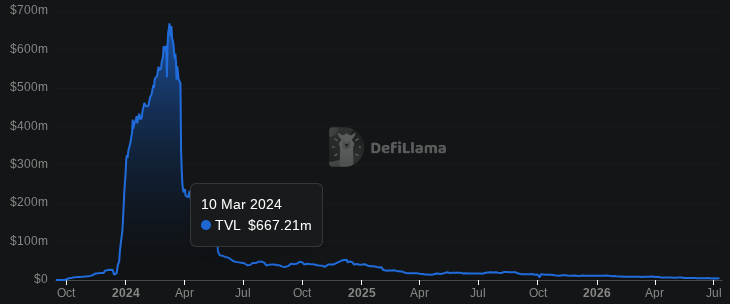
Its TVL chart is dramatic, highlighting an intense, heavily gamified airdrop campaign, which saw over $650 million poured into the chain.
Just a few weeks before its peak, TVL sat at under $20 million. Likewise, within four months, it was back below $50 million once again. Today, just $4 million is held on the chain.
Got a tip? Send us an email securely via Protos Leaks. For more informed news and investigations, follow us on X, Bluesky, and Google News, or subscribe to our YouTube channel.


The United Kingdom has set an early 2027 target to issue its first digital sovereign bond on distributed-ledger infrastructure, becoming the first G7 country to launch government debt in tokenized form.
Summary
- The UK plans to issue its first blockchain based sovereign bond by early 2027 through HSBC’s Orion platform.
- The Digital Gilt Instrument will operate inside the Bank of England and FCA Digital Securities Sandbox.
- The move comes as the UK expands cooperation with the US on stablecoins, tokenized assets and cross border financial markets.
According to Chancellor Rachel Reeves, who announced the plan during her annual Mansion House speech, the government intends to follow the first issuance with additional digital gilt sales if the pilot progresses as expected.
The Digital Gilt Instrument, or DIGIT, will be a sterling-denominated government bond issued on HSBC’s Orion blockchain platform. It will operate within the Bank of England and Financial Conduct Authority’s Digital Securities Sandbox, a testing environment created for digital securities.
The Treasury introduced the pilot in 2024 to examine whether distributed-ledger technology could shorten settlement times, reduce reconciliation work and lower operating costs across government debt markets. HSBC secured the mandate to operate the platform in February after issuing more than $3.5 billion of digital bonds through Orion.
Speaking at the same event, Bank of England Governor Andrew Bailey said the central bank will work toward making DIGIT eligible as collateral in its market operations. According to Bailey, that step could support tokenized repurchase agreements while allowing banks to use the security in central bank funding transactions.
The Treasury has not disclosed the size, maturity, coupon, investor eligibility, or settlement asset for the bond. Officials said the initial issuance will sit outside the government’s conventional gilt financing program.
Digital bond plans follow tokenization push
The planned bond sale comes as the UK expands its work on tokenized financial markets beyond pilot projects.
Earlier this week, the UK and the United States published a joint statement committing to closer cooperation on stablecoin regulation, cross-border payments and tokenized finance through the Transatlantic Taskforce for Markets of the Future.
According to the joint statement, both governments plan to explore how regulated stablecoins issued in one country could access the other market while maintaining separate domestic regulatory frameworks. The two countries also agreed to seek common approaches for tokenized securities settlement and examine whether stablecoins or tokenized money market funds could serve as collateral in clearing markets.
The statement said stablecoins presented as money should maintain at least a one-to-one backing with high-quality liquid assets, while reserve assets should remain separate from issuers’ corporate funds. Officials also said holders should receive timely redemptions and clear legal protections if an issuer fails.
Although the stablecoin agreement does not create automatic market access or mutual recognition, it outlines a framework for regulators to reduce unnecessary barriers to cross-border tokenized financial services while each country completes its own regulatory process.


Key takeaways
- Solana (SOL) has rebounded above its 50-day EMA at $76.82 after a 4% rally.
- Rising futures trading volume and positive funding rates point to growing bullish sentiment among retail traders.
- Solana ETFs have recorded two consecutive days of zero inflows, signaling muted institutional demand.
Solana (SOL) extended its recovery on Wednesday, climbing above its 50-day Exponential Moving Average (EMA) after gaining roughly 4% in the previous session.
The rebound comes as improving sentiment across the cryptocurrency market encourages renewed retail participation, while institutional investors remain cautious despite the broader market rally.
Retail traders return to Solana futures
Recent derivatives data suggests retail traders are becoming more optimistic about Solana’s short-term outlook.
According to CoinGlass, SOL futures open interest has remained stable at approximately $4.91 billion over the past 24 hours, indicating traders are maintaining existing leveraged positions rather than exiting the market.
Meanwhile, futures trading volume jumped 15% to around $6.90 billion, reflecting stronger market activity and continued position building.
Adding to the positive outlook, Solana’s funding rate remains in positive territory at approximately 0.0040%, suggesting traders are willing to pay a premium to maintain long positions—a sign that bullish sentiment is strengthening among retail participants.
While retail activity has improved, institutional demand has yet to show similar strength.
Data from SoSoValue indicates that Solana exchange-traded funds (ETFs) have recorded two consecutive trading sessions with zero net inflows this week.
The lack of fresh ETF investment suggests traditional investors are adopting a wait-and-see approach despite the recent rebound in cryptocurrency prices.
This divergence between retail enthusiasm and institutional caution could influence the sustainability of Solana’s recovery.
Solana price analysis: $81.50 remains key breakout level
From a technical perspective, Solana has strengthened after reclaiming its 50-day EMA at $76.82.
The token is also trading above the 50% Fibonacci retracement level at $76.92, measured from the decline between $98.41 and $60.13, reinforcing the improving short-term structure.
However, SOL continues to face significant resistance from a descending trendline positioned near $81.50, while the 200-day EMA at $94.52 remains a major long-term barrier.
A decisive daily close above $81.50 would confirm a breakout from the prevailing downtrend and could trigger a move toward the $88.56 resistance and the 200-day EMA at $94.52.
Technical indicators suggest bullish momentum is slowly building. The Relative Strength Index (RSI) is hovering around 54, indicating modest buying pressure without entering overbought territory.
Meanwhile, the Moving Average Convergence Divergence (MACD) is approaching a bullish crossover near its signal line, reflecting a neutral-to-positive momentum shift that could support additional upside if buying pressure continues.

If Solana encounters renewed selling pressure, traders will likely monitor the following support levels:
- 50-day EMA: $76.82
- Previous ascending trendline: $68.88
- Cycle low: $60.13
Holding above the 50-day EMA would help preserve the current recovery, while a break below it could expose SOL to a deeper pullback toward the lower support zones.
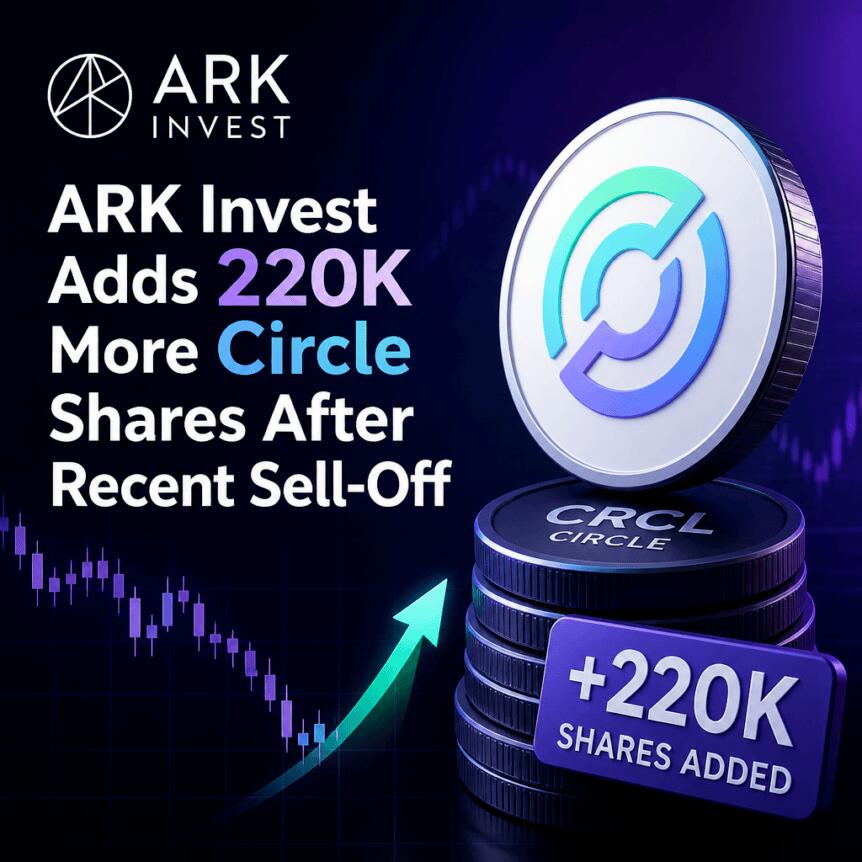
Cathie Wood’s ARK Invest is continuing to add to its position in Circle Internet Group, the company behind the USDC stablecoin, even as Circle’s stock remains in a long slump.
According to ARK’s daily trade disclosures reviewed by Cointelegraph, the firm bought an additional 220,000 shares of Circle across three actively managed exchange-traded funds on Tuesday. ARK’s most recent purchase was valued at roughly $13.9 million based on Circle’s Tuesday closing price of $63.22 on the New York Stock Exchange.
Key takeaways
- ARK Invest added 220,000 Circle shares on Tuesday, worth about $13.9 million at the NYSE close.
- Through its disclosed July buys, ARK has accumulated 725,517 Circle shares, extending a pattern of additions despite persistent share-price weakness.
- Circle represented about 4.37% of the ARK Fintech Innovation ETF (ARKF) as of Wednesday, and about 3.35% of ARK Innovation ETF (ARKK).
- Analyst 10x Research said it no longer views Circle as a buy after the stock fell back below $80, citing deteriorating fundamentals and slower USDC activity.
Another Circle buy lifts ARK’s July total
ARK’s newest transaction increased the firm’s disclosed July acquisitions to 725,517 Circle shares. The same disclosures show prior buys of 287,609 shares on July 1 and 217,896 shares on July 9.
The buys matter because they highlight a sustained commitment by ARK’s actively managed funds to its thesis on Circle’s role in regulated stablecoin infrastructure—an area where market sentiment has been volatile. Even as Circle’s equity has fallen sharply from its IPO-era high, ARK has continued to build rather than pause.
As of Wednesday, Circle was listed as the seventh-largest holding in ARK Fintech Innovation ETF (ARKF), accounting for 4.37% of the fund. The position was valued at about $33 million, based on the fund’s latest holdings data available on ARK’s official website.
Circle was also a meaningful component of ARK Innovation ETF (ARKK). It represented 3.35% of the flagship fund and ranked as the ninth-largest holding, worth about $218 million, according to ARKK holdings data on ARK’s site.
Circle’s stock under pressure, ARK keeps buying
While ARK’s trading has been steady, Circle shares have struggled. The stock was down about 22% year-to-date and roughly 76% below its post-IPO peak, setting a challenging backdrop for any incremental capital allocation.
That makes ARK’s continued additions notable: the strategy implies ARK sees enough long-term value in Circle—particularly tied to USDC’s position in the stablecoin landscape—to keep increasing exposure during a period when many investors have grown more cautious.
Still, public equity performance can diverge from broader ecosystem adoption, and stablecoin markets are influenced by a mix of regulatory outcomes, competition among issuers, and the pace of on-chain and payment activity.
Analysts warn of deteriorating fundamentals and slower USDC activity
ARK’s latest purchase came as some analysts revisited Circle’s outlook. Digital asset research platform 10x Research said it no longer considers Circle a buy after the stock declined back below $80. In a report published Tuesday, the firm explained that it previously regarded Circle as attractive below that level but now believes Circle’s fundamentals have “meaningfully deteriorated.”
10x Research also pointed to slower USDC activity as a key concern, including a decline in active addresses. While stablecoin usage metrics can fluctuate for a variety of reasons, a sustained slowdown in users interacting with USDC could weigh on expectations for Circle’s growth.
The stablecoin market data adds further context. According to CoinGecko, USDC’s market capitalization had declined roughly 3% year-to-date to $73 billion at the time of publication, though it remained about 17% higher than a year earlier. In other words, USDC’s market size is still larger than it was a year ago, but the near-term trajectory has weakened.
10x Research also left room for two competing interpretations: the recent drop in Circle’s share price could represent a long-term buying opportunity, or it could signal the start of a more prolonged downturn. That uncertainty reflects the broader challenge in assessing equity risk around stablecoin issuers—investors must separate temporary market drawdowns from longer-term changes in transaction demand, regulatory clarity, and competitive dynamics between different stablecoins.
What to watch next for ARK, Circle, and USDC
For investors tracking this story, the immediate focus should be whether Circle can reverse the factors cited by analysts—particularly USDC activity levels—and whether ARK’s continued buying is mirrored by broader capital flows into Circle or remains idiosyncratic. Given how sharply sentiment has swung, the next reports and on-chain usage trends around USDC will likely carry outsized importance.
Crypto World
Crypto News, July 15: Bitcoin and Ethereum Price Jump on Softer CPI and Japan Bitcoin ETF

Bitcoin and Ethereum price climbed after cooler-than-expected U.S. inflation data improved market sentiment. Just hours after, a Japan Bitcoin ETF bill cleared a major committee in the country’s Upper House, raising expectations that spot Bitcoin exchange traded funds could eventually reach Japanese investors. The combination of easing inflation and friendlier regulation gave crypto traders another reason to stay bullish.
Japan’s proposal would classify cryptocurrencies as financial instruments under the Financial Instruments and Exchange Act while lowering crypto taxes to a flat 20%. If passed into law, the framework could allow spot Bitcoin ETFs to launch on the Tokyo Stock Exchange by 2027.
Elsewhere, South Korea advanced plans recognizing virtual assets within national asset rules, while policymakers in India, Europe, and the United States continued debating crypto regulation.

Don’t Miss Out on Our $1,000 USDT Airdrop on ByBit
Japan Bitcoin ETF Sparks Fresh Price Optimism
The Japan Bitcoin ETF proposal has quickly become the day’s biggest story. After years of cautious regulation, lawmakers are now considering a framework that brings digital assets closer to traditional financial markets. Lower taxes and the prospect of regulated investment products could attract both institutional and retail capital once the legislation clears the remaining stages.
— Coin Bureau (@coinbureau) July 15, 2026
 BREAKING: Japan advances landmark bill to legalize Bitcoin ETFs.
Japan’s Upper House committee has approved legislation to reclassify bitcoin and other cryptocurrencies as financial instruments, paving the way for spot crypto ETFs as early as 2027.
The proposal would also… pic.twitter.com/VzTbAUcBBm
Outside Japan, governments are moving at different speeds. India’s Finance Ministry is pushing regulators to strengthen oversight without appearing to endorse cryptocurrencies.
Meanwhile, a joint U.S.-U.K. task force called for greater stablecoin innovation, and banks continue to discuss amendments to the CLARITY Act before lawmakers meet later this week. Europe is also pressing ahead with its Digital Euro pilot.
Markets welcomed the shifting backdrop as Bitcoin price briefly touched above $65,000 before easing back toward the mid $64,000 range. Even so, the move marked a clear breakout from nearly two weeks of muted trading. Softer inflation figures encouraged investors to rotate back into risk assets after fears of additional Federal Reserve tightening faded.

Institutional demand also improved. U.S. spot Bitcoin ETFs recorded $181 million in net inflows after heavy outflows, with BlackRock accounting for the largest share. On-chain data also points to continued accumulation by large holders, suggesting long-term investors remain confident despite recent volatility. Together, stronger ETF demand and the Japan Bitcoin ETF narrative helped keep the Bitcoin price supported.
Discover: The Best Crypto to Diversify Your Portfolio
Ethereum Price Outpaces BTC as ETF Flows Improve
While Bitcoin grabbed the headlines, Ethereum quietly outperformed Bitcoin price. Ethereum recovered faster than Bitcoin and strengthened against BTC, signaling improving momentum after several weeks of weakness. Traders pointed to a healthier ETH/BTC ratio as evidence that buyers are becoming more confident.
Fresh institutional flows reinforced that view. U.S. spot Ethereum ETFs posted about $58 million in net inflows, reversing the mixed trend seen earlier this month. Morgan Stanley also updated filings tied to proposed Ethereum and Solana ETFs, naming Coinbase as custodian and staking provider. Those developments added to growing confidence around regulated crypto investment products.
The Ethereum price continued pushing toward the $1,900 level after reclaiming important technical support. Analysts say maintaining momentum above recent breakout levels could open the door to another test of psychological resistance near $2,000. At the same time, steady ETF demand remains an important tailwind.
Looking ahead, traders will closely watch incoming U.S. economic data alongside political developments in Japan and Washington. The Japan Bitcoin ETF proposal still faces additional legislative steps, yet it already marks one of the strongest pro-crypto signals from a major economy this year. If institutional inflows continue and macro conditions remain favorable, both Bitcoin and Ethereum price could have room to extend their gains.
Don’t Miss Out on Our $1,000 USDT Airdrop on ByBit
Discover: The Best Token Presales
The post Crypto News, July 15: Bitcoin and Ethereum Price Jump on Softer CPI and Japan Bitcoin ETF appeared first on Cryptonews.
Bitcoin (BTC) price is up about 3% over the past day, near $64,500, after a cooler US inflation print pushed it above a level that had capped it since mid-June.
The move keeps a two-week uptrend alive. Still, fading buying volume and a band of supply just overhead raise the question of how much further the rally can run.
Crypto Traders Are Scared While the Money Stays Calm
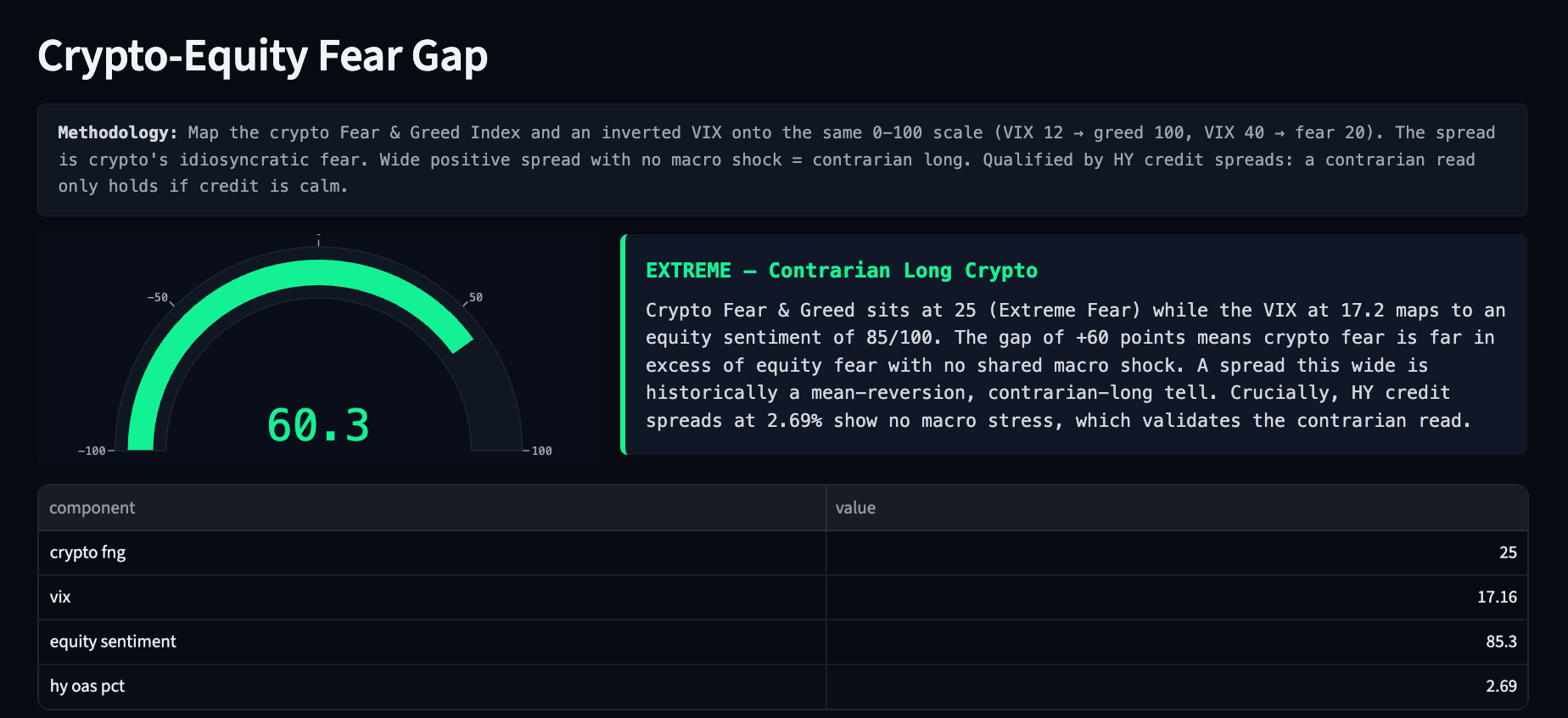
Sentiment tells a strange story. The first of two proprietary gauges built for this analysis, the Crypto-Equity Fear Gap, puts the crypto Fear and Greed Index and the stock market’s fear on one scale. Crypto now sits at 25, or “extreme fear,” while stock-market fear is low (high sentiment).
That gap is the signal. When crypto is this scared while stocks stay calm, the fear is usually specific to crypto rather than a sign of a wider crisis. That kind of isolated panic more often signals a possible Bitcoin bottom than the start of a deeper drop.

One number backs up the calm. High-yield credit spreads, a simple gauge of stress in the financial system, sit at just 2.69%. Tight spreads mean no hidden macro problem, so the fear looks overdone rather than justified.
The second proprietary gauge, the Liquidity Siphon Index, checks whether cash is physically leaving crypto for traditional finance. It reads “outflow pressure building,” as the stablecoin supply, the money that waits on the sidelines to buy, slipped 0.35% in a week while tokenization and IPO headlines pulled attention toward Wall Street.
That signal is usually strongest when stablecoins shrink and stocks rip at the same time, since money is clearly chasing the rising market. Here, though, stocks also fell about 1.2% over the stretch, so the cash is not obviously rushing into equities.

With credit spreads still calm, this is not a panic-driven flight either. It looks like a mild, benign drift (more like indecision) rather than a real exit, the kind that tends to reverse. High fear and weak flows hint at a bounce, yet neither shows whether the big players are positioned for one.
Big Traders Lean Long as Bitcoin Holds a Rising Channel
Positioning leans bullish. A gauge of Bitcoin whales versus small traders shows top accounts running about 28% more long than retail, with both groups broadly aligned rather than fighting each other. Bigger players leaning long adds weight to the case, and it echoes signs that Bitcoin’s long-term holders keep accumulating.

The chart backs them up. Since early July, Bitcoin has climbed inside an ascending channel, a band of higher highs and higher lows. After the softer inflation print, it reclaimed a prior swing high it had struggled with, a sign buyers hold control.

However, one crack shows in the move. The buying volume behind this climb has faded since the start of the month even as price rose. That split between rising price and shrinking volume warns the rally may lack fuel. The price chart shows exactly where it must prove itself.
Bitcoin Price Levels to Watch as the $66,000 Ceiling Nears
The first real test is close. To show strength, the daily Bitcoin price chart needs a close above the 0.618 Bitcoin Fibonacci level, the critical technical zone traders track for reversals, at $66,086. That sits about 2.45% above the current price.
Want more token insights like this? Sign up for Editor Harsh Notariya’s Daily Crypto Newsletter here.
On-chain data points to a similar spot. The UTXO Realized Price Distribution (URPD), a metric that maps the prices where coins last moved, shows a heavy supply cluster at $66,898 holding about 2.04% of all Bitcoin. Many holders bought there, so some may sell to break even, which suggests extra BTC resistance. Chart and chain line up on one $66,000 zone.

A daily close above that band would open the path to $67,264, then $68,764. On the downside, Bitcoin support levels start at the channel base and the $61,752 swing low, and losing the channel risks a slide toward $57,716.

One caveat matters here. The heaviest on-chain supply does not sit right on the $66,086 Fibonacci level but a little higher, near $66,898. So even if Bitcoin tags $66,086, a thicker band of coins waits just above. Only strong buying volume can carry price through both. With volume fading, the $66,086 level separates a high-volume push toward $68,764 from a stall that fades back deeper into the channel.
The post Fear, Whales and a Supply Ceiling Point Bitcoin to One $66,000 Test appeared first on BeInCrypto.
326 Wrapped Bitcoin (WBTC) tokens on Ethereum were withdrawn from exchanges in a single day. According to fresh data shared by Santiment, this is the largest net exchange outflow since early June.
This transfer of coins has reduced the amount of WBTC immediately available on trading platforms.
Exchange Outflow
The latest outflows come as Bitcoin continues to trade through a “risk-heavy stretch.” Even as the crypto asset briefly climbed to $65,000 on Wednesday, market pressure from geopolitical tensions and ETF flow swings persists, Santiment stated in its findings. The large exchange withdrawals, however, could potentially serve as a positive signal for the broader crypto market recovery. The analytics platform added,
“Wrapped Bitcoin’s 6-week high exchange outflows provide more good news to crypto’s rebound “
Wrapped Bitcoin (WBTC) was launched in 2019 following a joint initiative by BitGo, Kyber Network, and Ren. It remains the largest tokenized version of Bitcoin, with a market capitalization of about $7.6 billion. Coinbase entered the space with cbBTC in 2024, which has grown to nearly $6 billion in market value. This space has become increasingly competitive in 2026.
Last month, stablecoin issuer Circle expanded the market by launching cirBTC on Ethereum.
Recovery Near?
As for Bitcoin’s price, the crypto asset moved higher after the latest US inflation report came in cooler than expected. Consumer prices fell 0.4% in June, bringing annual inflation to 3.5%. Economists had expected a 0.2% monthly decline and a 3.8% annual rate.
Meanwhile, Bitfinex analysts said that the asset is approaching what has historically been the final stage of its typical bear market period. According to the report, the BTC often spends five to six months trading below the Short-Term Holder Realized Price before entering a broader recovery. With July being identified as the fifth month of the current cycle, analysts believe the market could be closing in on a significant rebound.
They still warned that history alone does not guarantee a recovery. While July has traditionally been a favorable month for Bitcoin, broader macroeconomic conditions will also play a crucial role.
The post Is Wrapped Bitcoin Flashing a Bullish Signal? Exchange Outflows Hit Six-Week High appeared first on CryptoPotato.


Key takeaways
- Pi Network (PI) is stabilizing above $0.07500 after more than two weeks of sustained selling pressure.
- Improving crypto market sentiment following softer U.S. inflation has boosted speculative interest in PI.
- PI open interest climbed from $9.11 million to $12.14 million, signaling renewed trader participation.
Pi Network (PI) traded above $0.07500 on Wednesday, showing early signs of stabilizing after more than two weeks of persistent losses.
The token’s recovery comes as broader cryptocurrency markets rebounded following softer-than-expected U.S. inflation data, improving investor sentiment and encouraging renewed interest in higher-risk digital assets.
Although PI remains in a broader downtrend, technical indicators suggest bearish momentum may be weakening.
Improving market sentiment boosts risk appetite
The latest U.S. Consumer Price Index (CPI) report helped ease concerns over additional Federal Reserve interest rate hikes, reducing pressure on risk assets, including cryptocurrencies.
As market sentiment improved, investors showed greater willingness to return to speculative assets such as Pi Network.
CoinMarketCap’s Crypto Fear and Greed Index rose to 35 on Wednesday from 28 on Monday, reflecting a noticeable decline in market fear and improving investor confidence.
Historically, rising risk appetite has often supported increased trading activity in speculative cryptocurrencies.
Derivatives data points to growing interest in Pi Network. According to CoinAnk, PI futures open interest increased from $9.11 million to approximately $12.14 million over the past day.
The sharp increase suggests traders are opening new positions rather than closing existing ones, indicating renewed confidence and stronger speculative demand.
While rising open interest alone does not guarantee higher prices, it often supports increased market liquidity and stronger price momentum when accompanied by improving sentiment.
Pi Network technical analysis: Can PI reclaim $0.1000?
From a technical perspective, Pi Network is attempting to build a base near $0.07500, where a descending support trendline forming part of a falling channel continues to hold.
A Doji candlestick formed near this support during the previous trading session, signaling indecision between buyers and sellers and potentially marking the beginning of a short-term reversal.
The 161.8% Fibonacci extension at $0.06793, measured from the decline between $0.1998 and $0.1183, reinforces this support zone and increases the likelihood of a technical rebound.
If buying momentum strengthens, PI could target the following resistance levels:
- $0.09613 – 127.2% Fibonacci extension
- $0.1000 – Psychological resistance level
A decisive move above $0.09613 would significantly improve the short-term outlook and increase the probability of a recovery toward $0.1000.
Although Pi Network remains within a broader bearish trend, momentum indicators suggest downside pressure may be becoming exhausted.
The Relative Strength Index (RSI) has fallen to around 21, placing the token deep in oversold territory. Such readings often indicate that selling has become excessive and that a relief rally could emerge if buyers return.
Meanwhile, the Moving Average Convergence Divergence (MACD) remains below its signal line, confirming that the broader trend is still bearish. However, the indicator also suggests bearish momentum may be weakening after the recent decline.
The most important downside support remains the 161.8% Fibonacci extension at $0.06793.

A daily close below this level would invalidate the current rebound scenario and could trigger a new phase of price discovery to the downside.
As long as PI holds above this support, the possibility of a recovery toward $0.09613 and eventually $0.1000 remains intact.


Polymarket has been blocked in the Czech Republic after authorities classified the prediction market platform as an unlicensed gambling service, adding another European jurisdiction to the list of countries restricting its operations.
Summary
- Czech authorities have given internet providers 15 days to block access to Polymarket.
- Regulators said the platform must follow gambling rules regardless of how its contracts are described.
- India, Argentina and several European countries have also taken action against Polymarket.
The Czech Ministry of Finance has ordered internet service providers to block access to Polymarket within 15 days of placing the platform on the country’s list of unauthorized internet games.
Officials argued that prediction markets operate like gambling products even when they are presented as investment tools. According to the ministry’s position, the only difference is the terminology, with bets described as “contracts” and winnings presented as “returns on investment.”
The latest move follows similar restrictions introduced in France, Germany, Romania, Spain, and Belgium. Outside Europe, regulators in New Zealand, Australia, and Brazil have also taken action against prediction market platforms.
Czech authorities reject Polymarket’s investment argument
Commenting on the decision, Jan Řehola, director of the Czech Institute for Gambling Regulation, said prediction markets should not be treated differently simply because they are presented as financial products.
“Prediction markets are not harmless technological novelties. They involve betting on real-world events, often without clear accountability to the state, without standard player-protection measures and without the rules that apply to legal gambling,” Řehola said.
He argued that changing the terminology does not alter the nature of the product.
“If something looks like a bet, functions like a bet, and allows people to win or lose money depending on the outcome of an uncertain event, we cannot stop treating it as gambling simply because it is called a contract,” he said.
Řehola added that the Ministry of Finance’s decision confirms that the same regulatory standards should apply to all operators offering betting products.
“This is not about banning innovation. It is about ensuring that the same rules apply to everyone who offers betting for money. Player protection, the prevention of money laundering, and effective market supervision must not depend on what an operator chooses to call its product,” he said.
Europe remains divided over prediction markets
While several European countries have classified prediction markets as gambling, Gibraltar recently introduced a separate regulatory framework for the sector instead of treating such platforms as either gambling products or financial instruments.
The framework was introduced after Gibraltar licensed prediction market operators ADI Predictstreet and Wire Market, becoming the first jurisdiction to establish dedicated rules for the industry.
The Czech decision extends a series of enforcement actions against Polymarket this year.
In May, India blocked access to the platform after the Ministry of Electronics and Information Technology directed internet service providers and VPN operators to restrict access to prediction market websites that authorities classified as illegal online money gaming platforms.
Argentina also ordered a nationwide block in May after a Buenos Aires court concluded that Polymarket operated outside the country’s gambling framework. Authorities there cited consumer protection concerns, crypto-based payments and identity verification standards among the reasons for the decision.
South Korea has taken a different approach. Earlier this month, the Broadcasting, Media and Communications Review Committee postponed any enforcement decision after deciding to hear Polymarket’s response before determining whether its service violates local gambling laws.
The company is also facing scrutiny in the United States, where the CFTC is investigating parts of Polymarket’s business, including its social media operations.
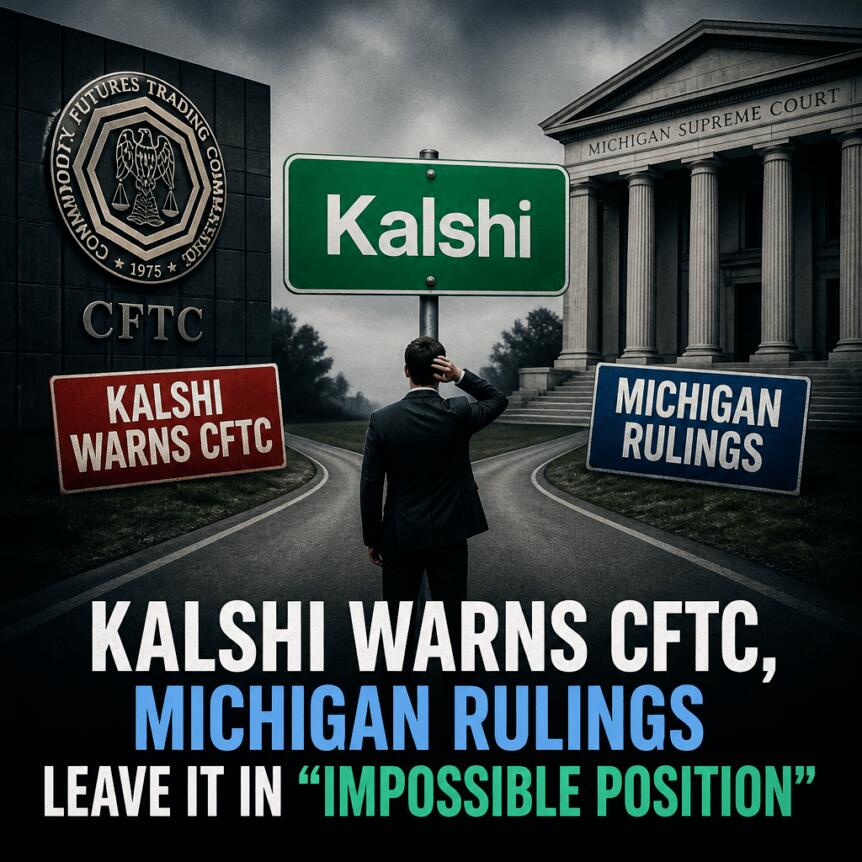
Kalshi says it has been placed in an “impossible position” after the U.S. Commodity Futures Trading Commission (CFTC) moved to prevent the prediction market platform from complying with a Michigan court order. The dispute underscores an ongoing jurisdiction fight over who can regulate prediction markets—federal authorities or state regulators—once bets are already placed and contracts are executed.
In a decision announced Tuesday, the CFTC ordered Kalshi not to follow the state directive to unwind certain trades in Michigan, according to Reuters. The pushback comes shortly after an Ingham County Circuit Court judge required Kalshi to stop offering sports betting contracts to Michigan users while litigation proceeds over whether Kalshi violated state sports betting laws.
Key takeaways
- Michigan’s court order required Kalshi to stop offering sports-betting contracts to state users and unwind already-executed trades.
- The CFTC instructed Kalshi not to comply with the state order, citing federal authority under the Commodity Exchange Act.
- Both sides frame the conflict as a question of jurisdiction—states vs. the CFTC—over prediction market derivatives.
- The CFTC warned that canceling executed trades could create broader market uncertainty.
- Kalshi said it is reviewing the federal order and weighing its next steps, citing conflicting obligations.
Michigan order vs. federal instruction
The conflict traces back to June 29, when Ingham County Circuit Court Judge Rosemarie Aquilina ordered Kalshi to cease offering sports betting contracts to Michigan users. The ruling was issued while a lawsuit plays out over whether Kalshi’s offerings breach Michigan’s sports betting framework.
On Tuesday, the CFTC said it would not allow Kalshi to comply with that state directive. The agency ordered Kalshi not to take steps to cancel trades that had already been executed. Earlier coverage noted that the Michigan court order targeted both ongoing offerings and the effect of prior contracts.
Kalshi’s head of enforcement and legal counsel, Robert DeNault, said the company is “disappointed” by the CFTC’s decision, arguing it places the firm in an untenable position: complying with a state court order could conflict with federal regulatory obligations. DeNault added that Kalshi had already acted and unwound trades as the Michigan court order required, and said the company “did not have a choice” at that time.
CFTC’s rationale: executed trades and market certainty
At the center of the CFTC’s argument is the idea that canceling already-executed derivatives trades is destabilizing. CFTC Chair Michael Selig said the agency views the attempted state interference as unprecedented, and warned of potential knock-on effects across prediction markets.
In remarks quoted in the reporting, Selig said canceling trades already executed risks “a cascading effect on the entire marketplace” and undermines the contracting certainty needed for a functioning market.
Selig further argued that the CFTC will not allow states or state courts to pressure CFTC-registered entities into violating the Commodity Exchange Act and CFTC regulations. The statement reflects the agency’s view that once markets are registered and operate within the federal framework, states cannot retroactively negate contractual outcomes through orders aimed at executed derivatives.
Kalshi’s position and what comes next
Kalshi indicated it is reviewing the CFTC’s Tuesday order and considering its next steps, according to Reuters. The company’s public response emphasizes how the two legal directives collide: state courts seeking to enforce local sports betting limits versus the federal regulator insisting on continued compliance with its framework.
While the details of how Kalshi will proceed were not spelled out in the provided reporting, DeNault’s comments point to a core dilemma. If Kalshi acts to satisfy the state court’s directive, it could potentially violate federal requirements. If it does not, it risks further legal exposure in Michigan. That tension is likely to remain a focal point for both sides as proceedings continue.
Tuesday’s move also highlights how quickly such disputes can escalate from parallel legal actions into direct operational instructions—particularly when the instructions concern whether previously executed contracts should be undone.
A broader jurisdiction battle with state regulators
Beyond Kalshi and Michigan, the episode reflects a larger and unresolved regulatory divide. The CFTC has previously said that states attempting to interfere with executed derivative transactions create systemic risks, and it has characterized Michigan as the first state to attempt interference of that kind.
This dispute sits inside a broader pattern in which prediction market operators and derivatives regulators face differing approaches from state authorities. In the reporting, Selig said the CFTC has “sued nine states” and indicated it would continue legal action against states that try to impose criminal or civil fines on CFTC-registered exchanges.
The practical implication for users and investors is that prediction market participation may be increasingly shaped by legal geography. Even if a platform believes it is compliant with federal derivatives rules, state litigation and orders can still create uncertainty around market operations, particularly around the validity or enforceability of contracts once bets are placed.
For builders and market participants, the immediate question is not only who has final authority, but how quickly orders can be issued and enforced—especially when they conflict. For regulators, the question is whether a unified federal approach can prevent fragmentation of contractual certainty across states.
Readers should watch closely for how Kalshi responds procedurally—whether it challenges the CFTC order, seeks clarification, or pursues legal steps in parallel jurisdictions. The case will also be important for the industry at large because it tests what happens when federal registration meets state-level enforcement pressure, particularly after trades have already been executed.

Perfect Justice secures premiership lead for jockey Siena Grima in 2026

Starlink’s New V5 Home Dish Is Smaller And More Energy-Efficient

The Hub Westhoughton to stage art classes for children


-

 Fashion6 days ago
Loro Piana Fall 2026 Enters Houston’s Art Scene
-

 Fashion4 days ago
Weekend Open Thread: Nutriplenish Leave-In Conditioner
-
 Sports6 days ago
2026 Genesis Scottish Open Thursday TV coverage: Round 1
-

 Sports5 days ago
Super Eagles star Moses Simon opens up on Liverpool transfer regret
-

 Tech6 days ago
Character.AI enters the microdrama arena with its own productions, but there’s a twist
-

 News Videos14 hours ago
XRP BOMBSHELL… XRP OMBOARDED FOR TRANSACTIONS!!!
-

 Tech1 day ago
Get Your ESP32 Sunny Side Up With This Solar Dev Board
-

 Tech14 hours ago
Dark Secrets Emerge When Jailbreaking LLMs
-

 News Videos6 days ago
Crypto Just Entered Its Most Important 6-Month Candle (Could Decide Everything!)
-
 NewsBeat6 days ago
Major update after Huntingdon train attack as man enters plea
-

 News Videos2 days ago
how to make coin bank box with cardboard #scienceproject #money #diy #shorts
-
 Sports7 days ago
39-year-old Djokovic wins five-hour thriller to enter Wimbledon semis | Other Sports News
-

 Tech6 days ago
Level Infinite Launches Gangstar Mirage City in India with Pre-Registrations
-
 Tech2 days ago
Cloudflare Precursor Watches Your Mouse and Keyboard To Decide If You Are Human
-

 Tech6 days ago
Entra passkey enrollment vishing targets Microsoft 365 users
-
 Crypto World6 days ago
DeFi Dashboard Zapper to Shut Down After 7 Years
-
 Crypto World6 days ago
Mark Cuban-Backed DeFi Dashboard Zapper Shuts Down After 7 Years
-

 Tech6 days ago
Claude’s New Reflect Dashboard Wants To Help You Log Off Of Claude
-

 Crypto World7 days ago
Fed minutes June 2026: officials split on rates
-

 Tech7 days ago
Former OpenAI exec Kevin Weil is now on the board of Stoke Space
You must be logged in to post a comment Login