

Crypto World
CFTC Endorses Crypto Perpetual Contracts, Sets 24/7 Trading Guidance


The U.S. Commodity Futures Trading Commission (CFTC) is charting a more explicit path for crypto derivatives, approving a Bitcoin-backed perpetual futures product on Kalshi’s prediction-market platform while granting Coinbase a no-action interpretation for similar instruments. The moves, paired with the agency’s broader commentary on 24/7 trading in crypto markets, underscore a regulatory shift toward allowing regulated crypto derivatives while maintaining guardrails to manage risk, compliance, and market integrity.
In a Friday notice, the CFTC approved perpetual futures contracts tied to the spot price of Bitcoin for Kalshi’s platform. Kalshi simultaneously announced that it would launch the perpetual futures on its platform, aligning its product line more closely with a traditional derivatives venue. The Commission’s order reflects an individualized assessment of Kalshi’s request and the BTCPERP contract’s terms, the nature of the underlying market, and Kalshi’s compliance with the Commodity Exchange Act and the Commission’s regulations, including the Core Principles applicable to designated contract markets.
The perpetual futures would enable users on Kalshi’s platform—and potentially on other compliant venues—to speculate on Bitcoin price movements without taking ownership of the asset itself. The CFTC’s no-action position for Coinbase, paired with formal approval for Kalshi, signals a cautious openness to crypto derivatives while emphasizing the need for robust oversight and product design that conforms to U.S. law and regulatory standards.
Coinbase chief legal officer Paul Grewal described the development as a “massive first for the industry” in a post on X, highlighting the regulatory milestone for a segment seeking broader access to continuous trading. The broader industry context includes Coinbase’s recent expansion of stock perpetual futures for non-U.S. traders, illustrating how major exchanges are pursuing 24/7 exposure to price movements through regulated channels.
The Kalshi approval and Coinbase’s no-action relief sit within a broader regulatory framework that the CFTC has been actively developing around digital-asset derivatives. The elements of the Kalshi order—its terms and adherence to core market-principle requirements—are presented as a model for how crypto-based perpetual futures might be structured within U.S. oversight, while the Coinbase relief demonstrates that the agency is not granting blanket permission but evaluating products on a case-by-case basis.
Kalshi’s BTCPERP: CFTC approval and contract design
The CFTC’s action centers on a perpetual futures contract designed to track Bitcoin’s spot price, offered on Kalshi’s platform as a derivatives-like product within a prediction-market framework. The agency’s documentation emphasizes that the approval rests on Kalshi’s representations and submissions detailing the BTCPERP contract’s terms, the mechanics of the underlying market, and Kalshi’s compliance with the Commodity Exchange Act and related regulations, including the core principles applicable to designated contract markets.
Per the regulator’s description, the BTCPERP product would function without the need for the trader to own or borrow actual Bitcoin, a structure typical of perpetual futures designed to provide synthetic exposure to price movements. The decision also reflects the Commission’s effort to distinguish crypto-linked derivatives from other asset classes that may pose different risk profiles or regulatory considerations. The Kalshi development thus marks a concrete step in integrating crypto-native exposure into a regulated, exchange-like framework for market participants seeking structured, rule-based exposure to digital-asset prices.
For Kalshi, the milestone is more than a new product approval; it signals a potential pathway for more complex, exchange-like features within prediction markets and crypto markets that rely on transparent price discovery, reliable clearing, and enforceable settlement. The commission’s emphasis on process and compliance highlights a regulatory preference for products whose terms and market mechanics align with traditional design principles, even when the underlying asset is a digital commodity like Bitcoin.
Coinbase no-action relief vs Kalshi approval: Regulatory nuance
In parallel with Kalshi’s approval, the CFTC issued a no-action letter relating to Coinbase’s planned BTC perpetual futures. A no-action position allows a regulated entity to pursue a particular activity without the agency taking enforcement action, provided that the firm adheres to conditions designed to address investor protection and market integrity. This stands in contrast to Kalshi’s formal approval as a designated contract market, illustrating the spectrum of regulatory outcomes the CFTC utilizes for crypto derivatives.
The practical effect is that Coinbase can potentially offer or list perpetual futures referencing crypto assets under the terms outlined in the agency’s relief, while Kalshi progresses under a full-approval framework with explicit design and market-structure requirements. The distinction matters for market participants in terms of legal certainty, risk management, and compliance planning, particularly for institutions seeking clear regulatory footing before committing capital or establishing clearing arrangements.
The contrast also highlights ongoing regulatory calibration around product features, custody, settlement mechanics, and compliance regimes. While the CFTC has shown willingness to adapt to crypto-dominated trading and clearing infrastructures, it continues to ground approvals in demonstrable adherence to oversight standards, including risk controls, disclosure, and the ability to withstand market stress scenarios.
In the wake of these actions, industry participants and observers are watching how such products will integrate with existing market structures, including how they might interact with banking relationships, liquidity provision, and cross-border activity. The pair of actions underscores a nuanced, case-by-case approach, rather than a broad green light for crypto derivatives, and reinforces the need for robust risk-management frameworks and regulatory alignment for any firm seeking to operate these products at scale.
Regulatory stance on 24/7 trading and market structure
The CFTC separately reinforced a calibrated view on 24/7 trading for crypto derivatives, distinguishing crypto markets from other traditional asset classes where a 24/7 model may be less appropriate. The agency stated that derivatives referencing crypto assets may be well-suited for around-the-clock trading due to digital infrastructure, global reach, and the nonstop nature of crypto price discovery. Conversely, markets such as agricultural commodities may be less compatible with a 24/7 regime, given their regional bases, customer profiles, and physical-commodity considerations that influence settlement and risk management.
Industry participants have highlighted the potential benefits of 24/7 access, including tighter price discovery and more consistent liquidity during global trading hours. However, the new guidance also implies heightened attention to clearing, margining, custody, and regulatory oversight to ensure that continuous trading does not undermine investor protection or market integrity. The CME Group’s public signaling of 24/7 crypto futures trading, albeit subject to regulatory review, further indicates a shifting market architecture where continuous trading could become a baseline expectation for crypto derivatives, contingent on satisfying scrutiny from U.S. authorities.
These regulatory distinctions bear practical implications for exchanges, market-makers, and institutional investors. 24/7 access raises questions about risk controls, governance, and the monitoring of cross-border flows and settlement cycles. As U.S. regulators weigh these models, the balancing act remains: enable regulated, transparent access to crypto derivatives while maintaining robust oversight to prevent disclosures, manipulation, and systemic risk.
Jurisdiction, enforcement posture, and political signaling
Beyond product-specific decisions, the regulatory landscape for crypto derivatives intersects with questions of jurisdiction, enforcement, and governance. In a public thread, President Donald Trump highlighted support for the CFTC’s asserted authority over prediction markets, a stance echoing ongoing litigation at the state level that seeks to curb or ban certain platforms. The discussion underscores the broader policy tensions surrounding who governs complex financial innovations—federal regulators, state authorities, or a combination of both—and how such jurisdictional questions shape market access and consumer protections.
Meanwhile, Michael Selig—the CFTC chair and sole commissioner at the time—has framed the agency’s jurisdiction as central to maintaining a consistent federal standard for crypto-related markets. As of the latest update, no nominations had been announced to fill the remaining seats on the five-member commission, a dynamic that can influence regulatory agility and the pace of decision-making as the agency navigates evolving market structures. These political and institutional factors matter for market participants because they shape the durability of regulatory commitments and the likelihood of further rulemaking, enforcement actions, or new product approvals in the crypto derivatives space. According to Cointelegraph, the Trump post reflected a push for continued CFTC authority, while Selig remained the single sitting commissioner with potential implications for governance and strategic direction.
The combination of a formal approval for Kalshi, a favorable no-action pathway for Coinbase, and a recognized potential for 24/7 crypto trading within a regulated framework points to a regulatory strategy that seeks to balance innovation with oversight. For exchanges, custodians, and liquidity providers, the evolving posture necessitates enhanced compliance programs, clear product disclosures, and rigorous risk controls aligned with the CFTC’s expectations for market integrity and consumer protection.
Closing perspective
Taken together, the latest CFTC actions illustrate a measured experimental phase for U.S. crypto derivatives: approvals and reliefs are being granted on a case-by-case basis, anchored by explicit regulatory principles and ongoing oversight. As the market structure for crypto assets evolves—potentially toward 24/7 trading, regulated clearing, and more transparent pricing—market participants should monitor regulatory filings, enforcement signals, and policy developments that could redefine licensing, supervision, and cross-border activity in this rapidly changing landscape.

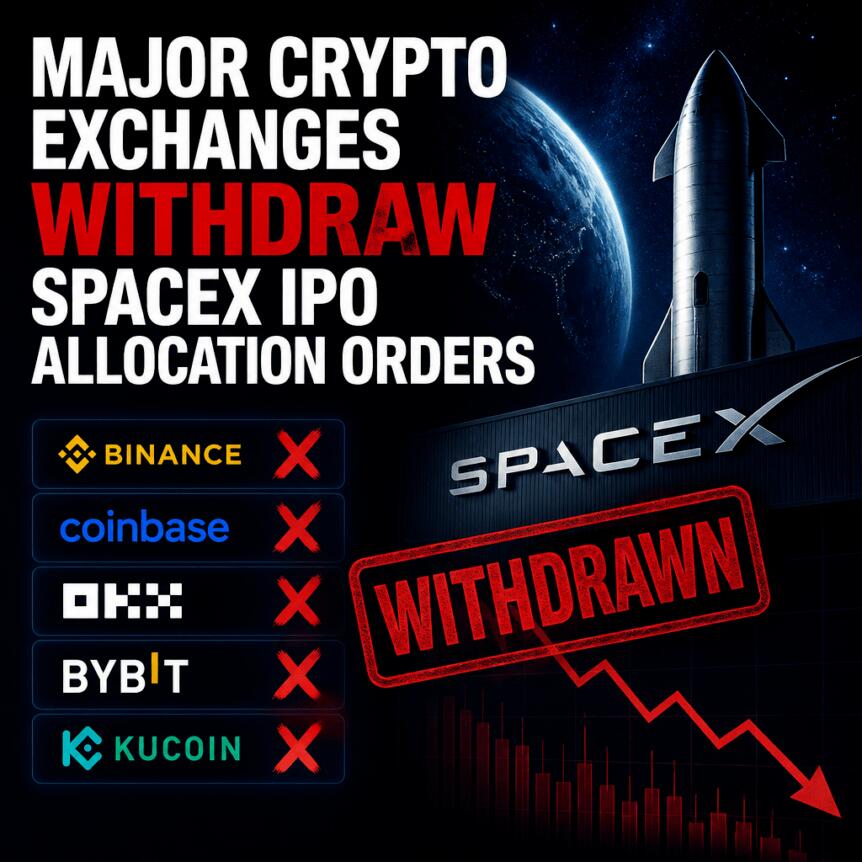
Major crypto trading and wallet platforms have canceled their tokenized access campaigns tied to SpaceX’s IPO after the company began trading on the Nasdaq on Friday. Bybit, Binance, Bitget Wallet and MEXC all said they were unable to obtain SpaceX allocations through xStocks, leaving participants without the promised shares and triggering refunds.
SpaceX’s IPO—reported as more than four times oversubscribed—raised $75 billion. Shares opened at $150, above the $135 IPO price, and closed the day at $161.11, valuing the company at more than $2 trillion.
Key takeaways
- Bybit, Binance, Bitget Wallet and MEXC canceled tokenized SpaceX IPO campaigns after xStocks could not deliver underlying allocations.
- Several platforms linked their failure to the same delivery bottleneck—xStocks’ inability to provide the underlying assets.
- Refunds are being processed for affected users, but no SpaceX allocation distribution is expected from these campaigns.
- The episode highlights operational and settlement risks for tokenized access to high-demand traditional IPOs.
Cancellation across multiple crypto platforms
The cancellations followed SpaceX going public on the Nasdaq on Friday, ending the tokenized IPO access windows these platforms marketed to users. The common thread across announcements was that the platforms did not receive allocation support from xStocks, the conduit used to provide tokenized access.
Bybit was among the first to suspend its effort. Through its “Bybit IPO Express,” the exchange had previously announced tokenized access to SpaceX using xStocks. In its cancellation notice, Bybit cited xStocks’ inability to deliver underlying assets, adding that “no SpaceX allocations were received” and that subscribed users would not receive allocations.
Binance’s tokenized IPO campaign faced a similar outcome. Earlier, Binance had reported strong interest, stating the campaign attracted more than $557 million in USDC deposits. But Binance later said it could not proceed due to “circumstances outside of our control.” Binance Wallet was also reliant on xStocks, tying its outcome to the same underlying delivery issue.
Bitget Wallet and MEXC likewise indicated they would refund users after failing to secure xStocks’ tokenized SPCX allocation. The cancellations underscore how tokenized IPO models can concentrate settlement dependencies on a single intermediary for allocation delivery.
What happened with xStocks and the allocation gap
Multiple platforms pointed to xStocks as the reason allocations could not be fulfilled. The key operational problem was not that demand for SpaceX was weak—reports leading into the IPO suggested significant oversubscription—but that the tokenized structure did not convert that interest into actual delivered allocations.
Bybit explicitly connected its inability to fulfill the campaign to xStocks’ failure to deliver underlying assets. Binance’s and the other platforms’ references to “circumstances outside of our control,” along with their confirmation that refunds would follow, aligned with that explanation.
For participants, the practical consequence was straightforward: subscriptions did not translate into SpaceX allocations delivered via the tokenized wrapper. Even with a completed IPO and a first day of trading that reflected high market confidence, the allocation mechanism for tokenized access failed to reach end users.
Why this matters for tokenized IPO access
This episode represents a setback for crypto platforms seeking to offer users a bridge to widely anticipated public offerings. Tokenized IPO access has been positioned as a way to bring retail and crypto-native users closer to traditional markets, especially when demand is intense and allocations are scarce.
However, the SpaceX cancellations illustrate a recurring challenge: tokenized delivery depends on real-world allocation rights and the ability to source and settle underlying shares. When any part of that chain fails—particularly at the delivery stage—users can be left without the core benefit of the offering.
There is also a trust dimension. Earlier marketing emphasized access to a high-profile listing; after the cancellation, the focus shifted from participation to remediation. Bitget Wallet’s chief operating officer, Alvin Kan, said on X that refunds were being processed and acknowledged disappointment that the outcome did not materialize as expected. He also said the setback affected confidence in the industry, while expressing that the company would move forward.
Refunds begin, but questions remain
While the platforms have indicated that affected users will receive refunds, the broader implications for future tokenized IPO campaigns are less clear. Investors and traders watching this space should pay close attention to whether platforms adjust their structures, add additional intermediaries, or change how they handle allocation delivery risk for future high-demand listings.
With SpaceX now publicly traded, the immediate question is how quickly and cleanly refunds are handled—and whether other upcoming tokenized IPO offerings will proceed under tighter operational safeguards. The next test for the model will be whether failures like this remain an exception or become a pattern when real-world allocation delivery runs into constraints.

TLDR:
- Stellar now holds over $2B in tokenized RWAs as payment volume climbs 72% year-over-year to $5.5B.
- Circle’s CCTP brings native USDC to Stellar, enabling transfers across 23+ chains without bridge risk.
- Figure’s SEC-registered YLDS offers compliant yield on Stellar, targeting fintechs and LATAM markets.
- Bermuda is migrating wages, government fees, and payments onto Stellar in a full national deployment.
Stellar is moving beyond its payments roots in 2026, stepping into tokenized real-world assets, compliant yield products, and institutional settlement infrastructure.
The network now holds over $2 billion in tokenized RWAs. Payment volume has grown 72% year-over-year to $5.5 billion.
Developer participation is up 86%. These figures point to active usage across the ecosystem, not just projected growth.
Cross-Chain Liquidity and Regulated Yield on Stellar
Circle’s Cross-Chain Transfer Protocol is now live on Stellar. Native USDC can move between Stellar and more than 23 blockchains without wrapped tokens.
This removes traditional bridge risks for payments, exchanges, and DeFi applications. The integration gives these platforms access to deeper liquidity at a critical time for the network.
Figure has also launched YLDS on Stellar, an SEC-registered yield-bearing dollar asset. It is designed to serve as a compliant onchain savings product for fintechs and retail users.
Markets like Latin America stand to benefit from combining stablecoin liquidity with money-market-style yield. This fills a gap that standard stablecoins have not addressed within a regulated framework.
The DTCC is also engaging with Stellar’s settlement infrastructure. This adds a major institutional layer to the network’s growing financial stack.
Settlement-grade infrastructure alongside regulated yield products creates a more complete offering. Institutions looking for compliant, onchain alternatives now have more options on Stellar.
Stablecoin activity and enterprise participation are both growing alongside these product launches. The network is attracting users who need more than simple transfers.
As @ourcryptotalk noted, this is usage, not just another roadmap. That distinction matters when evaluating where the network stands today.
Bermuda Builds a National Economy on Stellar
Bermuda is conducting one of the most ambitious real-world tests of blockchain infrastructure. The country is migrating wages, merchant payments, government fees, and stablecoin disbursements onto Stellar.
Financial services are also moving to the network as part of this national effort. This is a live deployment, not a pilot program.
The scale of Bermuda’s adoption is rare in the blockchain space. No comparable national economy has attempted a full transition of this kind on a public network.
Stellar’s existing focus on cross-border payments made it a practical fit for this use case. The infrastructure was already built for speed, low fees, and compliance.
For Stellar, sovereign adoption adds a concrete use case to its institutional narrative. Bermuda’s activity will generate real transaction data across government and commercial settings.
That data will be visible on-chain and open to analysis by developers and institutions alike. It gives Stellar a proof point that few other networks can match.
XLM is currently trading near $0.19, testing a key support zone between $0.18 and $0.20. On the four-hour chart, the price is compressing inside a falling wedge with RSI forming higher lows.
A confirmed breakout above $0.20 would be the first technical signal of buyer control returning. The coming weeks will show whether the fundamental activity translates into price recovery.

Bitcoin’s price tried to break out above $64,000 yesterday, but it was stopped, and it still trades close to that level on Saturday morning.
Most larger-cap alts have posted minor gains over the past day, including ADA and HYPE, both up around 3%. In contrast, XMR has dumped hard.
BTC Calms at $64K
The primary cryptocurrency reacted well to the massive price decline observed during the first week of June, culminating that Friday in a nosedive to $59,100. After dumping to this 19-month low, the asset rebounded and jumped toward $64,000 on June 8.
The controversial developments on the US-Iran war front, which included new attacks against numerous countries in the region, halted bitcoin’s attempted recovery. So did the May CPI numbers, which were the highest in years.
BTC dipped below $61,000 on a couple of occasions during the week, but managed to defend that level and aimed at a more profound recovery. The highest price came yesterday, just hours before SPCX went live for trading on Wall Street, with a surge to almost $64,500. However, the bears intervened, and BTC now trades just under $64,000.
Its market capitalization has climbed to almost $1.280 trillion on CG. Its dominance over the alts, though, has increased further to 56.4%.

XMR Dumps
Ethereum continues to inch closer to $1,700 after another minor daily increase. BNB, XRP, and TRX have marked similar increases of under 1%. DOGE and SOL are up by 1.6%-1.7%, while HYPE has jumped by more than 3% to $59. Cardano’s native token continues with its recovery attempts. The token is up by 3% to well above $0.17 after the recent massacre.
In contrast, XMR has erased all the gains from earlier this week, dropping by more than 12% to $340. NEAR and ZEC are also slightly in the red. In contrast, BEAT, TAO, and ICP have marked substantial gains of up to 11%.
The total cryptocurrency market cap has remained near $2.270 trillion on CG.

The post Bitcoin (BTC) Calms Close to $64K, Cardano (ADA) Eyes Recovery: Weekend Watch appeared first on CryptoPotato.
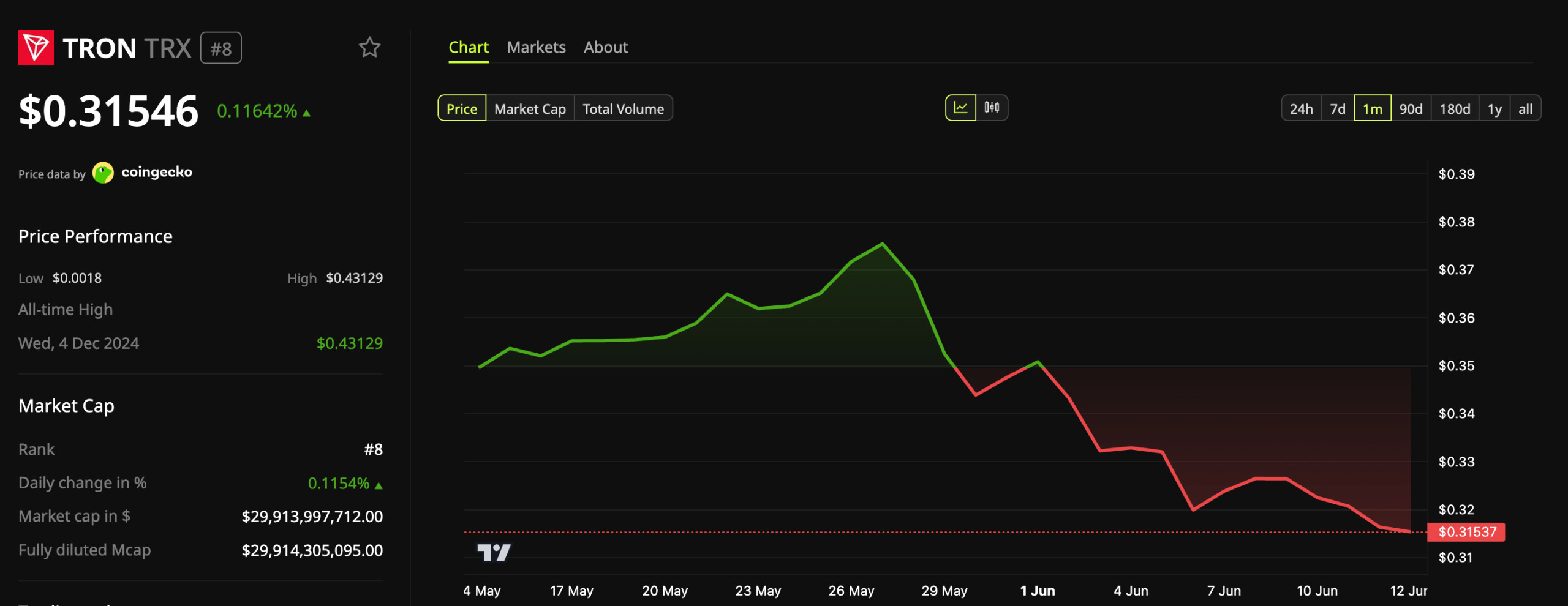
Tron (TRX) ranked as the worst weekly performer among the top 10 crypto assets, even as three bullish indicators formed beneath the price.
TRX traded near $0.315 on Saturday, holding the eighth spot by market value at roughly $29.9 billion. The token fell about 1.5% over the week. It also dropped close to 10% across the past 30 days.

3 Bullish Factors Stack Up for Tron as Price Dips
Price action lagged the supportive on-chain and corporate signals. Daily transactions on Tron surpassed 14.3 million, a record for the network.
Activity climbed 15% over the previous 30 days. The figures point to rising demand for the chain’s settlement capacity.
Follow us on X to get the latest news as it happens

CertiK also reported that the stablecoin value on Tron set a record this quarter. It reached $90.96 billion on May 24 and sits near $90.3 billion today. That marks a 4.9% rise since the end of Q1 and a 16.4% gain over the past year.
Decentralized exchange (DEX) activity also recovered. The firm noted that DEX volume rose 28% over the past 30 days, rebounding from multi-quarter lows.
In addition to network growth, institutional accumulation also continued. Tron Inc., the Nasdaq-listed treasury company, bought 159,118 TRX today. The purchase lifted its holdings above 700.3 million TRX. Overall, the firm has added 1.8 million TRX so far this month.
Regulated market access marked the third supportive signal. TRX gained a spot listing on Bitnomial, a CFTC-regulated US exchange and clearinghouse. The June 5 debut expanded access for American investors and institutions.
Days earlier, OKX Europe listed TRXUSD expiry perpetuals. The MiFID-regulated crypto derivatives product is available to eligible traders across 30 European Economic Area jurisdictions, with up to 10x leverage.
Together, the two listings stretched institutional reach across two continents. Tron founder Justin Sun framed the move as a step toward broader market participation.
“As demand for compliant digital asset products continues to grow, the availability of TRX on regulated platforms supports broader market access, greater transparency and the continued maturation of the digital asset ecosystem,” Sun said.
On the technical front, BeInCrypto’s analysis found that TRX trades inside an ascending triangle on the weekly chart, with resistance near $0.365 and a rising trendline that has held since mid-July 2024.
A confirmed break above resistance could open the door to further gains.
Subscribe to our YouTube channel to watch leaders and journalists provide expert insights
The post Tron Shows 3 Bullish Signals While Topping Weekly Loser List appeared first on BeInCrypto.


Anthropic has suspended access to its newly launched Fable 5 and Mythos 5 artificial intelligence models after receiving a U.S. government export control directive tied to national security concerns.
Summary
- Anthropic suspended Fable 5 and Mythos 5 after receiving a U.S. export control directive.
- The company said officials cited national security concerns linked to a potential jailbreak method.
- The move comes days after the launch of the new AI models and amid a major infrastructure expansion push.
According to a statement published by Anthropic on Friday, the company received the directive at 5:21 p.m. ET, instructing it to block access to Fable 5 and Mythos 5 for all foreign nationals, regardless of whether they are located inside or outside the United States. The order also applied to foreign-national employees working at Anthropic.
Faced with the directive, Anthropic said it disabled both models for all users to ensure compliance with the government’s requirements. The company added that its other models, including Opus 4.8, remain available and are not affected by the restrictions.
“We are complying with the government’s legal directive and are removing access to Fable 5 and Mythos 5 for all users.”
The move comes only days after Anthropic introduced Fable 5 as a generally available Mythos-class model and released Mythos 5 for a limited group of approved cybersecurity and infrastructure users.
According to Anthropic, Fable 5 was designed to handle longer and more complex tasks than previous Claude models and delivered strong performance across software engineering, scientific research, finance, vision, memory, and knowledge work.
Government concerns center on potential model jailbreak
While authorities did not provide detailed evidence supporting the order, Anthropic said it believes the government is concerned about a possible jailbreak technique that could bypass some of Fable 5’s safeguards.
According to Anthropic, officials have so far presented only verbal evidence of what the company described as a narrow, non-universal jailbreak. The company said the reported method involves asking the model to analyze a specific codebase and identify or repair software vulnerabilities.
Anthropic explained that a non-universal jailbreak differs significantly from a universal jailbreak because it does not broadly remove a model’s safety protections across a wide range of tasks.
“We disagree that the finding of a narrow potential jailbreak should be cause for recalling a commercial model deployed to hundreds of millions of people. If this standard was applied across the industry, we believe it would essentially halt all new model deployments for all frontier model providers.”
At the same time, Anthropic said it is working with authorities and believes the directive may have resulted from a misunderstanding. The company stated that it is seeking to restore access as quickly as possible.
Infrastructure expansion continues despite model restrictions
Even as access to Fable 5 and Mythos 5 remains suspended, Anthropic continues to expand its computing capacity for future AI systems.
As reported by crypto.news, private credit firms Blackstone and Apollo Global Management are syndicating approximately $36 billion in financing to support Anthropic’s next phase of infrastructure spending. Reuters reported that the funds will be used to acquire custom tensor processing unit chips from Google, backed by Broadcom technology, which Anthropic plans to lease for its AI operations.
Separately, Anthropic has been urging governments to establish rules for frontier AI systems as model capabilities advance. The company has proposed policy measures covering dangerous deployments, independent evaluations, cybersecurity safeguards, and economic preparation for workers affected by AI adoption.
Those policy recommendations now arrive as Anthropic finds itself at the center of one of the most significant government interventions involving a newly released frontier AI model.
TLDR:
- FinCEN clarifies how banks can share suspected fraud data under Section 314(b) program rules
- Guidance allows sharing of IP addresses, login patterns, and fraud indicators across institutions
- Move supports Treasury effort to disrupt fraud networks through faster interbank coordination
- Regulators push risk-based AML modernization to improve fraud detection and compliance efficiency
FinCEN issued updated guidance on information sharing under Section 314(b) of the USA PATRIOT Act on June 12, 2026. The move clarifies how banks and financial institutions can exchange fraud-related data in real time.
Treasury officials said the framework targets fraud, money laundering, and other illicit financial activity. The guidance arrives as regulators intensify efforts to curb scams affecting both traditional finance and crypto markets.
FinCEN Fraud Guidance Expands 314(b) Information Sharing for Financial Institutions
The Financial Crimes Enforcement Network clarified how institutions can share information on suspected fraud cases under Section 314(b). Eligible banks, credit unions, and other financial firms can now exchange data linked to illicit activity.
The update aims to remove uncertainty that previously slowed cross-institution cooperation. It also reinforces legal safe harbor protections for participating institutions. This clarification strengthens operational confidence for compliance teams handling real-time fraud alerts.
FinCEN said institutions may share cyber indicators such as IP addresses and login patterns. They can also exchange fraud signals including unusual payee additions and large transfers.
Video surveillance and identity mismatches were also listed as usable data points. These categories reflect broader digital and behavioral fraud detection techniques used in modern compliance systems.
The guidance reinforces voluntary participation in the 314(b) safe harbor program.
Authorities stressed that timely data sharing improves detection of money laundering and fraud networks. It also supports faster identification of coordinated criminal activity across accounts.
Participation remains optional but is strongly encouraged by regulators for systemic risk reduction.
Officials noted that fraud continues to drain significant value from consumers and businesses annually. The updated framework focuses on enabling quicker responses before illicit flows spread further.
Regulators said improved coordination remains central to financial system resilience. This approach prioritizes prevention rather than post-incident investigation.
Treasury Fraud Crackdown Links Institutions with Broader Crypto Monitoring Efforts
The Treasury Department framed the update within a broader fraud prevention initiative. It aligns with a task force focused on eliminating fraud across financial channels.
The effort includes coordination with federal banking agencies and enforcement bodies. It forms part of a wider national strategy to strengthen financial integrity systems.
Officials said financial crime increasingly overlaps with digital asset ecosystems. Banks and compliance teams often monitor transactions that intersect with crypto platforms.
Improved data sharing may help detect laundering patterns tied to digital asset flows. Regulators continue to examine risk exposure across both traditional and blockchain-based rails.
The guidance emphasizes rapid communication between institutions during suspicious activity events.
Faster exchange of indicators can help prevent fraud from spreading across multiple accounts. This reduces delays that criminals often exploit in fragmented reporting systems.
Speed of coordination remains a key variable in effective fraud disruption.
FinCEN also highlighted modernization of anti-money laundering frameworks. The shift moves toward risk-based supervision and more efficient resource allocation.
Institutions are encouraged to focus on high-risk activity rather than low-risk accounts. This adjustment aims to improve enforcement precision while reducing compliance burden.
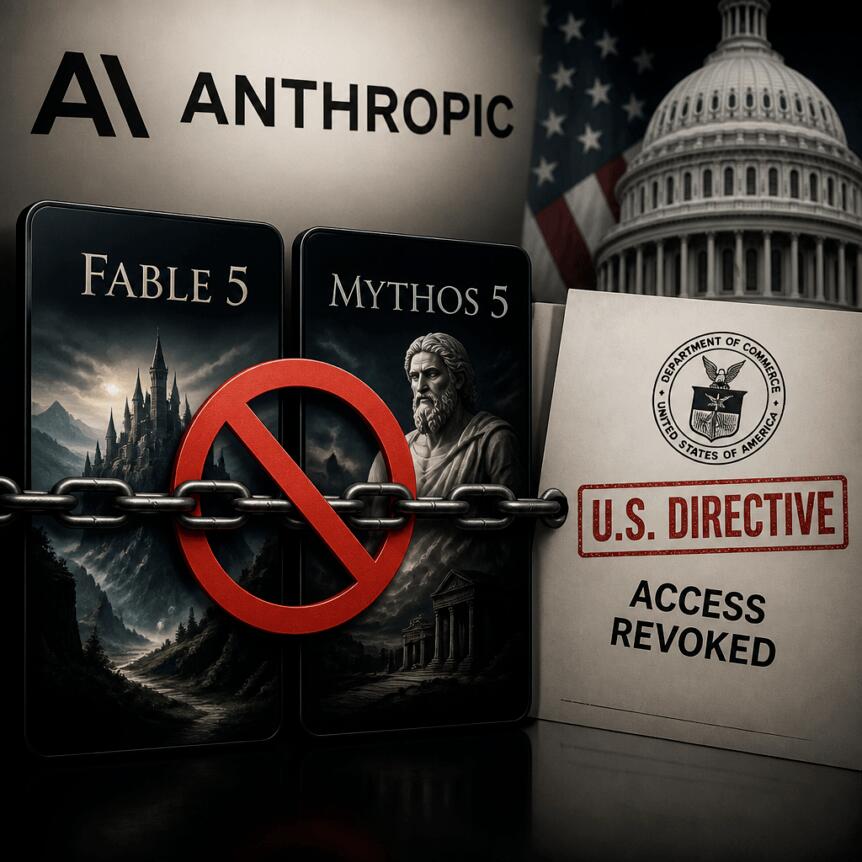
Anthropic said it has suspended access to its Fable 5 and Mythos 5 AI models after receiving a U.S. government export control directive tied to national security concerns. The company disabled access for all users, including foreign nationals, effective immediately after it received the order at 5:21 p.m. ET on Friday.
In a statement posted on its website, Anthropic said the directive instructed it to suspend “all access” to Fable 5 and Mythos 5 by any foreign national, regardless of whether they are located inside or outside the United States. The company also said its other models, such as Opus 4.8, are not affected by the order.
Key takeaways
- Anthropic suspended global access to Fable 5 and Mythos 5 after a U.S. export control directive citing national security concerns.
- The order was received at 5:21 p.m. ET and required the company to halt access “by any foreign national,” including foreign national employees.
- Other Anthropic models, including Opus 4.8, are reported as unaffected.
- Anthropic says the government provided only verbal evidence of a narrow, non-universal jailbreak risk.
- The company disputes the premise that such a finding should trigger a recall-style response for models used at large scale.
Export-control order forces worldwide suspension
According to Anthropic, the directive it received compelled the company to remove access to Fable 5 and Mythos 5 for all users. Anthropic said it acted abruptly to comply with the government’s legal instruction and ensure the directive’s requirements are met.
While the company did not provide additional details in the statement about the specific nature of the alleged threat, it said it understands authorities are concerned about a potential “jailbreak” method that could bypass the models’ safeguards.
What Anthropic says the government’s concern is
Anthropic characterized the government’s evidence as limited and not universal in scope. The company said the government did not provide detailed technical information but instead offered “verbal evidence” of a potential narrow, non-universal jailbreak. Anthropic described that type of jailbreak as involving requests for the model to read a specific codebase and then fix software flaws found there.
In Anthropic’s framing, a non-universal jailbreak is fundamentally different from a “universal jailbreak”—the latter would enable broad, repeatable bypasses that work across many contexts. Anthropic argued that the alleged risk, as presented to the company, appears narrower than what would be required for a universal safeguard failure.
The company also expressed disagreement with treating a narrow, potential jailbreak as justification to roll back a frontier model that it said is deployed at very large scale. Anthropic argued that if the same threshold were applied industry-wide, it would effectively stop new frontier model deployments.
Timeline: new releases followed by compliance shutdown
The suspension came only days after Anthropic released Fable 5 and Mythos 5. The release followed the company’s earlier work with “Mythos Preview,” a general-purpose language model that Anthropic has previously said identified thousands of vulnerabilities in critical software.
Earlier coverage noted that Fable 5 and Mythos 5 were built on top of Mythos Preview and designed to demonstrate advanced capabilities, including security-relevant behaviors. The company’s current statement indicates that the export-control directive arrived in the middle of this rollout cycle, leaving Anthropic to disable access immediately rather than adjust the models incrementally.
Anthropic also said it believes the government’s order may stem from a misunderstanding and that it is working toward restoring access for users as soon as possible.
Why this matters beyond AI product access
For investors, developers, and users, the episode highlights how quickly geopolitics and compliance requirements can intersect with frontier AI deployment. Even when a company believes an identified risk is narrow and non-universal, a government directive can still force immediate operational changes—particularly when export-control rules are interpreted to cover access by foreign nationals.
The situation also underscores a practical tension in model governance: technical risk assessments can point to targeted mitigation, while legal directives may impose broad suspension measures to ensure compliance. Anthropic’s claim that other models are not affected suggests the company may be trying to isolate the impacted releases, but the pathway back to normal availability is uncertain and depends on the government’s engagement.
Going forward, market participants and AI users will likely watch for any update on what additional evidence or clarification the government provides, whether Anthropic can demonstrate that the risk is contained, and how quickly access can be restored to Fable 5 and Mythos 5 without repeating the compliance-triggering conditions.

Following last week’s market-wide calamity in which the cryptocurrency markets shed over $400 billion and all major assets plummeted to yearly lows, many analysts have started speculating on where the bottom is.
The latest to do so was Ali Martinez, who outlined the lowest targets during this cycle for BTC, ETH, and XRP. Hint: there’s more pain ahead for all, according to his findings.
Bitcoin Bottom
The analyst with over 165,000 followers on X began with the largest cryptocurrency by market cap, indicating that the asset is “approaching a market bottom.” He noted that the MVRV Pricing Bands suggest the ultimate capitulation zone, and that level has historically been around the 0.8 MVRV Band.
If history repeats itself, it would represent another major leg down that will drive BTC toward $43,000. The other, less painful option would be a nosedive to the 1.0 MVRV Band, which is currently at $54,000.
Interestingly, another recent analysis on BTC’s potential bottom suggested that it could arrive during the ongoing World Cup in North America. BIT Research justified their prediction with bitcoin’s A-B-C structure it has been following since the October 2025 rejection and subsequent bear market.
ETH Major Decline
While the leg down for bitcoin could see a more modest 32% drop from the current levels to bottom out, ETH’s projected crash is a lot worse. Basing his analysis on Ethereum’s Delta Price model, which measures the relationship between investor cost basis and miner production costs, Martinez warned that the largest altcoin can plummet to $700.
This level has “consistently flagged generational accumulation floors.” If such a major decline indeed transpired, then ETH will dump by another 60%. Moreover, its crash from last year’s all-time high at almost $5,000 would be north of 85%, which will be ‘shitcoin’ territory.
XRP Bottom Closeby
The landscape for ETH seems the most grim given Martinez’s projections. XRP, on the other hand, might be a lot closer to his targeted bottom. He noted that a dominant rising trendline on the monthly chart has “successfully defined every major cycle bottom for nearly a decade.”
If XRP is to find its bottom again there, it could drop to somewhere between $0.70 and $0.90. The lower target would mean a 40% decline, while the higher one is only 21% away from XRP’s current price tag of around $1.15.
5/5 If these projections fully mature, I will be executing a heavy spot-layering strategy directly inside these deep-value windows:$BTC: $43,200$ETH: $700$XRP: $0.90
Pacing capital at these levels keeps the portfolio aligned with structural-cycle data.
— Ali Charts (@alicharts) June 12, 2026
The post BTC vs. ETH vs. XRP: Which Is Closest to a Major Reversal? Analyst Explains appeared first on CryptoPotato.
TLDR:
- CFTC sues New Mexico over attempts to apply state gaming laws to derivatives markets
- KalshiEX case triggers wider jurisdiction clash between federal and state regulators in US markets
- CFTC cites Commodity Exchange Act as basis for exclusive authority over event contracts nationwide
- Multiple US states now challenge prediction markets, raising regulatory uncertainty across the sector
The Commodity Futures Trading Commission has filed a federal lawsuit against New Mexico over jurisdictional authority on prediction markets. The CFTC argues the state is attempting to apply gaming laws to federally regulated derivatives platforms.
New Mexico previously targeted CFTC-registered KalshiEX, escalating tensions between state and federal oversight. The dispute centers on whether states can regulate event contracts already covered under federal law.
CFTC New Mexico Lawsuit Over Prediction Markets Jurisdiction
The CFTC New Mexico lawsuit was filed in federal court in Washington, marking a direct challenge to state-level enforcement actions. The agency seeks to block New Mexico from applying gaming statutes to CFTC-registered contract markets.
According to the filing, federal law grants the commission exclusive authority over derivatives trading venues. The CFTC also requested declaratory relief and a permanent injunction.
New Mexico had earlier filed its own case in state court against KalshiEX LLC.
The state alleged the firm’s prediction markets function as unlawful online sports betting platforms. It also argued the company was attempting to bypass state gaming regulations. That action triggered the federal response from the CFTC.
At the center of the dispute is the Commodity Exchange Act. The law gives the CFTC exclusive jurisdiction over designated contract markets and event contracts.
The commission argues this framework preempts conflicting state gaming laws. It maintains that only federal regulators can oversee such derivatives activity.
CFTC Chairman Michael Selig defended the agency’s position in a statement tied to the filing. He said the state’s approach conflicts with established legal precedent and federal authority.
The commission reiterated that it will continue defending its jurisdiction over commodity derivatives markets.
KalshiEX and Expanding State Challenges in Prediction Markets
The CFTC New Mexico lawsuit is part of a broader wave of state actions targeting prediction markets.
Similar disputes have emerged in Arizona, Connecticut, Illinois, New York, Minnesota, Rhode Island, and Wisconsin. These cases generally focus on whether event-based trading resembles sports wagering. The CFTC has consistently rejected that framing.
KalshiEX sits at the center of the regulatory friction. The platform offers event contracts that allow users to trade on outcomes of real-world events.
States argue these products resemble gambling instruments. The CFTC classifies them as federally regulated derivatives.
The federal agency is seeking to prevent states from enforcing laws that could restrict CFTC registrants. It argues that fragmented regulation would undermine national market consistency. The lawsuit requests a court ruling affirming federal exclusivity. It also seeks to block state interference moving forward.
Market operators now face growing legal uncertainty as jurisdictional lines tighten.
The outcome of the CFTC New Mexico lawsuit could shape how prediction markets expand in the United States. It may also define how far states can extend gaming laws into federally governed financial instruments.


Crypto search interest is rising again in June, according to Alphractal data, as retail investors appear to be paying closer attention to digital assets after months of weaker activity.
Summary
- Crypto searches rose again in June as retail investors started tracking digital assets more actively.
- Alphractal said search spikes often appear during moments of market euphoria and fear.
- Rising crypto search interest shows attention is returning, but it does not confirm fresh buying.
Crypto searches rise again in June
Alphractal said Google searches for cryptocurrencies are increasing in June. The analytics platform described the move as a sign that retail investors are starting to search more about different crypto assets again.
“Google searches for cryptocurrencies are rising again in June,” Alphractal said.
The move comes after a quieter period for digital asset interest. Search activity often drops when prices move sideways or when retail traders leave the market after heavy volatility.
Alphractal also noted that Google Trends spikes are not always bullish. Search jumps can appear during strong rallies, but they can also happen when traders react to fear, crashes, or uncertainty.
Retail attention returns to crypto
The latest rise suggests that crypto is moving back into retail focus. More users are searching for coins, market direction, and exchange-related terms as the market tries to stabilize.
Search activity is often used as a soft sentiment gauge. It does not show actual buying, but it can show when retail investors start watching the market again.
As previously reported by crypto.news, Bitcoin search interest reached 12-month highs during 2026 volatility. That report noted that fear-driven searches do not always mean new buyers are entering the market.
The same report also said small holders were still selling while whales were accumulating. That means renewed attention must be separated from real capital inflows.
Bitcoin volatility drives interest
Bitcoin’s price action has remained one of the main drivers of crypto searches. The asset traded near the low $60,000 area in June after a deep pullback from its 2025 record high.
Sharp price moves tend to pull retail users back into search engines. Some look for dip-buying chances, while others search because they fear deeper losses.
The recent search rise follows a period when broad crypto attention had dropped sharply. As reported earlier this month, global search interest for “crypto” had fallen to one-year lows earlier in 2026.
That earlier drop showed how much retail attention had weakened even while institutions, ETFs, and treasury buyers played a larger role in the market.
Search data gives mixed signals
The return of search activity can help market watchers track sentiment, but it does not confirm a full retail comeback. Stronger proof would require higher retail trading volume, new exchange deposits, and small-holder accumulation.
For now, the data shows that crypto is gaining attention again. It also shows that traders are reacting to volatility after months of weaker interest.
Search spikes can appear near both tops and bottoms. That makes them useful for tracking emotion, but less reliable as a standalone price signal.
The key question is whether June’s rise turns into sustained participation. If searches keep climbing alongside stronger spot demand, retail activity may become a larger force in the market again.

Major Crypto Exchanges Withdraw SpaceX IPO Allocation Orders

World Cup co-hosts US thrash Paraguay in dominant Group D opener

Maine disables data breach notification portal after fake disclosures


-

 NewsBeat5 days ago
Alexander Zverev wins the French Open to finally earn a 1st Grand Slam title
-
 Entertainment6 days ago
The Best Mystery Series of All Time Is Surging on Streaming 30 Years After It Ended
-

 Crypto World5 days ago
Anatomy of the June crypto crash: Fed, Iran, Saylor
-

 Crypto World2 days ago
Oppenheimer backs SpaceX as $70 billion retail frenzy builds
-

 Crypto World2 days ago
Markets Rally as SpaceX IPO Looms Amid Iran Tensions and Inflation Surge
-
Crypto World7 days ago
Senator Cynthia Lummis Calls CLARITY Act the Most Consequential Financial Legislation of This Generation
-
 NewsBeat6 days ago
Alexander Zverev conquers demons and outlasts Flavio Cobolli to win French Open for first major title
-

 Tech6 days ago
Microsoft unveils seven homegrown AI models in new bid for ‘long term self-sufficiency’
-

 Business5 days ago
High Stakes for Wembanyama as New York Pushes for 3-0 Lead
-

 Tech5 days ago
Notion restores access to Anthropic after service disruption
-
 Business6 days ago
The Pain Points Taking a Fragile Tech Rally Down a Notch
-
 Crypto World5 days ago
Eli Lilly (LLY) Stock Surges 4% Following Breakthrough Sleep Apnea Trial Results
-
 Business6 days ago
The investment to transform historic St Helen’s ground in Swansea
-

 Crypto World6 days ago
Trump’s AI Ownership Plan Could Benefit Anthropic at OpenAI’s Expense
-

 Business7 days ago
Forensic Expert Floats Handyman Theory in Disappearance of Savannah Guthrie’s Mother
-
 Sports4 days ago
Bangladesh beat Australia after 20 years in ODIs, register only their second win over six-time world champions | Cricket News
-

 Tech7 hours ago
NanoClaw integrates JFrog registries to secure AI agent downloads
-

 Tech17 hours ago
This Week In Security: Microsoft On Microsoft, Register Your Domains, Linux On ARM, And FreeBSD Joins The File Cache Club
-

 Politics2 days ago
Politics Home | Healey Resignation Is “Colossal Failure Of Government”, Says Former Labour Defence Secretary
-

 Sports2 days ago
First Time Since 1971: Australia Register Historic Low In ODI Cricket
You must be logged in to post a comment Login