
Crypto World
CFTC fines former White House operator $172K over prediction market bets

A former White House teleprompter operator has agreed to pay $172,539 after U.S. regulators found he used advance access to President Donald Trump’s speeches to make more than $107,500 trading prediction market contracts.
Summary
- Gabriel Perez made more than $107,500 trading prediction market contracts using advance access to Trump’s speeches, the CFTC said.
- Perez must return $107,539 in profits, pay a $65,000 penalty and serve a three year trading ban.
- The CFTC said Perez received a reduced penalty because of his cooperation and credited Kalshi for assisting the investigation.
- The case follows other insider trading investigations involving prediction markets, including trades linked to Polymarket and Kalshi.
The Commodity Futures Trading Commission said on Aug. 28 that Gabriel Perez misappropriated material, nonpublic information obtained through his federal government job to trade event contracts for his personal benefit. The settlement requires Perez to return $107,539.02 in profits and pay a $65,000 civil monetary penalty.
Perez has agreed to a three-year trading ban and must cease further violations of the Commodity Exchange Act and CFTC regulations. The $65,000 penalty was substantially reduced under the agency’s new cooperation policy because of what the regulator described as his “exemplary cooperation” during the investigation.
White House access gave Perez advance knowledge of Trump speeches
Between December 2025 and February 2026, Perez worked as a White House teleprompter operator while trading presidential “mention market” contracts, according to the CFTC.
Such contracts are event contracts whose outcomes depend on whether particular words or phrases are used during a presidential speech. Perez’s position gave him access to speeches before Trump delivered them publicly, allowing him to know information directly connected to the contracts he was trading.
The regulator found that Perez used the information in breach of his duty of trust and confidence, generating more than $107,500 in trading profits during the period.
The CFTC credited KalshiEX with assisting its investigation. Perez is no longer employed by the federal government after previously being placed on unpaid leave following scrutiny of his trading activity.
The enforcement action comes as regulators and prediction market operators have been dealing with multiple cases involving traders accused of using information unavailable to the public.
Prediction market insider trading cases have drawn CFTC action
Another federal case centers on U.S. Army Master Sergeant Gannon Ken Van Dyke, who has been accused of using classified military information to trade contracts on Polymarket connected to the operation targeting Venezuelan leader Nicolás Maduro.
As crypto.news previously reported, prosecutors allege Van Dyke made about $409,881 through 13 Venezuela-related trades after putting more than $33,000 into the positions. He pleaded not guilty and has disputed whether the contracts involved legally qualify as swaps.
A federal judge in August stayed the CFTC’s civil enforcement action against Van Dyke until the related criminal proceedings are completed. The case has placed the legal treatment of event contracts and the use of confidential government information in prediction market trading before a federal court.
Kalshi has faced a separate insider-trading episode involving an editor affiliated with YouTube creator MrBeast. In February, the platform imposed a $20,397.58 penalty and a two-year suspension after finding that the editor traded contracts connected to MrBeast content using confidential information.
The MrBeast editor case involved violations of Kalshi’s prohibited insider-trading rules and a failure to cooperate with the investigation. Beast Industries subsequently opened its own investigation and said it had zero tolerance for the misuse of proprietary information.
Scrutiny has since extended to accounts whose trading patterns raise concerns before regulators determine whether a violation occurred. Polymarket referred nearly 100 wallets for further review after an analysis identified trading activity carrying characteristics associated with potentially informed positions.
The review covered signals including newly created wallets, concentrated positions and trades entered shortly before major events. A suspicious designation does not establish that insider trading occurred, and a referral does not mean charges will follow.
Kalshi has expanded controls around prediction markets
Kalshi has introduced several controls intended to identify traders who may have access to confidential information.
In June, the exchange began requiring users in certain higher-risk markets to disclose their employers, giving its compliance team more information to compare a trader’s employment with the subject of a contract. The policy followed a series of cases involving people whose professional positions could give them access to information relevant to market outcomes.
The platform later integrated with StarCompliance, a system used by financial firms to monitor employee trading. Kalshi said the arrangement would allow participating companies to supervise employees’ prediction market activity through compliance systems already used for other financial transactions.
Its trade surveillance controls include a whistleblower reporting channel and a risk-scoring process applied to proposed markets before they are listed. Kalshi has used its own detection engine alongside outside surveillance and integrity services to examine potentially problematic trading behavior.
Regulatory attention has extended past insider trading. The CFTC in August reminded regulated entities offering event contracts that pricing information must clearly identify the products as contracts traded on a regulated exchange. Agency staff warned that displaying the products using American-style sportsbook odds could mislead customers about the nature of the transaction.
CFTC authority over event contracts remains under legal scrutiny
The Perez order treated the presidential mention contracts as event contracts, or swaps, under federal commodities law. The classification places his use of nonpublic government information within the CFTC’s enforcement framework under the Commodity Exchange Act.
At the same time, the scope of federal authority over prediction markets remains the subject of court disputes involving Kalshi and several U.S. states.
New York, Nevada and other states have challenged contracts offered through federally regulated prediction markets, particularly products tied to sports. Kalshi and the CFTC have argued in several proceedings that federally regulated event contracts fall within the commission’s jurisdiction, while state authorities have maintained that some products operate as gambling and remain subject to state law.
The CFTC used emergency authority in August to direct KalshiEX to continue normal operations after New York sought restrictions against the exchange. The agency said federal derivatives law gives it exclusive jurisdiction over event contracts traded on registered exchanges, while courts have reached different conclusions over the extent to which federal law preempts state gambling rules.
A separate regulatory dispute has spread across multiple states, with the CFTC filing actions or participating in proceedings involving state attempts to regulate prediction market contracts.
For Perez, the CFTC’s Aug. 28 settlement resolves the federal enforcement action without removing the financial consequences of the trades. He must surrender the full $107,539.02 generated from the activity, pay the discounted $65,000 penalty and remain out of CFTC-regulated trading for three years.



Cosmos Labs has disclosed that attackers exploited a critical Cosmos EVM vulnerability across six blockchain networks between Aug. 20 and Aug. 25, converting stolen tokens into about $5.72 million in assets through decentralized and centralized exchanges.
Summary
- Attackers exploited a critical Cosmos EVM flaw across six networks between Aug. 20 and Aug. 25, converting stolen tokens into about $5.72 million in other assets.
- Cosmos Labs first received the vulnerability report in April but initially concluded that production networks were not at risk and handled the fix through its silent patch process.
- MANTRA lost 720.9 million tokens worth about $3.6 million, while TAC and KiiChain later suffered separate attacks using the same method.
- The first attack began about 20 hours after patched Cosmos EVM versions were released without a vulnerability specific advisory to network operators.
- Cosmos Labs coordinated with 40 chains during the response and helped 13 networks patch or halt before they could be attacked.
Cosmos Labs said in a technical post-mortem published Friday that the flaw had first been reported through its bug bounty program on April 25, nearly four months before the attacks began. Its testers were unable to reproduce the exploit against configurations used by known production Cosmos EVM networks and concluded at the time that live user funds were not at risk.
Based on that assessment, developers handled the vulnerability through a silent public patch instead of privately distributing a security fix to affected chains. Cosmos Labs merged the fix in May without telling network operators which vulnerability it addressed.
The assessment later proved incorrect after independent researchers established in early August that the bug affected all Cosmos EVM chains. Cosmos Labs then obscured the fix to make reverse engineering more difficult and released patched versions at 7:01 p.m. ET on Aug. 19.
Release notes referred to “important” security fixes without describing the vulnerability. The first known attack began at 3:06 p.m. ET on Aug. 20, about 20 hours after the patched software became available.
Cosmos EVM flaw allowed attackers to drain large accounts
The vulnerability involved an integer underflow in Cosmos EVM, the ecosystem’s Ethereum-compatible framework built from the open-source Evmos codebase.
An attacker could first create an account containing locked tokens and delegate more tokens to a validator than the account was able to spend. Subtracting the delegated amount caused the balance to fall below zero, making the value wrap around to the maximum possible figure of 2^256-1 base units.
The attacker could then use the inflated balance against another account. Sending the amount to a target pushed its recorded balance past the same numerical ceiling, causing an overflow that wrapped the value back down and left the attacker holding the target’s tokens.
No additional tokens were created through the process, according to Cosmos Labs, and total token supply remained effectively unchanged. MANTRA said the exploit changed its supply by only one base unit, the smallest divisible denomination of the token.
Cosmos Labs said attackers targeted accounts holding large balances, including burn addresses and multisignature wallets created when networks launched. Its advisory classified the flaw as critical and identified Cosmos EVM releases before v0.6.2 and v0.7.2 as vulnerable.
The incident followed another security disclosure involving Cosmos software earlier this year. Crypto.news previously reported that a researcher had disclosed a CometBFT flaw in April that could cause nodes to stall during block synchronization. The CVSS 7.1 issue did not allow direct asset theft.
Networks had about 20 hours after the patch
Once independent researchers confirmed the Cosmos EVM flaw could affect production chains, Cosmos Labs prepared the security releases that went live on Aug. 19.
Network operators were not given a vulnerability-specific warning explaining what the upgrade fixed. MANTRA later said 20 hours was not enough to assess, build, test and coordinate a state-breaking upgrade across its 38 independent validators.
“Twenty hours was not a realistic window in which to assess, build, test and coordinate a state-breaking upgrade across 38 independent validators, particularly without a vulnerability-specific advisory,” MANTRA wrote in its post-mortem.
Another disclosure occurred before the first theft. At 3:16 a.m. ET on Aug. 20, a Push Chain developer publicly submitted a code change describing the vulnerability and its exploitation path. The filing credited the finding to an audit by security firm Hacken and listed versions considered vulnerable.
The submission said no released version contained the fix, though its version table omitted v0.6.2 and v0.7.2, which Cosmos Labs had published roughly eight hours earlier.
Cosmos Labs described publication of an exact exploitation path by a downstream developer as “highly unusual” and said such disclosures can raise the risk that a vulnerability will be exploited.
MANTRA placed the public security finding 11 hours and 45 minutes before the attacker’s first probe. However, the attacker’s wallet had been funded almost four hours before the finding was filed.
“We state the timing as fact and draw no conclusion from it,” MANTRA said.
A withdrawal of 472.70 MANTRA from a customer account at a centralized exchange funded the gas fees used throughout the attack, according to the network.
MANTRA lost $3.6 million before halting its chain
MANTRA suffered the largest publicly disclosed loss from the attacks, with 720.9 million MANTRA tokens then valued at about $3.6 million taken from two addresses.
One was the network’s burn address. The second was a dormant multisignature wallet left from an earlier incentive campaign.
No automated warning was generated when tokens first moved from the burn address because MANTRA’s monitoring systems treated the address as immovable and did not watch it for outgoing transactions.
The attack remained undetected for almost four hours, giving the attacker time to drain the dormant multisig wallet.
MANTRA halted the network at 7:13 p.m. ET on Aug. 20. About 38 million stolen MANTRA remained frozen in the attacker’s wallet, but 94.7% of the stolen tokens had already been transferred to one centralized exchange deposit address through 15 transactions.
The chain remained unable to process transactions for roughly 30 hours. Crypto.news reported during the interruption that MANTRA halted transactions while engineering and security teams investigated the incident and exchanges suspended deposits and withdrawals.
Validators later deployed patched software and resumed block production without rolling back the chain or altering user balances. Version 8.4.0 included the Cosmos EVM security fix.
MANTRA had added native EVM support to its mainnet in September 2025 alongside CosmWasm compatibility, allowing Solidity applications and Cosmos-native smart contracts to operate on the network.
No stolen MANTRA tokens had been recovered as of Aug. 28, according to the project.
Its circulating supply increased by about 720.9 million tokens because assets held in accounts previously classified as unspendable, including the burn address, became tradable after being moved by the attacker.
TAC and KiiChain were hit after MANTRA
The same method was used against TAC on Aug. 22, according to Cosmos Labs. Nearly 3 billion TAC were taken from the network’s staking pool.
TAC is designed to bring decentralized finance applications to TON and Telegram users. Around 1.2 billion of the stolen tokens were sold on BNB Chain for roughly $950,000.
KiiChain was attacked that evening, losing approximately 148 million KII. About 64.6 million tokens were sold for roughly $1.6 million.
Cosmos Labs estimated that around 54% of the stolen KII remains recoverable onchain if the network is restored.
In its Aug. 23 technical post-mortem, KiiChain criticized how the vulnerability had been communicated to downstream networks. The project said Cosmos Labs did not provide advance notice, identify the release as security critical or initially tell affected chains to halt.
“A patch takes days to review, build, test and roll out across a validator set. A halt takes minutes,” KiiChain wrote. “The only measure that would have contained the risk immediately was a clear instruction to stop producing blocks, and that instruction came after the damage was done.”
Cosmos Labs recommended that vulnerable networks halt on Aug. 22, after MANTRA, TAC and KiiChain had already been hit.
KiiChain disputed part of the technical assessment as well, saying three upstream defects were needed to carry out the exploit and that only the underflow had been publicly patched.
MANTRA reached a different conclusion after testing the fix against a working reproduction of the exploit. Its post-mortem described the underflow repair as “the control that closes this attack path.”
Cosmos Labs described two chained vulnerabilities but did not address KiiChain’s claim that another upstream defect remains unresolved.
Three other Cosmos EVM networks were attacked
Three further chains were exploited with the same method, though Cosmos Labs did not identify them in its report.
Nesa may have been one of the affected networks. Bitvavo suspended NES deposits and withdrawals on Aug. 24, citing a critical consensus vulnerability that had been exploited to make vulnerable nodes accept invalid blocks.
Blockchain analytics firm Bubblemaps identified Nesa as one of the affected chains in an Aug. 26 analysis. The firm said an attacker bought about $250,000 worth of NES, bridged it to Nesa, used the flaw to increase the balance about 200-fold and transferred roughly $50 million in NES back to Ethereum.
Most attempted swaps suffered extreme slippage as liquidity was removed from trading pools, leaving the attacker with about $60,000 in profit, according to Bubblemaps.
The wallet had originally been funded through Monero. Bubblemaps said differences in the funding method and the attacker’s behavior meant a separate party may have been responsible for the Nesa exploit.
The remaining two affected chains have not been publicly identified.
Cosmos Labs said it coordinated with 40 networks during its response and worked with 13 others to patch the vulnerability or halt before they were attacked.
The firm said it does not maintain a complete registry of the more than 115 public blockchains operating across the Cosmos ecosystem. Its response uncovered 11 Cosmos EVM deployments that had not previously been registered with the team.
MANTRA, meanwhile, is being acquired by existing backer Inveniam Capital Partners, which had made a $20 million strategic investment in the project in August 2025. The transaction is expected to close in the third quarter of 2026, with MANTRA Chain, its token and related infrastructure set to continue operating under Inveniam’s ownership.
Crypto World
Zoomex Puts Precision Trading Within Reach with Specialized 1000x Leverage Futures Contracts
Zoomex, the global crypto derivatives exchange built for traders who value speed and control, is spotlighting one of its most distinctive offerings: specialized futures contracts with leverage of up to 1000x. Available on select major trading pairs, this high-leverage tier gives experienced traders a way to size positions with exceptional capital efficiency, while staying inside a rule-based execution framework designed to keep the playing field fair for everyone who opens a position.
Zoomex has built its infrastructure specifically to support extreme leverage on the pairs where liquidity and price stability make it viable, starting with flagship assets like BTC and ETH, and now extending to a growing list of instruments. The result is a derivatives environment that stays genuinely Focused on Derivatives, rather than treating high-leverage futures as an afterthought bolted onto a spot-first platform.
What the 1000x Futures Tier Actually Offers
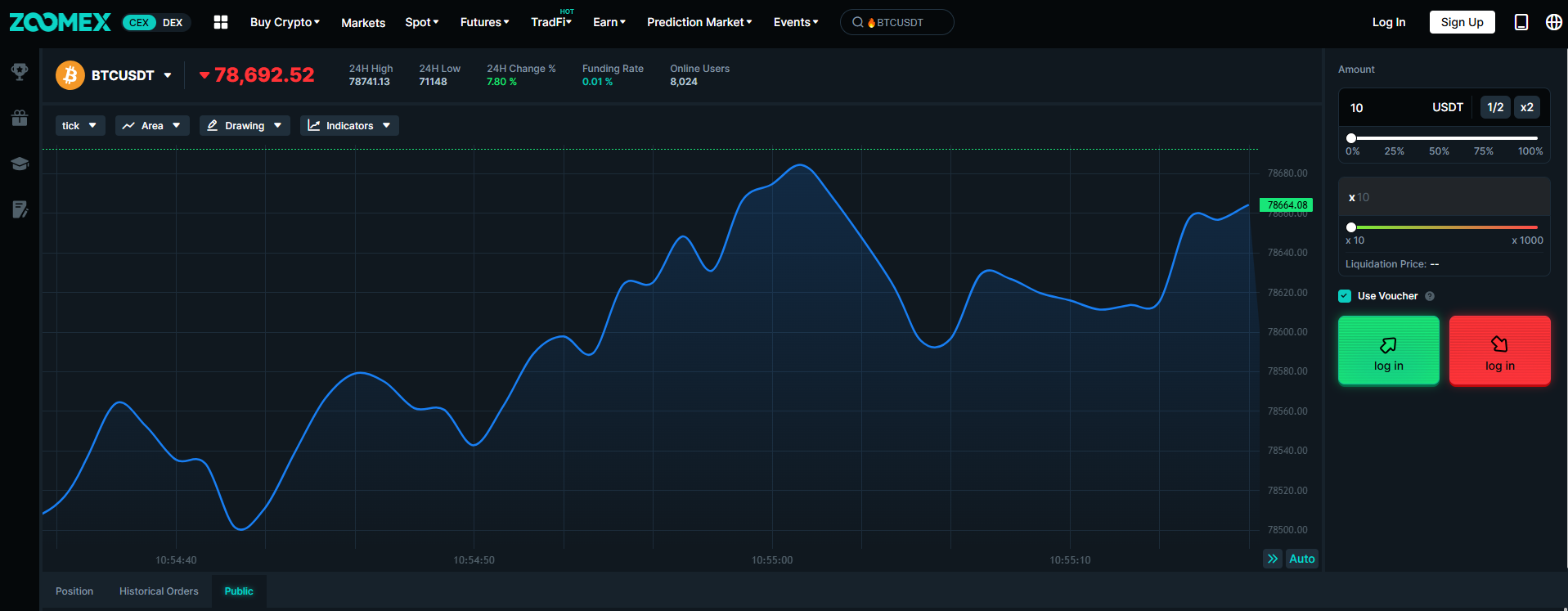
The mechanics are straightforward by design. Traders select a trading pair, choose a margin amount, and dial in their preferred leverage, up to 1000x on eligible contracts, before opening a long or short position. Because the tier sits inside Zoomex’s dedicated futures interface, position management tools like take-profit and stop-loss orders, real-time margin tracking, and active-position monitoring are all available from the same screen, without needing to jump between separate trading environments.

Source: Zoomex
This matters more than it might first appear. Extreme leverage compresses the distance between a winning trade and a liquidation event, so the quality of the surrounding tools, clear margin visibility, responsive order execution, dependable uptime, becomes just as important as the leverage figure itself. Zoomex’s approach treats the 1000x tier as a complete trading environment, not a headline number sitting on top of a generic order book.
Fair Access & Rule-Based Execution at the Core
High leverage only works if the exchange behind it can be trusted to execute consistently, especially during volatile moves when slippage and order-matching speed matter most. Zoomex sources liquidity from major market venues and routes orders through a matching engine designed to treat every trader, from a first-time futures user to a high-volume desk, under the same rule set. There is no tiered advantage for size or tenure on the platform; execution logic applies uniformly, which is precisely what Fair Access & Rule-Based Execution is meant to guarantee.
That consistency is also what allows Zoomex to responsibly offer leverage at this scale in the first place. Extreme leverage products expose weaknesses in matching engines and risk systems quickly, so the exchange has invested in multi-signature custody, two-factor authentication on withdrawals, and independent third-party security audits to support the infrastructure sitting underneath the trading layer.
A Growing List of Eligible Markets
The 1000x tier is not static. Zoomex has continued to widen the set of instruments eligible for its highest leverage bracket, most recently extending coverage into equity-linked assets tied to the artificial intelligence and semiconductor sectors, markets where trader demand for high-conviction, high-leverage exposure has grown alongside the broader AI investment narrative. That expansion sits alongside Zoomex’s existing Stock Perpetuals lineup, reflecting a broader strategy: bring the leverage and execution standards traders already associate with crypto derivatives to a wider range of asset classes, without diluting the standards that apply to any single one.
For traders, that means the same account, the same margin logic, and the same Transparent by Design fee structure whether the position is a BTC/USDT perpetual or a leveraged contract tracking a semiconductor stock. Nothing about eligibility, margin requirements, or execution priority changes based on which asset class a trader is engaging with.
Transparent by Design, From Fees to Risk Disclosure
Extreme leverage carries extreme risk, and Zoomex does not obscure that trade-off. Fee schedules for maker and taker orders are published and consistent, margin requirements are visible before a position is opened, and liquidation thresholds are calculated using the same logic across every account tier. New users stepping into the 1000x tier for the first time are also encouraged to start with materially lower leverage while they familiarize themselves with how quickly margin can move against a position, a recommendation built directly into Zoomex’s own trading guides, not just a disclaimer buried in the terms of service.
This is what Transparent by Design looks like in practice: not a marketing phrase, but a commitment that shows up in how the product is documented, priced, and explained to the people actually placing trades.
Easy to Use, Even at the Extreme End of the Risk Curve
Sophisticated leverage doesn’t have to come with a complicated interface. Zoomex’s futures workspace keeps the essential controls, pair selection, margin input, leverage slider, and order type, in one continuous flow, so traders can move from analysis to execution without friction. Active positions, available balance, and risk parameters remain visible throughout, which matters most exactly when markets are moving fastest and traders have the least time to hunt through menus.
That same simplicity extends to closing or adjusting a position. A single click from the active positions panel is enough to exit a trade, and stop-loss or take-profit levels can be set or modified without leaving the position view. The goal is a platform where the complexity lives in the risk itself, not in the process of managing it, keeping the experience genuinely Easy to Use regardless of how experienced the trader is.
A Refined Brand & Trading Experience Built Around Serious Traders
Zoomex’s identity has increasingly been shaped by high-visibility partnerships, from its association with the TGR Haas F1 Team to sports and entertainment activations that put the brand in front of a global, sports-literate audience. But underneath the branding sits a platform built specifically for traders who want derivatives depth, not a simplified, watered-down futures product tacked onto a spot exchange. The 1000x leverage tier is one of the clearest expressions of that positioning: a feature built for traders who understand exactly what they’re signing up for and want an exchange capable of supporting that level of conviction.
That combination, recognizable brand presence paired with serious trading infrastructure is central to what makes Zoomex’s Refined Brand & Trading Experience.
Trading Responsibly at 1000x
Zoomex is direct about the risk profile of its highest-leverage products, at 1000x, even small price movements can move a position significantly, and liquidation can happen quickly without active risk management. Traders using this tier are encouraged to rely on stop-loss orders, size positions conservatively relative to total account balance, and treat the 1000x bracket as a tool for specific, high-conviction setups rather than a default trading mode. Zoomex’s own trading guides reinforce this point directly, recommending that newer users begin with lower leverage before scaling into higher brackets as they build familiarity with how margin behaves under extreme conditions.
About Zoomex
Founded in 2021, Zoomex is a global cryptocurrency trading platform focused on derivatives trading. The platform serves over 3 million users across 35+ countries and regions, offering access to 700+ trading pairs. Built around easy to use, transparency, fairness, and speed, Zoomex provides a clear and efficient trading experience for users worldwide.
Through its high-performance matching engine, clear asset and order displays, and transparent fee and rule mechanisms, Zoomex helps users better understand their account status, order execution, trading costs, and results. Zoomex maintains registrations, licenses, and regulatory statuses across multiple jurisdictions, including the U.S. MSB, Canada MSB, U.S. NFA, and Australia AUSTRAC, and has completed security audits conducted by blockchain security firm Hacken. The platform also continues to strengthen its trust framework through Proof of Reserves, Security & Transparency, Compliance Information, and Fees / Rules Transparency initiatives.
Beyond trading, Zoomex builds a refined brand experience through elite sports partnerships, including the TGR Haas F1 Team, World Cup-winning goalkeeper Emiliano Martínez, and world-class tennis events such as Wimbledon. The values of speed, precision, discipline, fair play, and rule-based execution are closely aligned with Zoomex’s approach to derivatives trading.
At Zoomex: Easy to Use. Transparent balance. Fair access to your earnings.
Frequently Asked Questions
What is Zoomex?
Zoomex is a global crypto derivatives platform founded in 2021, serving over 3 million users across more than 35 countries and regions with 700+ trading pairs.
How does Zoomex work?
Zoomex operates through a high-performance matching engine with transparent asset and order displays, allowing users to execute trades and track outcomes with full visibility into their balances and results.
What can you trade on Zoomex?
Zoomex offers 700+ trading pairs spanning cryptocurrencies such as BTC, ETH, and SOL, as well as stock-linked contracts like NVDA and AAPL and gold exposure through XAUT.
Where is Zoomex headquartered?
Zoomex operates as a global cryptocurrency exchange with regulatory registrations including Canada MSB, U.S. MSB, U.S. NFA, and Australia AUSTRAC, reflecting its multi-jurisdictional compliance approach.
Is Zoomex available in my country?
Zoomex serves users across more than 35 countries and regions. Availability can vary by local regulation, so traders should check the official Zoomex website for country-specific access and requirements.
The post Zoomex Puts Precision Trading Within Reach with Specialized 1000x Leverage Futures Contracts appeared first on BeInCrypto.


Crypto projects spent approximately $638 million repurchasing their native tokens between January and Aug. 31, according to Allium Labs figures cited by the Financial Times.
Summary
- Crypto projects spent $638 million on token buybacks this year, exceeding last year’s comparable total.
- Hyperliquid and Pump.fun represented nearly 90% of tracked repurchases, according to Allium Labs data overall.
- Hyperliquid directs 99% of eligible trading fees toward automated HYPE purchases and permanent token burns.
- Sky spent $26 million on 2026 repurchases, while its cumulative program remains considerably larger overall.
- Lido’s proposed framework activates buybacks only above revenue thresholds and limits annual purchases to $10 million.
The total increased 17% from the $545 million recorded during the corresponding period in 2025. Projects spent only $366,000 across all of 2024, showing how quickly revenue-funded token repurchases have become part of decentralized finance.
Hyperliquid and Pump.fun accounted for nearly 90% of the 2026 total. Their dominance means the broader increase does not represent uniform adoption across the crypto market.
The annual figure also differs from cumulative buyback totals. Hyperliquid’s reported $1.3 billion covers purchases since its late-2024 launch, while the $638 million figure counts buybacks completed during 2026 by multiple projects.
Hyperliquid dominates crypto token buybacks
Hyperliquid operates the largest revenue-funded repurchase program included in the dataset. The derivatives platform routes 99% of eligible trading fees to its Assistance Fund, according to its protocol documentation.
The system converts trading fees into HYPE through automated purchases executed as part of Hyperliquid’s layer-1 operations. Purchased tokens are then burned, permanently removing them from supply.
Hyperliquid has reportedly bought and cancelled about $1.3 billion in HYPE since launching in December 2024. That cumulative number should not be added to the $638 million annual total because the two figures cover different measurement periods.
HYPE traded near $63.35 on Aug. 31. The token had gained approximately 70% over the previous year, according to the Financial Times. Buybacks may have supported demand, but they cannot be isolated from trading growth, user activity and broader market sentiment.
An earlier examination of Hyperliquid’s automated fee-funded repurchase system found that the Assistance Fund had accumulated roughly 28.5 million HYPE by May. The analysis placed its annualized buyback rate near 7% of market capitalization at the prevailing revenue level.
Pump.fun supplies the second major buyback engine
Pump.fun uses revenue from its token launchpad, PumpSwap exchange and trading products to purchase PUMP. Its current mechanism commits 50% of designated revenue to token buybacks and burns through a locked smart contract.
During the week ending Aug. 9, the platform spent approximately $5.02 million buying and burning 2.15 billion PUMP. Its cumulative program had offset an estimated 15.7% of the token’s original supply by that point.
The purchases have continued alongside scheduled token releases. In July, Pump.fun distributed $86.49 million in vested PUMP to 121 team and investor wallets. Buybacks reduce supply, while unlocks make previously restricted tokens transferable. The two forces therefore work in opposite directions.
PUMP traded near $0.0015 on Aug. 31. Its performance shows why repurchases should not be treated as guaranteed price support. Platform revenue, token unlocks, investor confidence and demand can outweigh the buying program.
Sky and Lido follow different models
Sky Protocol bought approximately $26 million of SKY during 2026, according to Allium’s annual dataset. Its cumulative buyback spending is considerably higher because the Smart Burn Engine began operating before this year.
Sky’s official dashboard describes the mechanism as an onchain system that uses protocol surplus to purchase SKY from the open market. Governance reduced the buyback rate in March by lowering individual purchase sizes and lengthening the interval between transactions.
Sky also says staking rewards are financed through open-market purchases rather than new token issuance. That structure connects protocol surplus with token demand without increasing SKY’s maximum supply.
Lido’s proposed NEST framework is more conditional. Buybacks would activate when annualized revenue exceeds $40 million. The original proposal also required ETH to trade above $3,000, although later discussions considered disabling that separate price floor.
The framework would allocate 50% of staking revenue above the $40 million baseline to LDO purchases. It includes a $50,000 daily limit and a $10 million rolling 12-month cap. These are governance parameters rather than guaranteed spending commitments.
Buybacks cannot guarantee higher token prices
Token buybacks create a recurring buyer and can reduce circulating supply when purchased assets are burned. Unlike corporate shares, however, governance tokens do not necessarily provide ownership, dividends or legal claims over protocol assets.
The effects also depend on execution. Tokens held in a treasury may eventually return to circulation, while permanently burned tokens cannot. Projects may change or discontinue discretionary programs through governance decisions.
Recent results have been mixed. Hyperliquid has combined strong revenue with positive HYPE performance, while several other tokens remained under pressure despite recurring purchases. Crypto analyst Ansem previously argued that buybacks cannot overcome weak community alignment or declining demand.
The next test is whether fee revenue remains strong enough to fund purchases during weaker trading periods. Investors should also track whether repurchased tokens are burned, held or redistributed and compare annual purchases with new emissions and insider unlocks.
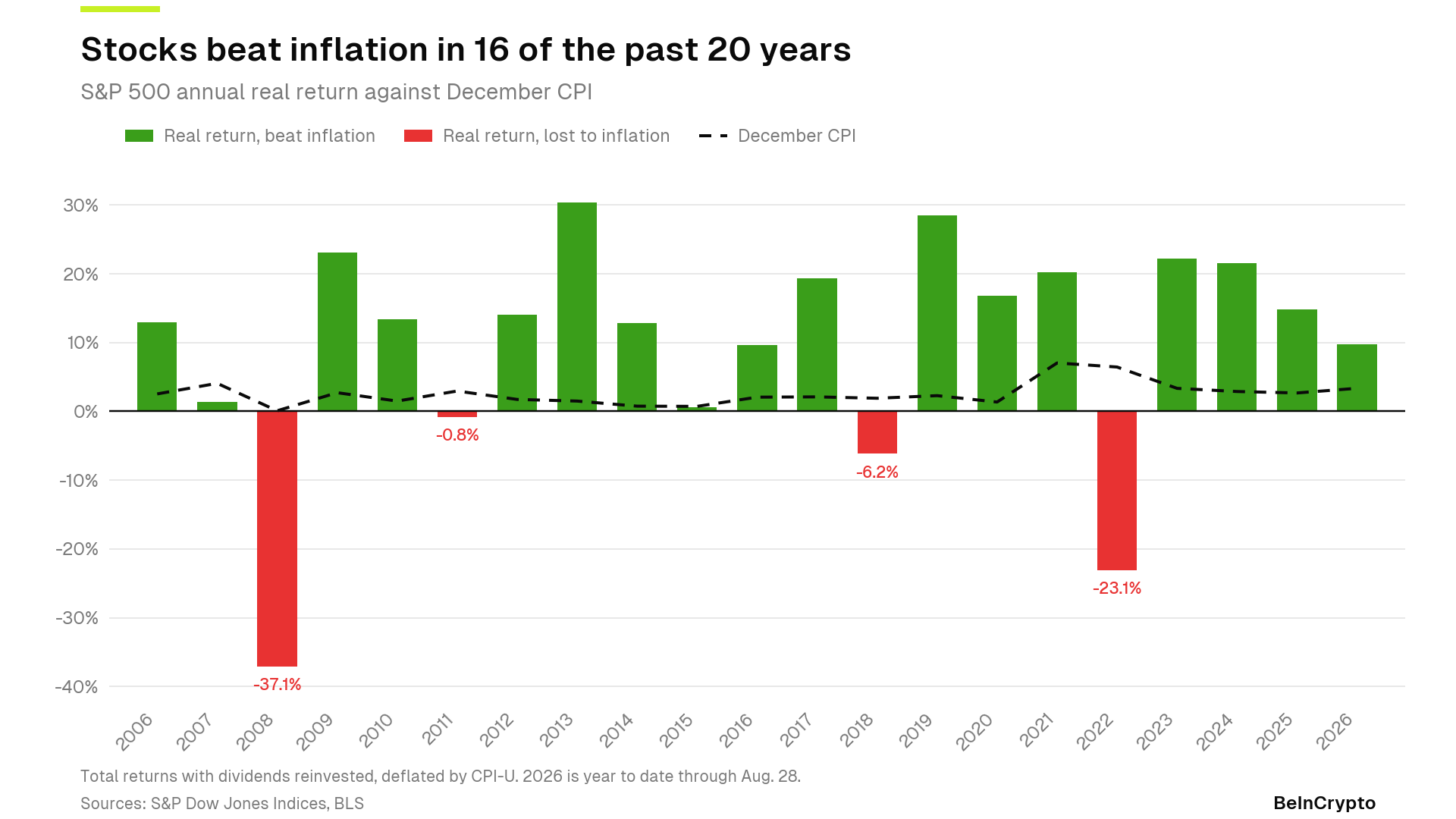
The S&P 500 has gained 13.5% in 2026, outpacing US consumer prices, which rose 3.4% over the 12 months through July.
The trend also holds over the longer term. Historical data show that the index has outpaced US inflation in 16 of the past 20 calendar years.
How the S&P 500 Has Performed Against Inflation
The S&P 500 delivered a 14.76% real return in 2025 after accounting for 2.70% inflation, according to The Kobeissi Letter. The index also recorded strong real returns in the previous two years, gaining 21.47% in 2024 and 22.11% in 2023.
“Stocks have historically been one of the best hedges against inflation,” the post read.
The record is thinner than the count suggests. The four years when stocks failed to beat inflation were 2008, 2011, 2018, and 2022.
Three of those four years ended with inflation below 3%. Consumer prices rose just 0.1% in December 2008, yet the S&P 500 plunged 37% that year.

The 2022 result was different. The BLS reported a 6.5% year-over-year increase in consumer prices in December. The S&P 500 fell 18.11%. The real loss came to roughly 23%.
Only three years in the period ended with December inflation above 4%. The S&P 500 still outpaced inflation in 2007 and 2021 but fell short in 2022. The largest real return came in 2013, when the index gained 30.42%, and inflation stood at 1.5%.
Follow us on X to get the latest news as it happens
AI Earnings Are Carrying the Real Return
Earnings did most of the work in 2025. First Trust calculated that 13.5 of the index’s 17.9 percentage points came from higher earnings per share.
According to FactSet, analysts project 28.2% year-over-year earnings growth for the third quarter of 2026. They expect 31.2% across the full year.
That growth is concentrated in a narrow group. Ben Snider of Goldman Sachs Research said in May that AI infrastructure beneficiaries should supply roughly half of index earnings growth this year. He also flagged narrowing market breadth as a risk signal.
Meanwhile, 9 of the decade’s 10 best S&P 500 performers trace to the same buildout. Nvidia leads that list by a wide margin, with gains above 13,000%.
Inflation has cooled since the spring. Consumer prices rose 4.25% in the year through May before easing to 3.4% in July.
Subscribe to our YouTube channel to watch leaders and journalists provide expert insights
The post The S&P 500 Failed to Beat Inflation Only 4 Times in 20 Years. Here's the Pattern. appeared first on BeInCrypto.


The European Central Bank has strengthened its privacy commitments for a potential digital euro as Revolut has begun rolling out its first euro-backed stablecoin, EURR, to selected customers across three European markets.
Summary
- Revolut has begun rolling out its EURR euro stablecoin to eligible users in Denmark, Poland and Portugal.
- EURR is issued by Stripe owned Bridge and initially runs on Ethereum, with wider EEA availability planned.
- The ECB says its digital euro would provide the highest privacy level current technology can support.
- Offline digital euro payments would remain visible only to the payer and recipient, while banks would retain information required for compliance.
- The digital euro remains under development as regulated euro stablecoins continue expanding under MiCA.
Forbes reported that the two projects are developing on separate tracks, with the digital euro designed as central bank money while EURR is a privately issued stablecoin intended to maintain a value of one euro.
Digital euro privacy would limit ECB access to user identities
ECB Executive Board member Piero Cipollone said the digital euro would offer the maximum level of privacy that existing technology can support, addressing concerns over how much transaction information a central bank digital currency could expose.
For offline payments, transaction details would only be available to the payer and recipient, Cipollone said. The Eurosystem would not receive information allowing it to identify the people involved in those payments.
Online transactions would operate differently because banks participating in the payment would still need access to customer information for anti-money laundering and other compliance requirements. However, Cipollone said the Eurosystem itself would not be able to identify the users making or receiving the payment.
In practice, the ECB would not be able to directly connect a specific person with a digital euro transaction regardless of whether the payment was made online or offline, according to Cipollone.
“The digital euro guarantees the maximum level of privacy that current technology can offer,” he said.
The privacy framework forms part of a digital euro project that remains under development. In March, crypto.news reported that the ECB expected to publish digital euro technical standards during the summer as payment providers, banks and merchants prepared their systems for a possible rollout.
Cipollone said at the time that a 12-month pilot was scheduled to begin in the second half of 2027, covering person-to-person and point-of-sale payments. The ECB has been working toward technical readiness for possible issuance around 2029, subject to the required European Union legislation.
The digital euro would complement physical cash and bank deposits instead of replacing them, according to the ECB. Private intermediaries such as banks and payment service providers would distribute the currency and provide wallets and related payment services.
Revolut EURR enters three European markets
While the ECB continues developing the digital euro, Revolut has started phased testing of EURR with eligible customers in Denmark, Poland and Portugal.
EURR is Revolut’s first stablecoin and is designed to maintain a value of €1. The token is initially launching on Ethereum, with Revolut planning wider availability across European Economic Area markets later in 2026.
Despite carrying Revolut branding, the token is issued by Bridge Building S.A., part of Stripe-owned stablecoin infrastructure company Bridge. Revolut distributes EURR through its existing platform, giving eligible customers a way to move between fiat currency, crypto assets, external wallets and supported blockchain networks.
Bridge entered the European market with regulatory approvals before the rollout. Crypto.news previously reported in July that the company had secured MiCA and EMI licenses in Luxembourg, allowing it to provide regulated stablecoin and euro payment services across all 27 EU member states.
The company subsequently joined the European Union’s MiCA register as the bloc’s 42nd authorized electronic money token issuer. The Bridge MiCA registration gave the Stripe-owned business a regulated route for issuing euro-backed tokens and providing related payment infrastructure across the bloc.
Revolut said EURR gives customers an on-chain euro option without requiring them to begin with a separate crypto platform. The company already serves more than 75 million customers across more than 40 markets through services covering payments, foreign exchange and crypto.
EURR is fully integrated into the Revolut platform, while stablecoins tied to other currencies are under development. Wider access to the euro token is expected later this year as the company continues its phased rollout.
Euro stablecoins expand under MiCA
Revolut’s entry comes as the supply and number of regulated euro-backed stablecoins have increased under the EU’s Markets in Crypto-Assets framework.
A Decta study covered by crypto.news in July found that the market capitalization of eight MiCA compliant euro stablecoins increased 128% in the year leading up to the end of the EU’s crypto transition period.
Their combined market capitalization rose from $295.6 million on June 30, 2025, to $673.9 million on June 28, 2026. Trading volume across the tokens increased 43.1% from $47 million to $67.3 million over the same period, while the number of compliant euro stablecoins with active market data increased from five to eight.
EURC, EURCV and EURI accounted for much of the increase identified by Decta. Dollar-backed stablecoins remained far larger, with the eight euro tokens covered by the report accounting for less than 1% of the global stablecoin market.
Circle’s EURC has become one of the largest regulated euro tokens. Its circulation passed €400 million in August after more than doubling over the previous year, while total euro stablecoin supply had reached about €650 million by June.
Circle operates EURC as a MiCA-compliant electronic money token through its licensed electronic money institution in France. Eligible Circle Mint customers can redeem the token directly for euros at a one-to-one rate, while the stablecoin has gained support across blockchain networks, exchanges and payment infrastructure.
European banks have been developing competing products. Qivalis, a consortium involving major European financial institutions, selected Fireblocks earlier this year to provide infrastructure for a MiCA-compliant euro stablecoin intended for institutional settlement, treasury operations and tokenized assets.
The digital euro would sit in a different category from EURR, EURC and other privately issued tokens because it would represent a direct liability of the central bank. Private stablecoins depend on their issuer, reserve structure, redemption arrangements and regulatory status.
Under the ECB’s proposed structure, the digital euro could support offline payments while banks continue handling customer-facing services and required compliance checks for online transactions. EURR, meanwhile, gives Revolut customers a euro-denominated asset that can move through blockchain networks and external wallets under Bridge’s regulated issuance structure.
Revolut plans to extend EURR beyond Denmark, Poland and Portugal to other eligible EEA markets later this year, while the ECB’s digital euro project is moving toward its planned 2027 pilot and possible issuance around 2029.

NPS asked those who know of hikers or backpackers in the inner canyon along the Bright Angel Creek corridor on Saturday, “as well as anyone who had a campground reservation in the affected corridor,” to provide information.
The flash-flood event occurred in Bright Angel Canyon and the Phantom Ranch area on Saturday afternoon at around 2:30 p.m. Arizona is currently in the throes of the monsoon season, and storms poured over the Grand Canyon from early Saturday morning and returned in the evening.
Nearly all footbridges over Bright Angel Creek were destroyed in the floods, the Park Service said, preventing hikers from crossing. NPS is continuing to assess the extent of the damage. Parts of the canyon—Phantom Ranch, Bright Angel Campground, the Phantom Ranch Canteen and cabins, and the entire North Kaibab Trail from the North Kaibab Trailhead to Phantom Ranch—were closed until further notice.
The Transcanyon Waterline, a 12.5-mi. pipeline in the Grand Canyon that carries water for drinking and fire suppression has also been damaged. With that pipeline out of action, the park has a limited water supply and has resorted to conservation measures.
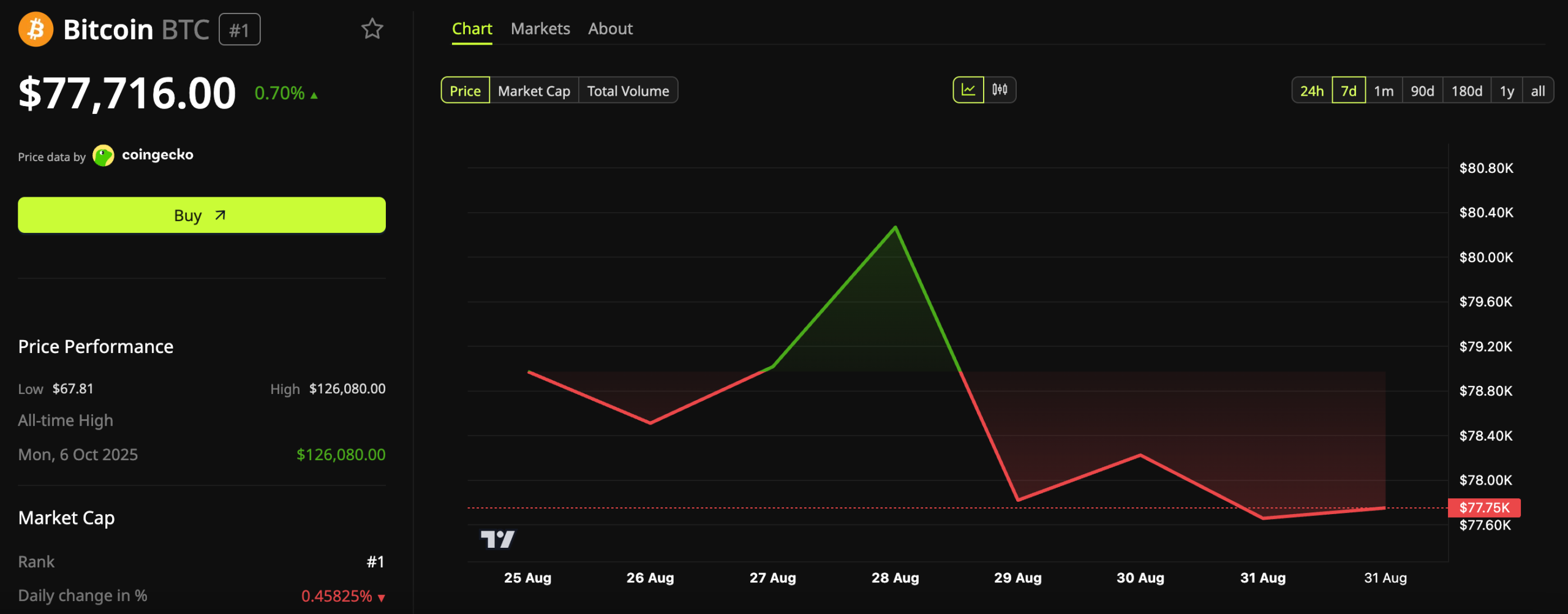
US spot Bitcoin (BTC) exchange-traded funds (ETFs) recorded $924 million in net inflows from Aug. 24 to Aug. 28. BlackRock’s iShares Bitcoin Trust (IBIT) led with $938 million, according to SoSoValue data. Despite the demand, Bitcoin’s price stayed stuck below $80,000.
Spot Ether (ETH) ETFs added $824 million over the same stretch. BlackRock’s ETHA fund led that category too, extending its own inflow streak to 10 straight trading days. Both products drew strong institutional demand, even as Bitcoin struggled to hold its recent gains.
Why Bitcoin’s Price Isn’t Following ETF Money
The stall traces largely to the Federal Reserve. Fed Chair Kevin Warsh delivered a hawkish keynote at the Aug. 28 Jackson Hole Economic Policy Symposium.

He warned that inflation remained a bigger concern than the labor market and declined to rule out a rate hike. Bitcoin slid from around $79,500 to below $77,000 in the hours that followed. Traders priced in higher odds of a hike at the Fed’s September meeting.
Bitcoin also faces a longer-term technical hurdle. On-chain analytics firm CryptoQuant has pointed to a bull market confirmation tied to Bitcoin’s 365-day moving average, near $83,000. BTC has repeatedly failed to close above that level, despite its rally from the mid-$60,000s.
Inflow Streak Comes to an End
The nine-day Bitcoin ETF inflow streak that carried into last week’s total ended on Aug. 28. Funds recorded a $201.81 million net outflow that day. Even so, August remains 2026’s strongest month on record for the products, with more than $3 billion in net inflows.

Whether Bitcoin can convert renewed ETF demand into a decisive break above $80,000 may depend on the Fed’s next moves. A close above its 365-day moving average would help, too, something it has not managed since the rally began.
The post Bitcoin ETFs Pulled In Near $1 Billion Last Week, So Why Is BTC Stuck Below $80,000? appeared first on BeInCrypto.
Crypto World
Cronos Halts Network as Tectonic Faces Mango-Style Attack: $75M in Assets Reportedly Affected
Cronos halted its blockchain on Sunday after an exploit hit Tectonic, which happens to be its largest lending protocol. Experts estimated that roughly $75 million in assets were affected.
So far, no timeline has been provided for when the network will resume. The blockchain has also not said what will happen to the assets linked to the attacker after the chain is restarted.
Third Mango-Style DeFi Attack?
Crypto.com CEO Kris Marszalek confirmed the security breach and said that the Cronos team was investigating the incident. The Cronos app and exchange were not affected and continued operating as usual, and Marszalek asserted that all funds were safe.
On-chain tracking platform LookonChain reported that the attacker was only able to bridge $6.29 million to Ethereum. These funds were swapped for 2,592 ETH when the network was halted. As a result, the remaining $68.7 million is stuck on the Cronos Network.
Meanwhile, researcher Weilin Li said the attack was linked to Tectonic’s TONIC governance token, which has a 20% collateral factor despite having very thin liquidity. According to Li, the attacker carried out a Mango Markets-style pump-and-borrow price manipulation attack, which caused TONIC’s price to surge 100-fold within 20 minutes.
Similar price-manipulation attacks have also affected other DeFi platforms recently. For instance, Moonwell, a lending protocol on the Base network, lost over $8 million last week after an attacker manipulated the collateral price of MAMO, a small-cap token with thin liquidity. In response, Moonwell cut borrow caps for all Core Markets on Base to 1 wei, which effectively stopped new borrowing across the deployment. It also reduced supply caps for MAMO and WELL to 1 wei, while leaving other supply caps unchanged.
Another recent case involved a low-liquidity Pendle market, where price manipulation led to about $36 million in liquidations of leveraged PT-reUSD positions on Morpho.
Aftermath
Tectonic’s locked assets have dropped sharply following the exploit. According to the latest stats by DefiLlama, the lending protocol held around $121 million on August 29.
Two days later, that figure had fallen to roughly $3 million.
The post Cronos Halts Network as Tectonic Faces Mango-Style Attack: $75M in Assets Reportedly Affected appeared first on CryptoPotato.
Crypto World
September Fed rate hike fears look overblown as the probability stands at just 58%, not 90%
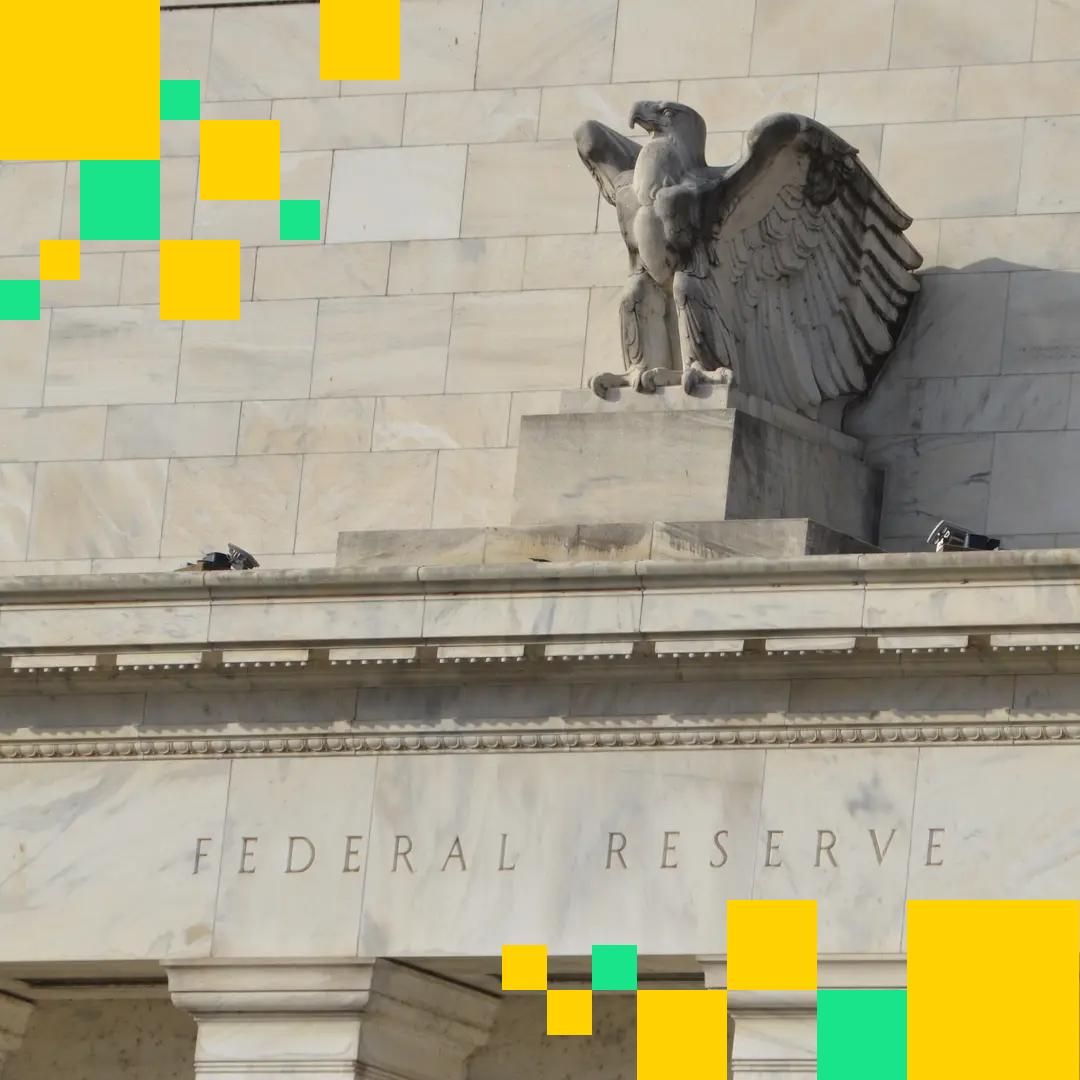
Odds of a rate hike in September remain below 60% despite Warsh’s hawkish speech on Friday. Observers downplay fears of tightening.


A Solana wallet labeled as Fireblocks Custody transferred another 30 million USD1 to Binance during a 15-hour period, according to an Aug. 31 report from blockchain tracker Onchain Lens.
Summary
- Fireblocks-labeled custody wallet sent 30 million Solana-based USD1 tokens to Binance across fifteen reported hours.
- Onchain records confirm transfers, but they do not identify the beneficial owner or transaction purpose.
- The same wallet previously transferred 66 million USD1 to Binance during the preceding reported week.
- USD1 is issued by World Liberty Financial and operates across multiple networks, including Solana today.
- Neither Fireblocks, Binance nor World Liberty publicly explained whether the deposits supported trading or liquidity.
The tokens had a nominal value of $30 million because USD1 is designed to track the U.S. dollar. The transfer extended a series of large deposits from the same address, but its commercial purpose remains unknown.
Neither Fireblocks, Binance nor USD1 developer World Liberty Financial had publicly identified the beneficial owner or explained the transfers when the latest movement was reported.
USD1 transfer is visible on Solana
Onchain Lens identified the sending address as 9Rycov3U4efJf5HiqZYGjN7qJJHEtMsj4vbmkG4xfCxk. Its activity can be reviewed through the Solscan account page.
The tracker described the address as Fireblocks Custody and the receiving destination as Binance. Those labels are blockchain-analytics attributions rather than identities recorded directly inside Solana transactions.
Onchain data verifies that tokens moved between addresses. It cannot, by itself, establish who beneficially owned the assets or whether the transfer represented a sale, market-making activity, customer withdrawal, treasury operation or internal exchange movement.
Accordingly, the Onchain Lens report should not be interpreted as proof that Fireblocks, World Liberty or another party sold $30 million of USD1.
Fireblocks-labeled wallet previously moved $66M
The same address previously transferred 28 million USD1 to Binance through three transactions over 21 hours, according to an earlier Onchain Lens update.
A subsequent report said the wallet had deposited 66 million USD1 into Binance over one week after sending another 10 million tokens. The latest 30 million transfer appears to follow that reported sequence.
If the periods do not overlap, the cited movements would represent approximately 96 million USD1 sent to Binance. However, Onchain Lens did not provide a complete transaction inventory in its latest post, so the combined figure should be treated cautiously.
Fireblocks provides wallet and transaction infrastructure for institutions. A wallet using its custody technology can hold assets for a customer without Fireblocks owning those assets economically.
World Liberty’s USD1 already has close Binance ties
USD1 is a dollar-pegged stablecoin associated with World Liberty Financial, the crypto business linked to U.S. President Donald Trump and members of his family.
World Liberty’s official documentation lists USD1 deployments across several blockchains. The Solana token address begins with USD1ttGY1N17, matching the asset identified in the transfer report.
USD1 already has substantial links to Binance. Abu Dhabi-backed investment company MGX used $2 billion of the stablecoin to settle an investment in the exchange during 2025.
As crypto.news previously reported, the MGX transaction gave USD1 an early institutional use shortly after its launch.
Binance-controlled wallets and customer accounts held nearly 87% of USD1’s supply at one stage. Such concentration can reflect exchange customer holdings, institutional settlement balances and Binance’s own operational wallets.
Binance deposits do not establish selling pressure
Sending a volatile cryptocurrency to an exchange can indicate possible selling. That interpretation is less direct for a stablecoin because dollar-pegged assets commonly move to exchanges as trading collateral, settlement funds or quote-currency liquidity.
Binance offers USD1 trading pairs, including a SOL/USD1 market. Deposits could therefore support customer trading, market-making or liquidity management.
World Liberty says USD1 circulation has exceeded $4 billion. As crypto.news reported, company CEO Zach Witkoff attributed its expansion to institutional demand. That remains a company explanation rather than proof of the purpose behind these transfers.
World Liberty also received preliminary conditional approval to establish a national trust bank that could eventually issue and redeem USD1. The institution cannot open until it satisfies the OCC’s conditions.
Further wallet movements, changes in Binance balances or statements from the involved companies could clarify the deposits. No verified price movement in USD1, WLFI or another asset was directly attributable to the reported transfer.
Baird upgrades STAG Industrial stock rating on valuation appeal

Cosmos EVM vulnerability drains MANTRA, TAC and KiiChain in cross chain attacks

Scottie Scheffler polishes off Tour Championship in clinical fashion

Weekend Open Thread – Corporette.com

Weekend Open Thread: Brooks Brothers

London Mayor Sadiq Khan handed a peerage by Keir Starmer alongside 15 other Labour figures… just days before the PM leaves No10

#bitcoin #btc #crypto #cryptocurrency #akademicrypto #margincall #timothyronald #kalimasada #ai #fyp

Money Rules That Will Change Your Life and Give You Financial Freedom

#trading #liquidity #crypto #cryptonews #investing #altcoins #bitcoin #cryptocurrency #cryptotrading
-

 Crypto World5 days ago
SpaceX stock could rise 75% to $240, JPMorgan says
-

 Fashion3 days ago
Weekend Open Thread: Maeve – Corporette.com
-

 Crypto World3 days ago
Bitcoin’s 22% rally now needs real demand to outlast Treasury liquidity boost
-

 Crypto World5 days ago
Warsh Jackson Hole keynote puts financial innovation first
-

 Crypto World6 days ago
A $30 Billion AI Fund Implodes, Now the SEC Is Investigating Wall Street’s Role
-

 Business3 days ago
Salesforce Stock Soars 19% as Blowout Earnings and Agentforce AI Growth Silence Software Skeptics
-

 Crypto World5 days ago
Did Trump Just Move SpaceX Stock With One Truth Social Post?
-

 Crypto World4 days ago
Elon Musk Grok Bot Promise: We Will Make You Whole if AI Loses Your Money
-

 Business5 days ago
Walmart takes aim at younger shoppers with new fashion brand
-

 Business3 days ago
Apple Confirms September 9 Keynote and Reveals Its Full Pre-Order Schedule
-
 NewsBeat5 days ago
Lindsay Clancy jury braces for closing arguments as judge tells court: ‘You’ve heard all the evidence’ – Live updates
-

 Crypto World2 days ago
Bitcoin price tests $82K resistance as Brandt stays long
-

 Business5 days ago
Thailand’s Eastern Economic Corridor Capital City (EECiti): Key Developments and Investment Opportunities
-

 Crypto World4 days ago
NVIDIA revenue hits $96.2B as AI demand doubles
-

 Business2 days ago
Onto Innovation Stock: AI’s Next Bottleneck Is Yield (NYSE:ONTO)
-

 Business7 days ago
Moderna CEO warns China is pouring state money into mRNA technology
-

 Business6 days ago
NVIDIA Stock Drops Nearly 2 Percent to $210 on Seventh Losing Day Ahead of Critical AI Earnings
-

 Business3 days ago
iPhone 18 Pro Pre-Orders Could Shift to Saturday as Apple Reportedly Avoids September 11 Anniversary
-

 NewsBeat5 days ago
Trump’s trade truce with China faces test with Iran effort
-
 Crypto World4 days ago
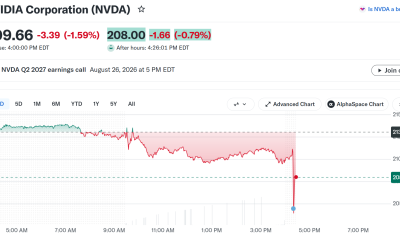
Nvidia Q2 Earnings Reveal $96.2 Billion Beat, So Why Is NVDA Falling?
You must be logged in to post a comment Login