

Crypto World
Citadel’s various hedge funds rise in February, beating the S&P 500 in a choppy month

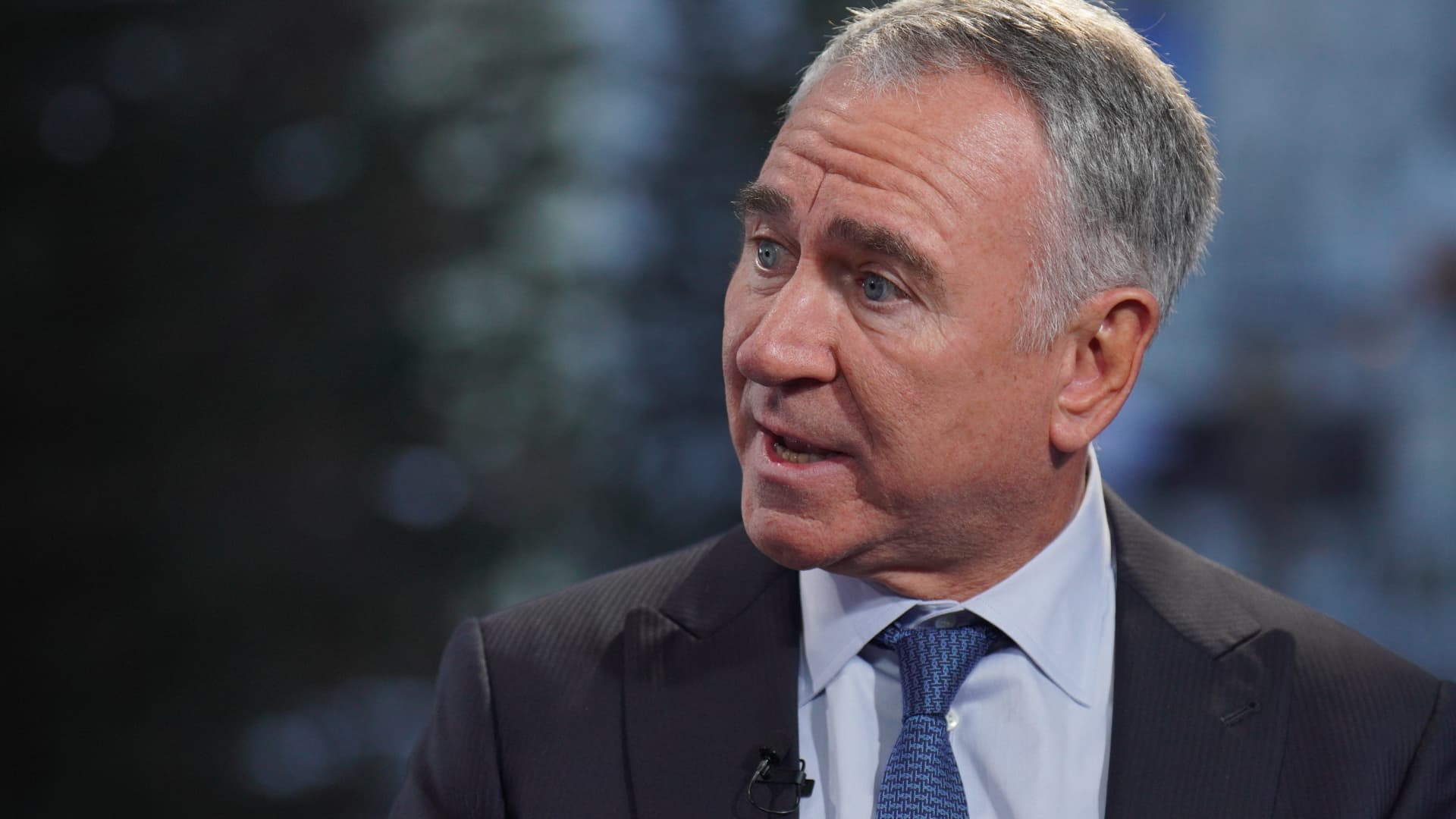
Ken Griffin, CEO of Citadel LLC speaks on Squawk on the Street at the World Economic Forum in Davos, Switzerland on Jan. 21, 2026.
Oscar Molina | CNBC
Billionaire investor Ken Griffin’s various hedge funds at Citadel generated positive returns in February, navigating a volatile month for markets as macro uncertainty and disruption from artificial intelligence whipsawed asset prices.
The firm’s flagship multistrategy Wellington fund rose 1.9% in February, bringing its year-to-date gain to 2.9%, according to a person familiar with the matter who asked not to be named because the information is private.
Performance was broad-based across the fund, with all five of Citadel’s core strategies — commodities, equities, fixed income, credit and quantitative — finishing the month in positive territory, the person said
The tactical trading fund advanced 1.5% in February, lifting its year-to-date return to 3.5%, the person said. The equities fund gained 1.0% for the month and is now up 2.2% in 2026. Meanwhile, the global fixed-income fund climbed 1.6% in February, bringing its year-to-date increase to 2.9%, according to the person.
The S&P 500 fell 0.9% in February amid fresh selling pressure in AI-linked and software shares. Fears that automation could erode established business models and trigger mounting layoffs have dampened investor sentiment, raising concerns about potential spillover effects on the broader economy. The market fell under massive pressure again after the U.S. and Israel’s attack on Iran caused oil prices to surge.
The firm declined to comment. Citadel oversaw $66 billion in assets under management as of Feb. 1.

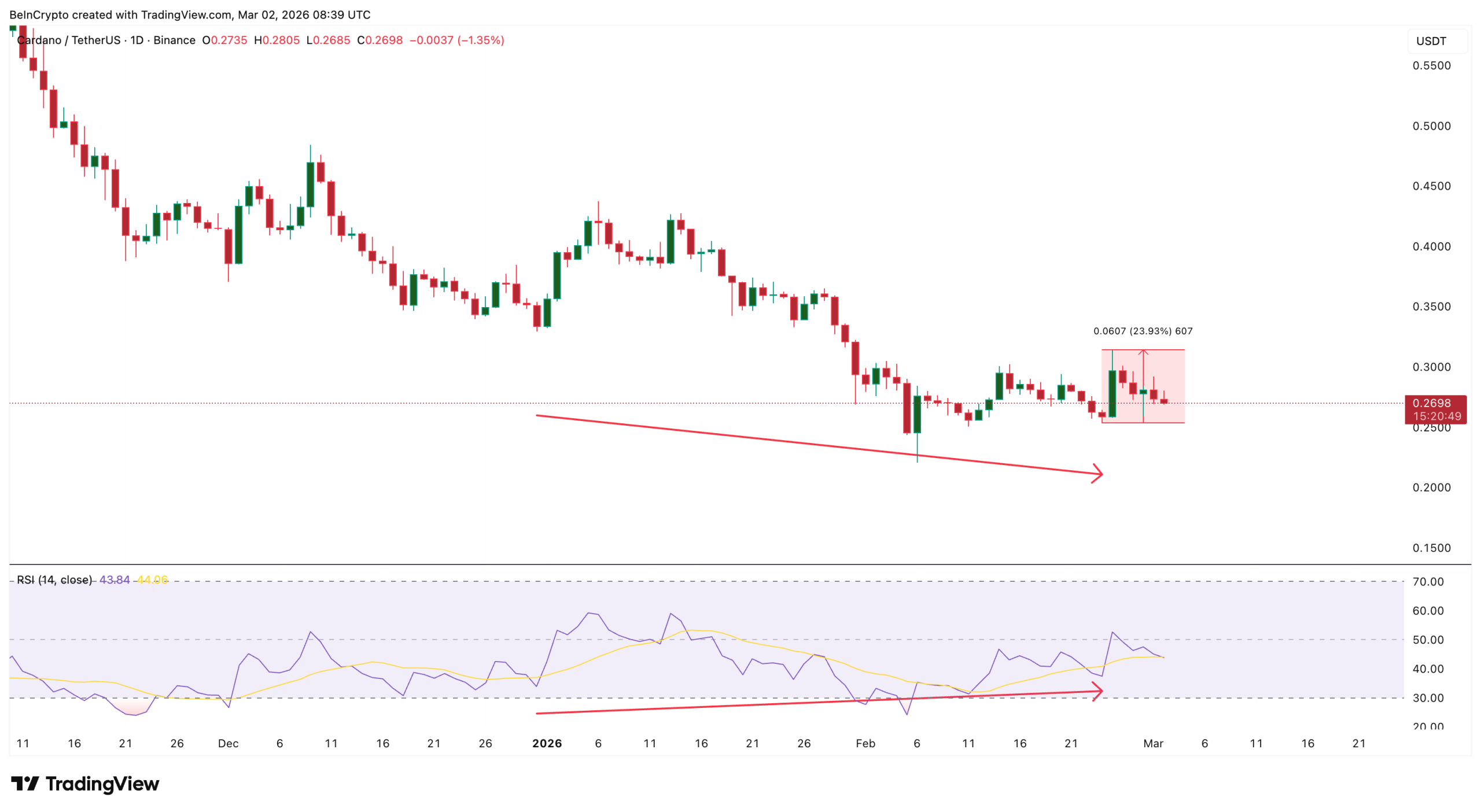
The Cardano price flashed a textbook bullish divergence on the daily chart, surged 24%, then collapsed. On-chain data reveals a coordinated whale exit worth over $540 million into the rally — even as the Money Flow Index confirmed retail was actively buying the dip.
Here’s what happened, and what it means next.
Daily RSI Divergence Fired & MFI Confirmed the Move
Between December 31, 2025, and February 24, 2026, ADA’s daily chart built a bullish divergence. The Cardano price printed a lower low, between the late-December range and the February 24 low. Meanwhile, the Relative Strength Index (RSI), a momentum oscillator, formed a higher low.
When price makes a lower low but RSI makes a higher low, it signals that bearish momentum is weakening even as price continues to fall.
The signal resolved on February 25 when ADA surged nearly 24%, briefly touching $0.31 before posting a long upper wick — a candlestick structure indicating aggressive selling into the highs.
Want more token insights like this? Sign up for Editor Harsh Notariya’s Daily Crypto Newsletter here.
What makes this setup more interesting is that the Money Flow Index backed it up. The MFI is a volume-weighted momentum indicator that combines both price and volume to measure buying and selling pressure, scored from 0 to 100. Unlike the RSI, which only considers price, MFI factors in trading volume — making it a more direct proxy for whether real capital is flowing into or out of an asset.
Between February 24 and 28, both price and MFI trended higher together. There was no bearish MFI divergence. This means the dips were being genuinely bought with volume conviction, not just price drifting upward on thin liquidity. Someone was actively absorbing sell pressure.
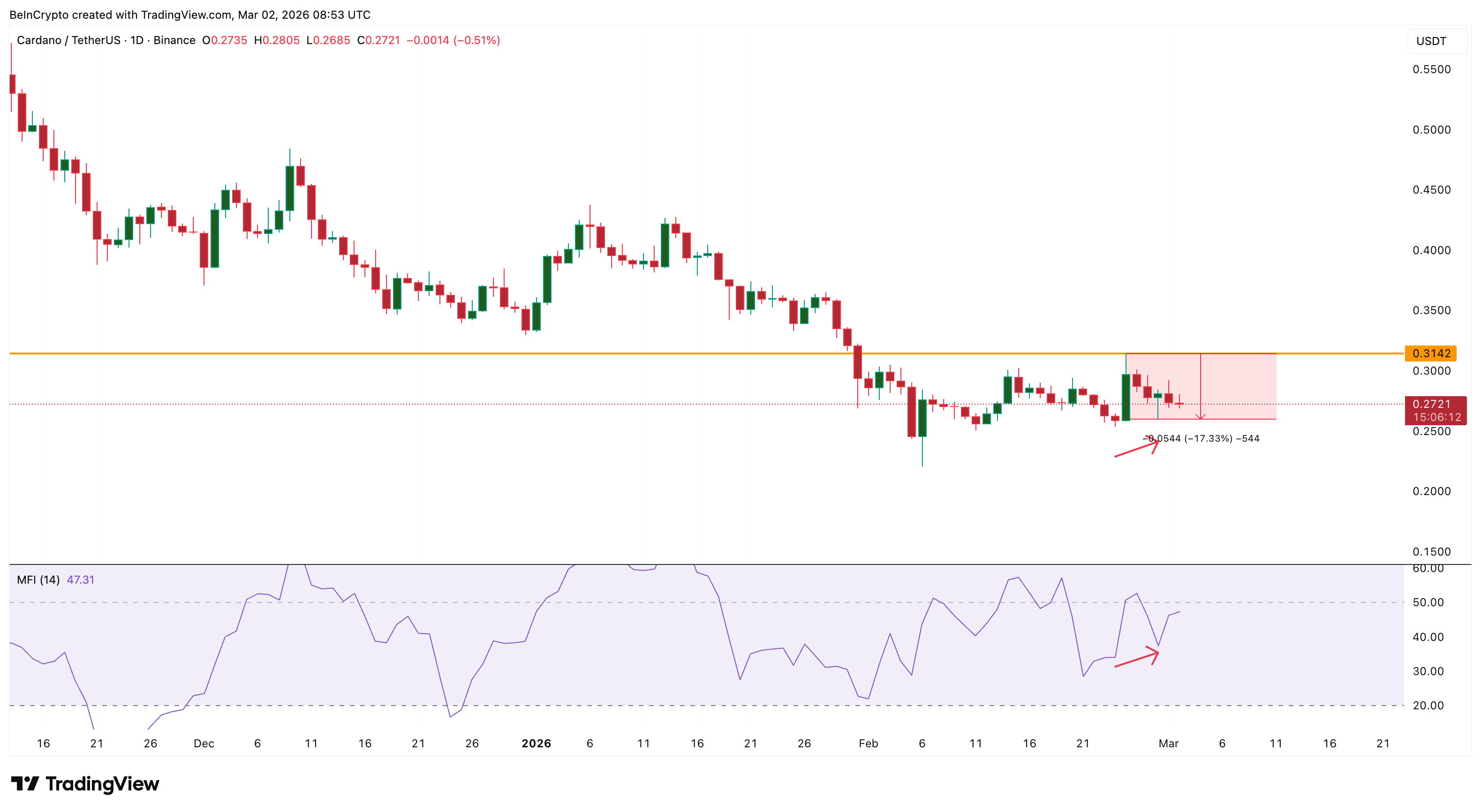
So the RSI divergence fired. MFI confirmed genuine buying support. ADA jumped 24%. And yet, from that February 25 peak, the price fell 17% within days. If the technical setup was valid and dip-buying was real, what killed the rally?
Over 2 Billion ADA Distributed in 3 Days: The Whales Were the Sellers
The answer is on-chain. Santiment’s supply distribution data reveals that between February 24 and 27, every major whale cohort reduced its holdings simultaneously.
The 1 billion-plus ADA cohort executed the largest single exit. It shed roughly 1.02 billion tokens in a single day between February 24 and 25 — dropping from 2.90 billion to 1.88 billion ADA.
The 100 million to 1 billion cohort initially picked up tokens on February 24, likely absorbing some of that initial sell, but then reversed aggressively by February 27, dropping from 3.47 billion to 2.61 billion ADA — a reduction of approximately 860 million tokens.
The 10 million to 100 million cohort shed around 220 million ADA over the same window, declining from 13.90 billion to 13.68 billion. Even the smallest whale tier, the 1 million to 10 million holders, reduced from 5.69 billion to 5.64 billion, offloading roughly 50 million tokens.
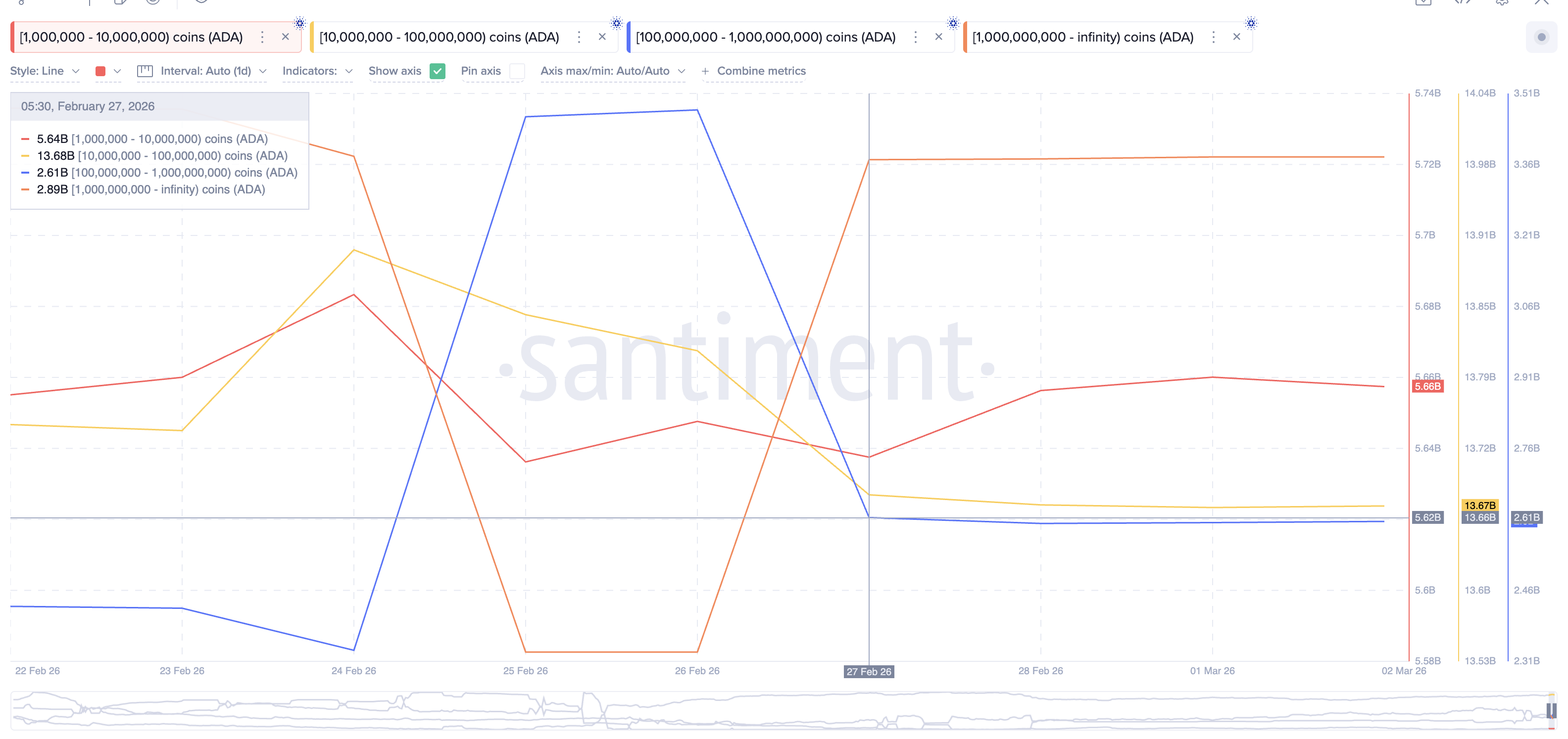
In total, approximately 2.15 billion ADA was distributed across all four cohorts within three days. At the average price of roughly $0.27 during this window, that amounts to approximately $540 million in concentrated sell pressure — all hitting the market during a rally that retail was actively buying into.
This is why the MFI data is so revealing. The MFI confirmed genuine buying support. The whale data confirms where the selling came from. Retail and mid-tier addresses were absorbing whale supply on the way up, but $540 million in distribution over 72 hours simply overwhelmed that demand.
Derivatives Data Adds Weight To ADA Breakdown
The derivatives market reinforces this picture. Cardano’s futures open interest had already collapsed from $1.95 billion September peak to below $450 million by mid-February. One of the lowest levels this year. This meant that leveraged retail had largely exited before the divergence even fired.
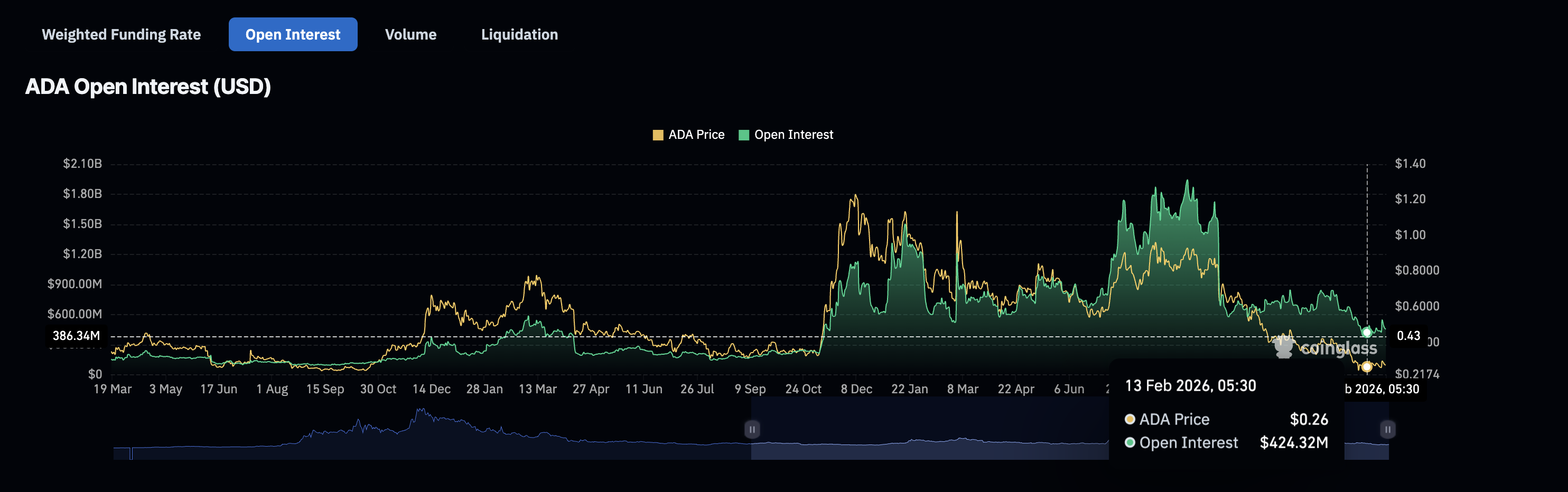
The buying MFI captured was therefore likely spot-driven: retail accumulating on the dip, using RSI divergence as conviction. But spot buying alone could not absorb the scale of whale distribution.
Cardano Price Action: Lower Lows Persist, Whale Re-Entry Becomes the Key Signal
ADA’s daily price structure remains lower as of March 2 (relative to late December), trading at $0.27, while the RSI continues to print higher lows (again relative to late December). This means the divergence framework is still technically alive, even after the late-February failure. A new swing low could trigger it again.
On the upside, $0.31 is the line in the sand. This was the exact rejection level on February 25. A daily close above this level would mark the first structural break in the downtrend, opening a path toward $0.37.
On the downside, a loss of $0.26 would confirm the weakness. Below that, the $0.23 and $0.21 levels become critical.
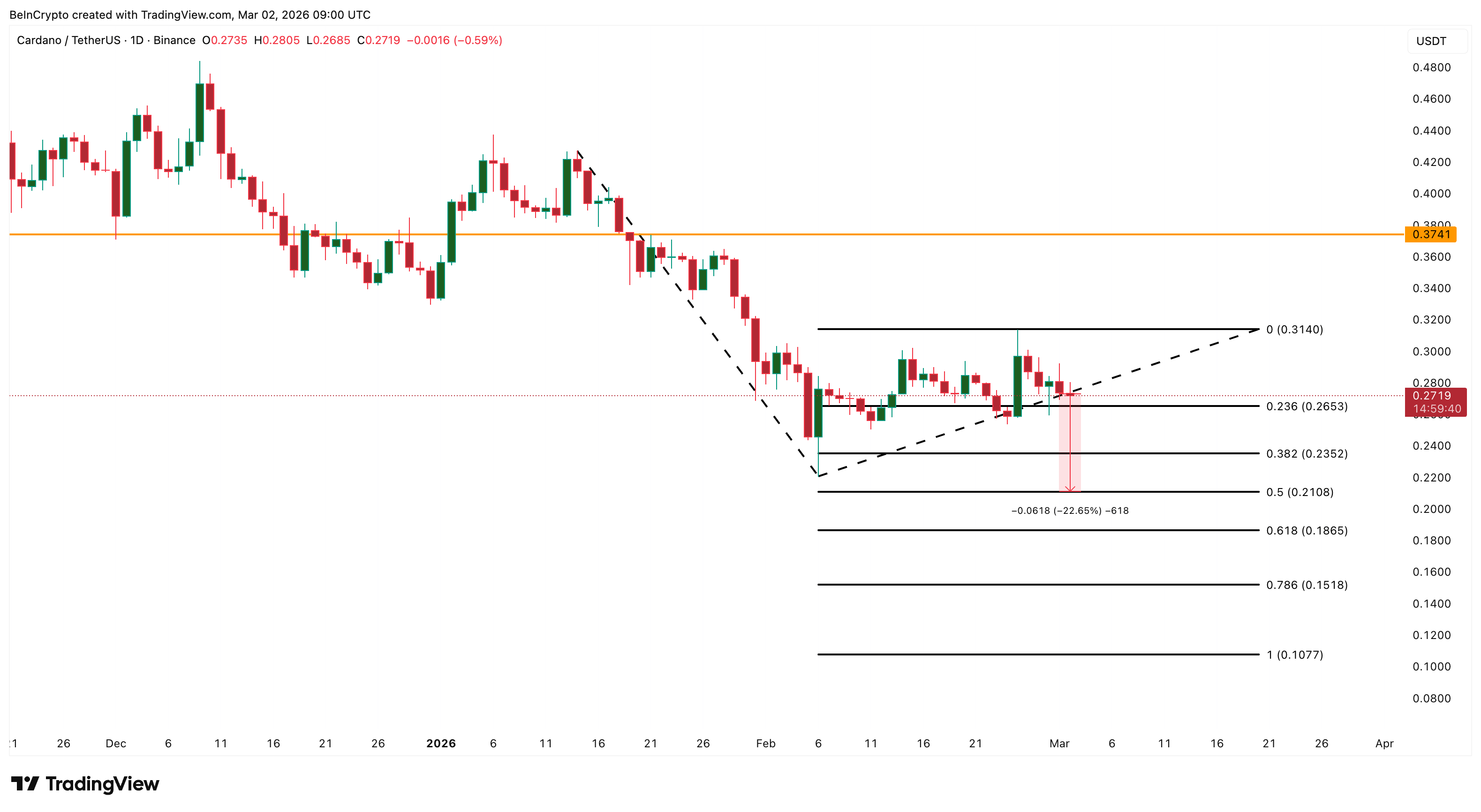
If $0.21 fails, deeper Fibonacci extensions at $0.18 (0.618) and $0.15 (0.786) come into play.
But the most important variable for Cardano’s next move is not a price level. It is whether the whales start buying again. As of March 2, Santiment data shows that major holders have not resumed significant accumulation.
If ADA declines toward $0.21 or lower and whale cohorts begin to re-accumulate, as they did earlier, it would represent a considerably stronger setup than February delivered. The moment whales resume buying can be treated as a potential local bottom signal.
For the next divergence to succeed, it needs whale participation as confirmation, not contradiction. Until that happens, the Cardano price structure could continue to point lower.

Editor’s note: Bitcoin closed February with a 15% drop, marking five consecutive monthly losses. The report also highlights a shift as major banks move to integrate crypto into traditional finance, signaling a convergence of fintech and lending rails. With geopolitical tensions and upcoming US data ahead of the Federal Reserve’s next meeting, crypto markets remain sensitive to macro signals. This editor’s note sets the scene for the figures that follow and what they may mean for price momentum and policy-driven risk in early 2026.
“Bitcoin has started March on the backfoot amid rising geopolitical tensions in the Middle East, which have triggered a broader flight from risk assets. This week’s US economic data — including ISM manufacturing and services PMI, ADP employment figures, and non-farm payrolls — will be closely watched ahead of the Federal Reserve’s next meeting. While markets are currently pricing in a hold on rates, softer data could increase expectations of a cut, potentially providing much-needed support to cryptoasset prices.”
Key points
- Bitcoin fell 15% in February, extending five consecutive monthly losses.
- If March finishes lower, it would mark six consecutive monthly declines.
- Institutional adoption accelerates: Citibank plans to integrate bitcoin into core banking and custody; Barclays explores stablecoin payments and tokenised deposits.
- Markets await US data (ISM, PMI, ADP, payrolls) and the Fed decision, which could influence crypto prices.
Why this matters
These numbers and moves matter because they illustrate a shift where crypto assets are increasingly considered alongside traditional finance. The data underscores how macro factors and policy expectations can drive crypto sentiment, while bank-led crypto integration signals a broader use case beyond speculation. If banks expand custody, settlement, and compliance workflows for digital assets, market dynamics and liquidity could evolve even as Bitcoin remains volatile.
What to watch next
- March performance and whether Bitcoin ends the month with a sixth straight decline.
- Upcoming US data releases and the Fed meeting shaping risk assets.
- Progress on Citi and Barclays crypto initiatives with potential launches later this year.
Disclosure: The content below is a press release provided by the company/PR representative. It is published for informational purposes.
Bitcoin Records Five Consecutive Monthly Losses as Major Banks Move to Integrate Crypto into Traditional Finance
Abu Dhabi, UAE – 2 March 2026: Bitcoin ended February down 15%, marking five consecutive months of losses and a 48% decline from its all-time high of $126,500 in October 2025.
For the first time in its history, both January and February have closed in negative territory in the same year. Should March also finish lower, it would mark six consecutive monthly declines — only the second such occurrence on record.
Simon Peters, Crypto Analyst at eToro, commented:
“Bitcoin has started March on the backfoot amid rising geopolitical tensions in the Middle East, which have triggered a broader flight from risk assets. This week’s US economic data — including ISM manufacturing and services PMI, ADP employment figures, and non-farm payrolls — will be closely watched ahead of the Federal Reserve’s next meeting. While markets are currently pricing in a hold on rates, softer data could increase expectations of a cut, potentially providing much-needed support to cryptoasset prices.”
Biggest Movers
NEAR rose 17% last week, climbing from $1.009 to $1.184 following NEARCON 2026 in San Francisco. Key announcements included the Near.com Super-App, enabling account management across more than 35 blockchains without manual bridging, and “Confidential Intents,” a privacy execution layer designed to shield cross-chain transaction details.
Polkadot (DOT) also gained 17% in anticipation of a major supply reduction on 14 March, which will cut annual token issuance by more than 50% — from approximately 120 million tokens to 55 million.
Institutional Adoption Accelerates
Citibank announced plans to integrate bitcoin into its core banking systems, aiming to make the asset “bankable.” The proposed services include institutional-grade custody of bitcoin, key management and wallet services, and the extension of traditional tax, reporting and compliance workflows to digital assets. The service is expected to launch later this year.
In the UK, Barclays is reportedly exploring the development of a blockchain platform for stablecoin payments and tokenised deposits. Earlier this year, Barclays acquired a stake in Ubyx, a US-based clearing system for digital money, marking its first direct investment in stablecoin infrastructure.
These developments highlight the continued convergence between traditional finance and the digital asset ecosystem.
About eToro
eToro is the trading and investing platform that empowers you to invest, share and learn. Founded in 2007 with the vision of a world where everyone can trade and invest in a simple and transparent way, today eToro has 40 million registered users from 75 countries.
eToro believes in the power of shared knowledge and that investors can become more successful by investing together. The platform has built a collaborative investment community designed to provide users with the tools they need to grow their knowledge and wealth. On eToro, users can hold a range of traditional and innovative assets and choose how they invest: trade directly, invest in a portfolio, or copy other investors.
Visit eToro’s media centre for the latest news.


A popular trading pair on Iran’s largest crypto exchange, Nobitex, is experiencing problems with inadequate liquidity and market fluctuations after it was suspended amid ongoing US-led airstrikes in the country.
Nobitex’s Telegram account posted on February 28 that it was suspending the Tether/Toman market until the following morning due to the “current emergency situation and per the directive of the Central Bank.”
When it was reopened, Nobitex claimed there had been “a temporary disruption in the supply and demand balance.”
“This situation led to momentary fluctuations and prices outside the market’s normal trend,” it said, adding that user positions priced at less than 145,000 Tether/Toman were liquidated as a result.
Read more: US senators call Binance ‘repeat offender’ over $2B Iran transfers
“Nobitex has decided to review all positions that were liquidated at prices below 145,000 Tether and reverse the process.”
It also warned that any transactions voluntarily placed below the 145,000 Tether/Toman price mark “will not be subject to this reversal process.”
“Additionally, until the review and reversal process is complete, affected users are requested to refrain from any transfers or withdrawals of the relevant assets to ensure the process proceeds without disruption,” Nobitex said.
Users in Iran are withdrawing crypto from Nobitex
Nobitex said on Saturday that internet outages in the country were slowing down its ability to process crypto withdrawals. The exchange also disabled the ability to create new futures positions with a leverage greater than one due to increased price volatility.
These announcements were made as the exchange experienced a 700% surge in outflows minutes after the first US-Israel airstrikes in Iran.
Crypto analytics firm Elliptic noted that the surge equated to an hourly withdrawal rate of almost $3 million at its peak, and “potentially represents capital flight from Iran.”
Read more: Crypto sleuth links $500M in Iranian USDT to stolen Bybit funds
It added that “Initial tracing of recent outflows from Nobitex suggests that the funds are being sent to overseas cryptoasset exchanges that have historically seen significant inflows from Iran.”
Coinbase Director Conor Grogan noted that Nobitex hasn’t processed any outbound transactions on its Ethereum addresses across the weekend, adding that TON transactions going through might be “botted activity.”
Nobitex’s site is also currently displaying an error 504, and crypto analyst Chainalysis noted that other Iranian exchanges like Ramzinex are also offline.
US and Israel kill Iran’s supreme leader
The conflict began on Saturday after the US had been increasing its military presence in the region for weeks in order to push Iran to accept a new nuclear deal.
US President Donald Trump has accused Iran of building nuclear weapons and has encouraged the country’s citizens to prepare to overthrow their current government.
There’s been civil unrest in the country since January when a government crackdown reportedly killed tens of thousands of protesters.
Elliptic’s findings show that the exchange experienced another outflow surge around this time, as well as outflows that coincided with new sanctions this year.
Read more: US hits Iran’s ‘shadow banking’ network in Hong Kong, UAE
Airstrikes launched by Israel and the US against military targets killed Iran’s supreme leader, Ayatollah Ali Khamenei, in his Tehran compound, alongside other top government officials. Most of Khamenei’s family have also reportedly been killed.
In the wake of the strikes, Middle East analysts have suggested that Iran’s political system won’t collapse quite yet as it distributes power across multiple institutions, such as the Islamic Revolutionary Guards Corps, and isn’t centralized with Khamenei.
Iran has launched drone and missile strikes across the Middle East in response to the military operations and has targeted Israel, Saudi Arabia, the United Arab Emirates, Qatar, and other countries in the region.
Got a tip? Send us an email securely via Protos Leaks. For more informed news and investigations, follow us on X, Bluesky, and Google News, or subscribe to our YouTube channel.
TD Securities, a major Canadian investment bank with operations across North America, says tokenization may be approaching an institutional turning point following the New York Stock Exchange’s push into tokenized equities.
In recent commentary, TD Securities Reid Noch, vice president for electronic trading, said tokenization is beginning to carry real implications for market structure, pointing to the NYSE’s proposed tokenized equities alternative trading system (ATS) as a key development.
The planned platform would enable 24-hour trading and near-instant settlement of tokenized stocks and exchange-traded funds (ETFs), subject to regulatory approval.
Rather than creating a parallel crypto-native marketplace, the venue is designed to operate within existing US market rules while leveraging blockchain-based settlement infrastructure.

Noch described the structure as closer to a “2.0” market shift, where custody and settlement would remain anchored to the Depository Trust & Clearing Corporation (DTCC), while trading would comply with National Best Bid and Offer (NBBO) requirements. This means prices must reflect the best available bid and offer across U.S. exchanges to prevent fragmented liquidity.
Although Noch said early activity is expected to be retail-driven, the broader implications extend well beyond individual traders.
TD Securities’ institutional focus suggests the company sees potential impact on core market plumbing, including trading hours, collateral management, settlement cycles and liquidity, areas that shape how large financial institutions operate.
Related: Crypto’s 2026 investment playbook: Bitcoin, stablecoin infrastructure, tokenized assets
Tokenized equities gain institutional traction
Tokenization accelerated in 2024, led primarily by private credit and U.S. Treasury products, which have accounted for the bulk of onchain real-world asset (RWA) issuance, according to industry data.
Despite broader crypto market volatility, capital inflows into tokenized assets have continued, suggesting sustained institutional interest in blockchain-based settlement and ownership models.
More recently, tokenized equities have begun gaining traction. Kraken’s xStocks platform has emerged as one of the more visible entrants, reporting more than $25 billion in cumulative trading volume since launching last year.

Although tokenized equities remain a small fraction of global stock market activity, their growth reflects a broader shift toward bringing traditional financial instruments onchain within regulated frameworks.
Related: Kraken launches tokenized securities trading in Europe with xStocks
Chainlink has enabled Coinbase cbBTC bridging to Monad, unlocking over $5B in Bitcoin-backed liquidity for decentralized finance applications.
Summary
- Chainlink CCIP will support bridging cbBTC from Base to Monad.
- More than $5B in Bitcoin-backed liquidity can enter Monad DeFi.
- Developers gain access to BTC-based lending and trading tools.
Chainlink (LINK) is now supporting the bridging of Coinbase Wrapped BTC from Base to Monad using its Cross-Chain Interoperability Protocol.
According to Chainlink’s March 2 announcement, the rollout will open up new pathways for Bitcoin-backed liquidity across decentralized finance applications.
cbBTC enters the Monad ecosystem
The new bridge makes it possible for users to deploy cbBTC in lending, trading, and structured finance products on Monad. Early adopters include Curvance and Neverland, which are launching markets built around the token.
Coinbase issues cbBTC, which is backed 1:1 by Bitcoin that is kept in custody. More than $5 billion in cbBTC is currently in circulation across networks such as Ethereum, Base, Solana, and Arbitrum.
Thanks to the integration, developers can build products that use Bitcoin as a base asset and benefit from Monad’s fast settlement and cheap fees. These products include derivatives connected to Bitcoin prices, deeper spot markets, automated trading routes, and lending pools based on Bitcoin.
Chainlink says its CCIP system has already supported over $28 trillion in on-chain transaction value, offering a standardized security framework for cross-chain transfers.
Keone Hon of the Monad Foundation said the move gives builders a strong asset to design around. Johann Eid of Chainlink Labs added that the system allows billions of dollars in cbBTC to move across networks with institutional-grade protection.
What this means for Chainlink, Coinbase, and DeFi
The partnership strengthens Chainlink’s position as a leading provider of cross-chain infrastructure. The network controls a sizable portion of the oracle market, with over $100 billion in total value secured.
Its reach has also been extended beyond retail DeFi through recent partnerships with institutional networks. Coinbase continues to use cbBTC to connect traditional custody with on-chain activity.
The expansion to Monad supports its goal of giving users more ways to earn yield, borrow, and trade without selling their Bitcoin. cbBTC is already used in several lending and yield platforms, with some offering returns of up to 3%.
Monad will benefit from direct access to large Bitcoin-backed liquidity pools. The network, which targets up to 10,000 transactions per second and sub-second finality, is designed for high-frequency finance and capital-intensive applications.
With more than $5 billion in cbBTC now able to reach Monad, industry watchers expect higher activity in Bitcoin-based DeFi products, especially in lending, trading, and structured finance markets.

Editor’s note: Geopolitical tensions in the Middle East are triggering a rapid market reaction, with oil and gold rallying while regional equities reel from disruptions. This editor’s briefing previews the immediate market response as UAE exchanges pause trading and investors weigh reopening scenarios. Market color from Josh Gilbert of eToro underscores the uncertainty and the central question: how long this disruption lasts and whether we see escalation or de-escalation in the coming days.
Markets hate uncertainty, and right now investors are facing one of the most unpredictable geopolitical backdrops in years. The key question is not just what has happened, but how long this disruption lasts and whether we see escalation or de-escalation in the coming days.
Rising Middle East tensions push oil and gold higher, rattling regional equities and shaping the near-term global outlook as markets await any de-escalation.
Key points
- Oil prices surged to around US$82 per barrel, with Brent rising on disruption fears in the Strait of Hormuz.
- Gold climbed above US$5,350 per ounce, reinforcing safe-haven demand amid geopolitical risk.
- Abu Dhabi and Dubai exchanges were closed, highlighting the seriousness of the situation and uncertainty around reopening.
- Risk assets weakened as capital rotated toward defensive positions, awaiting clarity on escalation or de-escalation.
Why this matters
As energy and precious metal prices respond to geopolitical risk, the near-term outlook for regional economies and global inflation remains sensitive to sentiment and policy signals. The UAE’s diversified, services-driven economy may weather disruption better than markets fear, but confidence and capital flows could face headwinds until de-escalation appears likely.
What to watch next
- Reopening trajectory for UAE exchanges after the pause, with the next 48–72 hours critical for sentiment.
- Oil price movement and its potential impact on transport costs and global inflation.
- Gold’s continued safe-haven demand versus any shift in risk appetite.
- Any changes in UAE tourism, aviation, and real estate activity tied to connectivity and confidence.
Disclosure: The content below is a press release provided by the company/PR representative. It is published for informational purposes.
Oil and Gold Surge as Middle East Tensions Rattle Global Markets
Abu Dhabi, UAE – 2 March 2026: Escalating tensions in the Middle East have sent shockwaves through global markets, pushing oil and gold sharply higher and raising fresh questions about the near-term outlook for regional equities.
Josh Gilbert, Market Analyst at eToro, said: “Markets hate uncertainty, and right now investors are facing one of the most unpredictable geopolitical backdrops in years. The key question is not just what has happened, but how long this disruption lasts and whether we see escalation or de-escalation in the coming days.”
The Abu Dhabi Securities Exchange (ADX) and Dubai Financial Market (DFM) remain closed on Monday and Tuesday in a rare move outside scheduled holidays, highlighting the seriousness of the situation. Investors are now focused on what reopening could look like once trading resumes.
“History shows that outcomes vary widely,” Gilbert added. “When Turkey suspended trading after the 2023 earthquake, markets rallied strongly on reopening. When Russia halted trading after invading Ukraine, the outcome was far more severe. For UAE markets, the next 48 to 72 hours will be critical.”
Oil in Focus
Oil has been the immediate flashpoint. Brent crude surged as much as 13% to around US$82 per barrel, driven by fears of disruption in the Strait of Hormuz, which carries roughly 20% of the world’s crude oil and LNG supply.
“Even without a full closure of the Strait of Hormuz, disruption to tanker traffic is enough to rattle energy markets,” said Gilbert. “Conflicting signals from Iran have added to the uncertainty investors are trying to price in.”
There are, however, short-term buffers in place. The global oil market entered this period with relative oversupply, and OPEC+ had already announced a production increase of 206,000 barrels per day for April. Major consumers such as the US and China also hold substantial strategic reserves, while Saudi Arabia has pipeline capacity to reroute some exports.
“These measures provide short-term cushioning,” Gilbert noted. “But if tensions persist, sustained higher oil prices will filter through to transport costs and ultimately inflation globally.”
Gold Surges, Risk Assets Weaken
Gold has once again acted as the clearest safe haven, climbing above US$5,350 per ounce and gaining roughly 22% year-to-date.
“Gold remains the asset investors turn to in times of geopolitical stress,” Gilbert said. “Unless we see meaningful de-escalation, that safe-haven demand is unlikely to fade.”
Meanwhile, higher-risk assets, including cryptocurrencies, have come under pressure as investors rotate toward defensive positions.
“In risk-off environments, capital typically flows to traditional safe havens rather than more volatile assets,” he added.
Direct Impact on the UAE
For the UAE, the implications extend beyond market volatility. Real estate, tourism, aviation, and retail — key pillars of economic diversification — are particularly exposed.
Dubai averaged approximately 13,000 home sales per month last year at an average price of AED 2.5 million, largely supported by foreign investment and expatriate inflows. With around 350,000 new units expected to come to market over the next two years, any sustained hit to confidence or capital flows could challenge demand absorption.
Tourism is another critical sector. Travel and tourism accounted for around 13% of UAE GDP in 2025. With hundreds of flights cancelled and temporary airport disruptions reported, the impact is already being felt.
“Dubai’s retail and hospitality ecosystem depends on connectivity,” Gilbert said. “Any prolonged disruption to airspace or tourism confidence will weigh on near-term growth.”
While higher oil prices may offer fiscal support, the UAE economy today is far more diversified and services-driven than it was a decade ago.
“That means disrupted tourism, grounded flights, and shaken investor sentiment matter more than ever,” Gilbert explained.
Staying Focused on the Long Term
Gilbert cautioned against reactive decision-making.
“The instinct in moments like this is to act, but for most long-term investors, doing very little is often the wiser approach. Selling into panic rarely proves to be the right decision in hindsight.”
He concluded: “There is room for volatility when UAE markets reopen, particularly as very little geopolitical risk had been priced in. However, if de-escalation emerges quickly, the long-term fundamentals of the UAE — strong infrastructure, a pro-business regulatory framework, and its role as a regional hub — remain intact. Short-term turbulence does not undo decades of structural progress.”
About eToro
eToro is the trading and investing platform that empowers you to invest, share and learn. Founded in 2007 with the vision of a world where everyone can trade and invest in a simple and transparent way, today eToro has 40 million registered users from 75 countries.
eToro believes in the power of shared knowledge and that investors can become more successful by investing together. The platform has built a collaborative investment community designed to provide users with the tools they need to grow their knowledge and wealth. On eToro, users can hold a range of traditional and innovative assets and choose how they invest: trade directly, invest in a portfolio, or copy other investors.


While US Senate lawmakers have been working to pass a comprehensive digital asset market structure bill since July, some industry observers in Washington say progress could be “on hold” due to government gridlock.
Since the House of Representatives passed the CLARITY Act last summer and sent the legislation to the other chamber, lawmakers have faced a historically long government shutdown, partisan divides on ethics and debates over stablecoin yield that have likely slowed progress on the bill, which could be further hampered by the upcoming US midterm elections in November.
Eight months ahead of the midterms, one version of the market structure bill focused on commodities regulations has passed the Senate Agriculture Committee, while members of the Senate Banking Committee have yet to address a bill on securities laws and regulations after the panel cancelled a markup in January.
Rebecca Liao, co-founder and CEO at Web3 and AI protocol Saga and a former adviser to then-US President Joe Biden during his 2020 campaign, told Cointelegraph last week that the legislation was effectively “on hold.” She also pushed back against comments by Ohio Senator Bernie Moreno, who said in February that Congress could pass market structure “hopefully by April,” citing a lack of steam for advancing the bill.
Related: US lawmakers move to protect blockchain devs from prosecution
“Earlier, when crypto markets were doing very well, when it seemed that every TradFi institution was coming up with a crypto strategy, looking to load up on the main assets, there was a lot more urgency around any sort of new legislation or new administrative policy coming out of the SEC, CFTC, etc,” said Liao.
“But now that the markets have cooled significantly, and even people within crypto are saying ‘we don’t know, honestly, if the Trump family ended up being a good thing for crypto or not’ a lot of the wind has been taken out of the sails.”
She added:
“It is not easy to get any sort of legislation through this Congress, and when it’s on a topic that most Americans honestly still find pretty obscure, it’s even harder. And it’s an election year.”
Stablecoin debate rages, with the Trump administration in the middle
Further complicating the matter in the Senate is the debate around stablecoin rewards, which has resulted in a reported three meetings at the White House between Trump officials and representatives from the crypto and banking industries. Some in banking have argued that having the market structure bill include provisions allowing yield payments to stablecoin holders on third-party platforms could undermine the industry.
Crypto advocacy organization Digital Chamber CEO Cody Carbone spoke to Cointelegraph after attending the World Liberty Financial forum during which Moreno laid out his timeline on the bill. The trade group leader said the mood among some at the event, such as Coinbase CEO Brian Armstrong, was “very optimistic” on finding resolutions to move the bill forward, but outside of Moreno’s April goal, “there wasn’t a lot of specifics.”
The 2026 election season has already kicked off in some US states, with party primaries scheduled for Tuesday in Arkansas, North Carolina and Texas ahead of the November general election. The Senate will also likely take about a month away for a state work period in August, returning two months before the election.
Magazine: Clarity Act risks repeat of Europe’s mistakes, crypto lawyer warns
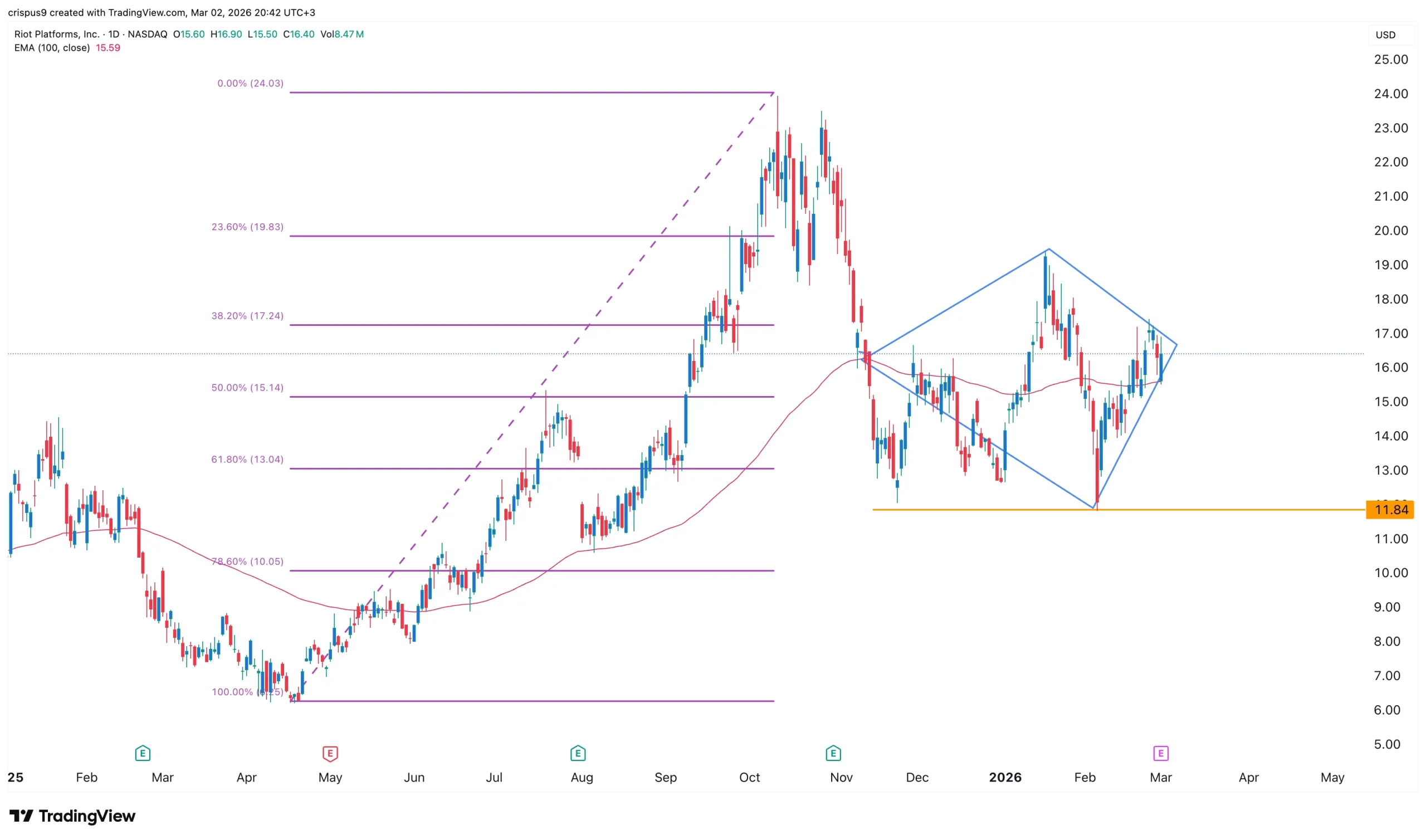
Riot stock price rose by over 1.2% on Monday as Bitcoin and other altcoins rose despite the ongoing geopolitical risks. It also rose as traders waited for its financial results.
Summary
- Riot Platforms stock rose as the crypto market rebounded.
- The company will publish its financial results on Monday.
- The stock has formed a diamond reversal pattern, pointing to a potential reversal.
RIOT stock rose to $16.50 from the intraday low of $15.45. It remains 40% above its lowest level in February, with the market capitalization soaring to over $6.14 billion.
Wall Street analysts expect the upcoming results to show that the Bitcoin (BTC) mining giant did well in the last quarter, with its revenue rising by 10% to $158 million. Its annual revenue is expected to come in at $658 million, up by 75% YoY.
The most recent showed that its revenue jumped to $180 million in the third quarter from $84 million in the same period in 2024. This growth was driven by its mining operations, whose revenue rose from $67 million to $160 million. Its engineering revenue rose to $19 million from $12 million.
Like other Bitcoin mining companies, Riot Platforms is facing major challenges as the coin remains in a technical bear market after falling by over 40% from its all-time high. As a result, it is expanding to the data colocation industry, which is booming as companies boost their capital expenditure.
It recently acquired 200 acres of land in Texas to expand its mining operations. Also, it entered a data center leasing agreement with AMD, a top semiconductor company. Its initial deal is for 25 MW of IT capacity.
Riot Platforms is under pressure from Starboard Value, an activist investor, who believes that it should accelerate its transition into a data center operator. It wants it to accelerate the rollout of its data centers, a move that will make it more attractive to hyperscalers. For example, IREN has already inked deals worth over $10 billion, while CoreWeave has a backlog of over $50 billion.
Riot Platforms stock price technical analysis
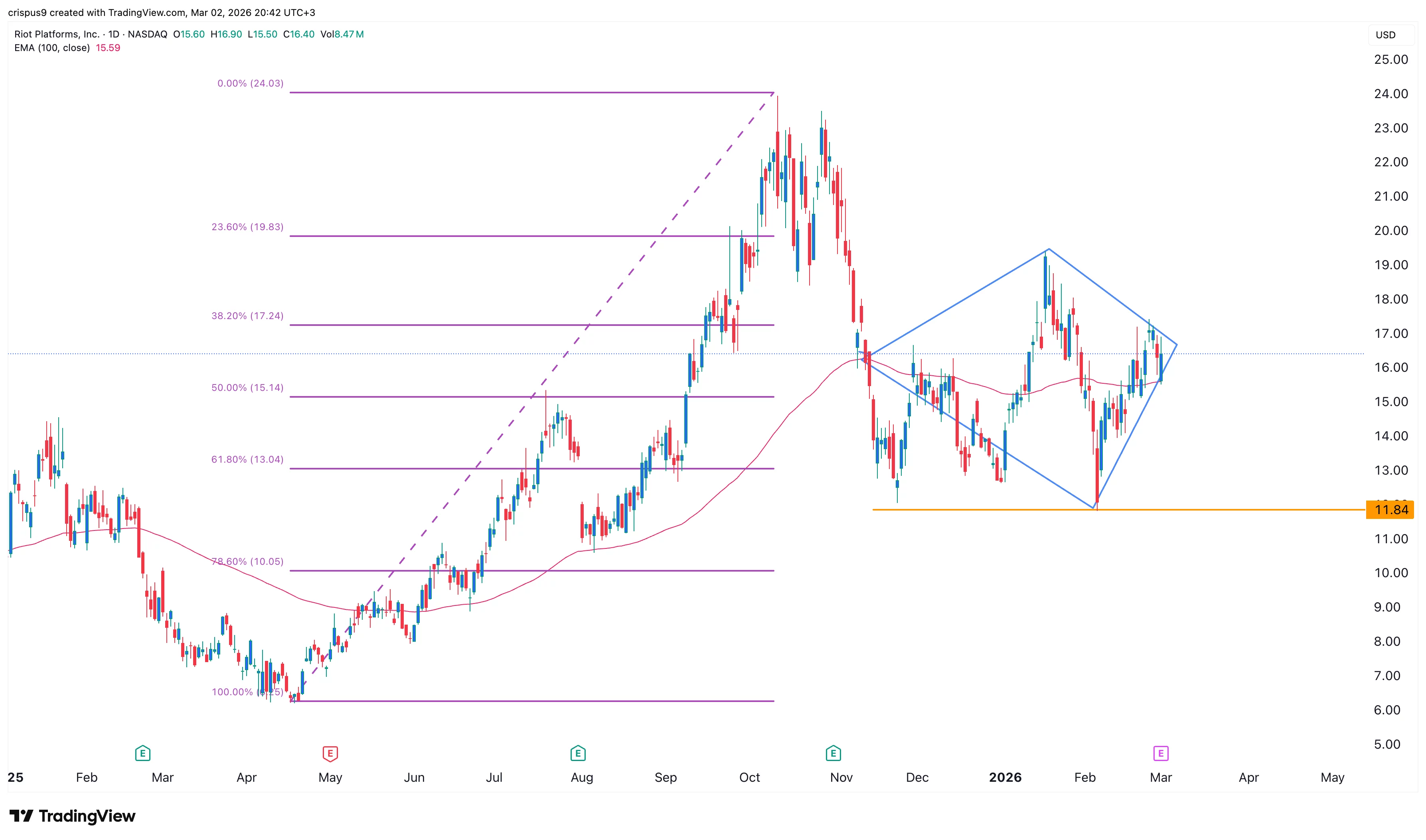
The daily chart shows that the Riot Platforms share price has rebounded from the year-to-date low of $11.85 in February to the current $16.50.
It remains between the 50% and 38.2% Fibonacci Retracement level. It also moved slightly above the 100-day Exponential Moving Average.
However, the stock has also formed a diamond reversal pattern, which often leads to a bearish breakdown.
Therefore, it will likely have a bearish breakdown after its earnings. If this happens, the next key target to watch will be the psychological level at $15.
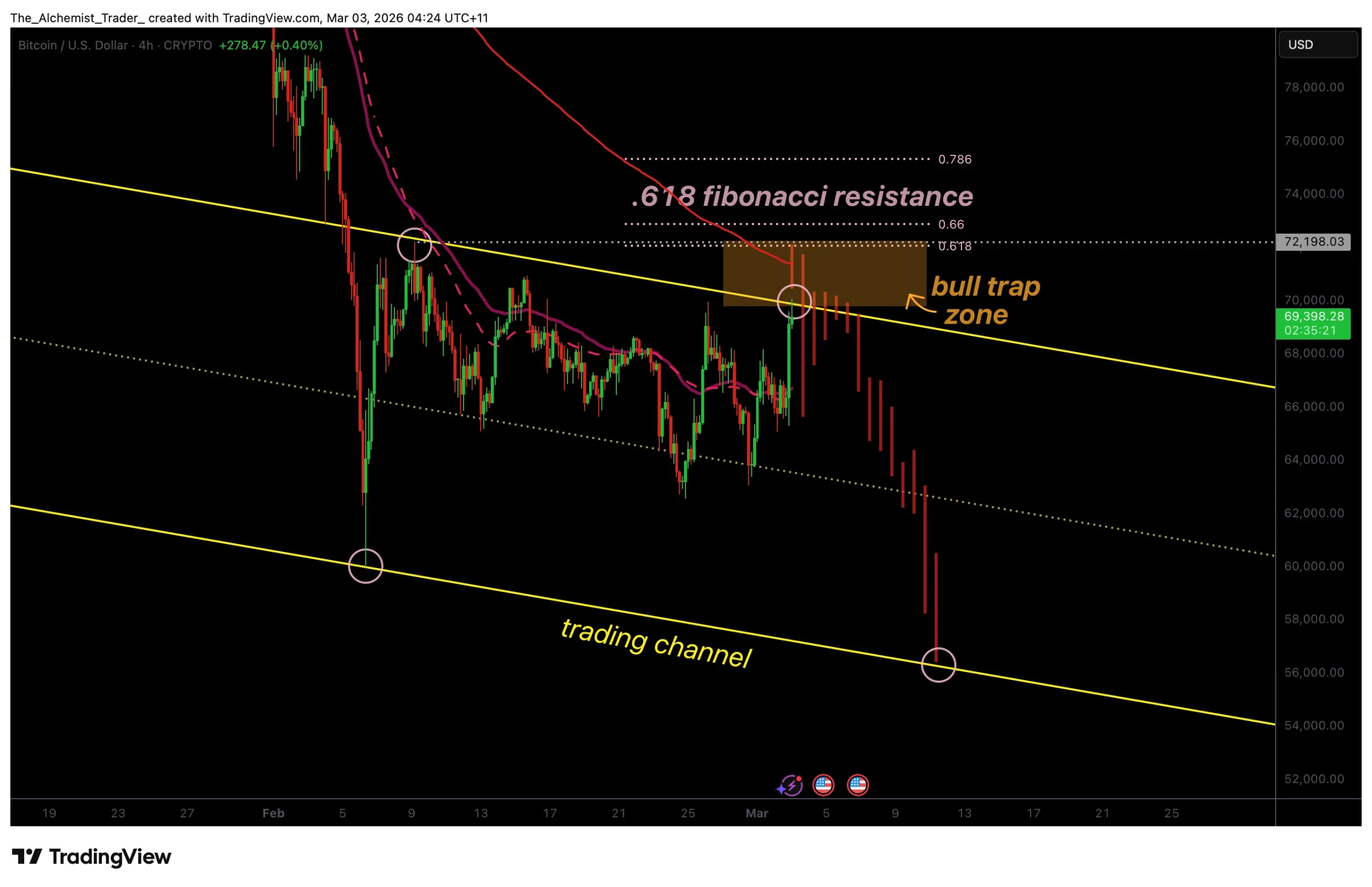
Bitcoin price impulsive rally is approaching a dense resistance cluster, raising concerns that the move could evolve into a bull trap.
Summary
- Price testing channel high and Fibonacci resistance
- Declining volume signals weakening bullish momentum
- Rejection risks rotation toward $60,000 channel support
Bitcoin (BTC) price has staged a sharp recovery from recent lows near $60,000, pushing price back toward the upper boundary of its broader trading channel. While the rally has improved short-term sentiment, the technical landscape suggests caution.
Multiple layers of resistance now converge above price, creating conditions where upside continuation may struggle to sustain momentum.
Bitcoin price key technical points
- Channel Resistance: Price approaching upper boundary of established trading channel.
- Fibonacci Confluence: Overhead resistance aligns with key swing high and moving averages.
- Volume Concern: Declining participation signals potential bull trap formation.
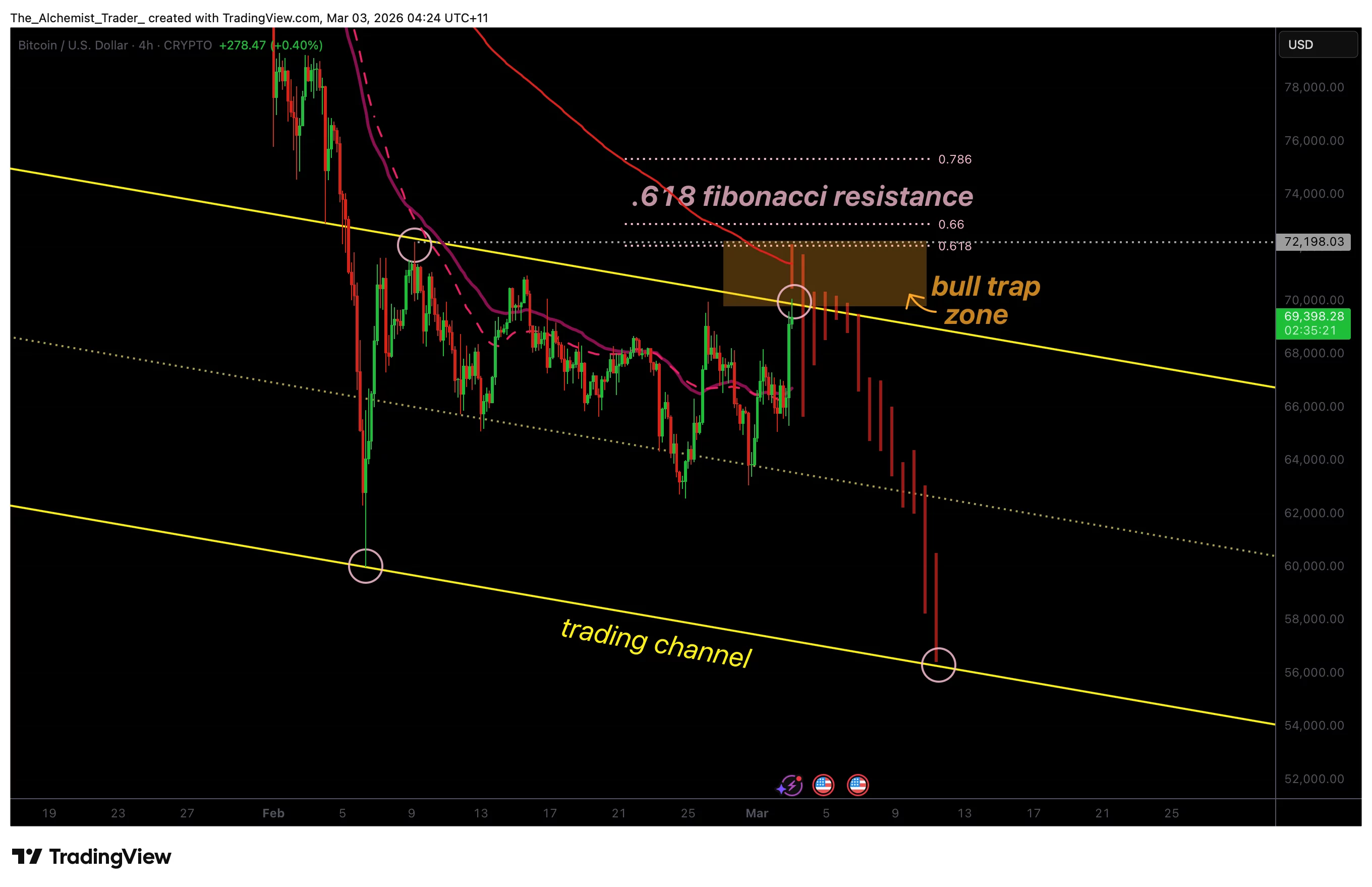
Bitcoin price recent rally has carried price above the channel midpoint, signaling short-term strength within the broader range. However, the move is now testing the upper channel boundary, an area that has repeatedly capped upside since $60,000 was established as the weekly low. This level represents a key structural ceiling within the ongoing consolidation phase.
Adding to the resistance confluence is the presence of a significant Fibonacci retracement level, which overlaps with a prior swing high and descending moving average resistance. When multiple technical indicators align within a narrow price zone, markets often react decisively. In this case, the overlapping resistance cluster increases the probability of rejection rather than breakout continuation.
Volume dynamics further reinforce caution. Despite the impulsive appearance of the rally, trading volume has steadily declined as price approaches resistance. Healthy breakouts typically require expanding participation to confirm strength.
Instead, fading volume suggests that buying pressure may be weakening, a classic precursor to bull trap scenarios, particularly as roughly 46% of Bitcoin supply is currently held at a loss, nearing levels seen during the 2022 bear market.
A bull trap typically forms when price briefly breaks above resistance, attracting breakout buyers, only to reverse sharply and close back below key levels. Should Bitcoin fail to hold above the channel high and instead fall back into the channel structure, it would signal weakness and confirm the trap setup. A bearish close back within the channel would likely shift momentum downward.
If rejection occurs, the next logical destination would be the lower boundary of the trading channel. Notably, the channel support has not been retested since the $60,000 weekly low was formed. Markets frequently revisit untested support zones to rebalance liquidity before determining the next major direction.
From a broader market structure perspective, Bitcoin remains range-bound rather than in confirmed bullish expansion. Without a decisive breakout supported by strong volume, rallies into resistance carry elevated failure risk.
The confluence of Fibonacci resistance, moving averages, and structural channel highs strengthens the argument that this zone may cap upside in the near term, particularly as Bitcoin navigates a defensive liquidity backdrop amid escalating US–Iran tensions and broader market volatility.
What to expect in the coming price action
Bitcoin’s rally remains vulnerable while testing confluence resistance with declining volume. A rejection from this zone would confirm a potential bull trap and increase the probability of a corrective move back toward channel support near $60,000.
Only a strong breakout with volume confirmation would shift the outlook decisively bullish.


U.S. spot Bitcoin ETFs added 21,000 BTC worth $1.45 billion, marking the first major accumulation wave since mid-October 2025.
Spot Bitcoin exchange-traded funds (ETFs) recorded one of their best days for weeks in terms of inflows on February 25, marking their first meaningful increase in holdings since mid-October 2025.
The shift comes as analysts point to falling retail flows and heavy unrealized losses among newer buyers as signs that market structure could be turning.
The Institutional Signal vs. Retail Exit
In a March 2 market update, analyst Amr Taha tracked two key data points that suggest a major shift in how Bitcoin moves between different types of investors. The first chart tracks 30-day cumulative Bitcoin inflows to Binance, separated into retail inflows (small investor flows) and whale inflows (large investor flows).
According to the chart, between February 6 and March 2, retail inflows dropped significantly, going from $14.1 billion down to $9.05 billion, a total contraction of approximately $5 billion.
What makes this interesting, Taha explained, is that nearly identical patterns appeared twice in 2025, with retail inflows contracting by about $8 billion from March 5 to April 7 of that year and falling by around $5 billion from June 6 to June 22. In both cases, the drop in retail inflows happened right before significant market movements.
The second chart tracks the total Bitcoin held by all US spot ETFs combined. Here, Taha observed something important occurring on February 25: for the first time since mid-October, ETF holdings increased meaningfully. Approximately 21,000 BTC flowed into the funds, equivalent to $1.45 billion at current prices, marking what Taha called the first noticeable accumulation wave after months of stagnation.
“Historically, rising ETF demand tends to be constructive for price, while declining demand often aligns with price weakness,” the crypto trader noted.
However, data from SoSoValue and FarSide show a different number. Both sites claim that the actual net inflows on February 25 were just over $500 million, or almost three times less than what Taha suggested. Nevertheless, it was still the best day for net inflows since mid-January.
You may also like:
Market Situation and Sentiment
The broader backdrop for this on-chain signal has been brutal, with Bitcoin posting five consecutive monthly losses for the first time since 2018, after ending February with a nearly 15% drop. The asset is currently trading just above $66,000, down by over 20% in the past month and sitting 47% below its October 2025 all-time high.
Analyst Crypto Dan offered additional context on market psychology, noting that most investors who purchased Bitcoin within the past two years are currently in loss positions.
“In the investment market, sharp reductions often follow when the majority of people are making big profits, and conversely, strong rallies tend to begin after most people experience significant losses,” he pointed out.
Dan suggested that if Bitcoin’s price drops below $60,000, putting the majority of investors (excluding very long-term holders) into loss territory, it could represent an accumulation opportunity for those with clear entry criteria.
As it is, Taha’s data suggests institutional buyers are already making that calculation, even as retail traders step back.
Binance Free $600 (CryptoPotato Exclusive): Use this link to register a new account and receive $600 exclusive welcome offer on Binance (full details).
LIMITED OFFER for CryptoPotato readers at Bybit: Use this link to register and open a $500 FREE position on any coin!

Cardano Price Reversal Failed As Whales Sold $540 Million Into It

Freedman tracks weather closely ahead of 2026 Surround Stakes with Apocalyptic

Fyne Audio’s Full-Bleed Bristol Takeover: Colorful F500SP Speakers Steal the 2026 Hi-Fi Show


-

 Fashion3 days ago
Weekend Open Thread: Iris Top
-

 Politics4 days ago
ITV enters Gaza with IDF amid ongoing genocide
-

 Business6 days ago
True Citrus debuts functional drink mix collection
-

 Tech2 days ago
Unihertz’s Titan 2 Elite Arrives Just as Physical Keyboards Refuse to Fade Away
-
Sports3 days ago
The Vikings Need a Duck
-

 Crypto World7 days ago
XRP price enters “dead zone” as Binance leverage hits lows
-
 NewsBeat2 days ago
Dubai flights cancelled as Brit told airspace closed ’10 minutes after boarding’
-

 NewsBeat5 days ago
Cuba says its forces have killed four on US-registered speedboat | World News
-

 Tech6 days ago
Unsurprisingly, Apple's board gets what it wants in 2026 shareholder meeting
-
 NewsBeat2 days ago
The empty pub on busy Cambridge road that has been boarded up for years
-
 NewsBeat5 days ago
Manchester Central Mosque issues statement as it imposes new measures ‘with immediate effect’ after armed men enter
-

 NewsBeat1 day ago
‘Significant’ damage to boarded-up Horden house after fire
-

 NewsBeat2 days ago
Abusive parents will now be treated like sex offenders and placed on a ‘child cruelty register’ | News UK
-
 NewsBeat6 days ago
Police latest as search for missing woman enters day nine
-

 Entertainment14 hours ago
Baby Gear Guide: Strollers, Car Seats
-

 Business5 days ago
Discord Pushes Implementation of Global Age Checks to Second Half of 2026
-

 Business4 days ago
Only 4% of women globally reside in countries that offer almost complete legal equality
-
 Tech3 days ago
NASA Reveals Identity of Astronaut Who Suffered Medical Incident Aboard ISS
-

 Crypto World6 days ago
Entering new markets without increasing payment costs
-
Politics2 days ago
FIFA hypocrisy after Israel murder over 400 Palestinian footballers