
Crypto World
Citi, Goldman, other global banks and asset managers team up on stablecoin venture



The group will focus first on a U.S. dollar stablecoin for payments and digital asset settlement, with a euro token a priority for expansion.



Allbirds, a once-popular shoe brand, rebranded to Smartbird – an AI company – a few months ago, and the stock soared.
While shares had been slowly – and then quickly – deteriorating since the brand’s IPO, on news of this pivot, they quickly shot up to over $20 overnight, an increase of over 800%.
But in a situation that is darkly reminiscent of the infamous Long Blockchain Company, Smartbird’s share price has since collapsed to the exact same price it was before becoming an AI company, and the future looks bleak.
What was Allbirds?
Full disclosure: I own a pair of Allbirds [editor note: I also have owned several pairs and enjoyed them]. They’re great. They look snazzy, in a casual sense. They’re a lovely, warm, wet sand-yellow. I bought mine on a trip to Tokyo; I can even recall the sales pitch.
The Allbirds store was mostly empty, and I wasn’t hunting for a new pair of shoes. But the rows and rows of Allbirds called to me. The Japanese saleswoman started her initial spiel about how the shoes were sourced from high-quality, sustainable materials. Finally, perhaps in an act of desperation, she told me, “You can throw them in the washing machine and they will look just like new.”
I was sold.
I love my Allbirds. I generally use slip-ons and the best part of my Allbirds is that they aren’t slip-ons. They’re real shoes with heel and arch support. I can walk for miles and my feet don’t hurt, and, lastly, the saleswoman wasn’t lying: I wash them and they look like new.
But despite never hearing about Allbirds before this moment in Japan, I was late to the game. It turned out, in fact, that I was showing up for the fleeting encore performance right before the dramatic end of the show.
What happened to the shoe company?
The short story is that, after a brief moment of explosive sales years and years ago, to the point that the C-suite could take the company public, no one wanted to buy Allbirds anymore. Revenue fell through the floor, the stock died, and the company desperately needed to pivot.
The longer story goes something like this:
Allbirds was celebrated by Silicon Valley elites and politicians and was even a media darling, largely due to its campaign of using sustainable materials. Before going public, the brand was pushing hundreds of millions in revenue every year and was considered a fashion icon at the time, along with the likes of Lululemon, focusing on casual, cozy clothes.
Fashion is a fickle mistress. Allbirds IPOed at the peak of consumer interest in the brand, and the stock tumbled basically forever after day one. Allbirds remained focused on sustainable materials, shoes, and their direct-to-customer sales model. To put it bluntly, an inability to change killed Allbirds.
After being valued at $4 billion on IPO day, it only took two years for the company to lose over 85% of that valuation.
This year, Allbirds sold off its footwear IP and merchandise to American Exchange Group for a measly $39 million – a massive fall from grace. In general, American Exchange Group buys failing clothing companies and licenses and distributes them after purchase, owning such well-known brands as bebe, Rocawear, Ed Hardy, and Rampage.
So, while the shoes will likely no longer be seen in global retail stores, they’re still available online. It’s unclear if quality will remain the same or if American Exchange Group will need to cut costs significantly to make the brand profitable again.
As for why a pivot to AI? It helps that the company is steeped in Silicon Valley culture and was invested in early by the biggest names in tech at the time, along with private equity funds.
With America in the midst of an AI boom, it makes sense for the company, which remains publicly listed despite years of price action in the doldrums and poor returns, to try and jump on the biggest hype train around before it’s completely left the station.
What does Smartbird do?
Bluntly: nothing yet. But maybe they will do something related to artificial intelligence soon?
Their latest quarterly financial documents put forward stark realities about headwinds the company faces, from “fac(ing) intense competition from larger, more experienced and significantly better-capitalized companies” to the fact that “[Smartbird] may be unable to implement [an AI Infrastructure Business] successfully or at all.”
The once fashion miracle story is now looking for a second miracle, this time related to AI infrastructure. Whether it can stumble upon that miracle is yet to be seen, but post-pivot it’s looking downright ugly for Smartbird: since hitting a peak of just over $24 on April 15th, Smartbird has shed 90% of its value, now trading around $2.50.
The CEO released a lengthy, optimistic letter to shareholders in August. There are no specifics or timelines, but they seem to be targeting every industry and all sizes of customer.
Allbirds’ mantra used to be pretty clear, if overly optimistic: “Create better things in a better way.” Smartbird’s new slogan is more ambiguous and certainly not optimistic, if it suggests any personality at all: “Built for AI, managed for you.”
Got a tip? Send us an email securely via Protos Leaks. For more informed news and investigations, follow us on X, Bluesky, and Google News, or subscribe to our YouTube channel.

In the 19th century, the British introduced rabbits to New Zealand, hoping to harvest them for meat and fur. Lacking natural predators, rabbit numbers exploded, threatening New Zealand’s economy, which was heavily reliant on the export of wool. The rabbits were eating crops that farmers were growing for their sheep, and their burrows were eroding the soil in fields. So, starting in 1882, the colonial government released around 8,000 stoats and weasels into New Zealand, believing that these predators would bring rabbit numbers down.
But New Zealand’s ground-nesting bird species—like the kiwi, which had not evolved any fear of these foreign predators—were far easier prey for stoats and weasels. Some 40% of New Zealand’s native bird life has gone extinct since. The New Zealand government spends $25 million a year trying to eradicate invasive predators, but this effort has so far been largely unsuccessful for one key reason: the predators can breed. Only 8,000 stoats and weasels were ever released, but they self-replicated exponentially. Millions of their offspring became endemic in the environment, making the task of undoing their introduction far more burdensome than the task of releasing them in the first place.


OKX has added 10 USDC spot margin pairs for European customers, offering up to 10x leverage as NEAR and ENA gained 7.2% and 5.6%, respectively, over the past 24 hours.
Summary
- OKX added USDC margin markets for HYPE, ZEC, LINK, ONDO, ENA, AAVE, NEAR, TRUMP, OKB, and BNB.
- Selected markets allow up to 10x leverage, with interest charged hourly on borrowed funds.
- NEAR led the listed tokens with a 7.2% daily gain, followed by ENA at 5.6%.
- All 10 pairs use USDC, whose reserves include cash and short-dated U.S. government debt.
According to a Sept. 1 press release shared with crypto.news, the new markets expand OKX’s spot margin service for European customers, allowing eligible traders to take long or short positions across 10 additional tokens.
The exchange added HYPE/USDC, ZEC/USDC, LINK/USDC, ONDO/USDC, ENA/USDC, AAVE/USDC, NEAR/USDC, TRUMP/USDC, OKB/USDC, and BNB/USDC. Availability may depend on the customer’s location and account eligibility under local rules.
OKX spot margin adds 10 USDC markets
Under the expanded service, customers can borrow assets against collateral and use the funds to open positions larger than their account balance. OKX said selected markets support leverage of up to 10x, although the available limit may differ by pair and user.
Unlike a derivatives contract, a spot margin trade involves buying or selling the underlying asset with borrowed funds. A trader expecting a token to rise can borrow USDC to increase a purchase, while someone expecting a decline can borrow the token and sell it before attempting to repurchase it at a lower price.
According to the exchange’s European margin guide, interest begins accruing once an order is filled and continues until the debt is repaid. Customer assets serve as collateral for loans supplied by other users.
OKX said its borrowing charges are calculated hourly and apply only to the amount borrowed. The company does not impose a separate fee for opening the margin position or a recurring rollover charge, though normal trading and liquidation fees can still apply.
For Bitcoin, the exchange said borrowing rates begin at an annual percentage rate of 0.5%. Rates can vary by asset, customer tier, and market conditions, meaning the starting Bitcoin rate does not necessarily apply to each of the newly listed tokens.
Using a hypothetical example, OKX estimated that a €1,000 Bitcoin position held at 5x leverage for seven days would generate €0.08 in borrowing costs at a constant 0.5% APR, excluding trading and liquidation fees and assuming no price movement.
The company compared that amount with an unnamed platform charging a 0.02% opening fee and another 0.02% every four hours. Under OKX’s calculation, the same hypothetical position would cost €8.60 over one week on the competing platform. The comparison was supplied by OKX and does not identify the platform or account for possible changes in either company’s rates.
NEAR and ENA lead the listed tokens
CoinGecko data showed that six of the 10 newly supported tokens had gained over the preceding 24 hours at the time of writing, while three declined and ONDO traded nearly unchanged.
NEAR recorded the largest increase, rising 7.2% to $2.01 on approximately $299.8 million in daily trading volume. ENA followed with a 5.6% advance to $0.1610 as its 24-hour volume reached about $629.2 million.
AAVE gained 2.7% to $127.59, while ZEC climbed 1.6% to $855.22. HYPE rose 1.5% to $83.33, supported by roughly $1.43 billion in daily volume, and LINK added 0.5% to trade at $11.38.
ONDO changed by less than 0.1% and traded near $0.3444. Among the declining tokens, BNB fell 0.4% to $686.29, OKB lost 0.5% to $110.92, and TRUMP dropped 0.8% to $2.39, according to CoinGecko.
Daily gains do not remove the additional risk created by leverage. OKX’s margin documentation states that leverage increases both potential profits and losses, while interest continues to accrue until borrowed assets are fully repaid.
Under cross-margin settings, OKX calculates risk across the assets held in the account. The platform’s cross-margin documentation says positions may be partly or fully liquidated if adjusted account equity becomes insufficient to meet maintenance-margin requirements. Isolated margin can confine the collateral and debt to an individual position, depending on the market and account configuration.
USDC supports OKX’s European expansion
All 10 additions are quoted against USDC, placing the dollar-backed stablecoin at the center of the expansion. OKX had already introduced a way for eligible European customers to deposit USDT and convert it into USDC across 30 European Union and European Economic Area countries.
On July 18, crypto.news reported on the conversion, which was introduced as European platforms adjusted their stablecoin services to comply with the Markets in Crypto-Assets framework.
The regional competition changed further after some rival platforms faced licensing limits. A July 5 report found that Binance customers in France had retained withdrawal access but lost trading access after the exchange did not secure approval before the applicable MiCA deadline.
OKX has also added products beyond conventional cryptocurrency pairs. On June 9, the exchange introduced 13 X Perps for European users, providing price exposure linked to U.S. stocks, exchange-traded funds, equity indexes and commodities, including Apple, Nvidia, SPY, QQQ, gold and oil.
For U.S. readers, the connection comes through USDC and the assets supporting the stablecoin rather than direct access to the European offer. OKX’s Sept. 1 announcement applies to European customers and does not state that the 10-pair rollout extends to accounts in the United States.
Circle, the U.S.-based issuer of USDC, says the stablecoin is redeemable one-for-one for U.S. dollars and backed by highly liquid cash and cash-equivalent assets. According to Circle’s reserve disclosure, most USDC reserves are held in the Circle Reserve Fund, an SEC-registered government money market fund managed by BlackRock.
Circle says the fund may hold cash, short-dated U.S. Treasury securities and overnight Treasury repurchase agreements, while Bank of New York Mellon serves as custodian. BlackRock publishes daily portfolio reporting, and Circle provides monthly third-party reserve assurances.
OKX’s European customers therefore use a U.S. dollar-denominated settlement asset when borrowing or trading across the new markets. The company’s announcement did not disclose initial borrowing limits, liquidity levels or asset-specific APRs for the 10 pairs, leaving those terms to the rates and position tiers displayed to eligible customers on the platform.
Crypto World
Robinhood's new crypto network is printing cash, and it's sending Arbitrum's token soaring
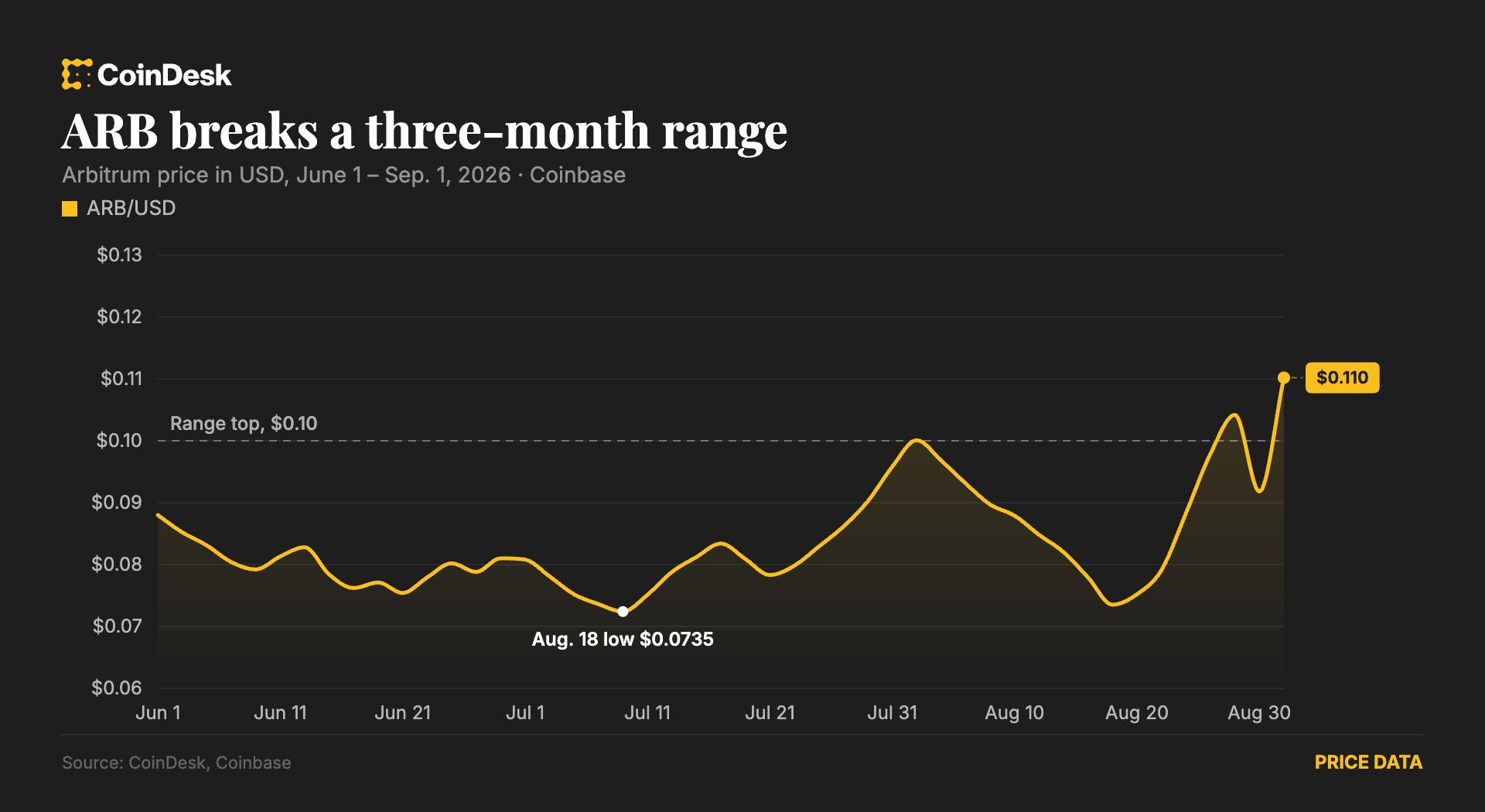
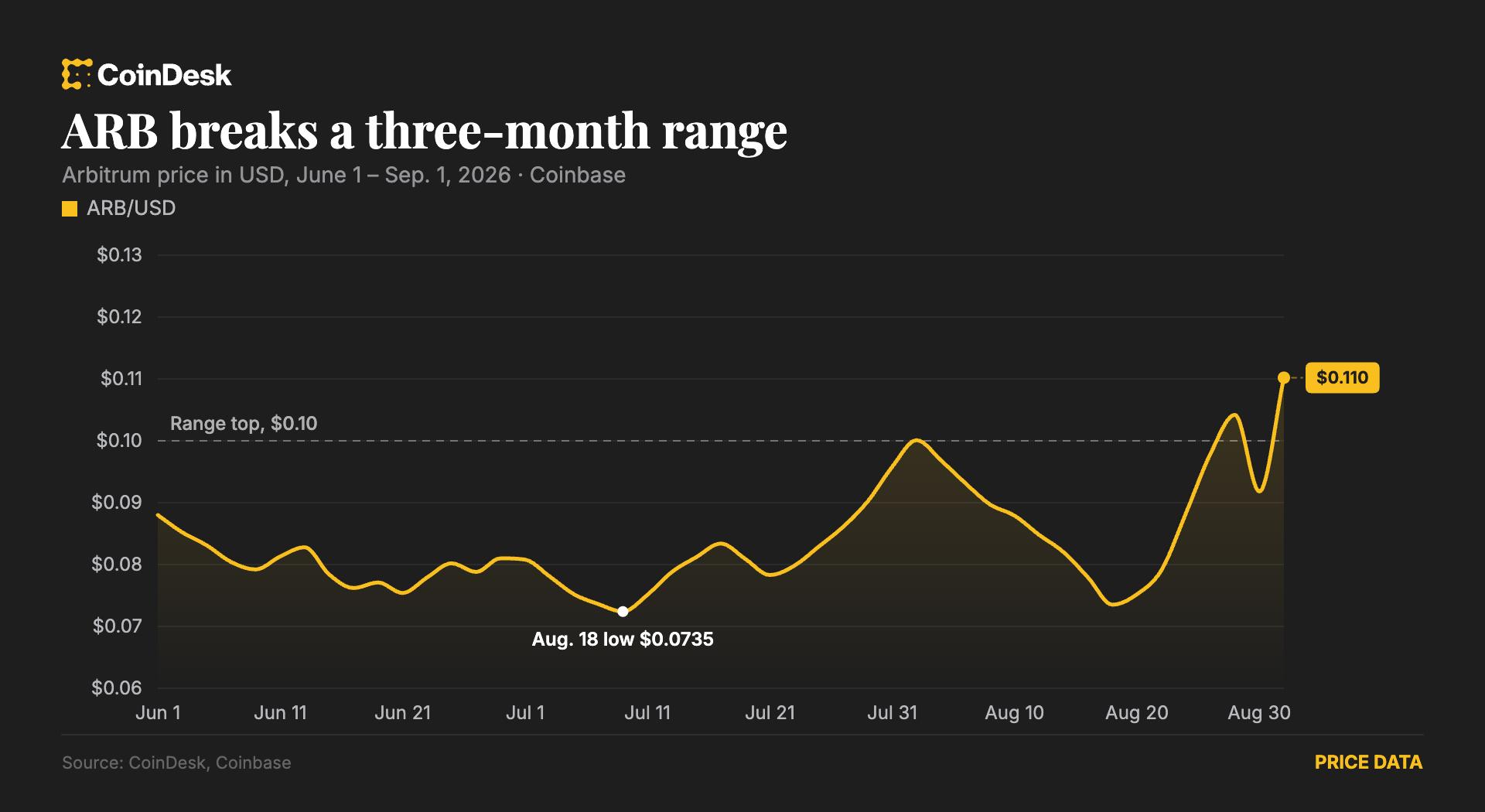
Revenue on Robinhood Chain hit a 24-hour record of $1.9 million, driving a 30% rally in ARB as traders chased downstream gains.

Hegseth, meanwhile, is just the latest senior Trump Administration official to be linked with a Presidential bid for 2028.
Trump has previously shown support for a Vance-Rubio ticket
During a White House event in May, Trump raised the question of the Republican nomination. “Who’s it going to be? Is it gonna be J.D. [Vance]? Is it gonna be somebody else? I don’t know,” he said.
Trump proceeded to pit Vance and Rubio against one another, asking the crowd to show their support for who they liked.
“By the way, I do believe that’s a dream team, but these are minor details,” the President said, notably stopping short of endorsing either member of his Administration.
“That does not mean you have my endorsement under any circumstance,” he emphasized, adding that he thinks it “sounds like a presidential candidate and vice presidential candidate.”

A fake desktop application impersonating Anthropic’s Claude is reportedly being used as a delivery mechanism for RevStealer, a Windows malware strain designed to steal crypto-related data and other sensitive information. Researchers at Morphisec say the campaign has evolved beyond earlier distribution channels, including GitHub repositories and game-cheat themed sites, and that the “Claude Opus 5 Free Desktop” lure is now among the most prominent.
While the technical details are aimed at defenders, the operational choices behind RevStealer carry direct implications for users and anyone investing in or managing digital assets: the malware is built to avoid analysis, profile the infected machine, and then extract high-value information across browsers, password managers, wallet software, and even selected documents.
Key takeaways
- RevStealer is delivered via a fake “Claude Opus 5 Free Desktop” Windows app that impersonates Anthropic and offers supposed free access.
- The malware is designed to leave minimal traces and harvest browser data, cookies, password-manager records, VPN/remote-access settings, screenshots, and selected files.
- It targets more than 50 cryptocurrency wallets and can also capture messaging data and other credentials beyond crypto holdings.
- Before executing, it checks system characteristics consistent with real user environments and aborts if it detects signs of analysis or abnormal conditions.
- Curious about broader context: Morphisec’s report follows Kaspersky’s earlier identification of OkoBot, a separate framework aimed at crypto investors.
A Claude-themed lure masks a crypto-stealing payload
In a Monday report, cybersecurity firm Morphisec described how RevStealer has been distributed through multiple fronts, with earlier campaigns using GitHub repositories and game-cheat themed websites. The latest and most notable delivery method, the researchers said, is a project branded as “Claude Opus 5 Free Desktop” that impersonates Anthropic and promises free access to Claude.
From an attacker’s perspective, this approach is logical: it repackages a familiar consumer brand into a Windows installer or desktop program, lowering user skepticism and increasing the odds that victims will run the malicious payload.
Designed to extract high-value data from browsers, wallets, and more
Morphisec’s analysis portrays RevStealer as a multi-purpose stealer. The malware not only searches browser databases and cookies, but also looks for password-manager records and configurations tied to privacy and remote access. In addition, it targets VPN and remote-access settings and collects messaging data, which can reveal account recovery paths, authentication workflows, or direct access tokens.
For crypto users, the most significant operational detail is wallet targeting. Morphisec said RevStealer targets over 50 cryptocurrency wallets, positioning the malware to compromise both the user’s general credentials and the specific applications most likely to contain or facilitate asset management.
The report also notes that the malware can capture screenshots and selected documents. That matters because some users store seed phrases, backup codes, or operational instructions in non-wallet files—making document harvesting an extra layer of financial opportunity for attackers.
Execution gating: it tries to spot “analysis” before it acts
One of the more defensive-relevant elements of RevStealer, according to Morphisec, is the way it determines whether a machine resembles a real user environment. The malware checks available memory, the number of CPU cores, hostname and username information, and graphics hardware characteristics. It also monitors for debugging delays that are typical in malware analysis setups.
If the checks fail—if the system presents signals that look automated, instrumented, or otherwise atypical—RevStealer does not progress to the next stages of infection and malicious activity.
When the system passes, the malware decrypts its payload, stores it under a randomly generated name, and executes it covertly. This workflow is designed to reduce the chance that researchers can quickly identify the complete payload chain and to make behavioral detection harder when the malicious component only activates under specific conditions.
RevStealer follows a wider pattern of crypto-investor targeting
The Morphisec report arrives after earlier reporting by Kaspersky on a new malware framework targeting cryptocurrency investors called OkoBot. Kaspersky’s description, as referenced in Morphisec’s write-up, indicates that OkoBot can harvest crypto wallet files and browser data, steal user credentials, inject malicious extensions, and capture wallet application windows to help redirect or siphon assets.
Taken together, the two stories suggest a persistent trend: attackers are not limiting themselves to “wallet-only” theft. Instead, they are expanding into browser and credential ecosystems, then coupling that access with wallet application targeting and, in RevStealer’s case, extensive environmental checks to avoid discovery.
For investors, traders, and operators of digital asset infrastructure, this matters because compromises rarely begin in the wallet UI itself. The intrusion surface is often broader: downloadable “desktop” apps, browser states, stored credentials, and remote-access configurations that attackers can convert into the ability to act on funds.
What to watch next
With fake Claude desktop projects being used to deliver a stealer that targets both wallets and sensitive browsing credentials, users should watch for new impersonation campaigns and suspicious installers that promise free access to popular AI tools. On the defensive side, prioritizing endpoint protection, restricting execution of unknown binaries, and maintaining clean browser and password-manager hygiene may help reduce the odds that malware like RevStealer finds a usable environment before it can activate.


Identity verification is becoming a core part of the DeFi stack as developers look to embed reusable credentials, privacy-preserving proofs and compliance checks directly into lending, payments, stablecoins and tokenized asset platforms.
Summary
- Embedded verification SDKs are bringing identity, credentials and compliance checks directly into DeFi applications.
- AIR and zkMe focus on reusable credentials and privacy preserving verification that can work across applications and blockchains.
- Privado ID uses verifiable credentials and zero knowledge technology for decentralized identity and conditional access.
- Sumsub offers a more traditional compliance stack covering KYC, KYB, AML screening and transaction monitoring.
- Civic is now primarily focused on Web3 authentication and embedded wallet onboarding following its move away from Civic Pass verification products.
As decentralized finance expands into lending, payments, stablecoins and tokenized real-world assets, applications increasingly need ways to establish whether users meet specific requirements without turning every interaction into a traditional onboarding process.
That is driving interest in the embedded verification SDK: infrastructure developers can integrate directly into an application to handle identity, credentials or access requirements without sending users through disconnected experiences.
The strongest solutions for DeFi go further. They are increasingly focused on reusable credentials, privacy-preserving proofs and interoperability across applications and chains.
Here are five embedded verification SDKs and identity platforms worth watching in 2026.
1. AIR by Moca Network
AIR is a particularly interesting option for platforms that want verification to become part of a broader financial experience.
AIR Kit is Moca Network’s modular SDK for embedding identity, fintech services and programmable loyalty through one integration. Businesses can start with its identity functionality before expanding into additional modules.
For DeFi applications, AIR Identity is the most relevant component. It enables platforms to work with reusable credentials and verify user information without necessarily accessing the underlying raw data. Businesses can establish which credentials are shared, with whom and under which conditions.
The distinction is important: AIR is not itself positioned as a replacement for the underlying KYC or identity verification provider. Instead, it can consume those verification primitives and transform verified information into reusable, user-consented credentials and proofs.
That model can be useful for DeFi because a user’s verified status does not necessarily have to remain trapped inside one onboarding flow. Credentials can instead become portable infrastructure for determining eligibility across applications and services.
AIR also has a direct connection to zero-knowledge KYC infrastructure. zkMe joined the Moca ecosystem as an issuer of demographic and financial credentials, with AIR Kit enabling credentials including age, citizenship, location, credit score and investor accreditation to be reusable across applications and chains.
Best for: DeFi and fintech platforms looking for reusable identity infrastructure that can eventually connect verification with payments and loyalty.
2. zkMe
zkMe is built specifically around reusable zero-knowledge KYC for open finance.
Its infrastructure covers individual KYC, business verification, transaction monitoring and other credential types, with an emphasis on minimizing exposure of underlying personal information. Its SDK allows developers to integrate the verification flow directly into their front end.
The DeFi proposition is particularly clear. zkMe lists support for permissioned DeFi pools, compliant launchpads, stablecoins and tokenized real-world assets, and says its infrastructure operates across more than 30 blockchains.
For developers building regulated or permissioned financial products on-chain, the combination of reusable credentials, zero-knowledge proofs and multi-chain support makes zkMe one of the more DeFi-specific options available.
Best for: DeFi, RWA and stablecoin applications requiring privacy-preserving KYC and compliance credentials.
3. Privado ID
Privado ID takes a decentralized identity approach to verification, using verifiable credentials and zero-knowledge technology to allow users to prove information about themselves.
This architecture fits an important DeFi requirement: separating the verification of a claim from unnecessary disclosure of the information behind it.
For example, an application may need to establish whether a wallet belongs to an eligible participant without putting that person’s complete identity on-chain. Credential-based identity systems can make those types of conditional access models possible.
That makes Privado ID relevant to developers exploring permissioned DeFi, tokenized assets and other applications where identity needs to interact with smart contracts without making personal data public.
Best for: Developers seeking decentralized identity and zero-knowledge credential infrastructure.
4. Sumsub
Sumsub approaches embedded verification from a more traditional compliance direction.
Its SDK infrastructure supports identity verification within existing products, while its broader offering covers areas including KYC, KYB, AML screening and transaction monitoring.
For DeFi companies moving toward regulated financial services, this more comprehensive compliance approach can be useful. A protocol connecting with fiat infrastructure, operating tokenized assets or serving regulated jurisdictions may need considerably more than a simple proof-of-personhood check.
The trade-off is philosophical as much as technical. Sumsub is closer to conventional compliance infrastructure than decentralized, reusable identity. That can make it well suited to businesses prioritizing established KYC workflows over self-sovereign credential models.
Best for: Crypto and DeFi businesses requiring a broader traditional compliance stack.
5. Civic
Civic has long focused on bringing identity and access infrastructure into Web3.
Its current Civic Auth Web3 SDK combines authentication with embedded wallets, supporting Ethereum and a range of EVM-compatible networks as well as Solana. This can help applications onboard users without requiring them to arrive with an existing crypto wallet.
There is an important caveat for anyone comparing verification SDKs in 2026. Civic announced in 2025 that its Civic Pass identity verification, uniqueness and liveness products were being discontinued as the company shifted its focus toward Civic Auth and newer identity infrastructure.
That makes Civic more relevant today for Web3 authentication and wallet onboarding than as a direct equivalent to reusable KYC products such as zkMe.
Best for: Web3 applications prioritizing authentication and embedded wallet onboarding.
Why embedded verification matters for DeFi
The larger shift is from identity verification as a one-time compliance checkpoint to identity as reusable financial infrastructure.
A lending protocol might need proof that a participant meets jurisdictional requirements. An RWA marketplace may need investor accreditation. A token launch may need Sybil resistance, while another application may simply need to know that a user has already completed an approved KYC process.
None necessarily needs every piece of the user’s identity every time.
Embedded verification SDKs make it possible to bring these checks closer to the application layer. Reusable and privacy-preserving credentials take the idea further by allowing verified attributes to travel between compatible services.
That could prove particularly important for DeFi.
Open financial infrastructure depends heavily on composability. If identity develops in the same direction, credentials could become another interoperable primitive, allowing applications to verify what they need while reducing repeated onboarding and unnecessary disclosure of personal information.
For developers choosing an embedded verification SDK, the question is therefore becoming bigger than “can this provider perform KYC?”
The more important question may be: What can the application do with a verified identity after the verification is complete?
Crypto World
Senate vote approaches, ETF inflows break historical records, holders explore cloud mining daily returns exceeding $10,000

ETF inflows have broken the historical record of $1.66 billion, while XRP prices continue to decline amid market volatility. UE Crypto has launched a new cloud mining smart contract, and its return mechanism has attracted significant attention from XRP holders.
Summary
- On August 31, XRP prices fluctuated between $1.37 and $1.39, declining by 2% over 24 hours.
- The Senate is scheduled to hold a cloture vote on the CLARITY Act at 2:15 p.m. on September 15.
- UE Crypto promotes its cloud mining contracts as an alternative for XRP holders seeking returns beyond price appreciation, with daily returns varying depending on the contract.
On August 31, XRP was trading at approximately $1.37, down about 2% over the previous 24 hours. Market attention has shifted toward the upcoming Senate vote on September 15, which could have a significant impact on XRP’s near-term price performance.

This procedural vote concerns a motion to invoke cloture on the Digital Asset Market Clarity Act, commonly referred to as the CLARITY Act. Reaching the required 60-vote threshold would only advance the bill to full Senate debate and would not guarantee its final passage.
Prediction platforms show that the situation has changed significantly. At present, the probability of the bill being passed in 2026 is estimated at approximately 14%, down sharply from 82% in February. Democratic lawmakers insist that stricter provisions regulating cryptocurrency transactions by political officials be included in the bill as a condition for their support.
Michael Selig, Chairman of the U.S. Commodity Futures Trading Commission (CFTC), has publicly stated that the agency has sufficient authority to regulate the cryptocurrency market under the current legal framework. In addition, on August 18, the U.S. Securities and Exchange Commission (SEC) released its “Crypto Asset Regulatory Framework,” which contains several definitional elements consistent with the CLARITY Act.
Crypto analyst XrpArab noted on August 31 that CFTC Chairman Michael Selig appeared optimistic about the outcome of the September 15 Senate hearing. The analyst highlighted several unresolved complexities and discussed the potential consequences if the cloture motion fails before the October election recess.
Unprecedented ETF fund flows reflect growing institutional demand
XRP exchange-traded funds recorded their highest-ever weekly inflows, totaling $110.49 million. On August 28 alone, net inflows reached $26.2 million, bringing cumulative net inflows to $1.66 billion.
Cumulative ETF net inflows have reached a record $1.66 billion. However, XRP prices have not surged accordingly and have instead experienced a pullback, further increasing investor caution.
Short squeezes, steady ETF inflows, and indications of Treasury buybacks have driven the broader market trend. However, despite these positive factors, because earnings determine actual spreads, these favorable conditions have produced significantly different results across various cryptocurrency stocks.
Weak performance offsets XRP’s overall uptrend
Although Bitcoin continued its rally in late August, cryptocurrency stocks with disappointing earnings declined. Investors viewed the promotion of cloud mining contracts as an alternative for XRP holders seeking returns beyond price appreciation, with daily returns varying by contract. This model has also demonstrated the ability of XRP holders to identify opportunities and potentially generate returns despite fluctuations in market prices.
Against this backdrop, an increasing number of investors are paying attention to the UE Crypto cloud mining platform, exploring potential sources of returns beyond simply holding digital assets. Compared with strategies primarily based on price speculation, cloud mining provides a different approach to generating returns from digital assets, even during periods of short-term price volatility.
Therefore, XRP’s current price performance cannot be attributed entirely to ETF inflows. Multiple factors, including ETF fund flows, “whale” trading activity, on-chain activity, and overall market sentiment, may have a significant impact on XRP’s subsequent price performance and broader market trends.
As market volatility increases, more investors are seeking ways to participate in digital assets beyond simple price speculation. UE Crypto provides a sustainable-energy-based cloud mining solution, offering investors a more structured channel to explore the digital asset ecosystem while focusing on the long-term value of XRP and expanding diversified sources of returns.
Through cloud mining, users can participate in the operation of blockchain infrastructure and earn returns according to predetermined rules, creating a cash-flow-oriented participation model without the need to deploy dedicated mining hardware or possess advanced technical expertise.
Compared with traditional mining models, cloud mining can reduce the burden associated with purchasing mining equipment, securing electricity supplies, maintaining hardware, and handling daily operations. The platform manages computing power allocation, technical maintenance, and related operations. Users can select an appropriate computing power plan according to their needs and monitor operational and return data through an automated system, allowing them to participate in digital asset mining more conveniently.
About UE Crypto
UE Crypto was established in 2015 and is headquartered in the United Kingdom. The company states that its operations follow relevant European regulatory frameworks, including the Markets in Crypto-Assets Regulation (MiCA) and the Markets in Financial Instruments Directive II (MiFID II), while continuously improving transparency, operational standards, and user protection mechanisms.
In terms of security and compliance, the platform states that it has implemented the following protective measures:
- Annual financial and security audits conducted by PwC
- Custodial digital asset insurance provided by Lloyd’s
- Enterprise-level security solutions from Cloudflare and McAfee®
- Bank-grade data encryption and professional security infrastructure to provide multiple layers of protection for user assets and accounts.
Currently, UE Crypto supports a range of major crypto asset payments, including XRP, BTC, ETH, USDT, BNB, ADA, USDC, DOGE, LTC, and SOL, providing users with a more flexible way to participate in digital asset services.
Join for free, Learn with ease: Start your UE Crypto journey in 3 steps
Step one: Register an account
Step two: Choose a mining package
Choose a suitable cloud mining contract based on your personal budget and requirements, then start mining with one click.
Step three: Start earning
Once the contract is activated, the system will automatically allocate computing power, and returns will be settled automatically every 24 hours. Users can withdraw their returns at any time or continue participating as needed to achieve long-term compound growth of their assets.
Popular UE Crypto contracts
BTC (Super computing system contract)
Investment Amount: $1,000
Investment Term: 10 days
Daily Return: $13.10
Principal Returned at Expiry: $1,000 + $131 return
LTC (Algorithm-driven system contract)
Investment Amount: $5,000
Investment Term: 25 days
Daily Return: $72
Principal Returned at Expiry: $5,000 + $1,800 return
BTC (Quantitative intelligent system contract)
Investment Amount: $10,000
Investment Term: 34 days
Daily Return: $158
Principal Returned at Expiry: $10,000 + $5,372 return
For more details about the contract plans, please visit the official UE Crypto website.
Conclusion
Continued net inflows into XRP ETFs further demonstrate institutional demand for XRP and sustained market interest. However, growth in ETF assets does not necessarily mean that XRP’s price will rise at the same pace. XRP’s current market performance continues to be influenced by multiple factors, including “whale” fund movements, on-chain capital flows, and overall cryptocurrency market sentiment.
For long-term XRP investors, in addition to continuously monitoring price movements and ETF fund flows, exploring more diversified ways to participate in the digital asset ecosystem is also worth considering. Through cloud mining and related digital asset infrastructure, UE Crypto provides investors with another channel to participate in the digital asset ecosystem, enabling them to focus on the long-term value of XRP while exploring potential diversified sources of returns and further refining their long-term asset allocation strategy.
“As a traditional financial investor, I place great importance on the platform’s compliance and transparency. UE Crypto provides daily return reports, and checking my returns every morning has become part of my routine. This is much easier than any side business I have done in the past.”
For more information, please visit the official website and download the application.


Ethena has launched Ethena Pay in beta for 400 early users, bringing USDe payments, Avalanche settlement and annual reward rates of up to 6% to a self-custodial mobile app.
Summary
- 400 users will receive initial access, with the rollout expanding weekly during September.
- 49 countries can access the app, while the U.S., EU, U.K., and Canada remain excluded.
- Standard users receive up to 5%, while Pro and VIP rates reach 6% within set balance caps.
- Eligible card purchases earn up to 5% cashback, which is credited in AVAX.
Ethena Pay connects USDe balances with daily payments
Ethena said in a launch announcement that Ethena Pay will begin with an early-access group of 400 users before adding more participants each week. The company plans to increase access throughout September as the app moves beyond its initial beta stage.
Available on iOS, the app combines a self-custodial crypto wallet with bank transfers, fiat on-ramps and a Visa payment card. A user’s dollar balance is held in USDe, Ethena’s synthetic dollar, while Avalanche processes transfers, purchases, and settlement behind the app’s consumer-facing interface.
Users can receive fiat through assigned International Bank Account Number details or transfer crypto directly to their wallets. In either case, the received balance appears as USDe. Withdrawals sent to external bank accounts can be converted into the recipient’s local currency, according to Ethena.
Payments between Ethena Pay users can also be sent through a username or payment tag instead of a blockchain address. Ethena said transfers between app users carry no fee, while bank transfers denominated in U.S. dollars, euros, and British pounds are also free. Other bank transfers may cost between 0.05% and 0.1%.
The beta is available across 49 countries in Latin America, the Caribbean, Asia, the Middle East, Africa, and Oceania. Ethena Pay’s supported-market list includes countries such as Brazil, Mexico, Australia, Japan, Singapore, the United Arab Emirates, Kenya and South Africa, although individual products remain subject to local eligibility rules.
Ethena Pay rates depend on membership tier
Ethena Pay divides its balance rewards across Standard, Pro, and VIP tiers. Standard users can receive a total annual rate of up to 5% on eligible balances capped at $5,000.
Pro users can receive up to 6% on a maximum eligible balance of $15,000, while the VIP tier applies the same 6% rate to as much as $50,000. Amounts above each limit continue to receive the prevailing USDe base rate but do not qualify for the added Daily Boost.
Rather than adding a separate 6% payment to USDe’s existing rate, Ethena Pay uses the Daily Boost to bring eligible balances up to the advertised total. If the USDe base rate increases, the boost becomes smaller; if the base rate falls, the boost grows to maintain the applicable tier rate. No boost applies when the base rate exceeds the tier’s stated rate.
Calculated from a user’s time-weighted average daily balance, the boost is normally paid in USDe within 24 hours after the accrual day ends. Ethena Pay requires users to complete at least one qualifying card transaction during each calendar month to receive it.
Despite the app’s consumer-facing rate display, Ethena Pay’s terms describe the Daily Boost as a discretionary promotional incentive rather than interest, yield or a deposit product. The company also states that the balance and related rewards are not covered by the U.S. Federal Deposit Insurance Corporation or any other government-backed deposit insurance program.
Standard membership is free. Pro access can be obtained by locking $2,000 worth of ENA or referring 10 eligible users, while VIP membership requires $10,000 in locked ENA or 50 referrals, according to launch details reported by The Block.
Ethena’s balance model relies partly on returns generated from the assets supporting USDe. In August, Ethena and FalconX opened a $1 billion facility that uses part of USDe’s backing portfolio to finance secured, overcollateralized loans for institutional borrowers.
According to crypto.news, institutional lending already accounted for $310 million, or 6.9%, of USDe’s backing in early July. The reported portfolio also included roughly $2 billion in decentralized finance lending, about $1.2 billion in liquid stablecoins, and additional exposure to tokenized assets.
Self-custody leaves recovery with the user
Ethena Pay Ltd., a Malta-registered software company, states that it does not operate as a bank, broker-dealer, investment adviser or money services business. Third-party providers supply the financial services accessible through the app.
Under its self-custodial design, private keys, seed phrases and wallet recovery details stay on the user’s device. Ethena Pay says it cannot access customer assets or restore a wallet when the user loses the credentials needed to enter it.
The Visa Spend Card is issued by Third National, a Puerto Rico-chartered bank, under a Visa license. Signify Holdings, which operates as Rain, manages the card program.
Qualifying purchases earn cashback in AVAX rather than dollars or USDe. Standard users receive 4% on the first $2,500 spent each month, while Pro members earn 4.5% on their first $8,000 and VIP users receive 5% on their first $20,000.
Rates decline in bands after users cross those spending limits. For example, the Pro rate falls to 2% between $8,000 and $10,000, then to 1% from $10,000 to $12,000, and 0.5% above $12,000. Each lower rate applies only to spending within that band rather than repricing earlier purchases.
Ethena Pay excludes several categories from cashback, including ATM withdrawals, cash advances, gambling, gift cards, account funding, peer-to-peer transfers, and purchases of cryptocurrencies, stablecoins, non-fungible tokens, or securities. Transactions below $1 also receive no cashback.
Once a card payment settles, normally within one to three business days, the dollar value of the reward is converted into AVAX at the rate available when the credit is issued. Ethena Pay warns that its dollar value can rise or fall after reaching the user’s wallet because AVAX remains exposed to market movements.
U.S. users remain outside the Ethena Pay rollout
For U.S. readers, the main restriction is direct access. Ethena Pay is not yet available in the United States, and its card terms exclude U.S. citizens, residents and other U.S. persons even though the issuer is chartered in Puerto Rico.
The European Union, the United Kingdom, and Canada are also outside the initial release. Ethena has listed those markets for a later rollout, but access will depend on regional requirements and product approvals.
American investors can still obtain indirect public-market exposure to Ethena’s ecosystem through StablecoinX, which trades on Nasdaq under the ticker USDE. The company held approximately 3.03 billion ENA tokens valued at about $275 million when its merger with TLGY Acquisition Corp. closed in June.
Institutional access has developed through a separate channel. In June, BlackRock integrated USDe into Aladdin, its investment and risk-management platform used by institutions overseeing more than $20 trillion in assets. BlackRock’s BUIDL tokenized money-market fund was also selected as the main reserve asset for Ethena’s white-label stablecoin product.
Avalanche handles the app’s settlement activity
Avalanche serves as the exclusive settlement network for Ethena Pay, covering transfers, card-related money movement, and payments, while the blockchain layer remains largely hidden from users.
The network has already supported card and corporate-payment trials involving stablecoins. In July, Hyundai Card completed a $20,000 transfer between Hyundai Motor’s U.S. and Mexican entities using USDT on Avalanche.
Hyundai Card said the intercompany settlement took about seven minutes, compared with the three to four hours usually required for a conventional bank transfer. The company handled the project’s regulatory reviews, legal and tax assessments, internal controls, and remittance design, while blockchain payments provider Axiym also participated.
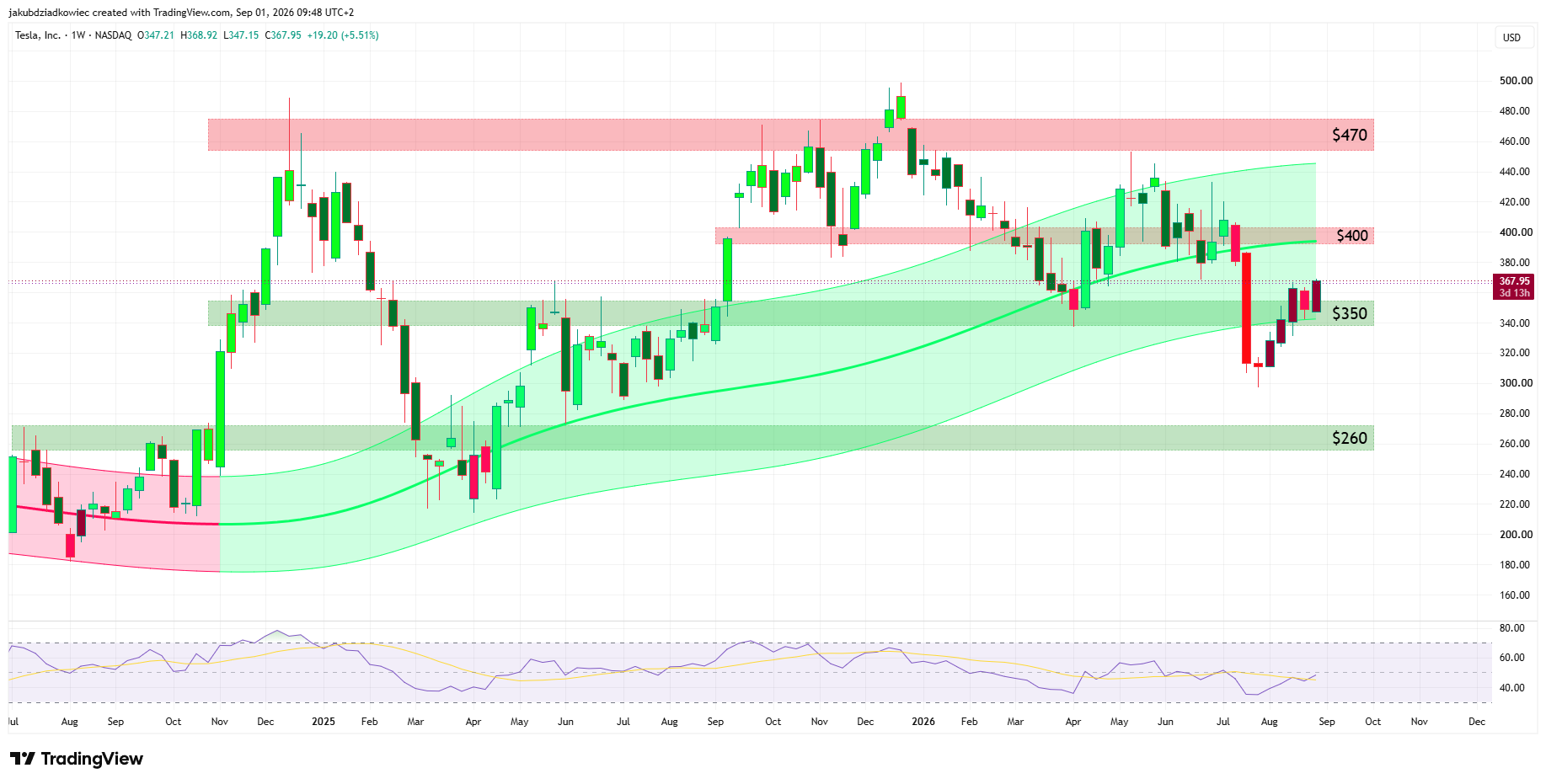
Tesla Inc. (TSLA) stock closed at $367.95 on Monday, up 5.51%. Volume reached 61.8 million shares, roughly 46% above the three-month average, while the S&P 500 and Nasdaq both finished lower.
The rally landed three days before Tesla’s Cybercab launch event in Austin. Traders now want to know whether the recovery can reach the $400 resistance band that capped the stock through summer.
Three Catalysts Lifted Tesla Stock in One Session
Tesla confirmed an invite-only Cybercab event for Sept. 3 and plans to livestream it.
Over the weekend, Elon Musk posted that SpaceX and Tesla are each building 100 gigawatts per year of solar production capacity. He added that SpaceX will cast gas turbine blades in-house, which could bring turbines online up to 18 months earlier.
Nevada regulators also cleared Tesla for 5,000 robotaxis in Clark County on Aug. 20. However, Tesla’s own Cybercab chief engineer told that hearing the company expects roughly 2,500 within a year.
Fundamentals Still Lag the Narrative
Second-quarter revenue hit a record $28.24 billion, up 26%, on 480,126 deliveries. Profitability moved the other way.
Operating margin fell to 1.4% from 4.1%, and free cash flow turned negative at $1.09 billion. Regulatory credits dropped 67% to $146 million in the same earnings report. Meanwhile, the stock trades near 193 times forward profit estimates.
Weekly Chart Shows Recovery Below the Midline
Tesla broke through the $400 zone and the Gaussian channel midline in mid-July, then lost the lower band near $300 in that breakdown.
The stock has since reclaimed $350, a level that has acted as both support and resistance for two years. In contrast, price still sits under the channel midline near $400.

Weekly RSI reads close to 48, back at neutral after the summer washout. A deeper correction would put the $260 band in play.
Tesla Stock: $400 Is the Next Test
The daily chart broke below a falling parallel channel on July 23, and the price reached the $296.16 measured target within days.
Tesla stock has climbed 23.5% from that low. It has recovered $350 and the channel midline, and it is now testing the 50-day moving average.

The first hurdle sits near $380 at the channel’s upper rail. Above that, $400 and the July swing high at $428.01 come into view. Daily RSI at 59 suggests room before overbought.
Analysts remain split, with targets running from $125 to $600. Therefore, Sept. 3 may decide the direction. A credible Cybercab reveal could carry price toward $400, while a rebrand of the existing fleet would leave $350 as the level that matters.
The post Tesla Stock Jumps 5.5% Ahead of Cybercab Launch. Is $400 Next? appeared first on BeInCrypto.

The shoe company that pivoted to AI is dying

GloRilla Shares “Jiggly Bow Bow” Snippet Featuring Sexyy Red

Scottish politics LIVE John Swinney reveals SNP Government plan to axe health boards and quangos





-

 Crypto World7 days ago
SpaceX stock could rise 75% to $240, JPMorgan says
-

 Fashion4 days ago
Weekend Open Thread: Maeve – Corporette.com
-

 Crypto World5 days ago
Bitcoin’s 22% rally now needs real demand to outlast Treasury liquidity boost
-

 Crypto World6 days ago
Warsh Jackson Hole keynote puts financial innovation first
-

 Business5 days ago
Salesforce Stock Soars 19% as Blowout Earnings and Agentforce AI Growth Silence Software Skeptics
-

 Crypto World6 days ago
Elon Musk Grok Bot Promise: We Will Make You Whole if AI Loses Your Money
-

 Business5 days ago
Apple Confirms September 9 Keynote and Reveals Its Full Pre-Order Schedule
-

 Crypto World7 days ago
Did Trump Just Move SpaceX Stock With One Truth Social Post?
-

 Business4 days ago
Onto Innovation Stock: AI’s Next Bottleneck Is Yield (NYSE:ONTO)
-
 NewsBeat6 days ago
Lindsay Clancy jury braces for closing arguments as judge tells court: ‘You’ve heard all the evidence’ – Live updates
-

 Business6 days ago
Walmart takes aim at younger shoppers with new fashion brand
-

 Crypto World4 days ago
Bitcoin price tests $82K resistance as Brandt stays long
-

 Crypto World6 days ago
NVIDIA revenue hits $96.2B as AI demand doubles
-

 Business7 days ago
Thailand’s Eastern Economic Corridor Capital City (EECiti): Key Developments and Investment Opportunities
-

 Business4 days ago
iPhone 18 Pro Pre-Orders Could Shift to Saturday as Apple Reportedly Avoids September 11 Anniversary
-

 NewsBeat7 days ago
Trump’s trade truce with China faces test with Iran effort
-
 Crypto World6 days ago
Nvidia Q2 Earnings Reveal $96.2 Billion Beat, So Why Is NVDA Falling?
-
 Tech3 days ago
Hugging Face built a $4.5 billion empire on free AI models. Now Nvidia is buying it for $12.9 billion
-
 Tech6 days ago
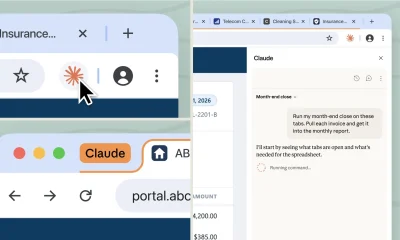
Claude Cowork gets its own browser that doesn’t touch your tabs, bookmarks, or saved passwords
-

 Crypto World5 days ago
Truflation calls for Fed rate cut after PCE forecast
You must be logged in to post a comment Login