

Crypto World
CLARITY Act’s real obstacle: Trump’s crypto business



The CLARITY Act has the votes and the momentum to become law, having cleared the House and a key Senate committee. It is stuck anyway. The deepest reason is not crypto skepticism but a fight over the president’s own crypto empire, estimated in the billions, and whether the rules should restrain it.
Summary
- The CLARITY Act, the U.S. crypto market-structure bill, has cleared the House and the Senate Banking Committee and reached the Senate calendar, yet it remains stuck.
- The deepest obstacle is not crypto skepticism but an ethics fight over President Trump’s family crypto interests, estimated at roughly $2.3 billion or more, spanning World Liberty Financial, the USD1 stablecoin, and the TRUMP memecoin.
- Democrats led by Senator Gillibrand say there is no bill without ethics language restricting officials from profiting on digital assets, and a committee amendment to that effect failed on a party-line vote.
- The White House argues that ethics limits must apply uniformly and not single out the president, and a target to sign the bill by July collapsed when the ethics talks broke down.
- With a hard deadline before the August recess and a 60-vote threshold that needs several Democratic votes, the bill’s fate now turns on whether credible ethics language can be agreed, not on crypto policy itself.
The CLARITY Act is the bill the American crypto industry has wanted for years, the one that would finally settle how digital assets are regulated in the U.S., and by the ordinary logic of legislation it should be on a path to becoming law.
It passed the House of Representatives with bipartisan support, cleared the Senate Banking Committee on a 15-to-9 vote, and was placed on the Senate calendar, formally eligible for a floor vote. The industry is mobilized behind it, with hundreds of companies urging passage, and analysts have spent the year handicapping when, not whether, it would be signed.
And yet it is stuck.
The reason it is stuck has surprisingly little to do with crypto policy itself, on which a workable consensus largely exists, and a great deal to do with something the bill’s authors never intended it to be about: the president’s own crypto business.
President Trump and his family hold crypto interests estimated in the billions of dollars, and the question of whether a law regulating crypto should also restrain officials who profit from it has become the obstacle that crypto policy alone never was.
This piece explains how a bill with the votes to pass got trapped by the president’s crypto empire, and why that fight is harder to resolve than any technical dispute over digital assets.
This is a politically charged subject, and the aim here is to lay out the situation factually and fairly, presenting what each side argues rather than taking a position. The dispute touches genuine disagreements about ethics, executive power, and the proper scope of a market-structure bill, and reasonable people land in different places on all of them.
What follows covers what the CLARITY Act would do, the two obstacles blocking it, the scale and nature of the president’s crypto holdings, the conflict-of-interest concerns that critics raise, the responses from the White House and its allies, why the impasse is so hard to break, and the deadline that now governs the bill’s fate.
The goal is to make a complicated and contested situation legible, not to argue for an outcome.
A bill that should pass, and cannot
Begin with the puzzle, because it is genuinely strange.
The CLARITY Act has cleared the procedural hurdles that kill most legislation. It advanced through the House with broad bipartisan support, survived markup in the Senate Banking Committee with two Democrats crossing over to join Republicans in a 15-to-9 vote, and landed on the Senate legislative calendar, meaning it is formally ready for floor consideration.
Behind it stands an unusually unified industry. Hundreds of crypto companies and organizations have publicly pressed Senate leaders to bring it to a vote, arguing that clear federal rules are needed to keep digital-asset innovation in the U.S.
By the normal measures of legislative momentum, this is a bill on track.
And yet it has not moved to a floor vote, and the window to do so is closing. The reason is not that the Senate cannot agree on how to regulate crypto.
The core architecture of the bill, which divides oversight between regulators and gives the market the legal certainty it has long wanted, commands fairly broad support.
As crypto.news previously explained in the bill explained in full, the CLARITY Act is designed to create defined lanes for digital assets rather than leave the market trapped between agencies.
The bill is stuck on two provisions that have little to do with that core architecture, and the deeper of the two has nothing to do with crypto regulation at all.
It concerns ethics, specifically whether the law should restrict government officials, up to and including the president, from profiting on the very digital assets the law would legitimize.
That question has fractured the fragile coalition the bill needs, and it has done so at the worst possible moment, against a hard deadline.
The bill that should pass cannot, because it has become entangled with the president’s personal financial interests in a way its authors did not design and cannot easily escape.
What the CLARITY Act would do
To understand what is at stake, it helps to know what the bill actually does, because the prize is substantial and explains why the industry is so eager.
The CLARITY Act creates a comprehensive federal framework for digital assets, resolving the long-running uncertainty over which regulator oversees what.
In broad terms, it grants the commodities regulator primary jurisdiction over the spot markets for digital commodities, assets that function more like commodities than securities, while leaving the securities regulator in charge of assets sold as investment contracts.
For tokens like the major cryptocurrencies, this would provide the clear legal classification the industry has sought for years, removing the cloud of uncertainty that has hung over the market and deterred some institutional participation.
The bill also creates new pathways for crypto projects to raise money and operate within defined legal boundaries, including a tailored exemption that lets certain projects raise capital from the public without the full weight of traditional securities requirements, subject to disclosure rules and caps.
The overall effect would be to bring the American crypto market inside a defined regulatory perimeter, with clear rules for who is overseen by whom, how tokens are classified, and what protections apply to consumers.
For an industry that has spent years operating amid legal ambiguity, and watching some activity move offshore as a result, this clarity is the entire point.
It is why hundreds of companies are lobbying for passage, and why supporters argue that failing to pass it would leave the U.S. behind as other jurisdictions write their own rules.
That comparison matters because how other regions wrote their rules has become part of the pressure campaign in Washington. Europe has MiCA, stablecoin issuers have the GENIUS Act framework, and the U.S. market still lacks a full digital-asset structure.
The substance of the bill, in other words, is broadly what the industry wanted. The trouble lies in the provisions attached around it.
The two obstacles
Two distinct disputes have blocked the bill from a floor vote, and it is worth distinguishing them, because they are different in kind.
The first concerns a provision, carried over from a separate piece of legislation and folded into the bill, that shields software developers who do not control customer funds from being treated as money transmitters subject to certain financial-crime obligations.
The crypto industry considers this provision essential, arguing that developers who merely write code, without ever holding anyone’s money, should not face the legal exposure of a money-transmitting business. Without this protection, builders argue the broader bill would fail to deliver the certainty they need.
Opposing it, several law-enforcement organizations and other groups have warned that the exemption is too broad and could create blind spots that sophisticated criminals exploit, making it harder to trace illicit activity.
This is a substantive policy disagreement, and it is negotiable in the ordinary way, through tighter drafting and compromise language.
The second obstacle is the one this piece focuses on, because it is deeper and far harder to resolve.
It concerns ethics, and specifically whether the law should bar senior government officials, including the president, the vice president, and members of Congress, from issuing, promoting, or profiting from digital assets while in office.
This dispute is not really about how to regulate crypto. It is about whether a crypto law should constrain the people writing and enforcing it, at a moment when the most powerful of those people has a large personal stake in the industry.
Where the developer-shield fight is a technical disagreement that careful drafting might bridge, the ethics fight runs into something structural and personal: the president’s own crypto business, and the question of whether the rules should touch it.
That is why, of the two obstacles, the ethics one has proven the more intractable, and why it, more than anything in the bill’s actual crypto provisions, now threatens to sink the whole effort.
The president’s crypto empire
To understand the ethics fight, you have to understand the scale and nature of the president’s involvement in crypto, which is unprecedented for a sitting head of state and which both sides acknowledge as a fact even as they dispute its significance.
President Trump and his family hold crypto interests that have been estimated at roughly $2.3 billion, with some broader estimates running considerably higher.
The holdings span several ventures. There is World Liberty Financial, a crypto venture the Trump family launched in 2024, in which the family holds a large ownership stake and which issues a dollar stablecoin called USD1.
There is the TRUMP memecoin, a token bearing the president’s name that trades largely on political news and has been highly volatile. And there are further crypto-adjacent ties through the family’s media company, including an arrangement involving a major exchange.
That is why the USD1 stablecoin at issue is not just another stablecoin in this debate. It sits at the intersection of crypto policy, payment regulation, and presidential financial exposure.
Several features of these holdings have drawn particular scrutiny.
The stablecoin venture received a large investment from a fund linked to a foreign government for a significant ownership stake, a transaction that routed substantial sums to entities associated with the family, and the same stablecoin was used in a multibillion-dollar transaction involving a major exchange whose founder was later pardoned by the president.
Critics point to the timing and structure of these deals as raising questions about whether regulatory and policy decisions and private financial interests have become entangled.
Supporters and the White House dispute that characterization.
What is not in dispute is the basic situation: a sitting president and his family have a large, active financial stake in the crypto industry, at the same time that the president’s administration is shaping crypto regulation and enforcement.
It is that overlap, unprecedented in modern times, that the ethics fight in the CLARITY Act is ultimately about.
The conflict at the center of the bill
The concern that critics raise is, at its core, a conflict-of-interest argument, and it is worth stating in the terms its proponents use.
The objection is that the same administration writing and enforcing crypto rules is personally exposed to those rules, which creates at least the appearance, and potentially the reality, of decisions being shaped by private financial interest rather than public good.
Ethics experts, watchdog organizations, and Democratic lawmakers have argued that a president whose personal wealth is tied to crypto ventures has an incentive to favor policies and enforcement choices that benefit those ventures.
They also argue that allowing such an arrangement to stand without guardrails sets a troubling precedent.
Some have characterized specific transactions, particularly the foreign investment in the stablecoin venture, as self-dealing, and have warned about the entanglement of a sitting president’s personal finances with assets the government regulates.
From this vantage, the logic of insisting on ethics provisions in the CLARITY Act is direct.
If the law is going to legitimize and regulate digital assets, the argument goes, it should also ensure that the officials overseeing that regulation cannot personally profit from it, precisely because the current situation shows how real the conflict can become.
Democratic senators have made this case the basis of their conditional support, with one prominent senator stating flatly that there is no version of the bill she will support without ethics language addressing it.
The concern, in this framing, is not partisan obstruction but a principled insistence that a law regulating an industry should not enrich the people enforcing it.
Whether one finds this argument compelling or overstated, it is the substance of the objection, and it is what has made the ethics provisions a condition rather than a preference for the senators whose votes the bill needs.
The White House and Republican response
The other side of the dispute deserves equal weight, because the White House and its allies have substantive responses, and the disagreement is genuine instead of one-sided.
The central counterargument, advanced by the administration’s crypto policy lead, is that ethics limits should apply uniformly to all officials and should not be written to single out the president or his family.
From this view, crafting provisions targeted at one administration is itself improper, a politicization of what should be a neutral market-structure bill, and the appropriate approach is general ethics rules applied evenly instead of bespoke language aimed at a particular person.
The White House has stated directly that the president has acted in the public interest and that there are no conflicts of interest, rejecting the premise of the critics’ case.
Republicans have added a jurisdictional argument, contending that sweeping ethics provisions restricting officials’ financial conduct fall outside the proper scope of a banking and market-structure bill, and belong, if anywhere, in dedicated ethics legislation instead of bolted onto a crypto framework.
They have also emphasized the cost of letting the ethics dispute sink the whole bill, arguing that the country needs the regulatory clarity the CLARITY Act provides and that allowing a fight over the president’s holdings to block it would harm the broader industry and cede ground to other jurisdictions.
The companies and individuals named in connection with specific transactions have, for their part, disputed the characterizations of those deals as conflicts, offering their own accounts of how and why they occurred.
The result is a real clash of principles: one side insisting that a crypto law must restrain officials who profit from crypto, the other insisting that singling out the president is improper and that the bill’s substance should not be held hostage to that fight.
Both positions have coherent logic, which is part of why the impasse has been so difficult to resolve.
Why this is so hard to break
The reason the ethics dispute has proven nearly intractable, where the technical disagreements in the bill are negotiable, is that it sits on a genuine structural conflict that compromise language struggles to dissolve.
The fault line runs straight through the coalition the bill needs.
Because passage in the Senate requires clearing a 60-vote threshold, the bill needs support from several members of the minority party, and the Democratic senators whose votes are in play have tied their support to meaningful ethics guardrails.
Meanwhile, the White House and Republican leadership have resisted provisions they see as targeting the president.
These positions are not easily reconciled, because the thing one side considers essential, language that would restrain officials including the president from profiting on crypto, is close to the thing the other side considers unacceptable, language singling out the president.
An attempt to write a provision strong enough to satisfy the senators demanding guardrails tends to be exactly the kind of provision the White House rejects, and vice versa.
The negotiations have borne this out. A committee amendment that would have barred senior officials from holding crypto business interests failed on a party-line vote, signaling that the dispute splits cleanly along partisan lines instead of admitting an easy middle.
A separate effort to craft an enforcement mechanism collapsed when it was withdrawn, leaving the central question unresolved.
Each attempt to find compromise language has run into the same wall: the gap is not really about wording but about whether the rules should reach the president’s business at all, and that is a question of principle, not phrasing.
Add the personal and political stakes, in which any provision becomes a referendum on the president’s crypto dealings, and the difficulty compounds.
This is why a bill that commands broad agreement on its actual crypto provisions cannot get to a vote.
The obstacle is not a drafting problem that a skilled negotiator can solve over a weekend. It is a structural conflict between the votes the bill needs and the interests of the administration whose cooperation it also needs.
The clock, and what comes next
All of this is now racing against a hard deadline, which is what gives the impasse its urgency.
The practical window to pass the bill runs up against the Senate’s summer recess, and the consensus among those tracking it is that if the CLARITY Act does not clear the Senate before that recess, its prospects deteriorate sharply.
Some of the bill’s own architects have suggested that a failure to act could push comprehensive crypto legislation back by years.
Negotiators have set out a compressed timeline, aiming to publish updated text and then move to floor action within weeks, but the ethics dispute has already caused a target to sign the bill earlier in the summer to collapse.
The calendar is unforgiving, with the Senate facing competing legislative demands for its limited remaining time.
The market for predictions reflects the uncertainty. Wagering on whether the bill passes this year has fallen sharply over the course of a month, from comfortable odds to roughly a coin flip, as the ethics and developer-shield disputes hardened.
Independent analysts have likewise moved toward viewing passage as genuinely uncertain instead of likely.
The path forward, if there is one, runs through some compromise on the ethics language credible enough to win the Democratic votes the bill needs without provoking the White House into withdrawing support, a needle that has so far proven extremely difficult to thread.
What happens next will be decided not by any argument over how to regulate digital assets, on which the bill is largely settled, but by whether the parties can resolve a fight about the president’s personal crypto interests under intense time pressure.
If they can, the U.S. gets its long-awaited crypto framework. If they cannot, the most consequential crypto legislation in years may die not over crypto, but over the crypto business of the man whose signature it would require.
That is the irony at the center of the whole affair, and it is the truest summary of where the CLARITY Act stands: its obstacle was never the technology. It was the president’s stake in it.
Frequently asked questions
What is the CLARITY Act?
The CLARITY Act is a U.S. crypto market-structure bill that would set up a comprehensive federal framework for digital assets. It resolves which regulator oversees what, broadly granting the commodities regulator primary jurisdiction over digital-commodity spot markets while keeping the securities regulator over assets sold as investment contracts, and it would create defined pathways for crypto projects to raise money and operate.
For the industry, it would deliver the long-sought legal clarity that removes regulatory uncertainty. It has cleared the House and the Senate Banking Committee and reached the Senate calendar, but it has not yet received a floor vote.
Why is the CLARITY Act stuck if it has the votes?
Because two provisions attached around the bill’s core have fractured the coalition it needs, and the deeper one concerns ethics instead of crypto. The core crypto framework commands fairly broad support, but the bill has stalled over a developer-protection provision that law enforcement opposes and, more intractably, over whether the law should restrict officials, including the president, from profiting on crypto. The second dispute runs into the president’s own large crypto holdings, making it a fight about personal financial interests instead of crypto policy, which is far harder to resolve through ordinary compromise.
What are the president’s crypto holdings?
President Trump and his family hold crypto interests estimated at roughly $2.3 billion, with some estimates higher. They include World Liberty Financial, a crypto venture in which the family holds a large stake and which issues the USD1 stablecoin, the TRUMP memecoin, and further crypto-adjacent ties through the family media company.
Particular scrutiny has fallen on a large investment in the stablecoin venture from a fund linked to a foreign government, and on the stablecoin’s use in a major exchange transaction. The basic fact, undisputed by both sides, is that a sitting president has a large active stake in the industry his administration regulates.
What is the conflict-of-interest concern?
Critics, including ethics experts, watchdog groups, and Democratic lawmakers, argue that the same administration writing and enforcing crypto rules is personally exposed to those rules, creating at least the appearance, and potentially the reality, of decisions shaped by private financial interest.
They contend a president whose wealth is tied to crypto has an incentive to favor policies benefiting those ventures, and that a law legitimizing digital assets should ensure officials cannot personally profit from it. Some have characterized specific transactions as self-dealing. This concern is the basis for Democratic senators conditioning their support on ethics guardrails.
How does the White House respond?
The White House and its allies argue that ethics limits should apply uniformly to all officials and not be written to single out the president, viewing targeted provisions as an improper politicization of a neutral bill. The White House has stated that the president acted in the public interest and that there are no conflicts of interest. Republicans add that sweeping ethics provisions fall outside the proper scope of a market-structure bill and belong in dedicated ethics legislation, and they warn that letting the dispute sink the bill would harm the industry and cede ground to other countries. Parties named in specific deals dispute that they were conflicts.
What happens if the CLARITY Act does not pass soon?
The practical deadline is the Senate’s summer recess. The consensus among those tracking the bill is that if it does not clear the Senate before then, its prospects deteriorate sharply, and some of the bill’s own architects have suggested failure could delay comprehensive crypto legislation by years. Passage requires a 60-vote threshold needing several Democratic votes, which are tied to ethics guardrails the White House resists. Prediction markets have moved from comfortable odds toward roughly a coin flip. If a credible compromise on the ethics language cannot be reached under time pressure, the bill may not pass this year.
This article is information, not legal, financial, or political advice. It describes a contested and fast-moving legislative situation, and presents the positions of the parties involved instead of endorsing any of them. Vote counts, holdings estimates, deadlines, and negotiations reflect reporting available as of June 26, 2026, and can change quickly. Verify current developments through primary sources.

Crypto World
AMLBot Puts Polymarket Phishing Toll at $3.1M Across 11 Wallets, Funds Traced to Ethereum
Blockchain intelligence firm AMLBot has fixed the total stolen in Thursday's Polymarket supply-chain attack at approximately $3.1 million in PUSD, providing the first forensically confirmed on-chain dollar figure and tracing the stolen assets from Polygon to Ethereum. On-chain investigator Specter,… Read the full story at The Defiant
The world’s largest altcoin felt the pain of the overall market weakness over the past week, dropping to just over $1,500 for the first time in well over a year.
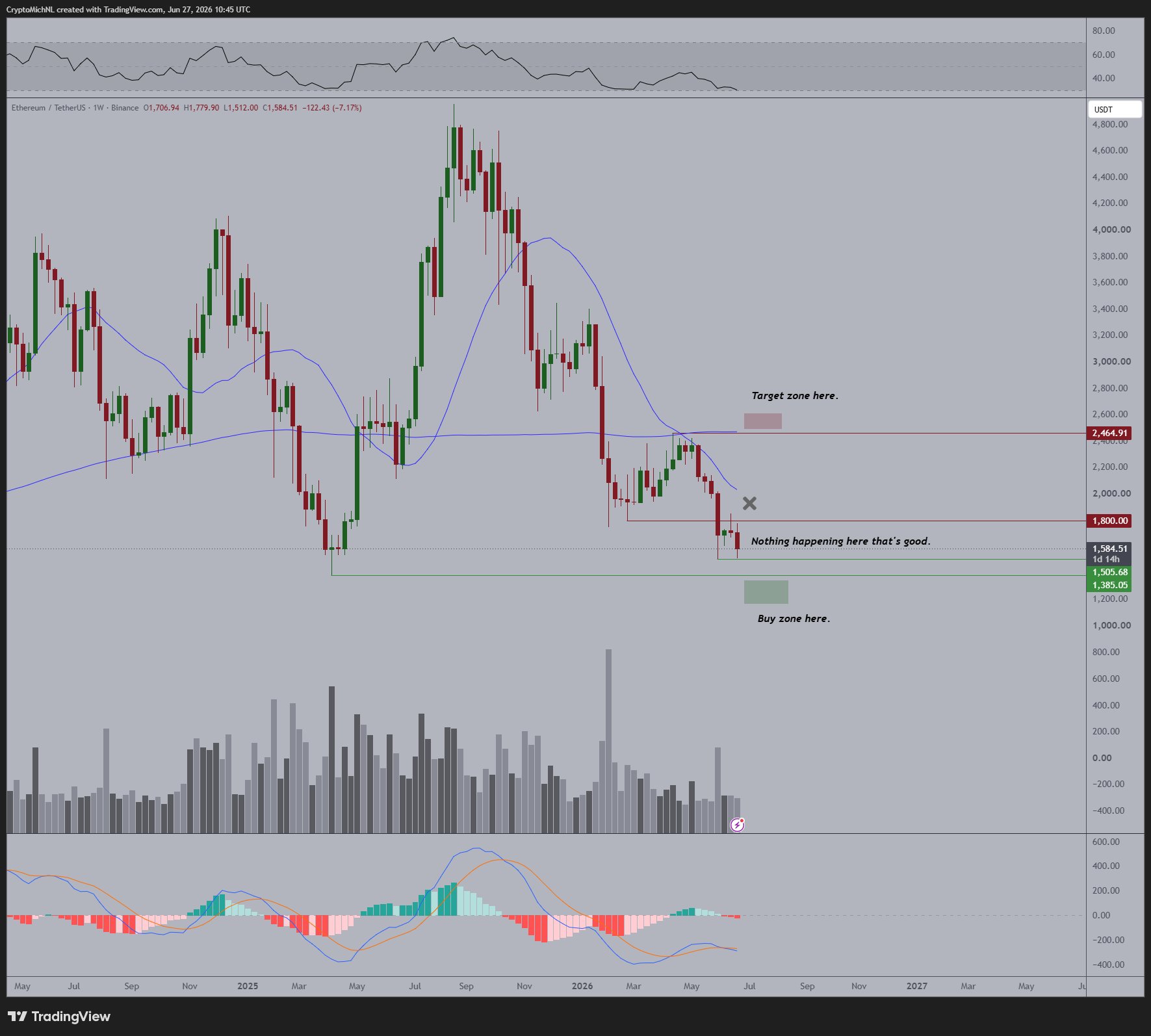
The asset remains below key support levels, including $1,800, which holds a particular significance in its long-term potential, according to popular analyst Michaël van de Poppe.
ETH Below $1.8K Means…
The market observer believes ETH sliding below $1,800 is a “massive opportunity” and that day traders should avoid it, as it’s “not really attractive” here. The chart below paints a clear picture, showing that the asset has been in a clear downtrend for months. It peaked at almost $5,000 last summer, but it has plunged by nearly 70% since then to the current $1,600.
However, there’s finally light at the end of the tunnel as the asset is “making a potential strong bullish divergence on many levels that would indicate that ETH is going to follow Bitcoin.”
Perhaps the biggest catalyst for future price gains in the crypto market, especially for tokens like ETH, which some analysts believe would benefit more than BTC, is the CLARITY Act. The bill, expected to be signed into law in the US this year, should increase regulatory clarity on the entire market in the US.
Van de Poppe says ETH is currently following a classic “sell the rumor, buy the news” type of price action. He also named $1,505 and $1,385 as the next levels at which ETH would present a “tremendous buying opportunity” if it gets there. Overall, though, he believes markets are not eager to go down more, and he doubts ETH will drop to those levels.
“I much rather see a clear breakthrough at $1,800 and see these levels as strong opportunities to be accumulating more positions.”
3 in a Row
Ethereum’s native token is just days away from creating history but in a negative manner by ending a third consecutive quarter in the red. Despite its previous bear cycles, it has never done this but it would require nothing short of a miracle to avoid it now. It closed with a 28.28% drop in Q4 2025, another 29.26% decline in Q1 2026, and is down by more than 24% in Q2 as of press time.
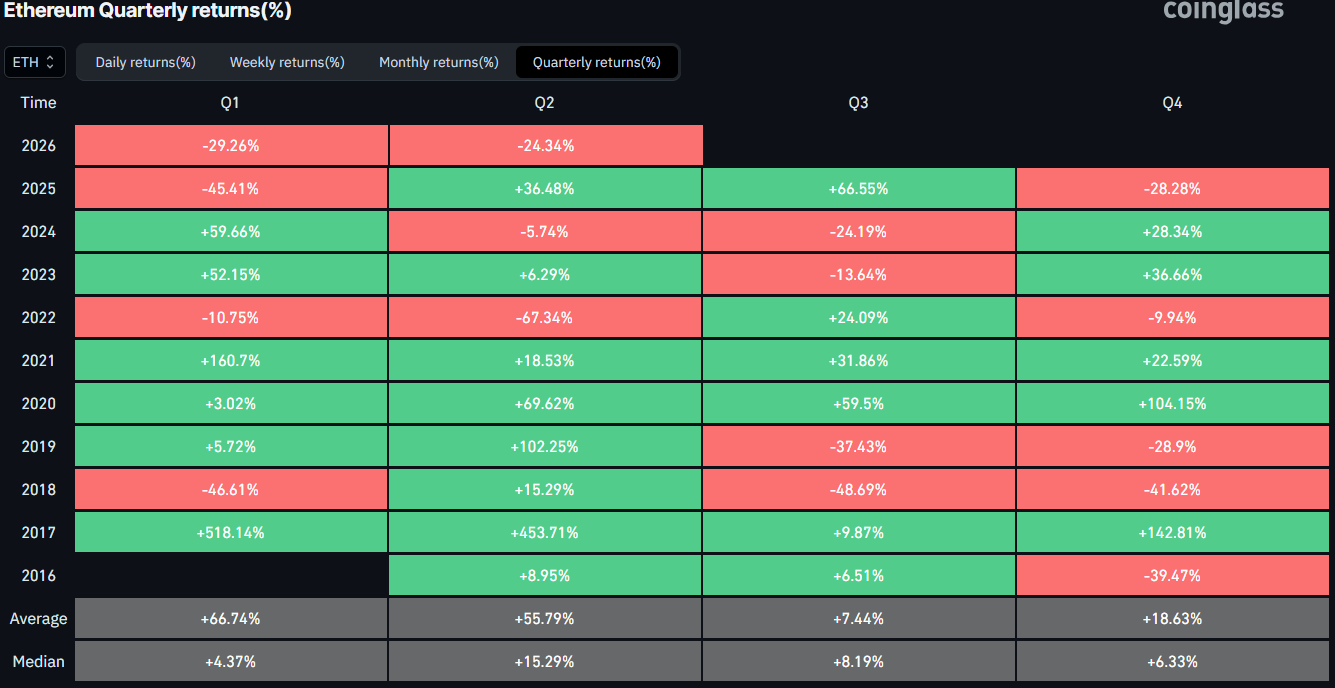
With June almost gone, investors have focused on July now. Ted Pillows brought some hope for the bulls, indicating that ETH has historically seen a bounce back in July. This has been particularly true in 2020, 2021, 2022, and 2025. ETH has posted notable gains in those July, all of which followed a red June.
The post Ethereum (ETH) Below $1.8K: What Does It Mean for Investors appeared first on CryptoPotato.

A pullback across US technology stocks is spilling into the crypto sector, and the market reaction is revealing a wider split between digital-asset equities and the broader S&P 500. Shares of Coinbase and Circle have fallen far more sharply from their peak levels than many large-cap technology names, underscoring how investors are treating crypto stocks as a higher-beta exposure to both risk sentiment and digital-asset fundamentals.
According to data cited from The Kobeissi Letter, Coinbase shares are down 69% from their all-time high, while Circle is down 72%. Those declines outpace drawdowns in several major technology companies—Oracle, Salesforce, Netflix and Palantir—each down roughly 48% to 57% from their peaks. By comparison, the S&P 500 has retreated about 3.5% from its recent high, suggesting crypto-linked equities are absorbing additional pressure beyond the general market rotation.
Key takeaways
- Crypto-focused stocks are declining much more than the S&P 500, pointing to company- and sector-specific risk on top of broad tech weakness.
- Sentiment has deteriorated alongside digital asset prices, with Bitcoin slipping below $60,000 and Ether falling to around $1,500.
- Operational stress is showing up in earnings: Coinbase reported results that missed expectations, including a quarterly revenue drop and a per-share loss.
- 21Shares says institutional adoption is improving some aspects of the market (notably stablecoins and tokenization), but the firm still sees Bitcoin’s four-year cycle as the key driver of price behavior.
Why crypto equities are moving differently from traditional tech
The immediate backdrop is a broad selloff in technology shares, but the crypto space appears to be reacting with additional intensity. The pressure is being linked to rising uncertainty that advances in artificial intelligence could disrupt existing business models within parts of the technology sector. While semiconductor stocks have generally held up better—despite volatility—crypto-related equities have remained under pressure amid weakness in digital asset markets.
Investors also appear to be weighing the pace of US policy progress on crypto market structure. The article notes uneven advancement toward comprehensive legislation in the United States, which can matter to publicly traded crypto firms that depend on clearer regulatory frameworks and more predictable market access conditions.
Digital asset price weakness adds fuel to equity declines
Market sentiment toward crypto has turned more cautious as Bitcoin and Ether extended their downturns. The report states that Bitcoin fell below $60,000 this week, widening its decline to more than 54% from its October peak. Ether, meanwhile, has faced heavy selling pressure, trading around $1,500—about 69% below last year’s high.
When crypto prices drop, equity investors often reprice more than just revenue expectations. They may also adjust assumptions about liquidity, trading activity, custody demand, and the overall risk appetite for crypto-exposed businesses. In that sense, the equity selloff can be interpreted as a compounding effect: traditional market weakness lowers risk tolerance, while falling token prices directly compress fundamentals for crypto-linked companies.
Coinbase results highlight how financial performance is getting tested
Beyond price action, corporate fundamentals are contributing to the negative tone. The article points to Coinbase’s first-quarter performance, stating that the exchange operator reported results that missed Wall Street expectations. According to the referenced coverage from Cointelegraph, Coinbase’s revenue fell 21% from the previous quarter, and the company posted a loss of $1.49 per share compared with analysts’ expectations for a profit of $0.27 per share.
Those numbers help explain why the stock reaction has been so pronounced during periods of weaker market conditions. In downturns, revenue for crypto platforms can be particularly sensitive to reduced trading volumes and tighter liquidity. Even when institutional participation grows, quarterly results can remain under pressure if broader market activity declines faster than new demand offsets it.
CoinShares data and other industry metrics often emphasize institutional adoption, but equity markets tend to react quickly to near-term earnings signals. In this case, the report suggests Coinbase’s fundamentals are worsening at the same time that the wider digital asset market is selling off.
21Shares trims its 2026 outlook while still tracking the four-year Bitcoin cycle
While crypto equities have been under pressure, at least one prominent asset manager is offering a more structured view of what to watch next. The article highlights a midyear outlook from 21Shares in which the firm reduced its expectations for 2026, arguing that digital asset prices have underperformed relative to the industry’s underlying fundamentals.
In the report, 21Shares says institutional adoption is still strengthening—particularly in areas such as stablecoins, tokenization and prediction markets. However, the firm’s central framework remains unchanged: Bitcoin’s four-year market cycle continues to exert the dominant influence on crypto prices.
21Shares notes that growth in institutional ownership has helped moderate Bitcoin’s drawdowns, but it has not fundamentally altered the cyclical behavior of the asset. The firm explicitly walks back an earlier position that the four-year cycle had become obsolete, stating that “Bitcoin’s cycle is evolving, but it has not broken yet,” as reported in the article.
That distinction matters for investors because it reframes “adoption” as a stabilizing force rather than an immediate cycle-breaker. Stablecoin usage, tokenization activity, and other institutional channels can support the ecosystem even when price trends lag, but if Bitcoin continues to follow its historical rhythm, broader market valuations may still face pressure until the cycle shifts.
What investors should monitor next
With crypto equities currently reflecting both a risk-off tech backdrop and renewed weakness in Bitcoin and Ether, the near-term signal investors will likely seek is whether fundamentals stabilize—particularly around trading volumes and quarterly reporting for major listed platforms. At the same time, 21Shares’ view suggests market participants should keep focusing on Bitcoin’s cycle dynamics even as institutional adoption expands; the question now is whether improved adoption can translate into clearer price recovery during the next phase of the cycle.


Robinhood says layoffs aren’t being driven by AI integration
According to a Forbes report published on June 4, 2026, AI has been the top reason cited for tech layoffs during 2026. Robinhood, however, seems to be taking a different tack.
Unlike BitGo, attributing its cuts to AI, Robinhood hasn’t indicated these layoffs were driven by AI adoption. The company’s stated reason is that it’s reducing management layers and streamlining operations to improve efficiency. And at this point, there is no clear evidence that Robinhood is replacing laid-off employees with AI.
That said, AI is likely part of the broader trend affecting how companies think about staffing. Rather than completely replacing employees, AI is often used to make existing teams more productive. Tasks involving research, customer support, coding, analysis and administrative work can frequently be handled faster and with fewer people than in the past.
As for service quality, users should probably expect the core user experience to remain largely unchanged. Functions such as trade execution, portfolio tracking, market data and charting are already highly automated.
The areas to watch are customer support and specialized assistance. AI can handle many routine questions effectively, but more complex issues, such as account restrictions, tax-related questions or crypto transfer problems, still benefit from human expertise.

Key Highlights
- Anthropic may receive clearance to reactivate its Fable 5 AI system following a 15-day suspension
- Final authorization from the Pentagon and NSA remains outstanding before full deployment
- Limited Mythos 5 access was reinstated on Friday by the Commerce Department for select users
- Commerce Secretary Howard Lutnick and Treasury Secretary Scott Bessent facilitated resolution discussions
- Anthropic and OpenAI are advocating for standardized government evaluation protocols for cutting-edge AI systems
According to a recent Axios report, Anthropic’s Fable 5 AI system may return to operation as soon as next week. The Trump administration is reportedly approaching a final determination to remove restrictions that have disabled the model since June 12.
The system went offline following a U.S. government export control directive that raised national security questions. The interruption disrupted access for numerous developers and enterprises who had integrated the technology into their workflows.
According to Axios sources with knowledge of the deliberations, the restrictions may be removed within the upcoming week. Dialogue between Anthropic representatives and government officials is anticipated to continue throughout the weekend.
However, universal approval hasn’t been achieved yet. Both the Pentagon and the National Security Agency must provide their authorization before the model can be reactivated. Several other government entities have already determined that the system poses no significant security risks for public deployment.
Commerce Secretary Howard Lutnick and Treasury Secretary Scott Bessent were instrumental in advancing negotiations. In correspondence to Anthropic, Lutnick acknowledged that the company “has worked with the US government to address risks” connected to both AI systems.
Partial Access Restored for Mythos 5
The Commerce Department granted Anthropic permission on Friday to reinstate Mythos 5 access for a select cohort of vetted users. Mythos 5 represents the more sophisticated version of the two systems and has never been released for widespread public consumption.
Both the Fable 5 and Mythos 5 platforms share the same foundational AI architecture. The primary distinction lies in their deployment strategy: Fable 5 targets general public accessibility, whereas Mythos 5 incorporates enhanced protective measures designed to minimize risks such as cyberattacks or biological weapons development.
The Significance of Fable 5 for Development Teams
Prior to its June 12 suspension, Fable 5 had gained substantial traction among software developers due to its superior coding and analytical functions. Payment processing firm Stripe allegedly utilized it to restructure a 50 million-line codebase within a single day—a task that would have required manual engineering efforts exceeding two months.
Following the suspension, automated development processes were interrupted, and certain organizations migrated their operations to alternative AI platforms, including more affordable Chinese-developed models.
The shutdown also occurred amid broader tensions between Anthropic and the Trump administration. Defense Secretary Pete Hegseth had previously characterized Anthropic as a “Supply-Chain Risk to National Security.” The anticipated reinstatement of Fable 5 signals a transformation in that dynamic.
An administration representative informed Axios that Anthropic “has worked positively with the government.”
Advocacy for Standardized Evaluation Framework
Both Anthropic and OpenAI are urging the Trump administration to establish a formalized assessment framework for advanced AI models prior to their public release. This initiative follows President Trump’s June 2 executive order that introduced voluntary government screening for powerful AI technologies.
OpenAI secured approval on Friday for a restricted preview of GPT-5.6. In an official statement, the organization expressed that it doesn’t believe government access mechanisms “should become the long-term default.”
Anthropic has similarly advocated for an evaluation process that is “transparent, fair, clear, and grounded in technical facts.”


A broad selloff in technology stocks has weighed even more heavily on crypto-focused companies, highlighting a growing divergence between digital asset equities and the broader US stock market.
Shares of Coinbase (COIN) and Circle (CRCL) have fallen 69% and 72%, respectively, from their all-time highs. Those declines exceed the drawdowns seen in several major technology companies, including Oracle (ORCL), Salesforce (CRM), Netflix (NFLX) and Palantir (PLTR), which are down between 48% and 57% from their peaks, according to data from The Kobeissi Letter
By comparison, the large-cap S&P 500 Index has retreated just 3.5% from its recent high.

Source: The Kobeissi Letter
The pullback in technology stocks reflects mounting concerns that advances in artificial intelligence could disrupt existing business models across parts of the sector. Semiconductor stocks have generally held up better despite bouts of volatility, while crypto-related equities have remained under pressure amid broader weakness in digital asset markets and uneven progress on comprehensive crypto market structure legislation in the United States.
Negative sentiment toward the sector has intensified after Bitcoin fell below $60,000 this week, extending its decline to more than 54% from its October peak. Ether has also come under heavy selling pressure, recently falling to around $1,500, roughly 69% below last year’s high.
Bear market conditions have also weighed on corporate earnings, with Coinbase reporting first-quarter results that missed Wall Street expectations. Revenue fell 21% from the previous quarter, while the company posted a loss of $1.49 per share, versus analysts’ expectations for a profit of $0.27 per share.
Related: Crypto Biz: The cost of stacking sats
Analysts downgrade crypto market’s 2026 outlook despite strong institutional adoption
The crypto market’s prolonged downturn has prompted analysts at 21Shares to lower their expectations for 2026, arguing that digital asset prices have significantly underperformed the industry’s underlying fundamentals.
In its midyear outlook, 21shares said institutional adoption continues to strengthen, particularly in stablecoins, tokenization and prediction markets. However, the asset manager argued that Bitcoin’s four-year market cycle remains the dominant force driving crypto prices.
According to the report, growing institutional ownership has helped moderate Bitcoin’s drawdowns but has not fundamentally altered its cyclical behavior.
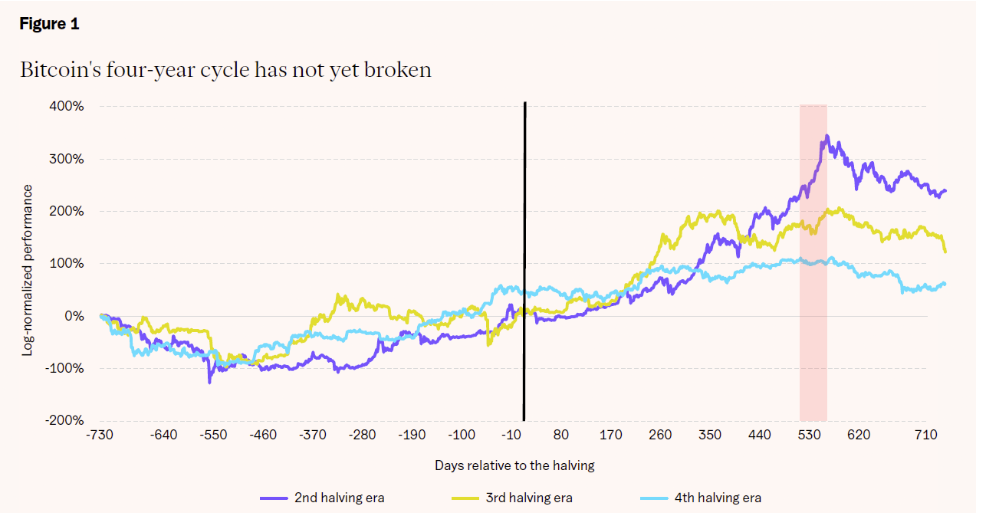
Bitcoin’s price action this year suggests the four-year cycle remains intact. Source: 21shares
“Bitcoin’s cycle is evolving, but it has not broken yet,” 21Shares said, walking back its earlier forecast that the four-year cycle had become obsolete.
Related: Ethereum Foundation leadership exodus continues with director’s departure


Tokenized real-world assets crossed $30 billion on-chain in 2026, with BlackRock, JPMorgan, and Franklin Templeton leading the charge. This guide explains what RWA tokenization actually is, how it works, why the biggest names in finance are betting on it, and the risks the hype tends to skip.
Summary
- Real-world asset tokenization is the process of creating a blockchain token that represents legal or economic rights to an asset that exists off-chain, such as a Treasury bill, a property, or a bar of gold.
- The token is not the asset itself; it is an on-chain record of a claim on an off-chain asset, and that claim is enforced by legal structures, custodians, and jurisdictions outside the blockchain.
- The on-chain RWA market grew from roughly $5.5 billion in early 2025 to around $30 billion by mid-2026, led by tokenized US Treasuries near $12.9 billion and private credit around $19 billion.
- The momentum comes from traditional finance, not retail traders, with BlackRock, JPMorgan, Franklin Templeton, and others building tokenized funds and settlement systems.
- The promise is fractional ownership, 24/7 settlement, and programmability, but the risks are real: the token is only as strong as the legal structure, the custodian, and the regulatory wrapper behind it.
Real-world asset tokenization is the process of creating a blockchain-based token that represents legal or economic rights to an asset that exists in the traditional, off-chain world, such as a US Treasury bill, a share in a building, a unit of a money market fund, or a gram of gold held in a vault.
The single most important thing to understand at the outset is that the token is not the asset. When you hold a tokenized Treasury, you do not hold the Treasury bill itself on the blockchain; you hold a digital record of a claim on an underlying bill that a custodian or legal entity holds on your behalf. The token is a convenient way to track and transfer ownership, but the actual legal and economic substance lives off-chain, in contracts, custody arrangements, and the laws of whatever jurisdiction governs the asset.
This distinction is the key to understanding everything else about real-world assets, often shortened to RWAs, because it explains both why tokenization is powerful and where its risks come from.
The reason RWA tokenization has become one of the most discussed topics in crypto in 2026 is that it represents a bridge between two worlds that have mostly stayed separate: the enormous, established markets of traditional finance, and the always-on, programmable infrastructure of blockchains.
The on-chain value of tokenized real-world assets grew from roughly $5.5 billion at the start of 2025 to around $30 billion by the middle of 2026, and the forces driving that growth are not retail speculators chasing the next memecoin but the largest financial institutions on earth.
This guide explains what RWA tokenization actually is, how the process works step by step, the main categories of assets being tokenized, why institutions are moving so fast, how RWAs differ from other crypto assets, a concrete worked example, and, crucially, the risks that the enthusiastic coverage often skips over. By the end, you should be able to tell the difference between the genuine innovation and the hype.
What a tokenized real-world asset actually is
Begin with a precise definition, because the term gets used loosely. A real-world asset, in the crypto sense, is any asset that exists outside the blockchain and has been given an on-chain representation through tokenization. The underlying asset can be tangible, such as real estate, gold, or commodities, or it can be a traditional financial instrument, such as a government bond, a corporate bond, a share of a fund, or a slice of private credit.
Tokenization is the process of issuing a token that stands in for defined rights related to that asset, so those rights can be tracked, held, and transferred on a blockchain. A useful working definition is this: an RWA token is an on-chain record of rights to an off-chain asset, enforced by legal and operational structures that exist outside the blockchain.
The phrase rights to an asset is doing important work in that definition, because what the token represents varies. In some cases, the token reflects fractional ownership of the asset itself. In others, it represents an entitlement to the cash flows the asset produces, such as the interest on a bond. In still others, it is a redemption right, a promise that the holder can exchange the token for the underlying asset or its cash value, or a claim secured by collateral.
What the token means in any specific case depends entirely on the legal structure behind it, which is why two tokens that both call themselves tokenized Treasuries can carry very different rights and protections. The blockchain provides a shared, transparent ledger for recording who holds what and for moving those holdings quickly, but it does not, by itself, create or enforce the underlying rights. That enforcement comes from the contracts, the custodians who hold the real asset, and the courts and regulators of the relevant jurisdiction. Tokenization, in short, changes the wrapper around the asset, not the asset itself.
How tokenization actually works
The lifecycle of a tokenized real-world asset connects the physical or financial world to the blockchain through a chain of legal, operational, and technical steps, and each link matters. It begins with asset selection and valuation, where an issuer identifies an asset suitable for tokenization and gets it properly valued, which, for real estate, means appraisals and, for private credit, means underwriting.
Next comes the legal structure, typically the creation of a special purpose vehicle, a separate legal entity that holds the underlying asset on behalf of token holders and defines their rights. This legal layer is the foundation of the whole arrangement, because it determines what holders actually own and what happens if the issuer fails. A well-designed structure with bankruptcy-remoteness, meaning the asset is insulated from the issuer’s other obligations, offers far stronger protection than a simple contractual promise.
With the legal structure in place, the token itself is issued, usually following an established standard such as ERC-20 for fungible tokens or specialized security-token standards built to carry compliance rules. Smart contracts, the self-executing programs on the blockchain, then handle much of the assets’ on-chain lifecycle, automating the minting of new tokens, transfer restrictions, distribution of yield such as interest or dividends, and the redemption process.
Because most tokenized RWAs fall under existing securities rules, compliance is woven throughout: many require identity verification, and once a holder is verified, their wallet address is often whitelisted, meaning the token can only be transferred to other approved addresses.
Custody arrangements guarantee that the real asset backing the token is held securely, and a redemption process defines how a holder converts the token back into the underlying asset or its value. Services such as proof-of-reserve attestations, which cryptographically confirm that the on-chain tokens are fully backed by real assets held with a custodian, and cross-chain interoperability standards that let tokens move between blockchains, are increasingly layered on top to build trust and avoid fragmented liquidity. The result is an asset that behaves like its traditional counterpart legally but moves with the speed and programmability of crypto.
The main categories of tokenized assets
The RWA label covers a wide and growing range of asset classes, and each behaves differently, so it helps to know the major categories. By distributed value on public blockchains, tokenized US Treasuries are the largest single category, at roughly $12.9 billion in 2026, prized because they bring the steady, low-risk yield of government debt on-chain in a form that settles 24/7 and can be used inside decentralized finance. Closely related are tokenized money market funds, which package short-duration government debt into a single yield-bearing token. Private credit is the other giant of the sector, with active on-chain private credit around $19 billion, representing loans to businesses that produce yield for token holders, and depending on how it is measured, private credit may be the largest category of all.
Beyond those two, tokenized equities and exchange-traded funds let investors hold on-chain exposure to stocks, though most such products provide economic exposure to a stock’s price and dividends rather than direct share ownership or voting rights, a distinction regulators have drawn sharply. Commodities, dominated by gold-backed tokens such as PAXG and XAUT, rose sharply to around $5.5 billion as gold itself climbed, each token backed 1-to-1 by physical metal in a vault.
Real estate tokenization lets people buy fractional stakes in properties and receive a share of rental income, lowering the entry cost of a market once reserved for the wealthy. Bonds, both government and corporate, round out the core categories.
It is worth noting that stablecoins, which are technically tokenized claims on real-world reserves like dollars, are usually tracked separately because of their enormous scale, around $300 billion, and their distinct role as payment instruments rather than investments. The breadth of these categories is part of why advocates describe tokenization as potentially touching nearly all of human economic activity, even if the reality today is concentrated in Treasuries, credit, and gold.
Why institutions are betting billions
The defining feature of the 2026 RWA boom, and what separates it from most crypto trends, is that the institutions driving it are the largest names in traditional finance rather than crypto-native startups. BlackRock, the world’s largest asset manager, has committed firmly to tokenization through its BUIDL fund, a tokenized money market fund that surpassed $2.5 billion in assets, and its chief executive Larry Fink has repeatedly described tokenization as the next generation for markets, comparing its current stage to where the internet was in 1996 and envisioning a future of one general ledger on which all assets are tokenized.
Alongside BlackRock sit Franklin Templeton with its BENJI token, Circle, Securitize, and the major banks: JPMorgan processes large volumes of tokenized transactions through its blockchain platform, while Goldman Sachs, HSBC, and UBS have explored or piloted tokenized issuances.
The reasoning behind these bets is a combination of efficiency and opportunity. Tokenization can consolidate the traditionally separate processes of distribution, trading, clearing, settlement, and safekeeping into a single layer, reducing the counterparty risk and operational cost that come from passing an asset through many intermediaries. It enables near-instant settlement instead of the days that traditional securities can take; it allows assets to trade around the clock, and it makes them programmable, so that compliance rules, yield distributions, and other functions can be automated in code.
For institutions managing vast portfolios, even modest efficiency gains translate into large savings, and the ability to offer clients 24/7 access and fractional products opens new markets. This is why the institutional move is best understood as a bet on the infrastructure of tomorrow’s financial system instead of a trade on today’s prices, and why forecasts from major consultancies, while varying widely, are strikingly large, with estimates of the tokenized market reaching figures from $2 trillion to $16 trillion by 2030. Whether those forecasts prove accurate or optimistic, the direction of institutional conviction is clear.
A worked example: tokenized gold
To make the abstract concrete, consider tokenized gold, one of the clearest illustrations of how RWA tokenization works in practice. A company that issues gold-backed tokens takes physical gold, held and audited in professional vaults, and issues tokens against it on a 1-to-1 basis, so that each token represents ownership of a specific quantity of gold, often one fine troy ounce. If the issuer holds a 400-ounce gold bar, it can issue 400 tokens, each backed by 1 ounce of that bar. A holder of 1 token owns the rights to 1 ounce of gold sitting in the vault, and can redeem the token for the physical metal or its cash value according to the issuer’s terms.
What tokenization adds to this otherwise ordinary gold ownership is the set of capabilities that come from the asset living on a blockchain. The token can be divided into very small fractions, in some cases as small as a millionth of a unit, so a person can own a tiny sliver of gold instead of a whole bar or coin. It can be transferred person to person in minutes, at any hour, without the logistics of moving physical metal. And because it is a programmable token, it can be used within decentralized finance, for example, as collateral to borrow against without selling the underlying gold.
The token’s value tracks the price of gold, because that is what backs it, so the holder gets the store-of-value characteristics of physical gold combined with the portability and programmability of crypto. This example captures the essence of the RWA thesis at the level of an individual asset: real-world value on one side, the flexibility of crypto infrastructure on the other, joined by a token whose worth depends entirely on the gold actually sitting in the vault and the legal right to claim it.
How RWAs differ from regular crypto
A common source of confusion is the difference between tokenized real-world assets and native crypto assets, and the distinction is fundamental to understanding what an RWA is and is not. Native crypto assets, such as Bitcoin or Ether, originate directly on a blockchain and have no claim on anything outside it. Their value comes from network activity, utility, governance roles, scarcity, and market demand, and they exist purely on-chain with no custodian or legal entity standing behind them holding a real-world counterpart. When you hold Ether, the asset itself is the on-chain token; there is no off-chain thing it represents.
A tokenized real-world asset is the opposite in this respect. Its value derives from an off-chain asset held by a custodian or structured through a legal entity, and the token is a representation of rights to that external asset instead of a self-contained on-chain asset. This difference shapes nearly everything about how the two are treated. RWA tokens typically fall within securities classifications because they reflect ownership, economic rights, or claims linked to a financial instrument, which means they usually require compliance, regulated custody, and clear legal documentation.
Native crypto tokens are often classified as utility tokens and regulated, where they are regulated at all, under different frameworks. A useful way to hold the distinction in mind is that tokenization does not change the regulatory nature of the underlying product: if an asset is treated as a security in the traditional world, it will generally be treated as a security once tokenized, because the token is just a new wrapper around the same legal substance. Crypto-native assets, having no such off-chain substance, sit in a different regulatory category entirely.
Risks and what can go wrong
For all the genuine promise of RWA tokenization, the risks are real and specific, and an honest understanding of them is essential before treating any token as a reliable claim on a real asset. The foundational risk is that the token is only as good as the legal structure behind it.
Because the enforceable rights live off-chain, a token’s value in a crisis depends on whether the legal arrangement actually holds up, and a well-designed special purpose vehicle with bankruptcy-remoteness offers far stronger protection than a loose contractual promise.
If the issuer becomes insolvent, the legal structure determines whether holders recover anything, which makes the quality of that structure the single most important thing to evaluate.
The other risks build on this foundation. Counterparty and custodial risk means that holding a tokenized Treasury requires trusting that the custodian actually holds the underlying bills and that the issuer will honor redemptions; if the custodian suffers a breach or the issuer fails, holders can face losses regardless of how sound the blockchain is.
Regulatory uncertainty is significant because the treatment of RWA tokens remains unsettled in many jurisdictions, and tokenization does not exempt an asset from securities laws. Smart contract and oracle risk means that bugs in the code, or manipulation of the price feeds some tokens rely on, can affect how the token functions.
Liquidity and redemption constraints are a practical danger: many RWA tokens restrict transfers to whitelisted, identity-verified addresses, and redemption may be limited to the issuer or approved purchasers, so a token that looks liquid can become hard to exit under stress, which is often the most underappreciated risk.
Issuers also typically hold administrative keys that let them pause transfers, blacklist addresses, or upgrade contracts, introducing a degree of central control. And it is worth remembering that only a small fraction of tokenized RWAs, around $2.5 billion of the roughly $30 billion on-chain, is actually active in decentralized finance, because compliance rails limit open-market use.
The blunt summary is that tokenization changes the wrapper, not the underlying exposure: an RWA token carries all the risks of the underlying asset plus a new set of technical, custodial, and legal risks layered on top.
Frequently Asked Questions
What is real-world asset tokenization in simple terms?
It is the process of creating a blockchain token that represents rights to an asset that exists in the traditional world, such as a Treasury bill, a property, or gold. The token is not the asset itself; it is an on-chain record of a claim on an off-chain asset, and that claim is enforced by legal structures, custodians, and jurisdictions outside the blockchain. Tokenization lets the asset be held, divided, and transferred on a blockchain with the speed and programmability of crypto, while the underlying legal and economic substance stays governed by traditional law.
What is the difference between an RWA token and a cryptocurrency like Bitcoin?
Bitcoin and Ether are native crypto assets that originate directly on a blockchain and have no claim on anything off-chain; their value comes from network activity, scarcity, and demand. An RWA token is the opposite: its value derives from an off-chain asset held by a custodian, and the token represents rights to that external asset. Because of this, RWA tokens usually fall under securities rules and require compliance and regulated custody, while native crypto tokens are typically treated differently. Tokenization does not change an asset’s legal nature, so a security stays a security once tokenized.
How big is the RWA tokenization market?
The on-chain value of tokenized real-world assets grew from roughly $5.5 billion in early 2025 to around $30 billion by mid-2026. Tokenized US Treasuries are the largest category by distributed on-chain value at approximately $12.9 billion, while private credit is around $19 billion and may be larger depending on the measurement. Tokenized gold rose to about $5.5 billion. Stablecoins, technically tokenized dollar claims, are tracked separately due to their roughly $300 billion scale. Forecasts for 2030 vary widely, from $2 trillion to $16 trillion.
Which companies are driving RWA tokenization?
The leaders are major traditional finance institutions instead of crypto startups. BlackRock’s BUIDL tokenized money market fund surpassed $2.5 billion, and its chief executive has called tokenization the next generation for markets. Franklin Templeton issues the BENJI token, JPMorgan processes large volumes of tokenized transactions through its blockchain platform, and Circle, Securitize, Goldman Sachs, HSBC, and UBS are all active. This institutional involvement is the defining feature of the 2026 RWA boom and the main reason it has continued to grow even while other parts of the crypto market struggled.
What can be tokenized?
In principle, almost anything of value, which is why advocates describe the potential market as enormous. In practice today, the activity is concentrated in US Treasuries and money market funds, private credit, commodities such as gold, equities, and exchange-traded funds, real estate, and bonds. Smaller emerging categories include non-US government debt, private equity, carbon credits, and art. Each category behaves differently in terms of risk, yield, and liquidity, and the legal structure varies by asset and jurisdiction, so the experience of holding a tokenized Treasury differs significantly from holding tokenized real estate or private credit.
Is RWA tokenization safe?
It carries real risks that should be understood before treating any token as a reliable claim. The token is only as good as the legal structure behind it, and in an issuer’s insolvency, recovery depends on how well that structure is designed. There is counterparty and custodial risk, regulatory uncertainty, smart contract and oracle risk, and liquidity constraints, since many RWA tokens restrict transfers to whitelisted addresses and limit redemption. Tokenization changes the wrapper, not the underlying exposure, so an RWA token carries all the risks of the underlying asset plus new technical, custodial, and legal risks. Careful due diligence on the issuer, custodian, and legal structure is essential.
This article is educational information, not financial, legal, or tax advice. Market sizes, products, and institutional activity reflect reporting available as of June 26, 2026, and the RWA sector is evolving quickly. Tokenized real-world assets carry significant risks and are not suitable for everyone. Verify current details and the specific legal structure of any product from primary sources, and consider your own circumstances before making any decision.

Key Takeaways
- Western Digital shares plunged as much as 13% during trading on June 26, reaching an intraday bottom of $611.53
- On June 22, Fox Advisors cut their rating from Outperform to Equal-Weight, expressing concerns about hard disk drive pricing expectations
- The company finalized a SanDisk share swap and eliminated $858.4M worth of convertible notes, leading to dilution and increased share supply
- Insider transactions showed 125 stock sales over six months with no purchases, with CEO Irving Tan offloading roughly 40,000 shares in 26 separate deals
- Following a remarkable 54%+ rally in the previous month, the stock’s forward P/E ratio had climbed to 40x–45x, leaving limited margin for disappointment
Western Digital (WDC) experienced a sharp decline of up to 13% during June 26 trading, bottoming out at $611.53 as multiple negative catalysts converged simultaneously.
Western Digital Corporation, WDC
Selling pressure intensified following Fox Advisors’ rating cut on June 22, which moved WDC from Outperform to Equal-Weight. The analyst firm expressed skepticism that hard disk drive pricing improvements would meet the market’s elevated expectations.
This downgrade continued to exert downward pressure on shares throughout the remainder of the week.
Concurrently, Western Digital completed two significant corporate actions that introduced additional shares into circulation. The company executed an exchange involving more than one million SanDisk shares for WDC common stock, generating immediate share overhang and prompting arbitrage-related hedging strategies.
Additionally, the firm extinguished $858.4 million of its 3.00% Convertible Senior Notes maturing in 2028, exchanging them for cash plus approximately 21.3 million newly issued common shares. This equity dilution negatively impacted short-term earnings per share projections.
Heavy Insider Selling Compounds Concerns
Insider activity at WDC painted a concerning picture, with 125 stock disposals recorded over the past six months and not a single purchase. Among those selling was CEO Irving Tan, who divested around 40,000 shares through 26 individual transactions.
This uniformly negative insider trading pattern contributed to deteriorating investor confidence.
The broader memory and storage sector also experienced downward momentum. Investor sentiment took a hit when a South Korean policymaker floated the idea of an AI-focused windfall tax, triggering steep declines in South Korean equity indices and pulling down memory and chip stocks globally.
Quick Reversal After Impressive Rally
Prior to this sharp decline, WDC had enjoyed a spectacular run, climbing more than 54% over the preceding month. This surge was driven by optimism surrounding AI-related storage demand and momentum from the broader memory sector rally following Micron’s impressive earnings report on June 25. Those gains are now being significantly retraced.
At the peak of that rally, the stock’s forward price-to-earnings ratio had expanded to 40x–45x — a premium valuation that offered minimal cushion for negative developments. Once the downgrade, dilution announcements, and sector-wide headwinds materialized simultaneously, profit-taking intensified rapidly.
Notwithstanding the recent decline, analyst sentiment toward WDC remains predominantly positive with 21 buy recommendations, 3 hold ratings, and just 1 sell rating. The stock maintains a year-to-date gain of 292.35%, with a current market capitalization of $232.8 billion.
Broader market indices provided no support during WDC’s selloff, with the Nasdaq declining 0.2% and the S&P 500 trading roughly unchanged on the same session.
The stock’s average daily volume stands at 8.1 million shares. According to the most recent technical indicators, sentiment readings continue to signal a buy.

Key Takeaways
- Chief Accounting Officer Emily Ho offloaded 1,860 SNOW shares at $232.245 apiece, generating proceeds of $431,975 on June 24, 2026.
- The stock was priced at $248.96 when the transaction was disclosed, representing a gain over Ho’s sale price.
- Recent months have witnessed significant insider disposals, notably director Frank Slootman’s May divestment of 437,076 shares worth more than $110 million.
- The cloud data company’s latest quarterly earnings exceeded Wall Street forecasts — posting $0.39 earnings per share against $0.32 projections, while revenue surged 33.5% annually to reach $1.39 billion.
- Wall Street maintains an optimistic stance with a “Moderate Buy” consensus and price target averaging $293.53.
On June 24, 2026, Emily Ho, serving as Snowflake’s Chief Accounting Officer, executed a sale of 1,860 SNOW shares priced at $232.245 each, totaling $431,975 in transaction value. When the regulatory filing became public, shares were changing hands at $248.96 — indicating the stock had appreciated beyond her disposal price.
Following this divestment, Ho maintains direct ownership of 41,283 shares, which encompasses holdings connected to unvested restricted stock units.
This transaction represents just one piece of a broader pattern of insider activity at Snowflake. On May 29, director Frank Slootman divested 437,076 shares at a mean price of $252.43, generating proceeds exceeding $110 million. This disposal occurred through a predetermined Rule 10b5-1 trading arrangement and slashed his stake by approximately 92%.
Director Michael Speiser similarly unloaded 50,338 shares in April at $148.21 each. Collectively, company insiders have disposed of 1,702,704 shares valued at approximately $390 million during the past quarter. Current insider ownership represents roughly 4.80% of outstanding shares.
Institutional Money Flows in Opposite Direction
Contrary to insider behavior, institutional capital has been accumulating SNOW positions. Union Bancaire Privee UBP SA expanded its holdings by an impressive 521.5% during Q1, concluding the period with 224,795 shares worth approximately $33 million.
Brighton Jones LLC increased its allocation by 90% in the fourth quarter. Intech Investment Management boosted its stake by 24% in Q1. Institutional ownership now comprises approximately 65% of SNOW’s shareholder base.
SNOW commenced Friday’s trading session at $248.29. The equity trades within a 52-week range spanning $118.30 to $284.99. The 50-day moving average rests at $191.99, considerably beneath current levels, while the 200-day average sits at $189.19. The company commands a market capitalization of $86.06 billion.
Snowflake’s most recent earnings announcement on May 27 revealed EPS of $0.39 — surpassing the $0.32 analyst consensus by $0.07. Revenue registered at $1.39 billion, exceeding expectations of $1.32 billion and representing a 33.5% year-over-year increase.
The organization continues operating at a deficit. Net margin stands at -23.79%, accompanied by a negative return on equity of -50.50%. Full-year EPS projections anticipate -$1.87.
Wall Street Maintains Confident Outlook
The wave of insider disposals hasn’t significantly altered analyst perspectives. JPMorgan elevated its price objective to $285 while maintaining an “Overweight” designation following Q1 results. Truist advanced its target to $300, pointing to encouraging signals from Snowflake Summit 2026. UBS confirmed its “Buy” stance with a $370 projection.
Sanford Bernstein lifted its target to $250 while preserving a “Market Perform” rating. Evercore maintains a more conservative $200 objective.
Among 41 analyst assessments, 34 recommend Buy, five suggest Hold, and one advises Sell — including one Strong Buy. The consensus price target reaches $293.53.
Regarding business developments, Unlimitail chose Snowflake’s infrastructure to support a retail media network utilizing Data Clean Rooms capabilities. Rival Databricks announced its data warehousing operations achieved a $1.5 billion annual run rate, fueled by artificial intelligence demand.
SNOW’s year-to-date price appreciation registers at 3.51%, with typical daily trading volume hovering around 8.6 million shares.

The best government bond market may be outside the United States.
Allspring Global Investments’ George Bory is pushing clients toward countries whose central banks are raising interest rates or have different inflation dynamics.
“Bond markets everywhere have rushed to price inflation. Places like the UK, certainly across Europe, even places like Australia — we’ve seen a material run-up in central bank tightening expectations,” he told CNBC’s “ETF Edge” this week. “Now, some of that’s been delivered on already. The ECB raised rates just a few weeks ago. The expectation is they will do a bit more. But unless the Fed is going to validate those moves, they’re going to have to move at a slower pace than perhaps what’s priced in.”
Bory works as chief investment strategist in fixed income at Allspring — an asset management firm primarily focused on fixed income, money markets, and stocks. According to Allspring’s website, clients range from consultants and financial advisors to corporations and financial institutions.
“Short to intermediate duration global government developed market bonds [are] not a bad spot to be, especially for those central banks that are really tethered to inflation,” he said. “If they’re going to move aggressively, that will help bond investors. And so, adding that international duration … mixing it with some U.S. duration. Now we’re playing different rate cycles, and that works really, really nicely.”
The Fed hasn’t hiked rates in the U.S. since July 2023. The CME Group’s FedWatch gauge as of late Friday shows a 78% chance the Fed will hike rates in December. The odds dipped to 68% in January 2027.
Meanwhile, Bory highlights the European Central Bank’s move earlier this month. The ECB raised its rates 25 basis points to 2.25% on June 11 — the first rate hike since Sept. 2023.
Steve Laipply, the global co-head of iShares Fixed Income ETFs at BlackRock, also sees advantages for investors going abroad. He points to fixed-income securities issued in Europe that offer lower risk and higher yields.
“Many of our clients, many bond investors, [are] very US-centric,” Bory added. “It’s a big world out there, you know. The global bond market is massive, and diversifying both your duration, your credit risk, and even your security selection can do … good things for your portfolio.”

Sweltering heat wave sets new records across Europe
Qamar Zaman & Rene Perras Podcast releases an AI SEO For Lawyers Episode

Off Campus Cast Options for Tucker’s Love Interest Sabrina


-

 Entertainment7 days ago
Renter of Home in Anne Heche Crash Denies Settlement With Son
-
 Sports4 days ago
Two goals and an assist by sheer aura: Cristiano Ronaldo just entered the World Cup chat
-

 Tech5 days ago
Microsoft accidentally kills epic Outlook email threads
-

 Fashion24 hours ago
Weekend Open Thread: Staud – Corporette.com
-

 Business7 days ago
Soccer-U.S. defends Iran World Cup travel restrictions, says discussions ongoing
-

 Politics1 day ago
The House | Manchesterism won’t survive the painful trade-offs unless it gets citizens on board
-

 Politics2 days ago
Potential 2028er World Cup attendee leaderboard
-

 Business1 day ago
Asia stock markets slide as tech shares slump
-

 Tech2 days ago
A Look At A Gaggle Of Transputer Boards
-
Crypto World4 days ago
Bitcoin (BTC) Dips Below $62K, Ethereum (ETH) Plunges 6% Daily: Market Watch
-

 Crypto World3 days ago
Securitize Wraps Roubini's SEC-Registered ETF as Dubai VARA Digital Security
-
 Crypto World2 days ago
Dell (DELL) Shares Tumble Over 5% Following Analyst Downgrade to Hold
-
Business4 days ago
Entergy settles forward sale agreements, raises $672 million in cash proceeds
-

 Crypto World13 hours ago
Kraken's xStocks Opens Bending Spoons IPO Registration to EEA Retail
-

 Sports21 hours ago
FIH Pro League: India defeat Pakistan 7-1, register biggest win of campaign | Other Sports News
-

 Crypto World1 day ago
RTX holders must register wallets before token distribution begins
-
Crypto World1 day ago
Hyperliquid Named on Singapore MAS Investor Alert Register
-

 Sports2 days ago
India vs Bangladesh LIVE Score, Women’s T20 World Cup: Bangladesh Opt To Bat; India Enter ‘Do-Or-Die’ Stage As Semi-Final Race Heats Up
-
 Tech6 days ago
Signal’s Meredith Whittaker says AI chatbots ‘are not your friends’ and calls Copilot agents a backdoor
-
Crypto World1 day ago
The DATA Foundation Launches to Tackle AI’s Multi-Billion Dollar Training Data Bottleneck
You must be logged in to post a comment Login