

Crypto World
CME Move To Sue CFTC Over Crypto Perpetual Futures: Here’s Why


CME Group CEO Terrence Duffy announced Wednesday that the exchange operator will file a federal lawsuit against the CFTC, targeting the regulator’s late-May approval of bitcoin perps for prediction-market platform Kalshi, the first regulated U.S. listing of perpetual futures.
Duffy’s central argument, made on CNBC’s Fast Money, is that the products the CFTC approved as futures are legally swaps under the Dodd-Frank Act, and that the agency overstepped its authority in fast-tracking them without adequate review.
The stakes extend well beyond Kalshi. Duffy stated on air that CME holds exclusive licensing agreements with every major benchmark provider whose indexes underpin crypto derivatives pricing.
If perpetual futures are reclassified as swaps in court, any platform offering them would need to route through CME’s licensing framework regardless of how their products are labeled, a structural outcome that would effectively block Kalshi, Coinbase, and Kraken from operating U.S. perp markets outside CME’s terms.
CFTC Chair Michael Selig defended the approval earlier the same week, telling CNBC it was “time to approve regulated futures contracts that have no expiration date,” while a CFTC spokesperson dismissed the threatened lawsuit as frivolous.

The broader regulatory context matters here. Legislators are simultaneously debating the scope of CFTC jurisdiction over crypto through vehicles like the CLARITY Act currently moving through the Senate, which would formalize CFTC authority over digital commodity derivatives – making the outcome of CME’s lawsuit directly relevant to how that legislative framework gets applied in practice.
Discover: The Best Token Presales
CME Duffy Core Argument: Why Perpetual Futures Are Swaps Under Dodd-Frank
The legal framing is specific and worth unpacking. The Dodd-Frank Act draws a hard line between futures and swaps in the Commodity Exchange Act: a futures contract involves delivery or cash settlement at a defined expiration date, while a swap involves two parties continuously exchanging payments based on an underlying reference rate.
Perpetual futures have no expiration date. Instead, they use a funding-rate mechanism, periodic payments between long and short holders, to keep the contract price anchored to spot. That mechanism, Duffy argues, is structurally identical to a swap under the statute.
Duffy stated the case plainly in his CNBC appearance: “Under the Dodd-Frank Act, it clearly defines what a swap is and what a future is, and when there’s two parties exchanging payments to each other, that’s deemed a swap.
So, if anything, these products that he supposedly approved as futures are not futures, they would be swaps, and if they’re swaps, and let’s say, as you know, there are different requirements in order to participate in the swap market.”
The classification carries real consequences: swaps participants face stricter eligibility requirements, higher capital thresholds, and different reporting obligations than futures market participants.
CME’s second front is procedural. Market lawyers quoted in early coverage expect the lawsuit to include an Administrative Procedure Act challenge, arguing the CFTC relied on expedited self-certification and abbreviated review for what the agency itself has described as a novel and complex product class,without the full notice-and-comment rulemaking that complexity typically demands.
Duffy reinforced the procedural critique directly, accusing the CFTC of describing a 24/7 trading release as a formal rule when it was not, saying he believed “to an extent” the agency was misrepresenting facts.
Discover: The Best Crypto to Diversify Your Portfolio
CFTC Chair Selig Calls the Lawsuit Frivolous: Here’s the Regulator’s Case
Selig’s position is that the CFTC has clear statutory authority to approve futures contracts on commodity indexes, and that a well-structured perpetual futures contract, with a defined reference rate, margining requirements, and daily settlement, qualifies as exactly that.
The agency’s framing sidesteps the no-expiry objection by pointing to the daily settlement mechanic as functionally equivalent to the roll that occurs in dated futures, satisfying the Commodity Exchange Act’s “future delivery” requirement at least in economic terms.
Whether that construction holds up to the Dodd-Frank swap definition in federal court is the central legal question the case will force into the open.
The CFTC also has a political tailwind: the current regulatory posture across Washington has been broadly pro-crypto-access, and fast-tracking onshore perp listings aligns with the administration’s stated goal of pulling derivatives volume back from offshore, unregulated venues.
Derivatives lawyers quoted across coverage have noted that the case could function as a test of the entire CFTC product-approval framework for crypto, putting the futures-swap boundary under the kind of federal-court scrutiny it has never faced in the context of crypto derivatives specifically.
Commentators in the ongoing regulatory classification disputes around the Clarity Act have drawn direct parallels to this case, noting that definitional line-drawing by agencies has repeatedly ended up in litigation.
The post CME Move To Sue CFTC Over Crypto Perpetual Futures: Here’s Why appeared first on Cryptonews.

Crypto World
Ethereum News: ETH Developers Hit Near Record Highs Even as ETH Dumped Below $1,750, Is the Network Stronger Than the Price Suggests?
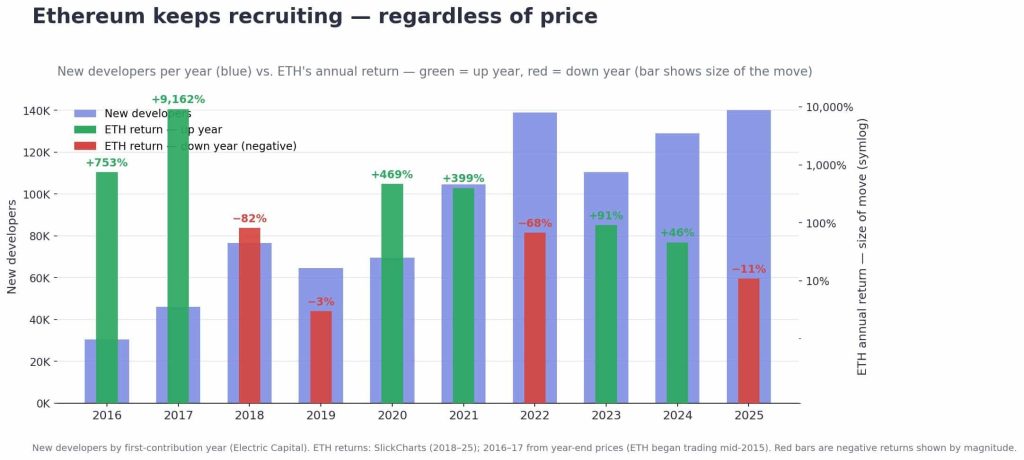
Ethereum News: ETH price is sitting near $1,750, down roughly 1.4% in the last 24 hours, and the bears are clearly running the short-term narrative.
But strip out the price action, and something more durable is happening underneath. Developer growth tells a story that the chart currently refuses to.
New developers building on Ethereum have climbed from approximately 30,000 in 2016 to nearly 140,000 in 2025, and crucially, that growth did not pause during the brutal drawdowns.
When ETH dropped 82% in 2018, roughly 77,000 new developers joined the network anyway. When ETH shed 68% in 2022, new developer additions hit approximately 139,000, one of the strongest cohort years on record.
Even now, with ETH down around 11% year-to-date, developer intake remains close to that same 140K ceiling. Block production has also stabilized near the 7,000-blocks-per-day range since approximately 2023, regardless of where spot price traded.
The gap between price performance and network health is widening. That divergence is worth taking seriously before the next macro catalyst forces a re-rating. Upcoming protocol decisions and FOMC positioning will likely be the near-term triggers that determine which way that gap closes.
Ethereum News: Can ETH Price Reclaim $2,000 or Is a Drop to $1,500 the More Likely Path?
The technical setup is uncomfortable. ETH broke below a key demand zone, and Yahoo Finance’s technical analysis marks $1,700 as the line in the sand, with the path to $1,400 largely unobstructed if that level fails.
Overhead resistance compounds the problem. The 50-day EMA sits near $2,194 and the 200-day EMA near $2,510, and both have capped every recent bounce attempt.
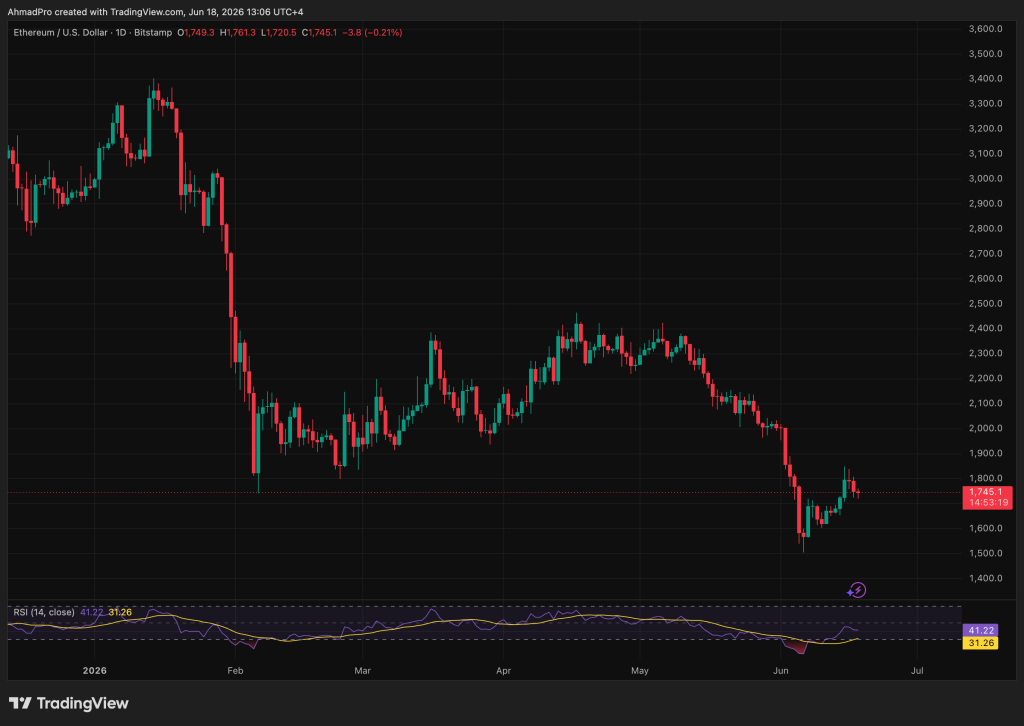
If $1,700 holds as weekly support, macro sentiment stabilizes after FOMC, and ETH reclaims $2,000 within two to three weeks on renewed risk appetite.
However, if $1,700 fails on a daily close, derivatives pressure accelerates the slide toward $1,400-$1,500. Liquidation cascades, not fundamentals, have been the primary driver of recent drawdowns, the flush could move fast rather than gradual.
Standard Chartered and other institutional desks still hold constructive multi-year ETH price targets, which keeps the capitulation thesis incomplete until on-chain accumulation data turns materially bearish.
LiquidChain Could Replace Ethereum For Smart Traders In The Future and Here is Why
When Ethereum bleeds, it tends to flush speculative capital out of the broader ecosystem, and that capital often rotates into early-stage infrastructure plays with asymmetric upside profiles that large-cap ETH can no longer offer at current market cap.
The question is where that rotation lands. Whale accumulation patterns during ETH weakness suggest sophisticated money is positioning in infrastructure, not exiting crypto entirely.
LiquidChain (LIQUID) is an L3 infrastructure project positioning itself as a cross-chain liquidity layer that fuses Bitcoin, Ethereum, and Solana liquidity into a single execution environment.
The core proposition, deploy once, access all three ecosystems, directly addresses the fragmentation problem that costs Ethereum developers time and TVL every cycle.
Key architecture features include a Unified Liquidity Layer, Single-Step Execution, Verifiable Settlement, and a Deploy-Once Architecture designed to reduce cross-chain overhead.
The presale is currently priced at $0.01471 per $LIQUID with $852,080.07 raised to date. As with any early-stage presale, liquidity and execution risk are real — this is not a liquid position and vesting schedules matter.
That said, for traders who want infrastructure exposure without riding ETH’s current technical uncertainty, Visit LiquidChain’s full presale terms here.
The post Ethereum News: ETH Developers Hit Near Record Highs Even as ETH Dumped Below $1,750, Is the Network Stronger Than the Price Suggests? appeared first on Cryptonews.


Key takeaways
- While momentum indicators suggest downside pressure is easing, ETH remains trapped below multiple key moving averages.
- Until buyers reclaim resistance levels above $1,800, the broader technical outlook remains cautious, with support around $1,741 likely to play a crucial role in determining the next major move.
ETH Open Interest falls to a multi-week low
Ethereum (ETH) derivatives markets remain subdued following weeks of price weakness, reflecting a cautious stance among leveraged traders.
After ETH fell below the $1,800 level, futures open interest dropped sharply, reaching 13.64 million ETH on Sunday, its lowest level since early May.
Open interest saw a modest recovery on Monday after Ethereum rebounded above $1,700, but overall participation remains significantly lower than recent highs.
Open interest represents the total value of outstanding futures contracts. Since May 28, Ethereum futures markets have witnessed a decline of roughly 2 million ETH in open interest, highlighting a strong reduction in leveraged exposure and growing risk-off sentiment.
Funding rate data paints a similar picture of caution. Over the past two weeks, Ethereum funding rates have fluctuated between positive and negative territory, signaling a lack of clear conviction from either bulls or bears.
Funding rates are periodic payments exchanged between long and short traders in perpetual futures markets. Positive rates indicate bullish positioning, while negative rates suggest stronger bearish sentiment.
The market’s tone shifted notably after the June 5 correction, which pushed funding rates into negative territory following nearly a month of positive readings.
Although ETH has recovered modestly since then, bullish traders have struggled to regain control.
Spot-market indicators offer little evidence of aggressive accumulation. Ethereum exchange reserves have declined modestly over the past two days, reversing part of the increase recorded last week.
While falling exchange balances can sometimes indicate accumulation, the move remains too small to signal strong demand.
Ethereum price analysis: ETH trapped below key resistance
Ethereum continues to trade within a bearish short-term structure despite recent stabilization.
On the 4-hour chart, ETH remains below its 20-day EMA near $1,794, the 50-day EMA around $1,955, and the 100-day EMA near $2,108
The clustering of these moving averages above current price levels indicates that upside attempts continue to face significant resistance.
Although the broader trend remains bearish, some technical indicators suggest downside momentum may be easing.
The Relative Strength Index (RSI) has climbed toward the mid-50s, indicating selling pressure is weakening but not yet signaling a bullish reversal.
For Ethereum to build a stronger recovery, bulls must reclaim several important resistance zones.
Immediate resistance at $1,794 could pave the way for an extended rally towards the $1,806 and $1,909 psychological levels.
A sustained move above these levels would significantly improve Ethereum’s outlook.

On the downside, Ethereum faces several important support areas. If the bearish trend persists, immediate support is seen at the $1,524 level, with another demand zone at $1,405.
If selling pressure intensifies and these levels fail to hold, ETH could decline toward the next significant support area near $1,156.
Crypto World
Marvell (MRVL) Stock Surges 6% as KeyBanc Boosts Price Target to $385 on Optical Networking Strength

Key Highlights
- KeyBanc elevated MRVL price target by 48% to $385 while maintaining Overweight rating
- Shares climbed approximately 6.4% to $308.60 during premarket hours Thursday
- The stock has surged 51% throughout June and 263% since the start of the year
- Analysts view optical-networking segment as more sustainable than custom AI chip operations
- Company preparing to utilize TSMC’s advanced 1.4-nanometer A14 technology for future AI processors
Shares of Marvell Technology (MRVL) experienced a significant rally during Thursday’s premarket session following a substantial price target increase from KeyBanc Capital Markets, driven by enhanced optimism surrounding the company’s optical-networking division.
Marvell Technology, Inc., MRVL
John Vinh, an analyst at KeyBanc, upgraded his price objective to $385 from the previous $260 level, while maintaining his Overweight recommendation. This new target represents a 33% premium over Wednesday’s closing figure of $289.54.
During premarket trading Thursday, MRVL advanced 6.4% to reach $308.60. The semiconductor stock has demonstrated remarkable momentum with a 51% gain in June and an impressive 263% climb year-to-date, based on data from Dow Jones Market Data.
The bullish revision emerged after KeyBanc conducted an investor meeting with Marvell. Following the discussion, Vinh expressed increased confidence in the optical-networking segment, characterizing it as potentially more “durable” compared to Marvell’s customized AI chip operations.
“Networking represents the most durable growth opportunity,” Vinh stated, projecting that the total addressable market for optical networking could expand to approximately $30 billion by the end of the decade.
Marvell produces digital signal processors that power optical transceivers — critical hardware components responsible for transforming electrical signals into optical transmissions, enabling rapid data transfer within AI-focused data centers. As these facilities continue expanding, the demand for such advanced technology accelerates accordingly.
Networking Business Emerges as Primary Focus
While Marvell’s customized AI application-specific integrated circuits (ASICs) have traditionally captured investor attention, Vinh indicated that the optical networking division is poised to become the primary focus moving forward.
However, the AI chip segment remains a significant revenue contributor. Vinh maintains a “clear line of sight” toward achieving $10 billion in AI chip revenue by 2030, supported by strong demand from major cloud providers including AWS and Microsoft.
Marvell has been strategically expanding its networking capabilities through acquisitions. The company recently completed the purchase of Celestial AI for $3.25 billion and acquired XConn for $540 million. Additionally, Nvidia made a $2 billion investment in Marvell as part of a strategic partnership.
Advanced Manufacturing Process Node Adoption
Adding to Thursday’s positive momentum, a Nikkei Asia report revealed that Marvell intends to leverage Taiwan Semiconductor’s forthcoming A14 1.4-nanometer manufacturing process for its next-generation AI processors.
Marvell’s President and Chief Operating Officer, Chris Koopmans, confirmed the company’s commitment to TSMC, stating they will continue the partnership “if Taiwan Semiconductor maintains the absolute best technology in the world.”
Currently, Marvell’s data center segment generates over 75% of the company’s total revenue.
The company’s next quarterly earnings announcement is scheduled for approximately August 27, 2026. Wall Street analysts are forecasting earnings of 87 cents per share, representing growth from 67 cents in the comparable period last year. Revenue expectations stand at $2.70 billion, compared to $2.01 billion in the year-ago quarter.
MRVL currently trades at a price-to-earnings multiple of 99.5, indicating a premium market valuation.
Additional recent analyst activity includes B. Riley Securities elevating its Buy rating target to $345 on June 12, while Barclays raised its Overweight target to $275 on May 29.
As of Thursday premarket, MRVL was trading up 4.89% at $303.70.

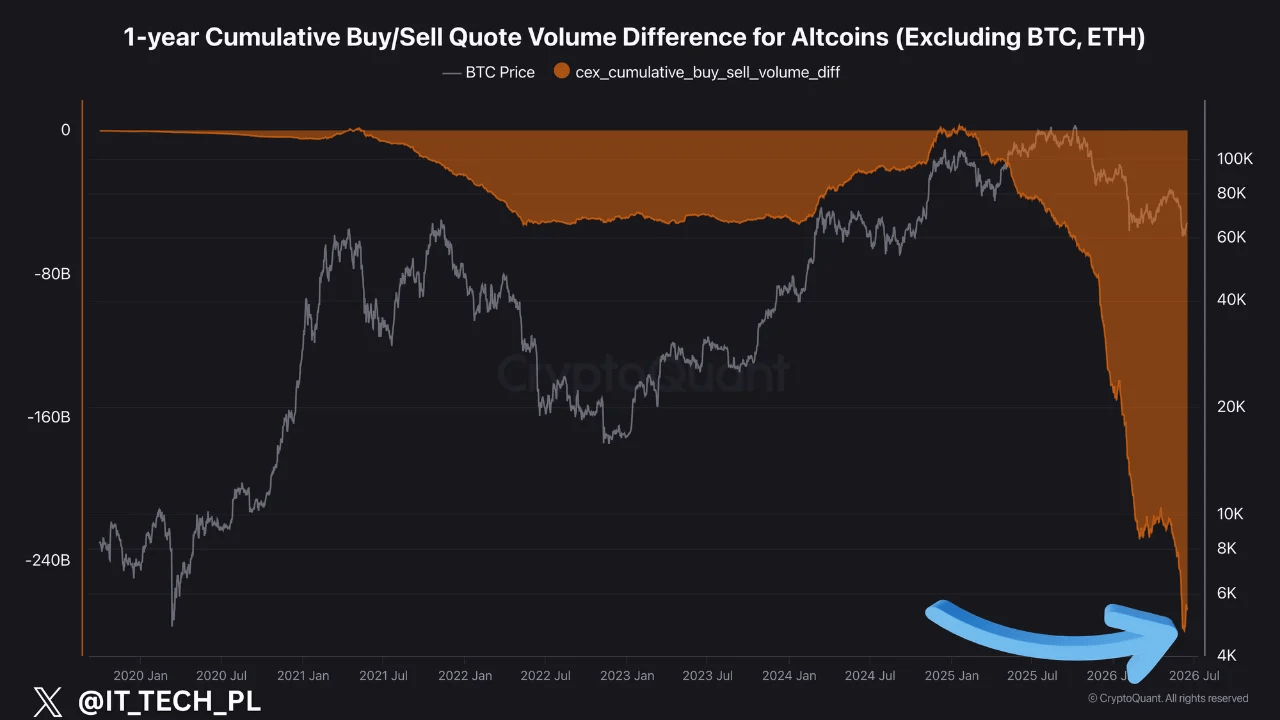
Altcoin sell pressure on spot exchanges has fallen to its deepest level since 2020, marking 15 straight months of net selling across the market outside Bitcoin (BTC) and Ethereum (ETH).
Yet a separate CryptoQuant gauge points in the opposite direction. The platform’s 180-day Altcoin Season Index is edging toward a reading that historically signals the start of an altcoin season.
Two CryptoQuant Signals Pull in Opposite Directions
The metric tracks the cumulative difference between buy and sell volume for altcoins, excluding BTC and ETH. Its drop to the most negative level since 2020 indicates sustained net selling pressure on spot exchanges.
Follow us on X to get the latest news as it happens

The indicator nearly returned to flat in early 2025. It then reversed and continued to decline over the following months. According to CryptoQuant analyst IT Tech,
“This is not a dip. It’s 15 months of continuous net selling on Spot Exchanges.”
The Altcoin Season Index offers the counterweight. CryptoQuant’s 180-day version is 18.48. According to an analyst, “altcoin season begins in earnest” once the indicator crosses 20. The gap suggests rotation building rather than running.
Analysts Split on Altcoin Season Prospects
Joao Wedson, founder of Alphractal, argued that many altcoins that suffered steep declines through 2025 and early 2026 may avoid setting new record lows.
He said a large share of the market has already entered the cycle’s “depression” phase, a period when many investors exit while large holders quietly accumulate.
“The rise in BTC Dominance should come mainly from the top 20 altcoins and stablecoins. This does not mean that all altcoins are going to die. It means that capital will rotate in a very selective way,” he said.
In contrast, Crypto Kid takes the bearish side. The trader says a true altcoin season needs the kind of money printing that drove the 2020 and 2021 cycle. He placed that window around 2028 or 2029.
The two signals leave the near-term path unsettled. One shows altcoins under their heaviest sustained selling in five years. The other shows a rotation gauge approaching its trigger. The next move may hinge on whether selective accumulation or the wait for looser policy proves correct.
Subscribe to our YouTube channel to watch leaders and journalists provide expert insights
The post Altcoins See Deepest Spot Selling Since 2020 as Season Index Nears Trigger appeared first on BeInCrypto.


A failed Australian crypto trader who was sentenced to 25 years in prison for murdering his mother has been given less than two days by the country’s Court of Appeals to prove he didn’t kill her to get his hands on a $1.2 million insurance payout.
Andre Rebelo was found guilty in December 2024 of the 2020 killing of his mother Colleen Rebelo. A court found that he had killed her and staged her body to make her death look like natural causes.
The West Australian reports that from September 16, Rebelo’s lawyers will have around a day and a half to convince the court of Rebelo’s claim that his mother died from a cardiac episode caused by a genetic mutation.
They will also argue that he couldn’t have been present due to the timings of her shower’s hot water system.
Rebelo forged mother’s will before murder
Rebelo and his social media influencer girlfriend, Grace Piscopo, reportedly lived a lavish lifestyle and Rebelo claimed that he’d made more than $500,000 trading cryptocurrencies.
However, prosecutors say this was a lie and the couple actually possessed over $100,000 worth of debt.
Colleen Rebelo was found dead in the shower of her home. Despite the death not initially being treated as suspicious, her insurance provider submitted a fraud report two years later.
It was subsequently discovered that her son had taken out three life insurance policies in her name days before her death, forged her will, and tried to cash it in days later.
Read more: Australian police failed to act on HyperVerse scam for two years
The judge sentencing Rebelo said he moved her body to the shower in her home to make it look like she died of natural causes, but that she may have been subject to asphyxiation.
However, a postmortem never revealed exactly how she died. The judge said, “The only reasonable inference is that you took your mother by surprise,” adding that he “used personal violence to kill her.”
He added, “You killed her for a financial motive, it was a premeditated offence, a monstrous act that was integral to a fraudulent scheme, which you intended to profit from life insurance policies taken out by you.”
The night before his trial, Rebelo pleaded guilty to the fraud charges regarding the insurance policy and her will.
Got a tip? Send us an email securely via Protos Leaks. For more informed news and investigations, follow us on X, Bluesky, and Google News, or subscribe to our YouTube channel.

Stake.com and Bet365 stand on opposite sides of the online betting world. Stake.com is one of the top names in crypto gambling, while Bet365 has spent decades building trust as a major fiat-based operator. Both pull in huge global audiences. But the market is shifting, and a fresh group of crypto-first casinos is starting to grab attention next to these giants. ZunaBet, which launched in 2026, is one of the names becoming part of that story.
Here is a closer look at how Stake.com and Bet365 compare, and where ZunaBet is starting to stake out its own space as a platform worth keeping an eye on.
Two Leaders From Different Sides
Stake.com launched in 2017 and quickly grew into one of the most recognized crypto casinos around. It runs on crypto from the ground up, supports a wide range of coins, and pairs its casino with a full sportsbook. Big-name sponsorships in UFC and football have pushed it into the mainstream, even though it sits outside the regulated US market.
Bet365 has been running since 2000 and is one of the largest privately owned betting brands in the world. It started in the UK and grew into a global operator offering a full sportsbook, casino, poker, and bingo all under one account. Payments go through standard channels like cards, bank transfers, and e-wallets, with strict regulation in every market it works in.
Both are trusted on their own turf. Stake.com leads on the crypto side, and Bet365 leads on the traditional side. But both also have limits. Bet365 is tied to fiat payments and regional rules, while Stake.com is blocked in some markets and now faces a growing list of crypto-first rivals chasing similar players.
ZunaBet Steps Onto the Scene
ZunaBet is a newer name picking up traction since its 2026 launch. It is owned by Strathvale Group Ltd and operates under an Anjouan gaming license. The biggest difference between ZunaBet and the older brands is in the design. ZunaBet was built around crypto from day one and is positioning itself as a fresh option on the crypto-first side, with a lineup that even traditional players would respect.
The casino runs more than 11,000 games from over 60 providers, including top studios like Pragmatic Play, Hacksaw Gaming, Yggdrasil, BGaming, and Evolution. That library puts it among the bigger crypto-focused offerings in the market and easily beats what Bet365 can carry in most regulated regions. Slots, table games, and live dealer rooms all sit under one account.
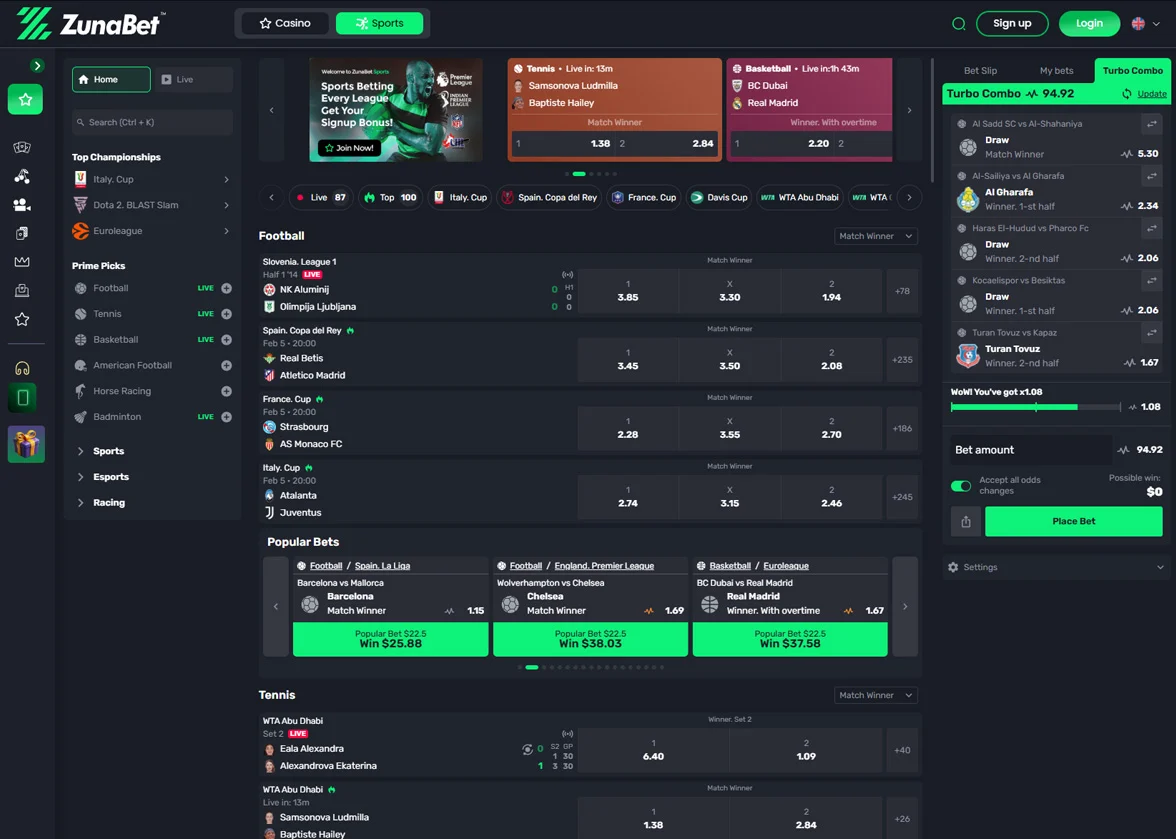
A full sportsbook is part of the package too. It covers football, basketball, tennis, NHL, and the other major sports, plus esports like CS2, Dota 2, League of Legends, and Valorant. Virtual sports and combat sports finish out the menu. That puts ZunaBet in the same hybrid lane as both Stake.com and Bet365.
Crypto vs Fiat at Work
This is where the split between these brands is easiest to see. Bet365 mainly handles fiat. That means bank processing times, possible holds, and slower payouts depending on the method. It works well for players who want a regulated, familiar setup but falls behind on speed.
Stake.com and ZunaBet both run on crypto. ZunaBet supports more than 20 cryptocurrencies, including Bitcoin, Ethereum, USDT across multiple chains, Solana, Dogecoin, Cardano, and XRP. There are no platform fees on transactions, and withdrawals move quickly. For players who already hold crypto or just want quicker, cheaper transfers, that is a real edge over fiat-based brands.
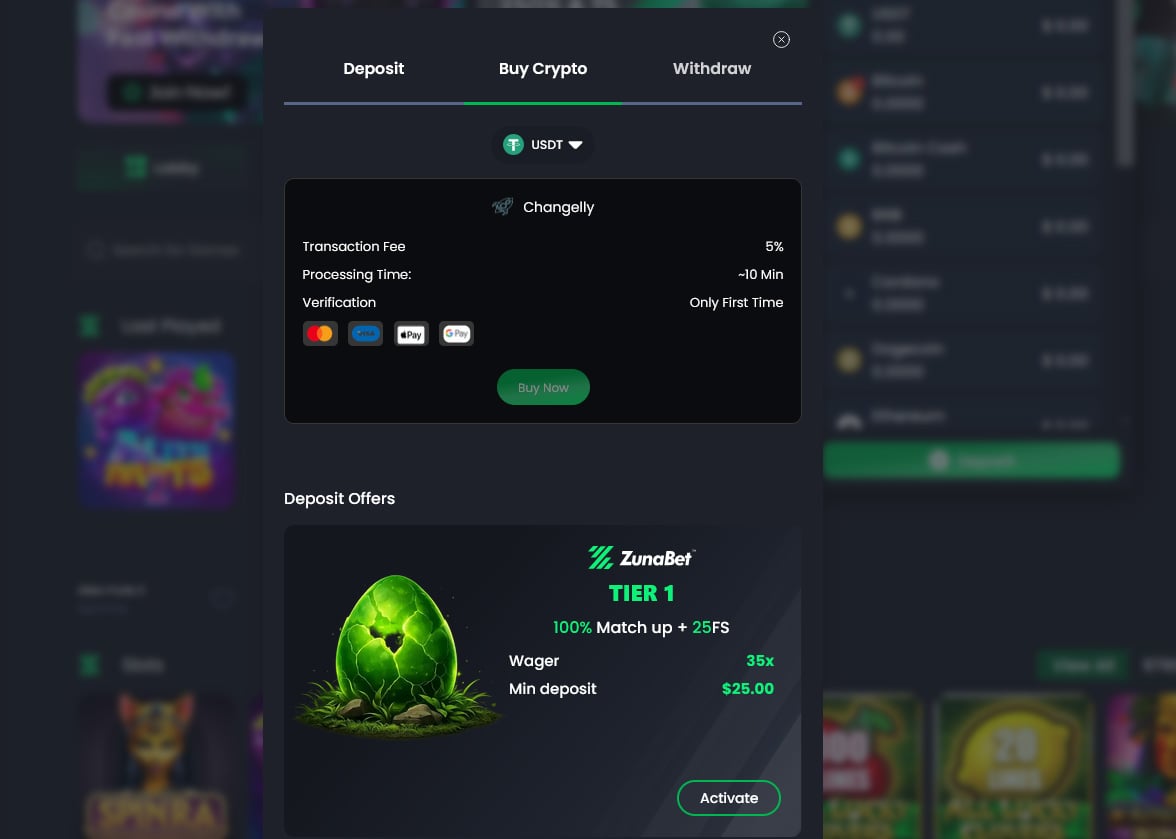
Crypto platforms also tend to run globally instead of being tied to certain regulated regions. Players in many countries can use the full casino and sportsbook without dealing with the patchwork rules that come with brands like Bet365. For a generation that already lives much of its life in digital, crypto-friendly spaces, that lines up with how they expect any modern platform to work.
Welcome Bonus Differences
Bet365 runs welcome offers that change heavily by region, usually a deposit match or a smaller bonus for new sign-ups. Wagering requirements tend to be tight on the casino side. Stake.com runs its own promotions, but its welcome offer is lighter than what some crypto rivals push, with more attention on reload bonuses and rakeback for active players.
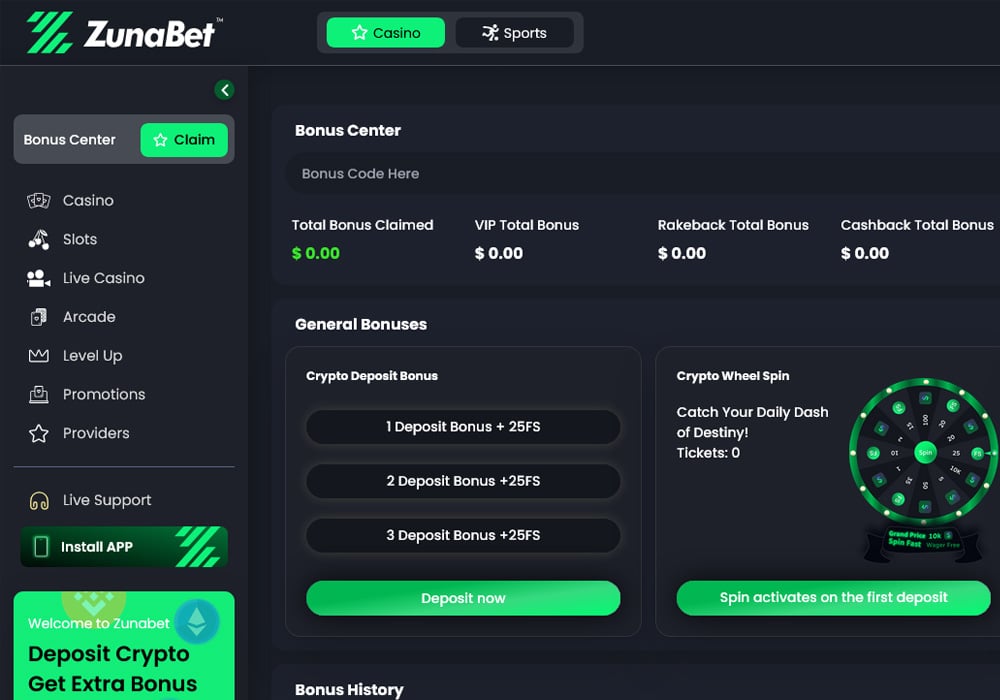
ZunaBet offers a welcome package worth up to $5,000 plus 75 free spins, spread across three deposits. The first deposit gets a 100% match up to $2,000 plus 25 spins. The second adds a 50% match up to $1,500 plus 25 spins. The third gives another 100% match up to $1,500 plus 25 spins. Marketed as a 250% bonus over three deposits, it gives new players more time to explore the platform than a one-shot welcome offer.
Loyalty: Three Different Styles
Bet365 keeps its loyalty quiet, leaning on personalised offers that show up in player accounts based on activity. Stake.com runs a strong VIP program built around rakeback, reloads, and milestone bonuses, which has helped it hold onto long-term players. Both work, but Bet365 follows the traditional loyalty card formula while Stake.com leans hard on rakeback as the main draw.
ZunaBet takes a different approach by blending rakeback with gamified progression. Its loyalty program is built around a dragon evolution theme with a mascot called Zuno. There are six tiers: Squire at 1% rakeback, Warden at 2%, Champion at 4%, Divine at 5%, Knight at 10%, and Ultimate at 20% rakeback at the top.
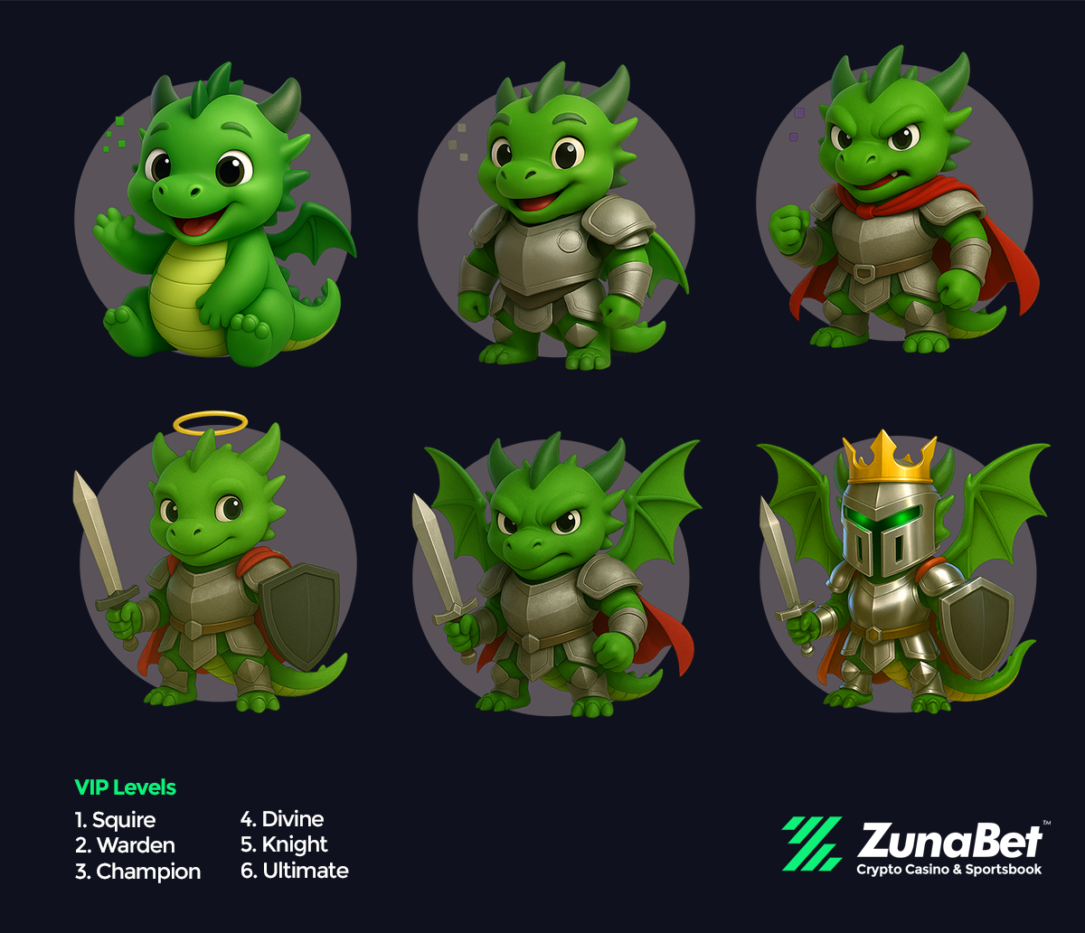
Players also pick up tier-based free spins up to 1,000 spins, VIP club access, and double wheel spins as they climb. The whole setup feels more like leveling up in a game than swiping a points card or just chasing flat rakeback. For players who enjoy that kind of system, it lands harder than either a standard VIP setup or a plain rakeback program.
Why ZunaBet Belongs on Your Radar
Bet365 still makes sense for players who want a long-running, well-regulated betting experience, and Stake.com remains one of the strongest names on the crypto side. Both have earned their place. But what players want from these platforms is changing fast. Quick payouts, deeper libraries, and more engaging rewards are turning into baseline expectations rather than nice extras.
ZunaBet is built around that baseline. The crypto-first foundation means fast payments and low fees. The game library outpaces what most established brands carry. The sportsbook covers traditional sports and esports under one roof. The dragon loyalty program turns regular play into a journey with clear rewards at every step.
For players who want speed, variety, and a more modern feel, ZunaBet is one of the most exciting options on the market right now. It is still an emerging platform, but the direction is clear. A new generation of players expects crypto support, gamified rewards, and global access as standard features, not extras layered on top.
Stake.com and Bet365 shaped what online betting looks like today. ZunaBet is one of the platforms shaping what comes next.

Decentralized Finance (DeFi) was created to challenge traditional financial systems by offering open, permissionless, and transparent alternatives to banking, lending, trading, and asset management. Over the past few years, the industry has demonstrated remarkable innovation, attracting billions of dollars in capital and creating entirely new financial primitives.
Yet while many discussions focus on external threats—regulatory uncertainty, centralized institutions, or macroeconomic conditions—the greatest challenge facing DeFi today may come from within.
The biggest threat to DeFi is internal competition.
Not competition itself, which is healthy and necessary for innovation, but the increasingly fragmented and adversarial nature of competition that divides liquidity, duplicates infrastructure, confuses users, and weakens the ecosystem as a whole.
The Fragmentation Problem
Every new DeFi cycle introduces dozens of protocols attempting to solve similar problems.
Multiple decentralized exchanges compete for the same liquidity.
Multiple lending protocols compete for the same borrowers and lenders.
Multiple Layer 1s and Layer 2s compete for developers and users.
Multiple yield platforms compete for capital.
While competition encourages innovation, excessive fragmentation creates inefficiencies.
Liquidity becomes scattered across numerous platforms, reducing capital efficiency and increasing slippage. Users are forced to navigate a growing number of protocols, wallets, bridges, and interfaces. Developers spend valuable resources recreating products that already exist instead of building entirely new financial infrastructure.
Rather than creating a unified financial ecosystem, DeFi often resembles a collection of isolated islands.
Liquidity Wars Are Costly
Liquidity is the lifeblood of DeFi.
To attract users, protocols frequently launch aggressive incentive programs that distribute large quantities of governance tokens. While this strategy can rapidly increase Total Value Locked (TVL), it often creates short-term participants rather than long-term users.
Capital flows toward the highest yield opportunities, only to leave when incentives decline.
This phenomenon creates what many refer to as “mercenary liquidity”—capital that lacks loyalty to a protocol’s long-term vision.
As protocols engage in continuous liquidity wars, they consume treasury resources, dilute token holders, and generate limited sustainable growth.
The result is an ecosystem focused on attracting temporary capital rather than building durable financial products.
Fork Culture and Feature Replication
One of DeFi’s strengths is open-source development.
Anyone can inspect code, improve it, and launch new versions.
However, this openness also encourages rapid replication.
When a protocol introduces a successful innovation, competitors often copy the feature within weeks. This creates a cycle in which differentiation becomes increasingly difficult and genuine innovation yields a shorter period of competitive advantage.
Many projects find themselves competing over marginal improvements rather than delivering transformative breakthroughs.
As a result, resources that could be directed toward research, security, and user experience are often spent trying to outperform nearly identical competitors.
User Attention Is Limited
DeFi protocols frequently underestimate a simple reality:
User attention is scarce.
The average user cannot actively monitor dozens of ecosystems, governance proposals, yield opportunities, and token incentives.
As the number of protocols expands, onboarding becomes more difficult.
New users entering DeFi encounter:
- Multiple wallets
- Multiple chains
- Numerous bridges
- Complex governance systems
- Constantly changing incentives
Instead of making decentralized finance more accessible, excessive competition often increases complexity.
This complexity slows adoption and limits the industry’s ability to reach mainstream audiences.
Builders Competing Against Builders
Perhaps the most concerning aspect of internal competition is that builders increasingly compete against one another for the same resources.
Projects compete for:
- Developers
- Venture funding
- Liquidity
- Community attention
- Partnerships
- Market narratives
Rather than expanding the overall market, many projects focus on capturing existing market share.
This creates a zero-sum mentality where success is measured by taking users from another protocol instead of creating entirely new categories of financial services.
The industry becomes trapped in redistribution instead of expansion.
Why Collaboration Matters
The next phase of DeFi growth may depend less on competition and more on coordination.
Protocols that embrace interoperability, shared liquidity, modular infrastructure, and composability are likely to create stronger network effects than isolated competitors.
Some of the most successful innovations in DeFi emerged through collaboration:
- Shared liquidity layers
- Cross-chain infrastructure
- Yield aggregation
- Protocol integrations
- Modular financial primitives
These developments demonstrate that cooperation can often create more value than direct competition.
The future winners may not be the protocols with the largest incentive budgets, but those that become essential components of a broader financial ecosystem.
The Path Forward
Competition will always remain a critical driver of innovation. The goal is not to eliminate rivalry but to ensure it contributes to ecosystem growth rather than fragmentation.
DeFi needs:
- Better interoperability
- Shared infrastructure
- Sustainable token economics
- User-focused design
- Long-term alignment between protocols
As the industry matures, success will increasingly depend on building on a collaborative network rather than isolated silos.
Conclusion
DeFi’s greatest obstacle may not be regulators, banks, or centralized exchanges. It may be its own tendency toward fragmentation and internal rivalry.
The industry has already proven it can innovate.
The next challenge is proving it can coordinate.
If DeFi can transform competition from a destructive force into a productive one, it has the potential to build a truly global, open, and interconnected financial system. If it cannot, internal competition may continue to slow the very adoption that DeFi seeks to accelerate.
REQUEST AN ARTICLE


HIVE Digital Technologies (HIVE) shares jumped 10% in pre-market trading on Thursday after the company announced a $220 million, three-year GPU cloud contract with Bell Canada and AI firm Cohere, as the company continues its transition away from pure-play bitcoin mining.
The deal will see HIVE’s BUZZ High Performance Computing unit deploy 2,304 Nvidia Grace Blackwell GPUs at Bell’s AI Fabric facility in Merritt, British Columbia, forming the dedicated compute layer for Cohere’s enterprise AI models serving Canadian government and corporate clients.
All infrastructure will remain on Canadian soil, supporting Ottawa’s broader push to reduce reliance on foreign-controlled AI technology.
The deployment is expected to go live from late 2026 to early 2027, adding roughly $70 million in annual recurring revenue (ARR). Combined with approximately $35 million of current realised ARR, HIVE’s contracted HPC revenue target now exceeds $100 million, a clear signal that its infrastructure pivot is gaining serious commercial momentum.
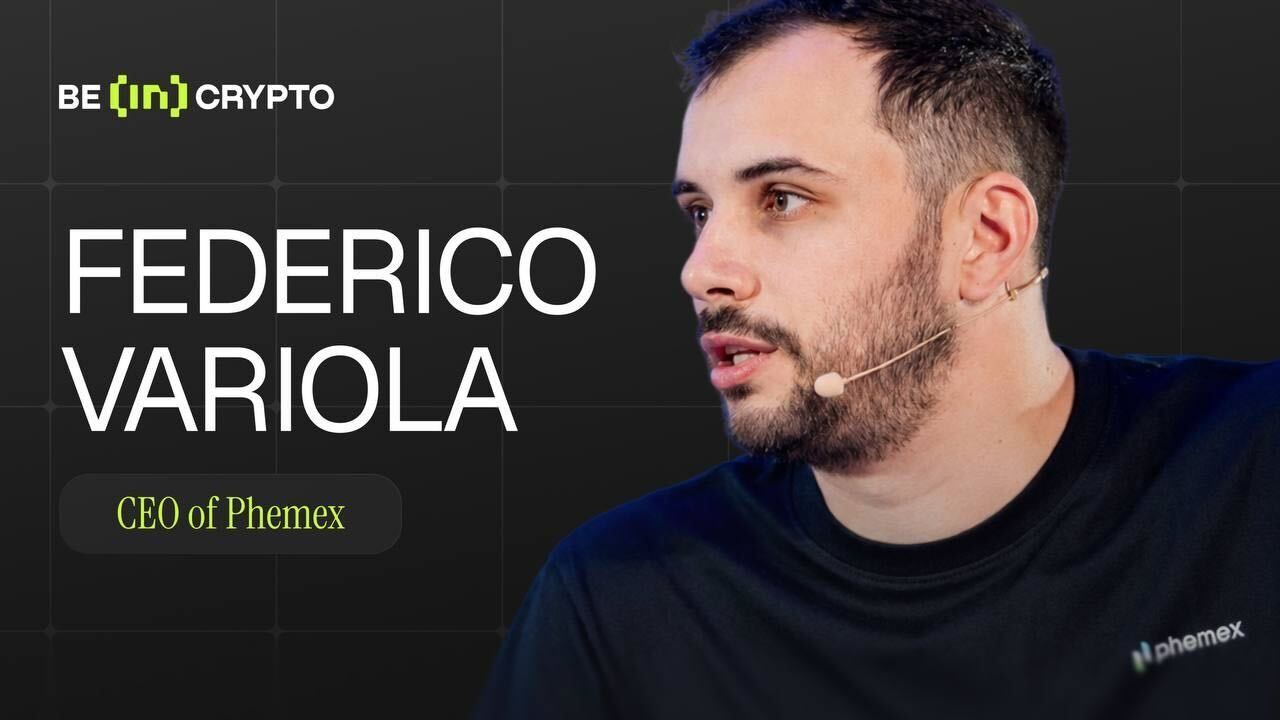

Phemex’s 2026 Ultimate Championship uses global football attention to show how the exchange wants traders to move across one connected ecosystem.
The campaign features a $7 million prize pool, a $6 million Trading Showdown allocation, prediction contracts, spot and futures trading, Mystery Boxes, rewards, and country-based competition.
At the center is Golden Ball, a shared campaign system that connects different forms of participation into a single experience. Within just one week of launch, the campaign has already attracted over 3,000 registered users, showing strong initial momentum and clear user interest.
In an interview with BeInCrypto, Phemex CEO Federico Variola said the campaign comes from a simple view of modern market behavior, where traders now participate through several routes at once.
“Trader behavior is becoming more multi-dimensional. Futures, spot, prediction contracts, rewards, and community mechanics each attract different types of participation, but they do not have to exist in isolation. The opportunity is to connect these behaviors into a more coherent exchange experience,” Variola said.
Phemex’s All-in-One Exchange Direction
The Ultimate Championship works as a product statement as much as a campaign. Football gives the timing, while the design points to how Phemex sees exchange engagement evolving.
Users arrive with different intentions. Some chase volume, some focus on ROI, some prefer event outcomes, while others respond to rewards or community identity. Phemex’s answer is an exchange experience where those behaviors can overlap.
“Golden Ball is more than a campaign reward. It reflects how we think about platform engagement: users should be able to move across trading, predictions, rewards, and community-driven activities without each experience feeling disconnected,” Variola said. “For us, the goal is to create more continuity between products and give traders multiple ways to participate within the same ecosystem.”
Golden Ball exemplifies this direction. A user can earn it through eligible actions and carry it into predictions, Lucky Draws, Mystery Boxes, or trading-linked tracks. The point is continuity: one campaign object, several ways to use it, and fewer barriers between products.
Instead of treating each activity as a separate promotion, Phemex uses Golden Ball to tie different product tracks into one participation journey.
A user can enter through a simple reward task, move into prediction contracts, join a trading contest, or contribute to a country-based team without leaving the same campaign environment.
Why Football and Prediction Markets Fit Together
Football gives prediction contracts a strong entry point because outcomes are public, emotional, time-sensitive, and easy to follow. Users can form views around team form, match results, player performance, tournament progression, and momentum as the event unfolds.
“Live sports are naturally suited to prediction because they are structured around clear outcomes, emotional participation, and real-time information,” Variola said.
The football championship provides Phemex with a familiar setting for prediction contracts, while the broader product idea extends beyond sport.
Prediction markets can become a more accessible way for users to engage with real-world events, especially when outcomes are visible, and participation happens in real time.
Phemex has already surpassed the USD 1 million milestone in prediction market liquidity, reflecting growing demand among its 10 million users to engage with and capitalize on world events through market-based products.
For Variola, prediction contracts fit into the wider exchange experience because they give users another way to express conviction.
“Prediction contracts should also be a way for users to express conviction around real-world events in a transparent, market-based format,” he said. “Instead of simply following news, trends, or major global moments as spectators, users can take a position on how they believe those events will unfold. That makes prediction markets a natural extension of trading behavior, where information, timing, and conviction all matter.”
What Makes Phemex’s Campaign Different
Many exchanges can attach bonuses, leaderboards, or themed rewards to a major football event. Phemex’s Ultimate Championship goes further by connecting trading, prediction markets, rewards, and community identity through Golden Ball.
The campaign gives users one connector across several product areas. Prediction contracts capture event-based conviction. Spot and futures trading create the main competitive arena.
Mystery Boxes and Lucky Draws make participation easier for reward-led users. Country-based teams add identity, social energy, and live-event momentum.
This structure also keeps Phemex’s trading identity at the core of the campaign. The $6 million Trading Showdown allocation accounts for most of the $7 million prize pool, showing active trading remains the main arena even as the campaign expands into predictions and rewards.
By adding tournament result multipliers and country-based teams, Phemex links trading performance with the emotional rhythm of the football championship.
Variola noted that this changes the psychology of participation. Prediction contracts around live sports combine probability assessment with team identity, national support, and real-time momentum, making user engagement more immediate and emotionally driven.
What Phemex Wants to Learn After the Campaign
After the Ultimate Championship ends, Phemex will analyze how users move between prediction contracts, spot, futures, rewards, and team-based competition within a single campaign environment.
The exchange will look at whether users who enter through Golden Ball tasks later join prediction contracts, Mystery Boxes, or trading tracks.
It will also examine whether users who predict become more active in spot and futures competitions, and whether country-based participation creates stronger engagement than individual leaderboards alone.
“The Ultimate Championship will also serve as a live assessment of how users interact with our all-in-one trading ecosystem,” Variola said.
This gives the campaign strategic value. Phemex can use the results to understand how traders behave when event-based conviction, active trading, rewards, and community identity operate inside one connected exchange experience.
“Those lessons will help us understand how Phemex can continue building a more connected exchange ecosystem beyond a single campaign,” Variola said.
The post Phemex’s 2026 Ultimate Championship Signals a More Connected Exchange Experience appeared first on BeInCrypto.
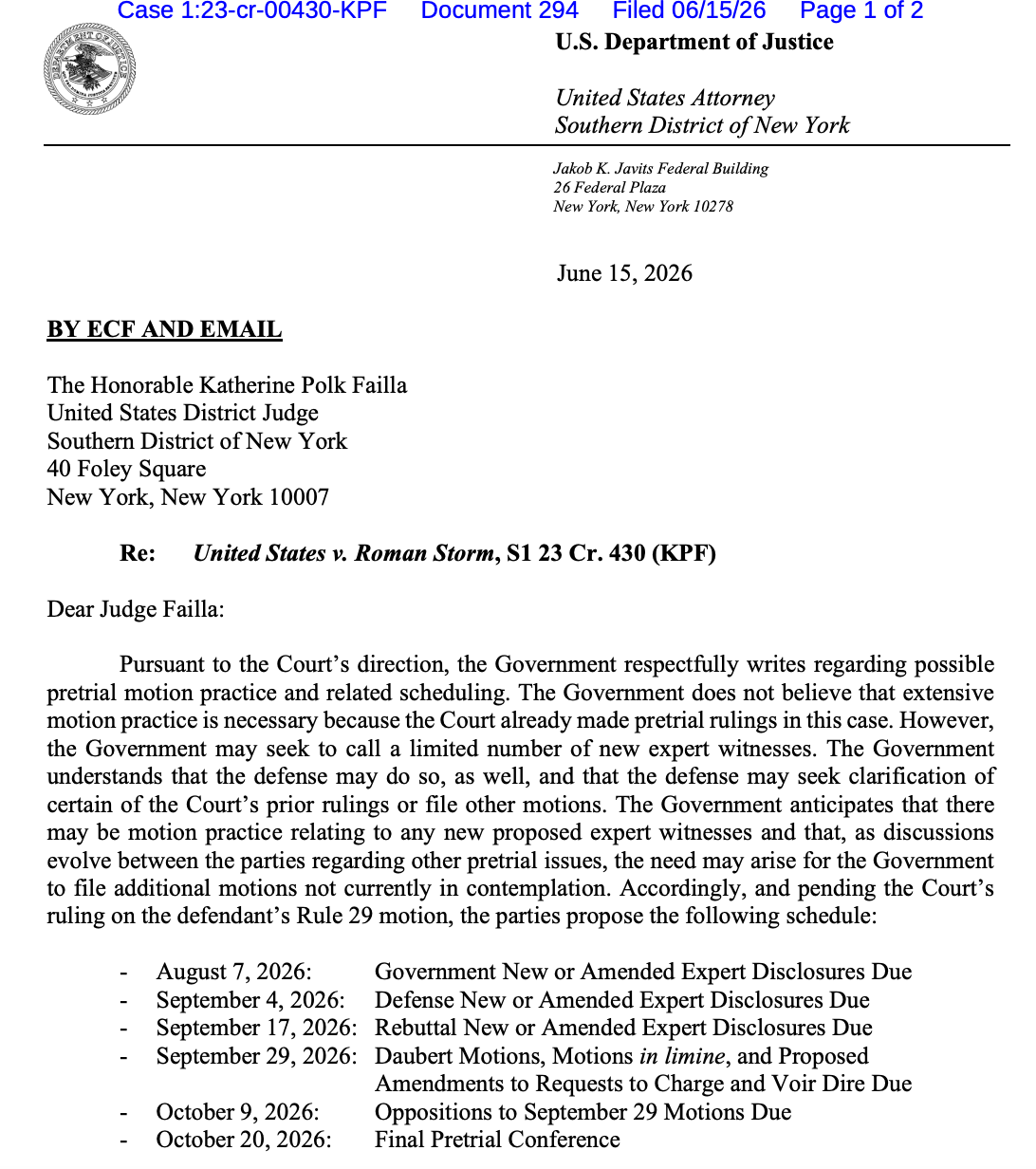
US prosecutors propose late 2026 retrial for Tornado Cash co-founder
Federal prosecutors on Monday submitted a proposed schedule for the potential retrial of Tornado Cash co-founder and developer Roman Storm to begin later this year. Storm was found guilty on one of three charges related to illegal money transmitting in 2025, but a jury deadlocked on two other charges, setting the stage for a potential retrial.
US Attorney for the Southern District of New York (SDNY) Jay Clayton Clayton proposed an Oct. 20 final pretrial conference in Storm’s case, signaling a potential trial start date of late October or November 2026. The filing noted that the timeline was subject to the court’s decision on a Rule 29 motion filed by Storm requesting acquittal of the remaining charges.
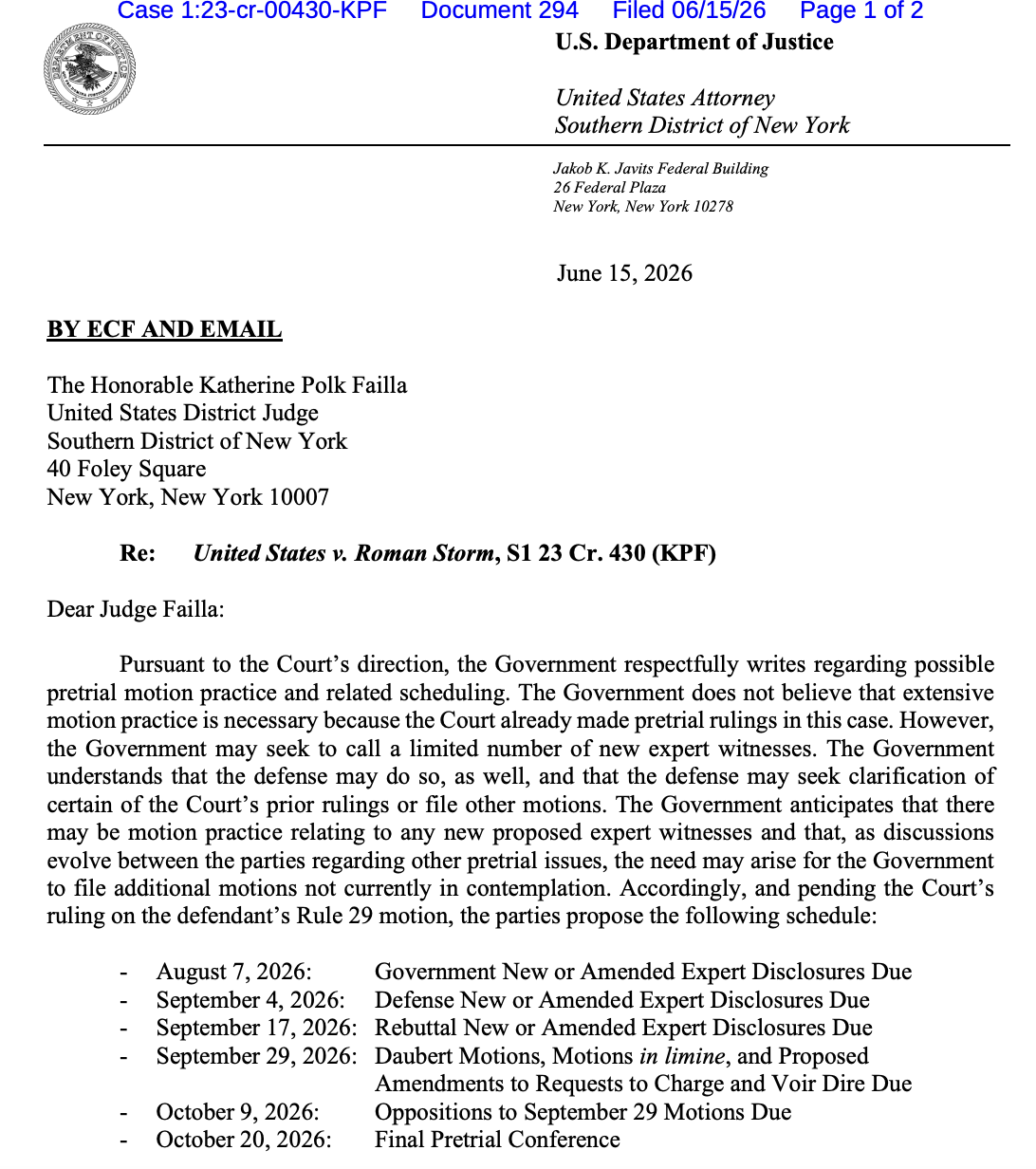
Source: PACER
Storm’s case continues to draw attention from many in the crypto industry given the implications for developers potentially being held criminally liable for code they write. Should a retrial be scheduled, the Tornado Cash co-founder could face the two remaining charges of conspiracy to commit money laundering and conspiracy to violate sanctions again.
Judge sets 60-day deadline for prosecutors to respond to Celsius CEO’s motion to vacate sentence
Alex Mashinsky, the former CEO of cryptocurrency lending platform Celsius who said he would be representing himself in court, could receive an answer to his pro se motion to vacate his 12-year sentence before the end of the year.
In a Saturday filing in the US District Court for SDNY, Judge John Koeltl granted a motion giving prosecutors until mid-August to respond to Mashinsky’s request to vacate his sentence. The 60-day deadline followed the former Celsius CEO requesting the judge vacate his May 2025 sentence, which resulted in Mashinsky reporting to federal prison.
Mashinsky, once one of the most recognizable figures in the crypto industry, was indicted in 2023 with his cohort Roni Cohen-Pavon on charges related to fraud and market manipulation. Celsius filed for bankruptcy in 2022 amid the crypto market downturn that resulted in the collapse of exchanges including FTX and Voyager Digital.
Related: Sam Bankman-Fried loses appeal to overturn 25-year prison sentence
The former CEO was ordered to pay $48 million in forfeiture as part of his criminal case. Cohen-Pavon was sentenced to time served but ordered to pay more than $1 million and a $40,000 fine.
Judge sets December 2026 trial for US soldier in Polymarket insider trading case
Gannon Ken Van Dyke, the US soldier charged after allegedly making more than $400,000 on a Polymarket event contract related to the capture of Venezuela President Nicolás Maduro, is looking at a December 2026 trial after his April arrest.
In a June 10 SDNY filing, Judge Margaret Garnett ordered pretrial motions for US prosecutors and defense attorneys in Van Dyke’s case, culminating in jury selection scheduled for Dec. 7. The soldier allegedly used nonpublic information to profit off the removal of Maduro in January, when US forces entered his residence in Caracas and extradited him to the United States to face criminal charges.
The Van Dyke case carries potential implications for Polymarket and other prediction markets platforms facing scrutiny from US lawmakers calling for elected officials to be barred from potentially betting on events with classified or nonpublic information. Van Dyke has pleaded not guilty to all charges.
Magazine: Bitcoin, the ‘canary in the coal mine,’ XRP transaction demand falls 91.5%: Market Moves

Ethereum News: ETH Developers Hit Near Record Highs Even as ETH Dumped Below $1,750, Is the Network Stronger Than the Price Suggests?

Trump praises USGA golf ball rollback decision

AI nose uses ‘Smell Language Model’ to sniff out signs of disease

Blockchain.com files with SEC for U.S. IPO

No Jackpot Winner as $257 Million Prize Rolls Over to $269 Million Monday Draw

Israel says it has killed new Hamas military leader in Gaza City airstrikes

Satoshi Bitcoin Wallet Dumps EVERYTHING! Why Crypto ISN’T DEAD (Send This To 1 Friend)

New Earning App Without Investment | Online Game Earn Money | How to Earn Money Without Investment

Bitcoin & Ethereum are about to SKYROCKET! (SERIOUSLY)
-
 Business4 days ago
No Jackpot Winner as $257 Million Prize Rolls Over to $269 Million Monday Draw
-

 Fashion6 days ago
Weekend Open Thread: Tuckernuck – Corporette.com
-

 Crypto World7 days ago
Oppenheimer backs SpaceX as $70 billion retail frenzy builds
-

 Crypto World7 days ago
Markets Rally as SpaceX IPO Looms Amid Iran Tensions and Inflation Surge
-
 Crypto World4 days ago
Zimbabwe Requires Crypto Businesses to Register Annually Under New FIU Regulations
-

 Crypto World5 days ago
Bitget enters Argentina’s regulated crypto market through PSAV registration
-

 Tech6 days ago
NanoClaw integrates JFrog registries to secure AI agent downloads
-

 Tech6 days ago
This Week In Security: Microsoft On Microsoft, Register Your Domains, Linux On ARM, And FreeBSD Joins The File Cache Club
-

 NewsBeat7 days ago
El Nino has formed in the Pacific and could set records, forecasters say
-
 Tech7 days ago
Dutton Ranch star claims they ‘didn’t see any disruption’ on set following Chad Feehan’s exit from Yellowstone spinoff fueled by Taylor Sheridan clash rumors
-

 Politics7 days ago
Politics Home | Healey Resignation Is “Colossal Failure Of Government”, Says Former Labour Defence Secretary
-
 Entertainment7 days ago
Donnie Wahlberg & More Heat Up Las Vegas at Circa’s Barry’s Downtown Prime
-
 Tech7 days ago
Opendoor Ends India Operations, Fueling a Bigger Conversation About AI and Outsourcing
-

 Politics7 days ago
Belfast burns, while Met chief points finger at Iran and Russia
-

 Business7 days ago
AT&T: Verizon's 27% Outperformance Sets Up A Solid Entry Point
-

 NewsBeat6 days ago
FBI searches office of Ohio voter registration group
-
 Tech7 days ago
Anthropic is spending $150M to embed 1,000 AI fellows inside nonprofits. No degree required.
-

 Politics7 days ago
Modi thanks Trump for wishes as US attacks Indian seafarers
-
 Entertainment6 days ago
‘The Pitt’s Fan-Favorite Doctor Confirms Noah Wyle Gave His Blessing to Return [Exclusive]
-
 Crypto World6 days ago
Ripple and Bitso Bring MXNB Stablecoin to XRP Ledger
You must be logged in to post a comment Login