

Crypto World
CME now trades crypto 24/7. Here’s why it matters



On May 29, 2026, at 4:00 p.m. Central Time, CME Group flipped the switch. The world’s largest regulated derivatives exchange now trades Bitcoin and Ethereum futures and options around the clock, seven days a week, with only a short maintenance pause.
Summary
- CME Group now offers near-24/7 trading for crypto futures and options, with only short maintenance pauses.
- The shift covers nine assets, including Bitcoin, Ethereum, Solana, XRP, Cardano, Chainlink, Stellar, Avalanche, and Sui.
- Continuous trading effectively ends the recurring weekend CME gap that shaped years of Bitcoin technical analysis.
- The change is a major institutional milestone, but weekend liquidity may remain thin until volume builds.
The change covers nine crypto assets: Bitcoin, Ethereum, Solana, XRP, Cardano, Chainlink, Stellar, Avalanche, and Sui. The first weekend saw more than 7,200 contracts traded. It sounds like a dry piece of market plumbing, and in one sense it is.
But it quietly kills one of the most-watched quirks in all of crypto trading, the “CME gap,” and it marks a real milestone in how thoroughly traditional finance has absorbed digital assets. This piece explains what changed, why institutions pushed for it, what it does to the famous weekend gap, and the catch that most of the celebratory coverage is leaving out.
What actually changed
For years, CME’s crypto futures ran on traditional-market time. Trading opened Sunday evening and closed Friday afternoon, with the market shut for roughly 48 hours every weekend. That made sense for the exchange that has historically traded corn, oil, and interest-rate futures. It made much less sense for an asset class that never stops.
As of May 29, 2026, that closure is gone. CME crypto futures and options now trade nearly 24 hours a day, seven days a week, on its Globex electronic platform. The only interruptions are a two-minute maintenance window on weekdays between 4:00 and 4:02 p.m. Central Time, and a longer two-hour window on weekends. Continuous trading kicked off at 4:00 p.m. Central, which is 10:00 a.m. UTC. As close to always-on as a regulated exchange realistically gets.
The product roster is broad. Bitcoin futures, which CME first launched in December 2017, and Ether futures, added in 2021, anchor the lineup. Around them sit futures on Solana, XRP, Cardano, Chainlink, Stellar, Avalanche, and Sui. All of them now fall under the 24/7 umbrella, giving institutional traders continuous access to a diversified crypto derivatives portfolio on a single regulated venue. CME also rolled out Bitcoin Volatility futures, a product that lets traders position on Bitcoin’s volatility itself, available 24/7 from June 1.
The early demand was real. CME reported more than 7,200 contracts traded during the first weekend of continuous operation. Average daily volumes for crypto futures in early 2026 were already up 46 percent year-over-year, reaching around 407,200 contracts, with open interest near 335,400 contracts at launch. The weekend trading is not a token gesture. There is genuine appetite for it.
Why institutions pushed for this
The argument behind the change is simple and entirely about risk management.
A hedge fund, corporate treasury desk, or asset manager running a Bitcoin position has a problem if the main regulated futures venue closes for 48 hours every weekend. Bitcoin does not stop trading on Saturday. Spot markets and offshore venues keep moving, sometimes violently, on weekend news. But the institution holding a regulated hedge through CME could not adjust that hedge until Sunday evening. For two days every week, carefully managed exposure sat frozen while the underlying asset kept moving.
That gap between when risk happens and when you can hedge it is exactly what professional risk managers are paid to eliminate. Tim McCourt, CME’s Global Head of Equities, FX and Alternative Products, framed it directly, saying client demand for round-the-clock risk management had reached an all-time high and that always-on regulated markets let clients trade with confidence at any time. The institutional translation: we have clients with real money at risk who could not sleep on Friday night, and they asked us to fix it.
The ecosystem moved with CME. Robinhood’s futures chief called it the first time its users could trade regulated futures at any hour of any day. Ripple Prime, positioning itself as a futures commission merchant built for always-on markets, signed on. Wedbush, which had already been serving clients on a 24/7 basis, expanded its support. The point is that this was not CME acting alone. It was a coordinated move by the brokers and clearing firms that route institutional money into crypto derivatives, which tells you the demand was coming from their clients, not from the exchange looking for a headline.
The death of the CME gap
The most interesting casualty of this change is a piece of crypto trading folklore: the CME gap.
Here is how it worked. Because CME closed Friday afternoon and reopened Sunday evening, Bitcoin’s spot price would drift over the weekend while CME futures sat frozen at Friday’s closing level. When futures reopened Sunday night, the chart showed a “gap” between Friday’s close and Sunday’s open, wherever spot had wandered to in between. These gaps became a fixture of Bitcoin technical analysis. Traders watched them obsessively, because Bitcoin’s price had a well-documented tendency to later return and “fill” the gap, snapping back to that abandoned price level.
The gap became both a technical indicator and a speculative strategy. Traders would position around gap fills, betting the price would return to close them. Thin weekend liquidity made the whole thing worse, because low-volume weekend order books exaggerated moves that would frequently reverse once institutional participants logged back on late Sunday. The 11:00 p.m. UTC Sunday reopen was a recurring moment of volatility as futures recalibrated to wherever spot had gone, much of it low-volume noise rather than real price discovery.
With continuous trading, that structural quirk is, for practical purposes, extinct. There is no Friday close to gap away from and no Sunday reopen to snap back. One of the most reliably exploited inefficiencies in crypto markets just disappeared. For chart analysts who built strategies around gap fills, a tool they relied on for years is gone. For the market as a whole, it removes a recurring source of artificial weekend volatility that had little to do with fundamentals.
Why it matters beyond the gap
Strip away the trading folklore and the deeper significance is about market maturity.
Every step CME has taken in crypto, from the first Bitcoin futures in 2017 through the addition of Ether, Solana, and the rest, has been a marker of how seriously traditional finance takes the asset class. The 24/7 move is the next one. It signals that crypto derivatives have enough institutional volume and demand to justify the operational cost of running a regulated market around the clock, which is not trivial. Exchanges do not staff weekend operations and rebuild clearing schedules for an asset they consider a sideshow.
It also narrows the structural gap between regulated venues and crypto-native ones. For years, the knock on regulated crypto derivatives was that they operated on banker’s hours while the real action happened 24/7 on offshore perpetual-futures exchanges. That divide pushed a lot of volume to less-regulated venues simply because those were the only places open when the market moved. By going continuous, CME removes one of the main reasons institutional traders had to step outside the regulated system to manage weekend risk. It brings activity that had leaked offshore back toward a venue with US oversight and clearing guarantees.
There is a longer-arc reading too. The shift quietly admits that crypto’s always-on model won the argument. Traditional markets close because the institutions trading them are human and need the weekend. Crypto never adopted that convention, and rather than force crypto to conform, the largest traditional derivatives exchange reshaped itself around crypto’s clock. That is a small but telling reversal of who is adapting to whom.
The catch the press releases skip
Here is the part that the celebratory coverage tends to leave out: the structural gap is gone, but the liquidity is not evenly there yet.
Eliminating the weekend closure does not automatically create deep weekend markets. In the early going, liquidity on CME’s crypto products remains concentrated where it always was, during peak weekday hours and in the most-traded contracts. Weekend order books may stay thin for a while, which means volume and genuine price discovery will still cluster on weekdays even though the market is technically open all weekend. You can now trade Saturday, but you may not find a deep market to trade into.
The broader liquidity reality complicates the story further. Even with the change, the deepest pools of crypto derivatives liquidity sit elsewhere. IBIT options open interest, tied to BlackRock’s spot Bitcoin ETF, far exceeds CME’s crypto options markets, and offshore perpetual-futures venues still dominate raw volume. CME going 24/7 removes a structural inefficiency, but it does not instantly make CME the deepest place to trade crypto on a Saturday. That will depend on whether the weekend volume builds over time or stays a thin afterthought to the weekday session.
And the back office still runs on traditional time. Any trade executed over a weekend or holiday gets assigned the next business day’s date for clearing and settlement. You can trade on Saturday, but the paperwork pretends it happened Monday. It is a practical accommodation that lets CME extend trading hours without rebuilding its entire clearing infrastructure, but it is a reminder that the plumbing of traditional finance has not gone fully continuous even as the trading screen has.
None of this undercuts the significance of the change. It just means the honest version is “CME removed the weekend closure and the famous gap, and weekend liquidity will build from here,” not “CME weekends are now as deep as weekdays.” The structure changed instantly. The liquidity follows on its own schedule.
Where this leaves the market
CME going 24/7 is one of those changes that looks like plumbing and turns out to matter more than it first appears.
The immediate effects are concrete. The weekend closure is gone, the CME gap that shaped years of Bitcoin technical analysis is effectively extinct, and institutional traders can now hedge regulated crypto positions at any hour instead of sitting frozen through every weekend. The first-weekend volume and the 46 percent year-over-year growth in crypto futures activity show the demand was real, not theoretical.
The significance is mostly structural. This is another marker of crypto’s absorption into mainstream finance, a step that narrows the divide between regulated and crypto-native venues and pulls some weekend risk management back toward a US-overseen platform. It also quietly confirms that crypto’s always-on model reshaped the largest traditional derivatives exchange rather than the other way around.
The caveat is liquidity. A market being open is not the same as a market being deep. Weekend trading on CME will start thin and build only if the volume actually shows up, and the deepest crypto derivatives liquidity still sits in ETF options and offshore perpetuals rather than on CME. The structural change happened on May 29. Whether it becomes a genuinely active weekend market or stays a technically-open but lightly-used window is the thing to watch over the coming months. Either way, the era of the Bitcoin weekend gap is over, and that alone makes this a date worth remembering in the slow institutionalization of crypto.
This article is for informational purposes and does not constitute financial or investment advice. Cryptocurrency markets are highly volatile. The figures and analysis described reflect data available as of June 2, 2026. Always do your own research and consult with qualified financial professionals before making investment decisions.


[PRESS RELEASE – Zug, Switzerland, June 23rd, 2026]
The Liechtenstein Financial Market Authority has granted Bitcoin Suisse (Europe) AG a license as a Crypto Asset Service Provider (CASP) under MiCAR. The European entity of Bitcoin Suisse can now serve clients across selected EEA markets, with Roman Przibylla appointed CEO to lead the expansion.
After more than a decade as Switzerland’s crypto pioneer, the Bitcoin Suisse Group (“Bitcoin Suisse”) is expanding across Europe. Its European entity, Bitcoin Suisse (Europe) AG, founded in 2018, has been granted a license as a Crypto Asset Service Provider (CASP) under MiCAR by the Liechtenstein Financial Market Authority (FMA), building on its long-standing registration under the Token and TT Service Provider Act (TVTG).
Across Europe, Bitcoin Suisse operates with a clear ambition: to be the first choice for high-net-worth individuals, corporates and institutional investors. This ambition is built on more than a decade of operational experience, proven across multiple market cycles in which the company’s business model has consistently demonstrated its resilience.
Its core services of trading, custody and staking rest on two pillars that clearly differentiate Bitcoin Suisse in the market: a robust, proprietary infrastructure and a unique service philosophy that provides every client with a dedicated relationship manager.
As a result, clients benefit not only from institutional-grade technology and regulatory clarity, but also from personal attention, deep expertise and continuity in the relationship. In a market that is often complex, fast-moving and fragmented, Bitcoin Suisse offers clients a trusted partner that combines technical strength with human accessibility.
“We are very proud of this milestone. The MiCAR authorization marks a decisive step on our journey towards a global brand and eventually becoming a global wealth management platform. Together with our presence in Switzerland and Bermuda, we now have the regulatory foundation to serve clients across some of the world’s most important financial centers,” says Andrej Majcen, Co-Founder and Group CEO, Bitcoin Suisse.
Roman Przibylla Appointed to Lead European Business
Roman Przibylla leads the European expansion as CEO of Bitcoin Suisse (Europe) AG. He brings more than 15 years of distribution experience from senior roles at Deutsche Bank, Commerzbank, HSBC, Vontobel and Maverix Securities.
“The MiCAR license gives Bitcoin Suisse access to one of the largest and most sophisticated investor markets in the world. We can now bring high-net-worth and institutional clients in Europe what they truly need: infrastructure at the highest level and, at the same time, direct, personal points of contact with genuine crypto expertise. That combination is not a given in this market,” says Roman Przibylla, CEO Bitcoin Suisse (Europe) AG.
About the Bitcoin Suisse Group
Bitcoin Suisse is a leading premium provider of crypto financial services for institutional clients, crypto foundations, family offices, asset managers and high-net-worth individuals. Headquartered in Zug and founded in 2013 by crypto natives, Bitcoin Suisse employs over 200 people across Switzerland, Liechtenstein, the United Arab Emirates and Bermuda.
The post Bitcoin Suisse Receives MiCAR License and Launches European Expansion appeared first on CryptoPotato.


A Trump White House official is now directly negotiating an ethics compromise on the CLARITY Act with Senate Democrats, the last major sticking point standing between the crypto market structure bill and a Senate floor vote. The development was reported by journalist Pete Rizzo on Tuesday, citing… Read the full story at The Defiant


In the same state, Fairshake backed incumbent Representative April McClain Delaney for $516,000, while also contributing ad spending in other states’ Tuesday primaries to Republican incumbent Representative Blake Moore in Utah and $1.3 million for one of the industry’s most reliable allies in the House, Representative Ritchie Torres, a New York Democrat. All of them also won their races or were winning, with McClain Delaney in an early lead with votes still being counted.
The most recent Federal Election Commission filings showed Fairshake with about $126 million still on-hand at the end of last month. But it’s spending heavily on the way to the November general elections in which the two-year destiny of the U.S. Congress will be decided.
If Boafo contributes to the rise of a new Democratic majority in the House, the crypto industry will have a campaign-finance bond with him and other Democrats the PAC has supported. A Democratic majority is set at 79% odds in betting on prediction market platform Kalshi, and if the party earns that status, it’ll have chairmanships of all the committees, complete with control of the chamber’s agenda and subpoena power.
Fairshake’s approach is to flood pro-crypto candidates from both parties with large-scale independent advertising that can’t legally be coordinated with the campaigns. The ads don’t typically mention crypto as a political issues but are instead just calculated to use whatever political message would be most helpful for the candidates.
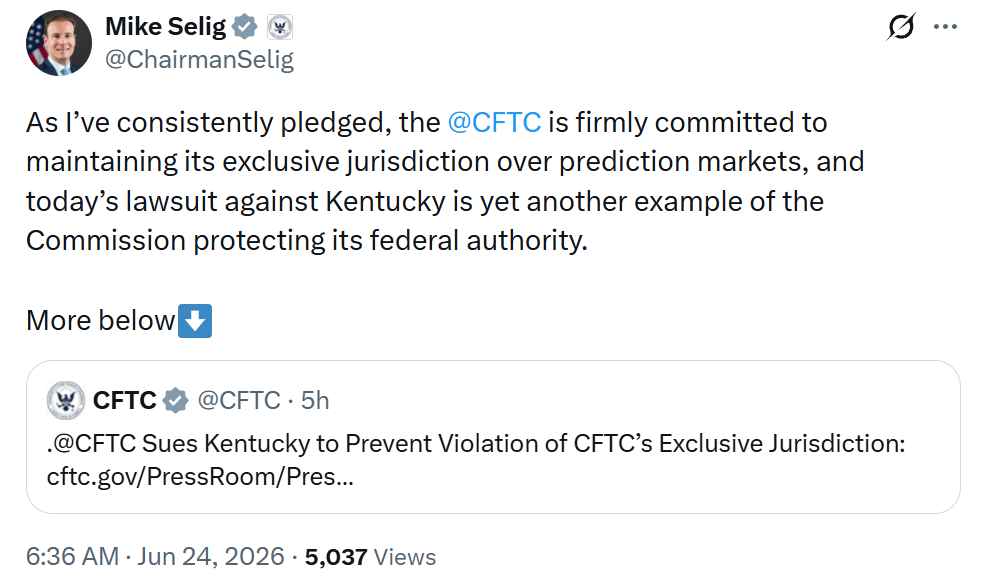
The US Commodity Futures Trading Commission filed a lawsuit against Kentucky on Tuesday after the state sued prediction market operators last week, accusing them of operating unlicensed and illegal gambling platforms.
The lawsuit, filed in federal court, seeks to block Kentucky’s legal action against five prediction markets filed on Wednesday last week, calling for declaratory and injunctive relief. It names Kentucky Governor Andrew Beshear, Attorney General Russell Coleman and the Kentucky Horse Racing and Gaming Corporation, among others.
“Kentucky is the latest state attempting to shut down federally-regulated event contracts,” CFTC Chair Mike Selig said in a statement. “As I’ve consistently pledged, the CFTC is firmly committed to maintaining its exclusive jurisdiction over prediction markets, and today’s lawsuit against Kentucky is yet another example of the Commission protecting its federal interests.”
The CFTC has been ramping up its effort to maintain authority over prediction markets since Selig was appointed as chair in December. Kentucky is now the ninth state that the CFTC has sued over state authorities taking action against prediction markets.
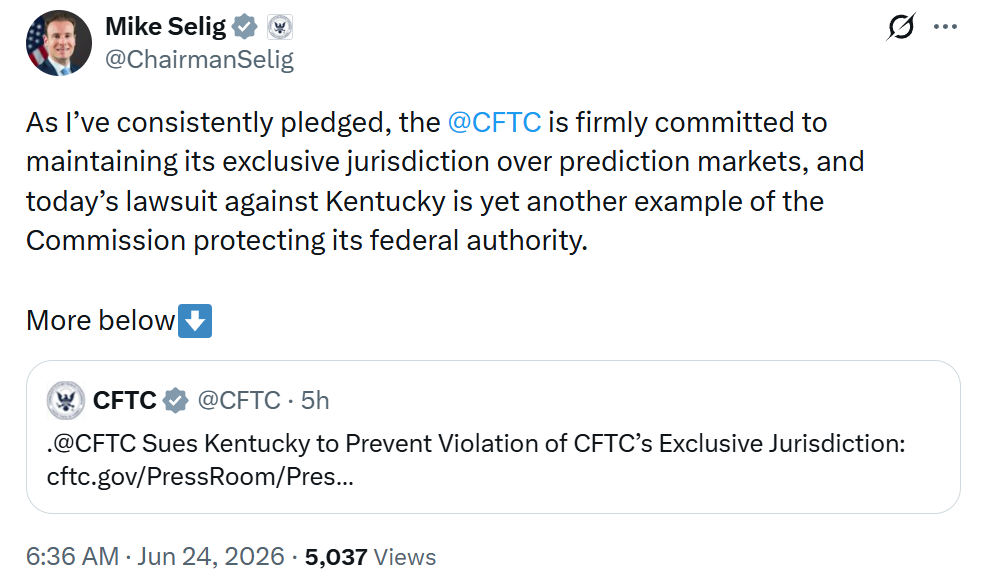
Source: Mike Selig
Kentucky sued Polymarket and Kalshi, along with Kalshi partners Coinbase, Robinhood and Webull, claiming they are “doing business without a Kentucky gaming license or following state regulations” and that their sports event contracts “fall squarely within the definition of ‘sports wagering’ under Kentucky law.”
Sports betting has been under the jurisdiction of the Kentucky Horse Racing and Gaming Corporation since 2023.
Related: Mark Zuckerberg ordered Meta staff to develop moneyless prediction market: NYT
The state also alleged the platforms offer users “few or no resources” to identify or seek help for a gambling problem as required by state law.
In its lawsuit, the CFTC argued that Kalshi and Polymarket are designated contract markets under its authority, and their event contracts are “swaps” under federal commodities law.
It argued that Coinbase, Robinhood and Webull are CFTC-registered futures commission merchants that can offer event contracts in partnership with a designated contract market.
The regulator also took aim at Kentucky’s recent law that imposed a 14.25% excise tax on prediction market transaction fees, arguing it was an attempt to make prediction markets economically unviable in the state.
“This tax essentially makes it impossible for prediction markets to operate in Kentucky,” the CFTC argued.
The lawsuit comes just weeks after CFTC similarly sued New Mexico to block the state’s efforts to apply state gaming laws to Kalshi.
In May, US President Donald Trump gave the CFTC moral support, saying it was “critically important” that the regulator was the authority on prediction markets.
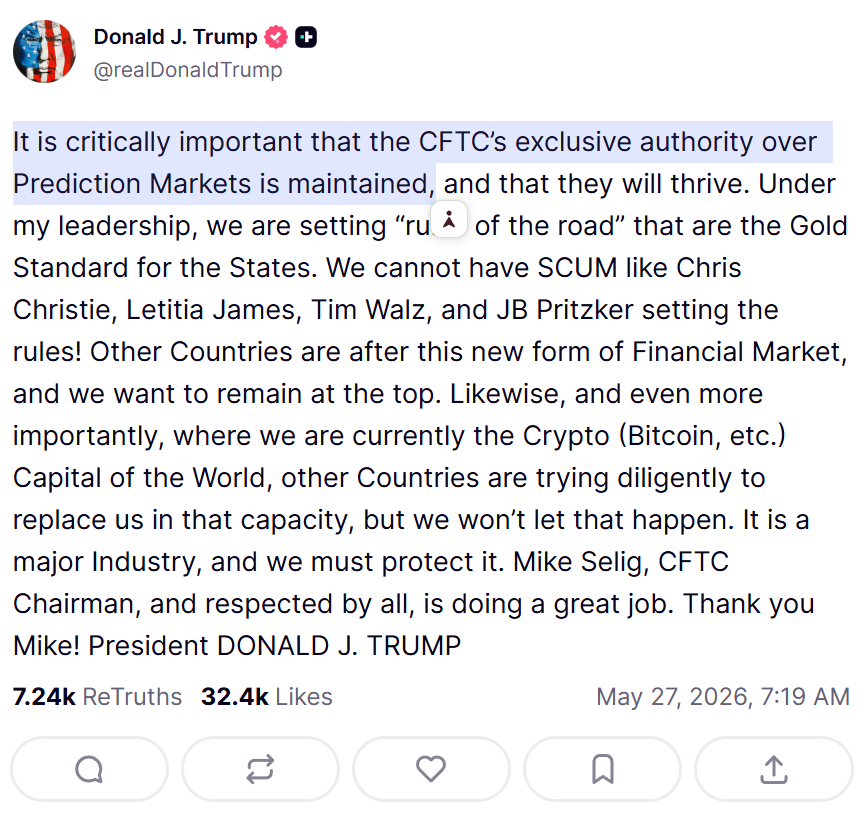
Source: Donald Trump
Trump’s son, Donald Trump Jr., has invested in and is on the advisory board for Polymarket and is an adviser to Kalshi.
Magazine: Bitcoin decouples from tech stocks, Ether eyes ‘selling wave’: Market Moves


Both chambers of Congress have passed legislation barring the Federal Reserve from issuing a central bank digital currency through 2030, with the bill heading to President Trump for signature after the House cleared it Tuesday. The House passed the 21st Century ROAD to Housing Act with a large… Read the full story at The Defiant
The Ethereum Foundation is cutting its budget by roughly 40% and reducing staff by about 20%, concluding a planned shift toward a leaner, endowment-style organization with a narrower set of priorities.
Co-founder Vitalik Buterin called the cuts a deliberate trade, not an efficiency drive. Solana co-founder Anatoly Yakovenko went further, arguing the leaner foundation will move faster and prove bullish for Ethereum.
What the Budget Cut Removes
The foundation confirmed it is cutting 54 roles, close to one-fifth of its staff. It is reorganizing into a seven-cluster structure built around protocol security, censorship resistance, and privacy.
Buterin did not frame the reductions as pure efficiency. He named concrete losses. These include a smaller Devcon, the wind-down of Privacy and Scaling Explorations, and fewer projects beyond Ethereum.
The Ethereum co-founder also signaled his diminishing influence on the board.
The foundation’s June 2025 treasury policy set annual spending at 15% of holdings, with a 2.5-year cash buffer. It mapped a glide path to a 5% endowment baseline by about 2030.
To sell less ether (ETH), it now leans on staking and DeFi yield instead of principal.
“This year, the EF is decreasing its budget by roughly 40%, which entails some difficult decisions… the EF is transitioning into being a long-term-oriented endowment-based organization…” Vitalik Buterin wrote.
Follow us on X to get the latest news as it happens
Buterin tied the budget to Ethereum’s Strawmap, which he calls the network’s third iteration after the Merge.
He wants that core protocol overhaul finished, then a higher bar for new features. He also expects leaner shipping.
Buterin said more of the protocol will shift from client redundancy to AI-assisted formal verification, reducing upgrade costs.
Solana Co-Founder Sees Upside
Not everyone reads the cuts as a decline. Solana co-founder Yakovenko argued that tight budgets force focus.
“Bullish… Budget constraints force prioritization and focus. Ethereum isn’t going away. A smaller and leaner EF will be more decisive and will move faster and will be able to course correct faster,” the Solana executive wrote.
Skeptics see risk. Former foundation contributor Trent Van Epps warned of a roughly $30 million annual funding gap for core development.
BitMine chairman Tom Lee dismissed the crisis talk, betting private backers and stakers will step in.
That bet is already taking shape. Days earlier, five former foundation researchers launched an independent nonprofit, Ethlabs. Lee and Ethereum co-founder Joe Lubin backed it to push institutional adoption.
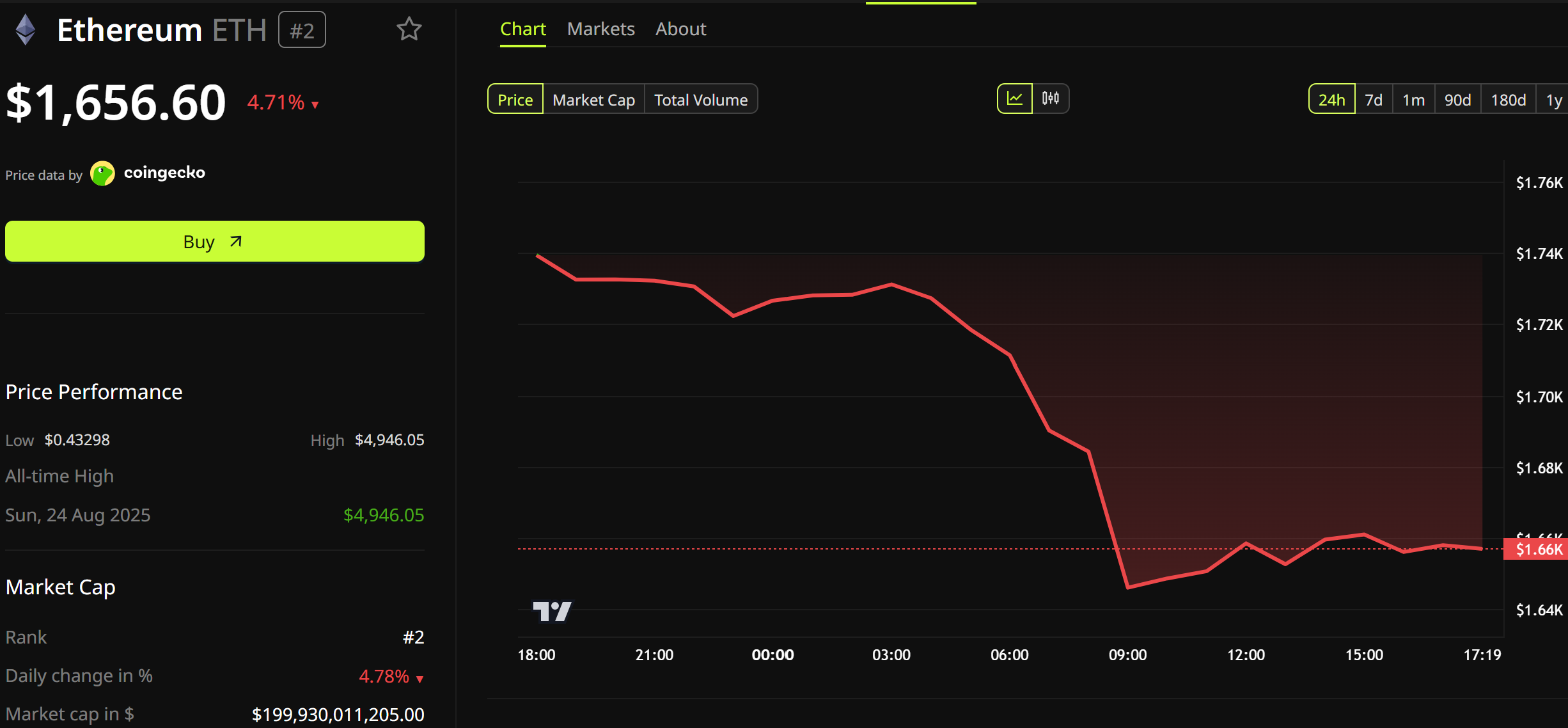
Ethereum reflected the unease. Ether’s price action slid below $1,660, down about 5% over 24 hours. It retained its rank as the second-largest cryptocurrency, valued at about $200 billion.

The next treasury reports and protocol milestones will test the bet.
They will show whether a smaller foundation ships faster, as Yakovenko predicts, or whether the lost talent slows Ethereum’s most ambitious upgrade yet.
The post Ethereum Foundation Cuts Another 40% But Solana Founder Calls It Bullish appeared first on BeInCrypto.
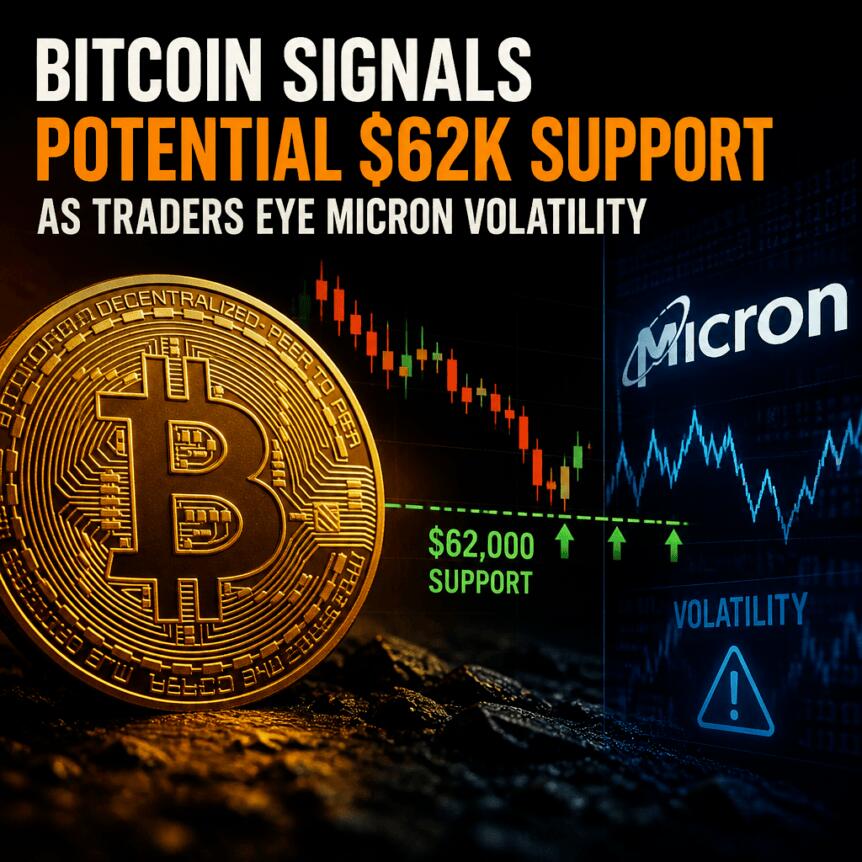
Bitcoin traded with limited conviction at the start of Tuesday’s Wall Street session as earlier losses in Asia’s technology-heavy markets spilled into global risk sentiment. While BTC held its position near recent ranges, traders increasingly pointed to cross-asset volatility—particularly moves in major US indices and upcoming company-specific headlines—as a driver of short-term price swings.
On the crypto side, liquidation data underscored how thin the margin for error currently looks. CoinGlass reported that rolling 24-hour crypto liquidations were approaching $1 billion on Tuesday, after earlier liquidation totals neared $700 million in the prior day’s window.
Key takeaways
- Bitcoin remained range-bound at the Wall Street open, with $62,500 emerging as a key near-term reference point.
- Asia’s tech sell-off contributed to early downside pressure across equities, feeding into heightened market volatility.
- Trader commentary linked BTC’s dips below $62,000 to short-term liquidity grabs and subsequent price resets.
- CoinGlass data showed liquidation activity intensifying, with totals nearing $1 billion over a 24-hour rolling period.
- Attention is focused on US earnings—especially Micron Technologies’ Q3 guidance—expected to influence broader momentum-driven trading.
BTC checks levels as equities wobble
According to TradingView data referenced by Cointelegraph, BTC’s movement on lower time frames looked indecisive, with traders watching $62,500 as a focal level. The day’s volatility had begun in Asia: two intraday dips pushed price action briefly below the $62,000 area as equities posted major declines.
The US open was less severe, but weakness carried over. At the time of writing, the S&P 500 was down about 1% and the Nasdaq Composite about 1.3%, reflecting that investors had started resetting risk positions after the earlier tech-led sell-off.
In commentary that tied the equity and crypto tapes together, The Kobeissi Letter said expectations around Micron Technologies’ upcoming Q3 earnings guidance were a key factor behind the current market turbulence. The firm’s post on X highlighted how sentiment around the stock could drive broader momentum-based moves, particularly given Micron’s large market value.
“Speculation over Micron’s earnings is a key factor driving this volatility,” Kobeissi wrote on X.
Why Micron’s guidance matters to traders right now
Kobeissi also linked the broader market drop in Korea to legal concerns related to unrealized gains and to increased leverage among traders, arguing that these dynamics amplified volatility in both directions. It noted that the S&P 500 had already rebounded meaningfully from its opening low, reflecting a market that is quick to reverse when liquidity shifts.
“The result is amplified volatility in both directions, which also explains why the S&P 500 is already up +60 points from its opening low,” the account added.
The broader point for crypto participants is not the earnings event itself, but how it can influence risk appetite across correlated assets. If tech earnings expectations cause sharp swings in sentiment, BTC often feels the effect through liquidity conditions—especially when leverage is active in both directions.
Even as traders absorb the equity newsflow, the “AI narrative” underpinning parts of the tech complex remains a central theme, according to Kobeissi, which argued that volatility after a strong prior run can be “normal” rather than purely bearish. For BTC investors, the implication is that price may continue to oscillate rather than trend aggressively until the market’s next catalyst becomes clear.
Liquidations spike as BTC searches for liquidity
Despite the day’s broader uncertainty, BTC activity appeared to concentrate around nearby liquidity pockets—an environment where both longs and shorts can be forced out. CoinGlass data placed 24-hour crypto liquidations at nearly $700 million at one point during the session, with the overall rolling figure later described as climbing toward $1 billion over 24 hours.
Trader Daan Crypto Trades commented that the $65K area failed to hold and that price subsequently moved to “grab the liquidity below $62K.” This type of commentary aligns with the observed pattern: dips below round-number support can accelerate liquidation cascades, then produce rebounds once stop orders and leveraged positions are cleared.
CoinGlass’s liquidation snapshots were also accompanied by market analysis from CryptoReviewing, which described the long-short imbalance as “ridiculous” and pointed to the rolling $1 billion figure on Tuesday. CryptoReviewing suggested that what comes next could still offer opportunities for bulls, but the immediate takeaway from the liquidation data is that the market remains highly leveraged and therefore sensitive to short-term shifts.
What to watch next: levels and catalysts
For now, BTC’s near-term direction looks closely tied to both US equity momentum and earnings-driven risk sentiment, with Micron’s guidance emerging as a near-dated catalyst highlighted by traders. As liquidation totals remain elevated, watching whether BTC can reclaim and hold above the $62,500 area—and whether equities stabilize or reintroduce downside pressure—may be the most practical indicators for the next move.


Amid waning poll numbers and pressure from inside the Labour Party, Prime Minister Keir Starmer has stepped down.
During Starmer’s tenure, the government introduced a moratorium on cryptocurrency donations to political campaigns, citing concerns that crypto could become a vector for foreign influence in UK elections. Beyond the ban, the UK has charted a cautious path on crypto regulation under the Labour government.
Starmer’s departure from Number 10 has started discussions about his successor. A frontrunner has emerged in Andy Burnham, a member of parliament for Makerfield and former Mayor of Greater Manchester.
Burnham has expressed optimism about the blockchain industry’s ability to support economic development. But it remains to be seen whether that enthusiasm can translate into real policy moves.
Burnham wanted Manchester to be a “Web 3 powerhouse”
A graduate of Cambridge, Burnham served as a Cabinet minister under both Tony Blair and Gordon Brown, both as Health Secretary and Culture Secretary. From 2010 to 2015, he served as Shadow Education Secretary and Shadow Health Secretary under Ed Miliband before unsuccessfully contesting the Labor leadership bid in 2015.
From 2015-2016, he was Shadow Home Secretary under Jeremy Corbyn before leaving Westminster to become Mayor of Manchester in 2017.
As mayor, Burnham has consistently framed digital technology as an economic development tool and a way of driving growth and jobs in the city. This framing was evident at a Stand With Crypto and Manchester Blockchain Alliance event, where he said, “I’m bought in.”
He further noted his commitment to “make [Manchester] the Web3 powerhouse that we want it to be.”
Whether this will translate into a coherent national policy is another matter. As mayor, Burnham championed a model dubbed “Manchesterism,” which prioritized devolution, regional economic control and public-private partnerships.
It’s a bottom-up approach that, some observers in the crypto industry say, needs to be amplified if it’s to bring national-level change to the industry.
Nick Jones, founder and CEO of UK digital assets services platform Zumo, told Cointelegraph, “Burnham’s rhetoric on crypto has to date been heavily influenced by his role as Mayor of Greater Manchester. For example, he has previously drawn parallels between digital innovation and historical developments, pointing out that Manchester was the home of the Industrial Revolution and has the potential to become the home of the Web3 revolution.”
“But such soundbites were to be expected in the context of his role. If he becomes Prime Minister, he will be well aware of the need to amplify that ambition and ensure the UK as a whole sits at the heart of the world’s future financial system,” he said.
Related: UK central bank is warming up to stablecoins, but says industry input is lacking
Benoit Marzouk, the CEO of GBP stablecoin tGBP, told Cointelegraph that Burnham’s Manchester experience “is not a handicap.” Rather, his experience outside Westminster, “could help implement and accelerate the right policies for the digital asset industry across the UK.”
Burnham has not yet published a detailed digital assets policy. His public comments about crypto reflect broader enthusiasm rather than specific regulatory commitments. He has not yet addressed the Financial Conduct Authority’s crypto framework, stablecoin law, or the crypto political donation ban on public record.
The donation ban, politics, and what Burnham could actually do
In March, Stamer’s government banned crypto donations to political campaigns over concerns of foreign influence in British elections.
The ban followed an independent review by Philip Rycroft, a former civil servant turned consultant, who found that the pseudonymous nature of crypto assets created unacceptable risks to political financing transparency.
Reversing a policy introduced on the recommendation of an independent review carries political risk. Labor’s left could scrutinize any move that appears to open the party to crypto money, which Reform UK has used to fund its leading performance in recent local elections.
According to Reuters, crypto donations from billionaires based overseas put Reform well ahead of Labour in the fundraising race. Reform’s leader Nigel Farage is under investigation for an undisclosed 5 million pound ($6.6 million) gift from British Thai-based businessman Christopher Harborne.
Despite obvious ethics concerns, Farage said he should be able to spend the gift however he wishes, be it for campaigning, or on Ferraris and betting on horses.
Amid political concerns over the temporary moratorium, a 180-degree ban reversal from Burnham seems unlikely.
Marzouk expects Burnham to exhibit “pragmatism rather than political announcements.” For tGBP, success in the first year of a Burnham premiership would include a finalized stablecoin framework, pilot programs involving government and GBP stablecoins and continuing work on tokenization.
Tom Rhodes, chief legal officer for UK stablecoin issuer Agant, told Cointelegraph, “We don’t expect the next PM to interfere with any specific policies. The regulators remain independent and cryptoasset regulation is nearly settled.”
Jones said that Burnham is “on record strongly backing the underlying economic potential of our nascent sector.”
“If he does become the next Prime Minister, it’s unlikely his position will change. I believe he would continue to pursue the current growth-focused policy approach.”
The transition period could be bumpy, stalling momentum, according to Jones. “Any potential cabinet reshuffle could displace ministers who are familiar with the evolving regulatory regime at the critical inflection point when regulators and industry alike are preparing for authorization, and that would be a problem.”
Labour is yet to announce an official timetable for replacing Starmer, although the former PM has said that he’d like to see nominations open on July 9, after a NATO summit. According to Sky News, it could be a week later, on July 16, when parliament goes on summer recess.
The winner must receive more than half the votes cast. If no one receives the necessary votes, then ballots are recast based on preference.
Magazine: Bitcoin decouples from tech stocks, Ether eyes ‘selling wave’: Market Moves


Close to 100 Catholic bishops and church leaders have sent a letter to Senate leadership opposing the CLARITY Act, arguing that one of its core provisions would weaken federal safeguards against human trafficking and other financial crimes ahead of a Senate floor vote. The letter, addressed to… Read the full story at The Defiant
Crypto World
Digital Chamber CEO Carbone Presses Senate for CLARITY Act Vote, Citing Financial Friction Cost to Americans
Cody Carbone, chief executive of The Digital Chamber, testified before the Senate Banking Committee on Tuesday pressing for passage of the CLARITY Act, arguing the crypto market-structure bill is a prerequisite for reducing financial costs that fall hardest on lower-income households. In written… Read the full story at The Defiant

Zoey Deutch’s Chic ‘Bowling Bag’ Has a $25 Lookalike on Amazon

Quit Your Job: My Journey to Financial Freedom #shorts

Downed US pilot saw Iran drones flying in ‘jellyfish’ formation: ‘Real alien s**t’


-

 Fashion4 days ago
Weekend Open Thread: Miami – Corporette.com
-

 Entertainment3 days ago
Renter of Home in Anne Heche Crash Denies Settlement With Son
-

 Tech2 days ago
Microsoft accidentally kills epic Outlook email threads
-

 Business3 days ago
Soccer-U.S. defends Iran World Cup travel restrictions, says discussions ongoing
-
 Politics5 days ago
BBC Reporter Discusses Cross Party Criticism Of Trumps Iran Deal
-
 Sports8 hours ago
Two goals and an assist by sheer aura: Cristiano Ronaldo just entered the World Cup chat
-
 Business4 days ago
Wall Street Week Ahead: Investors see Micron earnings as pulse check of AI rally momentum
-
Business3 hours ago
Entergy settles forward sale agreements, raises $672 million in cash proceeds
-

 Tech6 days ago
AWS enters the context layer race with a graph that learns from agents, not manual curation
-

 Politics4 days ago
Andy Burnham and the meaning of Makerfield
-
 Crypto World4 days ago
Can Charles Hoskinson Really Rescue Cardano?
-

 Crypto World4 days ago
HIVE shares jump as $220M AI deal speeds Bitcoin mining pivot
-

 Crypto World4 days ago
Jake Chervinsky accuses CME of protecting derivatives monopoly
-

 NewsBeat4 days ago
Keir Starmer Allies Question His Chances For No 10
-

 Business5 days ago
Brexit cost 6% of UK economy, Bank of England company data suggests
-

 Tech1 day ago
Nearly 7,000 fake Amazon domains registered ahead of Prime Day 2026, researchers warn
-

 Sports5 days ago
FIFA World Cup 2026: Canada beat 9-men Qatar 6-0 to register first ever win | FIFA World Cup 2026
-
 Tech3 days ago
Signal’s Meredith Whittaker says AI chatbots ‘are not your friends’ and calls Copilot agents a backdoor
-

 Business3 days ago
MHP SE 2026 Q1 – Results – Earnings Call Presentation (OTCMKTS:MHPSY) 2026-06-20
-

 Entertainment4 days ago
Jose Alvarado Wants Taylor Swift at More Knicks Games
You must be logged in to post a comment Login