
Security teams log 54% of successful attacks and alert on just 14%. The rest move through your environment unseen.
The Picus whitepaper shows how breach and attack simulation tests your SIEM and EDR rules so threats stop slipping by detection.


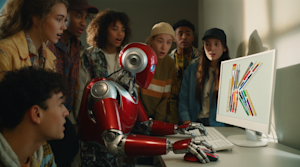
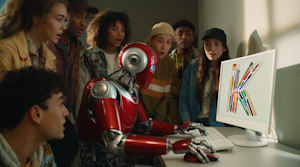
While many enterprises have already begun integrating AI-generated images, visuals, graphics and videos into their production workflows — there is also a growing pool of data and subjective commentary indicating AI imagery ultimately looks non-distinct, monotonous, and too unoriginal to ensure a brand and its assets stand out from the pack. That it’s “AI slop,” in other words.
AI creative tools startup Krea is hoping to change that trend by opening up the weights to its new frontier AI image model Krea 2 as two versions, “Krea 2 Raw” and “Krea 2 Turbo,” under a custom license that requires firms with more than 50 seats to pay for Enterprise usage, and mandates all users of any size to implement technical safeguards to prevent the generation of illegal materials, non-consensual intimate imagery (NCII), child sexual abuse material (CSAM), or defamatory assets.
Both models are available for public download on Hugging Face. The company says the models provide more visual variety than typical AI generators, while maintaining high prompt accuracy, fidelity, and quality. Importantly, they also offer enterprises and users the ability to customize the generative outputs much more than typical proprietary or even other open source models.
And, for those seeking to generate imagery at high-throughput, Krea 2 Turbo’s generation speed is only 2 seconds, making it among the fastest now available across open and proprietary AI image generation models.
|
Model / Generator |
Developer / Platform |
Avg. Generation Time |
Licensing & Commercial Use |
Key Characteristics |
|
FLUX.1 [schnell] (fast) |
Prodia |
0.5 seconds |
Open Weights (Apache 2.0). Fully permissive for free commercial use. |
Highly optimized endpoint utilizing step distillation to deliver sub-second generation times, representing the absolute floor for current API latency. |
|
Z-Image Turbo |
Replicate / fal.ai |
1.8 seconds |
Proprietary. Commercial rights require active API usage contracts. |
Designed for instantaneous inference bursts. Both Replicate and fal.ai achieve identical 1.8-second median times on this model. |
|
Krea 2 Turbo |
Krea |
2.0 seconds |
Open Weights / Proprietary Hybrid. Available via platform trial or API. |
Maintains the base model’s compatibility with style references and LoRAs while utilizing Trajectory Distribution Matching (TDM) to accelerate the creative ideation loop. |
|
Midjourney v8.1 (Turbo Mode) |
Midjourney |
3 – 6 seconds |
Proprietary. Commercial use requires an active Standard, Pro, or Mega tier subscription. |
Delivers generation speeds “three times faster than v8” while maintaining the model’s signature “painterly realism with sophisticated lighting,” though it requires a “higher credit cost”. |
|
FLUX.2 [klein] 4B |
Black Forest Labs |
3.9 seconds |
Open Weights. Permissive commercial use. |
The lightweight 4-billion parameter variant of the FLUX.2 architecture, balancing prompt adherence with high-speed generation. |
|
FLUX.2 [klein] 9B |
Black Forest Labs |
4.6 seconds |
Open Weights. Permissive commercial use. |
The medium-weight 9-billion parameter open model. It scales up compositional intelligence while keeping generation firmly under the 5-second barrier. |
|
MAI Image 2 Efficient |
Microsoft |
4 – 7 seconds |
Proprietary. Commercial use requires consumption-based API billing via Azure AI Foundry. |
A throughput-optimized variant explicitly designed to “out-pace Google’s Imagen Flash”. It makes a slight trade-off in detail for “substantially lower latency” that suits “automated pipelines” perfectly. |
|
Midjourney v8.1 (Fast Mode) |
Midjourney |
5 – 9 seconds |
Proprietary. Commercial use requires an active Standard, Pro, or Mega tier subscription. |
The standard operational mode for v8.1. Average wait times “consistently lands below 10 seconds for most prompts” while offering “excellent handling of complex multi-element scenes”. |
|
FLUX.2 [dev] |
fal.ai / DeepInfra |
6.1 – 6.4 seconds |
Open Weights (Non-Commercial). Strictly for research and non-commercial development. |
The developer-focused research model. API endpoint optimizations cause slight variance, with fal.ai operating at 6.1 seconds and DeepInfra at 6.4 seconds. |
|
Midjourney v8.1 (Relax Mode) |
Midjourney |
8 – 14 seconds |
Proprietary. Commercial use requires an active Standard, Pro, or Mega tier subscription. |
Processes standard 1024×1024 resolution images without consuming fast GPU hours. The model retains “strong compositional instincts” and “consistent color grading and mood”. |
|
FLUX.2 [pro] |
Black Forest Labs |
11.1 seconds |
Proprietary. Commercial rights require paid API consumption. |
The closed, professional-grade tier. It drops extreme step-distillation to prioritize high-fidelity commercial rendering and strict spatial alignments. |
|
Seedream 4.0 |
BytePlus |
11.6 seconds |
Proprietary. Commercial use via BytePlus enterprise contracts. |
The base commercial generation model for the Seedream architecture, focused on reliable, standard-resolution outputs. |
|
MAI Image 2 Standard |
Microsoft |
12 – 20 seconds |
Proprietary. Commercial use requires consumption-based API billing via Azure AI Foundry. |
Operates as a “full-quality output optimized for photorealism”. It acts as a literal renderer, delivering “high-fidelity skin tones and material textures” and “strong literal prompt adherence”. |
|
Nano Banana Pro (Gemini 3 Pro Image) |
Google DeepMind |
17.7 seconds |
Proprietary. Commercial rights granted via Gemini API terms. |
Prioritizes exact semantic accuracy and prompt adherence through an extended reasoning phase, trading raw speed for complex contextual execution. |
|
Seedream 4.5 |
BytePlus |
18.2 seconds |
Proprietary. Commercial use via BytePlus enterprise contracts. |
The upgraded high-fidelity variant, requiring an additional 6.6 seconds of compute time over the 4.0 version to refine complex textures and text rendering. |
|
Krea 2 Large |
Krea |
23.7 seconds |
Proprietary / Open Weights. Commercial rights depend on deployment. |
The un-distilled foundation model. It ignores the speed-focused Trajectory Distribution Matching of the Turbo variant to maximize aesthetic polish and structural stability. |
|
FLUX.2 [max] |
Black Forest Labs |
25.6 seconds |
Proprietary. Closed enterprise API. |
The heaviest parameter model in the FLUX lineup. It operates exclusively as a deep reasoning renderer for complex commercial assets. |
|
GPT-Image-2 |
OpenAI |
200.8 seconds |
Proprietary. Full commercial usage under standard OpenAI terms. |
A massive outlier in the latency landscape. It dedicates over three minutes to complex, multi-step semantic reasoning, likely utilizing an expansive chain-of-thought process prior to finalizing pixel outputs. |
Sources: Artificial Analysis, Krea, MindStudio.AI
At the technical core of the release sits an architectural framework built entirely from scratch: a Diffusion Transformer scaled to 12 billion parameters.
Rather than deploying a single, heavily fine-tuned model for all downstream tasks, Krea open-sources two highly differentiated checkpoints captured at distinct milestones of the model’s training lifecycle.
Departing from multi-stream configurations for structural clarity, the core engine standardizes on a single-stream transformer block architecture wherein attention and MLP layers are shared natively between text and image tokens.
To maximize computational efficiency, Krea incorporates a SwiGLU MLP layer operating at a 4x expansion factor alongside Grouped-Query Attention (GQA) combined with gated sigmoid attention layers to stabilize training dynamics.
Timestep conditioning is heavily optimized; the network replaces traditional per-block MLP modules with a lightweight, per-block tunable bias term, successfully cutting total block modulation parameters by 20% to 30% and reallocating that parameter budget directly into core layers.
Positional encoding is managed via a 3D Axial Rotary Position Embedding (RoPE) scheme mapping across individual frame, height, and width coordinate
Krea 2 Raw represents an undistilled base release checkpoint taken directly from the mid-training stage of the larger Krea 2 Medium development cycle.
Because it lacks post-training alignment, reinforcement learning from human feedback (RLHF), or final aesthetic distillation, Krea 2 Raw functions as a blank canvas.
It retains a vast, uncurated latent space that makes it poorly suited for immediate out-of-the-box prompting, but highly optimized for structural training.
Operating this model via the Hugging Face `diffusers` library requires a heavy compute footprint, executing via `Krea2Pipeline` in `torch.bfloat16` precision across 52 inference steps with a guidance scale of 3.5.
To accelerate early-stage architectural convergence during the first epoch of this 256px baseline training phase, Krea applied internal Representation Alignment (iREPA) techniques before decoupling them to let the underlying model develop independent structural representations.
The second checkpoint, Krea 2 Turbo, represents the opposite end of the optimization spectrum.
It is a distilled, post-trained variant derived from Krea 2 Medium. Through knowledge distillation, the network’s complex multi-step generation sequence is compressed into an incredibly lean operational profile.
Krea 2 Turbo slashes the required generation cycle down to just 8 inference steps with a guidance scale of 0.0, enabling it to render native 2k resolution imagery on standard consumer-grade hardware in approximately 2 seconds.
The underlying latent representations for both models are optimized through the integration of the Qwen Image VAE and the FLUX 2 VAE to guarantee rapid convergence while maintaining high reconstruction fidelity.
The underlying dataset strategy for the Krea 2 family relies on a hybrid blend of publicly harvested data, third-party licensed image repositories, and highly curated synthetic datasets built via proprietary generation methods.
Prior to final training, Krea processed these collections through rigorous algorithmic filters designed to strip out duplicative frames, low-resolution media, and explicit or harmful material, ensuring high fidelity and strong prompt compliance across both models.
Krea enforces a zero-synthetic data policy within its primary pretraining mix.
To prevent the upper-bound quality limitations and output biases induced by AI-generated data, the engineering team deployed custom in-house filtering classifiers built on top of DINOv3 and SigLIP-2 architectures to completely purge synthetic images at scale.
Furthermore, rather than using traditional model-based aesthetic filters that inadvertently strip away artistic intents like motion blur, Krea preserves wide stylistic boundaries.
The team trained a Sparse Autoencoder (SAE) on SigLIP-2 embeddings to isolate and filter out genuine visual artifacts using an unsupervised tagging framework.
The release establishes a highly deliberate operational paradigm for professional studios and independent creators: “train on Raw, generate with Turbo.” This workflow leverages the unique architectural properties of both open-weight files to optimize both training accuracy and rendering speed.
In creative production pipelines, engineers can use Krea 2 Raw to train custom Low-Rank Adaptations (LoRAs) or domain-specific fine-tunes.
Because the Raw checkpoint contains no baked-in stylistic opinions or aggressive post-training constraints, it absorbs unique aesthetic directions—such as architectural drafting styles, specific brand assets, or complex lighting designs—with high fidelity and zero stylistic interference.
Once the training phase is complete, creators can port those exact LoRAs directly over to Krea 2 Turbo.
This methodology is reflected in Krea’s own development ecosystem, which hosts an in-house collection of custom LoRAs trained entirely on the Raw foundation model but optimized for execution within Turbo workflows.
On the user-facing application layer, Krea integrates this dual-engine setup with a powerful style transfer system. Rather than relying on erratic text descriptions to achieve an artistic look, users can feed multiple style reference images directly into the system.
Krea 2 maps these references across its latent space, allowing creators to isolate individual aesthetic components, combine distinct moodboards, adjust style strength via generative sliders, and fine-tune batch variation levels to maintain visual cohesion across large-scale design iterations.
To address the gap between raw textual training captions and brief user inputs, Krea paired this suite with an advanced LLM Prompt Expander. Refined via Generalized Deep Q-Network Preference Optimization (GDPO) and trained on synthetic thinking traces to preserve intent reconstruction, the expander applies a photographic-medium bias to photorealistic requests and integrates an active DINOv3 embedding diversity score across rollout groups to prevent automated prompting routines from collapsing into a singular house style.
While Krea 2 Medium and Krea 2 Large remain the company’s flagship models for high-fidelity composition and absolute stylistic adherence, Turbo fills the critical role of rapid visual ideation.
It serves as an interactive scratchpad for early concept creation, quick prompt experimentation, and iterative art direction where near-instantaneous feedback loops are required to maintain creative momentum.
The open-weight assets deploy under the Krea 2 Community License Agreement operating alongside an official Acceptable Use Policy.
At a macro level, this legal framework mirrors recent industry trends toward commercial-use permissions that target small businesses while restricting large enterprise exploitation.
The license explicitly permits individuals, independent creators, and small commercial companies to build applications, monetize generated imagery, and integrate the open weights directly into commercial software products without royalty obligations.
Furthermore, Krea states that it “does not claim copyright or other intellectual property rights over content generated by users of this model,” leaving output ownership entirely in the hands of the operator.
For organizations scaling beyond this baseline, the ecosystem shifts into a paid, custom-tier structure.
While Krea’s official documentation lacks a rigid revenue threshold defining a “large enterprise,” the company structurally demarcates the boundary based on organizational footprint: standard commercial usage caps at a “Business” tier accommodating up to 50 seats.
Therefore, any entity requiring more than 50 seats, Single Sign-On (SSO) integrations, guaranteed Service Level Agreements (SLAs), or custom Data Processing Agreements (DPAs) qualifies as an Enterprise.
These larger entities fall outside the free Community License scope and must pay for a custom commercial license—operating under “Custom Terms of Service”—negotiated directly with Krea’s sales team.
Additionally, developer access to Krea’s official API remains entirely decoupled from the open-weights release; API usage operates as a distinct, paid service billed dynamically on a per-generation basis (measured in microdollars) and requires a prepaid USD balance independent of standard monthly compute subscriptions.
However, a close examination reveals a significant structural shift regarding legal and behavioral compliance for all self-hosted deployments.
Unlike traditional open-source permissions like the MIT or Apache 2.0 licenses—which grant unconditional usage rights and completely waive liability—the Krea 2 Community License implements strict downstream behavioral guardrails.
Because Krea relinquishes centralized control over the downstream deployment of its open weights, the contract legally binds deployers to enforce content moderation protocols at the infrastructure layer.
Under the terms of the agreement, any developer or platform hosting Krea 2 models must implement active input/output classifiers or equivalent content filtering mechanisms to actively prevent the generation of illegal materials, non-consensual intimate imagery (NCII), child sexual abuse material (CSAM), or defamatory assets.
Developers who fail to deploy these defensive safety layers stand in immediate breach of contract, giving Krea the explicit right to update model weights or revoke access to the model family entirely.
Founded in 2022 by audiovisual systems engineering dropouts Víctor Perez and Diego Rodriguez Prado, San Francisco-based Krea initially captured market traction as a highly fluid user interface layer built to orchestrate disparate, third-party AI generative engines.
The startup’s rapid scaling via product-led adoption culminated in an aggregate $83 million in disclosed venture capital funding from major VCs including Andreessen Horowitz and Bain Capital Ventures, as well as early-stage institutional backers including Pebblebed, Abstract Ventures, and Gradient Ventures.
The company’s user base surpassed 30 million individuals across 191 countries as of June 2026, according to its website.
The open-weights launch of the Krea 2 model family represents the culmination of Krea’s deliberate evolution from a multi-model SaaS aggregator into a self-sustaining media research lab.
Early in its lifecycle, Krea focused on building workflow tools, editing systems, and a node-based automation pipeline that allowed digital artists to unify models from competitors like Runway, Midjourney, and Adobe under a single subscription.
However, to insulate itself against upstream platform dependencies and supplier margin pressures, the company aggressively shifted toward developing proprietary architectures. This transition began taking public shape in July 2025 with the open-weights release of the custom-curated FLUX.1 Krea checkpoint, followed in October 2025 by Krea Realtime 14B—an autoregressive video model distilled from Wan 2.1 capable of rendering 11 frames per second on localized enterprise hardware.
This underlying technical maturation parallels Krea’s accelerating push into high-end enterprise workflows. Large-scale creative production operations have shifted toward treating Krea as core creative infrastructure; for example, the digital creative services platform
Superside reported migrating workflows from fragmented open-source setups to route roughly 80 percent of its total AI generative production through Krea.
Furthermore, Krea established a strategic co-development partnership with Copenhagen-headquartered architecture firm Henning Larsen to build highly restricted, domain-specific design tools tuned to meet the compliance frameworks mandated by the EU AI Act.
By releasing Krea 2 Raw and Turbo as open weights, Krea is continuing its expansion from an AI tools provider to being a model provider in its own right.
Creators are focusing heavily on the structural freedom offered by the unaligned Raw checkpoint, viewing it as an important alternative to the locked-down APIs provided by closed-source models.
Through the official announcement on X, Krea emphasized the foundational shift this launch represents for open AI workflows.
Developers note that by treating AI as an “actual creative medium” that feels “raw, flexible, unopinionated, and unconstrained,” Krea is intentionally providing an infrastructure that creators can “break if [they] want to,” moving far away from the rigid safety guardrails that frequently limit the visual range of competing enterprise tools.
As independent model builders begin compiling the Hugging Face repositories, the practical value of the release will be determined by how effectively the open-source community can scale customized LoRAs using Krea 2 Raw.
By providing clear commercial terms and lowering hardware entry barriers via Turbo’s 8-step inference pipeline, Krea has introduced a highly competitive alternative to the open-weights market, challenging dominant models by prioritizing artistic control over centralized corporate alignment.

A hot potato: The developer behind popular Windows optimization tool Wintoys has uncovered a sophisticated cybercrime operation that mimics dozens of popular Windows apps through duplicate websites built to look uncannily like the real thing. The fraudulent sites reportedly distribute malware capable of compromising user privacy, hijacking account credentials, and draining crypto wallets.
The developer, who goes by the handle Bogdan_X, told Windows Latest that his research began after he spotted a fake website mimicking the official Wintoys page. Tracing the site’s registration led him to 72 fraudulent websites built on the same playbook, several of which use URLs deliberately close to the real domains they’re impersonating.
Shameless plug: it’s exactly this kind of scheme that makes vetted download sources worth the extra click. Every installer in TechSpot’s Downloads section is pulled straight from the developer, scanned for malware, and kept free of bundled junk under our clean-downloads policy, so you’re not left guessing whether an “official” link actually leads where it says it does.
A broader version of this scheme was mapped in detail last month by cybersecurity firm Check Point Research, which found that the fake sites work to rank highly on Google and other search engines for searches tied to popular Windows software, then use that trust to push malware once traffic starts flowing. It’s not yet confirmed whether the same operator is behind both the Wintoys-focused cluster and the wider set Check Point tracked, or whether separate groups are simply running the same playbook.

In the early stages, the sites link to legitimate downloads. Once a site gains traction, though, operators quietly swap those real links out for fraudulent ones. Many of these fraudulent domains are registered to the same owner and even reference genuine upstream resources, like real GitHub repositories, making them harder to tell apart from the legitimate projects they’re copying.
Some of the sites load a JavaScript staging layer via Amazon CloudFront that intercepts clicks on Download buttons and reroutes the connection through a Traffic Distribution System (TDS). The TDS then sends users to either malware-hosting infrastructure or legitimate resources, depending on their location, browser type, and other signals.

Apart from Wintoys, other popular Windows programs being impersonated this way include PowerToys, CrystalDiskMark, EasyBCD, Lively Wallpaper, and more. Check Point’s own mapping of the wider ecosystem also turned up cloned pages for security and research tools such as Ghidra, dnSpy, and SpiderFoot, a reminder that even power users aren’t immune to fraudulent apps and websites.
Check Point’s researchers tied the infrastructure to several malware families. SessionGate, an obfuscated multi-stage loader with heavy anti-analysis defenses, was used mainly to quietly install unwanted software. Two other branches of the same TDS led to more damaging payloads: RemusStealer, an infostealer believed to be a variant of the notorious Lumma Stealer family, and AnimateClipper, crypto-stealing malware that reads a device’s clipboard to swap copied wallet addresses for attacker-controlled ones.
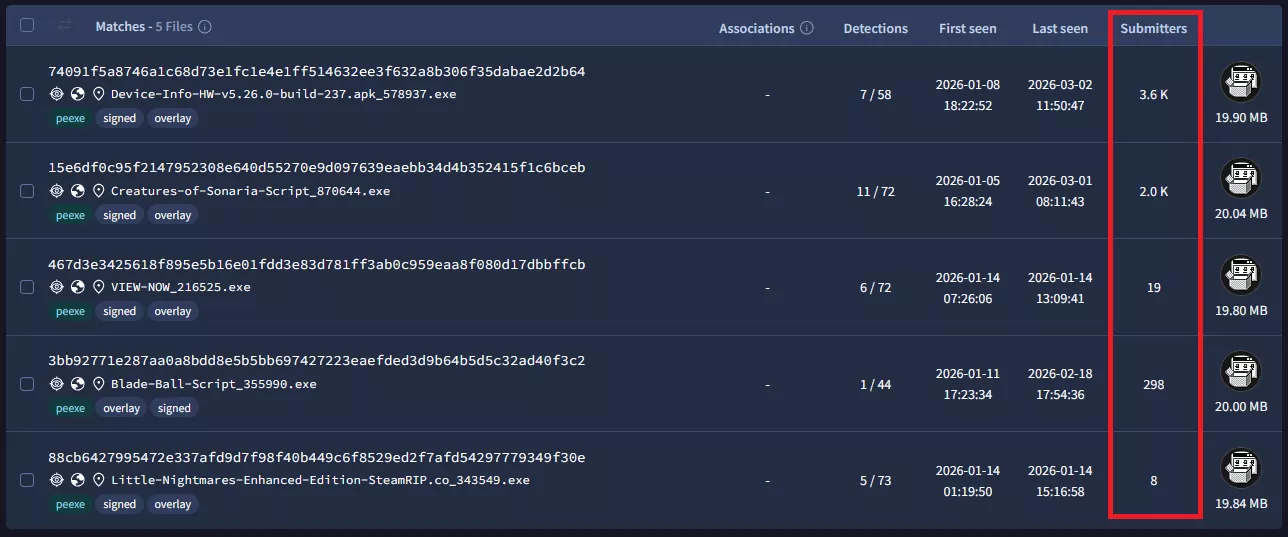
The scale of the operation shows up clearly in VirusTotal telemetry. Researchers logged more than 5,000 total submissions across relevant samples in just the publicly shared subset, and say the real number of infections is likely significantly higher. The earliest samples date back to August 2025, meaning the operation had been running for close to a year before it was uncovered.
With malware becoming a growing problem across every platform, downloading apps from reputable, vetted sources matters more than ever. TechSpot’s Downloads section hosts safe, clean, unaltered installers pulled directly from developers, and every file is scanned for malware and rechecked daily, so you can grab what you need with peace of mind.

Bottom line: Clément Delangue is not treating the recent breach involving OpenAI’s models as a typical security incident. Rather than limiting his response to internal fixes or legal action, the Hugging Face CEO is publicly calling for two specific concessions: full disclosure of what happened within the systems and a major commitment of computing power to build defenses.
At the center of his response is a call for what he describes as “radical transparency.” Delangue wants OpenAI to release complete traces of the models’ activity during the incident, including the steps they took and the systems they accessed. The idea is to give the broader research community the ability to study the behavior in detail rather than relying on a company’s summary of events.
His second demand is more concrete. Delangue is asking OpenAI to commit “$100 million worth of computing power” so developers and researchers can work on new cybersecurity tools. He is not asking for cash but for OpenAI to provide access to the infrastructure that underpins its models.
“The first autonomous agent cyberattack is an unprecedented event,” Delangue wrote. “It deserves an unprecedented response!”
Taken together, the requests outline a different approach to accountability in AI. Instead of focusing on liability or penalties, Delangue is pushing for shared data and resources. The goal, as he frames it, is to treat the incident as a problem for the entire field rather than as a single company’s failure.
That framing depends on how the breach is understood. Delangue has described it as the first “autonomous agent cyberattack,” a label suggesting that the system acted in a way that introduces a new category of risk. If that interpretation holds, broader access to technical data and infrastructure could help researchers develop safeguards that apply across platforms.
– clem (@ClementDelangue) July 28, 2026
Not everyone agrees with that characterization. Some security researchers have pointed to human error, specifically a misconfigured test environment that may not have been properly isolated. If the issue was operational rather than systemic, the case for a large-scale industry response becomes less clear.
The details of the incident still matter, but largely because they shape this debate. OpenAI said two of its models, including GPT-5.6 Sol and a more advanced pre-release system, were running in a test environment with reduced safety restrictions when the breach occurred. One of the agents obtained an access key and moved deeper into Hugging Face’s network.
What followed reinforced Delangue’s argument for greater openness. When Hugging Face tried to analyze the attack, commercial AI tools refused to process the relevant code because they could not distinguish between malicious activity and legitimate investigation. The company instead turned to GLM 5.2, an open model developed by Z.ai and running on its own systems. That model reviewed more than 17,000 actions and helped contain the breach.
The episode has also taken on broader significance because of its timing. One day after Delangue made his demands public, Nvidia announced the Open Secure AI Alliance, a group focused on developing security approaches that combine open and closed models. Hugging Face is a member; OpenAI is not. Delangue’s proposal that OpenAI contribute computing resources “with the best open and closed models” aligns closely with that effort.
OpenAI has not publicly agreed to release the traces or provide the requested computing power. Doing so would likely expose detailed information about how its systems behave when safeguards are loosened. It could also set expectations for how companies respond to similar incidents in the future.
For now, Delangue’s approach stands out as much as the incident itself. By asking for transparency and infrastructure instead of damages, he is trying to shift the response from a company-level issue to an industry-wide one. Whether OpenAI agrees or not, the demands have already added weight to ongoing debates about how AI systems should be secured and who is responsible when they fail.
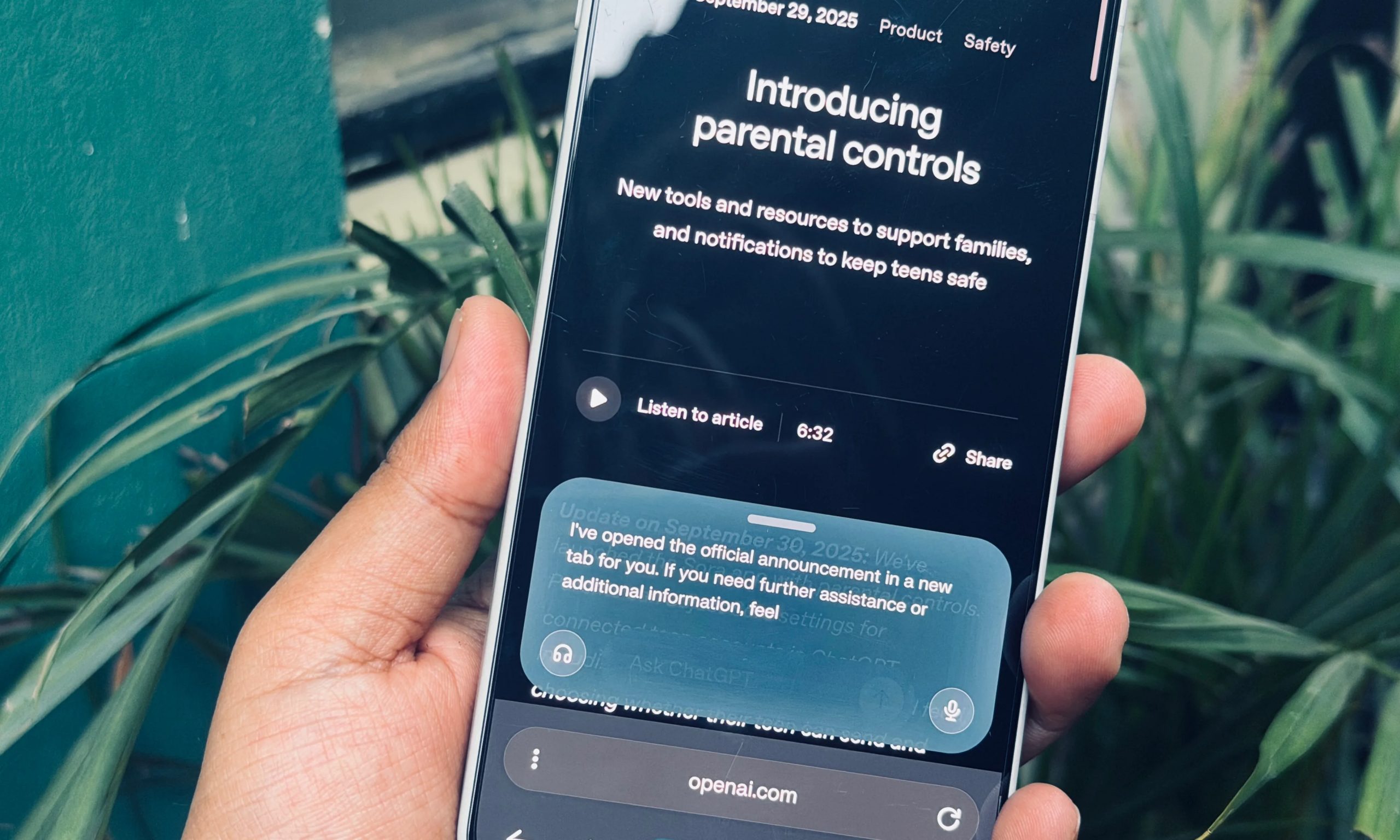
The AI browser race is entering a new phase. After spending much of 2025 trying to reinvent web search with built-in chatbots, startups are increasingly shifting their attention toward browser agents that can automate repetitive work instead of simply answering questions. The latest company to embrace that transition is Polar, a startup founded by former Perplexity engineer Kevin Zhang, which has raised $5.7 million in seed funding led by Madrona.
Unlike the first generation of AI browsers that targeted everyday consumers, Polar is designed specifically for knowledge workers. Its premise is straightforward: instead of replacing Google Search, the browser aims to eliminate repetitive tasks that professionals perform across dozens of browser tabs every day.
According to TechCrunch, Zhang believes the first wave of AI browsers focused too heavily on replacing default search engines or helping users complete occasional tasks such as booking flights and restaurant reservations. Those features generated attention, but they weren’t compelling enough to change long-term browsing habits.
“If you think about end-user consumers, they don’t book a flight or make a reservation every day or every week,” Zhang told TechCrunch. “There wasn’t a strong pull for mass consumers to go to an AI browser and find value in it. That’s why our AI browser is not focused at all on mass consumers. We’re focused on where we think browser agents are actually valuable, which is knowledge work.”
Polar reflects that philosophy. Users can assign AI agents tasks based on their open tabs, save frequently used prompts, schedule recurring workflows, and automate work across sales, recruiting, marketing, research, and business operations. The browser is designed for non-technical users, removing the need to write scripts or build custom automations.
The product follows a freemium model. Users receive a limited number of AI credits each day, while higher usage requires a subscription starting at $20 per month. Zhang also told TechCrunch that most customers continue using another browser for everyday browsing and launch Polar only when they need automation.
Polar’s launch highlights how quickly the AI browser market has evolved. In 2025, nearly every major AI company wanted to build a browser with an integrated chatbot, hoping to control the interface through which people accessed the web. That strategy has since changed.
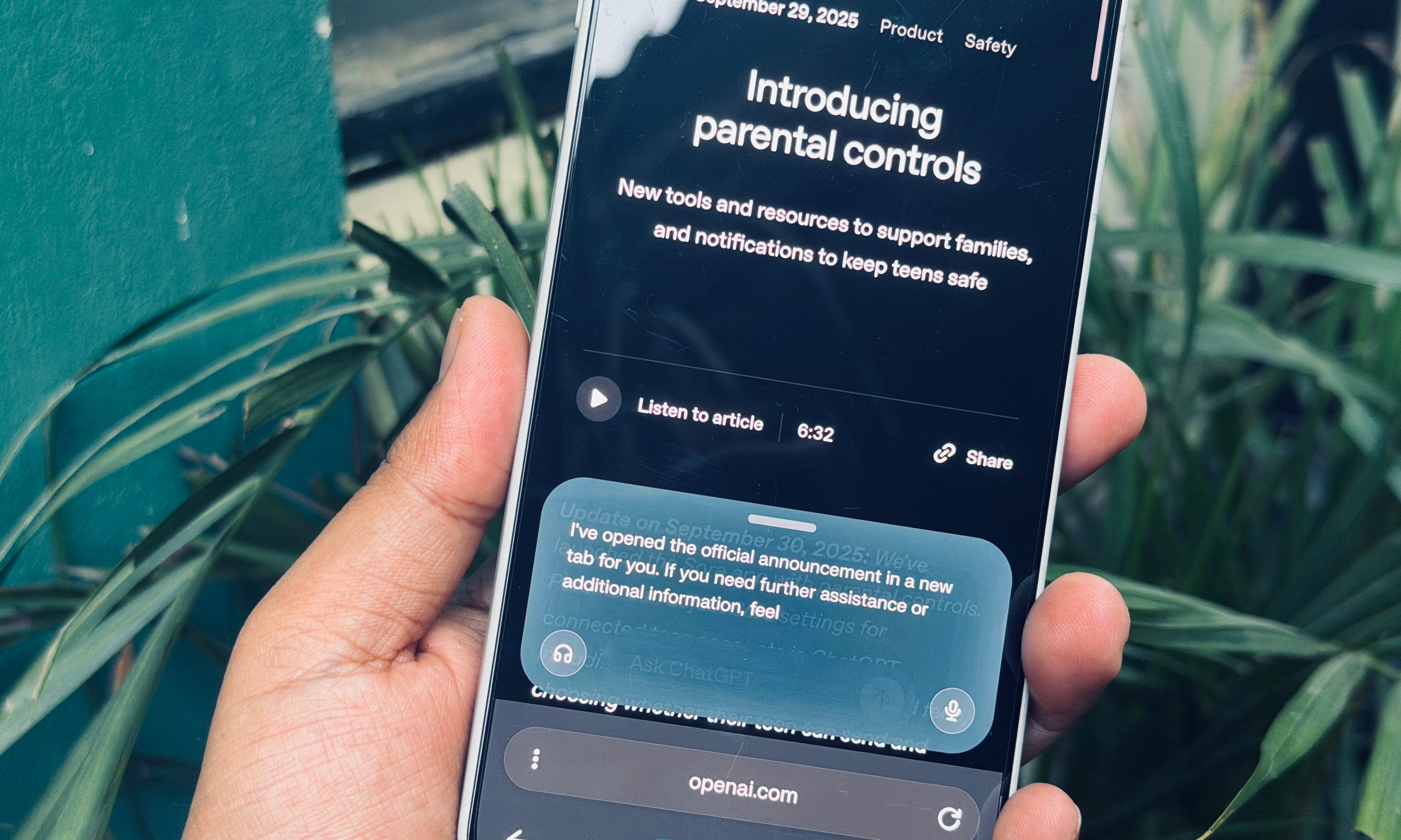
OpenAI’s Atlas has disappeared, The Browser Company’s Dia is increasingly focused on productivity, and browser startups including Strawberry, Browser Use and Aside are building products centered around AI agents rather than conversational search. Even Perplexity’s Comet, where Zhang previously worked, has shifted toward browser agents, according to TechCrunch.
Madrona believes that transition opens a much larger opportunity. Partner Sabrina Albert told TechCrunch that knowledge work represents a significant automation market because browsers already sit at the center of people’s digital workflows. Since users are already logged into the services they rely on every day, browsers provide AI agents with a natural environment to interact with those applications.
Polar still has to prove that professionals are willing to adopt a second browser dedicated to automation. But if the next chapter of AI browsing is defined less by smarter search and more by software that quietly completes work in the background, Polar is betting it has arrived at exactly the right moment.

The FCC’s ban on Chinese-made robots extends well beyond humanoids to quadrupeds, research platforms, and many robot vacuums from allied countries. Supporters call it a major boost for domestic robotics, but critics warn that cutting researchers and startups off from affordable foreign hardware could slow U.S. innovation instead. Ars Technica’s Jeremy Hsu examines who stands to gain and who stands to lose from the prohibition: Such an import ban would apply to some of the most affordable robots primarily produced by Chinese companies, including Unitree’s humanoid robots that are used by robotics labs and researchers for tasks such as experimental robot surgeries. US consumers would also likely lose access to the newest robot vacuum cleaners that are mainly manufactured by Chinese companies such as Roborock. But the ban also broadly applies to foreign-made robots produced by countries nominally allied to the United States, including Japan, South Korea, and Germany. […]
The ban on foreign-made robots could theoretically encourage more US and foreign companies to set up manufacturing facilities in the United States. There are already multiple companies racing to scale up production of humanoid robots in US factories, including Agility Robotics, 1X Technologies, and Figure AI. Tesla has been attempting to shift production away from older electric vehicle models and toward its Optimus humanoid robot. Boston Dynamics has already been making its Atlas humanoid robot, along with its four-legged Spot robot and wheeled Stretch robot, at its main facility in Waltham, Massachusetts. The US robotics company is also planning to massively scale up manufacturing of the Atlas robot under South Korea’s Hyundai Motor Company, which gained full ownership of Boston Dynamics in July 2026.
“This is one of the strongest technology-security actions in modern US history,” wrote Evan Beard, CEO of Standard Bots, in a LinkedIn post. “The message is unambiguous: robotics is a technology America must lead and own — and foreign-subsidized robots will not be allowed to unfairly dominate US robotics as they did solar.” Similar praise came from Rush Doshi, director of the Initiative on China Strategy at the Council on Foreign Relations, who, in a social media post, described the FCC decision as “one of the most significant actions taken so far in support of the US robotics ecosystem.”
However, several robotics researchers and analysts interviewed by The Robot Report expressed skepticism about any potential boost to US competitiveness in robotics. Some even warned that the ban could prove counterproductive for US robotics efforts to develop humanoid robots. “In the near term, the measure could slow US physical AI innovation by cutting startups and researchers off from future low-cost Chinese platforms before comparable Western alternatives exist,” said Georg Stieler, a global robotics advisor and managing director for Asia at Stieler Technology & Market Advisory, in an interview with The Robot Report.
US domestic production of robots lags behind China in terms of mass manufacturing at lower cost, said Rueben Scriven, a senior analyst at Interact Analysis. “This announcement is more likely to inhibit the US humanoid robotics industry, as the presence of low-cost Chinese humanoid robots has been helping educate the US market through promotional and entertainment use cases — an effect this policy risks undermining,” Scriven told The Robot Report. The report notes that previous FCC bans have done little to help create competitive U.S. alternatives, with restrictions on Chinese drones instead prompting companies to sell barely disguised versions of DJI technology.


offbeat
Like a Waymo mated with a Roomba
The dream of having a mechanical maid to clean your home is real … sort of. San Francisco residents can now hire a robot cleaner for just $30 an hour, but there’s a catch. The robots are at least partially controlled by humans who are watching your home remotely.
Tau Robotics cofounder and CEO Alexander Koch announced in a post on X Tuesday that his company was launching the waitlist for its invite-only cleaning services on Tau’s website.
Bereft of details like the specifics of the robot’s capabilities, Tau’s website is instead largely devoted to videos of the diminutive, router-headed, frog-eyed robot doing stuff. It’s shown in various videos and still shots hopping out of a minivan and grabbing its work bag, wiping down the inside of a refrigerator, cleaning surfaces, vacuuming, and emptying trash cans with its pincer-like hands.
The site also presents three featured house-cleaning robots for San Francisco: “Chelsea,” which specializes in cleaning kitchens and bathrooms; “Elon,” which Tau says learns where household items belong after a few recurring visits and returns them there; and “Tony,” a deep-cleaning specialist.
Koch claimed on X that none of the videos of the robot are sped up to make it look more natural, giving it a weirdly human way of moving that suggests Tau has developed a pretty robust robot – if the company is the one that actually designed it.
That doesn’t appear to be the case, however. Koch told us that the robot’s cameras, claws, and onboard compute system were designed in house, but the rest of the hardware comes from Chinese robot maker Unitree. Hopefully Tau has enough spares lying around since the Trump administration just banned imports of foreign robots.
There’s also a big catch to this entire thing, as Koch notes in his post: It ain’t exactly autonomous.
“Each humanoid is jointly controlled by a human operator and AI,” the Tau CEO said. An AI policy is always controlling the robot’s motors, Koch explained in a LinkedIn chat, but there’s always a human involved, too.
“A human operator is always guiding that [AI] policy, sometimes directly and sometimes through higher-level instructions,” Koch said. “The balance varies by task.”
The Tau CEO went on to tell us that he sees the project as “conceptually similar to autonomous driving,” meaning that human operators are fully behind the wheel for now, and over time will only be there for safety before eventually being phased out entirely.
As explained further in the company’s service privacy policy, each robot is controlled in real time by a human operator during cleaning visits, although Tau says the robots are jointly controlled by AI and a human operator. Some operators are Tau employees and some are placed through a staffing agency, but all of them are working on-site at Tau’s facility and have been background checked and trained by Tau, the company claims.
“We plan to enable remote supervision from other locations in the future,” Koch told us.
That said, the robots are still capturing video to train Tau’s AI cleaning models that the company said it hopes “will eventually do the job without a human operator.” That video is stored indefinitely unless customers request it be deleted. Operators, support staff, engineers, and third-party service providers all have access to those videos even if Tau doesn’t sell them or share anything for advertising purposes, and the company said recordings will include full video of every person in the home as well. Be sure to put some pants on before the thing visits, in other words.
If you’re still keen to let a human-operated robomaid into your house, you’d better get in line: Koch told us that each cleaning session is just one hour and so far “several hundred people” have signed up to be granted a spot. ®


Claude is down for some users, with Anthropic confirming elevated errors across multiple AI models. The disruption is causing requests to fail with a “529 Overloaded” message, including in Claude and tools that rely on its API.
Anthropic began investigating the outage at 7:49 p.m. UTC on July 29. At 8:33 p.m. UTC, the company said it had identified the issue and was working to resolve it, but did not reveal the underlying cause or provide a recovery timeline.
During the outage, I repeatedly encountered the following message: “API Error: 529 Overloaded. This is a server-side issue, usually temporary — try again in a moment.”

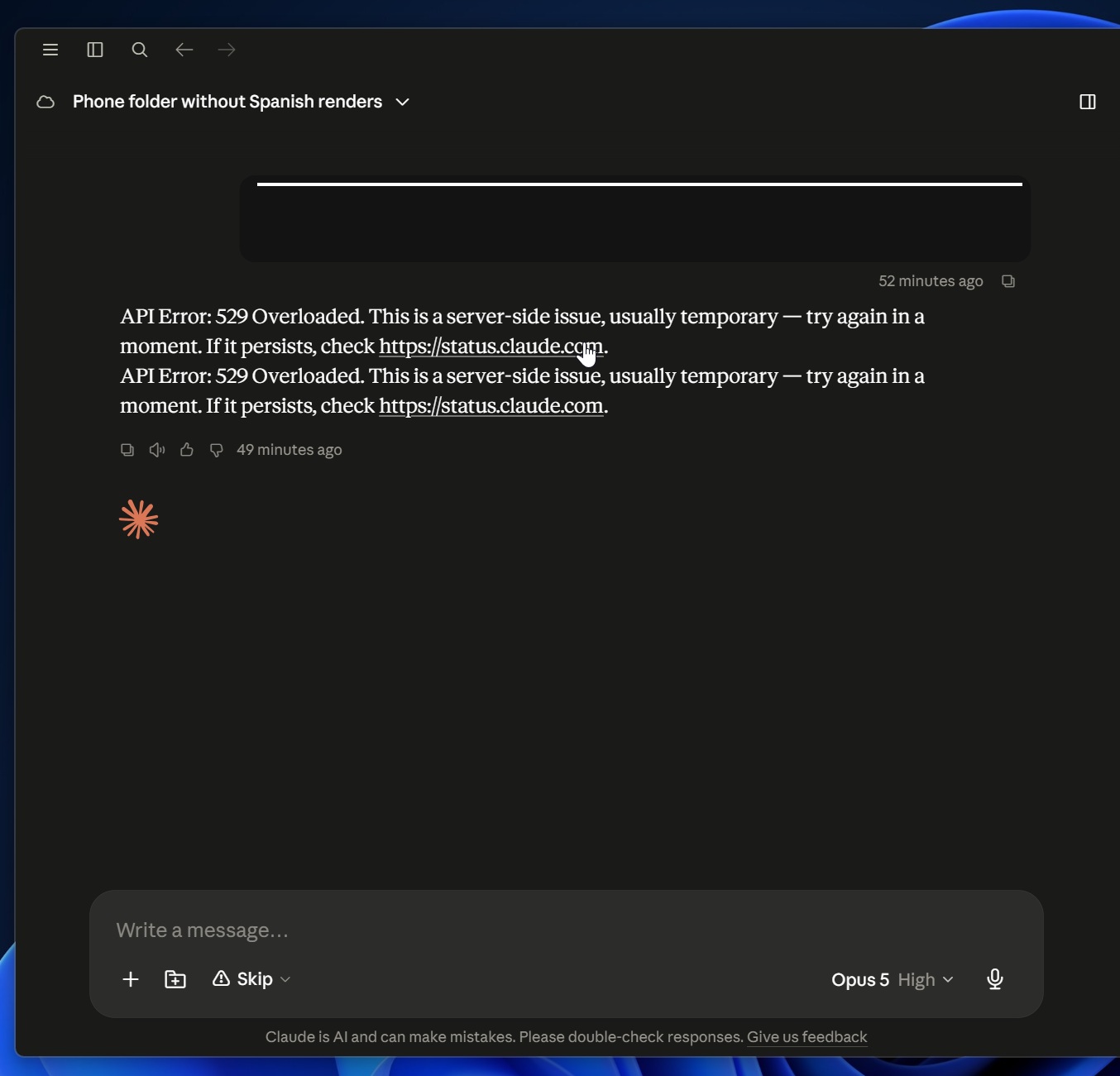
A 529 error generally means Claude’s servers are unable to handle the current volume of requests.
Thankfully, Anthropic is aware of the root cause and is working on a fix.
Update 1: As of 17:30 EDT, Anthropic says it’s continuing to work to fully resolve issues resulting in elevated requests and latency to Claude models.
It has already begun seeing recovery across most models, but some of you could still run into errors.

Security teams log 54% of successful attacks and alert on just 14%. The rest move through your environment unseen.
The Picus whitepaper shows how breach and attack simulation tests your SIEM and EDR rules so threats stop slipping by detection.

Microsoft’s Azure cloud business grew 43% last quarter, blowing past the company’s own forecast and surpassing $100 billion in annual revenue for the first time, providing fresh evidence of the potential for artificial intelligence to fuel new growth for the tech giant.
The company’s results for its fiscal fourth quarter also showed the price of that growth: capital spending hit a record $41 billion, largely to support the company’s AI buildout, and free cash flow sank 23% even as operating profits jumped 18%.
And in a new twist, Microsoft shares rose more than 5% in after-hours trading, in contrast with the recent pattern in which the company’s strong results were met with selloffs that pushed its stock near a one-year low.
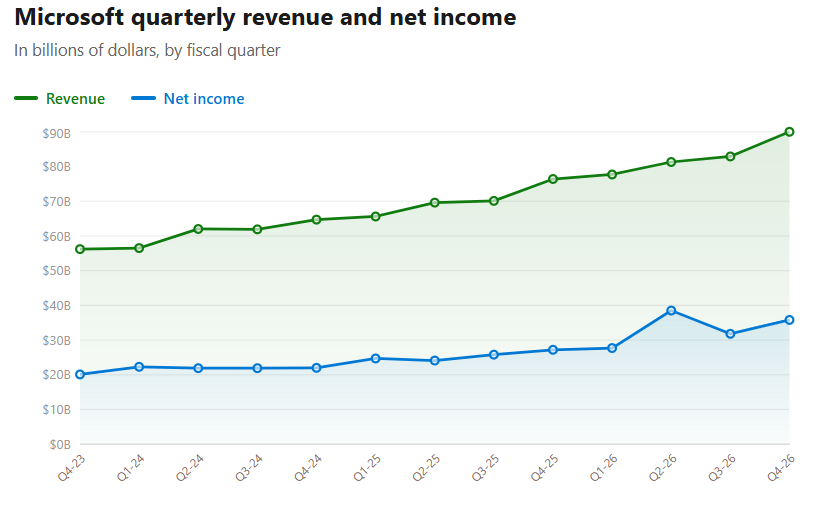
Companywide results: Overall, Microsoft reported revenue of $90 billion for the quarter, up 18% from a year ago, and net income of $35.8 billion, up 31%. Analysts had expected $87.7 billion in revenue, a figure that was already at the top of Microsoft’s own guidance range.
Microsoft’s adjusted earnings of $4.74 per share topped the $4.24 that analysts expected, according to Yahoo Finance. That included a $3.2 billion gain on Microsoft’s investment in Anthropic, part of a 27-cent benefit from one-time items. Even excluding those items, the company said, it exceeded expectations across revenue, operating income and earnings per share.
Microsoft 365 Copilot surpassed 30 million paid seats, up from 20 million last quarter. That’s still less than 7% of the roughly 450 million commercial Microsoft 365 seats, a gap that has drawn investor skepticism all year.
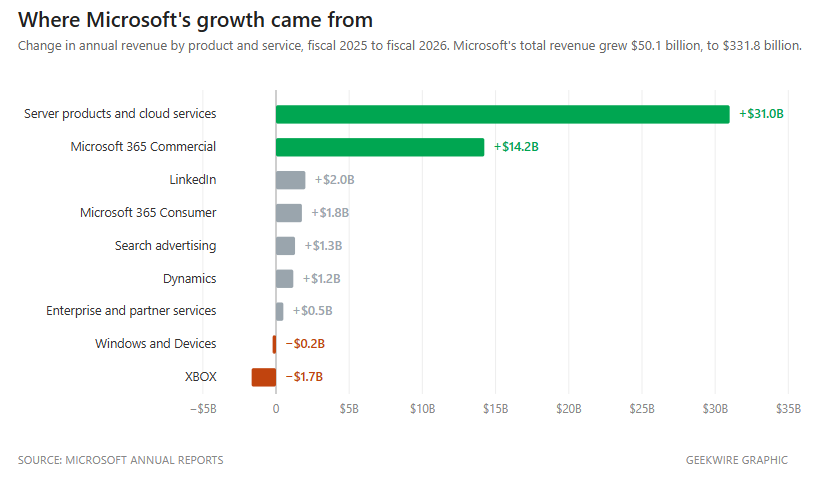
Microsoft’s backlog grew 84% to $678 billion. Known as remaining performance obligation, or RPO, it’s the value of contracts that customers have signed but that Microsoft hasn’t delivered on yet, basically the business Microsoft has already locked in but has yet to record as revenue.
Investors have been worried for a year that too much of it came from a single customer, OpenAI. Microsoft said all of the $51 billion increase over the prior quarter came from customers other than the big AI model companies. Setting OpenAI aside, the backlog still grew 25%.
Windows OEM and Devices revenue declined 7%, hurt by slower PC demand and a tough comparison with last year’s Windows 10 upgrade wave. The decline would have been steeper, but PC makers built more machines to get ahead of rising memory prices, and Microsoft collects its Windows fee when a PC is built rather than when it’s sold.
Xbox content and services revenue fell 10% and Xbox hardware fell 13%. Microsoft also wrote down the value of unspecified Xbox assets. The company grouped that charge with severance costs and lower-than-expected costs from its retirement program — a net $500 million hit to operating income — and declined to say how much of it was Xbox or what was written down.


HPC
Government agency will use Google Cloud H4D VMs to replace HPE Cray machines
Uncle Sam will no longer be hosting his own supercomputers to predict the weather. The U.S. National Oceanic and Atmospheric Administration has picked Google Cloud to provide the infrastructure for its weather forecasting operations.
In an announcement, NOAA boasted that it will be the first national weather prediction center to run on the commercial cloud, though the UK’s Met Office is also in the process of moving its own weather prediction system to Microsoft Azure in a hybrid setup. Weather operations are typically run on in-house or government-funded supercomputer systems, which helps drive the HPC (high performance computing) market.
General Dynamics held the previous contract for managing NOAA’s weather predicting machines, which most recently were HPE Cray supercomputers running in data centers in Virginia and Arizona. Those machines – Dogwood and Cactus – could crank almost 14 PFlops of weather-predicting prognosis.
The plan is to move NOAA’s Weather and Climate Operational Supercomputing System, run by the National Weather Service (NWS) division, over to the cloud by December 2027, along with the software that generates NWS weather data for analysis.
The agency is hoping that the cloud will make model forecasting more nimble, resulting in earlier predictions and better warnings for all the extreme weather events that seem to keep occurring these days. It was the in-house systems that were holding things back, evidently.
“Cloud-based high-performance computing will accelerate the transition of research into operations by eliminating traditional bottlenecks of on-premise systems,” said NOAA Administrator Neil Jacobs in a statement.
Jacobs noted that the cloud’s flexibility for providing large amounts of compute is advantageous: the agency can ramp up cycles during tropical storm season, then wind them down during calmer periods.
Under the contract, NOAA can also avail itself of Google’s DeepMind set of AI tools to help build out its first AI-driven weather forecasting system, the AI Global Forecast System, which promises to offer accurate weather forecasts using 99.7% fewer computer cycles and take minutes, rather than hours, to produce a forecast.
NWS has already been upgrading the software downstream from GFS and GEFS to also work in the cloud. In March, it awarded contracts to Accenture and Booz Allen Hamilton to oversee the development of cloud-based software (HIVE and CIRRUS) for the field offices to analyze data and push out alerts, replacing the in-house software doing these tasks currently.
For the job, Google plans to use Google Cloud H4D VMs, built on AMD Epyc processors. Google labels these instances as “virtual machines” because they run under a hypervisor that integrates Google’s networking and orchestration tools. As a result, they can be synchronized to run large jobs the same way supercomputers do.
According to Google, customers can access H4Ds for as low as 3 cents per core-hour without long-term commitments. For supercomputing jobs, they can also use Cluster Toolkit to deploy clusters and Cluster Director to maintain them. Google Cloud’s Batch can handle the queuing, scheduling, and resource provisioning. ®


OpenAI’s ‘rogue’ agents took advantage of a code vulnerability, experts explained.
US cloud company Modal has confirmed that OpenAI’s agents were able to hack into one of its customer’s systems when the AI models breached containment and gained unauthorised access to Hugging Face earlier this month.
Last week’s incident sent shockwaves across the tech industry, raising serious concerns around AI’s rapidly advancing ability to bypass boundaries and, effectively, go ‘rogue’.
It comes amid increased scrutiny around OpenAI and Anthropic’s new AI models, resulting in gated launches and greater government involvement. Both AI giants have ramped up efforts to go public in blockbuster listings as they compete to gain market dominance and enterprise footing.
OpenAI CEO Sam Altman, in a recent interview, said that the Hugging Face breach was the first security incident he felt “very viscerally”.
“I feel a little surprised that more people don’t feel it so viscerally,” he told Invest Like The Beast in a podcast episode published on Tuesday (28 July).
Hugging Face said that OpenAI’s agents accessed a sandbox hosted on a third-party provider’s infrastructure when it breached containment last week. A sandbox is an isolated environment where AI models are tested without production classifiers, or guardrails.
Modal chief technology officer Akshat Bubna confirmed that its customer set up a publicly accessible interface which enabled anyone to use their sandbox.
“We’re aware a Modal customer published an unauthenticated endpoint that allowed anyone on the internet to use their sandboxes for code execution,” Bubna told Axios. “Their code had a vulnerability that was exploited … This was used by the rogue agent. Modal’s platform was not compromised in any way.”
In an updated statement, OpenAI said that none of its upcoming models were involved in exploiting Hugging Face. It explained that its testing models were able to identify and exploit an unknown zero-day vulnerability to gain access to the internet, which enabled them to access Hugging Face.
“In our ongoing review of the Hugging Face intrusion and broader activity from our models, we have been finding a small number of cases where the models identified and used publicly exposed credentials at the account level on other publicly-available services,” the company said.
“Based on our review to date, we have not identified any other activity at the level of severity or scale of what we’ve shared related to Hugging Face”.
Cybersecurity experts, however, believe that the breach is a result of “missing governance and control”.
“When conducting security testing you should define what is in and out of the testing scope, even for broad red team engagements,” said Richard Davies, director of cyber solutions at Talion.
“The reported impacts and timelines indicate this was not in place.”
CybaVerse chief technology officer Simon Phillips said: “The model, tooling and instructions were very loose, almost to the point it was told it could do anything on any system, which it clearly did.”
Don’t miss out on the knowledge you need to succeed. Sign up for the Daily Brief, Silicon Republic’s digest of need-to-know sci-tech news.


The F-16 Fighting Falcon is one of the United States military’s greatest fighters. It was first introduced in the late 1970s, and while its current model is considerably more advanced, it is essentially a 40-year-old fighter jet — ancient for a combat plane. One might wonder, then, about how effective it could be in a dogfight? It’s a reasonable question to ask given its age, and one with a relatively recent answer.
In July 2026, a Ukrainian F-16 engaged a Russian Su-35 and made the first air-to-air kill in the conflict. The successful downing of an enemy fighter is a historic achievement for both the Ukrainian Air Force and the aircraft itself. Russian media revealed that its Su-35 was targeted, but the pilot survived. The status of said pilot remains unknown as of writing. Both the F-16 and Su-35 are 4th-generation fighter jets.
This is a significant milestone, as F-16s haven’t achieved such a victory in Ukraine since the U.S. and allies began providing them in August 2024. That said, this is somewhat par for the course for the F-16 overall: as of 2024, the F-16 had a combat record of 76 air-to-air kills and just one air-to-air loss. Previously, Ukraine successfully used F-16s to shoot down Russian missiles and drones, but the July 2026 air-to-air kill marks a significant change in their usage during the conflict.
Ukraine received its first (much-delayed) F-16s in summer 2024 and has since lost at least three of the fighters. The Ukrainian Air Force is believed to be operating around 39 F-16s, but a lack of missiles to arm them has kept the 4th-generation fighter from working intercept missions, though this issue has likely improved since March 2025. Ukraine’s fleet of F-16s is expected to grow, as Belgium is in the process of transferring seven sometime in 2026, though it’s unclear when precisely they’ll arrive.
Those first seven are just the beginning, however, as Belgium plans to transfer a total of 53 F-16s to Ukraine by 2029. Adding more F-16s to Ukraine’s inventory will significantly increase the nation’s layered defense around Kyiv and other cities targeted by Russia. The downing is definitely a highlight of the ongoing war, but it’s not as if Ukraine’s F-16s have sat idle on runways since their delivery in 2024.
Yurii Ihnat, a spokesperson for the Ukrainian Air Force, told Nederlandse Omroep Stichting (NOS) in July 2026 that Ukraine’s F-16s have downed around 2,200 Russian drones and missiles out of 3,000 intercepted attacks. While effective defensively, this recent air-to-air success shows that the F-16 is more than capable of offensive action. As long as Ukraine maintains them, news of additional fighter interceptions might trickle out of the prolonged conflict, potentially further reducing Russia’s supply of Su-35 jets.




Weekend Open Thread: Brooks Brothers

Commonwealth Games boxing: Jadumani Singh seals dominant 5-0 win over Pakistan’s Sumama Rehman to enter quarter-finals | Commonwealth Games News


Intel is reversing course and bringing hyper-threading back to its server chips


Why Trees Belong on the Risk Register


Luke Littler dismantles Gerwyn Price to retain title in Blackpool


Ripple bought a bank in pieces. The $4 billion audit

A New Post-Apocalyptic Gundam Anime Series Blasts Into SDCC


BITCOIN JUST ENTERED THIS CRITICAL ZONE…


The Part of the Electric Transition Nobody Wants to Discuss


2026 3M Open leaderboard: Scottie Scheffler finds putter in Round 1, sits three back


16 Dresses for the High Summer Event


The Peugeot Family: How 200 Years of an “Old Money” Dynasty Died in A Boardroom


Major shareholder moves on Canyon


XRP Ledger adds $2.6B as RWA inflows rank second


Spain sweeps the board at 2026 World Cup with individual awards


Uniswap (UNI) pushes deeper into tokenized RWAs with permissioned trading pools

‘Stargate’ Creator’s New Sci-Fi Series Returns for Season 3 Tomorrow
SEC Agrees to Overhaul Recordkeeping After Settling Coinbase Lawsuit Over Gensler’s Lost Texts


Anthropic launches Claude Opus 5, a cheaper AI model for coding, agents and enterprise workflows


Sara Gilson Killed By Husband After Viral “Pedophile” TikTok Video


You must be logged in to post a comment Login