

Crypto World
Coinbase and Ethena tease a bigger push as ENA gains speed

Coinbase Ventures has purchased ENA tokens on the open market as Coinbase and Ethena prepare a new partnership focused on on-chain finance and savings products.
Summary
- Coinbase Ventures bought ENA tokens on the open market rather than participating in a discounted private round.
- Ethena said the purchase came alongside a new partnership with Coinbase focused on on-chain finance and savings products.
- Coinbase Ventures confirmed the ENA purchase and said Ethena plays a key role in on-chain finance.
Ethena said in an official X post on Tuesday that Coinbase Ventures made its first disclosed open-market investment in the protocol’s ENA token, while Coinbase and Ethena also agreed to work together on products for Coinbase users. The company said the first growth initiative from the partnership will launch next week, though it did not name the product.
Coinbase Ventures takes public ENA position
Coinbase Ventures confirmed the purchase in a separate X post, saying it backed Ethena through an open-market buy of ENA. The venture arm said Ethena plays a key role in on-chain finance and added that it expects closer work between Ethena, Coinbase, and USDC.
The transaction differs from the usual venture model used by Coinbase Ventures. According to Coinbase Ventures’ website, the firm has made more than 600 investments across crypto and web3 since its launch in 2018, with most deals involving seed or early-stage private rounds.
In this case, Coinbase Ventures bought ENA from the public market rather than through a discounted private allocation. Ethena did not disclose the number of tokens purchased, the average price, or any wallet addresses tied to the transaction.
Ethena partnership targets Coinbase users
According to Ethena’s announcement, the partnership will focus on expanding on-chain finance and savings products to Coinbase’s user base. Ethena said Coinbase has more than 100 million users, a figure Coinbase previously reported after crossing 100 million verified users in 2022.
The partnership could bring more attention to Ethena’s main products, USDe and sUSDe. USDe is Ethena’s synthetic dollar asset, while sUSDe is the staked version designed to generate yield.
Coinbase reported $294 billion in platform assets at the end of the first quarter. Ethena did not say whether the upcoming launch will involve USDe, sUSDe, ENA, or a separate Coinbase product.
Ethena’s TVL and revenue remain in focus
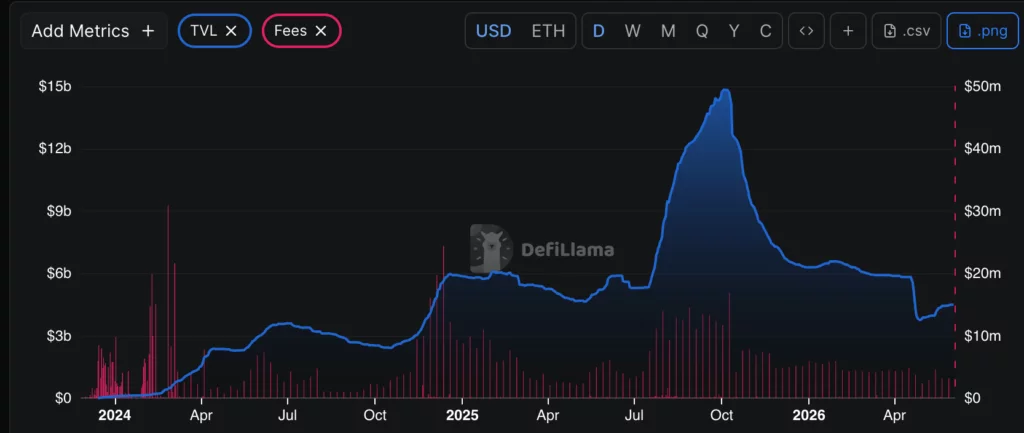
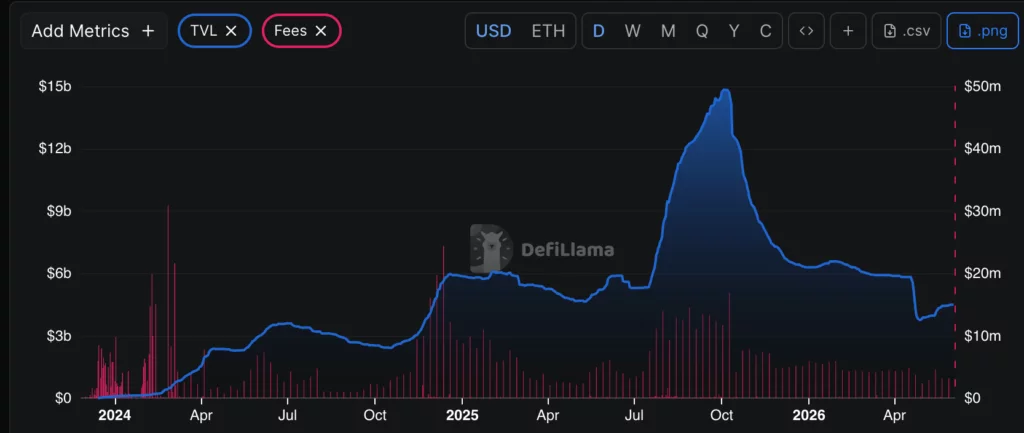
According to DefiLlama data cited in the announcement context, Ethena holds about $5.4 billion in total value locked. The USDe contract accounts for about $4.5 billion of that amount.
Source: DefiLlama
DefiLlama data also show Ethena is generating $178 million in annualized fees. The protocol has generated $972 million in cumulative fees and $332 million in cumulative protocol revenue since Ethena Labs was founded by Guy Young in 2023.
ENA, the protocol’s governance token, has a market capitalization of about $859 million and a fully diluted valuation of roughly $1.4 billion, based on the same market data.
ENA rises after the announcement
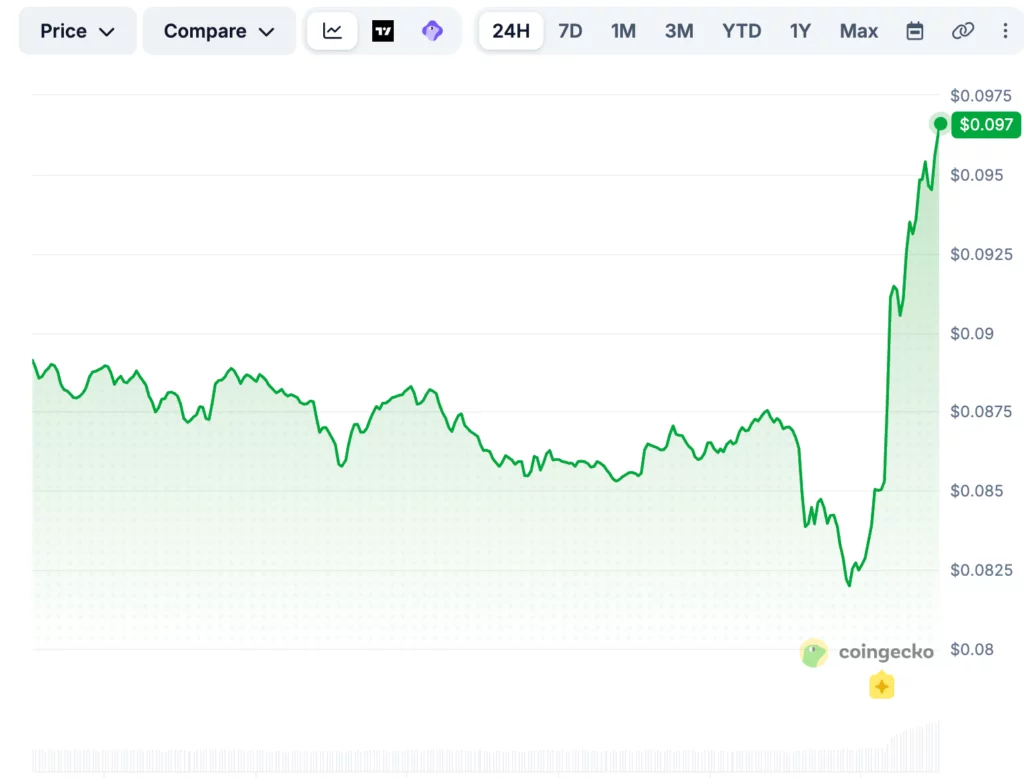
Market data showed ENA rose 8.3% over the past 24 hours after the announcement. DefiLlama showed 24-hour ENA trading volume of $168 million.
Source: Coinglass
At the same time, DefiLlama showed $178 million in on-chain ENA volume through Uniswap V3 and Aerodrome. The reported on-chain volume exceeded the centralized exchange flow during the period.
Ethena and Coinbase have not provided more details on the product expected next week. Coinbase already serves as the primary custodian for ENA held by the Ethena Labs core team and Foundation under a previous Coinbase Prime agreement.



Key takeaways
- HYPE hit a new all-time high of $75 on Tuesday, driven by rising institutional demand amid broader market weakness.
- Grayscale has advanced plans to launch its spot Hyperliquid ETF HYPG this week.
Hyperliquid’s native token, HYPE, surged to a new all-time high of $75.52 on Tuesday, extending its recent rally as growing institutional interest and expanding ecosystem activity continue to drive demand.
Grayscale to launch a Hyperliquid ETF
A key catalyst behind HYPE’s latest gains is increasing competition in the exchange-traded fund (ETF) market.
Grayscale is preparing to enter the race with a spot Hyperliquid ETF after filing an amended S-1 registration statement with the U.S. Securities and Exchange Commission (SEC).
Bloomberg ETF analyst James Seyffart noted that the amendment suggests the fund could launch in the near future, potentially within days.
The proposed ETF will trade under the ticker HYPG and carry a management fee of 0.29%, undercutting competing products.
Institutional appetite for HYPE has already been demonstrated by the success of Bitwise’s Hyperliquid ETF, BHYP. The fund attracted roughly $20 million in inflows on Friday, marking its largest single-day inflow since launch.
After just 11 trading days, BHYP has surpassed $100 million in assets under management (AuM), supported by cumulative inflows of $81.8 million. The ETF has also generated average daily trading volumes of $35.1 million.
Bitwise has further aligned itself with the Hyperliquid ecosystem by committing to hold 10% of its annual management fees in HYPE tokens on its balance sheet for at least 12 months.
According to onchain analytics platform Lookonchain, Bitwise purchased an additional 336,474 HYPE tokens, valued at approximately $24.4 million, over the past 24 hours.
The latest acquisition highlights continued institutional accumulation as investors seek exposure to the rapidly growing Hyperliquid ecosystem.
Hyperliquid price outlook: HYPE retraces after reaching a new all-time high
Despite reaching a record high of $75.52 earlier in the day, HYPE was trading at $72.28 at the time of writing, up by 1% over the previous 24 hours.
However, the token remains one of the strongest-performing digital assets as institutional adoption and ETF-related demand continue to accelerate.
The RSI of 65 shows that HYPE is bullish but is yet to enter the overbought region, creating room for further growth.
If the bullish trend persists, HYPE could extend its rally and create a new all-time high around the $80 level.

However, if the pullback extends, HYPE could retest the Sunday low of $67. An extended bearish trend could see HYPE drop below $60 for the first time since May 28.

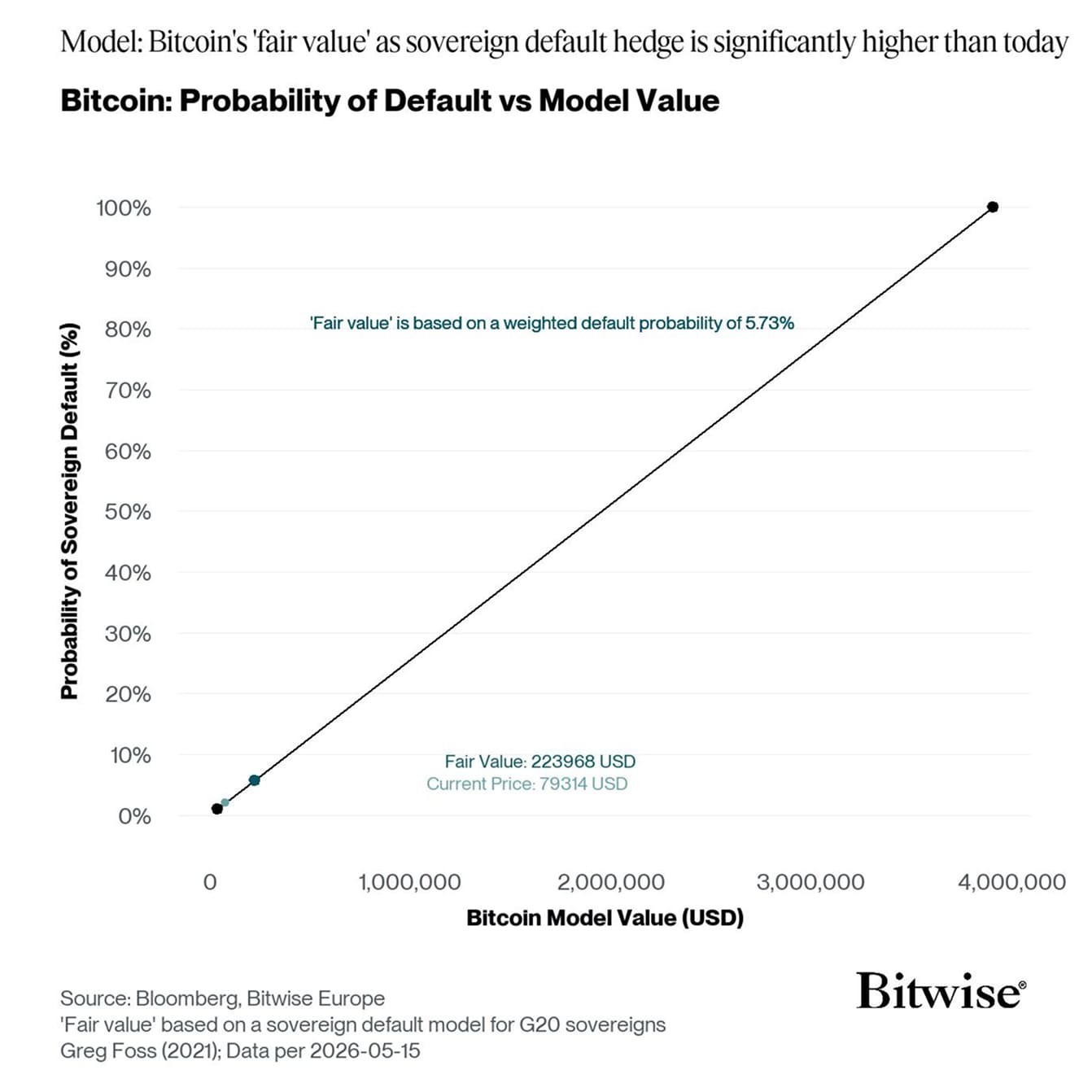
New reporting from Bitwise suggests that Bitcoin’s (BTC) undervaluation could expand if investors’ concerns over sovereign debt deepen. The asset management firm said that mounting pressure in global bond markets and rising government debt levels could strengthen Bitcoin’s role as a hedge against macroeconomic risks, with one valuation model suggesting a theoretical fair value of $224,000.
Debt market turmoil may support Bitcoin in the long-term
Bitwise pointed to mounting pressure across the global bond markets. The Organization for Economic Co-operation and Development (OECD) estimates governments and companies will need to borrow roughly $29 trillion in 2026, up 17% from 2024 and nearly double the amount raised a decade ago. Around 78% of OECD government borrowing is expected to be used solely to refinance existing debt.

10-year sovereign swap spreads across nations. Source: Bitwise
Bitwise noted that Japan remains a key focus. The country’s 10-year government bond yield recently climbed to 2.78%, while its 30-year bond yield reached a record high. At the same time, Japan’s public debt stands near 230% of GDP, among the highest levels in the current macroeconomic environment.
The report noted that Japanese investors hold approximately $1.2 trillion in US Treasurys, but higher domestic yields are making overseas bonds less attractive. Currently, the 10-year Japanese bond yield is 2.66% on Tuesday, compared to 2.19% for Yen-hedged 10-year US Treasurys, potentially encouraging capital to return to domestic markets.
Bond market stress is not limited to Japan. US 30-year Treasury yields recently reached 5.11% on May 11, its highest level since 2007, while sovereign risk premiums, measured through 10-year swap spreads, have risen to their highest levels since the European debt crisis of 2011-2012.
While these trends could weigh on risk assets in the short term, Bitwise believes a deeper bond-market disruption could eventually become a bullish catalyst for Bitcoin if central banks are forced to inject liquidity to stabilize financial markets.
Bitcoin probability of default vs model value. Source: Bitwise
The firm cited a model developed by investor Greg Foss that values Bitcoin at roughly $224,000 if it gains broader adoption as a hedge against sovereign default risk. Bitwise stressed that the figure is a theoretical estimate rather than a price target.
Despite the long-term bullish case, the report noted that Bitcoin may remain range-bound in the near term as higher real yields and tighter financial conditions continue to pressure demand.
Related: Bitcoin back in ‘distribution phase’ as extreme fear grips crypto market
Declining real yields may improve Bitcoin’s macro backdrop
Bitwise noted that Bitcoin’s near-term outlook may depend heavily on real interest rates, which measure the Federal Reserve’s policy rate after adjusting for inflation. In the report, real rates are calculated as the Fed Funds rate minus US CPI inflation. Historically, Bitcoin has tended to perform well when real rates fall, as cash and bonds become less attractive in inflation-adjusted terms.
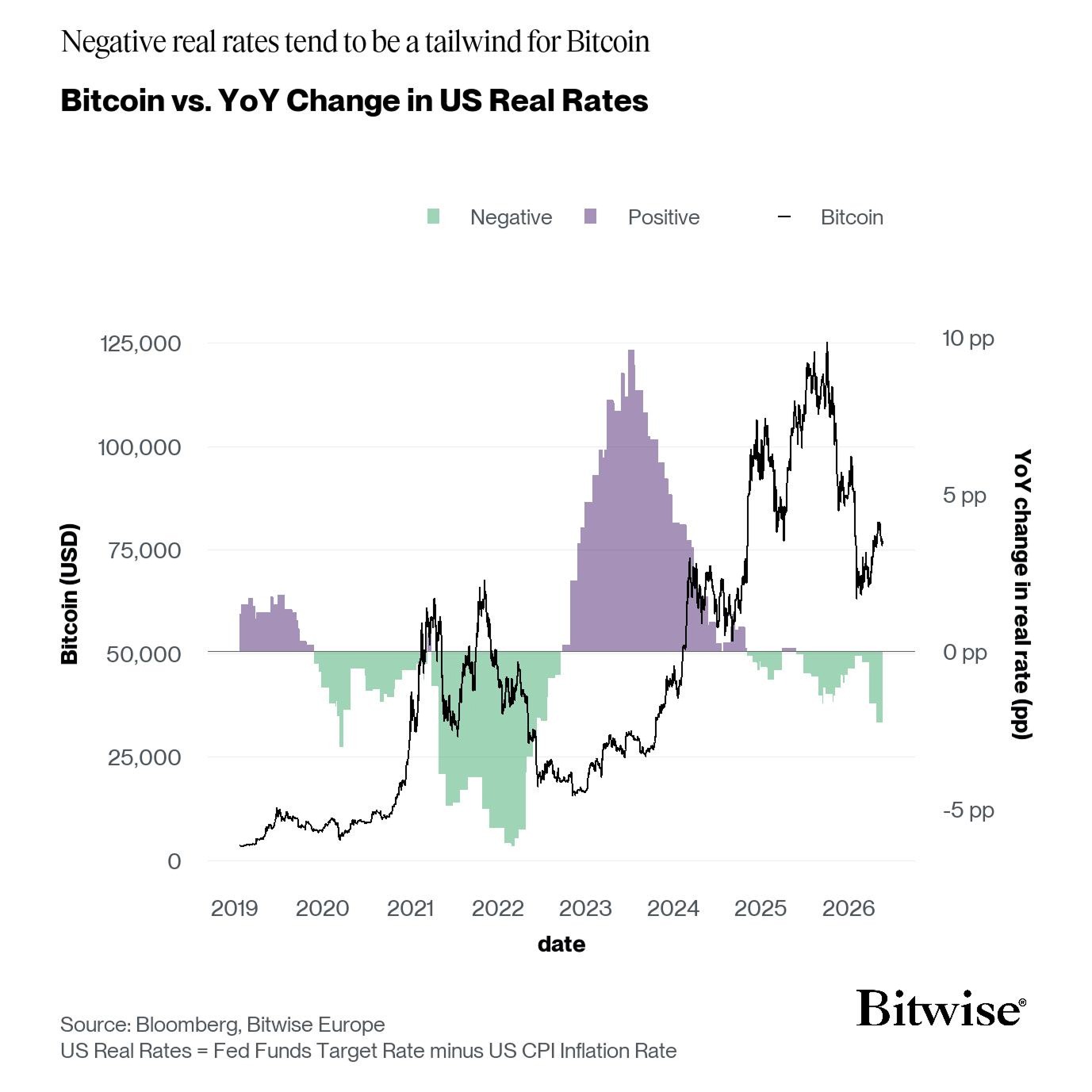
Bitcoin vs year-on-year change in US real rates. Source: Bitwise
The firm noted that Bitcoin’s 2021 bull market coincided with declining real rates, while the 2022 bear market unfolded alongside rising real rates and aggressive monetary tightening. Although real rates remain restrictive, Bitwise said that a scenario in which inflation rises while the Fed keeps rates unchanged could push real rates lower, potentially creating a more supportive backdrop for Bitcoin.
Meanwhile, Bitcoin researcher Sminston outlined that BTC could trade between $90,000 and $255,000 by the end of 2026, based on the Bitcoin Decay Channel, a logarithmic price model that has historically identified major cycle tops and bottoms. The analyst noted Bitcoin’s recent rebound emerged near the model’s long-term support zone, keeping the broader bullish outlook intact.
Related: Bitcoin volatility is down 56% but analysts still expect up to 20% BTC price move
Crypto World
Coinbase (COIN) backs Ethena (ENA) ahead of savings product launch for 100 million users


Coinbase Ventures, the investment arm of crypto exchange Coinbase (COIN), said it had backed Ethena (ENA), buying the protocol’s token on the open market as the two firms prepare to launch a new onchain savings product for the exchange’s more than 100 million users.
Ethena announced Tuesday that it partnered with Coinbase to expand onchain finance and savings offerings, with the first initiative scheduled to launch next week.
“Excited to partner with Coinbase for the first time to support their dollar savings products,” Ethena founder Guy Young said in a post on X. “The upcoming integration next week will be the first time Ethena products are available for their 100m+ user base.”
As part of the deal, Coinbase said it is already Ethena’s primary custodian, wallet provider and perpetuals venue, while the protocol’s USDe yield token will be distributed on the Base network and the “wider [Coinbase] ecosystem.”
ENA, Ethena’s governance token, surged 20% following the news before paring gains. The token was up 3% over the past 24 hours despite the broader crypto market pullback.
The investment marks a notable endorsement from Coinbase as Ethena seeks to expand beyond crypto-native users. Ethena emerged as one of crypto’s fastest-growing protocols, combining stablecoin demand with derivatives-based funding strategies to provide yield to investors in a token form. Assets on the protocol swelled to $15 billion by the October market peak, but since then declined to $5.3 billion as demand and yields vaned amid the crypto downturn.
The announcement comes as lawmakers continue to debate the CLARITY Act, a market structure bill that could provide a clearer regulatory framework for crypto products in the U.S. Young said the legislation could create additional tailwinds for onchain-native assets such as USDe, Ethena’s synthetic dollar token.
Tapping into Coinbase’s user base
While neither company disclosed details of the upcoming product, investors speculated the partnership could significantly expand Ethena’s distribution.
Access to Coinbase’s user base could provide a new source of capital as the protocol seeks to expand beyond decentralized finance into mainstream crypto brokerage platforms.
Yan Liberman, managing partner at Delphi Ventures, an investor in Ethena, said the deal could potentially connect Coinbase’s roughly $19 billion USDC stablecoin ecosystem with Ethena’s yield-generating infrastructure.
“If sUSDe yields clear baseline USDC rates, Coinbase can offer better USDC lending yields,” Liberman wrote on X. “Ethena gets deeper and cheaper funding than native DeFi alone.”
Expansion to institutional credit market with Anchorage
Ethena is also pushing deeper into institutional markets.
On Tuesday, the protocol and crypto bank Anchorage Digital said it had broadened its partnership with Ethena to support institutional lending.
Under the arrangement, Anchorage will manage collateral for Ethena’s loan investments through its Atlas platform, allowing borrowers to keep assets in custody rather than moving them onchain.
The setup aims to make crypto-native lending more accessible to institutions that require regulated custody and compliance controls.
“Institutions want access to crypto-native capital, but not at the cost of custody, controls, or operational rigor,” Anchorage CEO Nathan McCauley said in a statement.
The announcement builds on an existing relationship between the firms. Anchorage Digital Bank already serves as the U.S. issuer of Ethena’s USDtb stablecoin.
Crypto World
Crypto News, June 2: Bitcoin Price Flash Crashes Below $70K, Saylor Explains Strategy Sale, Trump Saving Bibi’s Ass
Bitcoin price endured a brutal start to the week, briefly crashing below $70,000, just now, for the first time since April. This has also triggered a wave of liquidations of $766 million as news on Saylor and Strategy Bitcoin selling hit the market’s trust.
The selloff arrived amid concerns surrounding Mt. Gox, whose latest Bitcoin transfer brought fears of creditor distributions. At the same time, rising geopolitical tensions involving Iran, President Donald Trump, and Israeli Prime Minister Benjamin Netanyahu added another layer of uncertainty.
Discover: The best crypto to diversify your portfolio with
Bitcoin Price Falls Below $70K as Mt.Gox Awakens and Gets Active
Bitcoin’s drop below the psychologically important $70,000 level has somehow caught us off guard. While there was no single catalyst behind the move, weeks of weakening momentum, ETF outflows, and growing market fear created the conditions for a sharp downside break.
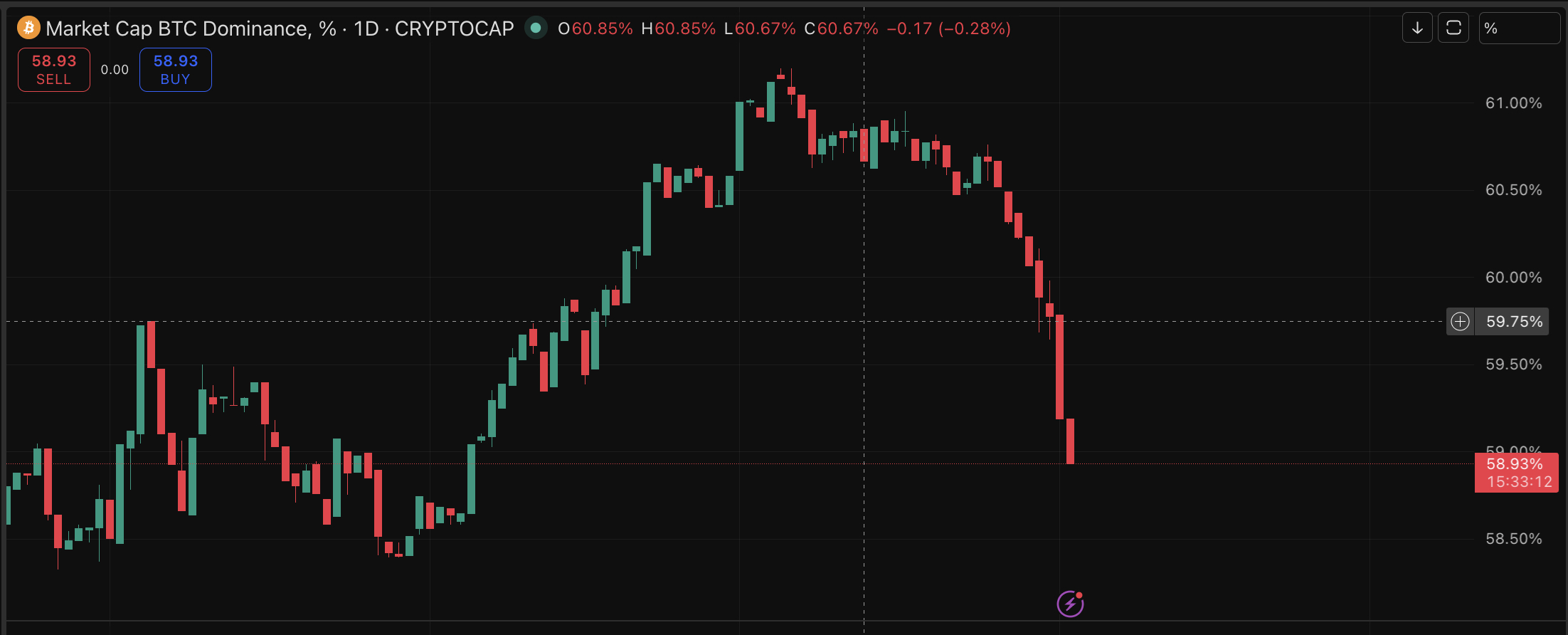
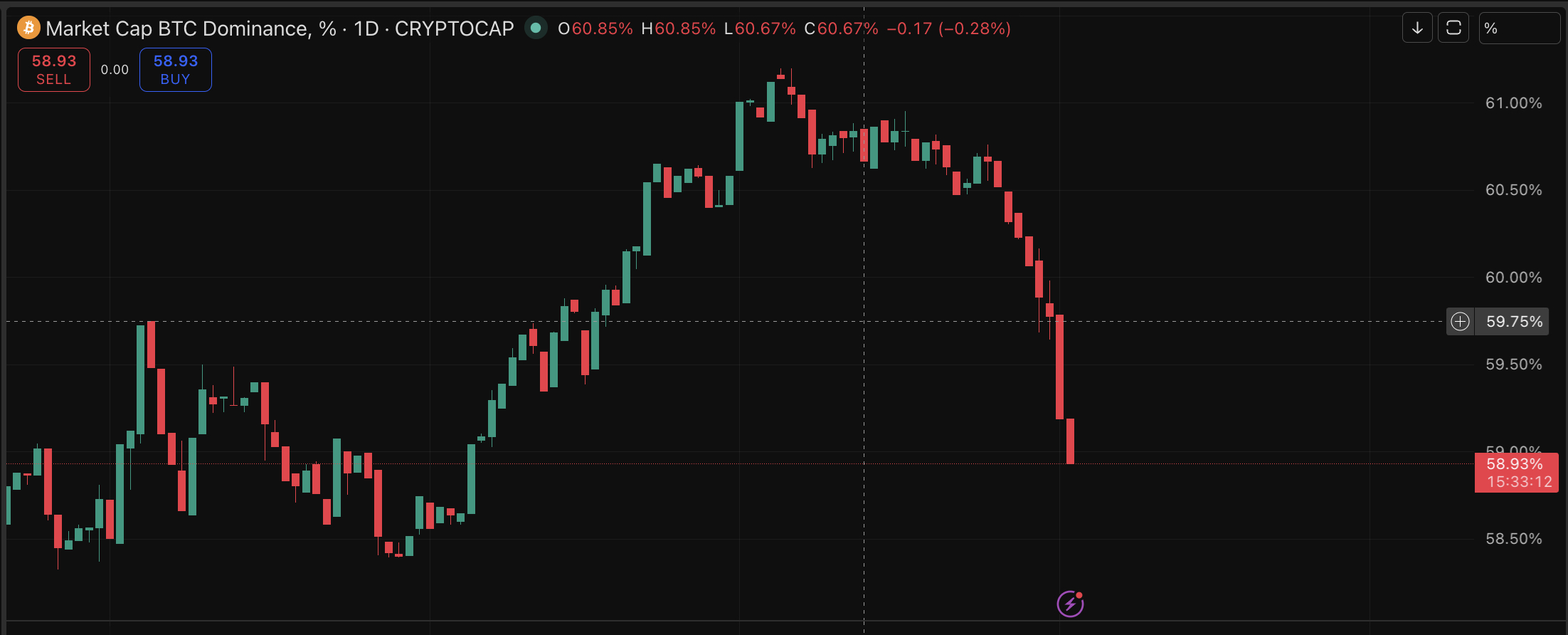
Once key support levels failed, leveraged positions were quickly liquidated, accelerating the decline. Major altcoins followed Bitcoin lower, though Bitcoin’s dominance level is dropping under 60%, showing the strength of altcoins.
The market’s anxiety intensified after Mt. Gox transferred 10,306 BTC, or $731 million, from cold storage into new and hot wallets. The movement marked the largest transfer from the estate in more than two months and sparked speculation that additional creditor repayments are approaching.
For years, Mt. Gox has remained one of crypto’s biggest jeopardizers. The collapsed exchange still controls 34,500 BTC, and with the repayment deadline set for October 2026, investors remain sensitive to any activity involving the estate’s wallets. We just don’t want to see a single sale of creditors’ Bitcoins when they receive theirs. It’s going to be ugly for us.

However, previous repayment-related transfers generated short-term volatility, but markets eventually absorbed the selling pressure. Many creditors have waited more than a decade for repayment and may be less inclined to sell immediately than we expect. For now, the uncertainty alone appears sufficient to keep market sentiment fragile.
Discover: The best pre-launch token sales
Saylor Says Strategy’s Bitcoin Sale Proves Liquidity, It’s a “Nothing Burger,” But Price Says Otherwise
As Bitcoin struggled, attention also turned to Strategy after the company sold 32 BTC worth $2.5 million. The transaction sparked debate, fear, and even memes online as people questioned whether the company was quietly reducing exposure after years of aggressive accumulation. Although Bitcoin ran from $12K to its all-time high, the last time Strategy sold their stack.
But, according to Saylor, the sale was a deliberate demonstration aimed at traditional financial rails, banks, and credit-rating agencies that continue to view Bitcoin as an illiquid or difficult-to-monetize asset on corporate balance sheets.
He challenges them by showing that the ability to convert Bitcoin into cash almost instantly is one of the asset’s greatest strengths. By executing a small sale while maintaining its accumulation strategy, Strategy sought to show that Bitcoin can function as a practical treasury reserve, not just simply a long-term speculative holding.
People are overthinking the 32 BTC sale. — Alex
“Why sell?”
“Why not just buy less next week?”
“Is this bearish?”
Michael @saylor already explained the logic:
• If Bitcoin can’t be sold, critics say it has no value.
• If it has no value, the balance sheet value is zero.
• If the… pic.twitter.com/i8Dx2QpMC4
 (@AlexesNakamoto) June 1, 2026
Saylor described the act as a form of economic arbitrage, clearly showing the depth of both Bitcoin’s spot and derivatives markets. In his view, proving liquidity helps lenders and credit agencies better evaluate companies that hold large Bitcoin reserves.
The proceeds from the sale were reportedly used to meet corporate obligations, including dividend requirements, while allowing the company to remain a net buyer of Bitcoin overall.
Despite criticism surrounding the timing, Saylor dismissed the controversy as a “nothing burger,” insisting that Strategy remains fully committed to expanding its Bitcoin position over the long term.
Discover: The best pre-launch token sales
Trump Called Netanyahu “Crazy” as Geopolitical Tension Hit Bitcoin and The Market Again
Recent reports alleging that Iran continues using crypto networks to bypass sanctions have attracted attention from U.S. regulators and policymakers. The issue has resurfaced amid concerns about how crypto can be used to move funds outside traditional systems. This comes as Axios sources report a growing friction between President Donald Trump and Israeli Prime Minister Benjamin Netanyahu.
JUST IN: — BRICS News (@BRICSinfo) June 1, 2026

 Axios sources say President Trump was "pissed" during call with Israeli Prime Minister Netanyahu and told him off:
"You're f*cking crazy. You'd be in prison if it weren't for me. I'm saving your ass. Everybody hates you now. Everybody hates Israel because of this."… pic.twitter.com/Im1NvO1Jdj
According to insiders, Trump has become increasingly frustrated with Israel’s approach toward Iran, with reports believing tensions between the two leaders have grown hotter behind closed doors. While political disagreements are nothing new, any deterioration in U.S.-Israel coordination could affect Middle East stability and global markets.
For crypto investors, geopolitical events often create conflicting forces. On one hand, rising uncertainty can trigger a big sell-off. On the other hand, Bitcoin is increasingly viewed as a neutral asset that operates outside traditional financial and political systems.
As the market digests Mt. Gox developments, Strategy liquidity demonstration, and a growing list of geopolitical concerns, we are now watching with pain. Follow us here for more news, and maybe pains.
Discover: The best crypto to diversify your portfolio with
The post Crypto News, June 2: Bitcoin Price Flash Crashes Below $70K, Saylor Explains Strategy Sale, Trump Saving Bibi’s Ass appeared first on Cryptonews.

Key Insights
- Speculative behavior is prevalent in the cryptocurrency market, especially leveraged trading and memecoins
- Vitalik Buterin, co-founder of Ethereum, is once again highlighting the need for real use cases for blockchain technology
- The builders and traders of crypto are split regarding what lies ahead for the industry
Utility Questioned as Speculation Grows More Prevalent in the Market
The issue of crypto utility has recently re-entered the spotlight, as the digital asset market seems to place more emphasis on speculation rather than practical applications of blockchain technology. Although blockchain solutions were introduced as revolutionary technology intended to disrupt traditional spheres like finance, personal data storage, and digital ownership, recent developments show that speculation continues to be a major driving factor in the crypto space.
Whether cryptocurrencies and other technologies built atop blockchain are becoming more decentralized or are simply drifting from their original vision is a question the industry often debates. This debate has become sharper as leverage products, memecoins, and volatile tokens have attracted increasing amounts of capital in various crypto markets. Utility versus speculation has once again emerged as a key topic for discussion.
Speculative Activities Gaining Momentum
In a recent debate on platform X, there were renewed warnings about the growing presence of speculative activities in the cryptocurrency space. The discussion emphasized that market actors still seem to opt for risk-reward games even amid calls to emphasize utility-driven developments.
Trading on margin continues to be one of the major drivers of market activity. Traders have increasingly turned to leveraged positions to amplify profits, which often results in short-term price fluctuations rather than long-term investing. Leveraging can boost returns in favorable conditions but also increases overall volatility.
Memecoins are still gaining traction. Cryptocurrencies spawned from internet trends and culture have seen huge trade volumes while often delivering little in the way of practical utility. Finally, another class of instruments receiving attention is perpetual trading products that reflect specific narratives or events in the market environment.
Ethereum’s Original Vision Returns to Focus
The discussion also referenced concerns frequently raised by Ethereum co-founder Vitalik Buterin regarding the long-term direction of the industry. Buterin has consistently emphasized the importance of building meaningful blockchain applications that solve real-world problems rather than focusing exclusively on market speculation.
When Ethereum launched, its vision extended beyond simple cryptocurrency transactions. The platform introduced programmable smart contracts, enabling developers to create decentralized applications that operate without traditional intermediaries. This innovation opened the door to a wide range of use cases, including decentralized finance (DeFi), digital identity solutions, tokenized assets, and decentralized governance systems.
Over the years, Ethereum became the foundation for many significant developments within the blockchain sector. These innovations showed how distributed ledger technology can provide practical benefits across numerous industries. However, critics argue that excessive speculation risks overshadowing these advancements. As capital increasingly flows toward short-term trading opportunities, utility-focused projects may struggle to attract the same level of attention and investment.
Builder Versus Traders Continue to Split Apart
There have been noticeable differences among various communities in the crypto world. In particular, there is a growing divide between builders, technologists, and developers who focus on creating robust technological platforms to promote blockchain adoption, and traders who concentrate on liquidity and volatility. Builders aim to develop technologies that provide real value to the industry.
Traders focus on generating fast profits through speculative trades. These differences tend to be more pronounced when crypto markets are performing well, as traders chase quick gains using risky products. Nonetheless, speculators remain relevant because they contribute to market liquidity and participation.
Cryptocurrency Utility’s Future Is Still Unclear
Such conflicting opinions illustrate one of the most relevant issues in the digital asset world right now: what will create value in the long run? Proponents of utility-oriented projects believe blockchain will succeed by offering solutions and real-world applications. Supporters of the market’s speculative side argue there is nothing wrong with betting on a potential future success story. For now, both trends shape the evolution of cryptocurrency markets.
The debate is likely to continue as capital, talent, and attention shift between building and trading. Stakeholders will watch which model attracts sustained adoption and real economic activity.

Los Angeles Mayor Karen Bass (L) and Los Angeles mayoral candidate Spencer Pratt.
Los Angeles Times | Getty Images
Los Angeles voters are heading to the polls Tuesday to elect their next mayor, a race that has put all eyes on the nation’s second-largest city.
But if no one reaches more than 50% of the vote after all the ballots are counted, the top-two vote getters will head to a November runoff. Traders on prediction market platform Kalshi think the incumbent Mayor Karen Bass and insurgent former reality TV star Spencer Pratt are most likely to advance to the second round.
Traders are fairly certain Bass will make it to the second round, giving her 93% odds. Bass has consistently led in public polls of the race, though has been well short of the 50% mark for an outright win in the first round. Pratt has about a three-in-four chance of advancing, according to traders.
City Councilmember Nithya Raman is also challenging the incumbent. Raman has a 28% chance of advancing to the second round.
Los Angeles mayoral elections are nonpartisan, though Pratt is a registered Republican, while Raman and Bass are Democrats.
Traders once viewed Raman as the favorite to win the mayor’s office, with nearly a 60% chance of victory at one point, though her odds collapsed on Kalshi after a May debate. Her chances of winning the whole race are now at just 11%.
The fall was so notable that Pratt has made several comments about it on the campaign trail. “She went from 64% on Kalshi, to 8%,” he said on Bill Maher’s “Club Random” podcast. “So she got bombed, she’s done.”
Pratt, though, only has a 25% chance of winning the mayor’s office. Traders place 65% odds that Bass is re-elected.
While Bass was seen as vulnerable after her approval ratings fell following her handling of wildfires that swept the city and surrounding region in 2025, Pratt’s conservative-leaning politics could be a barrier to earning support from a majority of voters in a very blue city. Former Vice President Kamala Harris won 70% of Angelenos’ votes in the 2024 presidential election.
Disclosure: CNBC and Kalshi have a commercial relationship that includes customer acquisition and a minority investment.

TLDR
- Microsoft launched MAI-Code-1 to generate source code from written prompts.
- MAI-Code-1 is available through GitHub Copilot and Visual Studio Code.
- Microsoft introduced MAI-Thinking-1 as a reasoning model focused on lower token costs.
- MAI-Thinking-1 is available in private preview through Microsoft Foundry.
- Microsoft is building more in-house AI models while still partnering with OpenAI and Anthropic.
Microsoft used its Build conference in San Francisco to introduce new in-house AI models for developers. The company launched MAI-Code-1 for software generation and MAI-Thinking-1 for reasoning tasks.
Microsoft Enters AI Coding With MAI-Code-1
MAI-Code-1 turns written prompts into source code for applications and websites. Microsoft introduced the model as demand grows for text-based software development tools. Developers now use natural language prompts to build code, interfaces, and basic products. This practice has gained attention under the “vibe coding” label.
Microsoft placed MAI-Code-1 inside GitHub Copilot and Visual Studio Code. That gives the coding model direct access to the company’s developer user base. Kyle Daigle, Microsoft’s developer marketing chief and GitHub operating chief, described the model as “inference ultra-efficient.”
The company used that point to highlight lower operating demands. The new model also gives Microsoft more control over AI coding costs. The company can run its models on Azure instead of paying outside model providers.
MAI-Thinking-1 Targets Reasoning at Lower Token Costs
Microsoft also introduced MAI-Thinking-1, a reasoning model built for performance and cost control. The company positioned the model as medium-sized and efficient. Daigle wrote that MAI-Thinking-1 was “built for high efficiency and performance.” He added that it runs “at a low token cost.”
Developers use tokens to pay for AI model input and output. Therefore, lower token costs can reduce spending for companies that run large workloads. MAI-Thinking-1 has entered private preview through Microsoft Foundry.
The service helps customers integrate AI models into software applications. Customers can register interest before Microsoft makes the reasoning model widely available. The company has not provided a full release date for broader access.
Microsoft Builds More of Its Own AI Stack
Microsoft has invested heavily in leading AI companies while building its own systems. The company committed $13 billion to OpenAI and $5 billion to Anthropic. It also offers OpenAI and Anthropic models through Azure cloud services. However, its new models give developers another path inside Microsoft’s own ecosystem.
The company’s strategy comes as OpenAI and Anthropic pursue public market plans. As we had reported, Anthropic confidentially filed for an initial public offering on Monday. OpenAI has also explored a possible offering this year, according to the report. Both companies have recorded strong growth during the current AI cycle.
Microsoft faces competition from Google, which released Gemini 3.5 Flash in May. Google designed that model for coding and other tasks inside its own data centers. At Build, Microsoft also announced updated cloud models for speech recognition and synthetic voice generation. It also revealed image generation updates and small Aion models for Windows PCs.

The largest meme coin by market capitalization has followed the broader crypto market’s decline, but that hasn’t stopped analysts from making bullish price predictions.
Several technical indicators reinforce the optimistic outlook, suggesting bearish pressure may soon ease.
Rebound Incoming?
As of this writing, DOGE trades at around $0.096, representing a 6% plunge on a weekly scale. While this might sound concerning, the meme coin has held up far better than BTC (down 10% during this period) and well-known altcoins such as BCH and SUI, which have dropped by almost 20%.
The asset has become the subject of numerous price predictions lately, with Ali Martinez being among the commentators. He claimed that the TD Sequential indicator has flashed a buy signal on DOGE, adding that if the $0.096 support holds firm, $0.11 could be next. X user CryptoBoss made a similar forecast, arguing that the current levels offer a buying opportunity and envisioning a rise to roughly $0.108 in the following days.
CoinForge and MikybullCrypto were even more optimistic. The former thinks the meme coin is about to do “something insane.” They reminded that in 2024 DOGE formed a descending triangle pattern before exploding during the breakout phase.
“In 2026, DOGE is about to form that same breakout phase,” the analyst predicted.
For their part, MikybullCrypto opined that the OG meme coin is at a level that could trigger a massive rally to a new all-time high, setting a target of $2.50. It is important to note that such a price explosion seems unrealistic at this time, given that Dogecoin’s market cap would need to skyrocket to over $385 billion. Currently, BTC is the only cryptocurrency with a higher capitalization than that, while ETH (the second-largest digital asset) has less than $240 billion.
Observing Some Indicators
DOGE’s Relative Strength Index (RSI) backs the bullish case shared by the aforementioned analysts. The technical indicator has dropped below 30, indicating the asset is oversold and potentially poised for a price surge. The index ranges from 0 to 100, and conversely, anything above 70 is seen as a sign of an impending pullback.

Next on the list is Dogecoin’s exchange netflows. According to CoinGlass, outflows have outpaced inflows over the past several days, suggesting that investors have abandoned centralized platforms in favor of self-custody. This development reduces immediate selling pressure.

The post Dogecoin (DOGE) Dips Below $0.10, Yet Key Indicator Flashes a Buy Signal appeared first on CryptoPotato.
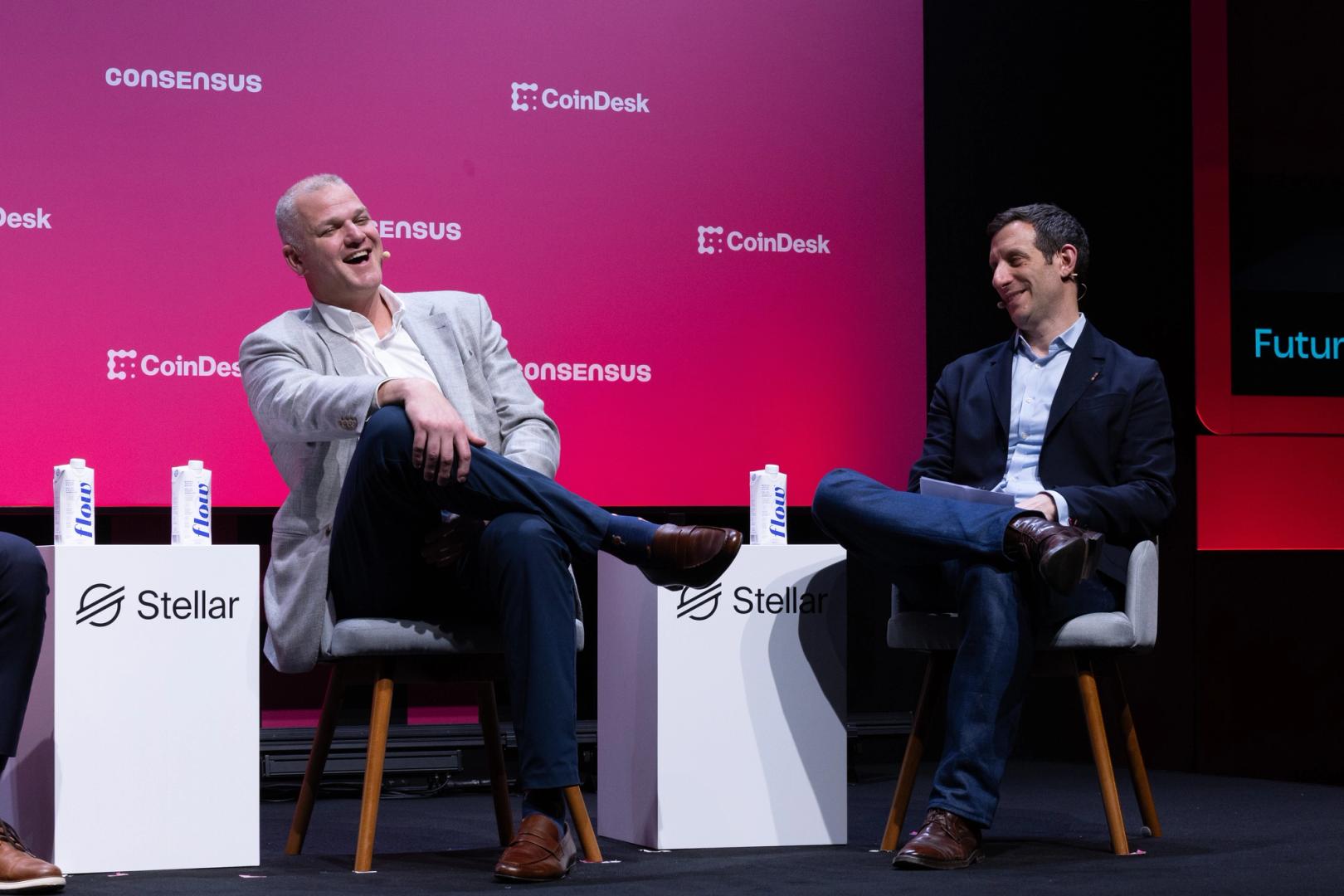
Galaxy Digital (GLXY) said Tuesday it had launched over-the-counter (OTC) prediction markets trading for institutional investors, becoming one of the first major digital asset firms to offer large-scale access to event-driven markets through a bilateral trading framework.
The Nasdaq-listed company said that the new service, offered through its global markets trading desk, will allow hedge funds, family offices and other institutional investors to trade contracts tied to political, economic and geopolitical events while accessing liquidity and trade sizes typically unavailable through retail-focused prediction market platforms.
Shares of the company are down 6% on Tuesday, in line with the broader crypto stock market.
The launch comes as prediction markets have gained traction among investors seeking ways to express views on real-world events ranging from elections and central bank decisions to regulatory developments. Platforms such as Kalshi and Polymarket have experienced rapid growth over the past two years, with many crypto-native companies entering the market.
Galaxy said its offering initially covers non-sports event contracts traded on Kalshi and Polymarket, with plans to expand to additional venues. The firm will also allow clients to combine prediction market positions with hedges across equities, commodities and other asset classes, creating broader event-driven investment strategies.
As part of the launch, Galaxy facilitated a $10 million trade with crypto-focused hedge fund Arca tied to the outcome of the proposed CLARITY Act, legislation that would establish a regulatory framework for digital assets in the United States.
“Event-driven markets are becoming core to how sophisticated investors express macro views, and they deserve institutional infrastructure to match,” Jason Urban, Galaxy’s global co-head of digital assets, said in a statement.
Jeff Dorman, Arca’s chief investment officer, said prediction markets offered an effective way to hedge the fund’s exposure to ongoing negotiations in Washington surrounding crypto regulation, but that liquidity constraints on existing platforms made it difficult for large investors to participate directly.
The move reflects a broader institutionalization of prediction markets, a sector that has historically been dominated by retail traders. By acting as a principal counterparty, Galaxy can warehouse risk and facilitate larger transactions while providing greater discretion than exchange-based trading.
Earlier today, Polymarket completed its first block trade in a transaction between crypto broker FalconX and trading tech startup Anera Labs.
Industry observers say the entrance of firms such as Galaxy could help deepen liquidity and improve pricing efficiency in prediction markets by bringing professional investors into the space. Supporters argue that greater institutional participation could make market prices more useful as indicators of future outcomes, while critics caution that regulatory uncertainty remains a key challenge for the sector.
The launch further expands Galaxy’s growing derivatives and trading business. The New York-based firm, which provides institutional digital asset trading, asset management, staking and tokenization services, has increasingly positioned itself as a bridge between traditional financial markets and emerging digital asset infrastructure.

US Commodity Futures Trading Commission (CFTC) Chair Michael Selig has framed enforcement actions taken against Gemini as politically targeted by the Biden administration, arguing that the agency should reset its posture to a nonpartisan baseline. In remarks sent to mainstream media and reproduced in part in a CNBC interview, Selig contended that enforcement has been weaponized and pledged a fresh start focused on rule of law rather than politics. He also signaled that recent staff reductions in the agency may reflect an emphasis on addressing what he characterized as “lawfare” against the crypto industry.
“The Biden administration weaponized the federal agencies against the crypto industry and many other industries,” Selig stated. “They politically targeted people like the Winklevoss twins, and that’s not acceptable. We’re righting those wrongs. We’re gonna start fresh. The agency should not be used to engage in lawfare.”
According to the context provided by Cointelegraph, Selig’s remarks come as the CFTC pursued a nuanced realignment of its enforcement approach after a period of controversy surrounding Gemini. The agency, under his leadership, has also moved to reverse a prior settlement against Gemini—an action the commission described as part of its ongoing effort to revisit and, where appropriate, correct past positions.
In the same timeframe, the CFTC sought a federal court’s intervention to vacate a $5 million settlement with Gemini that had been reached in January 2025, prior to Selig’s accession as chair. Gemini’s co-founders, Tyler and Cameron Winklevoss, have longstanding political ties, including donations to Donald Trump’s 2024 campaign and attendance at White House events related to administration initiatives, including the GENIUS Act’s signature ceremony. Selig declined to discuss the specifics of the Gemini matter, noting that the investigation and litigation remain active, but underscored the broader aim of ensuring enforcement actions reflect neutral, nonpolitical application of the law.
“I’m not going to get into the facts, because this is an active investigation, litigation, but what is important here is that to the extent the agency was used to politically target folks, we’re reversing that, and we’re starting fresh,” Selig told CNBC in the interview. Cointelegraph notes that this framing fits into a broader narrative about regulatory reorientation under the current leadership.
Key takeaways
- The CFTC chair alleges political targeting of Gemini’s founders by the Biden administration, framing enforcement as partisan prior to his tenure.
- The agency moved to vacate a previously agreed $5 million settlement with Gemini, signaling a broader reexamination of past actions.
- Selig positions federal commodities law as superseding state prerogatives in certain market structures, reinforcing a centralized enforcement stance.
Gemini settlement, litigation, and enforcement posture
Under Michael Selig, the CFTC has actively pursued steps aimed at recalibrating prior enforcement outcomes. In a development cited by outlets familiar with the matter, the commission asked a federal court to vacate the January 2025 Gemini settlement, a move that would undo the framework of the previously agreed resolution. The timing and rationale for the move appear to align with Selig’s stated objective of “starting fresh” and ensuring enforcement actions are grounded in robust legal merit rather than political considerations. While the agency has not disclosed detailed grounds for seeking to unwind the settlement, the action underscores a willingness to revisit high-profile cases that occurred before his tenure.
Gemini’s founders, Tyler and Cameron Winklevoss, have publicly engaged in U.S. political fundraising and policy events in recent years, including help for President Trump’s campaign and participation in administration-led initiatives such as GENIUS Act signings. While Selig declined to discuss the factual matrix of the Gemini case during interview remarks, he reiterated that the ongoing investigation and litigation will dictate the procedural trajectory, even as he asserts a broader corrective aim at the agency’s enforcement posture.
Analysts note that this move—if sustained—could carry significant implications for normalization and predictability of CFTC enforcement, particularly for crypto platforms that navigated earlier settlements. It also frames the Gemini matter within a broader discourse about the independence of investigative actions from political influence, a concern repeatedly raised by lawmakers and industry observers.
Federal law, state authority, and the regulatory landscape
In his public statements and policy orientation, Selig has reaffirmed the CFTC’s stance that federal commodities law can supersede state regulations in certain domains—most notably in the governance of prediction markets. The agency has pursued litigation against state authorities, including Minnesota, challenging restive measures to curtail or ban such platforms. This posture signals a continued push to centralize regulatory authority over core crypto-futures and related markets, reinforcing a federal framework for compliance and enforcement that may limit state-level maneuvering by policymakers and market participants alike.
These dynamics come at a moment when U.S. policymakers, regulators, and industry participants are wrestling with a complex patchwork of jurisdictional authority, licensing regimes, and cross-border compliance considerations. The enforcement approach described by Selig—emphasizing the primacy of federal standards—could influence how crypto exchanges and prediction-market operators structure products, manage risk, and coordinate with supervising authorities across states and, where relevant, international jurisdictions.
Conversations around leadership and governance within the CFTC have intensified in 2025 and 2026, as resignations and departures contributed to Selig’s status as the agency’s sole commissioner. The absence of a complete bipartisan panel raises questions about policy continuity and the breadth of perspectives shaping rulemaking and enforcement priorities. In public statements, lawmakers have urged President Trump to nominate a bipartisan slate of commissioners to restore a full five-member leadership body, though no new appointments had been announced as of the latest briefings. The evolving leadership dynamic adds a layer of regulatory risk for firms seeking stable, long-term compliance expectations from the agency.
Legal and policy implications for the industry
The described reset carries practical implications for crypto firms, including exchanges, lenders, and market participants engaged in derivative-like products and paid-of-interest structures. A renewed emphasis on nonpartisan enforcement could affect risk management, internal investigations, and the cadence of regulatory disclosures. For entities operating in the United States, the shift may influence how material enforcement actions are communicated to investors, and how compliance frameworks are structured to withstand potential policy pivots at the federal level.
The policy trajectory also intersects with broader regulatory initiatives, including ongoing discussions around stablecoins, banking access, licensing regimes, and cross-border regulatory alignment. While specific rulemakings are not detailed in Selig’s public remarks, the broader context points to heightened scrutiny of crypto-native products under a centralized enforcement paradigm, with potential ripple effects on ancillary services such as custody, settlement, and risk management infrastructures.
Closing perspective
As the CFTC continues its review of past actions and charts a path toward what Selig describes as a “fresh start,” industry observers will monitor how the agency balances enforcement rigor with procedural fairness and transparency. The Gemini matter, the leadership question at the agency, and the broader federal-state dynamic together illustrate a regulatory landscape in flux—one that could shape compliance expectations, product design, and cross-border operations for years to come.

HYPE hits new ATH as ETF momentum and institutional demand fuel rally

Stassi Schroeder Reportedly Followed 600-Calorie Diet

‘Comfortable’ Michael Dunlop extends all-time Isle of Man win record with Supersport masterclass



![The Crypto Dump Is Just Beginning! Prepare For Mega Buying Opportunities [ETH & SOL Targets]](https://wordupnews.com/wp-content/uploads/2026/06/1780429707_maxresdefault-80x80.jpg)
-

 NewsBeat6 days ago
Israel says it has killed new Hamas military leader in Gaza City airstrikes
-

 Tech7 days ago
NASA taps Blue Origin to deliver lunar rovers for Moon Base initiative
-

 News Videos4 days ago
This is BROKEN! INSANE 5x MONEY CAR WASH WEEK! The NEW GTA Online UPDATE Today! (GTA5 New Update)
-

 News Videos7 days ago
XRP *JUST* SUCCEEDED!!!! CLARITY ACT EXPOSED!!! (SHE EXPOSED IT)
-
Crypto World7 days ago
Micron Crosses $1 Trillion Market Cap as AI Demand Reshapes Memory Sector
-
 Tech3 days ago
SpaceX just won a second Golden Dome contract. This one is $4.16 billion.
-

 Business7 days ago
Selena Gomez Reportedly Upset Over Benny Blanco’s Comments on Her ‘Terrible’ Diet
-

 Tech5 days ago
Waymo dominates autonomous vehicle registrations as Tesla trails behind
-

 News Videos4 days ago
SHE IS KILLING XRP!!! WATCH URGENT AND ACT FAST
-
 NewsBeat4 days ago
FIRST NIGHT REVIEW: Take That bring the Circus back to life in spectacular sun-soaked style
-

 Business24 hours ago
Jade Biosciences, Inc. (JBIO) Discusses Positive Interim Results From JADE101 Phase I Healthy Volunteer Study and Development Plans Transcript
-

 Tech6 days ago
The Samsung pay deal is the moment Korean unions changed register
-

 Tech7 days ago
Millions of AI agents imperiled by critical vulnerability in open source package
-
Crypto World4 days ago
CFTC Has Approved the First Regulated Bitcoin Perpetual Contract in the U.S.
-
Crypto World6 days ago
SpaceX’s $2 Trillion IPO: Why Tech Giants Nvidia (NVDA), Apple (AAPL), and Microsoft (MSFT) May Face Pressure
-
 Entertainment6 days ago
The Most Misunderstood Sci-Fi Horror Movie of the Last 10 Years Just Took Over Netflix
-
 Crypto World4 days ago
Snowflake (SNOW) Stock Rallies on Strong Q1 Results and AI Product Growth
-
 NewsBeat4 days ago
Novak Djokovic v Joao Fonseca LIVE: French Open latest scores and results after Jannik Sinner’s shocking collapse
-
 Entertainment4 days ago
Weak ‘Supergirl’ Box Office Tracking Amid Milly Alcock Backlash
-

 Business3 days ago
Is the Spurs Phenom Already Better Than Prime Diesel?
You must be logged in to post a comment Login