

Crypto World
Coinbase Could Hit $300 Billion as AI Agents Reshape Finance: Artemis

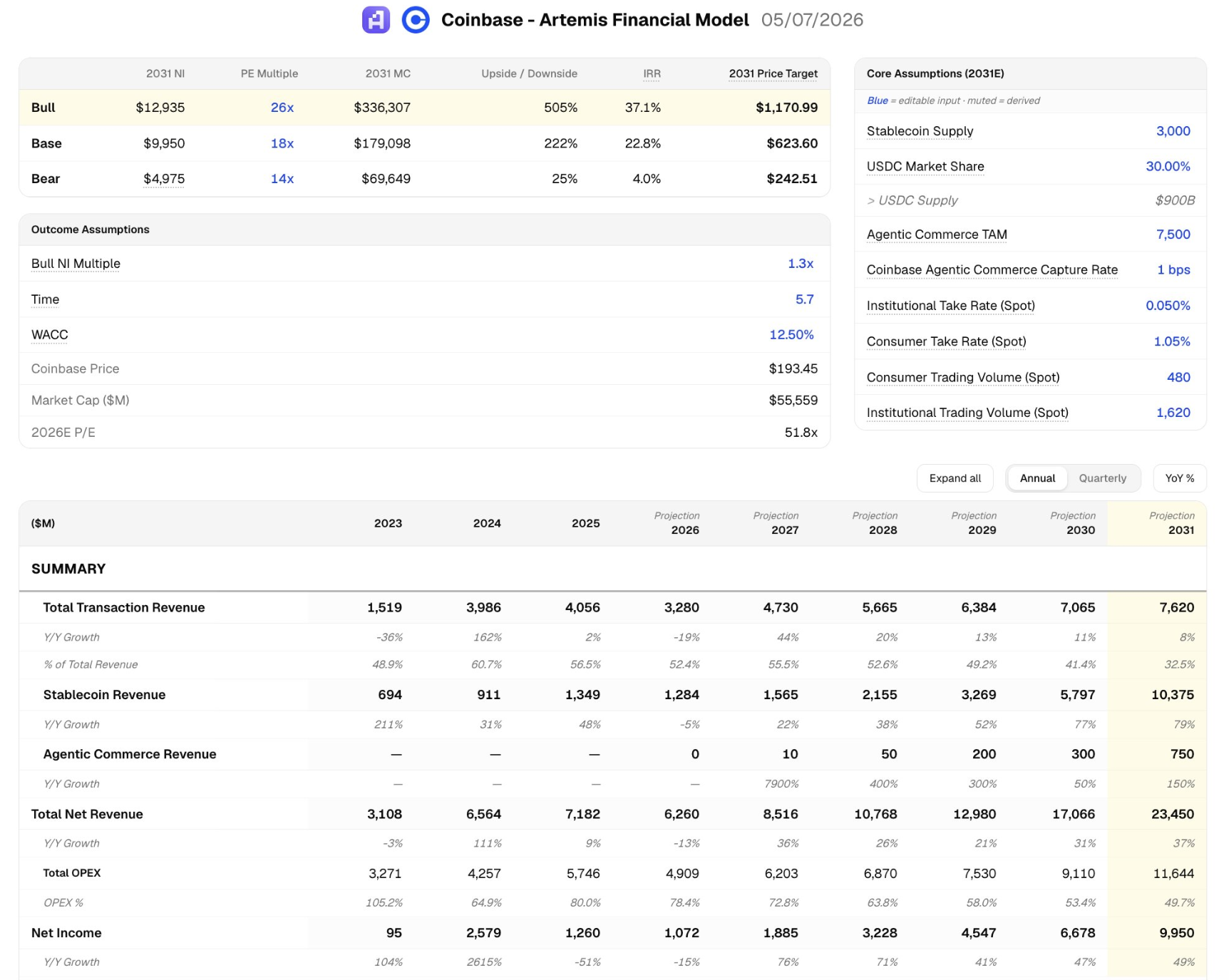
Artemis CEO Jon Ma released an open-source Coinbase (COIN) financial model on Thursday. The bull case projects a $300 billion market cap for the exchange by 2031.
The thesis frames Coinbase as the central winner of AI-native finance. It assumes stablecoin scale, agentic commerce revenue, and a shift toward subscription services through 2031.
Stablecoin and Agentic Commerce Drive the Bull Case for Coinbase
Ma’s model assumes total stablecoin supply will reach $3 trillion by 2031. That figure tracks the trajectory Treasury Secretary Scott Bessent projected for 2030.
USD Coin (USDC) would capture 30% of that supply. The token is distributed heavily by Coinbase through its Circle partnership.
The bull case also leans on agentic commerce. Artemis estimates AI agents will drive $7.5 trillion in annual spending by 2031. Coinbase would capture one basis point of that flow. The exchange co-stewards the x402 protocol with Cloudflare under the Linux Foundation.
Subscription and services revenue would climb from roughly 40% of total revenue today to 65% by 2031. That mix would lower Coinbase’s exposure to volatile trading flows and widen its base of recurring fees.

“In our bull case, Coinbase does ~$23B revenue in 2031 with ~$10B of net income. At 30x PE that assumes ~$300B of marketcap (6x+ from today),” Ma projected.
Coinbase Restructures Around the Same Thesis
The Artemis model arrived the same week Brian Armstrong reduced Coinbase staff by about 14%. He framed the move as a push to make the company lean, fast, and AI-native.
The exchange flattened its hierarchy and built AI-native pods to manage fleets of agents.
Armstrong has pushed engineers to lift AI-generated code above 50% of daily output.
Coinbase has also launched Agentic Wallets to settle machine-to-machine payments. Both moves mirror the assumptions baked into Ma’s spreadsheet.
Whether Coinbase delivers the 6x upside depends on stablecoin policy, agentic commerce adoption, and USDC holding distribution share against newer entrants.
The bear case in the same model values the company near $70 billion.
Subscribe to our YouTube channel to watch leaders and journalists provide expert insights
The post Coinbase Could Hit $300 Billion as AI Agents Reshape Finance: Artemis appeared first on BeInCrypto.

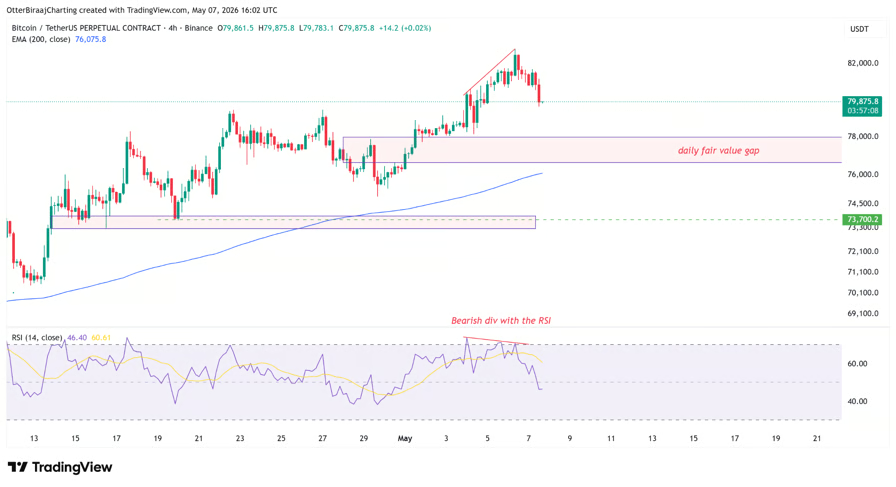
Bitcoin (BTC) price dropped to $79,800 on Thursday after being rejected at a key dynamic resistance level. The pullback occurred despite the weekly spot Bitcoin exchange-traded fund (ETF) inflows surging past $1 billion for the first time since January, but technical data suggests the correction may be short-lived.
Bearish divergences point to where BTC price may go
Bitcoin’s dip below $80,000 came amid a bearish divergence in the relative strength index (RSI) on the one-hour and four-hour charts. A bearish divergence occurs when BTC forms higher highs while the RSI weakens across lower timeframes, signaling fading buying momentum during a rally.
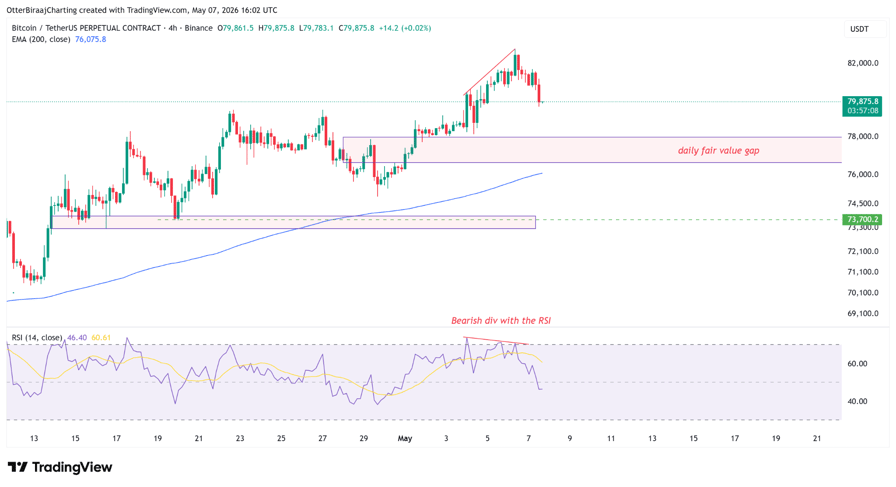
BTC/USDT, four-hour chart. Source: Cointelegraph/TradingView
A hold above the weekly open at $78,500 could stabilize the short-term price action. The key technical support range remains between $76,000 and $78,000, where the daily fair value gap (FVG) aligns with Bitcoin’s 200-day exponential moving average (EMA). If the correction continues, BTC could retest the FVG zone before attempting another rebound above its recent high at $82,800.
A fair value gap marks an area where a sharp price movement previously occurred with limited trading activity, leaving an imbalance that often becomes a liquidity zone during retracements.
Crypto trader Jelle said the “200-day MA/EMA cluster” was acting as resistance, while also identifying $78,000 as the first major support area. According to Jelle, a 200-day moving average retest could allow Bitcoin to retest higher price targets.
Meanwhile, crypto trader Killa XBT identified the $76,300 to $74,700 range as a deeper support zone if selling pressure continues. The trader pointed to the weekly open near $78,500 as the main short-term level that bulls are attempting to defend.
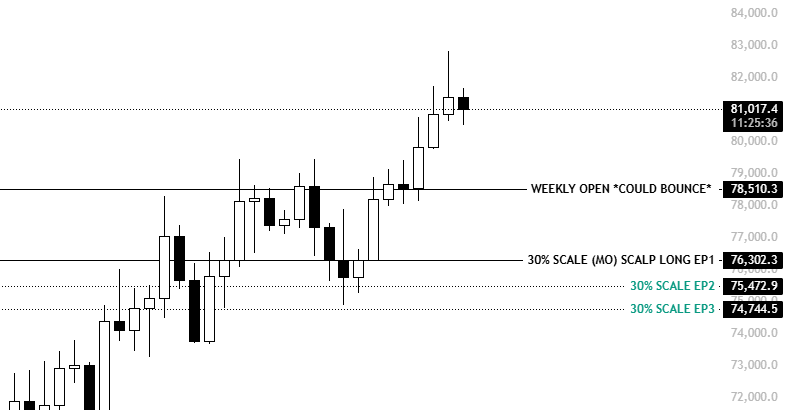
BTC one-day chart analysis by Killa. Source: X
Related: Bitcoin analysts say this level must break for BTC price to confirm bottom
Can spot ETF inflows offset price weakness?
Spot Bitcoin ETF demand strengthened sharply this week. Net inflows reached $1.05 billion, marking the strongest weekly intake since the third week of January. A positive close on Friday would confirm the largest weekly ETF inflow return in nearly four months.
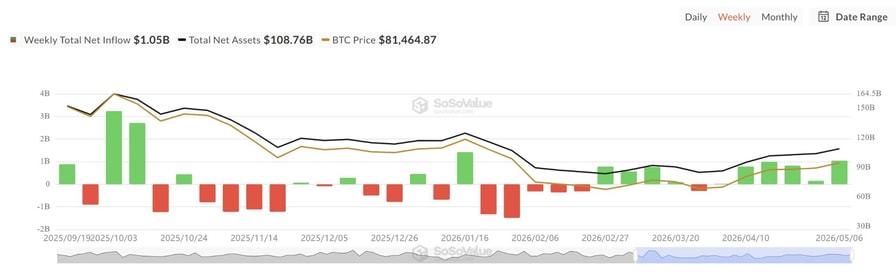
Spot BTC ETF net inflows. Source: SoSoValue
Meanwhile, Swissblock data shows that the Bitcoin Risk Index has reset to near zero, while ETF net flows turned positive again at roughly 3,000 BTC. Historically, elevated risk readings aligned with the ETF outflows and heavier selling pressure across the market.
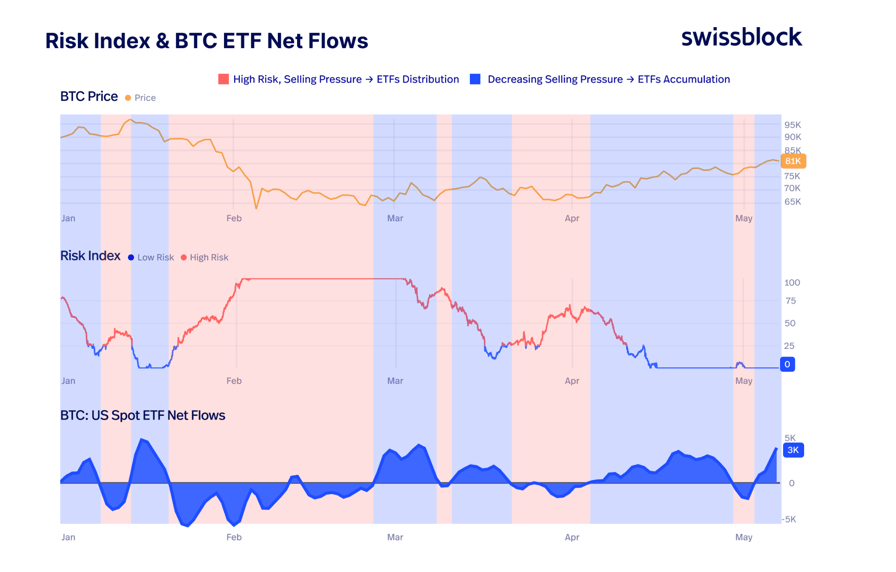
Risk index and BTC ETF net flows. Source: Swissblock/X
The resets into the low-risk zone often coincided with renewed accumulation near the major support clusters. The analysis added,
“That synchronization is still in place. Even when the Risk Index ticked slightly higher last week, ETF selling appeared briefly, but accumulation quickly resumed. That tells us ETF demand is absorbing selling pressure. This remains a flow-driven breakout.”
Related: Bitcoin market dominance moves above 61%: Will altcoins follow?
Public blockchains make transactions transparent enough to trace, audit and police, but that visibility can come at the expense of user privacy. Traditional compliance systems often address accountability by identifying people, but that can undermine one of crypto’s original promises: the ability to transact without exposing personal identity by default.
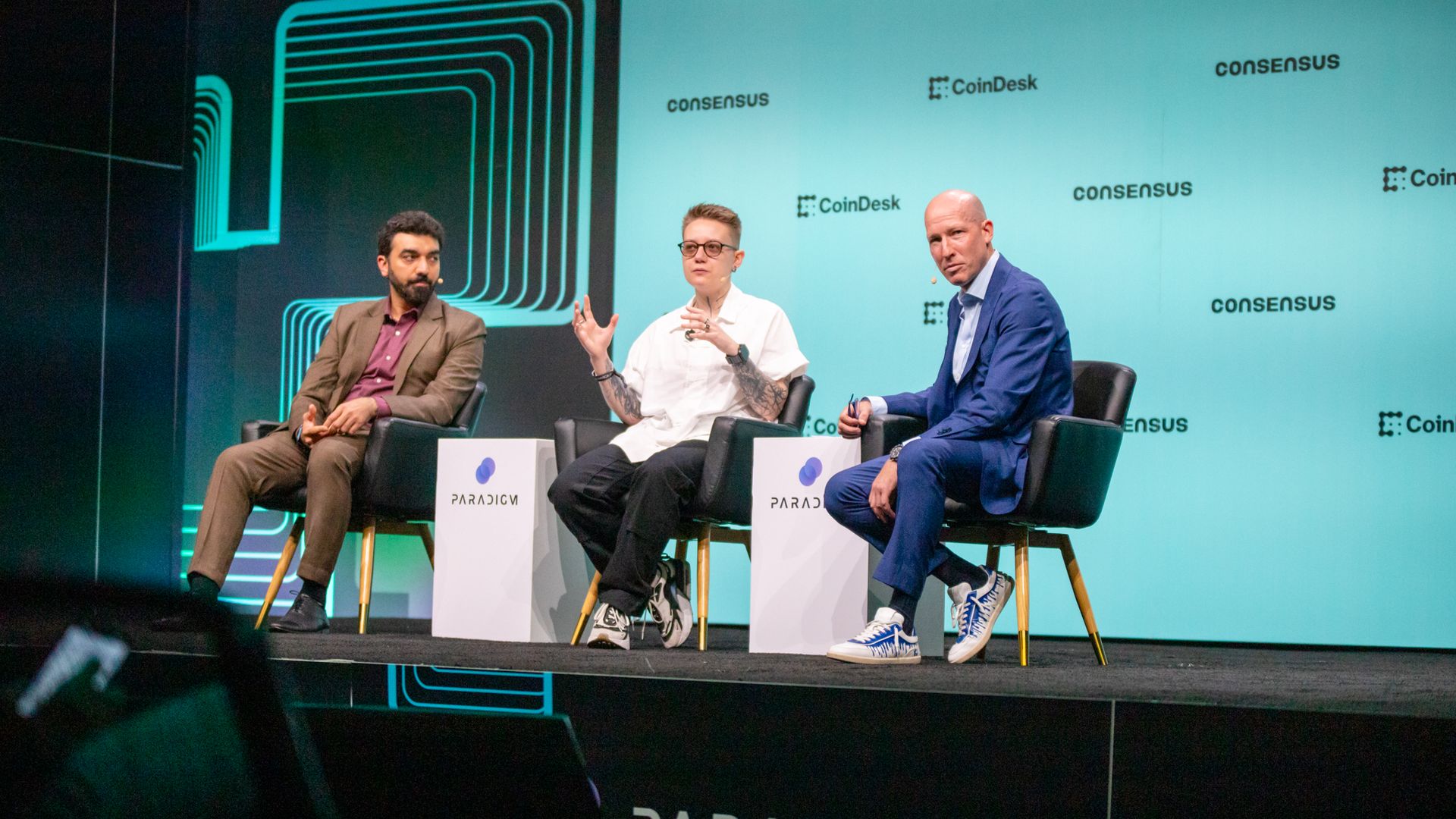
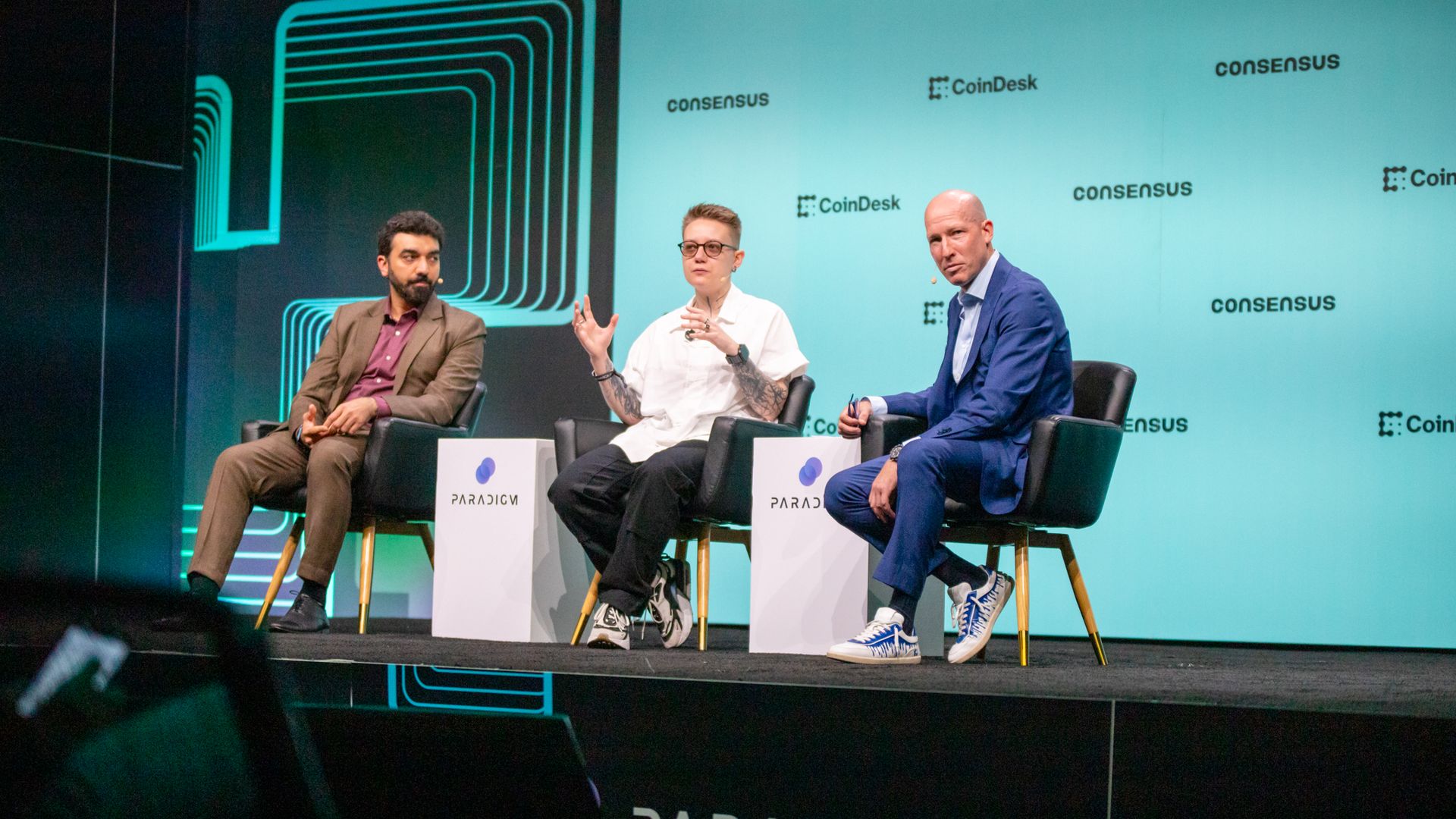
According to panelists at CoinDesk’s Consensus Miami conference earlier this week, those tensions are increasingly solvable through an onchain “intelligence layer” that combines hybrid blockchain architecture with wallet-address-level monitoring.The idea is to split the work across different parts of the system. Private permissioned networks can give institutions the accountability and credibility they need, while public permissionless chains can provide liquidity, and blockchain-forensics tools can help platforms screen transactions at the wallet-address level without automatically tying every user to a real-world identity.
Rajeev Bamra, global head of strategy for digital economy at Moody’s Ratings, said the conventional intelligence layer answers three questions: “Who is it? What are they doing? And can I trust the record?” Those have been addressed in traditional finance by banks, custodians, clearinghouses and credit-rating agencies, he said.
Bamra estimated the institutional digital-finance market at roughly $35 billion today, against more than $200 trillion in annual clearing-house flows in conventional finance, with growth of “over 100 or 150%” in the past 18 months. Blockchain architecture, he predicted, will not be uniformly public or private but a hybrid. “Private permission networks are going to offer the accountability, the credibility aspect,” he said, while “the public permissionless brings the liquidity which the private permissions don’t.”
Pauline Shangett, chief strategy officer at the non-custodial exchange ChangeNOW, firmly sided with the user-side argument. “Bitcoin at its core, at its origin was a semi-anonymous digital cash,” she said.
ChangeNOW, which does not enforce KYC by default, works with AML providers and blockchain forensics firms to monitor flows at the wallet-address level. “All of this blockchain forensics infrastructure allows us to not map people who are passing funds through our system, but instead map their addresses,” Shangett said.
When law-enforcement agencies come to ChangeNOW, Shangett said, the company provides transaction data without doxing the person behind the transaction. She said that compromise allows the platform to provide registration-free swaps while still maintaining internal accounting systems and working with authorities when illegitimate funds move through the service.
On regulation, Bamra said cross-border frameworks like the European Union’s Markets in Crypto-Assets Regulation and the U.S. GENIUS Act ask the same fundamental questions about asset quality, segregation and liability, but diverge sharply at the specifications layer. “We think there is regulatory convergence in intention, but there’s fragmentation in reality or in execution,” he said.
Shangett ended with a regulatory-liability framing, which she suggested cuts to the heart of where responsibility should actually sit.
“The agents who should be held liable for the regulatory frameworks and the adoption thereof are agents who are dealing with emission and not transmission,” she said.
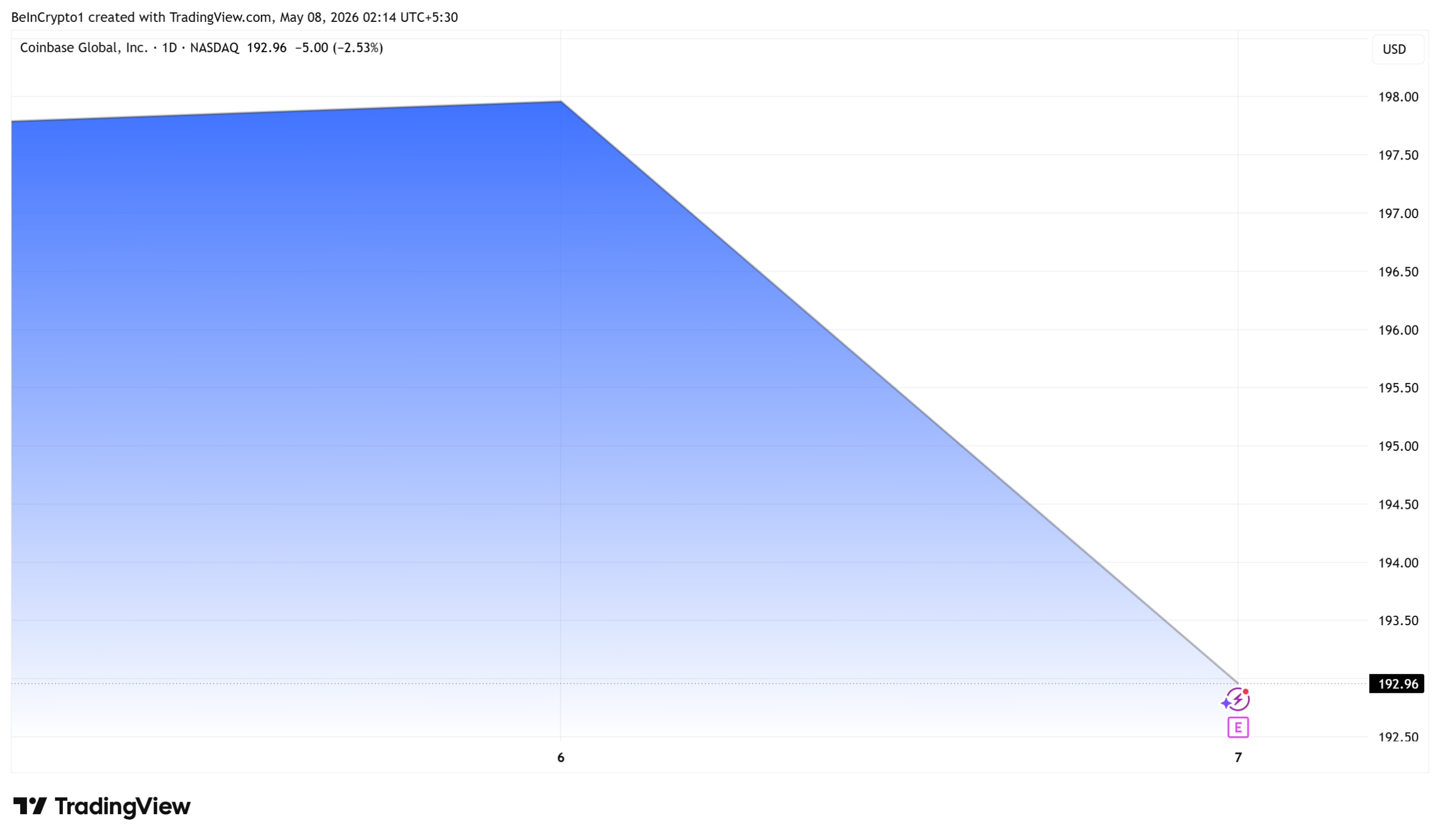
Coinbase (COIN) posted first-quarter 2026 revenue of $1.41 billion, missing Wall Street estimates as crypto trading volumes contracted. Revenue fell 31% year-over-year, and the exchange recorded a $394.1 million net loss, or $1.49 per share.
Transaction revenue of $755.8 million and subscription and services revenue of $583.5 million both came in below sell-side projections. Total crypto market capitalization fell more than 20% during the quarter, weighing on retail order flow.
Trading Slump Drives Coinbase Q1 Loss
Transaction revenue dropped 23% quarter-over-quarter, slightly outperforming the 28% decline in industrywide crypto trading volume. Spot trading on the platform fell 37% as Bitcoin and Ether prices retraced through the quarter.
Consumer transaction revenue came in at $567 million, while institutional transaction revenue fell 27% to $136 million.
The company recorded a $482.4 million unrealized loss on crypto held for investment. Peer holders such as MicroStrategy posted larger markdowns, with a $12.5 billion Q1 loss tied to its bitcoin treasury.

Coinbase’s COIN stock tumbled following the news, falling to $192.96 as of this writing.
Still, Coinbase reported a 13th consecutive quarter of positive adjusted EBITDA at $303.3 million, though the figure declined 46% sequentially.
Crypto trading market share reached an all-time high of 8.6% in the quarter.
Subscription Business Cushions the Blow
Subscription and services revenue accounted for 44% of net revenue, a record mix. The company has positioned the segment as a buffer against trading volatility. Stablecoin revenue contributed $305 million as USDC reached $80 billion in market cap.
Average USDC held in Coinbase products hit $19 billion, up 55% year-over-year, supporting stablecoin economics.
Management guided second-quarter subscription and services revenue between $565 million and $645 million.
The outlook also includes $50 million to $60 million in restructuring charges tied to a 14% workforce reduction.
The headline miss highlights how dependent Coinbase remains on crypto market activity, even as recurring revenue grows.
The post Coinbase Q1 2026 Revenue Falls 31% to $1.41 Billion in Major Wall Street Miss appeared first on BeInCrypto.
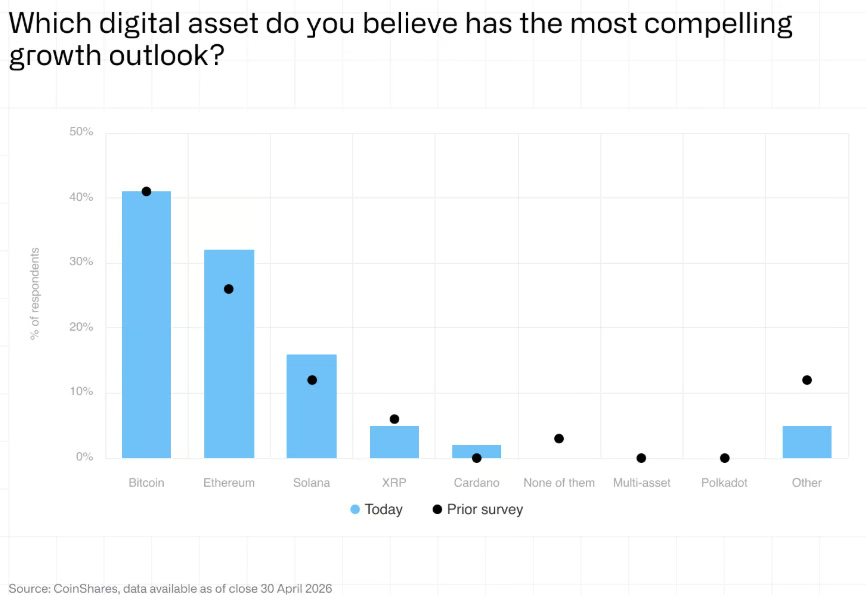
Fund managers are warming back up to digital assets, with Bitcoin continuing to dominate allocation preferences even as broader crypto sentiment improves, according to a new survey by CoinShares.
The April survey gathered responses from 26 institutional investors overseeing a combined $1.3 trillion in assets under management. Allocations to digital assets remain relatively modest, at around 1%, reflecting what CoinShares described as “typical entry sizing” in the current de-risking environment.
“Bitcoin remains the digital asset with the most compelling growth outlook,” CoinShares head of research James Butterfill wrote in the report. Sentiment toward Ether (ETH) and Solana (SOL) also improved modestly compared with previous quarters.
According to the survey, around 32% of respondents have already invested in Bitcoin (BTC) and 25% have already allocated to Ether.
The findings suggest institutional investors are gradually increasing exposure to crypto amid improving market sentiment, growing adoption of exchange-traded funds (ETFs) and a more favorable regulatory backdrop.
At the same time, respondents identified internal restrictions and regulatory uncertainty as the main barriers preventing broader adoption. The survey also pointed to a shift away from “legacy altcoins” and toward newer decentralized finance protocols and emerging blockchain sectors.
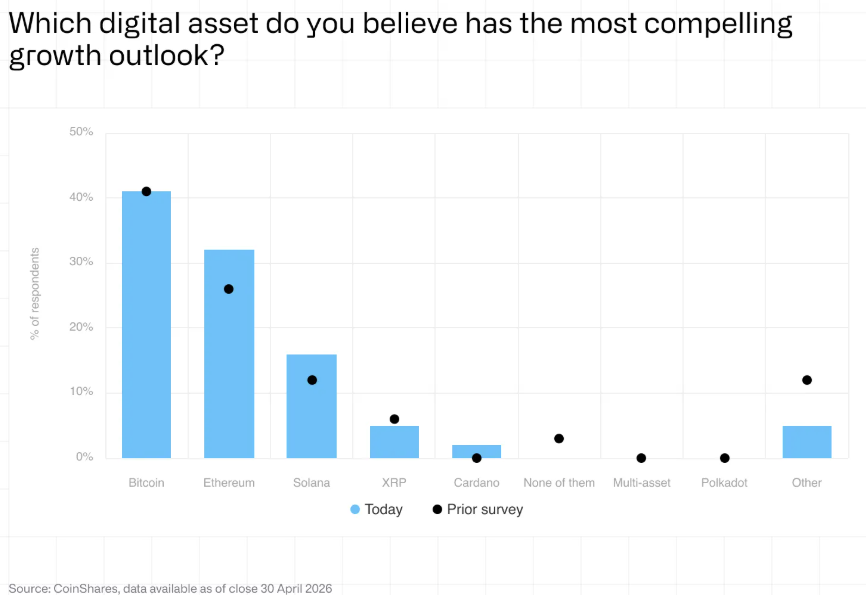
Fund managers identified Bitcoin as having the strongest growth outlook among digital assets, followed by Ether and Solana. Source: CoinShares
Related: Bernstein cites $4T tokenized credit opportunity for Figure Technology stock
Institutional inflows continue to build as sentiment improves
The survey’s upbeat tone aligns with broader institutional flow trends. CoinShares data recently showed digital asset investment products recording several consecutive weeks of inflows, led primarily by Bitcoin demand.
Crypto exchange-traded products attracted $1.2 billion in inflows through April 27, marking the fourth straight week of gains and bringing total inflows during that stretch to $3.9 billion.
The momentum has extended into early May. US spot Bitcoin ETFs recorded nearly $1 billion in net inflows this week as BTC climbed back above $80,000, according to SoSoValue data.

Bitcoin ETF inflows have risen since last Friday. Source: SoSoValue
The inflow trend also aligns with a recent survey by Coinbase and EY-Parthenon, which found that 73% of institutional investors plan to increase their digital asset exposure this year, with most expecting crypto prices to rise over the next 12 months.
The launch of spot Bitcoin ETFs in the United States in January 2024 has been widely viewed as a turning point for institutional adoption. The ETF structure has also helped reduce operational friction for institutions by offering regulated exposure to Bitcoin without requiring direct custody of digital assets.
Related: Crypto Biz: Capital has no consensus

TLDR
- Nvidia stock rose about 3% to $213.53 in early trading after gaining 5.8% in the previous session.
- Goldman Sachs reaffirmed a Buy rating on Nvidia and maintained a $250 price target.
- The bank expects a beat-and-raise quarter based on current supply and demand trends.
- Major technology companies increased their 2026 capital expenditure forecasts to support AI infrastructure.
- Combined spending by Alphabet, Amazon, Meta Platforms, and Microsoft could reach $725 billion in 2026.
Nvidia shares (NVDA) extended their advance on Thursday as semiconductor stocks moved higher. Nvidia stock gained about 3% to $213.53 in early trading after a 5.8% rise on Wednesday. The move pushed the shares back above $200 ahead of the company’s earnings report later this month.
Nvidia Stock Rises as Goldman Backs $250 target
Goldman Sachs reaffirmed its Buy rating on Nvidia and kept a $250 price target on the shares. The bank said demand for data center products continues to support upside potential. It also stated that investors may focus on the possible upside to Nvidia’s $1 trillion data center guidance.
The firm expects a “beat-and-raise” quarter based on current supply and demand trends. However, it said expectations remain high, setting a strong bar for further gains. Goldman added that valuation could improve if hyperscalers show stronger profitability and broader enterprise adoption increases.
The bank also cited opportunities linked to agentic systems and server central processing units. It said these trends could expand Nvidia’s reach beyond traditional large-scale buyers. The company will release its quarterly earnings results later this month.
AI Spending Plans Support Nvidia Stock Outlook
Large technology companies recently increased capital expenditure forecasts for 2026. Alphabet, Amazon, Meta Platforms, and Microsoft raised combined spending projections to about $725 billion. Analysts at Bank of America and Evercore estimate total capital expenditure could exceed $1 trillion by 2027.
This level of spending supports continued demand for Nvidia’s graphics processing units. These chips remain central to artificial intelligence workloads in cloud data centers. As a result, sustained infrastructure investment provides a steady revenue backdrop for Nvidia.
Despite this support, Nvidia stock has trailed several semiconductor peers in recent weeks. Over the past month, Advanced Micro Devices rose about 90%, and Micron Technology gained roughly 76%. In comparison, Nvidia stock increased about 19% during the same period.
Since late April, Nvidia shares have traded mostly flat while Intel and Micron have climbed more than 30%. Advanced Micro Devices also advanced about 20% during that stretch. Market updates highlighted supply constraints in memory chips and progress in internal chip development.
Alphabet continues to develop its tensor processing units for internal use. Amazon advances its Trainium chips to support its cloud operations. These in-house solutions improve efficiency for hyperscalers while introducing competition for external suppliers.
Some analysts now describe Nvidia as a broader proxy for the artificial intelligence sector. They say the market treats the company less as a single chipmaker and more as a sector benchmark. Nvidia will report earnings later this month, providing updated financial details.


Bitcoin (BTC) has climbed by almost 20% this month, but despite the current bullish setup, the threat of rejection near overhead resistance remains significant.
In fact, CryptoQuant found that the crypto asset must reclaim and hold $88,880 before the market can confirm a sustainable bottom formation.
Trapped Buyers Await
According to the latest analysis by CryptoQuant, Bitcoin’s current price of around $80,000 is still trading below several crucial realized price levels tied to underwater holder cohorts, which continue to act as overhead resistance.
The first major level stands at $88,880 for holders who bought between three and six months ago, followed by $93,450 for the 12-to-18-month cohort. The largest resistance zone is at $111,850, which is linked to holders from the six-to-12-month group, sitting roughly 29% above the current spot price.
CryptoQuant explained that these levels represent break-even exit points for investors who are still holding unrealized losses and may look to sell once prices recover. Its findings reveal that for a market bottom to be confirmed, Bitcoin must move above $88,880 and maintain that level instead of briefly spiking higher and falling back.
Until then, rallies between $85,000 and $88,000 are likely to face selling pressure from buyers who entered the market between November 2025 and February 2026.
A similar sentiment was echoed by analyst Ali Martinez, who had recently flagged that Bitcoin’s present trajectory resembled the 2022 bear market bottom formation. Martinez pointed to similarities with the period when the crypto asset briefly recovered to around $25,000 in August and September 2022 before experiencing another major decline that eventually dragged the asset below $16,000.
Based on this pattern, he indicated that Bitcoin could face another rejection around the $80,000 to $82,000 range before potentially falling below $55,000 if the market follows a similar trajectory. The analyst also highlighted the strong sell walls between $79,000 and $80,000, an area where the asset has already been rejected multiple times in recent weeks.
Crypto Market Positioning
Derivatives data also reflected the cautious mood in the market. Experts at Bitunix noted that all eyes are on liquidity absorption around the $80,000 region. In a statement to CryptoPotato, they revealed that open interest has declined 5.13% over the past 24 hours. At the same time, funding rates are still negative overall during the past week, which shows bearish positioning is still present, but the magnitude of those negative readings has started to narrow.
“This suggests that overheated leverage conditions are beginning to cool, while bearish hedging sentiment has eased somewhat. Even so, overall market positioning remains cautious.”
The post Bitcoin (BTC) Bottom Isn’t Confirmed Until This Key Level Breaks appeared first on CryptoPotato.
Crypto World
Hashed Open Finance Launch Testnet of Maroo, First Sovereign L1 Blockchain for KRW Stablecoins and AI Agents

[PRESS RELEASE – SEOUL, South Korea, May 7th, 2026]
Korea’s first won-denominated public blockchain goes live with built-in regulatory compliance and native AI agent identity, integrating with Model Context Protocol (MCP), Claude skills, Gemini CLI, and Cursor. The underlying technology already powers BDAN Pocket, a digital wallet used by 4 million citizens of Busan.
Hashed Open Finance, the fintech subsidiary of global Web3 venture capital firm Hashed, today launched the public testnet for Maroo, the first sovereign Layer 1 blockchain built for Korea’s KRW stablecoin economy.
With the global stablecoin market almost entirely denominated in U.S. dollars, Maroo offers Korean banks, fintechs, and AI agents native infrastructure to transact in won-denominated digital assets. The technology underpinning Maroo already powers BDAN Pocket, a digital wallet used by 4 million citizens of Busan in partnership with the Busan Digital Asset Exchange (BDAN).
The Maroo testnet is now open to external developers, banks, fintechs, and AI builders. The launch positions Korea among the first countries to design a public blockchain around its own currency rather than the U.S. dollar.
Maroo was designed from the outset with regulatory compliance, auditability, and verifiable privacy embedded in its core, allowing banks and fintechs to launch real-world services on Maroo while preserving the openness of a public chain. The chain operates on a dual-track model: an “Open Path” available to anyone, and a “Regulated Path” for transactions that require prior verification. Both paths share the same chain, allowing Maroo to test whether everyday users and regulated financial services can coexist on a single infrastructure.
Rather than relying on after-the-fact reviews, Maroo enforces compliance as code at the moment a transaction is made. Its Programmable Compliance Layer (PCL) currently covers five core policies: KYC verification, transfer limits, blacklist filtering, time-based volume caps, and AI agent transactions. Any non-compliant transaction is blocked on-chain instantly. Policy sets can be updated through a separate pipeline, allowing the network to adapt to new laws and service policies without redesigning the core protocol.
To prepare for a future where AI agents actively participate in financial transactions, the testnet also introduces the Maroo Agent Wallet Stack (MAWS). Built on the ERC-8004 standard, MAWS assigns each AI agent a unique on-chain identity. Agents can execute transactions autonomously, but only within user-defined permissions and limits. MAWS integrates seamlessly with major AI developer tools, including the Model Context Protocol (MCP), Claude skills, Gemini CLI, and Cursor. To balance autonomy with user control, users can instantly revoke permissions if abnormal behavior is detected.
On the testnet, transaction fees are paid in OKRW, a KRW-denominated test token, allowing users to participate in the network without holding volatile crypto. Beyond technical testing, Maroo offers practical scenario demos that showcase real-world utility, including KYC integration with Kakao, Korea’s leading messaging platform. Hashed Open Finance plans to introduce more advanced privacy features, including a Shielded Pool, in its next milestone later this year, with a mainnet launch to follow rigorous security audits.
“In this testnet, we have translated the core design from our January litepaper into a live network environment,” said Hojin Kim, CEO of Hashed Open Finance. “A framework where AI agents hold unique on-chain identities and autonomously execute financial transactions within user-defined rules will be a meaningful milestone for the future of blockchain-based finance.”
“Stablecoins aren’t just another financial product — they’re the infrastructure that will define what a nation’s currency looks like in the digital age,” said Simon Kim, CEO of Hashed. “Right now, that infrastructure is being built almost entirely on top of the dollar. Maroo is a rare chance for Korea to design its own digital financial order on the foundation of the won. Our goal is to make it an open platform where anyone — banks, financial institutions, fintechs, and the new kinds of players that will emerge in the AI era — can come in and experiment with the next generation of finance.”
Start building on Maroo today. The testnet is fully open to the public. Developers can access full documentation and begin building immediately at [docs.maroo.io], with the RPC endpoint available at rpc-testnet.maroo.io and on-chain activity viewable through the block explorer at [explorer-testnet.maroo.io]. AI builders can deploy AI agent wallets through [agent.maroo.io]. End users can try compliant KRW stablecoin transactions at the demo portal [experience.maroo.io], with KYC available at [kyc-testnet.maroo.io]. Banks, fintechs, and financial institutions interested in piloting Maroo for production services or partnership opportunities are invited to contact Hashed Open Finance at [inquiry@hashedopenfinance.com].
About Hashed
Hashed partners with the founders shaping the next paradigm in blockchain, AI, and content, joining them from the earliest moments as technology redraws the boundaries of industries. Headquartered in Seoul and operating from five global hubs across San Francisco, Singapore, Bangkok, Bangalore, and Abu Dhabi, Hashed provides the capital, networks, and on-the-ground execution that help founders move beyond a single region and reach meaningful scale in global markets.
About Hashed Open Finance
Hashed Open Finance is the fintech subsidiary of Hashed, established to lead Korea’s next generation of financial innovation, starting with stablecoins. The firm works with established financial institutions and global partners to research, develop, and commercialize blockchain-based applications across stablecoins, real-world asset (RWA) tokenization, and security token offerings (STOs).
The post Hashed Open Finance Launch Testnet of Maroo, First Sovereign L1 Blockchain for KRW Stablecoins and AI Agents appeared first on CryptoPotato.

Kalshi, the prediction-market platform, has closed a $1 billion Series F funding round at a $22 billion valuation, led by Coatue Management with participation from Andreessen Horowitz, Sequoia Capital, Morgan Stanley and Ark Invest. The raise more than doubles Kalshi’s valuation in about five months, underscoring a rising appetite among venture investors for prediction markets as retail adoption accelerates.
A Kalshi spokesperson told Bloomberg that the company’s annualized revenue run rate has surpassed $1.5 billion, a milestone investors are watching as the market matures beyond novelty use cases into real-world, scalable finance. The round’s size and backing come as a16z Crypto’s latest fundraising cycle highlighted prediction markets as a key thematic area for institutional capital. For context, a16z Crypto recently raised a multibillion-dollar fund and signaled notable interest in this segment.
Kalshi operates a centralized, federally regulated marketplace that lets users trade on the outcomes of real-world events—ranging from elections and economic data releases to sports. By contrast, Polymarket operates on decentralized blockchain infrastructure. Collectively, Kalshi and Polymarket accounted for the bulk of more than $25 billion in prediction-market trading volume last month, underscoring how the sector has moved into the mainstream of digital finance.
In line with its broader growth plan, Kalshi has pushed deeper into crypto. The company recently appointed John Wang as head of crypto, and Wang told Forbes that Kalshi hopes to have its prediction markets embedded in every large crypto application, signaling a broader strategy to integrate event-based trading into crypto ecosystems.
Regulatory scrutiny and a strategic policy response
Industry observers frame the latest funding as a sign that prediction markets are evolving from retail-oriented entertainment into institutional risk-management tools. Bernstein Research described the space as entering an “institutional era,” driven by demand for bespoke block trades and contract structures designed to hedge macro and geopolitical risk.
However, the regulatory backdrop remains tense in the United States. NPR reports that Kalshi is involved in at least 19 federal lawsuits alleging that some of its event contracts may violate state gambling laws. States including Massachusetts, New Jersey, Arizona, Nevada, Illinois and Connecticut have challenged Kalshi’s operations, arguing that certain sports and event-based contracts amount to unlicensed gambling. Political pressure has also intensified in Washington, with lawmakers calling for tighter oversight amid concerns about “suspicious trades.”
In response to this heightened scrutiny, Kalshi has expanded its policy bench, hiring former Obama adviser Stephanie Cutter as a policy adviser—an addition widely seen as an effort to strengthen ties with policymakers and navigate evolving oversight.
What the market shift means for investors and builders
The momentum behind Kalshi’s funding round and the broader adoption of prediction markets reflect a broader market recalibration. The sector’s move toward institutional-grade products—such as bespoke macro and geopolitical event contracts—could expand the pool of participants beyond retail traders and venture backers to traditional financial institutions seeking hedging tools in volatile environments. The convergence of centralized, regulated platforms with growing crypto integration suggests a hybrid path where compliance and innovation go hand in hand.
For readers tracking the ecosystem, several questions remain pivotal. How quickly regulators will clarify the status of event-based contracts across jurisdictions, and whether other traditional financial players will participate in this space, will shape Kalshi’s path. The crypto push also raises questions about how Kalshi will balance compliance with rapid product expansion across both fiat and crypto rails.
Looking ahead, watchers will evaluate regulatory filings, potential settlements, and the cadence of new product launches that could broaden access to prediction markets. The next set of developments—ranging from policy guidance to potential integrations with major crypto platforms—will help determine whether Kalshi’s ambitious roadmap translates into durable, institution-friendly growth or if regulatory friction slows progress.


Breadcrumbs analyst James Delmore presented a live breakdown of crypto PAC spending at the Consensus Miami 2026 Policy Summit on Thursday.
Summary
- James Delmore of Breadcrumbs laid out how much money crypto industry groups have committed to the 2026 midterm elections at the Consensus Miami Policy Summit.
- The crypto industry has committed over $288 million to the 2026 cycle, more than double the $130 million spent during the entire 2024 election.
- Fairshake and its affiliated PACs hold approximately $221 million in unspent funds, positioning crypto as a top-five PAC force in the country.
James Delmore, a research analyst at Breadcrumbs who has tracked crypto industry political spending since the 2024 cycle, took the Consensus Miami 2026 Policy Summit stage on Thursday to lay out where the money is going heading into November. The session arrived as the crypto industry sits on more political capital, literally, than at any previous point in its history.
The industry has committed over $288 million to the 2026 midterm cycle, according to available FEC data, more than double the roughly $130 million spent across the entire 2024 election.
Fairshake, the industry’s flagship super PAC backed by Coinbase, Ripple, and Andreessen Horowitz, holds approximately $221 million in unspent funds, making it the fifth most-funded PAC in the country.
Where the money is going
As crypto.news reported, a Fairshake-aligned group spent $514,000 in Indiana supporting Representative James Baird in his primary race. Fairshake and affiliated groups had already spent nearly $30 million on 2026 races by the end of March.
Earlier, Fairshake deployed $10.3 million opposing Illinois Lieutenant Governor Juliana Stratton in a Senate primary, mirroring a similar $10 million attack on Katie Porter in the 2024 California Senate primary.
The political context surrounding the session is defined by the CLARITY Act, which must reach the Senate floor before the August recess or risk losing its legislative window entirely.
As crypto.news noted, Ripple, Coinbase, and Andreessen Horowitz are among the largest backers of the spending push, collectively aiming to ensure the 120th Congress is the most pro-crypto session in U.S. history.


Amazon Web Services (AWS) rolled out a new payments infrastructure for AI agents on Thursday which is built in partnership with Coinbase and Stripe.
AWS explained that autonomous software agents will be allowed to buy APIs, web content, MCP servers and other online services in real time using stablecoins. It added, however, that future versions would eventually support larger purchases such as hotel bookings, travel reservations and merchant payments.
“Amazon Bedrock AgentCore Payments” is designed for AWS described as the emerging “agentic economy”, where AI agents transact independently inside a single execution loop.
The first version of the system focuses on micropayments, allowing agents to instantly pay for APIs, data feeds, paywalled content and other digital services, often for fractions of a cent, AWS said.
Bedrock is built on Coinbase’s x402, the HTTP-native payment protocol for powering agent-to-agent transactions with stablecoins, while Stripe’s Privy wallet is being used as a payment connection.
“There will soon be more AI agents transacting than humans, and they need money that’s built for the internet – programmable, always on, and global,” said Brian Foster, Coinbase’s head of infrastructure growth.
Foster’s words echo those of Coinbase founder Brian Armstrong, Binance founder Changpeng Zhao and of Cardano Founder Charles Hoskinson, who agree that shortly all activity on the internet will be conducted by AI agents.
Stripe said this roll-out is part of a broader push to build financial infrastructure for autonomous AI commerce. “For agents to become meaningful economic actors, they need a way to hold and spend money,” said Henri Stern, CEO of Privy, a Stripe company.
AWS added that the platform is protocol-agnostic, though x402 is the first supported standard at launch. The broader goal is to create infrastructure for autonomous software agents capable of completing commercial transactions on behalf of users.
Warner Bros. Discovery, which is already testing Amazon’s Bedrock AgentCore, said it sees potential for agent-driven transactions involving premium content, including live sports and major entertainment releases.
Hantavirus — cause of death for Gene Hackman's wife — at the center of Dutch cruise outbreak

Helen Zille to address explosive Treasury letter on Johannesburg’s financial crisis

Council deputy mayor criticises event for being ‘very juvenile in nature’

Manchester United reach agreement with Casemiro over contract clause amid transfer speculation

US brings back mandatory military draft registration

Steven Gerrard disagrees with Gary Neville over ‘shock’ Chelsea and Arsenal claim | Football


-

 NewsBeat4 days ago
Channel 5 – All Creatures Great and Small series 7 new post
-

 Crypto World13 hours ago
Upbit adds B3 Korean won pair as Base token gains Korea access
-
 Tech6 days ago
Trump’s 25% EU auto tariff breaches Turnberry Agreement that also covers semiconductors and digital trade
-
 NewsBeat14 hours ago
NCP car park operator enters administration putting 340 UK sites at risk of closure
-
 Sports6 days ago
Paul Scholes issues Marcus Rashford reality check as agreement emerges over Man United star
-

 Entertainment6 days ago
Met Gala 2026 Rumored Guest List Is Turning Heads
-

 Business7 days ago
Strait of Hormuz Blockade Persists Amid US-Iran Standoff, Sending Oil Prices Soaring
-
Entertainment6 days ago
New on Prime Video in May 2026 — Full List of Movies and Shows
-

 Entertainment6 days ago
Kylie Jenner Hit With Second Lawsuit From Ex-Housekeeper
-

 Sports6 days ago
Cavaliers vs. Raptors Game 6 live score, updates, highlights from 2026 NBA playoffs first-round series
-

 Tech6 days ago
Meta ends Sama contract after Kenyan workers report seeing intimate footage from Ray-Ban smart glasses users
-
 Sports6 days ago
David Benavidez responds to team Canelo saying the fight will never happen
-
 Sports6 days ago
IPL 2026: ‘Love you darling’- Hardik Pandya’s reaction to MS Dhoni steals the show |Watch | Cricket News
-
Entertainment5 days ago
New Netflix Movies in May 2026 — My Top 3 Picks to Stream
-

 Entertainment6 days ago
Young and the Restless Next Week: Cane Arrested & Matt’s Deadly New Scheme!
-

 Business5 days ago
Luka Doncic Injury Update: Doncic’s Hamstring Recovery Slows Lakers’ Hopes Against Thunder: Can He Run Yet?
-

 Sports6 days ago
What Preity Zinta Said After Punjab Kings’ First Defeat Of IPL 2026
-
 Crypto World5 days ago
Pi Network Mandates Protocol 23 Upgrade for All Mainnet Nodes Before May 15 Deadline
-

 Entertainment5 days ago
Melissa Joan Hart and More Stars Attend 2026 Kentucky Derby
-

 Sports7 days ago
Bayern won’t hand bottom side Heidenheim ‘gifts’ despite PSG game
You must be logged in to post a comment Login