
Crypto World
Coinbase faces user pushback on prediction-market alerts


Coinbase rolled out prediction market bets for US-based users in January through a partnership with Kalshi, expanding the exchange’s product scope beyond traditional crypto trading. As March Madness unfolds, however, user feedback has highlighted a growing tension around how aggressively Coinbase is deploying event contracts and push notifications to drive engagement, with some describing the approach as akin to sports betting rather than crypto activity.
The rollout comes amid broader scrutiny of prediction markets in the United States, where regulators, lawmakers, and industry participants are navigating questions about jurisdiction, consumer protection, and potential misuse. Coinbase’s moves sit at the intersection of retail access to complex financial instruments and the evolving regulatory framework that governs how such markets should operate in the US.
Coinbase previously indicated that the Kalshi-backed service would bring a range of outcomes to the platform, from political events to sports results. In December, ahead of the public launch of its prediction market service, Coinbase filed lawsuits against regulators in Connecticut, Illinois and Michigan, arguing that the US Commodity Futures Trading Commission should have exclusive jurisdiction over its prediction markets rather than state gambling authorities. The company did not immediately respond to requests for comment on the user-reported experience during March Madness, as reported by Cointelegraph.
Key takeaways
- Coinbase’s January launch of Kalshi-backed prediction markets brought US users the ability to bet on event outcomes within the Coinbase app, bridging crypto trading with contract-based bets.
- During March Madness, some users reported an influx of push notifications urging bets on college basketball games, prompting criticism that the app is leaning toward sports gambling at a time of industry trust concerns.
- Regulatory tension surrounds prediction markets: state-level lawsuits against operators coexist with the CFTC’s push for exclusive jurisdiction over these markets.
- Legislative activity in Congress has considered curtailing use of prediction markets by politicians, amid concerns about insider information and potential conflicts of interest.
- Industry players are adopting safeguards: Kalshi bans political candidates from trading on election-related markets, while Polymarket has introduced measures to curb manipulation and insider trading.
Push notifications and the March Madness debate
Several users have voiced concerns about the frequency and framing of Coinbase’s market prompts during the March Madness window. A prominent example came from a poster on X who described receiving multiple basketball-related notifications within a single hour, arguing that Coinbase’s emphasis on sports betting reflects a broader shift toward monetizable gambling features on a platform many investors associate with crypto trading. The sentiment echoes a broader critique about trust erosion in the crypto industry and the perceived risk of platform strategies that monetize user engagement through gamified betting.
“I have received three separate notifications about College Basketball from Coinbase in the past hour alone. It is absurd that, amidst arguably the worst collapse in trust in this industry’s history, the largest American CEX has completely pivoted to trying to get their customer base hooked on sports gambling, so that they can extract even more exorbitant fees.”
Industry observers have pushed back with concerns about how such notifications might influence user behavior, especially given the sensitivity around responsible money management and the reliability of on-platform yield sources. John Palmer, co-founder of PartyDAO, voiced a closely related concern, pointing to broader questions about risk controls and the integrity of internal risk management as prediction markets push into mainstream app experiences.
These reactions occur against a backdrop of legal action and regulatory debates that complicate Coinbase’s product strategy. In December, Coinbase argued in court that the CFTC should regulate its prediction markets rather than state gambling authorities. The company’s stance mirrors a broader industry argument that federal-level oversight may provide a clearer, more consistent framework for prediction markets—but it has also drawn pushback from state regulators who view these markets as gambling activities with their own distinct consumer protections requirements.
Regulatory landscape and how it shapes the market
The regulatory environment for prediction markets in the United States is plural and evolving. Prediction market platforms have faced multiple lawsuits from state authorities, asserting various legal and regulatory oversight challenges. At the same time, the federal regulator, the U.S. Commodity Futures Trading Commission, has signaled a preference for exclusive jurisdiction over such markets, creating a jurisdictional dispute that complicates operations for platforms like Coinbase, Kalshi, and Polymarket.
The policy conversation has intensified as lawmakers consider proposals to limit or prohibit certain uses of prediction markets by public officials. Reports describe bills aimed at banning presidents or members of Congress from using these platforms, prompted in part by concerns about insider information and potential conflicts of interest. In response, Kalshi and Polymarket have taken steps to reduce risk: Kalshi announced it would ban political candidates from trading on election-related markets, while Polymarket introduced measures designed to limit manipulation and insider trading.
The headlines around regulation underscore a central tension: prediction markets could offer useful tools for forecasting and hedging, but they also raise concerns about market integrity, consumer protection, and access that policymakers are eager to address. The debate is not only about the legality of the markets themselves but about how they should be designed, who can participate, and what safeguards are necessary to prevent abuse or manipulation.
Industry safeguards, policy shifts, and what to watch next
Beyond high-level regulatory talk, the industry has begun layering practical safeguards into platform rules. Kalshi, for instance, has made an explicit policy choice to bar political candidates from participating in election-related markets, aiming to limit conflicts of interest and insider dynamics. Polymarket has rolled out updates intended to curb manipulation and insider trading, a move that some observers view as essential if prediction markets are to gain broader legitimacy among mainstream users and regulators alike.
For Coinbase, the strategy remains a test of how to merge traditional crypto trading narratives with newer, non-crypto product lines without eroding trust or prompting regulatory backlash. The company’s December lawsuits against state regulators, followed by January market rollout and ongoing user feedback, reflect a high-stakes balancing act: deliver value and diversification to users while navigating a maze of regulatory constraints that could redefine what constitutes a permissible service on a US platform. The tension between innovation and compliance will likely continue to shape both product design and public perception in the months ahead.
Investors, traders, and builders should monitor regulatory developments, particularly any moves by the CFTC or Congress that could standardize or constrain prediction markets in the near term. In parallel, observers will watch for how Coinbase and other operators adjust notification strategies, user onboarding, and risk disclosures to align with evolving expectations around responsible gaming, data privacy, and financial risk management.
The evolving landscape suggests that the next phase of prediction markets in the US will be defined less by a single breakthrough and more by a gradual harmonization of innovation with clear guardrails. Whether Coinbase’s approach will be seen as a model for responsibly integrating event contracts into mainstream financial apps or as a cautionary tale about flashy monetization remains contingent on regulatory clarity, user experience, and demonstrated safeguards against abuse.
Readers should keep an eye on potential policy updates, court decisions, and platform-level changes to betting and disclosure practices as the market seeks a stable path forward amid competing regulatory and commercial interests.

Zcash’s ZEC is consolidating near $235–$240 after a sharp February selloff, with a $25m ZODL raise, Foundry’s new mining pool and rising shielded use turning it into a 2026 privacy‑trade leader.
Summary
- Zcash’s ZEC is trading near $235–$240 after a mid‑March surge of over 20% in a single day, extending a multi‑week recovery from February’s steep drawdown.
- The privacy‑focused coin has seen daily volumes in the hundreds of millions of dollars during the latest upswing, as traders respond to fresh venture funding, new mining infrastructure and improving technical momentum.
- Sector‑wide interest in privacy assets has picked up in 2026, with ZEC outpacing many peers as on‑chain shielded usage rises and developers accelerate work on new wallets and consensus upgrades.
Zcash’s (ZEC) native token ZEC, one of the longest‑running privacy coins in the market, is holding near the $235–$240 range this week after a volatile first quarter that saw it sell off sharply in February before rebounding on strong March news flow.
Data from BestCryptoChecker shows ZEC’s price dropped about 20.93% in February 2026, falling from $302.80 to close the month at $239.41, underscoring how aggressively the asset had been de‑risked before the latest move higher. The token, which uses zero‑knowledge proofs to enable shielded transactions and is categorized as a privacy and payments coin, has now re‑emerged as a focal point in the renewed 2026 privacy narrative.
ZEC extends rebound as $25m ZODL raise and Foundry mining pool revive Zcash story
Momentum turned decisively in March. On March 16, ZEC posted a 23.26% daily gain to trade around $285.35, with market capitalization at roughly $4.74 billion and 24‑hour trading volume reaching $583 million, according to MEXC’s tracking. CoinMarketCap’s Zcash dashboard later highlighted that ZEC broke above $235 on March 25 on “strong volumes” following a major ecosystem funding announcement, extending a weekly gain above 10% on elevated spot turnover. While some shorter‑term RSI screens still flag periods of selling pressure on lower timeframes, 14‑day readings near the low‑to‑mid‑50s indicate neither extreme euphoria nor deep exhaustion, leaving room for trend continuation if demand persists.
Behind the tape, a series of structural developments has reframed the Zcash story for 2026. The Zcash Open Development Lab (ZODL), a new core development entity formed after the breakup of the Electric Coin Company’s engineering team, closed a funding round of more than $25 million on March 25 from backers including Paradigm, a16z crypto and Coinbase Ventures, with capital earmarked for expanding the Zodl wallet and other privacy‑first tools. CoinMarketCap also reports that Foundry Digital, the largest Bitcoin mining pool, plans to launch an institutional‑grade ZEC mining pool in April 2026, marking its first move beyond Bitcoin and signaling growing confidence in Zcash’s long‑term viability. Additional roadmap items, including the CashZ wallet launch, consensus protocol upgrades and continued ZODL‑led ecosystem expansion, underline an effort to modernize infrastructure and make shielded transactions more accessible, potentially deepening ZEC’s role as a base layer for private finance.
Beyond Zcash itself, privacy coins as a group have begun to stage a comeback in 2026, with MEXC noting that ZEC and peers have delivered double‑digit daily moves as regulatory clarity around “digital commodities” and renewed interest in zero‑knowledge technology shift attention back to privacy‑preserving chains. That broader context matters: while some traders still see scope for a deeper correction toward the $100–$150 range based on ZEC’s longer‑term breakdown from much higher levels, recent funding, infrastructure and usage data have opened the door to a sustained repricing if the privacy trade continues to attract both retail and institutional capital.
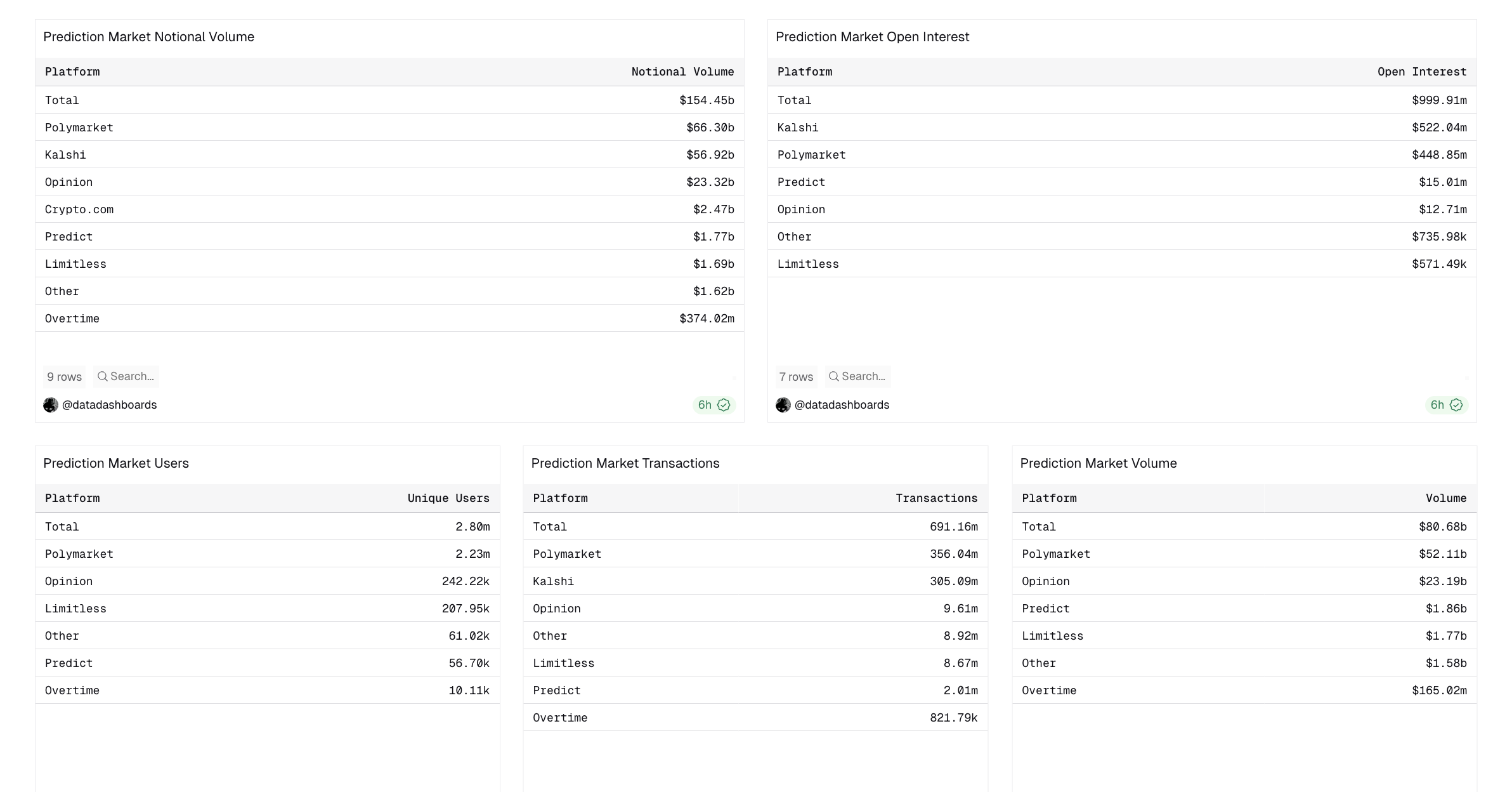
Prediction markets have processed more than $154 billion in total volume, with daily trading on Polymarket alone often exceeding $300 million.
That scale forces a more important question. These platforms no longer look like niche betting venues. They increasingly resemble something closer to retail trading.
This analysis uses on-chain data, primarily from Polymarket—the largest platform by users and transactions in a market dominated by a Polymarket–Kalshi duopoly—to test that shift directly.
$10 Trades Are Defining the Market
Across four dimensions, who participates, how they behave, how capital moves, and at what scale, the volume growth pattern tells a consistent story.
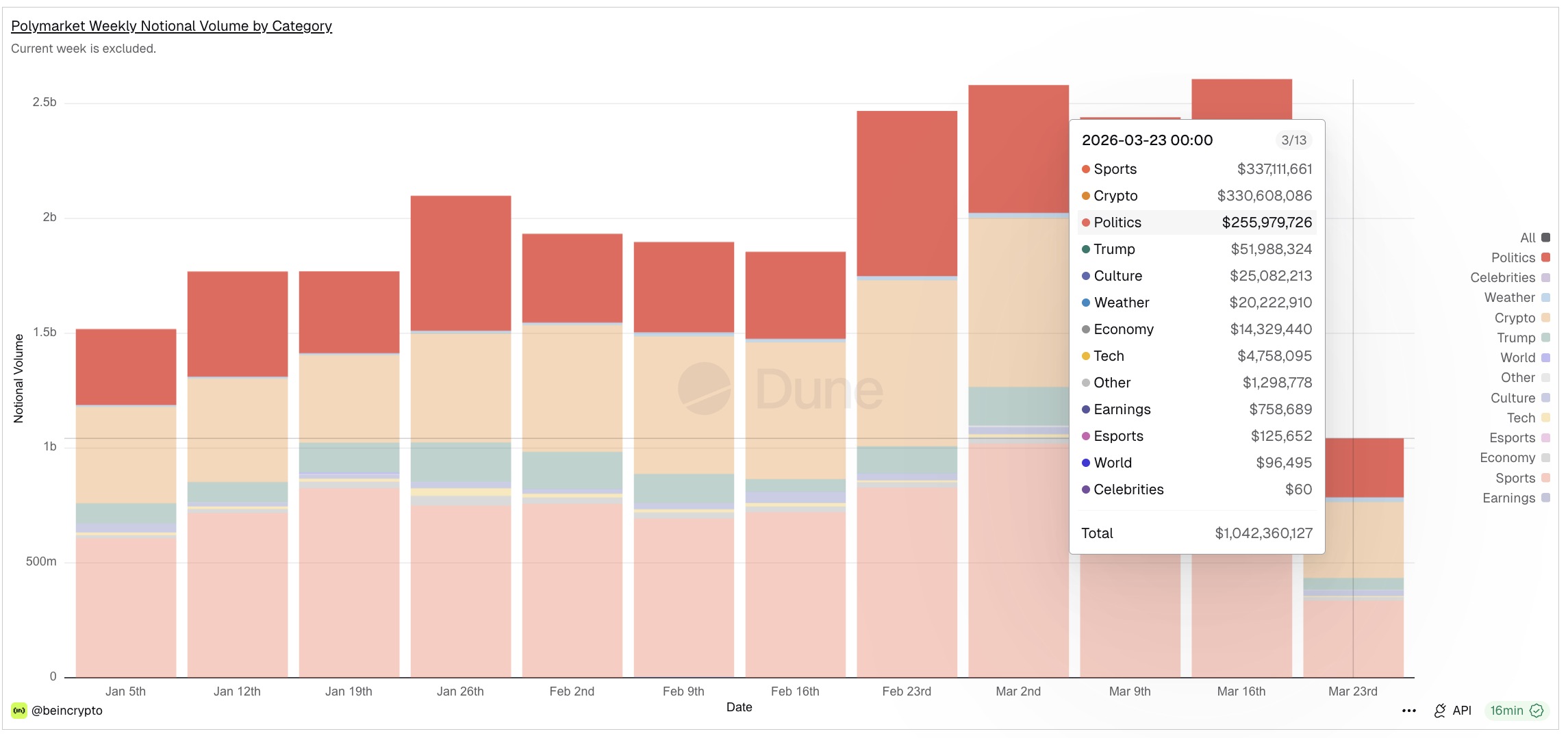
And the category mix reinforces the framing: crypto and politics (excluding sports) now lead weekly volume on Polymarket, with the economy and earnings categories growing alongside them. These are not traditional gambling categories. They are finance-adjacent verticals.
Notably, sports event contracts are already being offered as CFTC-regulated financial products by Kalshi and distributed through Robinhood’s Predictions Hub, placing them alongside stocks, options, and crypto within the same brokerage interface.
The most revealing signal is not how much money flows through prediction markets. It is who is placing the trades.
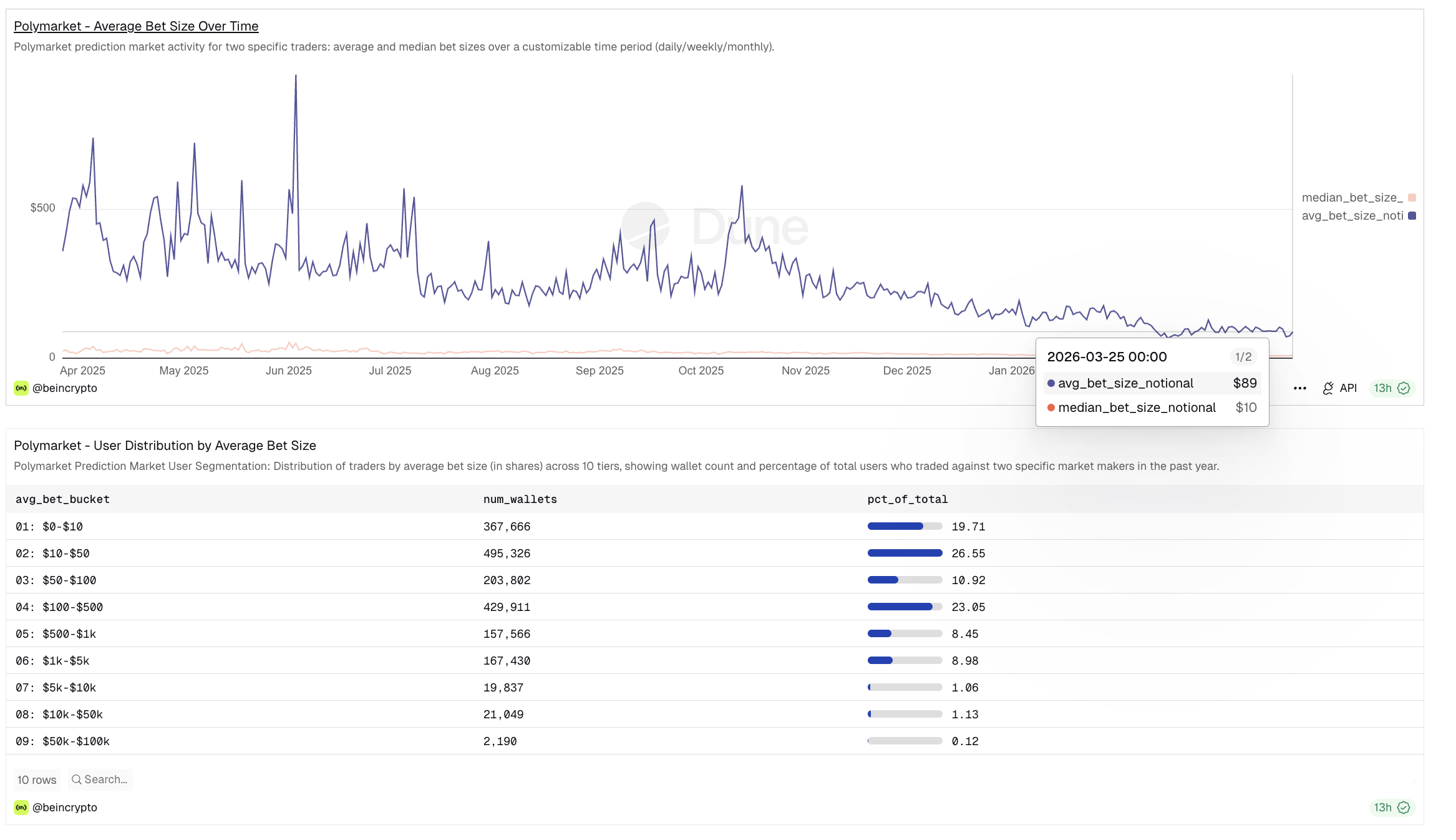
On Polymarket, the median bet size is $10, according to BeInCrypto’s exclusive dashboard. The average sits at $89, but that figure is pulled upward by a thin tail of large participants.
The underlying distribution paints a clearer picture: roughly 20% of all wallets trade in the $0 to $10 range, another 27% fall between $10 and $50, and about 11% sit in the $50 to $100 bracket.
In total, over 57% of users trade for less than $100, and more than 80% trade for less than $500.
This is not a market shaped by whales. It is a market built on small, individual participants deploying modest amounts. The pattern mirrors what defined the rise of retail stock trading.
Robinhood, for comparison, reported a median account size of $240, with the average around $5,000, according to CEO Vlad Tenev in 2021. The structural similarity is hard to miss: prediction markets are attracting the same class of small participants that reshaped equities over the past five years.
Users are Acting Like Traders, Not Bettors
Participation alone does not distinguish a financial platform from a betting one. Frequency of interaction does.
A bettor places a wager and waits. A trader enters positions, adjusts exposure, exits, and re-enters. The transactions-per-active-user ratio captures this distinction directly.
On Polymarket, this ratio currently stands at approximately 25 transactions per daily active user, meaning the average active participant executes 25 trades per day. Earlier this year, the figure peaked near 37.
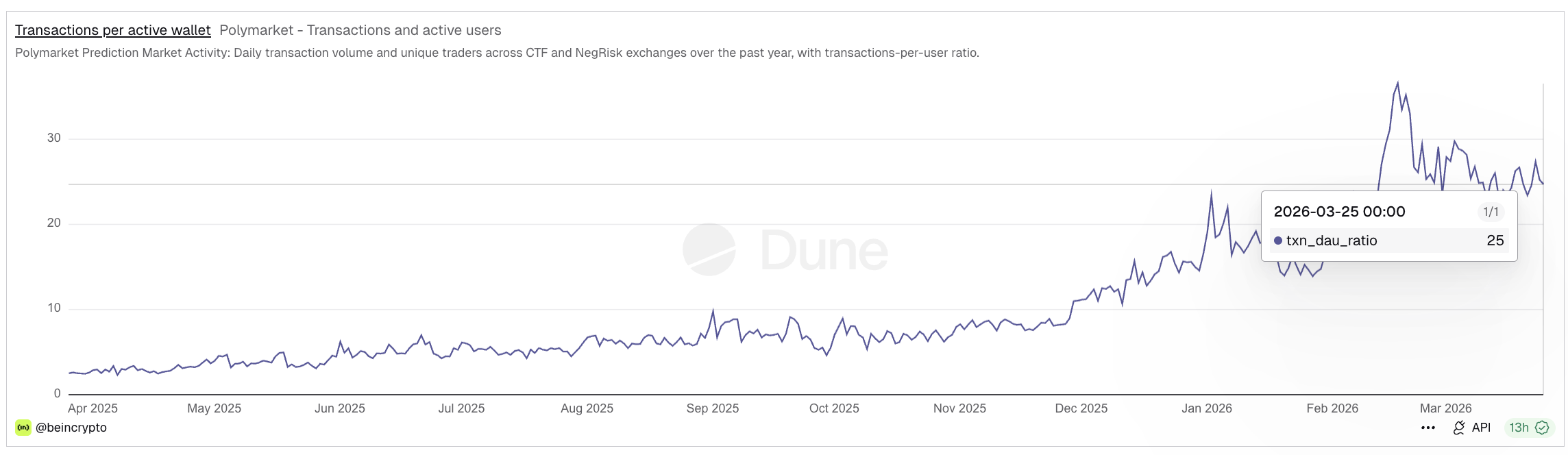
For context, through most of mid-2025, the ratio hovered between 3 and 5. The structural jump beginning in late 2025 represents a clear behavioral shift: users are no longer placing single predictions and walking away. They are actively managing positions across multiple markets.
This pattern has a direct parallel in crypto markets. A Kaiko research report on Binance found that the exchange processed 61.9 million trades against $20 billion in spot volume on a single snapshot day in December 2025, implying small average trade sizes and frequent execution across its 300 million registered accounts.
High-frequency, small-size trading is the behavioral signature of retail finance, whether the underlying asset is a stock, a token, or a prediction contract.
Capital Is Constantly in Motion
If users behave like traders, the capital dynamics should confirm it. They do. Polymarket currently holds approximately $445 million in total value locked, while open interest stands at roughly $477 million.
The near-parity between these two figures carries a specific implication: virtually all deposited capital is actively deployed in live positions rather than sitting idle. This is not passive liquidity. It is working capital.
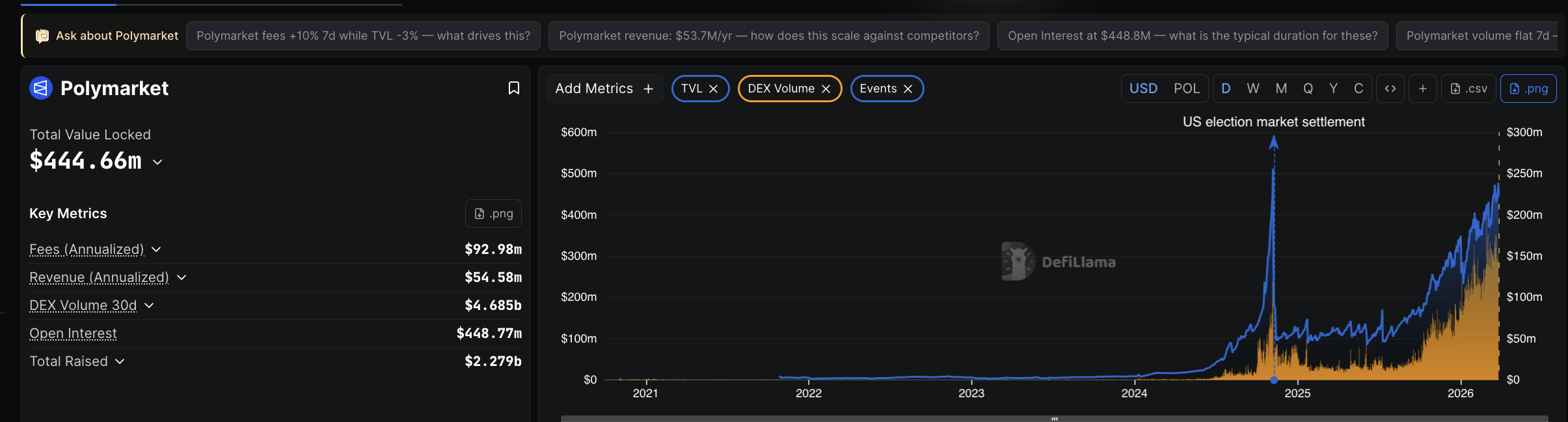
The volume-to-open-interest ratio reinforces the point. With daily taker volume around $339 million and open interest at $477 million, the ratio is 0.71. Capital is not just deployed. It is rotating.
Positions are being opened, closed, and re-entered at a pace that suggests continuous portfolio management rather than static, event-dependent exposure. A low vol-OI ratio would have suggested more betting-like activity.
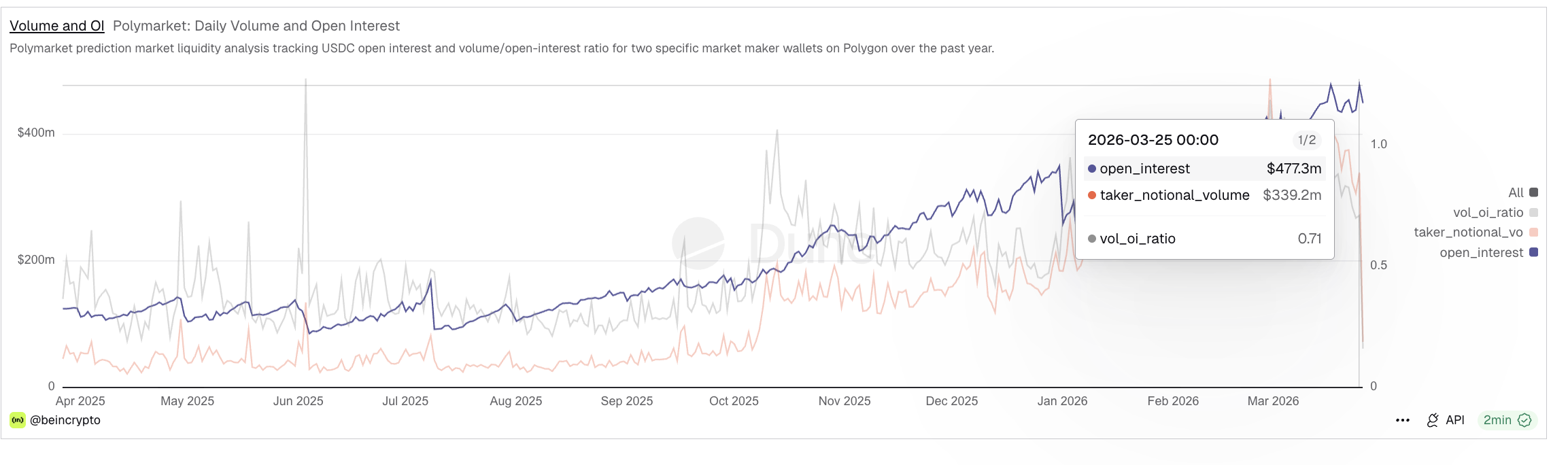
In a traditional betting market, capital tends to lock in and wait for resolution. Here, it circulates. That distinction is material: it signals a system in which participants treat capital as a tool for ongoing risk adjustment, not a one-time stake in a single outcome.
This Is No Longer Event-Driven Growth
The behavioral and capital patterns described above would be noteworthy even at modest volumes. But they are not operating at modest volumes.
Polymarket’s weekly notional volume has consistently exceeded $1 billion through Q1 2026, with recent weeks surpassing $2.5 billion. The 7-week rolling average has crossed $2 billion.
Monthly volumes have climbed from around $1 billion in mid-2025 to over $8 billion by March 2026. The growth trajectory is not driven by any single event cycle.
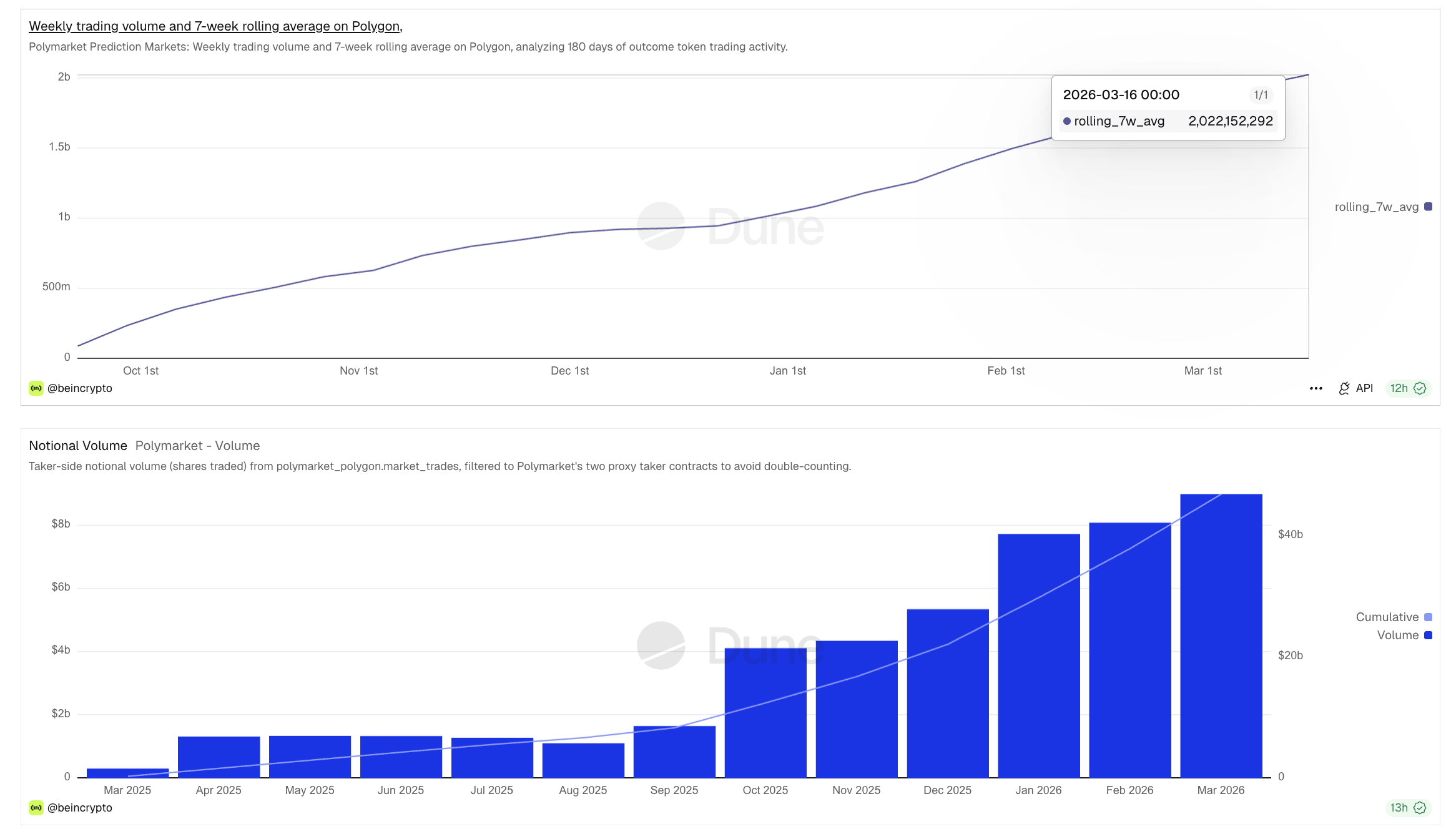
Volume is diversifying across categories: sports, crypto, and politics. Each contributed substantially in the most recent weekly data, with economy, weather, and culture adding further breadth.
This diversification is what separates structural growth from event-driven spikes. A presidential election creates a temporary surge.
Sustained, multi-category volume growth across sports, crypto, macro, and culture points to a user base that engages with prediction markets regularly, not just occasionally, as a typical retail habit.
What the Prediction Markets’ Data Says
Each dimension reinforces the next in a single causal chain. The majority of participants are small, retail-sized users. Those users trade frequently, not once, but dozens of times per session.
The capital they deploy is almost entirely active, rotating through positions rather than sitting idle. And this behavior is occurring at billions of dollars in monthly volume, across a broadening set of categories.
When small users dominate participation, execute frequent trades, and keep capital constantly in play at scale, the system begins to resemble a retail financial market rather than a betting platform.
Prediction markets are no longer just mechanisms for forecasting outcomes. They are changing into retail trading systems for real-world events, platforms where participants express views, manage risk, and deploy capital with a frequency and discipline that mirrors stock markets.
The post Prediction Markets Now Behave Like Stock Trading Platforms appeared first on BeInCrypto.

Bitcoin traded lower into Friday, sliding to around $65,530 after Thursday’s peak near $71,300 and erasing roughly $210 million in leveraged long exposure as the market faced an about $18.6 billion monthly options expiry. The Deribit options market priced in a bearish tilt, placing a 53% probability that BTC would stay below $66,000 by late April.
Traders also pushed the mood into risk-off mode as the delta skew for Bitcoin options advanced to about 15%, indicating puts were trading at a meaningful premium relative to calls. In parallel, the exit of a high-profile US policy voice and persistent questions about a US strategic approach to Bitcoin added to the cautious stance surrounding a sector still wrestling with regulatory and macro headwinds.
Key takeaways
- Bearish options posture dominates near-term bets: The delta skew rose to 15%, signaling a notable premium for puts over calls and implying a cautious, protection-oriented trading environment.
- BTC price action aligns with cautious expiry dynamics: BTC slid to about $65,530 on Friday, an 8% drop from Thursday’s $71,300, as the $18.6 billion monthly expiry weighed on market positioning and erased substantial bullish leverage.
- Markets price a sub-$66k scenario by late April: The market assigned roughly a 53% implied probability that Bitcoin would trade below $66,000 by April 24, reflecting elevated uncertainty amid macro tensions and policy questions.
- Put-heavy expiry signals risk-off sentiment into weekend: About $2 billion in put open interest existed at the $69,000+ level, with 97% of call options expiring worthless, underscoring a shift away from bullish bets during the expiry window.
- Policy leadership shake-up fuels uncertainty: David Sacks has stepped down as crypto and AI czar, a development that compounds questions about the cadence of US policy on Bitcoin and related technology, including the prospect of a US Bitcoin Reserve.
Bitcoin options and price action amid a thickening policy fog
Friday’s price action arrived on the back of a broad options setup that favored hedging over risk-taking. BTC traded near $65,530, leaving behind an 8% retreat from Thursday’s highs of about $71,300. The monthly expiry, totaling roughly $18.6 billion, amplified the impact of positioning shifts: much of the bullish call premium appeared to fade as the session concluded, with open interest leaning toward protective puts.
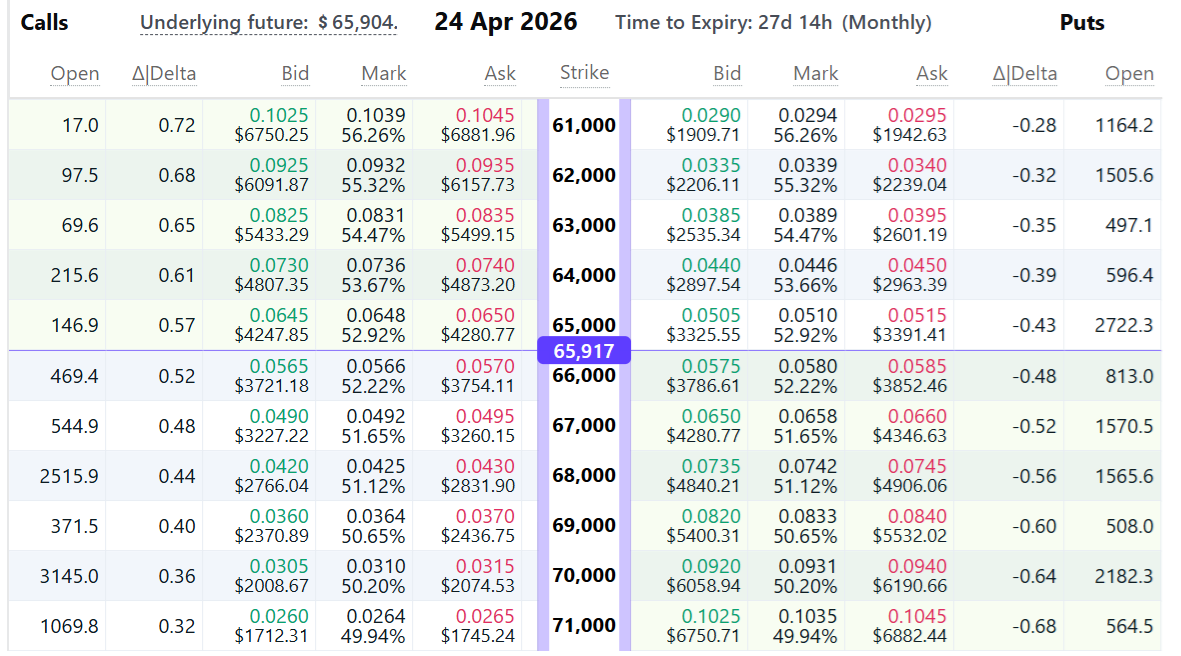
In particular, a 66,000-strike put traded at 0.0566 BTC (roughly $3,730), highlighting hedging activity around the $66k level. The market’s read on April 24 pointed to a 53% chance BTC would remain under $66,000, reinforcing a cautious posture among traders heading into the weekend. Data from Deribit and related analytics show the tilt away from outright bullish exposure as traders seek downside protection in an environment clouded by macro and geopolitical developments.
The options landscape also reveals a clearer signal from the longer end of the curve: the delta skew — a measure of put vs. call demand — jumped to 15% on Friday. In balanced markets, the skew typically hovers between -6% and +6%. A +15% reading indicates a material willingness to pay up for downside protection, suggesting reduced conviction that the $66,000 threshold would hold through the coming days.
Looking at expiry dynamics, Friday’s session favored neutral-to-bearish strategies. About 97% of call options at the $68,610 expiry strike were void, while puts at $69,000 and higher eclipsed $2 billion in open interest. The combination of heavy put exposure and weak call participation underscores a mood shift away from outright bullish bets, with traders prioritizing risk management as headlines and policy signals remained unsettled.
Beyond the technicals, market chatter on social platforms reflected a tentative mood about potential geopolitical catalysts. WhalePanda, an active market observer on X, noted that risk markets could push higher if no major negative developments materialize before Monday, though a fresh geopolitical flare could quickly tilt sentiment back toward fear-driven selling.
For readers tracking the macro context, traders are watching a confluence of factors: a U.S. inflation backdrop, possible shifts in fiscal posture, and policy signals around crypto. Oil prices moved higher, with West Texas Intermediate approaching the $100 per barrel mark, while 5-year Treasury yields rose to about 4.07% from roughly 3.72% three weeks prior. The S&P 500 also traded near multi-month lows, underscoring a broader risk-off tone that has often weighed on speculative assets like Bitcoin.
Policy landscape, leadership changes, and the strategic reserve question
Contributing to the mood is a lack of clarity around U.S. policy direction for Bitcoin. In recent weeks, David Sacks, who served as the administration’s crypto and AI czar, stepped down from that role, though he remains an advisor to the President’s Council on Science & Technology. His departure follows earlier remarks that fueled investor expectations, including hints that the U.S. could acquire more Bitcoin through budget-neutral methods without tax increases. The shift adds another layer of uncertainty for market participants seeking a clear pathway for crypto policy in Washington.
The trajectory of any formal U.S. plan to establish a Bitcoin reserve or similar strategic holdings remains unclear. Reports and commentary around a potential “US Bitcoin Strategic Reserve” have circulated in policy circles, but concrete details and timelines have yet to emerge. As policy ambiguity persists, investors are inclined to treat any bullish narratives with caution until clearer signals surface from lawmakers and regulators.
For broader context, readers may recall related discussions about crypto taxation and exemptions. Earlier reporting noted lingering gaps in a proposed crypto tax framework and exemptions for Bitcoin, underscoring how policy developments continue to shape market sentiment and risk appetite.
As the policy debate unfolds, investors should watch for concrete comments from policymakers on whether any strategic holdings or reserve-like program will materialize, and how such moves might interact with existing regulatory frameworks and market infrastructure.
What to watch next for traders and developers
Looking ahead, the key questions center on sentiment recovery versus continued caution. If geopolitical tensions ease and no fresh negative headlines emerge, the options market could recalibrate, potentially narrowing the delta skew and stabilizing the front-month expiry pace. Conversely, any new developments on U.S. crypto policy or a surprise shift in the global macro landscape could reassert a risk-off tone and keep downside hedges in demand.
Traders will also be assessing whether the market’s current pricing aligns with longer-term narratives, including Bitcoin’s role as a macro hedge or as a high-beta risk asset within a diversified portfolio. The ongoing tension between macro headwinds and crypto-specific catalysts suggests volatility could persist as market participants await clearer policy signals and more durable liquidity conditions.
The immediate takeaway is clear: exterior forces—policy signals, geopolitical headlines, and macro surprises—will continue to dictate Bitcoin’s near-term path. As long as uncertainty remains elevated, risk management will likely stay at the forefront of trading decisions, with the options market serving as a barometer of traders’ willingness to protect against drawdowns rather than chase outright upside.
For ongoing coverage, readers should monitor updates on U.S. crypto policy, any announcements related to a potential Bitcoin reserve, and the evolving reaction of equities and macro markets to fresh headlines. If policy clarity arrives or geopolitical tensions shift, the market could recalibrate quickly, offering new opportunities for both traders and builders in the crypto space.
Key takeaways:
-
Bearish sentiment is rising as Bitcoin options professional traders lose confidence that the $66,000 level will hold for long.
-
The exit of David Sacks as the Crypto and AI czar and a lack of a clear US Strategic Bitcoin Reserve plan added to investors’ doubts.
Bitcoin (BTC) fell to $65,530 on Friday, an 8% decline from the $71,300 level seen on Thursday. This move wiped out over $210 million in leveraged bullish Bitcoin futures and left most call (buy) options worthless during the $18.6 billion monthly expiry. Traders now anticipate a 53% chance that Bitcoin will stay below $66,000 by April 24.

On Friday, the April 24 Bitcoin $66,000 put (sell) options traded at 0.0566 BTC or roughly $3,730. With a 53% implied probability of Bitcoin trading below $66,000 by late April, the mood remains decidedly bearish following the increased uncertainty in the US and Israel-Iran war, pushing traders into a risk-averse mode.
US inflation threats and stalling crypto, Bitcoin legislation
Rising oil prices and a potential $200 billion in extra US military spending led investors to demand higher returns on government bonds and dragged the S&P 500 to its lowest levels since September 2025. West Texas Intermediate (WTI) oil surged to $100 on Friday, while 5-year Treasury yields reached 4.07%, up from 3.72% three weeks prior.

Inflationary fear and weaker corporate earnings perspectives alone cannot explain Bitcoin’s 20% underperformance against the S&P 500 in 2026. Other factors are likely at play, including investors’ discomfort over the lack of progress on the US Bitcoin Strategic Reserve.
David Sacks has stepped down from his role as the Trump administration’s crypto and AI czar. While Sacks remains an advisor on the President’s Council on Science & Technology, his departure follows earlier comments that inflated Bitcoin investors’ expectations. Sacks had previously hinted that the US could acquire more Bitcoin through budget-neutral methods without raising taxes.
Related: US lawmakers publish crypto tax proposal without Bitcoin tax exemption

The Bitcoin options delta skew jumped to 15% on Friday, showing that put options are trading at a significant premium relative to call instruments. In balanced market conditions, this metric usually ranges between -6% and +6%. The current level indicates a lack of conviction among whales that the $66,000 level will hold. Fear has largely dominated the Bitcoin options market since mid-January.
Bitcoin options expiry favored neutral-to-bearish strategies
Friday’s monthly options expiry at $68,610 proved unfavorable for neutral-to-bullish strategies, as 97% of call options became void. Bears gained the upper hand as put options at $69,000 or higher surpassed $2 billion in open interest. Critically, part of Friday’s downward move reflects a growing unwillingness among traders to maintain Bitcoin exposure over the weekend.

X social platform user WhalePanda, suggested that the crash in risk markets anticipates President Trump making “another dumb escalating move” after US markets close. Consequently, the current fear seen in the options market could reverse if no major geopolitical events occur before Monday.
During bearish cycles, traders often rush for the exits at the mere sight of any event that could be deemed negative. Investors should not take Bitcoin’s implied odds at face value, as these metrics are heavily impacted by recent news and headlines. However, expectations could shift more favorably if Iran effectively releases a counter-offer to the US peace proposal.
This article does not contain investment advice or recommendations. Every investment and trading move involves risk, and readers should conduct their own research when making a decision. While we strive to provide accurate and timely information, Cointelegraph does not guarantee the accuracy, completeness, or reliability of any information in this article. This article may contain forward-looking statements that are subject to risks and uncertainties. Cointelegraph will not be liable for any loss or damage arising from your reliance on this information.


a16z crypto partner Guy Wuollet says crypto is entering its “collared shirt” era, as the firm doubles down on a 10‑year infrastructure bet even while high‑profile partners exit amid a new $2b fundraise.
Summary
- a16z crypto partners have publicly reiterated a 10‑plus‑year investing horizon for the sector, comparing today’s market to the pre‑internet and pre‑AI groundwork phase.
- At the same time, named partners including Arianna Simpson and Kofi Ampadu are exiting or shifting roles, underscoring how venture talent is rotating as the industry matures.
- The crypto team is now raising roughly a $2 billion fifth fund, signaling that institutional LPs still see blockchains, tokenization, and AI‑crypto convergence as core long‑term themes.
Guy Wuollet, a16z crypto partner has published a new essay arguing that “finance is not separate from a larger vision; it is part of it,” describing blockchains as foundational infrastructure rather than a speculative sideshow. “At a16z and a16z crypto, we are looking long‑term: our fund structure is designed for a cycle of over 10 years because building new industries takes time,” the partner wrote, likening the current phase to laying railways before new categories of applications can run. The piece stressed that many breakthrough apps will only emerge once wallets, identities, liquidity, and trust mechanisms are mature, echoing a16z research that compares crypto’s timeline to the decades of work behind modern AI.
a16z crypto doubles down on long‑term thesis
That message is consistent with comments from a16z crypto general partner Chris Dixon, who recently said blockchain is “the next foundational infrastructure of the internet,” and that the industry is in a long “foundation‑building phase” similar to the 1943 neural‑net paper for today’s AI boom. Dixon has also noted that the firm has held onto about 95% of its historically invested assets because, in his words, “selling high‑quality assets too early is the worst decision in venture capital.” The stance underpins a16z crypto’s push into themes like stablecoins, tokenization, privacy, and prediction markets, laid out in a “Big Ideas 2026” roadmap that frames crypto as the plumbing for an internet where value moves as quickly as data.
The long‑term rhetoric comes as some a16z‑linked partners adjust their own career paths. Foresight News reported that Arianna Simpson, a general partner at a16z crypto, has “announced her resignation,” while fellow partner Kofi Ampadu is also leaving after the firm paused its Talent x Opportunity (TxO) program; a memo obtained by TechCrunch shows Ampadu telling staff that “closing my a16z chapter” followed four years of backing out‑of‑network founders. Those moves reflect a broader reshuffling inside top crypto VCs, as funds rebalance between seed bets, growth‑stage deals, and new AI‑crypto hybrids.
Despite the personnel churn, a16z crypto itself is pressing ahead with a fresh war chest. According to a report citing multiple insiders, the firm’s blockchain arm is targeting around $2 billion for its fifth dedicated crypto fund, on top of a broader $15 billion multistrategy raise across infrastructure, applications, and growth‑stage vehicles. Since launching its inaugural $300 million crypto fund in 2018 — in the wake of Bitcoin’s first run to $20,000 — a16z has grown that platform into a $4.5 billion vehicle and now backs projects from exchanges and DeFi protocols to gaming and NFT studios.
For builders, the message is mixed but ultimately constructive: competition for a16z checks is intensifying, even as the capital pool itself grows. On one hand, the departure of familiar faces like Simpson and Ampadu shows that even marquee crypto franchises are not immune to internal strategy shifts; on the other, a $2 billion target fund and a stated commitment to hold 95% of positions signal that LPs and partners remain aligned on treating crypto as a decade‑plus play. The firm’s research arm continues to push for clearer token rules and large‑scale DeFi adoption, arguing that “great endeavors take time” and that today’s messy, volatile years are the “groundwork” phase before a sharp inflection in usage.

BlackRock BUIDL fund, the largest crypto tokenized onchain Treasuries vehicle with approximately $1.7 billion in assets under management, has added oracle provider Chronicle Protocol as a new verification layer, the two parties announced Tuesday.
This is a structural attestation layer designed to give institutional allocators and DeFi protocols independently verifiable, real-time proof of what backs BUIDL’s tokens.
The move signals that tokenized RWA infrastructure is converging on auditable, machine-readable transparency as a baseline requirement, not a differentiator.
Chronicle’s Proof of Asset system will source holdings-level data directly from BUIDL’s custodians and administrators, publishing continuous on-chain attestations covering the fund’s valuation, asset composition, custody verification, and data freshness. The Chronicle Dashboard makes those attestations publicly viewable in real time.
- Verification Layer: Chronicle’s Proof of Asset will provide continuously updated, independently verified holdings data for BUIDL, covering valuation, composition, custody, and asset existence — viewable on the Chronicle Dashboard.
- Institutional Context: Chronicle’s Proof of Asset currently secures approximately $5 billion in total value across funds including Janus Henderson’s Anemoy Treasury Fund and Superstate’s USTB.
- Market Signal: The integration by BlackRock and Securitize establishes a transparency benchmark for institutional-grade tokenized funds targeting DeFi and TradFi composability.
Discover: The best crypto presales gaining institutional momentum right now
What Chronicle Actually Adds to Blackrock BUIDL Crypto Architecture
Chronicle’s integration replaces a core trust assumption in tokenized fund infrastructure with a cryptographically secured, continuous data feed.
Previously, investors holding BUIDL tokens had to rely on periodic disclosures from Securitize and BlackRock to understand what backed their position. Chronicle Proof of Asset changes that by sourcing data directly from custodians, including BNY Mellon, and publishing tamper-evident attestations on-chain in near real time.
The system provides what Niklas Kunkel, Chronicle’s founder, describes as an “integrity layer” delivering “more granular and transparent data” across four dimensions: valuation inputs, holdings composition, custody confirmation, and asset existence. Daily NAV calculations and specific Treasury holdings verification flow through a 24/7 public audit trail consumable by both smart contracts and human auditors.
Securitize CEO Carlos Domingo put the operational logic plainly: “Tokenization becomes meaningful when investors and protocols can independently verify what’s actually backing the product.” That framing matters, it positions Chronicle not as an analytics add-on but as a prerequisite for BUIDL’s broader DeFi composability.
Robert Mitchnick, BlackRock’s head of digital assets, confirmed the strategic intent: “Data oracles are a critical layer of market infrastructure for tokenized assets… We’re excited by Chronicle’s ability to unlock this for platforms and allocators seeking BUIDL fund data on-chain, strengthening confidence and transparency around tokenized assets.”
That statement frames oracles as infrastructure, not feature. That distinction matters for how the market prices verification capability going forward.

Chronicle is not entering this space without a track record. Its Proof of Asset system already secures approximately $8 billion in total value, covering funds including the Janus Henderson Anemoy Treasury Fund and Superstate’s Short Duration US Government Securities Fund. Securitize has also deployed Chronicle verification for its Tokenized AAA CLO Fund. BUIDL is the largest mandate yet — and the most visible.
Discover: The best crypto to diversify your portfolio with
The post BlackRock Tokenized BUIDL Fund Adds Chronicle Verification Layer appeared first on Cryptonews.

Key Takeaways
- The New York Stock Exchange’s parent company, Intercontinental Exchange (ICE), has injected an additional $600 million into Polymarket
- ICE’s overall financial commitment to the prediction market platform now approaches $2 billion
- Competing platform Kalshi secured over $1 billion in funding at a $22 billion valuation with approximately $1.5 billion in yearly revenue
- Polymarket has purchased a regulated exchange and clearinghouse while forming partnerships with Palantir and TWG AI for trade monitoring
- Congressional members are raising concerns about potential manipulation risks in prediction markets
Intercontinental Exchange, the entity behind the New York Stock Exchange, has committed an additional $600 million toward Polymarket, a marketplace where participants wager on real-world event outcomes.
This latest capital injection comes after ICE’s initial $1 billion commitment to the platform in October 2025. The exchange operator also intends to acquire up to $40 million worth of shares from current Polymarket stakeholders. Combined, ICE’s total financial exposure to the platform now stands near the $2 billion mark.
According to ICE, this investment won’t significantly affect its financial performance or shareholder return strategies.
The complete valuation of Polymarket remains undisclosed until the ongoing funding round concludes, according to company statements.
Polymarket operates as a marketplace where participants purchase and sell contracts linked to future event outcomes. These events span everything from political elections to macroeconomic indicators such as inflation reports. Contract values fluctuate continuously based on trading behavior.
Prediction markets have rapidly evolved from an obscure sector within cryptocurrency and academic finance circles into a booming trading category. Both participant engagement and transaction volumes have experienced dramatic growth throughout the last two years.
The Competitive Landscape
Polymarket isn’t the only platform attracting substantial capital. Kalshi[[/LINK_END_1]], a rival prediction market operator, recently secured more than $1 billion in funding at a $22 billion valuation—approximately twice its prior worth.
Kalshi is reportedly generating around $1.5 billion in annual revenue, demonstrating robust market appetite for event-driven trading instruments.
The rapid expansion of both platforms has captured the attention of regulatory bodies and government officials. Concerns persist regarding whether these prediction markets remain susceptible to market manipulation or illegal insider trading practices.
Infrastructure Development at Polymarket
Polymarket has implemented measures to address potential regulatory challenges. The company acquired a fully licensed exchange and clearinghouse operation earlier this year.
Additionally, the platform formed a strategic alliance with Palantir and TWG AI. This collaboration aims to develop sophisticated monitoring technology capable of identifying questionable trading patterns and market manipulation within its sports betting markets.
These strategic initiatives indicate Polymarket’s commitment to adhering to the compliance standards typically required of regulated financial institutions.
ICE’s ongoing financial support connects Polymarket to one of the world’s premier exchange operators. The NYSE’s parent organization has previously indicated it views prediction markets as a promising expansion opportunity in derivatives trading.
Industry observers suggest these products could draw additional retail participants and enable exchanges to broaden their revenue streams amid intensifying competition in conventional futures and options trading.
Friday’s announced $600 million investment represents a portion of Polymarket’s current fundraising effort. ICE initially revealed its intention to invest up to $2 billion in the platform earlier in the year.

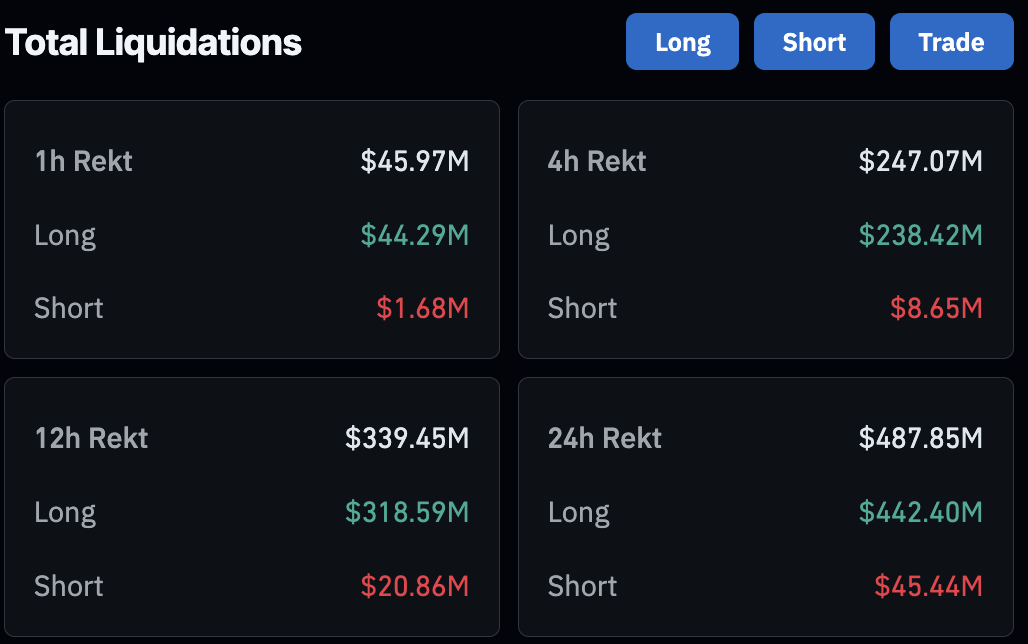
BTC USD has broken below the $67,000 price level for the first time since March 9, sliding by 5 big percents in 24 hours to trade at $66,300, and the macro backdrop just got considerably uglier. The 10-year U.S. Treasury yield is closing in on 4.5%, its highest level since July, draining risk appetite across crypto markets. Whether this dip finds a floor or accelerates into deeper liquidation territory is the question every trader is asking right now.
The selloff triggered close to $50 million in long liquidations in a single hour, with Coinglass data showing roughly 90% of those wipes coming from long positions. Shares of crypto-adjacent equities like Circle Internet (CRCL), Coinbase (COIN), and Strategy (MSTR) all fell in pre-market trading. Funding rates have flipped negative, meaning short traders are now paying longs: a textbook bearish signal in perpetual futures markets.

Macro conditions are compounding the pressure. The MOVE Index, which tracks U.S. bond market volatility, surged 18% in 24 hours. Oil prices, both Brent and WTI, rose 3% as Ukraine’s disruption of Russian oil flows complicated Trump’s supply-stabilization plans.
Risk assets are caught in a crossfire of rising yields, geopolitical friction, and forced crypto deleveraging. The broader BTC price outlook was already fragile heading into this week.
Discover: The best crypto to diversify your portfolio with
Can BTC USD Hold $66K Price Level? Or Is a Deeper Flush Coming?
The BTC USD price technical structure has deteriorated sharply. Key support levels sit at $68,400 has broken in a flash. All short-term moving averages are flashing SELL; the MA5 sits at $74,900, the MA3 at $78,900, both far above spot, confirming sustained downward momentum rather than a shallow correction.
The 48-hour liquidation heatmap is particularly concerning: a dense liquidity cluster sits below $66,000, which functions as a magnet for price during high-volatility episodes. The Fear & Greed Index has collapsed to 10, or Extreme Fear.

The Bernstein bottom analysis suggested structural support deeper in the range, but that thesis gets harder to hold when yields are rising, and oil is spiking simultaneously. If $66,000 breaks on volume, the next credible floor is meaningfully lower.
Discover: The best pre-launch token sales
Bitcoin Hyper Comes With Upside Potential as BTC Tests Critical Support
Spot Bitcoin bleeding through support is painful for leveraged longs. But it also historically sharpens attention toward early-stage infrastructure plays, projects that capture Bitcoin’s upside thesis without the same immediate downside exposure from macro-driven deleveraging. That’s where Bitcoin Hyper ($HYPER) is drawing interest.
Bitcoin Hyper is positioning itself as the first Bitcoin Layer 2 with Solana Virtual Machine (SVM) integration, delivering sub-second finality and smart contract capability directly within Bitcoin’s security model.
Wow! Now this looks like it'll lead somewhere nice. — Bitcoin Hyper (@BTC_Hyper2) March 26, 2026

Bitcoin just found its fast lane.  https://t.co/VNG0P4GuDo pic.twitter.com/ayZQyRm7m3
The pitch is blunt: Bitcoin is slow, expensive, and non-programmable. Bitcoin Hyper claims to fix all three simultaneously, via a Decentralized Canonical Bridge for BTC transfers and high-speed, low-cost transaction execution that reportedly outperforms Solana itself on latency metrics.
The presale has already raised more than $32 million at a current price of just $0.013 per $HYPER, plus 36% APY staking rewards for early buyers.
Traders rotating out of spot BTC exposure during macro stress periods have historically scouted infrastructure-layer presales at precisely these moments. Research Bitcoin Hyper before the current presale stage closes.
This article is not financial advice. Crypto assets are highly volatile. Always conduct your own research before investing.
The post BTC USD Price Falls Below $67K: 10-Year US Treasury Yield Approaches Yearly High appeared first on Cryptonews.

An early-stage discussion draft released by U.S. lawmakers seeks a comprehensive overhaul of how digital assets are taxed, aiming to clarify treatment across a range of activities—from stablecoins to lending and staking. Introduced as a conversation starter rather than a bill, the Digital Asset PARITY Act outlines proposed changes to the Internal Revenue Code that would reshape the tax landscape for individuals and institutions engaging with crypto in the United States.
The draft, authored by Representatives Max Miller and Steven Horsford, would set out specific rules for stablecoins, address cost-basis calculations, and establish de minimis exemptions for smaller transactions. Notably, the proposal stops short of an outright crypto tax framework and is framed as a starting point for a broader policy discussion among lawmakers, industry participants, and other stakeholders.
Conversations around the draft emphasize that if enacted, these provisions could influence onramping activity, compliance costs, and how crypto yields are reported. The document is not a bill introduced in Congress, but rather a discussion draft designed to spur debate on how the United States might modernize its tax code to accommodate digital assets.
Key takeaways
- Stablecoins may escape gains taxation if their cost basis remains within 1% of $1 (or $0.01), according to the discussion draft. This threshold would shape when gains on stablecoin holdings are recognized for tax purposes.
- Costs associated with acquiring or moving regulated dollar-pegged stablecoins would not be counted toward an investor’s cost basis, potentially lowering the taxable baseline for some trades.
- A de minimis exemption would apply to stablecoin transactions under $200, meaning those small trades would not trigger tax or reporting requirements. The act does not specify an annual cap yet.
- Income earned from lending, staking, or passive validator services would be treated as ordinary gross income in the year it is earned, measured by fair market value at the time of receipt.
- The proposal remains a discussion draft and has not been introduced as legislation; its purpose is to solicit input from lawmakers, industry participants, and the crypto community on how to overhaul crypto tax policy.
What the draft proposes and why it matters
The Digital Asset PARITY Act proposes a framework intended to bring greater clarity to how digital assets are taxed, with a focus on stabilizing tax outcomes for users who hold or transact with digital currencies that are designed to maintain a stable value. The centerpiece is a potential threshold-based treatment for stablecoins, aimed at reducing the tax friction associated with routine use of dollar-pegged tokens in everyday commerce or yield-generating activities.
Beyond stablecoins, the draft also addresses the allocation of tax burdens for earnings generated through decentralized finance (DeFi) activities. By treating income from lending, staking, and related validator services as ordinary gross income in the year earned, the proposal would require taxpayers to recognize fair market value at the time of receipt, aligning crypto income with traditional tax treatment for similar financial activities.
Officials behind the draft stress that the document is intended to catalyze cross-sector dialogue. They emphasize that any final policy will depend on congressional negotiations, administrative considerations, and input from the crypto industry and other stakeholders. The draft explicitly notes that it has not been introduced as formal legislation and invites feedback on the proposed structures.
Analysts and advocates see the bill as a reflection of the ongoing tension between fostering crypto innovation and maintaining robust tax oversight. From an investor perspective, the provisions could affect how quickly and efficiently activities such as yield farming, staking, and stablecoin usage move into formal compliance, potentially altering risk calculations and after-tax returns.
Industry responses and tensions
Reaction to the discussion draft highlights competing priorities within the crypto policy sphere. Cody Carbone, CEO of the Digital Chamber, framed the draft as a call for much-needed clarity in digital asset taxation. In a statement tied to the draft’s release, he underscored the risk of tax policy that remains ambiguous or misaligned with onshore activity, arguing that clear rules are essential for bringing more activity into the regulated economy.
“We need digital asset tax clarity or activity will never fully onshore,”
— Cody Carbone, Digital Chamber
Among Bitcoin advocates, the reaction was more skeptical, signaling concerns that the plan privileges stablecoins while bypassing a similar tax treatment for Bitcoin (BTC). The draft’s de minimis provision for stablecoins—but not for BTC—echoes ongoing debates about how decentralized, permissionless digital assets should be treated for tax purposes. Critics argue that stablecoins, being centrally issued and regulated, do not share the same decentralized attributes as BTC and should not enjoy the same exemptions.
“This is the wrong direction to go in,”
— Pierre Rochard, CEO, The Bitcoin Bond Company, commenting on the draft’s approach to de minimis relief and stablecoins
The broader policy landscape includes other proposed or pending measures, some of which contemplate various forms of tax relief or exemptions for BTC, while continuing to assess the equity of the tax treatment for stablecoins and other digital assets. Observers note that the Digital Asset PARITY Act aligns with an ongoing push to reform crypto taxation but remains a preliminary draft that will require extensive debate before any legislative action.
Context, implications, and what comes next
The draft arrives at a moment when policymakers are increasingly focused on how to create a workable tax regime for rapid innovation in digital assets, including DeFi, tokenized securities, and cross-border use cases. By proposing targeted exemptions and income-recognition rules, the authors aim to balance revenue considerations with practical usage patterns—especially for stablecoins that underpin much of DeFi liquidity, payments, and on-chain settlement.
For investors and developers, the move signals potential shifts in tax planning and compliance obligations. If adopted, the rules could influence how projects structure incentives, how wallets and exchanges report activity, and how users assess the after-tax viability of various crypto strategies. The discussion also foregrounds potential regulatory bifurcations between stablecoins and other digital assets, a theme that could shape policy debates in the coming months.
As Congress weighs the draft, stakeholders will scrutinize the mechanics of the proposed cost-basis rules, the exact thresholds for exemptions, and how these changes would integrate with existing tax provisions. The process will likely involve multiple committees, hearings, and stakeholder rounds before any formal bill could emerge. Market participants should watch for: whether the de minimis threshold for stablecoins is preserved or revised, whether BTC-specific exemptions gain traction, and how the definition of “regulated” stablecoins evolves in alignment with broader regulatory expectations.
In the near term, observers expect further commentary from industry groups, think tanks, and lawmakers as the dialogue around crypto taxation intensifies. The Digital Asset PARITY Act stands as a litmus test for how policymakers intend to reconcile traditional tax rules with the increasingly complex and transformative world of digital assets.
Readers should stay tuned for updates on whether the discussion draft progresses toward formal consideration and how the evolving policy debate will influence tax reporting, compliance costs, and the broader adoption path for digital assets in the United States.

Introduction
In cryptocurrency markets, success is rarely about prediction alone. It comes down to execution, consistency, and discipline — areas where human traders often fall short.
QBots addresses this gap by offering a fully automated trading platform designed to execute strategies with precision across the most liquid digital assets. Rather than relying on manual decisions, users can deploy algorithmic strategies that operate continuously, removing emotion from the process.
Focused on the Top 50 cryptocurrencies by market capitalisation, QBots enables users to automate trading across major global exchanges with efficiency and control.
Advanced Strategies for Every Market Condition
QBots provides a suite of strategies designed to perform across different market environments:
- Mean Reversion: Capitalises on price movements returning to historical averages, ideal for volatile and range-bound markets.
- Futures Grid Trading: Automates buying and selling within predefined price ranges, turning short-term volatility into structured returns.
- Momentum Trading: Identifies strong trends and enters positions when directional movement is confirmed.
- Dollar-Cost Averaging (DCA): Reduces timing risk by spreading entries over time, improving average entry price.
- Arbitrage & Scalping: Exploits small price inefficiencies across highly liquid pairs for frequent, short-term opportunities.
These strategies allow users to operate with a level of consistency and speed typically reserved for institutional trading desks.
Global Access with Real Execution
QBots integrates directly with leading exchanges through secure API connections. This allows users to:
- Retain full control of their funds (funds safe on mexc, bybit or binance)
- Execute trades automatically in real time
- Deploy multiple strategies simultaneously
By focusing on the most liquid assets, QBots ensures that trades are executed efficiently, with minimal slippage and strong market depth.
Built-In Risk Management
Automation without control is risk — which is why QBots incorporates:
- Customisable stop-loss and take-profit settings
- Strategy-level risk parameters
- Defined capital allocation per trade
This allows users to tailor their approach based on their risk tolerance while maintaining systematic execution.
Referral Program: Build Recurring Income
QBots also introduces a referral program designed for recurring income.
Users can invite others to the platform and earn a percentage of subscription revenue generated by their network. As long as referrals remain active, earnings continue — creating a scalable income stream alongside trading activity.
This turns QBots into not just a trading tool, but a distribution-driven ecosystem.
Additional Benefits
Users who choose to pay for QBots subscriptions using QIE tokens receive discounted pricing, adding an additional layer of value for participants within the broader ecosystem.
Conclusion
QBots represents a shift away from manual, emotion-driven trading toward structured, automated execution.
By combining institutional-grade strategies, real-time execution, built-in risk management, and scalable earning opportunities, QBots enables users to participate in crypto markets with greater consistency and efficiency.
In a market driven by speed and discipline, automation is no longer optional — it is an advantage.
Explore QBots and deploy your first automated strategy today.
Disclaimer: This is a Press Release provided by a third party who is responsible for the content. Please conduct your own research before taking any action based on the content.

Equitable and Corebridge Plan to Merge. Their Shares Are Rising.
Will Zcash recap $300 as ZK-backed privacy narrative gains threshold?
What happened to Rory Kennedy’s wedding after JFK Jr. and Carolyn Bessette’s deaths?


-
 Crypto World7 days ago
NIO (NIO) Stock Plunges 6.5% as Shelf Registration Sparks Dilution Worries
-
 NewsBeat3 days ago
Manchester United reach agreement with Casemiro over contract clause amid transfer speculation
-

 Crypto World6 days ago
Best Crypto to Buy Now: Strategy Just Spent $1.57 Billion on Bitcoin During Fear While Early Investors Quietly Enter Pepeto for 150x Potential
-

 Crypto World6 days ago
Bitcoin Price News: Bhutan Sells $72 Million in BTC Under Fiscal Pressure, but the Smart Money Entering Pepeto Sees What the Market Does Not
-

 News Videos2 days ago
Parliament publishes latest register of MPs’ financial interests
-

 Sports4 days ago
Remo Stars and Kano Pillars Strengthen Survival Hopes in NPFL
-

 Sports4 days ago
Gary Kirsten Accuses Pakistan Cricket Board Of ‘Interference’, Mohsin Naqvi Responds
-

 Business5 days ago
No Winner in March 21 Drawing as Prize Rolls to $133 Million for Next
-

 Tech5 days ago
Give Your Phone a Huge (and Free) Upgrade by Switching to Another Keyboard
-

 Tech5 days ago
AI enters the chat: New Seattle dating app relies on tech to facilitate meaningful human connections
-

 News Videos4 days ago
Ch 9 Financial Management Part 1 | Detailed One Shot | Class 12 Business Studies Boards 2026
-
Business7 days ago
Columbia Sportswear enters $500 million credit agreement with JPMorgan Chase
-

 Tech6 days ago
Today’s NYT Connections Hints, Answers for March 22 #1015
-

 Business1 day ago
Instagram, YouTube Found Responsible for Teen’s Mental Health Struggle in Historic Ruling
-

 Business6 days ago
Will Duke Basketball Win It All? Duke Basketball Enters Second Round as Third Favorite to Claim NCAA Title
-

 Sports5 days ago
2026 Kentucky Derby horses, odds, futures, preview, date: Expert who hit 12 Derby-Oaks Doubles enters picks
-
 NewsBeat5 days ago
Update on Wisbech river crash as search for teenage boy enters fifth day
-
 Entertainment4 days ago
Cynthia Bailey Dishes on ‘RHOA’ Season 17, Discusses Kandi
-
 NewsBeat2 days ago
Tesco is selling new Cadbury Dairy Milk bar and people can’t wait to try it
-

 Tech4 days ago
Samsung will soon let you control smart home devices from your car’s dashboard
You must be logged in to post a comment Login