
Crypto World
Coinbase Insider Trading Lawsuit Advances Despite $2.9B Stock Sale Defense

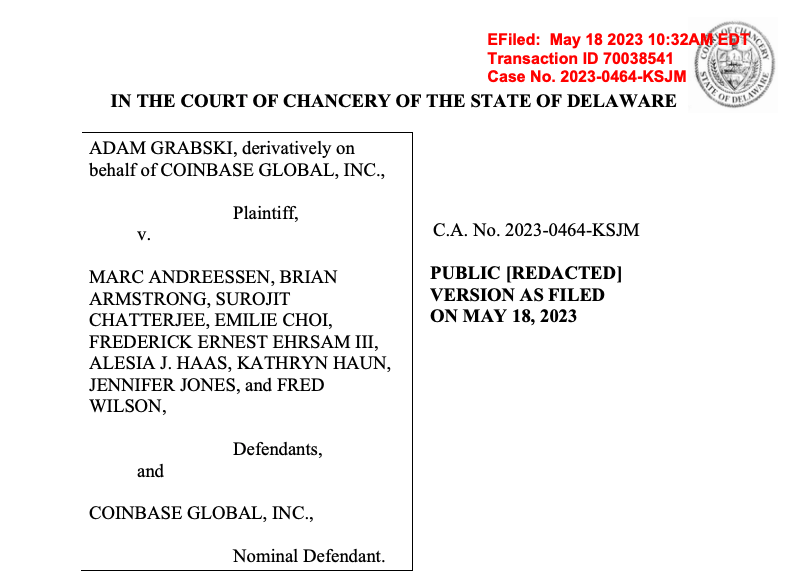
A Delaware judge ruled Friday that a shareholder lawsuit alleging insider trading by Coinbase directors can proceed, rejecting a special committee’s recommendation to dismiss the case despite its 10-month investigation clearing the defendants.
The decision affects several high-profile directors, including venture capitalist Marc Andreessen and CEO Brian Armstrong, who collectively sold over $2.9 billion in stock during the company’s April 2021 direct listing.
According to Bloomberg Law, Judge Kathaleen St. J. McCormick allowed the case to proceed due to conflicts involving one committee member, though she acknowledged the internal investigation “paints a compelling narrative” in support of the directors’ defense.
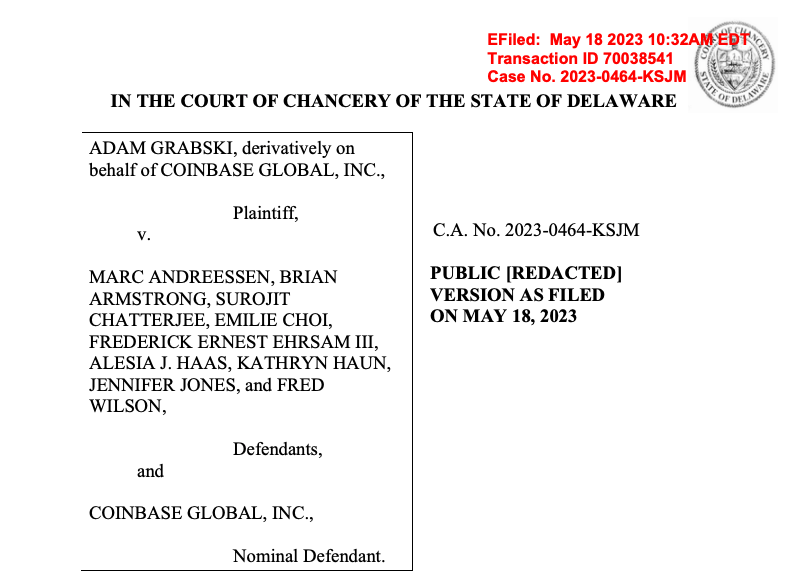
The lawsuit, filed in 2023 by shareholder Adam Grabski, claims directors used confidential valuation information to avoid more than $1 billion in losses by selling shares when Coinbase went public without traditional lockup restrictions.
Independence Concerns Undermine Internal Review
The special litigation committee comprised two Coinbase board members: Kelly Kramer, former chief financial officer of Cisco Systems, and Gokul Rajaram, a Silicon Valley angel investor.
Neither was named as a defendant nor sold shares in the direct listing. However, McCormick identified substantial business ties between Rajaram and Andreessen Horowitz as disqualifying conflicts of interest.
According to court filings, interactions included a 2007 investment by Andreessen in a startup co-founded by Rajaram, and at least 50 financing rounds in which Rajaram or his venture firm participated alongside Andreessen Horowitz since 2019.
“No one—not plaintiff and thus not the court—questions Rajaram’s good faith,” McCormick wrote. “But the thick ties between him and the subject of the SLC’s investigation are sufficient to raise material disputes regarding his independence.“
Attorneys for the committee argued that the business interactions were “immaterial,” given the 700 total investments, and noted that there was no evidence of coordination in financing rounds.
“These are not close personal ties. These are professional ones,” said Brad Sorrels, representing the committee, during an October hearing.
Direct Listing Structure Enabled Immediate Sales
The shareholder complaint centers on Coinbase’s unconventional path to public markets through a direct listing rather than a traditional IPO.
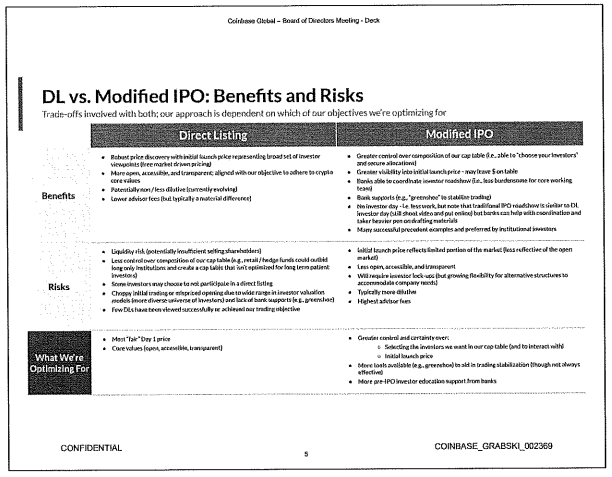
This structure allowed existing shareholders to sell immediately without the lockup periods typically imposed by underwriters to prevent insider trading on material nonpublic information.
Armstrong sold $291.8 million in shares, according to the complaint, while Andreessen Horowitz divested $118.7 million through the direct listing.
Other defendants included Chief Operating Officer Emilie Choi, who sold $224 million, and co-founder Fred Ehrsam, who sold $219.5 million.
The lawsuit alleges that directors knew the shares were overvalued, based on an internal Andersen Tax valuation that was substantially below market expectations when trading began at $381 per share.
Within five weeks of the April 14, 2021 listing, Coinbase shares declined by more than 37% as the company disclosed fee compression affecting retail revenues and announced a dilutive convertible note offering.
By May 18, 2021, the stock had wiped out just over $37 billion in value, according to the complaint.
Company Disputes Claims Amid Delaware Criticism
“We are disappointed by the court’s decision and remain committed to fighting these meritless claims in court,” Coinbase said in a statement.
The committee’s report concluded that the defendants didn’t rely on confidential information, noting that Coinbase stock is “highly correlated” with Bitcoin prices, making it impossible to prove insider trading allegations.
The committee argued directors “reluctantly” sold stock to provide sufficient supply for the direct listing, divesting only small portions of their holdings.
“The evidence roundly showed that defendants, including the two biggest stockholders, didn’t want to sell because they were bullish about the company,” Sorrels said during the October hearing.
Armstrong and Andreessen Horowitz “ultimately agreed to sell just over 1% of their respective shares only after the company and its banker pleaded with them to provide supply necessary for the direct listing to launch,” according to committee filings.
Andreessen Horowitz has publicly criticized Delaware’s business courts, announcing plans last July to reincorporate portfolio companies elsewhere due to perceived bias “against founders and their boards.“
Coinbase announced its own reincorporation plans on November 12, following similar moves by other major companies seeking to exit Delaware’s jurisdiction.
Beyond civil litigation, Coinbase faced a similar, but criminal insider trading case in 2023, when former product manager Ishan Wahi received a two-year prison sentence for sharing confidential listing information with family members who profited from the advanced knowledge.
The post Coinbase Insider Trading Lawsuit Advances Despite $2.9B Stock Sale Defense appeared first on Cryptonews.


XRP Tokyo is here. XRPL community descends on Japan for what may be the most consequential Ripple event of 2025. The headline figure out of XRP Tokyo is staggering; it reframes the entire stablecoin conversation. Whale accumulation is at a 10-month peak. Something is building.
At XRP Tokyo today, Ripple revealed that on-chain stablecoin volume is projected to exceed $33 trillion in 2026, a figure larger than the combined GDPs of the United States and China. The company’s conference flyer put it bluntly:
“Modern fintechs no longer ask if they should adopt stablecoins. Instead, they ask how quickly they can integrate them to stay ahead.”
Ripple holds more than 75 licenses globally and is positioning itself as the compliance backbone for that shift. SBI Holdings, Japan’s financial heavyweight and a Ripple partner since 2016, launched a 10 billion yen (~$64M) blockchain bond earlier this year using XRP rewards, underscoring that this is not conference theater.
BOOM! — X Finance Bull (@Xfinancebull) April 7, 2026
 $XRP TOKYO IS HAPPENING!
The institutional playbook on display.
Evernorth, SBI Ripple Asia, RippleX, GMO Aozora Net Bank, A16z Crypto, Fireblocks, and more.
Panels on stablecoins, RWA tokenization, and institutional blockchain adoption.
JAPAN IS DOING IT AGAIN! https://t.co/gEGqt97kCf pic.twitter.com/OI5GG3tNWR
The data points to a market coiling ahead of potential catalysts. Whether XRP can convert event momentum into a sustained breakout is the question every trader is sitting with right now.
Discover: The best crypto to diversify your portfolio with
Can XRP Price Break $1.40 Before Tokyo Conference Ends?
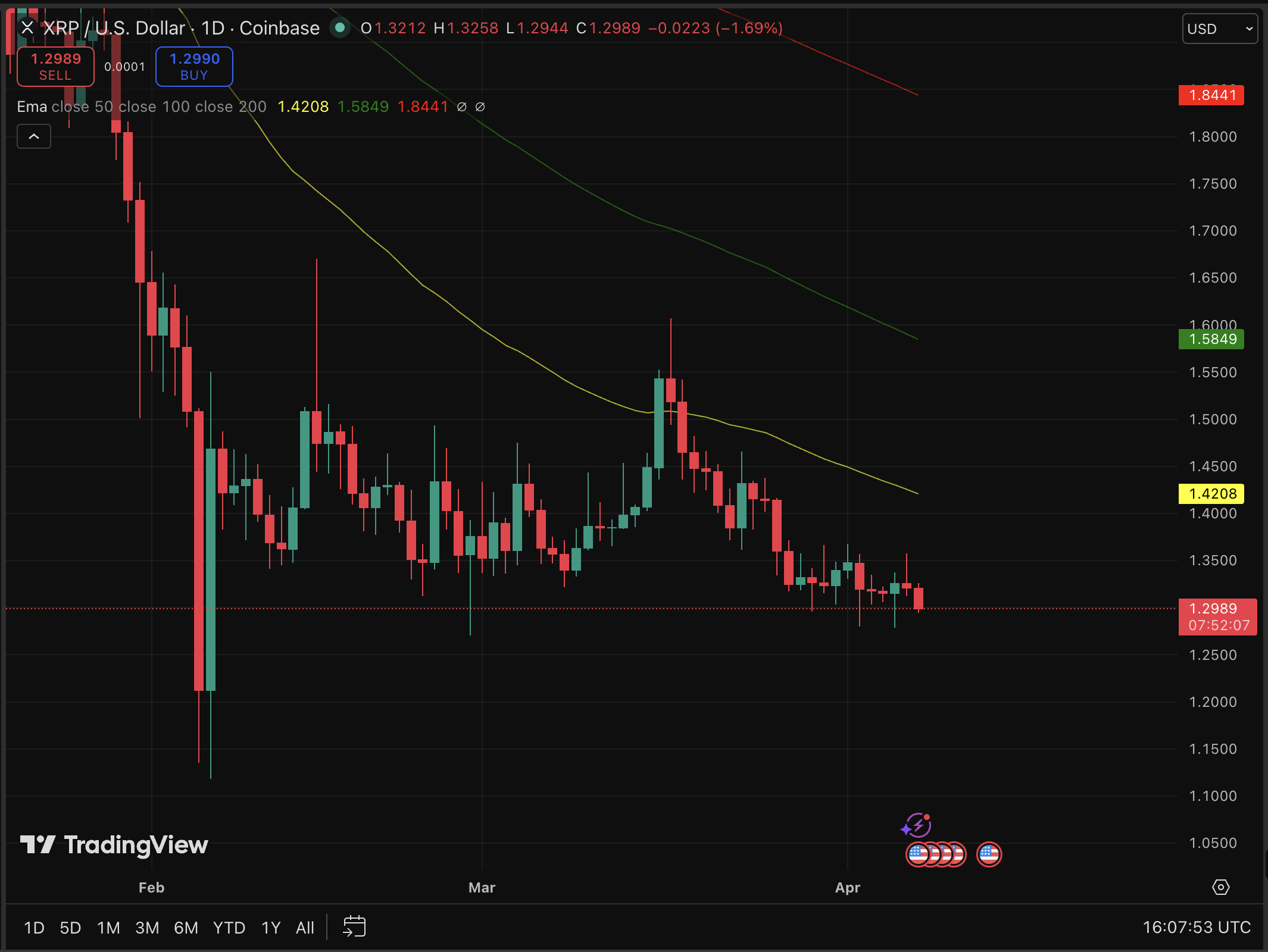
XRP is consolidating in a tight $1.28–$1.35 range, with 24-hour low touching $1.30. The ugly truth is that large investors have been pulling coins off exchanges at a pace exceeding 11 million XRP per day, compressing available supply precisely as conference hype peaks.
The key technical level is $1.35. Institutions appear to be hedging around that figure, and a clean daily close above it opens a path toward the $1.40–$1.60 range. Spot XRP ETFs have pulled in $41M in year-to-date inflows; institutional demand is not hypothetical.
SBI CEO Yoshitaka Kitao added fuel last week, stating XRP “will be very expensive” if Ripple secures a favorable legal resolution, a comment that sent community forums into overdrive.
“XRP WILL BE VERY EXPENSIVE.” — Stellar Rippler
No, this is not just David Schwartz’s confession. This was also said by the biggest financial giant of Japan, Yoshitaka Kitao, SBI Holdings CEO.
SBI is Ripple’s largest external shareholder.
And he says clearly: “XRP will be very expensive.”… pic.twitter.com/mixB533ymR
 (@Stellar_Rippler) April 3, 2026
Three scenarios frame the near term. Bull case: a confirmed close above $1.35–$1.36 on strong volume drives a move toward $1.50+, accelerated by any tokenization announcement out of Tokyo. Base case: XRP grinds sideways in the $1.30–$1.40 band while the market waits on regulatory clarity. Invalidation: a break below $1.28 on rising volume would revisit the failed breakout lows and likely flush late longs.
The CLARITY Act’s progress through the Senate remains the wildcard that could accelerate any of these outcomes significantly.
Discover: The best pre-launch token sales
Bitcoin Hyper Targets Early-Mover Upside
XRP at $1.3 is a recovery, but it’s also a return to levels the asset visited months ago. At an $82 billion market cap, the asymmetric upside that defined XRP’s earlier moves requires increasingly large capital inflows to replicate. That’s not bearish, it’s just math.
Traders hunting earlier-stage exposure are looking at Bitcoin Hyper ($HYPER), a Bitcoin Layer 2 presale that has raised more than $32 million at a current price of $0.013. The project’s core is genuinely differentiated: it’s the first Bitcoin Layer 2 integrating the Solana Virtual Machine, targeting sub-Solana latency with smart contract capability while anchoring to Bitcoin’s security.
Hyper is a Decentralized Canonical Bridge handles BTC transfers; high-speed, low-cost execution handles the rest. Staking is live with a high 36% APY bonus during the presale window.
Bitcoin Hyper presale details are here.
The post XRP Tokyo Is Here: What We Learn and What’s Next for XRP Price appeared first on Cryptonews.

TLDR:
- FDIC, OCC, and NCUA jointly propose updated AML/CFT rules aligned with FinCEN’s new framework.
- Banks must adopt risk-based programs, focusing resources on higher-risk customers and activities.
- Only systemic or significant compliance failures will trigger formal AML/CFT enforcement actions.
- A new FinCEN consultation framework will strengthen coordination across federal banking regulators.
Federal banking regulators have jointly proposed a rule to update anti-money laundering and countering the financing of terrorism requirements.
The FDIC, OCC, and NCUA are seeking public comment on amendments to AML/CFT compliance programs. These changes align with updates proposed by the Treasury’s Financial Crimes Enforcement Network.
The rule stems from the Anti-Money Laundering Act of 2020, which directed agencies to modernize the existing regulatory framework.
Risk-Based Approach Takes Center Stage
The proposed rule places greater focus on risk-based AML/CFT programs for supervised institutions. Banks would be required to direct more resources toward higher-risk customers and activities.
Lower-risk customers and activities would receive proportionally less regulatory attention under the new framework.
The FDIC shared this update directly, stating:
“The FDIC Board also approved a proposed rule to update requirements related to anti-money laundering and countering the financing of terrorism.”
This approach encourages institutions to align compliance efforts with their actual risk profiles. Rather than applying uniform scrutiny across all customers, banks must assess and prioritize accordingly. The goal is to produce more effective outcomes for financial institutions and law enforcement alike.
The proposed rule also requires that a bank’s designated AML/CFT compliance officer be located in the United States.
That officer must remain accessible to regulators at all times. This provision adds a layer of accountability to institutional compliance structures.
Clearer Enforcement Standards and FinCEN Coordination
The proposed rule also introduces clearer standards around when enforcement actions may be triggered. Only significant or systemic failures to implement a properly established program would qualify. This change offers banks more regulatory certainty around compliance expectations.
Additionally, the rule establishes a new consultation framework between the agencies and FinCEN. This framework applies to certain supervisory and enforcement actions taken by the FDIC, OCC, and NCUA. It is designed to strengthen coordination and consistency across federal regulators.
Banks would also gain explicit authority to share AML/CFT-related information directly with FinCEN. This provision supports more open communication between institutions and federal financial intelligence units. It further reflects the broader effort to modernize information-sharing under the Bank Secrecy Act.
The public comment period gives financial institutions, credit unions, and other stakeholders the opportunity to weigh in.
The agencies intend for these changes to produce a stronger, more consistent AML/CFT compliance environment nationwide.



The crypto market update bitcoin war hedge Strait of Hormuz news today centers on a striking development: Iran’s IRGC has established a formal toll system at the world’s most critical oil chokepoint, demanding payments in stablecoins or Chinese yuan for naval escort through the strait — yet despite crypto’s growing role in wartime finance, Bitcoin has underperformed gold significantly since the conflict began on February 28.
Summary
- Bloomberg reported April 1 that Iran’s IRGC is charging ships a baseline of $1 per barrel — up to $2 million per very large crude carrier — payable in stablecoins or yuan, with a five-tier “friendliness ranking” system determining access and escort terms
- Chainalysis estimated Iranian-linked on-chain crypto activity reached $7.8 billion in 2025, with stablecoins playing a central role; Iran legalized Bitcoin mining in 2019 and its Ministry of Defense has accepted crypto for military export contracts since January 2026
- Bitcoin has underperformed gold as a wartime hedge since the conflict began, sitting at rank 12 by market cap with dominance at 59%, while gold has held safe-haven capital that Bitcoin has not captured
The crypto market update bitcoin war hedge Strait of Hormuz news has a sharper edge than most market commentary suggests. According to Bloomberg’s report from April 1, Iran’s IRGC has formalized control over the world’s most important oil chokepoint into a structured payment gateway. Ship operators seeking Hormuz transit must submit vessel ownership records, flag registration, cargo manifests, crew lists, and AIS tracking data to an IRGC-linked intermediary. The IRGC then assigns the ship a ranking on a five-tier “friendliness” scale — lowest rankings get most favorable terms. Once payment is received, a single-use passcode is broadcast over VHF radio and an Iranian naval escort guides the ship through.
Critically, Iran is demanding payment in stablecoins — not Bitcoin — specifically because stablecoins eliminate price volatility between invoice and settlement, making them functionally equivalent to dollar wire transfers while remaining outside the US dollar clearing system. Oil tankers start at around $1 per barrel, with very large crude carriers paying up to $2 million per transit. At least 15 to 18 ships have transited under this system in recent weeks.
Iran’s Crypto Infrastructure Is Not New
The Hormuz toll system is the most visible iteration of a much longer-running strategy. Iran legalized Bitcoin mining in 2019, at its peak contributing an estimated 4 to 5% of global Bitcoin hash rate. Chainalysis estimates Iranian-linked crypto activity reached $7.8 billion on-chain in 2025. In January 2026, Iran’s Ministry of Defense Export Center updated its systems to accept stablecoin payments for drone, missile, and other military export contracts.
Iran’s parliamentary National Security Committee approved a formal “Strait of Hormuz Management Plan” on March 31, which includes an official toll structure that references Iranian rials as currency but operates in practice with yuan and stablecoins to bypass OFAC enforcement.
Is Bitcoin a War Hedge? The Data Says Not Here
As crypto.news reported, Bitcoin has dropped roughly 12% since the war began, while gold — despite its own volatility — has retained more safe-haven capital. Bitcoin sits at rank 12 by market cap, well behind gold at the top, and BTC dominance of 59% reflects consolidation rather than flight-to-safety flows. The Coinbase Premium Index has been in negative territory throughout the conflict, signaling US spot demand has not materialized in the way gold demand has.
As crypto.news noted, each confirmed escalation event in this conflict has produced immediate Bitcoin selling rather than buying — the opposite of what a war hedge would deliver. The stablecoin role in Iran’s Hormuz system is operationally rational: it solves a payment problem. Whether Bitcoin becomes a war hedge depends on a different question — whether retail and institutional capital decides to treat it as one.
“Bitcoin still trades more like a high-beta risk asset than a defensive hedge in the current climate,” one Orbit Markets analyst told Bloomberg this month.
Crypto World
Sky Protocol Proposes Two Structural Upgrades to Strengthen Capital Protection Framework: Sky Governance


Sky Governance is proposing a stronger solvency buffer and a more sustainable staking rewards model to solidify long-term protocol stability.
Sky Governance is proposing two structural upgrades to strengthen the protocol’s capital protection framework, according to an announcement on April 7, 2026. The proposals include implementing a stronger solvency buffer and adopting a more sustainable staking rewards model. The measures are designed to solidify Sky Protocol’s long-term stability while prioritizing trustworthiness over short-term yield-seeking.
Sky Protocol cited sUSDS, its yield-generating stablecoin, as the largest in its category, attributing its success to the protocol’s distinctive risk posture compared to competitors in the space. The governance updates reflect Sky Protocol’s commitment to capital protection and long-term sustainability.
Sources: Sky Ecosystem
This article was generated automatically by The Defiant’s AI news system from publicly available sources.

The Federal Deposit Insurance Corporation (FDIC) has moved to tighten oversight of stablecoins, signaling a clear shift in how these digital assets will operate in the United States.
On April 7, the FDIC approved a proposal to implement key provisions of the GENIUS Act. The rule would set standards for stablecoin issuers under its supervision, including requirements for reserves, redemptions, capital, and risk management.
In simple terms, stablecoins in the US are being pushed closer to the banking system. Issuers will need to hold safe assets such as cash or US Treasuries and prove they can redeem tokens reliably at a one-to-one value.
At the same time, the proposal formally brings banks into the stablecoin ecosystem. Insured banks would be allowed to hold reserves and provide custody services. This links stablecoins more directly to traditional financial infrastructure.
The FDIC also addressed how deposits backing stablecoins may be treated. If these funds meet the legal definition of a deposit, they could qualify for the same protections as regular bank deposits. This could increase trust but also expands regulatory control.
However, the rule is not final. The agency will accept public comments for 60 days before making changes.
Overall, the direction is clear. In the US, stablecoins are no longer being treated as a separate crypto product. They are operating under rules similar to those applied to banks.
The post FDIC Moves to Treat Stablecoins Like Banks Under New Rule appeared first on BeInCrypto.
Crypto World
FDIC Approves GENIUS Act Stablecoin Rule to Govern Reserve, Capital, and Deposit Standards
TLDR:
- The FDIC Board approved a proposed rule establishing a prudential framework for payment stablecoin issuers under the GENIUS Act.
- FDIC-supervised IDIs offering stablecoin custodial and safekeeping services will face defined requirements under the new rule.
- The rule clarifies that tokenized deposits meeting the deposit definition will be treated equally under the Federal Deposit Insurance Act.
- Public comments on the proposed rule will be accepted for 60 days following its official Federal Register publication date.
The Federal Deposit Insurance Corporation (FDIC) has taken a notable regulatory step for digital assets. Its Board of Directors approved a notice of proposed rulemaking to implement the Guiding and Establishing National Innovation for U.S. Stablecoins Act (GENIUS Act).
The proposed rule sets a prudential framework for FDIC-supervised permitted payment stablecoin issuers. It covers reserve assets, redemption, capital, and risk management standards. This marks the FDIC’s second rulemaking under the GENIUS Act.
FDIC Sets Prudential Standards for Stablecoin Issuers
The proposed rule targets FDIC-supervised permitted payment stablecoin issuers directly. It establishes clear requirements around reserve assets, redemption processes, capital adequacy, and risk management. These standards aim to bring consistency across how stablecoin issuers operate within the banking system.
The FDIC also addressed insured depository institutions (IDIs) offering stablecoin-related custodial and safekeeping services. Such institutions will face specific requirements under this proposed framework.
This ensures that custodial services for stablecoins meet the same prudential standards as other banking activities.
The FDIC Board approved the proposed rulemaking and announced it through official channels earlier today. The rule reflects an ongoing effort to integrate digital assets into existing regulatory norms. It follows months of legislative activity surrounding the broader GENIUS Act framework.
Deposit Insurance Clarified for Reserves and Tokenized Deposits
The proposed rule also addresses pass-through insurance for deposits held as stablecoin reserves. This clarifies how federal deposit insurance applies within a stablecoin context. It is a practical detail for institutions managing reserve-backed payment stablecoins.
Moreover, the rule covers tokenized deposits meeting the statutory definition of a deposit. Under the Federal Deposit Insurance Act, such deposits will receive no different treatment than any other deposit type. This provides legal clarity for banks exploring tokenized deposit products going forward.
The public comment period for the proposed rule will remain open for 60 days after its Federal Register publication.
Stakeholders across the financial and crypto sectors will have an opportunity to respond. This allows the industry to contribute before the rule is finalized.
This latest proposal is the FDIC’s second rulemaking under the GENIUS Act. The first was issued on December 19, 2025, covering application procedures for IDIs seeking to issue payment stablecoins through subsidiaries.
Together, both rules are building the foundation of a broader federal stablecoin regulatory framework. As the GENIUS Act continues to take shape, regulated stablecoin issuance is becoming increasingly well-defined for financial institutions.
Key takeaways:
-
BTC failed to hold $70,000 despite strong ETF inflows as selling by public miners offset recent institutional buying.
-
Options markets reflect high demand for downside protection as a 17% put premium signals cautious sentiment.
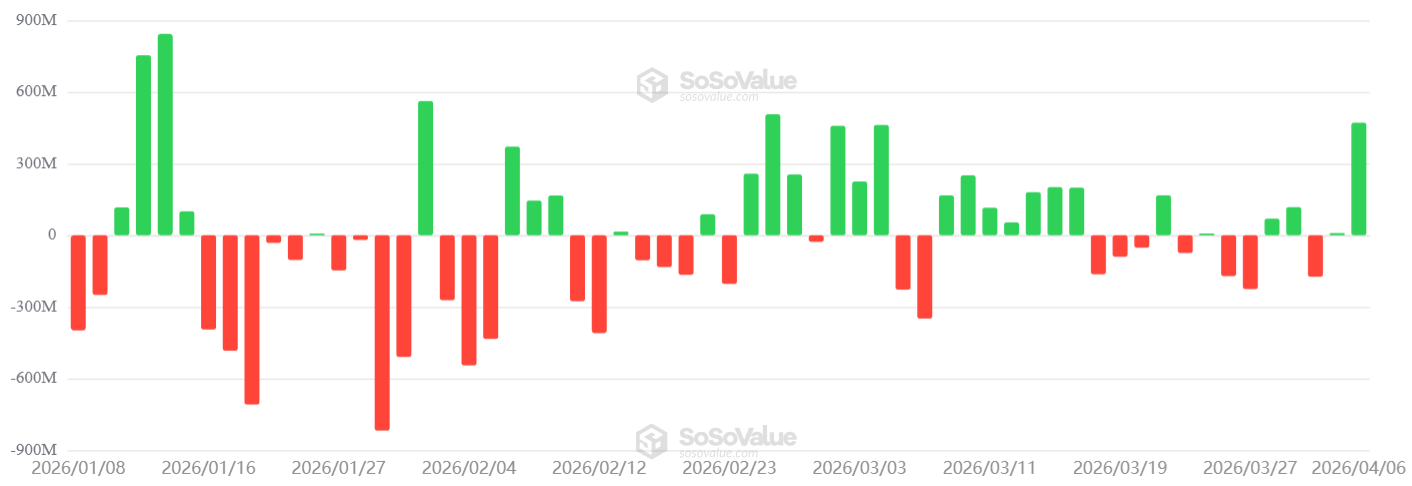
Bitcoin (BTC) failed to sustain Monday’s $70,000 level despite $471 million in net inflows into US-listed spot exchange-traded funds (ETFs). The market’s initial excitement faded following reports that multiple US and Israeli aircraft and equipment were destroyed during a military operation in Iran over the weekend.
Since the S&P 500 remained relatively flat between Friday and Tuesday, Bitcoin’s inability to maintain bullish momentum likely stems from other factors.

The US-listed Bitcoin ETFs recorded $471 million in net inflows on Monday, the highest in over five weeks; however, the trend for the preceding two weeks remained muted, signaling a lack of conviction. Part of traders’ concern stems from recent Bitcoin sales by publicly listed miners.
Bitcoin miner and digital asset treasury companies put BTC under pressure
MARA Holdings (MARA US) reportedly transferred 250 BTC on Tuesday, according to Lookonchain data. MARA previously announced the sale of 15,133 BTC in March and reported 38,689 BTC held in total. Traders fear additional sell pressure as multiple miners focus on trimming debt to fund a strategic shift toward AI computing data centers.
Riot Platforms (RIOT US) transferred 1,500 BTC for sale during the first week of April, according to Arkham data. Per the latest operational update, the company held 15,680 BTC, intensifying fears of continued liquidations as high energy costs negatively impact operations.
Other addresses linked to large miners sold 265 BTC on Tuesday after accumulating since early 2024, according to Lookonchain. The address 3PFNdgGi…myCh139 still holds 112 BTC. Regardless of the rationale behind these movements, sentiment worsened after Bitcoin’s hashrate dropped to 953 exahashes on Monday, down from 1,083 exahashes in late February.

Strategy (MSTR US) continued accumulating Bitcoin, totaling 4,871 BTC in the previous week alone. However, investors increasingly fear that few buyers remain after a two-month bear market, especially as companies that raised debt to accumulate Bitcoin face heavy pressure and are forced to sell some reserves.

Among the companies that reduced Bitcoin holdings over the past month are Sequans Communications (SQNS FR) and Nakamoto Inc (NAKA US). More concerning, a handful of other listed companies face losses of 35% or more on their Bitcoin holdings, including GD Culture Group (GDC US) and OranjeBTC (OBTC3 BR), according to BitcoinTreasuries data.
Related: Bitcoin price risks ‘$15K shakeout’ in the next 5 months, BTC analyst warns

Bitcoin options markets signaled discomfort on Tuesday as put (sell) options traded at a 17% premium relative to call (buy) instruments. Traders believe whales have a better gauge of the market, but the options skew results from regular traders constantly buying downside protection rather than a premeditated movement from market makers.
There is no indication that professional traders are leaning bearish, but a single day of strong ETF net inflows does not prove heightened institutional demand. Hence, even if a deal to reopen the Strait of Hormuz lifts risk markets, odds are Bitcoin could struggle to sustain levels above $75,000 given the risk-averse sentiment.
This article is produced in accordance with Cointelegraph’s Editorial Policy and is intended for informational purposes only. It does not constitute investment advice or recommendations. All investments and trades carry risk; readers are encouraged to conduct independent research before making any decisions. Cointelegraph makes no guarantees regarding the accuracy or completeness of the information presented, including forward-looking statements, and will not be liable for any loss or damage arising from reliance on this content.
Crypto World
Petroyuan Rises as Physical Oil, Yuan Settlements, and Rare Earth Markets Decouple From Dollar Systems
TLDR:
- Dated Brent physical oil trades at $141 while futures sit at $107, marking the widest gap recorded since the 2008 financial crisis.
- Twenty-six ghost fleet tankers settled yuan-based oil trades through CIPS, which hit 928 billion renminbi in daily volume by March 9.
- China controls 95 percent of heavy rare earth processing, and its 2025 export bans have already disrupted auto production lines in the US and Europe.
- The MAG7 lost $1.1 trillion in market cap since the conflict began, as physical supply constraints continue pressing paper-based equity valuations lower.
The petroyuan is gaining momentum as four key global markets send converging signals. Physical oil, equity valuations, yuan settlements, and rare earth supply chains are all drifting away from dollar-based systems.
China appears positioned on the favorable side of each shift. The gap between physical and paper oil markets has not been this wide since 2008, drawing growing attention from analysts tracking commodity and currency flows worldwide.
Physical Oil and Equity Markets Break From Paper Valuations
Physical oil prices have separated sharply from futures markets in recent weeks. Dated Brent is now trading at $141, while futures remain at $107, a $34 gap. Dubai physical hit $140, and Oman physical reached $166. That spread is the widest since 2008.
Equity markets, however, continue to price in a temporary disruption. The MAG7 has lost $1.1 trillion in market capitalization since the conflict began.
Microsoft is 32 percent off its peak, and the S&P technology sector is down 8 percent since February 28. Energy stocks are up 6.6 percent over the same period.
Market analyst Shanaka Anslem Perera wrote on social media that “the paper market prices a resolution. The physical market prices the molecules that are not there.”
That observation reflects a widening divide between financial pricing and real-world supply conditions. Force majeures have spread across ten countries, with zero restarts reported so far.
The longer the disruption continues, the more pressure builds on paper-based valuations. Analysts say the gap between physical delivery and financial claims may not close without actual supply restoration. The current trajectory points toward structural, not cyclical, dislocation.
Yuan Settlements and Rare Earth Controls Reshape Global Trade Flows
Yuan-based oil settlements are rising sharply through China’s CIPS payment system. Twenty-six ghost fleet tankers have left the Persian Gulf since February 28, settling trades in yuan.
CIPS daily volume surged to 928 billion renminbi by March 9. Iran is sending 1.22 million barrels per day to China entirely outside the dollar system.
The dollar still holds 58 percent of global reserves, but settlement flows are shifting. China is capturing the yuan volumes the ongoing conflict generates daily.
The IRGC is also moving to legislate this yuan-based oil architecture into permanent law. That adds a regulatory layer to what began as an informal arrangement.
China also controls 95 percent of heavy rare earth output and processing globally. Export bans introduced in 2025 have already shut automotive production lines across the US and Europe.
The $8.5 billion American diversification push remains years away from producing separated dysprosium at scale. No near-term substitute has emerged.
Deutsche Bank described the conflict as the making of the petroyuan. Analysts, though, say that framing is too narrow.
The war is revealing that the global financial architecture rests on paper claims converting reliably to physical delivery. The April 19 waiver expiry is the next key date markets are watching closely.


An analysis of Morpho markets finds depositors are undercompensated by 5-10x. Curators counter that empirical loss data tells a different story.
Overcollateralized lending has emerged as one of DeFi’s most durable primitives.
Morpho alone holds roughly $7 billion in TVL, according to DeFiLlama, with distribution via Coinbase, Kraken, and other front ends. Apollo Global Management has committed to acquiring up to 9% of MORPHO’s token supply over four years, and the Ethereum Foundation has deployed nearly $19 million into the protocol’s vaults.
But a quantitative analysis published Sunday by Dirt Roads, a DeFi research publication authored by Luca Prosperi, has sparked a debate over whether the depositors fueling that growth are being systematically undercompensated, or whether the lending primitive is working exactly as it should.
Bear Case: Depositors Are Selling Puts They Don’t Understand
Prosperi’s analysis adapts the Black-Cox first-passage framework – a refinement of Merton’s 1974 structural credit model – to DeFi collateralized debt positions. In this context, depositing USDC into a Morpho vault backed by ETH collateral is equivalent to holding a risk-free bond and simultaneously selling a put option on that collateral, with the liquidation loan-to-value (LLTV) acting as the strike price.
Calibrated to ETH’s approximately 75% annualized realized volatility, jump intensity of 1.5 events per year with a mean jump size of -8.3%, and an LLTV of 86% against a 70% starting LTV, the model shows that the appropriate credit spread ranges from 250 to 400 basis points above the risk-free rate, in this case the Fed’s Secured Overnight Financing Rate (SOFR).
Observed depositor rates in flagship Morpho USDC markets are roughly 2-4% APY – thin margins above SOFR, which currently stands at 3.65%.
Crypto investor Santiago Roel endorsed the findings, arguing that $11.7 billion in Morpho vaults is retail capital funding crypto-collateralized lending “thinking it’s a savings account.” No institution, he says, would accept near risk-free rates to come on-chain. He pointed to a structural shift from early DeFi — when triple-digit APYs at least compensated for risk — to a present where vaults with completely different risk profiles present the same thin yields, and depositors simply pick the highest number.
“Last cycle we saw a lot of retail pour savings into algo stablecoins promising ‘risk-free’ yield,” Roel wrote. “This cycle vaults have a lot of demand but they are mispriced for the level of risk.”
Bull Case: It’s a Repo, Not a Put Option
The pushback came swiftly from practitioners with skin in the game and challenged not just the model’s inputs but its foundational analogy.
Steakhouse Financial’s adcv, whose firm curates the primary Morpho vaults that Coinbase routes retail deposits through, argues that on-chain lending is structurally closer to a repurchase agreement than a put option sale.
In a repo, one party temporarily exchanges an asset for cash with a commitment to repurchase and, critically, the lender holds the collateral outright throughout the transaction. On Morpho, collateral is locked in smart contracts and can be seized and liquidated atomically if value declines toward the LLTV threshold. The lender’s exposure is bounded not by the theoretical option payoff on the collateral’s full volatility distribution, but by the narrow residual risk that liquidation mechanics fail to make the lender whole.
This reframing leads to adcv’s central empirical objection: the loss-given-default (LGD) parameter. Prosperi’s model sets LGD at approximately 5%, derived from Morpho’s formulaic liquidation incentive. But the liquidation penalty is a cost borne by borrowers — not a loss absorbed by lenders. For liquid crypto-native collateral on prime markets, on-chain liquidation has historically resulted in near-zero bad debt for depositors because the overcollateralization buffer, continuous oracle monitoring, and open liquidator competition work as designed.
Steakhouse’s own data supports the claim. During the sharp selloff in late January and early February, when BTC fell 17% and ETH dropped 26% in a single week, Morpho processed approximately $238 million in liquidations. Users of Steakhouse’s vaults absorbed zero bad debt and maintained full withdrawal liquidity throughout.
“If you set the LGD parameter to a few basis points over 0% rather than approximately 5%, the model outputs fall exactly in line with observed rates at around 3-30 basis points,” adcv wrote.
Hasu, a strategy lead at Flashbots, made the same point more bluntly.
“Great model, but bad data in, bad data out,” he wrote. “If you use the historically observed level of bad debt on Morpho prime markets, even with a big safety buffer, the result changes: Now, depositors should demand an excess return of only 3-30bps, which is in line with rates observed in the wild.”
The Real Risk Is Fundamental, Not Market
MonetSupply, a contributor at Spark, offered a third perspective that aligns broadly with the curators’ position but redirects the risk conversation entirely. The bulk of the risk in on-chain prime repo, he argued, is not from market price-jump risk – the variable that Prosperi’s model centers on – but from fundamental and technical risks embedded in collateral assets and oracle mechanisms.
Most blue-chip collateral in Ethereum DeFi consists of tokenized Bitcoin (WBTC, cbBTC) or liquid staking tokens (wstETH, weETH). These issuers have long track records, but remain subject to custody and key management failures, smart contract vulnerabilities, and business continuity risks. Oracle providers introduce an additional dependency layer. The probability of incidents across these vectors is low, MonetSupply argues, but losses in a failure case can reach 100% of exposure – a fat-tailed distribution that Merton-style market risk models do not capture.
He pointed to the most recent major DeFi loss events – the Resolv exploit and the Drift Protocol vault drain – as evidence. Both were driven by fundamental risk factors, not market volatility. “As a DeFi lender, the primary driver of risk is these fundamental factors rather than jump risk,” he wrote.
MonetSupply also offered the most rigorous version of the structural premium argument, framing it through the lens of liquidity premia and convenience yield. For traditional finance investors, prime money market funds and T-bills are the benchmark liquid assets, and they would never accept sub-SOFR yields. But for crypto-native actors, the relevant measure of liquidity is not speed-to-bank-account but speed-to-on-chain-execution. A directional crypto fund facing even a one-hour delay between requesting redemption of a money market fund and receiving a wire to their exchange account could miss a 5-10% move in a volatile asset, he argued, wiping out years of excess risk-adjusted return over on-chain repo.
Convenience yield — the implied return on holding inventory close at hand — provides the same logic from a different angle. If on-chain actors derive meaningful benefit from having capital instantly deployable within the crypto ecosystem, even if that benefit is realized infrequently, it can be entirely rational to accept risk-adjusted returns below SOFR on prime repo.
Spark’s own USDT savings vault, MonetSupply noted, maintains over $700 million in available withdrawal capacity against $885 million in total deposits, far exceeding those of typical on-chain lending markets, which already offer a significant liquidity advantage over off-chain cash equivalents.
DeFi’s Structural Advantages
A separate thread in the debate argues that the risk-free rate comparison itself is flawed on even simpler grounds.
Pseudonymous trader MilliΞ contends that DeFi yield carries structural properties traditional fixed income does not: composability that enables permissionless derivative applications, censorship-resistant access without custodians who can “play silly games with you,” and instant withdrawals versus the 30-day redemption windows typical of money market instruments.
“This may not matter to most of us first-worlders,” they wrote, “but it sure matters to the remainder of the planet.”
Where Both Sides Agree
Nobody disputes that the vast majority of retail depositors flowing into Morpho through exchange front-ends do not understand the credit exposure they are taking, and that vault risk profiles vary dramatically even when headline yields look similar.
Similarly, no one disputes that the track record supporting the curators’ optimistic loss assumptions is short and tested only in broadly favorable conditions; a point underscored by the Resolv exploit that cascaded across fifteen Morpho vaults in March, and the Stream Finance collapse that hit lending markets in November 2025. Steakhouse’s own vaults avoided those losses, but other curators’ depositors were not as fortunate.
Prosperi’s analysis also flags concerns outside the LGD debate. Leverage looping strategies, such as recursive wstETH/WETH or sUSDe loops at 7-10x effective leverage, behave not as credit products but as leveraged carry trades on mean-reverting basis spreads, where a 5% depeg at 10x leverage triggers liquidation. And the growing push to onboard non-crypto-native collateral breaks every assumption in the framework simultaneously: unobservable volatility, discrete oracle monitoring, multi-week liquidation delays, and jurisdictional enforcement risk.
The Real Test
The core disagreement is over which measure of risk matters: the structural exposure embedded in the position, or the empirical loss history of the platform. Prosperi and Roel argue the former; Hasu, adcv, MonetSupply, and the curator ecosystem argue the latter – while adding that the model is looking at the wrong risk entirely, and that rational actors may have good reasons to accept thin or even negative spreads over SOFR.
Structural models can overstate market risk by assuming passive borrower behavior and ignoring the efficiency of on-chain liquidation mechanics, which have performed as advertised even under severe conditions. But they may understate the fundamental risks that MonetSupply identifies, which lie entirely outside the analysis framework. Meanwhile, empirical models can understate risk by extrapolating from a short, favorable sample.
As institutional allocators expand on-chain credit exposure, the question may ultimately be settled not by models but by the next sustained drawdown, or the next fundamental failure.
“The mispricing will become visible when the market turns,” Prosperi wrote. The curators are betting it won’t, and vault depositors agree with them, at least for now.
This article was written with the assistance of AI workflows. All our stories are curated, edited and fact-checked by a human.


Summary
- Uniswap’s price climbs roughly 4–5% over 24 hours as shorts cover into prior selling.
- Perpetuals volume spikes while open interest only nudges higher, pointing to a flow‑driven bounce, not long‑term positioning.
- UNI trades as a DeFi governance and DEX token, moving broadly in line with other liquidity‑sensitive majors rather than staging a standalone re‑rating.
Uniswap’s (UNI) price rose about 4–5% over the past 24 hours on Tuesday, clawing back ground after a week of steady selling as traders rushed to cover shorts and fade what they saw as an overshoot to the downside.
UNI spot prices hovered around $3.10–$3.20 during the European afternoon, up from the roughly $3.00 area printed earlier this week, but still far below the $4.00 handle seen around key governance headlines in late February and early March.
The move comes as Uniswap, an automated market maker and leading DeFi DEX whose governance token sits squarely in the DeFi/L1 infrastructure bucket, continues to trade as a high‑beta proxy on on‑chain liquidity rather than a pure idiosyncratic story.finance.
Historical data from Yahoo Finance shows UNI closing near $3.10 on April 7 after marking $3.12 on April 5 and $3.17 on April 4, highlighting how compressed the absolute trading range has been even as percentage swings look dramatic intraday.
Kraken’s price page lists Uniswap at about $3.15, up 1.82% over the last 24 hours, with a circulating supply of roughly 633.6 million UNI and a market capitalization just under $2.00 billion. WEEX cites a similar picture, showing UNI at $3.11 with a 24‑hour volume of about $125.44 million and a market cap near $1.97 billion, reinforcing that today’s jump is happening inside a broader multi‑month range rather than breaking it.
Derivatives flows line up with the short‑covering narrative. While venue‑specific UNI perp data remains fragmented, platforms tracking perpetuals across majors have flagged a broader pattern where perpetual trading volume has doubled over the past five months even as aggregate open interest only climbed about 50%, from roughly $13 billion to $18 billion before retracing back to $13 billion. That structure—more turnover relative to the open risk being carried—typically marks environments where traders are trading the range, not building long‑term positions, and UNI’s latest pop fits neatly into that template.
Crypto.news’ recent coverage of Uniswap’s price around the dismissal of a four‑year scam‑token lawsuit, when UNI traded near $2.83 after a 15% weekly rebound, framed the token as pushing toward the upper end of a $3.30–$4.12 band with a strengthening RSI but still stuck below prior breakdown levels. Another crypto.news story from late February, written as UNI traded around $4.02 with an 18% weekly gain, tied that move to a fee‑switch expansion proposal that could lift protocol revenue toward $61 million annually and potentially justify a push toward the $4.55–$4.60 zone. Taken together with broader crypto.news reporting on Bitcoin’s recent slide and renewed risk jitters, UNI’s last 12 hours look like textbook mean‑reversion in a liquidity‑sensitive DeFi token—powered by perp flows and dip‑buyers, but still waiting on sustained open interest and fresh governance catalysts before any new macro uptrend can credibly be declared.

Alejandro Kirk injury: Blue Jays’ All-Star catcher out six weeks after thumb surgery

How Long Can You Drive With Expired Registration? What Florida Law Says

Harry Kane and Trent Alexander-Arnold put on a show for Thomas Tuchel as Bayern beat Real


-

 NewsBeat5 days ago
Steven Gerrard disagrees with Gary Neville over ‘shock’ Chelsea and Arsenal claim | Football
-

 Business5 days ago
No Jackpot Winner and $194 Million Prize Rolls Over
-

 Fashion4 days ago
Weekend Open Thread: Spanx – Corporette.com
-

 Crypto World6 days ago
Gold Price Prediction: Worst Month in 17 Years fo Save Haven Rock
-

 Business2 days ago
Three Gulf funds agree to back Paramount’s $81 billion takeover of Warner, WSJ reports
-

 Business4 days ago
Expert Picks for Every Need
-

 Sports3 days ago
India men’s 4x400m and mixed 4x100m relay teams register big progress | Other Sports News
-

 Business6 days ago
Login and Checkout Issues Spark Merchant Frustration
-
Business2 days ago
No Jackpot Winner, Prize to Climb to $231 Million
-

 Crypto World7 days ago
Bitcoin enters the public bond market as Moody’s gives a first-of-its-kind crypto deal a rating
-
Crypto World7 days ago
Bitcoin stalls below key resistance as technical signals skew bearish
-

 Tech5 days ago
Commonwealth Fusion Systems leans on magnets for near-term revenue
-

 Politics7 days ago
Starmer’s centre has collapsed, and the left was right all along
-

 Fashion1 day ago
Massimo Dutti Offers Inspiration for Your Summer Mood Board
-

 Crypto World6 days ago
Ripple rolls out enterprise crypto treasury platform for corporates
-

 Crypto World6 days ago
Why It’s Partnering, Not Issuing
-

 Business3 days ago
Akebia Therapeutics, Inc. (AKBA) Discusses Pipeline Progress and Strategic Focus on Kidney Disease Treatments at R&D Day – Slideshow
-
Politics7 days ago
Help us to finally end fox hunting for good
-

 Tech7 days ago
Solo Leveling: Ranking All Sung Jinwoo Shadows by Power
-

 Tech6 days ago
Drawing Tablet Controls Laser In Real-Time
You must be logged in to post a comment Login