
Crypto World
CoinDesk 20 performance update: Uniswap (UNI) gains 4.5% as all constituents rise

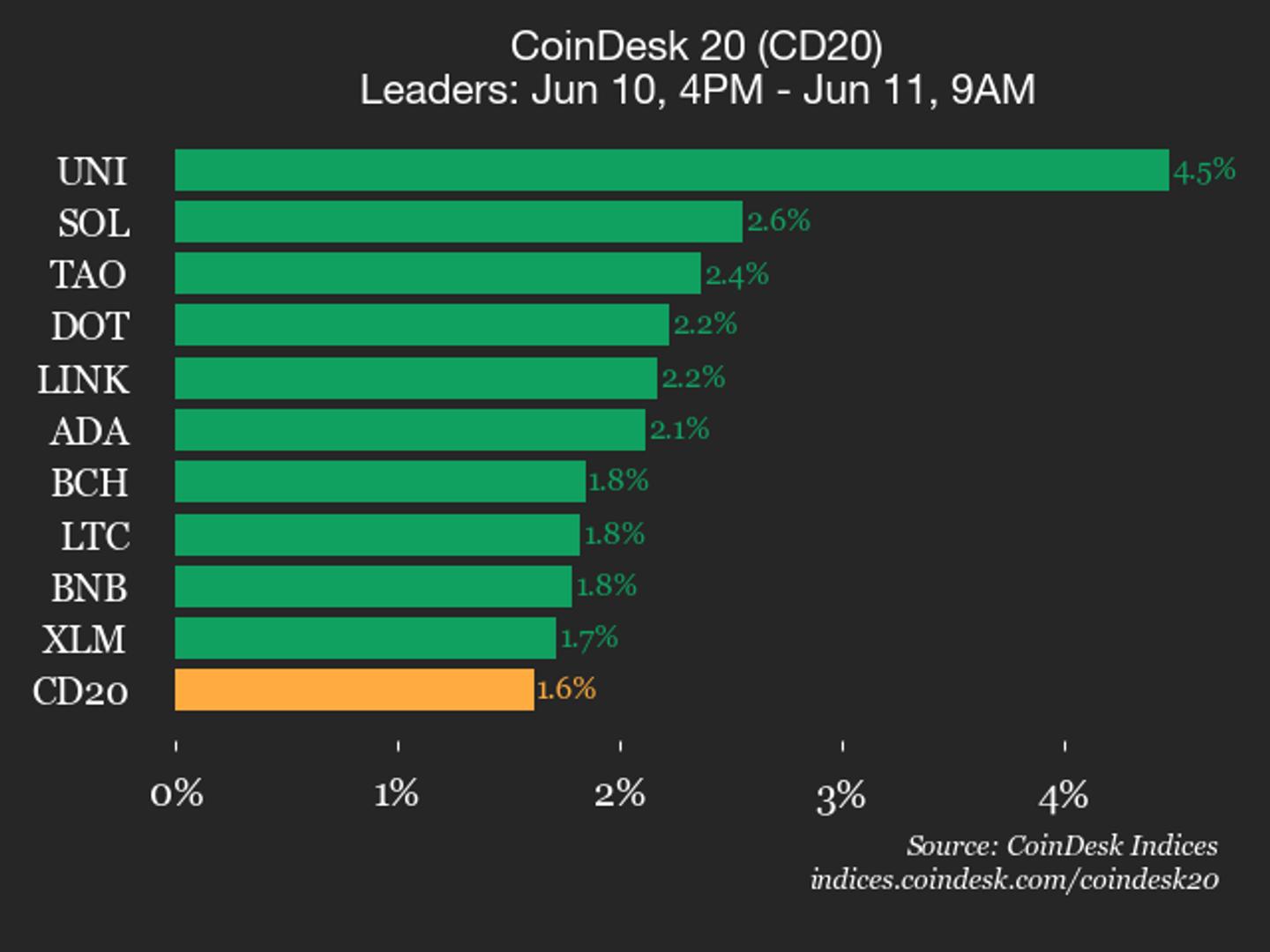
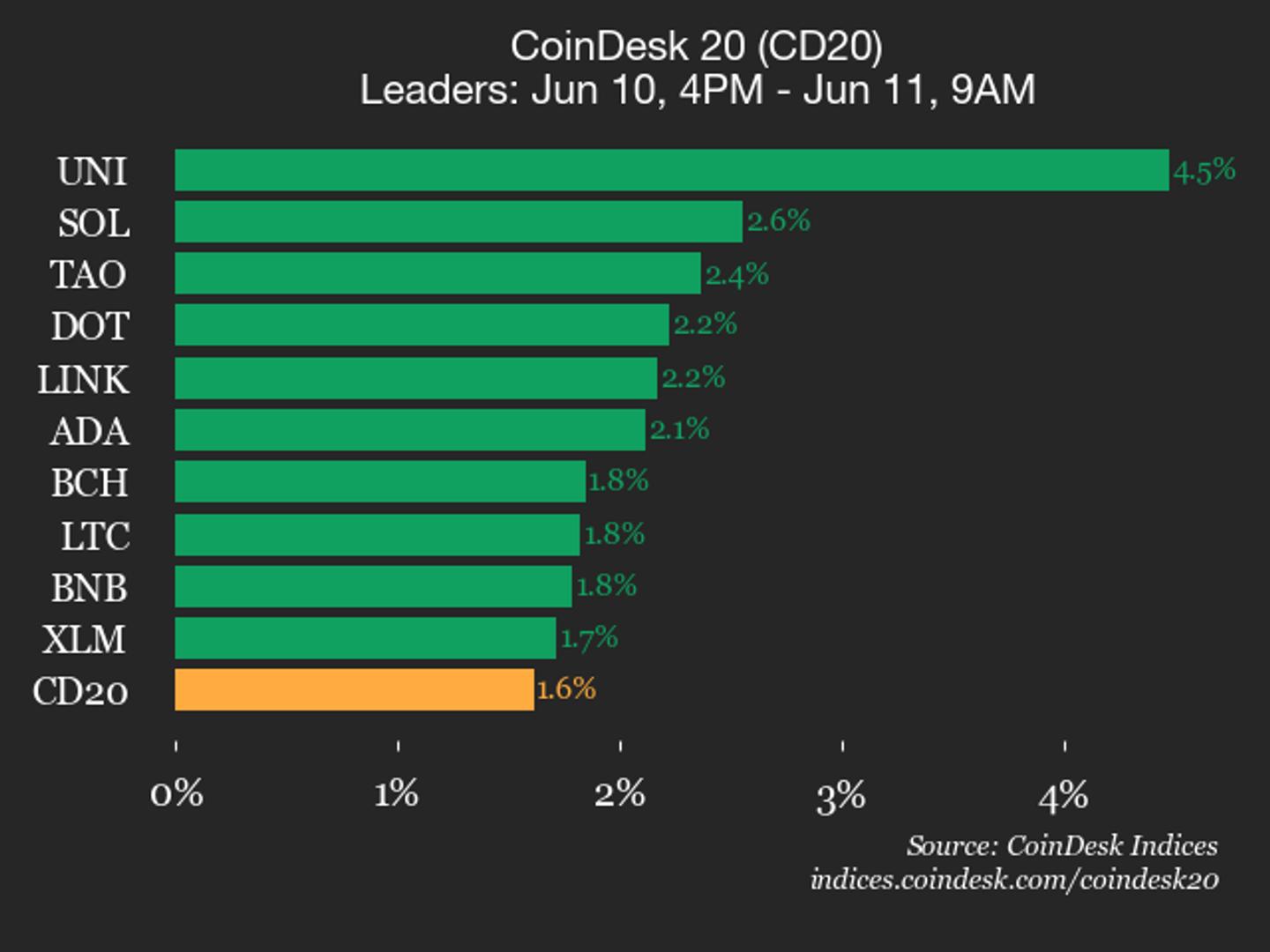
Solana (SOL), up 2.6% from Wednesday, was also a top performer.



The US Treasury’s Office of Foreign Assets Control (OFAC) has sanctioned two Iranian maritime firms in an effort to stop Iran from monetizing the Strait of Hormuz with its BTC insurance scheme.
OFAC claims the Persian Gulf Marine Insurance Company and HormuzSafe Marine Services Authority are “integral” to the Islamic Revolutionary Guard Corps (IRGC) and its “extortion scheme.”
The scheme, called “Hormuz Safe,” has been in the works for some months now. Shipowners could pay for Iran’s insurance with BTC and other cryptocurrencies and guarantee safe passage through the strait.
It would reportedly generate over $10 billion of revenue for the country and help it maintain control over the stretch of water once the war is concluded.
Read more: Crypto scams are now a threat in the Strait of Hormuz, report
In a statement, Treasury Secretary Scott Bessent said, “With its economy in freefall and inflation in the triple digits, the regime is desperate for cash.”
He added, “The United States will not allow Iran to hold global commerce hostage or use international shipping to finance the IRGC’s terrorism, aggression, and repression.”
The US noted that “disgraced regime financier” Babak Morteza Zanjani had already promoted the scheme to his followers on social media.
Zanjani reportedly used Binance between 2024 and 2025 to move $850 million, despite his account being flagged multiple times.
Yesterday’s sanctions also targeted an Iranian shadow fleet of tankers that the US says is supplying the country with millions of barrels of crude oil and petroleum products.
The war began in February 2026, and in June, a US memorandum of understanding was signed that aimed to peacefully reopen the Strait of Hormuz and end the war.
This didn’t last long, and millitary strikes resumed on July 13. Another round of peace talks took place in late July during a three-day ceasefire between the US and Iran, however, the conflict has since flared up again.
Got a tip? Send us an email securely via Protos Leaks. For more informed news and investigations, follow us on X, Bluesky, and Google News, or subscribe to our YouTube channel.
Goldman Sachs, Barclays, and Jefferies cut their Robinhood Markets (HOOD) price targets on Thursday, one evening after the Nasdaq-listed brokerage beat second-quarter revenue and profit estimates. Goldman and Jefferies had each raised their targets to $137 earlier in July.
All three firms kept bullish ratings. Their reversal is about timing, not execution. Analysts now expect Robinhood’s existing trading business, rather than its newer products, to carry growth into 2027.
Why Did Analysts Cut Robinhood Price Targets After an Earnings Beat?
Goldman Sachs moved to $118. Jefferies went to $127. Barclays cut deepest, to $105.
Firm
New target
Prior
Rating
Change
Barclays
$105
$122
Overweight
-14%
Goldman Sachs
$118
$137
Buy
-14%
Needham
$120
$123
Buy
-2%
Jefferies
$127
$137
Buy
-7%
The round trip is what stands out. Jefferies lifted its target from $94 to $137 on July 8. Goldman reached $137 in mid-July. Both unwound that optimism within a month.
Not everyone retreated. Piper Sandler held $135 and BTIG reiterated $125. Bernstein’s $160, set July 20, still leads the 28 analysts covering the stock.
Why It Matters for HOOD Stock
Robinhood beat and still could not hold a bid. That pattern is established, not new.
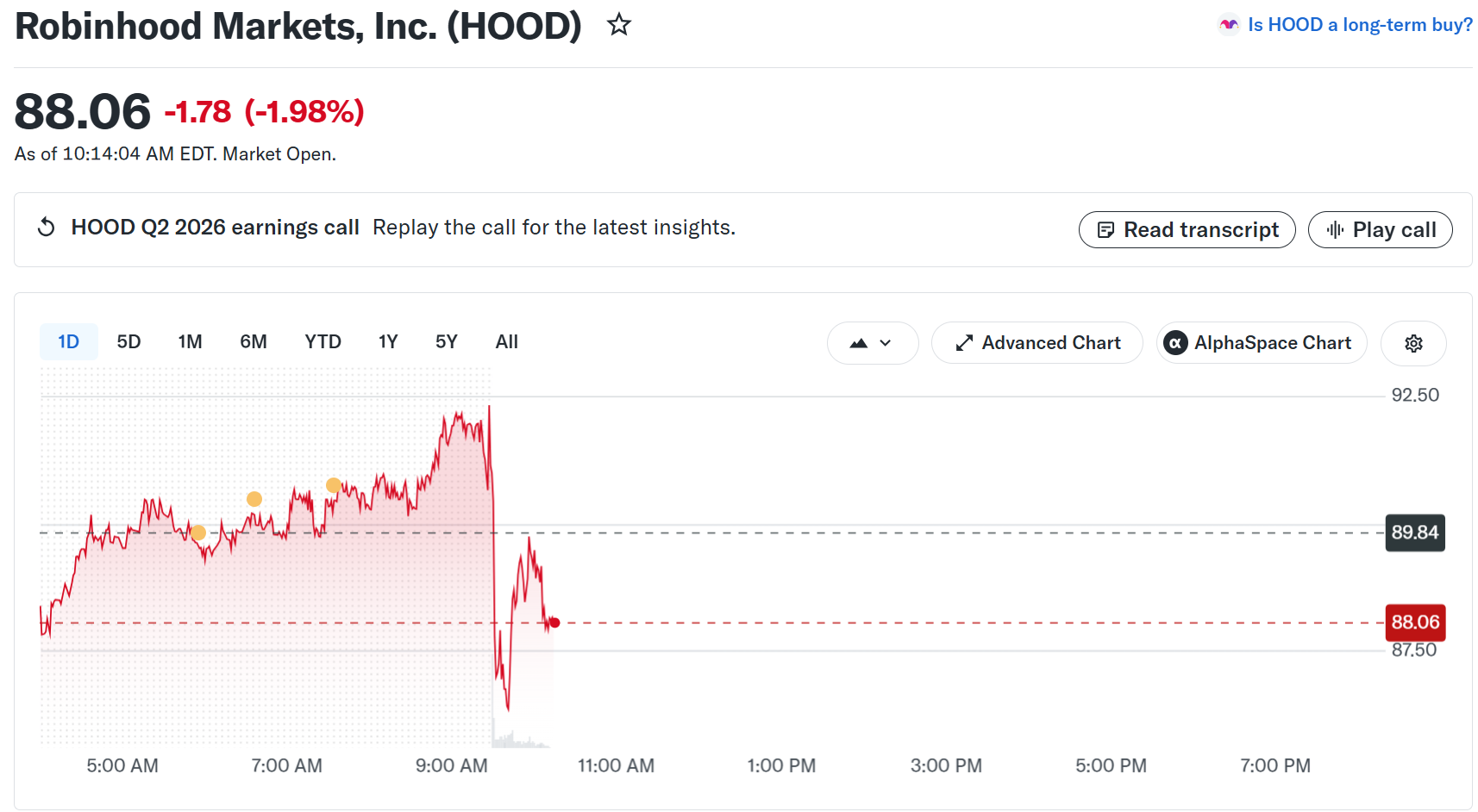
In November 2025, Robinhood beat on both lines and fell 10.8% the next session. HOOD traded near $89.67 on Thursday morning, about 42% below its October 2025 record.
Barclays framed the ceiling plainly. It expects existing businesses to drive near-term growth, arguing newer bets need years before they move the revenue base.

Robinhood’s HOOD stock fell almost 2% at market open, and was trading for $88.06 as of this time.
What Robinhood’s Q2 Filing Actually Shows
Revenue rose 32% to a record $1.31 billion, per the company’s filing. Diluted earnings reached $0.62 per share, up 48%. Adjusted EBITDA hit $741 million.
Earnings quality is thinner than the headline suggests. Roughly $0.14 of that EPS came from one-off gains, mostly the deconsolidation of Robinhood Ventures Fund I.
Crypto remains the soft spot. Robinhood’s crypto revenue beat consensus at $100 million, yet fell 38% from $160 million a year earlier.
That line now supplies 8% of net revenues, down from 16%. The 10-Q blames weaker market-maker rebate rates and 16% fewer users placing crypto trades.
What to Watch Over the Next 30 Days
July net new assets are tracking toward $4 billion, soft after a strong June.
Costs are the offset. Robinhood cut 10% of staff in June and lowered full-year 2026 expense guidance to a range of $2.675 billion to $2.775 billion.
Robinhood also leads tokenized stock ownership by holder count while trailing on money committed, which is the gap Barclays is pricing.
With the consensus target near $122 and the stock under $90, the question is whether prediction markets and tokenized assets scale before that spread closes on its own.
The post Goldman, Barclays, Jefferies Cut Robinhood Targets Despite Earnings Beat appeared first on BeInCrypto.
It’s clear Russia is the single most important ally to Iran in their shared conspiracy against global peace and prosperity. According to many intelligence reports, in addition to passing on sensitive intelligence to Iran about U.S. military installations in the region, Russia is systematically upgrading Iran’s aging, pre-1979 military infrastructure as its single largest external source of weaponry. As of mid-2026, Moscow has completed production of advanced Su-35 fighter jets and helicopters for Tehran, augmented by deliveries of Yak-130 combat trainers, Mi-28 attack helicopters, and hundreds of long-range air-to-air and anti-radar missiles. Furthermore, in 2022, Moscow helped launch Iran’s high-resolution Khayyam satellite, and Russian forces routinely transfer captured Western weaponry from the Ukrainian frontline—including Javelin and Stinger systems—directly to Iranian defense firms to be reverse-engineered and cloned for Tehran’s proxy networks. Simultaneously, Russian telecommunications firms are supplying Iranian operators with advanced digital surveillance and cyber warfare technologies.

Samsung SDS, the IT services arm of Samsung Group, says it is exploring cooperation with Dunamu—operator of South Korea’s Upbit exchange—across stablecoin infrastructure, digital asset systems and AI-enabled payment models. The discussions were outlined during Samsung SDS’ second-quarter earnings call on Thursday, according to remarks from CEO Lee Jun-hee.
The effort also arrives as Samsung Electronics continues to expand its digital asset footprint, including recent plans to add stablecoin support to Samsung Wallet. Together, the moves point to a broader push by Samsung-related entities toward regulated digital finance rails rather than purely retail-facing crypto features.
Key takeaways
- Samsung SDS is in talks with Dunamu on stablecoin infrastructure and broader digital asset system development.
- CEO Lee Jun-hee framed the Dunamu relationship as expansion in infrastructure capabilities, not a standalone financial investment.
- Samsung affiliates already have ties to Dunamu: Samsung Securities, Samsung SDS and Samsung Card agreed to buy a combined 4% stake in May 2026.
- Samsung SDS’ Q2 results show growth across cloud and AI-related services, providing business momentum for its digital finance ambitions.
- South Korea’s regulatory direction for stablecoins remains a key variable for how such infrastructure partnerships develop.
Samsung SDS and Dunamu explore stablecoin and digital finance infrastructure
During its Q2 earnings call, Samsung SDS CEO Lee Jun-hee said the company is discussing potential cooperation with Dunamu on stablecoin infrastructure, digital asset systems, and AI-based payment business models. Lee also referenced Samsung SDS’ own work in tokenized securities and stablecoin workflow validation as proof points for why it expects the partnership to strengthen its position in digital asset infrastructure.
Lee noted that Samsung SDS has already secured “differentiated business capabilities” through the Korea Securities Depository’s tokenized securities platform project and through end-to-end validation of a full stablecoin process—from issuance through settlement. The company’s stated aim is to combine its IT services, cloud and security capabilities with Dunamu’s blockchain expertise.
In the Q2 transcript, Samsung SDS said the partnership goal is to “lead this market” by pairing the two firms’ respective strengths. However, Samsung SDS did not provide additional detail on timelines, specific technical approaches, or the scope of any prospective commercial offering.
Cointelegraph previously reported Samsung Electronics’ plan to add stablecoin support to Samsung Wallet, and this new development suggests the Samsung ecosystem is aligning infrastructure capability with consumer-facing wallets. While Samsung Wallet would be a distribution layer, stablecoin infrastructure and enterprise digital asset systems typically sit behind the scenes—supporting issuance, settlement, custody integrations, and compliance-oriented workflows.
Earlier stake tie deepens: strategic rather than financial intent
The talks with Dunamu follow a prior move that increased Samsung affiliates’ exposure to South Korea’s digital asset sector. In May 2026, Samsung Securities, Samsung SDS and Samsung Card agreed to buy a combined 4% stake in Dunamu. That transaction strengthened existing commercial ties and underscored that Samsung-related companies are looking beyond pilots.
In the latest Q2 call, Lee reportedly characterized Samsung SDS’ investment in Dunamu as strategic rather than purely financial. He said both companies plan to refine potential business models for digital financial infrastructure, suggesting that any future cooperation could extend beyond infrastructure experiments into more defined productization.
Samsung SDS did not immediately respond to Cointelegraph’s request for comment, and Dunamu declined to comment. That limits what can be said publicly about how negotiations are progressing or whether agreements are already in place for specific use cases.
How Samsung SDS’ cloud and AI expansion could reinforce digital finance plans
Samsung SDS’ stablecoin and digital asset ambitions are being presented alongside broader growth in cloud and AI services. In its Q2 earnings presentation and related figures, Samsung SDS reported Q2 revenue of 3.72 trillion Korean won (about $2.6 billion), up 5.9% year on year. The company cited cloud momentum as a major contributor, including a 17% increase in cloud revenue from the prior year and a jump in external cloud business revenue of 75%.
Samsung SDS attributed part of the external cloud growth to demand for its cloud platform and graphics processing unit-as-a-service offerings. That emphasis matters because stablecoin infrastructure and tokenized financial systems often depend on the same enterprise capabilities—secure hosting, scalable compute, identity and access controls, and reliability under transaction load.
The company also reportedly outlined plans to expand its AI infrastructure capacity—from about 110 megawatts today to 230 MW by 2029, and more than 800 MW by 2031. If executed, such expansion would further position Samsung SDS to deliver data-intensive services for AI-driven finance workflows, including risk analytics, fraud detection, and automated settlement-related monitoring.
Still, investors and builders should distinguish between infrastructure readiness and regulatory authorization. Stablecoin use in retail payments, treasury operations, or tokenized assets typically depends on compliance frameworks and the specific licensing/oversight model in the relevant jurisdiction.
What this means for South Korea’s digital finance ecosystem
South Korea has been moving toward clearer stablecoin and crypto regulation, and industry participants are watching how the rules will translate into real, compliant payment and settlement deployments. Earlier coverage from Cointelegraph noted that a South Korea report proposed stablecoin rules ahead of a broader crypto law framework.
Against that backdrop, Samsung SDS’ focus on end-to-end stablecoin process validation—from issuance to settlement—reads like an attempt to be ready for both technical and compliance requirements. Rather than targeting speculative applications, the company appears to be building capabilities that can support regulated flows once the legal environment permits or clarifies specific models.
At the same time, the partnership’s practical impact will hinge on what “AI-based payment business models” ultimately involve. AI can be used in customer authentication, compliance monitoring, market surveillance, and payment risk assessment, but the boundaries of acceptable use will depend on data policies and the final regulatory approach.
For traders and users, these initiatives may not immediately change day-to-day trading volumes or retail access. For developers and institutional stakeholders, however, infrastructure partnerships can matter because they affect integration timelines, operational reliability, and the availability of custody/settlement tooling that exchanges and financial platforms can adopt.
Next, the key question is whether Samsung SDS and Dunamu will move from exploratory cooperation into concrete deployments—particularly in stablecoin issuance/settlement workflows and any wallet or payment integrations tied to Samsung’s consumer products. Observers should also watch for updates as South Korea’s stablecoin regulatory trajectory progresses, since the permitted use cases will likely determine what infrastructure work can scale commercially.


The two-week campaign brought thousands of traders on-chain, with daily $500 prize pools and fully transparent, publicly verifiable winner selection.
Primit, the decentralized perpetual exchange built on Avalanche, today announced the successful conclusion of its Season 1 trading campaign, a 14-day event that rewarded traders with daily prize pools and marked the platform’s first major community milestone since launch.
Running from July 15 to July 28, the campaign invited traders of all sizes to participate with a deliberately low barrier to entry: anyone generating at least $200 in daily trading volume was automatically entered into that day’s draw. Each day, 20 winners split a $500 prize pool, with rewards distributed directly to their wallets.
By the Numbers
Over the course of Season 1, Primit recorded:
- 10,000+ participating wallets across the campaign
- Over 500 wallets qualified for every single one of the 14 daily actions
- 14 daily draws completed, with 280 total winners
- $100,000 will be distributed directly to traders’ wallets
In a space where campaign fairness is often questioned, Primit published every day’s winner list — with masked wallet addresses — on its official blog, allowing anyone to verify results on-chain. This transparency-first approach became a defining feature of the campaign and a foundation of trust with its early community.
“Season 1 was about proving one thing: that a new perpetual DEX can give everyday traders a fair shot at real rewards, not just whales,” said Primit Team. “The response exceeded our expectations — traders came for the prizes, and stayed for the product.”
Built on Avalanche
Primit’s deployment on Avalanche played a central role in the campaign’s accessibility. Sub-second finality and near-zero gas fees allowed participants to reach the $200 volume threshold in minutes, at a cost of pennies — removing the friction that typically keeps retail traders away from on-chain derivatives.
What’s Next: Season 2
With Season 1 complete, Primit confirmed that Season 2 is already in development, featuring a larger prize pool and new participation mechanics. Details will be announced through Primit’s official channels in the coming weeks.
“This is the end of Season 1, but the beginning of Primit’s community story,” the team added. “Everything we learned from our first traders goes directly into what we build next.”
About Primit
Primit is a decentralized perpetual futures exchange deployed on Avalanche, offering fast, low-cost on-chain derivatives trading without KYC. Primit is building the next generation of accessible on-chain trading infrastructure.
Website: https://primit.io | X: https://x.com/primitforall
The post Primit Wraps Up Season 1 Trading Campaign on Avalanche appeared first on BeInCrypto.
The past months have not been kind to Ripple’s cross-border token, whose price is down roughly 65% on a yearly scale.
One analyst warned that it may soon fall well below the $1 psychological mark, while many others remain optimistic that a major rebound is coming next.
Going Further Down?
As of press time, XRP trades at around $1.08, which translates into a 4% weekly loss. According to X user Hamza, the asset’s recent decline has resulted in a breakdown from a critical symmetrical triangle that could lead to an additional pullback.
The analyst claimed that retail is still “bagholding on hope” while smart money had left and set a target of $0.836. At the same time, they said a potential rise to $1.16 would invalidate the bearish setup.
FOUR | Crypto Spaces also issued a pessimistic forecast, envisioning a plunge to $1.02, while Carl Hawley opined that XRP has shown “extreme weakness” on higher timeframes, making the asset the most oversold since COVID times. Usually, entering such a territory is a precursor to a resurgence, yet the analyst couldn’t predict the exact direction of the upcoming move, saying:
“Capitulation or opportunity? The next few weeks could be decisive.”
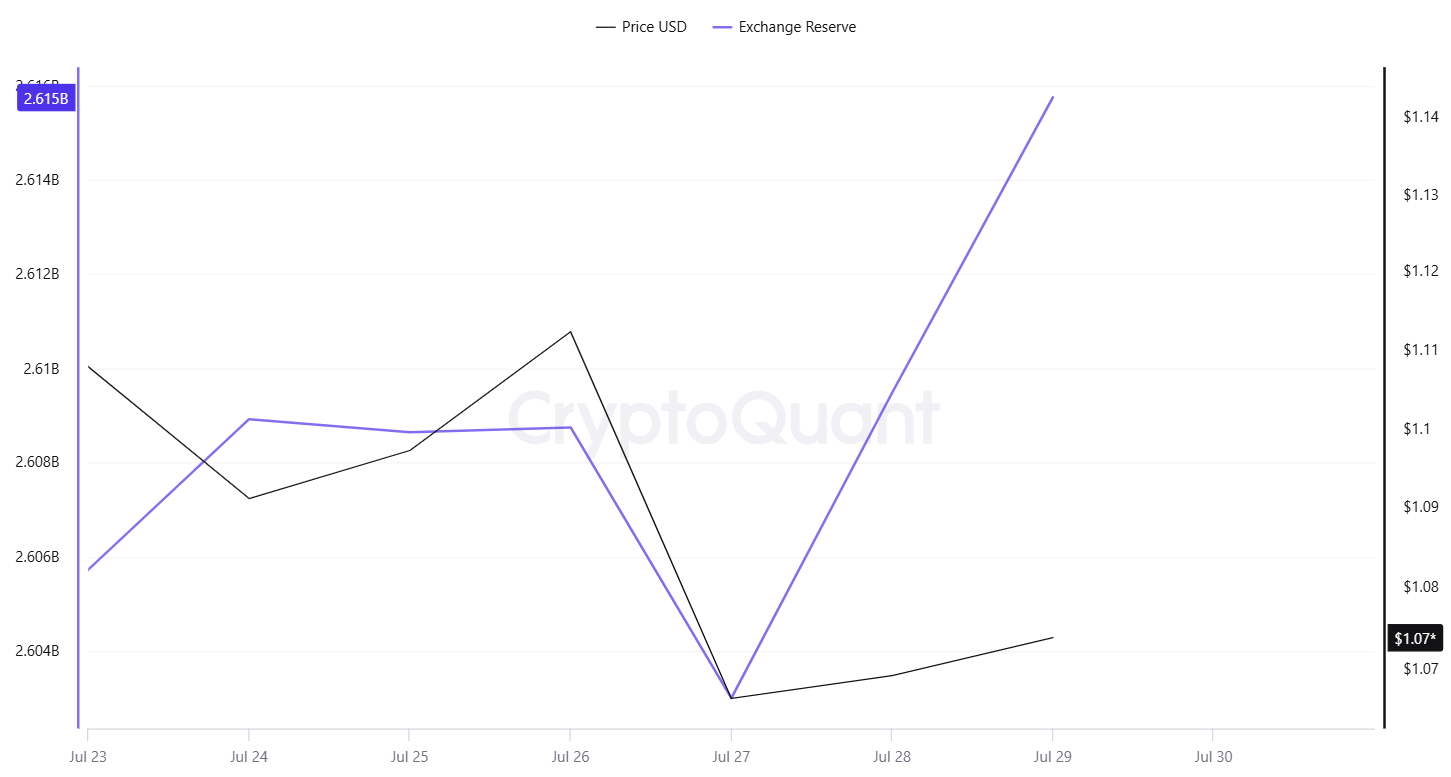
The rising number of XRP tokens stored on Binance suggests the bearish perspective is more likely. The figure has reached a nearly three-week high of approximately 2.62 billion coins, signaling that some investors have abandoned self-custody methods and moved their holdings to the exchange. This, in turn, increases the immediate selling pressure.
The Bullish Scenarios
It is important to note that the majority of people making XRP predictions remain optimistic. X user MARMOT recently claimed that the asset is repeating the exact pattern from 2017, which led to a 60,000% explosion. They believe the path to the next bull run involves three different phases, envisioning an eventual ascent to a new all-time high of $13.
Celal Kucuker also chipped in, seeing compression, exhausted sellers, and asymmetric risk. In their view, if XRP breaks above its current structure, those who called for $0.50 may suddenly start calling for $10.
The most bullish forecast came from xrpl_Adam, who suggested that Ripple’s native token may become a $100 trillion asset in the future. As of now, it’s hard to imagine an explosion of that magnitude, given that the entire market capitalization of the crypto sector is around $2.3 trillion.
The post XRP Warning: Why Ripple’s Price Could Plunge 23% appeared first on CryptoPotato.
Coinbase reports Q2 earnings after the close on July 30, with Wall Street expecting a soft quarter. Consensus revenue sits near $1.31 billion, down roughly 13% year over year. The EPS consensus has slipped to about $0.15, while HC Wainwright projects $0.05. The bigger question is whether management can justify Coinbase’s valuation through stronger guidance and growing revenue beyond spot trading.
Estimate cuts have been broad. Barclays expects Q2 trading volume near $152 billion, below the Street consensus of roughly $178 billion. The bank also sees adjusted EBITDA about 3% below consensus and revenue near the lower end of guidance. Softer crypto prices and slower USDC growth remain the biggest headwinds.
Clear Street forecasts roughly $160 billion in trading volume and adjusted EBITDA near $301 million. JPMorgan also cut its price target from $283 to $196 on July 17. The bank cited weaker trading activity and uncertainty surrounding Coinbase’s USDC revenue-sharing arrangement with Hyperliquid.
Discover: The Best Token Presales
Diversification Becomes the Bull Case
Citi lowered its price target from $400 to $235 while maintaining a Buy rating. Even so, the average analyst target remains near $223. That suggests most of Wall Street still expects meaningful upside once trading conditions improve despite lower earnings expectations.
William Blair remains constructive despite reducing forecasts. Analysts Andrew Jeffrey and Adib Choudhury cut 2026 revenue estimates by 12% and 2027 estimates by 13%. They also lowered adjusted EBITDA forecasts by 34% while maintaining an Outperform rating. The firm expects earnings to bottom during the second half of 2026 before recovering through 2027.
The firm argues Coinbase’s long-term story is becoming structural rather than cyclical. Spot Bitcoin ETFs continue attracting institutional capital, while Base, retail derivatives, and prediction markets are expanding the company’s revenue mix. Coinbase also strengthened its derivatives business through the Deribit acquisition, although the deal contributed little to Q2 because it closed late in the quarter.
Subscription and services revenue remains another bright spot. The segment includes USDC interest income, staking, custody, and Coinbase One subscriptions. Analysts expect around $601 million, within management’s guidance range of $565 million to $645 million. That recurring revenue provides a cushion when trading volumes weaken.
Trade on Bybit and Get a Chance to Win Our $1,000 USDT Airdrop
Regulation and Guidance Hold the Coinbase Key
The Clarity Act remains one of the biggest long-term catalysts. The proposal would divide crypto oversight between the SEC and CFTC. Benchmark believes recent Senate progress improves its chances, while Compass Point warns delays could pressure Coinbase’s valuation if investors have already priced in regulatory progress.
Bitcoin and Ethereum both traded at earlier highs during much of Q2, reducing retail participation and exchange volumes. Piper Sandler also highlighted prediction markets and perpetual futures after strong World Cup activity. However, Coinbase shares economics with Kalshi, limiting the business’s direct earnings contribution.
Ultimately, investors already expect a weak quarter. Management’s outlook for trading demand, stablecoin revenue, and regulatory developments will likely matter more than the headline results. If Coinbase shows its diversified businesses can offset weaker spot trading, the market may look beyond another soft earnings report.
Discover: The Best Crypto to Diversify Your Portfolio
The post Coinbase Q2 Earnings Preview: Guidance and Diversification in Focus appeared first on Cryptonews.
Crypto World
Institutional crypto trading hits a record 72% as Wall Street calms crypto’s wild swings


That concentration could make future altcoin rallies more selective.
“The result is a market where the flow that increasingly sets direction is concentrated in fewer names, traded more selectively,” the report said. It added that broad-based rallies, where most alternative cryptocurrencies rise together, are becoming less likely as institutional capital focuses on a handful of assets.
Derivatives and tokenization gain traction
The report also points to growing use of derivatives as another defining trend. Wintermute said notional trading volume in altcoin options on its OTC desk increased about 3.4 times from the second half of 2025 to the first half of 2026, driven largely by investors seeking yield rather than outright price exposure. At the same time, contracts for difference, or CFDs, are being used across a wider range of cryptocurrencies for directional trading, hedging and basket strategies.
Beyond trading, tokenized real-world assets continued to gain momentum, with the value of tokenized assets climbing nearly 50% to $31 billion during the first six months of the year, while average monthly transfer volume more than doubled to $9 billion. The firm said institutions are primarily adopting tokenized Treasuries, money market funds and private credit, while retail investors remain more active in tokenized equities.
While Wintermute expects retail participation to return during the next crypto bull market, it argues institutional influence is unlikely to fade. Instead, it said the market is increasingly taking on the characteristics of its largest participants, with professional investors shaping liquidity, pricing and the types of assets that attract capital.
The Magnum Ice Cream Company (MICC) posted first-half core earnings above analyst expectations on July 30. Cost cuts since its 2025 spinoff from Unilever (UL) drove the beat, alongside a heatwave-driven summer surge for Ben & Jerry’s.
Revenue reached €4.7 billion, up from €4.5 billion a year earlier, with organic sales growth of 4.7% across every region. Adjusted EBIT climbed 7.5% to €716 million, though separation costs pulled net profit down to €349 million.
Ben & Jerry’s Powers a Hot Start to Summer
Ben & Jerry’s led the gains across the portfolio. Growth accelerated sharply once summer heat set in across Europe. New stick and sandwich formats pulled fresh buyers into the brand, both in the Americas and in Europe.
“Ben & Jerry’s grew mid-single-digit and had an outstanding second quarter with 9.2% growth.”
Peter ter Kulve, the company’s CEO, praised a frontline-first operating model in a statement tied to the results. Sustained heat across Europe has already lifted other heatwave-driven cooling stocks this summer, and that trend now extends to frozen treats.
Magnum, Cornetto, and the Heartbrand also posted gains. All four core brands showed positive momentum, and Yasso, the company’s high-protein pint line, kept growing at a double-digit pace. The pattern echoes the seasonal plays behind several US stocks to watch this July.
Magnum’s Cost Cuts and Productivity Gains Lift Margins
A productivity programme launched in 2024 delivered €90 million in first-half savings, most of it from the supply chain. Waste reduction and better factory use both contributed. Meanwhile, a favorable working capital swing tied to the Unilever separation nearly doubled Free Cash Flow to €273 million.
Standalone financing pushed net finance costs up to €72 million, compared with just €10 million a year earlier. That shift lines up with the broader high-rate backdrop highlighted by the Fed’s July decision to hold rates steady, a move that rattled bond markets and pushed long-term borrowing costs to multi-year highs.
The earnings beat nonetheless continues a summer pattern of firms topping Wall Street estimates. It follows Robinhood’s earnings beat and Intel’s surprise profit beat earlier this season, both delivered despite mixed investor reactions.

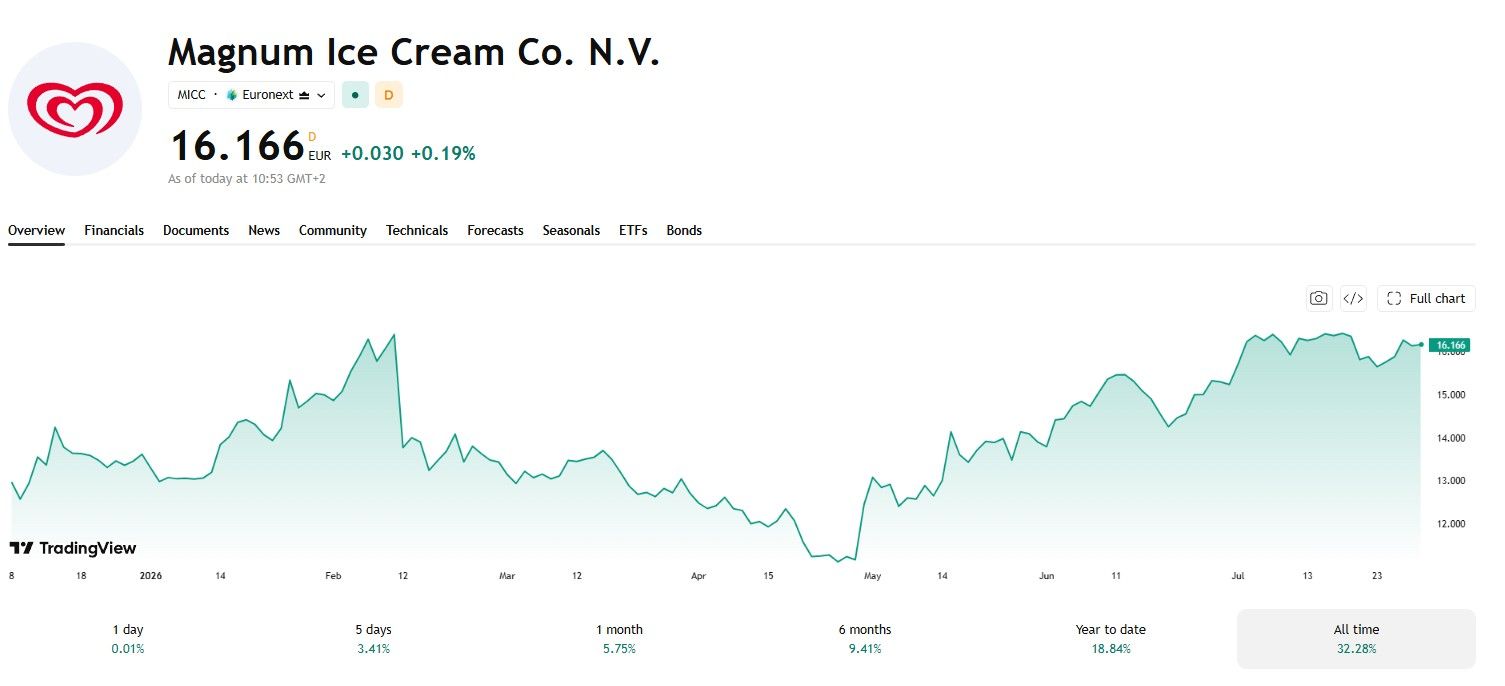
Shares of Magnum Ice Cream (EURONEXT: MICC) were changing hands near €16.16 ahead of the print, up roughly 19% for the year and close to the all-time high of €16.74 hit on July 7. The stock has climbed steadily since bottoming near €11 in late April, and the chart shows that run largely intact heading into results day.
Management reaffirmed full-year guidance of 3% to 5% organic sales growth. The company now enters peak summer demand with momentum intact. A pending antitrust review of its freezer-cabinet practices in Türkiye adds a regulatory wrinkle to watch.
The next quarter should still show whether the heat and the cost discipline both hold.
The post Heatwave Boosts Ice Cream Sales as Magnum Beats Earnings Forecasts appeared first on BeInCrypto.


[Update 08:55 UTC, July 30: Updates with additional reporting and context.]
Online brokerage Robinhood posted record second-quarter revenue and earnings, though cryptocurrency transaction revenue fell 38% from a year earlier.
The company said Wednesday in its earnings report that crypto transaction revenue fell to $100 million from about $160 million a year earlier. Overall revenue rose 32% year-over-year to $1.31 billion, while net income increased 48% to $573 million. Transaction-based revenue climbed 44% to $776 million.
Robinhood reported $40 billion in crypto notional trading volume during the quarter. Of that total, $18 billion came from the Robinhood app, down 35% from a year earlier, while $22 billion came from Bitstamp, the crypto exchange it acquired in June 2025.
The price of Robinhood shares was down 3.15% on Wednesday ahead of the company’s earnings release, according to Yahoo Finance data.
Robinhood expands crypto ecosystem
Despite the decline in crypto trading revenue, Robinhood continued expanding its digital asset business during the quarter, completing its acquisition of Canadian crypto platform WonderFi as it broadened its crypto offerings beyond trading.
After the quarter ended, the company unveiled the public mainnet of Robinhood Chain, introduced tokenized US stocks to eligible users in more than 120 countries and debuted its first decentralized lending product, Robinhood Earn.
Related: Bernstein raises Robinhood price target, cites tokenization and prediction markets
Data from DefiLlama shows Robinhood’s new Ethereum layer-2 network had $348 million in total value locked on Thursday, more than $500 million in stablecoins and over $1 billion in bridged assets.
Platform growth offsets crypto slowdown
Cryptocurrency was the only major transaction category to decline during the quarter.
Robinhood said growth in event contracts, options and equities more than offset the weakness, with event contract revenue surging more than tenfold to $156 million, options revenue rising 29% to $342 million and equities revenue jumping 95% to $129 million.
The company also reported record net deposits of $21.7 billion during the quarter, while total platform assets increased 32% year over year to $369 billion and funded customers grew 7% to 28.4 million.
Robinhood lowered and narrowed its 2026 outlook for adjusted operating expenses and share-based compensation to between $2.675 billion and $2.775 billion, from $2.7 billion to $2.825 billion previously. Adjusted EBITDA rose 35% to $741 million, while total operating expenses increased 33% to $734 million.
Magazine: Bitcoin price wedged into ‘most divided’ FOMC as Iran war spikes oil prices 8%

The Campbell’s Co. debuts Chunky prepared meals

US sanctions firms behind Iran’s Strait of Hormuz BTC insurance scheme

Kelly Clarkson’s Off Script Habit Reportedly Frustrated NBC


-

 Fashion6 days ago
Weekend Open Thread: Brooks Brothers
-
 Sports4 days ago
Commonwealth Games boxing: Jadumani Singh seals dominant 5-0 win over Pakistan’s Sumama Rehman to enter quarter-finals | Commonwealth Games News
-

 Business18 hours ago
Why Trees Belong on the Risk Register
-

 Tech4 days ago
Intel is reversing course and bringing hyper-threading back to its server chips
-

 Crypto World5 days ago
Ripple bought a bank in pieces. The $4 billion audit
-

 Politics3 days ago
Luke Littler dismantles Gerwyn Price to retain title in Blackpool
-

 Politics2 days ago
The Part of the Electric Transition Nobody Wants to Discuss
-
 Entertainment6 days ago
A New Post-Apocalyptic Gundam Anime Series Blasts Into SDCC
-

 News Videos4 days ago
BITCOIN JUST ENTERED THIS CRITICAL ZONE…
-

 Fashion6 days ago
16 Dresses for the High Summer Event
-

 Sports6 days ago
2026 3M Open leaderboard: Scottie Scheffler finds putter in Round 1, sits three back
-

 News Videos7 days ago
The Peugeot Family: How 200 Years of an “Old Money” Dynasty Died in A Boardroom
-

 Business1 day ago
Major shareholder moves on Canyon
-

 Crypto World4 days ago
XRP Ledger adds $2.6B as RWA inflows rank second
-

 Politics4 days ago
Spain sweeps the board at 2026 World Cup with individual awards
-

 News Videos3 hours ago
Bitcoin Enters the 3rd Stage of the Bear Market
-
 Entertainment2 days ago
‘Stargate’ Creator’s New Sci-Fi Series Returns for Season 3 Tomorrow
-

 Tech5 days ago
Anthropic launches Claude Opus 5, a cheaper AI model for coding, agents and enterprise workflows
-

 Crypto World2 days ago
Kraken Enables Retail Access to Jersey Mike’s IPO via Tokenized Shares
-

 Entertainment5 days ago
Sara Gilson Killed By Husband After Viral “Pedophile” TikTok Video
You must be logged in to post a comment Login