
Crypto World
CoinShares reveals hidden crypto blind spot among UK financial advisers



A CoinShares survey has found that 52% of UK financial advisers cannot see most of their clients’ cryptocurrency holdings because of firm-level restrictions.
Summary
- CoinShares found that 52% of UK financial advisers cannot see most of their clients’ crypto holdings.
- The survey says firm policies, not investor demand, are the main barrier to crypto oversight.
- Ripple executives and regulators point to growing crypto payment use and tighter oversight of digital assets.
According to a survey released by digital asset investment firm CoinShares on Thursday, more than half of UK financial advisers say most of their clients’ cryptocurrency holdings sit outside their view, even as digital assets become more common in investment portfolios.
The survey covered 261 wealth management professionals across Europe and found that 52% of advisers in the UK said the majority of their clients’ crypto exposure was effectively “invisible” to them.
Across the wider group of countries surveyed, including France, Germany, Italy, and Switzerland, the figure fell to 25%. CoinShares also found that 61% of respondents worked at firms that either restricted digital assets or had no clear internal policy on handling them.
Firm policies are limiting adviser visibility
Commenting on the findings, CoinShares co-founder and CEO Jean-Marie Mognetti argued that internal company rules, rather than investor demand or adviser knowledge, are preventing wealth managers from understanding their clients’ complete financial positions.
According to Mognetti, clients have already committed capital to digital assets, but advisers often cannot factor those holdings into portfolio management because firm policies stop them from discussing or overseeing them. He said this creates what he described as a “wrong-way risk,” where advisers are expected to manage wealth without access to a complete picture of client assets.
Mognetti also argued that advisers cannot properly allocate investments, manage risk, or build trust unless they first have visibility into those digital asset holdings.
“The capital has already been allocated. The people entrusted with managing it simply cannot see it, and in most cases not because clients are unwilling to engage, but because firm policy prevents them from doing so. This is not a knowledge problem. It is not a demand problem. It is a firm-policy problem becoming a wrong-way risk.”
The findings arrive as crypto ownership continues to grow in the UK. According to the UK’s Financial Conduct Authority, around 8% of adults in the country owned cryptocurrency as of its December report.
More recently, the regulator proposed allowing authorized investment funds to allocate up to 10% of their assets to cryptocurrency exchange-traded notes, signalling continued regulatory engagement with the sector.
Payment infrastructure is expanding alongside regulation
The survey comes as industry executives continue to argue that crypto’s next stage of adoption will be driven by payments rather than speculation.
As previously reported by crypto.news, Ripple executive Reece Merrick compared today’s crypto payments market with the early years of e-commerce, when online shopping represented only a small share of retail activity despite the underlying technology already being developed.
Merrick said improvements such as secure payment gateways, wider internet access, and smartphones eventually made e-commerce part of everyday life, and he believes scalable blockchains, stablecoins, regulated fiat on-ramps, and user-friendly wallets now play a similar role in crypto payments.
Separately, crypto.news previously reported that Ripple CEO Brad Garlinghouse said stablecoins are increasingly attracting interest from corporate finance teams and treasury departments evaluating blockchain-based payment systems and treasury management.
Regulators are also paying closer attention to how crypto transactions move through financial markets. In India, the Financial Intelligence Unit has asked at least three major cryptocurrency exchanges to provide records of over-the-counter crypto transactions exceeding $10,000, with the request covering data that exchanges must preserve from January 2026 onward.
The directive focuses on private OTC trades, which allow large transactions to avoid public order books but can make beneficial ownership harder to verify when intermediaries or closely held entities stand between exchanges and the original source of funds.



Cathie Wood’s ARK Invest bought 109,129 Circle shares after the stablecoin issuer secured a limited-purpose trust charter in New York.
Summary
- ARK acquired about $6.83 million in Circle shares across three exchange-traded funds.
- Circle received a limited-purpose trust charter from the New York Department of Financial Services.
- CRCL closed 2.54% lower at $62.61 on July 31 despite the regulatory approval.
- Circle plans to gradually transfer USDC issuance to its New York trust entity.
ARK Invest adds 109,129 Circle shares
ARK purchased 77,103 Circle shares through its flagship ARK Innovation ETF, according to the firm’s daily trade disclosures. The ARK Next Generation Internet ETF added 22,238 shares, while the ARK Fintech Innovation ETF acquired another 9,788.
Together, the purchases totaled 109,129 shares. They were worth approximately $6.83 million based on Circle’s July 31 closing price of $62.61.
The investment extended ARK’s exposure to Circle as the company expands its regulated stablecoin infrastructure in the United States. It also followed ARK’s roughly $40.2 million purchase of Tesla, SpaceX and Nvidia shares on July 28 during a broader technology-sector sell-off.
ARK made several other purchases on July 31, including 298,243 CoreWeave shares, 12,512 shares of the 3iQ Solana Staking ETF, 7,500 Pony AI shares and 2,700 Kodiak AI shares.
The firm reduced its positions in Shopify, Cloudflare, CrowdStrike, Snowflake, 10x Genomics, Komatsu, Brera Holdings, Iridium Communications and Figma.
Circle secures New York trust charter
ARK’s purchase followed Circle’s receipt of a limited-purpose trust charter from the New York Department of Financial Services. The approval covers Circle Internet Trust Company LLC, which will operate as Circle New York Trust.
A New York limited-purpose trust company can conduct approved virtual currency activities and exercise fiduciary powers. Unlike a BitLicense holder, it can also provide money transmission services in the state without obtaining a separate money transmitter license.
Circle said it plans to gradually move USDC issuance to the New York entity. Circle New York Trust will operate alongside Circle National Trust, the federally chartered national trust bank authorized to provide custody and collateral trustee services.
Circle CEO Jeremy Allaire described the New York approval as a long-term objective for the company.
“Earning a New York trust charter has been a longstanding objective for Circle given the regulatory clarity that comes with it.”
He added that the charter places USDC within a strong regulatory framework as digital dollars become more widely used in the global financial system.
Circle builds state and federal oversight
Circle’s New York authorization follows the Office of the Comptroller of the Currency’s final approval on July 10 for the company to establish Circle National Trust.
The federal trust bank will initially provide fiduciary digital asset custody services to Circle and its affiliates. Circle has also identified management of USDC reserves as a possible future capability, subject to its approved business plan and regulatory requirements.
The two charters give Circle separate state and federal regulatory structures. NYDFS will supervise the New York entity’s approved virtual currency and fiduciary activities, while the OCC will oversee the national trust bank.
For U.S. investors, the approvals strengthen Circle’s position within the regulated stablecoin market. However, the charters do not remove risks tied to USDC growth, interest-rate changes, competition or Circle’s share valuation.
Circle stock falls despite regulatory progress
Circle stock ended July 31 at $62.61, falling $1.63, or 2.54%, during the session. The decline suggests investors did not immediately treat the New York charter as a reason to reverse the stock’s recent weakness.
CRCL had gained about 10% on July 10 after Circle announced final OCC approval for its national trust bank. The shares subsequently surrendered those gains as the broader technology and digital-asset sectors came under pressure.
ARK’s latest purchase comes as the investment firm expects consolidation across crypto businesses. ARK digital assets research director Lorenzo Valente said on July 28 that revenue and investment were becoming concentrated among fewer companies.
Valente predicted more acquisitions, bankruptcies, shutdowns and talent-focused deals. However, his post did not identify the dataset, category definitions or measurement period supporting its revenue concentration figures.
Circle is scheduled to report its second-quarter 2026 financial results on Aug. 5, giving investors another measure of whether regulatory progress is translating into stronger USDC activity and company revenue.


Russia has expanded its cryptocurrency mining restrictions to Moscow, with the ban set to take effect on Aug. 15, 2026, and remain in place through Dec. 31, 2032.
Russia’s Resolution No. 936, signed by Prime Minister Mikhail Mishustin on July 25, 2026, amends an earlier mining restriction order issued in December 2024, according to records published on Pravo.ru.
The updated rules add Moscow, the Moscow Region and several territories in Russia’s Kursk Region to the list of restricted areas. The measure expands existing restrictions on cryptocurrency mining in areas facing electricity supply concerns. The ban also covers eight municipal districts and the city of Lgov in Kursk Region.
Earlier restrictions were also introduced in several Russian regions, including parts of Buryatia and the Zabaykalsky Krai, where a mining ban is set to run from April 1, 2026, through March 15, 2031.
The Moscow Region’s Energy Ministry previously said a mining ban was needed because of growing electricity demand, according to TASS. The ministry estimated that Moscow and the Moscow Region have 65 data centers connected to the power grid with a combined capacity of 734 megawatts (MW), including 19 data centers in the Moscow Region with 233 MW of capacity.
Related: BitRiver founder charged in Russia over alleged $8M fraud

Fifteen years later, the Gen Z protests in Delhi and other Indian cities have incinerated Modi’s carefully constructed political brand, delivering death by a thousand burns. The target of the anger and scorn in all the insulting posters, slogans, and graffiti of the protest zone was not the education minister but Modi himself.
A bonfire of vanities in Delhi
It was an exhilarating spectacle to watch a prime minister elevated to the status of a demigod through the expenditure of hundreds of millions of dollars of public money spent on ubiquitous advertising campaigns, becoming the butt of a torrent of wickedly humorous, profanity-laced slogans from young men and women in the capital. The eminently Instagrammable viral burns of the protesters were deliberate, taking apart and inverting each element of Modi’s political brand.
The weapon of choice was satire. The unofficial anthem of the protest was a call-and-response chant: “Chappan inch ka chhota bandar,” followed by the crowd’s chorus, “Bhaag Narendra, Bhaag Narendra.” (“The little monkey with the 56-inch chest. Run Narendra, Run Narendra!”) The viral reel that originated the chant features two women, who seem to be in their early 20s, dressed in casual streetwear, leading the chant while a man holds a poster depicting Modi as a little monkey.
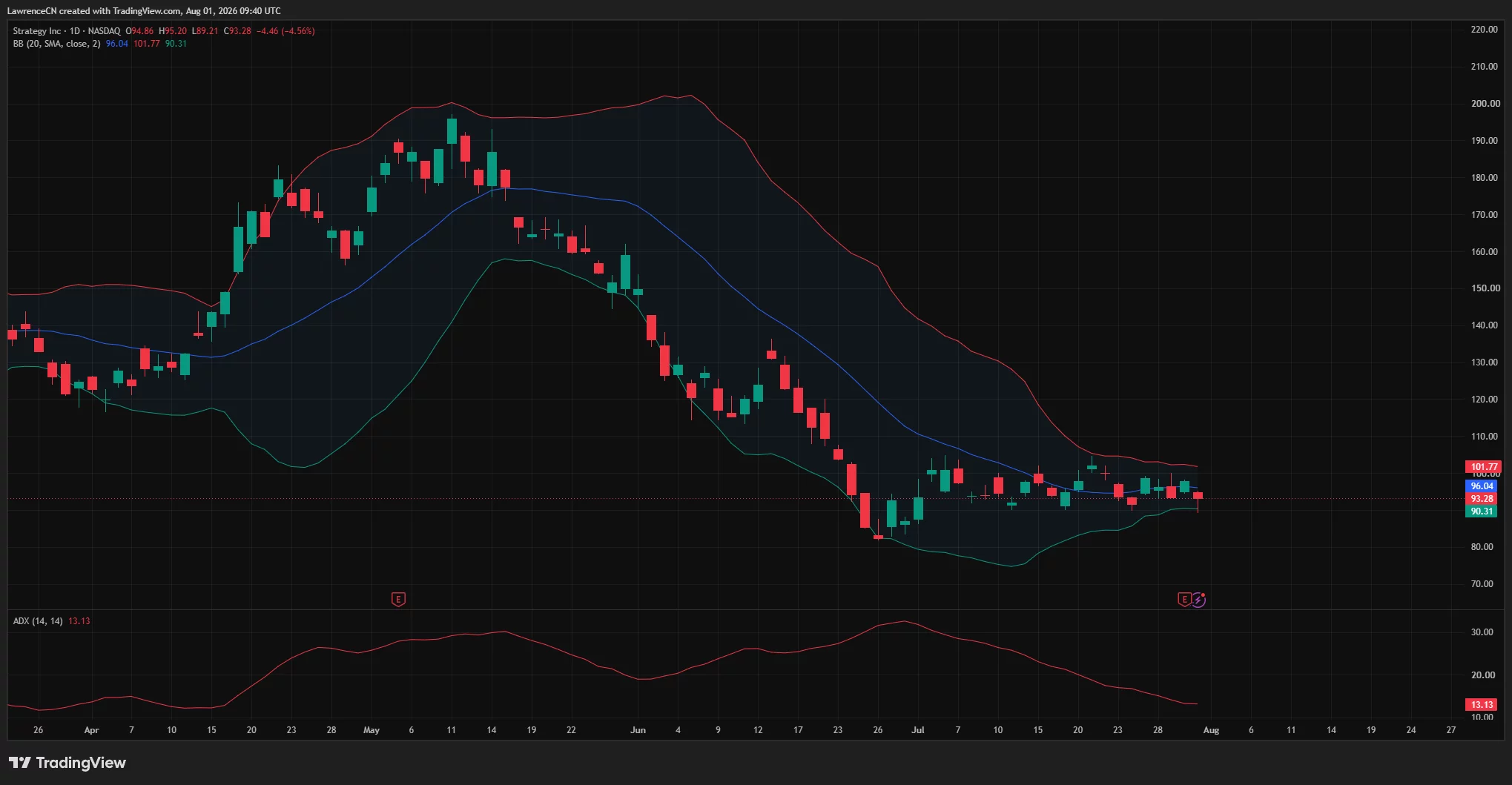
Strategy shares fell 4.56% to $93.28 on July 31 after the company reported an $8.22 billion quarterly loss and prioritized restoring its STRC preferred stock to its $100 par value.
Summary
- Strategy stock closed at $93.28, approaching its lower Bollinger Band at $90.31.
- The company reported an $8.22 billion net loss after recording an $8.32 billion unrealized Bitcoin loss.
- Michael Saylor said Strategy would hold both cash and Bitcoin instead of directing all available capital toward BTC.
- Analysts at Benchmark and H.C. Wainwright maintained their buy ratings despite the sell-off.
Strategy stock slides after $8.22B quarterly loss
Strategy stock traded as low as $89.21 on Thursday before recovering to close at $93.28. The 4.56% decline took the Nasdaq-listed company below $90 during the session for the first time since July 1.
The decline followed Strategy’s second-quarter results, which included an $8.32 billion unrealized loss on its Bitcoin holdings. That pushed the company to a net loss of $8.22 billion, or $24.45 per share, during the quarter.
Strategy held 843,775 BTC at the end of the reporting period, representing a 25% increase from the start of the year. The company acquired the holdings for approximately $63.69 billion at an average price of $75,476 per coin.
Lower Bitcoin prices reduced the market value of the position to about $54.77 billion. Under fair-value accounting rules, changes in Bitcoin’s market price flow through Strategy’s reported earnings, exposing quarterly results to large swings.
Operating revenue offered one positive data point. Revenue increased 6.9% from $114.5 million in the comparable period last year to $122.4 million.
Why Strategy is prioritizing STRC over immediate BTC purchases
Executive Chairman Michael Saylor said during the earnings call that Strategy would move away from directing all available funds toward immediate Bitcoin purchases. The company instead plans to maintain a combination of cash and BTC.
“Perhaps the best way to buy the most Bitcoin is not to buy the most Bitcoin immediately,” Saylor said.
Chief Executive Phong Le said Strategy would refrain from buying additional Bitcoin while STRC traded below its $100 par value. The company’s variable-rate preferred stock ended July 31 at approximately $89.
Strategy repurchased about $25 million of STRC between July 20 and July 24 while raising $544 million through sales of its common stock. The transactions indicate that management views support for the preferred share as necessary to preserve its broader capital-raising model.
Restoring STRC to par could improve investor confidence in Strategy’s preferred securities and make future issuance more efficient. Those instruments have become part of the company’s strategy for raising capital without relying exclusively on common-share sales or conventional debt.
Strategy also held a $3.75 billion cash reserve, giving it room to cover dividend and interest obligations without selling Bitcoin during a market downturn.
MSTR chart points to weak momentum near $90
The daily chart shows Strategy stock trading near the lower end of its recent consolidation range. Thursday’s decline took the price below the Bollinger Band midpoint at $96.04 and toward the lower band at $90.31.
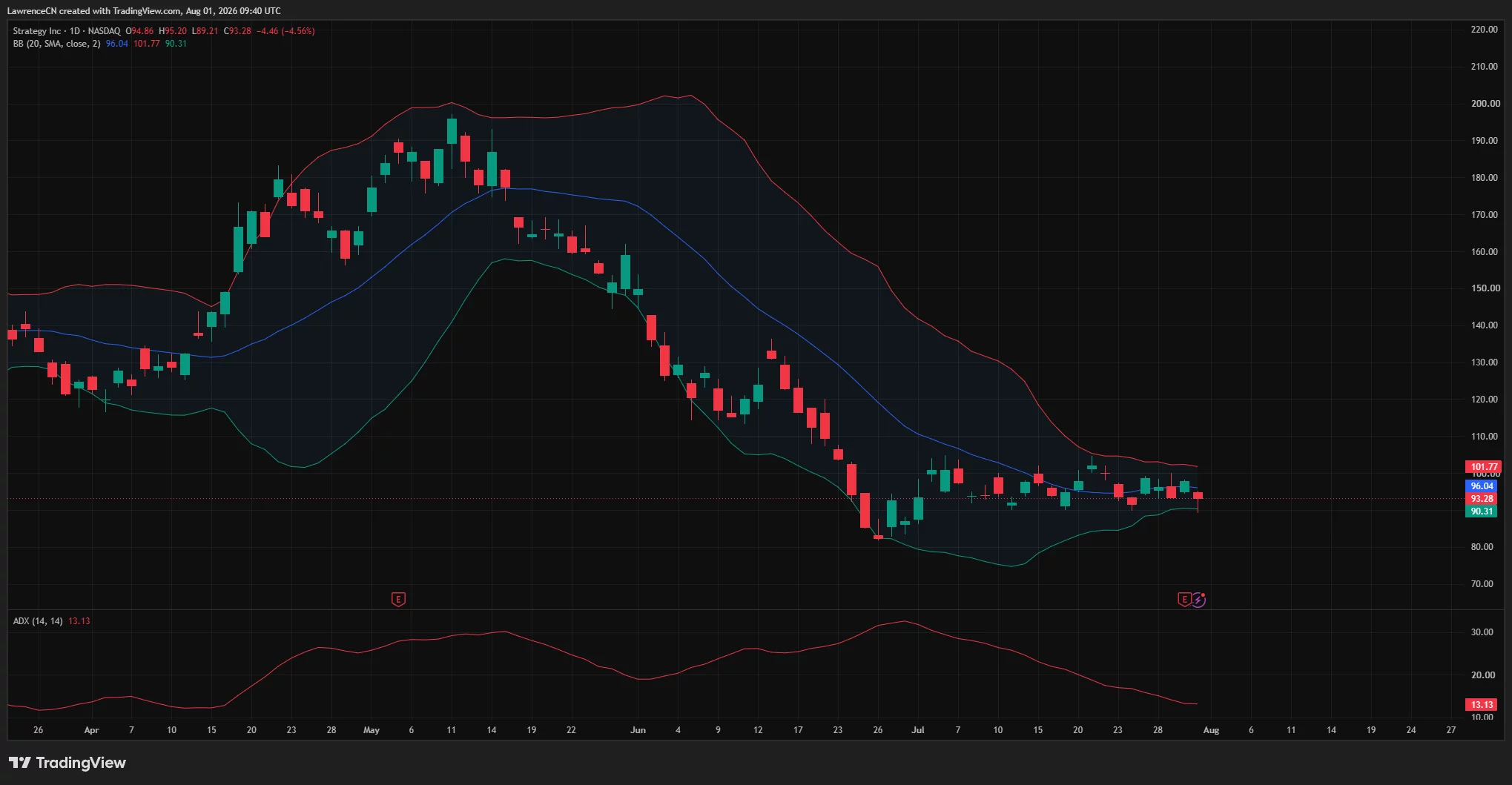
A daily close below $90.31 could confirm renewed selling pressure and expose the late-June low around $81 to $82. That area marked the bottom of the stock’s decline before its July stabilization.
The Average Directional Index stood at 13.13. An ADX reading below 20 generally indicates that the market lacks a strong directional trend, suggesting Strategy shares remain in consolidation despite the latest bearish session.
On the upside, MSTR would first need to recover above the $96.04 midpoint. A sustained move above that level could place the upper Bollinger Band at $101.77 within reach.
The narrow distance between the bands also shows that volatility has contracted following the stock’s steep decline from its May high near $200. A break outside the $90.31–$101.77 range could determine its next short-term direction.
Wall Street analysts retain bullish Strategy targets
Benchmark maintained its buy rating on Strategy but reduced its price target from $570 to $435. Analyst Mark Palmer said Saylor’s focus on bringing STRC back to par could strengthen the company’s ability to raise funds for future Bitcoin purchases.
H.C. Wainwright also maintained a buy rating and assigned Strategy stock a $325 target. The firm cited the company’s cash reserve and STRC repurchases as measures that could strengthen its balance sheet and limit the need to take on additional debt.
Both targets imply substantial upside from the July 31 closing price. However, their outlooks remain closely tied to Bitcoin’s performance and Strategy’s ability to issue securities on favorable terms.
For US investors, MSTR remains a publicly traded way to gain leveraged exposure to Bitcoin without holding the asset directly. That exposure also carries company-specific risks, including preferred-share obligations, equity dilution and earnings volatility caused by Bitcoin fair-value adjustments.
Bitcoin and STRC remain the next key catalysts
Strategy’s short-term stock performance will likely depend on whether STRC moves back toward $100 and whether Bitcoin recovers above the company’s average acquisition cost.
Management’s decision to preserve cash does not amount to abandoning its Bitcoin strategy. Instead, it delays immediate purchases while the company works to support the securities used to finance future acquisitions.
MSTR could remain range-bound while the ADX stays weak. A close below $90 would strengthen the downside case, while a recovery above $101.77 would signal that buyers are regaining control.
Disclosure: This article does not represent investment advice. The content and materials featured on this page are for educational purposes only.
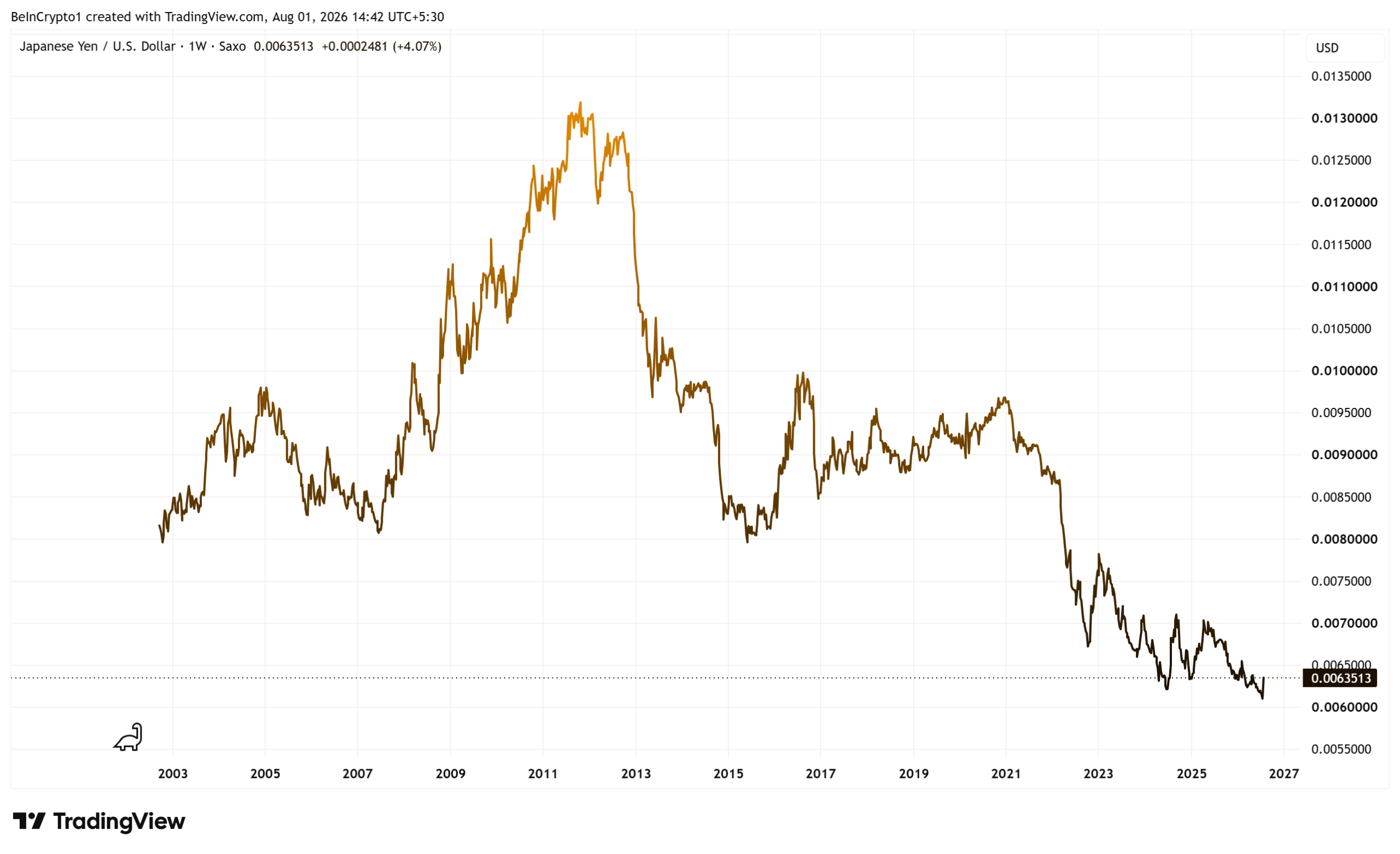
Bitcoin briefly broke below $63,000 on Friday, with the reason sitting 6,000 miles away. America bought Japanese yen for the first time in 28 years.
Washington almost never does this. The goal was to prop up a sinking currency. It also nudged one of the world’s biggest funding trades. Crypto sits at the end of that chain.
What Actually Happened
The yen has been sliding for years. Last week it hit 163.99 per dollar, before extending lower this weekend. That was close to a 40-year low.

Japan moved first, on Thursday. It sold dollars and bought yen. That is called intervention. A government buys its own currency to push the price back up.
Washington joined on Friday. The New York Fed sold euros and bought yen for the Treasury. It used Goldman Sachs and Morgan Stanley, the Financial Times reported.
It worked, for now. The yen closed at 157.40 per dollar, its strongest since early May.
US Last Bought Yen in 1998
America stopped meddling in currency markets in the mid-1990s. Since then it has stepped in only three times. Those were 1998, 2000 and 2011, according to a Congressional Research Service briefing. Friday was the fourth.
Most reports called this the first US help for the yen in over a decade. They pointed to 2011. That runs backwards. In 2011 the Group of Seven (G7) sold yen to stop it rising.
The US last bought yen on June 17, 1998. The New York Fed spent $833 million. Half came from the Fed. Half came from the Exchange Stabilization Fund, a Treasury pot for currency emergencies. The bank’s own record confirms it.
The size is the other shock. A Reuters photo caught Treasury Secretary Scott Bessent’s notepad at Camp David. It read “Buy Japanese Yen (JPY) $5-10 bil.”

That is six to twelve times the 1998 trade.
There is one more wrinkle. Treasury published its currency report on July 23. It kept Japan on a watchlist for currency practices.
Eight days later, Washington was buying yen itself.
Follow us on X to get the latest news as it happens
How Much Money Is Involved
Japan spent far more than the US. Bloomberg put Thursday’s Japanese buying at ¥8.45 trillion, or about $52.8 billion. That estimate came from Bank of Japan accounts and broker forecasts.
Here is how it compares.

Nobody knows Thursday’s real number yet. Japan’s finance ministry publishes intervention data once a month. The release covering July 30 is due at the end of August.
South Korea helped too. It sold dollars alongside Japan on Thursday, a Reuters timeline shows. Weeks earlier, Goldman Sachs forecast further weakness toward 165.
What This Means for Bitcoin
The Bitcoin (BTC) price sat near $63,034 at press time. It was down 1.25% over 24 hours, with a market value of $1.26 trillion. Bitcoin did not just fall. It fell alone.
Wall Street had a good Friday. The Nasdaq rose 1%. The S&P 500 added 0.7%. The Dow gained 0.53%, according to CNBC. Bitcoin went the other way.

That gap is the story. Stock traders were watching tech earnings. Crypto traders were watching Tokyo.
The reason is simple. Japanese rates have sat near zero for years. Traders borrowed yen cheaply. They swapped it for dollars and bought riskier assets. Stocks, bonds, and Bitcoin. That is the carry trade.
It works while the yen stays weak. A sharp yen rally breaks it. Traders then sell what they own to repay the loan. Japan’s bond market stress flagged that risk earlier in July.
Markets have been here before. The Bank of Japan raised rates on July 31, 2024. The yen jumped. Within days the Nikkei 225 fell 12.4%, its worst day since 1987. Crypto fell with it.
One thing is different now. That episode started with a rate hike, and hikes close the gap for good. Friday was a purchase. Purchases wear off.
What to Watch Next
The BOJ held rates at 1% this week on an 8-1 vote. That is the highest since 1995. It is still far below the 3.75% US ceiling. Governor Kazuo Ueda hinted at future hikes but promised none.
“Without backing from rate differentials, the impact of FX interventions is likely to be relatively short-lived,” Bloomberg reported in a Friday note, citing Evercore ISI strategists Marco Casiraghi and Gang Lyu.
Three dates matter now:
- Japan confirms its real spending at the end of August.
- Bessent meets Ueda at the Group of 20 (G20) finance meeting in Asheville, North Carolina, that same month.
- After that, the Fed and BOJ rate paths take over.
The simple test is 160. If the dollar stays below 160 yen, the defence held. If it climbs back, Tokyo and Washington face the same call again. The bill will be larger.
The post America Broke a 28-Year Rule to Save the Yen and Bitcoin Felt It First appeared first on BeInCrypto.
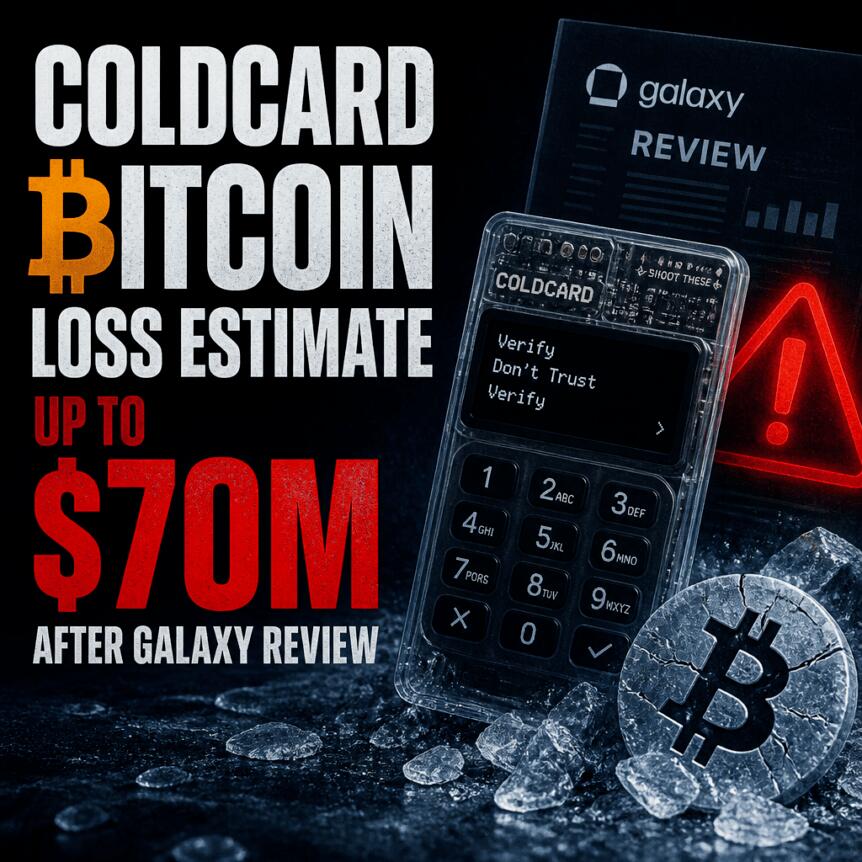
Galaxy Research, the research arm of Galaxy Digital, has expanded the on-chain scope of the Coldcard wallet incident after identifying 1,196 affected Bitcoin addresses. In a 41-minute window, those addresses lost a total of 1,082.65 BTC—worth about $70.2 million at the time the transactions occurred.
The new findings push earlier estimates further, helping clarify what attackers may have executed immediately after the vulnerable wallets generated seeds. Galaxy Research’s tracing covers movements between 1:10 AM and 1:51 AM UTC on July 30 across blocks 960,183 to 960,191, roughly 30 hours before Coldcard published its first security advisory.
Key takeaways
- Galaxy Research identified 1,196 addresses tied to the Coldcard incident and traced losses of 1,082.65 BTC in a 41-minute period.
- The identified activity occurred between 1:10 AM and 1:51 AM UTC on July 30, across blocks 960,183–960,191, about 30 hours before Coldcard’s initial advisory.
- Earlier estimates by AnchorWatch CEO Rob Hamilton were lower, pointing to 594.48 BTC moving through a tighter three-block window.
- Galaxy Research says the transactions share a distinctive pattern on-chain—identical 30 satoshis per virtual byte fees and no change outputs—but future sweeps may differ.
Galaxy Research broadens the attack map
Galaxy Research says it traced the Bitcoin movements tied to the incident to a specific burst of activity on July 30. The research effort focuses on addresses linked to the Coldcard wallet compromise that were swept between 1:10 AM and 1:51 AM UTC.
According to Galaxy Research, the losses accumulated across a short span of blocks—960,183 through 960,191—indicating that the attack likely operated with automation and repeated transaction structure rather than sporadic manual movement. At the time of the outgoing transfers, the 1,082.65 BTC figure was valued at approximately $70.2 million.
The timing is also notable: Galaxy Research’s tracing window began about a day before Coldcard’s first publicly issued security advisory, suggesting that the compromised funds were moved early and that the response cycle lagged behind the initial sweep.
Pattern matching helps confirm related transactions—within limits
In follow-up analysis, Galaxy Research said the identified transactions share a common signature. The company reported that the sweeps used identical 30 satoshis per virtual byte fees and that the transactions contained no change outputs.
Those characteristics are useful for investigators because they provide an on-chain fingerprint for clustering wallet-related activity, which can reduce the chances of misattributing unrelated transfers. Galaxy Research also cautioned that while the initial attack activity is identifiable through this pattern, later attacks against Coldcard-generated addresses may not preserve the same fingerprint.
For users and analysts, this distinction matters: it implies that incident totals based solely on one recognizable transaction structure could undercount additional rounds of activity if those later sweeps differed in fee settings or output behavior.
Earlier estimates were smaller, but based on a narrower window
Before Galaxy Research’s broader mapping, earlier preliminary analysis by AnchorWatch CEO and co-founder Rob Hamilton estimated that 594.48 BTC—about $38 million at the time—moved across 500 transactions within a three-block window.
Hamilton’s figures were drawn from a tighter segment of on-chain activity, reflecting how fast-moving wallet incidents often outpace early investigations. Galaxy Research’s expanded set effectively updates the picture by widening both the address set and the traced timeframe around the July 30 burst, nearly doubling the total BTC attributed to the sweep activity.
The divergence between estimates underscores a common challenge in incident response for self-custody systems: determining full scope can require days of tracing, clustering, and validation—particularly when attackers reuse similar logic across multiple transactions and destinations.
Coinkite acknowledges a firmware bug and advises seed migration
Coldcard’s manufacturer, Coinkite, has taken responsibility for the underlying issue. In an X post on Friday, Coinkite co-founder Rodolfo Novak said the company is working to determine the full scope of the problem and confirmed that it released a hotfix designed to remove a software fallback path.
Novak also emphasized a limitation of the mitigation: the update does not protect seeds generated on the vulnerable firmware. In practical terms, users who created seed phrases during the affected period were advised to move funds to a new seed.
This guidance aligns with the core risk in seed-based compromises—if a vulnerability affects how seed material or related execution paths behave, merely updating firmware may not retroactively secure already-generated keys. The immediate operational implication for affected holders is that recovery requires a transfer to safer key material, not just a device update.
What to watch next for affected users
Galaxy Research’s identification of a common on-chain sweep pattern offers a more structured basis for tracking related activity, but the company’s warning that future attacks may not match the same fingerprint suggests the incident may still evolve in how it appears on-chain. Users concerned about whether they generated seeds with vulnerable firmware should focus on migrating remaining balances to newly generated seeds and continue monitoring for any residual movement tied to addresses linked to the sweep logic.
Galaxy Research identified 1,196 addresses that lost 1,082.65 Bitcoin in a 41-minute window, expanding the estimated scope of the Coldcard wallet incident.
Galaxy Research, the research arm of crypto investment company Galaxy Digital, identified 1,196 addresses linked to the Coldcard wallet incident that lost 1,082.65 Bitcoin, worth about $70.2 million at the time of the transactions.
Galaxy Research traced the Bitcoin movements between 1:10 AM and 1:51 AM UTC on July 30 across blocks 960,183 to 960,191, about 30 hours before Coldcard published its first security advisory, according to an X post on Friday.
Earlier preliminary analysis of the Coldcard incident by AnchorWatch CEO and co-founder Rob Hamilton estimated that 594.48 Bitcoin, worth around $38 million, moved across 500 transactions within a three-block window.
Galaxy Research later said the identified transactions shared a pattern, including identical 30 satoshis per virtual byte fees and no change outputs. The company said the initial attack activity is identifiable on-chain through this pattern, but noted that future attacks against Coldcard-generated addresses may not follow the same fingerprint.
Coinkite co-founder Rodolfo Novak said in an X post on Friday that the company takes responsibility for the firmware bug and is working to determine the full scope of the issue.
Novak said Coinkite released a hotfix to remove the software fallback path, but warned that the update does not protect seeds generated on vulnerable firmware. He advised users who generated seeds on vulnerable firmware to move their funds to a new seed.
Related: SecondFi to wind down after $2.6M ADA theft linked to wallet flaw


A zero-knowledge proof lets one party prove to another that a statement is true without revealing any information beyond the truth of the statement itself. It is the cryptographic technique behind blockchain privacy, scalable rollups, and a growing number of identity verification systems.
Summary
- Zero-knowledge proofs allow a prover to convince a verifier that a computation was performed correctly without revealing the underlying data, enabling both privacy and scalability on blockchains.
- The two main families of zero-knowledge proofs used in blockchain are zk-SNARKs, which require an initial trusted setup ceremony, and zk-STARKs, which do not require trusted setup but produce larger proofs.
- Ethereum layer 2 rollups like zkSync, Scroll, and Polygon zkEVM use zero-knowledge proofs to compress thousands of transactions into a single proof verified on the main chain, reducing gas costs by 90 percent or more.
- Vitalik Buterin introduced the GKR protocol in late 2025 as a way to accelerate Ethereum zero-knowledge proof verification, aiming to make the technology practical for everyday use at scale.
- Zero-knowledge proofs are mathematically sound but not magic. They depend on specific cryptographic assumptions, require significant computational resources to generate, and have been deployed in production for less than three years at scale.
The standard explanation of zero-knowledge proofs uses the cave analogy. Ali Baba knows the secret word to open a door inside a circular cave. He can prove he knows the word by entering from one side and exiting from the other, on demand, without ever saying the word out loud. After enough successful demonstrations, the verifier becomes statistically certain Ali Baba knows the secret.
This analogy is correct but incomplete. It captures the intuition but misses the machinery. In practice, zero-knowledge proofs are not about caves or doors. They are about polynomial commitments, elliptic curve pairings, and the mathematical properties that allow one party to encode a computation as a set of constraints and another party to verify that those constraints are satisfied without learning what values satisfied them.
This article explains what zero-knowledge proofs do, how the two dominant proof systems work, where they are deployed in production, and what they cannot do. If you have heard that zero-knowledge proofs solve all of blockchain’s privacy and scalability problems, the reality is more specific and more interesting.
The three properties
A zero-knowledge proof must satisfy three mathematical properties. Completeness means that if the statement is true and both the prover and verifier follow the protocol, the verifier will always accept the proof. Soundness means that if the statement is false, no cheating prover can convince the verifier to accept it, except with negligible probability. Zero-knowledge means the verifier learns nothing beyond whether the statement is true.
The third property is the counterintuitive one. How can you verify a computation without learning anything about it? The answer lies in the structure of the proof system. The prover encodes the computation as a polynomial equation, commits to that polynomial using a cryptographic commitment scheme, and then responds to random challenges from the verifier. The verifier checks the responses against the commitment without ever seeing the polynomial itself.
In non-interactive zero-knowledge proofs, which are the type used in blockchains, the random challenges are replaced by a hash function applied to the commitment. This is called the Fiat-Shamir heuristic, and it allows the prover to generate the entire proof without any back and forth communication. The resulting proof is a compact string of data that anyone can verify independently.
The mathematical foundation rests on the hardness of certain computational problems. For zk-SNARKs, security relies on the difficulty of computing discrete logarithms on elliptic curves. For zk-STARKs, security relies on the collision resistance of hash functions, which is considered a weaker and more conservative assumption. If either assumption turns out to be wrong, the corresponding proof system breaks. This is why the choice between zk-SNARKs and zk-STARKs involves tradeoffs beyond just proof size and verification speed.
zk-SNARKs: trusted setup, small proofs
zk-SNARK stands for Zero-Knowledge Succinct Non-interactive Argument of Knowledge. The word succinct is the key differentiator: a zk-SNARK proof is extremely small, typically a few hundred bytes, and can be verified in milliseconds regardless of how complex the underlying computation is.
The cost of this succinctness is the trusted setup. Most zk-SNARK constructions require an initial ceremony where a set of structured reference strings are generated. These strings are used by both provers and verifiers. If the random values used to generate them are not properly destroyed, anyone who retains them could create fake proofs that appear valid. This is sometimes called toxic waste.
Modern trusted setup ceremonies use multi-party computation protocols where hundreds or thousands of participants each contribute randomness. The security guarantee is that as long as at least one participant honestly destroys their random contribution, the setup is secure. Zcash pioneered this approach with its Powers of Tau ceremony, and subsequent projects have refined it.
Newer zk-SNARK constructions like PLONK and its variants use a universal and updatable trusted setup, meaning the same setup can be reused for different circuits and additional participants can strengthen the setup over time without starting from scratch. This mitigates the trusted setup concern but does not eliminate it entirely. The fundamental tradeoff remains: smaller, faster proofs in exchange for a one-time trust assumption.
zk-STARKs: no trusted setup, larger proofs
zk-STARK stands for Zero-Knowledge Scalable Transparent Argument of Knowledge. Transparent means no trusted setup is required. The reference strings are generated from publicly verifiable randomness, which eliminates the toxic waste problem entirely. Scalable refers to the fact that proving time grows quasi-linearly with the size of the computation, making STARKs suitable for very large computations.
The tradeoff is proof size. A zk-STARK proof is typically tens to hundreds of kilobytes, compared to a few hundred bytes for a zk-SNARK. On a blockchain where data storage is expensive, this difference matters. Verification time is also somewhat longer for STARKs, though still fast enough for practical use.
StarkWare, the company behind Starknet, has been the primary commercial advocate for zk-STARKs. Their argument is that the transparency property, combined with quantum resistance from relying only on hash functions rather than elliptic curves, makes STARKs the better long term choice even at the cost of larger proofs. Whether quantum computers will actually threaten elliptic curve cryptography within a relevant timeframe is debated, but the conservative security posture appeals to applications where long term robustness matters more than immediate efficiency.
ZK rollups: the scaling application
The most important practical application of zero-knowledge proofs in blockchain today is ZK rollups. A rollup executes transactions off chain, batches them together, generates a zero-knowledge proof that all transactions were valid, and posts just the proof and compressed transaction data to the main chain. The main chain verifies the proof, which is orders of magnitude cheaper than executing every transaction individually.
This architecture allows Ethereum layer 2 networks to process thousands of transactions for the cost of a single proof verification on layer 1. In practice, ZK rollups like those built on Ethereum infrastructure reduce gas costs by 90 percent or more compared to executing the same transactions directly on mainnet.
The major ZK rollup projects in production or late stage development as of mid 2026 include zkSync Era, Scroll, Polygon zkEVM, Linea, and Taiko. Each uses a different proving system and makes different tradeoffs between EVM compatibility, proving speed, and decentralization. zkSync uses a custom virtual machine and PLONK-based proofs. Scroll aims for byte-level EVM equivalence using a zk-SNARK prover. Polygon zkEVM uses a combination of STARK and SNARK proofs in a recursive architecture.
The competition between these projects is driving rapid innovation in proof generation. Proving times have dropped from hours to minutes to seconds over the past two years. Vitalik Buterin’s introduction of the GKR protocol for Ethereum represents another step toward making ZK proof verification a routine operation rather than a computational bottleneck.
Privacy applications beyond rollups
Zero-knowledge proofs were originally developed for privacy, not scalability. Zcash, launched in 2016, was the first major blockchain to use zk-SNARKs for private transactions. In a shielded Zcash transaction, the sender, receiver, and amount are all hidden from public view while the proof guarantees that no coins were created out of thin air and no double spending occurred.
The privacy application extends beyond financial transactions. Zero-knowledge proofs can verify identity attributes without revealing the underlying data. A user could prove they are over 18 without revealing their birth date, prove they are a citizen of a specific country without revealing their passport number, or prove they hold a certain credential without revealing which institution issued it.
Projects like Worldcoin and Polygon ID have implemented ZK-based identity verification systems. Worldcoin uses zero-knowledge proofs to verify that a person has been scanned by their iris scanning device without linking the scan to any specific identity. Ethereum ecosystem projects are increasingly integrating ZK-based identity as a primitive alongside financial transactions.
The privacy use case faces regulatory headwinds. Financial regulators in multiple jurisdictions have expressed concern that fully private transactions could facilitate money laundering, sanctions evasion, and terrorist financing. The tension between privacy as a fundamental right and transparency as a regulatory requirement is one of the defining policy debates in cryptocurrency, and zero-knowledge proofs sit directly at the center of it.
What zero-knowledge proofs do not cover
Zero-knowledge proofs guarantee computational integrity: that a specific computation was performed correctly. They do not guarantee that the inputs to the computation were correct, that the computation was worth performing, or that the system built around the proof is free of bugs.
A ZK rollup can prove that all transactions in a batch were valid according to the rollup’s rules. It cannot prove that the rules themselves are correct. A bug in the rollup’s smart contracts or proving circuit could produce valid proofs for invalid state transitions. Several ZK rollup projects have disclosed and patched critical bugs in their circuits during audits and testnet deployments.
Zero-knowledge proofs also do not eliminate the need for data availability. In a ZK rollup, the proof tells the main chain that the state transition was valid, but users still need access to the underlying transaction data to reconstruct the state and verify that their funds are intact. Without data availability, users must trust the rollup operator, which partially defeats the purpose of the proof.
The computational cost of generating proofs is substantial. While verification is cheap, proof generation requires significant hardware. Running a ZK prover at production scale typically requires servers with hundreds of gigabytes of RAM and specialized hardware accelerators. This cost creates a natural centralizing force in who can afford to run provers, even if the proofs themselves can be verified by anyone.
Practical checks for evaluating ZK projects
When evaluating a project that claims to use zero-knowledge proofs, several questions distinguish serious implementations from marketing.
First, ask whether the proof system has been independently audited. Circuit bugs can create soundness vulnerabilities where invalid proofs are accepted as valid. A project that has not been audited by multiple independent cryptography firms should be treated with caution.
Second, ask whether the proving system uses a trusted setup and, if so, how the ceremony was conducted. A trusted setup with only a small number of participants, or one conducted by a single company without external verification, represents a meaningful trust assumption.
Third, check whether the project publishes its proof verification contracts and whether those contracts have been verified on chain. If verification is happening off chain or through upgradeable proxy contracts controlled by a multisig, the zero-knowledge proofs may not be providing the security guarantees users expect.
Fourth, look at the data availability solution. If the project does not post transaction data on chain or to a credible data availability layer, users cannot independently verify the state and must trust the operator. This is a meaningful departure from the trustlessness that zero-knowledge proofs are supposed to enable.
Frequently asked questions
What is a zero-knowledge proof in simple terms?
A zero-knowledge proof is a way to prove you know something without revealing what you know. In blockchain, it allows one computer to prove to another that a set of transactions is valid without showing the details of those transactions. This enables both privacy and scalability.
What is the difference between zk-SNARKs and zk-STARKs?
zk-SNARKs produce very small proofs, typically a few hundred bytes, and verify quickly, but require a one-time trusted setup ceremony. zk-STARKs produce larger proofs, typically tens of kilobytes, but do not require any trusted setup and are considered resistant to quantum computing attacks. Both achieve the same goal of verifiable computation with zero knowledge.
How do ZK rollups reduce Ethereum gas costs?
ZK rollups execute transactions off the Ethereum main chain, batch them together, and generate a zero-knowledge proof that all transactions are valid. Only the proof and compressed data are posted to Ethereum. Verifying a single proof is much cheaper than executing thousands of individual transactions, resulting in gas cost reductions of 90 percent or more.
Are zero-knowledge proofs quantum resistant?
It depends on the proof system. zk-STARKs rely on hash functions, which are believed to be resistant to quantum computers. zk-SNARKs rely on elliptic curve cryptography, which could theoretically be broken by a sufficiently powerful quantum computer. However, practical quantum computers capable of breaking elliptic curves do not yet exist and may not for decades.
Can zero-knowledge proofs make all blockchain transactions private?
Technically yes, but practically there are tradeoffs. Generating proofs for every transaction adds computational cost and complexity. Fully private transactions also face regulatory challenges in jurisdictions that require financial transparency. Projects like Zcash offer optional privacy, while most ZK rollups use the technology primarily for scalability rather than privacy.
What is a trusted setup and why does it matter?
A trusted setup is a one-time ceremony that generates cryptographic parameters needed by certain proof systems. If the random values used during the ceremony are not properly destroyed, someone could create fake proofs. Modern ceremonies use multi-party computation where hundreds of participants contribute randomness, and the setup is secure as long as at least one participant is honest.
Which blockchains use zero-knowledge proofs?
Zcash was the first major blockchain to use zero-knowledge proofs for private transactions. Ethereum uses ZK proofs through layer 2 rollups including zkSync, Scroll, Polygon zkEVM, Linea, and Starknet. Mina Protocol uses recursive ZK proofs to maintain a fixed-size blockchain. Several other chains incorporate ZK technology for specific features like identity verification or cross-chain messaging.
How long does it take to generate a zero-knowledge proof?
Proof generation time depends on the complexity of the computation and the hardware used. For ZK rollup batches containing thousands of transactions, proof generation currently takes seconds to minutes on specialized hardware. Two years ago, the same proofs took hours. The trend is toward faster proving through hardware acceleration and algorithmic improvements, with the goal of real-time proof generation.
Disclaimer: This article is for informational purposes only and does not constitute financial, investment, or legal advice. Cryptocurrency investments carry significant risk. Always conduct your own research before making any investment decisions. Information is accurate as of August 1, 2026.
A testnet is a separate blockchain network that mirrors a production chain’s rules and functionality but uses tokens with no monetary value. It is where developers break things, test upgrades, and discover bugs before those bugs can cost anyone real money.
Summary
- A testnet is a blockchain network that runs the same software as a mainnet but uses valueless tokens, allowing developers to test smart contracts, protocol upgrades, and applications without financial risk.
- Ethereum has run multiple testnets over its history, with Sepolia and Holesky serving as the primary public testing environments as of 2026 after the deprecation of Goerli.
- Testnet tokens are free and can be obtained from faucets, which are web services that distribute small amounts of test tokens to developer wallet addresses.
- Major protocol upgrades like Ethereum’s Pectra and Cardano’s van Rossem hard fork were deployed to testnets months before reaching mainnet, where they were tested under conditions designed to surface edge cases and failure modes.
- Testnets are not perfect replicas of mainnet conditions. They typically have fewer validators, lower transaction volume, and different economic incentives, which means some categories of bugs only appear after mainnet deployment.
Every piece of software ships with bugs. The question is whether those bugs are discovered in a controlled environment or in production, where they can destroy value. In traditional software development, staging environments and QA processes serve this function. In blockchain, testnets serve the same function but with a critical difference: blockchain bugs are often irreversible.
A smart contract that contains a vulnerability on a testnet loses nothing because the tokens are worthless. The same vulnerability on a mainnet can drain millions of dollars in minutes. The history of decentralized finance is littered with exploits that could have been caught on a testnet if the testing had been more thorough.
This article explains what testnets are, how they work, why they matter for the security of every blockchain protocol, and what their limitations are. If you interact with any blockchain application, the quality of its testnet phase directly affects the safety of your funds.
How testnets work
A testnet runs the same node software as its corresponding mainnet but operates on a separate network with its own genesis block, its own chain of blocks, and its own set of validators or miners. Transactions on a testnet are processed using the same consensus rules, the same virtual machine, and the same transaction format as mainnet transactions. The only fundamental difference is that the tokens have no market value.
This separation is enforced at the network level. Testnet nodes connect to other testnet nodes, not to mainnet nodes. The chain IDs are different, which prevents testnet transactions from being replayed on mainnet and vice versa. When a developer deploys a smart contract to a testnet, that contract exists only on the testnet and has no effect on the mainnet state.
Testnet tokens are distributed through faucets, which are simple web applications that send a small amount of test tokens to any wallet address that requests them. Most faucets impose rate limits to prevent abuse. Some require completing a captcha or connecting a social media account. The tokens have no monetary value by design, though there have been instances where testnet tokens have traded on secondary markets, which defeats their purpose and is generally discouraged by protocol teams.
Developers use testnets to deploy and interact with smart contracts exactly as they would on mainnet. They can test function calls, simulate user interactions, measure gas consumption, and verify that error handling works correctly. Wallet applications, decentralized exchanges, lending protocols, and NFT marketplaces all go through testnet deployment before launching on mainnet.
Types of testnets
Not all testnets serve the same purpose. Public testnets are open to anyone and mirror mainnet conditions as closely as possible. They are used for final stage testing before mainnet deployment and for community members who want to try new features. Ethereum’s Sepolia and Holesky are public testnets. Base’s Beryl testnet is another example of a public testnet used to test protocol upgrades before mainnet deployment.
Private or permissioned testnets are operated by specific development teams and are not open to public participation. These are used for early stage development where the protocol may be unstable or where the team wants to control the testing conditions. Many projects run private testnets for months before opening a public testnet.
Local development networks, sometimes called devnets, run on a developer’s own machine. Tools like Hardhat and Foundry for Ethereum allow developers to spin up a local blockchain instance, deploy contracts, and run tests in seconds without connecting to any external network. These are not true testnets but serve a similar function for unit testing and rapid iteration.
Shadow forks are a newer concept where a testnet replays real mainnet transaction data against a modified version of the protocol. This allows developers to test upgrades against realistic transaction patterns and state sizes rather than the synthetic and often unrealistic conditions of a standard testnet. Ethereum used shadow forking extensively during the preparation for The Merge in 2022.
Why testnet phases matter for protocol upgrades
Major blockchain upgrades follow a predictable lifecycle: specification, implementation, testnet deployment, monitoring, and finally mainnet activation. The testnet phase is where the implementation meets reality. Bugs that were invisible in unit tests become apparent when the code runs on a distributed network with independent operators, network latency, and concurrent transactions.
Ethereum’s Pectra upgrade, which introduced account abstraction and increased blob capacity, was deployed to the Hoodi testnet months before reaching mainnet. During the testnet phase, developers discovered edge cases in the account abstraction implementation that would have caused transaction failures for a subset of users. These were fixed before mainnet deployment.
Cardano’s van Rossem hard fork followed a similar pattern, with the upgrade reaching its public testnet weeks before the mainnet governance vote that activated it. The testnet phase allowed stake pool operators to update their nodes and verify compatibility before the hard fork went live.
The length of the testnet phase varies by the complexity and risk of the upgrade. Simple parameter changes might spend days on a testnet. Fundamental consensus changes like The Merge spent months across multiple testnets. The pressure to move quickly is always present, but the cost of shipping a mainnet bug that could have been caught on a testnet is high enough that most serious protocol teams err on the side of longer testing periods.
The gap between testnet and mainnet
Testnets are valuable but imperfect. Several categories of problems are difficult or impossible to reproduce on a testnet. Economic attacks, where an attacker exploits the relationship between token prices and protocol mechanics, require real economic incentives that do not exist on a testnet. Miner or validator extractable value strategies, front running, and sandwich attacks depend on real financial motivation.
Scale related bugs also often escape testnet detection. A testnet with 100 validators processes transactions differently than a mainnet with 1,000 validators. Network congestion patterns, state bloat, and the behavior of the peer to peer gossip layer under load all change with scale. Some bugs only manifest when the state database exceeds a certain size or when transaction volume spikes above levels that testnets rarely experience.
The social and governance dimensions of blockchain also differ between testnet and mainnet. On a testnet, there are no real stakeholders with financial exposure who might resist an upgrade. The politics of hard fork coordination, which can involve exchanges, wallet providers, major token holders, and application developers, do not exist on a testnet. A protocol change that works perfectly on a testnet can still fail on mainnet if the coordination required to activate it breaks down.
This gap is why many blockchain projects now use incentivized testnets, where participants earn rewards for finding bugs, stress testing the network, or running validators. Robinhood’s chain testnet recorded 4 million transactions in its first week, partly because of incentive programs that attracted real users performing realistic interactions rather than synthetic test scripts.
What testnets do not cover
Testnets do not test economic security. The value of tokens on a testnet is zero, which means rational economic actors behave differently than they would on mainnet. A protocol that appears secure on a testnet may be vulnerable to economic exploits that only become apparent when real money is at stake.
Testnets do not test long term stability. Most testnets are reset periodically, which means issues related to state growth, database performance over time, and the accumulation of edge cases in long running chains are not tested. Some protocols run long lived testnets specifically to catch these issues, but the practice is not universal.
Testnets do not test user behavior. On a testnet, users have no reason to optimize gas usage, rush to complete transactions before a deadline, or engage in arbitrage. The transaction patterns on a testnet are fundamentally different from mainnet patterns, which means performance metrics measured on a testnet may not translate to mainnet conditions.
Practical checks for using testnets
If you are a developer, always deploy to a testnet before mainnet. This sounds obvious but a surprising number of smart contract exploits involve code that was deployed directly to mainnet without adequate testnet coverage. Use automated testing frameworks to run your test suite against a testnet deployment, not just a local node.
If you are a user, check whether the applications you use went through a public testnet phase. Serious projects publish testnet addresses, invite community testing, and often run bug bounty programs during the testnet phase. A project that skips the public testnet phase and launches directly to mainnet is taking a risk with its users’ funds.
When interacting with testnets, use a separate wallet from your mainnet wallet. While testnet transactions cannot affect mainnet, using the same private key on both networks is a bad security practice. If a testnet application is compromised or contains malicious code, having your mainnet private key in the same wallet creates unnecessary risk.
Monitor the testnet phase of upgrades to networks where you hold assets. If a major upgrade encounters problems on a testnet, it may be delayed or modified before mainnet deployment. Understanding the testnet timeline gives you advance notice of potential disruptions or opportunities.
Frequently asked questions
What is a testnet in simple terms?
A testnet is a practice version of a blockchain. It works the same way as the real blockchain but uses fake tokens that have no value. Developers use it to test their applications and find bugs before launching on the real network where real money is involved.
Are testnet tokens worth anything?
No. Testnet tokens have no monetary value by design. They exist solely for testing purposes and can be obtained for free from faucets. While there have been cases of people trading testnet tokens on secondary markets, this is discouraged and defeats the purpose of having a free testing environment.
How do I get testnet tokens?
Testnet tokens are available from faucets, which are web services that distribute free test tokens. For Ethereum’s Sepolia testnet, you can search for a Sepolia faucet, enter your wallet address, and receive test ETH within seconds. Most faucets have rate limits to prevent abuse.
What is the difference between a testnet and a mainnet?
A mainnet is the production blockchain where transactions involve real tokens with real value. A testnet is a separate network that runs the same software but uses valueless tokens. Testnets are for development and testing. Mainnets are for actual use. They share the same rules but operate independently.
Why do blockchains need testnets?
Blockchain transactions are generally irreversible, so bugs in production can result in permanent loss of funds. Testnets allow developers to find and fix these bugs in a safe environment where mistakes cost nothing. Major protocol upgrades are always tested on testnets before being activated on mainnet.
Can I test my own smart contract on a testnet?
Yes. Anyone can deploy smart contracts to public testnets like Ethereum’s Sepolia. You need a wallet, free testnet tokens from a faucet, and a development framework like Hardhat or Foundry. The deployment process is identical to mainnet deployment, just using a different network endpoint.
What happens when a testnet is deprecated?
When a testnet is deprecated, its validators stop processing transactions and the network eventually shuts down. Any contracts deployed on it become inaccessible. This happens periodically as protocols evolve. Ethereum deprecated the Ropsten, Rinkeby, and Goerli testnets in favor of Sepolia and Holesky.
Is it safe to use testnets?
Testnets themselves are safe because the tokens have no value, so you cannot lose money. However, you should use a separate wallet from your mainnet wallet and never share private keys between networks. Be cautious of testnet applications that ask for mainnet wallet connections or permissions.
Disclaimer: This article is for informational purposes only and does not constitute financial, investment, or legal advice. Cryptocurrency investments carry significant risk. Always conduct your own research before making any investment decisions. Information is accurate as of August 1, 2026.
Bitcoin’s price failed at $65,000 earlier this week, and the subsequent correction pushed it south to a 17-day low of $62,400 before it found some support and rebounded to $63,000.
Most larger-cap alts are also in the red in the past 24 hours, led by more painful losses from HYPE, UNI, and AAVE.
BTC Back to $63K
It was just over a week ago when the primary cryptocurrency was riding high and tapped a monthly peak at $67,000 after the favorable US inflation data for June. However, the predominantly bearish sentiment quickly returned, and the asset slumped below $64,000 that Friday.
Its recovery began last weekend and intensified on Monday when bitcoin pumped to $65,600 on a couple of occasions. However, it couldn’t keep climbing and dumped to $62,700 a day later as investors de-risked ahead of the key FOMC meeting. More volatility ensued before and after the event as the Fed ultimately left the rates unchanged.
Bitcoin began a more profound recovery on Thursday and Friday morning, jumping to $65,500 once again. A familiar scenario repeated, though, as the bears resumed control and drove it south to its lowest position since July 14 at $62,400.
The bulls managed to step up and helped BTC recover some ground to the current $63,000, but there are some warning signs about another leg down in the making. Its market cap is down to $1.265 trillion on CG, while its dominance over the alts has settled at 56%.

These 2 Alts Fly
Audiera’s BEAT is by far the top gainer over the past 24 hours, surging by 22% to $4.60. MemeCore (M) follows suit and completes the modest double-digit gainer club with an 11% increase to $1.10. PUMP (9%) and PI (5%) follow suit.
In contrast, most of the larger-cap alts are in the red. ETH is down by over 1%, and so are BNB and XRP. HYPE has dumped by another 5% to $52. RAIN has lost almost 3% of value, while UNI and AAVE have slumped by more than 6%. XMR, HBAR, and SHIB are among the few exceptions in the green.
The total crypto market cap has dropped by around $30 billion in a day and is down to $2.260 trillion on CG.

The post Double-Digit Gains From These 2 Altcoins, Bitcoin Struggles at $63K: Weekend Watch appeared first on CryptoPotato.

One of the Most Beloved Sports Movies of the ’90s Is Officially Heading to Paramount+

Uefa declares loss of confidence in Gianni Infantino as backlash to cancelled World Cup sell-off plan builds

Unexpected item in the bagging area as Windows Activation error pops up at check-in


-
 Sports6 days ago
Commonwealth Games boxing: Jadumani Singh seals dominant 5-0 win over Pakistan’s Sumama Rehman to enter quarter-finals | Commonwealth Games News
-

 Business3 days ago
Why Trees Belong on the Risk Register
-

 Fashion17 hours ago
Weekend Open Thread: Wit & Wisdom
-

 Politics13 hours ago
Meta enters AI-training agreement with far-right ‘propaganda rag’ Newsmax
-

 Tech5 days ago
Intel is reversing course and bringing hyper-threading back to its server chips
-

 Crypto World7 days ago
Ripple bought a bank in pieces. The $4 billion audit
-

 Politics5 days ago
Luke Littler dismantles Gerwyn Price to retain title in Blackpool
-

 Politics4 days ago
The Part of the Electric Transition Nobody Wants to Discuss
-

 News Videos6 days ago
BITCOIN JUST ENTERED THIS CRITICAL ZONE…
-
 Entertainment4 days ago
‘Stargate’ Creator’s New Sci-Fi Series Returns for Season 3 Tomorrow
-

 Business3 days ago
Major shareholder moves on Canyon
-

 Crypto World6 days ago
XRP Ledger adds $2.6B as RWA inflows rank second
-

 Politics6 days ago
Spain sweeps the board at 2026 World Cup with individual awards
-

 News Videos2 days ago
Bitcoin Enters the 3rd Stage of the Bear Market
-
Crypto World4 hours ago
XRP Ledger v3.3.0 brings five institutional features
-

 Entertainment6 days ago
Sara Gilson Killed By Husband After Viral “Pedophile” TikTok Video
-

 Crypto World3 days ago
Kraken Enables Retail Access to Jersey Mike’s IPO via Tokenized Shares
-

 News Videos4 days ago
Claude: Build Financial Dashboards in Minutes (2026)
-

 Tech4 days ago
New macOS Sequoia & Sonoma security updates for older Macs
-

 Politics2 days ago
Luke Littler’s dominance sparks GOAT debate
You must be logged in to post a comment Login