

Crypto World
Crypto cash backs potential new allies in Congress as industry’s PAC presence widens

The U.S. cryptocurrency industry has flexed its campaign-finance might to help dethrone veteran incumbents and elevate new allies in Texas and other states as the congressional midterm season approaches full velocity, though the arrival of new political action committees may put the sector’s meticulous bipartisanship in question.
Fairshake is still an unrivaled channel for millions of old-fashioned U.S. dollars to steer primary elections, but other crypto super PAC names have crept into the conversation, getting louder in the wake of this week’s Texas primaries. And the collective crypto spending is already contributing to real consequences for the next Congress.
The most recent Texas runoff bouts illustrated the widening reach of the crypto industry in politics, with Fairshake targeting and helping oust a longtime Democrat member of the House of Representatives, crypto critic Al Green, and one of the new PACs throwing weight behind a Republican Senate candidate. The Fellowship super PAC, associated with Tether and Cantor Fitzgerald, backed Texas Attorney General Ken Paxton’s trouncing of the incumbent Republican with $500,000.
Though House races are often won or lost on funding in the hundreds of thousands of dollars, Fairshake spent $6.5 million to get U.S. Representative Christian Menefee advanced in place of Green. The Blockchain Leadership Fund (established recently with inaugural donations from Anchorage Digital and Chainlink) also endorsed and donated to Menefee, who won Tuesday’s unusual runoff of two incumbents pitted against each other by redistricting and is expected to win November’s general election in his Democratic-dominated district.
Across the Texas primaries, Fairshake also backed a list of Republicans seeking House seats, including Alex Mealer ($453,000), Tom Sell ($426,000), Carlos De La Cruz ($607,000) and Jon Bonck ($348,000) — turning in dominant wins in districts generally considered likely to come out for Republicans later this year.
But eliminating Al Green, a fixture on the House Financial Services Committee, is seen by crypto insiders as a major win. Green was a critic of the hazards the industry could pose to consumers, and he voted against crypto policy legislation while also co-sponsoring a bill seeking to ban President Trump from his personal crypto business interests.
Southern wins
The Texas successes join a recent Fairshake sweep from the $20 million it spent supporting candidates in Kentucky, Alabama and Georgia primaries. Two of the Republicans in those states were also backed by Fellowship: U.S. Representative Andy Barr in his Kentucky race for Senate and U.S. Representative Barry Moore’s campaign for Senate in Alabama, which still faces a runoff.
However, the industry has also seen setbacks — most notably in Illinois, where Fairshake spent more than $10 million trying to defeat Lt. Gov. Juliana Stratton on her way to her Democratic primary victory in March, meaning a crypto-crossed candidate is likely to arrive in the Senate next year.
For a crypto industry that maintains some two dozen distinct policy organizations in the lobbying and advocacy space and is continually establishing new ones, the dominance of a single super PAC has been noteworthy. However, it doesn’t really come from any unifying sentiment across the sector, but from the fact that a trio of core crypto businesses have been willing to devote so much money to politics — primary backers Coinbase, Ripple and a16z.
Those who run Fairshake have routinely declined to answer questions about its decision-making and strategy since the fund’s early days, and a spokesperson declined to comment for this article. But the mega PAC now has a significant record to demonstrate its strategy, which has involved carefully seeking a balance of Republican and Democratic candidates to throw its support behind. The organizers set up two affiliate PACs to operate through: Protect Progress (for Democrats) and Defend American Jobs (for Republicans). And those arms have sought to bolster primary election wins, especially in districts or states in which one party is dominant and the primary will essentially decide who will win the November general election.
The party balance may be tilting this year, though, judging from the greater funding of the Republican affiliate in the most recent Federal Election Commission filings. But even if its backing of GOP candidates becomes more heavily weighted, Fairshake has illustrated its goal has nothing to do with traditional political ideology and everything to do with friendly crypto policy. It buys ads for its favored candidates, using whatever political messaging helps the particular Republican or Democrat get elected — almost never mentioning crypto.
The crypto industry’s campaign funding isn’t lost on the members of Congress currently trying to hash out digital assets policy, including the Senate’s bipartisan effort to advance the Digital Asset Market Clarity Act that represents the leading policy goal of crypto lobbyists. But the strategy to build crypto support in both parties on Capitol Hill is not the apparent aim of a couple of the other PACs.
Republican lean
The brothers atop Gemini, Tyler and Cameron Winklevoss, set up the Digital Freedom Fund with $21 million to support Republican candidates and President Donald Trump’s crypto agenda, though the PAC hasn’t yet burst onto the political scene.
And the new Fellowship PAC, established with about $11 million — far short of an originally pledged $100 million — has solely contributed Republican support in several races. All but two of Fellowship’s chosen Republican candidates boast Trump’s personal endorsement, with the remaining two in crowded fields in which the president didn’t make a pick. The PAC’s alignment with the president’s politics was hinted in the first press release touting its foundation in support of what the administration had begun enacting in crypto policy. However, its chairman claimed it’s not dead-set on GOP support.
“Fellowship will also be providing bipartisan support,” Jesse Spiro, the super PAC’s chairman, said on stage at Consensus Miami 2026 earlier this month. “It’s not partisan. In that sense, it’s going to be candidates that support innovation in the U.S., that support crypto, that support the ecosystem.”
What’s less certain is the nature of its backing. Though foreign firms can’t engage directly in U.S. elections, the fund was associated with Tether since its beginnings, when an anonymous press release promised it would be a $100 million campaign-finance giant that championed transparency. Since then, a Tether executive, Spiro, emerged as its chairman, but its treasurer and its major opening contribution were from Cantor Fitzgerald, Tether’s U.S. financial partner that manages the stablecoin leader’s reserves.
So far, the millions in ads it’s bought for Republicans (the most, $629,000, going to Barr in Kentucky) has run through Nxum Group, a firm co-founded by Tether U.S. CEO Bo Hines (a former crypto adviser for Trump). Nxum has launched a number of ads across the country, and some of those produced by the fledgling political firm have apparently leaned into AI video production.
Spiro didn’t respond to messages seeking comment. The PAC’s federal filings indicate it may have spent the bulk of its opening funds.
The industry’s Republican emphasis outside of Fairshake comes at a time the party is beset by midterm election math. The declining popularity of Trump in the polls has dragged down the party’s already tenuous chances to keep its House majority next year. It’s possible that Republicans backed by the industry in this year’s races will find themselves in the congressional minority next year, and less able to direct crypto policy.
Betters at prediction markets platform Kalshi (whose own regulatory fate could be influenced by these political outcomes) put the Democrats at a 77% chance to win the House majority. They suggest the Democratic Party’s tougher road to win enough Senate seats put its chances for a majority in the upper chamber at 46%.
Hewing to the industry’s early strategy to support candidates from both parties, the Blockchain Leadership Fund backed by Anchorage Digital and Chainlink has so far had a modest beginning, focused on smaller, organic contributions directly to candidates’ own campaigns.
Its chairwoman, Jennifer Holdsworth, told CoinDesk that the fund was “proud to endorse several candidates who won their primaries yesterday.” She said the outcome made clear that “voters want leaders who will keep digital asset innovation, jobs and opportunity here at home.”
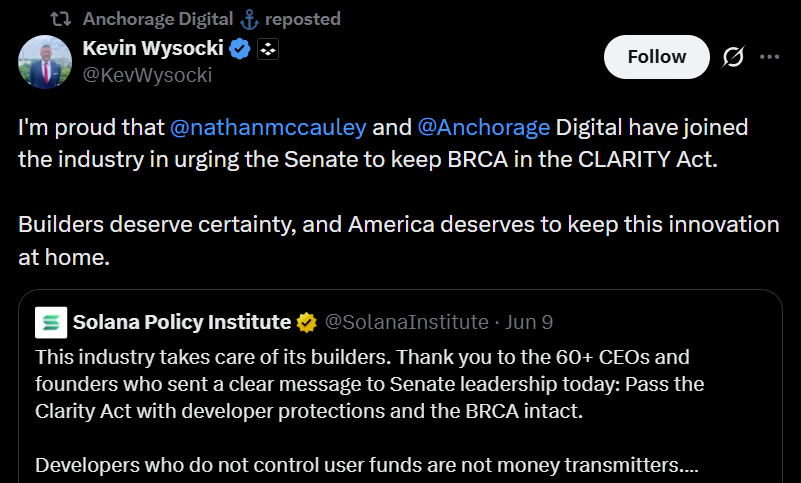
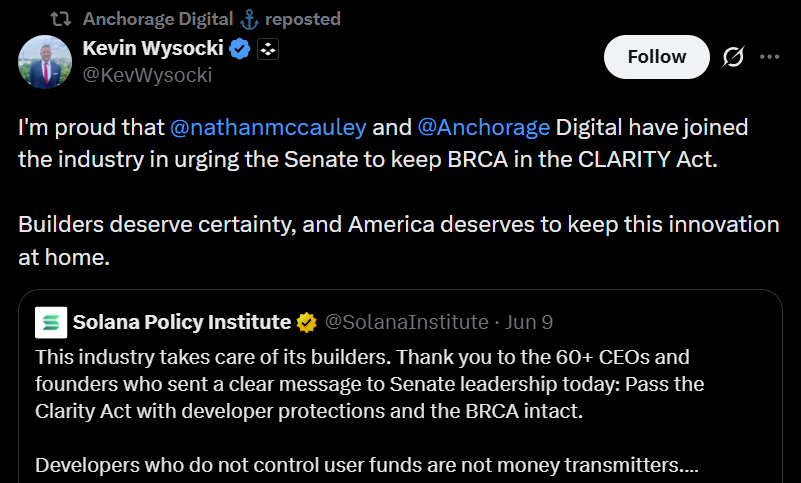
Anchorage Digital also contributed funds to Fellowship. Kevin Wysocki, head of policy at the crypto bank, said its engagement with both PACs is meant to reflect its “commitment to investing in bipartisan policy outcomes.”
“Crypto’s largest legislative wins — including the enactment of the GENIUS Act — have come from the thoughtful leadership of lawmakers on both sides of the aisle,” he said in a statement to CoinDesk.
Other crypto interests, the Solana Policy Institute and Multicoin Capital, have partially backed a separate PAC — the Sentinel Action Fund. Sentinel pitched an aggressive $8 million spending campaign against Ohio Democrat Sherrod Brown’s attempt to return to the U.S. Senate, where he’d previously run the Senate Banking Committee and stymied crypto legislation. More recently, it’s supporting Republican Mike Rogers’ Michigan Senate run with almost $900,000 in spending.
But none of the other PACs is remotely approaching the scale of Fairshake, which had boasted $193 million in spending power before the election season began. It’s not only the top crypto campaign fund but a leading super PAC across all U.S. industries and political organizations.
With U.S. House veteran Green going down in flames this week, a Fairshake spokesman, Geoff Vetter, called it proof that “anti-crypto hostility carries consequences.” It’s a message the industry’s money is spelling out clearly, even as lawmakers who are up for election this year continue to work on (or oppose) crypto legislation.

Anchorage Digital, a federally chartered crypto bank and stablecoin infrastructure provider, has submitted a public comment letter supporting the US Treasury Department’s proposed Anti-Money Laundering (AML) and sanctions framework for the GENIUS Act, arguing that the rules largely strike the right balance between compliance and innovation.
In a letter published Wednesday, Anchorage said the proposed framework appropriately places AML obligations on regulated stablecoin issuers while urging Treasury to clarify secondary-market sanctions liability, enterprise-wide AML programs and correspondent account requirements.
Specifically, Anchorage argued that issuers should not face strict liability for failing to independently identify sanctioned users who transact on secondary markets through their smart contracts.
“A final rule that is clear and workable gives regulated institutions the certainty they need to build, and strengthens U.S. leadership in the next generation of payments and settlement infrastructure,” Anchorage said.
Source: Kevin Wysocki
The comments address Treasury rules proposed in April that would classify payment stablecoin issuers as financial institutions under the Bank Secrecy Act, subjecting them to AML, customer due diligence and suspicious activity reporting requirements.
The proposal, jointly issued by the Financial Crimes Enforcement Network (FinCEN) and Treasury’s Office of Foreign Assets Control (OFAC), would align stablecoin issuers with existing US anti-money laundering and sanctions compliance standards while imposing enhanced monitoring and recordkeeping obligations.
Related: Solana Institute CEO says CLARITY Act must shield open-source developers
Industry groups push for broader sanctions carveouts
Support for the proposed rulemaking has not been uniform across the crypto industry.
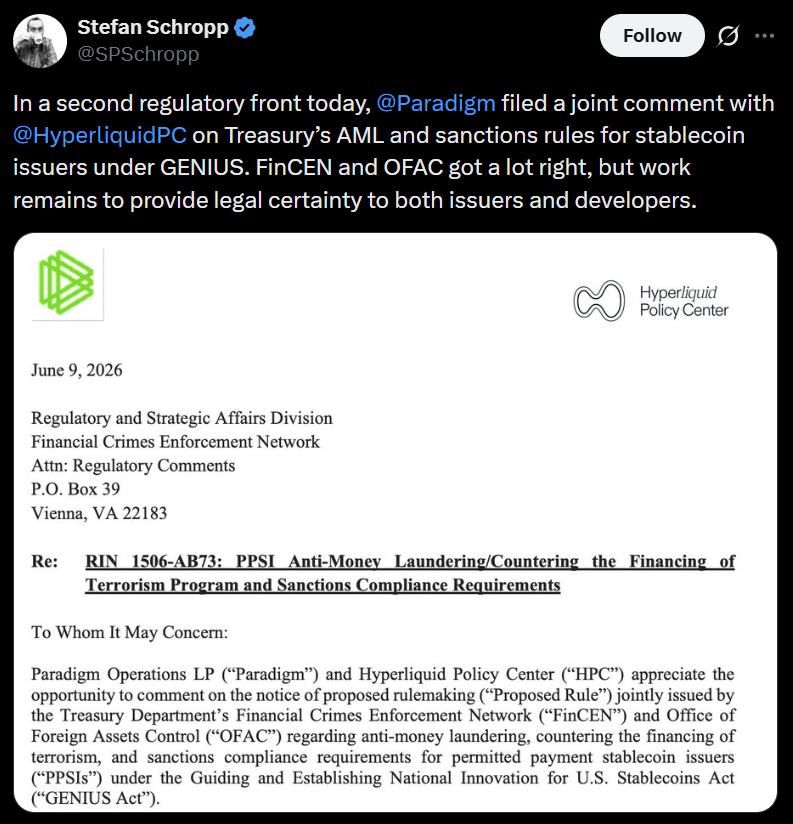
The lobbying arms of crypto derivatives exchange Hyperliquid and venture capital firm Paradigm recently submitted their own comment letter seeking greater clarity on secondary-market obligations, echoing Anchorage’s concerns but taking a more critical view of the proposal overall.
Source: Stefan Schropp
The groups argued that the current framework could impose sanctions obligations on issuers even when they lack a direct relationship with or visibility into users transacting on secondary markets.
“OFAC sweeps secondary market activity into the issuer’s compliance perimeter, treating smart contract interactions as an ongoing “provision of services” that carries sanctions liability regardless of whether the issuer has any relationship with, or visibility into, the transacting parties,” they said.
Related: SEC’s Peirce argues publishing DeFi code is protected speech


Meta has agreed to lease a 168-megawatt AI data center in India from Reliance Industries. The facility will rise in Jamnagar, and Reliance will deliver it within two years.
Summary
- Meta agreed to lease a 168-megawatt AI data center from Reliance Industries in Jamnagar.
- Reliance will build and deliver the facility within two years, with an option to scale.
- Meta also signed clean energy deals with CleanMax and Fourth Partner Energy for nearly 1GW.
The deal adds new AI infrastructure for Meta while extending its partnership with Mukesh Ambani’s group.
Meta expands AI capacity in Jamnagar
According to Meta’s release, Reliance Industries will build the AI-enabled data center for the US technology company. The facility will carry 168 megawatts of capacity and include an option to scale. Reliance operates businesses across petrochemicals, textiles, media, telecom, and digital services. Its new agreement with Meta adds data centers to a long-running technology partnership between both companies.
“This world-class facility in Jamnagar will help us scale our AI infrastructure globally,” Meta CEO Mark Zuckerberg said. He said the project also deepens Meta’s long-term investment in India’s economy. Reliance Chairman Mukesh Ambani described Meta’s latest investment as a “transformative moment for India’s digital infrastructure.” His company will build the site and lease it to Meta after completion.
The two companies already have deep business links in India. In 2020, Meta invested $5.7 billion in Jio Platforms, Reliance’s telecom and digital services unit. Last year, Meta and Reliance expanded their work through a joint venture. The partnership made Meta’s open-source AI models available to Indian enterprises and developers.
India draws data center capital
Global hyperscalers have increased data center spending in India as AI infrastructure demand grows. The country has attracted $400 billion into its AI ecosystem over the last year. Most of that money has gone toward data centers and energy systems, according to the provided industry figures. Large AI systems need high-capacity sites and steady power supply.
Nomura said in a June 2 report that India’s data center industry ranks among the fastest-growing globally. The brokerage also said India remains cost-efficient compared with developed Asia Pacific and Western markets. India’s data center capacity could rise to 7 gigawatts by 2030, according to Nomura. The report linked that growth to cost advantages and rising hyperscaler demand.
The Indian government also introduced a 20-year tax exemption earlier this year. The policy covers hyperscalers using Indian data centers to serve clients outside the country. The tax rule adds another incentive for companies building AI infrastructure in India. Meta’s Reliance deal comes during that expansion of policy and private-sector investment.
Renewable energy deals support Meta operations
Meta is also working with Indian clean energy firms CleanMax and Fourth Partner Energy. The company said those partnerships cover nearly 1 gigawatt of renewable energy. The projects will operate across northern and southern Indian states. They will supply clean power to Meta’s expanding infrastructure footprint in the country.
Meta said the India energy investments align with its global clean power target. The Facebook parent wants to match all operations with 100% clean and renewable energy. The Jamnagar data center agreement adds to Meta’s existing India commitments.
The deal links AI infrastructure, renewable power, and Reliance’s industrial base in one project. Reliance will deliver the data center within two years, according to Meta’s release. The facility also includes an option to scale after the first phase.


On-chain analysis is prompting speculation that Cardano co-founder Charles Hoskinson sold approximately 1.5 billion ADA in 2021, while publicly advocating for the token. NFT creator Masato Alexander published new on-chain tracing work this week claiming that large ADA transactions during the 2021… Read the full story at The Defiant


Raydium has pledged to fully reimburse losses after an exploit drained approximately $1.3 million from five legacy liquidity pools built on Solana.
Summary
- Raydium said it will fully reimburse losses after an exploit drained about $1.3 million from five legacy Solana liquidity pools.
- On-chain investigator Specter said the attacker used a fake mint address to exploit retired AMM code and steal RAY, SOL, and USDC.
- PeckShield traced part of the stolen funds to Tornado Cash, while Raydium said active pools and current users were unaffected.
According to blockchain security firm PeckShield and on-chain investigator Specter, the attack targeted retired automated market maker infrastructure that is no longer used by active Raydium pools. The protocol said current users and active liquidity pools were not affected by the incident.
Details shared by Specter indicate that the attacker exploited a validation weakness in dormant pools tied to Raydium’s early AMM design. By using a fake mint address, the attacker was able to bypass checks and withdraw liquidity from the affected pools.
The stolen assets included roughly 150,177 RAY tokens, 5,603 SOL, and 893,700 USDC. Specter reported that the attacker initially received funding through KuCoin before moving the stolen assets across chains to Ethereum.
Exploit was limited to retired Raydium infrastructure
Following the attack, Raydium stated that the affected pools belonged to a deprecated program with no active user participation. The team added that all impacted assets would be covered by the project treasury, preventing losses from falling on users who still had exposure to the legacy pools.
Tracking data from PeckShield showed that part of the stolen funds was routed through privacy tools after the exploit. The security firm reported that approximately 810 ETH was deposited into Tornado Cash, while another seven ETH was transferred to FixedFloat.
The movement of funds through Tornado Cash may complicate efforts to trace assets. PeckShield noted the transfers after the Ethereum-based funds were bridged from Solana. The mixer was removed from the U.S. Treasury Department’s sanctions list in March 2025.
Security incidents involving inactive code have become a recurring concern across decentralized finance. As previously reported by crypto.news, Token of Power suffered a separate exploit earlier this week that drained more than $1.5 million from a liquidity pool after an attacker manipulated token balances and withdrew WETH reserves. The two incidents involved different protocols and attack methods.
Raydium has moved quickly to cover user losses
Compensation commitments are not new for Raydium. The protocol faced another major security incident in December 2022 when an admin key compromise led to losses from active liquidity pools.
At the time, a governance proposal approved the use of buyback fees and vested team tokens to reimburse affected liquidity providers. The latest response follows a similar approach, with the project confirming that treasury funds will be used to make users whole.
Market reaction has remained relatively muted. Data at the time of writing showed Raydium (RAY) trading near $0.57, down less than 1% over the previous 24 hours. Solana (SOL) also moved lower during the same period, slipping nearly 2% to around $63.88.
While investigators continue tracing the stolen assets, information from PeckShield and Specter suggests the exploit was confined to outdated infrastructure rather than Raydium’s current trading systems.


ZK blockchain project Hyli is shutting down after two years, with the team citing weak market demand for zero-knowledge technology as the decisive factor. "ZK has not gained the traction we had hoped for," the team said in an announcement posted Wednesday on X, adding that it sees no viable path to… Read the full story at The Defiant
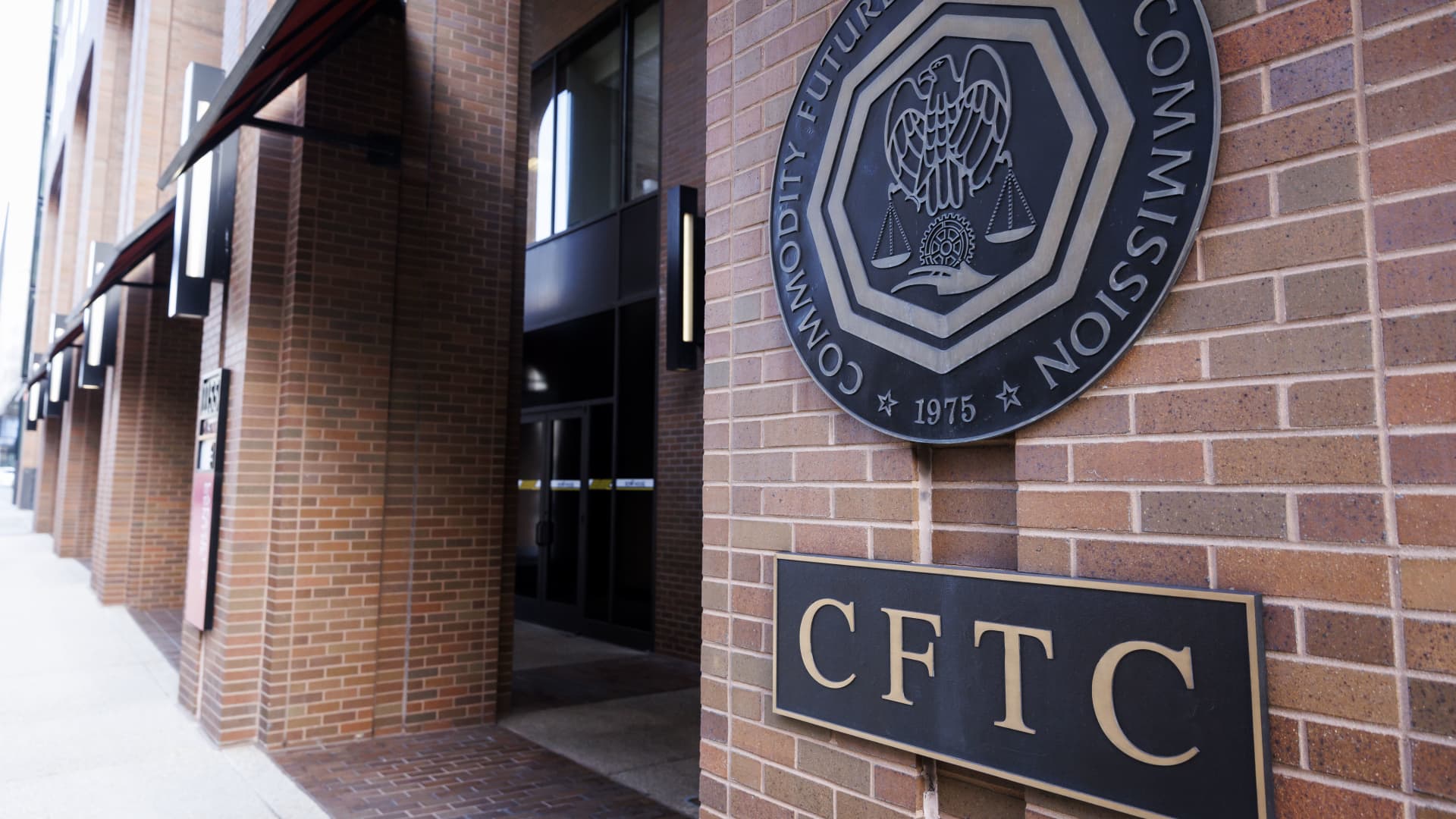
Federal regulators came out with their first proposed rules on how to oversee prediction markets on Wednesday.
The Commodity Futures Trading Commission, which has taken the lead as the federal regulator over the markets, will seek to develop a framework to determine if contracts are contrary to the public interest and illegal.
Those questions surround contracts that relate to terrorism, assassinations, war, gaming or illegal conduct under state and or federal law, based on the Commodity Exchange Act. The commission did not outright ban any type of event contract based on the category of the trade, like those related to sports or elections.
The proposed rule focuses heavily on how the commission will determine if a contract crosses too much into the realm of terrorism, war or assassinations, topics that domestically-regulated exchanges have avoided offering contracts on.
The CFTC rules left some grey area around gaming, which has been the source of much controversy on the question of sports-related event contracts, though it detailed some sports-related contracts that the commission will not allow.
In a release, the commission acknowledged the rules proposed on Wednesday were thin, and noted that further rulemaking regarding prediction markets may come in the future.
After Wednesday’s announcement, the proposed rule will now face a 45-day public comment period.
“The CFTC will protect the integrity of our regulated markets without standing in the way of responsible innovation,” said CFTC Chairman Michael Selig, who was appointed by President Donald Trump, in a statement. “This proposal gives the Commission a durable, transparent framework to identify the contracts Congress directed us to scrutinize while letting legitimate markets move forward.”
Selig in a post on X added that the commission will “balance market integrity with responsible innovation” as it continues future rulemaking processes.
The rule establishes a process to determine how contracts will be prohibited. The commission will first determine if the contract is in fact based on an event happening. Then, it will consider if that event falls within the categories defined in the Commodity Exchange Act, and then conduct a public interest analysis to decide if it should be prohibited or not.
Prediction markets have exploded in popularity over the past year, creating a scramble to figure out how to regulate them.
States have challenged the platforms, believing their sports-related offerings amount to betting, something that is under their jurisdiction. However, the CFTC argues all contracts — no matter their topic — are swaps, which gives the agency exclusive authority to regulate them.
At the same time, bipartisan members of Congress have expressed concerns about the platforms and potential risks for insider trading, though no official legislation on the markets has been considered.
On the question of sports, the rule was explicit that some contracts will not be allowed.
“Within gaming, the Commission aims to permit contracts settled on aggregate sports outcomes with objective data and integrity infrastructure, while prohibiting pure‑chance games and high‑risk sports‑adjacent designs (e.g., injury, officiating‑only, discrete actions, altercations, pre‑collegiate events),” according the rule.
The commission noted gaming, though, could be interpreted very broadly. It settled with one that defines it as something done for recreation or to entertain, is governed by rules and is based on measurable outcomes determined by skilled activity during the activity.
Using the new definition, the CFTC concludes contracts related to elections were not gaming, as they aren’t for recreation nor entertainment.
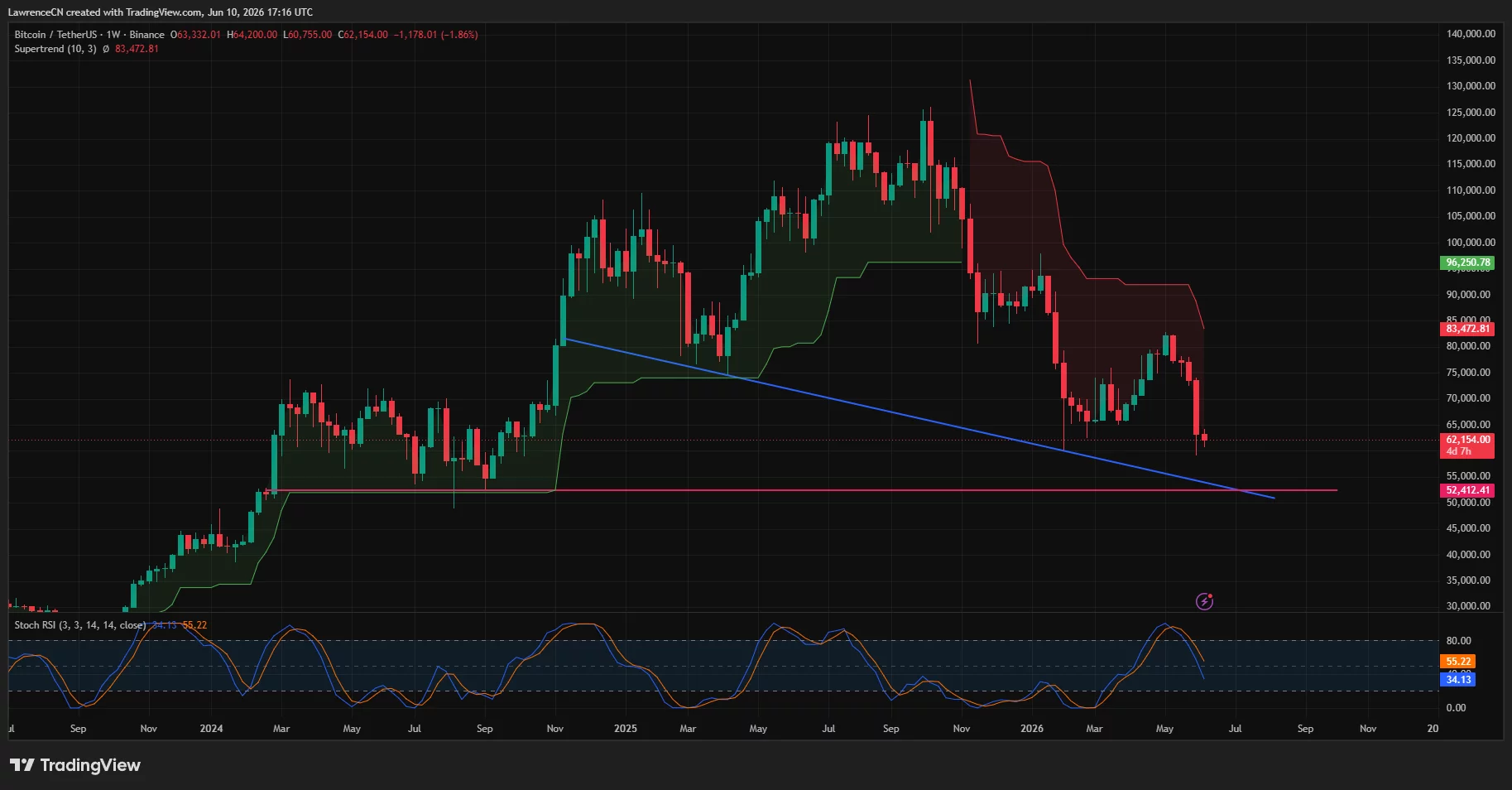
Bitcoin has erased its post-CPI gains after renewed threats from U.S. President Donald Trump against Iran pushed traders back into risk-off positioning and sent the crypto asset below $62,000.
Summary
- Bitcoin gave up its CPI-driven gains after renewed U.S.-Iran tensions pushed traders back into risk-off mode.
- Donald Trump warned Iran would “pay the price” and signaled potential strikes on Iranian infrastructure, while oil climbed to $90 per barrel.
- K33 Research says over 50% of the Bitcoin supply is now underwater, with traders watching support near $60,000 and resistance around $64,000.
According to market data, Bitcoin (BTC) briefly climbed above $62,400 on June 10 after U.S. inflation data came in line with expectations, easing concerns that price pressures were accelerating worse than anticipated.
The inflation report showed the U.S. Consumer Price Index rose 0.5% month-over-month in May, matching economists’ expectations, while the annual inflation rate came in at 4.2%, matching forecasts. The data eased concerns that inflation was reaccelerating beyond control and briefly strengthened expectations that the Federal Reserve could keep interest rates unchanged rather than hiking them later this year.
The move proved short-lived as geopolitical developments quickly took center stage, dragging BTC back toward the $60,000 area and leaving it down on the day.
Fresh pressure emerged after Trump issued a series of posts on Truth Social criticizing Iran and signaling that military action could intensify. In one post, Trump said Iran had taken too long to negotiate and would now “have to pay the price.” Later, he escalated his rhetoric further, telling reporters that “we’re going to be attacking them very hard,” fueling concerns that the conflict could expand in the coming days.
Oil markets also reacted to the developments. According to market data, crude oil rose 2% to around $90 per barrel as traders assessed the growing risk of supply disruptions across the Middle East.
Geopolitical risks overshadow inflation relief
Although the latest Consumer Price Index report initially supported risk assets, traders shifted their focus toward the deteriorating situation in the Gulf region.
According to reports cited by CNN, flashes of light observed near a U.S. military facility in Bahrain sparked fresh attention after Iran threatened retaliation against American interests in the region. The threats followed what Iranian officials described as U.S. “self-defense strikes” conducted after the downing of an American military helicopter.
Additional reports indicated that Iran launched attacks against Bahrain, Jordan, and Kuwait, further raising concerns about a broader regional conflict. Market participants have increasingly linked the possibility of prolonged disruptions in energy markets to higher inflation risks, a development that could complicate expectations for monetary policy and weigh on speculative assets such as cryptocurrencies.
Earlier military exchanges involving Israel and Iran had already contributed to weakness across digital assets, and the latest escalation added another source of uncertainty for traders.
On-chain and derivatives data highlight key Bitcoin levels
Beyond the geopolitical backdrop, recent on-chain data suggests Bitcoin has entered a period historically associated with major market stress.
As previously reported by crypto.news, K33 Research found that more than 50% of Bitcoin’s circulating supply is now held at an unrealized loss after the cryptocurrency briefly fell below $60,000 earlier this week.
According to K33 head of research Vetle Lunde, similar readings appeared near major bear-market lows in 2011, 2018, and 2022, although he noted that the indicator does not guarantee an immediate bottom.
Technical indicators continue to show weakness. On the weekly chart, Bitcoin remains below a bearish Supertrend indicator near $83,500 and has broken beneath a long-term trendline that previously acted as support. Weekly stochastic RSI has also turned lower, indicating that downside momentum remains intact.
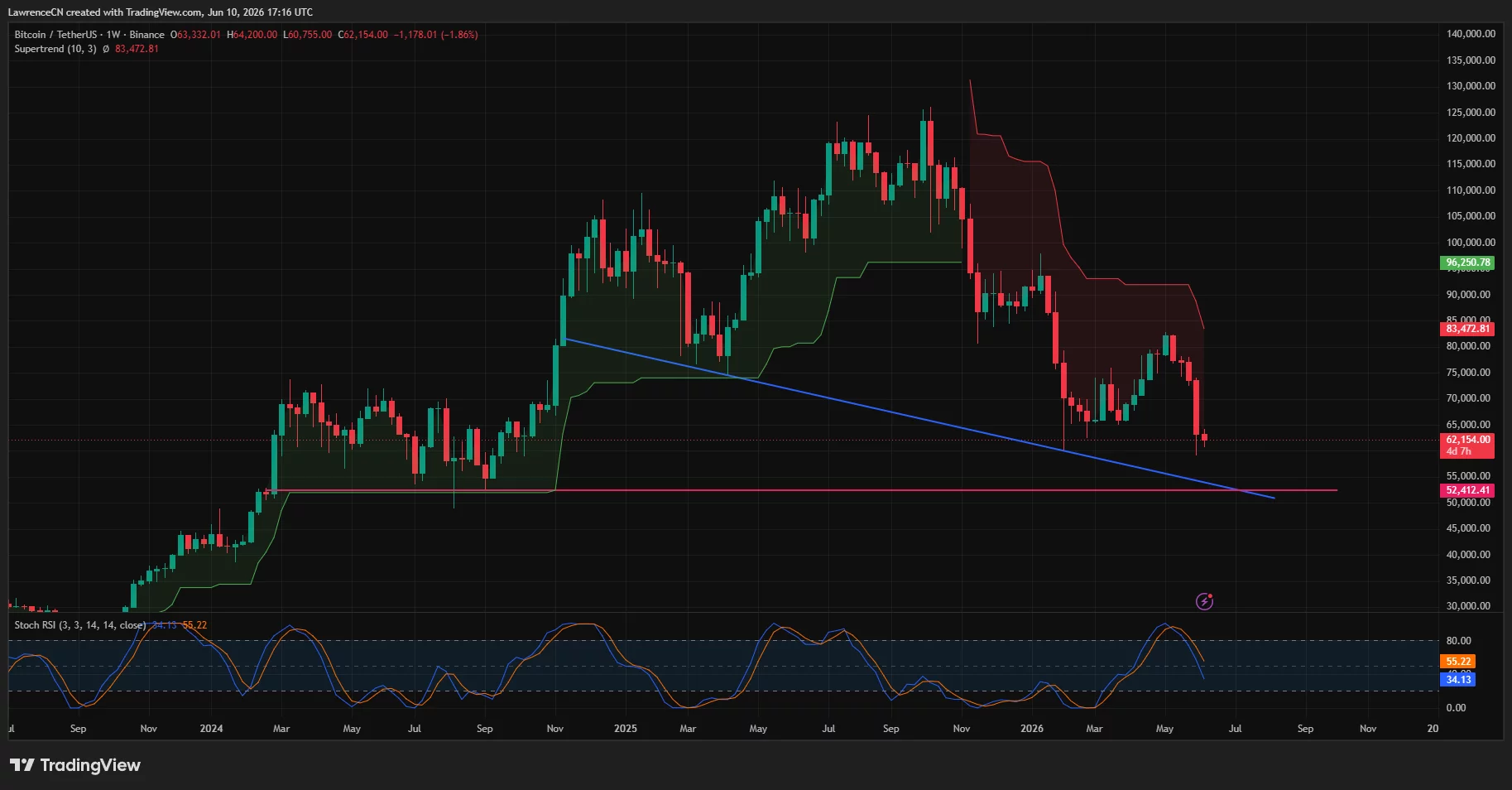
Meanwhile, CoinGlass liquidation data points to important short-term levels. The largest concentration of leveraged positions sits near $64,000, creating a potential upside liquidity target if Bitcoin rebounds.
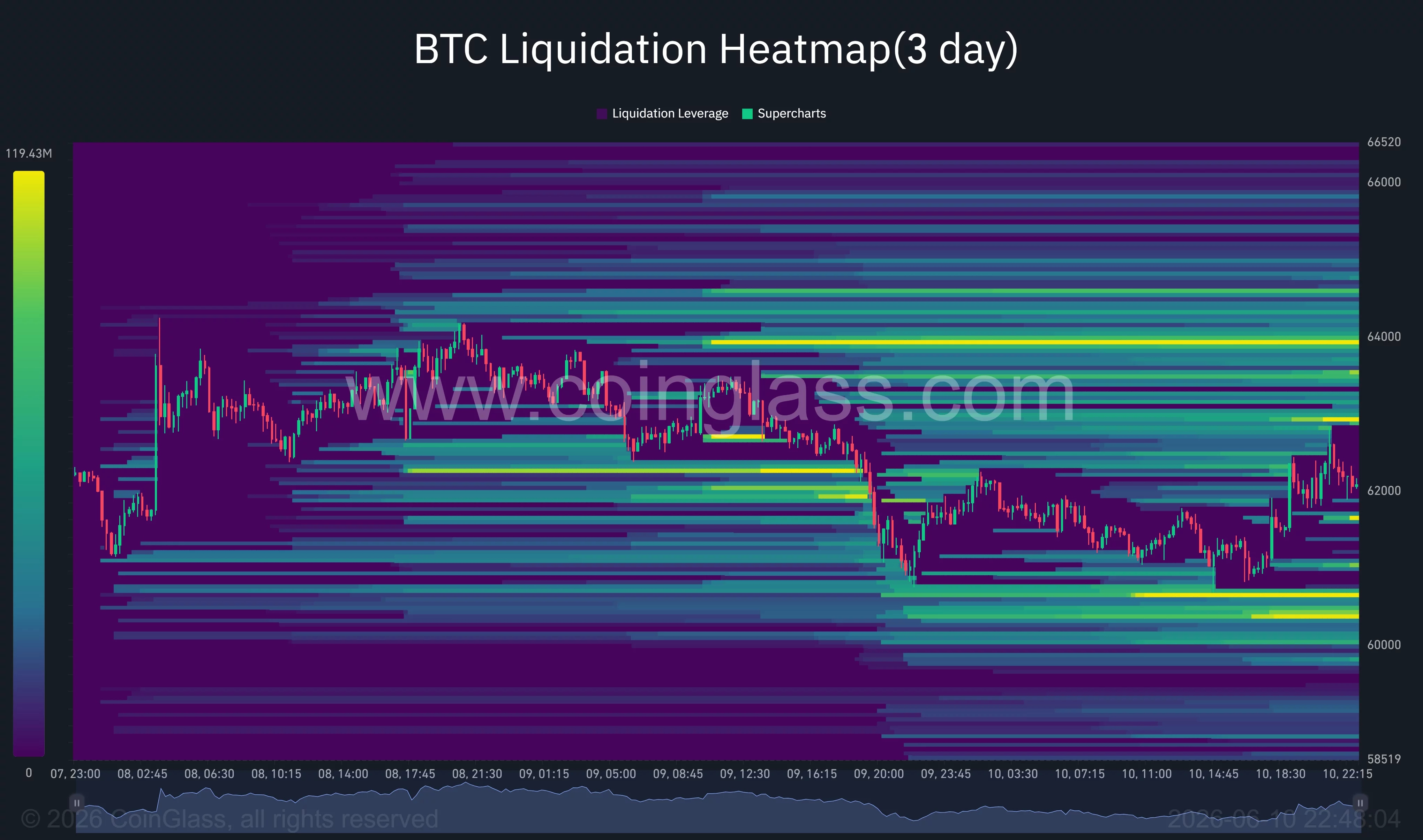
On the downside, notable liquidation clusters remain concentrated around the $60,000 to $60,500 zone, an area traders continue to watch closely as geopolitical headlines drive market sentiment.
Hence, if Bitcoin maintains support above $60,000, the next upside target could be the heavily populated liquidation zone around $64,000. Conversely, a breakdown below $60,000 may open the door to a move toward $55,000 and potentially the $52,400 support level highlighted by the weekly chart.
Disclosure: This article does not represent investment advice. The content and materials featured on this page are for educational purposes only.
Crypto World
Attacker Mints 10 Billion TOP Tokens Through Governance Takeover, Drains $1.58M from Balancer Pool
An attacker exploited a governance misconfiguration in Token of Power's Aragon DAO on Tuesday to mint 10 billion TOP tokens, then swapped a fraction of that supply for 944.2 WETH worth roughly $1.58 million. Security firm Blockaid identified the incident as a governance-takeover attack, distinct… Read the full story at The Defiant


Justin Sun-owned HTX revealed in its most recent proof-of-reserves, dated June 1, that it’s moved $1.3 billion worth of its reserves to a new category that it refers to as “ThirdParty.”
This has affected multiple important assets for the exchange, including bitcoin (BTC), ether (ETH), USDC, Usual Stablecoin (U), and Tether (USDT).
These balances have apparently been moved to a new custodian, as the HTX website now notes, “The assets in the Custodial Wallets are maintained by third-party custodians.”
In order to verify these quantities, we’re told to “please directly contact the third-party custodians.”
Unfortunately, HTX hasn’t publicly disclosed who those custodians are.
Protos reached out to HTX for clarification on who or what ThirdParty is, but HTX has yet to provide an explanation.
Bitcoin on HTX
Currently, the HTX proof-of-reserves claims that HTX has 20,922.77 BTC on the exchange.
Of these, only 8,691.6, or 41.5%, are native BTC on the Bitcoin blockchain.
Far larger than that are the 10,422.9, or 49.8%, which are tokenized BTC issued on the Sun-founded TRON blockchain.
Read more: Poloniex and the $1.3B bitcoin question
This product isn’t related to Sun-advised Wrapped Bitcoin but is a far less publicized tokenized BTC product issued by Sun-owned Poloniex.
Troublingly, Poloniex refuses to disclose where the collateral for this tokenized BTC product are held.
Even more troublingly, the circulating supply for this token is greater than the total amount of BTC disclosed in the Poloniex proof-of-reserves.
In addition to these two large categories, there’s a small amount of BTC lent on Sun-founded JustLend.
Finally, there are the 1,719 BTC, representing 8% of the total user BTC, which have been moved to this undisclosed ThirdParty.
Ether on HTX
The HTX proof-of-reserves currently claims that there are 109,573 ETH on HTX.
However, a shockingly small amount, 4,006 or a mere 3.7%, are native ETH on the Ethereum blockchain held by HTX.
A much larger portion, 29,051 or 26.5% worth is staked ether (stETH).
However, by far the largest segment for this asset, 76,515 ETH, or 70% of the total, has been transferred away from HTX and into the hands of an undisclosed custodian.
Usual on HTX
HTX currently claims to have $38,446,011 worth of the U stablecoin.
Most of this is in the “native” forms, predominantly on the TRON blockchain, but also on BNB Chain.
However, 46% has been moved to ThirdParty.
USDC on HTX
Circle-issued USDC is one of the assets that has almost entirely been moved to ThirdParty.
Currently, HTX claims to have $238,931,193 worth of USDC on the exchange.
However, a truly mind-boggling $237,470,509, or more than 99% has been moved.
USDT on HTX
The USDT reserves on HTX are similarly strange.
There is $906,548,772 worth of claimed USDT in the HTX reserves.
This includes a certain amount of native USDT, on Avalanche, Ethereum, and TRON, totaling less than 1% of the total reserves.
Additionally, there’s approximately $10 million worth of USDT on BNB Chain, no longer an official Tether-issued chain.
Read more: Poloniex exit leaves Ethereum stUSDT nearly abandoned
Also, there’s approximately $39 million in USDT in staked tether, which was previously invested in United States Treasuries but is now lent through Aave.
Also lent on Aave is the $1.4 million aEthUSDT included in this calculation of the reserves.
We also mustn’t forget to mention that a portion of these reserves — approximately $17 million — are also lent on Sun-founded JustLent.
Finally, the largest portion of these reserves, approximately $819 million, has been moved to ThirdParty.
HTX’s many problems
These changes have only compounded existing troubling problems in the HTX reserves.
They include the fact that a portion of the TRX token on exchange is also lent on JustLend.
Not to mention the fact that World Liberty Financial has recently chosen to blacklist addresses related to HTX.
Read more: HTX vs World Liberty war escalates with USD1 delisting
Besides these problems, the United Kingdom recently sanctioned HTX for helping to provide financial services to key industries in Russia.
Which of these problems is the most troubling we will leave as an exercise to the reader and the remaining HTX users.
Got a tip? Send us an email securely via Protos Leaks. For more informed news and investigations, follow us on X, Bluesky, and Google News, or subscribe to our YouTube channel.

The United States is entering a broader debate over AI-driven deception in political advertising as the midterm cycle intensifies. A growing constellation of state laws, a cautious federal stance, and high-profile campaign examples are shaping how campaigns may use or be constrained by AI-generated content in the near term.
Industry observers and watchdogs say the moment highlights a fundamental tension: AI can expand reach and persuasion for campaigns, but it also risks undermining trust if audiences cannot readily verify authenticity. Several developments this year illuminate where the policy terrain stands and where it might move next.
Key takeaways
- State-level patchwork: Roughly 28 states have disclosure requirements for political ads, with many penalties civil in nature; Minnesota’s 2023 law also contemplates criminal penalties for certain deepfake disclosures as elections approach.
- High-profile Minnesota case: An AI-generated ad targeting a Minnesota political race raised questions about deepfake legality and political norms, triggering responses from lawmakers on both sides of the aisle.
- Federal guardrails are cautious: The Federal Elections Commission emphasizes disclaimers and bans fraudulent misrepresentation, but has not launched a comprehensive AI rulemaking; broader federal legislation has repeatedly stalled.
- Legislative momentum and pushback: A bipartisan draft bill would preempt state AI regulations, drawing pushback from civil liberties groups that warn about overreach and the need for safeguards.
A patchwork of state rules governs AI in political ads
Across the United States, regulation of AI in political messaging has largely fallen to state governments. While about a quarter of states implement clear disclosure requirements for AI-generated content, most rules carry civil penalties rather than criminal consequences, and enforcement varies widely. Minnesota sits at the intersection of evolving policy and high-profile test cases.
In Minnesota, a campaign ad tied to the Senate primary drew scrutiny for its use of AI-generated imagery that appeared to resemble Lt. Gov. Penny Flanagan. Flanagan herself referenced the spot on BlueSky, noting that voters might soon see a TV ad “starring something that… kind of looks like me.” The episode underscored how AI can blur lines between genuine endorsements and deceptive representations.
The law in Minnesota already has a recent history of addressing AI deception. A 2023 measure, introduced by lawmakers concerned about manipulated content, approved language that criminalizes certain uses of deepfakes within 90 days of an election when the creator knows the content is a deepfake or intends to influence an election. Critics say the law’s structure makes enforcement highly fact-specific, and whether a given ad crosses the line depends on context and intent.
Observers note that while the incident occurred after the Democratic-Farm-Labor (DFL) Party secured a nomination, the legal questions are not easily resolved by a single ruling. The broader state environment includes a notable chorus of concern: 40 DFL state legislators signed a statement condemning AI-generated deepfakes in political advertising, arguing that the technology undermines trust in elections.
Minnesota case highlights tensions between policy and campaigning
The North Star Dawn PAC, which supported a candidate aligned against Flanagan, issued the AI-generated ad that sparked the dispute. Its content, which depicted a figure resembling Flanagan with a symbolic payoff image, drew immediate pushback from Flanagan and her allies, who described the approach as deceptive and inappropriate for public discourse. A leading Minnesota lawmaker summarized the sentiment by saying the use of AI deepfakes “is unacceptable” regardless of political affiliation.
The episode fed into a broader debate about the pace at which campaigns adapt to AI tools. Critics argue that even where laws exist, the ethical and practical implications of AI in political advertising merit careful consideration beyond compliance. Campaign consultants and advertising executives have urged a measured approach, acknowledging both the persuasive potential of AI and the risk to voter trust.
In parallel, observers like DSPolitical’s Mark Jablonowski noted that most campaigns, across parties, would prefer to set standards that protect voters and uphold integrity, even as exceptions may occur. The Minnesota case thus serves as a testbed for how laws may be interpreted in dynamic media environments where AI content can be produced quickly and disseminated broadly.
Federal regulators and lawmakers wrestle with AI in elections
On the federal front, the landscape remains cautious and inconsistent. The Federal Elections Commission (FEC) maintains that election advertising must include clear and conspicuous disclosures for content distributed by a candidate’s committee, and it reiterates that fraudulent misrepresentation is prohibited. While the FEC has discussed AI-specific questions in various contexts, it has not undertaken a comprehensive rulemaking to govern AI in political ads.
Public advocacy and consumer groups have pressed for more formal guidance. In 2023, Public Citizen petitioned the FEC to initiate rulemaking to address AI in campaign materials, but the commission opted not to begin a formal process at that time, arguing that existing fraud provisions already cover deceptive content regardless of the technology used.
Legislative efforts at the federal level have faced a slow trajectory. The REAL Political Advertisements Act—intended to establish more explicit AI-related rules—failed to pass in Congress. The broader political environment has historically shown limited appetite for sweeping AI regulation, even as concerns about safety, accuracy, and accountability mount.
Nevertheless, lawmakers continue to explore options. In June, a bipartisan draft bill proposed by Rep. Lori Trahan and Rep. Jay Obernolte would preempt state laws aimed at regulating AI model development, raising questions about how to balance innovation, consumer protection, and electoral integrity. Civil liberties groups, including the ACLU, argue that preemption could hinder essential safeguards—advocating instead for a framework that preserves state authority to address local harms while ensuring privacy, non-discrimination, and AI safety.
A spokesperson for the ACLU framed the concern clearly: preemption could broaden the potential for AI-enabled harms if states lose tools to police transparency and safety measures. ACLU policy experts emphasize that states must retain authority to protect residents from abuses, hold tech companies accountable, and ensure AI is safe and trustworthy. In the broader debate, the absence of a robust, unified federal standard leaves states to chart their own paths, while federal agencies look for practical guardrails that can be implemented without stifling innovation.
As policymakers weigh these issues, observers will watch for the outcomes of ongoing enforcement and potential new rules at the state level, along with any further federal proposals. The Minnesota episode and related debates illustrate both the urgency of addressing AI-driven deception in elections and the complexity of aligning legal frameworks with rapidly evolving technologies.
What readers should watch next is how states respond to ongoing incidents and whether federal regulators move beyond general antifraud provisions to craft concrete guidelines for AI-generated political content. The balance between safeguarding electoral integrity and enabling technological innovation will determine the trajectory of AI in political advertising through the 2026 cycle and beyond.

The Decade’s Funniest Sci-Fi Series Is Finally Complete On Netflix

How to start investing #finance #financialfreedom
Farage takes swipe at Restore as he says ‘unhelpful’ rival on the right will ‘not last’



-

 Fashion5 days ago
Weekend Open Thread: Evereve – Corporette.com
-
 Crypto World5 days ago
Jensen Huang Approves Samsung, SK Hynix, and Micron for NVIDIA (NVDA) HBM4 Memory Supply
-

 Crypto World3 days ago
Anatomy of the June crypto crash: Fed, Iran, Saylor
-
 Entertainment4 days ago
The Best Mystery Series of All Time Is Surging on Streaming 30 Years After It Ended
-

 NewsBeat3 days ago
Alexander Zverev wins the French Open to finally earn a 1st Grand Slam title
-

 Tech5 days ago
Suspicious Polyfill login prompts pop up on Toshiba, Muji websites
-
 Crypto World4 days ago
Senator Cynthia Lummis Calls CLARITY Act the Most Consequential Financial Legislation of This Generation
-

 Tech3 days ago
Microsoft unveils seven homegrown AI models in new bid for ‘long term self-sufficiency’
-

 Tech5 days ago
Microsoft launches MXC, an OS-level sandbox for AI agents, with OpenAI and Nvidia already on board
-

 Business5 days ago
(VIDEO) Justin Bieber Delivers Surprise Happy Birthday Serenade to Diners at Los Angeles Mexican Restaurant
-
 Business4 days ago
The Pain Points Taking a Fragile Tech Rally Down a Notch
-
 Crypto World2 days ago
Eli Lilly (LLY) Stock Surges 4% Following Breakthrough Sleep Apnea Trial Results
-
Crypto World5 days ago
LBank Surpasses 25 Million Users Worldwide as AFA Partnership Continues to Drive Global Growth
-

 Tech5 days ago
Von der Leyen’s AI envoy pick draws conflict-of-interest fire
-

 Crypto World3 days ago
Trump’s AI Ownership Plan Could Benefit Anthropic at OpenAI’s Expense
-

 Tech5 days ago
Meta steals a tactic from Tesla and builds data centers in tents
-
 Sports1 day ago
Bangladesh beat Australia after 20 years in ODIs, register only their second win over six-time world champions | Cricket News
-

 Business3 days ago
High Stakes for Wembanyama as New York Pushes for 3-0 Lead
-

 Tech4 days ago
Hackers now exploit SolarWinds Serv-U flaw to crash servers
-

 Tech3 days ago
Notion restores access to Anthropic after service disruption
You must be logged in to post a comment Login