

Crypto World
Crypto ETP Outflows Hit $1.47B as Bitcoin Leads Losses

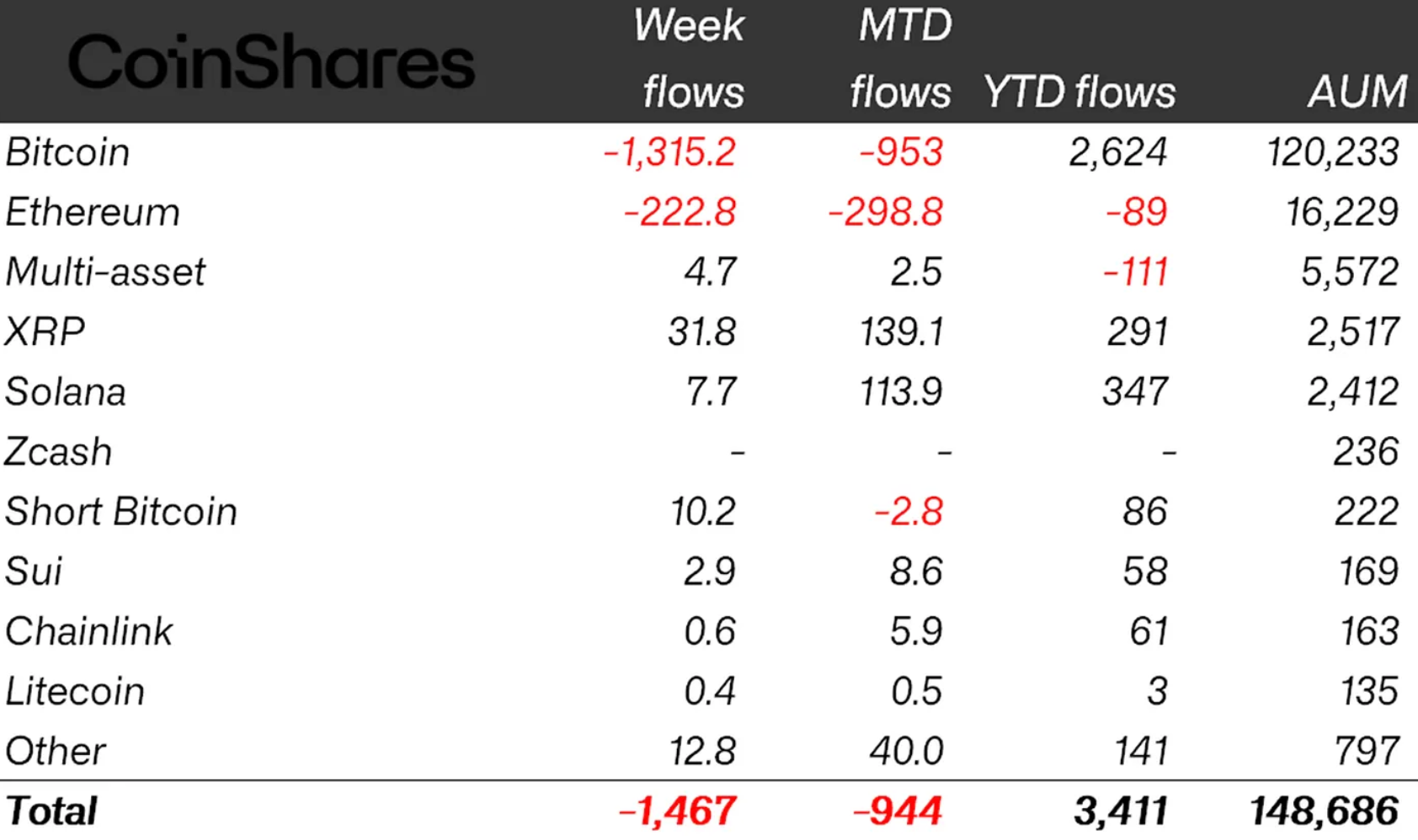
Crypto investment products recorded $1.47 billion in outflows last week, extending a second straight week of withdrawals as Bitcoin funds led the decline, according to CoinShares.
Crypto exchange-traded products (ETPs) extended the prior week’s $1.07 billion in withdrawals, CoinShares reported Tuesday.
Bitcoin products accounted for roughly $1.3 billion of the outflows, their largest weekly withdrawal of 2026, while Ether funds lost $223 million, the asset manager said.
Total assets under management in crypto ETPs stood at around $148.7 billion, with Bitcoin funds accounting for 80% with $120.2 billion.
CoinShares head of research James Butterfill said the selling reflected deepening Iran-related risk-off sentiment despite continued progress on the CLARITY Act.
Nine assets post inflows above $1 million
Altcoin ETPs still recorded notable gains despite the broader downturn, with at least nine assets seeing inflows above $1 million, Butterfill said.
XRP (XRP) led altcoin inflows with $31.8 million, while Solana (SOL) followed with $7.7 million.
Separately, data from SoSoValue showed Hyperliquid (HYPE) exchange-traded funds (ETFs) recorded $72.3 million in inflows.
Crypto ETP flows by asset (in millions of US dollars). Source: CoinShares
Smaller inflows were also recorded in Sui (SUI) and Chainlink (LINK), at $600,000 and $400,000, respectively. Short Bitcoin products added $10.2 million, aligning with broader risk-off sentiment.
Related: $1.26B Bitcoin ETF outflows spark ‘contrarian’ buy signal: Santiment
Total assets under management in crypto ETPs stood at about $148.7 billion by the end of the week, with Bitcoin funds making up 80% at $120.2 billion.
Crypto ETP outflows spread globally as US leads losses
Outflows broadened across global crypto ETP markets last week, reversing the prior week’s relative “European resilience,” the report said.
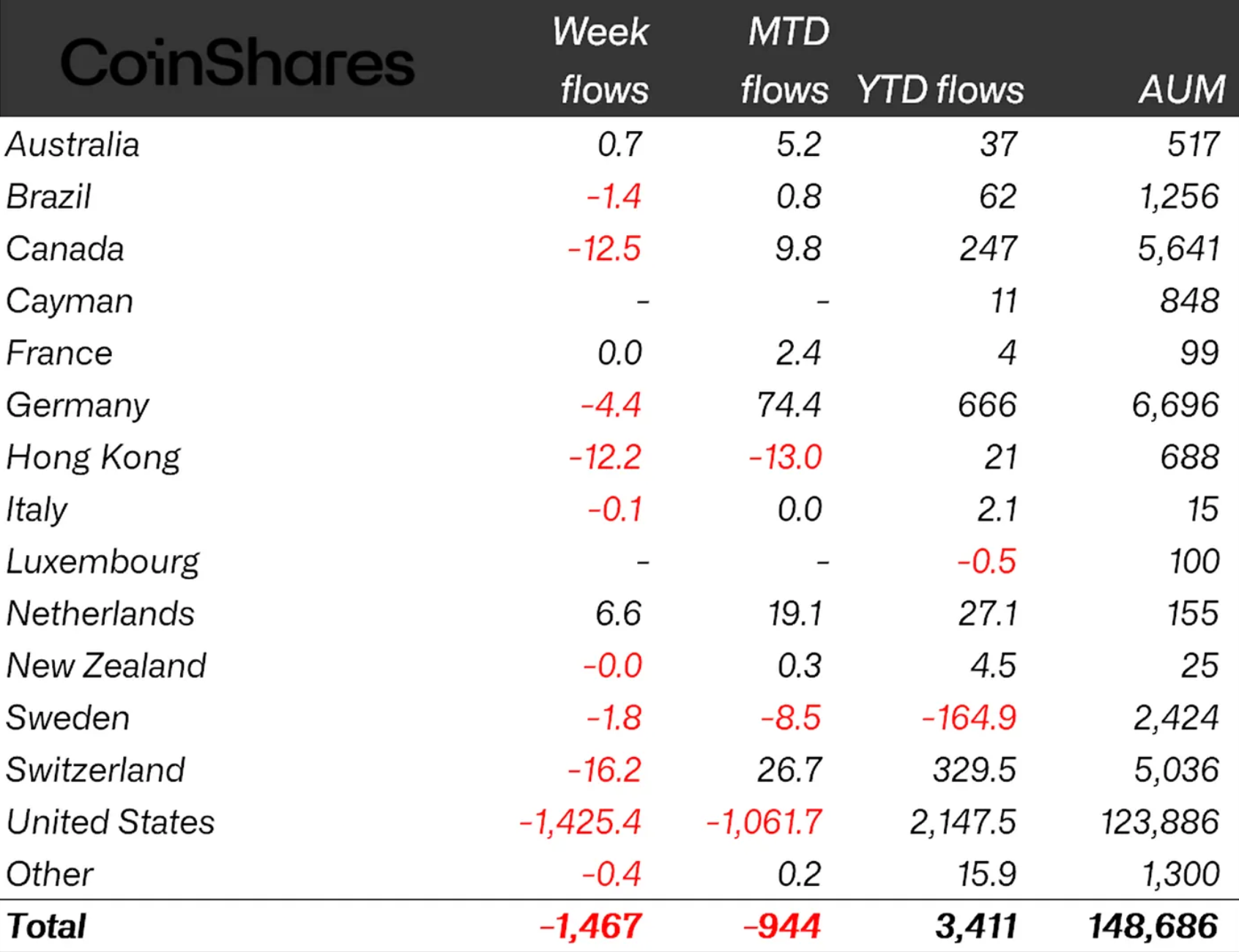
The United States led with $1.43 billion in outflows, including $1.26 billion from US-listed spot Bitcoin ETFs, according to SoSoValue.
Crypto ETP flows by country (in millions of US dollars). Source: CoinShares
More losses were recorded in Switzerland at $16.2 million and Canada at $12.5 million. Hong Kong and Germany also saw outflows of $12.2 million and $4.4 million, respectively.
The Netherlands was the only country to see notable inflows at $6.6 million, while Australia followed with $700,000 of inflows.
Magazine: ETH bears growling, Tom Lee’s buying, XRP to ‘explode’: Market Moves


Ethereum faced renewed pressure after a major transaction involving BitMEX co-founder Arthur Hayes entered the market. Hayes sold 6,000 ETH at a loss, while Ethereum continued trading near the $1,700 level. At the same time, several large holders increased their exposure to the asset, creating mixed signals across the market.
Arthur Hayes Exits Ethereum Position at a Loss
Arthur Hayes completed a large Ethereum sale after accumulating the asset over recent days. Blockchain data showed that he purchased nearly 5,900 ETH at an average price of $1,793. However, he later sold 6,000 ETH at around $1,690 per coin.
The transaction carried an estimated value of $10.14 million. As a result, Hayes recorded a loss of roughly $606,000 on the position. The move attracted attention because he typically executes trades that target profitable exits.
Market participants linked the sale to the ongoing weakness in Ethereum’s price action. Selling activity increased across the broader crypto sector, and several major digital assets moved lower. Consequently, Ethereum struggled to maintain support near the $1,700 level.
Whales Continue Accumulating Ethereum
Despite Hayes’ sale, other large holders continued purchasing Ethereum. Recent on-chain data showed strong accumulation from several whale wallets. These purchases occurred while Ethereum traded near recent lows.
K3 Capital acquired 10,000 ETH from Binance in a transaction worth approximately $16.92 million. The purchase represented one of the largest single acquisitions recorded during the latest trading session. Furthermore, the transaction suggested continued institutional-level interest in Ethereum.
Another wallet linked to Chun Wang acquired 7,650 ETH valued at about $12.93 million. The purchase added to a series of recent accumulation activities by large holders. Therefore, whale activity continued to provide a contrasting signal against recent selling pressure.
Ethereum Faces Key Price Levels Amid Market Weakness
Ethereum remained under pressure throughout the latest trading session. The asset touched a low near $1,670 before recovering slightly toward $1,700. However, sellers maintained control of short-term market direction.
Analysts identified several important price levels for Ethereum. Some market observers highlighted the possibility of a move toward $1,900 if buying momentum improves. Meanwhile, weaker conditions could expose the asset to additional downside near the $1,500 support zone.
Recent actions from Hayes added another layer of discussion around market sentiment. Earlier this month, he also reduced exposure to Worldcoin before the highly anticipated SpaceX IPO. In addition, he exited positions in Hyperliquid’s HYPE token and NEAR Protocol assets.
Ethereum remains the second-largest cryptocurrency by market capitalisation. The network supports decentralised finance applications, tokenised assets, and smart contract activity across the digital asset sector. Because of its role within the industry, major transactions involving prominent traders often attract significant attention.
Current market conditions continue to reflect competing forces. On one side, high-profile sales have increased discussions about short-term weakness. On the other side, sustained whale accumulation signals that some large holders still view current price levels as attractive entry points.
The coming sessions may provide greater clarity regarding Ethereum’s next direction. Until then, market participants will likely focus on support levels, whale activity, and broader crypto market performance. These factors could influence whether Ethereum stabilises above current levels or extends its recent decline.


Amazon has withdrawn from distributing the Sam Altman biopic “Artificial” as OpenAI moves closer to a potential public listing.
Summary
- Amazon has withdrawn from distributing Artificial, a biopic focused on OpenAI CEO Sam Altman.
- The move comes as OpenAI advances IPO preparations through a confidential filing with U.S. regulators.
- OpenAI continues expanding its enterprise business, including a major ChatGPT rollout across BBVA’s workforce.
According to a report from Puck, Amazon has stepped away from the high-profile film project despite continuing discussions with the filmmakers about securing a new distribution partner.
The report said the decision comes as Amazon deepens its business relationship with OpenAI, including a multi-billion-dollar investment commitment tied to future milestones.
The movie centers on OpenAI chief executive Sam Altman and also features Tesla and xAI founder Elon Musk. Puck reported that the film does not present either technology executive in an entirely favorable light, a factor that some industry observers believe may have influenced Amazon’s decision.
While the company reportedly expressed confidence in the director’s creative abilities, it has chosen not to move forward as the film’s distributor.
Amazon’s exit has drawn attention because it follows a major cloud computing agreement signed with OpenAI last year. Although the company has not publicly linked the decision to its partnership with the artificial intelligence firm, the timing has fueled discussion across both Hollywood and the technology industry.
OpenAI prepares for a possible stock market debut
Attention around the film arrives as OpenAI continues laying the groundwork for a potential initial public offering.
According to earlier reports, the company recently submitted a confidential draft registration statement to U.S. regulators, allowing it to prepare for a public listing without immediately committing to a launch date.
Reports citing internal discussions said Altman told employees that OpenAI could go public within the next year, though he stressed that the timeline remains flexible and could change depending on market conditions and company priorities.
During those discussions, Altman reportedly described the confidential filing as a strategic step that preserves optionality. By filing early, the company can move quickly if conditions become favorable or delay a listing if remaining private offers more benefits.
Investor interest in OpenAI has increased as artificial intelligence companies attract larger capital inflows and command higher valuations in public markets. The company has remained at the center of that trend through new partnerships, product expansion, and growing enterprise adoption.
Enterprise expansion strengthens OpenAI’s position
Recent commercial agreements have added to the momentum surrounding OpenAI’s business.
As reported by crypto.news earlier this month, OpenAI signed a multi-year agreement with BBVA that will expand ChatGPT Enterprise access from 11,000 employees to the bank’s entire workforce of 120,000 people.
According to OpenAI, the deployment will extend across BBVA’s operations in 25 countries and support AI-based tools for customer service, risk analysis, software development, and internal operations.
OpenAI said the rollout ranks among the largest generative AI deployments in the financial services sector. The company also stated that BBVA will work directly with its product, research, and technology teams as AI tools are integrated into customer-facing and internal systems.
Against that backdrop, Amazon’s decision to leave the Artificial project has landed at a moment when scrutiny of OpenAI, its leadership, and its future as a public company is intensifying. With IPO expectations building and new enterprise deals expanding the company’s reach, interest in Sam Altman and the organization he leads continues to grow well beyond the technology sector.
The cryptocurrency market has once again been painted red over the past 24 hours, yet the meme coin SIREN has defied the bearish conditions by posting a triple-digit price increase.
Still, many industry participants remain skeptical of the token and have cautioned investors to steer clear of it.
Same Pattern, Different Day
It was just days ago when SIREN whales liquidated 670 million tokens (roughly 92% of the circulating supply), thus triggering a major 95% price collapse. Despite the massive decline, the coin headed north over the last day to around $0.11 (a 150% daily increase) after speculative buyers reportedly stepped in.
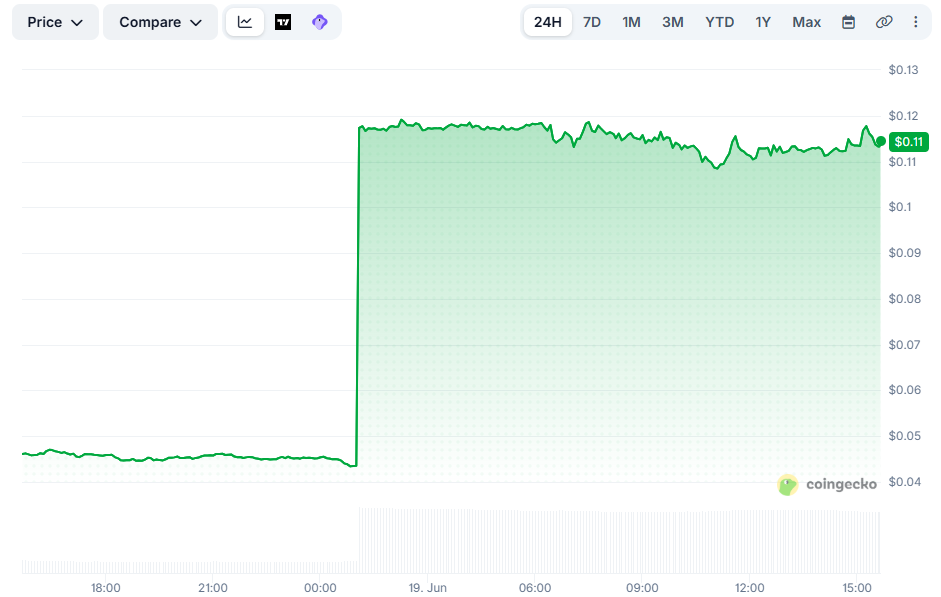
Moreover, the coin is the second-most trending cryptocurrency on CoinGecko today, ranking above well-known altcoins such as Solana (SOL), Hyperliquid (HYPE), and Pi Network (PI).
However, many analysts warned that SIREN’s evident pump shouldn’t be mistaken for the beginning of a new bull run. The token has been acting more than a little strangely during its relatively short existence, with each uptick followed by a violent correction.
X user Team LAMBO claimed that “the guy behind SIREN should be in jail,” noting that every time the price goes up, “he dumps his tokens.” Many others echoed a similar thesis.
Honey believes the most recent price drop was primarily intended to liquidate longs ahead of a massive jump (such as the one seen over the past several hours). The analyst described the project as “dead,” but added that unfortunately, such tokens are the ones generating billions in trading volume.
Previous Warnings
The analytics platform Bubblemaps and the popular blockchain investigator ZachXBT have also voiced their concerns about SIREN in recent months. In March, they warned that a single entity controls roughly half of the meme coin’s supply, adding that “this only ends one way.”
A detailed look on CoinMarketCap shows that the top 10 addresses hold over 82% of SIREN’s supply, which is a major red flag. After all, such high concentration can lead to price manipulation, as the ones depicted above.
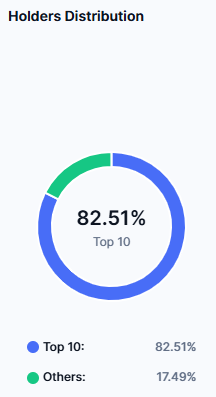
Last but not least, one should keep in mind that SIREN is a meme coin whose fundamentals and use cases remain dubious and is mainly driven by hype. This means investors should be prepared for high volatility and avoid allocating more than they can afford to lose.
The post Viral Meme Coin SIREN Explodes 150% Daily: Another Rug Pull Incoming? appeared first on CryptoPotato.


Earlier this year, a hacker tried to double-spend litecoin (LTC) before an emergency, 13-block reorganization thwarted the attack.
Even though developers have released a flurry of code patches to prevent a repeat, most of the Litecoin network’s nodes have still not installed the fix.
The patch has been available for free download for nearly two months. Nonetheless, of the nodes tracked by a major monitoring service, less than 30% are running up-to-date software that would reject the type of transactions behind April’s double-spending attempt.
Sadly, the largest cohort of node operators on the Litecoin network by software version run v0.21.4. This vulnerable version is live on roughly 39% of reachable nodes, most of which are non-mining.
Fortunately, most mining Litecoin nodes have updated their software, despite most validating nodes, which comprise the majority of the network, still operating with old, buggy code.
Read more: Bitcoin thieves got away with ATM double-spending spree across Canada
A post-incident review admitted that adoption of the patched software was a meager 23% after nearly two weeks of public release.
As weeks roll on, malformed transactions that triggered April’s reorg would still find a temporarily receptive majority today on the internet, even though miners wouldn’t be fooled and continue building on the correct chaintip.
The original vulnerability sat in Litecoin Core’s handling of MimbleWimble Extension Block (MWEB) transactions. MWEB is a Litecoin privacy layer the project activated in 2022.
Earlier this year, a malformed MWEB peg-out transaction allowed a tiny input to back a far larger withdrawal of LTC, effectively creating coins that should never have existed.
Nodes ignore the patch for Litecoin’s double-spending bug
It would be far more secure if most — or ideally all — nodes patched their software to reject invalid peg-out transactions containing unfairly minted LTC, but despite the fix being public for weeks, the network has declined or simply been too lazy to install it.
The major incident involving the exploit occurred on April 25. Non-upgraded mining nodes accepted an invalid MWEB transaction, and an attacker pegged out coins to third-party venues in an attempt to convert the fake LTC for other assets.
A 13-block reorganization beginning at block 3,095,931, documented in the post-mortem, fortunately reversed those transactions and wiped out roughly half an hour of blockchain activities.
The official Litecoin account admitted on social media, “A zero-day bug caused a DoS attack that disrupted major mining pools.” Litecoin creator Charlie Lee also posted about the double-spending attempt.
Litecoin node software developers shipped v0.21.5.4 the day after the reorg to stop the immediate threat of mining denial-of-service.
They soon followed with another patch in early May, v0.21.5.5, to add consensus-level MWEB validation hardening. Many node operators have simply ignored it.
Litecoin has a market cap of $3.4 billion. Its long-term security depends on software updates that most node operators have ignored for almost two months.
Got a tip? Send us an email securely via Protos Leaks. For more informed news and investigations, follow us on X, Bluesky, and Google News, or subscribe to our YouTube channel.
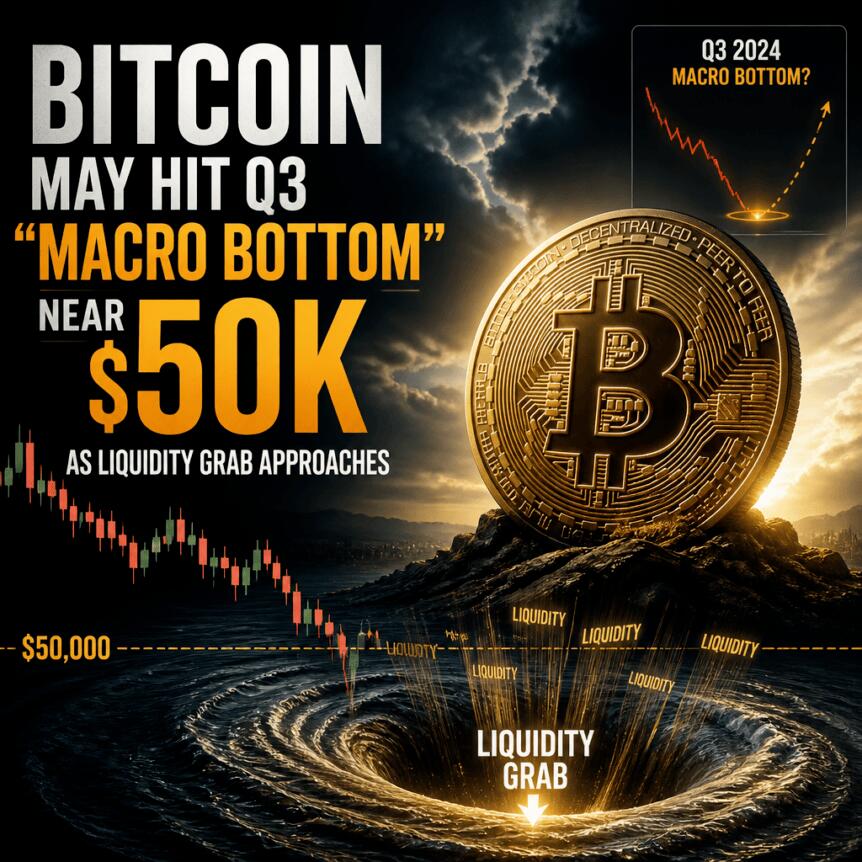
Speculation is building among parts of the trading community that Bitcoin’s next meaningful dip could function as a “macro bottom” trigger, potentially pushing BTC/USD into a targeted liquidity zone below $60,000 before a larger reversal. The renewed focus centers on how order-book liquidity on crypto exchanges can shape short-term price action—and whether traders’ current levels get “front-run” on the downside.
On Friday, pseudonymous analyst Killa argued that the market may be set up to sweep liquidity between roughly $50,000 and $60,000, potentially setting the stage for an end-of-bear-market pivot sometime between July and September. In parallel, multiple traders pointed to bearish pressure signals in short-term charts, including comments about short positioning on Binance.
Key takeaways
- Killa’s analysis suggests Bitcoin could “front run” higher-timeframe liquidity by sweeping $50,000–$60,000 to complete a longer-term bearish cycle.
- The core risk in Killa’s scenario is a partial liquidity grab—if the market reverses before that specific pool is fully taken, traders may be “left in complete disbelief.”
- Chart commentary from other traders highlights a close-in support window around $61,000–$62,000 that, if lost, could accelerate downside pressure.
- On shorter time frames, traders discussed “aggressive” short positioning on Binance, framing it as a reason near-term outlooks remain bearish.
Why order-book liquidity could drive a downside sweep
Killa’s thesis is tied to a familiar mechanism in liquid markets: order-book liquidity attracts activity, and large participants can move price in ways that force liquidation and unwind leveraged positions nearby. In the Bitcoin market, that process often results in sharp volatility when price moves toward clusters where traders have placed stops or liquidations.
According to Killa, the upcoming move is not just about where price is today, but about where liquidity is likely to be “front-run” by market makers and larger traders. Killa referenced prior behavior in which the market front-ran major liquidity above, and suggested a mirror pattern could occur below—leaving many participants surprised if the move is cleaner or faster than expected.
“Just like the market front ran the 140K liquidity above, it can do the exact same thing on the downside, leaving many in complete disbelief.”
In a post shared on X, Killa framed the key target as a sub-$60,000 liquidity grab in the next quarter. The idea is that once that pool is taken, the market may be positioned for a more durable reversal rather than a brief bounce.
Killa also emphasized that this is not a guarantee of a straight line lower. He noted that price could still sweep below $60,000 even if the primary argument is about taking the liquidity below that level.
The $50,000–$60,000 zone and what would “complete” the move
To support the liquidity-focused view, Killa pointed to a chart from CoinGlass showing a concentration of liquidation-linked liquidity activity in the $50,000 to $60,000 range. The practical implication is straightforward for traders: if that band is actively “cleared,” it can reduce the fuel for further forced downside in the immediate term and potentially change how derivatives positioning behaves.
The more nuanced part of Killa’s argument concerns what happens if the market doesn’t fully execute the expected sweep. Killa suggested that if the liquidity below $60,000 is grabbed completely, it may prevent the next major pool of liquidity from forming later—potentially around July to September—thereby marking what he described as a “macro bottom.”
“Because if this particular liquidity below 60K gets grabbed, there’s a very good chance the next major pool that forms between July and September never gets filled, marking the macro bottom.”
That distinction matters because it separates two outcomes that often look similar at first: a dip-and-retrace versus a liquidity-driven liquidation event followed by stabilization. In the first scenario, traders may treat a move below $60,000 as a temporary scare. In the second, they treat it as structural clearing that can shift the market’s next leg.
However, Killa’s own wording also highlights uncertainty. While he presented the $50,000–$60,000 area as the “main area of interest,” the market can still deviate—especially in highly leveraged periods where liquidity patterns can shift quickly.
Support tests and “aggressive” Binance shorts
Other traders are focusing on a narrower, near-term question: whether the market can hold current support levels around $61,000–$62,000. As Cointelegraph previously noted, there has been ongoing debate about the durability of the $60,000 area as the latest backdrop for BTC’s next move.
Daan Crypto Trades warned that the situation could deteriorate rapidly if those nearby lines fail to hold. In a summary posted to X, he said bulls need to defend the $61,000–$62,000 region to avoid “things get ugly real quick,” while also stating that, for the moment, price remained at support.
Meanwhile, Exitpump pointed to derivatives positioning dynamics on the Binance venue. In a separate X post, Exitpump flagged “aggressive” short positioning by Binance traders, arguing that it contributes to a bearish short-term outlook. In practice, this type of commentary is often used by traders to anticipate how quickly price could rebound—or how much downside pressure might build if the shorts remain crowded.
While such posts don’t provide a guaranteed path, they reflect a consistent theme across trading desks: in a market where liquidity and leverage amplify moves, positioning on major venues can influence whether support becomes a turning point or merely a stop on the way to a deeper sweep.
What investors and traders should watch next
If Killa’s liquidity-clearing scenario plays out, the key is not only whether BTC trades down toward $50,000–$60,000, but whether it does so in a way that meaningfully “takes” that pool and alters subsequent liquidity formation. Traders should also monitor the $61,000–$62,000 support window highlighted by Daan Crypto Trades—because a clean breakdown there could shift attention from a controlled liquidity sweep to a faster downside sequence. Over the coming weeks, changes in short-term derivatives positioning and whether liquidation-driven moves fully exhaust the targeted liquidity band will likely determine which narrative gains traction.

Binance’s renewed path to serving users in the Philippines is being shaped by a legal framework that hinges on what the companies say they are—and are not—doing under local rules. According to BlockShoals’ head of legal, Marie Antonette Quiogue, Binance may provide trading access through its arrangement with BlockShoals, but neither party is authorized to handle peso transfers or carry out other activities regulated by the Bangko Sentral ng Pilipinas (BSP), the Philippines’ central bank.
The discussion underscores a central tension in cryptocurrency regulation: whether an exchange can operate through an intermediary and a regulator-run sandbox while avoiding separate licensing requirements tied to banking and payments. The BSP has maintained that neither Binance nor BlockShoals is authorized to operate as a virtual asset service provider (VASP).
Key takeaways
- BlockShoals argues Binance’s trading access falls under the Securities and Exchange Commission’s (SEC) authority for crypto asset services, not BSP-regulated peso transfers.
- The BSP says participation in the SEC’s sandbox does not remove the need to comply with applicable laws and licensing obligations.
- Neither Binance nor BlockShoals has applied for a local VASP license, according to Quiogue.
- Binance’s return comes after the SEC and other regulators restricted access over licensing concerns in 2024.
How BlockShoals’ structure attempts to fit SEC oversight
Quiogue, who leads legal at BlockShoals, told Cointelegraph at Philippine Blockchain Week 2026 that Binance’s local activities are intended to operate under the SEC’s crypto asset service provider (CASP) framework. Under this model, BlockShoals acts as an intermediary, connecting Philippine users to Binance’s global trading platform.
She said the arrangement is designed to align with the SEC’s Strategic Sandbox, or StratBox. In practical terms, this is meant to establish which regulator—SEC versus BSP—has jurisdiction over the specific activities being offered.
Quiogue did not challenge the BSP’s position that neither company is authorized as a VASP in the Philippines. Instead, she argued that the lack of a VASP license does not automatically block the companies from providing services where the SEC has jurisdiction.
Her key distinction was operational: “Trading, the activity of trading, is clearly under the jurisdiction of the SEC,” she said, while adding that BlockShoals and Binance are “not moving pesos, which is clearly under the jurisdiction of the BSP.”
BSP stance: sandbox participation doesn’t eliminate licensing duties
While the SEC framework may govern trading-related activities, the BSP’s message is that regulatory experiments or sandbox participation do not excuse compliance with banking and payments rules. The central bank told Cointelegraph that neither Binance nor BlockShoals is authorized to operate as a VASP.
The BSP also emphasized that sandbox participation does not create a blanket exemption from other laws. As stated by the BSP, involvement in the regulatory sandbox “does not exempt an entity from complying with applicable laws, rules, and regulations, including any licensing requirements imposed by relevant regulators.” The BSP added that it was coordinating with the SEC on the issue.
From a compliance perspective, the practical implication is straightforward: if a service drifts into areas treated as VASP activity—or if it involves regulated functions tied to the BSP’s remit—additional authorization could still be required, even if the trading interface itself is routed through the SEC sandbox structure.
What changes—and what remains unresolved
Quiogue acknowledged that neither Binance nor BlockShoals sought a local VASP license. But she argued that when the companies introduce services that fall under a different regulator’s scope, they must obtain the relevant authority.
“If BlockShoals and Binance will be offering any product that is regulated by any other government agency, you have to get an authority from them,” she said. In other words, the legal position presented is conditional: permitted access depends on staying within the regulator-assigned boundaries.
This raises an investor-and-user question that matters beyond the immediate headline. Even where an exchange is accessible again, the legal risk may depend less on the existence of a sandbox relationship and more on the precise flow of activities behind the scenes—particularly anything touching transfers, custody, or payment rails that might be interpreted as BSP-regulated conduct.
For users, the change appears to be the restoration of platform accessibility under a new local structuring. For compliance watchers, the more important detail is that the arrangement is built around jurisdictional separation rather than a confirmed license covering all aspects of crypto services.
Background: restrictions followed SEC warnings over licensing
Regulatory scrutiny in the Philippines predates this latest arrangement. In November 2023, the SEC warned that Binance was not authorized to sell or offer securities in the country, citing the absence of the necessary license and registration. The SEC also pointed to the Binance platform’s status in relation to local regulatory requirements, according to the SEC’s advisory at the time.
Then in March 2024, the SEC said it had asked the National Telecommunications Commission to block access to the Binance website and related webpages. Following that order, internet providers in the Philippines began restricting access to the platform.
By the time Cointelegraph published its interview, Binance’s platform was accessible to users in the Philippines. That accessibility now appears tied to the BlockShoals arrangement and the assertion that trading-related activities can be handled under the SEC’s CASP and StratBox framework, while peso transfers and other BSP-regulated functions remain outside the scope of what the companies are doing.
Readers should watch how regulators operationalize these jurisdictional boundaries: whether the arrangement remains limited to trading access routed through SEC-supervised structures, and whether any expansion into payment-adjacent or custody-like functions triggers new licensing or enforcement actions from the BSP and SEC.

Key Takeaways
- Stellantis maintains a 9.5% ownership position in Factorial Energy, a solid-state battery developer based in the United States, with the stake valued at approximately $126 million
- The investment, distributed between Stellantis Ventures and Stellantis Europe, represents about 8.67 million shares in the startup
- Laboratory testing of Factorial’s battery technology demonstrated 375 Wh/kg energy density with charging times of approximately 18 minutes from 15% to 80%
- Real-world road testing has commenced using Factorial’s FEST battery cells installed in a prototype Dodge Charger Daytona vehicle
- Shares of STLAM have plummeted almost 43% year-to-date in 2026, with a recent 3.7% decline following negative news from BMW
An SEC disclosure has revealed that Stellantis maintains a 9.5% ownership stake in Factorial Energy, with the position currently worth approximately $126 million based on present valuations. The investment is distributed across both Stellantis Europe and Stellantis Ventures entities.
The automaker’s initial capital commitment to Factorial dates back to 2021, when Stellantis injected €75 million (approximately $86 million) into the battery technology company. This financial commitment has now transformed into an equity stake, positioning the automotive giant as a significant stakeholder in the emerging technology.
Jon Nelson, who leads Stellantis Financial Services as CEO, has secured a board seat at Factorial, transforming what began as a purely financial transaction into a strategic operational partnership.
The regulatory filing further indicated that Stellantis remains open to expanding its investment in Factorial, characterizing the company as representing a “compelling investment opportunity.”
Factorial has recently launched road testing of its solid-state battery technology in a development version of the Dodge Charger Daytona. This milestone represents the technology’s first deployment in actual driving scenarios beyond controlled laboratory settings.
During lab evaluations, Factorial’s battery cells achieved an energy density measurement of 375 Wh/kg. The cells also demonstrated the capability to charge from 15% to 80% capacity in about 18 minutes — performance metrics that would constitute a significant advancement over existing lithium-ion battery technology if achievable at commercial scale.
Solid-state battery technology offers reduced weight compared to traditional lithium-ion battery packs while promising enhanced driving range, accelerated charging capabilities, superior safety characteristics, and potentially reduced lifecycle costs. The primary obstacle remains manufacturing scalability, a challenge the automotive sector has yet to overcome.
Strategic Rationale Behind Stellantis’ Investment
For Stellantis, the partnership with Factorial represents a component of its comprehensive strategy to maintain competitive positioning in the electric vehicle technology landscape. Industry experts widely regard solid-state batteries as the next transformative advancement in energy storage, making early strategic alliances potentially critical when the technology reaches commercial viability.
The automaker’s approach prioritizes strategic involvement with a promising technology developer rather than attempting full ownership, particularly given Factorial’s demonstrated laboratory achievements and progression toward practical validation.
Share Price Challenges
While the Factorial development offers positive technological prospects for investors to consider, Stellantis shares have experienced significant headwinds throughout 2026. STLAM has declined nearly 43% since the beginning of January.
The latest downturn occurred this week, with shares dropping 3.7%. This decline coincided with a profit warning issued by BMW, which triggered broader selloffs across European automotive stocks.
Stellantis continues to face challenging conditions across its primary geographic markets, with the BMW announcement intensifying existing sector-wide pressures.
The SEC documentation, which officially discloses the Factorial ownership position, was filed on June 19, 2026.

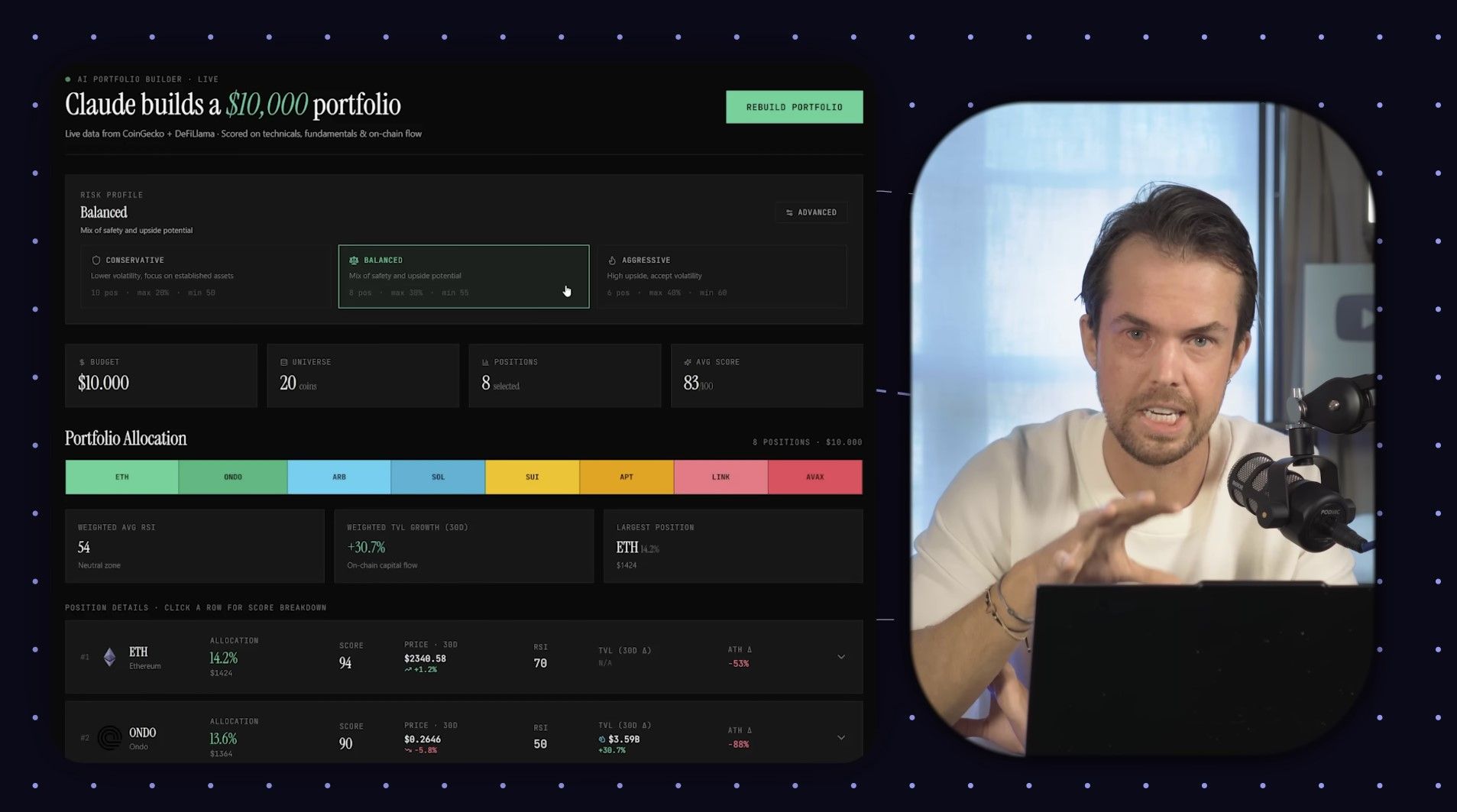
Artificial intelligence (AI) is changing how crypto and traditional markets get traded, yet four leading analysts agree it rewards skill rather than replacing it. The edge in AI in crypto trading still comes from clean data and human judgment.
Charles Edwards of Capriole Investments and Julio Moreno of CryptoQuant call AI an accelerant for serious research. Benjamin Cowen and Michael van de Poppe, speaking on a separate panel, reach the same conclusion from the trading desk.
Four Analysts, One Conclusion
On-chain analytics and AI tools have moved from niche to mainstream across crypto research. Two BeInCrypto panels gathered four analysts who use them every day.
Edwards founded Capriole Investments, a quantitative Bitcoin (BTC) hedge fund. Moreno serves as Head of Research at CryptoQuant. Cowen and van de Poppe are widely followed, independent market analysts.
Speaking at the Market Intelligence Council, Edwards said AI shifts the opportunity toward those who do the work.
“I think AI as well is making that… playing field more opportunistic for certain people.”
On a separate panel, van de Poppe set the limit plainly.
“It’s not going to make you a great trader if you weren’t a good trader in the first place.”
Where AI Already Helps
The clearest gains show up in routine research. AI now compresses tasks that once took hours.
Edwards pointed to faster analysis as the main benefit.
“The tool sets to do that are much more powerful and… it can be done more quickly today with AI.”
Van de Poppe showed how accessible this has become. He built a sample crypto portfolio using a chatbot and free data feeds. Tools like AI agents now pull live market data on demand.
“You can build a portfolio and a dashboard of cryptocurrencies within five minutes with just free APIs.”

Why AI Still Needs a Human
Speed does not equal skill. Van de Poppe noted that his AI portfolio missed important context.
“It didn’t create a basket of uncorrelated cryptos… it doesn’t have any macros in there.”
He said judgment fills that gap.
“That’s where the human knowledge and experience comes in and the intuition… That the AI agent doesn’t have or the LLM.”
He also warned against treating AI as magic. The tool will not deliver “some sort of magic that creates an infinite money loop.” That caution matches the wider market, where few experts back hands-off trading bots.
Moreno said institutions trust data but keep testing it.
“They do trust it but they verify a lot, and are continuously monitoring if the data remains relevant.”
Inside the Models
Professional funds treat AI as infrastructure, not a crystal ball. Edwards built his firm around large, tested models.
“We build hundreds of metrics and we also use hundreds of other data sources to build out comprehensive models… Combining onchain technicals and macro data for many years to build out trading models.”
Capriole’s Macro Index reflects that approach. The firm combines more than 60 on-chain, macro, and equities metrics into one machine-learning model. Most data platforms publish thousands of metrics, yet models still need careful curation.

Cowen is building his own bot from the ground up.
“Right now all the bot does really is regurgitates things that I say. It’s almost like an AI version of me.”
He avoids training on low-quality AI output to prevent model decay.
“I don’t want it to use AI slop that’s out there to create more AI slop”
Van de Poppe runs his fund the same way. AI writes the base of his trading algorithms, but a human keeps steering it, or it keeps “working on stuff that is wrong for your system.”
The Data Behind the Models
Every model depends on the data beneath it. Moreno gave the sharpest example of a data edge.
“They will trade for example mining stocks instead of waiting for your quarterly report you’re tracking in real time actually what they’re mining.”
Network hashrate offers one such real-time signal. It tracks how much computing power miners commit to Bitcoin each day.

The same method applies to equity exchanges. Bitcoin miner stocks have drawn fresh attention as AI infrastructure spending climbs. Julio Moreno continues:
“Some of the crypto exchanges have also started trading on stock exchange and so you can be monitoring the trading volume to assess the revenues.”
Cowen added that data quality decides the outcome. He values records from before the AI era.
“Data before 2022 in some ways is actually really valuable because it was data before all the AI stuff was even here.”
For institutions and retail traders alike, the lesson holds. AI compresses the work and widens access, but the advantage flows to operators with clean data and the judgment to steer the model. As adoption spreads, that judgment becomes the real differentiator.
The post AI Won’t Make You a Good Trader, But Here’s How the Pros Use It Anyway appeared first on BeInCrypto.
TLDR:
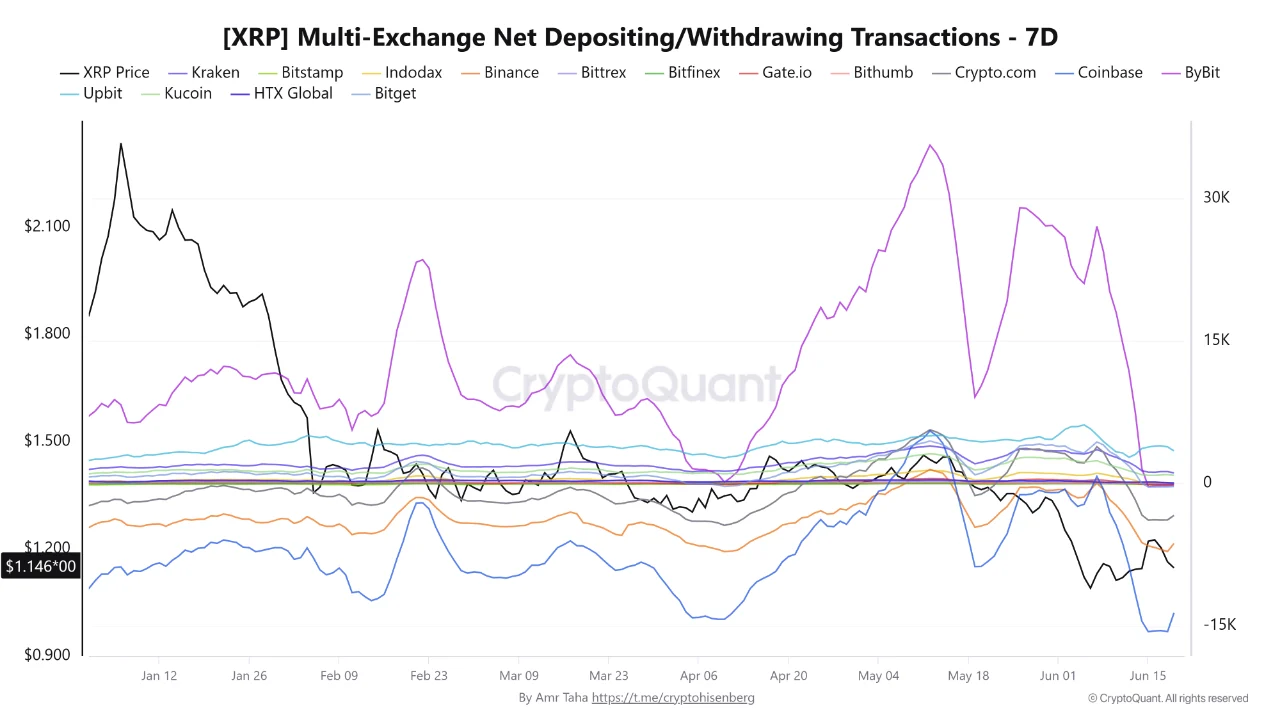
- Coinbase posted a seven-day net reading of -15,500 on June 18, exceeding its April and February lows.
- Binance recorded -7,100 on June 18, near April levels and below its February 14 reading of -5,200.
- Bybit’s net reading collapsed from +27,000 on June 7 to roughly -200 by June 18 in just 11 days.
- Spot XRP ETFs now hold 1.41% of circulating supply after just five outflow days since March 27.
XRP withdrawal activity is again gaining traction across major cryptocurrency exchanges, with fresh on-chain data from June 18 pointing to a notable shift.
Coinbase and Binance both posted deeply negative seven-day net depositing and withdrawing transaction readings.
Meanwhile, Bybit’s unusually large early-June deposit surge has nearly fully reversed. Separately, spot XRP ETFs in the United States continue accumulating supply, now holding over 1.4% of circulating tokens.
Coinbase and Binance Post Negative Net Transaction Readings
Coinbase recorded a seven-day net depositing and withdrawing reading of -15,500 on June 18. That figure fell below its April 9 reading of -14,200 and its February 14 level of -12,300. The move places the current withdrawal dominance at a more extreme rate than either prior episode.
Binance followed the same direction on the same date. Its reading dropped to -7,100, near April levels and below the -5,200 recorded on February 14. That cross-exchange alignment removes any suggestion that the activity is exchange-specific.
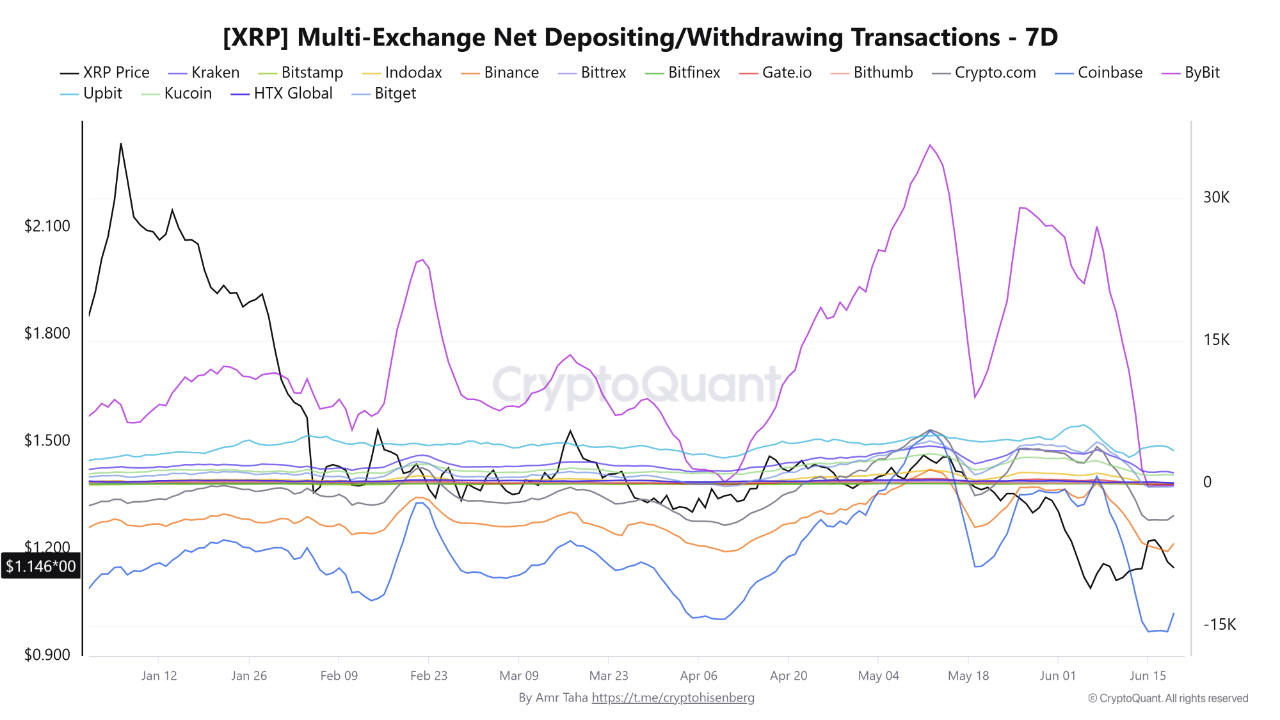
Source: Cryptoquant
The metric tracks the net number of depositing versus withdrawing transactions. It does not measure the total XRP volume or dollar value transferred between accounts. Even so, a synchronized drop across two of the largest exchanges carries weight as a behavioral indicator.
The back-to-back negative readings across Coinbase and Binance point to a broader pattern. XRP holders appear to be moving tokens away from centralized venues at a pace that now exceeds prior notable periods this year.
Bybit’s Deposit Surge Collapses While ETF Holdings Pass 1.4% of Supply
Bybit presented the sharpest single-exchange reversal. Its net reading stood at roughly +27,000 on June 7, reflecting an unusually concentrated deposit wave at the time.
By June 18, that figure had fallen to approximately -200, erasing nearly all of the early-June movement within 11 days.
The speed of the reversal at Bybit adds context to the Coinbase and Binance readings. Together, the three data points suggest a coordinated behavioral shift across major XRP trading venues during June. The withdrawal side is reclaiming dominance across different exchange types and geographies.
On the institutional side, spot XRP ETFs in the United States recorded net inflows of approximately $2.82 million on June 15.
Following that session, the suite of Ripple-linked ETF products now holds 1.41% of XRP’s entire circulating supply.
Since March 27, spot XRP ETFs have posted net outflows on just five trading days. That streak reflects sustained institutional demand running alongside the exchange-level withdrawal activity now observed across Coinbase, Binance, and Bybit.

Bitcoin is slipping back toward the $59,000 area after a failed rebound attempt left buyers unable to retake key resistance levels. The move has traders watching the downside closely, particularly as technical signals remain bearish and large pools of liquidations are reported to be concentrated near the yearly low.
At the same time, on-chain flow data suggests one source of immediate sell pressure may be easing: CryptoQuant analysis cited by the article points to a sharp decline in exchange inflows from mid-sized investors across Binance, Coinbase, and Coinbase Prime around June 19.
Key takeaways
- Bitcoin is approaching its yearly low near $59,000 after a recovery attempt stalled below the $67,500–$70,500 fair-value gap.
- Liquidation positioning is reportedly heavy near $59,000 (about $4 billion in leveraged longs), raising the odds of a liquidity-driven push lower before any rebound.
- CryptoQuant data shows mid-sized investor inflows to major exchanges fell across Binance and Coinbase to levels not seen since April 4.
- RSI is reportedly hovering near oversold conditions, which can precede volatility spikes and relief bounces after liquidation events.
Why $59,000 remains the center of attention
The latest price action reflects a stalled attempt to reclaim lost ground. According to the report, BTC failed to reach the daily fair-value gap between $67,500 and $70,500, and sellers regained control around the 50-day and 100-day exponential moving averages—levels described as acting as overhead resistance.
On the four-hour timeframe, the rejection reportedly pushed BTC below an ascending channel, marking a bearish break of structure. With price trading below that channel’s range, traders highlighted internal liquidity support around $60,700 before the market tests the yearly low near $59,000.
What makes the $59,000 zone particularly important is the clustering of leverage. The article cites liquidation data indicating that around $4 billion in cumulative leveraged long positions are concentrated near $59,000. If price trades into that area, forced liquidations can amplify downside moves by triggering additional selling—often referred to by traders as a “liquidity sweep” of trapped positioning.
Beyond that level, the next larger pocket of reported liquidity is near $68,000, where more than $4.75 billion in cumulative positions are said to be clustered. That distribution matters because it frames both the near-term risk (downside flushing into clustered longs) and the potential upside horizon if liquidations exhaust and a rebound takes hold.
Momentum signals: oversold conditions and the case for a bounce
Beyond structure and liquidity, the report also points to momentum indicators moving toward extremes. It notes that the relative strength index (RSI) is hovering near oversold territory. Another drive toward the yearly lows could push RSI below 30, a level that traders frequently associate with elevated odds of a sharp relief reaction after liquidation-driven selling.
Two separate traders emphasized that the market may not simply follow the most obvious liquidity path. Analyst “Killa” suggested Bitcoin could front-run a liquidity pool below $60,000 rather than fully sweeping the wider area. The reasoning, as presented in the article, is that markets sometimes move opposite the level that becomes “crowded attention,” referencing a past example where Bitcoin reportedly front-ran liquidity above $140,000 in October 2025.
Trader “LP” also cautioned against becoming “too bearish” in the immediate term, pointing instead to the possibility of a bottom forming toward late June. Together, these views underscore a key practical takeaway: even when liquidation maps point to downside, the timing of the flush versus the subsequent rebound can be difficult to forecast.
Exchange inflows cool—selling intent appears to ease
While price action and liquidation data focus on what happens when leverage is already positioned, exchange inflows help gauge what capital may be preparing to sell. The article attributes this portion of the story to CryptoQuant analyst Amr Taha, who reported that inflows from mid-sized Bitcoin investors declined simultaneously across Binance, Coinbase, and Coinbase Prime on June 19.
As stated in the report, Binance recorded roughly 3,500 BTC in inflows, Coinbase nearly 3,000 BTC, and Coinbase Prime about 1,700 BTC—described as the lowest readings since April 4. The article frames this as a reduction in near-term sell pressure because exchange inflows are commonly interpreted as a proxy for potential intent to trade or distribute coins.
This doesn’t automatically translate into fresh buying demand. The article’s interpretation is more nuanced: the data suggests mid-sized holders are sending fewer coins to exchanges as Bitcoin trades near the low-$60,000 region. In other words, one category of sell-side pressure may be lighter, even as the market tests a major liquidity concentration near yearly lows.
For traders, the practical implication is that downside moves toward $59,000 could still occur if liquidation incentives outweigh spot supply—especially given the large reported concentration of leveraged longs. But if exchange inflows continue to cool, it may reduce the “fuel” available for follow-through selling after any initial flush.
What to watch next as levels converge
Right now, the market is balancing two competing forces: bearish technical structure and large reported liquidation concentrations on one side, versus cooling mid-sized exchange inflows that could limit how persistently selling pressure builds once the market moves into the yearly-low pocket.
Going forward, traders are likely to focus on whether BTC breaks decisively below the $59,000 area (confirming a liquidity-driven downside move) or instead snaps back quickly—consistent with oversold momentum conditions and the possibility of trapped leverage being cleared without a sustained trend extension. The next key signal will be whether exchange inflows remain subdued as price approaches and potentially revisits these liquidity levels.

Family of woman killed by her son before he took his own life ‘hopes lessons will be learned’ after inquest

Vanguard report shows 401(k) balances hit highs as automatic enrollment spikes

Arthur Hayes Sells Ethereum at a Loss While Large Holders Continue Buying


-

 Business5 days ago
No Jackpot Winner as $257 Million Prize Rolls Over to $269 Million Monday Draw
-
 Crypto World5 days ago
Zimbabwe Requires Crypto Businesses to Register Annually Under New FIU Regulations
-

 Crypto World7 days ago
Bitget enters Argentina’s regulated crypto market through PSAV registration
-

 Tech7 days ago
NanoClaw integrates JFrog registries to secure AI agent downloads
-

 NewsBeat7 days ago
FBI searches office of Ohio voter registration group
-
 Entertainment5 days ago
Matt Damon’s Viral Sci-Fi Thriller Has Taken Over HBO Max
-

 Business5 days ago
Anthropic staff to meet White House officials next week, Axios reports
-

 Tech5 days ago
As AI companies race to go public, who else is along for the ride?
-
 Crypto World5 days ago
Bitcoin could crash to $48,000, if this historical pattern is triggered
-

 Politics5 days ago
“Israel’s” ban on ICRC visits ruled illegal, but Knesset moves to stop them permanently
-
 NewsBeat5 days ago
Warning of disruption as Cardiff Crossrail works to start
-

 News Videos5 days ago
Financial Accounting | Last Day Revision Strategy and Booster | CMA Inter – June 2026
-
 NewsBeat5 days ago
Tributes to former deputy head teacher at Cambridge school among death and funeral notices
-
 NewsBeat5 days ago
what doctors are seeing in ebike crashes
-

 Entertainment6 days ago
Deion Sanders Shares Powerful Post After Viral Advice To Deiondra
-
 Entertainment5 days ago
Kate Middleton Glare Goes Viral After Kids Booed At Royal Event
-

 Crypto World5 days ago
XRP ETFs Outperform As Bitcoin And Ethereum Funds Extend Outflow Trend
-
 Crypto World5 days ago
Market Preview: SpaceX (SPCX) IPO Record, Federal Reserve Meeting, and Iran Nuclear Agreement
-

 Business5 days ago
Invesco Quality Income Fund Q1 2026 Commentary
-

 Tech5 days ago
Over 400 Arch Linux packages compromised to push rootkit, infostealer
You must be logged in to post a comment Login