

Crypto World
Crypto Exchange Shakeout Deepens as BitMEX, BitMart, and AscendEX Exit the Market


BitMEX’s closure is no longer an isolated event. Within days, BitMart announced its own wind-down, while AscendEX had already confirmed it would cease operations earlier this month. Three centralized crypto exchange platforms exiting within weeks have shifted attention from individual failures to whether the industry is entering a new phase of consolidation.

The timing comes as trading activity remains well below previous bull market peaks. Retail participation has cooled, compliance costs continue rising, and liquidity is increasingly flowing toward a handful of global exchanges. Together, those trends are making it harder for smaller and mid-sized platforms to compete.
The growing list of exchange closures has also reignited debate over regulation. Former Binance CEO Changpeng Zhao, known as CZ, argued that years of regulatory pressure under the Biden administration accelerated industry consolidation by making it significantly harder for smaller exchanges to survive. While each exchange cited different reasons, analysts increasingly see the closures as symptoms of broader structural change.
Sad to see BitMex go. Some thoughts: — CZ
BitMex pioneered 100x perps in crypto back in 2014. Delivery futures existed before then, making Fridays hectic.
BTC deposits only, one chain only, withdrawals only once per day, through a multi-sig wallet. The constraints that seemed… https://t.co/8kP8byy37y
 BNB (@cz_binance) July 23, 2026
Discover: The Best Crypto to Diversify Your Portfolio
Crypto Exchange Consolidation Leaves Little Room for Smaller Platforms
BitMEX pioneered the perpetual swap in 2016 and later became the world’s largest crypto derivatives exchange. At its peak, the platform controlled roughly 57% of the global derivatives market. Its decline accelerated after U.S. authorities charged the exchange in 2020 with violating anti-money laundering and Bank Secrecy Act requirements.
Co-founders Arthur Hayes, Ben Delo, and Samuel Reed later pleaded guilty, while BitMEX paid substantial financial penalties and strengthened its compliance program. The changes reshaped its business model, ending the anonymous high-leverage trading that helped build its early success.
Meanwhile, Binance, Bybit, and OKX expanded with deeper liquidity, broader product offerings, and stronger fiat infrastructure. BitMEX later introduced spot trading and additional services, but those efforts failed to restore its competitive position as traders increasingly migrated elsewhere.
BitMart’s shutdown and AscendEX’s earlier exit reinforce the same trend. Each exchange faced different challenges, yet all struggled as compliance costs rose and competition intensified. A proposed class action lawsuit against former BitMEX executives also added reputational pressure, although the allegations remain unproven.
Trade Crypto on Bybit and Get a Chance to Win Our $1,000 USDT Airdrop
Regulation and Lower Trading Activity Reshape the Industry
The recent closures reflect broader structural changes across the crypto industry. Retail trading has slowed since the previous bull market, while Bitcoin ownership has increasingly shifted toward long-term holders. Lower speculative activity has reduced trading revenue, making it harder for smaller exchanges to remain profitable.
At the same time, Europe’s Markets in Crypto Assets regulation has raised compliance requirements across the European Union. Similar regulatory frameworks are emerging elsewhere, increasing legal and operational costs. Larger exchanges can spread those expenses across millions of users, while smaller competitors often cannot.
For customers, BitMEX has already halted new registrations and will enter reduced-only mode before its September closure. BitMart and AscendEX have also instructed users to withdraw assets within their respective timelines. Together, the three exits suggest the crypto exchange market is becoming increasingly concentrated among a few large global operators.
Discover: The Best Token Presales
The post Crypto Exchange Shakeout Deepens as BitMEX, BitMart, and AscendEX Exit the Market appeared first on Cryptonews.

The xyz.SKHYNIX perpetual on Hyperliquid crashed around 20% almost instantly late on Monday night, dropping from $1,131 to as low as $900, completely decoupling from pricing elsewhere on crypto exchanges.
On-chain data indicates that the entire cascade stems from a single share trade placed from Seoul.
How One Bad Price Caused a Liquidation Cascade
It appears that during the pre-market window before trading opened on the South Korean Nextrade exchange, there was an order to sell stock for major chip manufacturer SK Hynix placed 30% below the previous closing price. This order may have been placed by accident.
With thin pre-market liquidity, there were no competing orders on Nextrade at that moment, and that single trade briefly set the price of the stock on that exchange.
The price corrected back to market value within two minutes, but by that time, the XYZ oracle responsible for setting the price for this stock on Hyperliquid had already consumed and relayed the information.
Just four seconds after Nextrade opened for trading, the SKHYNIX oracle price plummeted 15.6%, and liquidations began about 2 seconds later.
Freefall: The Final Figures
On Hyperliquid, users were betting on the price of the semiconductor stock using leverage. X.com user MarketAlpha calculated that 960 accounts lost $57 million in a liquidation cascade as a result of this oracle error, with $17.3 million in realized losses.
Today, a single share sale triggered millions of dollars in liquidations on Hyperliquid.
At 11:00 pm UTC on July 27, $SKHYNIX suffered a flash crash on Hyperliquid, falling roughly 20% within seconds before rapidly recovering.
The entire cascade began with a single share sold… pic.twitter.com/quFIo2o1Lc
— Markets Alpha (@MarketsAlpha) July 28, 2026
The backstop then triggered auto-deleveraging against profitable short positions, with $10.8 million in gains realized across 100 accounts. The largest gains and losses for individual accounts were $2.55 million and $2.05 million, respectively. Surprisingly, the flash crash mimicked a real stock price correction of around 15%, which took place hours later on the open market.
Hyperliquid staff have pointed out that the exchange is permissionless and that SKHYNIX is deployed and operated by XYZ, which is reportedly investigating the issue but has not released a statement.

The post One Bad Price, 960 Liquidations: Inside SK Hynix Flash Crash on Hyperliquid appeared first on CryptoPotato.
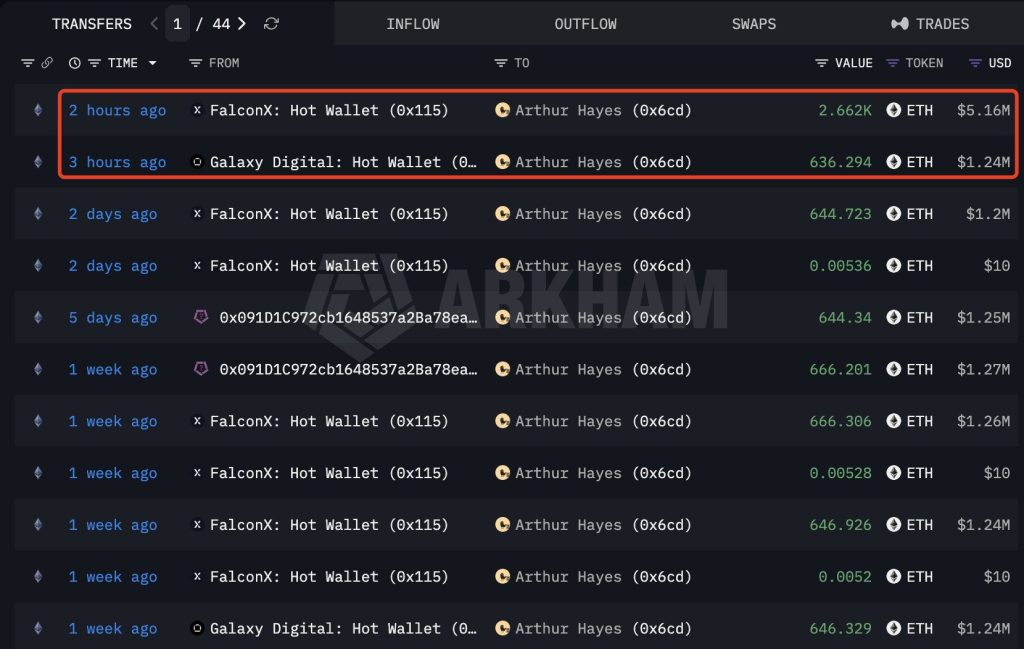
Arthur Hayes added 3,298 ETH worth $6.39 million on July 28, roughly three hours before Ethereum’s spot price slid from $1,960 to $1,872, a drop that immediately raised the question of whether the BitMEX co-founder’s whale trading triggered the selloff. The answer, grounded in the on-chain data, is no.
But the timing crystallizes a more interesting question about where Hayes is positioning for the next leg of this ETH cycle.
According to Lookonchain, the July 28 purchase was Hayes’s largest single leg in a buying streak that began on July 15. He has now accumulated 7,213 ETH at a total cost of $13.87 million, averaging $1,923 per ETH.
At post-drop prices, the position sits roughly $368,000 underwater – a paper loss, not a crisis, but one that underscores how quickly the macro environment can move against even a well-telegraphed accumulation thesis.
Discover: The Best Crypto to Diversify Your Portfolio
How Hayes Built the Position – and Why OTC Routing Matters
Hayes assembled the 7,213 ETH stack through a series of over-the-counter trades routed through Galaxy Digital, FalconX, and Cumberland. Individual legs ranged from approximately 645 ETH to 1,330 ETH, with the July 28 purchase at 3,298 ETH representing the largest single tranche.
OTC execution is the key structural detail: none of these trades hit the open order book in a way that would create visible sell pressure or liquidate stacked bids.
On-chain data flagged by Lookonchain confirmed the wallet-to-OTC-desk transfer pattern. The mechanics mean the correlation between Hayes’s buy and the subsequent ETH price drop is coincidental timing, not causation.

A $6.39 million OTC purchase, however attention-grabbing in dollar terms, is small relative to daily ETH spot and derivatives volume across centralized and decentralized venues.
This accumulation reverses a June exit that cost Hayes approximately $606,000 in realized losses. He had sold roughly 6,000 ETH below $1,700, citing macro headwinds, including energy prices and political risk.
He then re-entered starting July 15 as ETH recovered above $1,750, a pattern that fits his documented trading style, which prioritizes rebuilding conviction positions at dislocated prices rather than protecting short-term P&L.
The Actual Catalyst: Fed Timing and Broader Crypto Market Pullback
The ETH price drop on July 28 was not an isolated event. It was part of a broader crypto market pullback across the asset class as traders de-risked ahead of the Federal Reserve’s two-day policy meeting.
Rate decisions, or more precisely, the forward guidance language that accompanies them, have been the dominant macro variable for risk assets in 2026. Crypto markets have priced in sensitivity to that signal, and positioning ahead of the announcement typically compresses speculative longs.

ETH is not uniquely exposed here, but it is exposed. The move from $1,960 to $1,872 represents a roughly 4.5% intraday drawdown that hit simultaneously with pullbacks in BTC and major altcoins.
Attributing that to a single 3,298 ETH OTC purchase, one that didn’t touch the open market, requires ignoring how macro-driven de-risking actually propagates through derivatives books and spot liquidations.
$1,900 Is the Level That Decides the Near-Term Narrative
Hayes’s average entry of $1,923 is not far above ETH’s post-drop price. The $1,900 level is the immediate technical line of significance: a sustained hold above it would keep Hayes’s position near breakeven and preserve the bullish structure that drew him back in after the June exit.
A failure to reclaim $1,900 with any conviction opens the door to a retest of the $1,750–$1,800 range where his July re-accumulation began.
The institutional thesis underpinning Hayes’s position has not been altered by a single macro-driven pullback. Fundstrat’s Tom Lee has made a parallel argument: institutions are moving past simply trading Ethereum toward building on it, with BlackRock’s tokenized fund and Robinhood’s ETH-based fee token cited as structural demand drivers.
That thesis is a medium-term one, and it does not immunize any position against near-term rate-driven volatility.
On-chain data confirms that Hayes’s Maelstrom-linked wallet is still holding, with no exit signals flagged in the reporting window. That matters because his track record includes rapid reversals – he has publicly championed tokens including HYPE, Zcash, and Worldcoin before quietly closing those positions as sentiment shifted.
The ETH position is larger in both size and stated conviction than those prior trades, but the pattern is worth tracking. On-chain watchers will be monitoring for any OTC transfer flows in the opposite direction as the Fed decision lands.
For active ETH traders, the Hayes accumulation is a data point, not a trade signal. The more actionable read is the Fed meeting outcome and whether ETH can reclaim $1,900 in the sessions immediately following. A contrarian institutional position of this size at current levels suggests smart money sees value here; it does not guarantee the market agrees on any particular timeline.
Trade Ripple XRP on Bybit and Get a Chance to Win Our $1,000 USDT Airdrop
The post Arthur Hayes Holds 7,213 ETH as FOMC Jitters Drives Ethereum Price Drop appeared first on Cryptonews.
After several months of underperforming, the self-proclaimed Dogecoin killer finally posted a decisive rebound over the weekend. However, the pump was short-lived as the bears quickly intercepted the move and dragged the price down.
The enthusiasm faded, while a well-known analytics platform outlined when the next buying opportunity might emerge.
Retail Attention Arrived Late
Just a few days ago, Shiba Inu recorded a sudden 35% price jump to reach a two-month high of around $0.00000582 (per CoinGecko). Some potential factors that may have acted as catalysts for the significant revival include a whale that has resumed accumulating after more than half a year of inactivity, as well as the notable resurgence of the burning mechanism.
The bulls, though, lost momentum, and SHIB currently trades at roughly $0.000004631, representing a nearly 20% decline from the local high. The analytics platform Santiment noted that amid the rally, there were 52 whale transactions in a single day, the most since March 31.
“Activity strongly suggests larger holders took profits into strength,” it added.
On the other hand, retail investors joined the party too late and chased the excitement near the top, “giving whales the liquidity needed to reduce their exposure.”
According to the entity, the smart approach with meme coins is to cash out when retail FOMO spikes, and re-enter once the crowd turns hostile and calls the token a scam.
It seems like X user Crypto King had followed these rules. On July 26, the trader noted the double-digit price increase, the whales’ accumulation, the exploding burn rate, and rising volume to open a short position.
“These euphoric pumps have a habit of trapping late buyers… but the market loves proving people wrong,” they said.
What Comes Next?
As mentioned above, SHIB lost its traction, while the broader cryptocurrency market flashed in red again, which could lead to a further downfall for the meme coin in the near term.
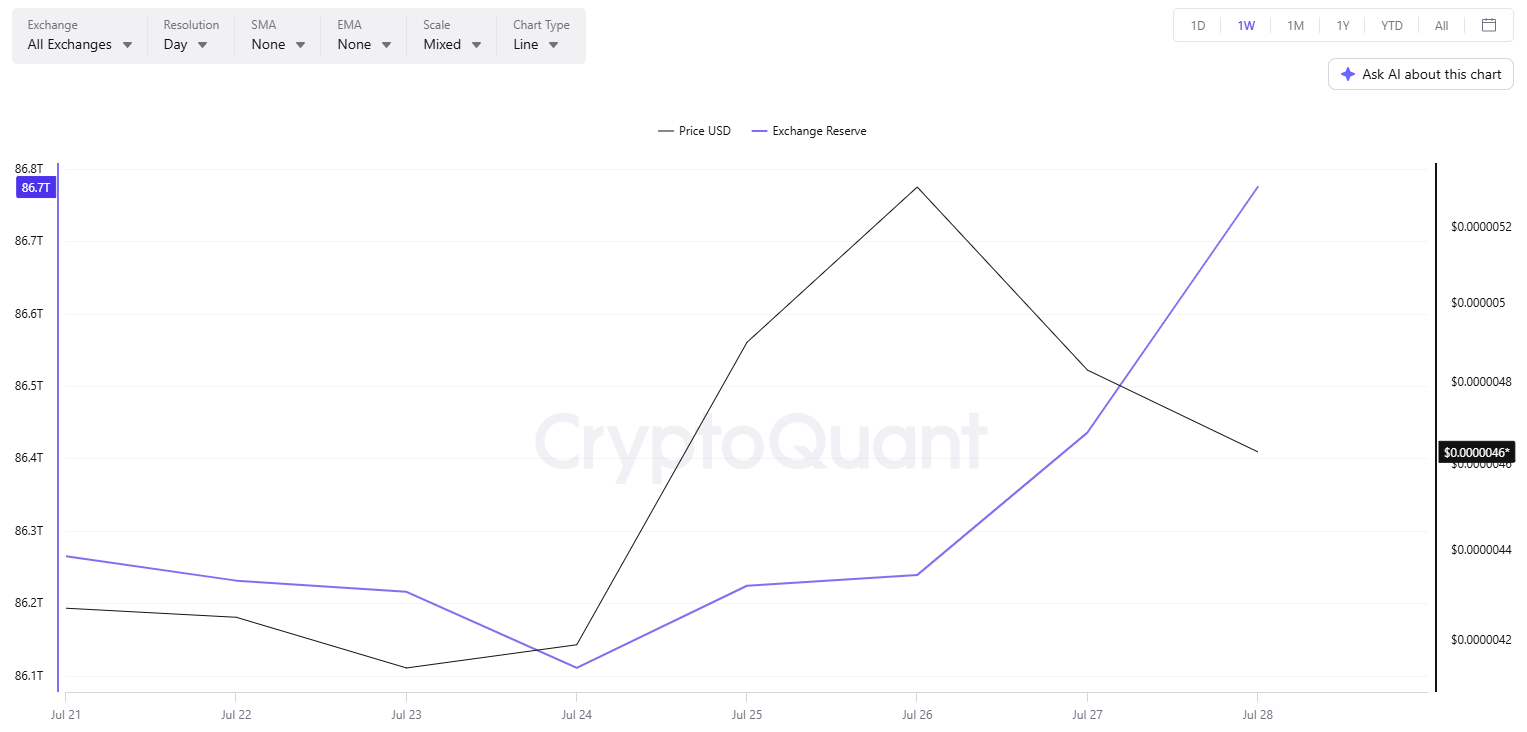
The rising amount of tokens stored on exchanges serves as another warning. CryptoQuant’s data shows that the figure has been constantly rising over the past several days, reaching a two-week high of around 86.7 trillion units. Such a development suggests that many investors have abandoned self-custody and flocked to centralized platforms, thus increasing immediate selling pressure.
The stalled activity on Shibarium is also worth mentioning. The layer-2 scaling solution, designed to foster the advancement of Shiba Inu’s ecosystem, was once considered among the primary catalysts that could trigger a price increase for the meme coin. However, after an exploit in September last year, the protocol saw a sharp decline in usage, dropping to merely hundreds or thousands of daily transactions.
The post Shiba Inu (SHIB) Drops 20% From Its Recent High: Is It Time to Buy? appeared first on CryptoPotato.


“Digital assets are becoming an increasingly important component of diversified investment portfolios,” Amy Oldenburg, head of digital asset strategy at Morgan Stanley, said in a press release. “As client interest in digital assets continues to grow, we’re focused on providing a range of digital asset solutions that allow investors to diversify their portfolios across traditional and decentralized asset classes while also adhering to Morgan Stanley’s standards for governance, infrastructure and risk management.”
Both products charge a 0.14% expense ratio — the lowest on the market — and plan to stake a portion of their ether or SOL holdings, with any staking rewards passed through to investors rather than kept by Morgan Stanley.
The products build on the Morgan Stanley Bitcoin Trust (MSBT), which debuted earlier this year and had gathered more than $381 million in assets under management through July 16. The bitcoin fund tracks the CoinDesk Bitcoin Benchmark Rate.
BlackRock, which owns the largest spot bitcoin ETF on the market, recently brought its first crypto income ETF to the market, as clients are increasingly looking for steady income from their long-term bitcoin investments.
Morgan Stanley also enters the market with a built-in distribution advantage. Its wealth management business includes roughly 16,000 financial advisors overseeing more than $9 trillion in client assets, while its ownership of E*TRADE gives the firm a direct line to millions of self-directed investors.

A federal judge has temporarily blocked Minnesota from enforcing a first-of-its-kind law that would have prohibited prediction markets in the state.
The latest decision hands a temporary legal victory to Kalshi, Polymarket, and the US Commodity Futures Trading Commission (CFTC).
Early Court Victory
According to Reuters, US District Judge Katherine Menendez granted a preliminary injunction after finding that the state law, which was due to take effect on Saturday, is likely preempted by the federal Commodity Exchange Act. The ruling allows Kalshi and Polymarket to continue offering event contracts to users in Minnesota while the lawsuit proceeds.
The dispute began after Governor Tim Walz signed legislation in May that made it a criminal offense to operate, host, or promote prediction markets in the state. Unlike other states that have challenged companies such as Kalshi by arguing they were operating unlicensed gambling businesses under existing gaming laws, Minnesota enacted a law that aimed specifically at prediction markets.
Judge Menendez said several event contracts offered by Kalshi and Polymarket likely qualify as “swaps” under federal law. Because the CFTC regulates swaps, she found that federal law is likely to override Minnesota’s ban on prediction markets. Despite this, she noted that the court could narrow the injunction later if it determines that not every event contract listed on the platforms falls within that definition.
For now, however, she said preserving the status quo is appropriate while the court fully considers the merits of the case.
The decision was welcomed by both platforms. A spokesperson for Kalshi, Elisabeth Diana, for one, said the ruling confirms that states cannot prohibit activities outside their jurisdiction. Meanwhile, Minnesota Attorney General Keith Ellison said the state disagrees with the decision and will continue defending the law while arguing,
“Prediction markets are gambling, plain and simple, and Minnesota has every right to keep predatory gambling out of our communities.”
Compliance and Legal Battles
The latest ruling comes as Kalshi continues to face legal restrictions in Massachusetts, Michigan, Nevada and Washington. Earlier this year, the company also stepped up enforcement of its own trading rules.
In April, it suspended three US political candidates after finding they had traded on contracts tied to elections in which they were running. The platform described the activity as political insider trading and said it violated its CFTC-approved rules. Minnesota State Senator Matt Klein and Texas candidate Ezekiel Enriquez each placed trades worth less than $100 on their own races and accepted fines and five-year suspensions.
Virginia candidate Mark Moran received a larger fine and a five-year ban after making multiple trades and refusing to settle. Moran said he placed the bets to test Kalshi’s enforcement process.
A month later, federal prosecutors charged Google software engineer Michele Spagnuolo, known online as “AlphaRaccoon,” with allegedly using confidential Google search data to make about $1.2 million by trading on Polymarket. Authorities said he accessed nonpublic “Year in Search 2025” rankings before they were released and placed bets on a related prediction market.
The post Minnesota’s Prediction Market Ban Hits Legal Roadblock After Federal Court Ruling appeared first on CryptoPotato.


But evidence points away from exploitation, a CoinDesk Research report found in July. If someone had minted counterfeit ZEC, the obvious next step would be to move it out and sell it, which would show up as funds leaving the pool. However, Orchard’s balance grew steadily through the four years the flaw was open, including through last year’s price rally, when cashing out would have been most profitable.
Developers patched the bug within days, but the patch could not account for the four years it was open. A zero-knowledge proof reveals nothing beyond the facts that it verified, so the chain holds no record of whether any Orchard transaction actually moved, and nobody can prove counterfeit coins were never created.
The turnstile is an answer to that. Money crossing into or out of a shielded pool is public even when the transactions inside are not, so the network already knows how much ZEC went into Orchard and will not release more than that. Any counterfeit coins sitting inside are stuck there.
As of press time, 1,500 ZEC have already moved into the new pool, according to a tracker.
Ironwood also launched with two protections Orchard never had. The record each coin leaves on the chain is built to stay recoverable if quantum computers eventually break the cryptography now securing it, a property specified under ZIP 2005 and in place from the first block.
Crypto World
The Clarity Act failed to drive up BTC, ETH prices; how EX DeFi enabled holders to earn $70,000 monthly

Disclosure: This article does not represent investment advice. The content and materials featured on this page are for educational purposes only.
Crypto market volatility and regulatory developments are driving interest in cloud mining platforms like EX DeFi as investors explore alternative digital asset strategies.
Summary
- EX DeFi gains attention as crypto volatility drives investor interest in cloud mining and alternative income strategies.
- Market uncertainty boosts demand for cloud mining platforms like EX DeFi as investors seek diversified crypto participation.
- EX DeFi highlights automated cloud mining services amid Bitcoin and Ethereum volatility following regulatory developments.
Recently, the US Clarity Act continued to advance. The market generally believes that a clearer regulatory framework for digital assets will help improve long-term transparency in the industry and create a clearer regulatory environment for institutional participation.

Bitcoin nearly fell below $63,000 during last night’s sell-off, while Ethereum dropped to $1,860, with 24-hour trading volume more than doubling.
According to Coinglass data, over $670 million was liquidated in the cryptocurrency market in the past 24 hours, including $533 million in long positions being wiped out.
Amidst increased market volatility, more and more investors are seeking diversified participation methods beyond simply holding cryptocurrencies, hoping to hedge against market volatility risks through stable cash flow.
Amid market volatility, cloud mining has regained attention
Since July, major digital assets such as Bitcoin, Ethereum (ETH), and XRP have been fluctuating around key price levels, making investors increasingly eager for stable returns. The emergence of the EX DeFi cloud mining platform has injected new options and vitality into the market.
Compared to traditional mining, which requires purchasing mining rigs and incurring electricity and equipment maintenance costs, cloud mining lowers the barrier to entry. Users do not need to deploy specialized equipment and can participate in digital asset mining through the platform’s computing power services, even during market volatility, and obtain substantial returns. This is one of the key reasons why more and more investors have been paying attention to cloud mining in recent years.
As a digital asset cloud mining platform, EX DeFi supports major cryptocurrencies such as BTC, ETH, DOGE, and XRP. Through intelligent mining and computing power allocation, it helps users achieve stable returns of up to $50,000 per month.
Why are more and more investors joining EX DeFi?
As the digital asset market matures, more and more investors are placing greater emphasis on long-term participation experiences, rather than just focusing on short-term price fluctuations.
EX DeFi, through cloud deployment and automated computing power management, helps users avoid the complex processes of mining machine procurement, equipment maintenance, and mining farm operation, enabling more ordinary users to participate in digital asset mining.
With this unique core advantage, EX DeFi is rapidly gaining favor among global cryptocurrency investors — whether they are complete beginners or seasoned investors seeking long-term, stable returns, they can all obtain a low-cost, high-efficiency, and sustainable source of passive income here.
Key advantages of EX DeFi:
1. Energy Efficiency: The platform uses clean energy sources such as solar, wind, and hydropower to power its data centers, improving energy utilization efficiency while reducing the energy consumption of traditional mining, providing stable support for computing power services.
2. Payment Methods: Supports cryptocurrencies and cryptocurrencies within cryptocurrencies, including BTC, ETH, DOGE, SOL, XRP, USDC, LTC, and USDT.
3. Affiliate Program: The affiliate program offers a 3% + 2% profit margin and referral bonuses up to $50,000.
4. Compliance and Transparency: Security and transparency of mining and energy information ensure reliable and stable data and services.
5. Security and Stability: The platform utilizes Cloudflare enterprise-grade network protection, McAfee® security system, and two-factor authentication (2FA) to further enhance account and data security, and provides 24/7 support.
How to earn mining rewards through the EX DeFi Platform?
1. Go to the EX DeFi website and create an account and automatically receive a $17 bonus.
2. Choose a mining contract that matches your budget and contract duration. (Minimum deposit $100)
3. Once mining begins, your earnings will be automatically credited to your account within 24 hours.
Featured Mining Contracts
BTC (Beginner Trial Contract): Investment of $100, Term: 2 days, Daily Yield: $4, Total Profit: $100 + $8
DOGE (Golden Shell Mini Dogecoin Pro): Investment of $500, Term: 6 days, Daily Yield: $6.5, Total Profit: $500 + $39
BTC (Canaan-Avalon-A1466): Investment of $1,000, Term: 10 days, Daily Yield: $13.4, Total Profit: $1,000 + $134
LTC (Bitmain Antminer L7): Investment of $5,000, Term: 20 days, Daily Yield: $73.5, Total Profit: $5,000 + $1,470
BTC (Bitmain S19K-Pro): Investment of $10,000, Term: 30 days, Daily Yield: $161, Total Profit: $10,000 + $4,830
BTC/DOGE/LTC (ANTSPACE-HK3): Investment of $50,000, Term: 37 days, Daily Yield: $870, Total Profit: $50,000 + $32,190
Visit the official website for more information on the potential returns of EX DeFi contracts.
Summary
The continued progress of the Clarity Act has brought positive expectations for establishing a clearer regulatory framework for the US digital asset market. However, in the short term, cryptocurrency prices are still affected by multiple factors such as the macroeconomy, geopolitics, and market sentiment, and have not continued to rise despite regulatory progress.
In an environment where market volatility remains high, EX DeFi provides investors with a safe, low-cost, and high-return way to participate. This cloud mining model not only reduces short-term risks but also provides a stable cash flow, with monthly returns up to $50,000, making it an optimal choice for investors seeking sustained growth.
For more information, visit the official website.
Disclosure: This content is provided by a third party. Neither crypto.news nor the author of this article endorses any product mentioned on this page. Users should conduct their own research before taking any action related to the company.


Morgan Stanley Investment Management has launched exchange-traded products tracking Ethereum and Solana, expanding the Wall Street bank’s digital asset lineup beyond Bitcoin.
Summary
- MSSE and MSOL began trading on NYSE Arca, providing exposure to Ether and Solana.
- Both products charge a 0.14% annual management fee and include staking.
- Morgan Stanley becomes the first US bank-affiliated asset manager to issue Ethereum and Solana funds.
- The launch comes as crypto ETF flows remain mixed during a wider market downturn.
Morgan Stanley launches MSSE and MSOL
Morgan Stanley Investment Management announced the launch of the Morgan Stanley Ethereum Trust and Morgan Stanley Solana Trust on Tuesday. The products trade on NYSE Arca under the tickers MSSE and MSOL, respectively.
MSSE seeks to track the performance of Ether, while MSOL follows SOL, the native asset of the Solana network. Both products charge an annual management fee of 0.14%, placing them among the lowest-cost US crypto exchange-traded products.
The launch followed the completion of the funds’ registration and listing process. NYSE Arca approved the products after Morgan Stanley submitted the required filings to the US Securities and Exchange Commission.
Although commonly described as ETFs, Morgan Stanley officially classifies MSSE and MSOL as exchange-traded products. Like spot crypto ETFs, they hold digital assets and allow investors to gain price exposure through traditional brokerage accounts without managing wallets or private keys.
Staking adds another source of returns
Both products can stake a portion of their holdings to earn blockchain rewards. Staking involves committing tokens to help validate transactions and secure a proof-of-stake network.
Regulatory filings show that MSSE plans to stake between 50% and 80% of its Ether. MSOL may stake up to 100% of its Solana holdings. Figment, Galaxy’s blockchain infrastructure business, and Coinbase Canada are listed among the staking providers.
Service providers and custodians will retain up to 5% of the staking rewards, with the remaining rewards allocated to the funds. However, returns will still depend largely on ETH and SOL price movements, while staking introduces additional operational, liquidity, and network risks.
Morgan Stanley’s entry could increase fee pressure across the US crypto fund market. Its 0.14% charge is below the management fees attached to many competing Ethereum and Solana products, although investors must also consider tracking differences and how each issuer distributes staking income.
US investors gain bank-backed crypto access
MSSE and MSOL are the first Ethereum and Solana exchange-traded products issued by an asset manager affiliated with a US bank. Their arrival gives US investors another regulated route to gain crypto exposure through taxable brokerage and eligible investment accounts.
Morgan Stanley entered the market earlier this year with the Morgan Stanley Bitcoin Trust, which trades under the MSBT ticker. The Bitcoin product held about $392 million in net assets as of July 24, according to the asset manager’s product page.
The bank has also expanded direct crypto access through E*TRADE, allowing customers to buy and sell Bitcoin, Ethereum, and Solana through accounts linked to crypto infrastructure provider Zerohash. Morgan Stanley has separately applied to establish a national trust bank focused on digital assets.
Its role in institutional crypto markets also extends beyond its own products. LMAX Group recently appointed Morgan Stanley and KBW to examine a potential sale or public listing that could value the trading company at up to $5 billion. LMAX is considering a direct sale, a special purpose acquisition company merger, or an initial public offering, with a Nasdaq listing reportedly its preferred route.
Crypto ETF flows remain uneven
Morgan Stanley’s launch comes during an uneven period for US crypto funds. Bitcoin ETFs have recorded three consecutive sessions of net outflows following a seven-day inflow streak, according to SoSoValue data.
Ethereum funds have posted net inflows on six of the past eight trading days. Solana products recorded four inflow days over the same period, alongside two sessions with no net flows.
Those mixed figures coincide with renewed weakness across the crypto market. Bitcoin pulled back after retesting the $65,000 level, while ETH and SOL also faced selling pressure as traders reduced exposure to risk assets.
The launch nevertheless broadens Morgan Stanley’s crypto offering during a period when traditional financial companies continue building digital asset products despite weaker prices. Initial trading volumes and asset inflows into MSSE and MSOL will show whether the bank’s brand, low fee, and staking structure can attract investors from established rivals.


Perpetual futures have become one of crypto’s defining financial products, but DRW CEO Don Wilson says much of what people think they know about them is wrong.
In a series of posts on X, Wilson argued that perpetual futures — or “perps” — are simply futures contracts without an expiration date. The features often associated with crypto perpetuals, such as high leverage, auto-deleveraging (ADL) and around-the-clock trading, are characteristics of how some crypto exchanges chose to implement the products, not the contracts themselves.
“Most of what people think they know about ‘perps’ … has nothing to do with the contract itself,” Wilson wrote.
His comments come as interest in bringing perpetual futures into regulated U.S. markets continues to grow. Several exchanges and market participants have explored launching perpetual futures beyond crypto, though questions remain over how the products should be regulated and whether they fit within existing futures or swaps frameworks. Kalshi, which saw perps trading explode shortly after launching, recently submitted a proposal with regulators to expand its offerings to precious metals.
Unlike traditional futures markets, crypto exchanges like Hyperliquid operate continuously, use digital collateral and can calculate margin requirements in real time. Those technological differences allowed exchanges to offer products with higher leverage and alternative liquidation mechanisms, including ADL, which automatically reduces winning positions when losing traders cannot cover their losses.
Wilson said those design choices should not be confused with perpetual futures themselves.
“I’m not a fan of ADL,” he wrote, adding that there is “no reason it needs to be used for perps.”
Instead, Wilson argued that digital payment rails create opportunities to improve risk management. Traditional clearinghouses generally calculate margin once a day, with market participants often having until the following business day to post additional collateral. Because markets can move significantly during that window, clearinghouses require relatively large initial margin buffers.
With real-time settlement, however, exchanges can recalculate margin continuously and require traders to post collateral immediately, reducing the need for large upfront margin requirements while maintaining the same level of protection, Wilson said. Whether exchanges choose to translate those efficiencies into higher leverage is a business decision, not a defining feature of perpetual futures.
Wilson said the real innovation of perpetual futures is that they eliminate the need for investors to repeatedly roll expiring contracts, reducing transaction costs, market impact and roll slippage while allowing positions to more closely track the front of the futures curve.
He also urged regulators to focus on economic substance rather than legal labels.
“There’s no reason to treat perpetuals as swaps simply because they don’t expire,” Wilson wrote. “Economically, they’re futures.”
Wilson concluded by calling for perpetual futures to be available across a broader range of markets, including commodities, securities and crypto, arguing that they should be viewed as another tool for price discovery and risk management rather than as a crypto-specific innovation.

Bitcoin slipped to ten-day lows at the opening of Wall Street on Tuesday, extending a broader risk-off move that followed a sharp sell-off in Asia-linked equities. As traders digested renewed pressure on global technology and AI supply chains, BTC trading weakened alongside US market futures before and during the start of US hours.
Crypto positioning also took a hit. Liquidation data indicates long positions were forced out quickly, with CoinGlass reporting more than $510 million wiped out over roughly 24 hours as the decline accelerated. Meanwhile, key benchmarks in semiconductor-heavy markets fell hard—underscoring how strongly crypto is still reacting to traditional market stress.
Key takeaways
- Bitcoin’s move to ten-day lows coincided with a US equities sell-off after steep declines in Asian markets.
- Semiconductor stocks led the reversal in Asia, with South Korea’s KOSPI closing down 10.8% in a day.
- Crypto derivatives liquidations for long positions surpassed $510 million over 24 hours, according to CoinGlass.
- BTC/USD dipped below $63,000 for the first time since July 17, setting up fresh levels traders will watch for follow-through.
- Analysts point to uncertainty around hyperscaler AI capex returns and intensifying competition from open-source AI.
Semiconductors trigger a wider risk-off swing
Tuesday’s pressure on Bitcoin was not isolated to crypto. Semiconductor losses spilled from Asia into US trading, amplifying the day’s bearish tone. In South Korea, the KOSPI Index finished down 10.8% in the session, with SK Hynix dropping 14.8%—a move that signals how quickly investors are repricing expectations for memory and chip-related demand.
The weakness wasn’t confined to one market. Japan’s Kioxia Holdings fell 18.3% on the day, highlighting a broader reset across parts of the semiconductor supply chain rather than a single company-specific issue.
In the US, the Nasdaq Composite was down more than 1% at the time of writing, as tech exposure dragged. Micron Technologies also reflected the intensity of the sell-off: the stock fell by over 10% at the open, then failed to sustain a rebound and reached its lowest levels since May 22.
AI infrastructure spending meets sharper scrutiny
A core theme behind the equity drawdown appears to be intensifying questions over the durability of hyperscaler capital expenditure. Investors are increasingly focused on whether the economics of large-scale AI infrastructure builds can justify the magnitude and pace of spending.
Coverage cited in the source notes that combined 2026 capex guidance from major hyperscalers—Alphabet, Microsoft, Amazon, and Meta—was tracking toward roughly $725–730 billion, with Wall Street projections suggesting it could rise toward $900 billion in 2027. Additional detail referenced alongside this is that Alphabet reported its first cash burn on record in the second quarter, totaling $5.9 billion, even as its cloud unit posted 82% growth.
For crypto traders, the implication is straightforward: if equities react to doubts about AI spending returns, high-beta assets like Bitcoin can face correlated selling pressure—especially when leverage is already elevated in crypto markets.
At the same time, the competitive narrative around AI is adding another layer of uncertainty. The source points to Moonshot AI’s Kimi K3 open-source model, launched two weeks prior to the report’s timeframe and benchmarked against leading proprietary systems from firms such as Anthropic and OpenAI. The argument being circulated is that if similar model capabilities can be achieved at lower cost, parts of the return assumptions for Western hyperscaler spending may be less certain.
Bitcoin breaks key levels as liquidations mount
Crypto didn’t escape the macro pressure. TradingView data referenced in the source shows BTC/USD dipping below $63,000 for the first time since July 17 as the day’s sell-off expanded into US hours.
As spot price weakness drew in leveraged participants, derivatives flows accelerated. CoinGlass liquidation data cited in the article indicates long liquidations cleared in excess of $510 million over 24 hours—an outcome consistent with sharp downside moves where stop-losses and margin calls cascade quickly.
On the risk side, the source includes commentary from CoinAnk warning of a potential long liquidation cascade below $64,700. CoinAnk noted that “extremely large long liquidity has accumulated below this level,” and added that upward movement may face less immediate resistance, with the $65,800 to $66,200 band described as a “major short liquidation zone.”
This framework matters for market participants because it ties price action to the mechanics of liquidation-driven volatility. When large clusters of orders sit near defined technical levels, the market can shift rapidly—not only because of new information, but because positioning unwinds.
What to watch next
Bitcoin’s next move will likely depend on whether the broader equity stress stabilizes or intensifies, especially as investors continue to reassess hyperscaler spending and AI infrastructure return assumptions. For traders and risk managers, the immediate focus should be on whether BTC can reclaim levels above recent breakdown points or whether liquidation dynamics extend further through the zones highlighted by CoinAnk and the broader long liquidations tracked by CoinGlass.

Main Street Banks Are a Cheaper Way to Play the AI Banking Boom
One Bad Price, 960 Liquidations: Inside SK Hynix Flash Crash on Hyperliquid

Women’s Hundred highlights: Manchester Super Giants defeat Sunrisers Leeds by four wickets

Renter of Home in Anne Heche Crash Denies Settlement With Son

No Jackpot Winner as $257 Million Prize Rolls Over to $269 Million Monday Draw

Weekend Open Thread: Staud – Corporette.com

#antique #gold #business #reseller #money #jewellery #fyp #goldjewellery #silver #coins #ytshorts

Old Money Doesn’t Carry Birkins Anymore. Here’s Why

GOLD LIVE – XAUUSD Forex Detector Live Trading Session# 465 #crypto #forexlive #forexdetector
-

 Fashion4 days ago
Weekend Open Thread: Brooks Brothers
-
 Business7 days ago
New Jersey voter registration controversy explained: How 6,600 noncitizens got on the rolls, and what happens next
-

 Tech2 days ago
Intel is reversing course and bringing hyper-threading back to its server chips
-
 Sports2 days ago
Commonwealth Games boxing: Jadumani Singh seals dominant 5-0 win over Pakistan’s Sumama Rehman to enter quarter-finals | Commonwealth Games News
-

 Crypto World6 days ago
Ethics, other provisions in crypto Clarity Act to be further discussed
-

 Politics1 day ago
Luke Littler dismantles Gerwyn Price to retain title in Blackpool
-

 Sports5 days ago
2026 3M Open leaderboard: Scottie Scheffler finds putter in Round 1, sits three back
-

 Fashion5 days ago
16 Dresses for the High Summer Event
-

 Politics10 hours ago
The Part of the Electric Transition Nobody Wants to Discuss
-

 News Videos5 days ago
The Peugeot Family: How 200 Years of an “Old Money” Dynasty Died in A Boardroom
-

 Politics2 days ago
Spain sweeps the board at 2026 World Cup with individual awards
-
 Entertainment4 days ago
A New Post-Apocalyptic Gundam Anime Series Blasts Into SDCC
-

 News Videos2 days ago
BITCOIN JUST ENTERED THIS CRITICAL ZONE…
-

 Crypto World3 days ago
Ripple bought a bank in pieces. The $4 billion audit
-

 Crypto World2 days ago
XRP Ledger adds $2.6B as RWA inflows rank second
-

 Crypto World5 days ago
Uniswap (UNI) pushes deeper into tokenized RWAs with permissioned trading pools
-

 Tech4 days ago
Anthropic launches Claude Opus 5, a cheaper AI model for coding, agents and enterprise workflows
-

 Entertainment3 days ago
Sara Gilson Killed By Husband After Viral “Pedophile” TikTok Video
-

 Crypto World7 days ago
Sablier Labs Enters Maintenance Mode, Halts Development
-

 Business5 days ago
Alliance Entertainment Holding Corporation (AENT) Discusses Evolution Into Omnichannel Distribution and Fulfillment Platform for Media and Collectibles Transcript
You must be logged in to post a comment Login