

Crypto World
Crypto firms push for bank licenses at Consensus



Executives at federally regulated banks told a Consensus Miami 2026 panel that crypto companies are increasingly seeking bank licenses as the industry moves toward regulated financial infrastructure.
Summary
- Panelists at the Consensus Miami 2026 Policy Summit said the push for bank licenses is accelerating among crypto firms under the current regulatory environment.
- A bank charter gives crypto companies direct access to client deposits, reduces borrowing costs, and pulls operations out of regulatory grey zones.
- The session follows a broader Trump-era deregulatory shift that has encouraged firms to pursue national and state bank charters.
Executives at federally regulated banks told the Consensus Miami 2026 Policy Summit on Thursday that the number of crypto companies seeking bank charters is rising sharply, as the industry pursues regulated status to gain credibility and reduce costs.
The session formed part of the Day 3 policy agenda, which also featured discussions on PAC spending, midterm strategy, and crypto legislation.
A bank charter gives a company direct access to customer deposits, federal oversight, and the legal authority to offer banking services.
For crypto firms, the appeal is structural: chartered status reduces borrowing costs, moves operations out of regulatory grey areas, and signals legitimacy to institutional clients who remain cautious about unregulated counterparties.
As crypto.news reported, at least half a dozen crypto industry executives confirmed in early 2025 that their firms saw an opportunity under the Trump administration to apply for banking licenses.
What is driving the charter push
The Office of the Comptroller of the Currency reversed its anti-crypto stance and permitted banks to engage in cryptocurrency-related activity including stablecoins operations and custody. Law firm Troutman Pepper Locke said it was “working on several applications now,” according to filings.
World Liberty Financial applied for a national trust bank charter through its WLTC Holdings entity in January, making it one of the most high-profile applications to date, even as Senator Elizabeth Warren called for the OCC to pause the review.
As crypto.news documented, chartered crypto firms can offer services like loans and deposits that previously required costly third-party arrangements, with SoFi’s relaunch as a nationally chartered bank offering crypto trading the most prominent recent example.

Key Takeaways
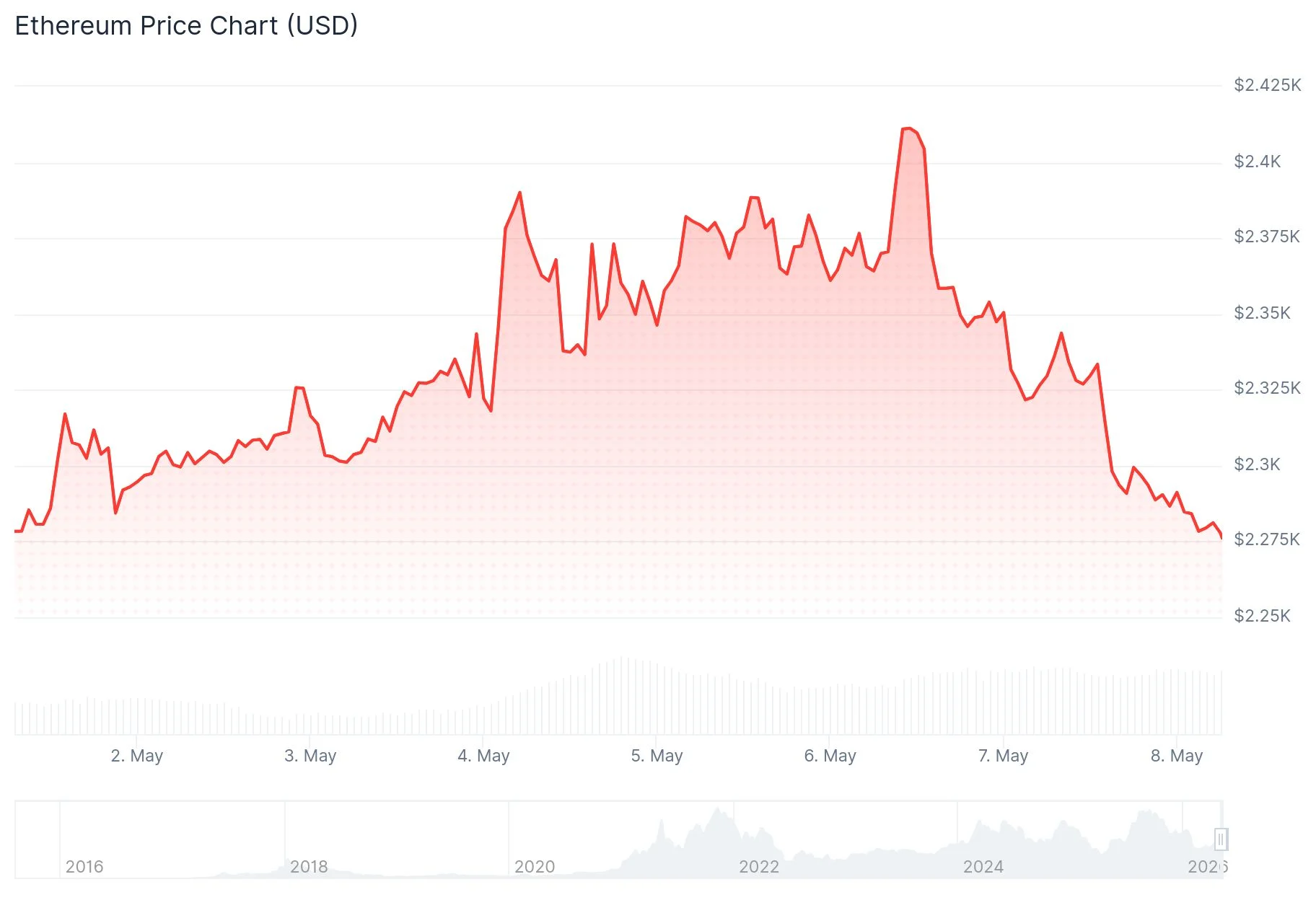
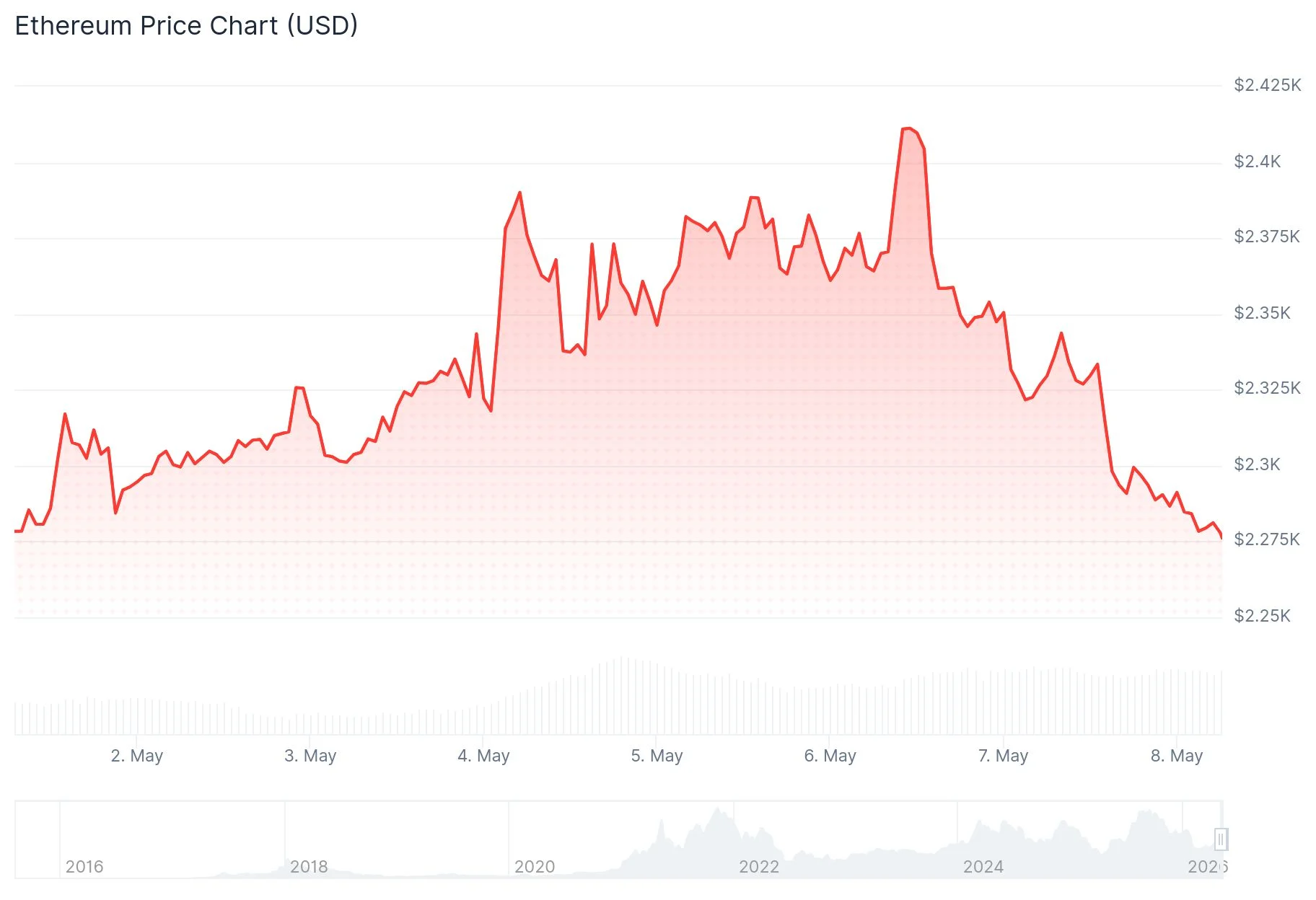
- ETH declined approximately 3%, currently trading between $2,280–$2,293
- Large holders transferred more than 63,000 ETH to Binance, signaling potential selloff
- Whale accumulation decreased 21.5% from October 2025 highs
- Open interest reached 14.85M ETH amid rapid short position expansion
- Market analyst Ted Pillows highlights insufficient spot demand weighing on ETH
Ethereum has experienced a nearly 3% decline over the last 24 hours, with current prices hovering around $2,280 as of this report. This downturn coincides with significant movements by major holders transferring their assets to trading platforms, typically signaling impending liquidation.
Blockchain analytics platform Lookonchain identified that an address associated with cryptocurrency asset manager Metalpha transferred 27,000 ETH, valued at approximately $62.78 million, to Binance. Another significant holder executed a separate transaction, moving 14,062 ETH worth $32.82 million to the identical platform during the same period.
These transactions came after Bitcoin veteran Garrett Jin deposited a massive 166,000 ETH to Binance on Wednesday, representing roughly $396 million in value. This series of substantial transfers has heightened market anxiety regarding additional downward price pressure.
Crypto analyst Ali Martinez highlighted an extended trend in large holder activity. Addresses containing between 1,000 and 10,000 ETH accumulated from 12.95 million coins in April 2025, reaching a maximum of 15.95 million by October 6, 2025. However, these holdings have since contracted to approximately 12.52 million ETH — representing a 21.5% reduction.
According to Martinez, Ethereum requires a “fresh wave of institutional or retail demand” to breach the $3,000 threshold.
Bearish Sentiment Dominates Derivatives Markets
Futures market indicators are revealing a distinctly pessimistic outlook. Open interest has surged to 14.85 million ETH — the highest level recorded since July of last year — despite concurrent price declines. This pattern, combined with negative funding rates, indicates an accelerating accumulation of bearish positions.
The 30-day moving average of Ethereum’s Net Taker Volume is approaching negative territory, suggesting that bearish traders are increasingly controlling futures market activity. Additionally, ETH saw $96.3 million in forced liquidations during the past day, with $89.1 million stemming from bullish positions.
Market analyst Ted Pillows shared his perspective on X, stating: “$ETH tried to hold above the $2,400 level again but failed. Spot demand is very weak, which is pushing Ethereum lower. Until that changes, ETH will continue to underperform the market.”
Critical Support and Resistance Zones
Technically, Ethereum maintains a position above its 50-day EMA at $2,262 but faces resistance from the 100-day EMA at $2,349. The Relative Strength Index hovers just beneath 50, while the Stochastic Oscillator trends downward toward 30.
Should ETH breach the $2,262 support level, additional downside targets emerge at $2,211, followed by $2,107. On the bullish side, clearing $2,388 would be necessary to challenge the $2,746 resistance zone.
The $2,300–$2,500 corridor has functioned as a distribution area throughout the past month, with smaller investors liquidating approximately 1.5 million ETH during the previous two weeks.

Crypto World
Michael Saylor says Strategy is turning Bitcoin into “digital credit” and “digital equity”


Michael Saylor says Strategy is “converting digital capital Bitcoin into digital credit (STRC) and digital equity (MSTR),” pitching a three‑layer capital stack with BTC as reserve asset, STRC as yield‑focused credit, and MSTR as the levered equity layer.
Summary
- Michael Saylor says Strategy is converting its Bitcoin “digital capital” into digital credit via STRC and digital equity via MSTR.
- STRC, a Bitcoin-backed perpetual preferred stock, has grown into an $8.5 billion “digital credit” product in under a year.
- The framework cements Strategy’s model: Bitcoin as reserve asset, STRC as yield-focused credit layer, and MSTR as leveraged equity tied to BTC upside.
Michael Saylor, founder and executive chairman of Bitcoin treasury company Strategy, said on X that the firm is “converting digital capital Bitcoin into digital credit (STRC) and digital equity (MSTR),” underscoring what he called a Bitcoin-centric capital market architecture. The post reiterates a theme Saylor has been pushing since his Bitcoin 2026 keynote, where he framed Bitcoin as “engineered capital,” STRC as a digital credit instrument built on that capital, and MSTR as the equity layer that absorbs the residual upside and volatility.
Bitcoin as capital, STRC as credit, MSTR as equity
At the Bitcoin 2026 conference, Saylor detailed Strategy’s three-layer model, with Bitcoin as layer-one digital capital, STRC as layer-two digital credit, and a range of yield and money products at layer three. “Digital credit is a killer application of digital capital. Every dollar that flows into digital credit will flow into digital capital,” he said, describing STRC as the credit layer built directly on top of Strategy’s BTC reserves.
STRC (ticker STRC), nicknamed “Stretch,” is Strategy’s variable-rate perpetual preferred stock backed by the company’s Bitcoin holdings and designed to trade near a $100 par value, according to the digital credit dashboard. Strategy manages STRC’s price stability by adjusting its monthly dividend rate and using an at-the-market (ATM) issuance program to sell new shares when they trade at or above $100, raising cash to buy more BTC and expand its reserve. In an April update, Saylor said STRC had reached $8.5 billion in assets under management in roughly nine months, making it “the world’s largest preferred stock” and targeting what he described as a $3.5 trillion private credit market.
In that same presentation, Saylor argued traditional private credit is “illiquid, opaque, discrete, and burdened with fees,” while “digital credit” such as STRC is “liquid, transparent, homogeneous, scalable, accessible, and carries no fee,” positioning the product as a structural fix to what he sees as misaligned incentives in legacy markets. KuCoin’s summary of the Bitcoin 2026 talk noted that STRC’s design channels Bitcoin’s capital returns into monthly income, with an 11% yield based on BTC’s 38% annualized return and a 5:1 collateral ratio intended to protect principal even if Bitcoin falls by 80%.
On the equity side, MSTR — Strategy’s common stock — functions as what Saylor calls “digital equity,” a leveraged claim on the firm’s expanding BTC treasury that captures the excess return from Bitcoin after servicing STRC’s coupon. A BitcoinTreasuries profile notes that Strategy now holds more than 800,000 BTC, and a recent digital credit overview frames MSTR as the equity layer sitting above STRC and other Bitcoin-backed preferreds. Yahoo Finance, in a separate report, estimated that roughly 85% of a recent $2.5 billion BTC purchase by Strategy was funded through STRC issuance, illustrating how the preferred stock has become the engine for scaling the company’s Bitcoin balance sheet.


The U.S. Department of the Treasury reportedly sent Binance a private letter pressing the exchange on compliance with its 2023 settlement duties.
Summary
- Treasury reportedly asked Binance for records and interviews tied to possible sanctions compliance concerns.
- Binance said it is giving the independent monitor “full cooperation and transparency” amid fresh scrutiny.
- U.S. attention on Iran-linked crypto flows has grown in recent weeks.
The request followed fresh claims that Iran-linked entities moved large sums through the platform. Bloomberg reported that Treasury sought employee interviews and records tied to possible sanctions violations.
The Information also reported that Treasury demanded Binance comply with the monitoring program imposed after its 2023 deal with U.S. authorities. That agreement followed anti-money laundering and sanctions cases that ended with large penalties and long-term oversight.
Binance says it is cooperating
Binance said it remains engaged with the monitor and U.S. agencies. The exchange said, “We welcome constructive feedback from the Treasury” and added that it is giving the monitor “full cooperation and transparency.”
The comments came after lawmakers raised questions about whether Binance had met the terms of its settlement. A February Senate letter asked Treasury and the DOJ to review Binance’s sanctions controls after reports tied the exchange to Iran-linked activity.
Additionally, Treasury’s 2023 settlement required Binance to pay billions in penalties and accept monitoring. FinCEN said its order imposed a five-year monitorship and required Binance to complete major compliance changes, including a full exit from the U.S. market.
The Treasury said the settlement gave officials access to Binance books, records, and systems for five years through a monitor. It also warned that failure to meet the obligations could expose Binance to more penalties, including a suspended $150 million penalty.
Iran-linked crypto claims widen the story
Related crypto.news coverage said internal data reviewed by the Financial Times showed 13 suspicious Binance accounts handled $1.7 billion in crypto, including about $144 million after the 2023 settlement. The report also said some wallets had links to funds later frozen over alleged Iran-backed activity.
This comes as U.S. enforcement around Iran-linked crypto flows grows. Crypto.news recently reported that the U.S. seized nearly $500 million in Iranian crypto assets, above a previously reported $344 million USDT freeze tied to Iran.
Binance’s monitoring issue also follows earlier reports that the exchange had sought an early end to a DOJ-appointed monitor. However, crypto.news noted that Binance also had a separate Treasury-linked monitorship through FinCEN, with no clear sign that this oversight was under the same review.
Solv Protocol said it will move more than $700 million in tokenized Bitcoin assets to Chainlink CCIP.
Summary
- Solv is moving $700M+ tokenized Bitcoin to Chainlink CCIP after reviewing bridge security risks carefully.
- Kelp DAO’s rsETH exploit pushed more protocols to question LayerZero-linked single-verifier bridge setups in DeFi.
- Aave’s recovery process continued as liquidations cleared attacker positions, but frozen Ether remains disputed legally.
The migration covers SolvBTC and xSolvBTC, which Solv uses across its Bitcoin finance products. The protocol said the decision followed an updated review of cross-chain systems and recent bridge hacks.
As part of the move, Solv will phase out LayerZero bridge support for Corn, Berachain, Rootstock, and TAC. Solv said Chainlink CCIP will become its official cross-chain infrastructure. Its CTO Will Wang said, “Security is the foundation of everything we build at Solv.”
Kelp DAO dispute puts bridges under watch
The move came after Kelp DAO said it would shift rsETH to Chainlink CCIP. The decision followed an April exploit that drained 116,500 rsETH from a LayerZero-powered bridge. Crypto.news reported that the stolen tokens later entered Aave v3 as collateral before parts of the funds were frozen.
The dispute between Kelp DAO and LayerZero remains unresolved. Kelp DAO claimed LayerZero approved the single-verifier setup later blamed for the attack.
LayerZero CEO Bryan Pellegrino rejected that account and said Kelp moved away from a default multi-verifier setup. Kelp also cited data showing many LayerZero apps used one verifier.
Aave recovery adds fresh market context
In a related update, crypto.news reported that Aave completed liquidation of the attacker’s final rsETH-backed positions on Ethereum and Arbitrum. Aave said the recovered collateral moved to Recovery Guardian, a multisig wallet controlled by DeFi United.
The recovery is not complete. Crypto.news reported that DeFi United still needs more support from Circle, Ethena, Frax, and Ink to restore rsETH backing. A separate legal dispute also covers 30,765 ETH, worth about $71 million, frozen by Arbitrum DAO after the exploit.
Bridge risk becomes the main story
The Solv migration adds to a wider shift in how DeFi projects review cross-chain infrastructure. OpenZeppelin said no public evidence showed a broken smart contract in the Kelp DAO case. It said the failure appeared tied to bridge operations and integration settings, not only deployed code.
That context makes Solv’s decision more than a vendor change. The protocol is moving a large tokenized Bitcoin stack at a time when users are asking how bridges verify messages and protect collateral. For Solv, the shift to Chainlink CCIP is now framed around reducing bridge exposure while keeping its Bitcoin products active across chains.
Solv did not directly blame LayerZero in its migration note. Instead, it pointed to security reviews and recent cross-chain incidents. That wording keeps the announcement focused on infrastructure choice, while the Kelp DAO dispute continues to shape the wider debate around cross-chain bridge design and user protection.


More layoffs swept across industries in early May 2026 as a fresh wave of firms announced job cuts.
Many of the cuts share a common driver. Companies are rebuilding around artificial intelligence (AI).
Cloudflare Announces Layoffs in May 2026
Cloudflare announced Thursday it would cut more than 1,100 jobs globally, about 20% of its 5,156-person workforce, as reported at the end of 2025. The firm revealed that internal AI usage increased by more than 600% in three months.
“We have to be intentional in how we architect our company for the agentic AI era in order to supercharge the value we deliver to our customers and to honor our mission to help build a better Internet for everyone, everywhere,” the email read.
On the same day, payments firm BILL said it would slash headcount by up to 30%. In addition, Upwork CEO Hayden Brown informed employees that the company would cut roughly a quarter of its workforce.
“We chose to take this step now for two reasons: (1) we know we move faster with smaller teams. Our 2024 layoff followed by excellent 2025 execution give us confidence this works. (2) To meet our profitability goals in a challenging environment,” Brown said.
Media reports also revealed that Ticketmaster has reportedly cut 8% of its global workforce, or roughly 350 employees across 25 countries.
Follow us on X to get the latest news as it happens
Earlier this week, Bloomberg reported that fintech firm PayPal plans to eliminate about 20% of its 23,800-person workforce over the next two to three years. That equals roughly 4,760 jobs.
“First, we will remove duplication and layers from our organizational structure. Second, we will accelerate our AI adoption and automation across our operations,” Chief Executive Enrique Lores told investors.
In the crypto sector, Coinbase announced Tuesday it would cut about 14% of staff, or roughly 700 employees. CEO Brian Armstrong framed the decision as a structural shift toward smaller, AI-augmented teams.
Notably, the cuts come as research finds little evidence of broad AI-driven job disruption at the moment. Economists still expect shifts ahead.
Subscribe to our YouTube channel to watch leaders and journalists provide expert insights
The post Layoffs Accelerate in May 2026 as Firms Restructure Around AI appeared first on BeInCrypto.


Coinbase Exchange faced a service outage for more than two hours after an Amazon Web Services problem disrupted parts of its platform.
Summary
- Coinbase Exchange reported degraded performance after AWS overheating disrupted trading access for some users overnight.
- Coinbase said funds remained safe, but some traders still faced failed access and transaction delays.
- Crypto.news previously covered similar AWS disruptions affecting Coinbase, Robinhood, MetaMask, and other major crypto platforms.
The exchange status page said some users could not transact on Exchange, while others faced slower service during the incident.
Coinbase later linked the disruption to an AWS outage and said its team was investigating. It also directed users to the AWS service status page for more information. The exchange told customers, “Your funds are safe,” as the trading disruption continued.
AWS data center issue drives the disruption
Reuters reported that AWS was working to restore normal temperatures at a North Virginia data center after overheating disrupted some services. AWS said a related power loss affected some hardware, and services tied to the affected facility could see service impairments.
AWS also said it shifted traffic away from the affected Availability Zone for most services. The company said it had made “incremental progress” in restoring cooling systems, but recovery had moved slower than expected.
Moreover, a related crypto.news report from October 2025 covered a separate AWS outage that left Coinbase users unable to access accounts or complete trades. That report also said AWS downtime reached other platforms, including Robinhood, Snapchat, Reddit, and Xbox Network.
Another crypto.news opinion article later said the 2025 AWS outage showed how many web3 services still depend on a few large cloud providers. The latest Coinbase disruption brings that question back into focus, even though the exchange said customer funds stayed safe.
Traders watch for full recovery
The main concern for users was access. During outages, traders may miss orders, face delayed execution, or lose the ability to manage open positions. Coinbase did not report a fund security issue on its status page during the incident.
The outage also raised fresh questions about how much major crypto platforms depend on centralized cloud infrastructure. Coinbase relies on live access for trading, account services, and order activity, so even short downtime can disrupt users during active market hours.
Coinbase has faced cloud-related disruption before. In November 2025, the company published a postmortem on an October AWS incident and said AWS failures had affected its ability to scale, monitor systems, and keep services available.
The Senate Banking Committee is reportedly preparing to formally schedule a markup session for the Clarity Act, according to Crypto In America host Eleanor Terrett.
The journalist reported the development on X, citing multiple industry sources familiar with the matter.
Senate Banking Committee Eyes Clarity Act Markup
Terrett revealed that the draft legislative text was shared with select industry members ahead of a possible committee vote on Thursday.
She noted that the bill’s language is reportedly still being finalized. Additional revisions are expected to incorporate priorities from Democratic lawmakers.
“One source told me the overall vibes after reviewing the bill and coordinating with other industry leaders are positive so far, though some bracketed sections are raising concerns that key provisions previously thought to be settled may still be in flux,” Terrett posted.
POLITICO separately reported that Senate Democrats at the negotiating table “are considering withholding support” unless the version the Senate Banking Committee will vote on later this month includes an ethics-related provision.
Subscribe to our YouTube channel to watch leaders and journalists provide expert insights
The Digital Asset Market Clarity Act passed the House in July. Yet, months of Senate stalemate followed.
Senators Thom Tillis and Angela Alsobrooks recently released a compromise on stablecoin yields. However, five US banking lobbies argued the text still falls short.
Bipartisan Voter Backing Adds Political Weight
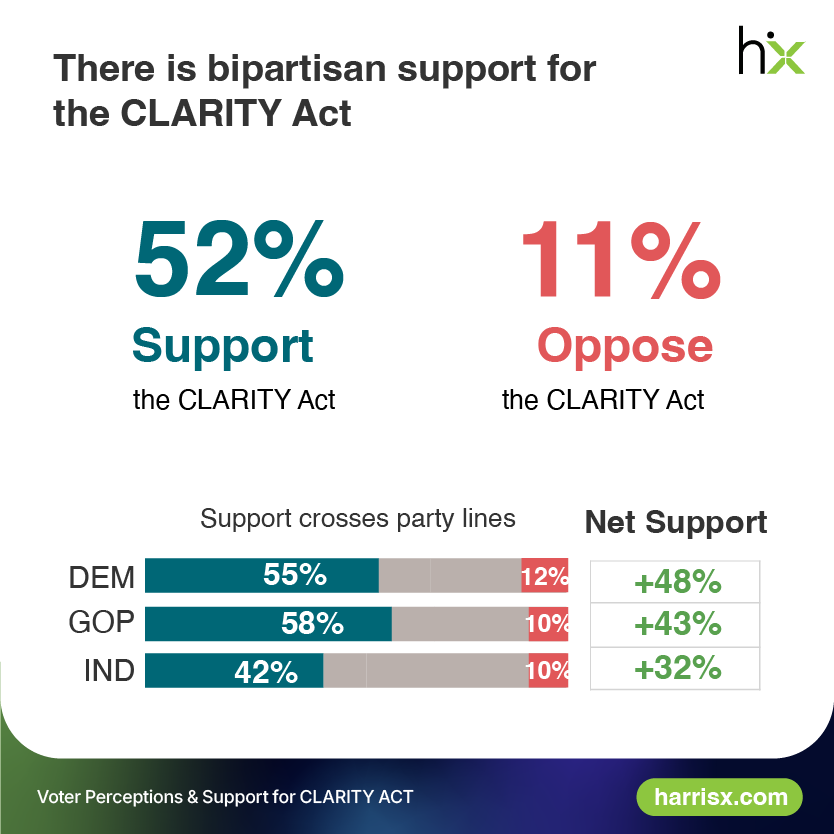
Meanwhile, a HarrisX national survey shows that 52% of voters support the bill, while 11% oppose it.
“Voters overwhelmingly favor clearer rules and consumer protections for digital assets,” the post read.
Follow us on X to get the latest news as it happens

The findings also suggest that lawmakers could gain political support by backing the legislation. Around 37% of voters said they would be more likely to support a senator who votes in favor of the bill.
Nearly 47% of respondents said they would consider voting across party lines. This figure climbs to 72% among cryptocurrency holders.
With broad, bipartisan voter support, lawmakers face growing political pressure to deliver. All eyes now turn to the markup and whether the bill can stay on course for the White House’s July 4 deadline.
The post CLARITY Act Markup Looms as 52% of Voters Back Crypto Legislation appeared first on BeInCrypto.


Coinbase revealed that some users are facing “degraded performance” on Thursday. The disruption follows an Amazon Web Services (AWS) data center in Northern Virginia overheating.
Follow us on X to get the latest news as it happens
The exchange flagged the issue around 6 p.m. Pacific time. Coinbase told customers their funds remained safe and pointed them to the AWS health dashboard for updates.
“This issue is related to a broader AWS outage. We’re monitoring closely and working to restore full service. We’ll continue to update. Your funds are safe,” Coinbase posted.
In a separate update, Coinbase pinpointed the disruption to a specific Availability Zone, use1-az4 in the AWS US-EAST-1 region, where temperatures had spiked. The exchange said it would re-enable trading shortly.
AWS said rising temperatures at a data centre in Northern Virginia disrupted some services. It stated that teams are continuing efforts to restore temperatures to normal levels in the Availability Zone (use1-az4) in the US-EAST-1 Region.
In a latest update, the cloud platform said it is seeing early signs of recovery, with additional cooling capacity allowing the team to recover some impacted racks. AWS added that it was working to recover the additional racks “in a controlled and safe manner.”
BeInCrypto has reached out to AWS for comment and will update this story with any response.
Subscribe to our YouTube channel to watch leaders and journalists provide expert insights
The post Coinbase Hit by Outage as AWS Issues Disrupt Trading appeared first on BeInCrypto.


The crypto industry’s embrace of AI is less about chatbots and more about building financial infrastructure for autonomous machines, says Chappy Asel, a former Apple engineer and founder of AI nonprofit The AI Collective.
Speaking at Consensus Miami, Asel, founder of The AI Collective, a global nonprofit AI community with more than 200,000 members across 150+ chapters, argued that as software agents increasingly make economic decisions on behalf of users and businesses, they will need payment systems capable of handling low-latency, programmable transactions at scale.
“When agents make the majority of financial decisions, economic decisions, how do they transact with each other?” Asel said during the panel. “You want them to be highly systematic, mechanistic. You want very small, micro transactions. You want very low latency.”
Asel, who previously worked on Apple’s Vision Pro and early Apple Intelligence efforts before launching The AI Collective, framed the convergence of crypto and AI through a practical lens.
“The number one thing that I’ve heard kind of throughout this conference… even my friends who only know about AI, they know nothing about blockchain, is they’ve heard about agentic payments,” he said.
Stablecoins already offer 24/7 settlement and smart contracts allow programmable execution. Marrying them together is the only logical way agentic payments — without a human in the middle — can become mainstream.
Still, the thesis remains early. AI agents are still nascent, and many companies today rely on centralized APIs and conventional payment systems. Attempts to build “agentic payments” infrastructure have so far generated little meaningful commercial activity, suggesting the narrative may be developing faster than actual demand.
Even if machine-to-machine commerce takes longer to materialize, Asel argued the broader overlap between crypto and AI may emerge elsewhere first.
“A lot of people will tell you, oh, it’s the models aren’t good enough,” Asel said. “It’s none of that. It’s literally compute, data centers, energy that is driving pretty much all decision-making in AI right now.”
That framing reflects a wider shift in the AI economy, where access to chips, power, and data center capacity is becoming the defining competitive advantage.
Parts of the crypto industry are already moving to capture that opportunity. Several bitcoin miners have spent the past year repositioning toward AI hosting and high-performance computing, betting that infrastructure originally built for mining can be repurposed for AI workloads.
For Asel, the practical advice for founders navigating the uncertainty was simple: experiment.
“When the world is more uncertain than it ever has been… things will only get crazier,” he said. “That warrants that you are spending more and more time playing around with the new technology.”
Crypto’s consumer adoption problem has always been partly a usability problem.
But AI agents do not need onboarding tutorials, aren’t intimidated by MetaMask, or need help remembering seed phrases. If autonomous software becomes a meaningful economic actor, crypto may have found a user base that actually thinks in code.

Regulatory scrutiny around Binance has intensified as reports emerge that the US Treasury privately insisted the crypto exchange adhere to an independent monitoring program established under a 2023 settlement with US authorities. The Information, citing internal communications, said the demand followed disclosures that funds potentially tied to Iran flowed through Binance, prompting renewed pressure from lawmakers and regulators to demonstrate ongoing compliance and effective controls. The episode arrives amid broader enforcement activity tied to Binance’s US and international operations and the evolving regulatory framework governing crypto firms.
Binance has publicly asserted its commitment to compliance, telling Cointelegraph it would cooperate with the independent monitor and maintain transparency as it strengthens anti-money-laundering and KYC controls. The remarks came as executive leadership faced renewed questions about governance and continued access to global liquidity for Binance.US, the firm’s U.S. affiliate, as authorities reassess cross-border oversight in the sector.
Key takeaways
- The US Treasury is reported to have privately required Binance to comply with a three-year independent monitoring program that was part of a 2023 settlement with Treasury and the Justice Department, according to The Information.
- The settlement in 2023 involved a $4.3 billion payment and established ongoing monitoring overseen by government officials; the new reporting emphasizes continued regulatory oversight even after the initial accord.
- Allegations that as much as $1 billion flowed through Binance to Iran-linked entities prompted renewed scrutiny and reports that Binance dismissed staff who flagged those transfers, underscoring enforcement focus on sanctions evasion risk.
- A group of US senators reportedly urged Treasury Secretary to detail Binance’s adherence to the 2023 settlement, reflecting legislative concern about compliance and sanctions enforcement within the industry.
- Binance’s response stressed cooperation with the monitor and ongoing collaboration with agencies, framing oversight as a mechanism to strengthen AML/KYC controls.
- Comments by former Binance CEO Changpeng Zhao at the Consensus conference in Miami highlighted his stance on leadership roles and broader liquidity considerations, while filings show legal actions related to the company’s AML regime in the 2023 settlement.
- Regulatory and geopolitical context remains volatile: Zhao’s legal exposure and the involvement of U.S. political figures intersect with cross-border policy developments, including potential implications for MiCA-era standards and cross-jurisdictional enforcement.
Regulatory oversight and monitoring obligations
According to The Information, the 2023 settlement between Binance, the US Treasury, and the US Department of Justice required Binance to operate under an independent monitoring program for a three-year period. The program was designed to assess and verify the firm’s compliance with sanctions, AML, and counter-terrorist financing obligations, with oversight to be conducted by government-appointed officials and an independent monitor. The reported private demand from the Treasury to continue strict adherence to that monitoring framework underscores the persistence of sanctions enforcement risk for large crypto platforms operating on a global scale.
The same reporting raises questions about the efficacy and reach of such monitors in a rapidly changing regulatory environment. The tied disclosures of a $4.3 billion settlement illustrate the scale of the settlement and the severity of expectations for ongoing compliance enforcement. For institutions and banks interacting with crypto entities, the situation reinforces the importance of robust due diligence, continuous monitoring, and clear line items in sanctions screening and AML/KYC programs to address cross-border risk, especially where sensitive jurisdictions are involved.
Beyond the financial penalties, the unfolding narrative includes congressional attention. A group of US senators reportedly urged Treasury Secretary to provide a formal update on Binance’s adherence to the 2023 settlement—the type of oversight activity that can influence licensing prospects, agency cooperation, and the perceived reliability of centralized exchanges in meeting U.S. regulatory standards. The reporting environment signals a tighter coupling between enforcement actions and regulatory transparency obligations for major crypto platforms.
Binance, for its part, emphasized cooperation with the monitor and with regulatory authorities. A spokesperson told Cointelegraph that the firm views oversight as an “important part of continuously strengthening our compliance and anti-money laundering controls,” and that Binance intends to provide the monitor with “full cooperation and transparency.” The emphasis on ongoing collaboration aligns with a broader regulatory expectation that major exchanges demonstrate verifiable compliance capabilities rather than relying solely on post hoc remediation.
Executive responses and leadership perspectives
The Information’s reporting on regulatory oversight coincided with Changpeng Zhao’s appearance at the Consensus conference in Miami. Zhao, who stepped down as Binance CEO in November 2023, has publicly signaled a cautious stance toward the future of leadership in the crypto sector. He told attendees that while he had been “trying to avoid” the United States, he did not rule out strategic moves to preserve user access to global liquidity, including the possibility of reviving Binance.US as a channel to maintain broader liquidity flows. He also rejected the notion of taking a leadership role at another crypto company, describing himself as a “one-trick pony.”
Legal and regulatory developments surrounding Zhao and Binance have continued to unfold through public filings and enforcement activity. Regulatory documents indicate Zhao pleaded guilty to a single felony charge related to failure to maintain an adequate anti-money-laundering regime at Binance as part of the 2023 settlement. While the specifics of the legal matter and its implications are subject to ongoing litigation and procedural developments, the admission underscores the lasting regulatory risk profile associated with major crypto exchanges and their executives.
Further complicating the public narrative is a report that Zhao’s ties to political and business developments have attracted attention beyond the U.S. regulatory sphere. In a separate thread of coverage, reports have highlighted high-profile investments and potential political entanglements that have, at times, intersected with regulatory discourse. The conversation around enforcement, leadership, and governance remains salient for institutional stakeholders evaluating exposure to exchange-level risk and compliance obligations.
Legal actions, enforcement context, and policy implications
The enforcement trajectory surrounding Binance encompasses a confluence of U.S. authorities, cross-border considerations, and internal governance decisions. The 2023 settlement’s legal framework—which included a substantial monetary penalty and the imposition of a monitoring regime—serves as a reference point for how authorities are likely to evaluate ongoing sanction compliance, AML controls, and corporate governance in the crypto sector. The reported guilty plea by Zhao, while tied to the same settlement, adds a personal accountability dimension to the broader regulatory narrative and may influence how future settlements are structured, disclosed, and monitored.
The regulatory cross-currents extend to policy conversations around market structure and licensing. In the European Union, developments tied to the Markets in Crypto-Assets Regulation (MiCA) are shaping standards for licensing, supervisory oversight, and cross-border enforcement. While the U.S. and EU frameworks differ in emphasis and approach, the underlying objective is consistent: ensure robust AML/KYC controls, transparent governance, and credible sanctions enforcement for entities operating in or with the crypto ecosystem. The Binance case thus sits at the intersection of ongoing U.S. enforcement initiatives and the broader global push toward harmonized, regulatorily coherent crypto markets.
The political dimension also factors into risk assessment. Reports of ties between Binance and high-profile political or business actors have fed scrutiny from lawmakers and regulatory observers. While investigators pursue specific regulatory obligations and sanctions compliance, the broader policy implication is clear: as enforcement actions evolve, institutions must weigh the implications for licensing trajectories, correspondent banking relationships, and the ability to provide compliant, regulated access to digital assets on a global scale.
For practitioners and compliance teams tracking regulatory developments, the key takeaway is that the Binance case illustrates a persistent demand for verifiable compliance evidence, continuous monitoring, and transparent remediation plans. The combination of a major settlement, a dedicated monitoring regime, and ongoing congressional engagement creates a framework in which crypto firms must demonstrate durable AML/KYC capabilities, rigorous sanctions screening, and governance that withstands scrutiny from multiple authorities across jurisdictions.
Closing perspective
The evolving narrative around Binance underscores the critical importance of verifiable compliance infrastructure for large crypto platforms operating on global rails. As regulatory expectations sharpen and enforcement tools expand, institutions should monitor not only the outcomes of specific investigations but also how monitoring, governance, and cross-border cooperation evolve within the broader policy environment. The next steps—clarity on monitoring outcomes, additional regulatory disclosures, and any potential licensing adjustments—will likely shape the credibility and resilience of major exchanges in a tightening regulatory landscape.
Notes and attribution: The reporting environment draws on The Information’s coverage of the Treasury’s posture toward Binance’s monitoring program, and on Cointelegraph’s reporting and coverage of Binance’s public statements and Zhao’s remarks at Consensus. For reference, The Information article is linked here, and Cointelegraph’s coverage is cited where relevant in ongoing updates.

Durham railway station set for spruce up after litter concerns
Wealthspire to Acquire $1.2 Billion Indianapolis Investment Advisory Firm

Ethereum (ETH) Slides Below $2,300 as Major Holders Offload 63K Coins

Manchester United reach agreement with Casemiro over contract clause amid transfer speculation

US brings back mandatory military draft registration

Steven Gerrard disagrees with Gary Neville over ‘shock’ Chelsea and Arsenal claim | Football


![BITCOIN: CRAZY!!!! THIS IS CRAZY!!!! [trades]](https://wordupnews.com/wp-content/uploads/2026/05/1778214197_maxresdefault-80x80.jpg)
-

 NewsBeat5 days ago
Channel 5 – All Creatures Great and Small series 7 new post
-

 Crypto World22 hours ago
Upbit adds B3 Korean won pair as Base token gains Korea access
-
 Tech6 days ago
Trump’s 25% EU auto tariff breaches Turnberry Agreement that also covers semiconductors and digital trade
-
 NewsBeat23 hours ago
NCP car park operator enters administration putting 340 UK sites at risk of closure
-
 Sports6 days ago
Paul Scholes issues Marcus Rashford reality check as agreement emerges over Man United star
-

 Entertainment6 days ago
Met Gala 2026 Rumored Guest List Is Turning Heads
-

 Entertainment6 days ago
Kylie Jenner Hit With Second Lawsuit From Ex-Housekeeper
-
Entertainment7 days ago
New on Prime Video in May 2026 — Full List of Movies and Shows
-

 Tech7 days ago
Meta ends Sama contract after Kenyan workers report seeing intimate footage from Ray-Ban smart glasses users
-

 Business7 days ago
Strait of Hormuz Blockade Persists Amid US-Iran Standoff, Sending Oil Prices Soaring
-

 Sports6 days ago
Cavaliers vs. Raptors Game 6 live score, updates, highlights from 2026 NBA playoffs first-round series
-
 Sports6 days ago
David Benavidez responds to team Canelo saying the fight will never happen
-
Entertainment5 days ago
New Netflix Movies in May 2026 — My Top 3 Picks to Stream
-

 Entertainment5 days ago
Melissa Joan Hart and More Stars Attend 2026 Kentucky Derby
-
 Sports6 days ago
IPL 2026: ‘Love you darling’- Hardik Pandya’s reaction to MS Dhoni steals the show |Watch | Cricket News
-

 Entertainment6 days ago
Young and the Restless Next Week: Cane Arrested & Matt’s Deadly New Scheme!
-

 Business5 days ago
Luka Doncic Injury Update: Doncic’s Hamstring Recovery Slows Lakers’ Hopes Against Thunder: Can He Run Yet?
-
 Crypto World5 days ago
Pi Network Mandates Protocol 23 Upgrade for All Mainnet Nodes Before May 15 Deadline
-

 Sports7 days ago
Bayern won’t hand bottom side Heidenheim ‘gifts’ despite PSG game
-

 Sports7 days ago
What Preity Zinta Said After Punjab Kings’ First Defeat Of IPL 2026
You must be logged in to post a comment Login