
Crypto World
Crypto-Funded Indiana GOP Primary Victory Signals Regulatory Push


A RepublicanUS House member running for reelection has secured his party’s nomination amid notable crypto-sector political spending. The Indiana race spotlighted growing ties between digital-asset interests and electoral politics as PACs targeted candidates with pro-crypto records.
According to NBC News, Representative James Baird won Tuesday’s Republican primary for Indiana House District 4 with more than 60% of the vote, defeating challenger Craig Haggard and others.
Federal Election Commission filings show that the Defend American Jobs political action committee, which is associated with crypto-oriented groups, spent about $514,000 on media to back Baird. The PAC is connected to Fairshake, a committee backed by crypto firms including Coinbase and Ripple that spent more than $130 million to influence the 2024 U.S. elections.
“Representative Baird has been a proven leader for pro-job, pro-consumer, and pro-innovation policies in Congress,” a Fairshake spokesperson told Cointelegraph before the primary. “We’re proud to support leaders committed to responsible regulation that ensures the US remains the global leader in innovation.”
Baird also received an endorsement from former President Donald Trump and reportedly thanked the President after the victory. The race occurs as lawmakers weighing crypto policy consider measures that intertwine with ethics provisions and regulatory oversight in the ongoing policy debate surrounding digital assets.
Fairshake, which reported holding $193 million as of January, is expected to spend millions more in the 2026 midterm elections to back crypto-friendly candidates and oppose what it views as anti-crypto politicians through media and advertising. As of Wednesday, the PAC and its affiliates had spent about $10 million on races in Illinois and Texas in 2026.
Key takeaways
- The Indiana primary outcome underscores active political financing from crypto-aligned groups aiming to influence policy through electoral support.
- FEC filings show the Defend American Jobs PAC spent roughly $514,000 on media to back Baird; its ties to Fairshake illustrate a broader ecosystem of industry-backed political activity.
- Pro-crypto lawmakers with a record of supportive legislation—such as the GENIUS stablecoin act and the CLARITY Act—benefit from targeted campaigns and endorsements in tight races.
- Regulatory discussions around stablecoins and market structure—including a finalized compromise on stablecoin yield—could shape future licensing, supervision, and cross-border compliance.
- The evolving policy landscape has direct implications for exchanges, banks, issuers, and institutional investors seeking regulatory clarity and enforceable standards.
Political financing and crypto policy signals
The Indiana race illustrates how crypto-affiliated groups are channeling resources into media to support candidates who align with industry interests. The Defend American Jobs PAC—the entity associated with Fairshake—spent about half a million dollars to advocate for Baird, highlighting a coordinated approach to candidate selection in a landscape where regulatory outcomes may impact business models, custody relations, and licensing pathways for crypto firms.
Fairshake’s involvement is notable not only for the amounts reported but also for its broader scope. The committee, backed by major crypto participants such as Coinbase and Ripple, spent more than $130 million during the 2024 elections and has signaled intent to deploy substantial resources in the 2026 midterms to promote “pro-crypto” candidates and oppose policies deemed unfriendly to the industry. As of January, Fairshake indicated it held $193 million in reserves, with recent disclosures showing continued activity in state and federal races, including tens of millions in ongoing cycles across multiple states. These dynamics underscore how political action committees with industry ties aim to influence regulatory dialogues as bills move through Congress.
A Fairshake representative framed Baird as a pro-job, pro-consumer, and pro-innovation policymaker, stressing a belief that constructive regulation will keep the United States at the forefront of innovation. The alignment between industry-backed political funding and legislative support for crypto-friendly bills—such as measures enabling innovative financial services while addressing risk—reflects a broader strategy to shape the regulatory environment ahead of potential sanctions, licensing regimes, and banking access decisions for crypto firms.
Stablecoin yield compromise and the regulatory path forward
In a parallel development, U.S. senators have signaled progress on the policy framework around stablecoins through a compromise embedded in the CLARITY Act. Senators Thom Tillis and Angela Alsobrooks announced they had finalized the text to incorporate a stablecoin yield compromise that addresses concerns within both the banking and crypto sectors. This adjustment is viewed as a potential catalyst for reviving stalled momentum on the broader market structure bill by clarifying how stablecoins fit within existing regulatory paradigms for payment, settlement, and asset custody.
Industry observers note that while a markup date has not yet been set by the Senate Banking Committee, the yield compromise may help bridge differences and accelerate consideration of the market structure legislation. A unified framework for stablecoins—encompassing issuance, reserve adequacy, yield mechanics, disclosure, and supervisory oversight—could affect issuers, custodians, exchanges, and on-ramps, with implications for compliance programs, AML/KYC controls, and cross-border operations. The policy shift also carries practical consequences for institutions seeking banking relationships and access to liquidity pools, as well as for investors evaluating risk management and capital adequacy in stablecoin-related activities.
These developments resonate beyond the United States, intersecting with global policy conversations on stablecoins and digital-asset regulation. While the EU’s MiCA framework advances alternative regulatory models, U.S. alignment or divergence in stablecoin treatment and market structure could influence cross-border compliance strategies and operational resilience for multinational firms operating in both markets. Authorities are considering enforcement priorities and licensing standards that would harmonize disclosure, governance, and risk management requirements across platforms and intermediaries.
Regulatory and institutional implications for market participants
The convergence of political financing, congressional consideration of crypto-friendly legislation, and a negotiated approach to stablecoin yield injects a degree of regulatory clarity into an otherwise unsettled environment. For regulated entities—exchanges, banks, and issuers—the evolving policy landscape translates into concrete compliance considerations: licensing timelines, custodial standards, capital and liquidity requirements, and enhanced consumer protections. In practice, firms must monitor not only legislative text but also the ethical and governance provisions that may accompany major crypto bills, given ongoing scrutiny of industry lobbying and campaign contributions.
Analysts note that the eventual shape of the CLARITY Act, including any stablecoin yield provisions, could influence how traditional financial institutions engage with crypto partners, impact stablecoin reserve management practices, and determine the degree of federal oversight applied to stablecoin products and associated yield offers. The policy path may also shape enforcement priorities among the SEC, CFTC, and DOJ, as well as how regulators coordinate with other agencies on cross-border settlement and anti-money-laundering frameworks. In parallel, a continued emphasis on ethics provisions in crypto-related legislation may affect how policymakers approach disclosures, campaign finance rules, and the permissible contours of industry influence in elections.
Closing perspective
As midterm dynamics unfold, the intersection of campaign finance, regulatory reform, and stablecoin policy will shape the trajectory of institutional engagement with crypto markets. Observers should watch for the CLARITY Act’s final form, potential markup schedules, and the broader market structure bill’s progress, all of which will influence compliance programs, licensing strategies, and risk management for banks, exchanges, and crypto issuers in 2026 and beyond.

Representative James Baird won the Republican primary for Indiana’s 4th Congressional District, keeping his reelection campaign on track before the 2026 midterms.
Summary
- Baird won Indiana’s Republican primary after crypto-linked PAC Defend American Jobs spent heavily supporting him.
- Fairshake’s political network is targeting 2026 races to support candidates backing crypto market rules.
- The victory comes as lawmakers debate the CLARITY Act and stablecoin yield rules in Washington.
Decision Desk HQ data showed Baird ahead with 35,805 votes, or 60.28%, while Craig Haggard had 18,256 votes, or 30.73%. John Piper followed with 5,340 votes.
The race drew attention from the crypto sector because Baird received support from Defend American Jobs, a political action committee linked to Fairshake. Crypto.news reported that the PAC spent about $514,000 on media buys to support Baird before the Indiana primary.
Crypto PAC money enters the race
Defend American Jobs backed Baird after he supported crypto-related legislation in Congress. Crypto.news reported that Stand With Crypto rated him as strongly supportive of digital assets after his votes on the GENIUS Act and the CLARITY Act.
Fairshake has become one of the most active crypto-funded groups in U.S. politics. A Fairshake spokesperson said, “Representative Baird has been a proven leader for pro-job, pro-consumer, and pro-innovation policies in Congress.” The group said it supports candidates who back responsible digital asset regulation.
Meanwhile, the Indiana result comes as crypto groups prepare for a larger role in the 2026 midterm elections. Crypto.news reported that Fairshake and AI-focused PACs have already deployed more than $100 million into midterm races.
At the same time, public trust remains mixed. A Public First poll cited by crypto.news found that 45% of Americans viewed crypto investing as too risky. The same report said 44% of respondents believed AI was moving too fast.
Baird also received an endorsement from Donald Trump. AP reported that Trump-backed candidates performed strongly in several Indiana Republican races, showing how national political spending and endorsements shaped local contests.
CLARITY Act debate stays in focus
Baird’s win comes as Congress weighs digital asset rules, including the CLARITY Act. Crypto.news reported that Senators Thom Tillis and Angela Alsobrooks reached a compromise on stablecoin yield, but banking groups later pushed back against the text.
The compromise would block passive stablecoin yield that acts like bank interest while allowing rewards linked to platform activity. Crypto firms see the deal as a possible path for the bill, while banking groups argue it still leaves room for deposit outflows.
The Indiana primary shows how crypto policy has become part of campaign strategy. Baird’s win gives the sector another preferred candidate heading into November, while the stablecoin and market structure debates continue in Washington.

Stablecoins are more likely to go mainstream if adopted by major technology companies, a shift Bitwise says could help push the market closer to a projected $4 trillion by the end of the decade.
Bitwise chief investment officer Matt Hougan said on Tuesday that DoorDash and Meta’s recent use of stablecoins for payments in limited projects is likely “the real killer app of stablecoins.”
“On a relative basis, these are not a big deal. Both are pilot projects and the dollar amounts are small,” Hougan wrote. “But they’ve answered a question I’ve had about stablecoins for a long time. They’ve also increased my confidence that stablecoins will scale to trillions in assets and hundreds of millions of users.”
Multiple large non-crypto institutions have been testing stablecoin technology. Meta on Thursday launched stablecoin payouts for creators in the Philippines and Colombia, while the food delivery app DoorDash said on April 21 it would offer stablecoin payments to its users, workers and merchants.
The market value of all stablecoins is currently just under $318 billion, but Hougan said projections, such as one from Citigroup in September, say the market could grow to $4 trillion by 2030 in a best-case scenario.

Matt Hougan, pictured at Bitcoin 2026. Source: YouTube
“To get there, stablecoins will have to expand beyond their current primary use case of crypto trading and be embraced for everyday activity, like payments,” Hougan said. “To really scale to hundreds of millions of users, stablecoins are going to need the support of very large players.”
He said that the current pitch to businesses about stablecoins is that they are cheaper and faster, but another main reason multinational companies would adopt the technology is to simplify their global payments infrastructure.
Related: Stablecoin firms have a $112B additional opportunity in LATAM remittance
“Stablecoins make global payments simple,” he argued. “One wallet address, no banking infrastructure, no currency conversions. For a global business managing millions of micropayments, that type of simplicity is worth a lot.”
Companies in the US have been more confident in testing stablecoins after Congress passed the GENIUS Act last year, a bill regulating stablecoin issuers and forming a framework for how the tokens should be backed.
Visa is among the companies that have adopted stablecoins, and the payments giant expanded its pilot of the tokens on Thursday to include five more blockchains as the volume of settlements on its stablecoin settlement network has grown.
US banks have meanwhile grown wary of stablecoins and have lobbied to restrict them, arguing they compete with and threaten bank deposits, which could harm the banking system.
The Senate is shaping legislation outlining how crypto will be regulated, which currently includes a clause banning platforms such as crypto exchanges from paying rewards on idle stablecoin holdings, but allowing other forms of rewards.
However, banking groups on Tuesday argued the clause that lawmakers pitched as a compromise between crypto and banking lobbyists’ interests, did not go far enough.
Magazine: GENIUS Act reopens the door for a Meta stablecoin, but will it work?
The largest cryptocurrency exchange in South Korea continues to list some smaller altcoins, which almost guarantees an immediate price uptick with double or even triple digits, such as today’s example.
Upbit announced hours ago that it plans to list Base (B3) in a trading pair against the Korean won, as cited by popular blockchain journalist Wu Blockchain.
Upbit to List B3 Korean Won Trading Pair
Upbit, South Korea’s largest crypto exchange, will list the B3 Korean won trading pair, with trading set to begin at 13:45 local time on May 7. B3 is a layer-3 blockchain built on Base, an Ethereum layer-2 blockchain, and uses the OP… pic.twitter.com/xCCrAC0TMl
— Wu Blockchain (@WuBlockchain) May 7, 2026
B3’s price reacted immediately, skyrocketing by over 300% from bottom to top. It stood at around $0.0005 earlier today before the announcement went viral on social media, before it exploded to $0.0022. It has since retraced to $0.0016, but it’s still up by 280% on a 24-hour scale.

Base (B3) is a layer 3 blockchain settlement layer built on the Coinbase-related Base network. It’s designed to improve on-chain gaming and consumer applications through its Open Gaming ecosystem.
It focuses on providing sub-cent transaction fees and high throughput, which should be the cornerstone of making blockchain gaming more accessible and scalable.
As mentioned above, Upbit listings have almost always led to instant price pumps for the underlying assets, even for larger caps. In March, ICP rocketed by 16% in minutes after the exchange listed it.
Shortly after, ETHFI posted an 18% surge, while some smaller altcoins, such as POKT and LPT, had soared by 350% and 80%, respectively, following their listings.
The post Viral Layer-3 Altcoin Rockets 300% After Major Upbit Listing appeared first on CryptoPotato.
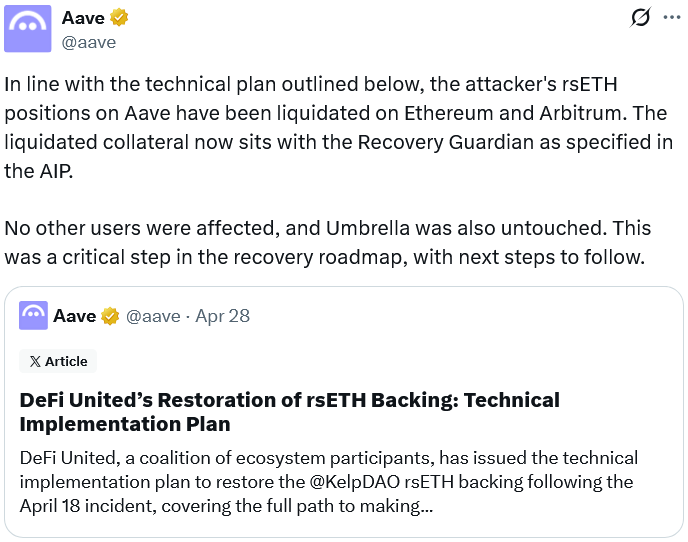
Aave Labs has liquidated the Kelp DAO attacker’s remaining rsETH positions on Ethereum and Arbitrum, moving one step closer to fully restoring rsETH backing and compensating affected users.
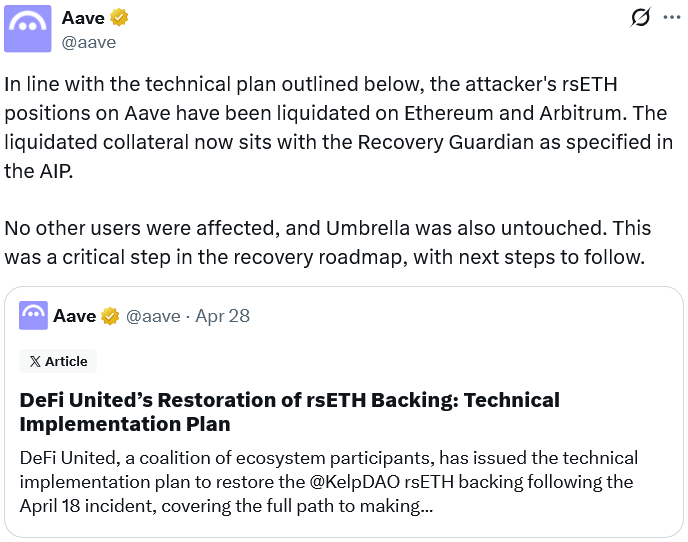
This marks a “critical step” in the “DeFi United” recovery plan, Aave posted on X on Wednesday. It added that the liquidated collateral tied to the $293 million exploit on April 18 was transferred to Recovery Guardian, a multisignature wallet managed by DeFi United.
DeFi United is now only about 10% short of the Ether (ETH) needed to restore the Kelp DAO restaked ETH (rsETH) token, according to Thaddeus Pinakiewicz, vice president of Galaxy Digital’s research team.
The Kelp DAO exploit has been one of the most devastating crypto hacks in 2026, causing a ripple effect throughout the DeFi lending market that disrupted billions of dollars in liquidity and eroded confidence across the ecosystem.
Aave said user funds weren’t affected by the liquidations and that Aave’s insurance mechanism to provide automated protection against bad debt — Umbrella — wasn’t used.
Source: Aave
Aave said on April 28 that clearing up the hacker’s collateral on Ethereum and Arbitrum would release 13,000 Ether worth nearly $30.2 million at current prices.
Pinakiewicz, however, noted that there is another 30,765 ETH frozen by Arbitrum DAO that is in “legal limbo” after US law firm, Gerstein Harrow LLP, filed a restraining notice on Friday to prevent Arbitrum DAO from redistributing the frozen ETH. In response, Aave filed an emergency motion to vacate that restraining notice.
Meanwhile, members of Arbitrum DAO are still voting on whether to release the frozen ETH to the DeFi United fund, with over 90% of voters in favor of the proposal. Voting set to close on Friday.
Related: Three reasons why Ether price rallies fizzle near $2.4K
DeFi United is also awaiting commitments from stablecoin issuers Circle, Ethena and Frax, as well as Kraken-built Ethereum layer 2 Ink.
Aave needs these commitments to “get it over the line and plug the hole,” Pinakiewicz said.
Aave’s TVL bleeding has stopped
Aave was hit hard by the Kelp DAO exploit, with its total value locked falling by nearly $12 billion in a week after the hacker put the stolen rsETH tokens up as collateral on its lending platform to borrow wrapped Ether, leaving more than $190 million in bad debt and triggering a wave of withdrawals.
DefiLlama data shows that net outflows from Aave’s lending markets have eased over the past week, with the protocol’s total value locked increasing from a local low of $14.2 billion on April 26 to back above the $15 billion mark.
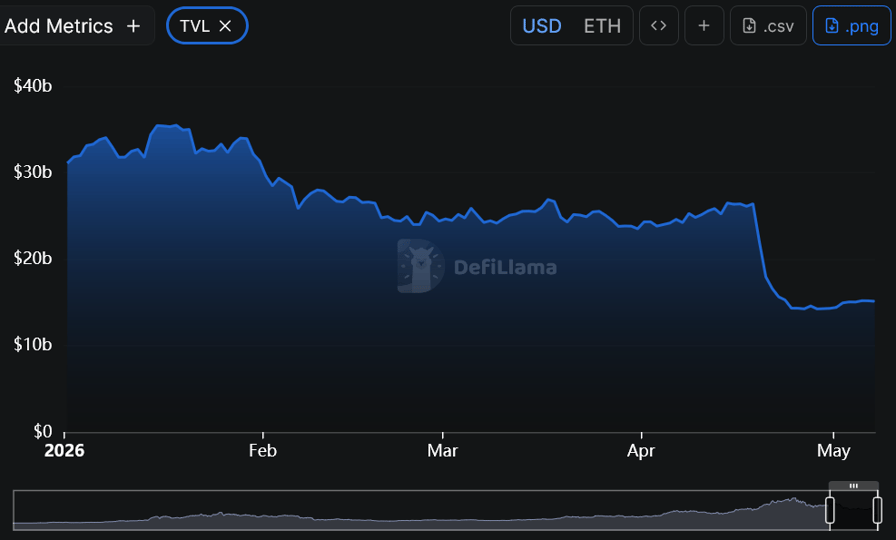
Aave’s change in TVL in 2026. Source: DefiLlama
Magazine: AI-driven hacks could kill DeFi — unless projects act now


Grayscale Investments has disclosed the new component weightings for its multi-asset funds as part of the Q1 2026 rebalancing.
The asset manager has removed Aerodrome Finance (AERO) entirely from its Decentralized Finance (DeFi) Fund and added Ethena (ENA) at a 13.59% weight.
Grayscale Drops AERO From DeFi Fund, Adds ENA in Q1 Rebalance
According to the press release, Grayscale funded the ENA purchase by selling AERO and other existing components proportionally.
AERO held a 5.36% weight before its full removal, ending its position in Grayscale’s flagship DeFi product. The altcoin was added during the Q3 2025 rebalancing and replaced MakerDAO (MKR).
“The compositions of DEFG Fund and GSC Fund are evaluated on a quarterly basis to remove existing Fund Components or to include new Fund Components, in accordance with the index methodologies established by the Index Provider. Holdings and weightings of each Fund are subject to change. Investors cannot directly invest in an index,” the asset manager stated.
Follow us on X to get the latest news as it happens
Meanwhile, Ondo (ONDO) recorded the biggest gain among retained holdings, climbing from 14.10% to 19.83%. Uniswap’s (UNI) dominance shrank during the quarter.
UNI fell from 42.67% to 35.22%, though it remains the fund’s largest single holding. Aave’s (AAVE) weighting also declined, dropping from 26.23% to 21.36%.
Ethereum Reclaims Top Spot in Smart Contract Fund
Grayscale’s Smart Contract Fund (GSC) saw a notable shift between Ethereum (ETH) and Solana (SOL). ETH moved back to the top weighting at 30.14%, edging SOL at 29.69%.
In January, SOL held the top spot at 29.55%, while ETH was at 29.00%. The reversal played out over a single quarter, with ETH gaining roughly 1.14 percentage points.
Other GSC components saw smaller moves. Cardano (ADA) slipped from 18.55% to 17.96%. In contrast, Sui (SUI) lost the most ground, dropping from 8.55% to 7.11%.
Subscribe to our YouTube channel to watch leaders and journalists provide expert insights
The post Grayscale Cuts a DeFi Token From Its Fund as a New One Takes Over appeared first on BeInCrypto.


BNY, the world’s largest custodian overseeing $59 trillion of assets, is expanding its digital asset custody business to the United Arab Emirates through local partners.
According to a Thursday press release, the global financial services giant is working with Finstreet and ADI Foundation to build regulated digital asset infrastructure anchored in Abu Dhabi Global Market (ADGM), the financial free zone in Abu Dhabi that has become a hub for crypto firms and blockchain projects entering the Middle East region.
The initiative will initially focus on custody services for cryptocurrencies including bitcoin and ether (ETH), with plans to later expand into stablecoins and tokenized assets, the press release said.
“The UAE is entering a new phase of financial development, characterized by deeper markets, greater digital sophistication and stronger global connectivity,” Hani Kablawi, executive vice chair at BNY, said in a statement. “With our world-class capabilities and scale across capital markets, BNY is uniquely positioned to connect traditional and digital financial ecosystems in collaboration with our clients.”
BNY’s move reflects a broader push by major financial institutions to bring blockchain technology into mainstream markets beyond crypto trading. Tokenization — the process of representing assets such as bonds, funds and equities on blockchain networks — is gaining traction as firms look for faster settlement, more efficient collateral management and lower operational costs.
The bank’s entry into the UAE also highlights how quickly the Gulf region is emerging as a center for digital asset finance. Abu Dhabi and Dubai have attracted crypto exchanges, stablecoin issuers and tokenization startups with regulatory frameworks designed to support digital assets while maintaining institutional oversight.
BNY’s involvement carries added weight because of the bank’s scale and role in traditional finance. The firm oversees about $59 trillion in assets under custody and administration, making it the world’s largest custodian bank, and was the first major U.S. global systemically important bank to launch digital asset custody services.
The UAE has also pushed deeper into state-backed digital finance initiatives. IHC and other local institutions recently unveiled plans last month for a regulated dirham-backed stablecoin aimed at government and institutional use.
Read more: BNY CEO says the future of crypto runs through big banks

Consensus Miami 2026 officially kicked off with a wave of major announcements across crypto infrastructure, stablecoins, tokenization, payments, AI, and blockchain compliance, reinforcing the industry’s continued push toward institutional adoption and real-world utility.
Several leading companies used Day 1 of the event to unveil new partnerships, acquisitions, and infrastructure initiatives aimed at shaping the next phase of digital assets and decentralized finance.
Bullish Announces $4.2 Billion Equiniti Acquisition
One of the largest announcements came from Bullish, which revealed plans to acquire global transfer agent Equiniti in a transaction valued at approximately $4.2 billion.
The deal aims to position Bullish as a major player in tokenized securities infrastructure and blockchain-native capital markets. The acquisition would combine traditional shareholder services with digital asset infrastructure, signaling increasing convergence between legacy finance and blockchain technology.
According to the announcement, the combined business intends to build infrastructure designed for tokenized equities and digital ownership management at institutional scale.
Kraken and MoneyGram Expand Crypto Cash Access Globally
Kraken and MoneyGram announced a strategic partnership designed to improve global crypto-to-cash accessibility.
The collaboration will allow Kraken users to convert digital assets into fiat currencies through MoneyGram’s international cash pickup network spanning more than 100 countries.
The move highlights growing demand for practical crypto off-ramp solutions as adoption continues expanding across emerging and developed markets alike.
Sumsub and Chainlink Launch Cross-Chain Identity Infrastructure
Compliance and identity verification remained another major theme during Day 1.
Sumsub announced a partnership with Chainlink to support privacy-preserving identity verification across multiple blockchain ecosystems.
The initiative integrates Sumsub’s KYC infrastructure with Chainlink’s Automated Compliance Engine (ACE), enabling reusable identity credentials across networks including Ethereum, Arbitrum, Avalanche, Polygon, and Base.
The solution aims to help institutional and retail participants access compliant on-chain financial services without repeatedly submitting verification information across different platforms.
OwlTing Introduces AI Agent Wallet Infrastructure
Nasdaq-listed OwlTing Group unveiled a self-custody wallet designed specifically for AI agents.
The new platform, called OwlPay Wallet Pro for Agents, is designed to allow AI assistants to manage stablecoins and execute blockchain-based transactions on behalf of users.
The company positioned the product as infrastructure for the emerging “agentic commerce” economy, where autonomous AI systems increasingly interact with financial services and payment networks.
GoMining Expands Bitcoin Utility Initiatives
GoMining made multiple announcements during the event, including plans to integrate with Babylon Labs and the launch of GoBTC.
The Babylon integration aims to enable Bitcoin holders to earn mining rewards through trustless vault infrastructure without giving up custody of their BTC.
Meanwhile, GoBTC was introduced as a payment-focused protocol intended to support instant Bitcoin transactions directly on Bitcoin’s base layer. The company stated that the protocol is designed to reduce settlement times and lower merchant processing costs compared to traditional payment systems.
Stablecoin Infrastructure Continues Expanding
Several announcements throughout the day highlighted continued momentum around stablecoin infrastructure and real-world payment adoption.
Figo launched a stablecoin-powered USD payments platform operating across more than 50 countries, targeting emerging markets where access to dollar-based financial infrastructure remains limited.
Meanwhile, Bamboo Block announced plans to accelerate stablecoin payment adoption among U.S. community banks ahead of expected regulatory developments surrounding the GENIUS Act.
Solana Trading Infrastructure Evolves
Jito Labs introduced JTX, a self-custodial trading platform built for advanced Solana traders.
The platform aims to bring professional-grade order execution and centralized exchange-style trading functionality directly on-chain while maintaining user custody of assets.
The announcement reflects growing competition among blockchain ecosystems to attract more sophisticated trading activity and institutional participation.
Consensus Miami Reflects Growing Institutional Momentum
Day 1 of Consensus Miami demonstrated how quickly the crypto industry is evolving beyond speculative trading into broader infrastructure, compliance, payments, tokenization, and enterprise applications.
Themes such as real-world assets, stablecoins, AI integration, institutional compliance, and blockchain-based financial infrastructure dominated many of the announcements across the event.
As Consensus Miami continues throughout the week, additional announcements and partnerships are expected from major players across the digital asset ecosystem.
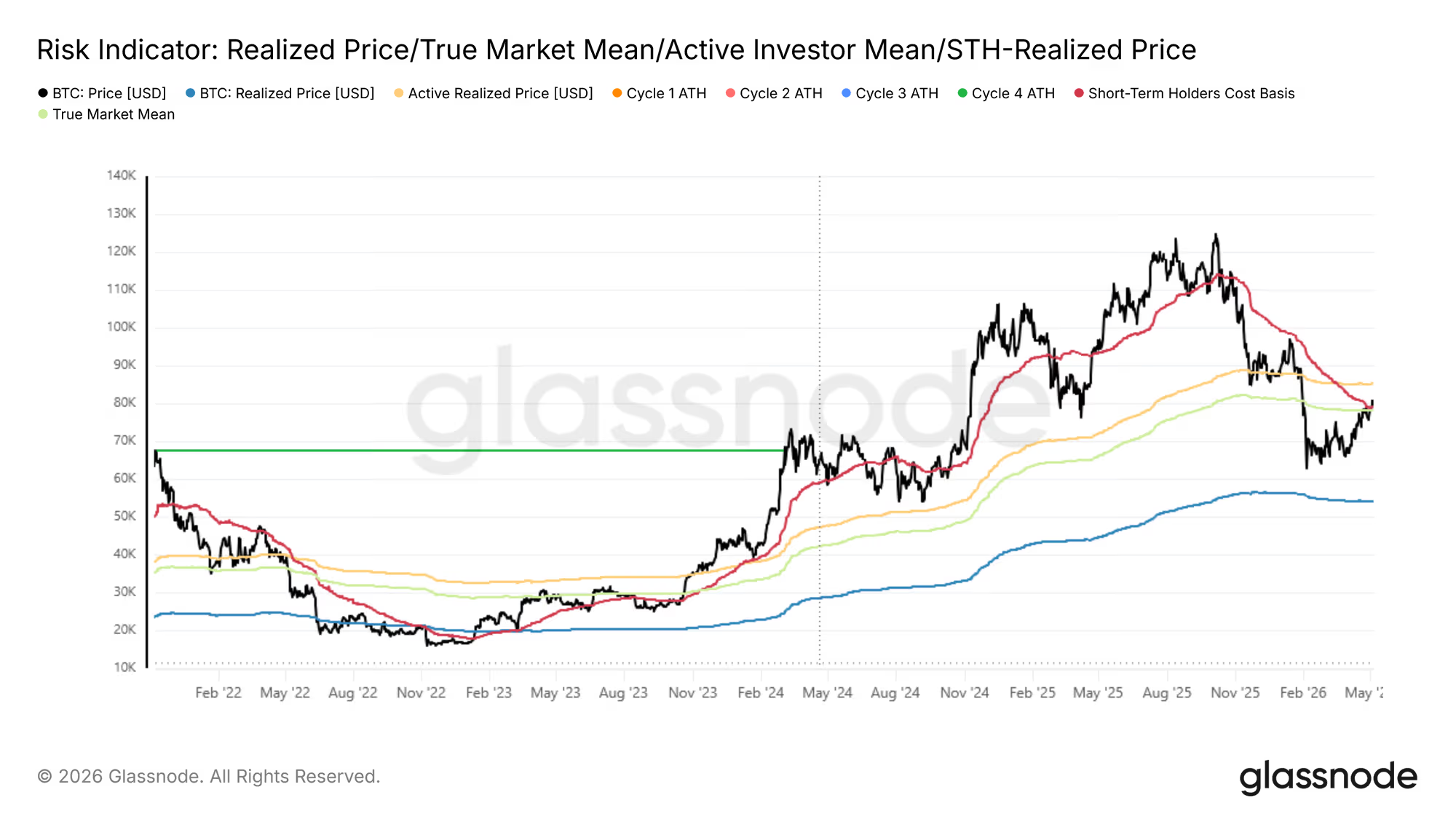
Bitcoin , the world’s largest digital asset by market value, has risen from roughly $63,000 to over $80,000 in the past three months, according to CoinDesk market data. And key signals that professionals watch closely are now all pointing in the same direction: $85,000.
The rally is not just about price, but about the ripples beneath the surface.
On-chain dynamics
Further gains look likely because bitcoin has topped two levels that on-chain analysts consider among the most important in the market: The True Market Mean at $78,200 and the Short-Term Holder Cost Basis at $79,100.

Here is why those numbers matter. The True Market Mean is the average price active bitcoin investors paid for the coins they currently hold. The metric doesn’t count every bitcoin ever mined, including those sitting dormant for years or lost, but focuses on coins that are actually changing hands between investors.
That makes it a cleaner estimate of the level that matters most to people that are active in the market. When bitcoin trades above it, most active investors are in profit, and when it falls below it, many are underwater. That’s why analysts use it to gauge sentiment, spot periods of market stress or euphoria, and identify potential mean-reversion zones.
Speaking of the short-term holder cost basis, it represents the average acquisition cost for people who acquired coins less than six months ago. Again, this tells us the price that matters to traders, not long-term dormant holders.
Hence, when the spot price breaks above both these levels, it is said to reflect a bullish outlook.
“Should price sustain above these two levels in the coming week, the deep value regime that persisted from early February 2026 through now would rank among the shortest episodes of its kind in Bitcoin market history,” analysts at research firm Glassnode said in a report.
“Attention now shifts to the next major resistance at the Active Realized Price near $85.2k, which tracks the cost basis of all non-dormant supply and represents the next structural threshold the market must reckon with,” they added.
As of writing, bitcoin traded near $80,800, well above the true market mean and the short-term holder cost levels.
Futures market flows
A subtle shift is underway in the futures market that could help push bitcoin higher.
The signal comes from funding rates, the small recurring payments traders make to keep leveraged futures bets open. For most of the past three months, funding rates were negative, indicating unusually heavy demand to bet against bitcoin in futures markets.
Much of that activity likely came from hedge funds and institutional traders running a popular arbitrage strategy: buying bitcoin or spot bitcoin ETFs while simultaneously shorting futures contracts. That trade created steady selling pressure in the futures market even as bitcoin rallied.
Now, funding rates have flipped back to neutral or slightly positive. That suggests many of those short positions have already been closed, removing a key source of downward pressure on the market.
It also raises the possibility of a short squeeze. If bitcoin continues rising, traders still betting against it may be forced (squeezed) to buy back futures contracts to exit their positions, which can accelerate gains.
“The flip toward neutral doesn’t invalidate the carry trade; it indicates that shorts paying for the privilege are no longer present at scale. Either funding migrates back negative as new ETF capital recreates the trade or the squeeze has further to run,” analysts at OG exchange Bitfinex said, explaining potential for more gains ahead.
Options dynamics
The third signal comes from the options market, where traders use contracts to position for or protect against price moves. Calls are bullish bets that give upside exposure if bitcoin rises, while puts are used as insurance against downside risk.
Options positioning is now set up in a way that could amplify the current move higher.
Market makers, the firms that provide market liquidity, have what’s known as “short gamma” exposure around the $82,000 level, with roughly $2 billion sitting near current prices, according to Glassnode.
Short gamma matters because it forces these dealers to hedge in the direction of the prevailing trend, which is bullish, to stay balanced.
In practice, that means as bitcoin pushes higher, dealer hedging itself can add incremental buying pressure, potentially accelerating the rally toward $85,000. Market makers make money by providing liquidity, meaning they try to stay neutral on price direction rather than betting on it.
But this cuts both ways. If the market turns lower, these same dealers would likely have to hedge in the opposite direction, selling into the decline, which can add to downside pressure.
“Short gamma means dealers are positioned in a way that forces them to hedge in the direction of the move, buying as price rises and selling as it falls. This creates a feedback loop that can accelerate price action, which helps explain the recent push toward $83K,” Glassnode explained.
Caveat
None of the things discussed above happens in a vacuum. Bitcoin still trades closely with U.S. tech stocks, so if equities suddenly turn risk-off, it can quickly slow the momentum or even pause the trend altogether.

Ether accumulation addresses are signaling a renewed wave of conviction among long-term holders as Ether approaches a fresh price milestone near $2,400. Fresh data show robust daily inflows into these wallets, alongside a sustained rise in long-term holder positions and notable growth in large-whale holdings, painting a picture of a market increasingly confident in Ethereum’s multi-year trajectory.
CryptoQuant data indicate accumulation addresses absorbed about 246,620 ETH in a single daily reading, worth roughly $592 million at prevailing prices. This activity aligns with Ethereum’s rebound from mid-2025 lows and a continued climb through 2026, a period during which long-term holders collectively expanded their stake to a record level and large holders stepped up accumulation.
According to the analytics, the total ETH held by long-term holders has surged to 25 million ETH, marking a 20.36% increase so far in 2026. The ongoing inflows have supported a broader narrative that seasoned investors are eyeing Ethereum as a structural position rather than a short-term trading vehicle.
In parallel, the debate over Ethereum’s supply dynamics has been framed by whale activity. Data show wallets holding between 10,000 and 100,000 ETH collectively control about 19.5 million ETH, while wallets with more than 100,000 ETH account for roughly 4.7 million ETH—both segments registering multi-year highs amid a 2026 rally in accumulation. This pattern mirrors a broader shift where larger holders appear to be weathering volatility with a long-run outlook in mind.
Cointelegraph noted that these shifts in balance and flow are often correlated with a rising spot-taker delta and other on-chain signals suggesting stronger demand from buyers. The report also highlighted changes in exchange balances and other metrics that have historically preceded price moves, underscoring a growing conviction among market participants.
From a risk-management perspective, the market continues to weigh how much of the current strength is sustainable against the backdrop of price dynamics that have kept liquidity concentrated around certain levels. Analysts are watching both on-chain behavior and price action as Ethereum tests a critical technical juncture that could unlock further gains or prompt consolidation.
Key takeaways
- Accumulation addresses absorbed about 246,620 ETH on a recent daily reading, equating to roughly $592 million, signaling aggressive long-term buying interest.
- Long-term holder ETH supply rose to 25 million ETH, a 20.36% increase for 2026 so far, indicating a sustained shift toward hodling among institutional and strategic investors.
- Whale wallets—those holding 10,000–100,000 ETH and those above 100,000 ETH—have expanded their combined stock to about 24.2 million ETH, with the larger cohort up about 30% year-to-date.
- Technical setup suggests a potential up-leg above key levels: a breakout above the $2,700 region could open a path toward $3,315, with broader targets above $3,000 if momentum persists and liquidity loosens at higher price bands.
On-chain momentum and the price chart
In on-chain terms, Ethereum’s accumulation pattern has matured from sporadic inflows into a steady flow that has supported a rising balance of long-term holders. As previously reported by Cointelegraph, Ether’s spot-taker activity and cumulative volume delta have shown improvements since early 2026, reinforcing the view that buyers are increasingly confidently stepping into the market rather than exiting on pullbacks.
From a chart perspective, Ether is navigating a classic setup around a horizontal trend line forming an ascending triangle near the $2,400 mark. Traders say a daily close above the 200-day exponential moving average near $2,700 would strengthen the case for a continued upturn, potentially targeting the triangle’s measured move around $3,315 — a roughly 40% gain from current levels if fulfilled.
Analyst commentary around preferred price pathways underscores a potential rally path if resistance around $2,600–$2,700 is cleared. One market observer noted, “There is almost no resistance for short positions” if Ether can breach that zone, a sentiment echoed by multiple technical reads that stress the need for a sustained close above key moving averages to confirm a trend change. A rally beyond $2,700 could invite momentum toward the $3,000–$3,315 zone, while a failure to hold above those levels could prompt a period of consolidation or a retrace toward mid-range support.
Macro-technical work from independent researchers has also framed a potential longer-term upside scenario. One analysis suggested that clearing the $2,600–$2,700 band could pave the way to a broader upside, with a path to roughly $3,000 if buyers maintain the initiative. A broader Elliott Wave view also hinted at a possible extension toward $3,500 if the $2,600–$2,700 barrier gives way, although such outcomes depend on sustained demand and a healthy liquidity backdrop.
Overall, the market is watching whether Ether can convert on-chain conviction into a decisive price breakout. If on-chain accumulation translates into sustained buying pressure, the technical setup supports a constructive trajectory toward the mid-$3,000s, while a lack of follow-through could keep Ether tethered to the current range for longer than expected.
As always, readers should treat on-chain signals as part of a broader set of inputs alongside macro liquidity and market sentiment. The evolving balance between long-term holders, whale cohorts, and price action will continue to shape Ethereum’s near-term path in the weeks ahead.

U.S. lawmakers are advancing the Clarity Act despite renewed disputes over stablecoin yield provisions and industry alignment. Banks remain divided, and lawmakers continue refining the bill while targeting approval timelines in mid-2026. Market sentiment stays firm, although political risks and regulatory differences continue shaping the debate.
Banks Clash Over Stablecoin Yield Provisions
Large U.S. banks are raising objections to revised stablecoin yield provisions within the Clarity Act. They argue the updated language still allows indirect yield mechanisms. As a result, they claim the measure does not fully address competitive concerns.
Meanwhile, smaller institutions and non-retail banks are showing broader acceptance of the revised framework. These firms see the changes as workable within current financial structures. However, divisions persist as community banks express mixed reactions.
The Independent Community Bankers of America has flagged risks tied to uneven regulatory treatment. Still, several smaller lenders support the compromise as a step forward. The disagreement highlights ongoing tension between innovation and traditional banking safeguards.
Lawmakers Push Forward Amid Industry Friction
Lawmakers continue advancing the Clarity Act despite growing industry debate over its provisions. Officials are preparing the bill for Senate markup as discussions intensify. At the same time, efforts focus on aligning different regulatory sections into one package.
Senator Bernie Moreno has indicated that progress is accelerating within congressional committees. He confirmed that lawmakers aim to finalize key elements quickly. Consequently, leadership expects movement toward a full Senate vote in the coming weeks.
Senate Banking Committee Chairman Tim Scott is working to secure unified Republican backing. This effort aims to strengthen negotiation power during bipartisan talks. Meanwhile, lawmakers continue balancing financial stability concerns with digital asset growth.
Political Risks and Market Sentiment Shape Outlook
Political dynamics remain a central factor influencing the Clarity Act’s trajectory in Washington. Analysts warn that shifts in Senate control could alter the bill’s priority status. Leadership changes within key committees may also impact their progress.
Some policymakers have historically taken a stricter stance on cryptocurrency regulation. Therefore, a shift in committee leadership could slow or redirect legislative focus. This possibility adds urgency to current efforts pushing the bill forward.
Despite these uncertainties, market sentiment remains positive toward the bill’s prospects. Prediction platforms indicate a strong likelihood of passage within the 2026 timeline. This optimism reflects confidence in continued bipartisan engagement and regulatory clarity goals.
The Clarity Act seeks to establish clear guidelines for digital asset markets and stablecoin operations. Lawmakers aim to reduce uncertainty while supporting financial innovation. At the same time, they are addressing systemic risks linked to digital currencies.
Stablecoin yield provisions remain a focal point due to their impact on competition and consumer protection. Banks argue that yield-bearing products could bypass traditional financial rules. Conversely, crypto firms view them as essential for product development and adoption.
The broader regulatory push follows increased scrutiny of digital assets in recent years. Authorities are working to integrate crypto into established financial systems. As a result, the Clarity Act represents a significant step toward comprehensive oversight.
Lawmakers continue refining the bill while managing competing interests across industries. Although disagreements persist, momentum behind the legislation remains steady. The coming weeks are expected to determine whether consensus can translate into formal approval.

Tips on How to Become a Cybersecurity Consultant

Affordable homes could be built on part of former golf course

Seth R Freeman on why global markets continue to climb amid West Asia conflict

Manchester United reach agreement with Casemiro over contract clause amid transfer speculation

US brings back mandatory military draft registration

Steven Gerrard disagrees with Gary Neville over ‘shock’ Chelsea and Arsenal claim | Football


-

 NewsBeat4 days ago
Channel 5 – All Creatures Great and Small series 7 new post
-
 Tech5 days ago
Trump’s 25% EU auto tariff breaches Turnberry Agreement that also covers semiconductors and digital trade
-
 Sports5 days ago
Paul Scholes issues Marcus Rashford reality check as agreement emerges over Man United star
-

 Entertainment5 days ago
Met Gala 2026 Rumored Guest List Is Turning Heads
-

 Business6 days ago
Strait of Hormuz Blockade Persists Amid US-Iran Standoff, Sending Oil Prices Soaring
-
Entertainment6 days ago
New on Prime Video in May 2026 — Full List of Movies and Shows
-

 Sports5 days ago
Cavaliers vs. Raptors Game 6 live score, updates, highlights from 2026 NBA playoffs first-round series
-
 Sports5 days ago
David Benavidez responds to team Canelo saying the fight will never happen
-

 Entertainment5 days ago
Young and the Restless Next Week: Cane Arrested & Matt’s Deadly New Scheme!
-

 Tech6 days ago
Meta ends Sama contract after Kenyan workers report seeing intimate footage from Ray-Ban smart glasses users
-

 Entertainment5 days ago
Kylie Jenner Hit With Second Lawsuit From Ex-Housekeeper
-
 Sports5 days ago
IPL 2026: ‘Love you darling’- Hardik Pandya’s reaction to MS Dhoni steals the show |Watch | Cricket News
-
Entertainment4 days ago
New Netflix Movies in May 2026 — My Top 3 Picks to Stream
-

 Sports7 days ago
Stalemate in Madrid as resilient Arsenal Blunt Atletico Madrid in semi-final clash – Sports
-

 Business4 days ago
Luka Doncic Injury Update: Doncic’s Hamstring Recovery Slows Lakers’ Hopes Against Thunder: Can He Run Yet?
-

 Sports6 days ago
What Preity Zinta Said After Punjab Kings’ First Defeat Of IPL 2026
-
 Crypto World4 days ago
Pi Network Mandates Protocol 23 Upgrade for All Mainnet Nodes Before May 15 Deadline
-

 Sports6 days ago
Bayern won’t hand bottom side Heidenheim ‘gifts’ despite PSG game
-

 Sports5 days ago
Plane crash in Wimberley, Texas kills 5 pickleball players at tournament
-

 Sports5 days ago
LeBron James adds to his legacy as Lakers eliminate dysfunctional Rockets
You must be logged in to post a comment Login