

Crypto World
Crypto PAC Expands Pro-Crypto Support, Signals Regulatory Push


Six congressional runoff winners in Texas—backed by cryptocurrency-aligned political action committees (PACs)—signal a growing political footprint for crypto policy advocates. The six candidates, spanning Democratic and Republican lines, benefited from media spending and endorsements orchestrated by industry-linked groups such as Fairshake, Defend American Jobs, Protect Progress, Blockchain Leadership Fund, and Fellowship PACs. The outcome underscores a broader narrative: crypto policy is increasingly embedded in electoral considerations, with industry players signaling intent to translate wins into legislative influence.
According to regulatory filings and reporting, more than $10 million in supportive media and ads was spent by crypto-aligned PACs on the six Texas candidates. Fairshake, one of the largest industry PACs, has reported a war chest exceeding $193 million in its latest public disclosures as of January, and indicated plans to deploy funds to support pro-crypto candidates in the 2026 midterm elections. In Texas, Democrat Christian Menefee challenged incumbent Rep. Al Green in the 18th district, while Republican Ken Paxton defeated incumbent Senator John Cornyn with a margin exceeding 63%. Four additional Republican candidates—Tom Sell, Alex Mealer, Jon Bonck, and Carlos De La Cruz—also prevailed in smaller districts, benefiting from thousands of dollars in media spending directed by Defend American Jobs.
Geoff Vetter, a spokesperson for Fairshake, framed the Texas results as evidence that anti-crypto hostility can carry electoral consequences. “Rep. Green’s defeat proves that anti-crypto hostility carries real electoral consequences, making him the first Democratic incumbent this cycle to lose his seat,” Vetter stated. “Fairshake was the difference-maker in this race, and we will continue to aggressively back leaders like Rep. Menefee across the country.”
Key takeaways
- The Texas runoff results demonstrate tangible electoral gains for candidates supported by crypto-aligned PACs, underscoring the organized political footprint of the crypto policy movement.
- Regulatory and policy considerations are increasingly central to campaign strategies, with substantial media investments aimed at shaping perceptions of crypto-friendly governance.
- The fundraising and backing patterns point to a broader, long-term strategy to influence federal and state policy discussions on crypto regulation, licensing, and compliance frameworks.
- Upcoming primaries in six states on June 2 will test the expansion of crypto-linked political activity beyond Texas, including cross-party support and district-level campaigns.
Strategic implications for policy and enforcement frameworks
The Texas outcomes arrive at a moment of heightened regulatory attention in both the United States and overseas. In the United States, the regulatory landscape—spanning the Securities and Exchange Commission (SEC), the Commodity Futures Trading Commission (CFTC), and the Department of Justice (DOJ)—continues to evolve around issues such as market integrity, investor protection, and the classification of digital assets. Lawmakers and regulators are increasingly weighing how to balance innovation with robust AML/KYC controls, licensing regimes, and cross-border oversight. Within this context, the Texas results improve the perceived relevance of crypto policy positions when candidates confront voter concerns about financial innovation, consumer safeguards, and the stability of the financial system.
From a compliance perspective, the growing involvement of crypto-focused PACs raises questions about disclosure, governance, and accountability in political spending. Efforts to align campaign financing with transparent reporting and to prevent misuse of industry funds for influence-peddling remain at the forefront of regulatory scrutiny. The U.S. policy debate continues to intersect with international norms, including the European Union’s MiCA framework, which centers on harmonized requirements for crypto issuers, service providers, and stablecoins. While MiCA is an EU instrument, its existence shapes global expectations for risk management, licensing, and consumer protections that domestic firms may seek to mirror in U.S. policy discussions.
Next testing ground: six states and a governance laboratory
Looking ahead to June 2, voters in California, Iowa, Montana, New Jersey, New Mexico, and South Dakota will participate in primaries for U.S. House and Senate seats in addition to several gubernatorial races. Regulatory-minded observers are watching these contests as a practical test case for how crypto-aligned campaigns mobilize resources and influence candidate selection across diverse state contexts.
In California, the political dynamic includes a gubernatorial race conducted under the state’s jungle primary system, in which all candidates appear on a single ballot and the top two vote-getters advance to the general election, regardless of party. The industry-aligned spending narrative echoes a broader history: in 2024, Fairshake dedicated substantial resources to influence the California Senate contest surrounding Democrat Katie Porter. Porter did not win the 2024 primary, but she remains a focal point of crypto-related campaign activity as she runs for governor. As of the latest disclosures, there were no clear indications of crypto PAC spending opposing Porter or other gubernatorial contenders in the immediate term, though industry fundraising and advocacy continue to shape public discourse around policy choices for the state’s crypto sector.
Industry insiders have cautioned that the regulatory and political environment remains fluid. For instance, backers of crypto policy have pointed to dynamic enforcement priorities that could shift with changes in administration, agency leadership, and legislative agendas. In parallel, prediction-market activity and donor contributions continue to provide indicators of where campaign support may trend, albeit with inherent uncertainty. The ecosystem’s cross-market signals—framing of regulation, licensing expectations, and potential banking relationships for stablecoins and other digital assets—remain integral to both campaign strategy and corporate risk assessment.
According to publicly available filings, Protect Progress has earmarked roughly half a million dollars to support Democratic candidates across the six upcoming states, including targeted investments in California districts and New Jersey races. The distribution illustrates how crypto-aligned groups deploy resources to bolster favorable candidates in high-stakes races and how such activity intersects with state-specific regulatory climates and enforcement priorities. Observers note that these patterns have implications for how policymakers prioritize crypto-related regulations, licensing regimes, and consumer protections at both state and federal levels.
Beyond state races, the broader policy conversation continues to integrate a spectrum of regulatory concerns—from comprehensive AML/KYC compliance frameworks to the treatment of cross-border payments and the resilience of the banking system to crypto exposures. The governance implications for exchanges, custodians, and issuers—particularly around licensing, reporting obligations, and the delineation between securities and commodities—remain central to institutional stakeholders, risk teams, and compliance officers evaluating market structure risk and regulatory alignment.
As the political and regulatory landscape evolves, market participants and researchers alike will be watching how crypto-aligned PAC activity translates into concrete policy outcomes, enforcement actions, and licensing decisions that shape the operating environment for exchanges, banks, and institutional investors. The Texas results are a data point in a longer arc of policy development, where elections, advocacy, and regulatory design intersect to determine the trajectory of crypto integration into the mainstream financial system.
In the near term, observers should monitor the June primaries for signals about institutional alignment, fundraising dynamics, and the readiness of crypto-friendly candidates to secure broader political backing. The evolving interplay among campaign strategy, regulatory expectations, and market infrastructure will likely define the contours of crypto policy discourse in the months ahead.



Bitcoin has risen 1.4% since midnight UTC, catching a tailwind as hopes for an Iran-U.S. deal sent oil prices lower. The move provided a lift to major altcoins, with ether (ETH) adding 2.4% and solana (SOL) and BNB advancing about 1.5%. XRP lagged with a 0.7% gain.
Despite the green shoots among the majors, the broader market has yet to follow suit. The CoinDesk 20 Index (CD20) remains slightly lower over 24 hours. Still, smaller outliers like DEXE and BEAT jumped of 8% and 5%.
Monday’s bounce, however, is being met with heavy skepticism from some analysts, particularly when comparing bitcoin’s price with its simple moving average (SMA).
“BTC has clawed back to $64K but nothing behind it. The 200-week SMA near $62.2K held the weekend dips, and that line with the $60K shelf is what separates a base from a deeper leg, while $66K to $68K caps the upside,” analysts at Marx said in an email.
“We buy near the 200 week and sell into resistance, we do not chase the middle,” they added.

Bitcoin liquidity in the over-the-counter (OTC) market continues to decline as the BTC OTC balance has fallen steadily since 2022.
Fresh data now suggests that the figure has reached its lowest level on record.
OTC Holdings Plunge
According to the latest report by CryptoQuant, large investors have continued accumulating Bitcoin even as available balances in the OTC market keep shrinking. Historically, OTC balances tend to rise toward the end of a bull market, but the current cycle has followed a different path. In fact, balances have continued to move lower instead of increasing.
CryptoQuant said the amount of Bitcoin held in the OTC market has dropped by around 400,000 BTC after falling from 550,000 BTC to 150,000 BTC while whale buying has persisted. The analytics firm stated that this market cycle differs from previous ones, as whale accumulation has lasted longer and the pace of balance growth during the bull market has been weaker than in earlier cycles.
It said that a stronger market rally may begin once whale accumulation ends. Until then, the record-low OTC balance indicates that accumulation remains strong while liquidity continues to tighten.
Deeper Reset?
Meanwhile, another on-chain signal tracked by CryptoQuant suggests that Bitcoin has yet to enter a strong recovery phase. The firm’s adjusted Spent Output Profit Ratio (aSOPR) remains below the crucial level of 1, which means that investors are still spending coins at a loss rather than in profit.
The 30-day average has also failed to reclaim this threshold as demand is not yet strong enough to absorb selling pressure. In previous instances, steady recoveries have tended to begin only after SOPR moves above 1 and holds that level as support.
Long-term investors are taking significantly smaller profits than they did during previous market peaks, as highlighted by the declining Long-Term Holder SOPR. If this trend continues, the market could move closer to the deeper reset phases that have historically appeared near major Bitcoin bottoms.
Despite these weak signals, Michael Saylor-led Strategy disclosed the purchase of 520 BTC for $35 million. Following the latest acquisition, the firm increased its holdings to 847,363 BTC.
The post Bitcoin Supply Crunch? OTC Balances Drop by 400,000 BTC Since 2022 appeared first on CryptoPotato.


UK Prime Minister Sir Kier Starmer has today announced that he’s to step down as leader of the Labour party, triggering a leadership contest that will likely result in the former Mayor of Greater Manchester and member of Parliament for Makerfield Andy Burnham being handed the keys to 10 Downing Street.
Burnham won a key local election last week in the Makerfield constituency, a victory perceived to be an indicator of public appetite for his role as Labour leader.
But what does Burnham know about crypto?
Burnham attended a crypto event in Manchester in 2024 that was hosted by local crypto group Manchester Blockchain Alliance and Coinbase-backed crypto lobbying firm Stand With Crypto.
In a nine-minute speech, he spoke about the importance of expanding the digital sector in the city, the benefits of crypto’s tendency to “disrupt,” and how young people need to be able to see the job opportunities crypto can provide.
Read more: Russia offered crypto to firebomb Sir Keir Starmer’s home, report
He said that Manchester could become a “web3 powerhouse,” and that when it comes to marrying economic progress with social progress, “web3 could be the democratisation of it all.”
Despite noting that his understanding of crypto is “rudimentary,” he said, “I’m in, I’m bought in, I love the sound of it.”
Stand With Crypto has its own crypto position checkers for politicians and claims that both Burnham and Starmer have “no stance” on crypto. This is despite their public statements on the sector.
Farage still dogged by billionaire backing scandal
Burnham has already found himself embroiled in the controversy surrounding Nigel Farage’s £5 million gift from billionaire Tether investor Christopher Harborne.
Indeed, in a now deleted post, Farage used AI to depict immigrants in a dinghy holding placards in support of Burnham. Farage claimed Burnham acted “for them.”
In response, Burnham noted that Farage was “getting desperate,” and said, “Maybe keep your crypto millions for something else.”
Read more: Nigel Farage accused of undervaluing Christopher Harborne jet loan by $666K
Days before this comment, Burnham also said that “the crypto money is kicking in” when responding to a user that claimed their social media feed was negatively geared against him because “power brokers are clearly paying the big bucks to keep [Burnham] out.”
Burnham’s comments were made one month after Farage was revealed to have accepted £5 million ($6.6 million) from Harborne.
Farage kept the sum a secret and maintains that it didn’t have to be declared as it was a personal gift for security and helping to deliver Brexit.
Harborne has donated over £25 million ($33 million) to Reform UK. These donations were partly why the UK, under Starmer’s leadership, introduced a cap on political donations from overseas donors in March.
Burnham thinks cap on donations is right
Burnham told Byline Times that he would welcome a cap, noting that he would’ve started higher than the £100,000 ($132,000) cap currently set and reduce it over time.
He said a cap would help stop the “perception of any one party being unduly influenced or swayed by one person or organisation.”
Alongside this donation cap, the UK also introduced a temporary ban on political crypto donations until UK regulation catches up.
The most recent crypto regulations came from the Bank of England today. The bank relaxed its proposed stablecoin regulation, dropping plans to cap the amount an individual can hold and instead introducing a £40 billion ($53 billion) issuance limit for each stablecoin.
Got a tip? Send us an email securely via Protos Leaks. For more informed news and investigations, follow us on X, Bluesky, and Google News, or subscribe to our YouTube channel.
Crypto World
Alphabet (GOOGL) Stock Plunges 6% as AI Talent Exodus Continues to OpenAI and Anthropic

Key Takeaways
- Alphabet shares declined approximately 6% Monday, reaching $343.30 during morning hours
- Noam Shazeer, Google VP and Gemini AI co-lead, is departing for OpenAI
- John Jumper, Nobel laureate and AlphaFold creator, is leaving Google DeepMind for Anthropic
- California court rejected Google’s motion for a new trial in youth addiction lawsuit
- Analysts maintain Strong Buy rating with average target price of $427.38
Alphabet shares tumbled approximately 6% during Monday’s trading session, settling at $343.30 in morning activity, as the tech giant confronted multiple adverse developments simultaneously. The decline deepened to 7% at certain points throughout the day, erasing roughly $250 billion from the company’s market valuation.
The most significant impact stemmed from consecutive announcements of prominent AI researchers joining competing organizations.
Noam Shazeer, holding the position of VP of Engineering at Google and serving as co-lead for the Gemini AI platform, revealed his decision to transition to OpenAI. The company had invested approximately $2.7 billion to recruit Shazeer back from Character.AI barely two years prior.
Shortly afterward, John Jumper, a Nobel Prize recipient and senior research scientist at Google DeepMind who co-developed AlphaFold, announced his move to Anthropic following nearly a decade at Google.
AlphaFold successfully predicted structural configurations for more than 200 million proteins, representing a transformative achievement with significant ramifications for medical research and biological sciences. The departure of the scientist responsible for this innovation — to a competing firm — carries substantial weight.
These consecutive departures sparked renewed debate about whether Google is falling behind in the artificial intelligence competition. Several market observers cautioned that the performance differential between Gemini and cutting-edge models from OpenAI and Anthropic might be widening.
Mounting Legal Challenges Compound Investor Concerns
In legal developments, a California court rejected Google and YouTube’s request for a retrial following a jury verdict determining their platforms were intentionally designed to create addictive behavior in minor users. This decision exposes Alphabet to financial liabilities and potential similar legal actions.
The United Kingdom’s proposed prohibition on social media access for individuals under 16, combined with enhanced chatbot regulations, introduces additional uncertainty for YouTube’s younger demographic and associated advertising income.
Market participants are also scrutinizing Alphabet’s financial position. The corporation recently executed an $84.75 billion equity offering, prompting speculation about potential suspension of share repurchase programs. Its projected capital expenditures for 2026 range between $180–$190 billion, a threshold anticipated to squeeze free cash flow profitability.
Market Conditions Offered Little Relief
The Nasdaq Composite declined 1.1% while the S&P 500 decreased 0.4% Monday, yet Alphabet’s losses significantly exceeded these benchmark indices. This disparity indicates company-specific challenges rather than general technology sector weakness.
GOOGL currently trades substantially beneath its 52-week peak of $408.61. The stock has surrendered considerable appreciation accumulated from its 52-week bottom of $162.
Important perspective: Alphabet’s Google Cloud division maintains expansion momentum, with its committed contract backlog exceeding annual revenue figures. Core business fundamentals remain intact.
Social media discussion contributed to selling pressure. Citrini Research published analysis on X suggesting hyperscale cloud providers might issue more than twice current projected debt levels during 2027–2028 to finance AI infrastructure — including processors, computing facilities and related equipment. This assessment unsettled investors already concerned about AI capital deployment exceeding financial returns.
Notwithstanding Monday’s selloff, Wall Street analysts haven’t abandoned their bullish stance. The consensus rating on GOOGL stands at Strong Buy, supported by 28 Buy recommendations and five Hold ratings issued during the previous three months. The mean price objective reaches $427.38, suggesting approximately 23% appreciation potential from present trading levels.



The departures also come as the foundation has unveiled a new strategic framework known as “CROPS,” an acronym standing for cypherpunk values, resilience, open-source development, permissionlessness and security. Foundation leaders presented the framework as a way to clarify the EF’s mission and reinforce Ethereum’s core values as the ecosystem becomes increasingly decentralized. Supporters viewed it as a reaffirmation of Ethereum’s founding principles, while critics argued it did little to address concerns about execution, organizational effectiveness and the network’s competitive position.
Among the most vocal critics was former Ethereum researcher Dankrad Feist, who suggested the recent spate of executive departures reflected deeper management issues rather than disagreements over strategy.
“The people who are leaving the Ethereum Foundation are CROPS believers,” Feist wrote on X. “The problem isn’t with the strategy, it’s with management.”
Feist’s comments were notable because they challenged the prevailing idea that recent departures stemmed from dissatisfaction with the foundation’s new direction. Instead, he argued that many of those leaving supported the CROPS vision itself, making the loss of talent a reflection of leadership shortcomings rather than ideological disagreements. “The exodus of talent is truly bearish for Ethereum, sadly,” he added.
Other community members echoed concerns about the Foundation’s internal dynamics. “It makes me sad to see the dysfunction at the Ethereum Foundation,” head of engineering at Coinbase Yuga Cohler wrote on X.
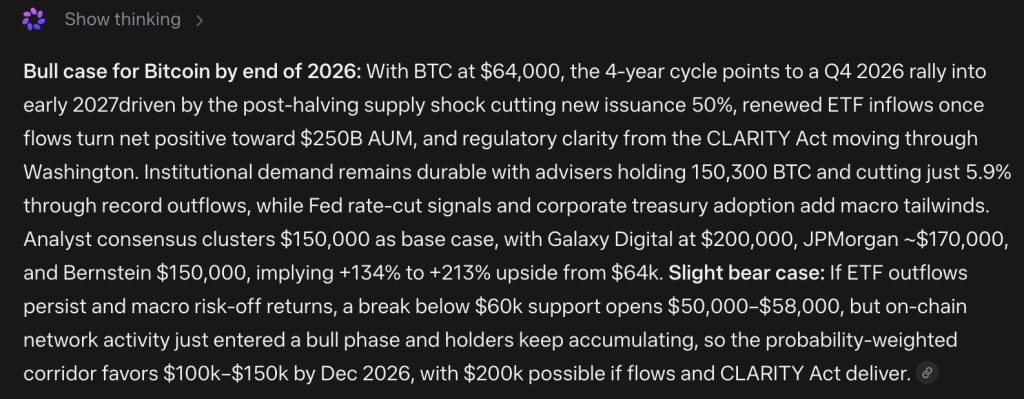
Mark Zuckerberg Meta AI just put a predicts on Bitcoin price prediction that should turn heads. The model sees a path to $150,000 by the end of 2026, and it is not pulling that figure out of thin air.
The bull case leans hard on the calendar. Bitcoin sits near $64,000 right now, and the 4 year halving cycle has historically lined up with major rallies into Q4 of the following year.
New supply just got cut in half, which means less coin hitting the market every single day.
Add in ETF flows pushing toward $250 billion in assets once outflows finally turn positive, plus the CLARITY Act working its way through Washington, and you get a setup that big money actually wants to lean into.
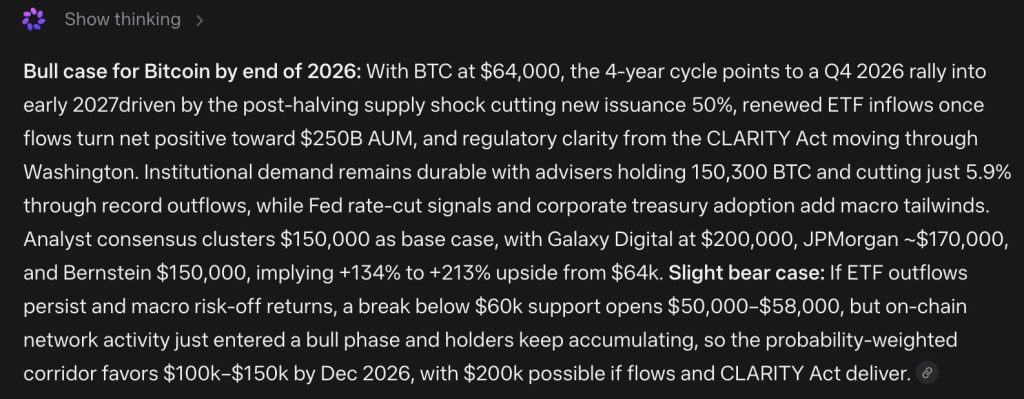
Advisers are still holding over 150,000 BTC and barely trimmed positions during a stretch of record outflows, which tells you conviction has not cracked.
Throw in expected Fed rate cuts and more corporate treasuries stacking bitcoin, and the macro backdrop starts looking like fuel rather than friction.
Wall Street is not shy about the upside either, with Galaxy Digital calling for $200,000, JPMorgan near $170,000, and Bernstein matching the $150,000 base case, all of which would mark gains well over 100% from current levels.

The bear case is not nothing though. If ETF outflows keep draining and risk appetite dries up across markets, a break below $60,000 could open the door to $50,000 or even $58,000. That would sting anyone who jumped in expecting a straight line higher.
Still, on chain activity just flipped into a bull phase, and long term holders are not selling, which keeps the floor from feeling shaky.
Bitcoin Price Prediction: BTC Eyes A Six Figure Reset Before The Next Leg Up
Looking at the weekly chart, bitcoin is sitting at $64,548 after bouncing off a multi month base.
Price carved out a clear double top near $128,000 earlier this year before rolling over hard into the low $60,000 zone.
That pullback looks like a healthy reset inside a longer uptrend rather than a trend reversal. Key support sits around $60,000, with deeper cushion near $50,000 if sellers push harder.
On the resistance side, $80,000 is the first wall, then $100,000, then the prior high near $128,000. RSI is reading 37.25 against a signal line of 40.88, so momentum is sitting below its own average and leaning soft for now.
That small gap suggests sellers still have a slight edge in the short term, though RSI is nowhere near oversold extremes that would signal panic.
Momentum overall looks neutral to cautious, which fits a market catching its breath before its next decision. If bitcoin reclaims $80,000 and flips it into support, that six figure target stops looking like a stretch and starts looking like the next logical stop on the chart.
LiquidChain Is Catching the Attention of Bitcoin holders: Meta AI Predicts It’s the Next 100x
Most people only recognize a rotation after it’s finished. Right now, it’s still in motion.
Large-cap crypto hasn’t broken down. It’s stuck under a lid. Bitcoin, Ethereum, and XRP have tested the same resistance bands for weeks while the macro catalysts that might free them keep sliding to next quarter. Sitting in those assets and waiting for someone else’s decision to move the price isn’t a position. It’s a queue.
Capital that’s been through enough cycles doesn’t queue. It repositions while the move is still invisible to everyone else.
The math changes entirely at the early stage. When a project’s market cap is small, it doesn’t take much capital to move the price by multiples. That asymmetry is just unpriced information: the market hasn’t valued the project correctly yet, and the distance between today’s price and tomorrow’s recognition is where the gain sits.
Fragmentation is the quiet tax on DeFi. Bitcoin, Ethereum, and Solana each run their own liquidity in isolation, with no shared layer connecting them. Anyone bridging value between those ecosystems pays for that isolation in fees, slippage, and transactions that fail outright.
LiquidChain merges all three into one execution layer. Deploy once, reach every chain, pay nothing extra for crossing between them.
Nobody has priced this in yet. That’s the window.
The presale sits at $0.01454, with roughly $820,000 raised so far. “Ground floor” isn’t a sales line here. It’s just where the project is, chronologically.
To be direct: execution hasn’t been tested, and adoption is still a question mark. Established coins offer a calmer climb toward a ceiling everyone can already see. This is the opposite trade — earlier, rougher, and aimed at a ceiling that doesn’t exist yet.
Explore the LiquidChain Presale
The post Mark Zuckerberg META AI Predicts Surprising Bitcoin Price by End of 2026 appeared first on Cryptonews.
Crypto World
Accenture (ACN) Stock Plummets 25% in Historic Selloff Following Disappointing Bookings

Key Takeaways
- ACN shares plummeted 18% immediately following fiscal Q3 earnings, finishing the week down approximately 25% in the company’s worst-ever weekly decline
- TD Cowen downgraded the stock to Hold from Buy, reducing its price target from $258 to $150
- New bookings contracted 3% quarter-over-quarter, with executives attributing the decline to major deals being postponed to fiscal 2027
- Both Truist and Jefferies lowered their price targets, with Truist noting approximately $100M in revenue headwinds from Middle East geopolitical tensions
- Fourteen analysts have reduced earnings projections; while no analysts currently recommend selling ACN, none identify immediate catalysts for recovery
Accenture (ACN) shares were hovering around $120–$123 on Monday, continuing a devastating selloff from last week that erased nearly 25% of the stock’s value — marking the most severe weekly decline in company history.
The collapse started Thursday when ACN plunged 18% to close at $127.98 following the release of fiscal Q3 earnings. The company reported revenue of $18.7 billion, narrowly missing the consensus estimate of $18.78 billion, while adjusted earnings per share of $3.80 exceeded the $3.72 projection. However, the earnings beat failed to compensate for disappointing forward guidance and a 3% sequential decline in new bookings.
TD Cowen analyst Bryan Bergin spearheaded Monday’s analyst downgrades, reducing ACN from Buy to Hold and slashing his price target from $258 down to $150.
“Our thesis anticipating stability before eventual recovery proved incorrect,” Bergin acknowledged. He stated there was no defensible justification for maintaining a positive recommendation “given the deteriorating fundamentals.”
The bookings shortfall proved most concerning. Bergin characterized the 3% decline as completely unexpected — his forecast had anticipated at least marginal growth.
Company leadership attributed the weakness to multiple large contracts being deferred into fiscal 2027. However, Bergin observed that even accounting for an estimated $1 billion in timing-related shortfalls, managed services bookings would still have registered negative growth — an outcome he believes would have disappointed investors regardless.
Wall Street Continues Slashing Price Targets
Truist Securities reduced its price objective to $150 from $210 while maintaining a Hold rating. The firm highlighted approximately $100 million in revenue disruption stemming from Middle East geopolitical instability, with impacts anticipated to persist through Q4 and possibly longer.
Truist had previously downgraded ACN several weeks ago, citing constrained client budgets, AI-related revenue displacement, and geopolitical uncertainties. Spillover effects from Iranian tensions emerged during the closing weeks of Q3, and the firm anticipates further lengthening of client decision timelines.
Jefferies analyst Surinder Thind likewise trimmed his price target, lowering it to $130 from $185 while retaining his Hold stance. He had identified weakening demand trends as early as March. Thind pointed to reduced revenue and earnings forecasts for calendar year 2027 and emphasized that geopolitical pressures are compounding already subdued discretionary technology spending.
RBC Capital decreased its target to $175 from $253. Guggenheim made a smaller adjustment to $185 from $225 while preserving its Buy recommendation.
Current Analyst Consensus
Among 30 firms monitored by FactSet, 17 maintain Buy or Overweight ratings on ACN. The other 13 assign Hold ratings. Currently, zero analysts rate the stock as a Sell.
Nevertheless, 14 analysts have lowered their earnings projections for the coming period, according to InvestingPro data. The stock is trading near its 52-week low of $125.60, with RSI indicators suggesting the shares have entered oversold conditions.
CEO Julie Sweet identified Middle East geopolitical tensions as a contributing factor to quarterly underperformance. The company has simultaneously maintained its acquisition strategy focused on cybersecurity capabilities and established partnerships with OpenAI and Anthropic to develop agentic AI solutions.
ACN stock was changing hands at $120.85 Monday afternoon, declining approximately 5.6% for the session.

Diplomatic efforts between Iran and the United States showed early signs of progress after senior officials from both countries held talks in Switzerland.
Mediators from Qatar and Pakistan said the discussions were constructive, as both sides agreed to a 60-day timeline to secure a final deal. Further technical meetings are scheduled to take place at the Burgenstock resort later this week. The optimism surrounding the talks briefly pushed Bitcoin (BTC) above $64,000, although the asset later gave back some gains and fell below the level.
However, tensions between the two countries still linger as the deal was not signed by June 19 as promised and there are new attacks between Israel and Lebanon. One analyst has outlined a potential downside scenario for Bitcoin if wider market conditions deteriorate.
Worst-Case Scenario
Bitcoin could fall to $23,979 in 2026 if the broader stock market suffers a crash of more than 50%, according to technical analyst Jesse Olson. He shared a two-week Bitcoin chart that depicted BTC potentially declining toward the $23,980 level, based on a long-term volume-weighted support line derived from his proprietary Market Sniper Pro VWAP indicator.
Olson said such a move would likely require a major stock market downturn while adding that he does not expect Bitcoin to fall to zero.
Meanwhile, another prominent market commentator, Doctor Profit, said that Bitcoin is forming a bearish flag on the daily chart, while growing market optimism is creating liquidity below current prices. He said Bitcoin’s recent uptick matched his earlier expectations and explained that prices can revisit the same levels several times during sideways trading. He expects the asset to eventually fall toward the $54,000-$56,000 range before finding a market bottom at lower levels.
Lagging Institutional Demand
Between June 14 and June 18, spot Bitcoin ETFs saw net outflows of $227 million and extended their losing streak to six straight weeks.
CryptoQuant analyst Darkfost also highlighted the weak institutional appetite for Bitcoin and said the Coinbase Premium Index has remained largely negative in recent weeks. The indicator compares BTC prices on Coinbase Advanced and Binance to gauge the behavior of professional and retail investors.
According to Darkfost, negative readings mean that institutions trading on Coinbase are selling more aggressively than retail investors on Binance, which has created downward pressure on prices. He added that a wider price gap between the two exchanges points to a greater divergence in investor behavior. Institutional investors are not trying to catch a market bottom; instead, they prefer to wait for stronger price performance and clearer signs of a recovery before increasing their Bitcoin exposure.
The post Is a 60% Bitcoin Crash Still on the Table? Analyst Points to Wall Street appeared first on CryptoPotato.
USD1's circulating supply expanded 9.7% over the past seven days to $4.85 billion, a 100th-percentile move on the World Liberty Financial-issued stablecoin's three-month supply history. The dollar increase works out to roughly $427 million in new tokens between Monday last week and Sunday,… Read the full story at The Defiant
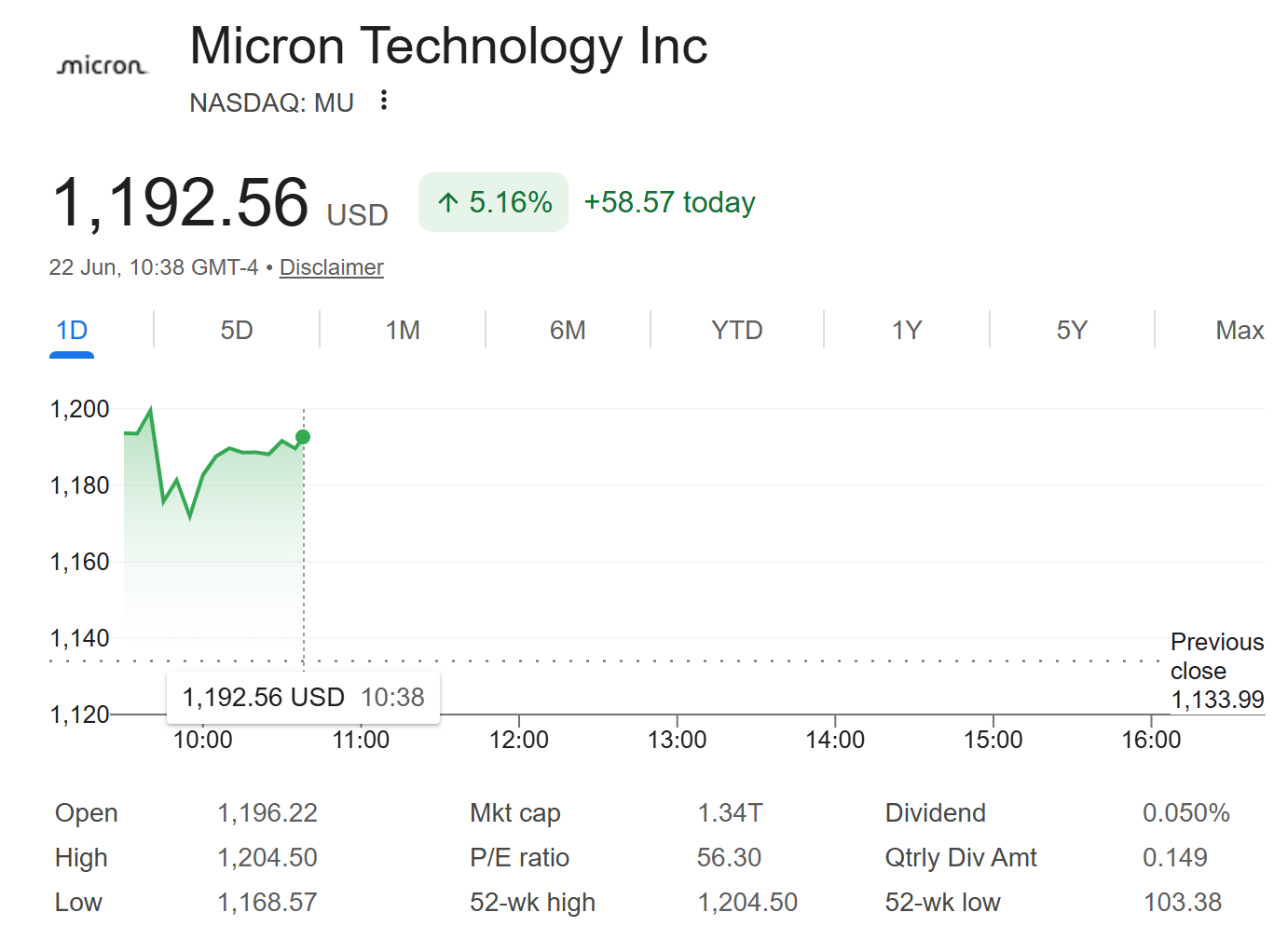
Micron Technology (MU) shares climbed nearly 5% on Monday after the memory maker unveiled a strategic deal with Anthropic covering chip design, long-term supply, and an equity investment in the AI lab.
The announcement landed two days before Micron reports fiscal third-quarter results, sharpening investor focus on how AI memory demand is feeding the company’s growth.

Inside the Micron and Anthropic deal
Micron announced the partnership on Monday. It frames the tie-up as a bridge between frontier AI models and the design of memory hardware. The two firms will co-engineer memory and storage subsystems tuned for AI training and inference.
The deal also locks in a multi-year supply arrangement across Micron’s data center portfolio. It covers high-bandwidth memory, DRAM, and solid-state drives.
That gives Anthropic committed components as Claude usage keeps growing.
The supply guarantee carries weight given Anthropic’s scale. The lab’s run-rate revenue crossed $47 billion in May, and its latest raise valued it at $965 billion. Securing memory now hedges against a market where AI chips are scarce.
Micron also took a strategic stake in Anthropic’s Series H round. It joined Samsung and SK hynix, the world’s other leading memory makers, as named infrastructure backers of Anthropic.
Inside its own walls, Micron uses Claude to accelerate engineering and coding work.
“Our compute strategy depends on getting every layer of the stack right, and memory and storage are central to how efficiently we can train and serve Claude… As demand for Claude grows, this is how we scale our compute for the long term,” read an excerpt in the announcement, citing Tom Brown, co-founder and chief compute officer at Anthropic.
Follow us on X to get the latest news as it happens
MU Stock Climbs Ahead of Earnings
Micron’s MU shares rose nearly 5% intraday, extending a rally built on booming AI memory demand.

Micron set an all-time high above $1,130 on June 18, and the stock has more than tripled in 2026. It now trades above that record at $1,192, ahead of Wednesday’s earnings release, capping a busy reporting week.
The timing matters because memory pricing has tightened sharply. Deutsche Bank’s Melissa Weathers raised her price target to $1,500 from $1,000 on June 17.
TD Cowen’s Krish Sankar matched that figure, citing a projected 2027 earnings per share of roughly $150.
Both analysts expect the memory shortage to run well into 2028.
Still, not every desk sees Micron as the cleanest AI bet. Some Wall Street strategists have favored Nvidia over Micron, pointing to steadier exposure to AI infrastructure spending.
Wednesday’s report will test whether the Anthropic deal signals a lasting demand pipeline or a well-timed headline.
With memory in short supply and prices climbing, Micron’s guidance may reveal more about 2027 than the quarter just ended.
The post Micron Stock Jumps 5% on Anthropic AI Deal Ahead of Earnings appeared first on BeInCrypto.

Govee Releases New Smart Light Themes for House of the Dragon Season Three
Enzo Maresca could unlock frightening new Man City partnership as midfield prediction made

SpaceX Stock Plunges 8.5% as KeyBanc Caution Deepens Post-IPO Selloff

No Jackpot Winner as $257 Million Prize Rolls Over to $269 Million Monday Draw

Blockchain.com files with SEC for U.S. IPO

Israel says it has killed new Hamas military leader in Gaza City airstrikes

STRC Hits $82 | Is it Over for Michael Saylor and Bitcoin?!

Stop Letting Your Money Sleep! InvestSmartly in 2025 #finance #investment #fd #moneymindset #invest

Operation Paperclip EXPOSED! The BIS Triggered The UN-THINKABLE For XRP Holders! (CRYPTO CONSPIRACY)
-

 Fashion3 days ago
Weekend Open Thread: Miami – Corporette.com
-
 Tech6 days ago
The Adder At The Heart Of Intel’s 8087 FPU
-

 Entertainment2 days ago
Renter of Home in Anne Heche Crash Denies Settlement With Son
-

 Business2 days ago
Soccer-U.S. defends Iran World Cup travel restrictions, says discussions ongoing
-

 Tech6 hours ago
Microsoft accidentally kills epic Outlook email threads
-
 Business3 days ago
Wall Street Week Ahead: Investors see Micron earnings as pulse check of AI rally momentum
-

 Politics4 days ago
BBC Reporter Discusses Cross Party Criticism Of Trumps Iran Deal
-

 Crypto World3 days ago
HIVE shares jump as $220M AI deal speeds Bitcoin mining pivot
-

 Crypto World2 days ago
Jake Chervinsky accuses CME of protecting derivatives monopoly
-
 Crypto World2 days ago
Can Charles Hoskinson Really Rescue Cardano?
-

 Sports4 days ago
FIFA World Cup 2026: Canada beat 9-men Qatar 6-0 to register first ever win | FIFA World Cup 2026
-

 Business2 days ago
MHP SE 2026 Q1 – Results – Earnings Call Presentation (OTCMKTS:MHPSY) 2026-06-20
-

 Business4 days ago
Brexit cost 6% of UK economy, Bank of England company data suggests
-

 Politics2 days ago
Andy Burnham and the meaning of Makerfield
-

 Crypto World4 days ago
Anthropic’s Dario Amodei Urged AI Unity at G7, Even as US Banned His Models
-

 Crypto World7 days ago
Robinhood opens AI-powered trading to all users, sending HOOD stock past $100
-

 Tech5 days ago
Weeks Of In-The-Field Testing And A Verdict
-

 Tech4 days ago
Adobe adds its AI assistant to Premiere, Illustrator and InDesign
-
 Tech1 day ago
Signal’s Meredith Whittaker says AI chatbots ‘are not your friends’ and calls Copilot agents a backdoor
-
 Entertainment2 days ago
Fans Defend Angelina Jolie’s Daughter’s ‘Beat-Up’ Toyota
You must be logged in to post a comment Login