

Crypto World
Crypto VC Paradigm Expands into AI, Robotics with $1.5B Fund (WSJ)


Paradigm, the San Francisco-based crypto investment firm, is pursuing a new $1.5 billion fund aimed at backing companies across artificial intelligence, robotics and other frontier technologies. The fundraising plan, reported by the Wall Street Journal, signals the firm’s intention to broaden its mandate while continuing to back crypto-related ventures using its established technical-investment team. Public filings show Paradigm already manages roughly $12.7 billion in assets, underscoring the scale it brings to a fund that blends crypto with cutting-edge tech bets. The strategy reflects a broader industry twist: the convergence of digital assets with AI and automation, a nexus that has attracted increased capital over the past year.
Paradigm will continue to invest in crypto companies, according to familiar sources, but the new vehicle will also evaluate frontier-tech opportunities outside the traditional crypto ecosystem. The Wall Street Journal noted that the firm’s managers sought greater latitude to avoid constraints that could cause them to pass on attractive deals. The approach mirrors a broader trend among crypto-focused funds expanding into adjacent technologies as capital markets prize diversification and cross-disciplinary expertise. The fundraise aligns with Paradigm’s history: it launched its flagship $2.5 billion fund in November 2021, at the time the largest crypto fund in history, and in 2024 publicly announced its third fund—a venture vehicle of about $850 million focused on early-stage crypto projects. These milestones punctuate a firm comfortable with large-scale vehicles and multi-cycle exposure to digital assets.
Beyond capital allocations, Paradigm’s strategy underscores a belief that crypto and AI are not mutually exclusive. The firm’s leadership has argued for a pragmatic view of the two domains, noting substantial overlap in areas such as how autonomous systems can execute transactions. This concept—agentic or autonomous AI agents performing actions within financial networks—has become a focal point in industry conversations about security, efficiency and governance. For readers familiar with the technical dialogue around AI agents and how they interact with decentralized systems, the connection is a natural extension of Paradigm’s investment thesis. The discussion sits at the intersection of risk management, smart-contract integrity and the evolving architecture of programmable money.
Open questions about the precise structure of the new fund remain, but the narrative around Paradigm’s pivot away from crypto appears to have evolved. In 2023, the firm faced public speculation after it trimmed crypto-specific language from its website, prompting some observers to wonder if it planned a broader shift toward AI. Co-founder Matt Huang disputed that interpretation, stating that the team had simply been exploring AI while remaining deeply committed to crypto across all stages. In a subsequent note, Huang emphasized that developments in AI are compelling enough to merit parallel exploration alongside ongoing crypto initiatives. This stance captures a pragmatic view in which crypto remains central, but AI opportunities are too consequential to ignore. The firm’s recent collaboration with OpenAI to release EVMbench—a benchmark evaluating how AI models can detect and patch security vulnerabilities in smart contracts—illustrates that the overlap between the two sectors is not theoretical, but operational and testable.
Paradigm’s frontier-tech push comes amid a broader AI funding boom
Industry data cited by the OECD shows venture-capital investments in artificial intelligence reached $258.7 billion in 2025, accounting for about 61% of all VC activity and effectively doubling AI’s share since 2022. Within AI, fundraising for generative AI firms made up roughly 14% of total AI VC investments, with the United States drawing the largest portion of capital. The numbers illustrate a market backdrop where AI is a driving force behind liquidity and deal flow, a context that investors like Paradigm are trying to leverage while maintaining a crypto footprint. The momentum around AI funding complements the evolving crypto landscape, where innovations in on-chain security, scalable infrastructure and tokenized financial assets continue to attract capital from traditional and specialized investors alike.
For readers tracking the practical side of AI-crypto convergence, Paradigm’s activities provide a useful case study. The firm’s involvement in AI benchmarking and security—through collaborative efforts with OpenAI on EVMbench—signals a preference for concrete, talent-driven assessments of risk and opportunity in crypto infrastructure. The project evaluates how AI agents can identify vulnerabilities in smart contracts and suggest patches, a capability that could improve the resilience of programmable money and decentralized applications. This line of work aligns with a broader push to raise the bar on cryptographic and governance standards as AI adoption scales across blockchain-native ecosystems.
In parallel, the market continues to size up the potential for frontier-tech finance to reshape venture ecosystems. The integration of AI with crypto workflows hints at new value propositions for developers, operators and investors who want to combine the speed and automation of intelligent agents with the structural transparency of decentralized networks. The 2025 funding landscape, highlighted by OECD figures, reinforces the idea that technology bets are increasingly pluralistic—funds seek to back teams that can navigate both AI breakthroughs and crypto-market dynamics, a stance Paradigm appears to be formalizing through its latest fundraising efforts.
Why it matters
The strategic timing of Paradigm’s fundraising matters for several reasons. First, it demonstrates how crypto-focused funds are maturing into multi-technology platforms capable of supporting complex portfolios that straddle AI, robotics and digital assets. This evolution could attract a broader set of LPs seeking diversified exposure to frontier tech themes without sacrificing deep domain expertise in crypto risk management. Second, the collaboration with AI researchers and benchmarks like EVMbench signals a willingness to invest not only in companies but in tooling and standards that improve security and efficiency across the crypto stack. If AI-driven testing and patching become mainstream in on-chain development, the resulting improvements in smart-contract safety could raise the confidence of users and institutions alike.
From a market perspective, Paradigm’s move sits at the nexus of two transformative trends. AI funding is surging, while crypto funding cycles remain active as investors wager on improvements in scalability, governance and regulatory clarity. The OECD data cited above illustrate a capital environment where AI is a dominant driver of VC flows, yet the crypto sector still presents material opportunities for those who can blend deep technical risk assessment with strategic portfolio construction. The cross-pollination of these domains could fertilize ecosystems where AI helps automate, audit and optimize crypto infrastructure, while blockchain technologies provide new data-native workloads for intelligent agents and automation platforms.
For the broader user and investor community, Paradigm’s approach signals that the near-term future of crypto funding may increasingly resemble traditional technology venture models: larger raised funds, diversified mandate, and a portfolio approach that prioritizes talent, rigorous due diligence and technical interoperability. The firm’s willingness to maintain its crypto commitments while pursuing frontier tech investments could set a template for other crypto-focused funds confronting the same balance: remaining anchored in digital assets while embracing adjacent advances that could reshape the entire technology stack.
What to watch next
- Progress toward closing the $1.5 billion frontier-tech fund, including potential fundraising milestones and any anticipated close dates.
- Regulatory filings and disclosures related to the new vehicle, especially as the strategy expands beyond crypto into AI and robotics.
- Portfolio visibility: any announcements of investments or co-investments in AI, robotics or related frontier technologies, alongside crypto companies.
- Updates on EVMbench adoption and results, and whether AI-driven security tooling becomes a standard in crypto development workflows.
- Continued commentary from Paradigm leadership on the crypto-AI overlap and strategic priorities across stages of investment.
Sources & verification
- Wall Street Journal report detailing Paradigm’s $1.5 billion frontier-tech fund and the firm’s expansion into AI and robotics.
- Regulatory filings showing Paradigm’s assets under management at roughly $12.7 billion.
- Cointelegraph coverage discussing Paradigm’s ongoing crypto investments and references to executive commentary.
- Announcement of EVMbench, a joint effort with OpenAI to benchmark AI agents’ ability to detect and patch smart-contract flaws.
- OECD data on AI venture-capital investments through 2025, highlighting the scale of AI funding and cross-sector allocations.
Paradigm widens the lens on frontier tech and crypto
Paradigm’s current fundraising push to assemble a $1.5 billion frontier-tech fund underscores a practical shift in how crypto-focused capital views the technology landscape. While the firm remains firmly rooted in crypto, the new vehicle signals a deliberate strategy to diversify into AI, robotics and other high-potential sectors. At the same time, Paradigm’s public record—$12.7 billion in AUM and a history of large crypto funds—offers a credible backdrop for investors weighing the risks and rewards of a broader tech mandate. The collaboration with OpenAI on EVMbench exemplifies the concrete, value-driven work that can emerge when crypto publics intersect with AI researchers and standards bodies. As the sector contends with regulatory questions and evolving market dynamics, Paradigm’s approach provides a lens into how crypto-focused firms may evolve to participate in the broader tech economy while maintaining a disciplined risk profile.



Bitcoin neared $63,000 in Saturday trading after the U.S. and Israel launched military strikes on Iran, pushing the largest cryptocurrency down roughly 3% in a matter of hours and extending what had already been a difficult weekend for risk assets.
The move brings bitcoin to its lowest level since the Feb. 5 crash, when the token briefly dipped below $60,000.
Israeli Defense Minister Israel Katz declared an immediate state of emergency across all areas of Israel. A U.S. official confirmed American participation in the strikes, The Wall Street Journal reported.
The sell-off follows a well-established pattern. Bitcoin trades 24 hours a day, 7 days a week, while equity and bond markets are closed on weekends.
That makes it one of the only large, liquid assets available for traders to sell when geopolitical risk spikes outside of traditional market hours.
The result is that bitcoin often acts as a pressure valve for broader risk-off sentiment during weekend events, absorbing selling that would otherwise spread across equities, commodities, and currencies if those markets were open.
The attack risks a wider regional conflict in one of the most economically sensitive parts of the world, following a month-long U.S. military buildup and failed negotiations over Iran’s nuclear program.

TLDR:
- Anthropic plans court action after rejecting Pentagon requests tied to surveillance and autonomous weapons permissions.
- Contract proposals included access to geolocation, browsing data, and financial records from commercial brokers.
- Defense contractors now face compliance risks when using Claude across enterprise and cloud operations.
- The designation places Anthropic’s $380 billion IPO strategy under legal and regulatory uncertainty.
Anthropic is heading to federal court. The AI company confirmed it will challenge the Department of War’s move to designate it a supply chain risk.
Secretary Pete Hegseth announced the designation on X after months of failed contract negotiations. The move threatens to ripple far beyond a single Pentagon deal.
Read also: Sam Altman’s OpenAI Moves Ahead With Pentagon AI Deal After Anthropic Says No
Anthropic’s Pentagon Deal Collapsed Over Surveillance Demands
The breakdown started with two narrow exceptions Anthropic refused to drop.
The company would not allow Claude to be used for mass domestic surveillance of Americans. It also rejected fully autonomous weapons applications. Those were the only two lines Anthropic would not cross.
But details surfaced through Axios changed the story significantly, according to an X post by market observer Shanaka Anslem Perera.
The Pentagon’s proposed compromise would have required access to Americans’ geolocation data. It also included web browsing history and personal financial records sourced from data brokers.
Under Secretary Emil Michael was reportedly offering this deal by phone at the exact moment Hegseth posted the designation publicly.
Anthropic pushed back directly. In a published statement, the company called the designation legally unsound and historically unprecedented. No American company has ever been publicly hit with this classification before. It has typically been reserved for foreign adversaries.
The company also clarified what the designation actually covers under 10 USC 3252.
A supply chain risk designation can only restrict Claude’s use on Department of War contract work. It cannot reach commercial API access, claude.ai subscriptions, or enterprise licenses. Anthropic’s legal team is betting the court agrees.
Pentagon Accepted OpenAI’s Identical Safety Terms Hours Later
The business stakes are enormous. Eight of the ten largest US companies currently use Claude. That includes defense contractors, cloud providers, banks, and consulting firms. The $200 million Pentagon contract is not the core concern. The $14 billion enterprise ecosystem is.
Every general counsel at every Fortune 500 firm with Pentagon exposure now faces the same question. Is using Claude worth the legal uncertainty? That question alone slows procurement cycles and complicates renewals.
Anthropic’s expected IPO, reportedly targeting a $380 billion valuation with $30 billion in new capital, now sits on hold. No underwriter will price an offering while the company carries a designation alongside Huawei.
Hours after blacklisting Anthropic, the Pentagon accepted OpenAI’s proposed safety framework. That framework contained the same two red lines: no mass surveillance, no autonomous lethal weapons. Anthropic said no amount of pressure will shift its position on either point.
TLDR:
- Tether has frozen $4.2B in USDT since 2021, with most enforcement actions taking place after 2023.
- U.S. authorities linked nearly $61M in frozen USDT to pig-butchering scams and online fraud networks.
- USDT supply now exceeds $180B, making enforcement actions more impactful across global crypto markets.
- Wallet freezing tools now play a central role in tracking and blocking cross-border illicit crypto flows.
Tether has frozen billions of dollars in USDT connected to criminal activity as regulators escalate global crypto enforcement. The action reflects growing cooperation between stablecoin issuers and law enforcement agencies.
Authorities now treat stablecoins as critical targets in fraud and sanctions investigations. The move places token controls at the center of crypto crime prevention.
Tether freezes USDT amid rising global enforcement actions
The stablecoin issuer said it has frozen about $4.2 billion in USDT tied to illicit activity. Most of the frozen amount occurred after 2023 as investigations intensified.
Data published by Reuters shows that more than $3.5 billion was restricted during the past three years. USDT supply has expanded rapidly during the same period.
The company confirmed it recently helped the U.S. Department of Justice freeze nearly $61 million linked to pig-butchering fraud schemes. These scams rely on long-term social manipulation to steal funds.
Tether also blocked wallets connected to human trafficking and conflict-related activity in Israel and Ukraine. Sanctioned Russian exchange Garantex reported that its USDT balances were frozen last year.
Figures shared by Wu Blockchain show USDT circulation now exceeds $180 billion. That level stands far above the $70 billion recorded three years ago.
The company can remotely freeze tokens held in user wallets upon receipt of formal requests from authorities. This mechanism allows direct intervention without blockchain reorganization.
Tether freezes USDT as supply tops $180 billion worldwide
USDT remains the world’s largest dollar-backed stablecoin by market value. Market data confirms the token’s dominance in daily trading volume.
Law enforcement agencies increasingly view stablecoins as key channels for moving illicit funds. Officials now track wallet activity across borders with greater coordination.
Tether said its compliance tools support global investigations into fraud, trafficking, and sanctions violations. The company has expanded wallet monitoring and blacklist functions over time.
Authorities credit the freezing capability with preventing rapid movement of stolen crypto. Funds can be locked before they reach exchanges or conversion services.
The scale of frozen assets shows how deeply stablecoins intersect with financial crime probes. It also signals tighter oversight of centralized issuers within the crypto market.
USDT’s growth continues alongside rising scrutiny from regulators and prosecutors. The stablecoin now operates under closer observation than at any point in its history.
TLDR:
- Morgan Stanley manages ~$9.3T in assets and filed for a national trust bank charter to custody crypto.
- The charter could allow staking services alongside direct custody for its 18 million clients.
- Morgan Stanley previously described Ripple as a leading SWIFT alternative for international payments.
- Citi is also building crypto infrastructure as institutional adoption accelerates across Wall Street.
Morgan Stanley is making a direct push into digital asset infrastructure. The firm, managing roughly $9.3 trillion in client assets, has reportedly filed for a national trust bank charter.
The move would allow it to custody Bitcoin and other cryptocurrencies at a bank-grade level. It could also open the door for client staking services.
Morgan Stanley Moves Toward Direct Crypto Custody With Trust Bank Filing
The filing marks a clear step beyond simple crypto access. Most Wall Street firms have previously relied on third-party custodians. This charter would let Morgan Stanley hold digital assets directly on behalf of clients.
That distinction matters. Custody is the foundation of institutional crypto infrastructure. Control over custody means control over client assets and the yield those assets can generate.
The firm serves approximately 18 million clients. Even a modest allocation shift across that base could move significant capital into crypto markets, according to commentary shared by crypto analyst account CryptosRus on X.
Morgan Stanley has followed a visible pattern. Access came first, then custody infrastructure, and now potentially staking yield. The progression mirrors how traditional financial services firms have historically absorbed new asset classes.
XRP and Bitcoin Both Surface as Morgan Stanley Builds Crypto Rails
Morgan Stanley’s prior statements have drawn attention alongside the charter news. The firm previously described Ripple as a leading alternative to SWIFT for international payments, according to @markchadwickx on X.
Internal documentation, as cited in the same post, reportedly noted XRP’s efficiency compared to Bitcoin and its closer alignment with how traditional banks currently operate. Morgan Stanley has not publicly confirmed those specific internal assessments.
Bitcoin remains central to the custody application. The charter, if approved, would position the firm to facilitate client purchases and swaps across multiple digital assets.
The filing comes as Washington edges closer to potential regulatory clarity. The Clarity Act has been referenced in financial circles as a framework that could formalize how institutions handle digital assets.
Other major players are also moving. Citi has been building out its own crypto infrastructure in parallel, adding further weight to the broader institutional trend.

Mark Karpelès, the former CEO of Mt. Gox, has revived a controversial bid to claw back billions stolen from the once-dominant Bitcoin exchange. In a Friday GitHub submission, Karpelès proposed a consensus-rule change that would enable the transfer of 79,956 BTC—currently held in a single recovery address without the original private key—to a dedicated recovery wallet. The move targets more than $5.2 billion in assets based on recent price levels and comes as the Mt. Gox trustee Nobuaki Kobayashi continues creditor distributions. The proposal unfolds against a backdrop of ongoing debates about Bitcoin’s immutability and the governance process that underpins the network.
Key takeaways
- The proposal seeks a hard fork to retroactively validate a previously invalid on-chain transaction, enabling the movement of Mt. Gox’s recovered BTC to a recovery address.
- Activation would require a broad network upgrade, as every node would need to adopt the change for the recovery operation to occur.
- The Mt. Gox trustee remains focused on creditor distributions, and on-chain recovery has not been pursued by him—creating a potential procedural deadlock that Karpelès aims to address with a concrete proposal.
- Critics argue that authorizing a recovery via a hard fork could undermine Bitcoin’s core principle of immutability, while supporters say the move could deliver restitution to affected creditors and bring clarity to an unresolved chapter in the exchange’s history.
- The discussion is publicly visible on forums and social media, with a mix of skepticism, caution, and some creditors expressing interest in recovering funds if feasible.
- Regardless of outcome, the debate highlights the tension between restitution and the decentralized integrity of the Bitcoin protocol.
Tickers mentioned: $BTC
Sentiment: Neutral
Market context: The episode sits at the intersection of governance debates in decentralized networks and the broader attention on restitution for legacy hacks, underscoring how on-chain recovery ideas can surface amid creditor proceedings and evolving regulatory scrutiny.
Why it matters
The Mt. Gox saga is embedded in Bitcoin’s history, and any attempt to move coins via a protocol change raises foundational questions about what Bitcoin is allowed to be in practice. The proposal, if discussed seriously and pursued, would test the boundary between protocol-level immutability and the legitimate pursuit of restitution for victims of one of the most infamous hacks in crypto history. Bitcoin’s developers, miners, and node operators would be convened to evaluate whether a consensus-rule upgrade could safely reconcile a dispute that sits outside the typical on-chain transaction flow. Critics argue that even discussing such a mechanism could erode confidence in a system built on a trustless, irreversible ledger. Proponents, however, point to the nearly two-decade-long wait for a definitive resolution and the ethical imperative to return assets to creditors when a solvency and theft case is clear in law and in fact.
The discussion also spotlights the role of the Mt. Gox trustee, Nobuaki Kobayashi, who has been tasked with distributing recoveries to creditors under a bankruptcy framework. His team has indicated that on-chain recovery would require a level of legal certainty and community consensus that may not exist, effectively stalling potential recovery pathways. Karpelès argues that the plan would not circumvent established processes but would catalyze a debate that could lead to a pragmatic resolution if there is broad agreement among stakeholders. The tension between procedural caution and the desire for restitution is a central theme, with the Bitcoin community weighing the long-term implications for the protocol’s governance and perceived neutrality.
The broader crypto environment is watching closely. While the specifics of the Mt. Gox funds are unique, the questions raised—whether a protocol-level change should ever unlock previously inaccessible assets, and under what circumstances—resonate with ongoing discussions about on-chain governance and the limits of what a decentralized network should decide collectively. The episode also intersects with regulatory conversations about how restitution cases should be handled in crypto, and how such moves could influence investor expectations in a space that continues to grapple with hacks, mismanagement, and the accountability of project teams.
What to watch next
- The Bitcoin community’s formal response to the GitHub proposal, including any follow-up discussions on Core developers’ channels.
- Whether the proposed activation height and upgrade path gain support from miners, node operators, and major ecosystems participants.
- Any concrete statements from Nobuaki Kobayashi or the Mt. Gox creditor committee about on-chain recovery viability under new consensus rules.
- New commentary from prominent developers or industry observers on the precedent such a change could set for future hacks or thefts.
- Updates from the Bitcointalk forum threads and social-media discussions that could influence perceptions of immutability and recovery ethics.
Sources & verification
- GitHub pull request: https://github.com/bitcoin/bitcoin/pull/34695
- Bitcoin address cited for unmoved coins: https://www.blockchain.com/explorer/addresses/btc/1FeexV6bAHb8ybZjqQMjJrcCrHGW9sb6uF
- Jameson Lopp discussion post: https://x.com/lopp/status/2027482550415847770
- Luke Dashjr update: https://x.com/LukeDashjr/status/2027594666690912414
- Bitcointalk discussion thread: https://bitcointalk.org/index.php?topic=5575915.new#new
Hard fork debate over Mt. Gox funds: Key figures and next steps
The core idea, as laid out by Karpelès, centers on a patch that would render a targeted, previously invalid transaction valid, thereby enabling a significant on-chain recovery. He emphasizes that this is a hard fork, not a stealth change: “This is a hard fork. It makes a previously invalid transaction valid. All nodes would need to upgrade before the activation height.” The explicit acknowledgment of a forked path helps separate the conversation from a passive suggestion and places it firmly in the realm of a concrete, testable proposal. He stresses that the intention is not to bypass Bitcoin’s normal development process but to invite structured debate among developers and the wider community.
On the other side, critics argue that creating a mechanism to recover stolen funds by altering the on-chain consensus could erode Bitcoin’s trustless design. The Bitcointalk thread contains strong cautions that such a change could set a troubling precedent, potentially inviting future appeals to “undo” losses through protocol changes rather than through traditional enforcement and restitution mechanisms. A recurring theme in the discussions is the risk of undermining irreversibility, which many proponents regard as a foundational feature of Bitcoin’s security model. Yet some creditors who persisted through the bankruptcy process indicate a personal incentive to see any possible recovery move forward if a legitimate avenue exists.
The tension between immutability and restitution is not unique to Mt. Gox, but the scale of the potential recovery—79,956 BTC—renders this debate unusually consequential. If the proposal gains momentum, it would require not only the cooperation of a critical mass of node operators but also a clear legal and regulatory framework that supports on-chain recovery in a way that remains coherent with global enforcement standards. For now, the proposal remains a discussion starter, with proponents hoping it could catalyze a path toward restitution and critics urging caution to protect Bitcoin’s core principles.
Why it matters for the crypto ecosystem
For investors and creditors, the Mt. Gox case is a reminder that legacy hacks can linger for years and that governance questions remain unsettled in decentralized networks. The possible on-chain recovery would be a precedent-setting event, raising questions about how restitution can be reconciled with the long-standing commitment to a permissionless, immutable ledger. For developers, the episode underscores the challenge of balancing innovation with the risk of unintended consequences to the network’s security and reliability. It also highlights the practical constraints of building consensus around controversial changes in a space where decisions are ultimately collective and technically demanding.
Beyond Mt. Gox, the discussion speaks to a broader market dynamic: asset recovery remains a persistent theme as regulators and market participants assess how to treat stolen or misappropriated funds within crypto ecosystems. While some stakeholders advocate for aggressive on-chain remedies, others insist that irreversibility is a non-negotiable attribute of Bitcoin’s value proposition. The ongoing dialogue could shape how future governance proposals are evaluated, how recovery pathways are designed, and how much weight the community assigns to restitution versus protocol integrity.
What to watch next
- Public consensus-building on GitHub PR 34695 and any formal follow-ups or discussions with Bitcoin Core maintainers.
- Updates from Nobuaki Kobayashi and the Mt. Gox creditor committee regarding whether on-chain recovery could be pursued under any future framework.
- New technical assessments of activation heights, potential vulnerabilities, and the overall risk-reward profile of a hard fork to recover funds.
- Reactions from major exchanges, miners, and node operators about the viability and acceptability of such a change.
Sources & verification
- GitHub pull request: https://github.com/bitcoin/bitcoin/pull/34695
- Original recovery address for references: https://www.blockchain.com/explorer/addresses/btc/1FeexV6bAHb8ybZjqQMjJrcCrHGW9sb6uF
- Jameson Lopp discussion: https://x.com/lopp/status/2027482550415847770
- Luke Dashjr discussion: https://x.com/LukeDashjr/status/2027594666690912414
- Bitcointalk thread: https://bitcointalk.org/index.php?topic=5575915.new#new
TLDR:
- Korean retail poured $40B into U.S. leveraged ETFs in 2025, with $7B flowing in December alone.
- South Korean regulators imposed training rules to limit retail access to 2x and 3x offshore ETFs.
- The KOSPI has rallied 177% over the past year, driven largely by semiconductor stocks.
- Volatility is rising at market highs, signaling stretched positioning through aggressive leverage.
South Korea’s stock market is sitting on a $40 billion leverage position in U.S. tech assets. The KOSPI has surged 177% over the past year.
On the surface, semiconductor giants Samsung and SK Hynix drove most of that momentum. But a deeper look reveals a retail-driven leverage story that regulators are already scrambling to address.
Korean Retail Floods U.S. Leveraged ETFs at Historic Pace
Korean retail investors allocated $40 billion into U.S. leveraged ETFs throughout 2025. Of that total, $7 billion entered in December alone.
The pace alarmed South Korean financial regulators enough to intervene directly. Authorities imposed mandatory training and mock trading requirements to restrict retail access to these instruments.
The same investor class that fueled the crypto “Kimchi Premium” has rotated into equities. Their appetite for high-risk, high-return products has not cooled. They simply shifted the arena. The move has concentrated enormous exposure into 2x and 3x U.S. tech ETFs.
This is not a niche segment of the market. Korean retail is widely recognized as one of the most active investor bases globally. Their capital flows carry real weight in offshore markets. At $40 billion, their U.S. ETF positioning is now systemically relevant.
The regulatory response confirms the scale of concern. Training requirements and mock trading rules are unusual interventions. They signal that authorities view the current behavior as a structural risk, not just speculative excess.
Rising Volatility at Market Highs Signals Stretched Positioning
Volatility is climbing even as the KOSPI holds near euphoric highs. That combination is historically unusual. Volatility typically spikes during market bottoms, not tops. When it rises alongside highs, it often reflects aggressive call buying and overextended leverage.
According to data flagged by Bull Theory, the current setup involves three overlapping risk layers. A 177% domestic rally almost entirely dependent on semiconductors.
Forty billion dollars parked in highly leveraged offshore tech products. And volatility expanding while prices stay elevated.
If U.S. tech corrects, Korean retail faces pressure on both fronts simultaneously. Their KOSPI holdings decline on weaker chip export expectations. Their leveraged U.S. ETF positions amplify losses in real time. The two portfolios move against them at once.
Seoul’s market is now directly tethered to Nasdaq price action, according to Bull Theory’s analysis. Korean retail has become a significant marginal buyer of high-beta U.S. tech. That linkage runs both ways.
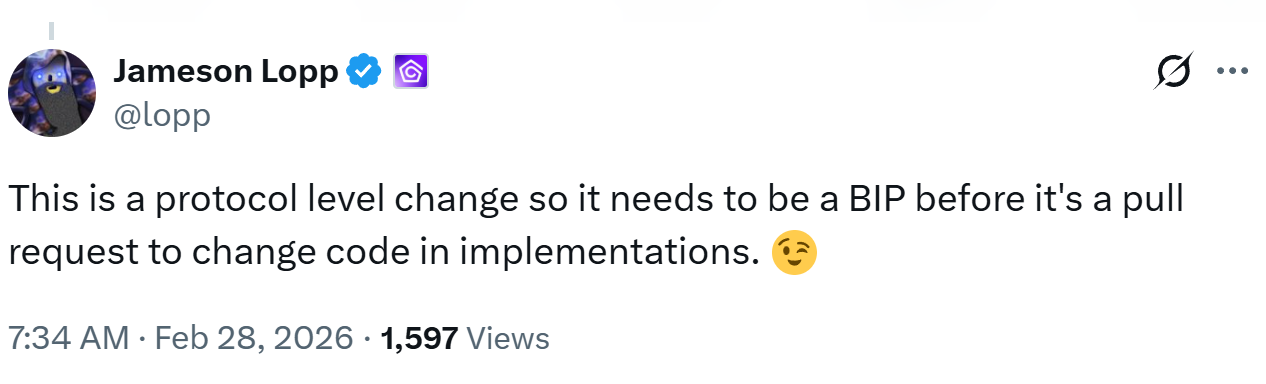
Mark Karpelès, the former CEO of Mt. Gox, is calling on community support for a proposal to recover more than $5.2 billion stolen from his Bitcoin exchange more than a decade ago.
On Friday, Karpelès submitted a proposal on GitHub to add a consensus rule that would allow the 79,956 Bitcoin hacked from Mt. Gox (currently sitting in a single wallet) to be moved to a recovery address without the original private key.
“These coins have not moved in over 15 years. They are among the most well-known and publicly tracked UTXOs in Bitcoin’s history,” he wrote.

Karpelès said that with Mt. Gox trustee Nobuaki Kobayashi already overseeing distributions to creditors, if the coins were recoverable, the existing legal and logistical framework would distribute them to their rightful owners.
“I want to be upfront: this is a hard fork. It makes a previously invalid transaction valid. All nodes would need to upgrade before the activation height. I’m not trying to disguise that fact or sneak it through as something else,” he added.
However, Karpelès said the proposal wasn’t intended to bypass the Bitcoin development process; instead, it was an attempt to start a discussion with the Bitcoin community.

“The MtGox trustee has declined to pursue on-chain recovery, citing the uncertainty of whether such a consensus change would ever be adopted,” he said.
“This creates a deadlock: the trustee won’t act without certainty, and the community can’t evaluate the idea without a concrete proposal. This patch breaks that deadlock by providing something concrete to discuss.”
Bitcoin immutability at risk, say critics
Karpelès’ proposal saw strong opposition on the online forum Bitcointalk, with most arguing that it would set a bad precedent for Bitcoin, a decentralized cryptocurrency intended to be irreversible and immutable.
“Each time a hack incident [happens], someone will call for another new consensus rule to recover stolen funds. This will destroy the bitcoin concept in full,” wrote “coupable,” who has been a member of the forum since 2015.
“Bitcoin should be independent from what Law Enforcement decides in any [jurisdictions],” said another forum member known as “PrivacyG.”
Karpelès also acknowledged that this would be the strongest argument against the proposal, but argued that the specific case is different enough, as there is both law enforcement and community consensus that the address in question contains Bitcoin stolen from Mt. Gox.
Some who claim to be affected by the Mt. Gox bankruptcy were in favor of the proposal.
“If those coins ever move by whatever mechanism, then I am going to want my share of them back,” said Samson.
“I’m a creditor and have been paid what little was left of my Bitcoin from the bankruptcy – I got about 15% back… I would support obtaining a court order to claim these coins.”
A brief recap of Mt Gox’s collapse
Mt. Gox was once the biggest Bitcoin exchange, operating from 2010 to 2014 and handling 70% of all Bitcoin transactions worldwide.
Its global presence, however, made it a honey pot for hackers, who used weaknesses in Mt. Gox’s security systems in 2011 to transfer out thousands of Bitcoin, while other operational errors led to thousands more Bitcoin being “lost.”
On Feb. 24, 2014, an alleged leaked document claimed that the company was insolvent after losing 744,408 Bitcoin in a theft that was undetected for years.
The exchange filed for bankruptcy protection in Tokyo on Feb. 28, 2014, reporting it had about $65 million in liabilities after losing 750,000 of its customers’ Bitcoin and 100,000 of its own, worth nearly half a billion dollars at the time.
Magazine: Review: The Devil Takes Bitcoin, a wild history of Mt. Gox and Silk Road


Magic Eden, the prominent NFT marketplace best known for its deep roots in the Solana blockchain ecosystem, is set to close its Bitcoin and EVM-based trading platforms and discontinue support for its multi-chain wallet.
Summary
- Magic Eden plans to shut down its Bitcoin and EVM NFT marketplaces in early March 2026, ending broader multi-chain support.
- The platform will continue supporting Solana-based assets, doubling down on its original ecosystem.
- Users need to withdraw assets from closing markets and the multi-chain wallet before termination dates.
Magic Eden refocuses on Solana, winds down Bitcoin and EVM services
Magic Eden originally rose to prominence by offering a user-friendly platform for buying, selling, and trading digital collectibles, especially non-fungible tokens (NFTs), on the high-throughput Solana network.
Over time, the platform expanded into Bitcoin Ordinals and Ethereum Virtual Machine (EVM) chains such as Ethereum, Polygon, and Avalanche in an effort to capture a broader share of the burgeoning NFT market.
However, new reports say the company will begin shutting down its Bitcoin and EVM marketplaces in the first week of March 2026, with its cross-chain wallet entering export-only mode by mid-March and fully ceasing service in early April. Support for Solana-based NFTs and assets will continue uninterrupted.
The move could be a strategic realignment rather than a retreat.
By concentrating on its core Solana busines, where the majority of its trading volume has historically originated, Magic Eden aims to streamline operational complexity and refocus engineering resources on strengthening features, liquidity, and community engagement within its original ecosystem.
Affected users are being urged to withdraw any assets held in the Bitcoin and EVM marketplaces or within the multi-chain wallet before support ends to avoid the risk of losing access. As the NFT sector evolves, Magic Eden’s decision highlights broader market trends toward specialization and platform consolidation.
TLDR:
- OpenAI signed a deal to deploy AI models on U.S. Department of War classified networks on Feb. 28, 2026.
- The agreement bans domestic mass surveillance and requires human control over lethal force decisions.
- Anthropic reportedly refused a similar Pentagon deal, citing autonomous weapons and surveillance risks.
- Backlash on X was swift, with thousands of users announcing plans to cancel ChatGPT subscriptions.
OpenAI has agreed to deploy its AI models on classified U.S. Department of War networks, CEO Sam Altman announced. The deal follows reports that Anthropic publicly declined similar Pentagon demands over autonomous weapons and surveillance concerns.
Altman posted the announcement to X, where it quickly drew millions of views and thousands of replies. The reaction online was largely critical, with many users threatening to cancel their ChatGPT subscriptions.
OpenAI and the Department of War Reach Classified AI Agreement
The agreement allows OpenAI models to operate within DoW classified systems under specific conditions.
Altman stated the deal includes explicit prohibitions on domestic mass surveillance. It also requires human oversight for any use of force, including autonomous weapons systems. Deployment will occur on cloud networks only, with OpenAI personnel embedded to monitor model behavior.
Altman noted on X that the DoW agreed with these core safety principles.
According to the post, those principles are also reflected in existing law and policy. OpenAI said it will build technical safeguards to keep models aligned with the agreement’s terms. The company also called on the DoW to extend the same terms to all AI companies.
Altman framed the deal as part of a broader effort to reduce friction between AI companies and the government. He wrote that OpenAI wants to move away from legal and governmental conflicts.
The announcement signals a shift toward negotiated frameworks rather than standoffs. OpenAI described its mission as serving all of humanity amid a “complicated, messy, and sometimes dangerous world.”
The post received over 11,000 likes within hours of going live. Reposts and quote replies numbered in the thousands. Despite the scale of engagement, most visible reactions skewed negative.
Anthropic’s Refusal Puts Spotlight on OpenAI’s Pentagon Move
Reports from the previous day indicated Anthropic CEO Dario Amodei refused similar Pentagon demands. The refusal reportedly centered on concerns about enabling mass surveillance and autonomous weapons.
Amodei allegedly offered to help the DoW transition to another provider rather than comply. That stance drew widespread praise from AI safety advocates and researchers.
OpenAI’s subsequent agreement was widely read as stepping into the gap Anthropic left. Critics on X accused the company of opportunism. Several users announced they were switching from ChatGPT to Claude. Some described the move as contradicting OpenAI’s own stated safety values.
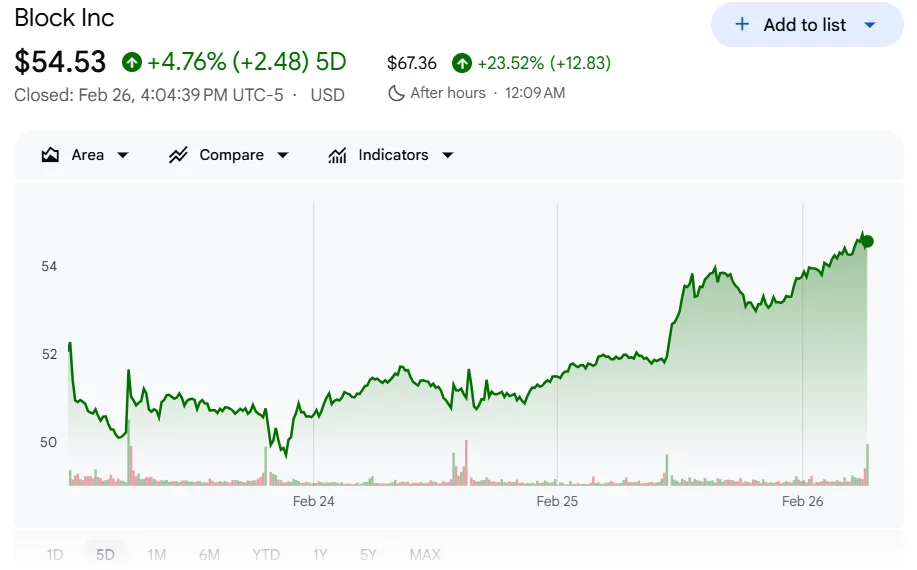
Block, Inc. will reduce its workforce by nearly half, cutting more than 4,000 jobs as CEO Jack Dorsey said the fintech firm restructures around artificial intelligence and leaner teams.
Summary
- Block, Inc. will cut over 4,000 jobs, reducing headcount from 10,000+ to under 6,000 in one of its largest corporate overhauls.
- CEO Jack Dorsey says the move reflects a strategic pivot toward intelligence tools and flatter, more efficient teams — not financial distress.
- Investors responded enthusiastically, sending Block shares up more than 23% in after-hours trading.
Wall Street cheers Jack Dorsey’s AI restructure
In a note shared publicly, Jack Dorsey said the company will shrink from over 10,000 employees to just under 6,000. He described the move as “one of the hardest decisions in the history of our company,” adding that affected employees would be notified the same day.
Despite the scale of the layoffs, Dorsey emphasized that Block is not facing financial distress. He said gross profit continues to grow, customer numbers are rising, and profitability is improving.
Instead, he framed the cuts as a proactive shift driven by the rapid advancement of intelligence tools that are reshaping how companies are built and operated.
“We’re already seeing that the intelligence tools we’re creating and using, paired with smaller and flatter teams, are enabling a new way of working,” Dorsey wrote, arguing that acting decisively now would avoid repeated rounds of layoffs that could damage morale and trust.
Employees leaving the company will receive 20 weeks of salary plus an additional week per year of tenure, equity vesting through the end of May, six months of healthcare coverage, their corporate devices, and $5,000 in transition support. Terms will vary internationally depending on local regulations.
Dorsey said internal communication channels would remain open through Thursday evening to allow departing staff to say goodbye, and he plans to host a live video session to address employees directly.
The market’s reaction to Jack Dorsey’s “leaner, meaner” pivot was nothing short of explosive. As news broke regarding the reduction of 4,000 roles, Block Inc. shares ignited in after-hours trading, surging by more than 23%.
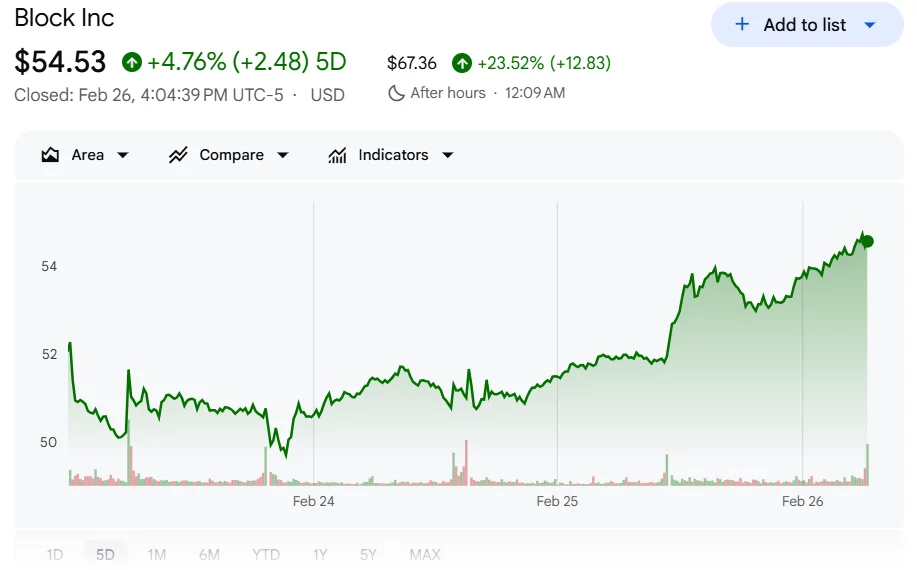
The chart reflects a dramatic vertical shift as investors pivoted from uncertainty to overwhelming optimism, interpreting the layoffs not as a sign of corporate distress, but as a commitment to long-term profitability and AI-driven efficiency.

Iran latest: Explosion heard in Tehran after Israel says it has launched ‘preventative attack’
Form 144 ALNYLAM PHARMACEUTICALS For: 27 February

Bitcoin drops to $63,000 as U.S. and Israel launch strikes on Iran


-

 Politics6 days ago
Baftas 2026: Awards Nominations, Presenters And Performers
-

 Sports4 days ago
Women’s college basketball rankings: Iowa reenters top 10, Auriemma makes history
-

 Fashion12 hours ago
Weekend Open Thread: Iris Top
-

 Politics5 days ago
Nick Reiner Enters Plea In Deaths Of Parents Rob And Michele
-

 Business3 days ago
True Citrus debuts functional drink mix collection
-

 Politics1 day ago
ITV enters Gaza with IDF amid ongoing genocide
-

 Crypto World4 days ago
XRP price enters “dead zone” as Binance leverage hits lows
-

 Business6 days ago
Mattel’s American Girl brand turns 40, dolls enter a new era
-

 Business6 days ago
Law enforcement kills armed man seeking to enter Trump’s Mar-a-Lago resort, officials say
-

 Tech4 days ago
Unsurprisingly, Apple's board gets what it wants in 2026 shareholder meeting
-

 NewsBeat2 days ago
Cuba says its forces have killed four on US-registered speedboat | World News
-
 NewsBeat2 days ago
Manchester Central Mosque issues statement as it imposes new measures ‘with immediate effect’ after armed men enter
-
 NewsBeat5 days ago
‘Hourly’ method from gastroenterologist ‘helps reduce air travel bloating’
-

 Tech6 days ago
Anthropic-Backed Group Enters NY-12 AI PAC Fight
-

 NewsBeat6 days ago
Armed man killed after entering secure perimeter of Mar-a-Lago, Secret Service says
-

 Politics6 days ago
Maine has a long track record of electing moderates. Enter Graham Platner.
-

 Business2 days ago
Discord Pushes Implementation of Global Age Checks to Second Half of 2026
-
 NewsBeat3 days ago
Police latest as search for missing woman enters day nine
-
 Sports5 days ago
2026 NFL mock draft: WRs fly off the board in first round entering combine week
-

 Business1 day ago
Only 4% of women globally reside in countries that offer almost complete legal equality