
Crypto World
CryptoQuant’s 2026 Report Reveals Institutions Never Left Bitcoin: Here’s the Proof

TLDR:
- Spot trading volume on centralized exchanges hit $679B in April 2026, the lowest since October 2023.
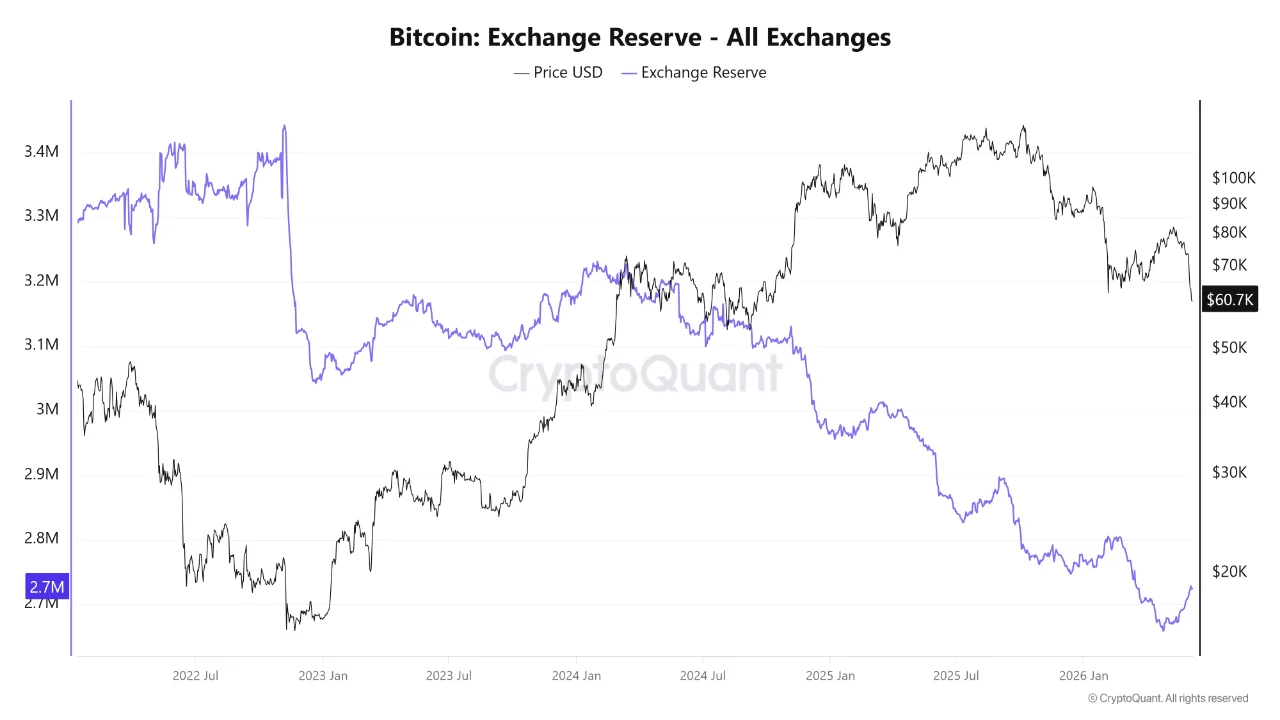
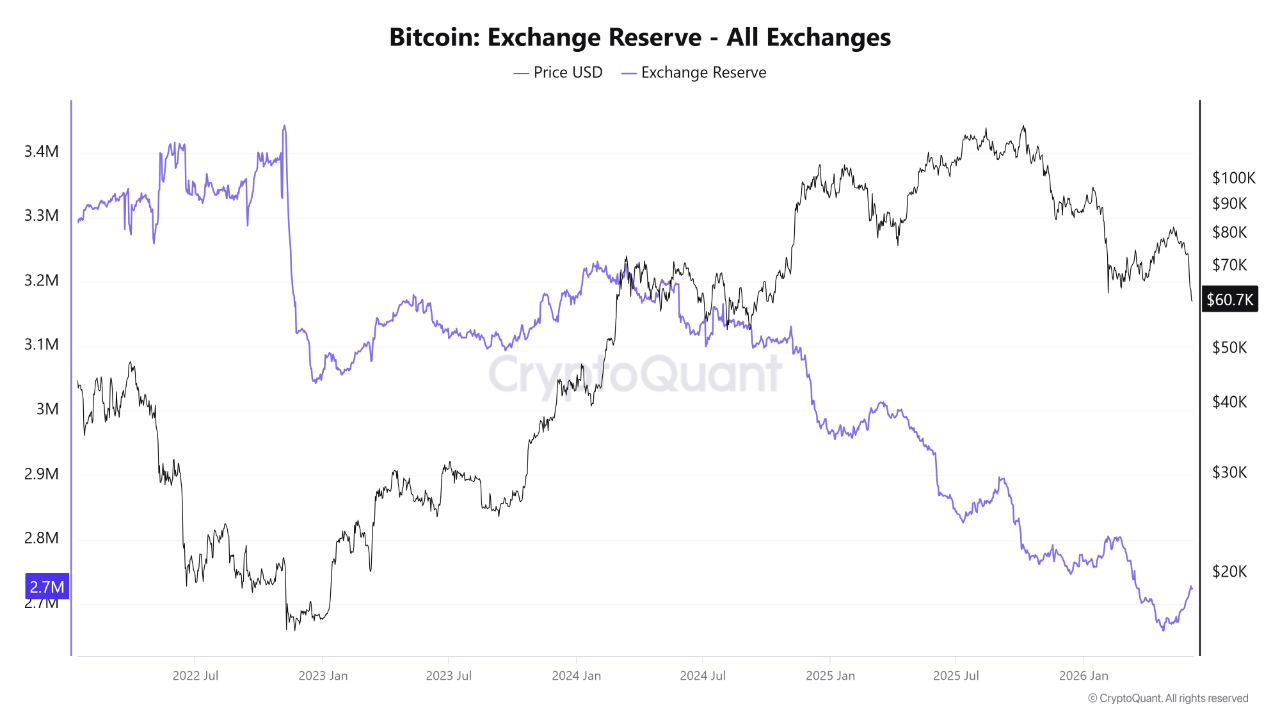
- Bitcoin exchange reserves fell to roughly 2.7M BTC, reflecting holder conviction rather than sell pressure.
- Gate, Kraken, and OKX continue processing large institutional transactions despite overall volume decline.
- Trading of gold, silver, oil, and equities on crypto exchanges reached record highs in 2026.
The question of whether institutions have abandoned Bitcoin has grown louder in 2026. Prices have fallen sharply, ETF outflows continue, and many altcoins are down more than 70%.
On the surface, the market looks deserted. However, CryptoQuant’s latest on-chain data challenges that narrative directly.
The numbers point to a market where retail has stepped back, but institutional capital has quietly stayed put.
What the Volume Data Actually Reveals
Spot trading volume across centralized exchanges fell to $679 billion in April 2026. That figure marks the lowest level recorded since October 2023.
Compared to late-2025 highs, overall trading activity has dropped by roughly 67%. Those numbers look alarming at first read, but context changes the interpretation considerably.
The decline is being driven by weaker retail participation, not institutional withdrawal. Perpetual futures volume has also dropped as speculative leverage exits the system. This tells analysts that buyers have gone quiet — not that sellers are flooding the market with supply.
CryptoQuant’s trade size analysis adds another layer to this picture. Exchanges including Gate, Kraken, and OKX are still processing large institutional-sized transactions.
Source: Cryptoquant
Professional capital continues moving through these platforms at meaningful scale. That activity does not match the profile of an institution that has packed up and left.
So the volume drop is real, but its cause matters. Retail has retreated. Institutions, by contrast, appear to be holding their ground.
On-Chain Signals and the TradFi Convergence
Bitcoin exchange reserves have fallen to roughly 2.7 million BTC, sitting near multi-year lows. Investors are withdrawing coins from exchanges rather than positioning them for sale.
That behavior reflects long-term conviction, not preparation for an exit. When holders pull coins off exchanges, it typically means they intend to keep them, not sell them.
This drawdown in exchange reserves is one of the stronger on-chain signals in CryptoQuant’s report. It runs directly counter to the narrative that institutions are dumping holdings and walking away. The data shows accumulation behavior, even as prices remain under pressure.
Meanwhile, the integration of traditional finance into crypto infrastructure has reached record levels in 2026. Trading in gold, silver, oil, equities, and ETFs on crypto exchanges hit new highs this year.
Digital asset platforms are no longer operating as isolated venues. They are expanding into broader financial marketplaces that attract a different and wider class of participant.
That structural shift matters beyond the short term. Infrastructure does not build itself during periods of abandonment.
The fact that traditional asset trading on crypto platforms is hitting records suggests that serious capital continues flowing into the space, even if Bitcoin’s spot price tells a different story right now.




Ask an Expert
Q. The Clarity Act, yea or nay?
Yea, with one important caveat. The objective cannot simply be to make life easier for crypto companies. It should make legitimate projects easier to identify, while making fraud and regulatory arbitrage harder. The biggest problem in the U.S. has been that companies often cannot determine whether they are dealing with the SEC, the CFTC or both until an enforcement action happens.
That is not a serious regulatory system. It pushes responsible teams offshore while doing surprisingly little to stop bad actors. The Clarity Act is directionally right because it recognizes that a capital-raising transaction can involve securities laws without automatically making the underlying token a security.
That distinction is much closer to how decentralized networks actually develop. My main concern is implementation. If the definitions remain subjective, or the SEC and CFTC apply conflicting standards, the uncertainty simply moves from the courts into the rulemaking process. The bill should pass, but success will depend on clear rules, coordinated regulators and real enforcement against fraud.
Q. What aspect will benefit investors the most?
The greatest benefit is the combination of clearer asset classification and mandatory disclosure. Investors need to know what they are buying, which regulator has jurisdiction, what information the project must disclose and what legal protections exist if something goes wrong. The current system often gives investors the worst of both worlds. Many projects do not provide disclosures comparable to public companies, yet they also lack a practical regulatory framework tailored to decentralized networks.
Cryptocurrency trading volumes spiked in South Korea as its stock market fell by nearly 18% this week.
Key points:
- South Korean exchanges see a 600% uptick in crypto trading volume around the snap declines in the KOSPI.
- Investors may be seeking to capitalize on volatility by buying stock-linked products overseas, per analysis.
- Bitwise highlights Bitcoin’s surprising resilience to macro headwinds throughout July.
KRW/USDT volumes spike in response to stock sell-off
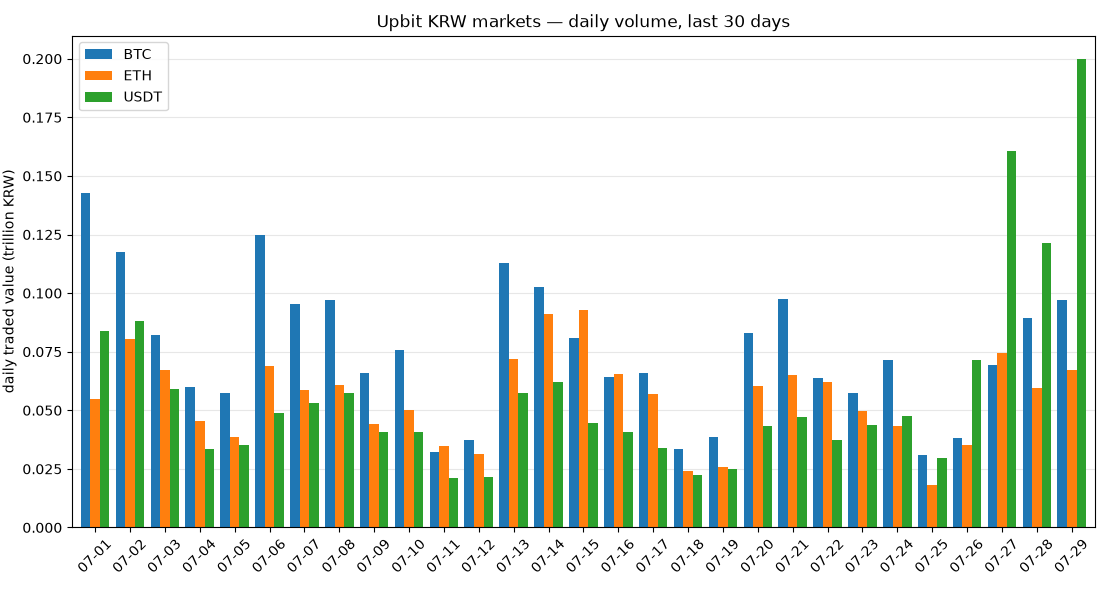
Data from largest South Korean exchange Upbit shows trading volume accelerating between the Korean won and Tether (USDT). It neared 200 billion won (140 million USDT) on July 29, up from just 20 million USDT on July 25 — an increase of 600%.
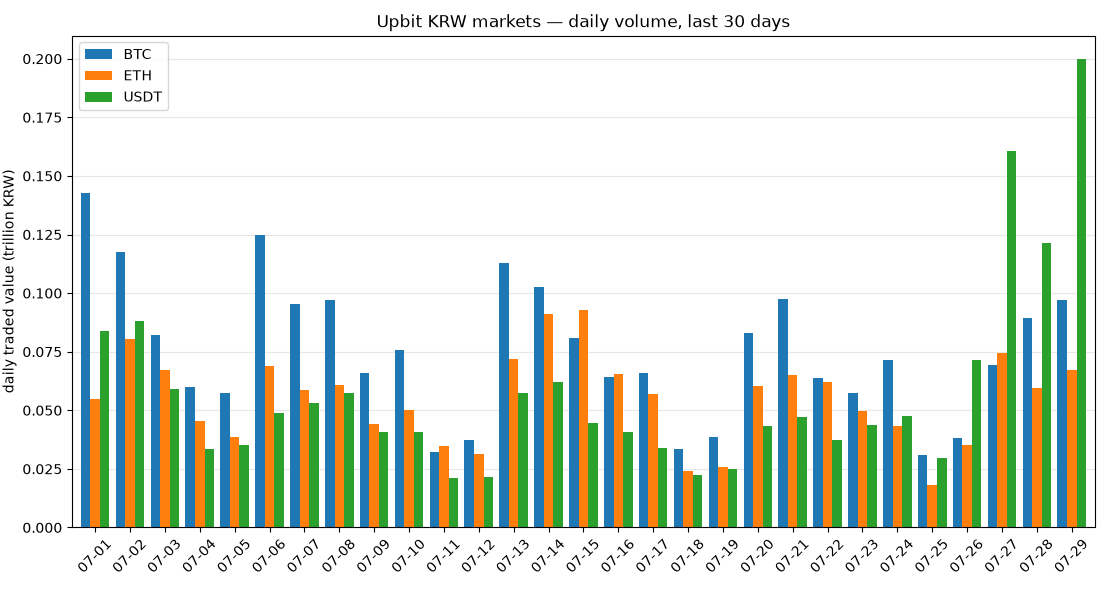
Korean won crypto trading-volume data. Source: Upbit
On the back of several straight days of downside on South Korea’s KOSPI, which came as a result of a sell-off in chip-maker stocks, investors variously sought protection and to take advantage of the decline. Capital could have flowed out of stocks to crypto, analysis referenced by local media outlet Seoul Economic Daily suggested, while investors could also have targeted derivatives of Korean equities via overseas crypto exchanges.
“There is a possibility that demand increased for moving funds to overseas exchanges or personal wallets to trade perpetual stock futures,” Cho Yoon-sung, a senior researcher at independent digital asset research and data provider Tiger Research, told the publication.
As Cointelegraph reported, an influx into semiconductors and away from crypto earlier this year is now under scrutiny as the tide turns on the AI trade’s rapid rise.
Crypto trading remains a hive of activity in South Korea, as younger traders in particular display a fondness for risk. Traders’ fondness for leveraged bets is an overarching feature of both crypto markets and this year’s AI retail boom.
Analyst underscores BTC price strength
The impact of KOSPI volatility on crypto trading volumes was in evidence before this week’s rout. On July 14, Upbit saw a conspicuous volume surge after the index plunged 10% in a single day.
Related: Bitcoin price wedged into ‘most divided’ FOMC as Iran war spikes oil prices 8%
Commenting on the latest events, Andre Dragosch, European head of research at crypto asset manager Bitwise, underscored the lack of contagion resulting from the semiconductor “meltdown.”
“Bitcoin is essentially flat since semis peaked in late June,” he summarized, suggesting that Bitcoin’s resilience was unexpected.
In an analysis released earlier this week, Bitwise attributed “remarkable outperformance” to Bitcoin in comparison to a range of US mega-cap stocks.
“Bitcoin continues to demonstrate remarkable outperformance and resilience vis-à-vis US mega cap stocks such as the Magnificent 7 and SpaceX (SPCX) – a relative strength that is all the more notable in the context of tightening financial conditions and consistent with our view of Bitcoin as the ‘canary in the macro coal mine,’” it stated.
Bitwise argued that Bitcoin may already be giving early indications of future monetary-policy easing by central banks despite rising inflation and the short-term potential for interest-rate hikes as a result.
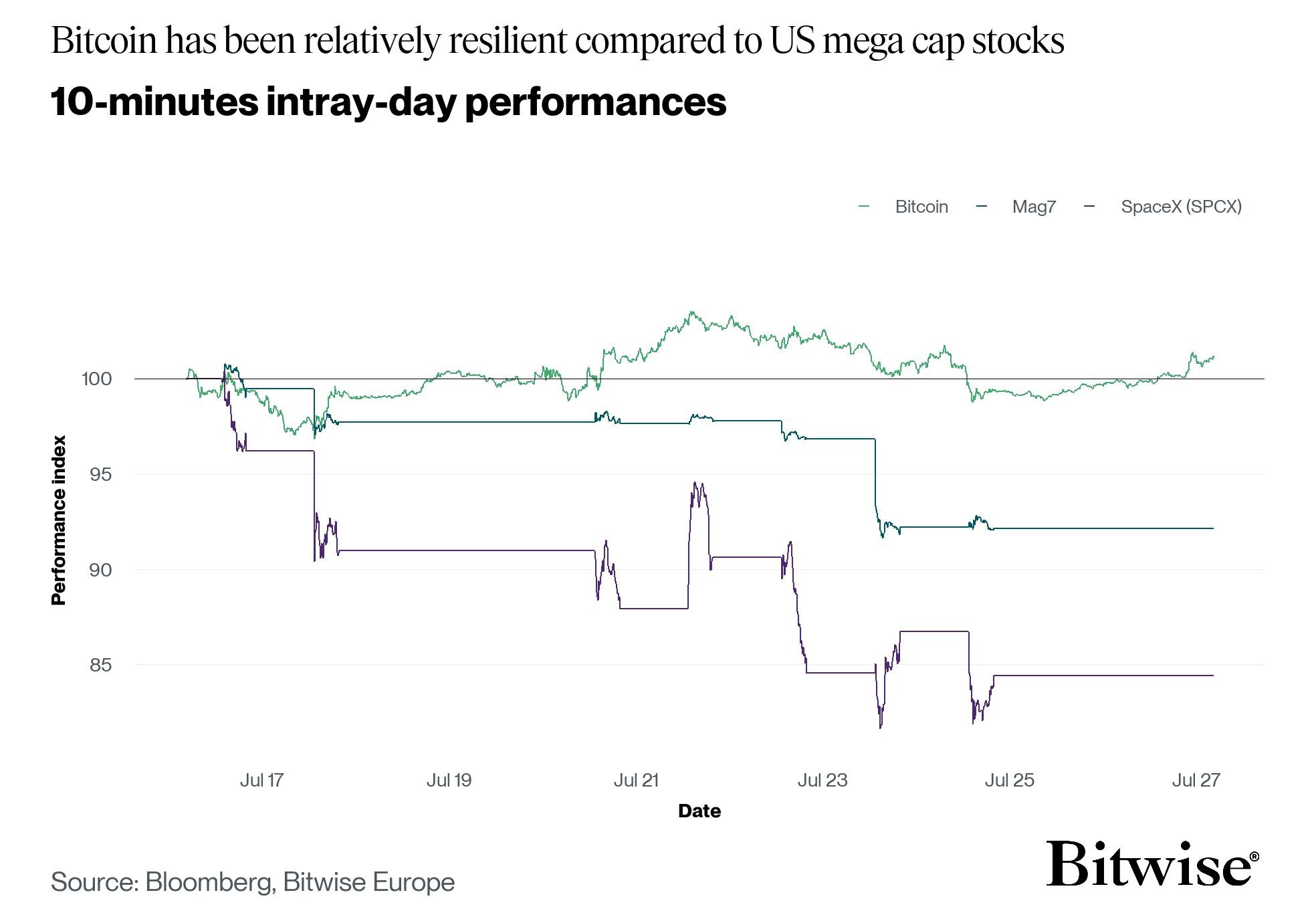
BTC/USD vs. SpaceX and Magnificent 7 stocks. Source: Bitwise
Crypto World
There is a hidden tax risk of crypto perps that no one is talking about, says CME’s CEO


U.S. approval of perpetual futures contracts could expose traders to unexpected tax and regulatory uncertainty if the products are ultimately determined to be swaps rather than futures, an issue that has received little public attention, according to CME Group Chairman and CEO Terry Duffy.
“There’s a consequence that nobody’s talking about,” Duffy said in an interview with CoinDesk. “There’s ambiguity right there, from a tax perspective, for all U.S. participants now.”
The comments come as CME continues its legal challenge against the Commodity Futures Trading Commission (CFTC) over the regulator’s approval of perpetual futures contracts in the U.S. Both sides await a federal court decision, and the outcome could significantly influence how the U.S. approaches the rapidly growing arena of perpetual futures. One consequence, according to Duffy, is how the Internal Revenue Service (IRS) ultimately taxes these contracts.
The dispute stems from whether perpetual futures should legally be treated as futures or swaps.
Duffy said that perps should fall under the legal definition of swaps, instead of how the CFTC categorizes them as futures, because of the periodic funding payments exchanged between long and short positions.
Unlike traditional futures, perpetual contracts never expire. Instead, traders periodically exchange funding payments intended to keep the derivative’s price close to that of the underlying asset. Duffy argued that those recurring payment exchanges satisfy the statutory definition of a swap under U.S. law.
“When two parties exchange payments to each other, that is deemed a swap,” he said, referring to the funding-rate mechanism used by perpetual contracts.
What Duffy sees as the main problem with this mismatched designation is that if perpetual contracts qualify as futures, many institutional traders could receive the blended tax treatment available under Section 1256 of the U.S. tax code. Under this, gains and losses are generally treated as 60% long-term and 40% short-term capital gains. If those contracts fall under swaps, they will be taxed under “ordinary” taxation. Given that the perps are newer innovations, the IRS has not issued guidance specifically addressing the tax treatment of perpetual futures.
So if the regulators or courts ultimately conclude that perpetual contracts are swaps rather than futures, market participants who have been treating them as futures for tax purposes could face uncertainty about how to report those positions to the IRS.
“So if you file your tax return and this ruling comes back, where these products that you’ve been trading and filing government tax returns as 1256 contracts [futures], when it should be ordinary, I will be curious what the IRS has to say to you about how much they think you owe them because you didn’t file your tax returns properly,” Duffy said.
‘Substance over form’
Legal experts, however, said that the issue is much more complex than that.
“The challenge here is that textually, by the structure, perpetual futures look a lot like a swap, but economically they perform a lot like futures,” said Rustin Diehl, a tax attorney and counselor at Allegis Law and an Emeritus Fellow at Georgetown Law’s Institute for International Economic Law and professor of business law at Weber State University. “It’s really a substance-over-form question … function versus text.”
Adding to the uncertainty, legal experts say that the definition of swaps is extremely broad.
“Basically, the statutory definition of swaps is so broad as to encompass … anything,” Jason Gottlieb, partner and chair of Morrison Cohen’s digital assets practice, told CoinDesk. He added that the breadth of the statutory language leaves considerable room for interpretation regarding its application to new financial products such as perpetual futures.
What it will come down to is how the court interprets it.
That’s because the Supreme Court’s 2024 Loper Bright decision eliminated the longstanding Chevron doctrine; federal courts now give less deference to agencies’ interpretations of ambiguous statutes, meaning judges could play a larger role in deciding how existing derivatives laws apply to novel crypto products.
Tax evasion?
And it’s likely to be a long, drawn-out process.
“My view is that there’s going to be a lot of litigation about it, and the Supreme Court has told courts that if there is ambiguity in the statute, they can ignore the CFTC and read the statute for themselves,” Gottlieb said.
Also, rather than immediately deciding whether the products should be classified as swaps or futures, a federal judge is likely to first examine whether the regulator reasonably considered public comments and sufficiently explained its decision before approving these contracts, Diehl said.
“I think the judge is going to focus on the Administrative Procedure Act, and kind of look at the question of did the CFTC really exercise independent judgment? Were they thorough? Were they reasoned? Did they express their reasoning?” he said.
Even if the litigation ultimately clarifies whether perpetual contracts are swaps or futures, tax treatment may still require separate guidance from the IRS, which is not obligated to adopt the CFTC’s interpretation of financial instruments, Diehl said.
“I think people are going to want to maybe check with the IRS and see how they should report these,” said Diehl. “They [IRS] generally do agree with the CFTC’s definitions of commodities historically, but there’s been many times when the IRS doesn’t just agree with a taxpayer submitting their tax position based on CFTC rules.”
Until regulators, tax authorities, or the courts provide greater clarity, Duffy said, large institutions could face uncertainty over how to report trades involving perpetual futures.
“How would you like to be running a very large public company that trades a lot and hedges a lot, and all of a sudden you’re in the news for not paying proper taxes,” said Duffy.
Read more: Inside the CME and CFTC’s battle over onchain perpetual futures
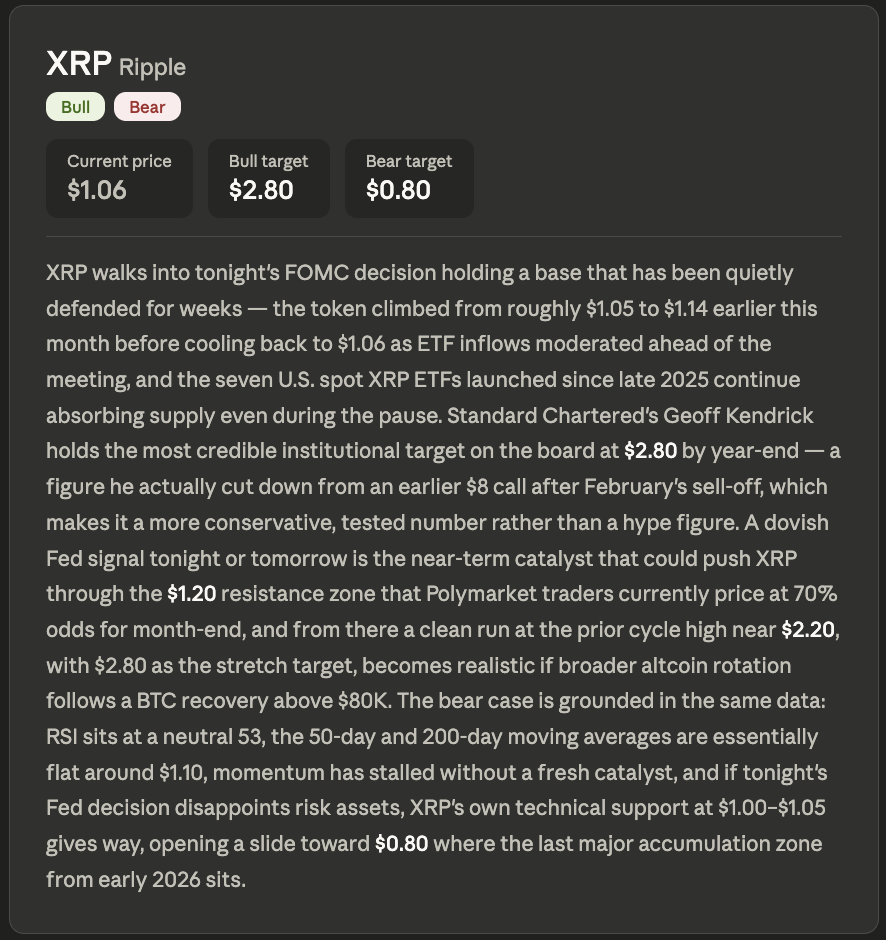
Claude AI predicts a Fed driven breakout for XRP, and this price prediction ties the entire setup to a single event. XRP walks into tonight’s FOMC decision holding a base that has been quietly defended for weeks, climbing from roughly $1.05 to $1.14 earlier this month before cooling back to $1.06 as ETF inflows moderated ahead of the meeting.
Seven US spot XRP ETFs, launched since late 2025, continue absorbing supply even during this pause. That kind of steady institutional buying through a quiet period is often more telling than a sharp spike, since it suggests real demand rather than momentum chasing.
Standard Chartered’s Geoff Kendrick holds the most credible institutional target on the board at $2.80 by year end. Worth noting, that figure was actually cut down from an earlier $8 call after February’s selloff, which makes it a more conservative, tested number rather than a hype driven one.
A dovish Fed signal tonight or tomorrow is named as the near term catalyst that could push XRP through the $1.20 resistance zone. Polymarket traders currently price 70% odds of that happening by month end.
From there, a clean run at the prior cycle high near $2.20 becomes realistic, with $2.80 as the stretch target if broader altcoin rotation follows a Bitcoin recovery above $80,000. The bear case is grounded in the same underlying data rather than a separate narrative.
RSI currently sits at a neutral 53, while the 50 day and 200 day moving averages are essentially flat around $1.10, meaning momentum has genuinely stalled without a fresh catalyst to break the tie.
If tonight’s Fed decision disappoints risk assets broadly, XRP’s own technical support at $1.00 to $1.05 gives way, opening a slide toward $0.80, the level where the last major accumulation zone from early 2026 sits.

XRP Price Prediction: XRP Is Sitting Exactly Where The Data Says It Should Be
Price closed at $1.0665, down 0.12%, in a session ranging between $1.0608 and $1.0925. That flat close lines up almost perfectly with the neutral RSI reading and flat moving averages described in the prediction itself.
Zoom out and the broader trend since July 2025 has been a long, uneven decline. XRP peaked near $3.65 that month, then spent the rest of the year carving a staircase of lower highs, with the sharpest break coming in October when price gapped from above $2.60 down through $1.80 in a matter of weeks.
Since that October crash, price spent months compressing between roughly $1.30 and $1.60, then broke that range lower in June, sliding toward $1.05. The bounce to $1.14 earlier this month has already faded back to current levels, exactly the kind of stalled momentum the flat moving averages point to.
Support sits at $1.00, the level the bear case names directly as the line that needs to hold. Resistance stacks at $1.14, then $1.20, the zone Polymarket traders are pricing tonight’s catalyst against, then the heavier ceiling near $2.20 from the prior cycle high.
Momentum here is genuinely neutral, not building toward a breakout in either direction on its own. For Claude’s bull case to activate, XRP needs a dovish signal to arrive and immediately clear $1.20, since nothing in the current chart structure suggests it can do that without outside help.
Here is What Claude AI Predicts About LiquidChain: Spoiler Alert, Very Bullish
Hindsight is the only place most people will see this rotation clearly. The money that moves early does not announce itself.
Large caps are not broken. They are boxed in. Bitcoin, Ethereum, and XRP keep testing the same ceilings with nothing giving way. Every macro catalyst comes with a new arrival date. Every institutional wave lands next quarter. Sitting in assets where the next leg depends entirely on someone else’s decision is not a position. It is a waiting room.
Capital that has survived enough cycles operates on one principle. It moves before the destination has a name.
Small market cap infrastructure plays by a different set of rules entirely. A rotation that would not register at Bitcoin’s scale can reprice an undiscovered project by multiples. The return lives in the distance between what something is genuinely worth and what the market has assigned it so far. That distance only exists while the project stays unfound. The moment it gets found, the gap closes for good.
Multi-chain fragmentation drains value from DeFi every single day. Bitcoin, Ethereum, and Solana operate as completely isolated systems with no native bridge connecting them. Every user who crosses those boundaries pays for that disconnection directly in fees, slippage, and failed transactions. Every crossing. Every time.
Claude AI predicts LiquidChain eliminates that entirely. All 3 networks unified inside a single execution layer. One deployment reaches every ecosystem. Zero cross-chain tax on any interaction.
The presale sits at $0.01454 with just over $920,000 raised. The market has not found this yet. That is exactly the opportunity.
The post Anthropic Claude AI Predicts the Price of XRP by The End of 2026 appeared first on Cryptonews.


The US Treasury’s Office of Foreign Assets Control (OFAC) has sanctioned two Iranian maritime firms in an effort to stop Iran from monetizing the Strait of Hormuz with its BTC insurance scheme.
OFAC claims the Persian Gulf Marine Insurance Company and HormuzSafe Marine Services Authority are “integral” to the Islamic Revolutionary Guard Corps (IRGC) and its “extortion scheme.”
The scheme, called “Hormuz Safe,” has been in the works for some months now. Shipowners could pay for Iran’s insurance with BTC and other cryptocurrencies and guarantee safe passage through the strait.
It would reportedly generate over $10 billion of revenue for the country and help it maintain control over the stretch of water once the war is concluded.
Read more: Crypto scams are now a threat in the Strait of Hormuz, report
In a statement, Treasury Secretary Scott Bessent said, “With its economy in freefall and inflation in the triple digits, the regime is desperate for cash.”
He added, “The United States will not allow Iran to hold global commerce hostage or use international shipping to finance the IRGC’s terrorism, aggression, and repression.”
The US noted that “disgraced regime financier” Babak Morteza Zanjani had already promoted the scheme to his followers on social media.
Zanjani reportedly used Binance between 2024 and 2025 to move $850 million, despite his account being flagged multiple times.
Yesterday’s sanctions also targeted an Iranian shadow fleet of tankers that the US says is supplying the country with millions of barrels of crude oil and petroleum products.
The war began in February 2026, and in June, a US memorandum of understanding was signed that aimed to peacefully reopen the Strait of Hormuz and end the war.
This didn’t last long, and millitary strikes resumed on July 13. Another round of peace talks took place in late July during a three-day ceasefire between the US and Iran, however, the conflict has since flared up again.
Got a tip? Send us an email securely via Protos Leaks. For more informed news and investigations, follow us on X, Bluesky, and Google News, or subscribe to our YouTube channel.
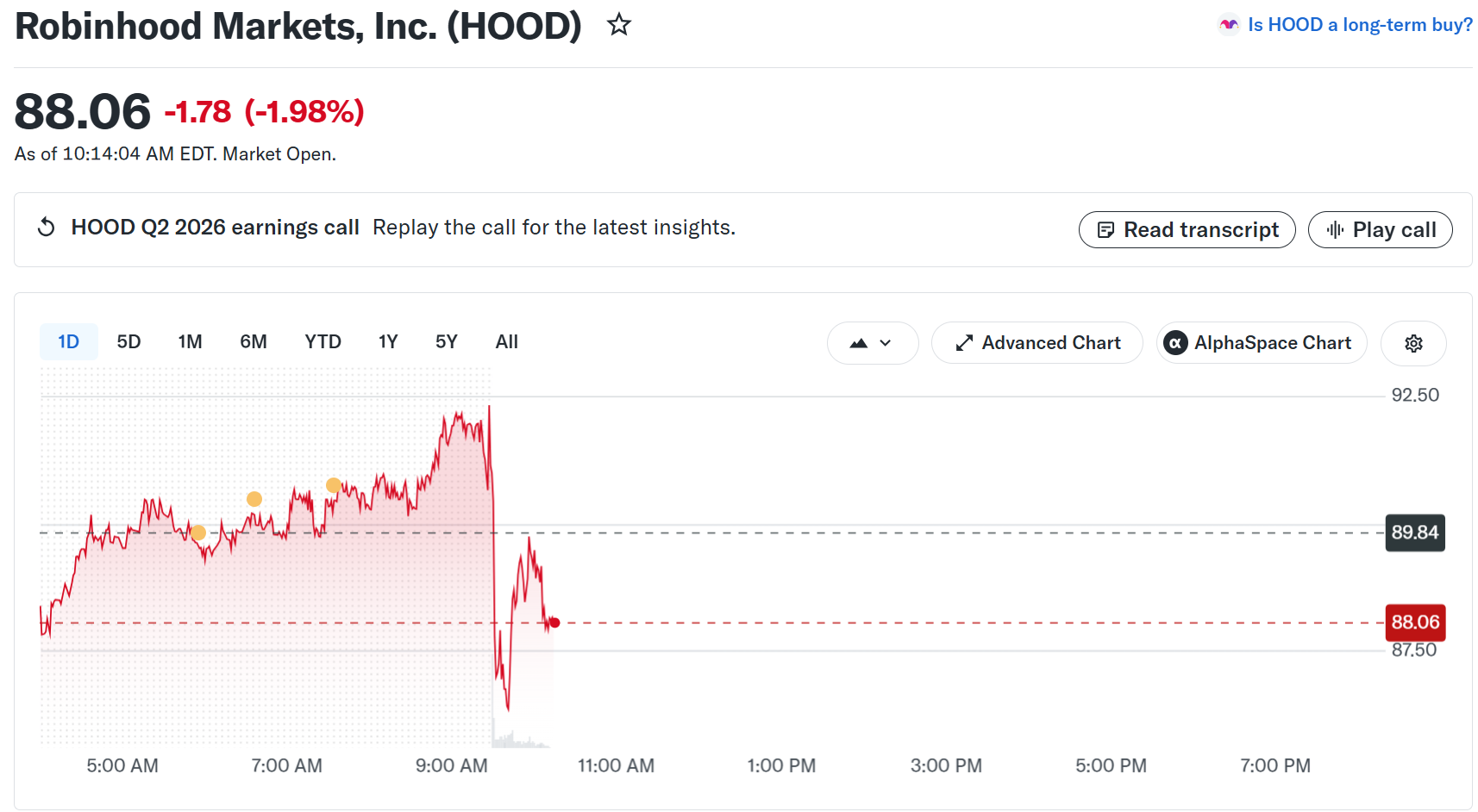
Goldman Sachs, Barclays, and Jefferies cut their Robinhood Markets (HOOD) price targets on Thursday, one evening after the Nasdaq-listed brokerage beat second-quarter revenue and profit estimates. Goldman and Jefferies had each raised their targets to $137 earlier in July.
All three firms kept bullish ratings. Their reversal is about timing, not execution. Analysts now expect Robinhood’s existing trading business, rather than its newer products, to carry growth into 2027.
Why Did Analysts Cut Robinhood Price Targets After an Earnings Beat?
Goldman Sachs moved to $118. Jefferies went to $127. Barclays cut deepest, to $105.
Firm
New target
Prior
Rating
Change
Barclays
$105
$122
Overweight
-14%
Goldman Sachs
$118
$137
Buy
-14%
Needham
$120
$123
Buy
-2%
Jefferies
$127
$137
Buy
-7%
The round trip is what stands out. Jefferies lifted its target from $94 to $137 on July 8. Goldman reached $137 in mid-July. Both unwound that optimism within a month.
Not everyone retreated. Piper Sandler held $135 and BTIG reiterated $125. Bernstein’s $160, set July 20, still leads the 28 analysts covering the stock.
Why It Matters for HOOD Stock
Robinhood beat and still could not hold a bid. That pattern is established, not new.
In November 2025, Robinhood beat on both lines and fell 10.8% the next session. HOOD traded near $89.67 on Thursday morning, about 42% below its October 2025 record.
Barclays framed the ceiling plainly. It expects existing businesses to drive near-term growth, arguing newer bets need years before they move the revenue base.

Robinhood’s HOOD stock fell almost 2% at market open, and was trading for $88.06 as of this time.
What Robinhood’s Q2 Filing Actually Shows
Revenue rose 32% to a record $1.31 billion, per the company’s filing. Diluted earnings reached $0.62 per share, up 48%. Adjusted EBITDA hit $741 million.
Earnings quality is thinner than the headline suggests. Roughly $0.14 of that EPS came from one-off gains, mostly the deconsolidation of Robinhood Ventures Fund I.
Crypto remains the soft spot. Robinhood’s crypto revenue beat consensus at $100 million, yet fell 38% from $160 million a year earlier.
That line now supplies 8% of net revenues, down from 16%. The 10-Q blames weaker market-maker rebate rates and 16% fewer users placing crypto trades.
What to Watch Over the Next 30 Days
July net new assets are tracking toward $4 billion, soft after a strong June.
Costs are the offset. Robinhood cut 10% of staff in June and lowered full-year 2026 expense guidance to a range of $2.675 billion to $2.775 billion.
Robinhood also leads tokenized stock ownership by holder count while trailing on money committed, which is the gap Barclays is pricing.
With the consensus target near $122 and the stock under $90, the question is whether prediction markets and tokenized assets scale before that spread closes on its own.
The post Goldman, Barclays, Jefferies Cut Robinhood Targets Despite Earnings Beat appeared first on BeInCrypto.
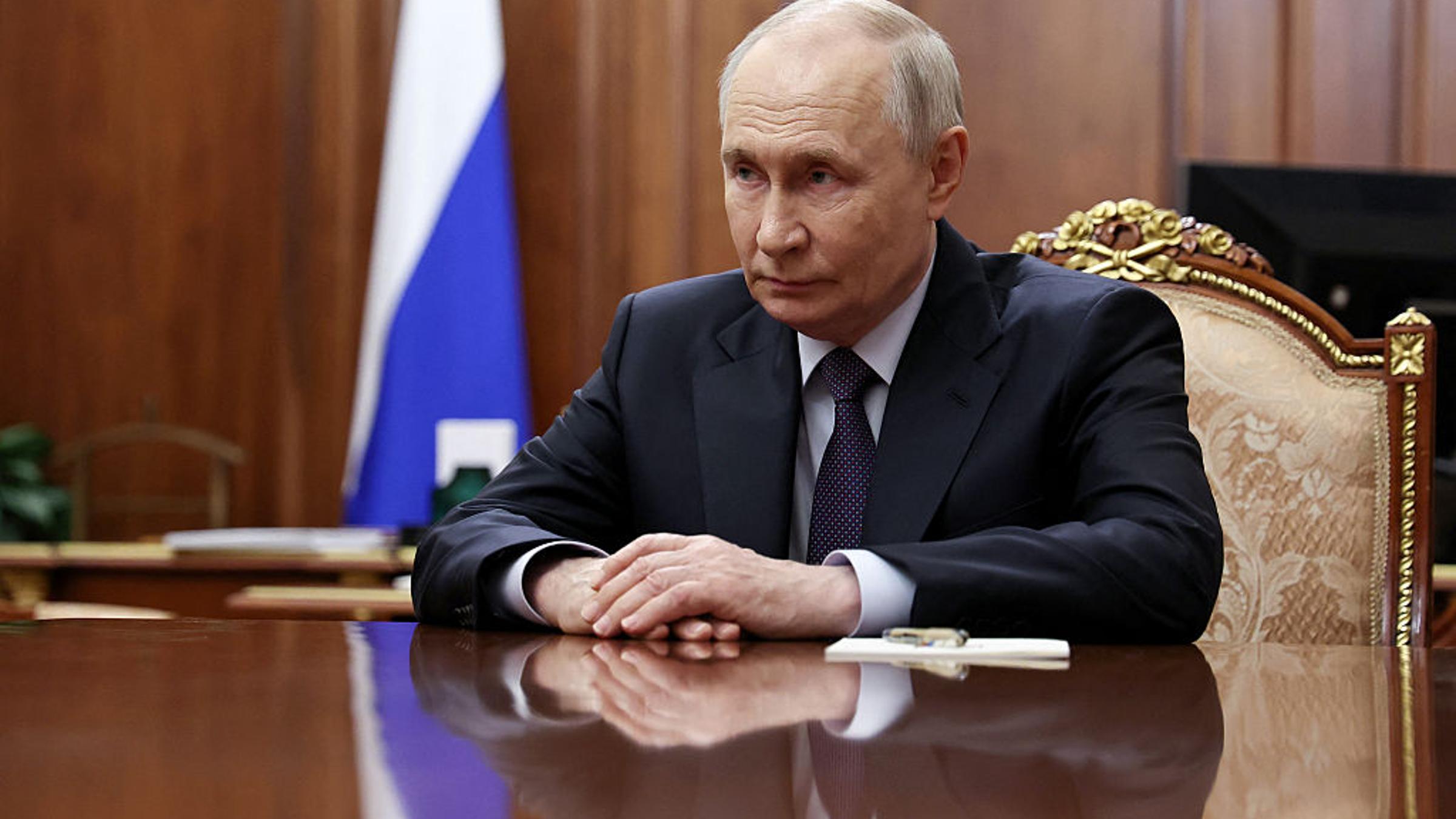
It’s clear Russia is the single most important ally to Iran in their shared conspiracy against global peace and prosperity. According to many intelligence reports, in addition to passing on sensitive intelligence to Iran about U.S. military installations in the region, Russia is systematically upgrading Iran’s aging, pre-1979 military infrastructure as its single largest external source of weaponry. As of mid-2026, Moscow has completed production of advanced Su-35 fighter jets and helicopters for Tehran, augmented by deliveries of Yak-130 combat trainers, Mi-28 attack helicopters, and hundreds of long-range air-to-air and anti-radar missiles. Furthermore, in 2022, Moscow helped launch Iran’s high-resolution Khayyam satellite, and Russian forces routinely transfer captured Western weaponry from the Ukrainian frontline—including Javelin and Stinger systems—directly to Iranian defense firms to be reverse-engineered and cloned for Tehran’s proxy networks. Simultaneously, Russian telecommunications firms are supplying Iranian operators with advanced digital surveillance and cyber warfare technologies.

Samsung SDS, the IT services arm of Samsung Group, says it is exploring cooperation with Dunamu—operator of South Korea’s Upbit exchange—across stablecoin infrastructure, digital asset systems and AI-enabled payment models. The discussions were outlined during Samsung SDS’ second-quarter earnings call on Thursday, according to remarks from CEO Lee Jun-hee.
The effort also arrives as Samsung Electronics continues to expand its digital asset footprint, including recent plans to add stablecoin support to Samsung Wallet. Together, the moves point to a broader push by Samsung-related entities toward regulated digital finance rails rather than purely retail-facing crypto features.
Key takeaways
- Samsung SDS is in talks with Dunamu on stablecoin infrastructure and broader digital asset system development.
- CEO Lee Jun-hee framed the Dunamu relationship as expansion in infrastructure capabilities, not a standalone financial investment.
- Samsung affiliates already have ties to Dunamu: Samsung Securities, Samsung SDS and Samsung Card agreed to buy a combined 4% stake in May 2026.
- Samsung SDS’ Q2 results show growth across cloud and AI-related services, providing business momentum for its digital finance ambitions.
- South Korea’s regulatory direction for stablecoins remains a key variable for how such infrastructure partnerships develop.
Samsung SDS and Dunamu explore stablecoin and digital finance infrastructure
During its Q2 earnings call, Samsung SDS CEO Lee Jun-hee said the company is discussing potential cooperation with Dunamu on stablecoin infrastructure, digital asset systems, and AI-based payment business models. Lee also referenced Samsung SDS’ own work in tokenized securities and stablecoin workflow validation as proof points for why it expects the partnership to strengthen its position in digital asset infrastructure.
Lee noted that Samsung SDS has already secured “differentiated business capabilities” through the Korea Securities Depository’s tokenized securities platform project and through end-to-end validation of a full stablecoin process—from issuance through settlement. The company’s stated aim is to combine its IT services, cloud and security capabilities with Dunamu’s blockchain expertise.
In the Q2 transcript, Samsung SDS said the partnership goal is to “lead this market” by pairing the two firms’ respective strengths. However, Samsung SDS did not provide additional detail on timelines, specific technical approaches, or the scope of any prospective commercial offering.
Cointelegraph previously reported Samsung Electronics’ plan to add stablecoin support to Samsung Wallet, and this new development suggests the Samsung ecosystem is aligning infrastructure capability with consumer-facing wallets. While Samsung Wallet would be a distribution layer, stablecoin infrastructure and enterprise digital asset systems typically sit behind the scenes—supporting issuance, settlement, custody integrations, and compliance-oriented workflows.
Earlier stake tie deepens: strategic rather than financial intent
The talks with Dunamu follow a prior move that increased Samsung affiliates’ exposure to South Korea’s digital asset sector. In May 2026, Samsung Securities, Samsung SDS and Samsung Card agreed to buy a combined 4% stake in Dunamu. That transaction strengthened existing commercial ties and underscored that Samsung-related companies are looking beyond pilots.
In the latest Q2 call, Lee reportedly characterized Samsung SDS’ investment in Dunamu as strategic rather than purely financial. He said both companies plan to refine potential business models for digital financial infrastructure, suggesting that any future cooperation could extend beyond infrastructure experiments into more defined productization.
Samsung SDS did not immediately respond to Cointelegraph’s request for comment, and Dunamu declined to comment. That limits what can be said publicly about how negotiations are progressing or whether agreements are already in place for specific use cases.
How Samsung SDS’ cloud and AI expansion could reinforce digital finance plans
Samsung SDS’ stablecoin and digital asset ambitions are being presented alongside broader growth in cloud and AI services. In its Q2 earnings presentation and related figures, Samsung SDS reported Q2 revenue of 3.72 trillion Korean won (about $2.6 billion), up 5.9% year on year. The company cited cloud momentum as a major contributor, including a 17% increase in cloud revenue from the prior year and a jump in external cloud business revenue of 75%.
Samsung SDS attributed part of the external cloud growth to demand for its cloud platform and graphics processing unit-as-a-service offerings. That emphasis matters because stablecoin infrastructure and tokenized financial systems often depend on the same enterprise capabilities—secure hosting, scalable compute, identity and access controls, and reliability under transaction load.
The company also reportedly outlined plans to expand its AI infrastructure capacity—from about 110 megawatts today to 230 MW by 2029, and more than 800 MW by 2031. If executed, such expansion would further position Samsung SDS to deliver data-intensive services for AI-driven finance workflows, including risk analytics, fraud detection, and automated settlement-related monitoring.
Still, investors and builders should distinguish between infrastructure readiness and regulatory authorization. Stablecoin use in retail payments, treasury operations, or tokenized assets typically depends on compliance frameworks and the specific licensing/oversight model in the relevant jurisdiction.
What this means for South Korea’s digital finance ecosystem
South Korea has been moving toward clearer stablecoin and crypto regulation, and industry participants are watching how the rules will translate into real, compliant payment and settlement deployments. Earlier coverage from Cointelegraph noted that a South Korea report proposed stablecoin rules ahead of a broader crypto law framework.
Against that backdrop, Samsung SDS’ focus on end-to-end stablecoin process validation—from issuance to settlement—reads like an attempt to be ready for both technical and compliance requirements. Rather than targeting speculative applications, the company appears to be building capabilities that can support regulated flows once the legal environment permits or clarifies specific models.
At the same time, the partnership’s practical impact will hinge on what “AI-based payment business models” ultimately involve. AI can be used in customer authentication, compliance monitoring, market surveillance, and payment risk assessment, but the boundaries of acceptable use will depend on data policies and the final regulatory approach.
For traders and users, these initiatives may not immediately change day-to-day trading volumes or retail access. For developers and institutional stakeholders, however, infrastructure partnerships can matter because they affect integration timelines, operational reliability, and the availability of custody/settlement tooling that exchanges and financial platforms can adopt.
Next, the key question is whether Samsung SDS and Dunamu will move from exploratory cooperation into concrete deployments—particularly in stablecoin issuance/settlement workflows and any wallet or payment integrations tied to Samsung’s consumer products. Observers should also watch for updates as South Korea’s stablecoin regulatory trajectory progresses, since the permitted use cases will likely determine what infrastructure work can scale commercially.


The two-week campaign brought thousands of traders on-chain, with daily $500 prize pools and fully transparent, publicly verifiable winner selection.
Primit, the decentralized perpetual exchange built on Avalanche, today announced the successful conclusion of its Season 1 trading campaign, a 14-day event that rewarded traders with daily prize pools and marked the platform’s first major community milestone since launch.
Running from July 15 to July 28, the campaign invited traders of all sizes to participate with a deliberately low barrier to entry: anyone generating at least $200 in daily trading volume was automatically entered into that day’s draw. Each day, 20 winners split a $500 prize pool, with rewards distributed directly to their wallets.
By the Numbers
Over the course of Season 1, Primit recorded:
- 10,000+ participating wallets across the campaign
- Over 500 wallets qualified for every single one of the 14 daily actions
- 14 daily draws completed, with 280 total winners
- $100,000 will be distributed directly to traders’ wallets
In a space where campaign fairness is often questioned, Primit published every day’s winner list — with masked wallet addresses — on its official blog, allowing anyone to verify results on-chain. This transparency-first approach became a defining feature of the campaign and a foundation of trust with its early community.
“Season 1 was about proving one thing: that a new perpetual DEX can give everyday traders a fair shot at real rewards, not just whales,” said Primit Team. “The response exceeded our expectations — traders came for the prizes, and stayed for the product.”
Built on Avalanche
Primit’s deployment on Avalanche played a central role in the campaign’s accessibility. Sub-second finality and near-zero gas fees allowed participants to reach the $200 volume threshold in minutes, at a cost of pennies — removing the friction that typically keeps retail traders away from on-chain derivatives.
What’s Next: Season 2
With Season 1 complete, Primit confirmed that Season 2 is already in development, featuring a larger prize pool and new participation mechanics. Details will be announced through Primit’s official channels in the coming weeks.
“This is the end of Season 1, but the beginning of Primit’s community story,” the team added. “Everything we learned from our first traders goes directly into what we build next.”
About Primit
Primit is a decentralized perpetual futures exchange deployed on Avalanche, offering fast, low-cost on-chain derivatives trading without KYC. Primit is building the next generation of accessible on-chain trading infrastructure.
Website: https://primit.io | X: https://x.com/primitforall
The post Primit Wraps Up Season 1 Trading Campaign on Avalanche appeared first on BeInCrypto.
The past months have not been kind to Ripple’s cross-border token, whose price is down roughly 65% on a yearly scale.
One analyst warned that it may soon fall well below the $1 psychological mark, while many others remain optimistic that a major rebound is coming next.
Going Further Down?
As of press time, XRP trades at around $1.08, which translates into a 4% weekly loss. According to X user Hamza, the asset’s recent decline has resulted in a breakdown from a critical symmetrical triangle that could lead to an additional pullback.
The analyst claimed that retail is still “bagholding on hope” while smart money had left and set a target of $0.836. At the same time, they said a potential rise to $1.16 would invalidate the bearish setup.
FOUR | Crypto Spaces also issued a pessimistic forecast, envisioning a plunge to $1.02, while Carl Hawley opined that XRP has shown “extreme weakness” on higher timeframes, making the asset the most oversold since COVID times. Usually, entering such a territory is a precursor to a resurgence, yet the analyst couldn’t predict the exact direction of the upcoming move, saying:
“Capitulation or opportunity? The next few weeks could be decisive.”
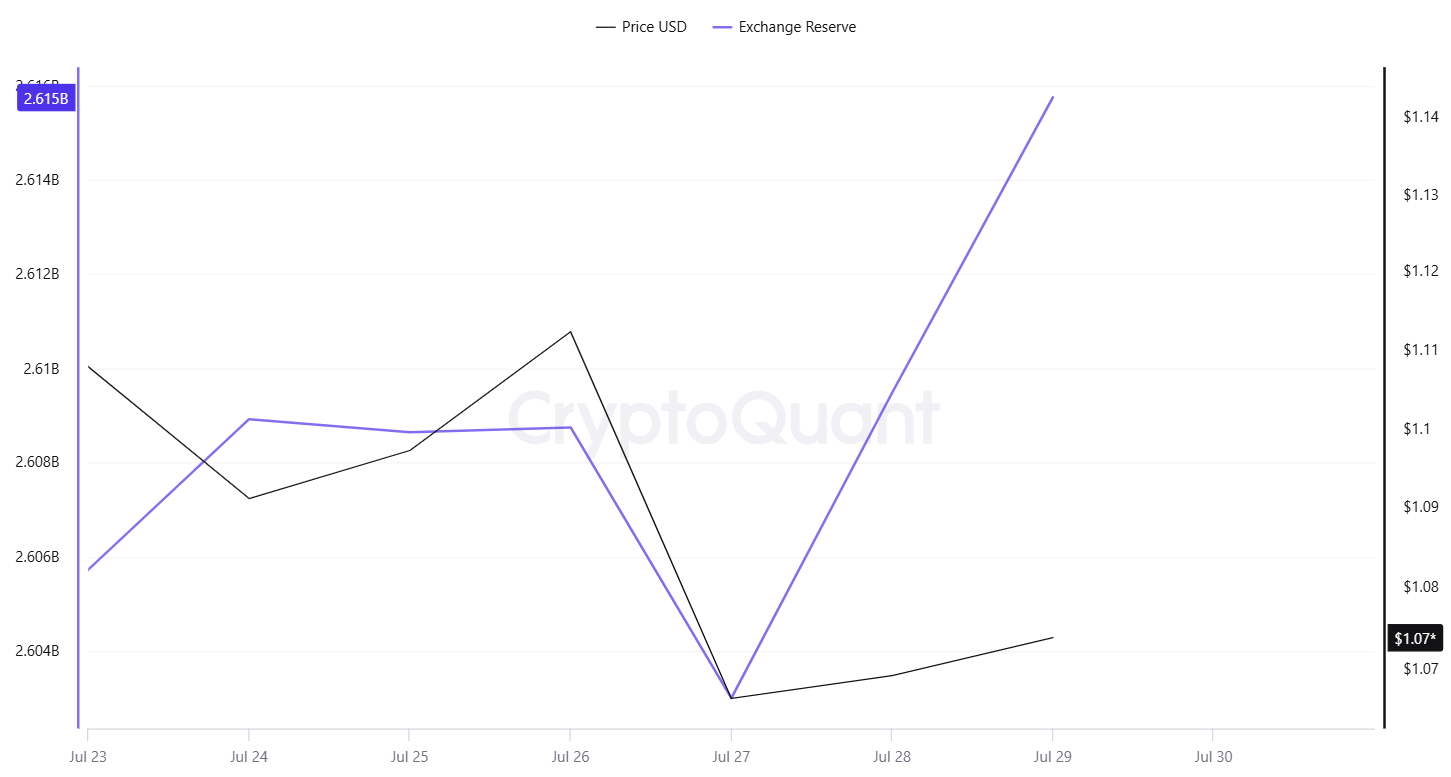
The rising number of XRP tokens stored on Binance suggests the bearish perspective is more likely. The figure has reached a nearly three-week high of approximately 2.62 billion coins, signaling that some investors have abandoned self-custody methods and moved their holdings to the exchange. This, in turn, increases the immediate selling pressure.
The Bullish Scenarios
It is important to note that the majority of people making XRP predictions remain optimistic. X user MARMOT recently claimed that the asset is repeating the exact pattern from 2017, which led to a 60,000% explosion. They believe the path to the next bull run involves three different phases, envisioning an eventual ascent to a new all-time high of $13.
Celal Kucuker also chipped in, seeing compression, exhausted sellers, and asymmetric risk. In their view, if XRP breaks above its current structure, those who called for $0.50 may suddenly start calling for $10.
The most bullish forecast came from xrpl_Adam, who suggested that Ripple’s native token may become a $100 trillion asset in the future. As of now, it’s hard to imagine an explosion of that magnitude, given that the entire market capitalization of the crypto sector is around $2.3 trillion.
The post XRP Warning: Why Ripple’s Price Could Plunge 23% appeared first on CryptoPotato.

A Generational Crypto Buying Opportunity Has Begun

Riviana Foods expands pulse, whole grain ingredients line

Is the Clarity Act dead?


-

 Fashion6 days ago
Weekend Open Thread: Brooks Brothers
-
 Sports4 days ago
Commonwealth Games boxing: Jadumani Singh seals dominant 5-0 win over Pakistan’s Sumama Rehman to enter quarter-finals | Commonwealth Games News
-

 Business19 hours ago
Why Trees Belong on the Risk Register
-

 Tech4 days ago
Intel is reversing course and bringing hyper-threading back to its server chips
-

 Crypto World5 days ago
Ripple bought a bank in pieces. The $4 billion audit
-

 Politics3 days ago
Luke Littler dismantles Gerwyn Price to retain title in Blackpool
-

 Politics2 days ago
The Part of the Electric Transition Nobody Wants to Discuss
-
 Entertainment6 days ago
A New Post-Apocalyptic Gundam Anime Series Blasts Into SDCC
-

 News Videos4 days ago
BITCOIN JUST ENTERED THIS CRITICAL ZONE…
-

 Fashion6 days ago
16 Dresses for the High Summer Event
-

 Sports7 days ago
2026 3M Open leaderboard: Scottie Scheffler finds putter in Round 1, sits three back
-

 News Videos7 days ago
The Peugeot Family: How 200 Years of an “Old Money” Dynasty Died in A Boardroom
-

 Business1 day ago
Major shareholder moves on Canyon
-

 Crypto World4 days ago
XRP Ledger adds $2.6B as RWA inflows rank second
-

 Politics4 days ago
Spain sweeps the board at 2026 World Cup with individual awards
-

 News Videos3 hours ago
Bitcoin Enters the 3rd Stage of the Bear Market
-
 Entertainment2 days ago
‘Stargate’ Creator’s New Sci-Fi Series Returns for Season 3 Tomorrow
-

 Tech5 days ago
Anthropic launches Claude Opus 5, a cheaper AI model for coding, agents and enterprise workflows
-

 Crypto World2 days ago
Kraken Enables Retail Access to Jersey Mike’s IPO via Tokenized Shares
-

 Entertainment5 days ago
Sara Gilson Killed By Husband After Viral “Pedophile” TikTok Video
You must be logged in to post a comment Login