

Crypto World
Ctrl Wallet shuts down after exploit, urges users to move funds



Ctrl Wallet has announced the permanent shutdown of its services after a recent security exploit, giving users until Aug. 3 to move their crypto assets before core wallet functions go offline.
Summary
- Ctrl Wallet will permanently shut down on Aug. 3 and has urged users to move funds before wallet services end.
- Users can still recover assets later by importing their 12- or 24-word recovery phrase into compatible wallets.
- The shutdown follows a recent Cardano-related exploit and comes amid a string of crypto wallet and bridge security incidents.
Ctrl Wallet said in a blog post published Tuesday that it will disable sending, receiving, swapping and all other wallet functions from Aug. 3, leaving users with only the ability to export their recovery phrases.
The company also confirmed it will immediately stop new downloads and remove the application from browser extension and mobile app stores as part of the shutdown process.
The decision comes just weeks after Ctrl Wallet disclosed a security incident affecting some Cardano wallets. On June 23, the wallet provider said it had placed parts of its platform into temporary maintenance mode while engineers investigated the issue and worked to protect user assets.
Users have one month to transfer assets
Ahead of the shutdown deadline, Ctrl Wallet has strongly advised customers to move their funds to another wallet or exchange instead of waiting until services are disabled.
According to the company, users who do not transfer assets before Aug. 3 will still be able to access their funds by importing their 12-word or 24-word recovery phrase into another compatible wallet.
Ctrl Wallet identified MetaMask, Trust Wallet and Phantom as compatible alternatives for importing recovery phrases. The company stressed that users should securely back up their seed phrases before attempting any migration.
Alongside the shutdown notice, Ctrl Wallet warned that there will be no migration token, token swap, or airdrop linked to the closure. The wallet provider urged customers to ignore social media posts or websites claiming to offer compensation or rewards tied to the shutdown, cautioning that such offers are likely to be scams.
Formerly known as XDEFI Wallet, Ctrl Wallet lists more than 650,000 monthly users and a workforce of between 11 and 50 employees on its LinkedIn profile. The wallet supported more than 2,500 blockchain networks, including Cardano and Midnight.
Security incidents continue across crypto platforms
The shutdown follows a transition announced on April 29, when Ctrl Wallet said it had come under the Emurgo umbrella and that its multichain technology would continue through the SecondFi wallet. SecondFi, a self-custodial wallet developed by Emurgo after rebranding from Yoroi in April 2026, later suffered its own security incident.
On June 24, attackers exploited a vulnerability in SecondFi that resulted in the theft of about 16 million ADA, worth roughly $2.4 million at the time.
SecondFi later said it had secured about 129 million ADA through emergency measures, transferred those funds to an independent third-party custodian, and introduced a recovery process covering the 374 affected wallet addresses.
The latest shutdown also comes during a series of security breaches affecting crypto infrastructure. As previously reported by crypto.news, blockchain security firm Blockaid detected an active exploit against the DeFi platform Summer.fi that had drained about $6 million before the attack was disclosed.
Separately, Taiko urged users to withdraw assets from all bridges on its network after confirming its chain state verification mechanism had been compromised, while Blockaid estimated losses from the related ERC20 Vault attack at more than $1 million.
Days earlier, interoperability protocol Axelar disabled its Secret Network bridge connections after an exploit led to the loss of roughly $4.7 million in bridged assets.
According to Axelar, early findings indicated the issue originated in the Secret Network’s ICS-20 smart contract rather than Axelar’s core infrastructure, prompting the protocol to suspend affected connections while its investigation continues.



Mizuho has lowered its price target for Strategy while maintaining an outperform rating, signaling that it still expects MSTR shares to climb above the $200 level despite the company’s recent Bitcoin sale.
Summary
- Mizuho cut its MSTR price target to $213 but kept an outperform rating, still expecting shares to trade above $200.
- The revised target follows Strategy’s $216 million Bitcoin sale, which left the company holding 843,775 BTC and $2.55 billion in cash reserves.
- Grayscale Research and several market commentators said the sale could strengthen Strategy’s finances and improve its S&P 500 inclusion prospects.
Mizuho reduced its price target on Strategy to $213 from $265 after revising its Bitcoin price forecast to $71,500 by the end of 2027. Even with the lower target, the brokerage kept its outperform rating, indicating that it continues to see substantial upside for the Bitcoin treasury company’s stock.
The revised target follows Strategy’s decision to sell 3,588 Bitcoin for about $216 million, a transaction the company said would help fund dividend payments tied to its digital credit securities. After completing the sale, Strategy held 843,775 BTC alongside approximately $2.55 billion in U.S. dollar reserves.
Although the announcement initially weighed on market sentiment, MSTR recovered as Bitcoin rebounded above $63,000. The stock closed back above the psychological $100 level and traded around $101 in premarket trading, according to Yahoo Finance. Even so, MSTR remains down more than 34% since the start of the year as Bitcoin has struggled through the current bear market.
Analysts still expect substantial upside
Mizuho’s revised forecast comes as analysts continue to debate whether Strategy’s Bitcoin sale should be viewed as a sign of weakness or disciplined financial management. While the brokerage adjusted its long-term assumptions for Bitcoin prices, it did not change its positive stance on the stock.
Supporting that interpretation, Grayscale Research argued in a July 6 report that investors may have misread the transaction. As previously reported by crypto.news, the research firm said the sale strengthened Strategy’s financial position rather than signaling financial distress.
According to Grayscale Head of Research Zach Pandl, the company’s financing structure remains well supported despite concerns raised by some market participants. The report was published after Bitcoin briefly fell toward the $61,000 level following news of the sale before recovering above $63,000.
Grayscale also argued that improving Strategy’s balance sheet could reduce concerns surrounding its financing model while creating conditions for a more stable Bitcoin market over time.
Bitcoin sale fuels S&P 500 inclusion debate
Beyond the balance sheet impact, several market commentators believe the transaction could improve Strategy’s chances of joining the S&P 500.
Crypto researcher Ignas argued that the sale demonstrates Strategy’s ability to generate liquidity during periods of Bitcoin weakness, something he believes could satisfy concerns previously raised by S&P Global.
According to Ignas, inclusion in the index would require passive index funds to purchase MSTR shares, potentially creating additional demand for the stock. He also suggested Strategy could eventually repurchase the Bitcoin it sold if such inclusion materializes.
Crypto commentator Zayn reached a similar conclusion. He argued that Strategy has addressed several issues that critics previously highlighted by building a sizeable U.S. dollar reserve, repurchasing convertible debt, and using Bitcoin sales to meet dividend obligations instead of relying on additional borrowing.
According to Zayn, those steps weaken claims that the company’s financing model resembles a Ponzi scheme while demonstrating continued access to capital markets during a prolonged Bitcoin downturn.
Even after lowering its valuation target, Mizuho’s latest note indicates the firm believes those financial changes leave room for MSTR shares to recover well beyond current trading levels if Bitcoin’s long-term outlook improves.
TLDR:
- Ethereum price forecast remains focused on the $1,800 zone, where about 4.30 million ETH previously changed hands.
- ETH could target $1,980 and $2,079 if buyers reclaim the high-volume resistance area with stronger spot demand.
- Binance ETH reserves have increased since late June, raising concerns about more available supply on the exchange.
- Derivatives data has improved, but flat open interest shows the latest ETH rebound is not mainly leverage-driven.
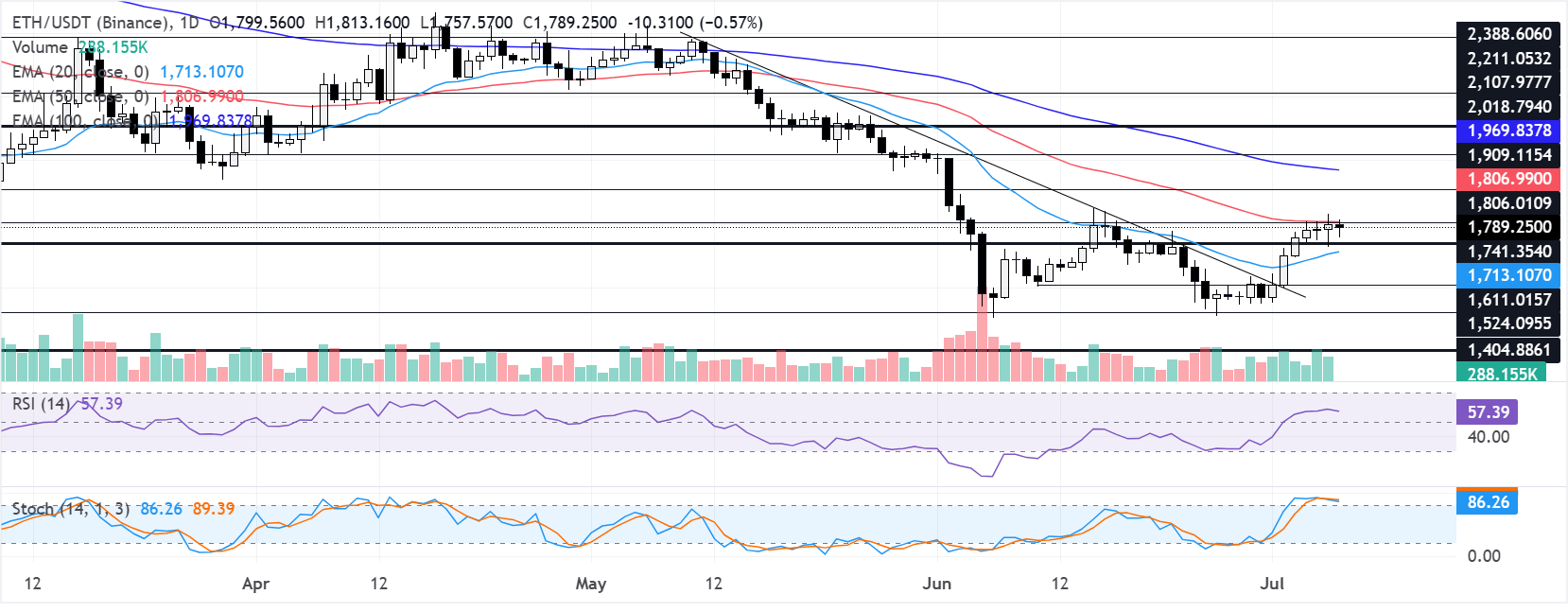
Ethereum price forecast remains locked around the $1,800 level as buyers attempt to reclaim a major resistance zone. ETH recently traded near $1,780 after a sharp rebound from late-June lows. The move has improved short-term sentiment, but the structure still lacks broad confirmation.
Roughly 4.30 million ETH changed hands near $1,800, based on the UTXO Realized Price Distribution data. That makes the level a major supply area. A clean reclaim could open a move toward $1,980 and $2,079. A rejection may expose thinner volume below, with the next support baseline near $1,237.
Ethereum Price Prediction Faces the $1,800 Supply Wall
Ethereum price prediction now depends on how ETH reacts near the $1,800 resistance band. The zone has become important as both volume profile data and moving averages align near the same area.
ETH also faces pressure from the 50-day exponential moving average near $1,806. The 100-day EMA sits higher near $1,970, close to the next major upside target. This keeps the recovery below the medium-term structure for now.
The daily chart shows a constructive but incomplete recovery. The RSI near 57 points to improving momentum, but it does not confirm a full bullish shift. The stochastic reading near 86 also shows that short-term upside could be stretched.
Immediate support sits near $1,741, followed by the 20-day EMA around $1,713. Deeper support levels stand near $1,524 and $1,405 if sellers regain control. A larger breakdown would bring the $1,156 area back into focus.
Ethereum price prediction would turn stronger if ETH closes above $1,806 with rising demand. The next upside levels would then sit around $1,909, $2,018, $2,108, and $2,211.
ETH Price Signals Show Demand Is Still Selective
Binance ETH reserves have increased from 3.64 million to 3.87 million since late June. That marks an increase of about 221,000 ETH, or 6.1%. Rising exchange reserves can point to higher potential sell-side liquidity.
The order-size data adds a cautious signal. ETH Average Order Size has moved into “Whale Left” territory, according to CryptoQuant analysis. That suggests larger participants are reducing their market footprint.
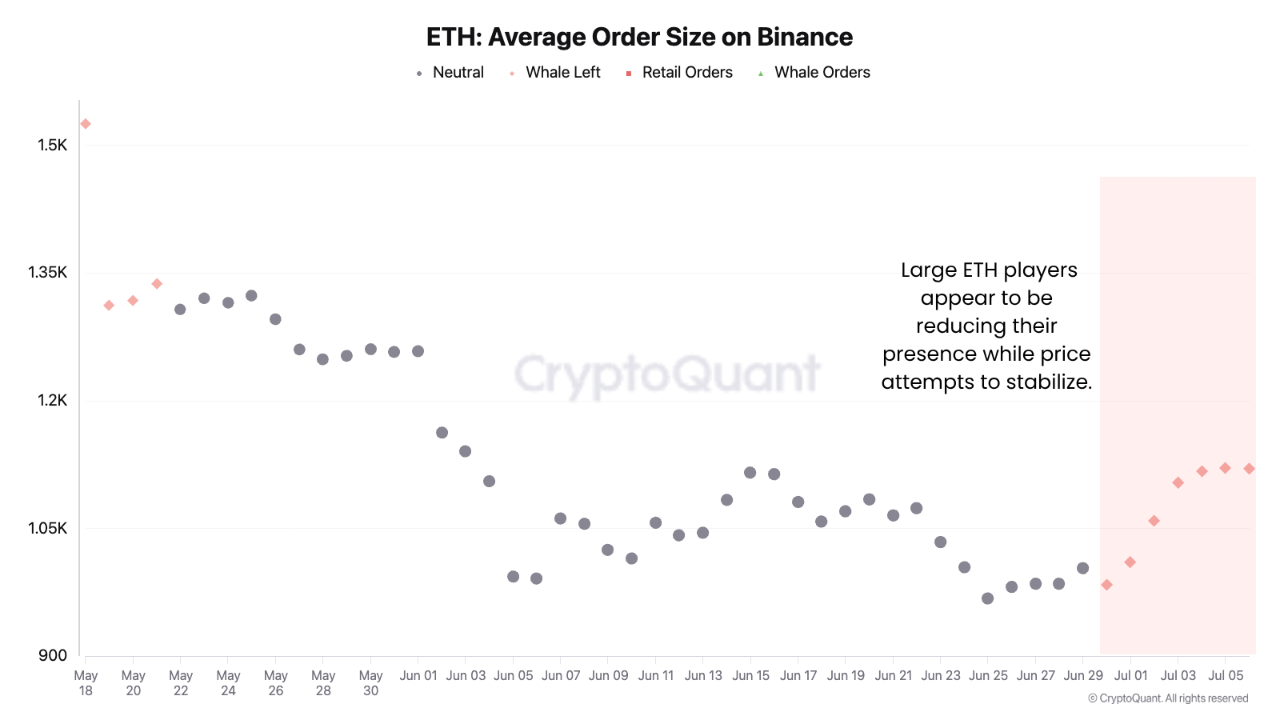
This creates a weaker setup beneath the recent rebound. More ETH is available on Binance, while whale-sized demand has not returned strongly. Ethereum Price Forecast therefore remains sensitive to any failed breakout near $1,800.
Derivatives data looks more positive, but it does not show excessive leverage. Ethereum has gained about 14% since Net Taker Volume turned positive on June 28. Positive Net Taker Volume signals stronger buying pressure in perpetual markets.
Open interest has stayed mostly flat across the rebound. The estimated leverage ratio has also failed to rise sharply after its June decline. That suggests the move is not driven by aggressive leveraged longs.
This lowers the risk of a major long squeeze, but it also shows caution among traders. ETH needs stronger spot demand and whale participation to confirm a healthier trend. Meanwhile, US spot ETH ETFs have recorded three straight days of net inflows, adding some support to sentiment.

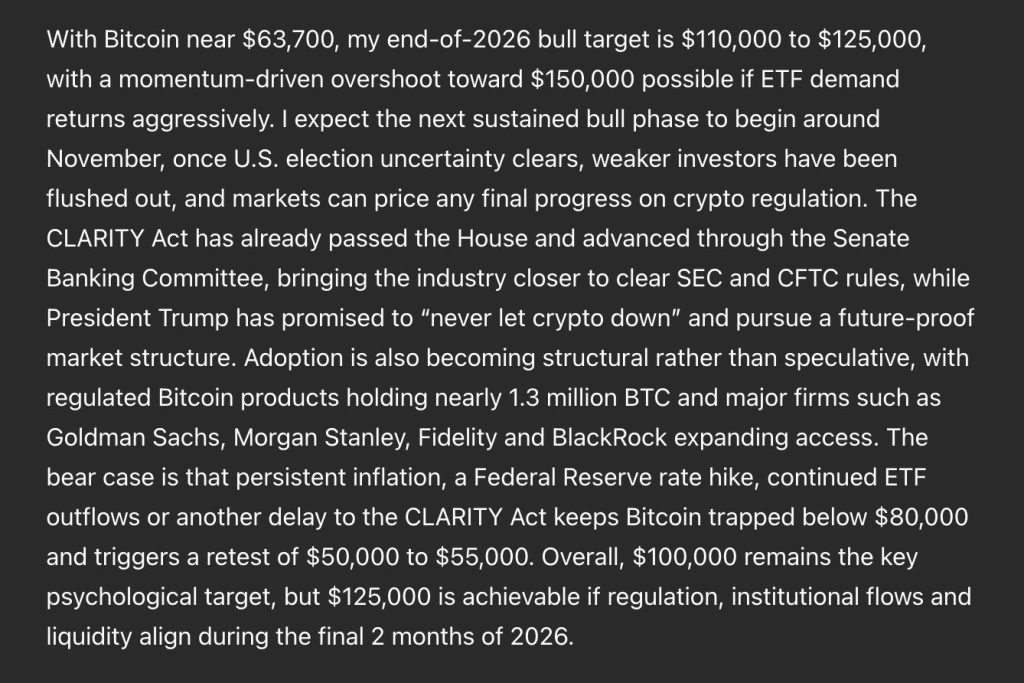
Sam Altman ChatGPT AI just circled November on the calendar and put a number next to Bitcoin Price Prediction. The model predicts $110,000 to $125,000 by the end of 2026, with a momentum overshoot toward $150,000 possible if ETF demand returns aggressively.
The bull case treats the next 4 months as a waiting period before a real ignition event. Bitcoin trades near $63,700 today, and the model frames November as the inflection point where several forces align simultaneously.
Election uncertainty clears, weaker investors get flushed out during the current soft patch, and markets can finally price in any final progress on crypto regulation.
The CLARITY Act has already passed the House and advanced through the Senate Banking Committee, putting clear SEC and CFTC rules within realistic striking distance.

President Trump has publicly pledged to never let crypto down and pursue a future-proof market structure, which the model treats as meaningful political cover for institutional allocators sitting on the sidelines. The adoption story has also shifted from speculative to structural in a way that is hard to dismiss.
Regulated Bitcoin products now hold nearly 1.3 million BTC, and major firms including Goldman Sachs, Morgan Stanley, Fidelity, and BlackRock continue to expand access for their clients.
That combination of legislative progress, political backing, and structural institutional ownership gives the bull case far more durable support than a typical market cycle rally.
If regulation, institutional flows, and liquidity all align during the final two months of the year, the model sees $125,000 as achievable, with $100,000 as the key psychological milestone along the way.
The bear case points directly at macro risks that could derail the entire timeline. Persistent inflation triggering a Federal Reserve rate hike would be the most damaging single event, since tighter monetary policy tends to drain risk assets faster than any crypto specific catalyst can offset.

Continued ETF outflows or another delay to the CLARITY Act could also keep Bitcoin trapped below $80,000 and trigger a retest of $50,000 to $55,000 instead of breaking higher.
Bitcoin Price Prediction: BTC Climbs Off Its Lowest Close In Months With November In Its Sights
The daily chart shows Bitcoin at $64,312 after grinding through one of the weakest stretches in this cycle, reaching a low near $58,000 in late June before the current recovery began.
That bounce over the past week has been steady rather than explosive, with a series of small to medium green candles pushing price back above $64,000 for the first time since late May.
The character of this recovery looks more like patient accumulation than a momentum-driven short squeeze, which actually fits the narrative in this prediction quite well, given the model expects the real fireworks to wait until November.
Resistance sits first near $68,000, a level price cleared briefly in late May before rolling over, with a much heavier ceiling near $76,000 where the most extended rally attempt of 2026 ultimately ran out of buyers.
Above that, the $80,000 level sits as the bear case ceiling named directly in this prediction, making it the clearest dividing line on the chart.
Support holds near $59,000 to $60,000, the zone that has been tested multiple times over the past several weeks and held each time.
The broader structure still shows lower highs stretching back to October, though the recent lows near $58,000 represent a higher low relative to the February bottom near $62,000, which is the first faint hint of a potential base forming.
Momentum on the daily candles looks like it is recovering rather than turning, with buying pressure showing up more consistently than at any point in the past month. If Bitcoin can push through $68,000 and hold it heading into August, the November thesis ChatGPT is describing starts to look like it has the technical runway it needs to actually play out.
Don’t Miss Out on Our $1,000 USDT Airdrop on ByBit
You Might Like What ChatGPT AI Predicts About LiquidChain
The rotation is already underway. Most people will recognize it after it has already happened.
Meta AI predicts that large caps are not broken. They are capped. Bitcoin, Ethereum, and XRP have been pressing against the same bands for weeks with nothing breaking through. The macro tailwinds keep getting rescheduled. The institutional inflows keep getting pushed back another quarter. Waiting on catalysts outside your control is not positioning. It is just waiting.
A capital that has navigated enough cycles does not sit at resistance. It moves before the destination has a name.
Early-stage infrastructure operates on different math. A small enough market cap means a modest rotation produces dramatic movement. The returns come from the gap between what something is genuinely worth and what the market has priced it at. That gap only exists while the project stays undiscovered.
Multi-chain fragmentation bleeds DeFi every single day. Bitcoin, Ethereum, and Solana run completely isolated systems with no native way to connect them. Every user crossing those boundaries pays in fees, slippage, and failed transactions. Every single time.
LiquidChain collapses all 3 into a single execution layer. One deployment. Full ecosystem access. No cross-chain tax anywhere.
The market has not found this yet. That is the entire point.
The presale is at $0.01454 with just over $890,000 raised. Ground floor is a description, not a pitch.
Execution is unproven. Adoption is unknown. Established assets offer a smoother ride toward a ceiling that is already visible. LiquidChain is an earlier seat at a table that has not been set yet.
Explore the LiquidChain Presale
The post Sam Altman ChatGPT AI Predicts Insane Bitcoin Price by 2026 appeared first on Cryptonews.


Robert Kiyosaki issued a fresh recommendation amid ongoing market turbulence, steering attention away from traditional safe havens like Bitcoin and commodities. Instead, he wants followers to study big systemic change.
Here is what the author of Rich Dad Poor Dad now recommends, why he shifted his focus, and how critics are reacting.
What Robert Kiyosaki Recommends Instead of Bitcoin and Gold
The recommendation is not an asset but a book about financial collapse and wealth transfer. In a recent post on X, Kiyosaki highlighted “The Entropy Trap” by Mickey M. Maini as the essential read for this moment in history.
The book carries a foreword by Jim Rickards, a name Kiyosaki often cites. Furthermore, he explained that it reveals how trust-dependent assets could collapse as faith in traditional financial systems steadily erodes worldwide.
Follow us on X to get the latest news as it happens.
Those assets include specific instruments. Kiyosaki pointed to US bonds, ETFs, and mutual funds as examples that rely entirely on trust. Moreover, he argues their value could unravel once confidence in the system finally breaks down.
“You can see that today as large bond holders, such as Japan have already started dumping US Bonds. People who know what’s going to happen and what assets to hold ….will become the world’s new rich,” Kiyosaki said on X.
His core thesis flips the usual playbook. Those who identify non-trust-dependent assets will become the next “ultra rich”. Meanwhile, those following outdated rules risk financial ruin during the coming reset he describes.
Why Did Kiyosaki Change His Message Now
The shift marks a notable evolution in Kiyosaki’s messaging. Rather than doubling down solely on gold, silver, or crypto, he now emphasizes deeper knowledge and preparation for an entropy-driven financial reset.
He frames the change in terms of historical patterns. Wealth transfers, he argues, repeat throughout history during major systemic breakdowns. Furthermore, he pointed to large holders, such as Japan dumping US bonds as an early warning sign.
The timing follows a public admission. In late June 2026, gold crashed from highs near $5,600 toward the $4,000 range. Kiyosaki then posted bluntly, “I was wrong. Gold still crashing. That’s real life.”
Despite the setback, he held firm in the long term. He maintained his $35,000 gold target within five years. Moreover, he stressed that profits are made when buying, not selling, and that markets naturally fluctuate.
Critics remain deeply skeptical, however. Detractors highlight his history of bold, sometimes unfulfilled forecasts and question extreme targets like $35,000. Nevertheless, Kiyosaki continues to position himself as an educator, urging proactive learning over any single asset class.
“Don’t worry Robert. You’ll be hilariously wrong again about gold being 35k/oz in 5 years,” one user replied.
Subscribe to our YouTube channel to watch leaders and journalists provide expert insights.
The post After His Gold Blunder, Robert Kiyosaki Issues a Surprising Recommendation appeared first on BeInCrypto.


The wallet behind BonkDAO's $20 million governance attack has parked most of the stolen BONK in a multisig controlled by a newly created shadow DAO, Chainalysis said in a post on its official X account Tuesday. The blockchain analytics firm calls the structure "BONK 2.0." The multisig is governed… Read the full story at The Defiant
Tether has invested $20 million in a strategic growth financing round for Mercado Bitcoin, Brazil's largest crypto exchange, the stablecoin issuer announced Tuesday. The deal backs Mercado Bitcoin's push into tokenization, payments, credit and capital markets across Latin America. Mercado Bitcoin,… Read the full story at The Defiant


The U.S. Securities and Exchange Commission has added three major crypto-related rule proposals to its 2026 regulatory agenda, expanding its work on digital asset regulation while Congress continues to debate the CLARITY Act.
Summary
- The SEC has added three crypto-related rule proposals to its 2026 regulatory agenda covering assets, broker-dealers, and market structure.
- The proposals include possible crypto asset exemptions, broker-dealer rule changes, and new trading rules for exchanges and ATSs.
- Meanwhile, the CLARITY Act awaits a Senate vote as lawmakers work to reconcile competing versions before the Aug. 7 deadline.
According to the SEC’s Agency Rule List, the commission is considering separate rulemaking projects covering crypto assets, crypto broker-dealers, and crypto market structure. Together, the proposals would address how digital assets are issued, traded, and handled by regulated financial firms, while providing new guidance in areas that have long lacked clear federal rules.
The proposal covering crypto assets would explore regulations for the offer and sale of digital assets, including potential exemptions and safe harbors. The SEC said these measures could clarify the regulatory framework for crypto assets and provide more certainty for market participants.
The initiative follows the commission’s recently proposed innovation exemption, which would allow eligible firms to issue and trade tokenized U.S. stocks under specific conditions.
New rules extend across crypto trading and broker-dealers
Another proposal focuses on broker-dealers that deal with crypto assets. The SEC’s Division is considering recommending amendments to Rules 15c3-1 and 15c3-3, along with other broker-dealer financial responsibility rules and Rules 17a-3 and 17a-4, to address how existing requirements apply to digital assets.
Earlier this year, the SEC also outlined conditions under which certain decentralized finance platforms could operate without registering as broker-dealers. At the same time, the commission is separately seeking public comments on several novel exchange-traded fund proposals, including prediction market ETFs.
A third proposal listed in the regulatory agenda concerns crypto market structure. Under the plan, the Division is considering recommending amendments to Exchange Act rules governing the trading of crypto assets on alternative trading systems (ATSs) and national securities exchanges.
Speaking previously about the agency’s regulatory direction, SEC Chair Paul Atkins said the commission is embracing innovation by bringing more financial products onshore, creating clearer capital-raising rules for crypto businesses, and providing regulatory clarity for tokenized securities.
Atkins linked those efforts to President Donald Trump’s stated objective of making the United States the world’s crypto capital.
Congress continues work on the CLARITY Act
While the SEC advances its own rulemaking process, lawmakers are still negotiating the CLARITY Act, one of the most significant crypto market structure bills under consideration in Congress.
The legislation did not become law before the previously discussed July 4 timeline, despite earlier optimism expressed by White House crypto adviser Patrick Witt. Attention has now turned to Aug. 7, the Senate’s final scheduled session day before lawmakers leave for the summer recess.
Crypto.news previously reported that the CLARITY Act has already passed the House of Representatives, cleared the Senate Banking Committee, and remains on the Senate calendar awaiting a full Senate vote.
Before floor consideration can proceed, Senate staff are still reconciling separate versions produced by the Agriculture and Banking Committees because both panels oversee different parts of digital asset policy.
More recently, crypto.news reported that Senator Bill Hagerty outlined a revised Senate roadmap that could see final legislative text released before lawmakers return from recess. Bloomberg Intelligence has estimated the bill has roughly a 60% chance of passing this month.
Still, crypto.news has also reported that the legislation will likely require 60 Senate votes, meaning Republican lawmakers will need Democratic support before the proposal can move closer to President Trump’s desk.


Kraken has secured a $22 million arbitration award against its former auditor Mazars USA, with co-CEO Arjun Sethi linking the dispute to what he described as Operation Chokepoint 2.0.
Summary
- Kraken secured a $22 million arbitration award against former auditor Mazars over its withdrawn 2022 audit.
- Co-CEO Arjun Sethi linked the dispute to Operation Chokepoint 2.0 and called for passage of the CLARITY Act.
- The exchange continues expanding its product suite with tokenized stock collateral and institutional lending services.
According to a letter published Tuesday by Kraken co-CEO Arjun Sethi, parent company Payward has asked the Delaware Court of Chancery to enter judgment on the arbitration award after prevailing against Mazars USA. The dispute centers on the firm’s withdrawal from Kraken’s nearly completed 2022 audit, which Sethi said caused financial damage to the exchange.
Sethi wrote that Mazars ended the engagement despite finding no fraud, raising no concerns about Kraken’s management and reporting no disagreements with the company. He argued that the decision disrupted access to banking relationships, licensing processes and other essential business services that rely on completed independent audits.
Describing audits as critical infrastructure for financial companies, Sethi wrote that “an audit is not a favor. It is oxygen,” while arguing that lawful crypto firms were denied access to basic financial services during the period.
Sethi ties audit dispute to regulatory pressure
In the letter, Sethi attributed Mazars’ withdrawal to Operation Chokepoint 2.0, a term used by parts of the crypto industry to describe alleged coordinated pressure on banks, auditors and service providers to distance themselves from digital asset companies.
To support that argument, the letter pointed to several regulatory developments during 2023. These included joint guidance issued by U.S. banking regulators, the Securities and Exchange Commission’s since-rescinded Staff Accounting Bulletin No. 121, and the collapse of crypto-focused banking networks Silvergate SEN and Signature Bank’s Signet payment system.
Sethi also urged Congress to pass the CLARITY Act, saying a dedicated crypto market structure law would provide clearer operating rules for digital asset companies instead of relying on enforcement actions.
Offering his own reaction on X, Kraken co-CEO Dave Ripley said the arbitration case represented only part of what happened during that period. Ripley described the $22 million award as compensation for financial harm that he said resulted from a coordinated campaign against the crypto industry.
Meanwhile, U.S. regulators have continued reviewing banking oversight tied to digital assets. In February, the Federal Reserve requested public feedback on a proposal to remove “reputation risk” from bank supervision after its 2025 directive instructing supervisors to stop pressuring banks to close customer accounts over reputational concerns. Critics of the previous framework argued the proposal could help end practices associated with Operation Chokepoint 2.0.
Kraken expands products while IPO plans continue
Even as the legal dispute moves through the Delaware court, Kraken has continued adding new institutional and trading products.
As previously reported by crypto.news, the exchange recently began allowing eligible users outside the United States to use selected tokenized stocks and exchange-traded funds as collateral for futures and margin trading on Kraken Pro.
The launch covers 10 xStocks assets, including SPYx, QQQx, AAPLx, GOOGLx, TSLAx, NVDAx, HOODx, MSTRx, GLDx and CRCLx, allowing traders to back leveraged crypto positions without selling those holdings.
The collateral initiative follows other recent product launches. In May, Payward partnered with Franklin Templeton to introduce tokenized money market products for collateral and cash management on Kraken. A month later, Kraken and Maple launched an institutional crypto lending structure using a bankruptcy-remote vehicle for crypto-backed loans.
Founded in 2011, Kraken has also been preparing for a public listing. The company disclosed in November 2025 that it had confidentially submitted a draft Form S-1 registration statement to the U.S. Securities and Exchange Commission.
However, reports published in May said the IPO may be delayed until 2027 because of weaker crypto market conditions and ongoing cost-cutting efforts.


Nigel Farage has resigned as a Member of Parliament after confirming he will seek re-election in a by-election while facing scrutiny over multimillion-dollar gifts from figures linked to the crypto industry.
Summary
- Nigel Farage has resigned as MP and will contest a Clacton by-election while parliamentary investigations continue.
- Farage denies wrongdoing over multimillion-dollar gifts linked to crypto figures Christopher Harborne and George Cottrell.
- The controversy comes as crypto-related political funding faces growing scrutiny in both the UK and the US.
According to statements Farage made during an X livestream on Tuesday, the Reform UK leader stepped down as the MP for Clacton so local voters could decide whether he should continue representing the constituency while parliamentary investigations into his financial declarations continue.
Farage said he had “done nothing wrong” and insisted he had not broken any laws or misused public money. He also confirmed that the UK’s parliamentary standards commissioner is investigating two separate matters related to gifts he received from crypto billionaire Christopher Harborne and George Cottrell, who has a previous fraud conviction and has been linked to a crypto casino.
Describing the donations as unconditional gifts, Farage said funds provided by Harborne would be used to cover his personal security costs, citing threats and attacks against him. He added that standing again in a by-election would allow Clacton voters to judge his actions directly rather than leaving the matter to political opponents.
Why has Nigel Farage resigned?
Speaking during the livestream, Farage accused established politicians of using what he described as “foul means” against him, saying the investigations had prompted his decision to resign and contest the seat again.
The controversy follows media reports that Farage personally received millions of dollars in donations and gifts from Harborne and Cottrell. Earlier reports in May stated that Harborne had given Farage a gift valued at about $6.7 million.
At the time, Farage described the payment as a reward for his role in campaigning for Brexit, the 2016 referendum that led to the United Kingdom leaving the European Union.
The London Standard reported that the timetable for the Clacton by-election remains uncertain because several procedural steps must be completed before voters return to the polls. According to the publication, the process could take weeks or even months. Farage originally won the Clacton seat in the July 2024 general election with 46.2% of the vote, defeating both Conservative and Labour candidates.
Long before the latest controversy emerged, Farage had built relationships within the crypto sector. He appeared as a speaker at the Bitcoin 2025 conference in Las Vegas and has disclosed that he is an investor in Stack, a London-listed Bitcoin treasury company.
Crypto money remains under political scrutiny
While the UK investigations continue, political funding tied to the crypto industry has also remained under scrutiny in the United States ahead of the November 2026 midterm elections.
According to a June report from consumer advocacy group Public Citizen, crypto companies and industry figures had spent roughly $189 million during the 2026 election cycle to support candidates viewed as favorable to digital asset policies.
Separately, U.S. President Donald Trump has continued to face criticism from several lawmakers over his 2025 financial disclosures. Those filings reported approximately $1.4 billion in earnings connected to crypto-related ventures, adding to ongoing debate over the industry’s growing financial influence in politics on both sides of the Atlantic.
New Hampshire’s Executive Council is holding a public hearing this Wednesday on $100 million in bonds financing private Bitcoin (BTC) purchases. Approval would clear the last governmental hurdle for the first municipal bond collateralized by Bitcoin.
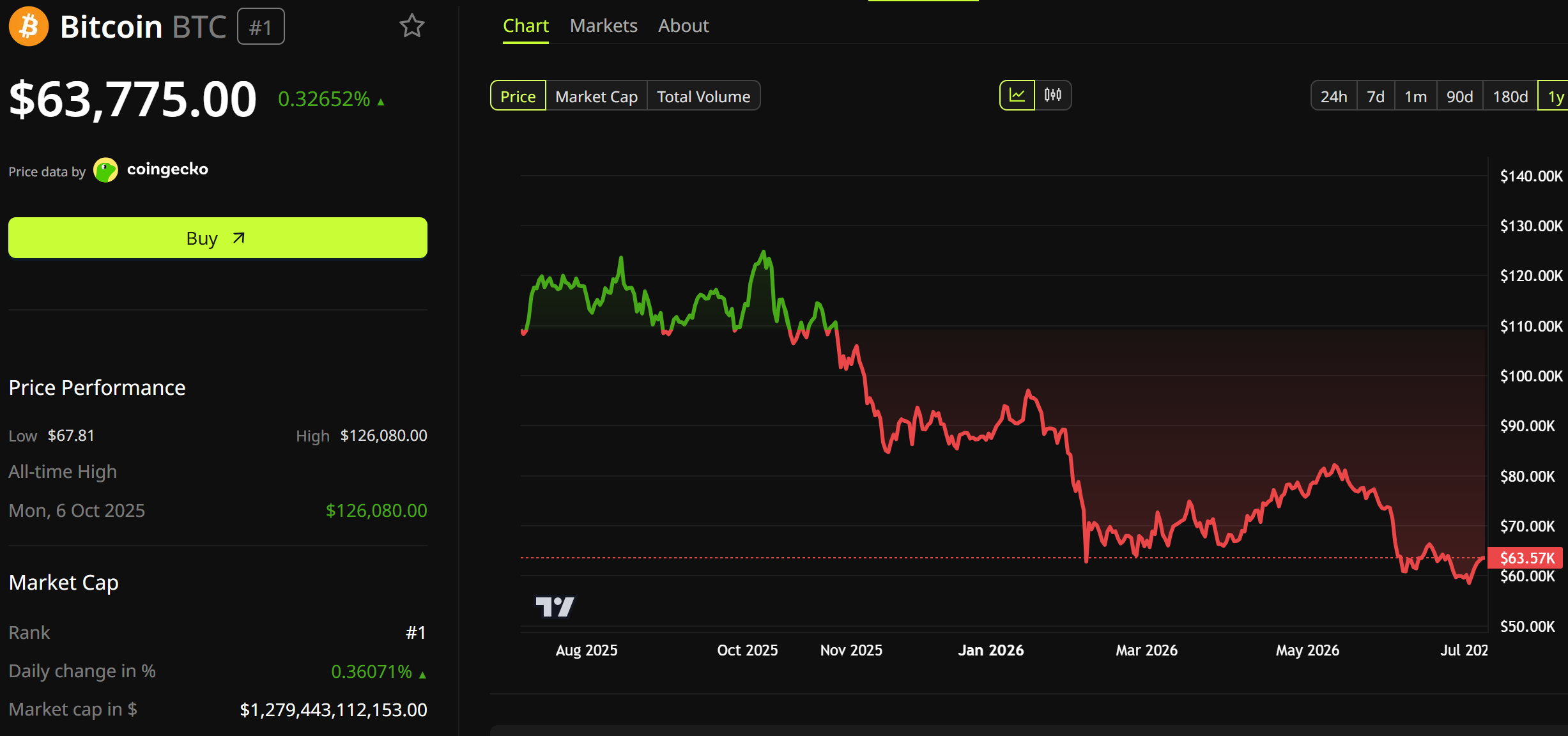
However, Bitcoin’s winter drawdown cut its price by more than half. This deal enters mandatory liquidation after a roughly 12.5% slide. That gap, rather than the vote, may decide how the experiment ends.

New Hampshire Bitcoin Bond Takes the Conduit Route
The New Hampshire Business Finance Authority (BFA) requested the hearing under state statute RSA 162-I. Executive Director James Key-Wallace asked Governor Kelly Ayotte and the five-member council to determine whether the project is feasible and beneficial.
If approved, the BFA will issue taxable conduit revenue bonds, meaning the state will facilitate the loan but never borrow. It will lend the proceeds to NH CleanSpark Borrower Trust 2026-1, tied to CleanSpark, the Nevada-based miner still absorbing steep first-quarter losses. Jefferies will underwrite the deal, which Wave Digital Assets designed.
Repayment falls entirely on the borrower, so taxpayers carry no direct exposure. Meanwhile, the BFA earns its fee in Bitcoin, seeding a planned Bitcoin Economic Development Fund.
House Bill 302, signed in May 2025, made New Hampshire the first state to let its treasurer hold digital assets. In contrast, the federal Strategic Bitcoin Reserve remains tangled in legal questions.
Why the 140% Liquidation Trigger Worries Researchers
Moody’s assigned the bonds a provisional Ba2 rating on March 31. That mark sits two notches below investment grade, in the tier commonly called junk bonds. The three-year notes rely on BitGo Trust Company to custody the collateral in cold storage and execute any liquidation.
CleanSpark must post $160 million in Bitcoin against $100 million of obligations, a 160% coverage cushion. If that ratio falls to 140%, mandatory liquidation and early redemption follow. All else equal, a 12.5% price drop erases that buffer.

Recent history clears that bar easily. Bitcoin peaked above $126,000 in October 2025, then slid to just above $60,000 by February. Meanwhile, record miner BTC sales showed how fast the industry converts coins to cash under stress.
David Krause, an emeritus finance professor at Marquette University, modeled the structure. He found that historical Bitcoin swings were highly likely to trigger the trigger, the Boston Globe reported.
“While the bond may serve as a proof of concept for integrating digital assets into structured finance, it is not well suited as a general-purpose public finance tool.”
Wednesday’s outcome appears predictable, since the BFA board approved the framework on November 18.
New York City rejected a similar pitch over tax law concerns, per law professor Tonya Evans.
Therefore, the harder test comes in the market, where investors must price junk-rated bonds against Bitcoin’s near-term price outlook.
The post New Hampshire Bitcoin Bond Nears Final Vote, But There is a Catch appeared first on BeInCrypto.

Mizuho slashes MSTR target but still sees Strategy topping $200

Sean Payton had an unrealized plan to hire Belichick for Broncos: report

Xbox’s Netflix strategy has reportedly failed. Now it’s betting on hardware again


-

 Fashion4 days ago
Weekend Open Thread: High Hopes
-
 NewsBeat3 days ago
Taylor Swift and Travis Kelce wedding staffer hilariously struggles to keep her cool while checking in megastars
-

 Fashion1 day ago
Open Thread: What Great Books Have You Read Recently?
-

 Politics4 days ago
The House | “Reframing the debate from a binary discussion of winners and losers”: Yuan Yang reviews ‘We Are Not Machines’
-
 Crypto World6 days ago
Airdrop Registration Becomes Key Focus For Remittix As RTX Launch Updates Approach
-

 Crypto World4 days ago
Standard Chartered Secures MiCA License as ESMA Adds 37 New Crypto Firms
-

 Business1 day ago
AXT Shares Jump Nearly 14% as Semiconductor Materials Maker Rebounds on AI-Linked Indium Phosphide Demand
-

 Sports6 days ago
Broncos roster: OL Ben Powers (No. 74) entering final year of contract
-

 Crypto World6 days ago
Binance stock trading tops $1B in first month after launch
-

 Crypto World6 days ago
Alibaba-affiliate Ant Group enters the humanoid robot market with 12 deals
-
Crypto World1 day ago
SK hynix (000660.KS) Stock Dips as $28B Nasdaq ADR Offering Drives AI Memory Expansion
-

 Crypto World2 days ago
South Africa proposes crypto tax guidance under existing rules
-

 News Videos1 day ago
Best Time to Enter Small Caps Right Now? Another Bull Run? | Financially Free
-

 Tech2 days ago
Lenovo laptops are now shipping with YMTC SSDs, a sign of Chinese NAND entering the mainstream
-

 News Videos19 hours ago
Whats Hidden Inside This Cash Register? #treasure #reselling #money
-

 Business6 days ago
Meta Platforms Stock Jumps 7% Today as Bloomberg Reports Company Plans to Enter the Cloud Business
-
 NewsBeat6 days ago
New exhibition reflects five decades of movement between island of Ireland and GB
-

 Business5 days ago
What a 10 Percent Drop Means for Buyers, Sellers and Renters
-

 Crypto World5 days ago
Binance Re-Enters Philippines As EU MiCA Rules Restrict Access
-

 News Videos1 day ago
Avoid entering in FOMO #bitcoin #cryptocurrency #trading #scalping
You must be logged in to post a comment Login