
Crypto World
CZ called ‘habitual liar’ over Huobi founder claims in new book



Former Binance CEO, Changpeng Zhao’s new book has apparently not gone down too well with OKX CEO Xu Mingxing after it claimed he was responsible for the arrest of Houbi’s founder Li Lin in 2025.
Freedom of Money, which launched today in various countries, recounts Zhao’s life growing up in China, his Binance journey, and his experiences with Terra and FTX.
In one section, he detailed how he attended a banquet with Li in 2025 after 11 years apart.
“Li Lin told me he’d seen a screenshot showing Xu Mingxing personally reporting him to Chinese police; it was that report that led to his arrest,” wrote Zhao.
The book notes that Li was arrested on November 28, 2020. However, details were kept under wraps at the time, and even reports from months later were uncertain.
Xu has claimed, however, that the book’s characterization of events is “purely false information.”
Read more: Changpeng Zhao has ‘nothing else to do’ during jail time so may write a book
He said that in the Asian Crypto industry, any founder or platform will process large amounts of reports, and that “this industry would have ceased to exist long ago” if reports influenced every “outcome.”
“Huobi’s Mr. Li has very high emotional intelligence and has managed all sorts of people around him well over the years; he shouldn’t believe this kind of nonsense that defies common sense,” Xu said.
Xu went on to claim that Zhao’s book makes further falsehoods including, “the history of joining and leaving OKCoin, the contract dispute with Roger Ver, whether [Zhao] personally manipulated the market, whether [Zhao] acted as a tainted witness to report Justin Sun during the investigation, [Zhao’s] own marital status, and so on.”
The exec expanded on the contract dispute while Zhao was at OKCoin (OKX’s former name), and how the Binance founder allegedly forged documents related to a Bitcoin.com agreement with Roger Ver.
CZ claimed these accusations put immense pressure on his professional reputation and denied the allegations in his book.
OKX CEO referenced Binance’s compliance firings
Xu’s post bringing up these allegations was made alongside an article from Bloomberg, which reports that Binance’s Chief Compliance Officer, Noah Perlman, is planning to quit within the next two years.
Read more: Justin Sun keeps fighting with Huobi founder Li Lin
The article also details further Binance compliance staff departures. This, alongside reports that Binance fired compliance staff looking into Iranian-linked transactions, has raised doubts about the company’s commitment to its 2023 plea deal.
Regardless, Xu has used the Bloomberg piece to emphasize his distrust for Zhao.
“After spending four months in prison, he continues to make false statements to the world. All I can say is: a habitual liar never changes their nature,” Xu said.
Zhao, on the other hand, has been busy promoting his book online and hasn’t addressed Xu’s comments. It hasn’t been entirely smooth sailing though, as his personal number appeared identifiable within the text.
Zhao distanced himself from the number and claimed that he hadn’t used it for years, adding that it has a new owner who’s probably “a hacker or the hat uncle.” He warned readers not to add the number to their contacts.
Got a tip? Send us an email securely via Protos Leaks. For more informed news and investigations, follow us on X, Bluesky, and Google News, or subscribe to our YouTube channel.



Summary
- Meta has launched Muse Spark, a new “personal superintelligence” AI model powering its Meta AI assistant across meta.ai and the Meta AI app.
- The natively multimodal system introduces a “Contemplating” mode that runs parallel agents for complex reasoning and is designed to compete with top-tier models like GPT‑5.4 Pro and Gemini 3.1.
- Muse Spark focuses heavily on health, with Meta claiming it collaborated with more than 1,000 physicians to improve medical reasoning, raising questions for regulators and competitors alike.
Meta has unveiled Muse Spark, its first AI model from the new Meta Superintelligence Labs unit, positioning it as a step toward “personal superintelligence” that can reason, use tools and orchestrate multiple agents on behalf of users. Announced on April 8 and highlighted by X account Coin Bureau as “Meta’s first step toward personal superintelligence,” the model is already live on meta.ai with a private API preview rolling out to select partners. Meta says Muse Spark is “small and fast by design, yet capable enough to reason through complex questions in science, math, and health,” and will gradually expand to WhatsApp, Instagram, Facebook, Messenger and Ray‑Ban AI glasses.
The launch follows nine months of rebuilding Meta’s AI stack under the Superintelligence Labs banner, created after Mark Zuckerberg vowed to “put superintelligence in the hands of everyone” and catch up to rivals such as OpenAI and Google. According to Meta’s blog, the company reworked its architecture, optimization pipeline and data curation to achieve similar capabilities to its previous Llama 4 Maverick model with “over an order of magnitude less compute,” describing Muse Spark as “the first step on our scaling ladder.” In comments reported by the Financial Times, Meta is explicitly leaning into niche strengths like health, arguing that medical and wellness queries are “one of the top reasons people turn to AI” and a space where differentiation from generic chatbots is possible.about.
Central to Muse Spark is a new “Contemplating” mode that runs multiple agents in parallel before responding, a feature Meta pitches as the answer to the “deep thinking” modes in frontier models like Gemini Deep Think and GPT Pro. AI at Meta described the mode as orchestrating several agents to reason together, achieving 58% on Humanity’s Last Exam and 38% on the Frontier Science Research benchmark, performance that the team says lets Spark “compete with the extreme reasoning modes” of its rivals. The model is also natively multimodal, able to process and generate both text and images, call external tools and manage sub‑agents to break down complex tasks, from financial modeling to troubleshooting household appliances.
Industry observers see the move as an attempt to reinsert Meta into the front rank of AI model providers after a period where most attention went to OpenAI, Google and Anthropic, similar to past catch‑up pushes that reshaped its core products. In a recent piece, Bloomberg noted that big tech firms are betting billions on proprietary “reasoning” models with agentic capabilities, framing Meta’s pivot away from purely open‑source Llama releases as part of a broader trend toward closed, vertically integrated AI stacks.
Beyond reasoning benchmarks, Meta is aggressively marketing Muse Spark’s health capabilities, calling it “one major application of personal superintelligence” and emphasizing that the model can generate interactive explanations of nutrition, exercise and medical information. Meta says it “collaborated with over 1,000 physicians to curate training data that enables more factual and comprehensive responses,” and external evaluations cited by the company claim Muse Spark scored 42.8% on the HealthBench Hard benchmark, outperforming rival models including Gemini 3.1 Pro and Opus 4.6, and slightly beating GPT‑5.4. Reuters reported that in practice Muse Spark can already estimate the calories in a meal from a photo and overlay objects, such as a mug on a shelf, demonstrating its combined visual and reasoning capabilities.
However, analysts quoted by the Financial Times and other outlets warn that turning a social network into a quasi‑medical assistant could trigger regulatory scrutiny, especially in the U.S. and EU, where health advice and data privacy are tightly regulated. At the same time, trading platform Invezz noted that Meta’s stock jumped around 9% on the day of the announcement as investors bet that a stronger AI strategy could drive new revenue streams and improve margins across Meta’s apps and hardware lines. For now, Muse Spark’s mix of agentic reasoning, health focus and multimodal capabilities suggests Meta plans to compete less on raw model size and more on targeted, high‑value use cases that can lock users into its ecosystem.
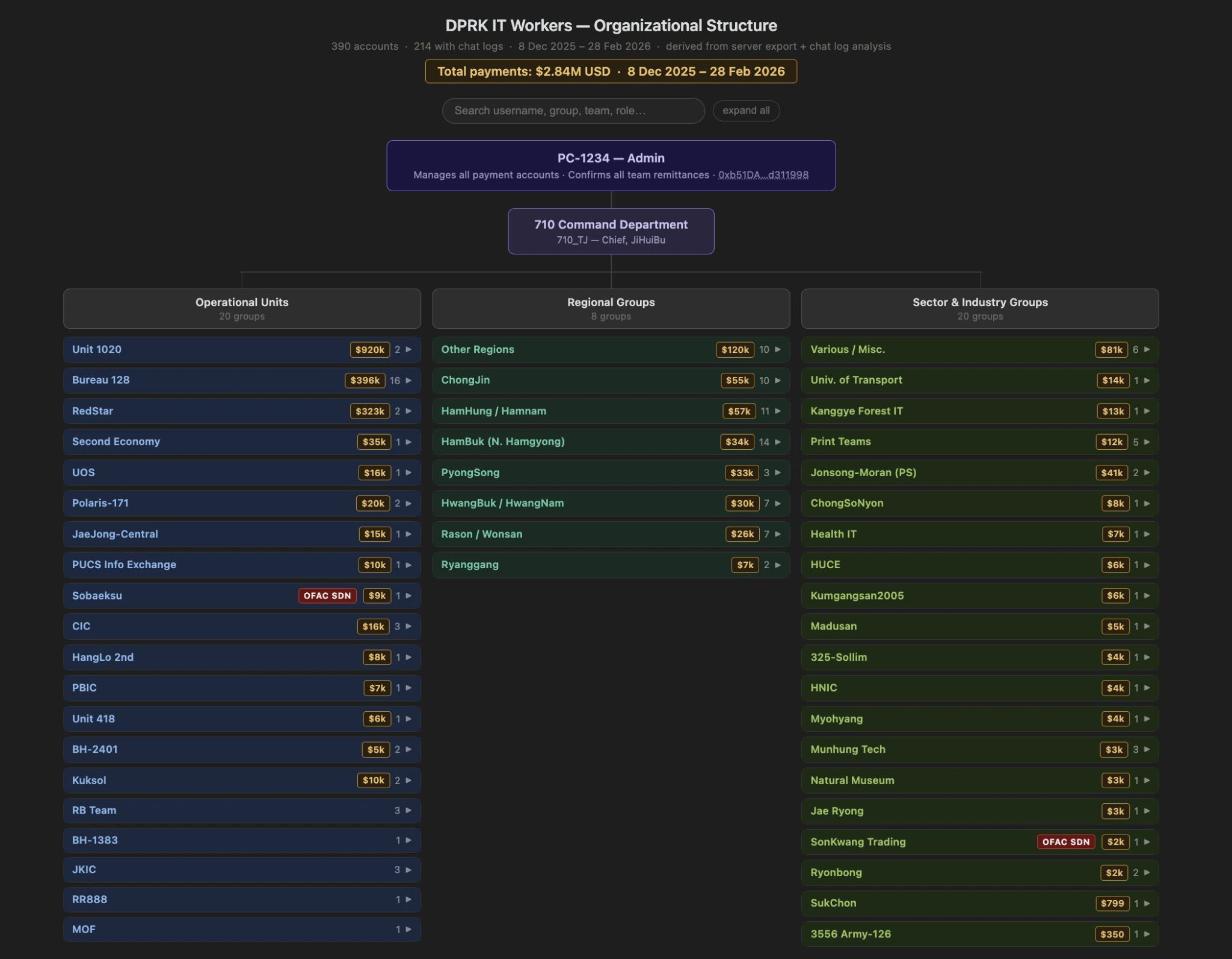
A group of North Korean IT workers made more than $3.5 million in just a few months by faking their identities to work as developers while also attempting to hack crypto projects, according to documents obtained by a hacker who compromised one of their devices.
The leaked data obtained by the unnamed hacker was shared by blockchain sleuth ZachXBT in a post to X on Wednesday. It revealed that one of the IT workers, “Jerry,” and a team of 140 members were making roughly $1 million a month, amounting to $3.5 million worth of crypto since late November.
The North Korean IT workers coordinated payments on a website called “luckyguys.site” using a shared password, “123456,” ZachXBT said, adding that some of the users on that platform appeared to work for Sobaeksu, Saenal and Songkwang, which are sanctioned by the US Office of Foreign Assets Control.
These crypto payments were converted into fiat and sent to Chinese bank accounts via online payment platforms like Payoneer. Tracing these wallet addresses also revealed links to other known North Korean wallets that were blacklisted by Tether in December, ZachXBT said.
Bad actors from North Korea and other countries continue to threaten the crypto industry with increasingly sophisticated tactics for carrying out hacks and scams.
North Korean state-backed workers have stolen over $7 billion in funds since 2009, with a large share of that coming from crypto projects. The $1.4 billion hack of crypto exchange Bybit and the $625 million Ronin bridge hack are among its most notable attacks.
North Korean hackers were also blamed for the $280 million hack of the Drift Protocol on April 1.
North Korean IT workers had a leaderboard
The North Korean IT workers who had their data exposed had a leaderboard showing how much crypto each IT worker had brought in for the organization since Dec. 8, with links to blockchain explorer pages showing transaction details.

Another screenshot shared by ZachXBT showed that Jerry used an Astrill virtual private network to access Gmail, where he submitted several applications for full-stack developer and software engineer roles on Indeed.
Related: Alleged Huione money-laundering boss extradited to China
In an unsent email, Jerry wrote a letter for a WordPress content and search engine optimization specialist position at a T-shirt company in Texas, seeking $30 an hour with availability of 15 to 20 hours a week.

Identification documents were falsified, too, with one of the IT workers, “Rascal,” sharing pictures of a billing statement using a fake name and fake address in Hong Kong.
Rascal also shared a picture of an Irish passport, though it is not clear if it was used.
ZachXBT however said these IT workers were less sophisticated compared to other North Korean groups like AppleJeus and TraderTraitor, which “operate far more efficiently and present the greatest risks to the industry.”
Magazine: Asia Express: Phantom Bitcoin checks, China tracks tax on blockchain


Credit card giant Visa has ventured further into the agentic AI payments race, announcing a new platform on Wednesday to help businesses participate in AI-driven commerce.
In a statement on Wednesday, Visa described Intelligent Commerce Connect as a network, protocol, and “token vault-agnostic ‘on-ramp’” to agentic commerce for AI agent builders and merchants.
The system serves as a universal platform for agentic AI payments, which means AI agents acting for consumers can browse, select and pay for goods.
“Through a single integration via the Visa Acceptance Platform, Intelligent Commerce Connect enables secure payment initiation, tokenization, spend controls, and authentication,” the firm stated.
Crypto networks such as Ethereum, Tron and Solana, as well as fintech firms, have been positioning themselves as a way for AI agents to make online payments on behalf of consumers.
Easy integration to enable agentic AI payments
The company said that Intelligent Commerce Connect supports both Visa and non-Visa card payments and is compatible with major AI agent protocols.
It also makes merchant catalogs discoverable within AI platforms, handles tokenization, spend controls, authentication, and PCI compliance and is accessible through one integration on the Visa Acceptance Platform.
Related: Agentic AI commerce may spell the end of internet ads: a16z Crypto
The system is currently in the pilot phase with select partners, and a broader rollout is planned for later in 2026.
It was not the first foray into agentic AI payments for Visa, which announced an experimental product called “Visa CLI” in March, allowing AI agents to make same-day payments.
Nevermined integrates with Visa using x402
In a related announcement, AI fintech firm Nevermined integrated with Visa’s new Intelligent Commerce using Coinbase’s x402 protocol, enabling AI agents to buy digital goods and services autonomously.
Users can enroll their Visa card and set spending rules, while AI agents can transact independently within those guardrails, and merchants receive payments through their existing processor.
“x402 gives agents an open standard to request payment programmatically, and this launch demonstrates how that can work alongside secure card infrastructure to enable real commercial transactions between AI agents and merchants,” said Erik Reppel, the creator of the protocol.
x402 has processed $24 million in transactional volume over the past 30 days, according to the protocol website.
AI Eye: IronClaw rivals OpenClaw, Olas launches bots for Polymarket


A top Bitcoin developer says he’s built something the community has debated for years but never actually produced: a way to rescue ordinary wallets if the network is ever forced to defend itself against a quantum computer.
in the face of quantum adversary, a commonly discussed emergency soft fork for Bitcoin would be to disable the Taproot keyspend path (https://t.co/Gzx8NVui3N), effectively turning it into something that resembling BIP-360
assuming an existing precautionary soft-fork to add a pq…
— Olaoluwa Osuntokun (@roasbeef) April 8, 2026
Olaoluwa “Roasbeef” Osuntokun, chief technology officer at Lightning Labs, unveiled the working prototype in an April 8 post to the Bitcoin developer mailing list. The tool targets a specific and uncomfortable flaw in Bitcoin’s long-term defense plan, a widely discussed “emergency brake” upgrade designed to protect the network from quantum attacks could also lock millions of users out of their own funds. Osuntokun’s proposal is an escape hatch.
Bitcoin relies on a form of encryption that could, in theory, be broken by sufficiently powerful quantum computers. If that happens, public data already visible on the blockchain could be turned into private keys, allowing attackers to seize funds.
One leading proposal, known as BIP-360, was merged into Bitcoin’s improvement-proposal repository in February as a draft. It would give users a new, quantum-resistant type of wallet to migrate their funds into ahead of any threat.
But migration takes time, and not everyone will move in time. That’s why developers have also been discussing a more drastic backstop — the “emergency brake.”
Every Bitcoin transaction today is authorized by a digital signature, a piece of cryptographic math that proves the sender owns the coins. Those signatures are exactly what a quantum computer would be able to forge.
The emergency brake would shut off Bitcoin’s current signature system network-wide, before an attacker could start draining wallets. Think of it as cutting power to the locks when you realize the keys have been copied.
The problem is what happens to everyone still inside. Most modern wallets — especially the single-user Taproot wallets introduced to Bitcoin in 2021 and now common across the ecosystem — rely on that signature system and nothing else to authorize spending. If it gets switched off, those wallets have no second way to prove ownership.
The coins inside them would be stranded, untouchable even by their rightful owners. The same upgrade designed to protect users could also freeze them out permanently.
Osuntokun’s prototype is designed to give those wallets a second way. Instead of proving ownership with a digital signature — the very mechanism a quantum attack would break and the emergency upgrade would disable — his system lets a user mathematically prove they were the one who originally created the wallet, using the secret “seed” that every Bitcoin wallet is generated from.
Crucially, the proof doesn’t require revealing the seed itself, so using it to rescue one wallet doesn’t compromise any others derived from the same seed. In effect, it replaces “I can sign this transaction” with “I can prove this wallet came from me.”
The prototype is already functional. Running on a high-end consumer MacBook, generating the proof took about 55 seconds, while verification took under two seconds. The resulting proof file was roughly 1.7 MB, about the size of a high-resolution image. Osuntokun said the system was built as a side project and remains unoptimized.
Right now there is no formal proposal to add it to the Bitcoin blockchain, no deployment timeline, and developers remain divided on how urgent the quantum threat actually is.
Academic researchers note that many widely cited quantum “breakthroughs” rely on simplified test conditions, and large-scale attacks on Bitcoin’s mining system would run into hard physical limits. But the risk to exposed wallets is considered real enough that developers have been sketching defensive upgrades for years.
Markets reflect that uncertainty. On Polymarket, traders currently assign roughly a 28% chance that BIP-360 is implemented by 2027.
But the prototype closes a gap that had lingered in theory: how to protect Bitcoin from a future threat without the collateral damage of locking users out of their wallets.


The crypto regulation landscape shifted Tuesday as the FDIC voted to release a 191-page proposed rule implementing the GENIUS Act, setting reserve, redemption, capital, and custody standards for stablecoin issuers — but the most consequential detail for everyday holders is what the proposal does not provide: federal deposit insurance on their tokens.
Summary
- The FDIC’s 191-page proposed rule requires permitted payment stablecoin issuers to hold reserves on a 1:1 basis against all outstanding tokens, redeem within two business days, and meet capital and liquidity standards — mirroring the framework the OCC proposed for national bank subsidiaries in February
- Stablecoin token holders themselves will not be covered by federal deposit insurance under the proposal; the FDIC clarified that the reserve deposits held inside insured banks may qualify for insurance, but that protection applies to the issuer’s reserves, not to individual holders of the tokens
- The proposal opens a 60-day public comment period covering 144 specific questions, including reserve buffers, eligible asset types, concentration limits, and bankruptcy-remote structures; the GENIUS Act requires final rules by July 18, 2026
The crypto regulation package governing US stablecoins took a significant step forward Tuesday when the FDIC voted to propose its 191-page rule under the GENIUS Act — the second federal banking regulator to do so, following the OCC’s February proposal. As Bloomberg reported, the rule applies specifically to “permitted payment stablecoin issuers” — a category the GENIUS Act defines as stablecoin issuers that are subsidiaries of federally insured depository institutions or entities authorized by a federal or state regulator.
FDIC Chair Travis Hill cited “tremendous progress in this area” over the past two years, pointing to the GENIUS Act’s enactment and the acceleration of digital asset development by both banks and nonbank firms as drivers behind the formal rulemaking.
The core requirements are clear. Stablecoin issuers covered by the rule must hold reserves on a strict 1:1 basis at all times against all tokens in circulation. Eligible reserve assets are limited to US dollars or highly liquid equivalents such as short-term US Treasury securities. Redemption must be honored within two business days. Capital and liquidity buffers are required. Custody arrangements must meet specific standards, and annual independent audits are mandatory for issuers with a market cap above $50 billion.
Issuers with less than $10 billion in circulating tokens may operate under state-level supervision, provided those state frameworks meet a “substantially similar” federal standard. The Treasury Department is simultaneously developing principles for evaluating which state regimes qualify, with its comment period running through June 2, 2026.
The Critical Detail Token Holders Need to Know
The FDIC made its most consequential clarification explicit: stablecoin token holders will not receive federal deposit insurance protection. The reserve deposits held inside insured banks may qualify for FDIC coverage — protecting the issuer’s reserves in case of bank failure — but that protection does not extend to the individuals holding the tokens themselves.
This distinction matters. It means that if a permitted stablecoin issuer fails, token holders are not in the same position as a traditional bank depositor covered up to $250,000. The FDIC argued that treating stablecoins as FDIC-insured products “seems inconsistent” with the GENIUS Act’s explicit language, which states that payment stablecoins are not subject to federal deposit insurance. The 1:1 reserve requirement is designed to be the structural safeguard in place of that insurance — but it is a different form of protection.
What Happens Next Before This Becomes Law
As crypto.news reported, the 60-day comment period covers 144 specific questions, including how reserve buffers should be sized, what additional asset types should qualify, how concentration limits should work, and what bankruptcy-remote protections should look like. The comment period must close before July 18, 2026 — the GENIUS Act’s regulatory deadline — leaving a tight window for finalization.
As crypto.news noted, the OCC’s February proposal similarly required 100% reserves and set application pathways for new issuers. The FDIC’s rule aligns closely with that framework while adding its own supervisory standards for state nonmember banks and state savings associations. The two proposals together are building the federal regulatory architecture that will govern an estimated $316 billion stablecoin market.


Disclosure: This article does not represent investment advice. The content and materials featured on this page are for educational purposes only.
Little Pepe gains momentum as presale surpasses $28 million, attracting strong investor interest.
Summary
- Little Pepe surpasses $28m in presale, with Stage 13 nearing sellout as investor demand accelerates
- LILPEPE leverages Ethereum Layer 2 tech to improve scalability, speed, and lower transaction costs
- Structured tokenomics and capped supply position Little Pepe for sustained growth ahead of next cycle
Little Pepe (LILPEPE) continues to sustain its pace and is gaining momentum in the memecoins market, especially after officially crossing the $28 million mark for its presale funding. It is a clear sign of increased investor sentiment and demand for the coins during its systematic token sale process. As each presale level is selling out, the project is gaining recognition as one of the most discussed early-stage projects before the next crypto market cycle.
Stage 13 approaches final sellout
In addition, the project has continued to advance quickly to its various stages in terms of price. Stage 13 is almost complete. After completing Stage 12, Little Pepe has now joined Stage 13, priced at $0.0022. The project is still enjoying a strong response from its participants. The next stage, Stage 14, is scheduled to take the price to $0.0023, thus maintaining a pattern of growth through its stages, especially in terms of its pricing structure.
While most memecoins are only driven by the power of the community, Little Pepe is backed by an Ethereum-compatible Layer 2 blockchain. The Layer 2 blockchain helps the coin have faster transaction times, reduced gas fees, and increased scalability, making it more accessible to the masses. By solving the major issues plaguing the blockchain world, the LILPEPE coin is more practical and efficient for the masses.
Balanced tokenomics support long-term growth
In the case of Little Pepe, the total token supply is capped at 100 billion, while the amount set aside for the presale is 26.5 billion tokens. The other amounts are carefully allocated in a strategic manner to cover staking incentives, liquidity, chain reserves, and marketing efforts. This approach ensures sustainability while allowing the project to grow. Tokenomics is an essential aspect in the maintenance of liquidity, as well as in the encouragement of wider participation in the project.
Feature-rich ecosystem to boost usage
In addition to this, the project also offers other features that will encourage users to continue using the project. For instance, zero-tax trading is available. There is also sniper bot protection to ensure fair play in the token launch. There are also staking rewards to encourage users to hold. The feature-rich ecosystem also includes the meme launchpad feature, where users will be able to create and launch their own tokens. DAO is also available.
Giveaways boost engagement and participation
To further boost the level of engagement, Little Pepe has offered several giveaway options in the ongoing presale. To start with, the $777,000 giveaway will see ten winners receive $77,000 worth of LILPEPE tokens each. Moreover, the 15+ ETH giveaway will continue to encourage the top buyers, and 15 random winners will also receive 0.5 ETH each, thereby boosting the level of engagement as the presale reaches the last stage.
Momentum builds toward the next phase
With over $28 million raised and Stage 13 nearing completion, Little Pepe continues to showcase its growth and market interest. Its use of Layer 2, its structured approach to its presale, and its utility-based features are what set Little Pepe apart from other projects in the burgeoning world of meme coins. However, as the presale is close to its end, LILPEPE is still a project worth keeping an eye on as we head into 2026.
For more information, visit the official website, X, and Telegram.
Disclosure: This content is provided by a third party. Neither crypto.news nor the author of this article endorses any product mentioned on this page. Users should conduct their own research before taking any action related to the company.


The crypto custody market reached a new consolidation milestone Wednesday when Bloomberg reported that Standard Chartered is planning to integrate Zodia Custody’s business into its corporate and investment bank division as early as this month, folding its majority-owned crypto custody subsidiary into an internal division that already offers similar services.
Summary
- The restructuring plan would merge overlapping custody functions that currently run in parallel between Standard Chartered’s internal CIB digital asset unit and the bank-backed Zodia Custody subsidiary it co-founded in 2020 with Northern Trust; an announcement could come as early as April 2026
- Zodia Custody would not disappear: the plan preserves Zodia as a standalone software-as-a-service platform offering crypto custody white-label services to third-party banks and fintechs across its seven offices in London, Dublin, Luxembourg, Singapore, the UAE, Sydney, and Hong Kong
- Standard Chartered declined to comment on the reported plans; minority shareholders including Northern Trust, Emirates NBD, SBI Holdings, and National Australia Bank did not immediately respond to or confirm whether they have been approached about the restructuring
The crypto custody market is consolidating, and Standard Chartered’s reported move to absorb Zodia Custody is its clearest signal yet that the bank intends to own the institutional digital asset infrastructure its advisors and corporate clients use, rather than maintaining it at arm’s length through a subsidiary. Bloomberg reported on Wednesday that discussions are underway to fold Zodia’s custody operations into the bank’s CIB division — a unit that has been building its own digital asset services since at least 2024.
The logic is operational. Zodia Custody and Standard Chartered’s internal division have been running parallel custody infrastructure, creating redundancy. Merging them consolidates both functions under a single regulated entity, reducing overhead and simplifying client-facing structures.
Under the reported plan, Zodia Custody’s customer-facing business for Standard Chartered’s institutional clients would move inside the bank. But Zodia would not be wound down. The subsidiary would continue operating as a white-label SaaS platform, providing crypto custody services to other banks and fintech firms that want to offer institutional-grade custody under their own brand. Zodia currently supports over 75 digital assets across seven offices globally, employs approximately 150 people, and holds regulatory registrations across the UK, Ireland, Luxembourg, and Hong Kong.
The dual structure — one business internalized, one remaining external — mirrors what the bank has already done with its broader digital asset strategy. Standard Chartered launched its own crypto custody services in Luxembourg in January 2025 and introduced spot crypto trading for institutional clients in July 2025 under the CIB umbrella. Those internal services were competing with Zodia’s external-facing platform for the same client base.
Standard Chartered’s Broader Crypto Stack
The Zodia integration fits into a multi-year digital asset buildout that now spans custody, trading, stablecoins, and prime brokerage. In January 2026, Standard Chartered moved to establish a crypto prime brokerage within its SC Ventures unit. In November 2025, it partnered with DCS Card Centre to support stablecoin-linked credit cards in Singapore. In March 2026, Bloomberg separately reported that Zodia Markets — the bank’s crypto trading subsidiary — lost its CEO Usman Ahmad in March, with Nick Philpott stepping in as interim. That leadership change preceded the custody restructuring news by less than two weeks.
As crypto.news reported, Zodia had been raising capital and expanding globally as recently as late 2024, with plans to enter new markets and attract tokenization and payments investors. As crypto.news noted, Standard Chartered secured its EU crypto custody license in Luxembourg in January 2025 — a move that in retrospect looks like preparation for bringing Zodia’s operations inside the regulatory perimeter of the bank itself.
The broader custody competition is intensifying. BNY Mellon, State Street, and Morgan Stanley — which named BNY Mellon as custodian for its MSBT Bitcoin ETF — have all expanded their crypto custody operations in 2026. Standard Chartered’s reported move accelerates that consolidation trend, positioning a globally systemically important bank as a direct competitor to specialist crypto custodians.
Silver (XAG/USD) price trades at $77.31 on April 8, forming a cup pattern on the 12-hour chart with a 32% breakout projection that puts triple digits within range.
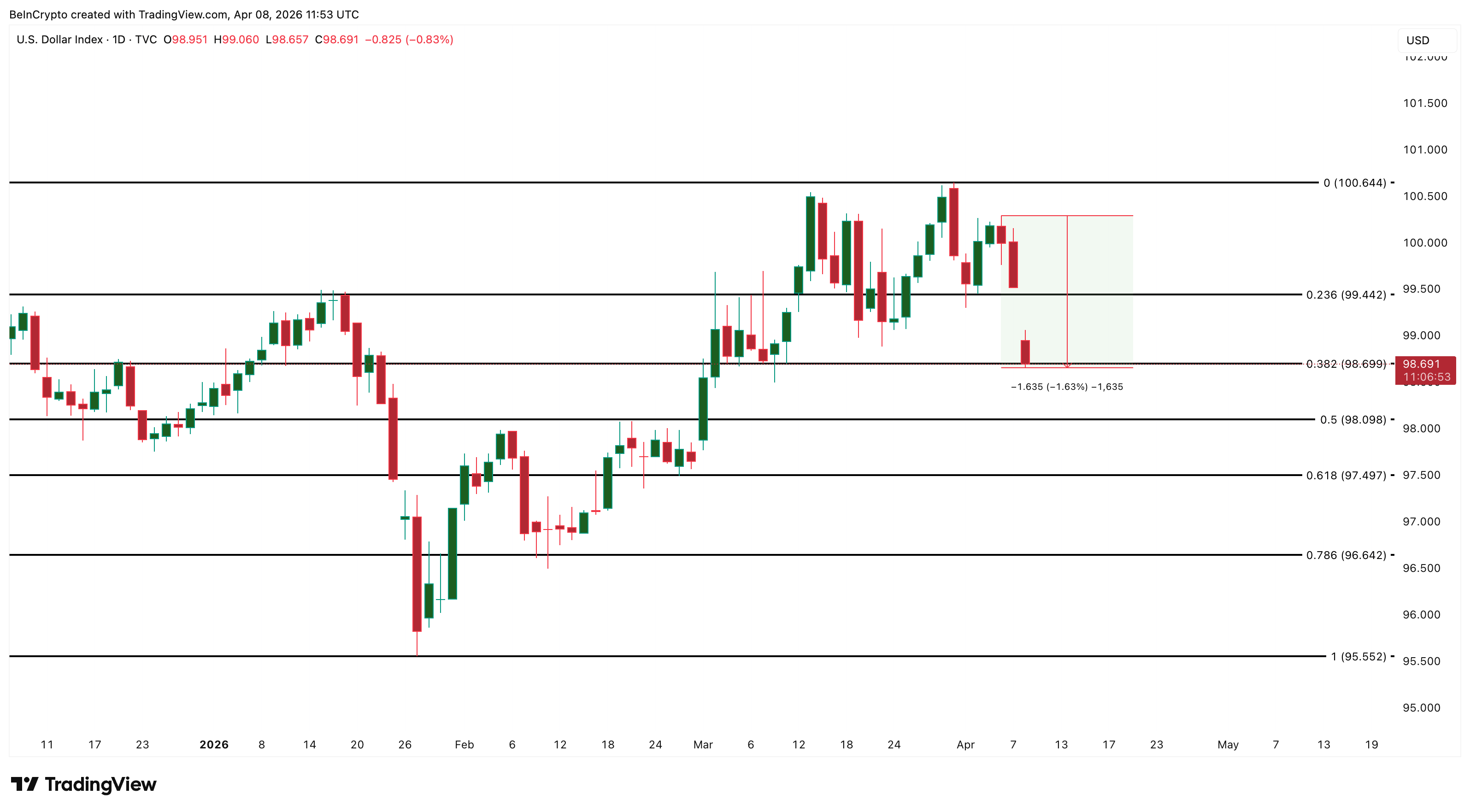
The setup arrives as the US-Iran ceasefire crashed Brent crude 15%, dragging the US Dollar Index (DXY) down 1.63% from its April 6 high. A weaker dollar traditionally lifts the silver price because the metal becomes cheaper for foreign buyers. Whether this macro tailwind translates into a confirmed breakout depends on how the handle forms and whether the futures market agrees.
Silver Price Builds a Cup as RSI Shapes the Handle
Silver price has been forming a cup pattern on the 12-hour chart since mid-March. The rounded bottom took shape through the late-March correction, and the recent bounce has now completed the supposed cup. All that remains is the handle, and a small pullback from the recent $77.73 peak hints at that formation.
The Relative Strength Index (RSI), a momentum indicator measuring the speed of price changes, raises a handle case. Between March 9 and April 7, the price made a lower high while the RSI made a higher high. This is a hidden bearish divergence, suggesting that the current pullback from the neckline may continue.
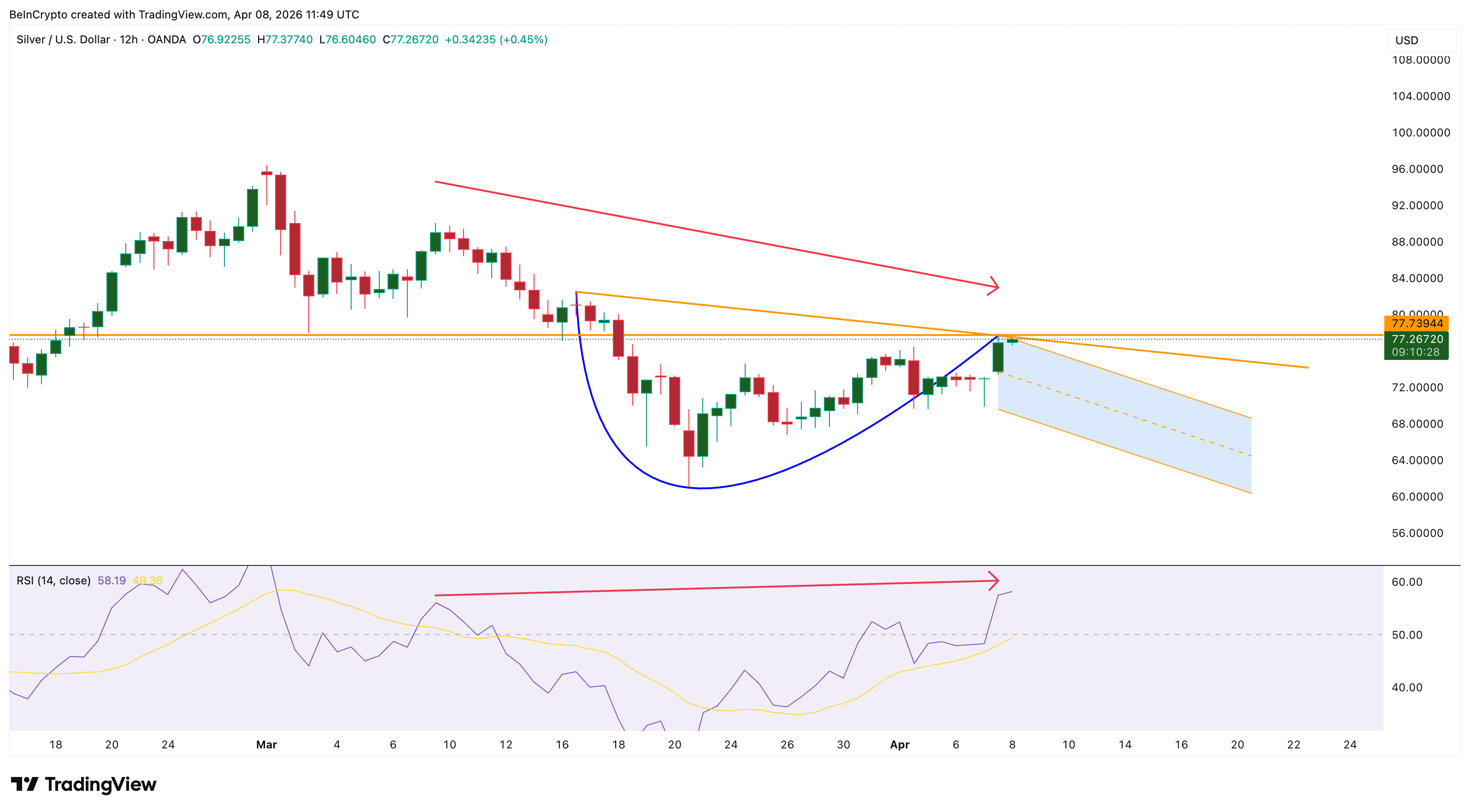
A deeper handle would not invalidate the cup. Handles are expected to pull back before breaking higher. The question is how deep it goes and whether the broader macro backdrop gives silver enough support to keep the handle shallow.
Futures Contango Shows No Delivery Urgency Yet
The spread between front-month and second-month silver futures (SIL1! minus SIL2!) sits at -0.55, a condition called contango, where silver futures prices trade higher than near-term prices. This means buyers are not scrambling for immediate delivery.
For context, this spread peaked at 7.875 in early February and hit 6.515 in early March, both periods when the silver price was surging and physical demand was tight. The collapse from those highs to negative territory shows that the urgency has evaporated.
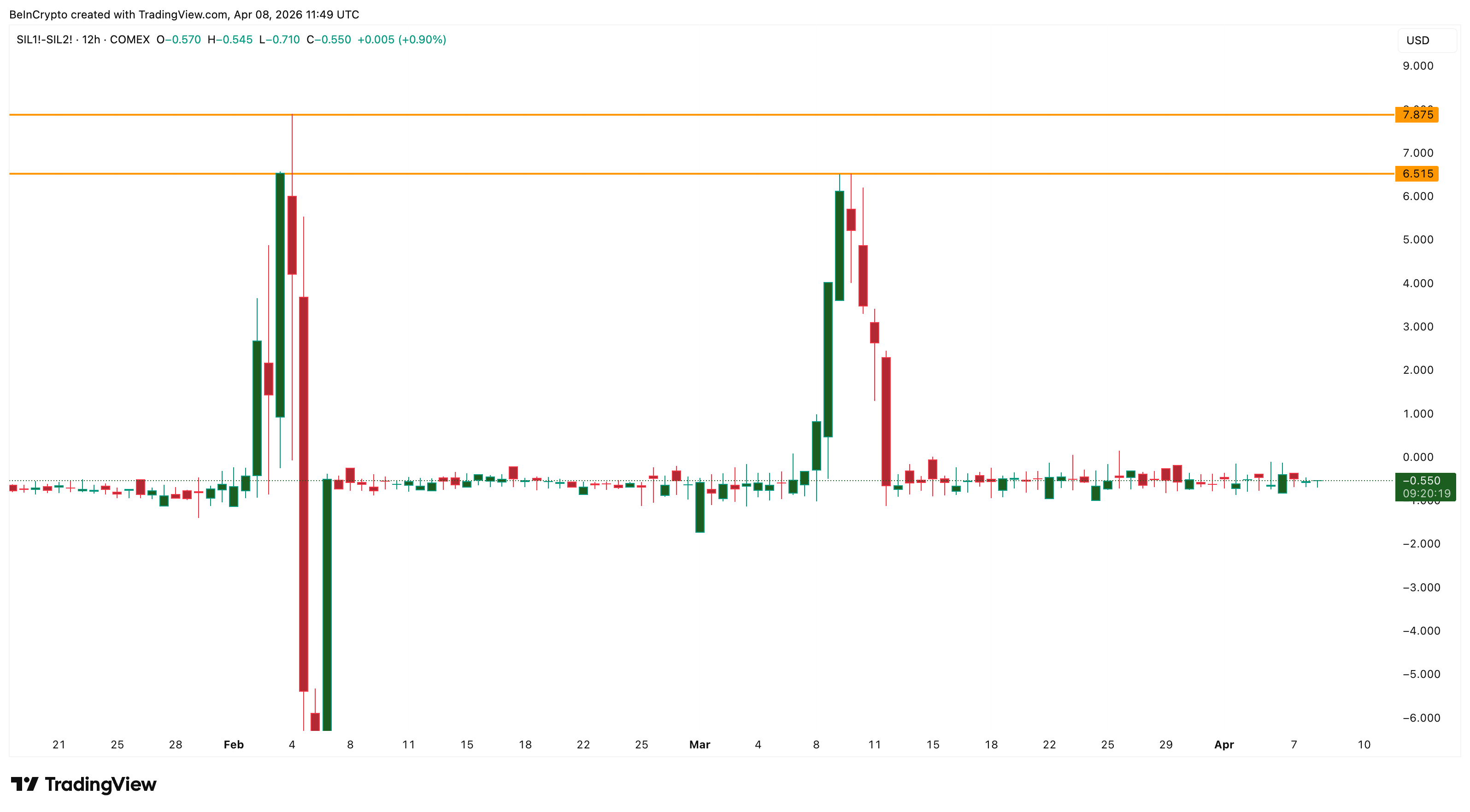
Contango does not kill a rally, but it does suggest the current move is being driven by macro positioning rather than physical supply stress. For the cup pattern to produce a sustained breakout, the spread would need to tighten back toward zero or flip positive, signaling that real demand is catching up with the price.
The macro positioning, however, is shifting fast. The reason sits in the dollar and in the options markets.
Falling Dollar and Shrinking Put-Call Ratio Fuel the Bullish Case
The ceasefire triggered an immediate repricing across commodities. Brent crude dropped 15% as the US-Iran de-escalation removed the war premium from oil. When oil falls, it reduces the petrodollar effect, where oil-importing nations need to buy dollars to pay for crude. Less dollar demand means a weaker dollar in the short-term.
The DXY has dropped 1.63% from its April 6 high and now sits at 98.69, directly on the 0.382 technical support level. If this level breaks, the next stops are 98.09 and 97.50. Every leg lower in the dollar historically provides a tailwind for silver price because the metal becomes relatively cheaper for buyers holding other currencies.
The options market confirms the shift. The iShares Silver Trust (SLV) put-call ratio, which compares bearish put options to bullish call options, dropped from 0.67 on April 6 to 0.47 on April 7. The open interest ratio also edged lower from 0.60 to 0.59. Both readings sit well below 1.0, meaning call buyers are dominating put buyers. The drop between April 6 and 7 suggests that bearish bets are being unwound as the ceasefire changes the macro picture.
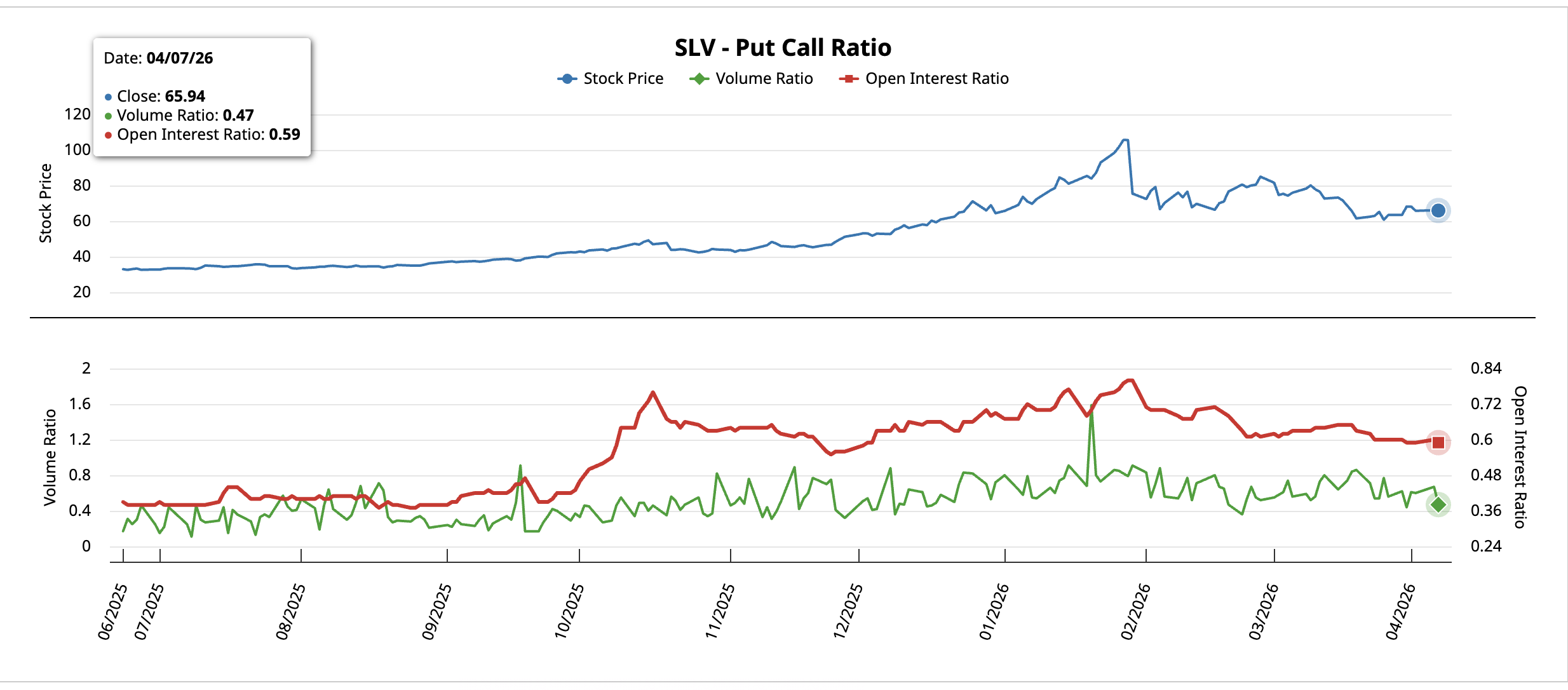
With the dollar weakening, oil falling, and options positioning turning bullish, the Silver price chart becomes the final decider.
Silver Price Levels That Determine if $100 Is Reachable
Silver trades at $77.31. The cup’s neckline sits between $77.29 and $77.73. A 12-hour close above $77.73 would confirm the cup breakout.
Above the neckline, $79.12 at the 0.618 level is the first real confirmation zone. A close above $79.12 would validate the breakout and shift the target higher. The $85.07 becomes the first major target. If momentum carries through, the 1.618 extension at $94.69 and the full 32% measured move projection at $102.29 (the $100+ zone) come into play.
For the $100 target to become realistic, two conditions need to hold simultaneously. The dollar must continue weakening below 98.69, and the futures contango must tighten as physical demand returns. Without both, the rally risks stalling at the $85 zone.
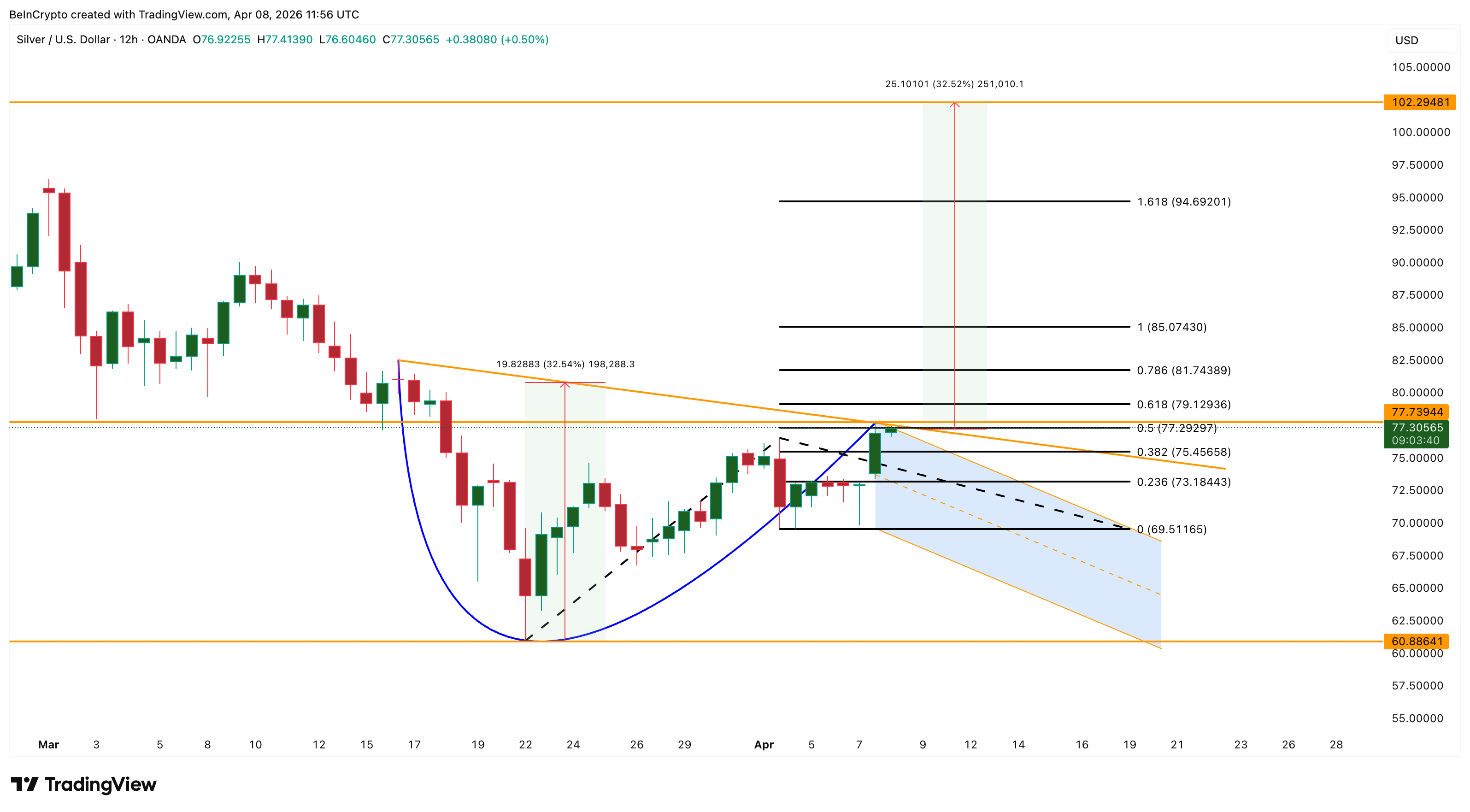
Cup patterns that form during macro regime shifts carry a nuance. If the macro trigger fades, such as the ceasefire collapsing or the dollar rebounding, the cup can convert into a failed pattern rather than a confirmed breakout. The RSI divergence already hints at that risk.
On the downside, $75.45 at the 0.382 level is the first handle support. A deeper handle could test $73.18. $69.51 is the critical floor and a break below would weaken the pattern significantly. A drop below $60.88 invalidates it entirely.
At present, $77.73 separates a confirmed cup breakout with a path toward $85.07 and eventually $100 from a handle deepening toward $73.18 and the $69.51 floor.
The post Can Silver Price Ride the Ceasefire Wave Past $100? A Falling Dollar Opens the Door appeared first on BeInCrypto.

Update (April 8, 2026, 18:21 UTC): This article has been updated to include a comment from a spokesperson for CZ.
Changpeng “CZ” Zhao’s new memoir has reignited a long-standing feud with OKX founder Star Xu, who accused the Binance founder and former chief of lying about their shared history and past disputes.
In Freedom of Money, released April 8, CZ revisits a contract dispute at OKCoin and claims rivals sought to undermine him with “fear, uncertainty and doubt (FUD)”, portraying him as an inept chief technical officer.
CZ also claimed that Huobi founder Leon Li told him in 2025 that he believed Xu had reported him to authorities years earlier. Xu has denied allegations of reporting Li and, in a series of posts on X on Wednesday, called CZ “a habitual liar,” disputing multiple claims in the book and reviving earlier accusations that CZ forged contract documents.
The book further revisits October 2020, when OKX (then OKEx) paused customer withdrawals for five weeks while Xu was reportedly under “soft arrest” in China, suggesting that “Xu alone held the keys” to exchange wallets, and contrasting it with Huobi’s decision not to halt withdrawals during Li’s detention a month later, saying the exchange “had a better wallet setup.”
Xu disputes memoir’s account
Xu said the memoir misrepresents key parts of the story, including CZ’s tenure at OKCoin, the contract dispute with Roger Ver, allegations about market manipulation, informant activity involving Justin Sun, and even his “current marital status.”

Xu resurfaced OKCoin’s 2015 rebuttal of CZ’s earlier allegations and a notarized chat video the exchange released at the time. The video, still publicly available, shows an OKCoin accountant’s QQ account being accessed in front of a notary and purports to display CZ sending two versions of the Bitcoin.com agreement (v7 and v8) on Dec. 16, 2014, with the controversial six-month termination clause appearing in v8.
He said CZ’s explanation at the time was that he rarely used QQ and that another OKCoin employee might have logged into his account and fabricated the chat history, a defense Xu questioned: “Do you believe such an explanation?”
Related: Roger Ver reaches tentative agreement with US DOJ over tax charges: Report
OKCoin’s accompanying Reddit statement accused CZ of forging Roger Ver’s signature on the v8 contract, overstating his technical contributions as chief technical officer, running his own trading bots, and waging a public campaign of “lies and desperate nonsense” after leaving the company.
Memoir revives older allegations
CZ’s memoir presents a sharply different narrative, portraying himself as the target of coordinated attacks from rival exchanges seeking to slow Binance’s rise, including last-minute funding withdrawals during its 2017 initial coin offering.
The new chapters extend the rivalry to the 2020 custody incidents, with CZ claiming that Li believed Xu had reported him to authorities.
Related: DeFi lender Aave launches on OKX’s Ethereum L2, X Layer
Xu called the claim “purely false information,” arguing that complaints against large exchanges are common and do not determine enforcement outcomes. He added that Li “shouldn’t believe this kind of nonsense that defies common sense.”

Xu also accused CZ of lying about whether he “personally manipulated the market” and whether he “acted as a tainted witness to report Justin Sun,” but has so far relied on previously released OKCoin materials rather than new evidence.
CZ had not publicly responded by publication time to Xu’s latest posts challenging the memoir, but a spokesperson for him told Cointelegraph that, while Freedom of Money touches on past events, “it is not intended to be an investigative book on legacy disputes.”
They said the book reflects CZ’s personal perspective and readers can evaluate his account directly and draw their own conclusions, pointing to the disclaimer on page 4, which provides additional context.
Cointelegraph reached out to Xu for comment, but had not received a response by publication.
Big Questions: Is China hoarding gold so yuan becomes global reserve instead of USD?


A fresh bitcoin price read from on-chain data shows that the total supply of BTC last moved between $60,000 and $70,000 has grown by approximately 844,275 coins since January 1 — bringing the total cluster in that range to 1.85 million BTC and giving analysts one of the clearest accumulation signals of the current cycle.
Summary
- Glassnode data published April 8 shows total BTC supply last moved on-chain in the $60,000 to $70,000 range now stands at 1,845,766 BTC, up from 1,001,491 BTC on January 1 — a net increase of 844,275 BTC indicating aggressive dip buying at that level throughout the Iran war-driven correction
- The $70,000 price band now holds 2.2% of total supply, making it the fourth-largest concentration zone by UTXO Realized Price Distribution, which tracks the cost basis of all BTC currently in circulation
- A supply “air gap” exists between $70,000 and $80,000, with only approximately 400,000 BTC having last moved in that range — analysts say this thin overhead supply could accelerate price movement in either direction once BTC decisively breaks out of the $65,000 to $73,000 war range
The bitcoin (BTC) price consolidation between $65,000 and $73,000 over the past six weeks looks choppy on price charts but reveals a different picture in on-chain data. According to Glassnode’s UTXO Realized Price Distribution (URPD) — which tracks where existing BTC last moved on-chain — the $60,000 to $70,000 range has absorbed 844,275 additional BTC since January 1. As Bitcoin Magazine reported, institutional buyers including ETF vehicles absorbed roughly $2.1 billion in inflows over a three-week period, nearly offsetting year-to-date outflows of $460 million — a sign that large capital is treating the current range as an entry zone.
The data does not say Bitcoin is about to break higher. It says a significant number of market participants have established cost basis in the $60,000 to $70,000 range and are unlikely to panic sell within it.
The URPD is useful precisely because it tells analysts not just where Bitcoin is trading, but where holders paid for their coins. A dense cluster in the $60,000 to $70,000 zone means that a large volume of BTC would need to drop below that range before those holders go underwater and begin selling defensively. The bigger the cluster, the stronger the implied support.
Lacie Zhang of Bitget Wallet assessed the current data landscape: “Bitcoin may be entering the late stage of a typical bear cycle,” she said — a framing that historically precedes base-formation behavior rather than additional downside. Matt Hougan, CIO of Bitwise, pointed to institutional behavior as the structural underpinning: “The best evidence we have is in the ETF market,” he noted, citing continued ETF inflows during the correction as confirmation that large allocators see current levels as accumulation opportunities rather than exits.
The Supply Air Gap Above $70K and What It Signals
The flip side of the $60,000 to $70,000 accumulation story is the supply gap directly above it. Between $70,000 and $80,000, only approximately 400,000 BTC last moved on-chain — a thin overhead supply zone that could accelerate price movement once buying pressure is sufficient to push through it.
In practice, air gaps work in both directions: less supply above $70,000 means fewer holders who would sell at a small profit to recover cost basis, which reduces resistance. But without a catalyst strong enough to bring fresh capital into the market, the gap does not self-execute. The Iran war ceasefire outlook, Federal Reserve rate policy, and spot ETF flow trends are the three variables analysts are watching most closely to determine which direction the $65,000 to $73,000 range breaks.
As crypto.news reported, Bitcoin briefly touched $70,200 on Monday when ceasefire talks surfaced, demonstrating that the demand capacity for a sustained break above $70,000 exists — but evaporated within hours when Iran rejected the proposal. As crypto.news noted, open interest has been declining alongside price consolidation, suggesting leveraged traders have largely been flushed and the remaining buyer base is more structurally stable.
The 844,275 BTC accumulated below $70,000 since January represents the market collectively deciding that this range is worth owning. Whether the Iran war deadline tonight validates or undermines that decision is the most consequential near-term variable.

Police appeal to find family of man, 73, who died in Bolton

BOJ chief says Japan’s financial conditions remain accommodative

Meta’s Muse Spark aims to put “personal superintelligence” in your browser


-

 NewsBeat6 days ago
Steven Gerrard disagrees with Gary Neville over ‘shock’ Chelsea and Arsenal claim | Football
-

 Business6 days ago
No Jackpot Winner and $194 Million Prize Rolls Over
-

 Fashion5 days ago
Weekend Open Thread: Spanx – Corporette.com
-

 Business5 days ago
Expert Picks for Every Need
-

 Business3 days ago
Three Gulf funds agree to back Paramount’s $81 billion takeover of Warner, WSJ reports
-

 Sports4 days ago
India men’s 4x400m and mixed 4x100m relay teams register big progress | Other Sports News
-

 Tech1 day ago
How Long Can You Drive With Expired Registration? What Florida Law Says
-
Business4 days ago
No Jackpot Winner, Prize to Climb to $231 Million
-

 Fashion3 days ago
Massimo Dutti Offers Inspiration for Your Summer Mood Board
-

 Tech7 days ago
Commonwealth Fusion Systems leans on magnets for near-term revenue
-
Politics6 days ago
Wings Over Scotland | The quality of mercy
-

 Fashion1 day ago
Let’s Discuss: DEI in 2026
-

 Business4 days ago
Akebia Therapeutics, Inc. (AKBA) Discusses Pipeline Progress and Strategic Focus on Kidney Disease Treatments at R&D Day – Slideshow
-

 Fashion6 days ago
Statement Sunglasses: The Accessory Shaping Modern Fashion
-

 Tech7 days ago
Daily Deal: The Modern No-Code Development Bundle
-
Sports7 days ago
Justin Jefferson’s Situation Remains Unchanged after JSN’s Deal
-

 Tech7 days ago
Every 3D Printable Film Camera, In One Place
-

 Politics6 days ago
East Jerusalem Palestinian families eviction orders
-

 Business7 days ago
Hess Midstream: Iran Conflict Reduces Bakken Production Fears
-

 Tech7 days ago
Larger, More Spacious 2027 Kia Seltos Debuts With New Hybrid Variant
You must be logged in to post a comment Login