

Crypto World
CZ wants to make the U.S. the ‘capital of crypto’: State of Crypto



CZ told CoinDesk over the course of two interviews that he saw multiple causes for crypto’s 2026 bear market including investors moving funds to AI, geopolitical events and the usual four-year crypto market cycle.
He laid out his goals for Binance.US — the U.S. crypto exchange he majority owns but does not run on a daily basis — saying he wanted to see the platform tap Binance Global — the global crypto exchange he majority owns but does not run — for its liquidity, as part of a broader push to make the U.S. market stronger.
And while he said his goal in Washington, D.C. was to clear up any “misunderstandings” about himself and Binance, he said that his pleading guilty to Bank Secrecy Act violations did not hurt his reputation.
Still, CZ told CoinDesk he does not want to run a crypto exchange again, saying he preferred to operate more as an informal adviser to the various companies he’s invested in.
Read more in CoinDesk.
There’s still no real word on where this bill is. As a reminder, the ethics provision remains the biggest hurdle to an agreement. Politico profiled White House crypto liaison Patrick Witt, confirming that any deal he helps broker will need presidential sign-off.

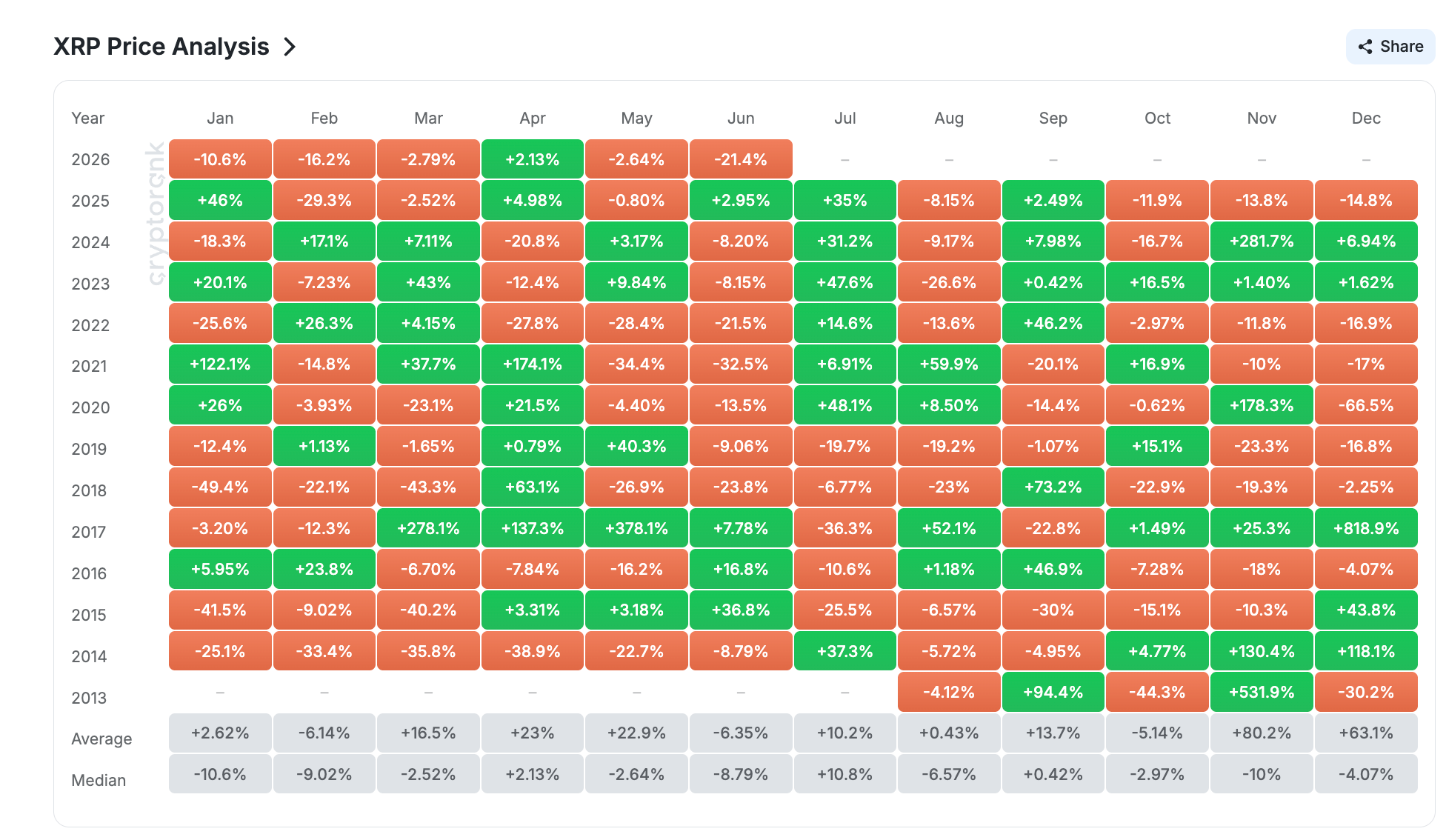
XRP (XRP) price trades near $1.05, caught between a year-long downtrend and a sudden burst of buying.
July has historically rewarded XRP holders. This year the month arrives with on-chain accumulation and steady institutional flows, raising the question of whether they can finally crack a falling channel.
XRP Price Eyes a Bullish July as the Falling Channel Tightens
History gives bulls a reason to watch. July is one of XRP’s strongest seasonal months, with an average return near 10% and a median close to 11%. May behaved as expected, slipping 2.64% in line with its median, before June sold off hard.

That seasonal hope meets a difficult chart. Since mid-July last year, the XRP price has traded inside a falling channel. Each attempt to reach the upper boundary has failed.
Want more token insights like this? Sign up for Editor Harsh Notariya’s Daily Crypto Newsletter here.
The 20-period Exponential Moving Average (EMA), a trend gauge that weights recent prices more heavily, sits at the center of those failures. On the three-day chart, price reclaimed it on January 4 and again on May 13, only to be rejected near the upper trendline both times.

Now the 20-period EMA rests directly on that upper trendline. A break would clear both barriers at once. Volume offers a quieter clue. Selling pressure has faded since early June even as price drifted lower, a possible sign that downside conviction is thinning. A bearish crossover, a key headwind, with the 100-period EMA slipping under the 200-period, has concluded.
Seasonality and structure set the stage, but flows show whether anyone is acting on them.
Exchange Outflows and ETF Inflows Build a Demand Base
The clearest shift is on-chain. The exchange net position change, a metric that tracks tokens moving in and out of exchanges, has turned sharply negative. A deeply negative reading suggests coins are leaving exchanges, which often points to accumulation rather than selling.
On June 22, the figure stood near 40.7 million XRP. It has since deepened to roughly 123 million XRP, an increase of about 200% that nearly tripled the outflow in days. The data suggests buyers may be pulling supply off exchanges with intent.

Institutions appear to share the bias. XRP ETF inflows have now run positive for eight straight weeks, with the week of June 26 adding $22.99 million and cumulative net inflows reaching about $1.47 billion. That steady drip gives XRP a base of committed demand.

With spot and institutional flows aligning, the price chart becomes the decider.
XRP Price Prediction for July 2026 and the Levels That Decide It
The first hurdle is the 0.382 Fibonacci level near $1.18 ($1.178 to be exact). Above it sits the 20-period EMA around $1.22, the level that has capped every recent bounce.
The cost basis heatmap, which maps where supply was last acquired, reinforces both. Roughly 22.8 million XRP cluster at the $1.18 to $1.19 band, and about 27.4 million XRP sit between $1.21 and $1.22.

Those are supply walls where trapped holders may sell to break even.
A clean break of $1.18 followed by $1.22 would lift XRP out of its bearish channel into neutral territory, validating the on-chain accumulation thesis.

The downside is just as defined. Immediate support sits at the 0.5 Fibonacci level near $1.02. A 3-day candle loss there opens the 0.618 level around $0.87 and weakens the bullish case.

One caveat matters. The fading sell volume is a hint, not a signal. A rejection at $1.18 on weak follow-through would keep the channel intact. The $1.18 level separates a seasonal July recovery from another leg lower toward $0.87.
The post XRP Price Prediction for July 2026: Can Buyers Finally Break the Downtrend? appeared first on BeInCrypto.

Crypto markets have continued to attract regulators worldwide, with new rules and enforcement actions spanning exchanges, social media promotions, and stablecoin infrastructure. In Singapore, the Monetary Authority of Singapore (MAS) added decentralized perpetuals platform Hyperliquid to its Investor Alert List, while Indonesia introduced certification requirements for influencers promoting crypto and other digital financial assets.
Meanwhile, South Korea fined Bithumb after it was found to have transferred user data overseas without separate consent, and Japan advanced mainstream exchange consolidation as SBI Holdings agreed to acquire Bitbank in a 46.7 billion yen (about $289 million) deal. Elsewhere, stablecoin projects also moved closer to wholesale finance use cases through new initiatives involving banks and financial institutions.
Key takeaways
- MAS inclusion on Singapore’s Investor Alert List flags potential consumer-protection concerns, not a prohibition or enforcement action.
- Indonesia’s new 2026 regulation requires qualified certification for “finfluencers” promoting crypto, alongside tighter limits on which assets and exchanges can be promoted.
- South Korea’s Personal Information Protection Commission fined Bithumb for transferring personal information overseas without separate consent during order book sharing and asset transfer.
- SBI’s Bitbank acquisition, expected to close around October subject to approval, would strengthen SBI’s position in Japan’s exchange and custody landscape.
- Stablecoin infrastructure efforts are increasingly focused on FX settlement and wholesale financial plumbing rather than consumer payments.
Singapore flags Hyperliquid on the Investor Alert List
On Friday, Singapore’s financial regulator MAS added Hyperliquid to its Investor Alert List. According to the listing, the entry includes the Hyper Foundation website and the Hyperliquid trading app.
MAS positions the Investor Alert List as a consumer protection tool designed to identify entities that might be misunderstood as licensed or regulated by MAS. Importantly, inclusion on the list does not indicate a ban or signal that enforcement action has been taken.
MAS has been expanding the list across recent months. The regulator added Bybit on June 17, and other crypto-related platforms—such as KuCoin and Bitget—appear on the list as well.
Hyperliquid responded by saying it has never claimed it is licensed or authorized by MAS and that nothing about its permissionless infrastructure has changed. For users, the practical effect is less about service disruption and more about clarifying how the platform is perceived in relation to Singapore’s regulatory oversight.
Indonesia tightens crypto influencer promotions with certification rules
Indonesia’s Financial Services Authority introduced certification requirements aimed at influencers who recommend crypto and other digital financial assets. Under Financial Services Authority Regulation No. 6 of 2026, announced Wednesday, individuals promoting digital assets must obtain competency certifications unless they are already covered by a separate licensing requirement.
The regulation also restricts what influencers can recommend: they may promote only digital assets listed on authorized exchanges. Service providers promoted by influencers must also be licensed. In addition, marketing campaigns must be carried out through regulated financial services businesses, which are responsible for the promotional content and must distribute it through their official communication channels.
These changes align Indonesia with a broader global trend. The rules mirror tightening approaches already underway in jurisdictions such as Australia and the United Kingdom, which have introduced broader controls for investment promotions and finfluencer activity, and the Philippines, which has adopted crypto-specific marketing restrictions.
For the Indonesian market, the key question now is how compliance will be implemented in practice—particularly how certification is obtained, enforced, and verified, and how platforms and promoters will ensure that promoted assets and counterparties match the authorized framework.
South Korea fines Bithumb for overseas transfer of user data
South Korean authorities moved from market oversight into direct privacy enforcement. According to a Thursday notice from the Personal Information Protection Commission (PIPC), Bithumb was ordered to pay a fine of $136,000 after investigators found the exchange breached personal information protection rules when it sent user data overseas.
The PIPC said its investigation determined Bithumb “transferred personal information overseas without the separate consent of the data subjects” during order book sharing and virtual asset transfers with overseas virtual asset exchanges.
The incident, as described by the regulator, relates to Bithumb sharing its Tether (USDT) order books between September and November 2025 with BingX, despite having consent to share data with Stellar. The PIPC also cited Bithumb sharing user information with 13 overseas exchanges.
Regulatory consequences in this area matter beyond a single exchange: data-transfer practices are a core operational issue for firms operating globally or linking liquidity across venues. The case underscores that “consent” can be treated as specific and separate for particular counterparties and use cases—not a one-time blanket approval.
SBI’s Bitbank acquisition and the push for institutional crypto infrastructure
In Japan, consolidation continues. Japan’s SBI Holdings has signed agreements to acquire full control of crypto exchange Bitbank through a transaction valued at 46.7 billion yen (about $289 million), advancing an earlier deal first disclosed in May. SBI expects the transaction to close around October, subject to regulatory clearance.
The deal would expand SBI’s regulated crypto exchange footprint and customer base. It also suggests potential cross-sell opportunities around stablecoins, tokenized assets, and onchain financial products—areas where large, regulated institutions typically seek additional distribution channels.
CoinGecko data shows Bitbank’s daily trading volume has generally stayed below $50 million for most of the past four months, with the BTC/JPY pair accounting for 39.5% of volume. XRP/JPY and ETH/JPY each accounted for 19.7%. SBI said combining Bitbank with SBI VC Trade would yield about 1.1 trillion yen in assets under custody and roughly 2.92 million crypto accounts, positioning the combined business as the largest Japanese crypto exchange group.
Stablecoins move further into FX settlement experiments
Beyond exchanges and marketing rules, institutional use cases are also advancing. Chainlink said it joined a working group with European and South Korean banking organizations to explore how stablecoins could be used for foreign exchange (FX) settlement.
Announced as Project Pangea, the initiative brings together multiple participants: South Korean digital asset infrastructure provider FairSquareLab; the Unified Korea Alliance (UniKA), a consortium that includes more than a dozen Korean commercial banks; and Qivalis, a euro stablecoin consortium backed by 37 European banks. The project’s goal is to evaluate direct, atomic swaps of euro- and South Korean won-denominated stablecoins using Chainlink’s data infrastructure alongside FairSquareLab’s onchain FX settlement technology.
This continues a notable shift in how stablecoins are being tested by finance: rather than focusing solely on consumer payment rails, institutions increasingly evaluate stablecoins for wholesale settlement and back-office infrastructure.
Readers should watch for how regulators operationalize these new frameworks—especially Indonesia’s influencer certification requirements and privacy enforcement approaches in Asia—as well as whether Japan’s Bitbank deal progresses on schedule and whether FX settlement pilots involving stablecoins transition from experiments into regulated deployments.
Crypto World
Amazon (AMZN) Stock Surges Nearly 5% on Record Prime Day Sales and Bullish Analyst Upgrades

Key Highlights
- Amazon shares climbed as high as 4.8% during Monday’s session following a record-breaking Prime Day that saw consumer spending reach $26.4 billion, marking a 9.3% increase compared to last year.
- Wells Fargo initiated coverage with a buy recommendation and set a $312 price target, implying approximately 35% potential upside from the current trading range near $232.
- Citizens JMP reaffirmed its Market Outperform stance with a $315 target, highlighting robust artificial intelligence infrastructure demand.
- Amazon Web Services announced a 20% hourly GPU rate increase starting July 1, signaling strong cloud computing pricing authority.
- Major enterprise clients are securing 3-to-5-year AWS capacity agreements, which Wall Street analysts view as a positive indicator for revenue stability and margin expansion.
Amazon (AMZN) shares surged by as much as 4.8% during Monday’s trading session, reaching an intraday peak of $246.76 after starting the day at $234.21. The significant upward movement followed a confluence of positive developments across both the company’s e-commerce and cloud computing divisions.
The company’s extended Prime Day promotional event concluded its four-day span with record-breaking consumer expenditure totaling $26.4 billion, representing a 9.3% year-over-year growth, based on data from Adobe Analytics. This year’s strategic calendar adjustment moved the shopping event from its traditional July slot to June, deliberately avoiding scheduling conflicts with major events including the FIFA World Cup and America’s 250th Independence Day celebrations.
This calendar realignment also capitalized on peak summer vacation spending patterns and early back-to-school purchasing behavior. Bank of America Securities analysts highlighted that this scheduling change is projected to drive a 5% boost in overall gross merchandise value.
Prior to this week’s rally, the stock had experienced significant downward pressure. AMZN declined more than 14% throughout June, retreating from its $270 peak to approximately $232. This substantial correction left market participants searching for support levels.
Wells Fargo stepped in to address that uncertainty. Ken Gawrelski, analyst at the firm, published a buy rating on Friday, June 26, establishing a $312 price objective. This target represents roughly 35% appreciation potential from present levels and translates to an $80-per-share gain for investors entering positions around $232.
Cloud Computing Pricing Strength Draws Wall Street Focus
Citizens JMP also released commentary Monday, maintaining its Market Outperform rating alongside a $315 valuation target. The research firm highlighted AWS’s forthcoming 20% increase in hourly GPU pricing, scheduled to begin July 1, as tangible evidence of sustained AI infrastructure demand and meaningful pricing power in the cloud services market.
AWS Chief Executive Matthew Garman discussed the company’s strong visibility into customer demand extending through the next three to six months. Major enterprise organizations are executing multi-year capacity commitments spanning three to five years, which Citizens JMP characterizes as risk-reducing factors that provide AWS with enhanced revenue predictability.
The investment firm maintains that artificial intelligence technology adoption remains in nascent stages and anticipates demand resilience even if current supply limitations prove temporary. Amazon’s top-line revenue expanded 14% over the trailing twelve-month period, while InvestingPro calculates a Fair Value estimate of $261 compared to the current market price of $233.
Favorable Market Conditions Supported the Rally
Broader market dynamics provided additional tailwinds for Amazon’s performance. The Nasdaq Composite advanced 1.2% Monday while the S&P 500 climbed 0.7%, indicating a return of risk appetite following a challenging previous week that saw significant technology sector selling pressure.
Mega-cap technology stocks experienced widespread gains, though Amazon benefited from company-specific catalysts beyond general market sentiment.
The convergence of exceptional Prime Day performance metrics, favorable analyst commentary from two prominent firms, and the AWS GPU pricing adjustment provided market participants with multiple distinct rationales for renewed buying interest. Market observers are now focused on the company’s upcoming quarterly financial release to determine whether these positive developments will materialize in improved earnings results.



Michael Saylor's Strategy said it can now sell Bitcoin to fund dividends, interest and stock buybacks, formalizing a capital pivot for the world's largest corporate holder of the cryptocurrency. The company, which holds 847,363 BTC, said in a press release and an 8-K filing with the U.S. Securities… Read the full story at The Defiant


Bybit will progressively restrict crypto trading on its Global platform for users across the European Economic Area, becoming the second major exchange after Binance to pull back from Europe before the July 1 MiCA deadline.
The exchange said affected users will receive advance notice and keep access to their assets. Bybit EU, its separately licensed European entity, stays open, while rival OKX moves to capture traders leaving both Bybit and Binance.
Bybit Steps Back From Europe Before the MiCA Deadline
The MiCA transitional period ends on July 1, 2026. After that, only firms holding a Crypto-Asset Service Provider (CASP) license can serve EEA residents. ESMA has ruled out any extension and issued a final warning to unlicensed firms.
In its notice, Bybit named 29 EEA countries where Global platform access will be limited in stages. Affected users will get timelines to manage positions and keep custody and withdrawal rights.
“We would like to inform you of certain operational and structural developments in the European Economic Area (EEA) in the context of our ongoing regulatory alignment efforts,” read an excerpt in the announcement.
Bybit EU, the group’s licensed arm in Vienna, stays open. It counts among just 14 fully licensed European exchanges on the ESMA register, though Malta sits outside its passport for now.
Follow us on X to get the latest news as it happens
OKX Courts Traders as Binance Exits the EU
Binance set the precedent days earlier. The world’s largest exchange withdrew its Greek MiCA application after reports that its regulator would balk at clearing co-founder Changpeng Zhao (CZ).
That scrutiny has history. Binance pleaded guilty in the United States in 2023 and paid more than $4.3 billion, while CZ admitted a money laundering charge and resigned as chief executive.
Binance will wind down EU services from July 1 and plans to reapply, reportedly in France.
OKX moved quickly to turn the disruption into an opportunity. It was among the first global exchanges to be licensed under MiCA, receiving Malta’s approval in January 2025, and holds a MiFID permission for derivatives.
That product matters here. Binance, OKX, and Bybit rank as the three largest derivatives venues by 2026 volume, yet Bybit EU currently offers only spot trading.
OKX Europe’s chief, Erald, urged Bybit and Binance users to switch, promoting an 8% deposit offer.
“Now we offer 8% on new deposits. Don’t wait to transfer your assets from Bybit Global and Binance to OKX,” said Erald.
Elsewhere, CEO Star Xu questioned whether Binance’s failure was really a loss for Europe, extending the longstanding public rivalry and aggression against Binance and its founder, CZ.
Xu’s appeal to the rule of law is pointed. OKX pleaded guilty in the United States in 2025 over more than $5 billion in suspicious transactions, paying a $504 million settlement. Months after gaining its MiCA license, Malta fined its European unit €1.1 million.
Compliance Becomes Europe’s New Dividing Line
Other licensed venues are pressing the advantage. Coinbase opened a Luxembourg hub, joining the regulated platforms chasing displaced traders.
The shake-out rewards firms that prepared early. Marcos Viriato, CEO and co-founder of Parfin, said a permit alone settles little.
“A license doesn’t create adoption. It creates the conditions for adoption… Compliance has become a competitive advantage,” Viriato told BeInCrypto in an email.
Whether consolidation around fewer licensed venues helps or hurts European users should become clearer in the months after the deadline.
The post OKX Courts Stranded Users as Bybit Starts EEA Trading Restrictions appeared first on BeInCrypto.


Hyperliquid added to Singapore’s Investor Alert List
The Monetary Authority of Singapore (MAS), the city-state’s central bank and financial regulator, has added decentralized perpetuals exchange Hyperliquid to its Investor Alert List.
The entry, added on Friday, includes the Hyper Foundation website and the Hyperliquid trading app.
The Investor Alert List is a consumer protection measure that identifies entities that may be wrongly perceived as licensed or regulated by MAS. Inclusion on the list does not constitute a ban or enforcement action.
MAS added crypto exchange Bybit to the list on June 17 and KuCoin and Bitget also appear.
Hyperliquid said that it has never claimed to be licensed or authorized by MAS and that nothing about its permissionless infrastructure has changed.
Indonesia sets certification rules for influencers recommending crypto
Indonesia’s financial regulator has introduced certification requirements for influencers who recommend crypto and other digital financial assets, as the country expands oversight of financial promotions on social media.
Under Financial Services Authority Regulation No. 6 of 2026, announced Wednesday, individuals recommending digital assets must obtain competency certifications unless they are already subject to a separate licensing requirement.
Influencers may recommend only digital assets listed on authorized exchanges, while any service provider they recommend must also be licensed. Marketing campaigns must be conducted through regulated financial services businesses, which are responsible for the promotional content, and distributed through their official communication channels.
Indonesia joins a growing number of jurisdictions tightening oversight of financial influencers, also called finfluencers, with Australia and the United Kingdom introducing broader rules for investment promotions and the Philippines adopting crypto-specific marketing restrictions.
South Korean authorities fine Bithumb $136K over sharing user information overseas
South Korean cryptocurrency exchange Bithumb was order to pay a $136,000 fine after it was found to have breached personal information protections rules when it sent user data overseas.
In a Thursday notice, the country’s Personal Information Protection Commission (PIPC) said that its investigation into Bithumb found that the exchange had “transferred personal information overseas without the separate consent of the data subjects during the process of order book sharing and virtual asset transfer with overseas virtual asset exchanges.”
The incident was connected to Bithumb sharing its Tether (USDT) order books between September and November 2025 with BingX, despite obtaining consent to share the data with Stellar, as well as sharing user information with 13 overseas exchanges.
SBI to acquire Bitbank in $289M deal creating Japan’s biggest crypto exchange
Japan’s SBI Holdings has signed agreements to acquire full control of crypto exchange Bitbank through a 46.7 billion Japanese yen ($289 million) transaction, advancing a deal first disclosed in May that would create the country’s biggest crypto exchange.
SBI expects the transaction to close around October, subject to regulatory clearance.
The acquisition would expand SBI’s regulated crypto exchange footprint and customer base, giving it another potential distribution channel for the stablecoins, tokenized assets and onchain financial products.
Bitbank’s daily trading volume has hovered below $50 million for most of the last four months, CoinGecko data showed. Volume is dominated by the BTC/JPY pair (39.5%), followed by XRP/JPY and ETH/JPY (both at 19.7%).
SBI said combining Bitbank with SBI VC Trade would give the group about 1.1 trillion yen in assets under custody and roughly 2.92 million crypto accounts, meaning the combined business would rank first among Japanese crypto exchanges.
Chainlink joins European and Korean bank consortia to develop FX settlement network
Chainlink has joined a working group with European and South Korean banking organizations to explore the use of stablecoins for foreign exchange (FX) settlement.
The protocol has announced Project Pangea alongside South Korean digital asset infrastructure company FairSquareLab, the Unified Korea Alliance (UniKA) — a consortium that includes more than a dozen Korean commercial banks — and Qivalis, a euro stablecoin consortium backed by 37 European banks.
Project Pangea aims to bring together financial institutions across Europe and South Korea to evaluate direct, atomic swaps of euro- and South Korean won-denominated stablecoins using Chainlink’s data infrastructure alongside FairSquareLab’s onchain foreign exchange settlement technology.
The initiative is another example of financial institutions evaluating stablecoins for wholesale financial infrastructure rather than consumer payments. According to the Bank for International Settlements, the global foreign exchange market processes roughly $9.6 trillion in daily trading volume.
South Korea adds token securities to capital market overhaul
South Korea’s financial regulator folded token securities infrastructure into a broader overhaul of the country’s capital markets, alongside plans for faster settlement, longer trading hours and greater use of artificial intelligence.
On Tuesday, the Financial Services Commission (FSC) said it had launched a capital market infrastructure review meeting to coordinate reforms across government agencies and market operators. According to the FSC, plans for token securities will be further discussed separately through a public-private council before being linked to the wider initiative.
The initiative includes a roadmap for shortening the securities settlement cycle, expected by October, and a Korea Securities Depository (KSD) system for settling over-the-counter trades in unlisted shares and fractional investment products by the end of 2026.
Circle, Nomura eye Japan corporate FX with stablecoin settlement: Report
Stablecoin issuer Circle and Japan’s largest investment bank Nomura have reportedly partnered to enable instant foreign exchange settlement for Japanese companies as early as 2027.
The service would enable companies to convert yen into dollar-denominated stablecoins for cross-border transactions and instant settlement, reducing delays caused by banking hours and time zone differences, Nikkei reported on Thursday.
The partnership would bring one of the world’s largest dollar stablecoins into Japan’s corporate foreign exchange market, expanding the use of stablecoins for business-to-business cross-border settlement.
Australian regulator extends no-action period for crypto licensing
The Australian Securities and Investments Commission (ASIC) has given digital asset businesses another three months (to September 30) apply for licenses required under its updated regulatory guidance.
The extension applies to businesses seeking an Australian Financial Services (AFS) license, as well as companies that may require market or clearing and settlement authorizations.
The regulator said it has received about 30 license applications since updating its digital asset guidance in October 2025 to clarify that many crypto products are financial products under the law and require an AFSL.
It noted its recent court victory against BlockEarner emphasized that point.
Bitmine has increased its Ethereum holdings to more than 5.7 million ETH, bringing the company within reach of its stated goal of controlling 5% of the cryptocurrency’s circulating supply.
Summary
- Bitmine added 27,084 ETH last week, increasing its treasury to more than 5.7 million ETH, or about 4.7% of Ethereum’s supply.
- Chairman Tom Lee said the company remains on track to reach its goal of controlling 5% of Ethereum’s circulating supply in 2026.
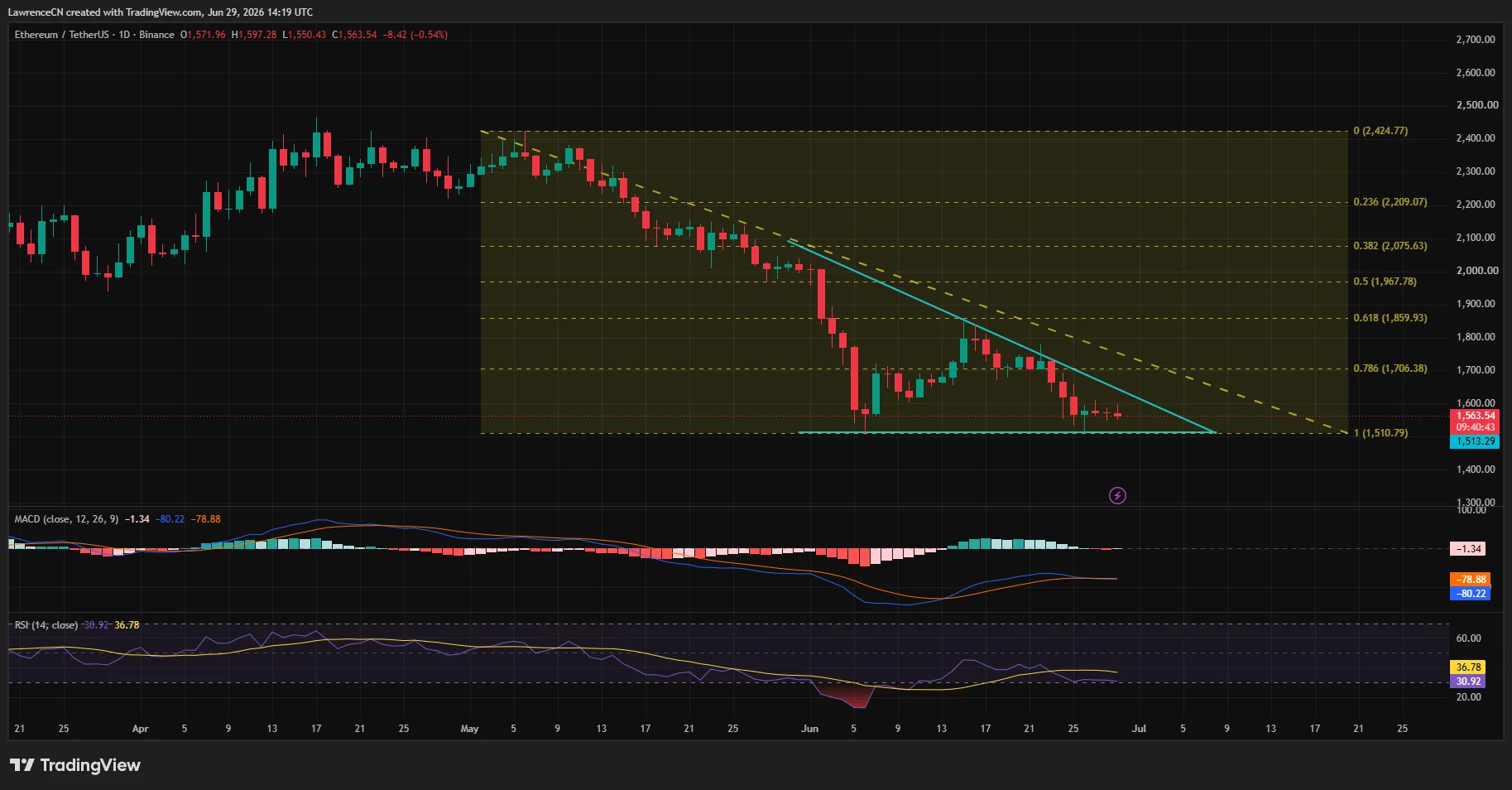
- Ethereum continues to hold above key support near $1,510, while Bitmine and other treasury firms keep accumulating despite recent market weakness.
According to a June 29 company announcement, the Ethereum treasury firm purchased another 27,084 ETH over the past week, lifting its total holdings to just over 5.7 million ETH.
Based on Bitmine’s figures, the treasury now represents about 4.7% of Ethereum’s estimated circulating supply of 120.7 million ETH, while Chairman Tom Lee reiterated his expectation that the company could reach the “alchemy of 5%” sometime in 2026.
Bitmine expands Ethereum treasury through steady buying
The latest purchase continues Bitmine’s accumulation strategy despite a difficult week for the crypto market. Ethereum fell around 8% during the period, yet the company maintained its buying pace while keeping most of its holdings in staking.
Per the announcement, Bitmine has staked nearly 4.9 million ETH, or about 85% of its treasury, with those holdings valued at roughly $7.7 billion at current market prices.
Tom Lee said the company projects annualized staking revenue of about $211 million, while its staking operations have recently generated an annualized seven-day yield of 2.75%.
Bitmine’s scale has made it the largest publicly traded Ethereum treasury company. Its Arkham wallet page has become a closely watched reference for investors tracking the firm’s purchases and staking activity, drawing attention to both the rapid expansion of its treasury and its exposure to Ethereum price swings.
Earlier this month, crypto.news examined what could happen if treasury companies continue accumulating large portions of Ethereum’s supply. The report noted that while sustained buying can reduce liquid supply available on the market, concentrated ownership may also increase risks if companies later finance operations through debt, equity issuance, or asset sales during weaker market conditions.
Institutional positioning continues despite weak price action
Separately, Bitmine said it has joined the Russell 1000 index following the annual reconstitution of the benchmark. Tom Lee stated that the inclusion could introduce hundreds or even thousands of additional institutional investors to the company’s shareholder base.
Although Ethereum has struggled in recent weeks, Lee pointed to several industry developments that he believes remain supportive. He cited the launch of Ethlabs and the Bank of England’s softer position on stablecoins as positive developments for the Ethereum ecosystem.
Commenting on the recent weakness across crypto markets, Lee said the selling pressure was consistent with quarter-end portfolio repositioning rather than a change in Ethereum’s long-term outlook.
“We are nearing quarter-end for June, and it is not surprising to see ‘window dressing’ leading to investors reducing their holdings in assets which have fallen in the past 3 months.”
The latest treasury purchase also comes as other publicly traded Ethereum holders continue adding to their positions. According to blockchain data highlighted by crypto analyst Rain, SharpLink acquired 39,196 ETH worth about $62.4 million over three days, even as spot Ethereum exchange-traded funds recorded a seventh straight week of net outflows.
Rain argued that the buying suggests some corporate treasury managers are positioning for long-term institutional adoption rather than responding to short-term market momentum.
Bitmine’s Ethereum strategy has also become increasingly linked to its public-market structure. In an earlier report, crypto.news noted that the company’s BMNP preferred-share dividend plan ties shareholder payments to the size of its Ethereum treasury and the income generated from staking, making staking returns a core part of the firm’s capital strategy rather than simply an additional revenue source.
Ethereum remains pinned near major support
From a technical perspective, Ethereum appears to be forming a descending triangle on the daily chart, with a series of lower highs pressing against horizontal support near $1,510. The pattern suggests sellers continue to gain control while buyers defend the same price zone.
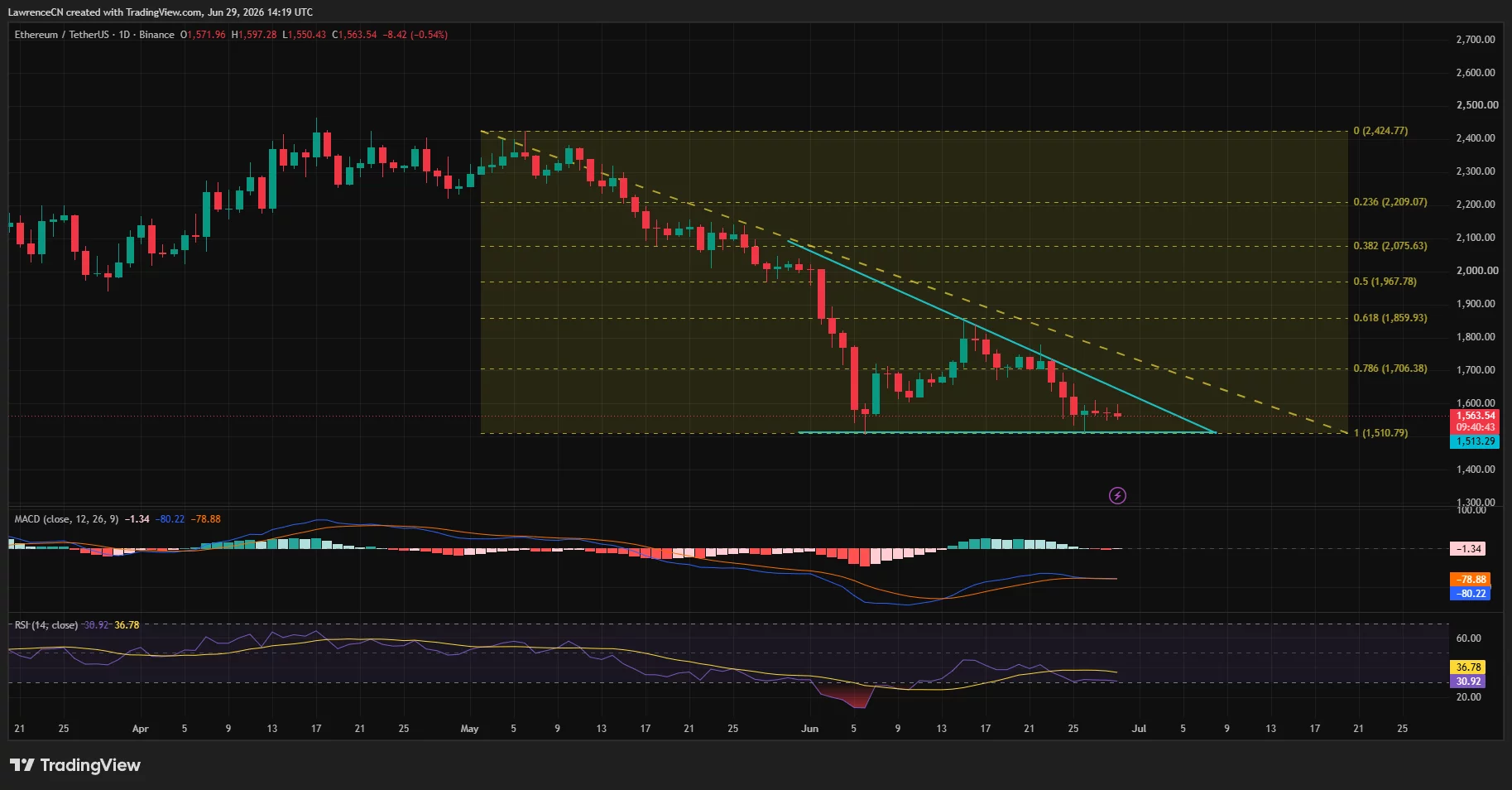
Momentum indicators remain cautious. The daily RSI is holding near 31, close to oversold territory, suggesting selling pressure has eased but buyers have yet to regain control. Meanwhile, the MACD remains below the zero line despite flattening out, indicating bearish momentum is weakening without confirming a reversal.
A breakout above the descending trendline and the $1,700 resistance could invalidate the bearish setup and open the way toward the $1,860 Fibonacci resistance. Conversely, a decisive break below the $1,510 support would confirm the descending triangle and could accelerate losses toward the psychological $1,400 level.
After yielding to heavy selling pressure and losing several key support levels over the past few weeks, Bitcoin is now holding at a key support level. The broader market structure continues to favor the sellers, but the market’s reaction to the $60k critical demand zone could determine the next major move.
Bitcoin Price Analysis: The Daily Chart
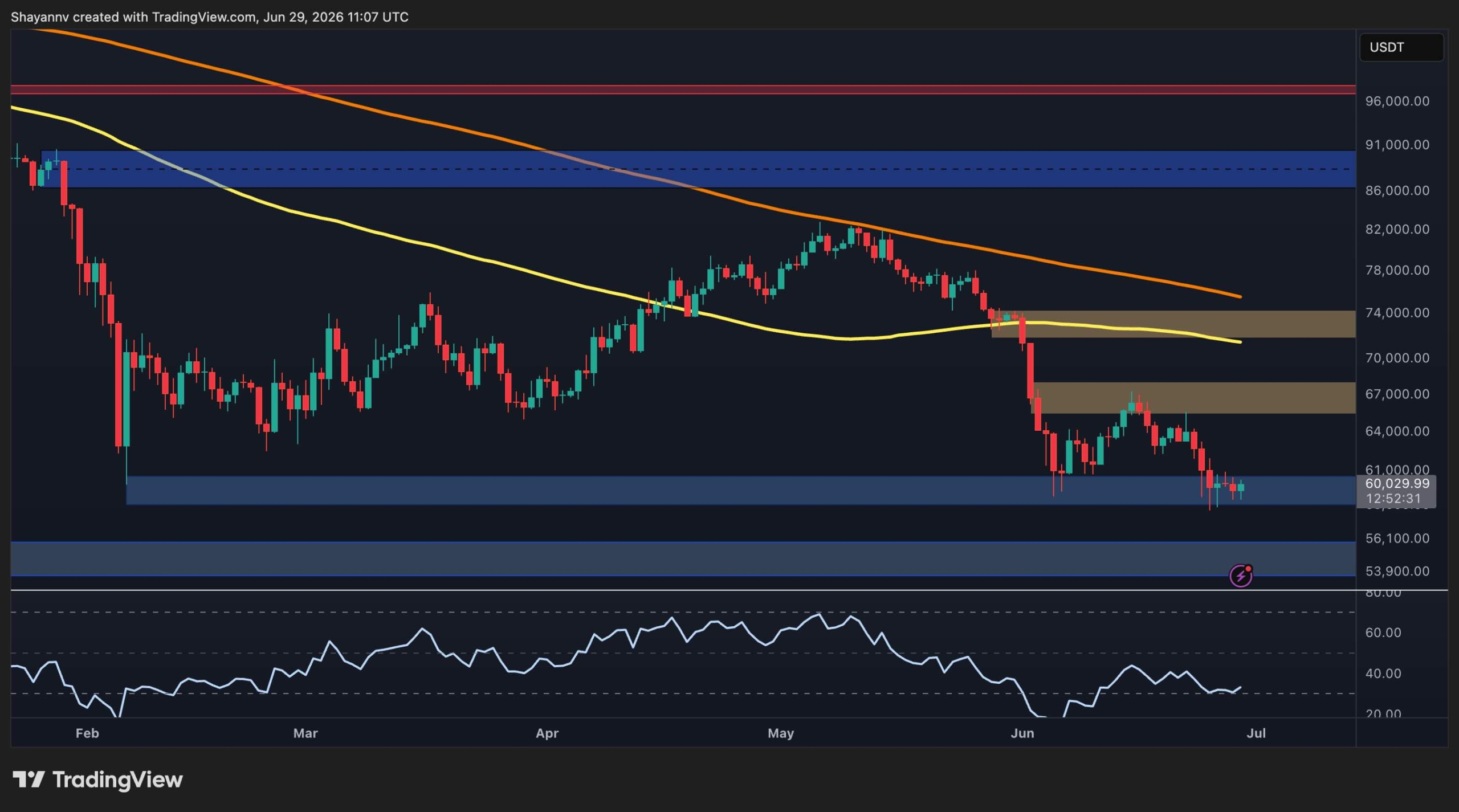
On the daily timeframe, BTC is trading below $60K after extending its decline from the rejection near the $82K region. The breakdown below the $74K resistance area, which also aligns with the 100-day moving average, confirmed a bearish shift in market structure and accelerated the latest leg lower.
The asset is currently testing a major support zone around $60K, where buyers have managed to slow the decline. This area also served as an important demand region earlier in the year and helped prevent the massive February crash, making it a key level to watch. As long as Bitcoin holds above this range, the market could attempt a relief rally.
However, the broader trend remains bearish. The 100-day and 200-day moving averages are both sloping downward, with the 200-day MA positioned around the $75k area and continuing to act as the ultimate dynamic resistance. Meanwhile, the $67K zone represents the first significant resistance on any recovery attempt, followed by the stronger $74K supply region.
To the downside, a decisive daily close below the $60K support would likely expose the next major demand area around $54K and potentially extend the current corrective phase.
BTC/USDT 4-Hour Chart
The 4-hour chart highlights a well-defined descending trendline that has consistently capped every recovery attempt since late May. The price recently tested this trendline again but failed to break above it, reinforcing bearish control over the short-term structure.
BTC is now consolidating just above the horizontal support around $60K, forming a relatively tight trading range after the latest rejection. The RSI has also recovered from oversold conditions and is hovering near the midline, suggesting that downside momentum has cooled, although there is still no convincing bullish momentum shift.
The first hurdle for buyers remains the descending trendline, which is currently located just below the $61K to $62K resistance zone. A successful breakout above both levels could trigger a short-term recovery toward the $67K supply area.
On the other hand, losing the $60K support with a bearish candle closing below it would invalidate the current consolidation and likely accelerate selling toward the next daily demand zone near $54K.

On-Chain Analysis
The Exchange Whale Ratio, which measures the proportion of the top exchange inflows relative to total inflows, has been trending lower alongside Bitcoin’s recent decline. Lower readings generally indicate that large holders are contributing a smaller share of exchange deposits, suggesting that aggressive whale selling has eased compared to previous periods.
While this moderation in whale activity may reduce immediate sell-side pressure, it does not yet signal a confirmed bullish reversal. Bitcoin continues to trade at a major technical support while the broader market structure remains bearish, indicating that buyers still need to reclaim key resistance levels before a sustained recovery becomes more likely.
For now, the combination of stabilizing whale inflows and price holding above the $60K support zone offers the first signs that selling pressure may be cooling. Nevertheless, confirmation will require Bitcoin to break above the descending trendline on the 4-hour timeframe and reclaim the $67K area before sentiment can begin shifting in favor of the bulls.

The post Bitcoin Price Analysis: Is $54K Inevitable for BTC if $60K Support Is Decisively Lost? appeared first on CryptoPotato.

President Donald Trump has a narrow window of roughly 10 days to decide whether to sign, ignore, or veto a bipartisan housing bill that includes a provision restricting the Federal Reserve from issuing or creating a central bank digital currency (CBDC) and other “substantially similar” digital assets through the end of 2030.
House Speaker Mike Johnson sent the “21st Century ROAD to Housing Act” to Trump’s desk on Monday, according to reporting from CNN. Under the U.S. Constitution, the president’s options hinge on a constitutional review period that begins with the bill’s delivery and runs for about 10 days excluding Sundays.
Key takeaways
- The housing bill includes a CBDC ban: the Federal Reserve is barred from issuing or creating a CBDC or “substantially similar” digital assets until the end of 2030.
- Trump has about 10 days to decide whether to sign, veto, or otherwise act on the bill after it reached his desk.
- Trump reportedly dismissed the measure as a “yawn” and cancelled a planned signing ceremony, urging focus on a different voting-related bill.
- The bill passed with bipartisan support, including participation tied to Sen. Elizabeth Warren, who backed the CBDC restriction as part of broader legislative bargaining.
- If Trump vetoes the bill, Congress could attempt to override with a two-thirds majority in both chambers.
How the CBDC restriction got attached to a housing package
The CBDC language is embedded in the 21st Century ROAD to Housing Act, a bill that the House passed last week with support from both Democrats and Republicans. The key policy provision bars the Federal Reserve from issuing or creating a CBDC “or any digital asset that is substantially similar” until the end of 2030.
Reports indicate that this restriction was included as part of an effort to attract Republican backing. The bill is described as being sponsored by Sen. Elizabeth Warren, suggesting the CBDC clause was used to broaden coalition-building around a major domestic policy goal: housing.
As a result, the question for crypto-focused observers is not only whether the CBDC prohibition survives, but whether lawmakers are willing to keep treating CBDC policy as bargaining material inside unrelated bills—potentially creating unpredictable outcomes for future digital-asset regulation.
Trump’s reported response and the politics around “SAVE America”
Trump’s public posture toward the housing bill appears dismissive and politically conditional. According to reports cited by Cointelegraph, Trump called the legislation a “yawn” and referred to the situation sarcastically as a “big deal.” He also cancelled a signing ceremony scheduled for Wednesday, telling Republicans in Congress, in effect, to focus on passing the SAVE America Act instead.
At the center of the broader legislative fight is a voting measure Trump has emphasized previously. The housing bill’s political linkage matters because it underscores how the White House may prioritize one agenda item over another—even when the other item contains a direct restriction on a CBDC.
The Reuters/CNN-style summary in the source material also notes the housing bill would require voters to provide proof of U.S. citizenship in person to register. That provision could affect electoral participation in ways that add friction for lawmakers who support housing policy but remain split on voting requirements.
What happens next if Trump vetoes
With the bill now in Trump’s hands, the next 10 days are likely to determine whether the CBDC restriction becomes law. If the president vetoes it, Congress could override that veto with a two-thirds majority in both the House and the Senate, a high bar but one that remains a constitutional pathway.
The source material frames Trump’s decision in the context of his stated priorities for other legislation. Earlier, Trump said in March that he would “not sign other bills” until the SAVE America Act was passed. At the same time, he posted on social media indicating support for the Digital Asset Market Clarity (CLARITY) Act, according to Cointelegraph’s prior reporting—signaling that the White House’s position on digital assets may not be uniformly hostile, even if it chooses to de-prioritize the CBDC language embedded in the housing bill.
Senate calendar pressures: CLARITY timing vs. housing CBDC ban
While the president weighs the housing bill, the Senate is operating on a separate legislative track. The chamber broke on Friday for state work periods, with lawmakers expected to return by July 13, according to the source text. That schedule would leave roughly four weeks for lawmakers to address the CLARITY Act before the Senate shifts again for another state work period in August.
This timing matters because it creates two parallel timelines: one is the immediate presidential decision on the CBDC restriction; the other is the Senate’s near-term window to move forward on broader market-structure and digital asset policy via the CLARITY Act.
In other words, even if the CBDC ban in the housing bill becomes law or dies via veto, the regulatory direction for the sector may still depend heavily on whether the CLARITY Act advances on the Senate’s calendar.
For investors and builders, the practical takeaway is that “CBDC policy” and “market structure policy” may be converging in the legislative process but not necessarily in a coordinated way. The next signals to watch are whether Trump signs the housing bill before the constitutional deadline, whether Congress can rally for a veto override if he rejects it, and whether Senate leadership maintains momentum on the CLARITY Act during the July window.
Crypto World
Circle’s USDC Becomes First Stablecoin Supported by BNY Mellon for Institutional Clients
The Bank of New York Mellon (BNY), the oldest bank in the United States, has expanded its partnership with Circle to introduce new stablecoin services for institutional clients.
Circle’s USDC will become the first stablecoin supported on BNY’s Digital Asset Custody platform under the arrangement. This will allow BNY clients to store, transfer, mint, and burn USDC through the bank’s custody services.
BNY Mellon integrates USDC
According to the official blog post, the latest move broadens BNY’s role as the primary custodian of USDC reserves. Institutional clients using BNY’s digital asset custody platform can now hold USDC in their custody wallets and use the bank to instruct Circle to convert US dollars into USDC.
Clients will also be able to redeem USDC for US dollars through the burning process. Circle said that these services are intended to support the entire lifecycle of institutional stablecoin activity by connecting traditional cash services with digital asset custody within one framework. BNY said the stablecoin capabilities are part of its integrated Digital Assets platform, which is designed to help institutional clients manage the growing connection between traditional finance and digital assets.
By combining custody and cash management services, the bank aims to provide access to blockchain-based networks while maintaining the controls, governance, and operational resilience required by institutional markets. BNY also plans to expand support to other stablecoin issuers and additional digital cash workflows over time.
BNY’s Chief Product and Innovation Officer Carolyn Weinberg commented,
“As digital assets become increasingly integrated into financial markets, institutions need infrastructure that seamlessly works across traditional and blockchain-based systems. With the addition of our enhanced stablecoin enablement capabilities, we’re expanding the ways clients can move value with the operational scale, trust, and resiliency they expect from BNY.”
BNY’s Crypto Footprint
BNY Mellon and Circle first partnered in March 2022, when the bank was selected as a primary custodian for the reserves backing the stablecoin. Since then, the bank has steadily strengthened its presence in digital assets over the past few years.
This year, the Wall Street giant expanded its digital asset custody business by partnering with Finstreet and ADI Foundation to develop regulated crypto infrastructure within Abu Dhabi’s ADGM financial hub.
The post Circle’s USDC Becomes First Stablecoin Supported by BNY Mellon for Institutional Clients appeared first on CryptoPotato.

Sony’s next PlayStation could break free of the living room and I think it’s worth the risk

Vegan and vegetarian diet differences explained

EPA won’t assess Rinehart’s $850m gas plant


-
 Sports6 days ago
Two goals and an assist by sheer aura: Cristiano Ronaldo just entered the World Cup chat
-

 Fashion3 days ago
Weekend Open Thread: Staud – Corporette.com
-

 Politics4 days ago
The House | Manchesterism won’t survive the painful trade-offs unless it gets citizens on board
-

 Politics4 days ago
Potential 2028er World Cup attendee leaderboard
-

 News Videos1 day ago
MAJOR BITCOIN & MARKET UPDATE!!!! (MUST WATCH ASAP!!!)
-

 Business4 days ago
Asia stock markets slide as tech shares slump
-

 Tech4 days ago
A Look At A Gaggle Of Transputer Boards
-

 Crypto World6 days ago
Securitize Wraps Roubini's SEC-Registered ETF as Dubai VARA Digital Security
-
Crypto World6 days ago
Bitcoin (BTC) Dips Below $62K, Ethereum (ETH) Plunges 6% Daily: Market Watch
-
 Crypto World4 days ago
Dell (DELL) Shares Tumble Over 5% Following Analyst Downgrade to Hold
-

 Crypto World2 days ago
Coinbase, Circle Deepen Crypto Stock Losses Despite Resilient S&P 500
-
Business6 days ago
Entergy settles forward sale agreements, raises $672 million in cash proceeds
-

 Crypto World3 days ago
Kraken's xStocks Opens Bending Spoons IPO Registration to EEA Retail
-

 Sports3 days ago
FIH Pro League: India defeat Pakistan 7-1, register biggest win of campaign | Other Sports News
-

 Tech3 days ago
Russian hackers now target Signal backup recovery keys
-

 Tech2 days ago
Bluekit phishing kit adopts browser-in-the-middle for login theft
-
 Crypto World4 days ago
Bitcoin Sparks $600M Hourly Liquidations With $65,000 Set To Become Resistance
-
 Crypto World3 days ago
Hyperliquid Named on Singapore MAS Investor Alert Register
-

 Crypto World3 days ago
RTX holders must register wallets before token distribution begins
-

 Crypto World5 days ago
Ripple and SBI launch RLUSD in Japan after JFSA approval
You must be logged in to post a comment Login