

Crypto World
DeFi TVL Falls 39% in 2026 as Market Weakness and Hacks Rise

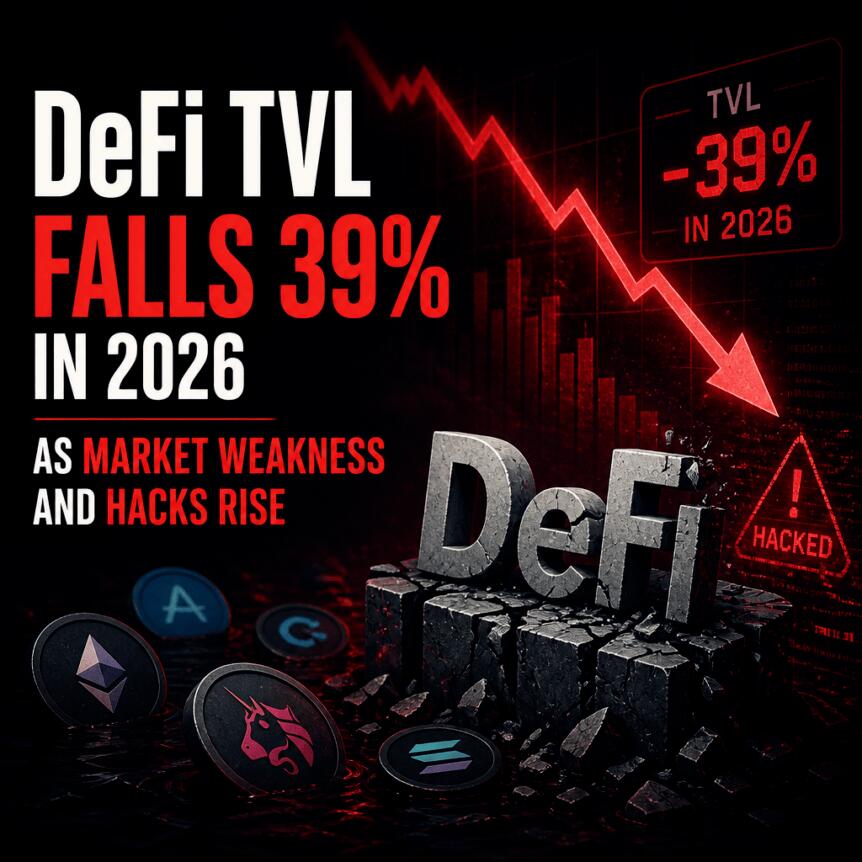
DeFi is losing ground again. Total value locked (TVL) across decentralized finance has dropped by roughly 39% in 2026 so far, sliding to a little over $70 billion from about $115 billion in January, according to a report shared this week by CryptoRank.
CryptoRank links the decline largely to the market’s post-October 2025 correction, after Bitcoin’s sharp run-up ended in a major liquidation event. But security incidents are also taking their toll—either by directly draining funds from protocols or by nudging users toward the exits more quickly than they otherwise might.
Key takeaways
- CryptoRank estimates DeFi TVL is down about 39% in 2026 to just over $70 billion, versus roughly $115 billion in January.
- CryptoRank points to the broader deleveraging after Bitcoin’s Oct. 10, 2025 liquidation event as a primary driver of the TVL drawdown.
- CryptoRank reports 121 hacks and about $942 million in losses year-to-date, which may be weighing on user confidence and capital allocation.
- Nansen analysis highlighted that the April 18 Kelp DAO exploit triggered rapid outflows, compressing what would normally be a slower capital rotation.
- While the total stolen in 2026 quarters appears lower than historical peaks, analysts argue this can reflect attackers shifting to new targets rather than genuine security progress.
DeFi TVL down as the 2025 selloff reverberates
The foundation for 2026’s contraction traces back to a broader correction that followed Bitcoin’s late-2025 peak. After Bitcoin pushed above $122,000, a market-wide liquidation event on Oct. 10, 2025 erased more than $19 billion in leveraged positions, according to the CryptoRank report. That liquidation intensified a wider deleveraging cycle across digital assets, which then translated into weaker demand and reduced liquidity across DeFi.
CryptoRank said that despite the double-digit drawdown seen this year, the current DeFi decline is materially smaller than the stress phase during the 2021–2022 bear market. In other words, the drawdown appears severe—but not as extreme as the earlier cycle’s contraction—suggesting DeFi has some resilience even when risk appetite falls.
Security incidents: fewer headlines, still meaningful pressure
CryptoRank also flagged security as a continuing headwind for DeFi activity in 2026. The provider reported 121 hacks and roughly $942 million in losses year-to-date. In CryptoRank’s view, exploits may not be the sole cause of TVL falling, but their frequency can still influence user sentiment and hasten capital outflows.
This distinction matters for investors and operators. If TVL is declining mainly because of market-wide deleveraging, risk management is largely about cycle navigation. If security events are accelerating outflows, however, the issue becomes more protocol-specific—turning “time to confidence” into a measurable performance variable for DeFi platforms.
Kelp DAO exploit illustrates how quickly capital can flee
One incident that demonstrates the speed of capital rotation was the Kelp DAO exploit on April 18, an event described by Cointelegraph as involving $293 million. According to Nicolai Søndergaard, senior research analyst at Nansen, the fallout from the breach concentrated into days rather than dragging out over weeks.
Søndergaard’s analysis indicated that Aave users withdrew about $15 billion in deposits within four days after the exploit. The scale and speed of those withdrawals underline how DeFi markets can reprice trust rapidly: once a high-profile event breaks user confidence, liquidity providers and depositors often act immediately to reduce exposure, even if broader conditions would likely have pressured TVL anyway.
The same period also reinforced that the industry’s incident pace remains elevated. CryptoRank described Q2 2026 as the most-hacked quarter on record by incident count, with 83 exploits targeting crypto protocols. Yet the total value stolen during the quarter—$755 million—was far below the $3.56 billion lost in Q4 2020, which Cointelegraph describes as the costliest quarter for hacks on record.
Lower stolen value doesn’t necessarily mean better security
Some readers may interpret smaller aggregate losses as an improvement in security. But multiple perspectives in the reporting suggest the reality is more complex.
HackenProof CEO Dmytro Matviiv argued that the decline in total stolen funds can be “misread as progress.” He said that while leading protocols may be harder to exploit, attackers adapt by expanding their attack surface—seeking out new targets rather than disappearing entirely. The implication for DeFi participants is that security performance may improve at the top end, while risk can migrate to less mature or more exposed systems.
Bitget Wallet COO Alvin Kan added a related behavioral angle: exploits make users more cautious, but the resulting capital shifts can also move liquidity away from “weaker” venues toward “stronger venues” with clearer yield models. Kan suggested this dynamic may encourage consolidation, where protocols with more credible risk assumptions attract deposits, while others struggle to regain capital after incidents.
Taken together, these points suggest that the DeFi TVL trend is being shaped by two overlapping forces: macro liquidity conditions that reduce leverage and risk-taking, and micro-level trust events that determine which protocols retain or regain capital once stress hits.
For the months ahead, the key question is whether TVL stabilizes as leverage normalizes—or whether security events continue to accelerate outflows for individual protocols. Monitoring both incident frequency and how quickly capital returns after major exploits may offer the clearest signal of whether DeFi’s drawdown is settling or still widening.

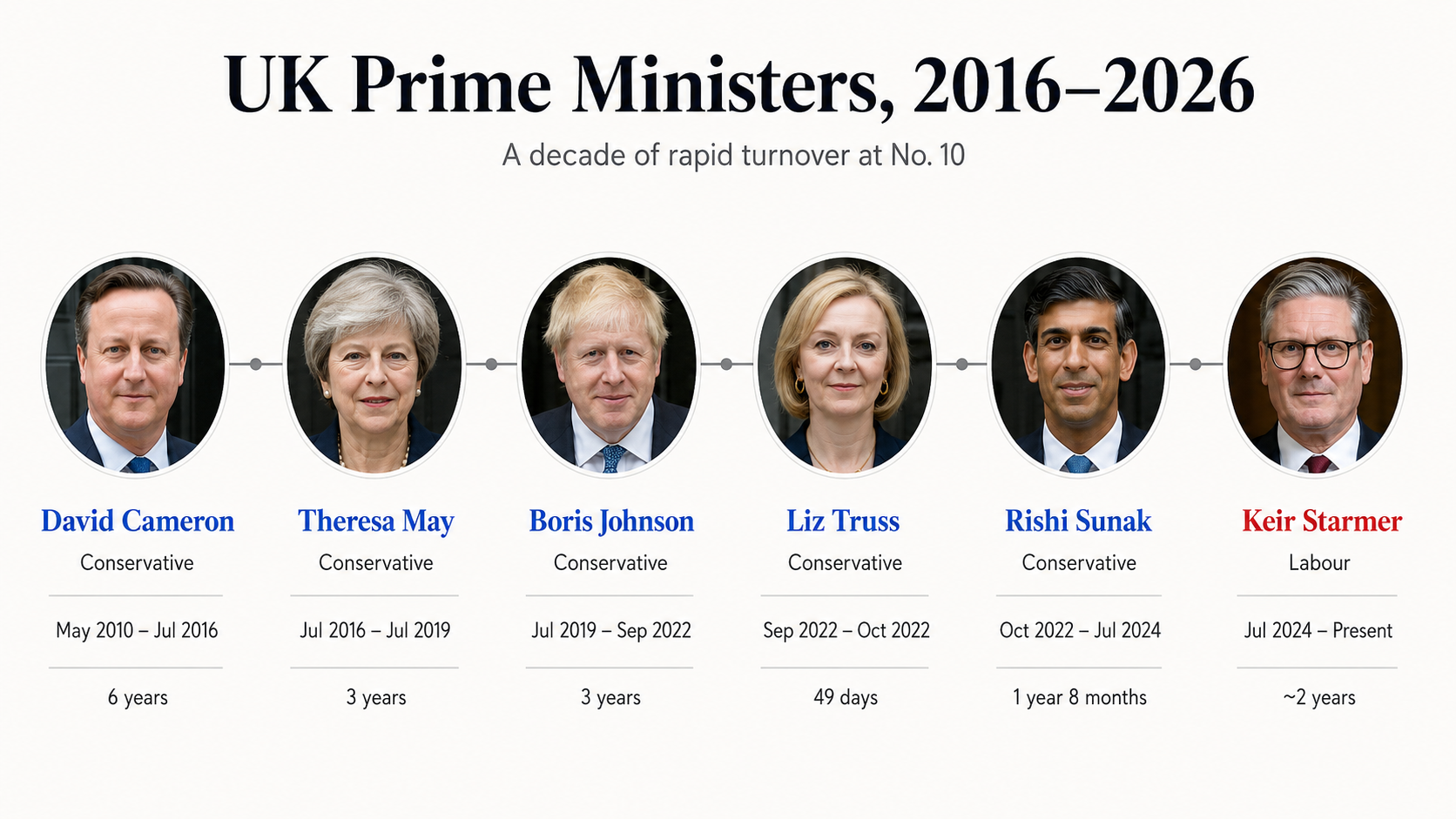
On Monday morning, June 22, Keir Starmer finally acknowledged what his Cabinet, parliamentary colleagues and the public had already concluded: he no longer had the authority to lead.
In doing so, he became the sixth prime minister in a decade – a level of political instability unmatched in modern British history. Every sector is now asking the same question: Who and what comes next? So, for digital assets, let’s unpack that.

Direction of Travel
From a policy perspective, the ship has largely set sail. Regulators are in the final stages of formalising a comprehensive framework, officials are listening, and engagement has been genuinely constructive.
This week’s announcement from the Bank of England illustrates the point well, even if it was partly overshadowed by political noise. Its policy statement and draft rules on sterling-denominated systemic stablecoins marked a clear step forward.
The required proportion of backing assets held in central bank deposits has been sensibly reduced from 40% to 30%, while the caps on holdings have been replaced by issuance limits.
“Each systemic stablecoin will be subject to an initial issuance maximum of £40 billion,” wrote The Bank of England.
We are imminently expecting a handful of policy statements from the FCA – covering everything from cross-cutting handbook reforms and the Regulated Activities Order. These will likely land much before a new Ministerial HM Treasury team is installed.
I mention this because political cycles may be volatile, but regulatory frameworks are built through sustained, technical engagement.
Politically speaking, we have navigated seven City Ministers since 2022 alone. Yet despite the political turbulence, the notion of a “global cryptoasset hub”, first coined by former PM Rishi Sunak, has survived.
Whoever walks through the door of No 10 – and whichever team follows them – will not reverse this. The wheel has already turned.
UK Crypto Sector Needs a Clear Political Wall
While we have made great progress on several ‘sticky’ issues for the sector, there are still some critical areas that need clear political will: the future direction for DeFi, a workable prudential regime for firms, workable FinProms rules, and a level tax playing field for stablecoins to name a few.
We must keep engaging at a political level to keep this momentum and keep landing messages around growth, productivity and jobs – all areas that transcend personnel. It is incumbent on industry to ensure that message carries through. We will certainly be playing our part.
More crucially, the digital asset agenda must not become politicised and dragged into the culture wars in the way it did in the US and as we’ve begun to see this year in the UK, thanks to so-called ‘crypto donations’.
This latest news shows how quickly the conversation descends into many of the usual tropes industry is familiar with, which are largely based on misunderstanding and misinformation.
Because strip away the headlines and the memes, and what we are actually talking about is rather prosaic. This is plumbing.
Financial infrastructure required to ensure the City of London remains a global centre of finance. With yesterday marking the tenth anniversary of Brexit, the point feels all the more pertinent.
That objective should transcend party lines. Encouragingly, there are signs that it does. Just last week, Conservative Party peers tabled amendments to the Financial Services and Markets Bill calling for a wholesale tokenisation strategy and a dedicated digital asset framework.
Meanwhile, the Liberal Democrats are actively developing their own policy platform for the sector.
And it must remain that way. The long-term success of the UK’s digital asset ecosystem will depend not on partisan point-scoring.
Who Steers the Ship?
It is too early to call who might stand against Burnham, but a coronation rather than a contest looks like the most probable outcome, especially following the early backing of Wes Streeting, himself long touted as a likely contender.
To add a layer of Westminster intrigue, sections of the media have been quick to elevate Al Carns as a possible dark horse contender. Yet the arithmetic looks challenging. Without the backing of the 81 MPs needed to trigger a contest, his route to the ballot is narrow.
So, with Burnham a few steps from No.10, attention inevitably turns to who might take up the keys to No.11, where the UK’s finance minister lives.
At this stage, Ed Miliband, Wes Streeting and Shabana Mahmood all appear to be in the frame as favourites.
On the face of it, Burnham is keeping his cards close to his chest. Whether this reflects genuine indecision or carefully managed ambiguity remains unclear.
More likely, it reflects an internal debate within his team about the future ideological direction of the Labour Party, with Reform UK waiting in the wings, buoyed by recent local election successes.
For now, the picture is one of competing centres of gravity rather than a settled plan, with No. 11 still very much up for grabs.
Other names are circulating. Yvette Cooper as a steady hand for markets, Miatta Fahnbulleh with her more radical economic vision, or even Louise Haigh, who is helping Burham run his campaign, as a wildcard.
What Does the Next UK PM Bring for Crypto?
For our sector, the jury is out. None of the frontrunners has meaningfully engaged with the digital assets industry to date.
The bookies’ favourite is a 2029 election, giving any new leader up to three years. That window must be used wisely, and it won’t be plain sailing for Burnham. A sharp lurch to the left risks alienating the very New Labour voices that brought Stamer’s Labour back to power.
Major foreign policy questions on Ukraine and Gaza remain unanswered and will prove divisive. On the economic front, whispers of significant cost-of-living interventions, particularly on energy bills and VAT, with limited financial headroom, suggest that borrowing may rise.
The markets’ reaction, as we saw with the pound strengthening and borrowing costs easing on news of Starmer’s departure, will be telling. History shows that bond market confidence can make or break an administration.
However, expect Burnham to make overtures to the City and roll back on some of his more hardline agenda in advance of coronation day to ensure he lands softly in No.10 and markets don’t give him a headache.
His team is already briefing about seeking guidance from well-known establishment figures such as Andy Haldane, a former Bank of England economist, to do just this.
But stepping back from the personalities, the task now is not to reopen the argument over digital assets, but to finish it properly, without losing focus on the inevitable noise that surrounds any moment of political transition.
Here at the UKCBC, we will keep fighting the good fight.
The post The Next PM Could Decide Britain’s Crypto Future appeared first on BeInCrypto.
Quick Overview
- HYPE has retreated 22% from its peak of $76.9, now hovering around $66
- Critical support zone between $50 and $54 coincides with the 50-day EMA
- Trader engagement has declined with open interest falling from $2.2B to $1.73B
- Spot market pressure is declining, though spot CVD stays negative at -$95M
- Crypto analyst Altcoin Sherpa identifies $55–$64 as an attractive accumulation range targeting $100
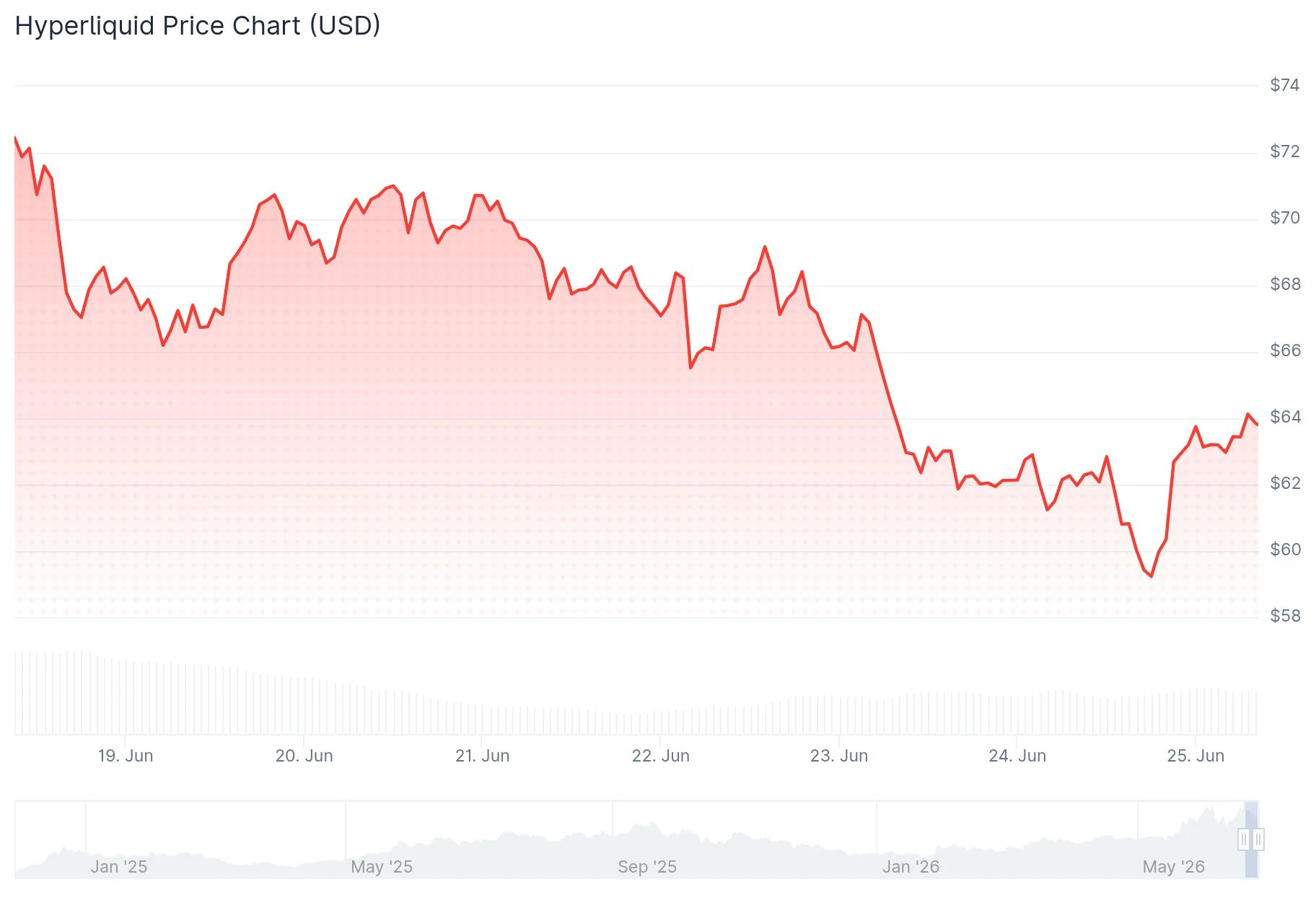
The HYPE token from Hyperliquid has experienced a 22% decline from its all-time peak of $76.9 achieved in recent trading sessions. Currently changing hands near $66, market participants are evaluating whether the bullish momentum that began in January remains intact.
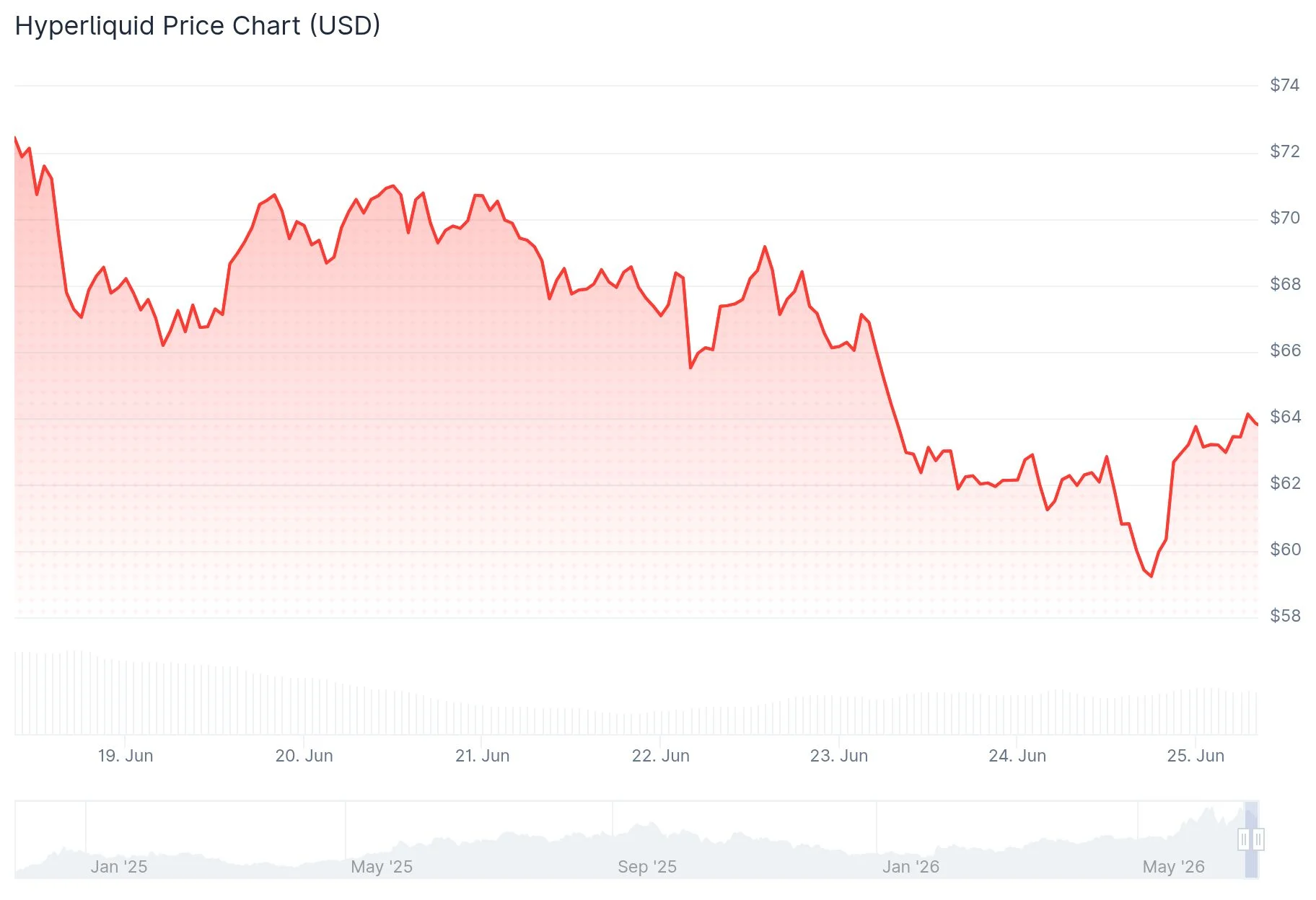
The correction emerged after the token failed to sustain levels above its record high near $76. During midweek trading, HYPE dipped beneath the $60 threshold before finding stability. The 50-day exponential moving average, which has provided consistent support during the March-initiated rally, is now facing a critical test.
Futures market metrics continue to reflect optimistic sentiment. Data from CoinGlass indicates a long-to-short ratio standing at 1.03, accompanied by positive funding rates of 0.0042%. This configuration shows long position holders are compensating short sellers, indicating prevailing expectations for upward price movement.
Spot Market Pressure Shows Signs of Relief
The intensity of spot selling has diminished compared to early June levels. The aggregated spot cumulative volume delta (CVD) has recovered from recent lows, although it maintains a substantially negative reading around -$95 million. When prices dropped from $76 in early June, spot selling pressure peaked at $110 million.
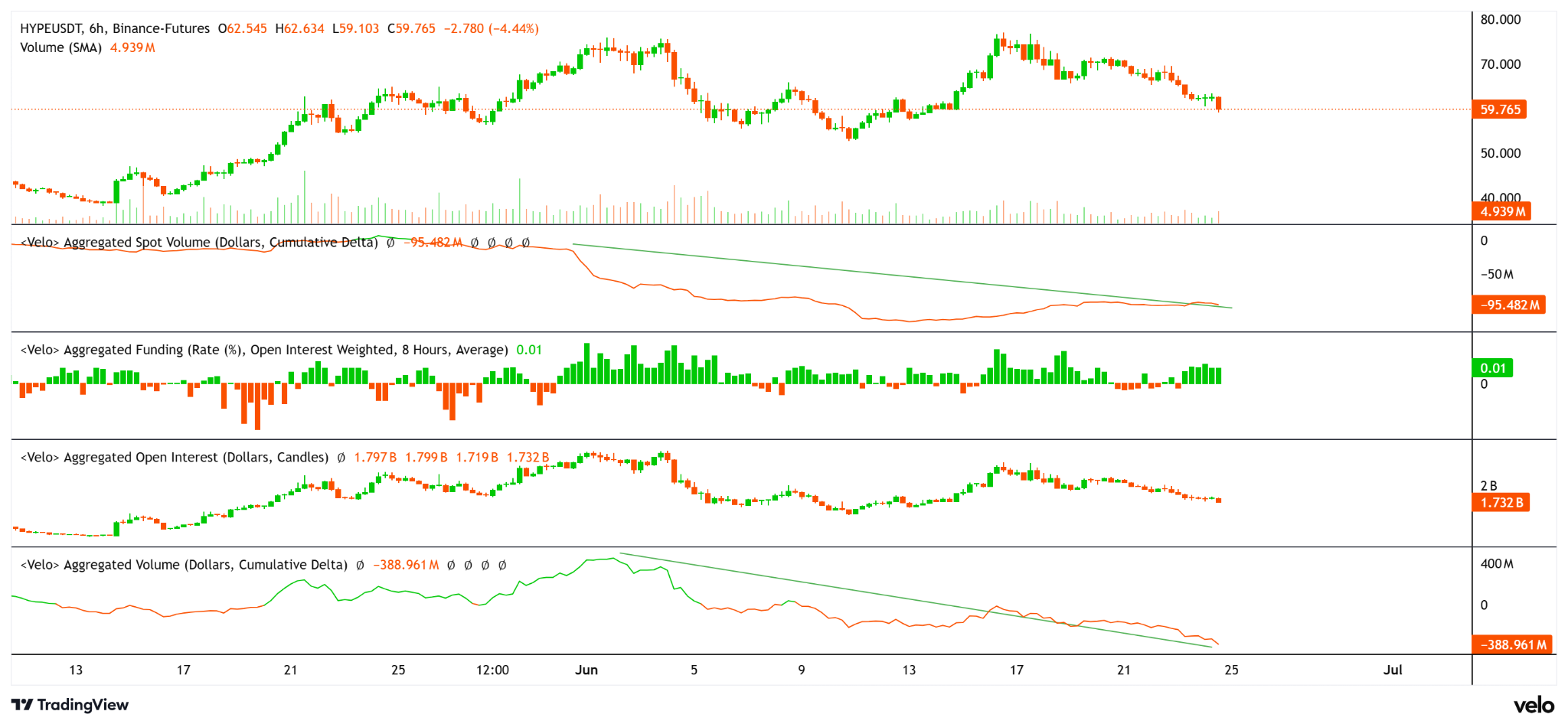
The derivatives landscape tells a more reserved story. Open interest has contracted from $2.2 billion down to $1.73 billion. Derivatives CVD hovers near -$389 million. This suggests market participants are reducing their positions rather than establishing fresh trades.
Social dominance metrics for HYPE have been declining since June 17, currently registering at 0.175% per Santiment data. Increased retail engagement following the all-time highs has emerged, which certain market observers interpret as a potential caution signal for short-term price action.
Spot ETF activity has remained subdued throughout the week, with SoSoValue reporting minimal institutional involvement.
Critical $50–$54 Zone Emerges as Pivotal Support
The most significant support level appears between $50 and $54. This zone aligns with both the ascending 50-day EMA and an unfilled daily fair-value gap. A daily candle closing beneath $53 would mark the first bearish structural shift on the daily timeframe for this year.
Beneath this level, the 100-day EMA positioned at $51.57 represents the subsequent support, with $49 following. More substantial support exists around the $38 level.
Cryptocurrency analyst Altcoin Sherpa provided his perspective on the current market structure: “HYPE, I think anywhere in the 55–64 area is a pretty good place to accumulate this one. I think it goes to $100 later this year personally and is still the best altcoin…but it’s going to also depend a lot on bitcoin IMO.”
For bullish continuation, a daily close exceeding $74.60 would clear the pathway toward establishing fresh highs. The 50-day EMA currently resides at $58.94, the 100-day at $51.57, and the 200-day at $44.68, all positioned below current price action and indicating the broader uptrend structure remains unbroken.
The Relative Strength Index reads approximately 53 on the daily timeframe, while the MACD displays marginally negative values, indicating momentum has moderated without transitioning to bearish territory.



CoinEx has rejected claims that it helped Iranian state-linked entities move funds through its crypto exchange after a Wall Street Journal report cited $3.84 billion in Iran-linked transactions since 2019.
Summary
- CoinEx denies state-linked Iran ties while promising stronger sanctions screening after WSJ’s $3.84b report.
- The exchange says on-chain flows alone do not prove platform knowledge or active support.
- The response comes as U.S. sanctions pressure rises around Iranian crypto platforms and fund routes.
The exchange said it had “never established any commercial relationship” with Iranian government-related entities, Iranian domestic exchanges, the Revolutionary Guard, or sanctioned parties. CoinEx said it does not have an office or operating entity in Iran.
CoinEx also said its official domain had been blocked in Iran since 2021 after it was blacklisted by the Iranian government. The exchange said that fact shows it was not a platform backed or recognized by Iranian authorities.
The company said some users promoted CoinEx through its global referral program, but it denied organizing Iran-focused promotion. It said ordinary user activity should not be treated as proof of state-level sanctions evasion.
CoinEx disputes on-chain reading
The WSJ report said investigators traced unusual transactions from two wallets controlled by Iran’s central bank. It also said further tracing showed links to funds stolen from Bybit by North Korean hackers.
CoinEx said the report relied too heavily on on-chain interpretation. The exchange said blockchain transactions are open and traceable, but a fund passing through a platform does not prove that the platform knew about, supported, or joined the related activity.
The company also challenged the reported aggregate amount. It said combining two-way fund flows into one number and presenting it as funds “processed” by CoinEx was misleading.
CoinEx said third-party blockchain analytics platforms can reach different results. It added that on-chain attribution has limits and depends on how analysts interpret wallet links and transaction paths.
Bybit hack reference draws response
CoinEx also addressed the Bybit theft cited in the WSJ report. It said it helped Bybit block accounts and freeze assets after learning about the incident. CoinEx said it would conduct an internal review of the transactions mentioned in the report.
WSJ said investigators linked the Iranian central bank wallet trail to assets stolen from Bybit by North Korean hackers. The Bybit hack remains one of the largest crypto thefts reported by the industry.
In a previous article, crypto.news discussed how the Bybit hacker laundered more than half of the stolen Ethereum in less than a week, mainly through THORChain swaps. That activity kept attention on cross-platform money movement after large thefts.
CoinEx said it had also been a hacking victim in 2023, when North Korea-linked actors were reported to have stolen funds from the exchange. In another previous article, crypto.news discussed CoinEx’s plan to resume services after the $70 million Lazarus-linked hack.
Compliance measures expanded
CoinEx said it started a full review and exit process for Iran-related risk exposure after sanctions against Iranian domestic exchanges. The exchange said it strengthened checks for Iranian users, blocked registrations from Iranian regions, and started compliance off-boarding for identified accounts.
It also said it expanded geo-fencing, access restrictions, KYT monitoring, sanctions screening, and transaction freezes for high-risk activity. CoinEx said it would restrict or freeze accounts and assets tied to any sanctioned entity or person.
The response comes during a broader U.S. sanctions push against Iranian crypto activity. As previously reported, the U.S. Treasury sanctioned Nobitex, Wallex, Bitpin, and Ramzinex, accusing them of helping sanctioned entities access digital asset markets.
Treasury said Nobitex processed more than 50% of Iranian digital asset inflows in 2025. It also accused the exchange of helping Iranian regime insiders access international platforms and move funds across jurisdictions.
CoinEx said it will keep investing in KYC, AML, sanctions screening, and on-chain risk monitoring. The exchange also said it would respond to concerns from users, partners, and authorities.

Indonesia’s financial regulator has moved to tighten rules governing “finfluencers,” requiring certified competency for individuals who recommend crypto and other digital financial assets. The change signals a broader push to bring social-media promotions within formal financial-consumer protection and licensing frameworks.
Under Financial Services Authority Regulation (POJK) No. 6 of 2026, announced Wednesday, individuals who provide recommendations about digital assets must hold competency certifications unless they are already covered by a separate licensing requirement. The regulation also limits what influencers can recommend and sets conditions on how marketing is carried out and by whom.
Key takeaways
- Competency certification required: POJK No. 6 of 2026 introduces competency certification obligations for influencers recommending digital assets.
- Scope restricted to authorized listings: Influencers may recommend only digital assets that are listed on authorized exchanges.
- Licensed service-provider rule: Any service providers recommended by influencers must be licensed.
- Marketing must route through regulated businesses: Promotions must be carried out by regulated financial services businesses responsible for the content and distributed via their official communication channels.
Indonesia’s POJK No. 6 of 2026: what changes
Indonesia’s Financial Services Authority (OJK) is framing the regulation as part of its expanded oversight of financial promotions on social media. POJK No. 6 of 2026 focuses on the behavior of “financial information deliverers,” which includes influencers who promote crypto and other digital financial products.
Practically, the regulation creates a compliance pathway and a gatekeeping mechanism. Influencers providing recommendations about digital assets are expected to obtain competency certification unless they fall under another licensing regime. This approach differs from rules that rely only on whether a promoter is formally acting as a licensed intermediary; it instead adds a targeted competency requirement for social-media recommendation activity.
The regulation also narrows the promotional universe. Influencers are permitted to recommend only digital assets that appear on authorized exchanges, which reduces the risk of promoting unapproved offerings. In addition, any service provider promoted alongside such recommendations must be licensed, tying influencer marketing to the status of the underlying entities offering access to regulated services.
Finally, POJK No. 6 of 2026 imposes content and channel controls. Marketing campaigns must be run through regulated financial services businesses, which are responsible for the promotional content. The campaigns must then be distributed through those businesses’ official communication channels. For compliance teams, this structure is significant: it places accountability on regulated firms to ensure that promotional material is aligned with requirements and that distribution does not occur solely through third-party influencer channels outside the regulated firm’s control.
Why certification and channel rules matter for compliance
For institutional stakeholders, influencer promotion requirements are not merely reputational issues—they can create legal exposure, distribution-risk, and documentation gaps across marketing operations.
Certification requirements can affect onboarding and contracting. Firms that engage finfluencers may need to verify whether individuals recommending digital assets have the required competency certification or whether their activities fall under an alternative licensing framework. This can change due diligence procedures, recordkeeping expectations, and the compliance review workflow for campaigns.
Authorized-asset constraints also alter governance. The requirement that influencers recommend only assets listed on authorized exchanges means that firms must maintain an up-to-date inventory of eligible assets and align campaign content with that list. It introduces an ongoing monitoring obligation, especially if exchange authorization status changes or if new assets are promoted in response to market developments.
Licensed-provider requirements shift scrutiny toward partnerships. Even where an influencer’s role is limited to promotion, POJK No. 6 of 2026 conditions recommendations on the licensing status of service providers involved in the promoted services. That makes it necessary for regulated businesses to verify licensing and ensure that contracts with marketing partners do not result in promotion of non-compliant counterparties.
Channel control and content responsibility are likely the most operationally consequential element. By requiring that campaigns be distributed through regulated financial services businesses’ official channels, the regulation may limit the ability of influencers to independently disseminate promotional materials. This creates clearer lines of responsibility for compliance monitoring and supports a record trail for regulators and internal audit.
Indonesia’s move in a broader finfluencer enforcement trend
Indonesia is not acting in isolation. Several jurisdictions have tightened their approaches to influencer marketing tied to regulated financial products, reflecting a wider recognition that social-media endorsements can function as financial promotion and, in some cases, as de facto advice or transaction facilitation.
In March 2022, the Australian Securities and Investments Commission (ASIC) stated that influencers may require a financial services license when content constitutes financial advice or helps arrange transactions. ASIC also highlighted potential liability risks for licensed financial firms that engage influencers who engage in misconduct—an important reminder that regulated entities can face enforcement consequences tied to how they structure third-party arrangements.
In the UK, the Financial Conduct Authority (FCA) issued guidance in 2024 indicating that unauthorized influencers may commit a criminal offense when promoting regulated financial products without appropriate approval from an authorized firm. In a later enforcement push, the FCA led an international “week of action” on April 24, reporting participation from 17 regulators and describing account-takedown efforts affecting a large volume of illegal financial advertisements reaching substantial social media audiences.
Elsewhere in the region, the Philippines introduced crypto-specific marketing restrictions in 2025, covering endorsements, sponsored content, social media posts, podcasts, livestreams, and certain paid educational content. Under those rules, crypto asset service providers must disclose authorized third-party marketers to the Philippine Securities and Exchange Commission—again reinforcing the theme that regulators are seeking greater visibility and accountability in the influencer ecosystem.
Potential implications for market participants in Indonesia
POJK No. 6 of 2026 is likely to change how firms in Indonesia plan, approve, and document digital-asset promotional activities. Companies operating as regulated financial services businesses may face pressure to adjust marketing governance so that influencer campaigns are routed through official channels and supported by compliance oversight of both the content and the parties involved.
For exchanges and other market intermediaries, the authorized-list condition creates a compliance dependency on exchange authorization status. For platforms and service providers partnering with influencers, the licensing requirement means that marketing arrangements must be treated as a regulatory-sensitive activity, not simply a branding exercise.
Cross-border considerations also matter. Influencer marketing often spans jurisdictions, and promotional content created for one market can be repurposed elsewhere. Firms will need to assess how Indonesian requirements interact with local rules in other countries—particularly where the same campaign is distributed through global social-media accounts that may not distinguish between audiences subject to different regulatory standards.
Closing perspective
Indonesia’s POJK No. 6 of 2026 adds certification, licensing, and channel controls aimed at reducing compliance risk from crypto promotions on social media. Market participants should monitor OJK implementation details—such as how competency certification is administered and verified—and align influencer contracting, asset eligibility checks, and distribution workflows accordingly.
Crypto World
Request Network Introduces One-Click Cross-Chain Mass Payouts and Expands Wallet Screening With Merkle Science
[PRESS RELEASE – Zug, Switzerland, June 25th, 2026]
Anyone can now execute mass payouts across EVM chains and Tron from a single platform and can choose between multiple wallet screening providers.
Just three weeks after releasing major upgrades for crypto payment collection, the Request Network Foundation today announced another expansion of its stablecoin payment platform. The release introduces one-click mass payouts on both EVM and Tron, alongside built-in bridging and token swapping across EVM chains. The update also expands compliance capabilities through the integration of Merkle Science as an additional wallet screening provider.
Together, these capabilities reinforce Request Network’s vision of providing businesses with a simpler, more scalable, and more resilient way to operate stablecoin payments globally.
Users Can Now Disburse at Scale in One Click From a Single Wallet Without Bridging or Swapping
Stablecoins are already widely used to disburse salaries, commissions, affiliate rewards, bug bounties, supplier payments, and customer refunds or withdrawals across the world. While settlements are now faster and cheaper in stablecoins compared to fiat, the operational processes needed to send funds remain complex as recipients usually require payments on multiple chains and in multiple currencies. This has forced finance teams to initiate multiple transactions in separate currencies and from multiple wallets.
Request Network now abstracts away this fragmentation, allowing anyone to initiate mass payouts from a single wallet in a single currency to pay recipients across the top 6 EVM chains (Ethereum, Base, Arbitrum, Optimism, Polygon, and BNB Chain) in USDC and USDT.
Through a single signature, a mass payout can now be initiated even if the individual transactions need to be bridged and swapped to reach their recipient. Request Network protocol automatically retrieves and batches bridge and swap quotes in order to funnel every payment of a batch to its correct destination in just one approval.
To simplify the process further, Request Network also allows any recipient to set and update their payment preferences so payments are always routed to where they should go.
This represents one of the biggest breakthroughs in cross-chain and swapping abstraction, bringing payers and recipients closer than ever before, regardless of the blockchain or currency they trust.
Mass Payouts Now Available on Tron
Alongside EVM mass payouts, Request Network also announced the support of mass payouts on Tron, becoming the first protocol to combine both capabilities.
Thanks to this release, anyone can now send USDT to multiple recipients on Tron in a single transaction, unlocking large-scale payouts on one of the most used chains in Asia, Africa, Eastern Europe, and Latin America.
With this release, anyone can now manage all stablecoin payouts globally from the Request Network protocol.
More Choice for Wallet Screening
Alongside mass payouts, Request Network also announced a partnership with Merkle Science to offer additional wallet screening providers on the protocol.
As a reminder, Request Network offers built-in wallet screening to protect its users from high-risk wallet interactions. When enabled, this feature allows payments to be executed only if the payer or recipient satisfies the preset screening policies, helping businesses to avoid exposure to high-risk wallets which may lead to asset freezing or difficulties off-ramping to fiat.
By expanding its integration of Merkle Science, Request Network just became one of the safest ways to receive crypto onchain, while accommodating for recipients’ preferences.
Tristan Wallaert, CEO of the Request Network Foundation, said: “Stablecoins allowed money to move globally without the usual fiat constraints, but executing payments at scale remains a bottleneck and is forcing users to rely on payment service providers. Anyone should be able to pay by himself hundreds of payments across chains in just a single operation.High risk wallets exposure has tarnished the crypto reputation recently, if we want to provide the best protection to blockchain users they need to be able to use the best screening providers. Sending and receiving payments must become intuitive and safe if we want stablecoins to be a real alternative to fiat.”
Mriganka Pattnaik, CEO of Merkle Science, said: “As stablecoin payments become more global and cross-chain, compliance needs to become just as seamless as the payment experience itself. Our integration with Request Network helps businesses screen wallets with greater confidence, reduce exposure to high-risk activity, and scale onchain payments without compromising trust or operational efficiency”.
About Request Network
Since 2017, Request Network has developed, educated about, and promoted the use of open-source, decentralized and permissionless protocols that provide infrastructure for on-chain payments and related financial flows.
Request Network allows anyone to send and receive crypto at scale, across chains, without custodial intermediaries. The protocol is developed by a community-funded foundation whose mission is to make crypto payments accessible while protecting its participants.
To date, more than $2 billion has moved thanks to Request Network technology.
About Merkle Science
Merkle Science provides blockchain analytics and crypto compliance solutions that help businesses detect, investigate, and prevent financial crime across digital assets. Its platform supports wallet screening, transaction monitoring, risk intelligence, and investigations, enabling crypto platforms, financial institutions, and payment providers to manage onchain risk and meet compliance requirements at scale.
The post Request Network Introduces One-Click Cross-Chain Mass Payouts and Expands Wallet Screening With Merkle Science appeared first on CryptoPotato.


Decentralized Finance (DeFi) total value locked (TVL) has fallen every month of 2026. The TVL has dipped 39%, driven by a broad market correction and a run of protocol exploits.
Among the top 10, only two chains grew their TVL in 2026, bucking a downtrend that pulled down every other major network.
What Is Behind the TVL Slide
In its latest report, CryptoRank noted that DeFi TVL dropped from roughly $115 billion in January to about $70 billion. The decline mirrors a broader market reversal.
After hitting an all-time high in October, Bitcoin (BTC) has dropped by more than 50%, with other major assets also recording steep losses.
Follow us on X to get the latest news as it happens
Meanwhile, most leading chains lost ground as capital exited. Ethereum (ETH), which leads the top-10 chains, saw a 43% drop, leaving its DeFi base at $38.91 billion. Arbitrum sank 55%, and Plasma collapsed nearly 75%.
Only two large networks held firm. TRON grew TVL by about 5%, supported by its role in Tether (USDT) settlement and stablecoin lending. Hyperliquid rose roughly 7% on perpetuals trading and its expanding HyperEVM ecosystem.
Crypto Hacks Add Pressure as Q2 Sets a Record
The report added that exploit frequency also affected user confidence. The second quarter produced 85 incidents and about $775 million in losses.
That makes it the most active quarter in the dataset for exploits. Overall, in 2026, the space experienced 121 hacks resulting in $942 million in losses.
“High-profile incidents involving major protocols reinforced concerns around security and may have accelerated capital outflows from DeFi,” CryptoRank stated.
Two April attacks drove most of the damage. The Drift Protocol breach cost $295 million, and the KelpDAO exploit followed at $293 million. Together, they accounted for more than half of all 2026 losses.
The KelpDAO incident hit lending hardest. Aave’s TVL fell from $26.4 billion to $14.3 billion over a few days, a 46% drop in deposits.
Nonetheless, the report highlighted that the current downturn still looks milder than the previous cycle. DeFi TVL collapsed by more than 70% in seven months, following its late-2021 peak near $177 billion.
A wider spread of capital across stablecoins, real-world assets, and derivatives may have cushioned the sector against sharper falls.
Subscribe to our YouTube channel to watch leaders and journalists provide expert insights
The post DeFi Total Value Locked Slides Every Month in 2026 to $70 Billion appeared first on BeInCrypto.
The controversial cryptocurrency project has recently unveiled numerous ecosystem updates that, unfortunately for the Pioneers, have failed to trigger a decisive rebound in PI.
All eyes are now set on June 28, which could deliver some groundbreaking announcements that could finally result in a major price increase.
‘Stay Tuned’
Pi2Day (June 28) is a symbolic day for Pi Network’s community since it represents the mathematical constant 2π. For several weeks, Pioneers have debated whether the Core Team is preparing to roll out significant updates on that date, with some floating the idea of a potential Binance listing.
Recently, Pi Network added fuel to the rumors by describing Pi2Day as a milestone-driven event and highlighting that last year’s edition included Pi App Studio, Directory Staking, Node updates, and other releases.
“Stay tuned on June 28 for what’s to come,” it teased.
Shortly after, the team reminded that Pi2Day marks the final deadline for the Vibe Coder campaign. The initiative aims to bring AI-driven applications into the project’s real distribution network through Pi App Studio. June 28 is also the last day of the Pi Launchpad testing period, which features the new test token, SLICE.
“Both initiatives help contribute to the growth, development, and use of the Pi ecosystem and its utilities,” the Core Team stated.
As usual, the announcements were met with mixed feelings by the community. Some said they are excited about Pi2Day and look forward to the potential updates, while others stressed that the migration to mainnet and KYC procedures remain hurdles that need to be addressed as a priority.
PI Price Outlook
The token remains under heavy pressure, falling alongside the reset of the crypto market. Currently, PI is worth around $0.127 (per CoinGecko), which is quite close to the all-time low witnessed at the start of June and represents a staggering 96% decline since the historic peak of $3 witnesses in February 2025.
Earlier this week, some analysts spotted the formation of a classic “head and shoulders pattern” on PI’s price chart, which could be a precursor of a further pullback.
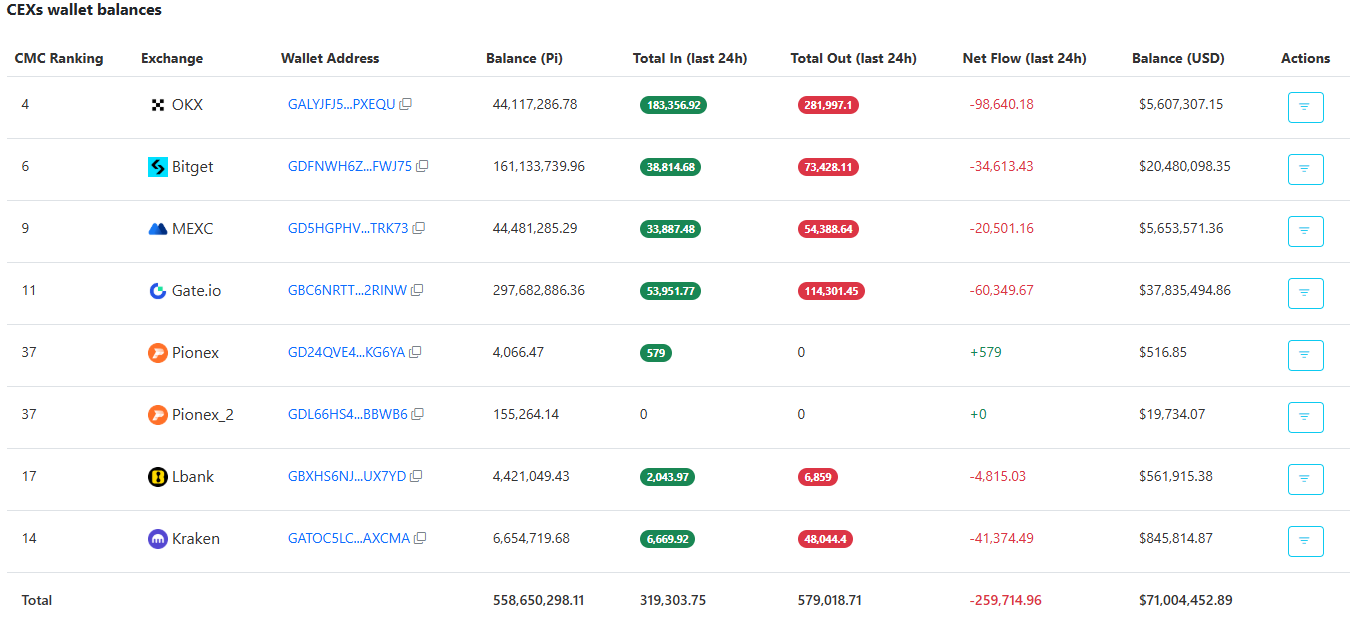
The rising amount of coins stored on crypto exchanges is another issue. The figure has risen to almost 560 million, signaling that many investors have moved their holdings from self-custody toward centralized platforms, thereby increasing immediate selling pressure.
The post Pi Network (PI) Teases Major Updates This Week: What Could Be Next? appeared first on CryptoPotato.

Kanga, a Poland-founded crypto exchange, says it has secured a Markets in Crypto-Assets Regulation (MiCA) license in Latvia—an approval it says will let it operate across the European Union through passporting.
In a Wednesday statement shared with Cointelegraph, Kanga’s operator, SIA AlphaRoute, said it received a Class 3 MiCA license from the Bank of Latvia after the regulator’s Supervisory Committee approved the authorization. The license was granted on June 18 and, according to the exchange, authorizes services including crypto custody, trading, and transfers across the EU.
Key takeaways
- Kanga (via SIA AlphaRoute) obtained a Class 3 MiCA license from the Bank of Latvia, enabling EU passporting.
- The authorization covers core exchange activities including custody, trading, and transfers, per the exchange’s announcement.
- Kanga says it began Latvia pre-licensing in November 2025 to prepare for MiCA’s transitional period.
- Poland remains without MiCA implementation legislation as the EU’s July 1 transitional deadline approaches, due in part to a recurring legislative deadlock.
Latvia licensing sets up EU-wide expansion
MiCA’s framework is designed to harmonize crypto regulation across the EU, but implementation schedules and national legislative processes have differed. Kanga’s move to obtain licensing in Latvia effectively positions it to serve EU customers under a compliant path while other jurisdictions—such as Poland—remain in flux.
According to Kanga’s statement, the relevant authorization was granted after the Bank of Latvia’s Supervisory Committee approved SIA AlphaRoute’s application. The exchange emphasized that the license permits it to provide crypto services across EU member states once passporting mechanisms are used.
Kanga also described how it planned for the regulatory shift. Its chief executive, Dominik Tomczyk, said the company began the pre-licensing process in Latvia in November 2025 after reviewing multiple jurisdictions. He framed the decision around using MiCA’s transitional period to ready internal systems and the organization for the new rules.
“From the very beginning, we knew that we had to use the transitional period provided for under the MiCA regulation to prepare the organisation to operate within the new regulatory framework,” Tomczyk said.
The exchange added that it will share additional information about operational changes and service terms through its official communication channels, pointing to a likely period of adjustment for customers as it aligns offerings with MiCA requirements.
Why passporting matters as MiCA deadlines loom
For operators, MiCA passporting is often the difference between being able to scale across borders quickly and being forced to run separate regulatory processes in each country. By securing a Class 3 license in Latvia, Kanga is effectively aligning itself with an EU-wide compliance route rather than waiting for national legislation elsewhere to catch up.
The timing is notable. The EU’s transitional deadline is set for July 1, and the broader compliance landscape remains uneven across member states. Kanga’s license—granted June 18—arrives shortly before that deadline, during a window when exchanges and custody providers may be reassessing market access and legal certainty.
That context is especially relevant for Poland-based firms. If a home market delays implementation, companies may seek licensing in other EU jurisdictions to avoid service uncertainty and to continue serving EU customers under a stable regulatory framework.
Poland’s legislative deadlock continues
While Kanga points to regulatory progress in Latvia, its home country still faces obstacles to MiCA implementation. According to earlier coverage from Cointelegraph, Poland has remained without MiCA implementation legislation ahead of the EU’s July 1 transitional deadline, with lawmakers attempting to break a deadlock after the Polish president vetoed a government-backed crypto bill three separate times.
Cointelegraph reports that President Nawrocki vetoed the bill for a third time on June 11, arguing that successive versions failed to address his objections—especially provisions he considered overly burdensome for crypto companies. Following the veto, members of the Poland 2050 party, part of Prime Minister Donald Tusk’s governing coalition, reportedly submitted a new proposal incorporating changes requested by the president.
As described by the bill’s sponsors, the latest proposal would reduce some fees, remove certain regulatory provisions, and make the overall framework less restrictive for crypto firms. Poland 2050 has reportedly called for the legislation to be fast-tracked through parliament.
At the same time, regulatory pressure in Poland is not limited to legislative timing. The country’s crypto sector has also faced increased scrutiny following a fraud investigation into Zonda, which Cointelegraph previously reported as Estonia’s largest crypto exchange. Prosecutors reportedly estimate customer losses exceed 350 million zlotys (about $92.7 million). Developments tied to that case may affect how regulators and lawmakers approach compliance and oversight of crypto platforms.
What to watch next for Kanga and EU MiCA adoption
Kanga’s Latvia license provides a concrete example of how crypto firms may navigate MiCA’s rollout when national implementation is delayed. Investors and customers will likely want to monitor how Kanga communicates specific operational changes, and whether Poland’s MiCA bill ultimately passes in the near term—since the pace of home-country legislation can still influence competition, costs, and compliance strategies for exchanges headquartered in Poland.
With the EU transitional deadline approaching, the next key signal will be whether other exchanges follow similar cross-border licensing paths—or whether Poland’s legislative process finally catches up, narrowing the gap between “ready under MiCA” and “still waiting for national law.”


Nouriel Roubini says the overwhelming majority of crypto projects are built on nothing, and that nearly two decades of blockchain development stemming from Bitcoin has produced exactly one legitimate use case.
Speaking on the BeInCrypto Expert Council podcast alongside Atlas Capital CEO Reza Bundy and Securitize founder Carlos Domingo, the economist known as “Dr. Doom” delivered a blunt post-mortem on the ICO era and the altcoin market as a whole.
A Massive Failure Rate With Fraud Baked In
Roubini’s accounting of the ICO boom left little to salvage. Of the 20,000 Initial Coin Offerings (ICOs) ever launched, he said the damage runs far deeper than market losses alone.
“There have been 20,000 ICOs, 80% of them were scam in the first place… A lot of stuff is backed by nothing. It’s totally vaporware. It’s based just on faith.”
The math compounds from there. Of the remaining non-fraudulent projects, Roubini argues 70% lost all their value. Then, among the small fraction still standing, including most of the top 10 cryptocurrencies, they have shed 50 to 60% from their all-time highs.
Indeed, Bitcoin dropped below $60,000 briefly on June 24, more than 50% down from its all-time high of $126,080.
His verdict: nearly everything built on-chain represents a speculative bet on faith rather than a claim on any real asset or utility. The history of ICO fraud bears this out, from pump-and-dump schemes at launch to projects that vanished entirely after raising funds.
Roubini has levelled similar criticism at the crypto space for years, including a 2019 face-off with Ethereum creator Vitalik Buterin in which he called the ecosystem overcentralized and riddled with manipulation. He also testified before the US Congress, calling blockchain the least useful technology in human history.
Stablecoins: One App Left Standing
Despite writing off the vast majority of the market, Roubini identified one product that genuinely works.
“After almost 20 years of Bitcoin, what’s the big killer app in crypto? Stablecoins.”
His endorsement comes with a caveat. Stablecoins, he argues, are simply a digital wrapper around fiat currency and therefore carry the same debasement risks. They work as a payment rail, particularly for users in high-inflation economies, but they generate no real return and offer no hedge against the monetary risks that originally made crypto appealing.
That distinction, useful for payments but limited as a store of value, underpins his argument for tokenized real-world assets as the next step.
The podcast appearance marks a notable evolution for Roubini, who previously dismissed all crypto as fraud in public forums. His position now separates speculative tokens, which he still regards as backed by nothing, from tokenized assets with verifiable, real-world collateral.
If Roubini’s numbers hold, the altcoin market’s long-run track record amounts to a near-total loss across 20,000 projects, with stablecoins as the only durable output of the entire experiment.
The post Dr. Doom Calls Most Crypto Vaporware Backed by Nothing, Except One Use Case appeared first on BeInCrypto.
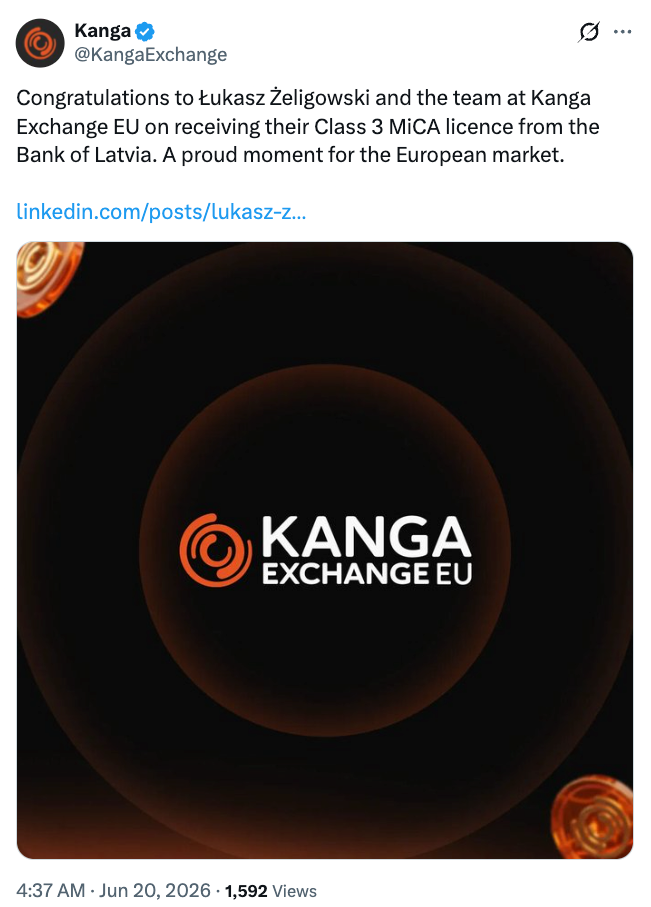
Kanga, a crypto exchange founded in Poland, said it has obtained a Markets in Crypto-Assets Regulation (MiCA) license in Latvia, allowing it to passport its services across the European Union.
The exchange’s operator, SIA AlphaRoute, received a Class 3 MiCA license from the Bank of Latvia after its Supervisory Committee approved the authorization, according to a Wednesday statement shared with Cointelegraph.
The license was granted on June 18 and authorizes the company to provide services, including crypto custody, trading and transfers, across the EU, said the exchange.
Kanga’s approval comes as Poland remains without MiCA implementation legislation ahead of the EU’s July 1 transitional deadline, with lawmakers still trying to break a deadlock following three presidential vetoes.
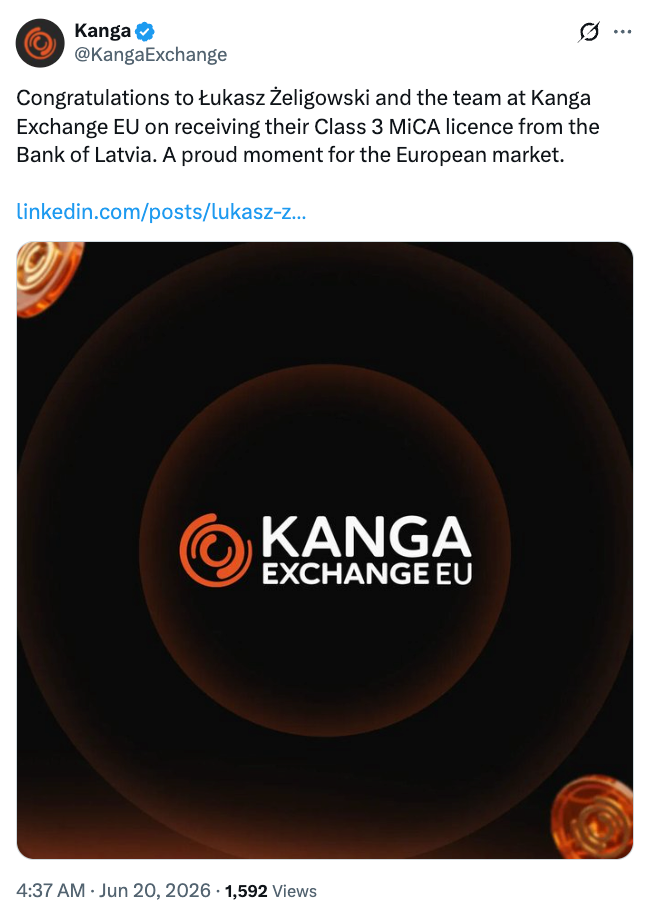
Source: Kanga
Kanga’s path to EU-wide operations
Kanga began the pre-licensing process in Latvia in November 2025 after reviewing several jurisdictions, according to SIA AlphaRoute CEO Dominik Tomczyk.
“From the very beginning, we knew that we had to use the transitional period provided for under the MiCA regulation to prepare the organisation to operate within the new regulatory framework,” Tomczyk said.
Related: Binance withdraws Greece-filed MiCA application
The company said it will provide customers with additional details about operational changes and service terms through its official communication channels.
Poland’s MiCA deadlock
President Nawrocki vetoed a government-backed crypto bill for a third time on June 11, saying successive versions failed to address his objections, including provisions he considered overly burdensome for crypto companies.
Members of the Poland 2050 party, part of Prime Minister Donald Tusk’s governing coalition, have since reportedly submitted a new proposal incorporating several changes requested by the president.
According to the bill’s sponsors, the proposal would reduce some fees, remove certain regulatory provisions and make the framework less restrictive for crypto companies. Poland 2050 reportedly called for the legislation to be fast-tracked through parliament.
Poland’s crypto sector also faces heightened scrutiny following a fraud investigation into Zonda, the country’s largest crypto exchange, where prosecutors estimate customer losses exceed 350 million zlotys (about $92.7 million).
Magazine: Bitcoin decouples from tech stocks, Ether eyes ‘selling wave’: Market Moves

Olivia Wilde Denies Explosive Florence Pugh Claims

‘Brutally honest’ Strictly Come Dancing stars join Celebrity Gogglebox

Stocks Retreat as Fears Deepen About Strength of AI Boom


-

 Fashion6 days ago
Weekend Open Thread: Miami – Corporette.com
-

 Entertainment4 days ago
Renter of Home in Anne Heche Crash Denies Settlement With Son
-
 Sports2 days ago
Two goals and an assist by sheer aura: Cristiano Ronaldo just entered the World Cup chat
-

 Tech3 days ago
Microsoft accidentally kills epic Outlook email threads
-

 Business4 days ago
Soccer-U.S. defends Iran World Cup travel restrictions, says discussions ongoing
-
Crypto World1 day ago
Bitcoin (BTC) Dips Below $62K, Ethereum (ETH) Plunges 6% Daily: Market Watch
-

 Politics5 days ago
Andy Burnham and the meaning of Makerfield
-
 Politics7 days ago
BBC Reporter Discusses Cross Party Criticism Of Trumps Iran Deal
-

 Crypto World1 day ago
Securitize Wraps Roubini's SEC-Registered ETF as Dubai VARA Digital Security
-
Business1 day ago
Entergy settles forward sale agreements, raises $672 million in cash proceeds
-

 NewsBeat6 days ago
Keir Starmer Allies Question His Chances For No 10
-
 Business5 days ago
Wall Street Week Ahead: Investors see Micron earnings as pulse check of AI rally momentum
-

 Tech7 days ago
AWS enters the context layer race with a graph that learns from agents, not manual curation
-
 Crypto World5 days ago
Can Charles Hoskinson Really Rescue Cardano?
-

 Crypto World5 days ago
HIVE shares jump as $220M AI deal speeds Bitcoin mining pivot
-

 Crypto World5 days ago
Jake Chervinsky accuses CME of protecting derivatives monopoly
-

 Entertainment5 days ago
Jose Alvarado Wants Taylor Swift at More Knicks Games
-
 Tech4 days ago
Signal’s Meredith Whittaker says AI chatbots ‘are not your friends’ and calls Copilot agents a backdoor
-

 Tech3 days ago
Nearly 7,000 fake Amazon domains registered ahead of Prime Day 2026, researchers warn
-

 Sports6 days ago
FIFA World Cup 2026: Canada beat 9-men Qatar 6-0 to register first ever win | FIFA World Cup 2026
You must be logged in to post a comment Login