

Crypto World
Dell (DELL) Stock Skyrockets Over 30% as AI Server Demand Powers Historic Market Rally


TLDR
- Dell’s quarterly revenue soared to $43.8B with an 88% year-over-year increase, while AI server orders reached $24.4B
- Dell stock rocketed more than 30% higher; the Dow Jones achieved a historic milestone by surpassing 51,000
- Strong enterprise AI software demand lifted Salesforce and NetApp shares significantly
- AI infrastructure enthusiasm drove gains in Hewlett Packard Enterprise and Super Micro Computer
- AST SpaceMobile shares declined following complications with Blue Origin’s New Glenn rocket program
Dell Technologies Delivers Massive AI-Driven Earnings Beat
Dell Technologies reported what many are calling one of 2025’s most impressive earnings performances. The tech giant announced quarterly revenue of $43.8 billion, representing an 88% jump from the same period last year, alongside adjusted earnings per share of $4.86. Revenue from AI-optimized servers climbed to $16.1 billion while AI-related order volume hit $24.4 billion. The company’s AI server backlog now exceeds $51 billion. Management upgraded its fiscal 2027 AI revenue projection from $50 billion to $60 billion. The stock responded by jumping more than 30%, prompting numerous Wall Street analysts to raise their price targets.
Dow Jones Achieves Historic 51,000 Milestone
The catalyst for broader market gains came directly from Dell’s blockbuster report. The Dow Jones Industrial Average broke through 51,000 for the first time in its history, while both the S&P 500 and Nasdaq established new all-time highs. Market participants continue viewing AI infrastructure investment as a fundamental growth driver, with Dell’s performance validating that perspective. The rally spread across multiple sectors, as traders sought additional opportunities to capitalize on the expanding AI infrastructure buildout.
Salesforce Gains Ground on Enterprise AI Momentum
Salesforce experienced significant upward movement following earnings that confirmed robust appetite for enterprise software and AI-enabled business applications. The company has emerged as a critical bellwether for investors monitoring practical AI implementation within major corporations. Its encouraging guidance helped broaden the day’s advances beyond hardware manufacturers into software providers, indicating the AI investment theme is expanding throughout the technology landscape.
NetApp and Enterprise Hardware Names Ride Dell’s Wave
NetApp emerged as a top performer, with shares climbing as market participants searched for AI infrastructure opportunities beyond semiconductor companies. The firm’s storage solutions and data management technologies are considered critical elements for large-scale AI system deployments. Hewlett Packard Enterprise and Super Micro Computer also posted substantial gains, as investors interpreted Dell’s strong numbers as a positive indicator for the broader enterprise AI hardware ecosystem.
AST SpaceMobile Drops on Blue Origin Rocket Program Issues
AST SpaceMobile ranked among the session’s weakest performers following news of difficulties with Blue Origin’s New Glenn rocket initiative. While the problem wasn’t directly connected to AST SpaceMobile’s business operations, it triggered widespread selling throughout space and satellite-related equities. Despite impressive performance over the past twelve months, Friday’s trading demonstrated that the space sector continues to face vulnerability from operational challenges and unfavorable developments.



Ripple’s (XRP) price witnessed a fresh rebound, which pushed the crypto asset from $1.11 to $1.18. The latest uptick was backed by changing wallet-flow trends, according to CryptoQuant.
Interestingly, South Korea’s largest cryptocurrency exchange, Upbit, took the top spot for XRP deposit-wallet activity across exchanges.
Upbit Overtakes Rivals
The latest data revealed that Upbit’s XRP Net Wallet Flow Dominance increased sharply from 13% on June 7 to 31% on June 14, reaching its highest level since May 2024. This indicates that Upbit now holds the strongest concentration of XRP deposit-wallet activity among leading crypto exchanges.
This wasn’t the case with several other major exchanges, which recorded declining dominance during the same period. Coinbase, for instance, showed the biggest drop, after falling from 27% on May 7 to 0% on June 14. This suggests deposit-wallet activity weakened considerably on the exchange, or that withdrawal-wallet activity became relatively stronger.
A similar trend was visible in Binance, which also recorded a decline in dominance, slipping from 16% to 13%, while Crypto.com dropped from 9% to 3%.
The divergence highlighted that XRP’s rebound was not supported by evenly distributed wallet flows across exchanges. Instead, the market saw a clear rotation of activity toward Upbit, while Coinbase, Binance, and Crypto.com moved in the opposite direction. CryptoQuant said,
“The takeaway is that XRP’s rebound is being driven by a divided flow structure.”
Meanwhile, crypto analyst Egrag Crypto had earlier said that bulls remain in control on lower time frames as long as the price stays above the $1.134-$1.14 range. He identified $1.193 as the first major resistance level, followed by $1.26 if momentum strengthens further. On the downside, however, the analyst said $1.09 remains the main support level, while a drop toward $1.05 could signal a deeper correction.
Institutional Flows
Even though most crypto ETFs are seeing investors pull money out, spot XRP funds are still managing to attract fresh inflows. Data from SoSoValue showed that XRP ETFs added almost $10.7 million over the last week. At the same time, spot Bitcoin ETFs in the US saw heavy outflows totaling $314.8 million.
Ethereum ETFs also ended the week in the red, as investors withdrew nearly $14.91 million.
The post Ripple’s (XRP) Latest Rally Is Being Driven by a Surprising Exchange Trend appeared first on CryptoPotato.


BlackRock’s Bitcoin income-focused ETF will begin trading on Nasdaq on June 16 after receiving regulatory approval from the U.S. Securities and Exchange Commission.
Summary
- BlackRock’s iShares Bitcoin Premium Income ETF (BITA) is set to begin trading on Nasdaq on June 16 after receiving SEC approval and exchange clearance.
- The fund seeks to generate income through a covered-call strategy on IBIT holdings while targeting a 15%–25% annual yield.
- Alongside BITA, BlackRock recently expanded its ETF lineup with the STAR space technology fund in Europe and the UK.
According to Bloomberg ETF analyst Eric Balchunas, Nasdaq confirmed that BlackRock’s iShares Bitcoin Premium Income ETF, trading under the ticker BITA, would launch on Tuesday. The confirmation came one day after the SEC approved the fund’s notice of effectiveness, clearing the way for public trading.
As reported by crypto.news, BlackRock filed for the product on June 12, positioning it as an income-generating alternative for investors seeking exposure to Bitcoin-related returns without directly holding the cryptocurrency.
According to the fund’s final prospectus, BITA is designed to generate income while maintaining participation in Bitcoin price movements. Rather than purchasing Bitcoin itself, the ETF will primarily invest in shares of BlackRock’s iShares Bitcoin Trust ETF (IBIT), which remains the world’s largest spot Bitcoin ETF by assets under management.
How the ETF generates income
Details outlined in BlackRock’s filing show that the fund will use a covered-call strategy by selling call options linked to its IBIT holdings. The premiums collected from those options are expected to serve as the primary source of income for shareholders.
Providing additional context on the structure, Balchunas said:
“The ETF will target 15-25% annual yield while trying to capture at least 70% of bitcoin’s upside in process.”
The prospectus states that investors will pay a sponsor fee of 0.65% per year. The fee accrues daily and is scheduled to be paid quarterly.
BlackRock also disclosed that investors may indirectly bear other costs associated with options transactions, brokerage commissions, financing expenses, legal services, and fund operations.
Earlier commentary from Balchunas described BITA as the anticipated successor product to IBIT. He also noted that IBIT has become the fastest-growing ETF in industry history based on asset growth.
BlackRock expands its ETF lineup
The Bitcoin income product arrives as BlackRock continues adding new funds across different investment themes.
Last week, the asset manager introduced the iShares Space Technologies UCITS ETF in the United Kingdom and Europe. According to BlackRock, the fund trades under the ticker STAR and tracks the STOXX Global Space Satellites and Drones Index.
BlackRock said companies included in the index must generate at least 25% of their revenue from space, satellite, or drone-related businesses. The firm also introduced a fast-entry mechanism that allows newly listed qualifying companies to enter the benchmark within 10 to 30 days of going public.
According to BlackRock, the rule was created to capture developments in rapidly evolving industries, including potential future stock market listings tied to the space sector. The company specifically pointed to growing investor interest surrounding a possible future listing of SpaceX.
Balchunas had previously estimated that BITA would likely begin trading later in the week. Nasdaq’s approval ultimately brought the launch forward, allowing the fund to reach the market sooner than expected.

The cryptocurrency market has turned green since the major Sunday evening announcement by US President Donald Trump, but some assets have marked more substantial gains than others.
Ripple’s cross-border token is among those, gaining over 3% in value on a daily scale, which is more than ETH’s 2.5% increase and BTC’s 1.9% jump.
Why Up, XRP?
Obviously, the more apparent reason behind XRP’s revival today is the deal announcement made by Trump yesterday. As reported, the POTUS also authorized the toll-free opening of the Strait of Hormuz and the removal of the United States Naval blockade.
The actual deal is expected to be signed by the end of the week, as reports from Pakistan and India have concurred with Trump’s statement. Peace news is always welcomed in the risk-on cryptocurrency markets, especially for larger-cap altcoins.
However, there could be more beneath the surface for XRP’s particular gains. For starters, the exchange-traded funds tracking its performance continue to defy the overall ETF trend. They attracted over $10 million in the past business week, in stark contrast to the $15 million in net outflows from the ETH ETFs and the over $300 million taken out of the Bitcoin counterparts.
Separately, a report from CryptoQuant revealed a somewhat surprising shift in trend. South Korea’s largest crypto exchange, Upbit, became the trading platform with the highest concentration of XRP deposit-wallet activity. The analysts at CQ determined that “XRP’s rebound is being driven by a divided flow structure.”
What’s Next?
Popular analyst Ali Martinez noted recently that the TD Sequential had flashed a buy signal for XRP after the asset’s recovery to over $1.10 commenced. In a follow-up post, he added that a breakout from the asset’s current symmetrical triangle could result in another 14% move.
Fellow analyst CW outlined the next two significant resistance lines if the token’s rally continues. The first is the sell wall at $1.25, followed by $1.40, where there’s a significant cluster of short positions.
CRYPTOWZRD warned that XRP had closed indecisively despite the late Sunday rally. According to their analysis, XRP needs to decisively reclaim the $1.18 level before it can offer further upside. It’s worth noting that the cross-border token is currently testing that level.
XRP Daily Technical Outlook:$XRP closed indecisively and its intraday chart is trading within a range. Above $1.1800 will offer a long, but a rejection at this resistance will offer a short. Moving below $1.1000 will offer further decline
pic.twitter.com/HkGXX2tpj6
— CRYPTOWZRD (@cryptoWZRD_) June 15, 2026
The post Why Is The Ripple (XRP) Price Up Today, and What’s Next? (June 15) appeared first on CryptoPotato.
Crypto World
Top 3 Cryptos to Watch as Wall Street Moves Deeper Into Ethereum and Pepeto Presale Attracts Big Capital While BNB and ADA Recover
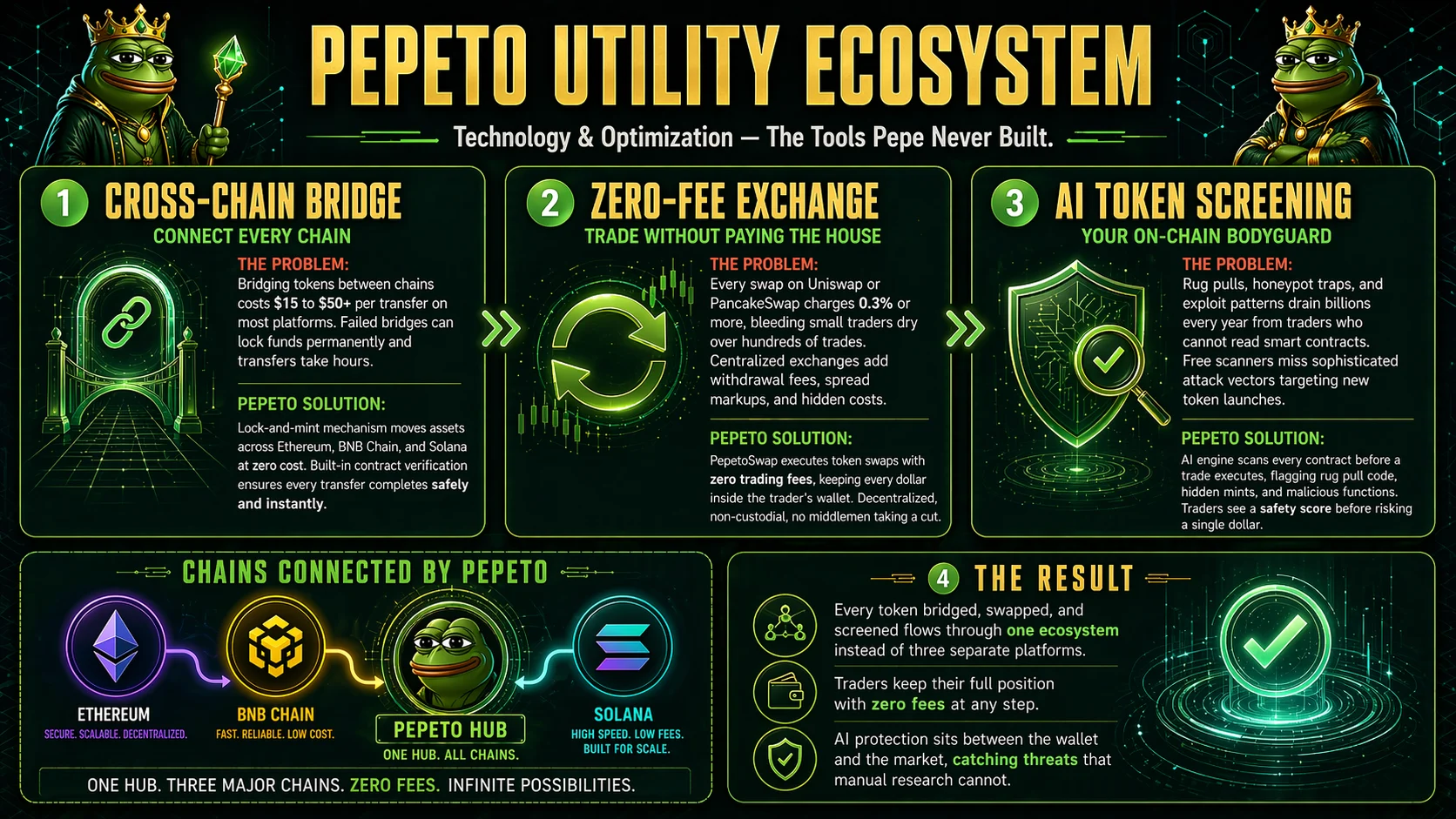
The top 3 cryptos to watch this cycle are the tokens with working infrastructure and a clear repricing event ahead, because Wall Street just moved past crypto pilots and deeper into Ethereum according to Etherealize’s cofounder, confirming that institutional capital is now building on blockchain instead of watching from the sidelines.
While BNB holds near $620 and ADA recovers to $0.18 after its five-year low, Pepeto has passed $10.25 million in presale demand with a live exchange and an approaching Binance listing where projected returns start at 100x.
Etherealize cofounder Vivek Raman told CoinDesk that Wall Street is now moving past pilot programs and building directly on Ethereum, adding that the infrastructure has largely been built but adoption has not yet been reflected in ETH itself. Institutional ETH ETFs hold above $8 billion in net assets and growing.
The tokens worth watching are those with exchange infrastructure already running, because institutional commitment rewards projects generating fees over those depending on speculation.
Tokens Holding Ground and the Presale Already Delivering What Others Promise
Pepeto: Leading the Top 3 Cryptos to Watch This Cycle
Wall Street building on Ethereum proves institutions want on-chain infrastructure, but the presale that passed $10.25 million during extreme fear secured that capital because the exchange was already live. Pepeto’s contract scanner audits every token for hidden traps before a single trade goes through, keeping positions safe while malicious contracts spike across the market.
PepetoSwap processes every trade without charging a fee, so each position carries through every rotation untouched. The 170% APY staking pulls committed tokens from supply daily, compounding returns while thinning what reaches exchanges. When the listing day arrives, it meets a reduced float, and that supply gap creates the price distance between early wallets and everyone else.
This live infrastructure makes Pepeto one of the strongest entries this cycle because the product already works while the token still trades at presale rates. BNB sat at pennies before Binance turned it into a $79 billion asset, and the wallets that entered early built real positions.
The same formation plays out now with the creator who built Pepe’s $11 billion rise and a former Binance advisor, with SolidProof verifying every contract. The presale price at $0.0000001876 exists only while rounds remain open, and the Binance listing erases that price level with exchange-level demand.
Binance Coin (BNB) Price at $620 as Market Recovery Gains Steam
Binance Coin (BNB) trades near $620 per CoinMarketCap, recovering 6% from its June low as the Iran peace deal and returning ETF inflows lift risk assets. A spot BNB ETF filing adds a potential catalyst.
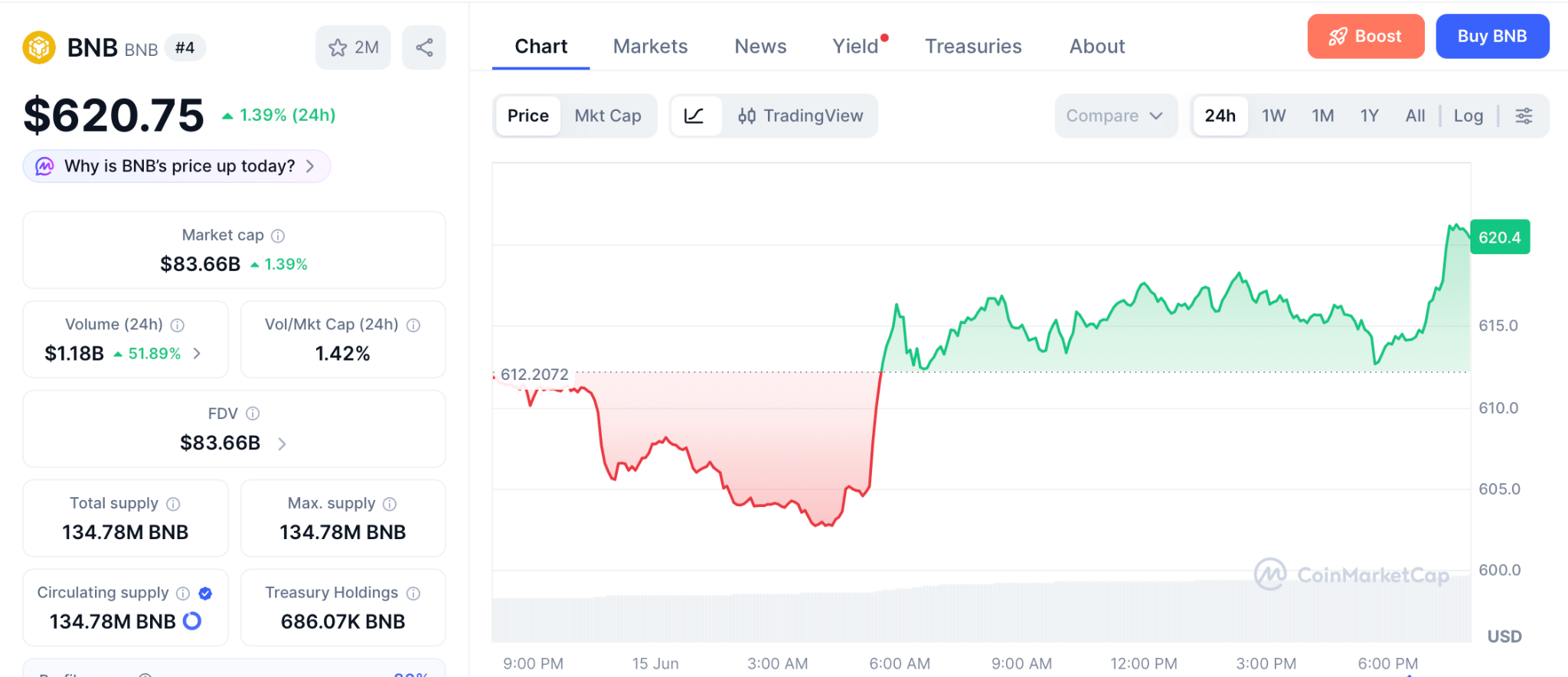
BNB sits 54% below its all-time high of $1,369 with support near $600 and resistance at $660. From $620, the path to $700 gives 11% over months, solid for holders but not the same distance a presale-to-listing event produces.
Cardano (ADA) Price at $0.18 as T. Rowe Price ETF Inclusion Boosts Outlook
Cardano (ADA) sits at $0.18 per CoinMarketCap, recovering 11% in a week from the five-year low of $0.1485 touched on June 6. T. Rowe Price’s new $1.8 trillion crypto ETF featuring ADA received regulatory approval for NYSE Arca listing on June 13.
Support holds at $0.16 with resistance near $0.24. Even a recovery to $0.24 gives 39% from here, a fraction of the distance the presale offers before the listing closes the entry.
Conclusion
Wall Street building on Ethereum proves that institutional capital is not leaving crypto, and Pepeto stands apart with a live exchange and presale pricing that BNB and ADA at their current sizes cannot match.
BNB sat at fractions of a dollar before it produced millionaires, and the wallets that believed early enough still hold those positions as proof of what conviction pays. Pepeto under the same Pepe creator is building that exact outcome for the wallets entering now. Rounds are filling. The listing is getting closer.
And the Pepeto presale price that exists today will not exist the day trading opens. The people reading this right now are either going to be the ones who got in before the listing repriced everything, or the ones who spend the rest of the year asking themselves why they did not act when every signal was pointing in the same direction.
Click To Visit Pepeto Website To Enter The Presale

FAQs
What are the top 3 cryptos to watch in June 2026?
Pepeto leads the top 3 cryptos to watch with $10.25 million raised, a live zero-fee exchange, and projected 100x returns before a Binance listing opens this cycle. BNB holds $620 and ADA recovers to $0.18.
Why is Pepeto considered a top presale as Wall Street enters crypto?
Pepeto is a top presale because its live exchange earns trading revenue as institutional adoption grows, positioning it ahead of speculative tokens. Over $10.25 million raised with 170% APY staking at $0.0000001876 confirms demand before a Binance listing.
Disclaimer: This is a Press Release provided by a third party who is responsible for the content. Please conduct your own research before taking any action based on the content.


Nvidia has raised the stakes in the artificial intelligence infrastructure race with plans to borrow at least $20 billion from debt markets, a move that comes as Bitcoin miners increasingly reposition themselves as AI and high-performance computing providers.
Summary
- Nvidia plans to raise at least $20 billion through a multi-part bond offering to fund AI investments and refinance debt.
- Bitcoin miners are expanding into AI and HPC services, with more than $70 billion in contracts announced across the sector.
- Industry forecasts suggest listed miners could generate up to 70% of revenue from AI by the end of 2026.
According to Bloomberg, Nvidia is preparing a multi-part bond offering worth at least $20 billion to fund AI-related investments and refinance existing debt.
People familiar with the matter told Bloomberg that the chipmaker intends to issue notes across seven maturities ranging from two to 30 years, with the longest-dated bonds expected to price at about 0.9 percentage points above comparable U.S. Treasury securities.
The planned offering arrives as demand for AI infrastructure continues to attract large pools of capital. As the leading supplier of graphics processing units used to train and run large language models, Nvidia occupies a central role in the AI ecosystem, with its spending plans closely watched by investors and technology companies.
Recent expansion efforts have extended beyond the United States. As previously reported by crypto.news, Nvidia announced partnerships in South Korea with SK Hynix, Naver, SK Telecom, Doosan Group, LG Group, and Hyundai Motor Group during a visit by CEO Jensen Huang. According to Nvidia, those agreements cover memory chips, AI data centers, robotics, mobility, and industrial AI systems.
Bitcoin miners pursue AI revenue streams
Growing investment in AI infrastructure has opened new opportunities for Bitcoin mining companies, many of which already control large amounts of power capacity and data center infrastructure.
Companies including HIVE Digital, TeraWulf, Hut 8, and CleanSpark have increasingly promoted AI and high-performance computing services alongside their traditional mining operations.
By repurposing existing facilities and leveraging power agreements originally secured for Bitcoin mining, these firms are seeking revenue sources that are less dependent on cryptocurrency market cycles.
Industry data suggests investors have responded positively to the trend. As reported by crypto.news, while Bitcoin declined roughly 17% during the opening months of 2026, a basket of Bitcoin mining stocks gained more than 50%, with the strongest performers advancing over 70%.
Notably, publicly traded miners have announced more than $70 billion in cumulative AI and high-performance computing contracts. Industry projections referenced by crypto.news suggest listed mining companies could derive as much as 70% of their revenue from AI activities by the end of 2026, up from around 30% today.
Mining margins remain under pressure
Despite growing enthusiasm around AI, many miners continue to face challenges in their core business.
Following Bitcoin’s April 2024 halving, higher mining difficulty and operating expenses have compressed profit margins across the sector.
Some market observers have described current conditions as the harshest margin environment the industry has experienced, prompting miners to reduce leverage, liquidate portions of their Bitcoin holdings, and search for alternative sources of income.
According to data from TheEnergyMag, Bitcoin miners sold more than 15,000 BTC between October and March as companies adjusted to tougher operating conditions.
Recent results from Canaan illustrate those pressures. According to the company’s June operational update, the Nasdaq-listed miner produced 90 BTC during the month and received another 24 BTC from customers. At the same time, Canaan’s first-quarter earnings report projected second-quarter revenue between $35 million and $45 million, well below analyst expectations of roughly $96 million.
Regulatory hurdles have also emerged. As previously reported by crypto.news, Canaan received a second Nasdaq non-compliance notice in January after its share price remained below the exchange’s $1 minimum bid requirement. The company has until July 13, 2026, to regain compliance.
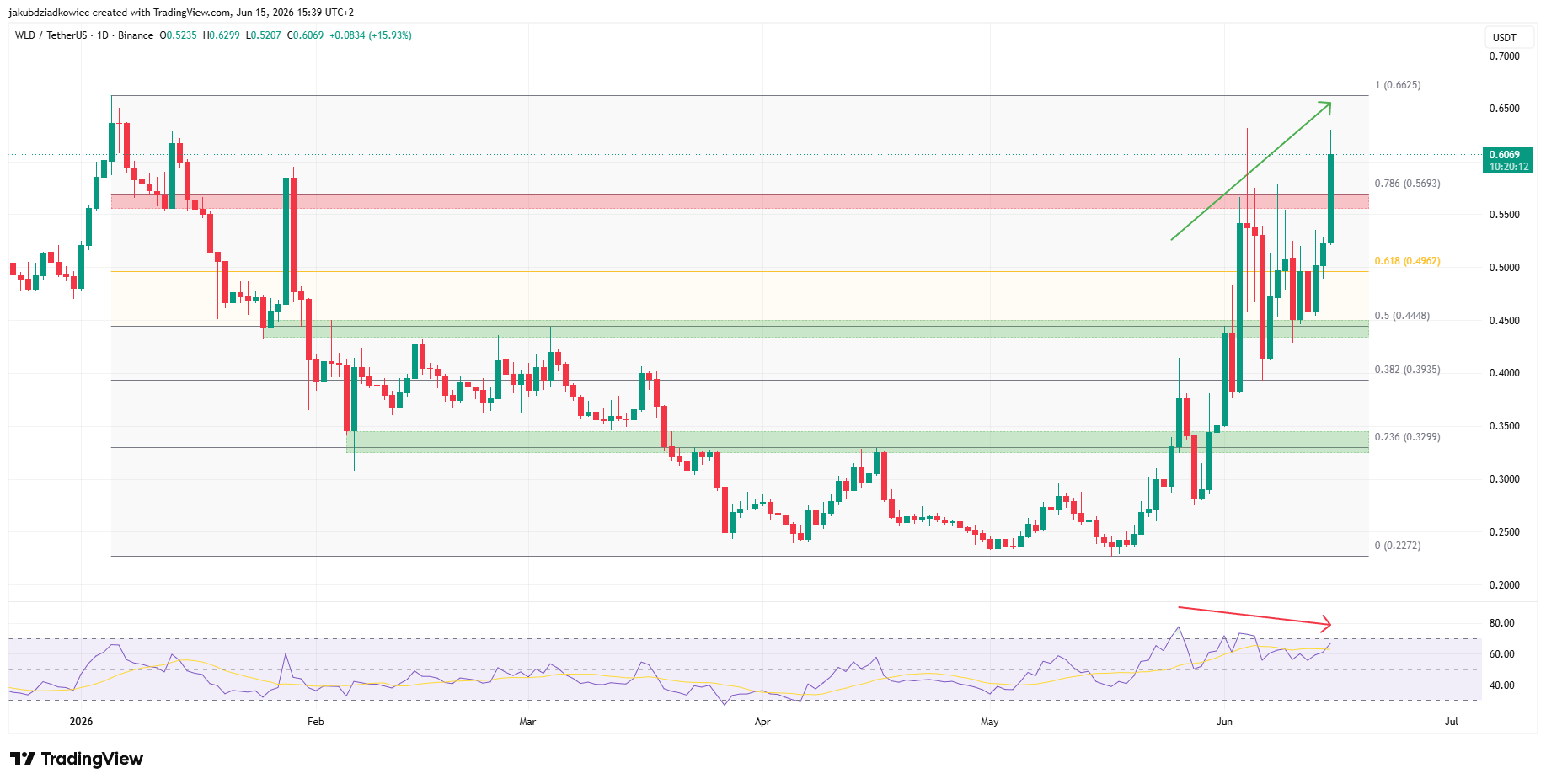
Worldcoin (WLD) jumped 21% on June 15 as Eightco Holdings (ORBS) reinforced its standing as the largest public holder of the token, with 283 million WLD now anchoring its growing digital asset treasury.
The rally lifted WLD to about $0.61, extending its 30-day gain to 154%. Recent disclosures put Eightco’s total treasury near $406 million.
Eightco Doubles Down on Its 283 Million WLD Position
Eightco Holdings reported holding 283,452,700 WLD as of June 10. That stake equals roughly 8.4% of the token’s circulating supply.
It stands as the largest publicly disclosed institutional position in WLD. No other listed company has confirmed a holding of this size.
The firm values the position at about $406 million. Alongside WLD, Eightco holds more than 16,000 ether and a $90 million stake tied to OpenAI.
The Proof of Human Thesis Behind the Buying
Eightco frames its WLD stake as a bet on digital identity. The company cites data showing that non-human activity now drives most web traffic and trading volume.
It positions Worldcoin and its Proof of Human network as the verification layer for that problem. The token, co-founded by OpenAI chief Sam Altman, counts more than 16 million verified users.
Speculation around an OpenAI public listing has added fuel to WLD this month. That narrative has kept demand for the token elevated.
WLD Jumps to $0.66 Swing High
On the daily chart, WLD broke above the 0.786 Fibonacci level near $0.57. The token now targets the prior swing high around $0.66. A clean close above that mark would open room for further upside.

The daily reading carries a warning, however. RSI is printing lower highs while price prints higher highs, a textbook negative divergence. That signal hints at a sharper correction later. The first support sits near $0.45, with deeper support around $0.33.
The hourly chart tells a firmer story. WLD has respected a rising parallel channel since May 26, only to be briefly broken in early June. RSI is holding former resistance as support inside bullish territory, which favors continuation if buyers defend the channel.

Volume rose on the breakout but stayed below early-June peaks. That gap suggests the move needs stronger participation to sustain the rally.
The setup leaves WLD balanced between a catalyst-driven breakout and clear technical warning signs. Holding $0.45 keeps the bullish case alive, while a drop below $0.33 would suggest the rally has stalled.
The post Worldcoin Jumps 20% After Treasury Reveals Massive Stake in WLD appeared first on BeInCrypto.
Crypto World
Ethereum News: Last Chance to Buy Ethereum Under $2K? ETH USD Powers Up After Hormuz Peace Deal
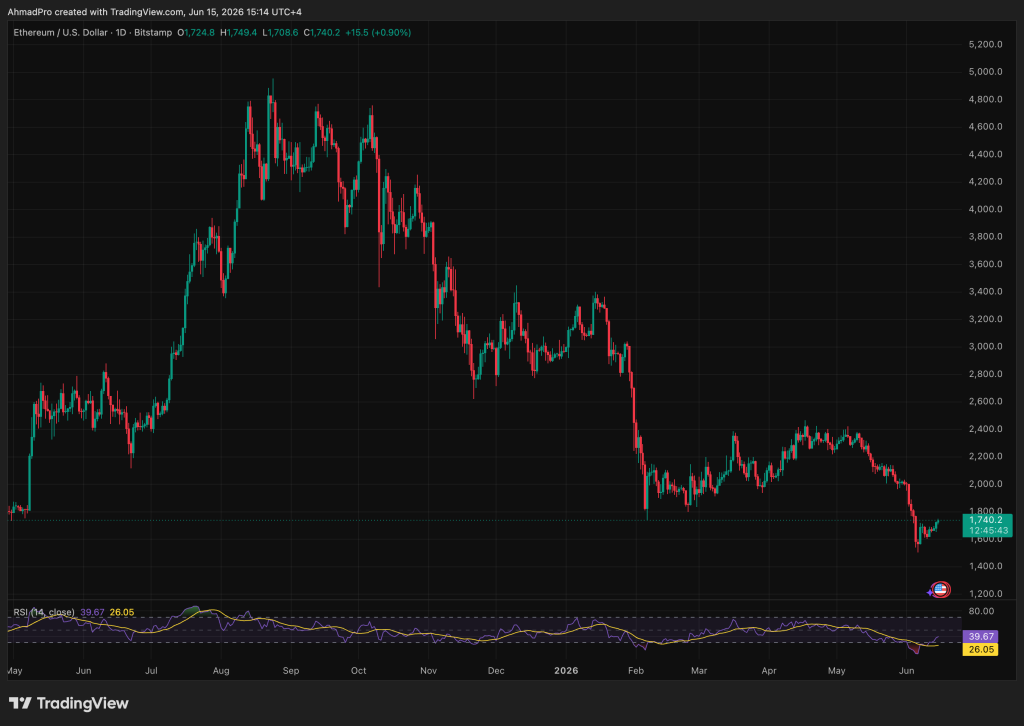
In the latest Ethereum News, Ethereum ETH Price is trading at $1,739 up 4% in 24 hours, as risk assets catch a bid following the Hormuz peace deal, and the chart is setting up a move traders haven’t seen in years. The question isn’t whether ETH bounces.
It’s whether this is the last entry point before $2,000 becomes a distant memory. One analyst just called ETH the most oversold it has ever been in its history, a claim that deserves more than a scroll past.
On June 14, 2026, analyst Ash Crypto flagged that ETH’s monthly RSI has fallen below readings recorded at the 2018 and 2022 bear market bottoms, both of which preceded multi-hundred-percent recoveries.
ETH is down nearly 70% from its all-time high and trading at price levels last seen four years ago. The asset bounced from a swing low of $1,603 and has since pushed toward $1,731, then pulled back to consolidate above the 23.6% Fibonacci retracement of that range.
The Hormuz peace deal injected fresh macro tailwinds across risk markets, with Bitcoin reclaiming $65,000 and dragging large-cap alts along with it. That broader backdrop matters; ETH rarely stages a sustained recovery without BTC providing the lift.
Ethereum News: Can ETH Price Hit $1,850 This Week?
ETH is holding above the $1,700 pivot after clearing what Bitget describes as a key resistance level, signaling a noticeable improvement in market outlook.
Volume backs the move. 24-hour trading sits at $26 billion against a $210 billion market cap, suggesting genuine participation rather than thin-air price action.
The technical structure is range-bound but coiling. Near-term support sits at $1,665 and $1,640, with resistance stacking at $1,690, $1,701, and $1,715. CoinCodex projects a potential high near $1,845 within days.
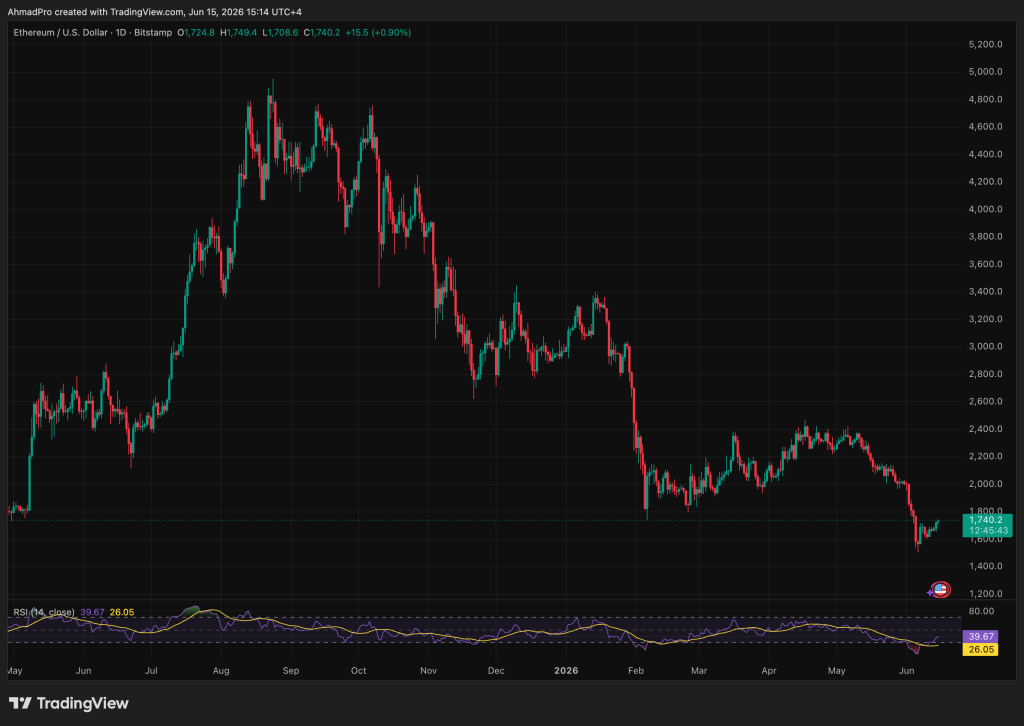
ETH holding $1,700 and clearing $1,734 opens the door to $1,923 and $2,133 in sequence. Consolidation between $1,665 and $1,780 through the week with a gradual grind toward $1,845 is the base case if BTC sentiment holds steady.
A daily close below $1,603 voids the bounce thesis entirely and reopens $1,585 and potentially lower.
The structural argument comes from RSI. Monthly extremes this deep have historically preceded violent recoveries rather than continued bleed. That does not guarantee the bottom is in. But the asymmetry is harder to ignore than usual.
LiquidChain Could be The Next Big Chain Layer 3 And Here is Why
ETH at $1,720 is compelling on historical metrics, but even a move to $2,022 represents roughly 17% upside from a $200+ billion market cap asset.
Significant in absolute terms; modest relative to where early-stage capital has historically multiplied. ETH’s market cap dynamics underscore exactly why some rotation toward smaller, pre-launch projects makes tactical sense during macro recovery windows.
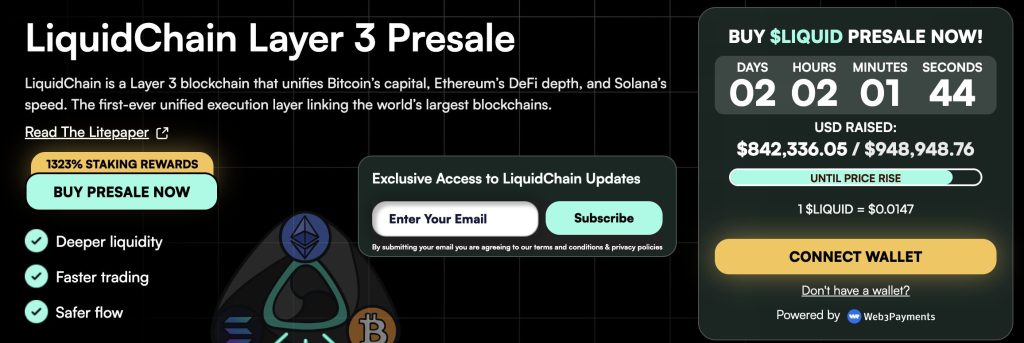
LiquidChain ($LIQUID) is an L3 infrastructure project building what it calls the Cross-Chain Liquidity Layer, fusing Bitcoin, Ethereum, and Solana liquidity into a single execution environment.
The pitch is structural rather than speculative: a Unified Liquidity Layer with Single-Step Execution and Verifiable Settlement means developers deploy once and access all three ecosystems without bridging friction.
The presale is currently priced at $0.0147 with $841,128.18 raised to date. Early-stage infrastructure plays at this raise level carry real risk — liquidity, execution, and adoption are all unproven, but the entry price reflects that risk explicitly.
Research LiquidChain here before the presale price moves.
The post Ethereum News: Last Chance to Buy Ethereum Under $2K? ETH USD Powers Up After Hormuz Peace Deal appeared first on Cryptonews.

The U.S. Commodity Futures Trading Commission (CFTC) has named Donald Battle as its new chief data innovation officer, a role focused on data strategy and advanced analytics for the agency. The appointment underscores how regulators are increasingly turning to blockchain-specific expertise and modern data tools to support surveillance, investigations, and enforcement across digital-asset markets.
In a notice dated Monday, CFTC Chair Michael Selig said the move reflects the commission’s growing emphasis on data science capabilities, including blockchain forensics, programming interfaces, and the use of cutting-edge AI solutions. Battle’s background spans both regulatory and enforcement-related work in the crypto space, positioning the CFTC to deepen its technical capacity as policy debates over digital asset market structure intensify.
Key takeaways
- The CFTC appointed Donald Battle as chief data innovation officer, with stated emphasis on blockchain forensics and advanced analytics.
- Battle previously advised the SEC’s crypto task force and earlier served as a blockchain data adviser to the CFTC, according to Selig’s description of his experience.
- The move aligns with ongoing U.S. efforts to redefine digital asset regulatory responsibilities through proposals such as the CLARITY Act.
- Coinciding with enforcement and jurisdiction disputes, the appointment may support the CFTC’s approach to digital-asset surveillance and market oversight.
- The CFTC is also progressing a separate rulemaking effort that could clarify how sports event contracts are regulated.
Why the CFTC’s data leadership change matters
Regulatory technology is becoming a core capability for U.S. financial oversight, particularly where crypto markets involve cross-border activity, rapid product innovation, and complex on-chain behavior. By creating a senior post dedicated to data innovation—and filling it with someone described as having blockchain forensics expertise—the CFTC signals a shift toward more technically specialized internal tooling.
This matters for compliance and enforcement because the effectiveness of investigations often depends on the ability to reliably map relationships between entities, transactions, and trading activity. Blockchain forensics skills and the capacity to integrate programming interfaces and advanced analytics can improve how regulators identify risk patterns, substantiate cases, and maintain audit-ready documentation.
At the same time, institutional readers should note that a leadership change does not itself resolve jurisdictional disagreements or the underlying question of how specific crypto-related activities should be classified under U.S. law. It does, however, strengthen the infrastructure regulators rely on when they seek to apply existing frameworks to evolving markets.
Battle’s background and the signal to U.S. crypto enforcement capacity
According to the CFTC notice, Selig appointed Donald Battle as chief data innovation officer. Selig described Battle’s experience as spanning “data science, blockchain forensics, programming interfaces, and cutting-edge AI solutions.”
The notice also links Battle’s previous work to both sides of the U.S. crypto regulatory landscape. Battle has been characterized as an adviser to the SEC’s crypto task force, which he joined in January 2025 in connection with the incoming Trump administration. The same CFTC announcement describes prior service as a blockchain data adviser for the CFTC and as a crypto enforcement specialist within the U.S. Treasury’s Financial Crimes Enforcement Network (FinCEN).
From a regulatory coordination perspective, the appointment is notable because it bridges key institutions involved in crypto oversight. The SEC and CFTC frequently address different—but overlapping—areas of digital asset regulation. A data-focused leader with experience across both agencies can potentially support internal consistency in how data is collected, analyzed, and presented to enforcement teams.
That said, unresolved policy questions remain. The U.S. digital asset regulatory architecture is still contested, and product classification disputes—such as whether certain offerings resemble gambling, sports betting, or regulated derivatives—are likely to keep driving litigation and rulemaking.
Jurisdiction debates and the broader policy context
The CFTC appointment arrives during a period when Congress is examining legislative changes intended to clarify digital asset market structure. Selig’s comments framed the hiring as part of an agency effort to better address crypto regulation and enforcement while policy discussions continue around a digital asset market structure bill, the CLARITY Act.
Coinbase and other large market participants are not mentioned in the notice, but the institutional relevance is clear: how the CFTC and SEC draw jurisdictional lines affects licensing expectations, compliance planning, and the operational design of trading venues and offerings.
Within this broader context, the CFTC has also faced significant legal challenges connected to its approach to jurisdiction over certain market activities. Cointelegraph has reported that the CFTC’s position on excluding jurisdiction for prediction market platforms has contributed to lawsuits involving state-level authorities. Those disputes reflect how rapidly courts and regulators are being asked to interpret longstanding legal concepts in relation to new market structures.
Additionally, the CFTC chair remains the only commissioner at the agency at the time of the reporting, a detail that can affect institutional capacity and the pace of rulemaking. While leadership structure alone does not determine legal outcomes, it can influence how quickly the agency advances guidance and how regulators prioritize enforcement and compliance initiatives.
Public comment begins on CFTC’s proposed sports event contracts framework
Alongside the data innovation appointment, the CFTC has advanced a related rulemaking effort that could affect how certain crypto-adjacent sports event contracts are treated under U.S. law. The CFTC released a proposed rule intended to distinguish sports event contracts offered on platforms such as Kalshi and Polymarket from what the agency described as “games of random chance,” a framing commonly associated with gambling.
The CFTC said the public has 45 days to comment on the draft rule. If finalized, the proposal may shape how the agency addresses regulation of sports event contracts across both state and federal levels—particularly in cases where platforms face scrutiny under gambling-related laws.
For regulated entities and compliance teams, this is a practical development because it bears directly on classification risk: whether a product is treated as a regulated financial instrument, and which regulator’s framework applies. It can also influence how market operators design offerings, disclosures, and custody or settlement processes to satisfy expected regulatory standards.
The uncertainty that typically accompanies proposed rules should be recognized as well. Comments received during the consultation period can lead to revisions, and even finalized rules may face legal challenges depending on how courts interpret statutory authority and the boundaries between gambling and regulated markets.
Closing perspective
The CFTC’s hiring of a data innovation leader with blockchain forensics expertise signals a strengthening of the agency’s technical capabilities as it pursues crypto regulation and enforcement. In parallel, the sports event contracts proposal highlights the regulator’s continued focus on classification questions that have already driven litigation. The next steps—public comments, potential rule revisions, and how courts respond to ongoing jurisdiction disputes—will likely determine how these developments translate into operational compliance expectations.
Crypto World
XRP Price Analysis: Ripple Token Eyes 10% Gain with Flashing Bullish Pattern and ETF Inflows

XRP price posts 9% moves today from low $1.1 to $1.24, with a prediction that it could go even higher. Two independent tailwinds are converging at the same time.
One, a textbook ascending triangle is pressing against horizontal resistance on the 4-hour chart. Two consecutive weeks of positive XRP Spot ETF inflows. The setup has a defined target; it just needs the trigger to fire.
From the latest ETF flow data, XRP Spot ETFs recorded a net inflow of $10.68 million for the week ending June 12, 2026. This is the second consecutive positive week, pushing cumulative net inflows to $1.44 billion and total AUM to $978.86 million.
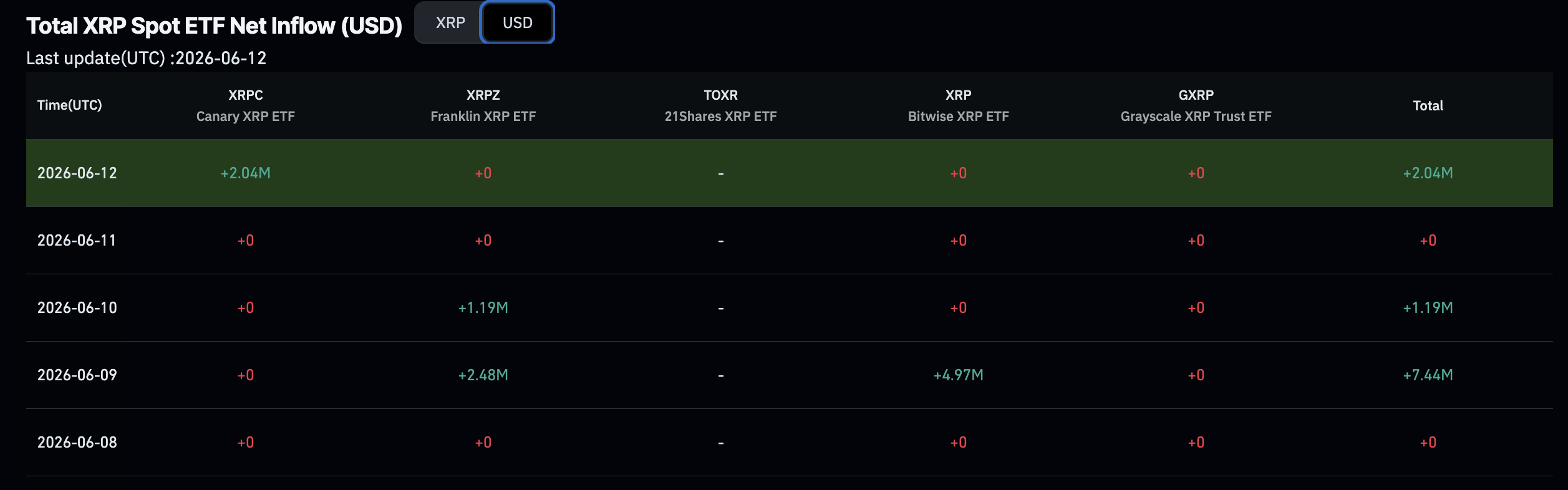
Why do the numbers matter? The $1 billion threshold tends to generate incremental media coverage in traditional finance channels, which historically pulls in additional allocators who benchmark product credibility by AUM size.
The macro backdrop, with improved risk sentiment following the US-Iran peace deal, has given the entire altcoin complex a lift, but the ETF data and chart structure suggest XRP’s move has more substance than a pure sentiment trade.
Ripple’s business side is also generating adoption signals worth tracking: the OpenPayd integration for Ripple Payments and ongoing RLUSD mint/burn flows both point to real settlement utility expanding. This, over time, will likely anchor demand more durably.
—
 Nice! Ripple partner OpenPayd confirms Nasdaq listing plans (OP): a decent reminder that the Ripple partnership wasn't just a one-off headline. Fiat rails, $RLUSD support, and cross-border payments still suggest a stack where an OP public listing could add more visibility
  pic.twitter.com/OJUTpnMm3X
 ChartNerd
  (@ChartNerdTA) June 1, 2026
Discover: The Best Crypto to Diversify Your Portfolio
Can XRP Price Hit $1.32 This Week?
XRP is currently hovering in the $1.25 range. On the 4-hour chart, the ascending triangle has been forming since early June, a series of higher lows compressing against horizontal resistance in the $1.18–$1.19 zone.
Price recently found support at $1.12, coinciding with the 50-period moving average, before rebounding toward the upper boundary. That moving average defense is the key structural signal: buyers are defending dips systematically, not reactively.

The measured move target on the ascending triangle breakout resolves near $1.32, still more than 5% from the current resistance. Our ETF-linked XRP price analysis has been tracking this structure for several sessions, with the $1.20 level identified as key downside support and $1.45–$1.50 as the next major resistance band if the initial breakout extends.
Discover: The Best Token Presales
LiquidChain Targets Early-Mover Upside as XRP Tests Key Levels
XRP is breaking out and in a reasonable trade after the triangle broke. But even a clean 10% move on an asset with a $70+ billion market cap is, structurally, a different risk-reward profile than catching a pre-breakout infrastructure layer before the market prices in the narrative.
Traders watching XRP’s ETF-driven institutional momentum might find it worth cross-referencing with where early-stage capital is currently pricing cross-chain infrastructure plays.
LiquidChain is always cooking something new. — LiquidChain (@getliquidchain) June 15, 2026
This is what happens when a great idea meets innovation.  pic.twitter.com/qYbth0impA
LiquidChain ($LIQUID) is a Layer 3 infrastructure project positioning itself as the cross-chain liquidity layer, fusing Bitcoin, Ethereum, and Solana liquidity into a single execution environment. The architecture centers on a Unified Liquidity Layer with single-step execution, verifiable settlement, and a deploy-once model that lets developers access all three ecosystems without rebuilding per chain.
The presale is currently priced at $0.0147 per $LIQUID token, with $840K raised to date.
Research LiquidChain’s presale structure before the current round closes.
The post XRP Price Analysis: Ripple Token Eyes 10% Gain with Flashing Bullish Pattern and ETF Inflows appeared first on Cryptonews.
Key Highlights
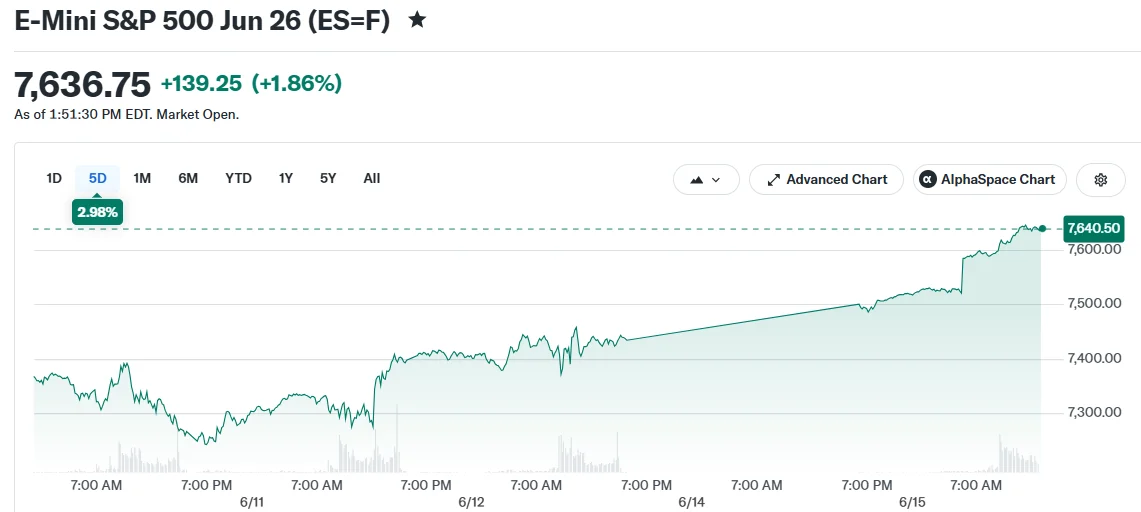
- Major U.S. indices rallied Monday with the Nasdaq climbing nearly 3%, the S&P 500 advancing 1.8%, and the Dow gaining 1.3% following ceasefire confirmation
- The peace agreement targets reopening the Strait of Hormuz, a waterway responsible for approximately 20% of global oil transport
- Brent crude tumbled close to 5% to approximately $83 per barrel as supply disruption concerns eased
- SpaceX stock climbed more than 8% Monday following Friday’s historic public market debut that valued the company over $2 trillion
- Federal Reserve policy decision anticipated Wednesday, with markets assigning a 98% probability of unchanged interest rates
U.S. equity markets delivered impressive gains Monday following confirmation from Washington and Tehran of a preliminary ceasefire agreement designed to conclude their military confrontation and restore access to crucial Middle Eastern oil transit routes.
The tech-heavy Nasdaq Composite commanded the rally with a jump approaching 3%. The broader S&P 500 index advanced 1.8% while the Dow Jones Industrial Average posted a 1.3% increase.
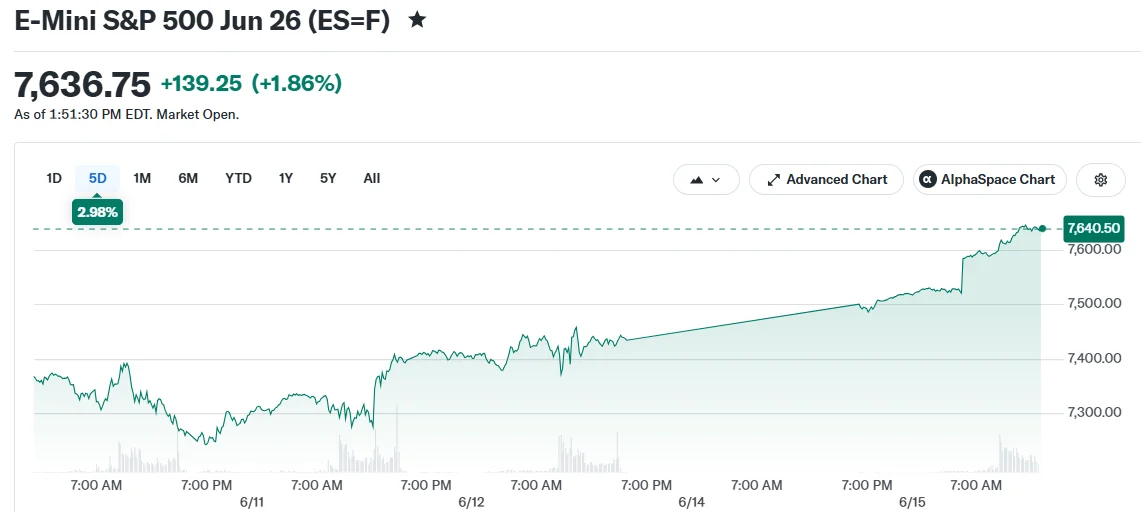
President Trump revealed the ceasefire arrangement late Sunday evening via Truth Social, characterizing the agreement as “complete.” An official signing ceremony has been scheduled for Friday in Switzerland.
The diplomatic breakthrough arrives after more than three months of heightened tensions between Washington and Tehran that unsettled financial markets worldwide and sparked concerns regarding potential disruptions to petroleum supplies.
Critical Oil Transit Corridor Poised to Resume Operations
The Strait of Hormuz, a strategically vital waterway situated along Iran’s southern coastline, may resume oil tanker traffic as soon as this week. President Trump attributed the implementation delay to necessary mine-clearing procedures.
Approximately one-fifth of global oil shipments traveled through this narrow passage before hostilities commenced in late February. Industry experts anticipate several months before shipping operations return to pre-conflict levels.
Oil prices experienced substantial declines following the announcement. Brent crude plummeted nearly 5% to settle around $83 per barrel. West Texas Intermediate similarly declined over 5% while maintaining levels above $80.
Pakistani Prime Minister Shehbaz Sharif validated the agreement, stating both countries had proclaimed “the immediate and permanent termination of military operations on all fronts,” extending to Lebanon.
Tehran has indicated the arrangement won’t become operational until formal signatures are affixed. Complete terms remain undisclosed by either party, prompting continued caution among shipping operators.
Precious metal prices increased while the U.S. dollar weakened after the peace deal disclosure. Treasury yields retreated, providing additional momentum to stock markets.
Central Bank Decision Takes Center Stage
Market participants now shift focus toward the Federal Reserve’s two-day policy deliberations, scheduled to conclude Wednesday.
Financial markets are pricing in better than 98% odds that policymakers maintain current interest rate levels, based on CME FedWatch Tool indicators. Nevertheless, certain economists suggest the Fed might eliminate accommodative language from its policy statement.
Newly appointed Fed Chair Kevin Warsh confronts competing pressures from accelerating inflation metrics and President Trump’s demands for substantial rate reductions.
SpaceX maintained its position as a focal point for Wall Street observers. Shares climbed over 8% Monday after the company’s Friday public market debut saw shares surge more than 19%, propelling market capitalization beyond $2 trillion.
Fox Corporation shares tumbled 15% following disclosure of a $22 billion acquisition proposal for Roku. Roku stock dipped 1% Monday after recording a 20% gain Friday.
Both the New York Stock Exchange and Nasdaq will observe market closures Friday for the Juneteenth holiday.
Ripple’s (XRP) Latest Rally Is Being Driven by a Surprising Exchange Trend

De Bruyne and Salah take centre stage in epic Belgium vs Egypt clash | FIFA World Cup 2026

Huawei’s HarmonyOS 7 brings familiar visuals and a performance boost

BloFin War of Whales 2026 Grand Prix opens registration for $5M trading championship

Blockchain.com files with SEC for U.S. IPO

Israel says it has killed new Hamas military leader in Gaza City airstrikes

Why SpaceX seems like a financial nightmare #spacex #elonmusk #money #finance #business #shorts

Timing #bitcoin #crypto #blockchain #cryptocurrency #money #ethereum #trending #solana #ai #news

Are money sheets legal to cut and spend?
-

 Business1 day ago
No Jackpot Winner as $257 Million Prize Rolls Over to $269 Million Monday Draw
-

 Crypto World4 days ago
Oppenheimer backs SpaceX as $70 billion retail frenzy builds
-

 Crypto World4 days ago
Markets Rally as SpaceX IPO Looms Amid Iran Tensions and Inflation Surge
-

 Fashion3 days ago
Weekend Open Thread: Tuckernuck – Corporette.com
-
Crypto World1 day ago
Zimbabwe Requires Crypto Businesses to Register Annually Under New FIU Regulations
-

 Entertainment7 days ago
The Ryan Gosling True Crime Thriller On Netflix That Gets Even Stranger, Stream It Now
-
 Sports6 days ago
Bangladesh beat Australia after 20 years in ODIs, register only their second win over six-time world champions | Cricket News
-

 Tech3 days ago
NanoClaw integrates JFrog registries to secure AI agent downloads
-

 Crypto World3 days ago
Bitget enters Argentina’s regulated crypto market through PSAV registration
-

 Tech3 days ago
This Week In Security: Microsoft On Microsoft, Register Your Domains, Linux On ARM, And FreeBSD Joins The File Cache Club
-
 Tech4 days ago
Dutton Ranch star claims they ‘didn’t see any disruption’ on set following Chad Feehan’s exit from Yellowstone spinoff fueled by Taylor Sheridan clash rumors
-

 Politics4 days ago
Politics Home | Healey Resignation Is “Colossal Failure Of Government”, Says Former Labour Defence Secretary
-

 NewsBeat4 days ago
El Nino has formed in the Pacific and could set records, forecasters say
-

 Tech6 days ago
‘This is Seattle’s position on AI’: City Council votes unanimously to pause big new data centers
-
 Entertainment4 days ago
Donnie Wahlberg & More Heat Up Las Vegas at Circa’s Barry’s Downtown Prime
-

 Business6 days ago
Thailand Ranks Second Worldwide for AI Adoption Growth, Microsoft Reports
-

 Sports5 days ago
First Time Since 1971: Australia Register Historic Low In ODI Cricket
-
 Tech4 days ago
Opendoor Ends India Operations, Fueling a Bigger Conversation About AI and Outsourcing
-

 Politics4 days ago
Belfast burns, while Met chief points finger at Iran and Russia
-

 NewsBeat3 days ago
FBI searches office of Ohio voter registration group
You must be logged in to post a comment Login