
Crypto World
Does Bitcoin’s Rally Mean We Haven’t Wasted Our Lives in Crypto?

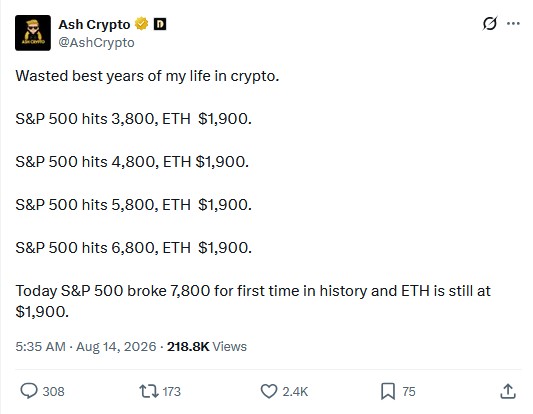
Sentiment in crypto has dived lower than a snailfish in the Mariana Trench in recent months.
Miners are capitulating to AI, cold wallets are getting exploited, and you can hardly fire up LinkedIn without reading another message from a newly unemployed crypto journalist searching for new opportunities. Even for an industry that’s endured nation-state bans, exchange blowups, and years of regulatory pressure, morale has rarely felt this low.
With business models failing and public interest dropping, many long-term crypto fans have begun to question whether we’ve all wasted a decade of our lives on a pipe dream.
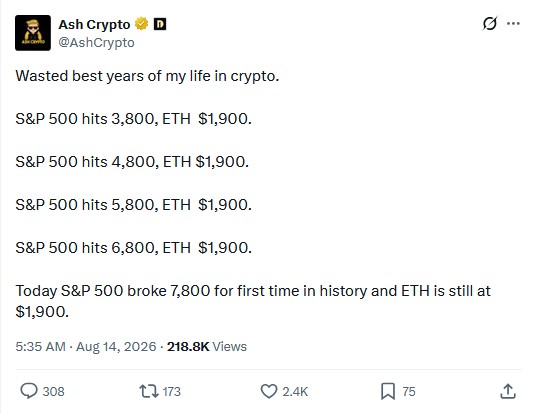
Source: Ash Crypto
Until the price went up, that is.
Bitcoin has just seen its best August in years with a 26% return, while Ethereum gained 34%. President Trump even sang the praises of a decentralized offshore perpetual futures venue at the White House. Crypto’s finally getting interesting again.
But a short-term price rise doesn’t mean all our dreams have come true. For anyone who spent years advocating for sovereign F-you money outside the control of the state and centralized entities, a custodial ETF is not exactly a version of BTC that sticks it to the man.
And there’s another problem with calling this a victory lap: many of the companies that helped build crypto’s foundations are no longer around to enjoy the latest pump.
Take BitMEX, one of the industry’s first Bitcoin futures exchanges that pioneered the perpetual swap and 100x leverage for degens. It’s shutting down operations in September after 11 years.
Former chief executive Stephan Lutz tells Magazine that BitMEX was a victim of its own success.
“Every legitimate crypto exchange is using the perpetual swap… every legitimate crypto exchange uses the funding mechanism to bring longs and shorts together that the founders invented originally… That isn’t going away… It’s just not a differentiating factor anymore.”
So what if crypto won — just not in the way we thought it would?
Crypto’s impact means it wasn’t a waste of time
Lutz doesn’t think crypto can simply disappear anymore because the technology has become too deeply embedded in traditional finance to be unwound.
“From my point of view, we passed the point of no return,” he says.
Utkarsh Ahuja, founder of Moon Pursuit Capital, agrees that crypto proponents have not wasted their lives, and points to the industry’s impact on payment rails, settlement and tokenization.
Stablecoins, he says, can have a “very, very lasting impact” as they become integrated into financial payment infrastructure, and “you can literally tokenize anything.”
Related: 10 weirdest things ever tokenized… including farts
He points to crypto’s spillover into energy, healthcare and AI, arguing that the technology is being widely used beyond the industry that created it.
Decentralized finance has also made a meaningful impact on the world and is now closer to infrastructure, than an experiment. Wanja Oberhof, chief executive of Subsquid Labs, tells Magazine:
“DeFi built the first financial system where you don’t have to trust the operator’s word: you can verify the ledger yourself, in real time, down to every transaction.”
Settlement happens in minutes rather than days, he says, while markets run 24/7 and lending protocols can clear billions transparently:
“No bank consortium ever shipped anything like it. DeFi removed the intermediary and kept the market.”
But while DeFi’s infrastructure has greatly improved, Oberhof concedes the industry “over-promised on timelines and under-delivered on user experience.”
He says the real win will come when the technology “disappears into products people use without thinking about it.”
Institutions are adopting blockchain technology like crazy, and tokenized funds, stablecoins and blockchain-based settlement are no longer ideas confined to the hallways of crypto conferences.
But crypto isn’t so much replacing the financial system as being absorbed by it.
The crypto industry’s success is a key reason it no longer feels as exciting or impactful. The more TradFi becomes involved, the more boring crypto seems, especially when compared to the days when the Long Island Iced Tea Corp changed its name to Long Blockchain Corp back in December 2017 and the stock price surged 500%. (It was delisted two months later for misleading the market).
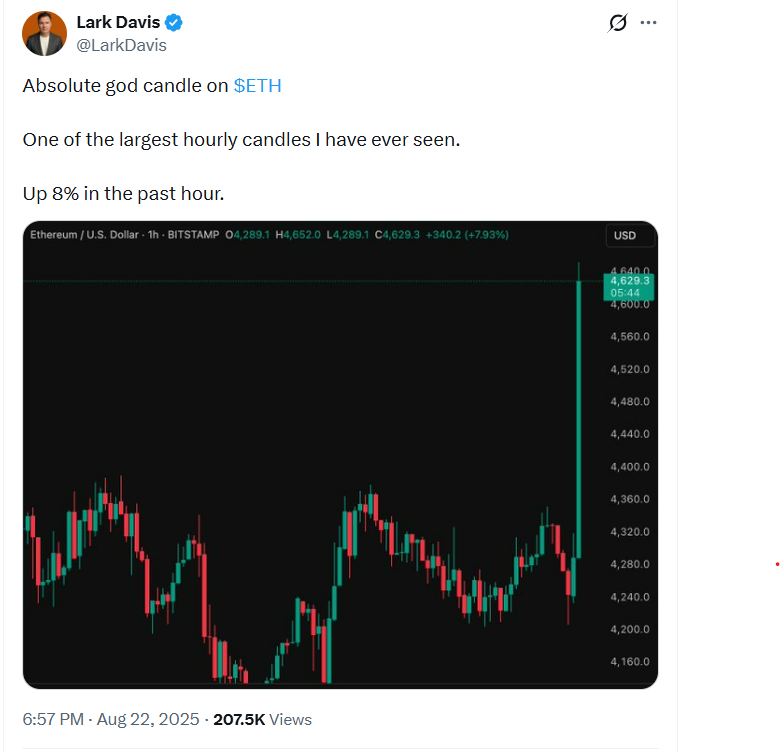
Ether printed a God candle on Aug. 22. Source: Lark Davis
Regulation has also made crypto much more legitimate but duller at the same time.
The EU has implemented its Markets in Crypto Assets (MiCA). The US has gone from treating crypto largely as a regulatory headache to building a framework around it. Senators may even pass the CLARITY act one day.
What did we lose along the way?
Despite increasing legitimacy, the crypto industry has failed to deliver on many things it promised. Dentacoin failed to revolutionize the dental industry. Bitcoin did not stop all wars. Ethereum is not the default home for global finance (at least, not yet.) Ahuja says:
“Has it delivered enough? Not yet, in my opinion. But has it changed our perception completely? Yes, it has.”
The audience has changed too.
Crypto is no longer some fringe hobby for a tiny band of libertarian cypherpunks and meme-weilding frog armies on Crypto Twitter.
Around one in five American adults, or 19%, now says they have invested in, traded or used cryptocurrency, according to Pew Research Center.
Broader ownership hasn’t made crypto easier to use. In fact, the explosion of assets and platforms has made the market harder to navigate. Users have to contemplate multiple networks, wallets, exchanges, bridges and onramps, creating the extra layers of friction that crypto was supposed to eliminate.
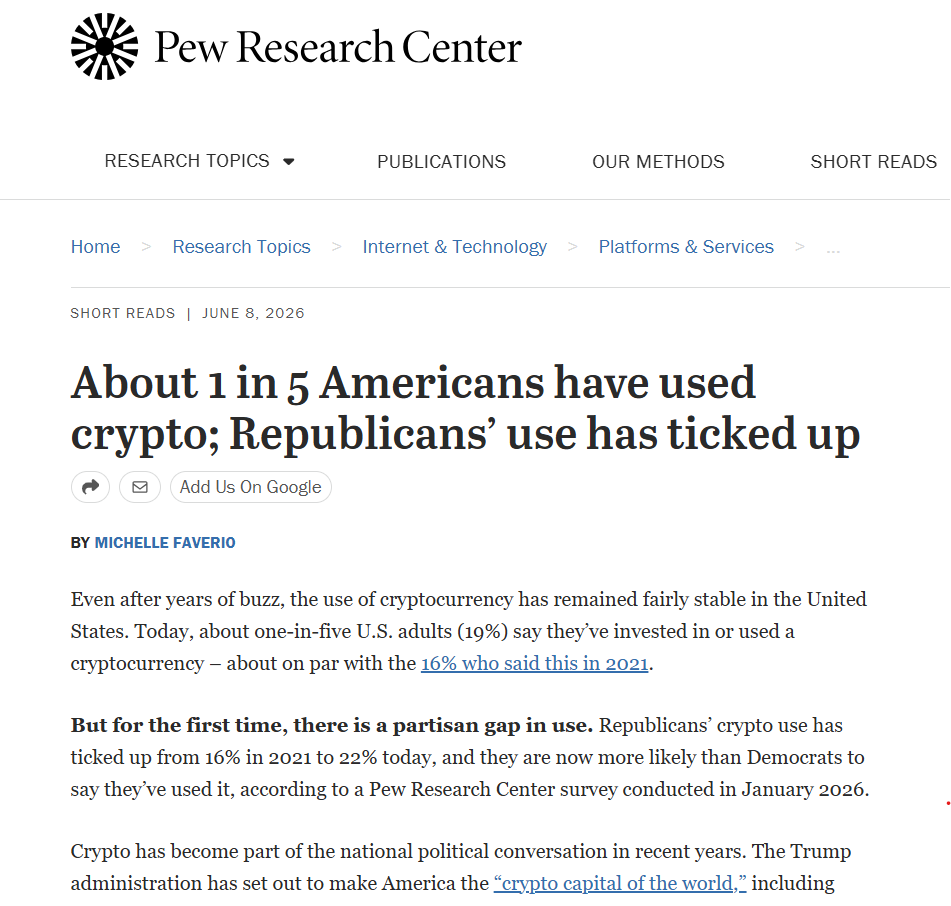
One in five Americans has used crypto. Source: Pew Research Center
Ahuja points to another irony: an asset class designed to be borderless is increasingly being shaped by national regulatory regimes, making it harder to move seamlessly across jurisdictions.
One Dubai-based crypto user Magazine spoke with receives their salary every month into a large centralized crypto exchange. They say they lose money when converting USDT into local currency, and then have to pay a flat 75 AED fee (roughly 20 USD) just to withdraw. They say:
“I wish I could receive a bank transfer instead.”
And then there’s the most basic promise of all: self-custody, arguably the biggest paradox the industry faces because the more valuable Bitcoin becomes, the more dangerous it is to hold your own private keys — whether for fear of being bludgeoned to death by a wrench or having your cold wallet exploited by an AI agent.
Arguably it’s this failure to deliver the future crypto once promised, that has made the bear market shutdowns and closures hit even harder.
Related: MiCA is coming for DeFi vaults, but regulation will be difficult
Layoffs are rampant throughout the industry. Projects that survived even the grizzly 2022 bear market have been shutting down this year, or being forced to reinvent themselves as the money and users pivot to AI — which is newer but has seen adoption crypto can only dream of so far.
Lutz doesn’t see BitMEX’s fate as evidence that the technology failed; quite the opposite: the technology worked so well that everyone copied it, and the industry has moved from a race to invent the infrastructure to a brutal fight over market share. He says:
“Now the differentiating factor is your aggressiveness in the competition, which is a completely different game. Some play that very well, others don’t.”
Perhaps the companies and projects that built crypto were never going to be the ones that ultimately benefited most from its adoption.
So have we wasted our lives?
Well, the purists may not have gotten their sovereign money, the early companies may not have survived, and the average user may still be waiting to catch a break.
But the technology is here, the infrastructure is becoming the rails, and the 20% daily candles sure are fun to watch.
And one thing that’s always been true, when the price starts going up, the narratives change quickly to explain why it may keep going up forever.
Magazine: Do the Coldcard attacks mean all hardware wallets are now insecure?
Cointelegraph publishes long-form journalism, analysis and narrative reporting produced by Cointelegraph’s in-house editorial team with subject-matter expertise. All articles are edited and reviewed by Cointelegraph editors in line with our editorial standards. Some articles contain affiliate links, from which Cointelegraph may earn a commission. These relationships do not influence which products we review or our editorial conclusions. Content published in here does not constitute financial, legal or investment advice. Readers should conduct their own research and consult qualified professionals where appropriate. Cointelegraph maintains full editorial independence.

Surprisingly or not, Arbitrum’s ARB leads the entire top 100 club today (September 1) as the strongest performer.
Some analysts expect further gains ahead, but a certain technical indicator suggests a short-term correction is also quite possible.
The 3-Month Peak
ARB experienced a sudden 27% daily increase and currently trades at around $0.11 (per CoinGecko), the highest point since late May. Its market capitalization surpassed $730 million, making it the 86th-largest cryptocurrency.

The double-digit increase is rather surprising given the slight overall decline in the market over the past day, and the most likely catalyst fueling the rally appears to be Robinhood.
Arbitrum’s team revealed that Robinhood Chain generated more than $1 million in fees in the last 24 hours. “As a dedicated Arbitrum chain, 10% of the protocol revenue flows back to the Arbitrum ecosystem,” they added.
According to X user Master of Crypto, ARB is nearing the end of a long consolidation after trading inside a clear symmetrical triangle, with resistance around $0.1495 and $0.1729.
“If ARB breaks above the triangle, the next move could target $0.1495 first, followed by $0.1729. A clean breakout could signal the start of a bigger trend move,” the analyst predicted.
For their part, X user OxNeena claimed that ARB is breaking out. In their view, holding above the key support just above $0.08 could open the door to further gains toward $0.12, $0.14, and $0.16.
Pullback Ahead?
Despite the aforementioned pump, ARB remains 98% below its all-time high. The token began trading in the spring of 2023 when its price briefly skyrocketed above $5.
The asset’s Relative Strength Index (RSI) suggests that narrowing the gap to the historical peak may have to wait a bit longer. The technical analysis tool, which measures the speed and magnitude of recent price changes, ranges from 0 to 100, with anything above 70 signaling a potential move south due to overbought conditions.
On the other hand, ratios below 30 hint that ARB has entered oversold territory and could be due for a resurgence. Currently, the RSI stands at around 73, reinforcing the bearish perspective.

The post Arbitrum (ARB) Pumps 27% Daily: The Start of a Bigger Move? appeared first on CryptoPotato.
Lumentum (LITE) stock scaled an almost vertical wall in the heyday of the artificial intelligence trade in 2025 and early 2026. As investors rotated out of tech names over this summer, this star among data center infrastructure names passed a technical test by finding support at its 200-day moving average while carving a base. Other metrics also suffered minimal damage,…
Copyright ©2026 Investor’s Business Daily, LLC. All rights reserved. 87990cbe856818d5eddac44c7b1cdeb8


Arch Lending now accepts PAX Gold and Tether Gold as collateral, opening credit access to a class of investors that have largely sat outside digital-asset lending.
As gold’s recent run higher has renewed interest in the metal as a store of value, Arch Lending, the alternative-asset lending platform operated by ChainFi, Inc, today began accepting PAX Gold (PAXG) and Tether Gold (XAUT) as loan collateral at starting loan-to-value ratios of up to 75%.
Borrowing Against Gold Is Already Happening
Demand for credit against tokenized gold is documented rather than theoretical. On January 29, 2026, Aave governance data showed $24.99 million in outstanding debt against a $25 million isolated debt ceiling for Tether Gold, effectively full utilization, with the ceiling raised repeatedly in the following weeks as borrowing continued to fill available capacity.
That activity took place on a decentralized, DeFi protocol, at variable rates, without fiat funding or a regulated custodian. Arch Lending is the first institutional-grade lender to offer the same underlying trade through a regulated, custodial structure: fixed 12-month terms, funding in dollars or USDC, and eligible collateral custodied by Anchorage Digital, a federally chartered bank.
PAXG, issued by Paxos Trust Company, represents one fine troy ounce of gold from an LBMA-accredited London Good Delivery bar held in Brink’s vaults. XAUT, issued by TG Commodities Limited, represents one fine troy ounce from a London Good Delivery bar held in Swiss custody. Together they account for the overwhelming majority of a category that generated $90.7 billion in spot trading volume in the first quarter of 2026, according to CoinGecko, surpassing the $84.64 billion recorded across the whole of 2025.
A New Class of Borrower
Arch Lending is targeting a profile that has largely sat outside crypto lending: gold investors, wealth advisors, commodities traders, family offices, and corporate treasuries with existing precious-metals allocations.
“We’re seeing real demand from advisors and family offices with a gold sleeve who have never borrowed against it, because the process was slow and usually ended in a sale,” said Himanshu Sahay, Co-Founder and CTO of Arch Lending. “Tokenization fixed the plumbing. Credit is the part that makes it worth doing.”
Terms
Loans start at $250,000, generally with 12-month terms. Rates for monthly-payment loans begin at 9.25% APR between $250,000 and $750,000, comprising 8.50% interest and a 0.75% origination fee, falling to 7.25% APR above $5 million. Rates and fees are subject to applicable state requirements.
- $250,000 minimum loan size
- Up to 75% initial LTV
- 85% margin-call threshold
- 90% liquidation threshold
- Generally 12-month loan structures
- USD or USDC funding
- No credit score is used for loan approval. Eligibility requirements apply.
- No prepayment penalties
- 24-hour cure window
- Partial-only liquidation
- Eligible collateral custodied by Anchorage Digital N.A., which maintains $100 million of insurance coverage through Lloyd’s of London
- No rehypothecation
PAXG and XAUT now sit alongside Bitcoin, Ethereum, Solana, and XRP within Arch Lending’s collateral set, extending Arch Lending’s core Bitcoin-backed platform into a multi-asset credit ecosystem built around premier stores of value.
About Arch Lending
Arch Lending is a U.S.-based lending platform that lets holders of alternative assets borrow against their holdings without selling. Supporting Bitcoin, Ethereum, Solana, XRP, PAX Gold, and Tether Gold as collateral.
For more information visit: archlending.com.
The post Arch Lending Adds PAX Gold and Tether Gold as Collateral for Crypto-Backed Loans appeared first on BeInCrypto.
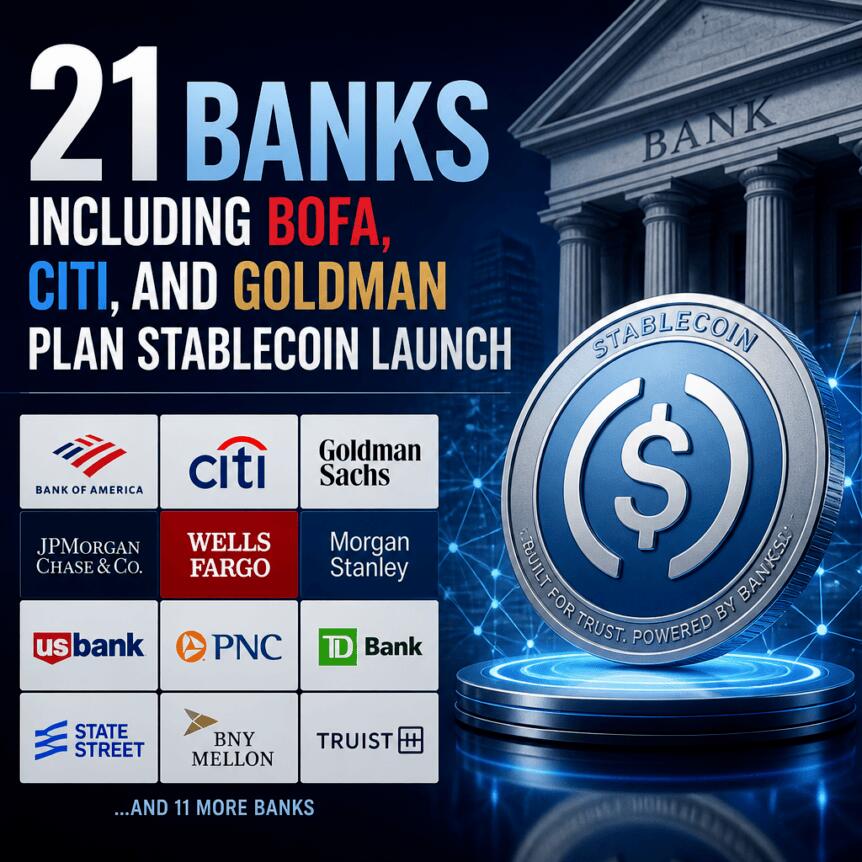
A consortium of 21 major financial institutions says it plans to form a new company dedicated to developing and issuing stablecoins, signaling a renewed effort from traditional banks to build digital-dollar rails that fit emerging regulations. The group announced Tuesday that it aims to launch a US dollar-denominated stablecoin in the first half of 2027, once the company is formed and other conditions are met.
Beyond a first US dollar product, the consortium says it intends to expand to stablecoins denominated in other G7 currencies, with a euro offering identified as its next priority. The planned tokens are intended to serve wholesale, institutional, and retail users, including applications such as cross-border payments and digital asset settlement.
Key takeaways
- 21 large financial institutions plan to create a company to develop and issue stablecoins.
- The initial product is expected to be a US dollar-denominated stablecoin in the first half of 2027.
- Officials say the stablecoin framework will aim to comply with the US GENIUS Act and, where applicable, the EU’s MiCA.
- After the dollar launch, the consortium’s stated next step is a euro-denominated stablecoin.
- The consortium more than doubled compared with an earlier October effort involving 10 banks exploring reserve-backed stablecoins.
From bank pilots to a coordinated stablecoin company
The Tuesday announcement frames the initiative as a step toward a more formal, multi-institution approach to stablecoins. The consortium names Bank of America, Goldman Sachs, Citi, Deutsche Bank, UBS, Santander, MUFG, and Fidelity Investments, among others.
While stablecoins have already gained traction across parts of the financial ecosystem, this move stands out for its scale and for the breadth of the participating institutions across regions including North America, Europe, East Asia, and parts of the Middle East and Africa. The group’s expansion from the earlier, smaller effort suggests momentum is building toward shared infrastructure rather than isolated, institution-by-institution experiments.
In October 2025, Reuters reported that an initial group of 10 banks was exploring a 1:1 reserve-backed model of digital money available on public blockchains. The new consortium effectively builds on that earlier exploration, with the stated plan now moving closer to an eventual issuance roadmap, albeit still contingent on forming the company and meeting other unspecified conditions.
Regulatory alignment is central to the plan
Stablecoin projects increasingly rise or fall on regulatory fit, and the consortium is explicitly tying its design goals to compliance pathways. According to the announcement, the planned stablecoin will aim to comply with the US GENIUS Act and the EU’s Markets in Crypto-Assets Regulation (MiCA), where applicable.
This matters for more than public messaging. Stablecoin issuers and distributors typically need legal clarity around reserve management, redemption, consumer protections, and supervisory oversight. By explicitly referencing both US and EU frameworks, the consortium is signaling that it wants the token to operate not just as a blockchain-native instrument, but as an asset that can be integrated into regulated distribution channels.
That regulatory emphasis also aligns with broader shifts in the sector. Stablecoins have seen growing adoption in recent years, and the passage of GENIUS and MiCA has helped clarify routes that were previously more uncertain for mainstream institutions.
Where the consortium says it wants to use the token
The announcement says the stablecoin is designed for wholesale and institutional use as well as retail access. Use cases highlighted include cross-border payments and digital asset settlement—applications where speed, programmability, and transfer finality are often treated as advantages compared with traditional correspondent banking flows.
For investors and market participants, the inclusion of multiple target segments suggests the consortium wants the stablecoin to function across different integration levels: internal settlement for financial firms, cross-border transfer for payment corridors, and easier access for retail users through downstream partners.
The planned multi-currency expansion further indicates the project is not intended to be a one-off US dollar product. The consortium’s stated next priority is a euro-denominated stablecoin, which could matter for liquidity planning and for cross-border use cases within Europe and between regions.
Broader industry momentum: Asia policy, bank issuance, and institutional surveys
This consortium’s announcement comes amid other signs of institutional progress. In Singapore, for example, the country’s authorities are said to be considering allowing jointly issued cross-border stablecoins into its regulatory regime. The Tuesday announcement reportedly revisits an earlier position that limited the framework to domestic issuance.
Separately, institutional interest has been building through both surveys and product launches. Earlier in 2025, a Fireblocks survey of 295 executives found that 90% of respondents were using or planning to use stablecoins, underscoring that demand is not limited to crypto-native companies.
There have also been concrete issuance steps by major firms. According to coverage referenced by the article, Societe Generale’s crypto subsidiary has issued euro- and dollar-denominated stablecoins, and Fidelity has launched a US dollar-pegged FIDD stablecoin. The article also notes Standard Chartered’s backing of a Hong Kong dollar stablecoin venture.
Taken together, these developments suggest a shift from isolated experiments toward products that can be distributed, regulated, and operationalized at institutional scale. The consortium’s planned US-dollar launch in 2027 can be read as part of that same arc—moving from “can it work?” to “how does it fit within the rules and distribution networks?”
For market watchers, the key question is whether the consortium’s approach—reserve-backed stablecoins with compliance targets aimed at GENIUS and MiCA—will translate into a deployable issuance plan that other institutions can readily integrate with. Investors should watch for updates on the company’s formation, the exact token structure and reserve arrangements, and how the group coordinates cross-border deployment as regulators continue to clarify stablecoin treatment.


The company’s Texas campus has two long-term leases worth $19.6 billion, more than 260 times its latest quarterly revenue, as AI companies race to secure power and data-center capacity.
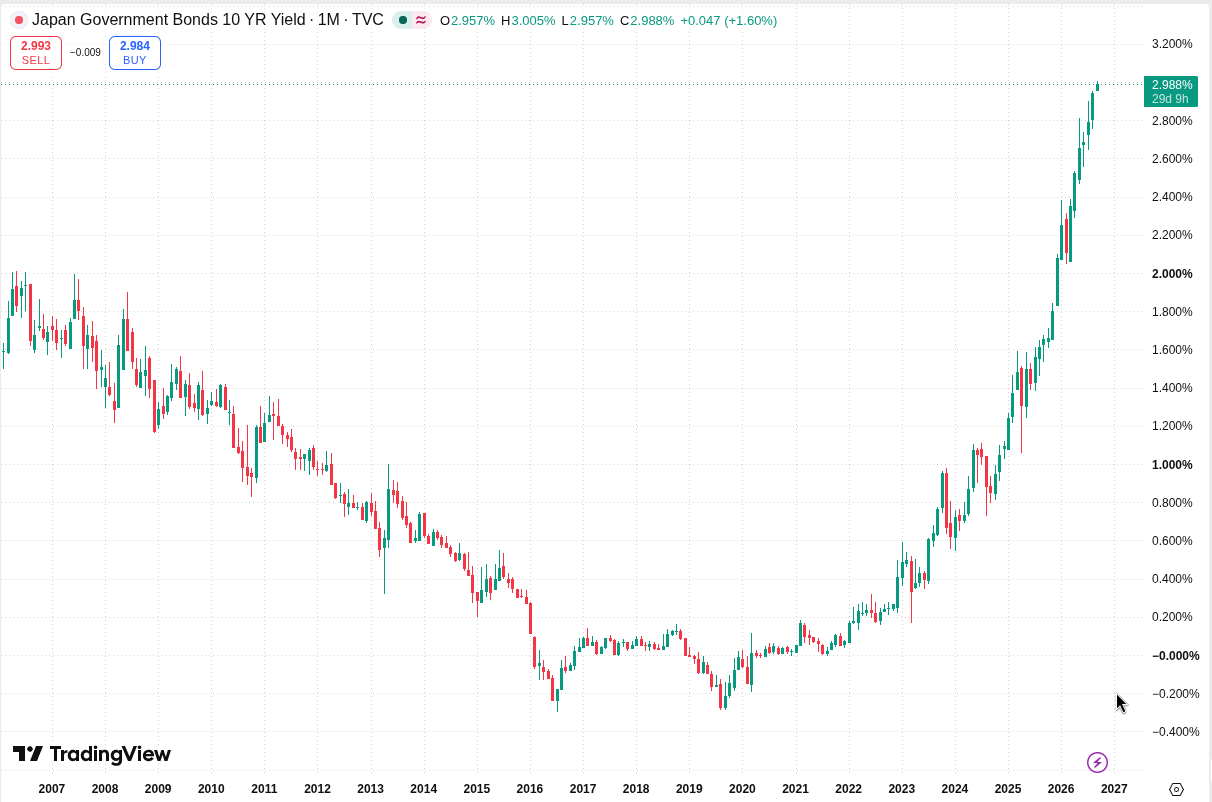
Japan’s JGB yield now at 30-year high
Global long-term bond yields are now at the highest level since the 2008 financial crisis as major long-dated sovereign bonds continued to sell off into trading on Tuesday.
The sell off comes only days after US Treasury Secretary Scott Bessent made headlines by announcing that the maximum size of debt buyback transactions would be increased to $4 billion from September.
While the Treasury does not conduct monetary policy, some commentators have compared this to a form of yield curve control. This has brought the debasement narrative, keenly followed by Bitcoin and precious metal investors, back into the spotlight.
Japan’s 10-year government bond yield surged to 3% for the first time since 1996 on Tuesday, while the 30-year JGB yield topped a record 4.18%. The 10-year US bond yield also surged to a new multi-year high and stands at 4.78% at the time of writing.
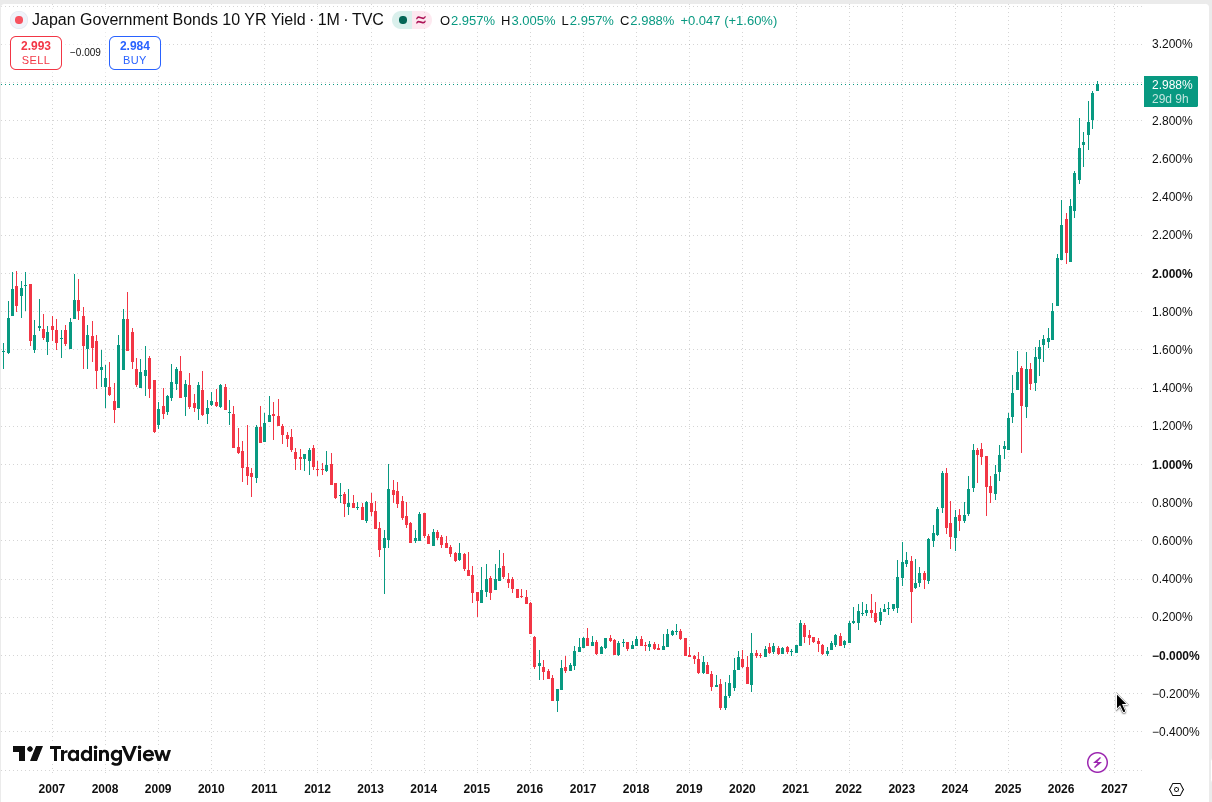
10-Year Japanese government bond. Source: TradingView
Officials in both countries face a mutual bind with respect to the Japanese yen: Tokyo can neither raise policy rates without incurring an operating loss that ultimately hits the Finance ministry, nor repatriate capital without divesting the Treasury securities on which Washington’s financing depends.
Industry commentators such as Arthur Hayes have argued for years that the Fed will eventually use its Foreign and International Monetary Authorities (FIMA) repo facility. Through this swap line, Japan’s Finance ministry could borrow dollars against its Treasury holdings and sell them for yen, strengthening the currency without causing an imminent sovereign bond crisis.
This mechanism would create new dollar liquidity, which is why Hayes recommends positioning in Bitcoin (BTC), gold and crypto. Treasury Secretary Scott Bessent hinted at the future use of the FIMA facility in August.
Rising long-term yields may be the first sign that Hayes’s scenario is being priced in. Robin Brooks, senior fellow at the Brookings Institution commented on X: “For the past two years, Japan has been in a “Liz Truss” bond market crisis whereby its currency falls even as government bond yields go ever higher. We’ve never had a major G10 sovereign experience something like this and it’s deeply destabilizing…”
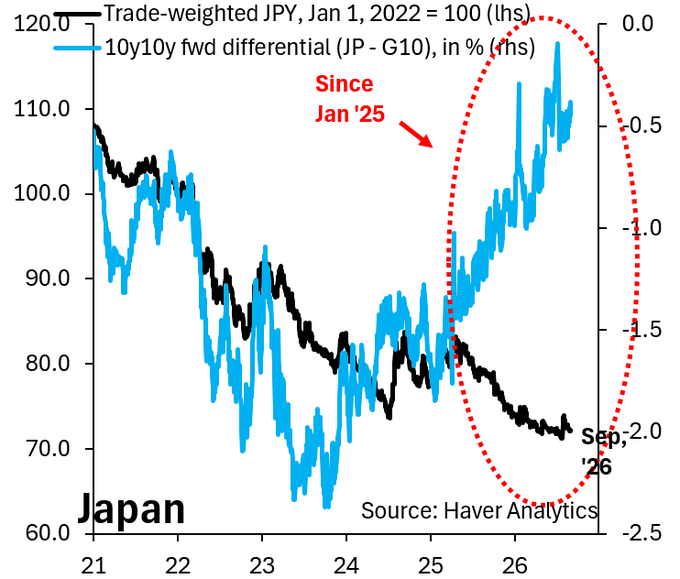
10-year interest swap rate and trade-weighted JPY.
Source: Robin Brooks on X.com
Bitcoin continues sideways movement
In the face of Tuesday’s bond sell-off, Bitcoin has been trading sideways near the $78,000 mark, following a minor corrective decline from its morning high close to $79,000.
Cointelegraph previously reported on a thick patch of resistance between the current spot price and $86,000. This has slowed Bitcoin’s upside momentum despite positive news and renewed interest in the debasement trade.
Related: Bitcoin faces true demand test above $83K as liquidity thickens: Glassnode
Overall sentiment across recent reports remains mixed to cautiously optimistic in the short term after the strong August recovery, with the $76,000-$82,000 range as the key battleground for the coming weeks.
S&P 500 index futures sold off by 0.3% on Tuesday and the gauge now hovers around 7,660, the lowest level since Aug. 4. This comes as tensions in the Iran war flare up once more. Oil prices rose more than 2%, with WTI around $88 per barrel and Brent above $92, fueled by renewed US-Iran fighting, including strikes, tanker incidents in the Strait of Hormuz, and comments from President Donald Trump.
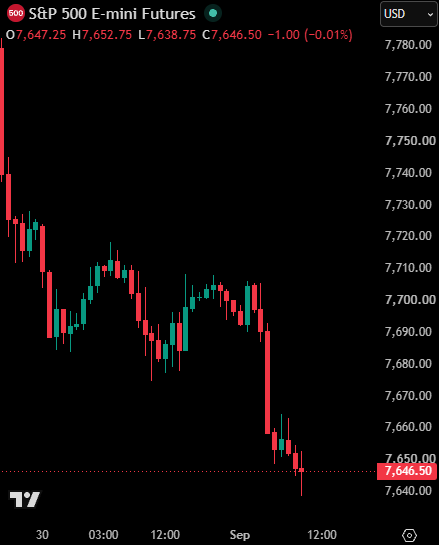
S&P 500 out-of-hours futures. Source: X.com
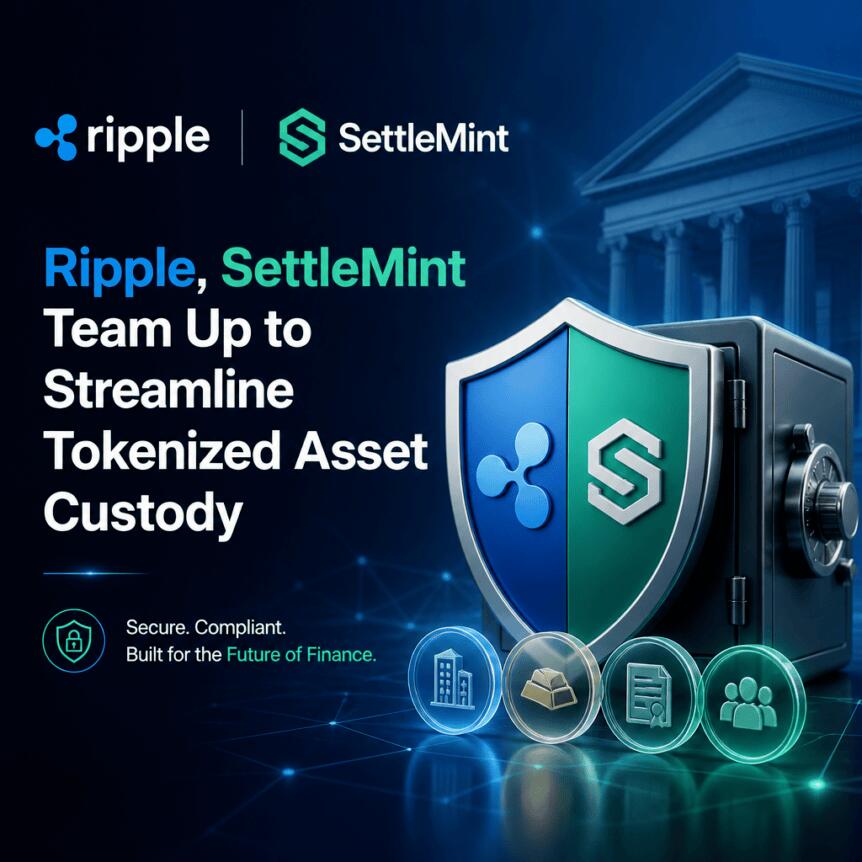
Ripple and SettleMint unveiled a new partnership on September 1. The deal merges custody, issuance, and lifecycle management into a single platform. Traditional finance firms now gain a simpler path toward digital asset adoption.
A Unified Platform for Institutions
SettleMint announced the collaboration in an official statement this week. The partnership links Ripple Custody with SettleMint’s Digital Asset Lifecycle Platform, known as DALP. Together, the two systems aim to accelerate tokenization adoption across the Asia Pacific region.
Fiona Murray, Ripple’s managing director for Asia Pacific, explained the strategic thinking behind the move. Institutions want to deploy digital assets without juggling separate systems for custody and governance. The combined platform gives them one foundation to build on and expand later.
Adam Popat, CEO of SettleMint, echoed that view in his own remarks. He described global capital markets as shifting fully on-chain in the current moment. As a result, custody and lifecycle management must now function as a single system rather than two.
Ripple’s Broader Institutional Strategy
Ripple continues to expand its custody infrastructure through several additional partnerships. The company has deepened ties with Securosys, Figment, and Chainalysis in recent months. These integrations aim to simplify how institutions secure digital assets, stablecoins, and real-world assets.
Ripple also plans to roll out the XRP Ledger v3.3.0 upgrade soon. The upgrade places tokenized real-world assets at the center of its roadmap. This step reflects Ripple’s wider strategy to court institutional capital through infrastructure improvements.
XRP itself traded higher following the announcement, rising more than one percent within 24 hours. The token moved between $1.36 and $1.40 during that window. Trading volume fell 16 percent, yet CME futures open interest still surpassed figures on Binance.
Regulatory Momentum Fuels Sector Growth
The partnership arrives as regulators reshape the tokenization landscape inside the United States. The SEC introduced tokenization innovation exemptions under the current administration this year. These changes encourage more institutions to seriously explore blockchain-based asset management.
The Depository Trust and Clearing Corporation also plans to launch its own tokenization service. That rollout is scheduled for October and adds further momentum to the sector. Multiple major players now compete to serve rising institutional demand for on-chain assets.
Financial firms increasingly need compliant infrastructure to manage complex ledger configurations safely. Custody providers must now handle growing volumes of tokenized assets without added risk. The Ripple-SettleMint partnership positions both companies to meet that rising demand directly.
Institutions across Asia Pacific stand to benefit most from this streamlined approach. Rather than managing multiple vendors, banks can now consolidate custody and issuance functions. This consolidation may lower operational costs while improving oversight of digital asset holdings.
The tokenization market continues to grow as traditional finance embraces blockchain technology further. Partnerships like this one signal a maturing industry ready for institutional-scale adoption. Ripple and SettleMint now join a growing list of firms building that infrastructure together.


Multiple crypto industry figures and CoinDesk staff received unexpected password reset emails on Tuesday, though there is no evidence yet that X itself has been breached.
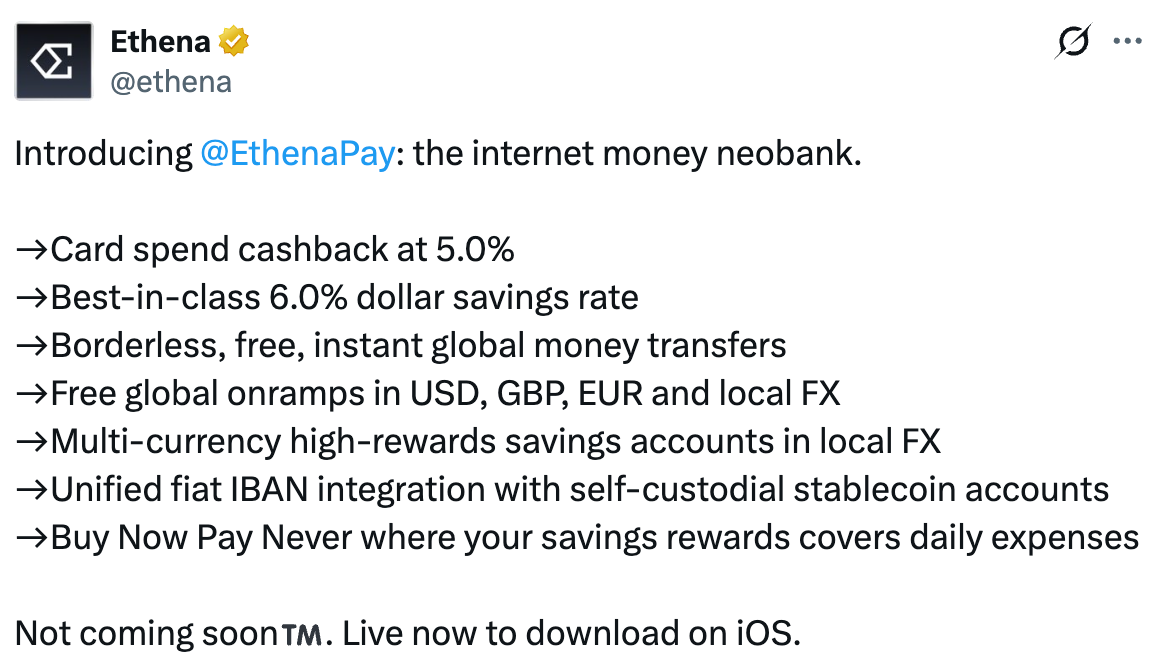
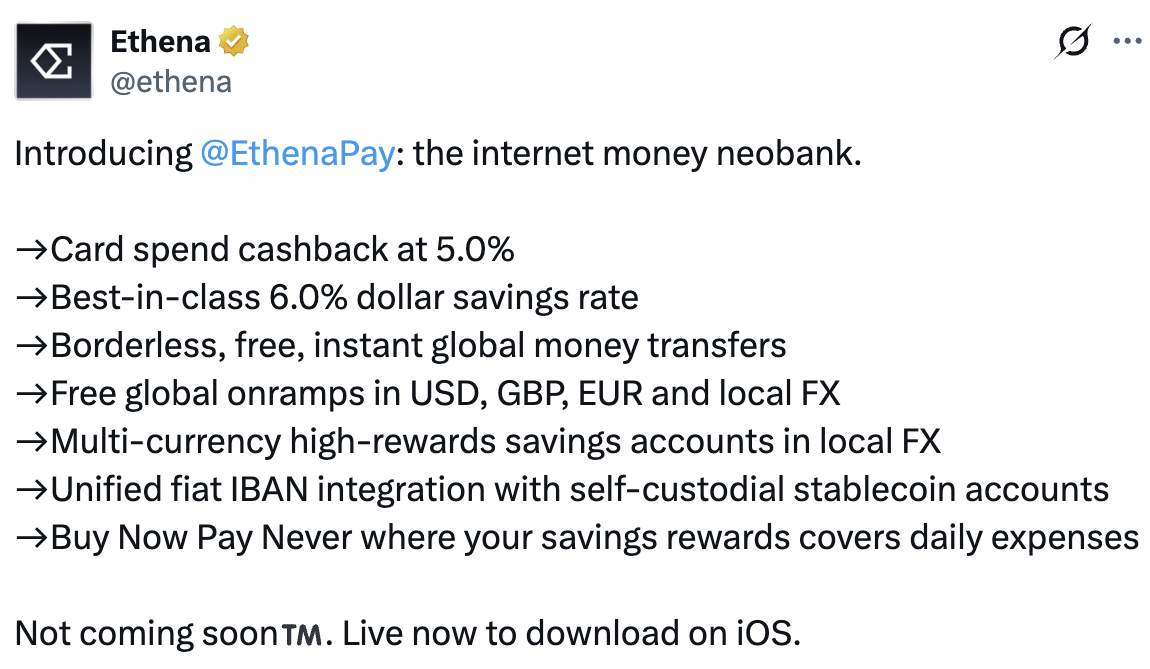
Ethena has launched a global money app built around its USDe synthetic dollar, expanding the crypto-native asset into everyday payments, savings and cross-border transfers.
According to Tuesday’s announcement, the self-custodial Ethena Pay app allows users to hold USDe through a dollar-denominated balance, earn as much as 6% in annualized rewards and spend funds through a payment card, while supporting fiat onramps.
The beta rollout includes 48 countries across Latin America, the Caribbean, Africa, Asia and other regions, though the initial rollout is limited to 400 users, with access set to expand weekly, Ethena said in a Tuesday thread on X. Avalanche will serve as the exclusive settlement layer for payments and transfers.
Source: Ethena
Users can deposit fiat or crypto, with funds converted into USDe (USDe). The app enables using IBAN details to move money to and from external bank accounts into local currencies. MoonPay-owned Iron provides backend infrastructure.
Ethena Pay is not initially available in the US, EU, Canada, Taiwan or South Korea, though Ethena expects to expand into those markets during the beta, subject to regulatory approval.
Related: Chelsea FC gets a stablecoin sponsor after UK FCA warning to clubs
Ethena’s USDe grows as ENA rallies
Ethena is an Ethereum-based protocol behind USDe, a synthetic dollar designed to maintain its value near $1 without relying on traditional banking infrastructure.
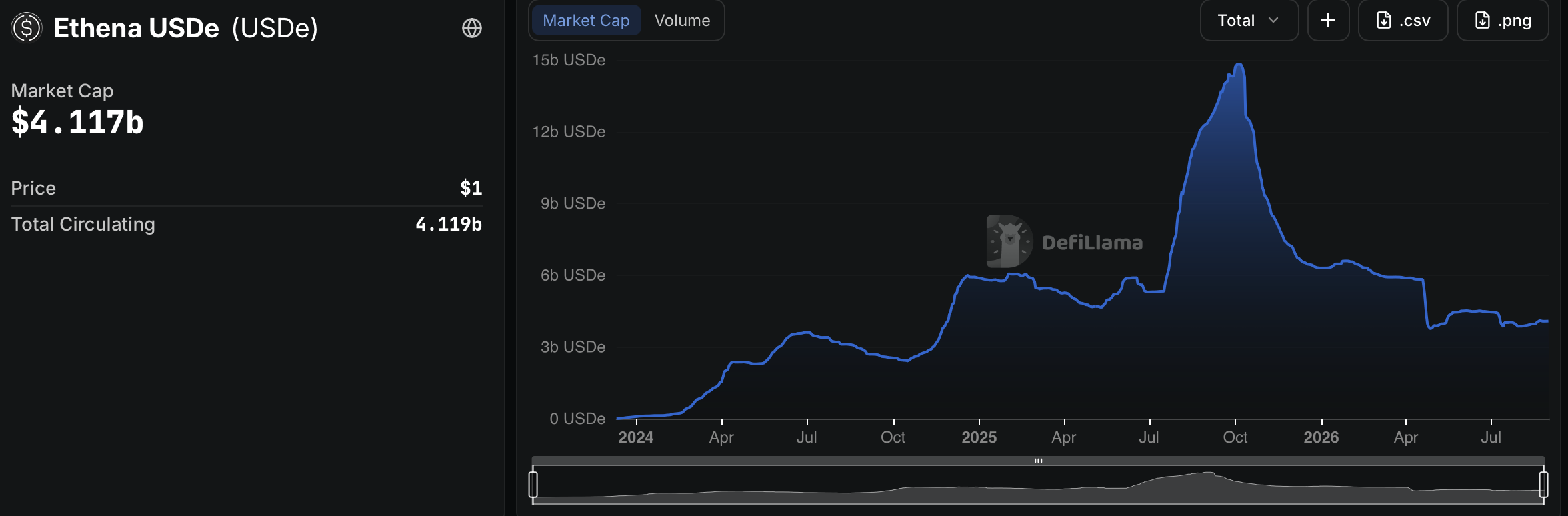
USDe uses crypto collateral alongside hedging strategies, including derivatives positions, to help maintain its peg. The asset has grown to a market capitalization of about $4.1 billion, making it the sixth-largest stablecoin, according to DefiLlama data.
USDe market cap. Source: DefiLlama
Ethena also operates ENA, the protocol’s governance token, which has a market capitalization of roughly $1.5 billion. The token has rallied sharply over the past month, gaining about 68%, but remains well below its previous highs.
On Friday, the Ethena Foundation proposed directing 95% of the net revenue it receives from Ethena’s core businesses toward ENA buybacks once USDe’s circulating supply reaches $7.5 billion. ENA rose more than 10% following the proposal and gained 27% over the week.
The token recorded about $595 million in trading volume over the past 24 hours, up 16% from the previous day, and was trading around $0.16 on Tuesday, according to CoinGecko.
Magazine: Does the Bitcoin rally mean we haven’t wasted our lives in crypto?


A group of 21 major financial institutions plans to establish a new company to develop and issue stablecoins, offering another sign of traditional finance’s push into digital dollars as regulatory frameworks take shape.
The consortium, announced Tuesday, includes Bank of America, Goldman Sachs, Citi, Deutsche Bank, UBS, Santander, MUFG and Fidelity Investments. It plans to launch a US dollar-denominated stablecoin in the first half of 2027, subject to the company’s formation and other conditions.
According to the announcement, the group ultimately plans to expand into stablecoins denominated in other G7 currencies, with a euro offering identified as its next priority.
The consortium said its stablecoin will target wholesale, institutional and retail markets, including use cases such as cross-border payments and digital asset settlement. The initiative is intended to comply with both the US GENIUS Act and the European Union’s Markets in Crypto-Assets Regulation (MiCA), where applicable.
The venture builds on an initiative announced last October, when an initial group of 10 banks said they were exploring a 1:1 reserve-backed form of digital money available on public blockchains. The consortium has since more than doubled in size, bringing together financial institutions across North America, Europe, East Asia, the Middle East and Africa.
Related: Kast launches stablecoin-powered business platform after $80M raise
Banks deepen push into stablecoins
The move comes as stablecoins have grown considerably in recent years, with the passage of the GENIUS Act and MiCA creating clearer regulatory pathways for adoption.
Elsewhere, Singapore is considering allowing jointly issued cross-border stablecoins into its regulatory regime, according to a Tuesday announcement, revisiting its earlier decision to restrict the framework to domestic issuance.
Institutional interest was already taking shape in early 2025, when a Fireblocks survey of 295 executives found that 90% of respondents were using or planning to use stablecoins.
Since then, major financial institutions have expanded their presence in the sector. Societe Generale’s crypto subsidiary has issued euro- and dollar-denominated stablecoins, while Fidelity recently launched its US dollar-pegged FIDD stablecoin.
SocGens crypto subsidiary has issued euro- and dollar-denominated stablecoins, as has Fidelity, with its FIDD US dollar-denominated entry. Last month, Standard Chartered backed a Hong Kong dollar stablecoin venture.
Related: SEC sends crypto custody rule overhaul to White House for review

Germ Experts Reveal How Gross It Is To Type As You Eat

Every done deal on transfer deadline day

i love allah #money #unfrez #motivation #unfrezzmyaccount #trending #duet #millionaire

Weekend Open Thread – Corporette.com

Weekend Open Thread: Brooks Brothers

London Mayor Sadiq Khan handed a peerage by Keir Starmer alongside 15 other Labour figures… just days before the PM leaves No10
i love allah #money #unfrez #motivation #unfrezzmyaccount #trending #duet #millionaire

RAOUL PAL JUST CALLED OUT XRP CHART!!! (”XRP BULLRUN EXPLOSION”)

3 Kunci yang Bisa Bawa Kamu Financial Freedom #financialfreedom #keuangan
-

 Crypto World7 days ago
SpaceX stock could rise 75% to $240, JPMorgan says
-

 Fashion4 days ago
Weekend Open Thread: Maeve – Corporette.com
-

 Crypto World5 days ago
Bitcoin’s 22% rally now needs real demand to outlast Treasury liquidity boost
-

 Crypto World6 days ago
Warsh Jackson Hole keynote puts financial innovation first
-

 Business5 days ago
Salesforce Stock Soars 19% as Blowout Earnings and Agentforce AI Growth Silence Software Skeptics
-

 Crypto World6 days ago
Elon Musk Grok Bot Promise: We Will Make You Whole if AI Loses Your Money
-

 Business5 days ago
Apple Confirms September 9 Keynote and Reveals Its Full Pre-Order Schedule
-

 Crypto World7 days ago
Did Trump Just Move SpaceX Stock With One Truth Social Post?
-

 Business4 days ago
Onto Innovation Stock: AI’s Next Bottleneck Is Yield (NYSE:ONTO)
-
 NewsBeat6 days ago
Lindsay Clancy jury braces for closing arguments as judge tells court: ‘You’ve heard all the evidence’ – Live updates
-

 Business6 days ago
Walmart takes aim at younger shoppers with new fashion brand
-

 Crypto World4 days ago
Bitcoin price tests $82K resistance as Brandt stays long
-

 Crypto World6 days ago
NVIDIA revenue hits $96.2B as AI demand doubles
-

 Business7 days ago
Thailand’s Eastern Economic Corridor Capital City (EECiti): Key Developments and Investment Opportunities
-

 Business4 days ago
iPhone 18 Pro Pre-Orders Could Shift to Saturday as Apple Reportedly Avoids September 11 Anniversary
-

 NewsBeat7 days ago
Trump’s trade truce with China faces test with Iran effort
-
 Crypto World6 days ago
Nvidia Q2 Earnings Reveal $96.2 Billion Beat, So Why Is NVDA Falling?
-
 Tech3 days ago
Hugging Face built a $4.5 billion empire on free AI models. Now Nvidia is buying it for $12.9 billion
-

 Tech6 days ago
Claude Cowork gets its own browser that doesn’t touch your tabs, bookmarks, or saved passwords
-

 Crypto World5 days ago
Truflation calls for Fed rate cut after PCE forecast
You must be logged in to post a comment Login