

In the United States, building a data center now polls roughly as well as abolishing the police. If current trends continue, server warehouses may soon be less popular with Americans than pizza topped with pineapple and shattered glass.
Tech
Seattle cannabis data startup Headset to pay $1M to settle allegations over pandemic-era loan


Seattle-based cannabis data analytics company Headset has agreed to pay more than $1 million to resolve allegations that it improperly received and obtained forgiveness for a federal Paycheck Protection Program (PPP) loan.
The settlement, announced Monday by the U.S. Attorney’s Office for the Western District of Washington, stems from a May 2024 whistleblower lawsuit filed by Sidesolve LLC under the False Claims Act. Sidesolve is a data analytics company that uses AI algorithms to hunt for potential pandemic loan fraud across public records.
The government alleged that Headset was ineligible for the Small Business Administration (SBA) loan it received in February 2021 — and had forgiven in August 2021 — because its work supporting the marijuana industry conflicts with federal law.
Under the terms of the deal, Headset paid $100,000 within 30 days of signing the agreement in early August and will pay the remaining balance of more than $900,000 over four years through August 2030. The company made no admission of wrongdoing, stating it agreed to the payments to avoid the risks and expense of litigation.
Headset was founded in 2015 by Cy Scott, Brian Wansolich, and Scott Vickers. The trio previously co-founded Leafly, the popular online cannabis strain database and marketplace, which was acquired by Privateer Holdings in 2011. After departing Leafly, they launched Headset to bring business intelligence and real-time sales metrics to the legal pot industry.
The startup functions like a Nielsen for the cannabis sector, aggregating point-of-sale data from dispensaries and retailers to provide market trends, pricing insights, and consumer demographics.
Over the years, the company has raised $29.4 million in total funding from investors including Poseidon Asset Management and Canopy Rivers, expanding its data coverage across legal state and international markets.
Continue Reading
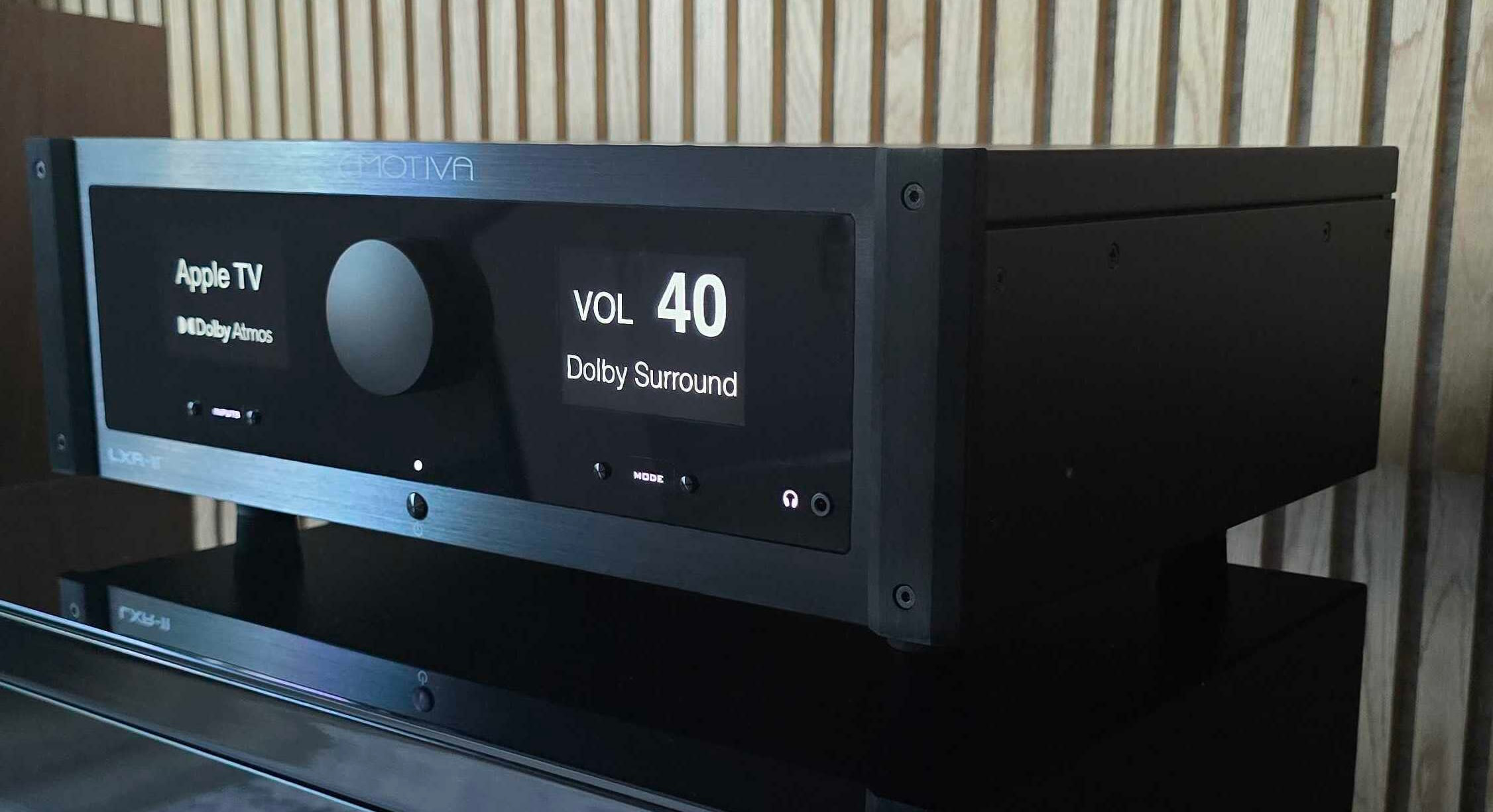
Emotiva has spent more than two decades building its reputation around a fairly simple proposition: offer serious audio hardware without requiring customers to liquidate part of their retirement portfolio to pay for it.
The new LXP-16 Immersive Cinema Processor and LXR-11 Immersive Cinema Receiver push that philosophy considerably further up the home theater ladder.
Both models will make their public debut at CEDIA Expo 2026 in Denver before their scheduled October release. The LXP-16 is priced at $4,799, while the LXR-11 will sell for $5,999.
What makes the new LX Series interesting is not any single specification. Emotiva is combining 9.4.6-channel immersive processing, four independently managed subwoofer outputs, HDMI 2.1, streaming, and the complete Dirac Live room correction package in two products priced below a number of established high-end alternatives.
And in the case of the LXR-11, Emotiva has thrown eleven channels of Hypex NCOREx amplification into the same chassis.
That is a rather serious amount of hardware for the money.
Related Reading:
What Does 9.4.6 Actually Mean?
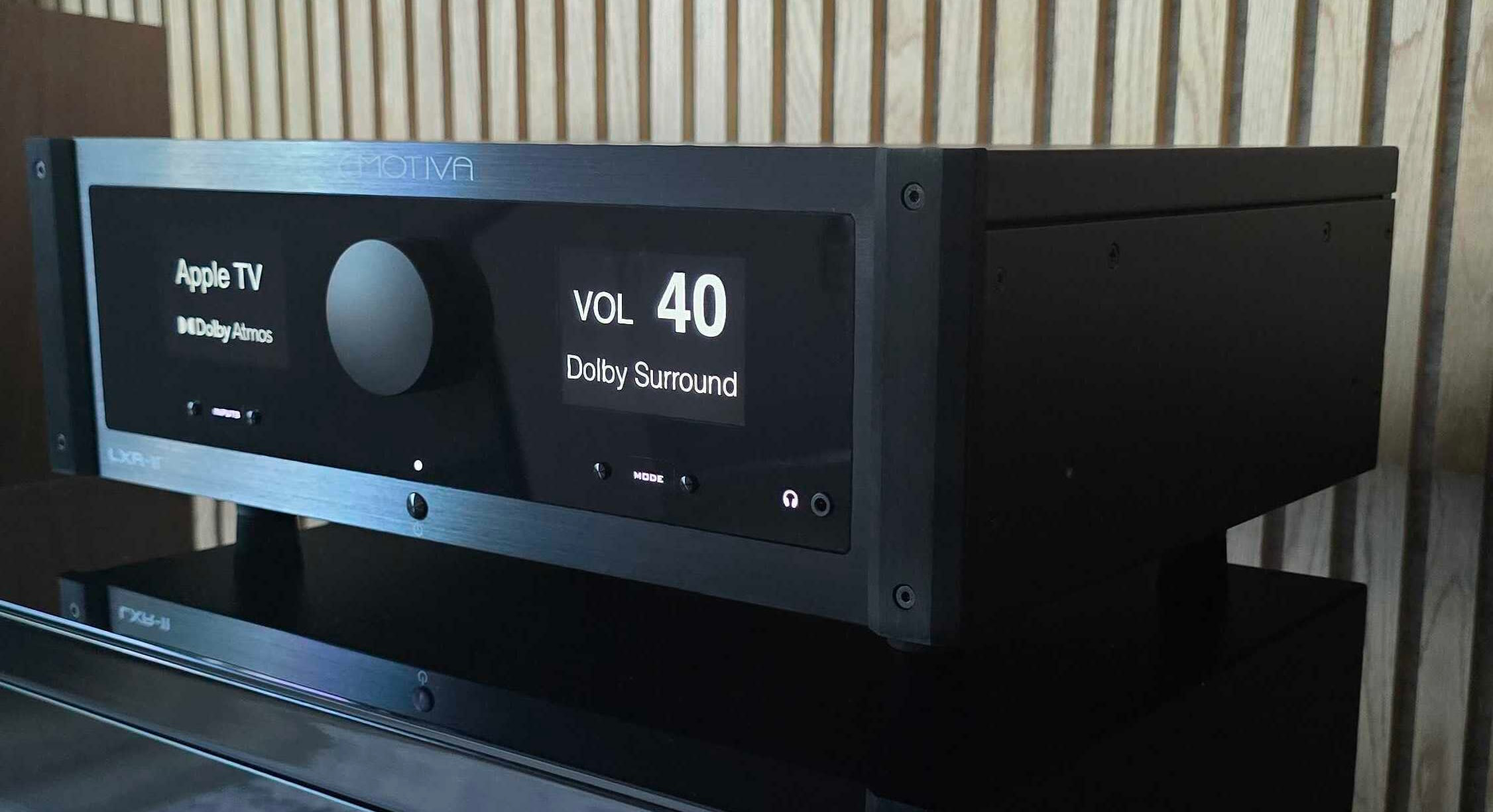
Both LX Series models can process a 9.4.6-channel system with left, center and right front channels, a pair of front wides, side surrounds, rear surrounds, four independently managed subwoofers and six height channels.
In practical terms, that means up to 15 independently processed loudspeaker channels plus four independent subwoofer feeds, with support for Dolby Atmos and DTS Pro.
More important for elaborate theater installations, those four subwoofer outputs are not simply four connectors carrying the same signal. Each is a balanced XLR output that can be independently adjusted for level and distance before being integrated by Dirac.
That distinction becomes increasingly important as systems move beyond one or two subwoofers. Multiple subs can improve bass consistency throughout a room, but only when placement, timing, level, and frequency response are properly managed. Four outputs are substantially more useful when the processor actually knows that four different subwoofers exist.
Dirac Live ART Is Included
This might be the most consequential part of the LX Series specification.
Both models include licenses for Dirac Live Room Correction, Dirac Live Bass Control, and Dirac Live Active Room Treatment, along with the required calibrated measurement microphone. There is no additional software purchase required to unlock the more advanced Dirac features.
Dirac Live handles frequency response and impulse correction. Bass Control coordinates the loudspeakers and multiple subwoofers around their crossover regions, while Active Room Treatment, or ART, treats the speakers as a coordinated acoustic system and uses their combined output to reduce low-frequency decay within the room.
ART support is becoming increasingly common on premium AV products, but inclusion in the purchase price is not.
ARCAM’s new Radia home theater components support Bass Control and ART as paid upgrades, while compatible Marantz AV receivers and processors also require users to purchase Dirac licenses separately. That gives Emotiva a meaningful advantage before anyone has connected a single loudspeaker.
Emotiva LXP-16 Immersive Cinema Processor
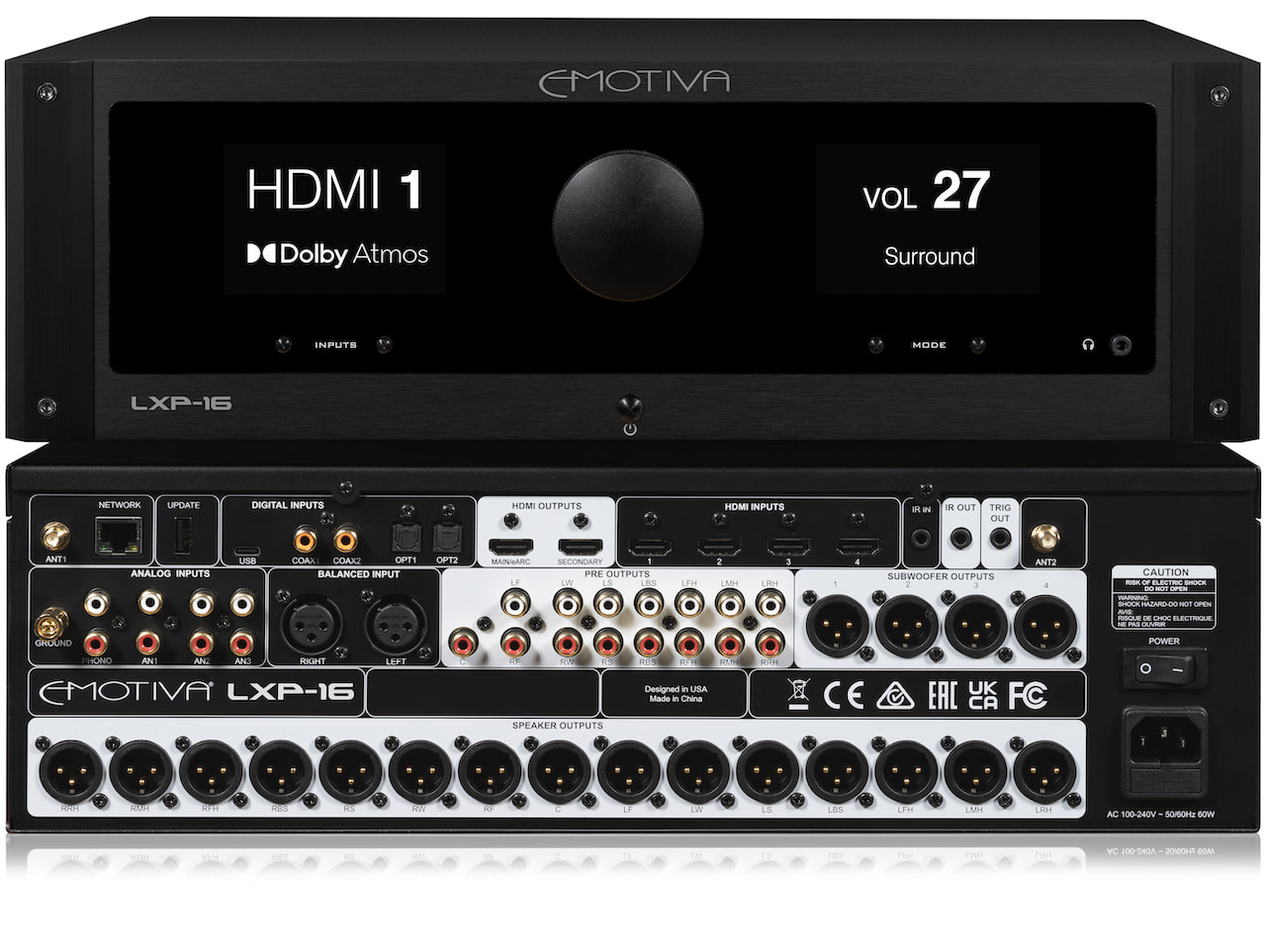
The LXP-16 is the separates option and requires external power amplification.
Internally, Emotiva is using a balanced architecture with Analog Devices SHARC DSP processing and ESS Hyperstream DAC technology. Emotiva has not identified the specific ESS DAC chips, so there is no reason to guess.
The processor provides 15 balanced XLR preamp outputs and 15 unbalanced RCA preamp outputs, with both sets available simultaneously. Four additional balanced XLR outputs are dedicated to the subwoofers. Maximum published output is 8V RMS through the balanced connections and 4V RMS through RCA.
LXP-16 Key Specifications:
- 9.4.6 immersive audio processing
- Dolby Atmos
- DTS:X Pro
- 15 balanced XLR preamp outputs
- 15 RCA preamp outputs
- 4 independent balanced XLR subwoofer outputs
- Analog Devices SHARC DSP
- ESS Hyperstream DAC architecture
- Dirac Live Room Correction included
- Dirac Live Bass Control included
- Dirac Live Active Room Treatment included
- 4 HDMI 2.1 inputs
- 2 HDMI 2.1 outputs
- 8K/60Hz and 4K/120Hz passthrough
- Dolby Vision
- HDR10+
- HLG
- VRR
- ALLM
- Primary HDMI output with ARC/eARC
- Moving magnet phono input
- Balanced XLR stereo analog input
- 3 RCA stereo analog inputs
- 2 coaxial and 2 optical digital inputs
- USB-C PCM input up to 768 kHz
- Ethernet, Wi-Fi and Bluetooth
- Bluetooth transmission to headphones or speakers
- 17 x 13 x 6.25 inches
- 14 pounds
Emotiva also publishes a frequency response of 20 Hz to 22 kHz within ±0.14 dB from analog sources, along with THD+N below 0.0008% at 1 kHz for line-level sources.
For $4,799, that specification puts the LXP-16 into some rather expensive company.
Emotiva LXR-11 Immersive Cinema Receiver
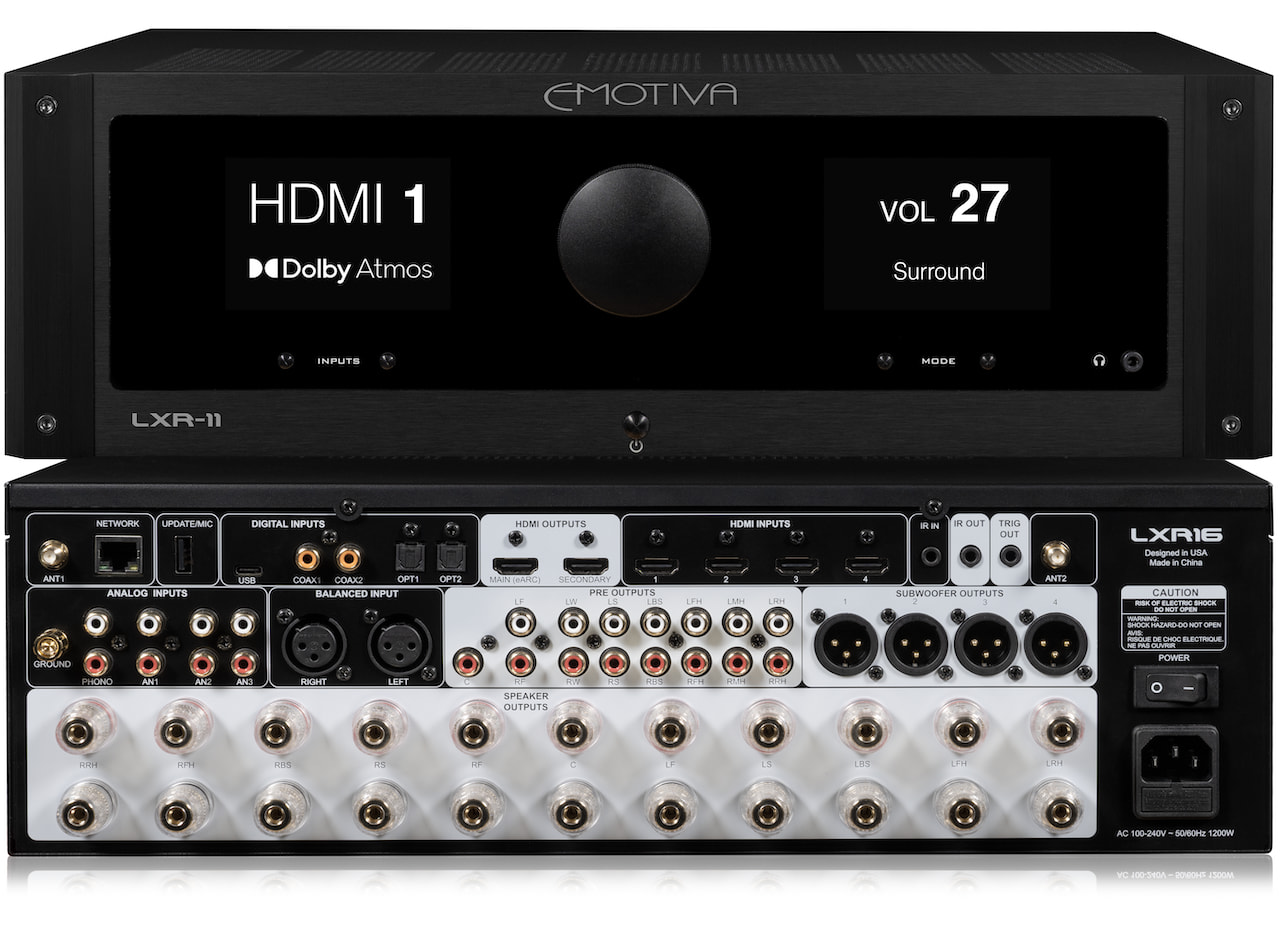
The LXR-11 takes essentially the same processing platform and adds 11 channels of Hypex NCOREx Class D amplification.
That is a notable choice. Hypex amplification has become increasingly common in serious two-channel and multichannel products because it can deliver substantial output from relatively compact, efficient designs.
Emotiva has also made the LXR-11 fanless, which matters in quiet rooms and enclosed equipment installations where mechanical noise is about as welcome as someone opening a bag of potato chips during 2001: A Space Odyssey.
The receiver provides 15-channel RCA preamp outputs, allowing external amplification to be added as the system grows. Emotiva also says the internal amplification can be completely switched off if the LXR-11 is eventually used primarily as a processor.
LXR-11 Amplifier Specifications:
Emotiva’s detailed power specifications are unusually useful because they specify how many channels are being driven:
- 140 watts per channel into 8 ohms, 2 channels driven, 20 Hz to 20 kHz, 0.02% THD
- 240 watts per channel into 4 ohms, 2 channels driven, 20 Hz to 20 kHz, 0.02% THD
- 140 watts per channel into 8 ohms, 5 channels driven, 0.1% THD
- 140 watts per channel into 8 ohms, 7 channels driven, 0.1% THD
- 100 watts per channel into 8 ohms, 9 channels driven, 0.1% THD
Emotiva has not published an 11-channels-driven power specification, so we are not going to invent one.
The rest of the LXR-11 specification closely mirrors the LXP-16, including four HDMI 2.1 inputs, two outputs, four independent balanced subwoofer outputs, MM phono, USB-C audio, network connectivity, and the complete Dirac package.
Emersa Brings Streaming Into the LX Series
Both models also include Emotiva’s Emersa streaming platform and Emersa Control app.
Published streaming support includes TIDAL Connect, Qobuz Connect, Spotify Connect, DLNA, Google Cast, Bluetooth, and USB playback. The app handles volume, source selection, listening modes, streaming access, and commonly used audio adjustments.
One competitive difference is worth noting: Emotiva’s published specifications currently do not list Apple AirPlay or Roon Ready support, both of which are offered by ARCAM’s newest Radia home theater products. Whether that matters will depend entirely on how a system is used.
There is also a more obvious hardware limitation.
The LX Series provides only four HDMI inputs. ARCAM and Marantz offer seven HDMI inputs on several of their closest competitors. Four will be enough for many installations, especially when eARC moves television apps back through the system, but owners with multiple consoles, disc players, streamers, and specialty video sources should count first and purchase second.
The Competition
Two brands stand out as the most relevant competition based on current technology, channel capability, and pricing: ARCAM and Marantz.
ARCAM Radia
ARCAM’s new AVP45 is probably the closest direct rival to the LXP-16.
Priced at $5,999.95, the AVP45 provides 16-channel processing, balanced outputs, seven HDMI inputs, Dolby Atmos, DTS, Auro-3D, extensive streaming, Roon Ready support, AirPlay, Google Cast, Bluetooth with Snapdragon Sound and Auracast, and Dirac Live. Bass Control and Active Room Treatment are supported but require paid upgrades.
The $6,999.95 ARCAM AVA35 is the more logical rival to the LXR-11. It processes up to 16 channels but provides nine channels of Class G amplification rather than eleven. ARCAM counters with more HDMI connectivity, Auro-3D, Roon, AirPlay, and its broader streaming feature set.
The Emotiva advantage is straightforward: more onboard amplifier channels in the receiver, four dedicated balanced subwoofer outputs and the entire Dirac suite already included.
Marantz
Marantz attacks the same market from two different directions.
The $8,000 AV 10 offers 15.4-channel processing, balanced outputs for every channel, seven 8K HDMI inputs, HEOS streaming, Dolby Atmos and a considerably more expensive premium chassis. It also supports Dirac Live, Bass Control and Active Room Treatment, but those features require separate licensing.
At $4,800, the Marantz CINEMA 30 costs less than the Emotiva LXR-11 and includes eleven channels of Class A/B amplification rated at 140 watts per channel with two channels driven. Its processing ceiling is 13.4 channels rather than Emotiva’s 15 speaker channels plus four subwoofers, while HEOS, AirPlay, seven HDMI inputs, Auro-3D and the broader Marantz ecosystem give it a different set of strengths. Dirac remains an optional upgrade.
This is not a case where one specification sheet automatically wins. Marantz has the more mature connected ecosystem and ARCAM offers excellent integration and streaming flexibility. Emotiva is putting more of the expensive acoustic processing into the purchase price.
There Is Another CEDIA Story Here
The hardware is only half of Emotiva’s CEDIA announcement.
The company is also launching a new Authorized Dealer Program and will be meeting with prospective dealers and integrators during the show. Emotiva has historically identified itself as a direct-to-consumer company, and its existing Integrator Program was designed primarily for professionals purchasing equipment for specific installations rather than conventional retail resale.
Emotiva has not yet published enough detail to determine exactly how broadly the new dealer structure will alter that business model.
But appearing at CEDIA with two considerably more ambitious home theater components while simultaneously building a dealer network is not difficult to interpret. Emotiva wants the LX Series specified into professionally designed theaters, not just ordered by enthusiasts already familiar with the brand.
That could ultimately be as important as another HDMI input.
The Bottom Line
Emotiva is not winning this fight simply by being cheaper.
The LXP-16 and LXR-11 combine 15-channel immersive processing, four independent balanced subwoofer outputs, modern HDMI 2.1 video support and the complete Dirac Live suite, while the receiver adds eleven channels of Hypex NCOREx amplification.
ARCAM offers more connectivity and a more comprehensive streaming platform. Marantz brings HEOS, seven HDMI inputs, a mature control ecosystem, and formidable competition at both ends of the price range.
But requiring customers to spend nothing extra for Dirac Live Bass Control or Active Room Treatment changes the value equation considerably.
If the LX Series performs as well as its specifications suggest and Emotiva can make its new dealer strategy work, CEDIA 2026 could mark the point where the company stops being viewed primarily as the direct-to-consumer value alternative and starts becoming a much bigger problem for established high-end home theater brands.
Price & Availability
Both are scheduled for release in October 2026, with further launch information expected before availability. They will make their CEDIA Expo debut at Emotiva Booth 2938 in Denver.
Related Reading:

More executive changes are happening at Apple as Ternus takes over, with former CFO Luca Maestri moving on from managing the company’s Corporate Services.
Luca Maestri was the chief financial officer at Apple under Tim Cook, but switched roles at the end of 2024 to become Vice President of Corporate Services. With Cook out, Maestri has also taken the opportunity to change his portfolio of work.
According to sources of Bloomberg, Maestri left his Corporate Services position in the last few weeks. He has not left the company, however, as he is still on the payroll.
Current CFO Kevan Parekh has now assumed the Corporate Services responsibilities.
It is unclear what his responsibilities now are, if anything, within Apple, beyond hosting a single class. That class is at Apple University, the company’s in-house program for educating executives and employees.
The report continues by saying Maestri is winding down his time at Apple, as he prepares for retirement. It is claimed he only comes into the office once a week.
With seemingly no remit, it seems that he won’t be reporting to new CEO John Ternus at all until Maestri’s eventual departure.

from the lots-of-staffing-for-‘field’-offices dept
As the Trump administration continues to chase away actual talent in order to staff federal agencies with loyalists and/or people who don’t know any better, it has had to lower hiring standards to keep the federal cupboards stocked.
ICE went on a hiring surge following the imposition of impossible arrest quotas and a few billion tax dollars. To keep ICE staffing at the level required to arrest 1,500-3,000 non-criminals a day, ICE had to lower its standards and drastically reduce the amount of training these new officers — many who were promised $50,000 signing bonuses — received.
The combination of bonuses and lowered standards not only saw ICE cannibalizing US law enforcement agencies, but also belatedly discovering that a lot of applicants weren’t even capable of meeting standards so low they had to trip over them.
The same thing is now happening at the FBI. Plenty of talent has fled/been bled since Trump took office for the second time. A large percentage of the remaining workforce has been tasked with providing support for Trump’s mass deportation efforts, which means there’s barely anyone left to do the work that still needs to be done by the FBI.
The standards have been lowered at the FBI. And the new standards are so low, they’d possibly even embarrass ICE HR personnel, as CBS News reports:
The FBI previously refused to hire job applicants if they admitted to hiring sex workers or stealing from an employer — or engaging in acts of bestiality.
[…]
In June, the FBI quietly lowered some of the standards it uses when it conducts background checks on would-be federal agents and other personnel. According to multiple sources briefed on the matter, the FBI did so to facilitate hiring in some cases, even if candidates acknowledged they engaged in sexually deviant activities or stole from an employer.
Um…
Well, I’m not going to insult sex workers or sex purchasers, so long as everything is consensual. That this remains a criminal act in most places in the nation is a failure of policy, rather than a leading indicator of criminal proclivity.
But then we have to move on to the other stuff. Stealing from employers tends to be a deal breaker for new hires across both the public and private sector. And you would think an agency with plenty of expensive/sensitive stuff in its possession would be more wary than most when it comes to admissions of theft from former employers.
And that’s probably going to be a problem for the FBI as it moves forward with these relaxed-to-the-point-of-comatose standards.
But it is weirdly specific that the FBI has decided to soften its stance on bestiality. I mean, the FBI wouldn’t be removing this standard if it was such a rare occurrence that it rarely prevented securing a new hire. That it’s being removed now strongly suggests the FBI is being prevented from hiring a lot of… shall we say… otherwise qualified candidates.
It also says something about the hiring pool, which must be loaded with bodily fluids and animal hair. I have never been asked specifically about my animal-fucking activities when applying for any job during my past 33 years of full-time employment. It says something about the FBI that this question even needs to be asked, even indirectly. And it says something else entirely about the FBI now that it’s decided being charged or convicted for bestiality is no longer worrying enough to take a hard pass on a candidate.
That being said, there’s something about the FBI’s new hiring standards that actually suggest it might be willing to forgive and forget, which isn’t a bad thing.
The new standards also specifically address applicants who have engaged in past acts of bestiality or animal cruelty – saying they may still be considered for the bureau as long as the incidents took place before the age of 18, the sources said.
So, it’s not as immediately disturbing as it first appears, although you’d still think the FBI would have enough qualified applicants that it could leave the “no bestiality” requirement in place, no matter what age the person was when they performed these acts. Also, it seems like a lifetime moratorium on animal cruelty convictions should probably remain in place, since those actions tend to predict future acts of violence and are generally (if not entirely factually) associated with, you know, serial killers.
The caveats make this less awful than my headline would suggest. But, on the other hand, we expect federal agencies to hire the “best of the best” because they’re supposed to be the ne plus ultra of law enforcement. Under this administration, though, we’re apparently willing to settle for anyone who can fog a mirror.
Filed Under: bestiality, doj, fbi, kash patel, lowering standards, moral turpitude ftw, party of law and order, trump administration
In an August survey from Heatmap Pro and Embold Research, just 15 percent of Americans said they would support a data center being built in their area, while 75 percent expressed opposition. One year earlier, 43 percent of respondents in the same poll had approved of nearby data center development, while just 42 percent opposed it.
- Data center projects are increasingly unpopular and vulnerable to local opposition.
- Nevertheless, the AI infrastructure buildout remains massive.
- The economic forces driving the data center boom are extremely strong.
- Since AI data centers can be located almost anywhere, it’s difficult to stop them from being built somewhere.
This soaring backlash is visible in other surveys — and in the actions of elected officials. In recent weeks, Wisconsin’s gubernatorial candidates sparred over who hates data centers more, Pennsylvania’s center-left Gov. Josh Shapiro enacted new restrictions on AI infrastructure projects (after previously championing such investment), and even Texas’s staunchly pro-business Republican government announced a temporary moratorium on new approvals.
Meanwhile, data center projects are being canceled at a record rate, as local opposition mounts.
This has led some in the pro-tech minority to worry that the data center buildout is about to collapse — and take the US economy down with it. Anti-AI commentators, for their part, are cheering the industry’s impending crisis.
But such panic and celebration are both premature.
In truth, despite exploding opposition, the data center boom is still going strong. Interviews with industry experts and recent construction data suggest that the economic forces driving the buildout remain more powerful than the political winds blowing against it. And unless Congress enacts a national moratorium, AI companies will almost certainly be able to continue finding jurisdictions willing to tolerate hyperscale campuses, in exchange for sufficient revenue and incentives.
America’s data center boom can be slowed and geographically shifted. But it probably can’t be killed, absent a collapse in demand for computing power or a much bigger revolution in American politics.
The boom is bigger than the backlash
There are two fundamental facts about today’s data center boom: 1) The backlash against it is huge, and 2) the buildout is even bigger.
The climate news outlet Heatmap has kept a tracker of new data center restrictions and cancellations. As of late July, it found that more than 500 jurisdictions had enacted severe constraints or bans on data center construction. The vast majority of these measures had been enacted since the beginning of this year.
The publication also found that contested data center projects face a skyrocketing cancellation rate. In late 2024, 20 percent of disputed developments were canceled; in the first half of 2026, that figure was closer to 50 percent. By Heatmap’s tally, more than 100 data center projects have been nixed this year in the face of local opposition, while more than 200 are currently being fought.
This surge of mass resistance is remarkable. And yet, it is also nowhere near sufficient to end the AI buildout.
Although the number of places with severe restrictions (or outright bans) on server farms is rapidly rising, more than 90 percent of US counties had no significant constraints on data center development at July’s end.
What’s more, many of the most eye-catching recent policy changes are less significant than they appear. For example, Texas Gov. Greg Abbott’s pause does not actually halt data center construction in the Lone Star State. Rather, it essentially establishes a more thorough screening process, when server farms apply for electricity from the state’s grid. Projects that supply all of their own power through on-site natural gas — as a rising share of new data centers do — are exempt.
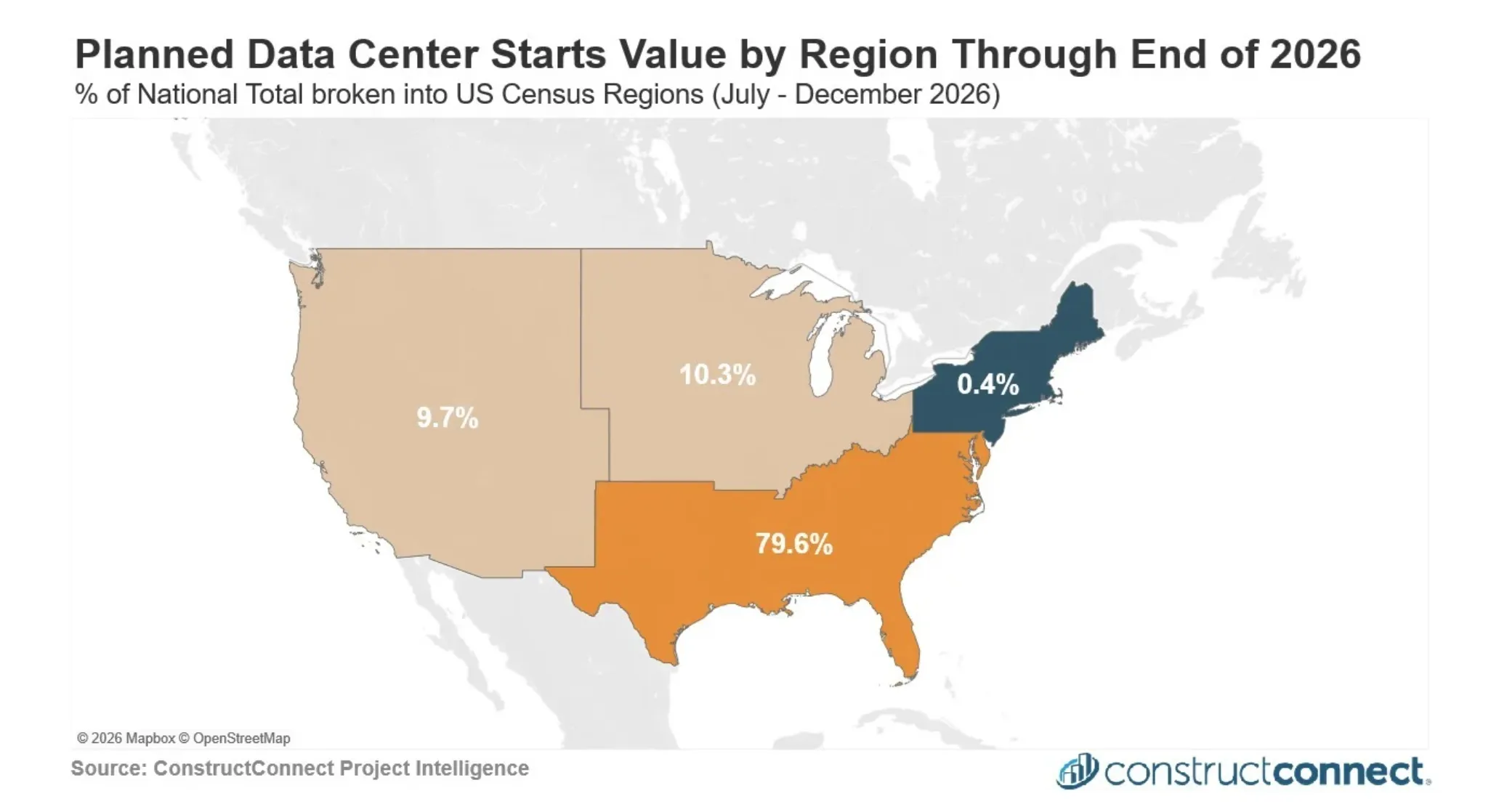
Pennsylvania and New York’s recently enacted restrictions on data center development are more substantial. Yet neither of those states are particularly important to the AI buildout. Taken together, New York and Pennsylvania host only about 6.5 percent of America’s data centers, according to Data Center Map.
And their share of all pending developments is even more negligible, as the trade publication Construction Connect has illustrated:

Meanwhile, although half of contested data center projects are now failing, many still go undisputed. In the aggregate, cancellations have not kept pace with construction or new development. In the first quarter of this year, at least 3.5 gigawatts of data center capacity were canceled amid local opposition, in Heatmap’s tally. During the same three months, at least 36 GW of capacity were added to the US pipeline of proposed and active projects, according to the analytics firm Wood Mackenzie. As of April 1, that pipeline contained a total of 106 GW worth of developments that had already survived the permitting gauntlet.
To be sure, cancellations have risen sharply since March. By Heatmap’s count, at least 13 gigawatts of capacity have been nixed so far this year. But the capacity of permitted projects has also grown since April 1. And the ratio between blocked and active developments has not radically changed, according to industry analysts.
“At this point, we do not think the recent wave of opposition and policy intervention has materially changed our national capacity growth trajectory,” Maya Barkin, an analyst at the AI industry research firm SemiAnalysis, told me.
Indeed, monthly construction spending on data centers in the US hit a record high this June.
In short, data centers are marching forward despite taking heavy fire, like a pack of gut-shot zombies.
The secrets of the AI buildout’s success
Why has the AI buildout proven so resilient? There are at least two reasons.
First, and most importantly, demand for computing power remains astronomical. As frontier AI companies have built out larger models — and consumers and companies have increased their use of artificial intelligence and digital services — our economy’s appetite for computation has far outstripped supply. According to a recent report from the commercial real estate firm JLL, 99 percent of North America’s data centers are occupied. What’s more, of the 66 GW of data center capacity currently being constructed in JLL’s count, 95 percent has already been reserved.
Second, data center projects are unusually location-flexible. If a housing developer gets chased out of San Francisco’s suburbs by zoning rules and local opposition, it can’t relocate its condo tower to a mostly uninhabited stretch of Nevada desert. By contrast, data centers can — and do — operate in the middle of nowhere.
For certain purposes, these facilities need some proximity to the users they serve; you can’t adequately support online gaming in New York City with data centers on the West Coast. But even in such cases, servers merely need to be in the same broad region. The hyperscale facilities used to train AI models, meanwhile, can be located virtually anywhere with land, fiber optic cables, a modicum of labor, and electricity (and now that many data centers are powering themselves through on-site natural gas plants, even the latter is potentially expendable).
Taken together, these two realities make data center construction extremely difficult to choke off. Sky-high demand for compute means that hyperscalers can afford to throw a lot of money at localities, in order to secure a project’s approval. And location flexibility makes it very difficult for data center developers to run out of host jurisdictions, particularly when so many rural counties throughout the United States are starving for revenue and investment. Thus, unless Congress imposes a national moratorium, development deals will almost certainly keep getting struck.
“I think companies will need to open up their wallets and make sure that communities receive clear benefits,” John Arnold, a billionaire investor and philanthropist who sits on Meta’s board (and whose foundation has given funding to Vox), told me. “There will be places that raise their hands and say, ‘For X amount of benefit, we will welcome you into the community.’”
Just this week, West Virginia Gov. Patrick Morrisey signaled that he was moving forward with plans to encourage data center development and use the consequent revenue to slash the state’s income tax.
Municipal permitting won’t preempt the robot apocalypse
On one level, all this may seem to validate anti-data center activism: If there are countless potential locations for these facilities, then why should any community host one it doesn’t want?
This said, many oppose new data centers out of concern for their aggregate impacts, rather than their local ones. Climate activists fear that the AI buildout will generate perilous increases in carbon emissions. Populists on the right and left, meanwhile, want to slow the progress of artificial intelligence, so as to prevent the technology from causing mass unemployment — and/or human extinction.
For these factions, the buildout’s resilience has more complicated implications. If state and local bans are unlikely to end the boom, then green groups might be unwise to push for such measures in relatively climate-conscious areas. After all, doing so could shift development toward jurisdictions with less renewable energy, and/or fewer restrictions on carbon pollution. Given that risk, blue-state environmentalists may do more to mitigate AI’s climate impacts by regulating data center development than by banning it. Specifically, climate groups could demand that hyperscalers help bankroll the vast expansions of clean energy and transmission infrastructure that the green transition has always required.
For AI doomers, on the other hand, local bans may have some instrumental value. Moratoria and other restrictions are surely slowing the data center buildout at the margin. Still, as long as hyperscale facilities remain location-flexible — and tech companies stay well-capitalized — AI infrastructure will get built somewhere. A national moratorium could buy significant time. But ultimately, humanity’s security from the risks of AI hinges less on whether data centers get built than on what companies are allowed to do with them — and how the wealth they generate is distributed.
The data center rebellion is among the most remarkable popular movements in recent memory. But it is arrayed against one of the largest investment frenzies in human history. Unless or until the AI industry’s alleged “bubble” bursts, its buildout will be exceptionally difficult to stop. Yet where that buildout happens, how it’s powered — and what communities extract from it — are all up for grabs (and, increasingly, being grabbed).

Before joining Sequoia Capital in 2020 as chief digital and information officer, Avon Puri spent over a decade running infrastructure at Rubrik and VMware. Three years ago, as large language models began showing their true potential, Puri, alongside another Sequoia IT leader, Sudheer Dhurjati, recognized that AI could help autonomously solve a major challenge for infrastructure engineers—preventing tech outages before they occur.
The two tech veterans realized that instead of reacting to system failures after the fact, they could build a tool to predict them. This insight led them to build Empirik, a product that tracks system changes and infers their potential ripple effects across the entire infrastructure.
Sequoia recognized that Empirik could be a new type of observability tool that helps prevent and resolve incidents. After incubating the startup in 2023, Sequoia recruited former Quantum Metric CPO and Salesforce observability VP Kartik Chandrayana as CEO earlier this year.
Empirik announced Tuesday that it is spinning out as an independent company after raising $21 million in seed funding from Sequoia, Canapi, and Alumni Ventures.
“There has always been a lot of money spent in keeping systems up and running,” Sequoia partner Bogomil Balkansky told TechCrunch, adding that most existing observability tools fail to understand complex system dependencies. Empirik, he claims, is one of the first dedicated tools focused on tracking changes across massive environments. It acts as an autonomous “traffic cop”—permitting low-risk changes, setting guardrails on larger ones, and flagging the most dangerous updates for human review.
By serving as an autonomous infrastructure engineer, Empirik allows busy DevOps and site reliability engineering teams to offload routine troubleshooting and focus on higher-value priorities.
Since launching earlier this year, Empirik has already brought on customers ranging from startups to several Fortune 500 players, including S&P Global, Guardant Health, and a major consumer packaged goods (CPG) company.
Empirik’s goal is to do for infrastructure engineers what Cursor and Claude Code did for software developers: automate certain tasks so they can work significantly faster.
As AI accelerates the pace of software development, tools that help infrastructure engineers keep up with constant system changes are more vital than ever, Chandrayana told TechCrunch.
“What agentic AI did for software, Empirik wants to do for infrastructure engineering,” he added.
As for competition, Balkansky claims Empirik is in a category of its own for now, acting as a complementary layer to AI SRE platforms like Resolve and Sequoia-backed Traversal.
When you purchase through links in our articles, we may earn a small commission. This doesn’t affect our editorial independence.
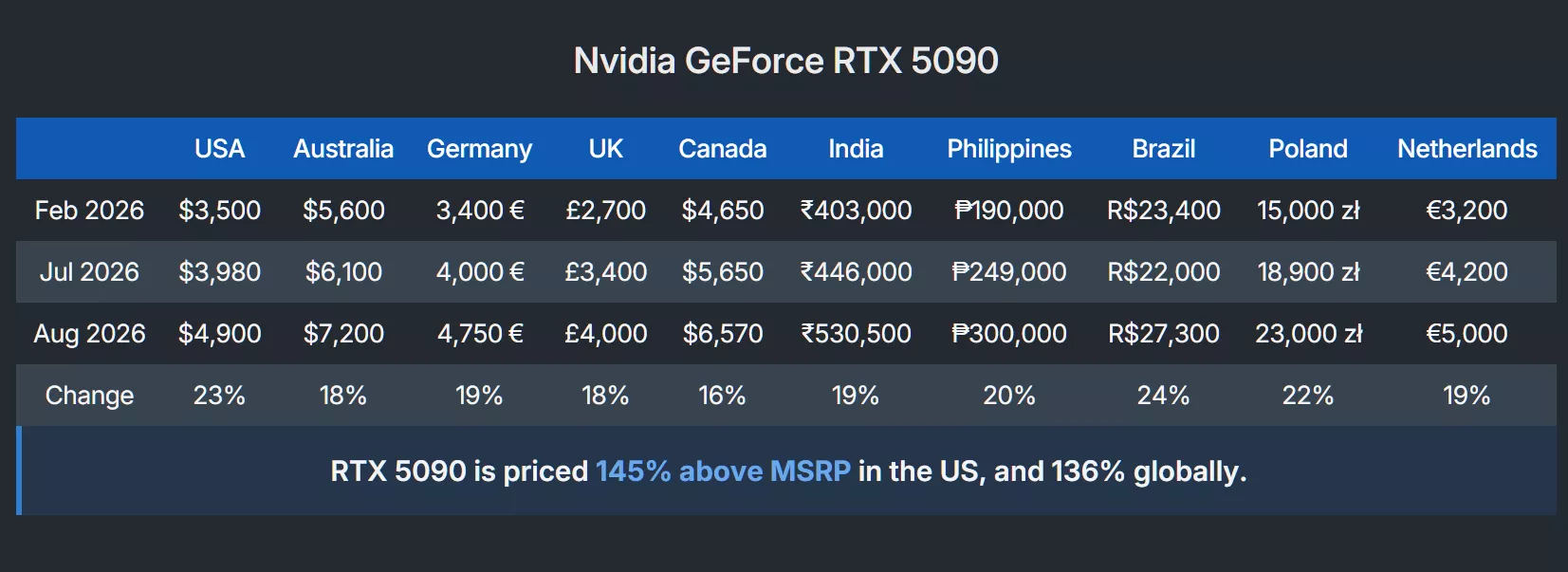
WTF?! Remember those halcyon days when the RTX 5000-series was announced and we were all shocked by the prices, especially the $1,999 RTX 5090. Now, the average price for the consumer flagship is pretty much $5,000, with one regular model hitting an actual $5,090.
As we noted in our recent graphics card pricing feature that shows just how quickly prices are rising, the RTX 5090 was around $4,900 in the US recently.
Prices for the card were up 20% over the past month and are now 41% higher than in February, by far the largest six-month increase of any card in the list. The massive increase since launch means it’s now 145% above MSRP.
Just days later, RTX 5090 prices have climbed even further. It’s at the point now where even regular cards have reached an apt $5,090 – the price of an Asus TUF Gaming OC.
There has already been a $5,090 RTX 5090 announced, but it’s far from normal: The special-edition MSI RTX 5090 Lightning Z, a 1,000W card that some describe as essentially an RTX 5090 Ti. The spec list includes two 12V-2×6 power connectors, a 3 oz copper PCB, a 40-phase VRM, and a carbon fiber backplate. It also has an attached AIO liquid cooler and an 8-inch display panel.
Now, though, that price has become the standard for many RTX 5090 cards.
But there’s an even pricier RTX 5090: the Asus ROG Astral RTX 5090 Edition 20. Another special edition card, Newegg lists it for $5,740. We recently covered the story of someone who paid $10,000 for an Asus anniversary bundle that included the card, only for the order to be inexplicably canceled, forcing them to pay an extra $500 for another one.
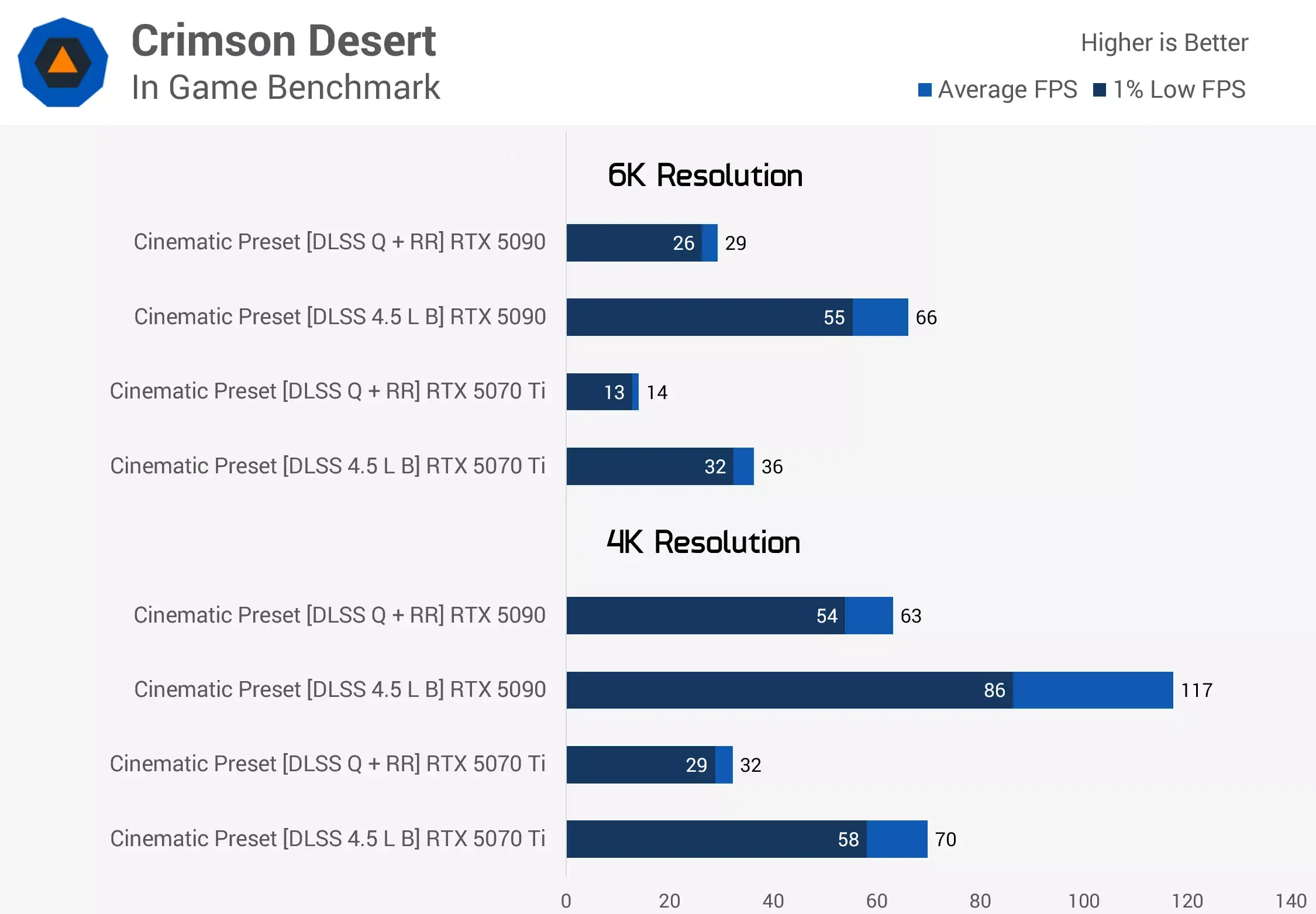
The question now is whether anyone even buying these cards? As we pointed out in our feature, the RTX 5090 is no longer fast enough, at least not when it comes to gaming at 6K on a monitor that supports the resolution.
What’s just as concerning is the prospect of the RTX 5090’s price, and that of pretty much every other graphics card, continuing to rise. It’s little wonder that the RTX 5000 Super series seems to have been canceled indefinitely. And who knows how much RTX 6000-series cards will cost. An RTX 6090 for $6,090, presumably.


Hackers delivered malicious updates to the Virtualizor VPS management software after hijacking BGP routing for its update infrastructure and redirecting update requests to malicious servers.
Virtualizor is a legacy web control panel from Softaculous that hosting providers use to create, sell, and manage virtual private servers (VPS).
An urgent notice from the vendor warns that between 20:57 UTC on August 28 and 06:10 UTC on August 30, an attacker rerouted a block of Hetzner-hosted IP addresses in a BGP (Border Gateway Protocol) hijacking attack.
This enabled the threat actor to divert traffic from Softaculous software update systems and the client/billing portal.
BGP hijacking occurs when a network operator falsely announces a route to IP addresses belonging to another organization. Other organizations may accept the fraudulent route as the preferred one.
An attacker receiving traffic this way can modify or redirect it to malicious destinations.
Softaculous says that the BGP hijacking allowed the hackers to deliver a malicious Virtualizor update to a small number of installations.
“We have confirmed that a malicious Virtualizor update package was delivered to a small number of installations that checked for updates while their traffic was being diverted,” the vendor says.
“This affected a handful of servers rather than the general Virtualizor user base.”
Because the requests were redirected to the attacker, the software vendor does not have logs. Softaculous recommends that Virtualizor operators check for the service:
/etc/systemd/system/java-jre-update.service
If found, admins should rotate and restrict API credentials, and audit systems for unauthorized SSH keys, accounts, scheduled tasks, and outbound connections.
Also, users who accessed the Softaculous client area or entered payment information during the incident window should reset their passwords, review account activity, and monitor card statements.
Softaculous’s investigation into the incident is still underway, but there are no indications that any of its other products were impacted.
Softaculous says routing has now been restored, the fraudulent certificate was reported for revocation, and a new version of Virtualizor, number 3.2.9.9, was released on September 1 with a “Security Analyzer” tool in the admin panel.
The company also plans to implement cryptographic signing for all software packages going forward and migrate to better infrastructure.

Overall prevention scores can hide what happens after initial access. Once attackers are using valid credentials, prevention drops sharply.
The Blue Report 2026 measures defenses technique by technique across 338 million simulations run in customer production environments.

from the big-giant-babies dept
Our full-diapered mad king is at it again, this time urging FCC boss Brendan Carr to go after media companies for the crime of….simply pointing out his terrible, crashing polling numbers:

Trump last week also posted a long, rambling screed on his personal propaganda website, vowing that NBC News‘ Meet the Press moderator Kristen Welker would be “reported to the FCC for rebuke or punishment” for the crime of accurately pointing out Trump’s political endorsements don’t carry the weight they used to.
The comment Welker actually made, as is par for the course for corporate media shows like Meet the Press, was just about as timid as you can get, simply stating Trump endorsements have seen “mixed results”:
“He’s going to loom large over these midterms. There’s no doubt about that. He, of course, has endorsed a slate of candidates in the primaries. He’s had some mixed results, but most recently, his pick of Senator Darline Graham, of course, the sister of the late Senator Lindsey Graham, was successful in her primary battle, so now she takes on Dr. Annie Andrews in South Carolina.”
The irony is that these are simply timid corporate media outlets that can often barely muster the courage to tell the truth (which, in this case, is that Trump’s endorsements will likely be toxic during the whole midterms). If Meet the Press offends Trump so deeply, it would be interesting to see his response to a healthy and vibrant media (if we had such a thing) firm in its conviction to the truth.
It goes without saying that the FCC has no authority to police accurate polling, journalism, or analysis of factual reality. Though overconfident Brendan Carr may certainly try.
As we’ve explored at length, the Trump FCC has been engaged in multiple overlapping manufactured investigations into ABC for a variety of “offenses,” ranging from comedian Jimmy Kimmel making fun of the president’s wife, to the morning talk show The View hosting politicians that Trumpism is clearly worried could erode Republican control of the Senate.
In the latter case, the Carr FCC appears to have colluded with right-wing local broadcast companies to falsely make it appear that a local ABC affiliate violated dated FCC “equal opportunity” rules by hosting Texas Senate hopeful James Talarico last February. Carr used this to try and justify an unprecedented early review of ABC’s eight local affiliate broadcast licenses.
ABC, in response, recently filed suit against the FCC for broad First Amendment violations, suggesting that as Trump’s health, political power, and influence wanes, the empty threats designed to chill media outlets’ desire to accurately criticize the president simply don’t carry the same weight.
Filed Under: 1st amendment, brendan carr, donald trump, fcc, free speech, kristen welker, polls

Sonos has a new soundbar in its streaming-centric lineup: the Dolby Atmos-capable Beam Ultra. It falls between the existing Beam and the flagship Arc Ultra.
The Beam Ultra is the Dolby Atmos upgrade of the Beam Gen 2 — which remains in the lineup– and adds physical, upfiring drivers and “warmer bass” to become a 7.1.2-channel soundbar.
Sonos says it has redesigned the center channel for clearer dialogue, and the speaker comes with four different levels of AI Speech Enhancement as well as a Night Sound mode. The Beam Ultra also comes with the Trueplay feature for tuning the soundbar to any room.
See Also: Best Sonos Speakers for 2026
Connectivity on the Beam Ultra includes Wi-Fi, Bluetooth and HDMI eARC, while the new version of the Sonos app includes Sonos 27voice — the company’s own music assistant — and Sonos 27mcp for connecting an outside AI assistant. The Sonos ecosystem includes compatibility with dozens of streaming apps as well as the ability to add surround speakers and multiroom options.
The Beam is one of CNET’s favorite soundbars, but it has always been limited by its software emulation of Dolby Atmos — something which the Beam Ultra fixes. Adding this option between $500 and $1,000 gives Sonos users more flexibility when building their own home theater systems.
The Beam Ultra is available for preorder starting today for $699, with general availability on Sept. 29, 2026.


Recap: While popular manufacturer Keychron offers partially open-source keyboards and is working to open-source its mouse firmware, modder Juho T’s fully open-source Silakka54 design has been inspiring affordable ergonomic split keyboards for some time. A new fork from another tinkerer adds Hall-effect switches.
Fans of minimalist ergonomic split keyboards and users familiar with the Silakka54 might be interested in a new Hall-effect variant. If it catches on with resellers, it could become one of the more affordable Hall-effect keyboards available, while its open-source hardware and firmware allow for unrestricted modding.
Juho T’s original Silakka54 design first emerged on GitHub in late 2024. The 54-key split keyboard draws inspiration from the REVIUNG41 and Corne, supports 5-pin MX-style switches, and uses firmware based on the open-source QMK and VIA standards.
While the project’s GitHub repository includes instructions for building the PCB and firmware from scratch, pre-built models from unaffiliated resellers are available on stores such as AliExpress for as little as $50. As a fully open-source project, forks were to be expected, and a recent creation from modder Hanthebot introduces a useful Hall-effect option.

The Silakka54-HE mostly retains the original design and firmware support. However, in addition to adding Hall-effect switches, it supports Wooting cases and features a reversible design, with its firmware and PCB schematics based on Choi Byungyoon’s TrueStrike42. Other features include adjustable actuation points (APC), rapid trigger, full-duplex communication, and much more.
Currently available only as a DIY project, the Silakka54-HE requires the following off-the-shelf components:
- PCB x2
- SOT-23 SS49E x54
- 0805 0.1uf capacitor x62 (0.1~1uf)
- PJ320A TRRS socket x2
- RP2040 Zero x2
If the Hall-effect model proves popular with resellers, budget-friendly pre-built models might emerge for those unaccustomed to building keyboards.
DIY keyboards like the Silakka54 take customization much further than Keychron’s partially open-source offerings. Like the Silakka54, the popular manufacturer has long supported the open-source QMK and VIA firmware. Keychron also recently open-sourced its cases, plates, and keycaps, but only for use with its PCBs, stopping just short of allowing users to build its designs from scratch.
Open-sourcing mouse firmware is the next step for Keychron. The company’s upcoming ZGM firmware aims to do for mouse sensor tuning, polling behavior, and click processing what QMK did for keyboard firmware. Set to arrive in the first quarter of 2027, ZGM will feature a modular architecture designed to facilitate deep customization. Perhaps it could lead to unique, affordable mouse designs that fill a role similar to the Silakka54.

NewsBeat12 seconds ago
Transfer deadline day LIVE: Enzo Fernandez to Man City agreed, Man Utd call on Valverde, Arsenal hunt

Business1 minute ago
HallPass wants a bite of the candy category

Crypto World2 minutes ago
Arch Lending Adds PAX Gold and Tether Gold as Collateral for Crypto-Backed Loans





-

 Crypto World7 days ago
SpaceX stock could rise 75% to $240, JPMorgan says
-

 Fashion4 days ago
Weekend Open Thread: Maeve – Corporette.com
-

 Crypto World5 days ago
Bitcoin’s 22% rally now needs real demand to outlast Treasury liquidity boost
-

 Crypto World6 days ago
Warsh Jackson Hole keynote puts financial innovation first
-

 Business5 days ago
Salesforce Stock Soars 19% as Blowout Earnings and Agentforce AI Growth Silence Software Skeptics
-

 Crypto World6 days ago
Elon Musk Grok Bot Promise: We Will Make You Whole if AI Loses Your Money
-

 Business5 days ago
Apple Confirms September 9 Keynote and Reveals Its Full Pre-Order Schedule
-

 Crypto World7 days ago
Did Trump Just Move SpaceX Stock With One Truth Social Post?
-

 Business4 days ago
Onto Innovation Stock: AI’s Next Bottleneck Is Yield (NYSE:ONTO)
-
 NewsBeat6 days ago
Lindsay Clancy jury braces for closing arguments as judge tells court: ‘You’ve heard all the evidence’ – Live updates
-

 Business6 days ago
Walmart takes aim at younger shoppers with new fashion brand
-

 Crypto World4 days ago
Bitcoin price tests $82K resistance as Brandt stays long
-

 Crypto World6 days ago
NVIDIA revenue hits $96.2B as AI demand doubles
-

 Business7 days ago
Thailand’s Eastern Economic Corridor Capital City (EECiti): Key Developments and Investment Opportunities
-

 Business4 days ago
iPhone 18 Pro Pre-Orders Could Shift to Saturday as Apple Reportedly Avoids September 11 Anniversary
-

 NewsBeat7 days ago
Trump’s trade truce with China faces test with Iran effort
-
 Crypto World6 days ago
Nvidia Q2 Earnings Reveal $96.2 Billion Beat, So Why Is NVDA Falling?
-
 Tech3 days ago
Hugging Face built a $4.5 billion empire on free AI models. Now Nvidia is buying it for $12.9 billion
-
 Tech6 days ago
Claude Cowork gets its own browser that doesn’t touch your tabs, bookmarks, or saved passwords
-

 Crypto World5 days ago
Truflation calls for Fed rate cut after PCE forecast
You must be logged in to post a comment Login