
Crypto World
DOGE Initiative Resulted in Federal Employees Getting Paid Billions to Not Work, New Government Report Finds



The federal government spent an estimated $9.5 billion paying employees to not work last year, with most of the cost tied to a Department of Government Efficiency (DOGE) initiative to shrink the federal workforce, according to a new report from the Government Accountability Office.
The report, published Tuesday, found that the use of paid administrative leave increased 435% from 2023 to 2025, while associated salary costs rose sixfold. GAO estimated that $6.7 billion—around 70% of the 2025 total—was associated with the Administration’s deferred resignation program. The congressional watchdog analyzed payroll data from 76 agencies representing around 95% of the civilian federal workforce.
In January 2025, the Trump Administration offered roughly 2 million federal workers the option to resign while continuing to receive full pay and benefits through Sept. 30. The government-wide offer was meant to encourage voluntary departures under an arrangement known as deferred resignation. The Office of Personnel Management directed agencies to place employees who accepted the offer on paid administrative leave until their departure. Some agencies later conducted additional deferred resignation programs.
According to federal workforce data, 139,963 federal employees left the government through deferred resignation programs.
The initiative was part of the Trump Administration’s broader campaign under DOGE to cut what it saw as wasteful federal spending. Tech billionaire Elon Musk, who became the public face of DOGE before leaving the Administration in May 2025, initially promised to save the federal government $2 trillion, before lowering the target to $1 trillion. DOGE’s website ultimately claimed $215 billion in estimated savings. That figure has not been independently confirmed. In a separate review of $110 billion in claimed savings, GAO found that some estimates were incorrect or unsupported. (DOGE officially shut down in July, after OPM absorbed most of its functions in November.)
Federal data showed a net decline of 271,363 civilian federal employees—around 12% of the federal workforce—between President Donald Trump’s inauguration and July this year.
Those reductions were not uniform across agencies. Between December 2024 and January 2026, the largest decline was at USAID, where the workforce fell 95%, according to a separate GAO analysis. Staffing declined 46% at the Education Department, 37% at the General Services Administration, 34% at OPM, 33% at the National Science Foundation, and 31% at the Department of Housing and Urban Development. The Department of Homeland Security, by contrast, reduced its workforce by less than 1%.
Some agencies later had to replace workers they paid to leave. The Partnership for Public Service identified 20,557 hires by June 2026 in the same types of roles as employees who left through deferred resignation.
OPM Director Scott Kupor defended the program’s economics in a letter responding to the GAO report. Kupor said OPM expects the workforce reductions to save $20 billion per year, while the $6.7 billion was a one-time cost.
“This distinction is crucial: The savings recur every year, while the administrative leave costs with the DRP were incurred once,” Kupor said.
The Trump Administration has pursued other efforts to reduce the federal government. Trump imposed a government-wide civilian hiring freeze on his first day in office and subsequently directed agencies to hire no more than one person for every four departures, except for positions of national security, immigration enforcement, and other priorities. Agencies were also directed to review whether probationary employees should be retained, prepare plans for large scale layoffs, and consider eliminating positions and functions not required by law.
The government has faced extensive litigation over its workforce cuts. In September 2025, a federal judge ruled that OPM had exceeded its authority by directing agencies to fire thousands of probationary workers, although the judge did not order their reinstatement. Separately, the Supreme Court stayed a lower court injunction in July 2025, allowing agencies to move forward with layoffs while litigation continued. Litigation has since shifted to challenges to individual agency layoff plans.
Earlier this month, U.S. District Judge Susan Illston ruled that a DHS plan to cut staffing at the Federal Emergency Management Agency (FEMA) by 50% was unlawful.
During the October 2025 government shutdown, the Trump Administration took the unprecedented step of threatening permanent cuts, using the funding lapse to accelerate its government downsizing campaign. Federal agencies issued layoff notices to around 4,100 employees and the Administration warned that more than 10,000 jobs could be eliminated. Congress ultimately nullified those layoffs by statute when the shutdown ended in November, and required agencies reinstate employees and provide back pay.
On Tuesday, Sen. Patty Murray (D, Wash.), the top Democrat on the Appropriations Committee, accused the Administration of wasting money while weakening public services.
“Trump spent billions to push out experienced and badly needed experts across government,” Murray said. “This was the most expensive way imaginable to make government worse.”

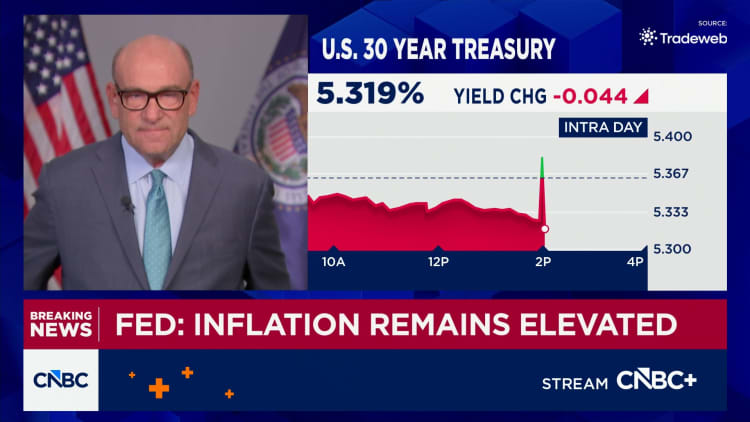

The Federal Reserve on Wednesday approved its first interest rate hike in more than three years and indicated another is to come, as part of an effort aimed at combating inflation brought on by spiraling oil prices and other factors.
In a move that markets widely anticipated, the central bank’s Federal Open Market Committee voted 12-0 to increase its key interest rate by a quarter percentage point, or 25 basis points. The move brought the overnight funds rate to a target range of 3.75%-4%.
“Inflation remains elevated,” the committee said in its brief post-meeting statement. “Today’s policy action will support a timelier return to the Committee’s 2 percent goal. The Committee will deliver price stability.”
During a news conference, Chairman Kevin Warsh said inflation has been “too high … for too long.”
“We must be confident that underlying inflation is moving to our objective clearly and at sufficient speed,” he said. “Today, the FOMC decided that this standard has not been satisfied.”
Warsh further explained that recent economic reports showed the economy, including the labor market, was strong. However, inflation remained above the central bank’s target, and added that tension in the Middle East also contributed to the decision.
“All three of of those things lend themselves to a firm unanimous decision today,” he said.
Highly anticipated
Despite a raft of conflicting recent statements from policymakers, markets had priced in a better than 90% chance that the FOMC would approve the increase, though there was chatter about the possibility of multiple dissents.
Persistently high inflation readings coupled with statements from Warsh a few weeks ago had convinced Wall Street that the Fed would OK its first rate increase since July 2023.
Updated projections the committee released Wednesday showed that a strong majority of officials think another hike is possible later this year.
The dot plot grid of individual officials’ expectations indicated that 16 of the 18 participants – Warsh has chosen not to submit a dot since taking the position – expected another rate increase, with four of those seeing two more as possible. Two participants expected the committee to stop at one hike.
However, there are no increases penciled in for subsequent years, with one cut each indicated for 2028 and at least one for 2029.
Officials also nudged up their expectations for inflation this year.
They see the headline personal consumption expenditures price index at 3.7% and core excluding food and energy at 3.4%, both 0.1 percentage point higher than the last update in June. The Fed doesn’t expect to reach its inflation target until 2029, though it sees both measures dropping off sharply in 2027 – 2.3% for headline and 2.5% for core.
The committee had been on hold all year and was expected to stay there, until the tide began turning towards a hike in late August.
Fed rarely moves once
The Fed rarely only moves once, as policymakers generally eschew incremental decisions when they think inflation is too high and needs elevated rates, or when growth is too slow and the Fed tries to boost demand with lower rates.
While the Fed’s action was expected, the rationale behind the hike was unusual.
The Fed generally looks through the kind of inflation the economy is experiencing now, with the higher fuel costs from the Iran war and the lingering impacts from tariffs. However, officials in recent days have weighed the cost of continuing to look through the price increases, particularly in light of a stabilizing labor market. The committee lowered its outlook for the unemployment rate to 4.1%, down 0.2 percentage point from June.
The worry now is that the duration of the energy prices could raise inflation expectations and start to spread through the economy. Economists also see expanded investment in artificial intelligence as a potential inflationary factor.
Also, the “transitory” episode from a few years ago is still fresh in policymakers’ minds, as Fed officials thought the supply-and-demand shock from the Covid pandemic eventually would fade. Instead, inflation readings hit 40-year highs before the Fed decided to act.
In July, the debate generated considerable dissent on the policy view, with three FOMC members voting against the decision to hold, preferring instead a quarter-point hike.
At this week’s meeting, 2027 was a fairly close call, with eight officials pointing to another hike, six seeing the funds rate holding steady and four envisioning cuts.
Markets already have been pricing in higher rates across the spectrum. The S&P 500 rose after Wednesday’s announcement.
Treasury yields have been surging. The 10-year note has risen about a quarter percentage point since Warsh’s remarks at the Fed’s Jackson Hole, Wyoming, symposium on Aug. 28. The benchmark is up about a full percentage point since its February low. The 2-year note, which is most sensitive to rate expectations, has seen even sharper gains.
Borrowing costs also have been on the move. A 30-year fixed rate mortgage had soared to 7.19%, up some 38 basis points since the Jackson Hole speech and more than a full percentage point from a year ago, according to Mortgage News Daily.
In the wake of the decision, Treasury yields were lower, a signal that investors were encouraged by the central bank’s attempt to tamp down inflation. Yields and prices move in opposite directions.
“Today’s FOMC could mark the moment when the FOMC regained a measure of spine,” Brad Conger, chief investment officer at Hirtle & Co. said. “There were many arguments for standing still. But for once, the committee sided with main street.”
“Inflation is a pervasive concern, and its uncertainty is impeding decision making among all businesses. One swallow doesn’t make a spring, but we might have just caught a glimpse of Volckerian decisiveness as opposed to the eternal sycophancy of the Powell era,” Conger added.
Crypto World
Both Democrats and Republicans Are Increasingly Worried About AI’s Environmental Impact

There are currently 1,287 data centers in operation in the U.S., with more than 2,000 planned projects, according to Clearview, a market intelligence company tracking U.S. power infrastructure and data center development. Virginia and Texas currently have the most data centers in operation, but many new developments are planned in rural areas in the South and Midwest. The growth is driven by the rise in hyperscale data centers, which are larger, more powerful, and often used to train and run large-scale AI models.
Despite the boom, Americans seem to be increasingly supportive of measures to regulate growth. About 6 in 10 Americans said they would support limiting the number of new data centers that can be built—including most Democrats and Republicans—the survey found.
Democrats seem to be the most concerned by the environmental impacts of data center growth. About two-thirds say they are “extremely” or “very” concerned about how AI will affect the environment, the poll found, compared to about half in 2025. By contrast, about half of Independents and 4 in 10 Republicans are highly concerned about the environmental impact of AI.


Ethiopia has reportedly reduced electricity delivered to Bitcoin miners to 23% of contracted levels as lower water inflows strain the country’s hydroelectric reservoirs.
On Tuesday, Bloomberg reported that El Niño intensified dry conditions in the east African country, reducing water inflows into its reservoirs by 20%. Ethiopian Electric Power (EEP) CEO Ashebir Balcha said the company cut power to miners to prioritize households and manufacturers.
Balcha said EEP initially reduced deliveries to 75% of contracted levels, easing to 50% and then 23%. The company will reassess conditions in October and could impose further reductions or even restrict electricity exports to neighboring countries, according to the report.
Bitcoin miners reportedly accounted for 35% of EEP’s revenue last fiscal year and consume almost one-third of Ethiopia’s electricity output. The country’s inexpensive hydropower has attracted international miners, including Phoenix Group, which expanded its Ethiopian mining capacity to 132 megawatts in April 2025.
Bitcoin mining power growth faces pressure from halvings and AI
Separately, economist and The Bitcoin Standard author Saifedean Ammous said in a Tuesday X post that global Bitcoin mining electricity consumption and capital expenditure may have peaked in 2024 to 2025.
Ammous said Bitcoin’s price would need to rise more than 18.92% a year just to keep the dollar value of newly mined coins growing, even before accounting for dollar depreciation. Under Bitcoin’s halving mechanism, the amount of Bitcoin awarded to miners is cut in half about every four years.
The price of the biggest crypto by market cap is down by more than 35% over the last 12 months, Yahoo Finance data shows.
“Given this decline in mining rewards, it would be expected that bitcoin mining would slow down, or even contract,” Ammous said. “Unless there is a major turnaround in this metric, this trend may continue indefinitely.”
Related: Bitcoin miner Phoenix Group adds 52 MW of mining capacity in Ethiopia
He also cited competition from artificial intelligence data centers, which gives miners an alternative way to monetize their electricity connections and infrastructure. Citing VanEck data, Miner Weekly estimated in June that public miners could require around $50 billion to develop their planned AI infrastructure as weaker mining economics encourage companies to redirect capacity.
Ammous said his conclusion as a testable hypothesis, acknowledging that substantially higher transaction fees or a sustained recovery above Bitcoin mining’s previous electricity-consumption peak could invalidate it.
Magazine: AI may already use more power than Bitcoin — and it threatens Bitcoin mining
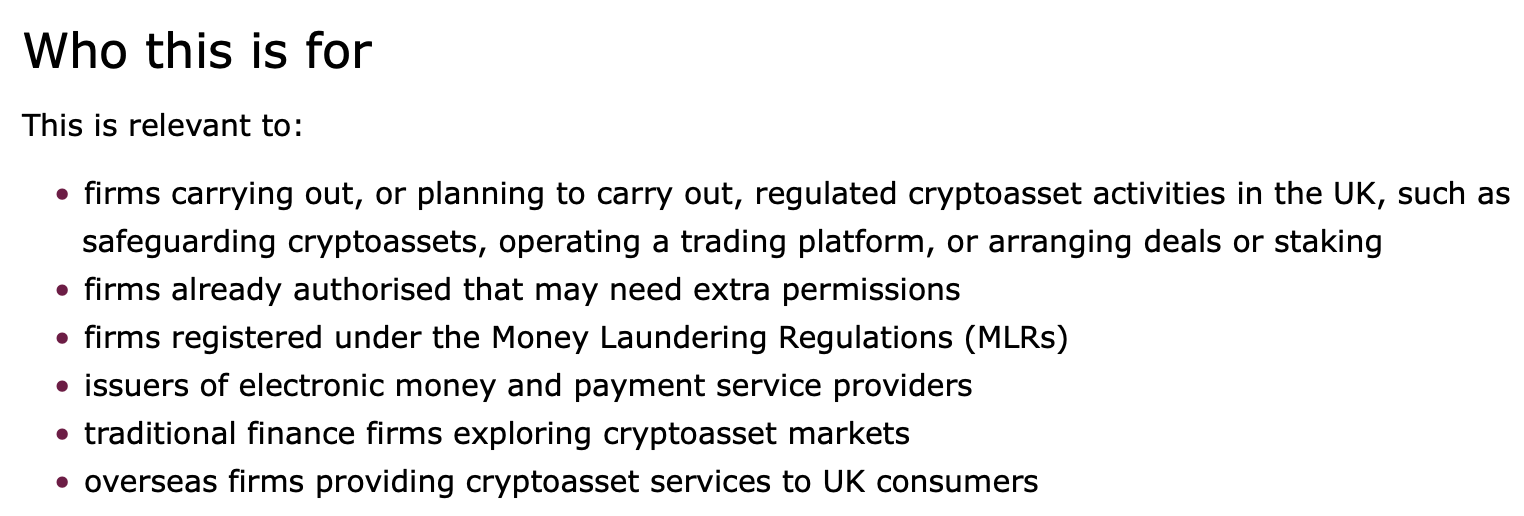
The UK Financial Conduct Authority has issued final guidance outlining when crypto activities may require authorization under the country’s incoming regulatory regime.
The guidance covers activities such as issuing qualifying stablecoins, operating crypto trading platforms, dealing and arranging transactions, safeguarding cryptoassets and arranging crypto staking. It is intended to help firms determine whether their activities fall within the regulatory perimeter and which permissions they will need to operate under the new framework.
Existing registrations and permissions will not automatically convert under the new regime, meaning firms will need to determine whether they require FCA authorization or a variation of permission.
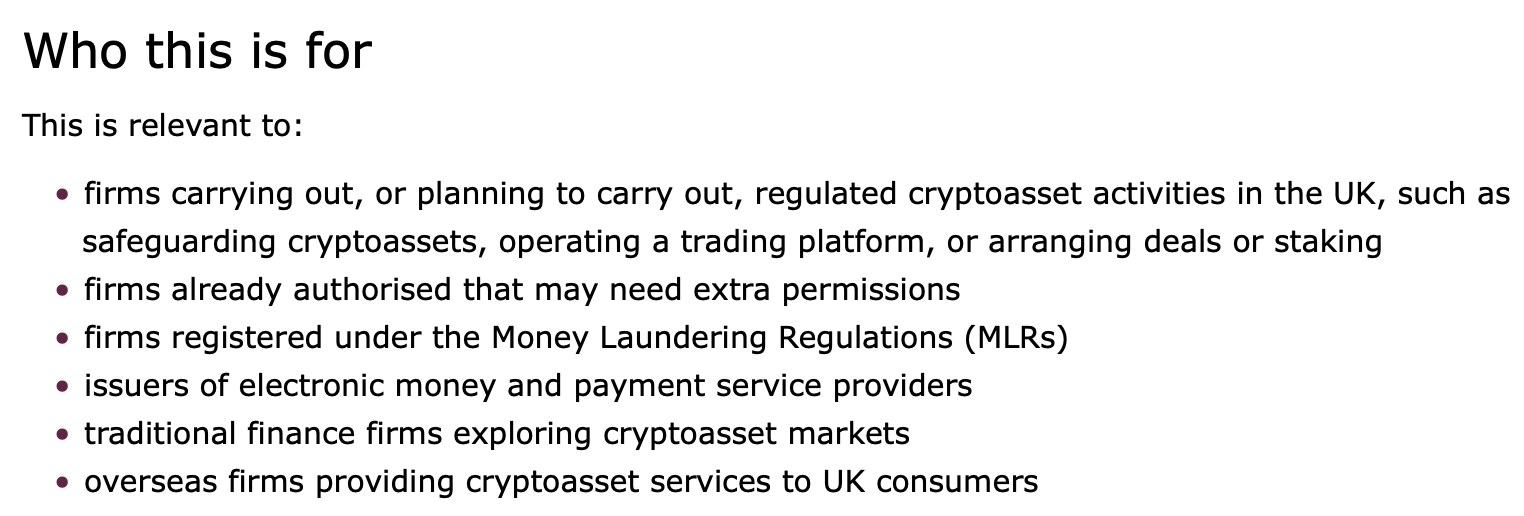
Firms covered by the FCA’s new crypto authorization guidance. Source: Financial Conduct Authority
“Getting ready for regulation starts with understanding how the regime applies to your business,” said David Geale, the FCA’s executive director of consumers, payments and competition. “This guidance gives firms the clarity they’ve asked for so they can prepare with confidence.”
The FCA will open applications on Sept. 30, with a Feb. 28, 2027 deadline for firms seeking transitional arrangements ahead of the new regime taking effect on Oct. 25, 2027. The regulator also plans to consult on further changes to its perimeter guidance later this year.
Related: US, UK launch joint alliance targeting crypto scam centers
UK crypto regulatory framework takes shape
The FCA’s latest guidance comes as the UK moves toward implementing a broader regulatory framework for digital assets.
Parliament approved regulations bringing cryptoassets within the FCA’s regulatory remit in February, while the regulator finalized a package of rules and guidance in June.
Last week, the House of Lords voted 194–138 to add an amendment to the Financial Services and Markets Bill requiring the Treasury to develop a digital asset strategy covering cryptoassets, stablecoins, tokenized securities and digital financial infrastructure within 12 months of the bill becoming law.
The FCA has also been advancing its work on tokenized assets. On Monday, the regulator sought feedback on whether some tokenized gold products should be exempt from UK fund rules, while the FCA and Bank of England said they plan to publish a roadmap for tokenization in wholesale financial markets later this year.
Magazine: Why are AI’s biggest companies suddenly asking to slow down?


The hackers behind a data breach at Revolut are demanding $3 million worth of monero (XMR) within 24 hours, threatening to sell the stolen customer data to other criminal groups if the bank refuses to pay, according to the Financial Times.
The group, which calls itself “iamnotavillain,” posted the demand Wednesday alongside a countdown clock, the FT reported. It asked Revolut to send 6,000 XMR, a cryptocurrency designed to obscure transaction details.
At least 680 Revolut customer accounts were affected by the breach, according to the report.
The hackers told the FT they chose their targets using blockchain analysis to find Revolut accounts with significant crypto holdings.
The group sent the FT a 60-second screen recording that appeared to show some of the data it obtained. The video included passports, driving licences, photos used for know-your-customer checks and transaction histories, according to the newspaper.
The breach came after attackers posed as government officials and sent requests for information that passed Revolut’s checks. Revolut handed over customer records before discovering the requests were fraudulent, according to notices previously sent to affected customers.
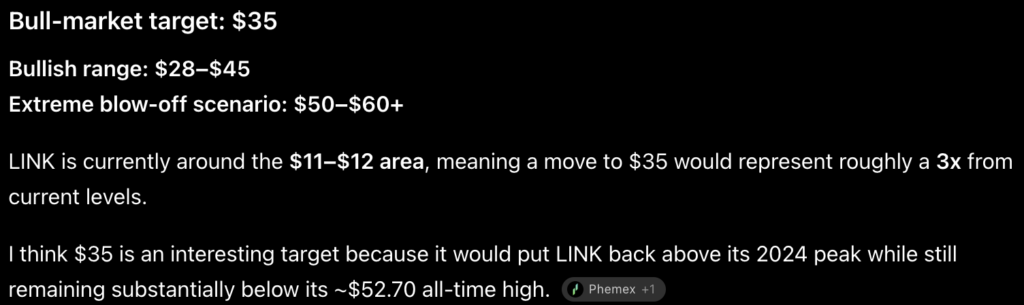
If we assume that full-blown bull-market conditions return between now and the end of 2026, Microsoft Copilot AI predicts that Chainlink (LINK) will hit $35 by January 1, 2027.
Currently, LINK is trading around $11–$12, so a move to $35 would be roughly a threefold increase from current levels. I believe $35 is a compelling target because it would place LINK above its 2024 peak while remaining well below its all-time high of approximately $52.70.
LINK has a history of being highly cyclical. During the 2020–21 bull market, it surged from around $1.77 at the beginning of 2020 to an all-time high of $52.70 in May 2021. However, it then endured a substantial bear-market drawdown and closed 2022 around $5.57.
This historical performance matters because LINK has already shown that a $20–$30 range is not unusual during a strong crypto market.
The key question now is what will happen if the overall market transitions from the current relatively weak environment into a genuine altcoin bull market.
Microsoft Copilot AI Predicts Chainlink: Technical Analysis Supporting the LINK Thesis
The 2026 chart currently indicates a substantial recovery from a capitulation low. LINK dropped from about $14.40 at the beginning of the year to around $7.00 in June, before rebounding into the $11–$13 range.
Recent data show increases of 13.5% in July and 38.2% in August, with August taking LINK from approximately $8.19 to over $12.50 at one point during the month. This change indicates a significant shift in momentum.
A recent golden cross occurred in the moving averages, with the 50-day average crossing above the 200-day average in late August. Current estimates place the 50-day average at about $9.60 and the 200-day average at about $9.00.
The immediate technical progression to watch is as follows: $12.50 to $14.40, then a run toward $17.50 and $20. $27–31 to $35 completes the move.
The first major hurdle is approximately $12.50–$14.40, where LINK needs to establish itself above this zone. Recent analysis has identified $12.50 as the key breakout level, with $13 as the next target if resistance breaks.
Once LINK surpasses the $17–$18 range, the chart becomes much more interesting, as this area incorporates the swing structure from 2025/2026. The next crucial zone to watch is $27–$31, which includes LINK’s significant highs from 2024–2025.
A clean breakout through this range would indicate that LINK is entering price discovery territory relative to the most recent cycle, making the $35 target plausible.
Supercharge Your Trading in 2026 With BloFin AI Trading Bots
Historical Price Action Supports the $35+ Possibility
LINK’s past bull-market moves illustrate just how explosive it can become when momentum builds:
2019: ~$0.30 → $3.04
2020: ~$1.77 → $20.11
2023: ~$5.13 → $17.67
2024: ~$9.49 → $30.94
2026 low to current: ~$7 → ~$11–12
LINK’s most substantial annual gain occurred in 2020, when it rose over 500%. Even 2023 yielded approximately 165% annual growth.
While past performance doesn’t guarantee future results, it provides a useful framework for a bull-market scenario: LINK has historically responded disproportionately when the crypto liquidity cycle turns positive.
A move from around $11.50 to $35 would be about +204%, a notable increase but not historically extraordinary for LINK during a significant crypto expansion.
Make Your Prediction Count With $25 For Free on Kalshi
Maxi Doge Targets Early Mover Upside as LINK Tests Key Levels

A steady price with two major catalysts still pending is exactly the kind of setup that tests conviction. LINK holders aren’t wrong to stay positioned, as the fundamentals case is intact, but at an $8Bn-plus market cap, even the most bullish price action isn’t going to double anyone’s stack overnight. That math pushes some capital toward earlier-stage plays with more room to run.
Enter Maxi Doge ($MAXI), an Ethereum-based meme token built around leverage-trading culture rather than passive holding. The project has raised $4.8M in its presale at a current price of just $0.0002839 per token. Staking offers a huge 65% APY.
Standout features include holder-only trading competitions with leaderboard rewards and a Maxi Fund treasury earmarked for liquidity and partnerships. The pitch is blunt: 1000x-leverage energy, gym-bro marketing, and a stated goal of outpacing original DOGE on the charts.
Get Ahead of Next Meme Coin Launch Here
Discover: The Best Token Presales
The post Microsoft Copilot AI Predicts Chainlink Could Hit $35 by 2027 appeared first on Cryptonews.


Bankrupt crypto lender Celsius Network’s estate has sued BitMEX over forced liquidations during the March 2020 Covid crash, seeking the return of 6,360 BTC now worth roughly $495 million.
The complaint was filed Sept. 12 in the U.S. Bankruptcy Court for the Southern District of New York by Blockchain Recovery Investment Consortium, the litigation administrator appointed in the Celsius bankruptcy. Defendants include HDR Global Trading, ABS Global Trading, Shine Effort, 100x Holdings and HDR Global Services — entities spanning Bermuda, the Cayman Islands, England, Hong Kong, the Seychelles and the U.S.
Celsius says it lost 1,325.84 BTC in a single liquidation on March 12, 2020, and is pursuing claims assigned to it by investment fund JST, which lost 5,034.33 BTC the following day. Both held positions that profited only if bitcoin held or rose. The complaint alleges BitMEX controlled both the system deciding when customers were liquidated and the insurance fund that grew from those liquidations.
“BitMEX intentionally designed its platform and liquidation procedures to cause liquidations of collateral and defraud its own customers,” the filing says.

The mayors I’ve met are can-do optimists, free of the cynicism and vitriol that has poisoned much of American politics. Many were political outsiders who felt called to serve. Haris Doukas was a mechanical engineering professor before being elected mayor of Athens, Greece. Patrick Payton, the now-former mayor of Midland, Texas, was a pastor. Each signed up for a relatively unglamorous job that’s part CEO, part building inspector, part mediator—and, on a bad week—part first responder and grief counselor.
In my experience, mayors tend to be deeply committed to their fellow human beings and their livelihoods. Henriette Reker was stabbed in the neck the day before being elected mayor of Cologne, Germany, while still in a coma. Her would-be assassin opposed Germany’s “influx of refugees,” and yet when Russia invaded Ukraine in 2022, a fully recovered Reker didn’t hesitate to welcome more than 100,000 Ukrainians fleeing the war.

Anchorage Digital Bank, the first federally chartered crypto bank in the United States, has expanded its custody offering to include Etherlink-issued assets on the Tezos ecosystem. The update adds custody support for Etherlink’s native tokenized uranium exposure through xU3O8, alongside additional Etherlink tokens such as wrapped Tezos (WXTZ), liquid staking token stXTZ, and major stablecoins.
In an announcement shared with Cointelegraph, Anchorage said its institutional clients can now hold these assets in segregated custody accounts at the federally chartered bank, enabling regulated custody for tokens that settle via an Etherlink network that runs on the Ethereum Virtual Machine (EVM) while relying on Tezos for settlement.
Key takeaways
- Anchorage Digital Bank added custody support for Etherlink assets, including xU3O8, a token backed by physical uranium exposure.
- The custody integration is designed for institutional clients using segregated accounts at the federally chartered bank.
- Supported assets include WXTZ, stXTZ, wrapped Ether (WETH), and stablecoins USDT, USDC, and USDSM.
- Anchorage claims tokenization can reduce transfer and settlement time from weeks to minutes compared with traditional uranium intermediaries.
- xU3O8 custody support is not new—Hex Trust previously integrated Etherlink for xU3O8 custody in August 2025.
Anchorage moves Etherlink custody into segregated bank accounts
The integration targets the institutional custody workflow Anchorage is built around: custody in segregated accounts at a federally chartered institution. According to Anchorage’s announcement, this means clients can hold assets issued on Etherlink—an EVM-compatible layer-2 network—within a regulated custody framework.
Etherlink’s positioning matters for investors because it allows assets to be issued and transacted on an Ethereum-compatible environment while settlement occurs on Tezos. For institutions, that combination can make it easier to support tokenized products that may otherwise require multiple operational layers across different networks.
Anchorage did not frame the move as a broader expansion beyond Etherlink tokens, but the specific selection of assets suggests a focus on both liquidity utilities and “core” market infrastructure tokens: wrapped assets (WXTZ and WETH), liquid staking (stXTZ), and stablecoins (USDT, USDC, and USDSM) alongside xU3O8.
What xU3O8 is, and why tokenized uranium is attracting custody attention
xU3O8 is designed to represent ownership exposure to physical uranium without requiring investors to directly handle or store the underlying commodity. Anchorage’s announcement describes a traditional uranium investment process as involving “specialist intermediaries,” longer settlement periods, and higher minimum investment sizes.
The custody bank argues that tokenization changes the mechanics: it enables transfers and settlement “in minutes rather than weeks,” pointing to faster movement of exposure compared with earlier commodity trading and delivery workflows.
CoinMarketCap data cited in the original announcement places xU3O8’s market capitalization just above $9 million at current price levels. That relatively small market size underscores that uranium exposure via tokens remains a niche product—one that may be more dependent on institutional access and operational support than on mass retail adoption.
The full list of newly supported Etherlink assets
Alongside xU3O8, Anchorage’s Etherlink custody expansion includes the following assets, as reported in the announcement shared with Cointelegraph:
- Wrapped XTZ (WXTZ)
- Liquid staking token stXTZ
- Wrapped Ether (WETH)
- Stablecoins: USDT, USDC, and USDSM
For institutional custody users, the mix is notable. Wrapped and liquid staking tokens can be used for portfolio rebalancing and yield-oriented strategies, while stablecoins are often needed for collateral, treasury management, and operational liquidity. Adding them to the same custody rail as xU3O8 suggests Anchorage is aligning the uranium exposure workflow with the practical day-to-day requirements of professional asset managers and funds.
Custody competition on Etherlink: Hex Trust added xU3O8 earlier
Anchorage’s decision to support xU3O8 is part of a broader trend: other institutional custodians have already moved in the same direction on Etherlink. Earlier, digital asset custodian Hex Trust integrated Etherlink in August 2025 to offer custody for xU3O8 and other Etherlink-issued assets, as noted in earlier coverage by Cointelegraph: Hex Trust integrated Etherlink to offer custody for tokenized uranium.
That earlier integration helps explain why investors watching tokenized real-world assets (RWAs) may see this as incremental but meaningful: multiple custodians are building operational capabilities around the same product rails and the same tokenized commodity exposure. Anchorage’s entry, however, is distinguished by its positioning as a federally chartered crypto bank, which may matter to institutions comparing custody providers’ regulatory status and account structures.
Still, questions remain for market participants. xU3O8’s comparatively small market capitalization suggests limited liquidity relative to mainstream token categories, and the long-term demand for commodity-linked tokens will likely depend on how easily institutions can expand from custody access into consistent trading and portfolio allocation.
As more custodians integrate Etherlink-based assets, traders and institutional allocators should watch whether liquidity for tokens like xU3O8 deepens and whether additional uranium- and commodity-linked products follow onto the same custody infrastructure—especially within regulated, segregated custody accounts.

There are neuroimaging studies to back up that finding, she continues. “When you read fiction, particularly stories that are rich in social content, it activates areas in the brain that we know are involved in social cognition, areas that always come up when you’re doing studies of theory of mind or understanding things from other people’s point of view,” she says.
Surveys indicate a link to stress reduction as well. “With reducing stress, it seems to happen really quickly,” Sahakian says. “If you get engrossed in a book, then your mind and your attention are really focused on reading and the content, which means it takes your attention away from other things. You don’t start ruminating about problems that you have…you forget all of that. So it’s a little bit like mindfulness in that regard, because the attention is so focused.”
The benefits of reading in older age
Some of the research Sahakian finds most exciting focuses on older people’s reading habits. She refers to one study in Taiwan that followed people over age 64 for 14 years. “People who just read once a week had a significantly reduced risk of cognitive decline over that 14-year period, and importantly, it didn’t relate to educational levels,” she says. “What is so good about reading is that you get these benefits regardless of socio-economic background or educational level. It will improve your brain. It will improve your cognition. It will improve your well-being,” she says.

A Deal Hunter’s Guide to Amazon Prime Big Deal Days (2026)

BITCOIN AND ALTCOINS: ON THE BRINK!!!!!

Transfer news LIVE: Alvarez to Arsenal FC, Ngumoha interest; Man Utd in Gabriel fight; Chelsea, Liverpool latest



-

 Fashion5 days ago
Weekend Open Thread – Corporette.com
-

 Business7 days ago
Micron Stock Climbs Above $1,031 as AI Memory Crunch and a $50 Billion Outlook Fuel the Rally
-

 Tech3 days ago
The Latest Weird Thing to Play Doom Is the Mapped-Out Brain of a Fruit Fly
-

 Business7 days ago
AMD Stock Climbs After Management Lifts 2027 Data Center Outlook Toward $70 Billion in AI Sales
-

 Business5 days ago
10 Most-Streamed Songs On Spotify In 2026 So Far, Led By Ella Langley’s Dominant Run On The Charts This Year
-

 Crypto World5 days ago
XAG/USD: Silver’s Short-Term Rally Meets Its Moment of Truth
-
 Crypto World6 days ago
2 Chip Stocks Broke Out This Week. Neither Was Nvidia
-

 Tech6 days ago
Battery life is the only iPhone 18 Pro and iPhone Duo upgrade I care about. Apple didn’t disappoint
-

 Crypto World7 days ago
Pi Network ships Protocol 27 on a network with 14 million users and zero DeFi
-

 Crypto World6 days ago
OKX launches 10x OpenAI, Anthropic X-Perps in Europe
-

 Crypto World5 days ago
Diesel Tops $6 a Gallon for the First Time as 28 States Set Records
-

 Tech7 days ago
Apple Watch Ultra 4 vs Watch Ultra 3: Should you really spend another $799?
-

 News Videos5 days ago
Facing Financial Fears
-

 Business6 days ago
Western Digital Slips 2.7% as AI Storage Rally Cools After Record Cash and Guidance
-

 Crypto World7 days ago
Bitcoin price risks $70K if $78K neckline breaks
-

 Entertainment7 days ago
Case Sees Major Update As Jury Deliberations Begin
-

 Business4 days ago
Rivals Sam Altman and Elon Musk Rally Behind Dario Amodei’s Call for a Slowdown in AI Development
-

 Crypto World2 days ago
Elon Musk Drops a Bombshell: Grok 5 Could Be the AGI Breakthrough
-

 Business6 days ago
Five Leading AI Experts Warn Superintelligence Could Kill Humans and Explain Their Case
-
 Crypto World7 days ago
Ethereum price breakout hinges on a close above $2,535
You must be logged in to post a comment Login