
Crypto World
DOGE Whales Quietly Dumped 280M Tokens While ETF Inflows Cooled: Is Rally Losing Its Real Buyers?

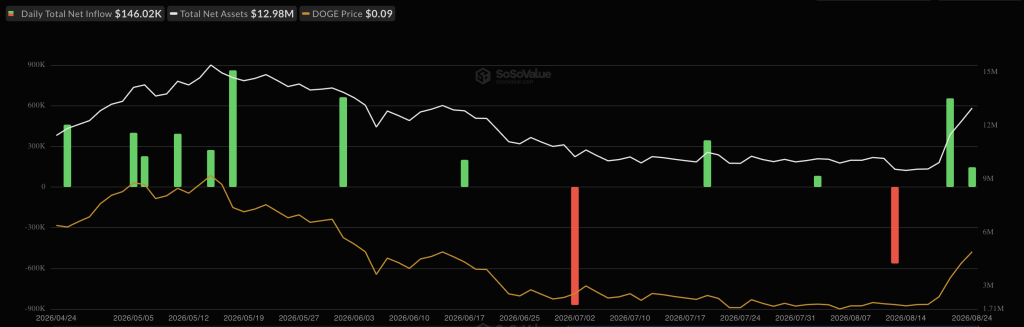
Whales are quietly stepping back right as retail gets excited again. Dogecoin (DOGE) has bounced 3.02% over the last 24 hours to $0.090, a level analysts have flagged as decisive. Can DOGE price push through, or does this stall into another leg down? The signals beneath the bounce suggest the answer might not be what the bulls want.
Spot Dogecoin ETFs pulled in a modest $146,020 inflow Monday, down sharply from the prior week’s $653,420. Institutional interest is present but cooling.

Whale behavior is even less encouraging. Wallets holding between 1 million and 100 million DOGE have shed a combined 280 million tokens since Friday. That is whales quietly de-risking into strength, not a vote of confidence after last week’s 34% rally.
Broader crypto sentiment remains choppy, with Bitcoin’s own price action still setting the tone for beta plays like DOGE. Macro liquidity conditions add another layer that traders should not ignore this week.

Discover: The Best Crypto to Diversify Your Portfolio
Can Dogecoin Price Hit $0.10 This Week?
The chart says bullish. The positioning data says caution.
DOGE at $0.090 sits above both its 50-day EMA near $0.076 and 100-day EMA near $0.081, a structurally bullish setup on paper. The reclaimed downtrend line near $0.070 now acts as support, with immediate protection sitting at the $0.088 horizontal level.
Momentum tells a different story. RSI reads near 77, deep overbought territory, while the long-to-short ratio sits at 0.93, close to a one-month low. Traders are positioning for a pullback even as the price holds up.
A clean break above $0.094, with sustained ETF inflows, could trigger a run toward $0.10 to $0.104. Consolidation between $0.088 and $0.094, as overbought conditions cool off, is the base case. A break below $0.088 exposes the 100-day EMA near $0.081, then $0.076.
Discover: The Best Token Presales
Maxi Doge Targets Early Mover Upside as Dogecoin Tests Key Levels
DOGE holders riding last week’s 34% rally have reason to feel good, but at a market cap in the billions, a repeat of that move gets harder every time.
Whale distribution and a sub-1 long-short ratio suggest the easy gains here may already be priced in. That’s pushing more traders toward earlier-stage plays where upside isn’t capped by nine-figure liquidity.
Maxi Doge (MAXI) is one of those plays, an Ethereum-based meme token built around gym-bro trading culture and “1000x leverage” energy, literally personified as a 240-lb canine mascot.
The presale has raised $4,848,993.00 so far, with tokens priced at $0.0002835 and dynamic APY staking live for holders. Standout features include holder-only trading competitions with leaderboard rewards and a Maxi Fund treasury earmarked for liquidity and partnerships.
Get Ahead of Next Meme Coin Launch Here
The post DOGE Whales Quietly Dumped 280M Tokens While ETF Inflows Cooled: Is Rally Losing Its Real Buyers? appeared first on Cryptonews.



Nikita Bier, who ran product at X for 13 months until Aug. 5 and now advises the company, said trade buttons are coming to the crypto charts embedded in X posts. He gave no timeline. The claim has no corporate backing. X's public record on crypto products — the Cashtags launch, its roadmap, its… Read the full story at The Defiant
Bitwise launched Automated Token Portfolios (ATPs) on Tuesday, giving eligible investors outside the U.S. a way to hold Coinbase-issued tokenized stocks directly in their own wallets on Base while Glider automatically keeps the holdings aligned with Bitwise’s model. The product extends Coinbase’s… Read the full story at The Defiant

Cosmos Labs has urged affected networks in contact with its team to halt operations amid an ongoing security incident involving the EVM module.
Statements issued by KiiChain, TAC, and MANTRA have all pointed to flaws within the Cosmos EVM infrastructure when describing the attacks they faced in recent days. Cosmos Labs, however, has yet to establish publicly whether the incidents stemmed from one common flaw or clarify which networks were specifically instructed to suspend operations.
EVM Security Crisis Escalates
Cosmos Labs said it will publish an incident report once the situation has been resolved. Meanwhile, KiiChain said an attacker drained 148,326,583.15 KII from wallets on August 22, repeating the same technique 18 times against different targets. The chain detected the activity internally and halted at block 9,355,723, thereby stopping further theft and freezing funds that remained on the network. According to KiiChain, the root cause had been identified, reproduced and fixed.
It said that the vulnerability was in the shared Cosmos EVM module, rather than KiiChain-specific code. The chain said three upstream defects combined to enable the attack, including an underflow in the staking precompile when it writes a post-delegation balance back to the EVM, along with two other undisclosed bugs.
KiiChain said the same class of vulnerability affected Cosmos EVM chains with vesting accounts enabled and linked the issue to the compromises of MANTRA and TAC during the same week.
The handling of the vulnerability has also come under scrutiny. A security fix for one of the three flaws was made public on August 19, but KiiChain said affected networks were not given advance notice and the release was not clearly flagged as a critical security update. When communication reached the affected chains two days later, the fix was included with unrelated issues already being handled privately. It was not accompanied by a recommendation to halt networks.
By then, MANTRA had already been exploited. KiiChain said an emergency halt could have contained the risk much faster than a software upgrade, which requires validators to review, test, and deploy the patch.
TAC separately said an attacker exploited a vulnerability in the Cosmos EVM precompile layer on the same day and drained a single account. The chain was halted to stop the attack, and it was said that the defect was not in TAC-specific code. The chain said 2,985,651,403 TAC was moved between accounts. No new tokens were created, and the total supply remained unchanged. Only TAC was affected, while other assets on the network remained intact.
Mantra Security Incident
MANTRA halted its Layer 1 network last week as a precaution for about 30 hours. The project later said it had identified the root cause, contained the immediate threat, and that no user funds were exploited.
MANTRA said the incident affected two wallet addresses, and the network resumed operations after a patch was deployed.
The post Cosmos Labs Urges EVM Chains to Halt as KiiChain and TAC Attacks Raise Security Fears appeared first on CryptoPotato.


Bitwise Asset Management has launched automated portfolios of Coinbase’s tokenized US stocks that allow eligible investors outside the United States to follow preset investment strategies while keeping the assets in their own wallets.
The portfolios use Coinbase’s recently launched tokenized stocks, while Glider automatically rebalances users’ holdings to match model portfolios designed by Bitwise, according to a Tuesday announcement.
The initial lineup includes three strategies — the Mag7X, robotics and AI leaders — and include Apple, Nvidia, Microsoft, Tesla and SpaceX.
Tokenized listed stocks now total $2.49 billion, up 5.18% over the past month, with 2.25 million holders and $27.28 billion in monthly transfer volume, according to rwa.xyz.
Unlike a traditional fund, the tokenized stocks remain in users’ non-custodial wallets, with Bitwise setting the portfolio methodology and Glider handling trades and rebalancing. Bitwise charges a 0.15% methodology access fee, excluding trading and Glider platform fees.
Because users retain the individual tokens, Bitwise said the assets could also be used in DeFi applications for lending or borrowing, subject to the risks of those protocols.
The launch comes a day after Coinbase’s tokenized US stocks went live on Base, allowing eligible non-US users to trade the assets around the clock and use them across DeFi applications.
Magazine: MiCA is coming for DeFi vaults, but regulation will be difficult
With Bitcoin up more than 20% since last week, traders are rotating into altcoins for larger gains. Three particular tokens, Kaspa, Solana, and Hyperliquid, are drawing renewed attention from market observers heading into the fall trading season.
However, all three altcoins are at different distances from their all-time highs. Analyst outlooks broadly support the undervalued narrative for two of the three under constructive market conditions, though outcomes will depend heavily on Bitcoin’s path and overall risk appetite going forward.
This article is not financial advice. Crypto markets are highly volatile, projected price ranges are scenario-based estimates rather than guarantees, and readers should conduct independent research before making any investment decision.
Kaspa (KAS)
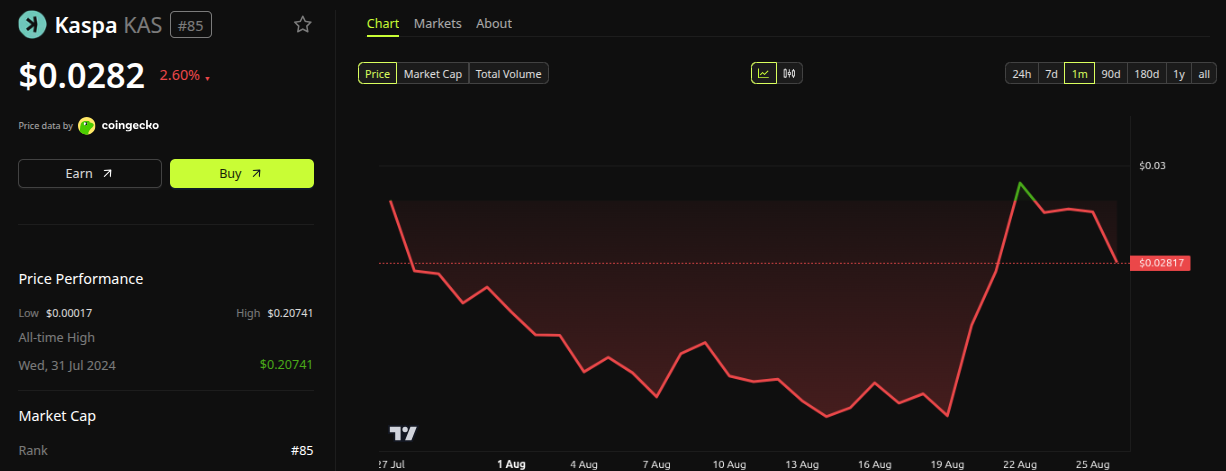
Kaspa trades at $0.0282, up 1.34% over the past 24 hours, according to BeInCrypto data. The token remains approximately 87% below its all-time high of $0.20741, reached on August 1, 2024.
Analysts point to its near-complete supply issuance and recent network upgrades as reasons for optimism.
In an upward scenario, price could climb toward $0.035 to $0.045 if network activity expands and emissions pressure continues to ease.
In a bearish case, it could retreat to $0.022-$0.025 if broader market weakness returns or developer adoption slows.
Follow us on X to get the latest news as it happens.

Solana (SOL)
Solana trades at $98.50, about 66% below its all-time high of $293.31, reached on January 19, 2025.
Observers cite tokenomics improvements, including potential cuts to inflation and stronger fee burns. Moreover, Solana hit a record $4.2 billion in on-chain transactions in July, up 13.5%, driven by the SOL rally and tokenized assets.
Bullish projections suggest a move toward $130 to $180, or higher in stronger cycles, if institutional flows accelerate. On the downside, a risk-off environment could push the token back toward the $75 support levels.

Hyperliquid (HYPE)
Hyperliquid trades at $82.34, up roughly 40% over the past week. The token set a new all-time high of $83.27 on August 23, meaning it now trades just 1% below its record.
Market participants view the token as attractively priced relative to its strong perpetual trading revenue and expanding infrastructure, even as it nears record levels.
On the other hand, Trump’s August 19 remarks about bringing Hyperliquid legally into the US sent HYPE surging nearly 20% within 24 hours.
In a positive scenario, sustained volume growth and buyback mechanisms could push it toward $100-$150. A bearish outcome might see a pullback to $60-$70 amid profit-taking or a broader market correction.
Subscribe to our YouTube channel to watch leaders and journalists provide expert insights.

None of the projections in this article constitute financial advice or price guarantees.
Cryptocurrency remains a highly volatile asset class, and readers should independently verify current prices and conduct their own research, or consult a licensed financial advisor, before making any investment decisions based on this analysis.
The post Top 3 Undervalued Altcoins to Watch in September 2026 appeared first on BeInCrypto.
The “BankChain Alliance” is aiming for a 2027 launch, and would foster stablecoins, payments and tokenized deposits inside the banking system’s regulatory sphere.

World Liberty Financial has rolled out its USD1 stablecoin natively on the Canton Network, positioning the token as a “cash leg” for settlements that pair stablecoin liquidity with tokenized real-world assets (RWAs). The company says the move is designed for institutional use cases where the stablecoin can sit alongside tokenized assets within the same transaction, including scenarios involving derivatives collateral, lending, and issuance and redemption flows.
According to a Tuesday announcement, USD1 is now issued and managed through the Canton integration with privacy and permissioning controls provided by the network. World Liberty adds that the design supports native issuance, allowing USD1 to be used directly in settlement rather than requiring institutions to rely solely on external exchanges or offchain routing.
Key takeaways
- World Liberty Financial launched USD1 natively on Canton to support institutional settlement alongside tokenized RWAs in the same transaction.
- USD1’s use cases span derivatives collateral, institutional lending, and RWA asset issuance and redemptions.
- The stablecoin’s market capitalization is about $4.05 billion, making it the sixth-largest stablecoin by DeFiLlama data.
- USD1 is issued and managed with reserves and mint/redemption processing handled by BitGo Bank & Trust, per World Liberty.
- The integration comes after additional Canton expansion plans, including a pilot connected to state-administered benefits distribution.
Why native USD1 on Canton matters for RWA settlement
For institutional finance, the key constraint in many tokenized-asset workflows is coordinating “cash” and “asset” legs efficiently and with appropriate governance. World Liberty’s announcement frames USD1 on Canton as a solution to this coordination problem: institutions can use USD1 directly for settlement that involves tokenized RWAs while simultaneously applying Canton’s permissioning and privacy features.
The company specifically highlights transaction categories where this structure is expected to be useful. In addition to serving as cash for tokenized asset transfers, USD1 is positioned for derivatives collateral, institutional lending, and the issuance and redemptions of tokenized assets. In practice, these are exactly the kinds of operations where onchain programmability needs to meet operational requirements typically associated with traditional settlement systems.
USD1 supply, reserves, and the role of BitGo Bank & Trust
USD1 has a market capitalization of about $4.05 billion, according to DeFiLlama’s stablecoin data, where it ranks as the sixth-largest stablecoin. That size matters because it suggests the token already has meaningful liquidity and visibility—two factors that institutions often consider when deciding whether a stablecoin can be operationally relied upon for settlement.
World Liberty states that USD1 is issued by BitGo Bank & Trust, which manages the stablecoin reserves and processes mints and redemptions. For readers assessing counterparty and operational risk, this is a notable detail: the integration is not simply a “token move” to a new chain, but a placement of USD1’s core issuance and redemption workflow into a Canton-based settlement environment.
When USD1 launched earlier, World Liberty said it was backed by reserves that include short-term U.S. Treasurys, government money market funds, and dollar deposits. The company’s current Canton deployment continues to emphasize the stablecoin’s use in institutional settlement rather than introducing a new asset class or altering the stated reserve backing in the announcement.
Canton’s institutional framing and network claims
Canton is described by the network as a public, permissionless blockchain intended for institutional finance. In the announcement, Canton’s positioning centers on scale and real-world asset throughput: the network claims it processes and issues more than $9 trillion in tokenized assets each month, and it reports moving more than $350 billion in onchain U.S. Treasurys daily.
Whether institutions focus on the specific magnitude of those figures or not, Canton’s broader pitch is consistent—enabling financial institutions to connect tokenized assets with settlement rails that can fit into regulated workflows. World Liberty’s move to list USD1 natively on Canton is aligned with that pitch: instead of treating the stablecoin as a separate settlement instrument that must be bridged or swapped, the integration targets same-transaction settlement behavior.
What’s next: Canton expansion and RWA distribution experiments
The USD1 launch on Canton follows another Canton expansion announcement made last week. In that update, Digital Asset and former U.S. House Speaker Paul Ryan’s American Idea Foundation described plans for a Canton-based system intended to distribute state-administered benefits across three U.S. states beginning in 2027.
That parallel matters for investors and builders because it suggests Canton is pursuing both “market infrastructure” goals—like RWA and treasury settlement—and “public services” applications that require operational controls. If these tracks progress, networks and stablecoin issuers tied to Canton could see increased relevance in institutional settlement flows beyond financial derivatives and lending.
Still, readers should watch how quickly institutions adopt the integrated settlement design. The announcement explains the capability at launch and ties it to established USD1 issuance and reserve processes, but it does not specify which institutions are actively using the new settlement path or what volumes are expected in the near term.
For now, the practical question is whether native USD1 settlement on Canton becomes a repeatable rails-choice for tokenized RWA operations—especially in lending, collateral management, and issuance/redemption cycles—while Canton’s broader institutional and benefits-distribution initiatives move from planning into execution.

“I am as proud of the Imagination Library,” Parton told PBS News in 2020, “as I ever will be, anything I ever do for the rest of my life.”
Tributes
Tributes for the country music icon began pouring in on Tuesday afternoon, including from President Donald Trump, who called Parton “one of the greatest Country singers.” Trump said that, in Parton’s honor, he was ordering U.S. flags across the country to be lowered for a week, starting at 6 p.m. that evening.
“This is a true loss for millions of people,” Trump said on Truth Social. “There has never been anyone like her, and never will.”
Republican Sen. Marsha Blackburn of Tennessee said in a social media post that she and her husband were “absolutely heartbroken and saddened to hear of the passing of our friend.”
“Dolly’s life and career are forever woven into Tennessee’s music, culture, and history,” Blackburn said. “Her extraordinary talent, generosity, and love for the Volunteer State touched hearts around the world and will continue to inspire generations to come. Tennessee will forever be grateful for Dolly.”


The crypto infrastructure firm failed to get approval when it first sought a U.S. charter, and the company is quickly back with what it said would be a narrower effort.
Strategy’s Bitcoin treasury may be less vulnerable to a crypto market crash than to a prolonged loss of capital-market access, a risk that could threaten its ability to fund roughly $1.76 billion in annual obligations without selling Bitcoin, according to a recent analysis from Regime Intelligence.
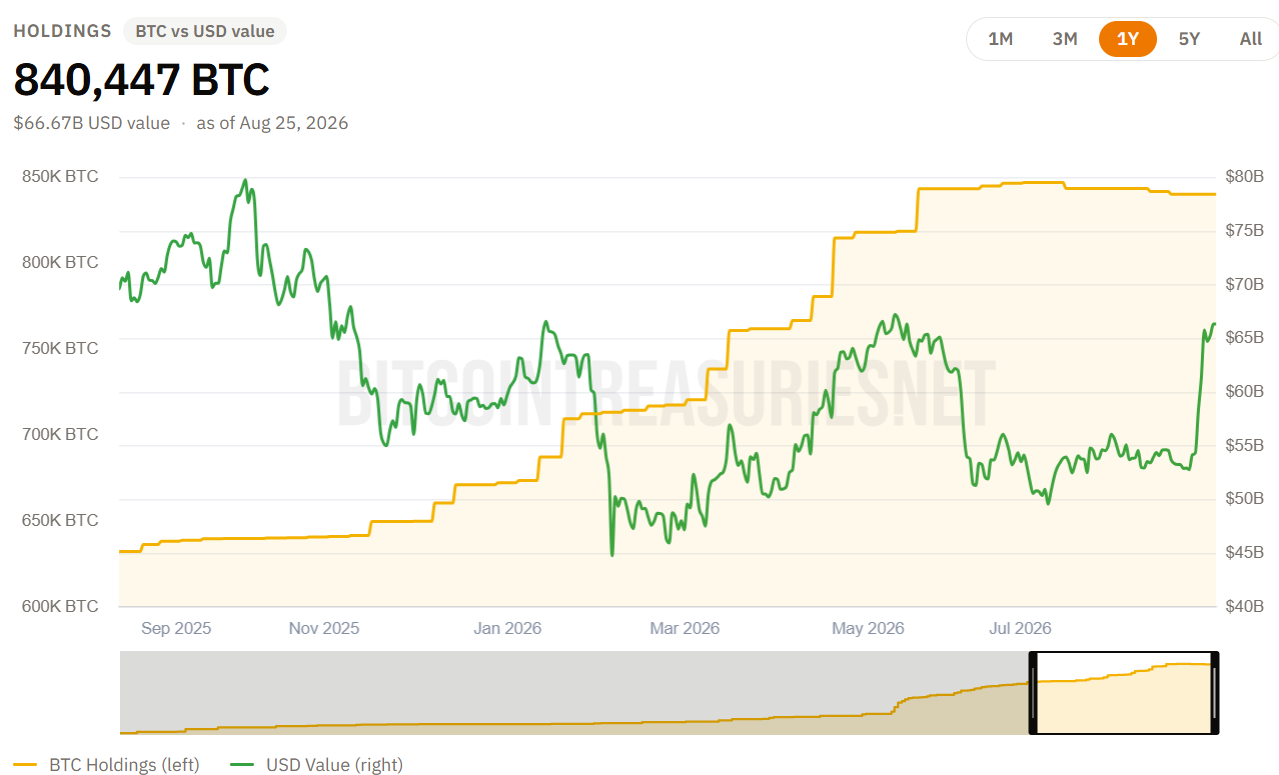
According to the report, Strategy’s 840,447 BTC stash sits behind roughly $22 billion in debt and preferred claims, meaning the company’s Bitcoin accumulation model depends on its ability to continually raise fresh capital to meet obligations.
Contrary to popular belief, Strategy’s (MSTR) biggest vulnerability isn’t a Bitcoin-driven price drop or liquidity event, but its continued dependence on access to capital markets. The report noted that Strategy’s debt does not function like a conventional Bitcoin-backed margin loan, with no BTC-linked margin call that would force the company to liquidate its holdings as prices fall.
Regime Intelligence’s stress test found that Bitcoin would need to fall roughly 96% before Strategy’s Bitcoin holdings and reserves would no longer cover its convertible notes. However, that shifts the risk to the other side of the balance sheet, as Strategy must continue servicing roughly $1.76 billion in annual preferred dividends and interest regardless of Bitcoin’s price.
“In my opinion, MSTR’s principal challenge is to keep the flywheel running in order to cover the annual debt and preferred charges,” the report’s author, Sherif Saad, told Cointelegraph.
He said investors should watch Strategy’s preferred share price and cash reserves, which currently cover about 2.6 times its annualized charges.
If financing conditions deteriorate, its Bitcoin accumulation strategy could reverse, forcing greater reliance on reserves and Bitcoin sales to meet its obligations.
“During a prolonged BTC decline, the problem becomes more serious if MSTR’s share price and mNAV decline at the same time,” he said, adding that raising capital would then become “progressively more difficult or expensive.”
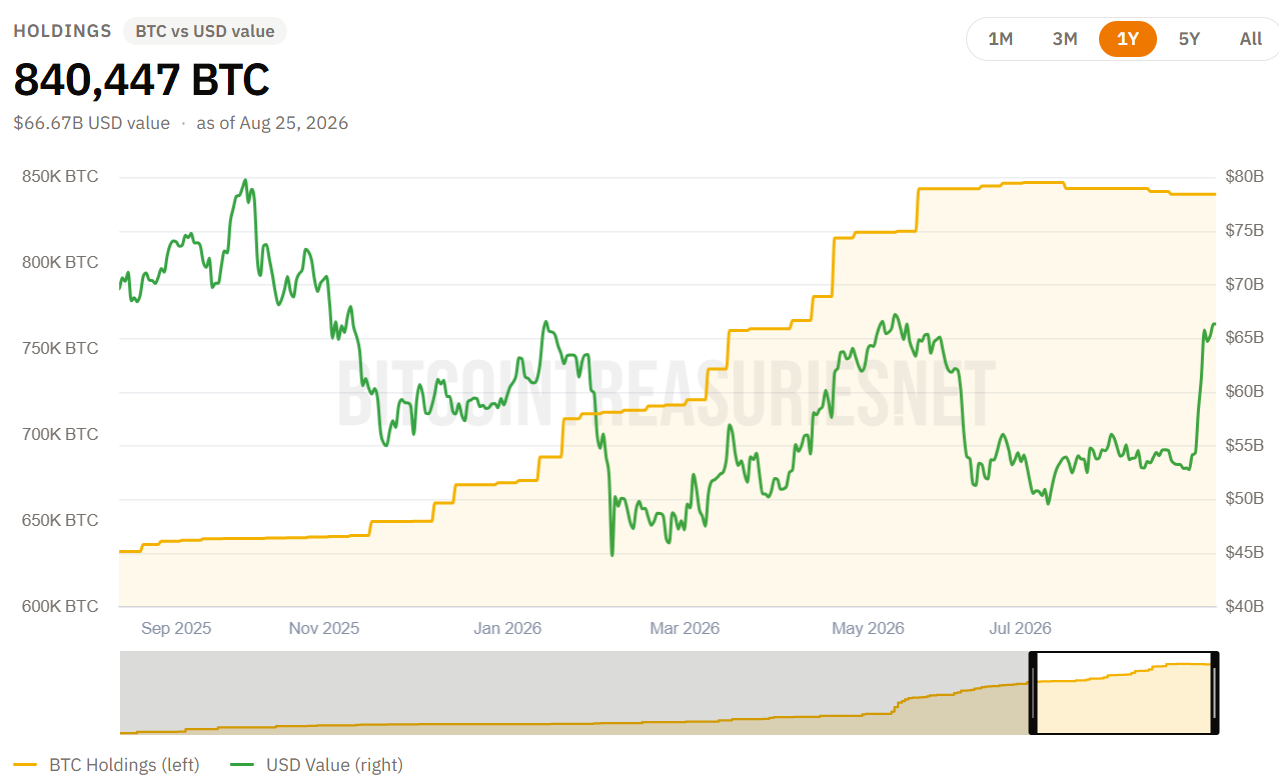
Following Bitcoin’s recent recovery, Strategy’s BTC stash is now worth $66.7 billion, higher than the company’s $63.36 billion cost basis. Source: BitcoinTreasuries.NET
Related: Standard Chartered analyst eyes $100K BTC as US Treasury doubles long-end buybacks
Michael Saylor’s juggling act
Much of the perceived risk surrounding Strategy centers on its willingness to tap the Bitcoin on its balance sheet, especially after executive chairman Michael Saylor spent years promoting a “never-sell” approach. So, it came as a surprise to some Bitcoiners when Strategy began selling BTC this year to meet its other business obligations.
The company has sold Bitcoin four times since May, including a recent sale of 1,690 BTC, with proceeds from recent sales used to fund preferred stock dividends, share repurchases and its growing US dollar reserve.
Despite the sales, Strategy CEO Phong Le reminded investors that the company has accumulated “about 25 times more” Bitcoin than it has sold this year. He told CNBC earlier this month that the company plans to resume Bitcoin purchases later this year.
Related: Crypto Biz: Bitcoin’s $116M self-custody wake-up call

GAA Rounders: Connacht Leads All-Ireland Finalists

Sony Is Reminding Us (Again) That We Don’t Own Our PlayStation Games

Second suspect charged with murder after woman dies in house fire

Weekend Open Thread – Corporette.com

Weekend Open Thread: Brooks Brothers

London Mayor Sadiq Khan handed a peerage by Keir Starmer alongside 15 other Labour figures… just days before the PM leaves No10

All Hell Just Broke Loose In Crypto (Guess Who Just Crashed Bitcoin?)

#stockmarket #investing #trading #stocks #investment #finance #money #nifty #forex #investor

Money is Important #money #mindset #reality #rajshamani #podcast #clips #motivation #shorts
-

 Fashion4 days ago
Weekend Open Thread: Madewell – Corporette.com
-

 Business3 days ago
Musk’s Tesla, SpaceX Confirm $16.8 Billion ‘Terafab’ Chip Plant as World’s Largest Building in Texas
-

 Crypto World4 days ago
anatomy of crypto’s biggest liquidation event since 2021
-

 Politics3 days ago
6 months on, Irish renters crushed by effects of government housing bill
-

 Crypto World22 hours ago
A $30 Billion AI Fund Implodes, Now the SEC Is Investigating Wall Street’s Role
-
 NewsBeat4 days ago
The ‘Lucky Dip Gang’ causing carnage for clicks: After five thugs were killed speeding in the wrong direction on a motorway, GUY ADAMS investigates a sick new trend… and why police aren’t even allowed to pursue them
-

 Tech7 days ago
GLM-5.3 hits the API at $1.4/$4.4 per million tokens
-

 Business3 days ago
Mystery AI Model ‘Ox Alpha’ Draws Developers With Free Access as Chinese Lab Origins Remain Debated
-

 News Videos6 days ago
Don’t Leave Your Financial Future To Chance | August 19, 2026
-

 Business6 days ago
Marvell Shares Jump 7% as Google Chip Deal Confirms Custom AI Silicon Partnership, Analysts
-

 Business5 days ago
Five Below: Kids Discount Retailer Reaps Rich Rewards
-

 Business4 days ago
UK firms in critical financial distress rise 9% to 53,756
-

 Sports3 days ago
Deshaun Watson fires back at Browns fans after being booed: ‘It’s a disrespectful thing’
-

 Fashion6 days ago
Jimmy Choo Autumn 2026 collection
-

 Business1 day ago
Moderna CEO warns China is pouring state money into mRNA technology
-
 Entertainment6 days ago
10 Most Perfect Fantasy Shows of the Last 25 Years
-

 Tech6 days ago
OpenAI confirms ChatGPT is down as logins and signups fail
-

 Business6 days ago
PayPal and Venmo now accepted for tuition at several universities
-

 Crypto World5 days ago
Optimism-funded team's deciding vote shifts $49 million in OP tokens away from users
-

 Crypto World3 days ago
Google Gemini AI Predicts Ethereum Could Become the Trade Retail Misses in 2026
You must be logged in to post a comment Login